Get in touch with Zejiang Paper Machinery Company

Updated October 2026
Quick specs for this shortlist
- 20 manufacturers with current first-party paper application evidence
- 7 full-width mill-winder candidates and 13 specialty or converting candidates
- Public examples include 300 mm narrow-web machines and 7.5 m Bellmer TurboWinders
- Paper, board, tissue, thermal, labelstock, coated and technical-paper duties represented
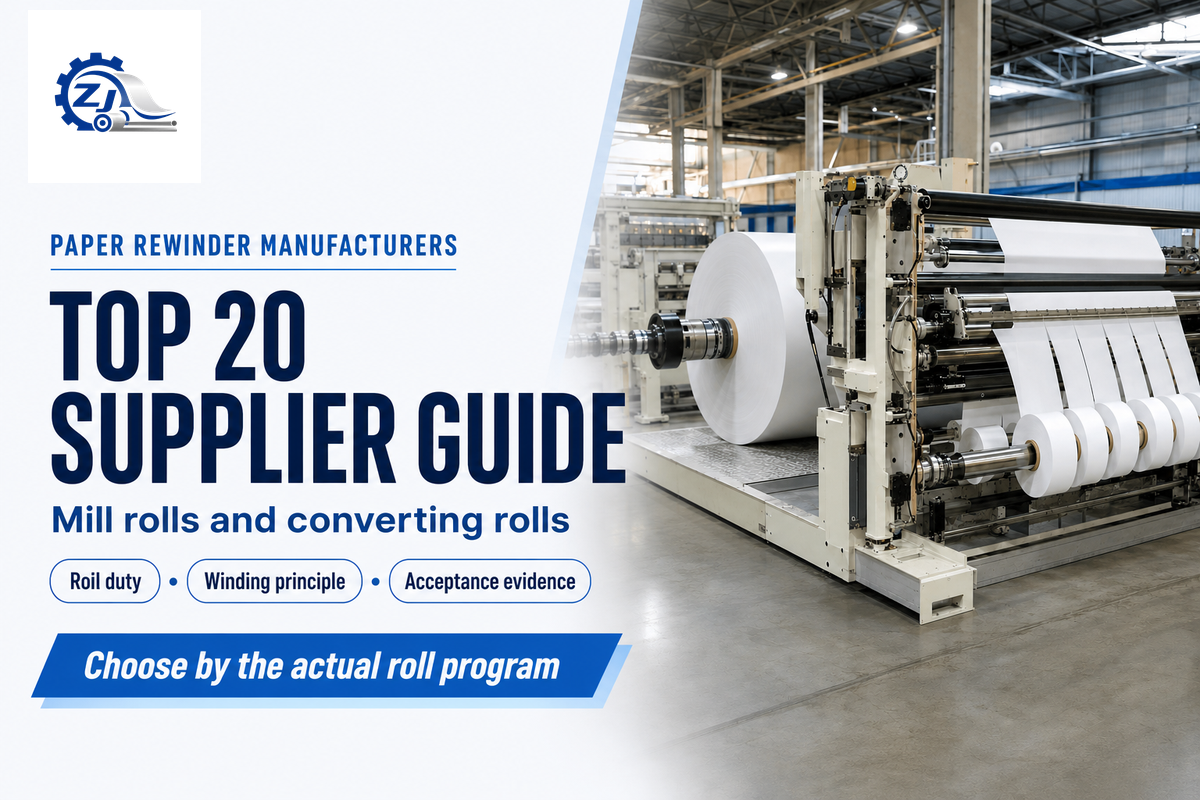
Paper rewinder machine manufacturers should be assessed on roll duty, paper grade and winding architecture, not on one headline speed. Paper rewinder machine manufacturers are builders of full-width mill winders or downstream slitter-rewinders for paper roll programs. This guide separates full-width mill winders from downstream slitter-rewinders, then records what each company actually publishes about its machine family, application range and limitations.
A slitter rewinder machine combines roll slitting with controlled roll rewinding. A paper roll slitter receives a parent roll and produces narrower customer rolls. In a paper roll slitter rewinder, web control is as critical as the knife, and if there’s poor tension, even if the cut width is correct, the finished roll can still be spoiled.
Direct answer: The best paper rewinder machine manufacturers for a mill-roll shortlist include Zejiang, Valmet, Voith, ANDRITZ, Pasaban, Scan Machineries and Bellmer for mill-scale duties, plus thirteen builders with documented specialty-paper or converting scope. The right choice depends on roll size, paper grade, winding principle, automation and service responsibility.
Quick Picks by Roll Program
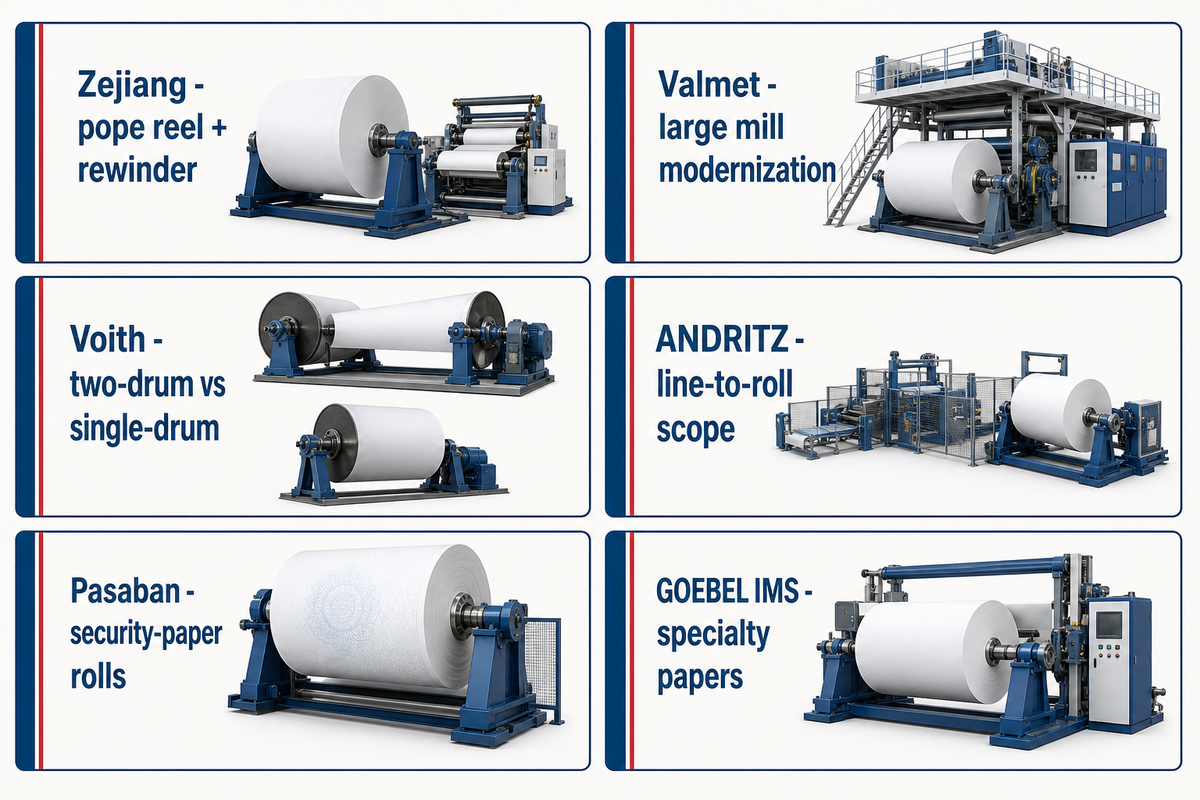
- Best for one engineering contact across pope reel, slitter rewinder and matching paper-machine parts: Henan Zejiang Paper Machinery
- Best for large mill capacity and modernization: Valmet
- Best for comparing two-drum and single-drum mill winders: Voith
- Best for integrated line-to-roll responsibility: ANDRITZ
- Best for security-paper roll structure: Pasaban
- Best for technical and specialty papers: GOEBEL IMS
Key takeaways
- A 3,000 m/min design speed on one model doesn’t establish the same roll diameter, paper grade and set-change time on another.
- Center, surface and center-surface describe winding force; simplex, duplex, turret and two-drum describe machine layout.
- A mill winder and a converting slitter-rewinder may both slit and rewind paper, but they sit at different process positions and handle different parent-roll duties.
- Send every bidder one common paper, width, diameter, roll-weight, tension and acceptance envelope.
Disclosure: This guide is published by Zejiang Paper Machinery. We list ourselves first because this is our website, not because we claim to be the market leader. The other 19 manufacturers are grouped by what they’re best for, in no particular order within each group.
How We Selected These Paper Rewinder Manufacturers
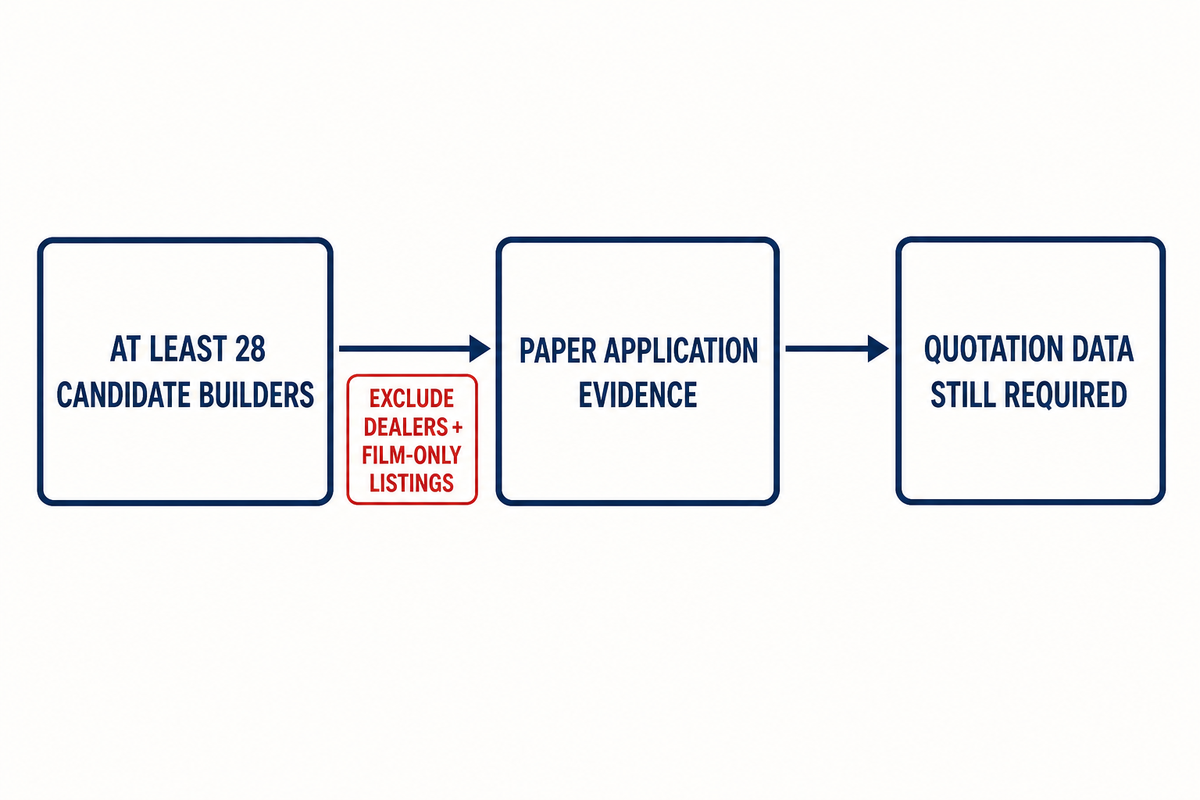
The shortlist began with at least 28 named candidate builders and retained companies whose current official material names paper, board, tissue, labelstock or another paper grade for a winder or slitter-rewinder. We excluded directories, dealers, used-equipment sellers, duplicate group brands and film-only suppliers without paper evidence. Company data was cross-checked against their official websites in October 2026.
Selection did not depend on a company publishing every specification online. Some mill-winder builders engineer each machine around a project and therefore publish concepts rather than a fixed catalogue table. Earning a place on the comparison list meant documenting paper applications and defining limitations. Comparison readiness required more: a buyer still needs the paper grade, parent-roll envelope, finished-roll geometry, speed, tension window, automation boundary and factory acceptance method in the quotation.
Group ownership received a separate check. A.Celli Paper is included under ANDRITZ because the acquired paper business now appears in the ANDRITZ portfolio. Dusenbery is identified as a Parkinson Technologies brand. GOEBEL’s 1851 date is treated as industrial lineage, while IMS TECHNOLOGIES group headquarters and the German GOEBEL entity are stated separately.
Legal names and product brands have been separated. A suffix such as Co., Ltd. or Ltd. can identify the contracting entity, but it doesn’t indicate where a machine is made. The same is true when the bidder states it’s a China manufacturer: the comparison names the engineering site, factory and the location of the acceptance test as separate fields.
Use this list to
- Build a first supplier set by roll duty
- Compare published machine families
- Identify missing quotation data
- Prepare one common request for quotation
Do not use it to
- Assume one universal ranking
- Combine maxima from different models
- Infer paper performance from film machinery
- Treat a website claim as a signed guarantee
Paper Mill Rewinder vs Converting Slitter-Rewinder
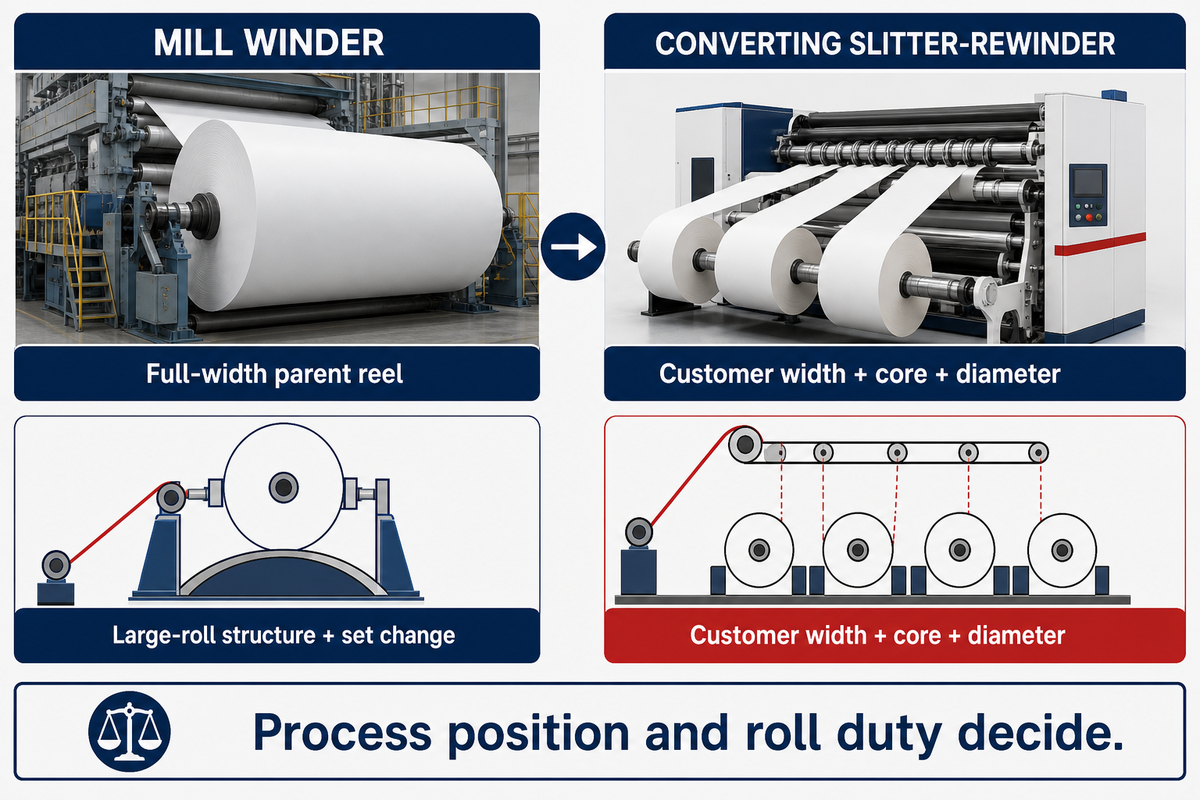
A paper mill rewinder normally receives a full-width parent reel near the paper machine and produces saleable rolls at mill scale. A converting slitter-rewinder usually receives an already produced roll and changes width, diameter, core, edge quality or inspection status for a downstream application. The names overlap, so process position and roll duty matter more than the label. The USPTO B65H classification likewise separates winder-slitters from rewinding after slitting.
Mill winder
- Receives a jumbo or parent reel
- Matches paper-machine width and output
- Controls large-roll structure and set change
- Often integrates slabbing, roll handling and wrapping
Converting slitter-rewinder
- Receives a purchased or finished parent roll
- Targets slit width, core and customer roll format
- May add inspection, perforating or printing
- Often handles more materials at narrower widths
There are many possibilities. A wide center-surface machine can process board, while a two-drum winder can slit and rewind at mill scale. The question isn’t “does it slit?” The question is if the published machine can accept your parent-rolls of the required mass and diameter, hold tension through the complete basis weight range, provide the required hardness of the completed rolls and remove the set of rolls within the available time.
A jumbo roll for a mill finishing line can be much larger than a converting unwind. Jumbo paper width and mass therefore belong in the first data exchange. Roll paper sold to downstream converters may arrive in smaller formats, but the incoming roll still governs shaft, brake and handling design.
For a new mill line, interface responsibility also changes the shortlist. A winder supplied with the pope reel, roll handling and packaging can reduce boundary disputes. A converter replacing one slitter may prefer a specialist with inspection, differential shafts, automatic knife positioning or downstream small-roll packaging.
20 Paper Rewinder Machine Manufacturers
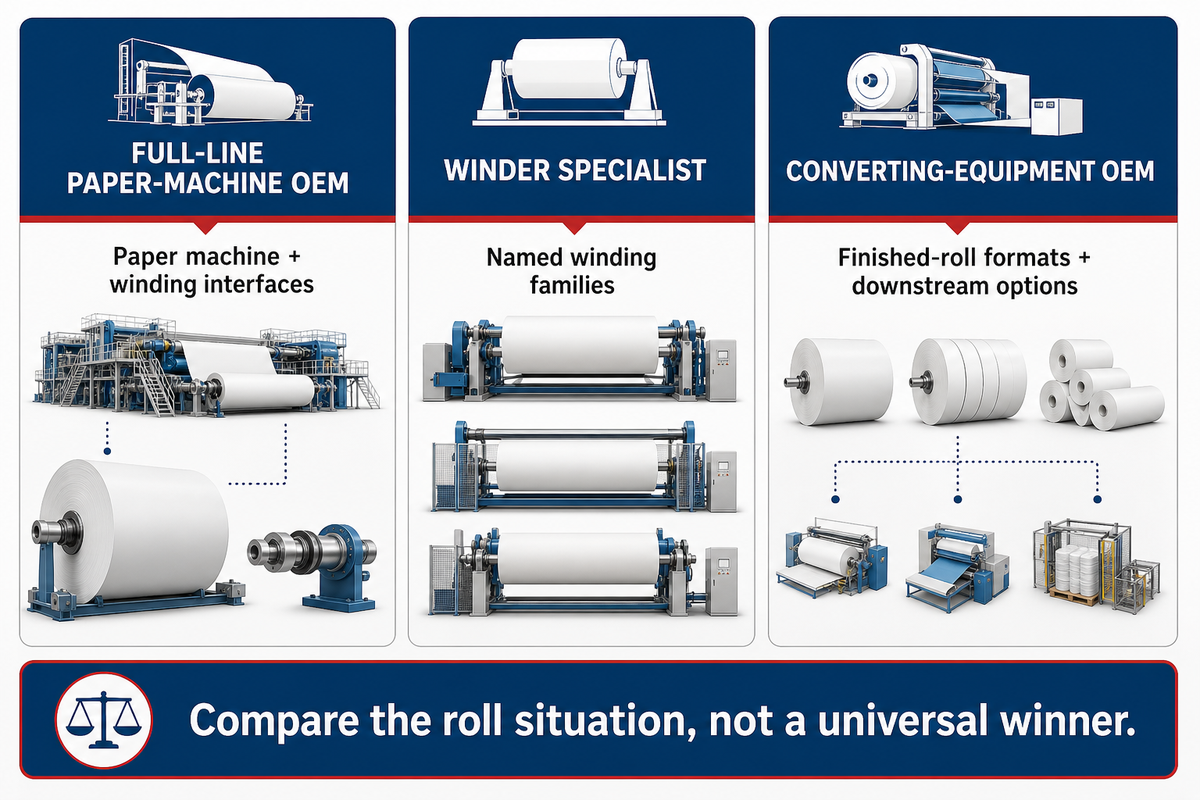
A first evaluation based on the source, not a ‘winner-takes-all’ assessment, is provided in the table. The phrase ‘best for’ references the program closest to the roll situation reflected in public data. Advantages and disadvantages are short screening labels; the individual profiles preserve the machine-family context and the one company-specific limitation that should enter the quotation discussion.
There may be similar equipment across catalogs that serve different paper programs. One cutting and rewinding machine may make retail rolls, while another slitter and rewinder handles large industrial sets. The table provides paper roll slitting scope and buyer limitation in the same row. This architecture-first treatment follows the USPTO B65H classification, which distinguishes winder-slitter arrangements from rewinding after slitting.
| No. | Company Name | Headquarters | Founded | Best For | Brief Introduction | Main Winder or Rewinder Families | Key Advantages | Potential Disadvantages | Official Website |
|---|---|---|---|---|---|---|---|---|---|
| 1 | Henan Zejiang Paper Machinery | Qinyang, China | 2014 | One supplier for pope reel and rewinder | Paper-mill equipment manufacturer | Pope reels; center, surface and duplex rewinders | In-house machining and balancing | No universal configuration, price or lead time across grades and interfaces | https://zjpapermachine.com/ |
| 2 | Valmet | Espoo, Finland | 2013 | Large mill capacity and modernization | Global process-technology supplier | OptiWin two-drum, belt and pulp winders | Broad grade and lifecycle scope | Mill-scale family data and scope may exceed converter needs | https://www.valmet.com/ |
| 3 | Voith | Heidenheim, Germany | 1867 | Two-drum versus single-drum comparison | Global paper-technology group | VariFlex and VariPlus | Model-level grade and roll data | One machine cannot combine two-drum and single-drum duty | https://www.voith.com/ |
| 4 | ANDRITZ | Graz, Austria | 1852 | Integrated tissue, paper and board lines | Full-line pulp-and-paper supplier | ANDRITZ and A.Celli winding portfolio | Line-to-roll handling scope | Portfolio scope covers a full line beyond one stand-alone specialty slitter | https://www.andritz.com/ |
| 5 | Pasaban | Tolosa, Spain | 1928 | Roll structure and edge alignment | Paper and board converting specialist | Paper winders and special converting lines | Security-paper application | Project-specific special-paper envelope, not one standard package | https://www.pasaban.com/ |
| 6 | Scan Machineries | Coimbatore, India | 1989 | Grade-specific mill winders | Paper-machine and turnkey supplier | Two-drum winders and pope reels | Paper, board and tissue families | Grade-specific concepts, not one rating across paper families | https://www.scanmachineries.com/ |
| 7 | GOEBEL IMS | Calcinate / Darmstadt | 1851 | Technical and specialty papers | IMS group slitting brand | RA 2 and T 2 | Five named specialty-paper families | RA 2 and T 2 serve different paper duties | https://www.goebel-ims.com/ |
| 8 | Elite Cameron | Taunton, UK | 1905 | Compare four rewind layouts | Converting-machinery builder | Center, center-surface, turret, two-drum | Paperboard application stated | Built-to-order envelope | https://www.elitecameron.com/ |
| 9 | Dusenbery | Woonsocket, USA | 1947 | Wide-web board and labelstock | Parkinson Technologies brand | MasterSlit duplex and center-surface | Published model ranges | Multi-material maxima do not define paperboard and labelstock duty | https://parkinsontechnologies.com/products/dusenbery/slitter-rewinders |
| 10 | Catbridge Machinery | Montville, USA | 2002 | Custom integrated converting lines | Web-converting system builder | Turret, two-drum, duplex and simplex | Engineering under one roof | Engineered-to-order line requires a complete roll brief | https://www.catbridge.com/ |
| 11 | ASHE Converting Equipment | Ipswich, UK | 1976 | Narrow to wide paper converting | Family-owned rewinder maker | Duplex, turret and inspection machines | 300 mm to 8.7 m range | Width span covers multiple machine families | https://www.ashe.co.uk/ |
| 12 | Hagihara Industries | Kurashiki, Japan | 1962 | Paper and silicone-release paper | Industrial machinery manufacturer | ASW and HSF paper rewinders | 35 mm slit on named model | ASW-1250R limited to 1,100 mm and 300 m/min | https://en.hagihara-eng.com/ |
| 13 | Jennerjahn Machine | Matthews, USA | 1979 | Receipt and small paper rolls | Roll converting and packaging builder | Paper slitters and packaging systems | Downstream packaging option | No common mill model; intended for small finished rolls | https://jennerjahn.com/ |
| 14 | JOTA Machinery | Kunshan, China | 2008 | Thermal and specialty rolls | Roll-to-roll equipment maker | Thermal-paper rewinders and cutters | Printing or perforating integration | Current converting scope needs wider factory acceptance testing | https://www.jotamachinery.com/ |
| 15 | Euromac | Villanova Monferrato, Italy | 1968 | Compare winding architectures | Slitter-rewinder manufacturer | TB-3, TB-5, TB-6 and CB-RB | Distinct center and surface families | Families use different winding architectures | https://www.euromacslitters.com/en/ |
| 16 | BIMEC | Vanzaghello, Italy | 1976 | Inspection and salvage rewinding | Winding-equipment manufacturer | Dual-shaft, turret and inspection lines | Bi-directional inspection options | Paper inspection test duty still differs from mill-winder duty | https://www.bimec.it/en/index.html |
| 17 | Miyakoshi Printing Machinery | Narashino, Japan | 1946 | Lighter printing-paper webs | Printing and converting builder | Paper slitter-rewinder | Full public duty envelope | 40–120 gsm only | https://miyakoshi.co.jp/english/ |
| 18 | HCI Converting Equipment | Taichung, Taiwan | 1982 | Small and mid-width paper rolls | Roll-converting equipment maker | Practical slitter-rewinder | Concrete baseline dimensions | One paper model fits small and mid-width duty | https://www.hci.cc/ |
| 19 | Rosenthal Manufacturing | Northbrook, USA | 1926 | Built-to-order specialty paper | Custom converting-equipment maker | SRD slitter-rewinder | Material testing offered | About 500 ft/min class | https://www.rosenthalmfg.com/ |
| 20 | Bellmer | Niefern-Öschelbronn, Germany | 1842 | Full-width mill modernization | Family-owned paper-technology maker | TurboWinder and roll handling | Named 5,700 mm mill reference | Full-width mill duty, not narrow-web converting | https://www.bellmer.com/ |
Full-Width Mill Winders and Roll-Finishing Systems
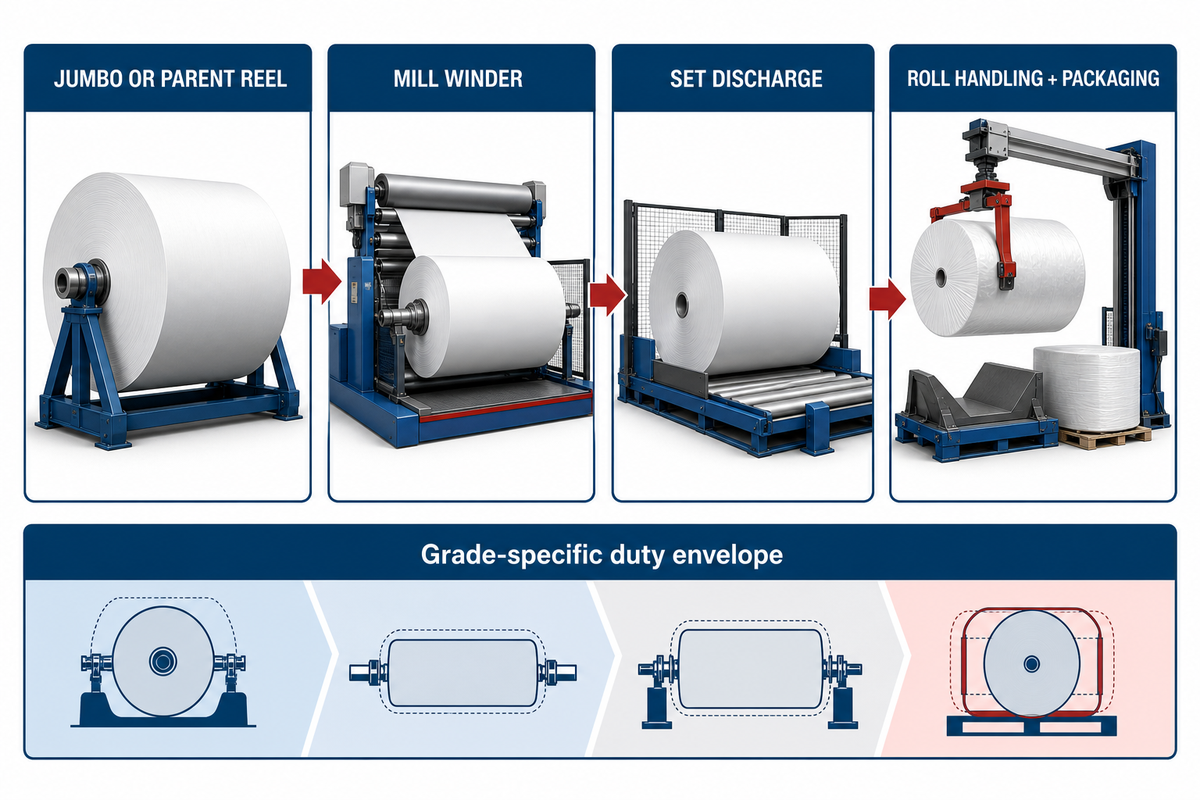
Full-width mill-winder candidates document a direct connection to paper-machine production, jumbo reels or large roll-finishing systems. Seven companies in this list fit that class. For some, the public data take the form of named-model envelopes, while for others, the data are descriptive of grade families and integrated product lines that require conversion for project scope definition and guarantee.
1. Henan Zejiang Paper Machinery, Best for Integrated Pope Reel and Rewinder Scope
Henan Zejiang Paper Machinery is best suited to mills that want one engineering contact for a pope reel, slitter rewinder and matching paper-machine parts. The company was founded in 2014 and manufactures paper machinery in Qinyang, Henan, China. Its scope covers pope reels, paper slitter-rewinders and complete paper-machine lines for kraft, tissue, board, cultural and specialty paper.
Headquarters: Qinyang, Henan, China; manufactured in Qinyang
Official website: https://zjpapermachine.com/
Best for: Mills that want one supplier for the pope reel and downstream rewinder
Company type: Full-line paper-machine OEM
Main products: Pope Reel + Slitter Rewinder and complete paper-machine lines
Capabilities: Center / Surface / Duplex winding; in-house machining, welding and dynamic balancing
The notable fit is interface ownership. The company can make both the parent-roll pope reel and the downstream rewinder, which gives the mill one place to settle web width, roll transfer and winding-duty assumptions. Buyers can review the company’s paper rewinder and pope reel product scope before issuing a common data sheet.
Specific limitation: Zejiang publishes representative configurations rather than one universal operating envelope. Final width, roll diameter, speed and tension depend on the mill’s paper grade, roll program and existing line interfaces.
2. Valmet, Best for Large-Mill Capacity and Modernization
Valmet fits large paper, board and pulp mills planning high-capacity winding, a brownfield rebuild or lifecycle modernization. The current independent company dates from 2013, although its industrial roots are older. Its headquarters are in Espoo, Finland, and its published winding portfolio covers paper, board and pulp grades at mill web widths.
Headquarters: Espoo, Finland, the current head office
Official website: https://www.valmet.com/
Best for: Large paper, board and pulp mills planning capacity or modernization
Company type: Full-line paper-machine OEM
Company background: Global supplier of process technologies, automation and services
Main products: OptiWin two-drum, belt-supported and pulp winders plus modernization services
Capabilities: The company cites more than 1,000 winder deliveries and 1,500 modernizations
OptiWin Belt deserves attention for coated board, lightweight coated paper and release paper because the concept controls roll structure with lower nip loads. That application statement helps separate a sensitive-grade need from a general high-capacity request. The delivery totals show installed experience, but they don’t establish performance on a buyer’s exact grade.
Specific limitation: OptiWin is a mill-scale family, not one standard machine. The selected concept, automation level, roll hardness target, web width, speed and finished-roll mass may exceed a stand-alone narrow-web converter need.
3. Voith, Best for Comparing Two-Drum and Single-Drum Concepts
Voith is a strong mill-scale candidate when the core decision is high-capacity two-drum winding versus single-drum winding for sensitive paper. Founded in 1867 and headquartered in Heidenheim an der Brenz, Germany, the technology group publishes distinct VariFlex and VariPlus concepts rather than treating every roll program as the same machine.
Headquarters: Heidenheim an der Brenz, Germany
Official website: https://www.voith.com/
Best for: Mills comparing high-capacity two-drum and sensitive-grade single-drum winding
Company type: Full-line paper-machine OEM
Company background: Global technology group with a paper-machinery division
Main products: VariFlex two-drum winders and VariPlus single-drum winders
Capabilities: Packaging paper, board, thermal paper, carbonless paper and other sensitive grades
The VariFlex Performance page publishes a 3,000 m/min design speed and a 25 seconds set-change figure for that named concept. VariPlus addresses controlled winding of sensitive grades. Those details give a buyer useful screening data because the roll-duty tradeoff is tied to machine architecture, not buried under a generic “high speed” label.
Specific limitation: VariFlex and VariPlus are different winding concepts. Their speed, width, roll-diameter and set-change figures belong to different machines; select high-capacity two-drum duty or sensitive-grade single-drum duty by paper grade and roll program.
4. ANDRITZ, Best for Integrated Line-to-Roll Scope
ANDRITZ suits tissue, paper and board producers seeking a supplier that can cover production equipment, winding, roll handling and lifecycle services. The group was founded in 1852 and is headquartered in Graz, Austria. A.Celli Paper’s winding and rewinding business now appears inside the ANDRITZ paper portfolio rather than as a separate company in this ranking.
Headquarters: Graz, Austria
Official website: https://www.andritz.com/
Best for: Integrated tissue, paper and board production and roll-finishing projects
Company type: Full-line paper-machine OEM
Main products: Paper-production lines, winders, rewinders, roll handling and packaging systems
Capabilities: Integrated tissue, paper and board scope promoted as all out of one hand
The main advantage is the possible reduction of line boundaries. The A.Celli transaction officially closed in July 2025, and one project team can now address winding, rewinding, roll handling and packaging interfaces as part of a larger delivery. That matters when set discharge, roll identification and downstream transport govern usable output as much as mechanical speed.
Specific limitation: The integration portfolio covers machine concept, site responsibility, roll envelope and contracting entity across production, winding and handling. This broader scope may exceed a stand-alone specialty slitter need.
5. Pasaban, Best for Roll Structure and Security Paper
Pasaban is relevant to paper, board and security-paper producers that place finished-roll structure and edge alignment near the top of the evaluation. Founded in 1928, the company operates from Tolosa, Gipuzkoa, Spain. Its product range includes paper winders, sheeters, unwinding lines and special converting equipment.
Headquarters: Tolosa, Gipuzkoa, Spain
Official website: https://www.pasaban.com/
Best for: Roll structure, edge alignment and security paper programs
Company type: Winder specialist
Company background: Paper converting and board converting machinery manufacturer
Main products: Paper winders, sheeters, unwinding lines and special converting equipment
Capabilities: Paper, cardboard and security paper winding with attention to aligned edges and roll structure
Certification: Integrated management policy aligned with ISO 9001:2015 and ISO 14001:2015; the published ISO 14001:2015 certificate is valid to January 15, 2028.
Security-paper coverage is the differentiating public signal. It points to a use case where winding quality, handling and finished-roll condition may carry tighter expectations than ordinary commodity converting.
Specific limitation: The paper-winder application focuses on high-finish and special papers, with speed, width and diameter defined by the project envelope. This limits like-for-like comparison because the project-engineered width, speed and roll-diameter package differs by special-paper duty.
6. Scan Machineries, Best for Grade-Specific Mill Winders
Scan Machineries fits mills seeking grade-specific two-drum winders as part of a broader paper-machine project. Founded in 1989, the company is headquartered in Coimbatore, Tamil Nadu, India. Its winding scope covers paper, board, writing and printing grades, and tissue rather than presenting one undifferentiated rewinder.
Headquarters: Coimbatore, Tamil Nadu, India
Official website: https://www.scanmachineries.com/
Best for: Grade-specific two-drum winders within a mill project
Company type: Full-line paper-machine OEM
Main products: Paper Mill Winders, rewinders, pope reelers and complete Paper Machine lines
Capabilities: Two-drum winders for several paper families; company-level literature states winders and rewinders up to 2000 mpm
The grade-family separation is useful during early screening. Board and kraft, writing and printing, and tissue don’t enter the same quotation with identical tension, nip and roll-density assumptions. Scan’s broader mill-equipment scope may also suit a project where the winder interfaces with upstream and downstream sections.
Specific limitation: Scan separates paper, board and tissue winder concepts. A mixed-grade mill cannot treat the 2,000 m/min company ceiling as one rated duty across all three families; it needs the configuration built for its dominant grade.
20. Bellmer, Best for Full-Width Mill Modernization
Bellmer is a mill-scale option for full-width two-drum winding or a modernization that includes automated roll handling. The family-owned paper and separation technology manufacturer traces its history to 1842 and is headquartered in Niefern-Öschelbronn, Germany. Its paper scope includes complete machines, reelers and the TurboWinder family.
Headquarters: Niefern-Öschelbronn, Germany
Official website: https://www.bellmer.com/
Best for: Full-width two-drum winding and roll-handling modernization
Company type: Full-line paper-machine OEM
Company background: Family-owned paper and separation technology machinery manufacturer; a family business since 1842
Main products: TurboWinder two-drum winders, paper and board machines, reelers and roll handling
Capabilities: Most paper and board grades; published envelopes reach 7.5 m working width and 2,500 m/min
A named Sappi Ehingen project provides more context than a catalogue ceiling alone. Bellmer reports a TurboWinder at 5,700 mm and 2,500 m/min with automated roll handling.
Specific limitation: The 7.5 m and 2,500 m/min values remain upper published envelopes for full-width two-drum mill duty. That simultaneous grade, width, speed, parent-roll and finished-roll combination is not comparable to a narrow-web small-roll converting duty.
7.5 mpublished Bellmer TurboWinder width in this mill group
3,000 m/minnamed Voith concept design speed
25 snamed VariFlex set-change figure
Specialty Paper and Converting Slitter-Rewinders
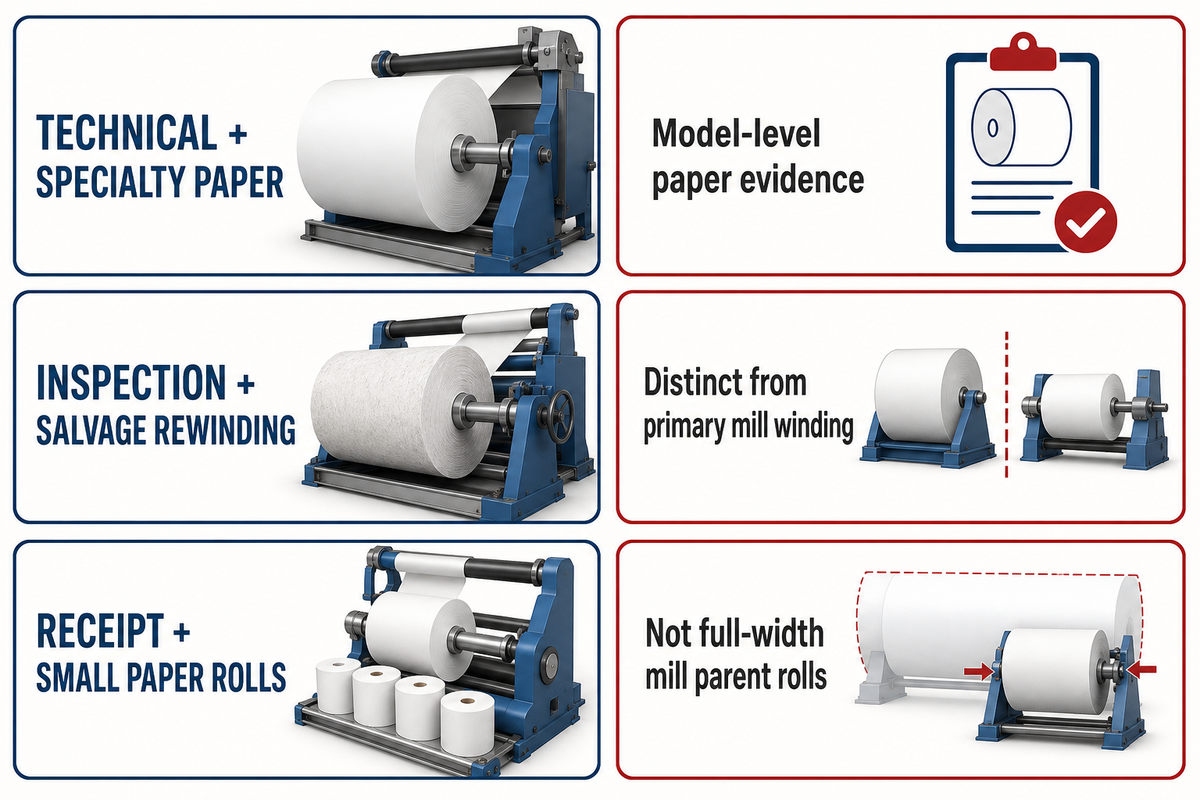
Narrow or variable roll programs such as thermal, release, label stock, and coated papers and small point of sale rolls are produced on specialty-paper and converting machines. There are 13 companies in this group and each has a current official source naming paper or a paper-based product. Capability with film alone didn’t qualify a company.
Scope may extend beyond the rewinder. A cutting machine may handle paper cutting or roll cutting after the web leaves the unwind. Lamination, flexo printing and a doctoring machine should be included in the comparison only if they’re part of the proposed line and acceptance boundary.
The end use changes the finished roll. A paper bag converter may need wide kraft lanes; a toilet roll or kitchen towel line has more specific core and diameter requirements. Web inspection can be more valuable than raw speed when the raw material contains defects that must be removed before sale.
7. GOEBEL IMS, Best for Technical and Specialty Papers
GOEBEL IMS fits technical and specialty-paper converters that need high-speed slitting backed by model-level material evidence. IMS TECHNOLOGIES group headquarters are in Calcinate, Italy, while the GOEBEL legal entity and operations are in Darmstadt, Germany. The 1851 date refers to GOEBEL’s industrial lineage, not the formation of the current group structure.
Headquarters: Calcinate, Italy, marked Headquarters & Operations 1; GOEBEL operations at D-64293 Darmstadt
Official website: https://www.goebel-ims.com/
Best for: High-speed technical and specialty-paper slitting
Company type: Industrial Slitter rewinders manufacturer within IMS TECHNOLOGIES
Company background: Industrial slitter-rewinder manufacturer within IMS TECHNOLOGIES, with GOEBEL lineage since 1851
Main products: RA 2 for Technical and Special Papers and T 2 for paper and board
Capabilities: Thermal papers, siliconized and coated papers, Carbonless copy papers and inkjet papers; configurations reach 3,000 mm and 1,500 m/min
The five named paper families make the public evidence useful. A buyer doesn’t have to infer paper suitability from a film-converting brochure. The RA 2 page also gives a concrete width and speed envelope for initial screening.
Specific limitation: RA 2 and T 2 are different concepts for technical or specialty-paper duty versus paper or board duty. Don’t combine the speed, roll weight or minimum-slit figures from both into one assumed machine.
8. Elite Cameron, Best for Comparing Rewinder Layouts
Elite Cameron is useful for paper and paperboard converters that want to compare center, center-surface, turret and two-drum layouts within one supplier range. The company traces its history to 1905 and operates from Taunton, Somerset, United Kingdom. It also supplies coating, laminating and core-cutting equipment.
Headquarters: Taunton, Somerset, United Kingdom
Official website: https://www.elitecameron.com/
Best for: Comparing center, center-surface, turret and two-drum layouts
Company type: Converting-equipment OEM
Company background: Converting-machinery manufacturer, Founded 1905, with Slitting, Hot Melt Coating and related equipment
Main products: Center, center-surface, turret and Two Drum Surface Winders
Capabilities: Center winders list slit widths to 25mm and rewind diameters to 800 mm
Elite Cameron explicitly identifies paper mills and paperboard as established application areas, rather than asking buyers to infer paper suitability from film machinery. That distinction matters because a generic web-handling machine may be successful on film yet fail to hold the tension range or surface condition needed for paper.
Specific limitation: Machines are built around the buyer’s material and roll requirements. Family-level examples don’t establish a guaranteed paper-specific slit width, roll diameter and speed.
9. Dusenbery, Best for Wide-Web Board and Labelstock
Dusenbery, a Parkinson Technologies brand, is a candidate for paperboard and label-stock converters that need wide-web slitter-rewinders with public model ranges. The Dusenbery company originated in 1947; current Parkinson Technologies operations are headquartered in Woonsocket, Rhode Island, United States.
Headquarters: Woonsocket, Rhode Island, United States
Official website: https://parkinsontechnologies.com/products/dusenbery/slitter-rewinders
Best for: Wide-web paperboard and label-stock converting
Company type: Winder specialist
Company background: Slitter-rewinder brand acquired by Parkinson Technologies; John Dusenbery started his company in 1947
Main products: MasterSlit duplex and center-surface slitter-rewinders
Capabilities: Paperboard and labelstock on named CS configurations; published ranges reach 4,575 mm width and 762 m/min
The model page publishes width, speed, slit-width and roll-diameter ranges. This gives procurement a clearer start than a general promise of custom engineering. The figures still need to remain attached to their respective MasterSlit configurations.
Specific limitation: These families also process film, foil and laminates, while the named CS configurations support paperboard and labelstock. The overall machine maximum does not define the stated paper duty.
10. Catbridge Machinery, Best for Custom Integrated Converting Lines
Catbridge Machinery suits converters that need a custom paper slitter-rewinder or an integrated web-processing line rather than a fixed catalogue machine. Founded in 2002, the company is based in Montville, New Jersey, United States. Its portfolio includes turret, two-drum surface, duplex and simplex rewinders.
Headquarters: Montville, New Jersey, United States
Official website: https://www.catbridge.com/
Best for: Custom paper rewinders and integrated web-processing lines
Company type: Converting-equipment OEM
Company background: Web-converting machinery designer whose machines are designed, built, and tested in New Jersey
Main products: Slitter Rewinders and integrated converting lines
Capabilities: Mechanical, electrical, and software engineering with inspection, printing, coating, laminating and roll handling
Catbridge states that design, machining, assembly, programming and testing take place all under one roof in New Jersey. That arrangement can help when a rewinder must exchange controls and material with adjacent inspection, printing or coating modules.
Specific limitation: Engineered-to-order scope means there is no catalog selection shortcut. Send a complete web, core and finished-roll envelope before comparing the offer.
11. ASHE Converting Equipment, Best for Narrow-to-Wide Web Coverage
ASHE Converting Equipment fits label and paper converters comparing narrow-, mid- and wide-web slitter-rewinders. Founded in 1976, the family-owned manufacturer operates from Ipswich, United Kingdom. It lists duplex, turret and inspection machines for label, paper and allied web applications.
Headquarters: Ipswich, United Kingdom
Official website: https://www.ashe.co.uk/
Best for: Narrow-, mid- and wide-web label and paper converting
Company type: Winder specialist
Company background: Family-owned slitting and rewinding machinery manufacturer established in 1976
Main products: Duplex, turret and inspection slitter-rewinders
Capabilities: Machine widths from 300 mm to 8.7m; ASHE states that up to 80% of machine parts are made in-house at Ipswich
The range spans a lower-cost Diamond series and higher-automation machines, so a buyer can compare investment and automation levels without leaving the supplier’s portfolio. The very wide headline range isn’t one machine and must be broken down by paper application.
Specific limitation: ASHE serves paper, film and allied webs. Its proposed paper-capable model must match a narrow-, mid- or wide-web family because the 300 mm-to-8.7 m span is not one scalable platform.
12. Hagihara Industries, Best for Paper-Specific Model Data
Hagihara Industries is relevant to paper and silicone-release-paper converters that prefer published model-level slit and speed data. Founded in 1962, the company is headquartered in Kurashiki, Okayama, Japan. Its industrial machinery range includes ASW and HSF paper slitter-rewinders.
Headquarters: Kurashiki, Okayama, Japan (岡山県倉敷市)
Official website: https://en.hagihara-eng.com/
Best for: Paper and silicone-release-paper conversion with model-level data
Company type: 機械製品メーカー with company history marked 1962年創業
Main products: Paper Slitter Rewinder ASW and HSF series
Capabilities: Automatic surface-drive winding, silicone-paper handling, shaft-bending correction and support-roller pressure control
The ASW-1250R page publishes a 35 mm minimum slit and 300 m/min mechanical speed. Model-level data make it easier to reject a poor fit early, especially when a buyer needs narrow finished rolls from release paper.
Specific limitation: The 300 m/min, 1,100 mm width and 35 mm slit figures belong to the ASW-1250R. Other Hagihara models cover different size and speed duties; jobs beyond the named figures require a different model or supplier class.
13. Jennerjahn Machine, Best for Small Paper-Roll Lines
Jennerjahn Machine is best matched to thermal receipt, point-of-sale, ATM, lottery and other small paper-roll production. Founded in 1979, the company operates from Matthews, Indiana, United States. Its scope combines paper slitter-rewinders with automated packaging systems for small converted rolls.
Headquarters: Matthews, Indiana, United States
Official website: https://jennerjahn.com/
Best for: Thermal receipt, point-of-sale, ATM and other small paper rolls
Company type: Converting-equipment OEM
Company background: Roll-converting and automated packaging machinery manufacturer
Main products: Paper slitter-rewinders and downstream packaging systems
Capabilities: Thermal receipt, point-of-sale, ATM, lottery and printer-roll converting
The connection between slitting and packaging can reduce the number of suppliers in a receipt-roll line. That’s a more specific advantage than high web speed if the production bottleneck occurs after the rolls leave the rewinder.
Specific limitation: The paper page is application-led for receipt, lottery, ATM and other small rolls, not full-width mill parent rolls. The selected model’s cycle time, core range, roll length, diameter, print-mark handling and packaging interface define the duty.
14. JOTA Machinery, Best for Thermal Paper with Added Converting
JOTA Machinery fits thermal-paper and specialty-roll converters that want slitting, perforating or printing combined with rewinding. Founded in 2008 and based in Kunshan, Jiangsu, China, the company moved from an early trading business into owned converting-machinery manufacturing.
Headquarters: Kunshan, Jiangsu, China
Official website: https://www.jotamachinery.com/
Best for: Thermal paper and specialty rolls with added printing or perforating
Company type: Converting-equipment OEM
Company background: Develops and manufactures roll-to-roll and roll-to-sheet converting machinery
Main products: Thermal paper slitter rewinders, roll cutters and flexographic equipment
Capabilities: Tension control, slitting, rewinding, cutting, printing, material testing and production automation
JOTA can configure perforating or flexographic printing with paper slitting and rewinding. That arrangement may suit a converter whose saleable roll needs more than a width change. The added operations also increase the number of register, waste and acceptance conditions that belong in the test plan.
Specific limitation: The 2008 date includes the earlier trading period. Combined printing or perforating expands the proposed machine’s factory acceptance test, waste and register conditions beyond full-width mill-winder duty.
15. Euromac, Best for Winding-Architecture Choice
Euromac suits paper and packaging converters comparing center-drive, center-surface and duplex layouts. The manufacturer was founded in 1968 and is headquartered in Villanova Monferrato, Italy. Its families include TB-3 duplex and turret machines, TB-5 center-surface systems, TB-6 heavy-duty center-drive rewinders and CB-RB doctoring equipment.
Headquarters: Villanova Monferrato, Italy
Official website: https://www.euromacslitters.com/en/
Best for: Comparing center-drive, center-surface and duplex layouts
Company type: Winder specialist
Company background: Producer of slitter rewinders founded in 1968
Main products: TB-3, TB-5, TB-6 and CB-RB families
Capabilities: Slitting and rewinding paper and other webs across six groups of machine concepts
The value of the range is architectural choice. Buyers can separate a center-surface need from a heavy-duty center-drive requirement before comparing automation. Doctoring and reel-to-reel equipment also give a route for inspection or roll correction rather than primary production only.
Specific limitation: The main range covers several materials, while the TB and CB families use different winding architectures. Select the paper-grade family; film performance cannot be carried across automatically because TB-3, TB-5, TB-6 and CB-RB impose different duplex, center-surface, center-drive or doctoring duties.
16. BIMEC, Best for Inspection and Salvage Rewinding
BIMEC is a candidate for paper converters that need a configurable slitter-rewinder together with inspection or salvage-rewinding equipment. Founded in 1976, the company is based in Vanzaghello, Milan, Italy. Its range includes dual-shaft, center-winding, double-turret and inspection rewinders.
Headquarters: Vanzaghello, Milan, Italy
Official website: https://www.bimec.it/en/index.html
Best for: Configurable paper rewinding with inspection or salvage capability
Company type: Winder specialist
Company background: Has designed and manufactured slitter rewinders since 1976
Main products: Dual-shaft, center-winding, turret, inspection and salvage slitter rewinders
Capabilities: Paper and other webs; its documented inspection-machine development dates to 1995
BIMEC’s development history includes bi-directional inspection and shaftless unwind systems. Those functions can matter when defect review, heavy parent-roll handling or recovery of nonconforming rolls consumes more time than the slitting step itself.
Specific limitation: The portfolio is intentionally multi-material and emphasizes inspection and salvage rewinding. Paper buyers should treat that web-trial duty as distinct from primary full-width mill winding and its tension range.
17. Miyakoshi Printing Machinery, Best for Lighter Printing-Paper Webs
Miyakoshi Printing Machinery fits printing and paper converters that need a compact, specification-led slitter-rewinder for lighter webs. Founded in 1946, the company is headquartered in Narashino, Chiba, Japan. It makes printing presses and pre- and post-press equipment, including a paper-specific slitter-rewinder.
Headquarters: Narashino-city, Chiba, Japan
Official website: https://miyakoshi.co.jp/english/
Best for: Compact slitting and rewinding of lighter printing-paper webs
Company type: Production and sales of printing machine and converting equipment, founded May, 1946
Main products: Printing presses and Slitter Rewinder equipment
Capabilities: 40–120 gsm paper, 440–880 mm web width, 300–1,100 mm roll diameter and up to 500m/min
Miyakoshi publishes basis weight, width, roll diameter and speed on one paper-specific page. That combination makes initial duty-point screening direct and reduces the risk of copying a film specification into a paper request.
Specific limitation: The public 40–120 gsm range excludes heavy board and large mill-roll duties. Buyers outside that window need a different supplier class rather than a wider safety margin.
18. HCI Converting Equipment, Best for Small and Mid-Width Paper Rolls
HCI Converting Equipment fits small and mid-width paper-roll converters seeking a practical slitter-rewinder with published baseline dimensions. Founded in 1982, the company operates from Taichung, Taiwan, and supplies roll-to-roll and roll-to-sheet converting equipment.
Headquarters: Taichung City, Taiwan
Official website: https://www.hci.cc/
Best for: Small and mid-width paper-roll conversion
Company type: Converting-equipment OEM
Main products: Slitting Machine, inspection machines, laminators and related equipment
Capabilities: The Practical model lists paper rolls, 300m/min, 1,300 mm maximum width, 800 mm unwind diameter and 500 mm rewind diameter
The Practical page links paper-roll use to a concrete speed, web width and roll-diameter envelope. That’s enough to decide whether a buyer should request a deeper proposal or remove the model from consideration.
Specific limitation: Those figures prove the named Practical model for small and mid-width paper duty, not HCI’s entire catalogue.
19. Rosenthal Manufacturing, Best for Built-to-Order Specialty Paper
Rosenthal Manufacturing serves specialty-paper and laminate converters that need a built-to-order slitter-rewinder at moderate production speed. Founded in 1926 and headquartered in Northbrook, Illinois, United States, the company builds slitters, sheeters, stackers, winders and custom systems.
Headquarters: Northbrook, Illinois, United States
Official website: https://www.rosenthalmfg.com/
Best for: Built-to-order specialty-paper converting at moderate speed
Company type: Converting-equipment OEM
Main products: Model: SRD slitter-rewinder and other custom machines
Capabilities: Paper and specialty materials; 36–126 inch web options, 18–40 inch maximum roll diameters and a stated Maximum Web Speed of 500 ft/min
Rosenthal publishes SRD width, diameter, speed and razor, score or shear slitting options, then invites buyers to send a sample roll for testing. Material testing can expose dust, edge and tension problems before an order rather than during commissioning.
Specific limitation: The SRD sits around the 500 ft/min production class and is built to order. It isn’t a high-speed mill winder, and actual speed remains material-dependent.
2-Axis Winder Shortlist Map
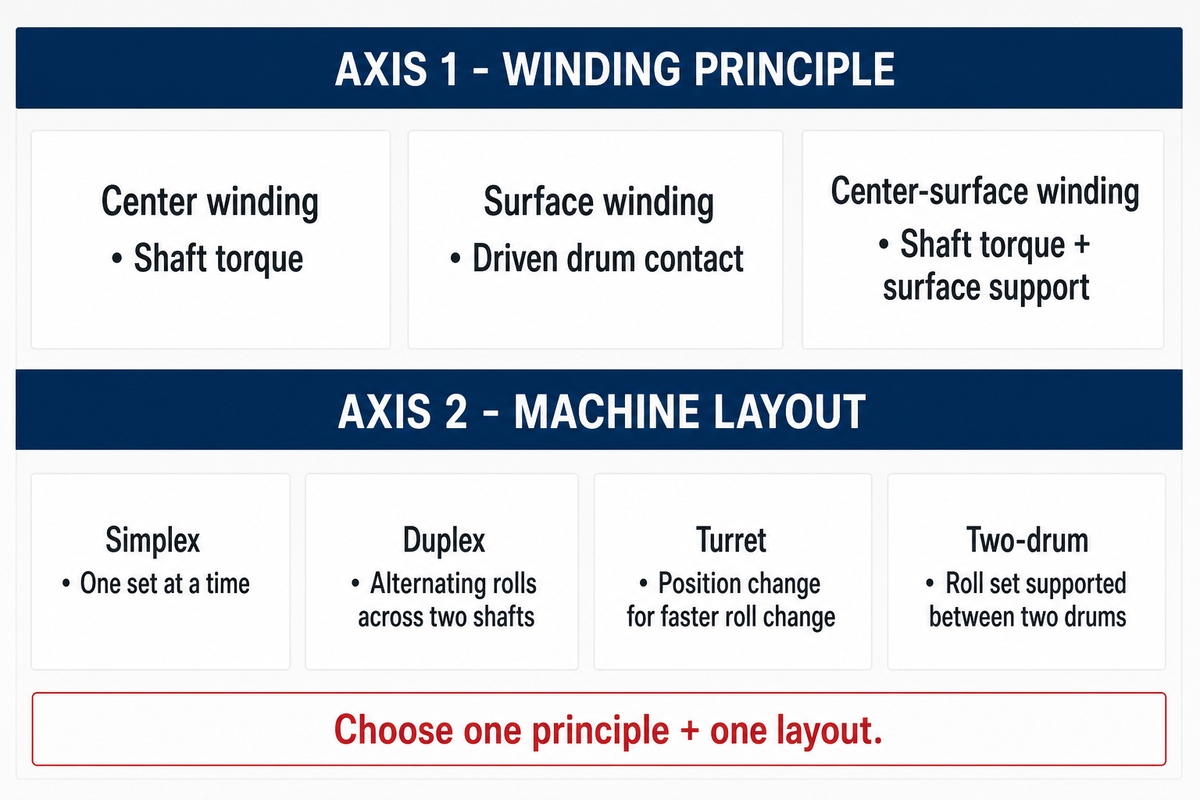
The 2-Axis Winder Shortlist Map separates winding force from machine layout. Buyers first choose how torque and contact build the roll, then choose how shafts, drums and changeover positions are arranged. Keeping those decisions separate prevents a duplex layout from being mistaken for a winding principle. That distinction aligns with US6283402B1, originally assigned to Ashe Controls Ltd, which identifies center, surface, center-surface and constant-gap winding geometries in a multi-function slitter rewinder.
The first axis is the winding principle. Center winding drives the rewind shaft and gives direct torque control. This principle is used for smaller or more sensitive rolls; surface winding transfers force through a driven drum and can suit larger or heavier rolls. Center-surface winding combines shaft torque with surface support to broaden the operating window. These are the different ways a roll can be built.
The control system must coordinate the interaction of torque, tension, and diameter as the roll builds. A PLC can control knives and shafts and sequence set discharge. It should, however, provide alarms and reveal process controls, i.e. recipes, that operators can verify. Proper trimming and edge-waste removal can reduce waste without hiding a poor slitting setup.
The second axis is layout. A simplex winder winds one set at a time, while a duplex machine winds alternating rolls across two shafts. A turret layout machine changes positions for faster roll change. Two-drum mill winders support a set between the drums. Automation of set handling, core loading and changeover depends on layout of the winder. A duplex machine can still use center or center-surface winding, so “duplex” isn’t a third winding principle.
When should a paper mill choose center winding or surface winding?
A paper mill should favor center winding when direct shaft torque and controlled tension permit it. Otherwise, surface winding becomes attractive when dealing with large rolls which benefit from drum support. A combination of center and surface winding designs can also be used. Factors which can influence this decision are basis weight, surface sensitivity, finished-roll diameter, roll mass and hardness profile.
Start with the paper, not the machine label. A sensitive coated paper can easily reject excess nip, even if the nominal roll diameter is achievable. On the other hand, a dense kraft roll can demand more supporting force and roll-handling capacity than a narrow converting shaft can provide. Ask the suppliers to show how torque, nip or contact pressure changes as diameter builds and speed changes.
Key takeaway
Compare one proposed winding principle and one proposed layout against the same roll duty; never score “duplex,” “surface” and “two-drum” as if they were three equivalent choices.
The Mill-Roll RFQ Envelope
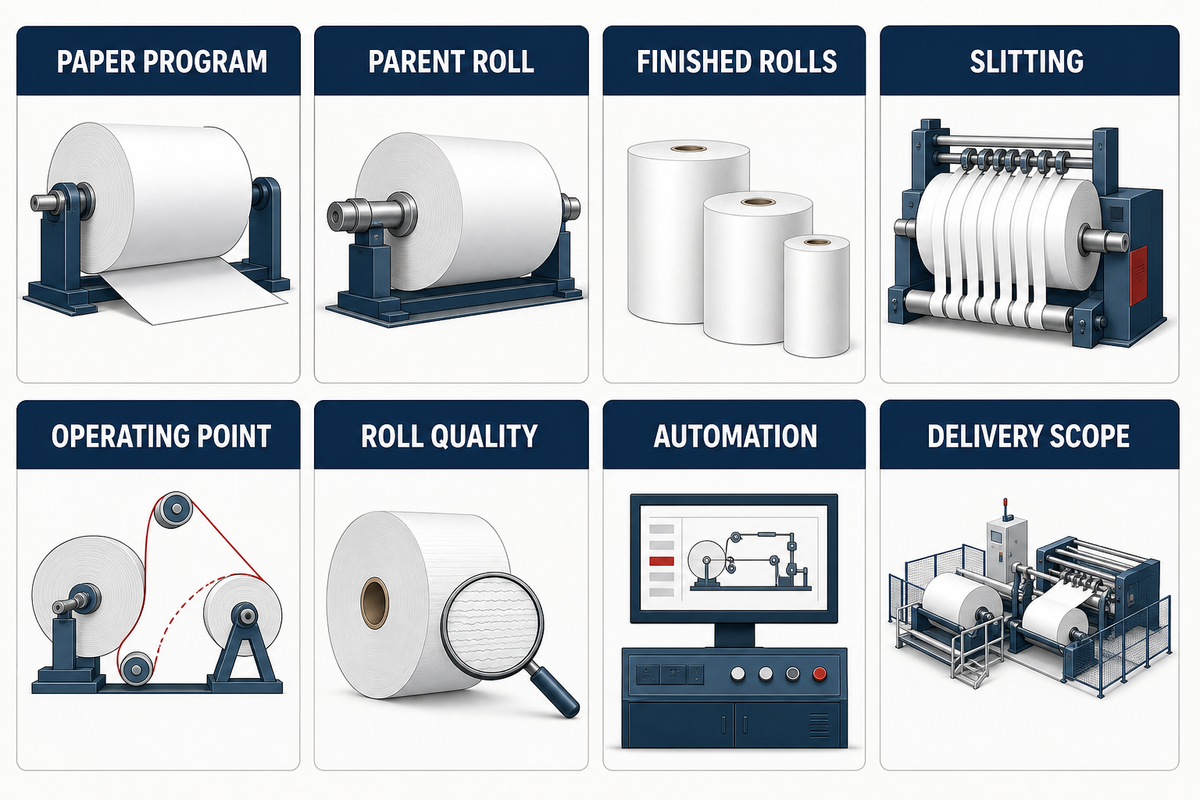
A useful request for quotation fixes the operating envelope before suppliers select the machine concept. In the absence of a common envelope, a low bid can omit parent roll handling, automatic knife setting, dust control and acceptance testing, while a high bid can include all of them. The prices then respond to different questions and can’t be compared.
Which specifications should I send to a paper rewinder manufacturer?
Send paper grades and basis weight range, parent roll width, diameter and mass, finished roll width, diameter, core and mass, slit width tolerance, production speed, tension window, winding principle, roll hardness, change over method, automation limits, utility requirements, safety and performance standards, and scope of Factory Acceptance Test and commissioning.
Use one data sheet for all bidders. Separate “normal,” “minimum,” and “maximum” conditions so a supplier can state which conditions are simultaneous. State whether the widest web, the highest speed, and the largest finished roll ever occur together. If they must occur together, label that point as a guaranteed duty case rather than scattering the maxima across separate rows.
An automatic high speed claim is incomplete without the grade and roll to which it applies. The same warning is applicable to a high speed slitting machine or to any general-purpose model. Determine whether speed drops during paper roll cutting, knife repositioning, core loading, or a complete set change.
RFQ checklist — copy these into your quote request:
| Parameter | Required entry | Why it matters | How to verify |
|---|---|---|---|
| Paper program | Grade names and basis-weight range in gsm | Sets tension and nip window | Run buyer-supplied rolls |
| Parent roll | Width, diameter, mass and core | Sizes unwind and handling | Measure loaded roll and drawings |
| Finished rolls | Width, diameter, mass, core and quantity per set | Defines shafts, drums and discharge | Inspect an acceptance set |
| Slitting | Method, minimum slit and width tolerance in mm | Controls edge quality and tooling | Gauge all rolls across the web |
| Operating point | Guaranteed speed in m/min at named grade and roll | Prevents mixed catalogue maxima | Timed factory acceptance run |
| Roll quality | Hardness profile, telescoping and edge limits | Defines saleable output | Agreed test method and sample plan |
| Automation | Knife, core, tape, set change, labeling and roll handling | Determines cycle and labor boundary | Demonstrate complete sequence |
| Delivery scope | Utilities, installation, spares, training and commissioning | Exposes price omissions | Responsibility matrix and signed offer |
For a broader line purchase, the same inputs from this paper making machine RFQ specification guide can also be used. Capacity claims should also be reconciled with the mill’s operating calendar, grade mix and saleable-roll assumptions; the site’s paper mill capacity calculation primer explains why nameplate speed alone does not equal annual output.
How to Choose a Paper Rewinder Machines Manufacturer: Public Screening vs Quotation-Stage Evidence
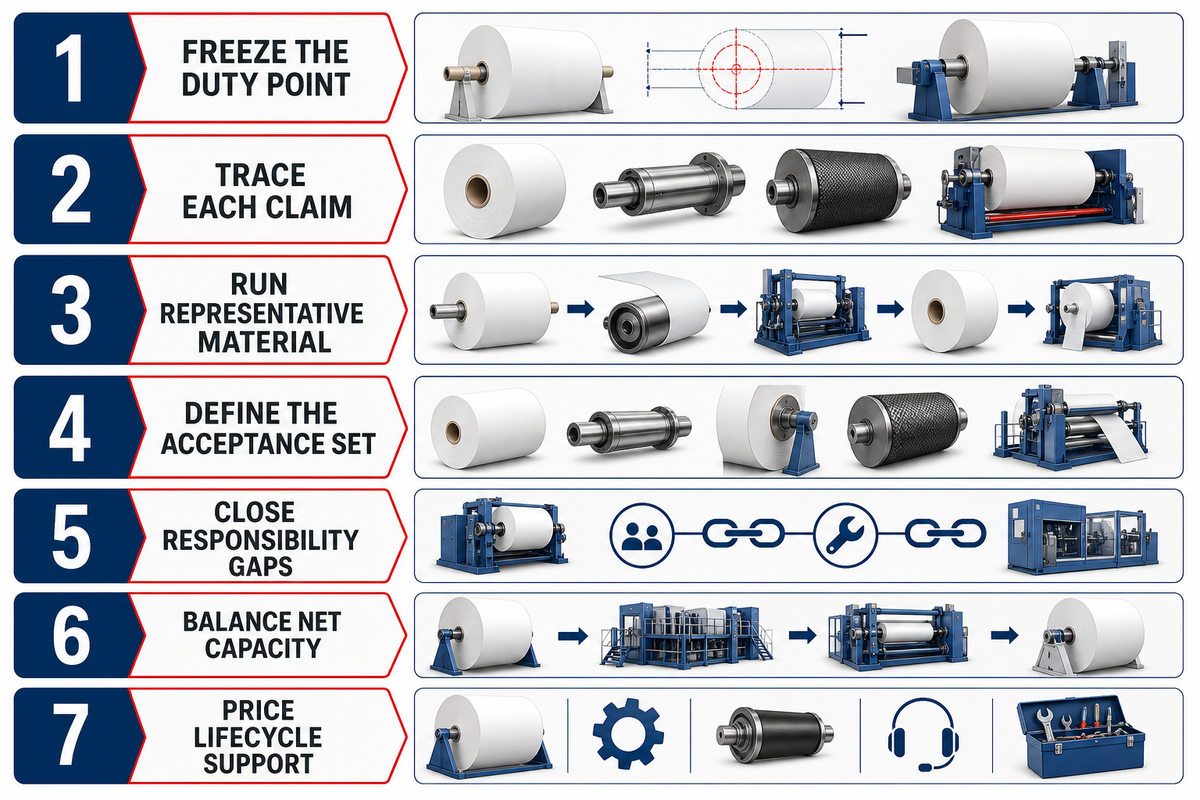
Public web pages can show a manufacturer can produce a given machine and may show a limit on a model. They cannot settle a project’s guaranteed throughput, simultaneous operating point, finished-roll quality, acceptance method or commissioning responsibility. Consider the website as a shortlist instrument, and the signed technical offer as the evidence package.
- Freeze the duty point — issue the same paper, parent-roll and finished-roll envelope to every bidder.
- Trace each claim — connect speed, width and diameter to the named model and material.
- Run representative material — use a buyer-supplied roll or grade that exposes dust, edge and tension behavior.
- Define the acceptance set — agree how speed, waste, roll quality and changeover time will be measured.
- Close responsibility gaps — assign controls, utilities, guarding, installation, roll handling and training.
- Balance net capacity — compare paper-machine output with net winder output after parent-roll changes, set changes, broke and planned cleaning.
- Price lifecycle support — separate commissioning, training, critical spares, knife and wear-part lead times, remote support, software backups and upgrade ownership.
Certificate claims need the same discipline. A current certificate should identify the legal entity, site, scope and validity period. A supplier-wide logo doesn’t prove that a quoted machine or factory sits inside the certificate.
Research and development or R&D claims can back up a factory review but won’t replace evidence concerning the proposed rewinding machine. Ask to see machine drawings, control philosophy, and test records. An adequate team for slitter and rewinder machines should also explain which design choices are standard and which choices are project engineering.
A factory acceptance test should reproduce the hardest agreed roll program, not a convenient demonstration web. If a roll has multiple programs, the control system should be evaluated at each program. State the incoming roll condition, grade, basis weight, slit pattern, core, finished diameter and target speed. Record edge quality, roll build, tension behavior, waste, stops and complete set-change time. Evaluate the utility system and interfaces. Installation and site acceptance then verify utilities, interfaces and sustained operation after shipment.
Paper products don’t all create the same duty. Various paper grades can vary dust, friction and compressibility, so one test roll isn’t sufficient to evaluate a broad grade mix. A China paper producer, an Italian specialty converter and a US receipt roll plant can use similar machine labels but require different safeguards.
A paper slitting and rewinding machine should be tested with the buyer’s hardest slit pattern. During paper roll rewinding, record tension and finished-roll build instead of judging appearance alone. A slitting rewinding sequence also needs clear stop, splice and reject rules if defects appear.
Buyers requiring a more extensive supplier audit can use the site’s paper machinery supplier checklist. Projects with numerous equipment boundaries should also define early on handover and acceptance responsibility. This turnkey paper mill project guide provides a related scope control framework.
Frequently Asked Questions
How do I size a paper rewinder so it does not bottleneck the paper machine?
Answer
Size the rewinder from net roll output, not design speed alone. Calculate paper-machine tonnes per day, parent-roll change time, set-change time, broke, cleaning and the slowest required grade. Compare that demand with the guaranteed cycle at the simultaneous width, diameter and roll-mass case, then add a documented margin for maintenance and operating variation.
How much does a paper rewinder machine cost?
Answer
No comparable public price range applies across these machine classes. Cost changes with web width, parent-roll mass, finished-roll format, design speed, slitting system, tension control, automation, roll handling, electrical scope, installation and acceptance testing. Compare quotations reliably only after every supplier receives the same technical envelope and states all exclusions.
Which winding method is better for tissue, board, or specialty paper?
Answer
No winding method is best for every grade. Center winding gives direct shaft torque for smaller or sensitive rolls, while surface winding supports larger or heavier rolls. Center-surface combines both, but tissue, board and specialty paper still need grade-specific tension, nip or contact pressure, finished-roll diameter, mass and hardness targets.
Which paper rewinder manufacturer is best?
Answer
It depends on the roll program. Zejiang fits mills wanting one engineering contact for a pope reel, slitter rewinder and matching paper-machine parts; Valmet suits large mill capacity; Voith supports two-drum versus single-drum comparison; GOEBEL IMS fits technical papers; and Jennerjahn fits small receipt-roll lines. Compare only companies serving the same duty envelope.
Who is the largest paper rewinder machine manufacturer in the world?
Answer
No single public source establishes one universal largest manufacturer across mill winders and converting rewinders. Companies report installed machines, modernization projects, working width, design speed or integrated-line scope. Those measures are not interchangeable for purchasing decisions.
What is the difference between a paper rewinder manufacturer and a supplier?
Answer
A manufacturer documents responsibility for designing, building or integrating a complete rewinder. A supplier may instead resell equipment or provide knives, shafts, chucks, controls, inspection or roll handling. Treat a supplier as the machine manufacturer only when it provides current complete-machine evidence.
Shortlist a Rewinder Manufacturer for Your Roll Program
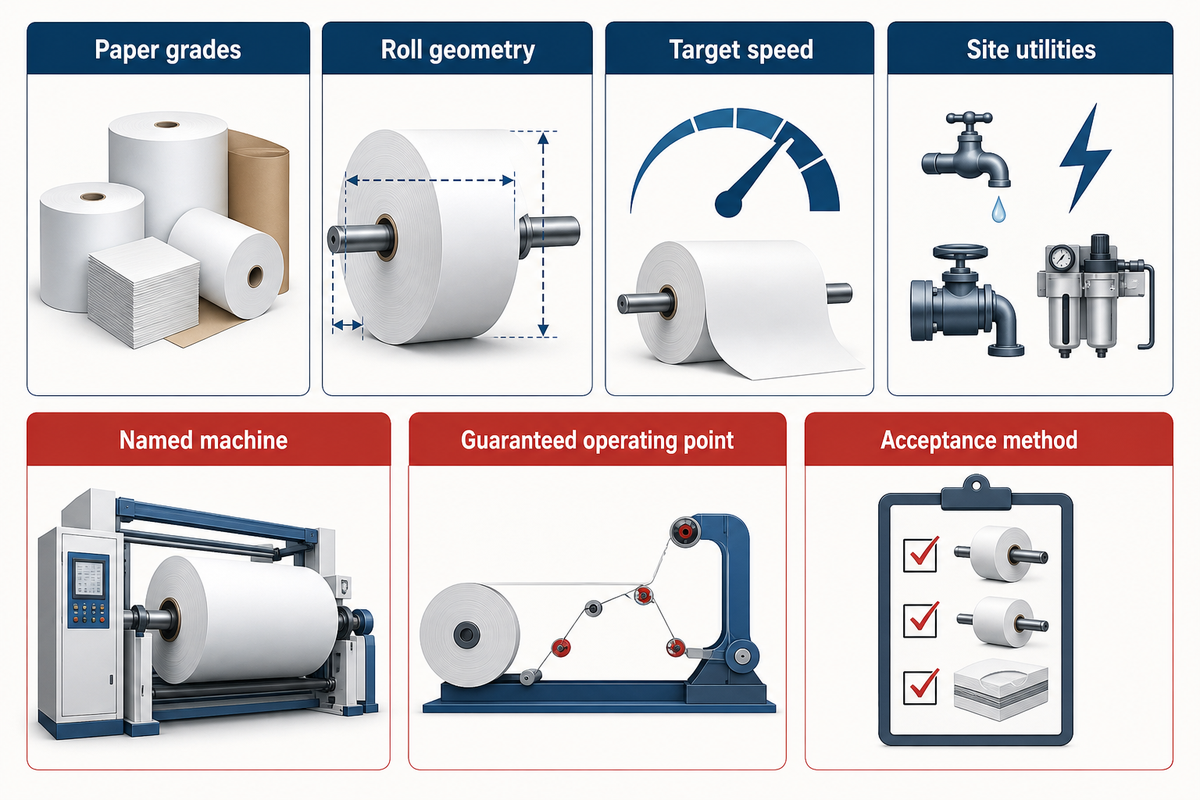
A practical shortlist should start with the roll program and end with evidence on the proposed machine.
Separate mill winders from converting slitters, choose the winding principle and layout on different axes, and give every bidder the same simultaneous operating case. That reveals weak fit, before price discussions mask it.
Henan Zejiang Paper Machinery can review a parent-roll and finished-roll data sheet for projects that need a pope reel, paper rewinder or both. Send the paper grades, widths, diameters, roll masses, core sizes, target speeds, slit pattern, automation boundary and site utilities through the project discussion form. The response should be evaluated against the same technical and acceptance requirements used for every company in this guide.
Prepare a comparable rewinder inquiry
Share one roll-duty envelope and ask for a named machine, guaranteed operating point, factory acceptance method and complete responsibility matrix.
Transparency note
This article uses public manufacturer information verified in October 2026. Published specifications remain attributed to the named company and model. They’re screening evidence, not independent performance tests or substitutes for a signed quotation and acceptance plan.
References & Sources
Official manufacturer websites are listed in the comparison table and directly below each company headquarters line. Company facts, product families and published limits were checked against first-party pages in October 2026; founding-year checks for Elite Cameron, Catbridge and Rosenthal also used their LinkedIn company profile, a New Jersey Manufacturing Extension Program case study and Thomasnet, respectively.