Get in touch with Zejiang Paper Machinery Company


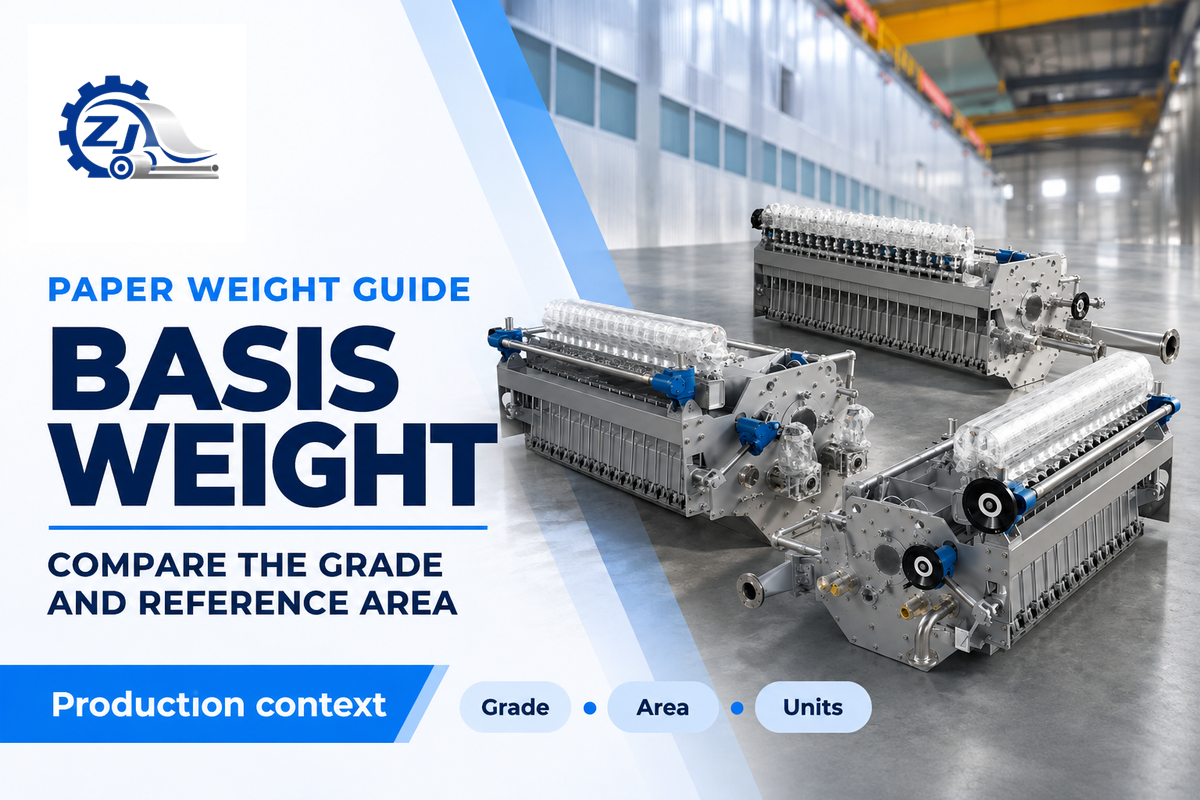
Basis weight is paper mass for a specified reference area. In U.S. printing grades, basis weight is usually the weight of 500 sheets at that grade’s basic size. An 80 lb text sheet is about 118 GSM; 80 lb cover is about 216 GSM. Compare the grade and reference area before comparing the pounds.
Basis weight measures mass per area. GSM uses one square metre. U.S. pound values need a sheet size and count, or a stated area such as 1,000 ft². Equal pound numbers across different grades can describe very different papers.
- 80 lb cover has more mass per area than 80 lb text because the reference sheets differ.
- GSM means grams per square meter; it compares areal mass across paper grades.
- Caliper measures thickness. Strength and converting performance require their own tests.
- For rolls, compare purchase cost per usable area after accounting for paper losses.
For a mill buyer, the first check is the unit printed beside the number. For a printer, it’s the grade printed beside the pounds. Both checks prevent an apparently equivalent weight from becoming the wrong stock on the production floor.
Paper Basis Weight: Three Different Reference Areas
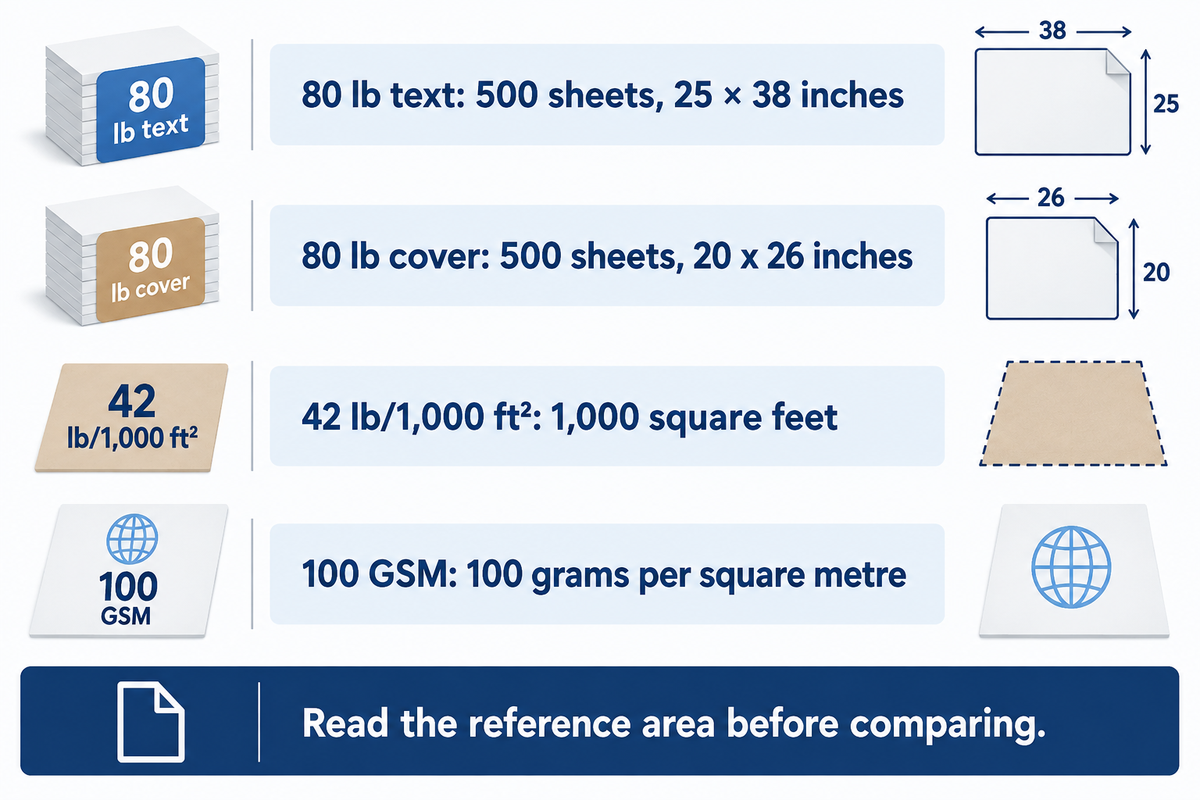
500 sheets, 1,000 square feet, and one square meter are three reference areas you may encounter while reading paper weight. The first depends on a named sheet size; the other two state area directly. A weight in pounds becomes comparable only when its denominator is known.
Grammage is mass per unit area; customary ream-based weight uses 500 sheets and occasionally 480, according to the TAPPI T 410 description. The printing conversions below use a ream of 500 sheets.
3-Basis Comparison Table
The 3-Basis Comparison Table identifies the reference area behind a paper weight before converting it or comparing a supplier’s specification.
| Specification | Reference | Comparison rule |
|---|---|---|
| 80 lb text | 500 sheets, 25 × 38 inches | Convert using the text basis size |
| 80 lb cover | 500 sheets, 20 x 26 inches | Convert using the cover basis size |
| 42 lb/1,000 ft² | 1,000 square feet | Multiply by about 4.8824 for GSM |
| 100 GSM | One square metre | 100 grams per square metre of paper |
Understanding basis weight begins with the whole specification, not the largest number. The paper industry uses both metric and American conventions. The basis weight of paper can be expressed as pounds per ream or per a specified area. Grammage makes the reference area explicit, while a bare “80 lb” leaves a buyer without enough information to select the conversion.
Paper Grade and Basic Sheet Size
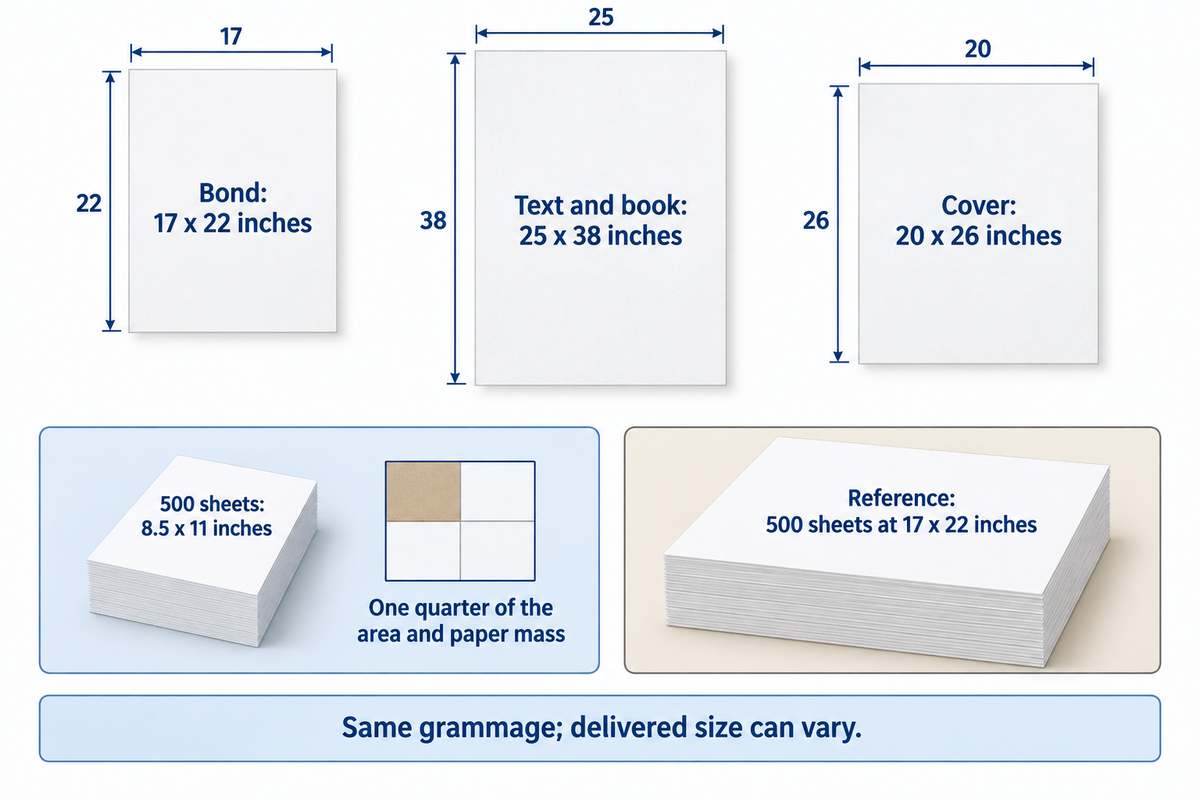
As stated in Utah Valley University’s Paper Primer, bond uses a basic sheet size of 17 x 22 inches, text and book paper use a basic sheet size of 25 x 38 inches, and cover uses 20 x 26 inches. These standard basis sizes define the pound rating, and the delivered sheet size can vary.
A ream of paper cut for an office printer isn’t the physical pile used to determine its basis weight. The weight of a ream of cut stock depends on the size of the paper and the number of sheets within the package. Cutting a sheet changes its mass and area together, so the grammage stays the same.
For example, a hypothetical 500-sheet pack measuring 8.5 x 11 inches contains one quarter of the area of 500 sheets measuring 17 x 22 inches. At the same grammage, its paper mass is one quarter as large. A package label can still call that stock 20 lb bond because the label refers to its basic size.
This separates the basic sheet from parent stock. A mill or merchant can supply different paper sizes under the same paper grade. The reference is a standard size for the grade rather than the only available delivery size. Read the grade designation when comparing various types of paper, then use the delivered dimensions for shipping weight or cut-sheet calculations.
Text Weight vs Cover Weight: Comparison Chart
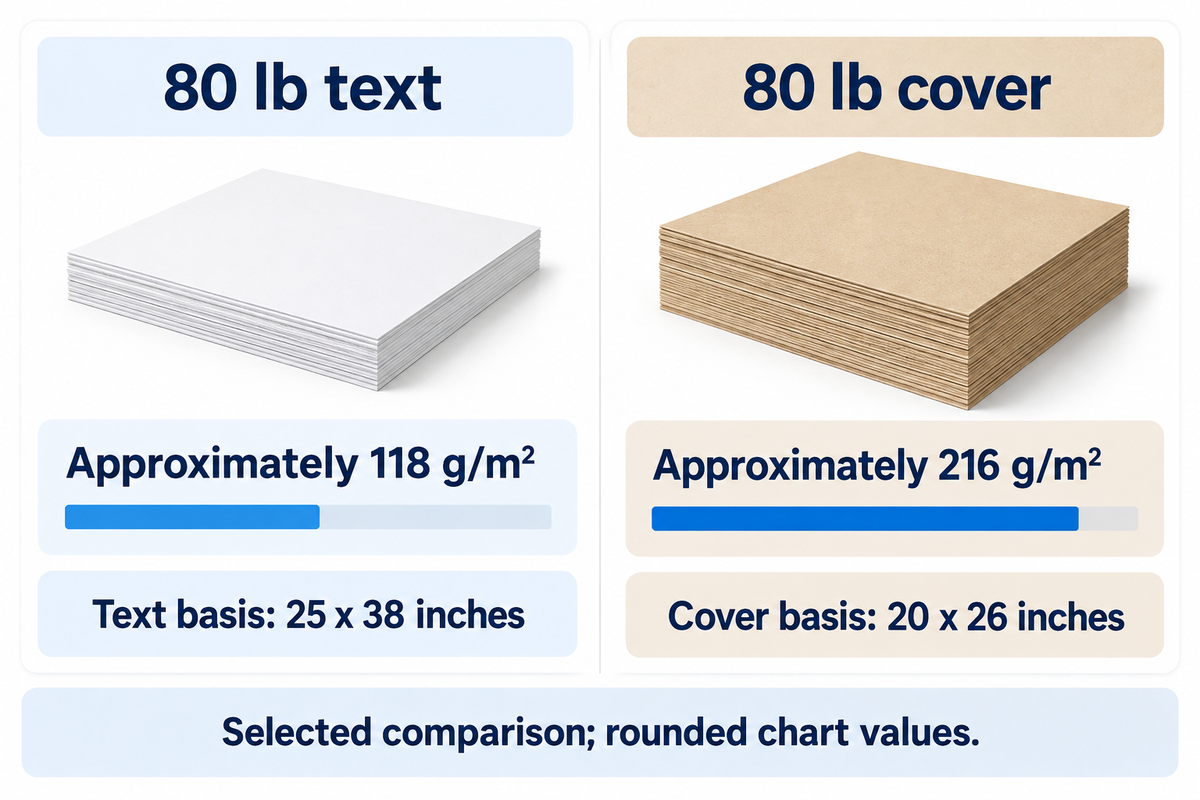
80 lb text is approximately 118 g/m², and 80 lb cover is approximately 216 g/m², based on Neenah’s rounded conversion chart. Equal pounds describe different mass per area, because cover’s basic sheet is smaller. A higher number within one paper type is helpful; comparing numbers across different types of paper requires conversion.
| Kind of paper | Basic dimensions, inches | Basis weight, lb | Approximate GSM |
|---|---|---|---|
| Bond | 17 x 22 | 20 | 75 |
| Bond | 17 x 22 | 24 | 90 |
| Text | 25 x 38 | 80 | 118 |
| Text | 25 x 38 | 100 | 148 |
| Cover | 20 x 26 | 80 | 216 |
| Cover | 20 x 26 | 100 | 270 |
Use this weight chart’s rounded common basis weights to compare nominal grades and the purchase spec’s acceptance limits to assess a measured delivery. Values may vary slightly between charts or from an unrounded calculation because of rounding.
Which paper is heavier, 80 lb text or 100 lb cover?
100 lb cover is heavier per unit area: about 270 GSM compared with 118 GSM for 80 lb text. At the same cut size, the cover sheet has roughly 2.3 times the mass. That comparison answers a weight question; caliper and bending behavior still determine how the particular paper handles in a feeder or folded product.
Choosing the right stock starts with the function of the sheet. A text paper and a cover stock serve different functions even if a conversion chart provides equivalent weight values. Heavier weight is a material input, not a complete definition of the paper used.
GSM to Pounds: Paper Weight Conversion
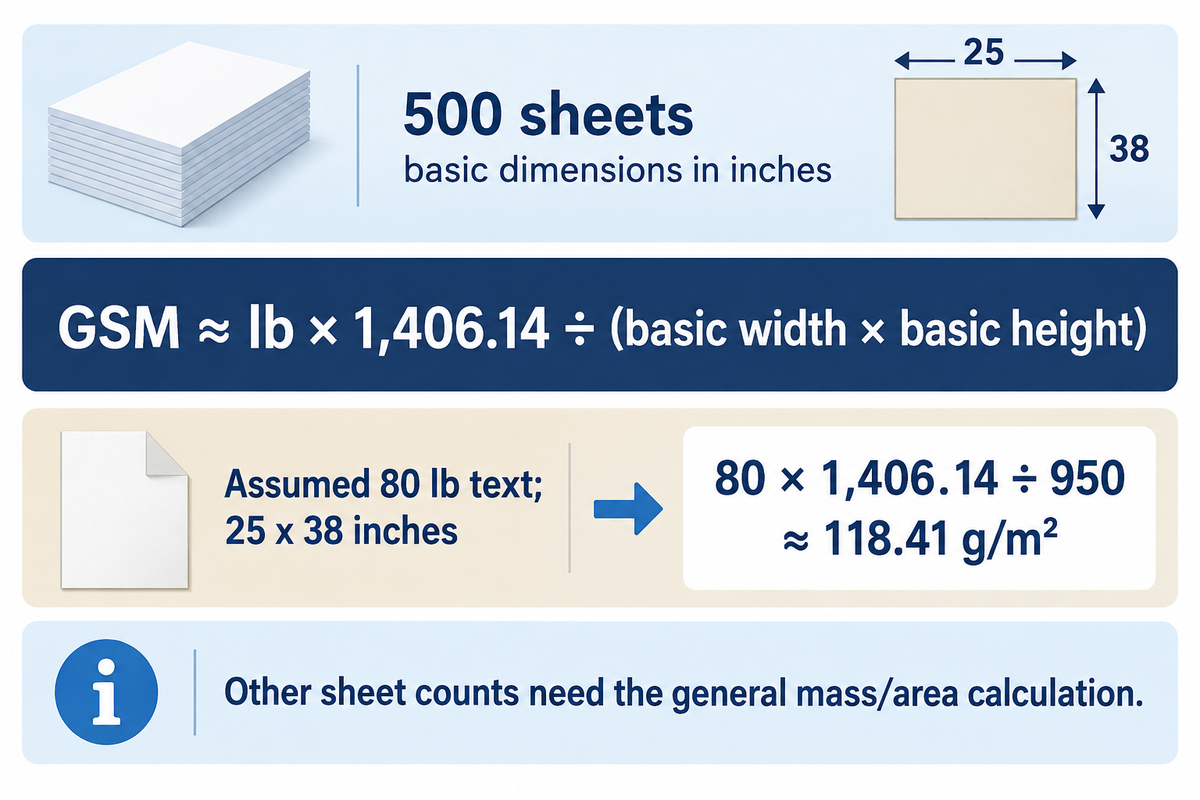
For 500 sheets with basic dimensions in inches, GSM is approximately lb × 1,406.14 ÷ (basic width × basic height). Use the reverse of this formula to convert GSM to pounds. This calculation uses the full basic sheet size and the stated sheet count, so it changes with the grade’s reference area.
An assumed 80 lb text grade with a basic size of 25 x 38 inches gives 80 × 1,406.14 ÷ 950, or about 118.41 g/m². The rounded coefficient comes from the pound and inch conversion factors in the NIST Guide to the SI. The reverse calculation returns approximately 80 lb.
How do you calculate basis weight?
Calculate grammage by dividing the mass (g) of a sample by the area (m^2) of the same sample. The result is grammage rather than ream weight. To obtain ream weight, multiply the grammage by the area of the specified ream and convert grams to pounds. The reference sheet dimensions and sheet count must be included in the result.
To determine the weight of 500 sheets, calculate the ream mass at the basic dimensions. A different count requires the general mass-per-area calculation instead of the 1,406.14 coefficient. This is why a conversion that accepts only pounds can return an incorrect value.
An assumed 42 lb/1,000 ft² specification converts to about 205.06 GSM using 42 × 4.8824. For lb/3,000 ft², the unit used by NC State’s pilot papermaking equipment, multiply by about 1.6275. The area of 500 sheets at 24 x 36 inches is exactly 3,000 ft²; confusing the two denominators creates a threefold error.
Is 300 GSM the same as 140 lb?
300 GSM and 140 lb are a nominal pairing used for some watercolor papers, including ARCHES Aquarelle. The pairing is specific to that paper product. It isn’t a general conversion for text, cover or bond. Use the stated grade and basic area when converting a different paper as opposed to borrowing a watercolor label.
Paper Caliper and Strength: What GSM Cannot Tell You
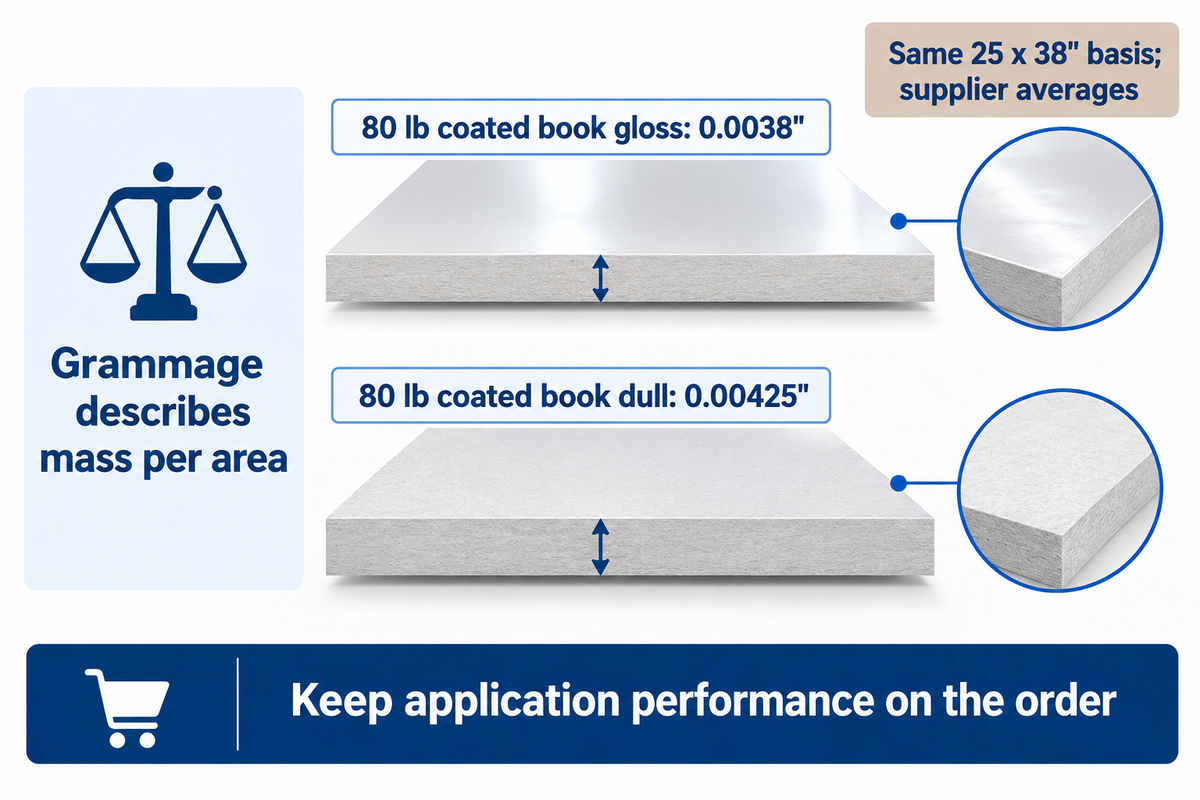
Caliper measures paper thickness while GSM measures weight of one square meter of paper. Two stocks can have the same grammage and different calipers. For instance, according to Case Paper’s average tables, 80 lb coated book gloss is 0.0038” and 80 lb coated book dull is 0.00425”.
Paper density requires both mass and volume for an engineering calculation; grammage describes mass per area. Supplier average calipers above differ within the same 25 x 38” basis, and a delivered sheet of paper can vary from these averages. “Density of paper” and “weight of paper” should be separate fields on a technical report.
Higher basis weight paper contains more mass per area, but choosing the best stock also depends on the required strength and durability. A printed folder may require fold and feed performance different from that of a carton with a given compression performance. Test results of the paper stiffness and grammage may help answer different purchasing questions.
A lighter basis is acceptable if the package still meets its performance and handling requirements as mentioned in the “lightweighting discussion” in Packaging World. For corrugated grades, compare “testliner and kraft liner performance” alongside mass specification. Paper bags and printing sheets require their own application criteria.
If stiffness and feeding behavior suit the job, select thicker paper. Keep the required performance on the order alongside the request for heavier basis weight, so the substitute is assessed against the same application requirements.
How to Measure Paper GSM
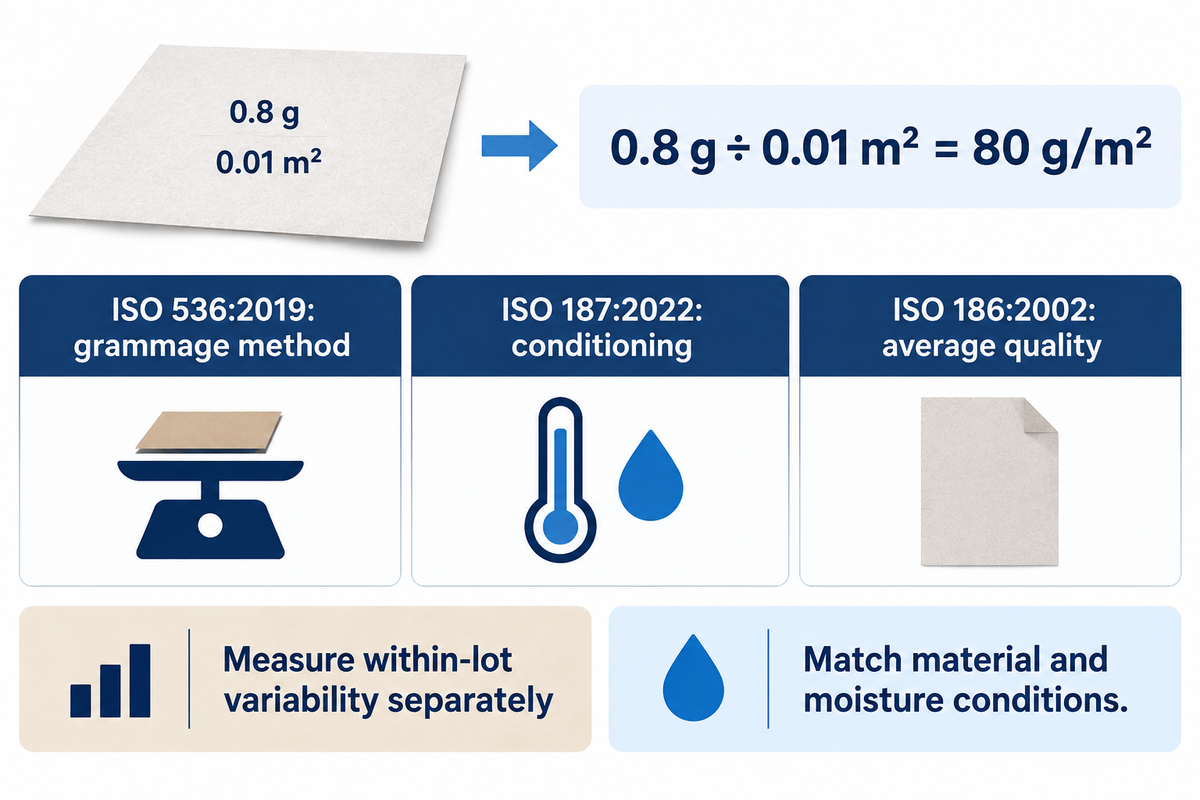
A sample of 0.8 g with an area of 0.01 m² is calculated to have a grammage of 80 g/m² (mass per area). The formal acceptance test also includes requirements of representative sampling and preparation, as well as agreement on the test method.
“This document specifies a method for determining the grammage of paper and board.”
ISO 536:2019 is the defined mass-and-area method for determining paper and board grammage; ISO’s catalogue records its confirmation in 2025. Applying the calculation in acceptance testing also requires specimen dimensions, sample count and an acceptance tolerance.
Grammage results must be compared for the same material and moisture conditions because water is part of the measured mass. Use ISO 187:2022 for conditioning and testing atmospheres and procedures for pulp, paper and paperboard, and ISO 287:2017 for lot moisture content.
Representative sampling under ISO 186:2002 assesses a lot’s average quality; within-lot variability needs separate measurement. Average and uniformity are different acceptance targets; specify the test method to assess variation when uniformity matters.
Paper Roll Weight and Usable Area
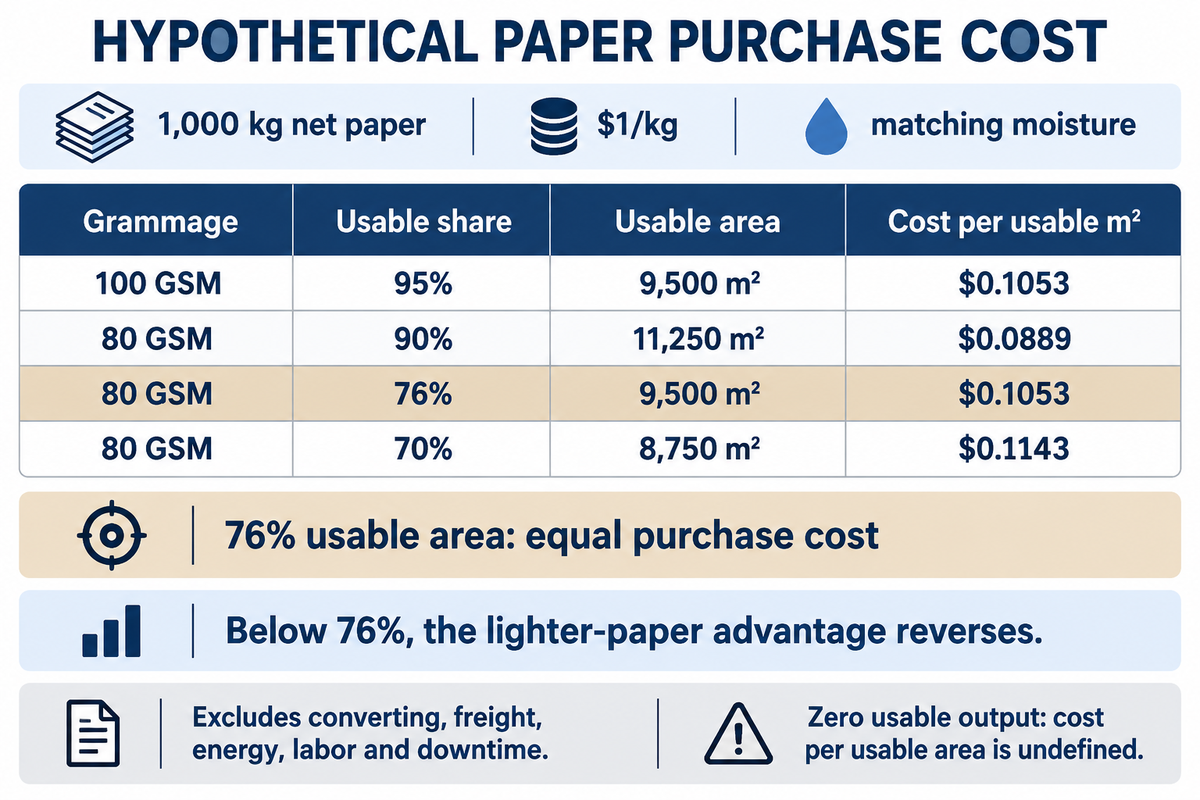
1,000 kg of net paper at an average of 100 GSM represents 10,000 m² of theoretical area. The mass and grammage must describe the same material and moisture condition. Exclude the core and packaging from the mass input and account separately for trim and rejected paper.
Paper Roll Area Worked Example
Area in m² = 1,000 x net paper mass in kg / GSM. Dividing this area by the width in meters gives a theoretical length. These relationships are based on mass per area and agree algebraically with DS Smith’s published formula for reel length.
Assume each option contains 1,000 kg of net paper, costs $1/kg, and has matching moisture conditions for its mass and average grammage. Assume 95% usable area for the 100 GSM option and 90% for the 80 GSM option. Both purchases cost $1,000. The calculated purchase costs below exclude converting, freight, energy, labor and downtime.
| Assumed grammage | Theoretical area | Assumed usable share | Usable area | Purchase cost per usable m² |
|---|---|---|---|---|
| 100 GSM | 10,000 m² | 95% | 9,500 m² | $0.1053 |
| 80 GSM | 12,500 m² | 90% | 11,250 m² | $0.0889 |
| 80 GSM | 12,500 m² | 76% | 9,500 m² | $0.1053 |
| 80 GSM | 12,500 m² | 70% | 8,750 m² | $0.1143 |
The lighter paper’s advantage reverses below 76% usable area under these assumptions. At zero usable output, cost per usable square metre is undefined. This comparison covers paper purchase cost, not total production cost.
For planning a paper mill, keep this area calculation separated from the paper mill output calculation. The weight of the paper on a reel describes material already produced. Rate calculations require operating dimensions, speed and time.
Basis Weight Specifications for Paper Orders
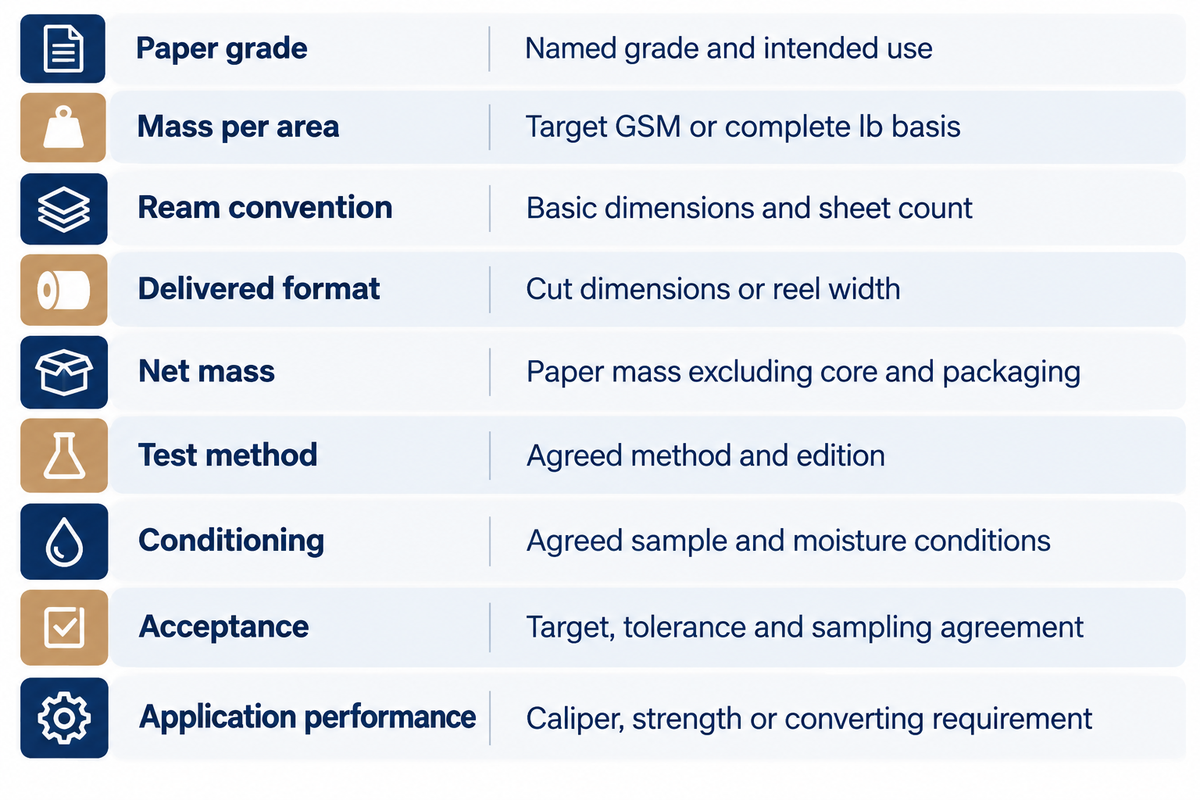
A paper order must specify grade, grammage or pound basis, dimensions, measurement conditions and acceptance rule. Specify how basis weight is expressed so the supplier can distinguish weight per ream from an area-based value. Record both target GSM and its tolerance, as they serve different purposes.
RFQ checklist: copy the required fields into the order
| Field | What to specify | Why it matters | Verification |
|---|---|---|---|
| Paper grade | Named grade and intended use | Determines the relevant paper convention | Match supplier grade description |
| Mass per area | Target GSM or complete lb basis | Prevents denominator mismatch | Read units with the value |
| Ream convention | Basic dimensions and sheet count | Controls ream-based conversion | Compare against the grade table |
| Delivered format | Cut dimensions or reel width | Determines actual area and handling | Measure received format |
| Net mass | Paper mass excluding core and packaging | Keeps tare out of the area estimate | Record weighing basis |
| Test method | Agreed method and edition | Makes results comparable | Check laboratory report |
| Conditioning | Agreed sample and moisture conditions | Keeps mass measurements consistent | Record preparation conditions |
| Acceptance | Target, tolerance and sampling agreement | Separates nominal grade from lot approval | Compare report with order |
| Application performance | Relevant caliper, strength or converting requirement | Matches the finished use | Use the specified test or trial |
For an equipment query, give the intended paper grades, working width and grammage range for paper machine selection. A control system discussion needs both the target average and the variation requirement. Zejiang offers hydraulic, air-cushion and open-type headboxes; the headbox flow distribution discussion should follow the intended machine and grade rather than a finished-sheet pound label alone.
Frequently Asked Questions
What does 32 ECT or 200# mean in relation to basis weight?
32 ECT and 200# describe strength tests, not paper grammage.
ECT refers to edge crush testing; the 200 lb test designation refers to bursting strength. Neither supplies the mass per area needed for a GSM conversion. A corrugated-board specification can include a strength designation alongside liner and medium grammages. Compare the specified test property directly, then assess board construction and the intended packaging application separately.
What is the difference between basis weight and M-weight?
M-weight is the weight of 1,000 sheets at the actual specified sheet size.
Basis weight instead uses the grade’s reference size and stated ream count. Case Paper’s M-weight calculator scales the actual sheet area against the basic area before calculating the thousand-sheet weight. Enter the delivered dimensions for freight or inventory estimates. Using only the nominal pound rating would leave out the area of the cut sheets being purchased.
Can recycled linerboard match the basis weight of virgin kraft?
Yes. Recycled and virgin-fibre papers can be specified at the same grammage.
GSM describes mass per area rather than fibre origin; papers with matching grammage can differ in furnish, structure and application performance. For a substitution, keep the board or package strength requirement on the purchase order and compare results under the agreed methods. Record the target grammage separately from the agreed tolerance and sampling conditions.
Does a higher basis weight always mean a stronger box?
No. Box strength is an application property, not a direct conversion from GSM.
Paper properties, board construction and package design all matter. Use the specified strength result when comparing boxes, and retain grammage as a separate material specification.
Why is basis weight important?
It connects paper quantity, grade comparison and purchasing calculations to a defined area.
Grammage is used to calculate how much theoretical area a net mass of paper contains. A complete pound specification performs the same job once its reference size and count are known. Purchasing can compare equivalent quantities; quality staff can compare the measured value with the order. Production then adds the application tests and usable fraction needed to assess the paper in its intended process.
Is paper weight thickness?
No. Weight measures mass; caliper measures thickness.
Paper weight expressed in grams per square metre is an areal measure. Papers with different structures or finishes can share that value while having different thicknesses.
What paper weight is suitable for watercolor?
300 GSM is one available watercolor grade, including ARCHES Aquarelle’s nominal 140 lb product.
The 140 lb watercolor label uses that paper’s convention and can’t be transferred to cover or text stock. Its nominal pairing identifies a product category, not a universal grade for every painting technique. Choose grammage alongside intended wet-media use, surface and product specification when considering a heavier sheet.
Discuss Your Paper Grade with Zejiang
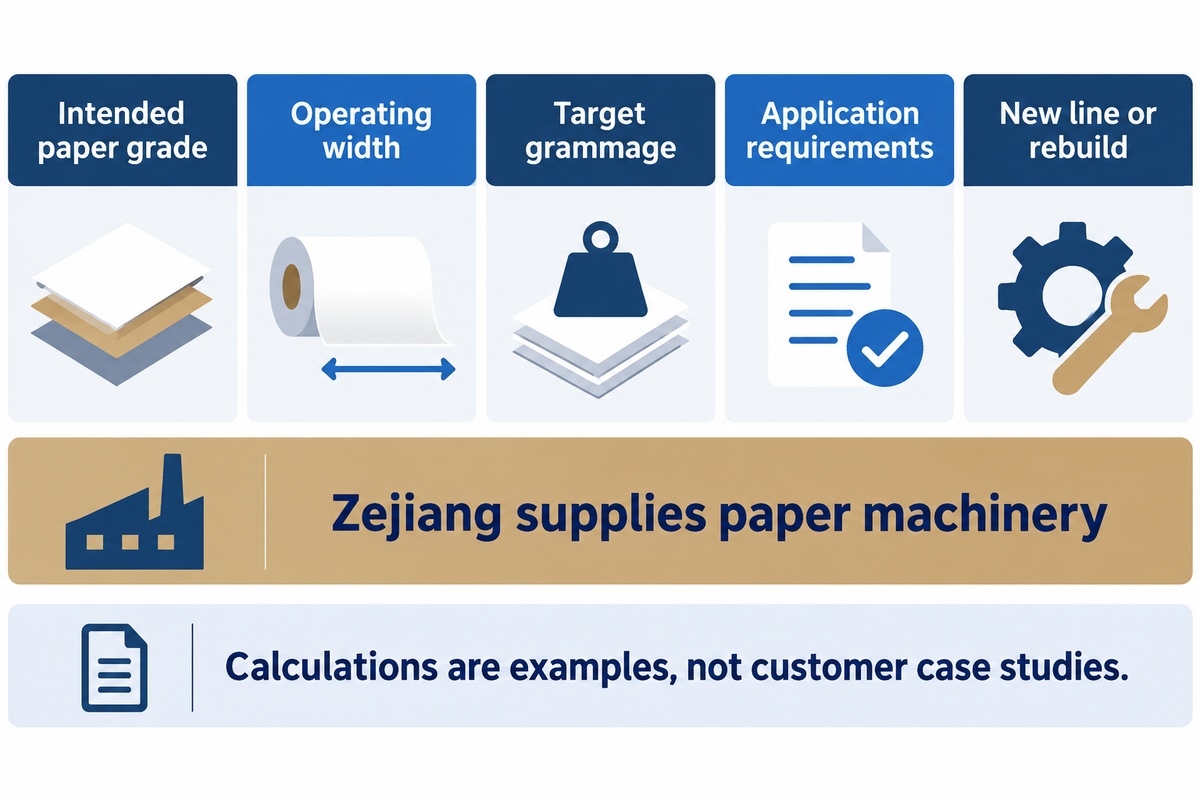
In your request for a paper machine, provide Zejiang the intended grade, operating width, and target grammage. Also provide requirements and state if a new line or a rebuild is being planned.
Our perspective: Zejiang supplies paper machinery. The conversion tables are based on published conventions, and the roll cost comparison is made with stated assumptions. It is more of an example on how to calculate, and not a case study on customer production. This guide’s source and standard information was checked in October 2026.
References & Sources
- Paper Primer, Utah Valley University.
- Grammage of Paper and Paperboard, T 410 om-23, TAPPI.
- Guide to the SI: Conversion Factors, NIST.
- Paper Making and Testing Technical Services, NC State University.
- ISO 536:2019: Determination of Grammage, ISO.
- ISO 187:2022: Conditioning and Testing, ISO.
- ISO 287:2017: Moisture Content, ISO.
- ISO 186:2002: Sampling for Average Quality, ISO.
- Lightweighting Can Be a Heavy Lift, Packaging World, 2015.