Get in touch with Zejiang Paper Machinery Company


![Pulping Equipment: How Paper Pulping Works [Guide]](https://zjpapermachine.com/wp-content/uploads/2026/07/pulping-equipment-guide-featured.png)
Pulping equipment is the machinery that breaks raw fiber into paper stock, spanning six machine types, pulpers, refiners, pressure screens, cleaners, thickeners, and pulp pumps, across a 45–95% fiber-yield range depending on chemical or mechanical process. That finished stock feeds directly into the paper machine’s headbox.
Quick Specs
| Machine categories in this line | 6 — pulper, disc refiner, pressure screen, cleaner (separator), thickener/deinking unit, pulp pump & agitator |
| Typical process order | Pulper → cleaner/separator → pressure screen → refiner → thickener/deinking → pulp pump & agitator → paper machine headbox |
| Line starts at | Raw fiber intake — virgin wood pulp, OCC (old corrugated container), or agricultural fiber |
| Line ends at | Screened, refined, consistency-controlled stock delivered to the paper machine headbox |
| Fiber yield range | ~45–55% (chemical/kraft) vs. ~90–95% (mechanical), per USDA Economic Research Service |
| Consistency terminology | Low consistency (LC, generally under ~6%) vs. high consistency (HC, roughly 8–18%) — exact bands vary by machine and vendor |
Pulping equipment is the machinery that turns raw fiber, virgin wood pulp, recycled waste paper, or agricultural residue, into the pumpable stock a paper machine needs, whether the line is running a waste paper recycling operation or virgin-pulp paper manufacturing, and getting the process type, machine category, and sourcing decisions right before an RFQ goes out is the difference between a stock-prep line that runs to spec and one that fights consistency problems for years. This guide covers pulping equipment from first principles: what it does, the three pulping process families, the six machine types in a real stock-prep line, a four-question framework for narrowing your own furnish to the right configuration, and what’s actually changing in sourcing, safety, and industry outlook for 2025–2026.
Key takeaways:
- Running a high-consistency pulper rotor slower is often the correct setting, not a compromise, mill engineers report it’s a deliberate choice to avoid shredding contaminants into fragments too small for downstream screens to catch.
- Chemical (kraft) pulping yields only about 45–55% usable fiber by wood weight, versus 90–95% for mechanical pulping, the trade-off is strength for yield, not one method being simply “better.”
- Kraft pulping accounts for roughly 70% of the world’s virgin pulp production and over 90% of chemical pulp, per Elsevier’s Reference Module in Chemistry, Molecular Sciences and Chemical Engineering.
- A working stock-prep line is six distinct machine categories, not one “pulping machine” — sizing the pulper alone without rebalancing the screening stage behind it is a documented recurring selection mistake.
- Buying pulper, screen, and refiner from separate vendors changes who’s accountable when the interface between machines, not any single machine, underperforms after startup.
(Updated July 2026)
On this page
What Is Pulping Equipment, and Where Does It Fit in Papermaking?
Pulping equipment is the machinery that breaks raw fiber, virgin wood pulp, recycled waste paper, or agricultural fiber, into a pumpable slurry before it becomes usable paper making stock. In stock-preparation vocabulary, this pulp processing equipment covers everything from the first pulper tank to the last pump feeding the paper machine, but not the paper machine itself, and not the fiber-source production step that happens before raw material reaches the mill gate.
Depending on the region and supplier, this same category of pulp mill machinery (or simply mill machinery) gets marketed under different names, paper pulping machines, paper pulp-making machines, a paper making machine feed line, or just paper pulp making equipment, the naming varies more than the underlying six-stage process does.
A paper mill’s fiber flow runs in a fixed order: (1) raw fiber arrives, virgin wood pulp bales, recycled OCC bales, or agricultural fiber such as wheat straw or bagasse; (2) stock preparation turns that raw material into screened, refined, consistency-controlled stock, the pulping-equipment stage this guide covers; (3) the paper machine forms, presses, and dries that stock into finished paper or board.
Two upstream processes sit outside this page’s scope, but they’re worth knowing as boundary markers. A digester cooks wood chips with chemicals to produce virgin chemical pulp before it ever reaches a paper mill’s stock-prep line, that’s pulp-mill territory, not pulping-equipment territory as covered here. After cooking, the digester discharges its contents into a blow tank, where a sudden pressure release helps separate the cooked chips into individual fibers before washing. Pulp bleaching, where used, whitens that pulp before shipment. If your furnish is virgin wood pulp, it typically arrives at the mill already digested (and bleached, for white grades); if it’s OCC or another recovered paper, none of that upstream chemistry applies, recycled fiber goes straight into the pulping and stock-prep stages below.
For the equipment on the other side of this boundary, the forming section (often built around a Fourdrinier wire and a vacuum drum), the press section (which may use a shoe press), and the dryer section, plus tissue machine variants for tissue-grade lines, starting where stock preparation hands off, see our headbox and wet-end equipment page.
Getting that raw-fiber mix wrong at the RFQ stage is a common, costly misstep: in the U.S., recycled fiber already accounts for 44.4% of all fiber paper mills use, per AF&PA’s 2024 industry data, so a wood pulping machine line specified only for clean virgin bales will frequently choke on the grit, staples, and plastic film that come with a recycled-heavy furnish. Buyers who send a single generic RFQ for “pulping equipment” without stating their actual virgin-to-recycled ratio routinely get back a quote sized for the wrong contaminant load.
Types of Pulping Processes: Chemical, Mechanical, and Chemi-Mechanical
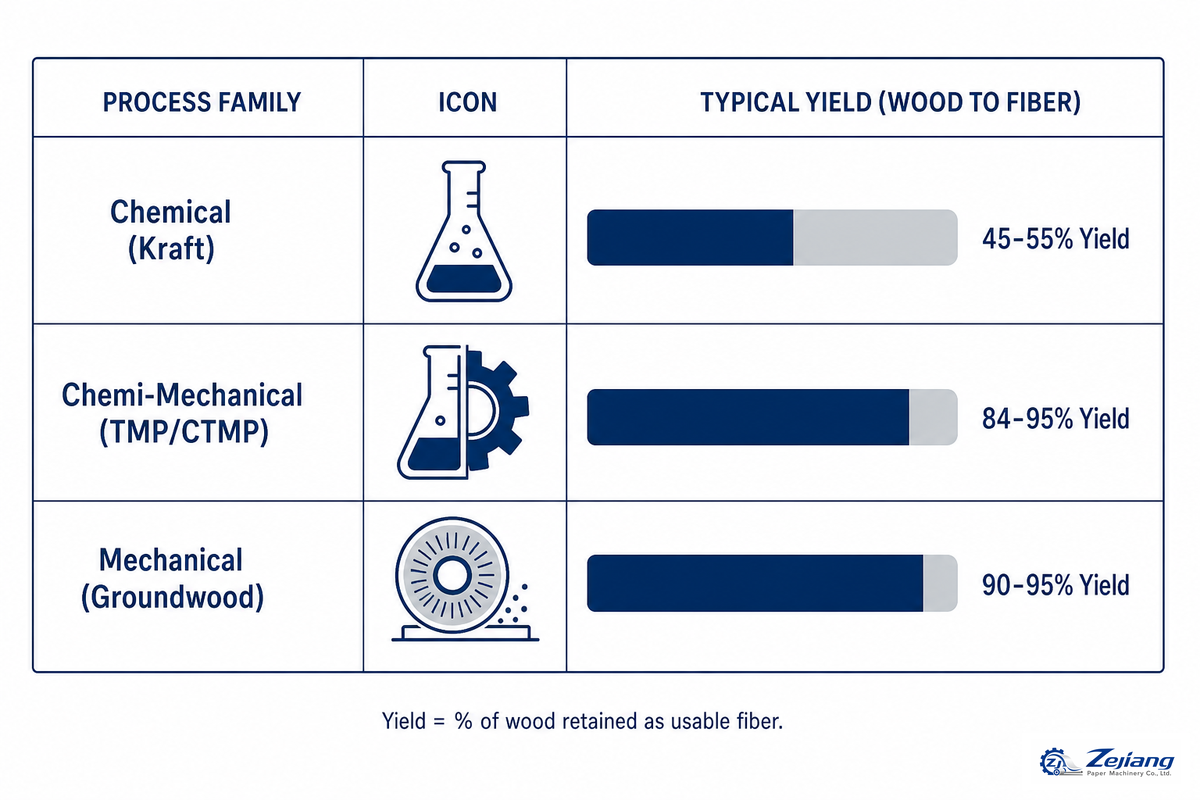
Pulping splits into three process families that trade fiber yield for fiber strength: chemical pulping (kraft) dissolves lignin with cooking chemicals to produce high-strength, lower-yield fiber; mechanical pulping grinds or refines wood into high-yield, shorter, weaker fiber; and chemi-mechanical pulping uses a mild chemical pretreatment before mechanical refining to land in between.
| Process | Yield (% of wood input) | Burst Index | Tear Index | Typical End Use |
|---|---|---|---|---|
| Kraft (chemical) | 45–55% | 7.10 | 6.40 | Kraft paper, testliner, high-strength packaging |
| Groundwood (mechanical) | 90–95% | 0.91 | 1.90 | Newsprint, lower-strength grades |
Source: USDA Economic Research Service, Industrial Uses of Agricultural Materials, Situation and Outlook Report, Table 8.
Chemi-mechanical grades (TMP/CTMP) sit between these two rows at roughly 84–95% yield, per the same USDA data set, without the full strength penalty of pure groundwood, the mild chemical pretreatment recovers some fiber bonding capacity that pure mechanical grinding sacrifices. Worth flagging honestly: a second independent USDA source (the Forest Products Laboratory) gives chemical-pulping yield as “about 40% to 50%” rather than the 45–55% in the table above, the two Tier 1 government sources don’t fully agree, so treat “roughly 40–55%” as the safer working range rather than either number alone.
One common specification mistake follows directly from that yield gap: buyers chasing the highest tonnage-per-hour number on a spec sheet sometimes default to a mechanical pulping machine purely for its 90–95% yield, then discover the finished sheet fails a burst- or tear-strength requirement the grade actually needed. Yield and strength trade against each other in this table, not with each other, so the process choice has to start from the target paper grade, not from whichever yield percentage looks best on paper.
What Is the Difference Between High Consistency and Low Consistency Pulping?
Low consistency (LC) pulping runs at a lower fiber-to-water ratio, generally under about 6%; high consistency (HC) pulping runs thicker, roughly 8–18% depending on the machine. The difference isn’t just water content: HC batch pulping normally uses a helical rotor turning at a deliberately low speed, specifically to avoid shredding contaminants into fragments too small for downstream screens to catch.
Mill engineers discussing pulper rotor selection on the IPPTA (Indian Pulp and Paper Technical Association) forum describe this as a deliberate design choice, not a shortcut, aimed specifically at plastic film and similar contaminants. Read literally, that means a faster-spinning rotor isn’t automatically “more thorough” pulping, one of the more counterintuitive operating realities in this equipment category, and it’s why raw material composition, how much hardwood or mechanical pulp sits in the furnish, has to factor into the RPM/consistency setting rather than a single fixed number for every batch. Many HC pulpers also pair the rotor with a ragger, a slowly rotating rope that continuously hauls out long, stringy contaminants, rags, wire, baling twine, before they can reach the screens at all.
“High consistency batch pulping normally uses a helical rotor, which is very much larger in relation to the pulper tub than a low consistency rotor. The low rotor speed relative to low consistency pulping reduces the cutting of plastic and other contaminants.”
The Kraft Process, Why It Dominates Chemical Pulping
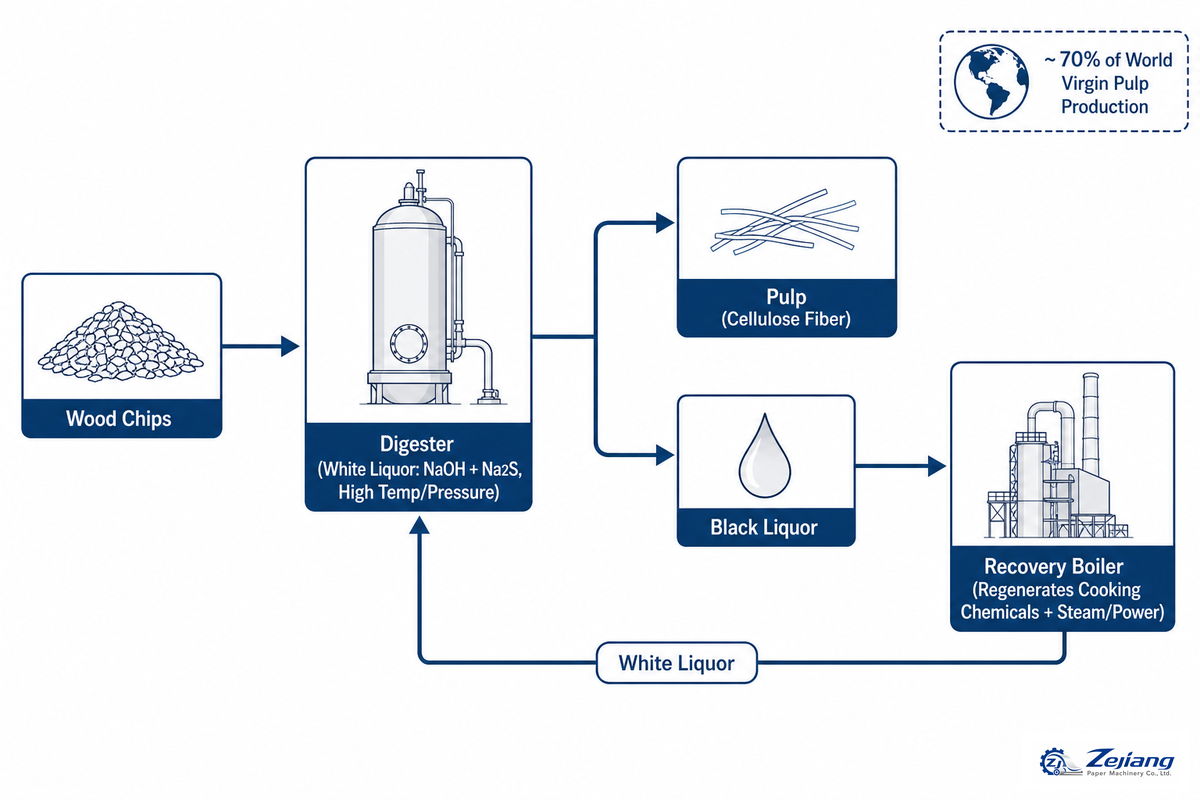
Kraft pulping cooks wood chips in white liquor, a solution of sodium hydroxide and sodium sulfide, at high temperature and pressure, dissolving lignin (the natural binder holding wood fibers together) and freeing individual cellulose fibers with their strength largely intact. What comes out the other side, alongside pulp, is black liquor: the spent cooking chemicals plus dissolved lignin and wood extractives, carrying most of the wood’s original energy content.
Kraft dominates chemical pulping for one structural reason: black liquor isn’t waste, it’s fuel. Mills burn it in a recovery boiler to regenerate cooking chemicals and generate steam and power for the mill itself, a closed chemical-recovery loop that few competing chemical processes match at scale. That loop is exactly why kraft mills carry a heavier upfront capital bill (a recovery boiler is a major line item) but a materially lower long-run chemical and energy operating cost than an open-cycle chemical process, the same capex-versus-opex trade-off buyers weigh when deciding how much sourcing risk they’re willing to carry (see the sourcing discussion further down this guide).
Kraft’s dominance shows up in the production data, too: kraft (sulfate) pulping accounts for roughly 70% of the world’s virgin pulp production and over 90% of chemical pulp production, per Elsevier’s Reference Module in Chemistry, Molecular Sciences and Chemical Engineering (2016). That share reflects decades of the chemical-recovery economics above, not fiber quality alone, a mill running a weaker chemical process without a comparable recovery loop pays full price for fresh chemicals on every single cook in the production process. A peer-reviewed sustainability review of kraft pulping, hosted by the U.S. National Institutes of Health’s PubMed Central archive, frames chemical refining broadly, kraft foremost, as the process family carrying today’s pulp industry, consistent with the production-share figures above (its own headline production-share figure is scoped to U.S. mills specifically, so it’s cited here for the framing, not repeated as a second global percentage).
Pulping Equipment, The 6 Core Machine Types in a Stock-Prep Line
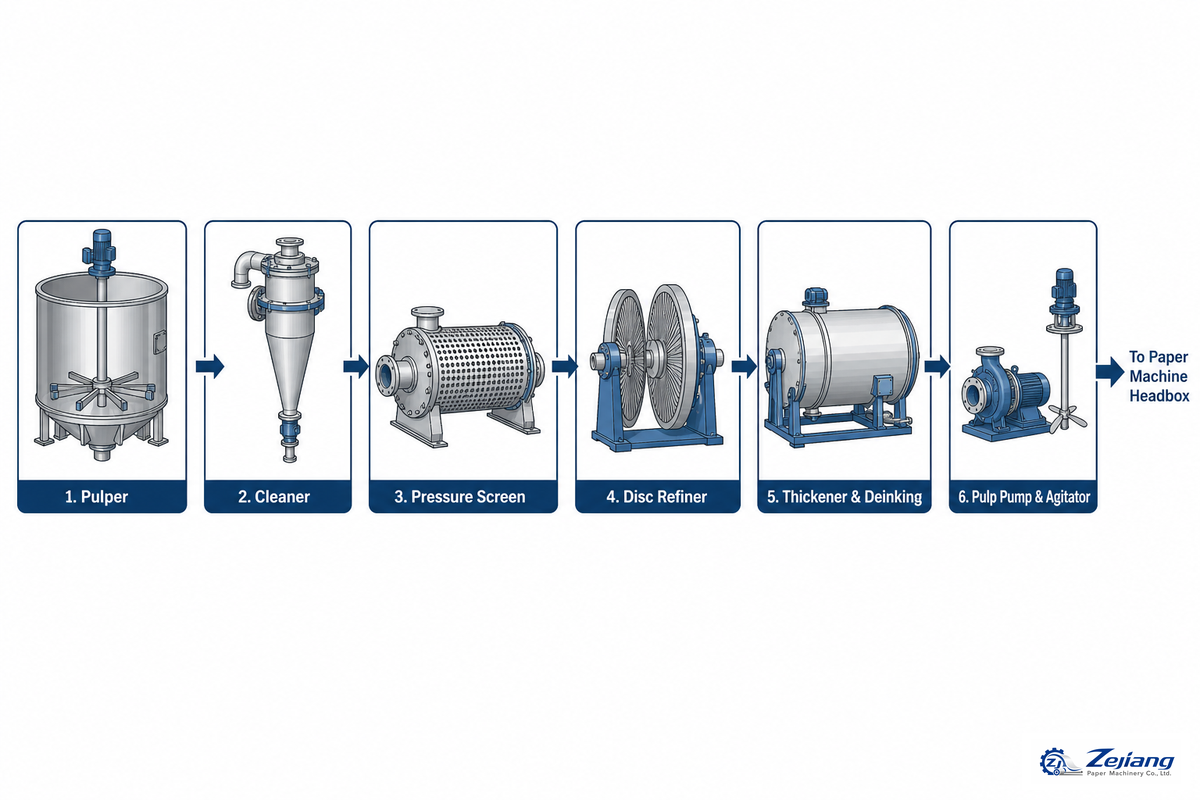
A working stock-prep pulping system is six distinct machine categories, not one all-purpose “pulping machine” — buyers sometimes still shorthand the whole line as a single “pulp machine,” but each stage below handles a specific job between raw fiber intake and the paper machine headbox. Our complete pulping equipment line covers all six categories, plus the spare parts and support equipment around them.
| Equipment Type | Stock-Prep Stage | Function | Learn More |
|---|---|---|---|
| Pulper | 1 — intake | Defibers raw material — virgin pulp, OCC, or agricultural fiber — into a pumpable slurry using a rotating rotor; on recycled-fiber lines, this stage is commonly called a waste paper pulper | paper pulper machine |
| Cleaner (separator) | 2 — cleaning | Spins stock through a cone to fling out heavy contaminants — grit, staples, glass — by centrifugal force | paper mill cleaner |
| Skipping this stage to trim machine count is a recurring under-speccing pattern for a pulper machine for paper industry lines running recycled furnish — without density-based contaminant removal ahead of it, grit and glass accelerate downstream refiner-plate wear instead of being caught early. | |||
| Pressure screen | 3 — screening | This screening equipment removes oversize shives and debris by particle size, protecting the refiner and paper machine from contamination downstream | pressure screen |
| Disc refiner | 4 — refining | Works stock between two grooved discs to refine and fibrillate fiber, building bonding strength before the sheet forms | disc refiner |
| Thickener & deinking unit | 5 — dewatering | Dewaters stock between stages, water removal that keeps consistency on target, using disc filter, twin roll press, or screw press technology; on recycled lines the deinking unit also strips ink and coating particles from recovered fiber | pulp thickener and deinking |
| Pulp pump & agitator | 6 — transfer | Keeps stock moving and in suspension between every stage above — without them, fiber settles and consistency drifts out of spec | pulp pump and agitator |
| Conveyor | 0 — material handling | Moves baled raw material into the pulper at the very start of the production line — inter-stage handling, not one of the 6 core categories, but keeps the whole line fed | — |
| Paper machine (downstream) | 7 — out of scope | Forms, presses, and dries finished stock into paper or board — this is where stock preparation hands off, not part of the pulping-equipment line covered here | paper machine wet-end |
What Is the Difference Between a Drum Pulper and a D-Type Pulper?
Equipment specification guides commonly describe a drum pulper as a continuously rotating, perforated cylindrical drum that tumbles raw material at a gentler, more consistent intensity, well suited to high-volume continuous lines where preserving fiber length matters. A D-type pulper, by contrast, is a vertical tank with a single rotor at its base, typically run in batch or semi-continuous mode.
The D-type design is mechanically simpler than a drum pulper and remains the more common small paper pulp making machine choice for general OCC and mixed-waste-paper duty at small and mid-size mills. Throughput and fiber preservation favor the drum design, while simplicity and lower upfront cost favor the D-type — in practice, neither design is universally better for every furnish.
How to Select the Right Pulping Equipment for Your Furnish

The 4-Question Furnish Diagnostic narrows a stock-prep specification down to a process family and machine path before you ever call a supplier, answer these four questions about your own furnish and target output, and each answer routes toward a specific configuration.
The 4-Question Furnish Diagnostic
- Q1, What’s your furnish type? Virgin wood pulp, OCC secondary fiber (deinked), OCC secondary fiber (non-deinked), or non-wood fiber (wheat straw, bagasse, or similar agricultural residue). Virgin wood pulp needing high strength points to the kraft/chemical route; OCC or mixed waste paper points to mechanical re-pulping with screening and cleaning sized to your contaminant level; non-wood agricultural fiber behaves differently enough from wood-based furnish that a standard wood-fiber spec sheet won’t transfer directly, flag this for your supplier explicitly, since straw pulp and other non-wood furnish typically need distinctly different screening and cleaning settings than a wood-based line.
- Q2, What target consistency do you need? Low consistency (LC) or high consistency (HC) changes rotor design, motor torque, and water/energy load per tonne. As Nugget 1 above shows, the right RPM/consistency setting isn’t a fixed number, it has to track the hardwood or mechanical-pulp ratio actually in your furnish.
- Q3, What’s your contaminant load? Heavy film, plastic, or grit content routes you toward a slower HC rotor speed and a tighter cleaner/screen cascade, not a faster, more aggressive pulper, per the counterintuitive finding above.
- Q4, What’s your target capacity? Tonnes-per-day throughput determines batch vs. continuous machine sizing, and it’s also the point where single-source versus multi-vendor sourcing risk (covered next) starts to matter more, not less.
Run all four answers together and you have enough to open a request for quote with a specific process family and machine path in hand, rather than a generic capacity number, see our machine finder tool to match your answers to a specific configuration.
How to Select the Right Pulper for a Paper Mill?
Start with furnish type and target consistency, not throughput alone, a pulper sized only around tonnes-per-day and bought without matching the screening and cleaning stage behind it is the single most common selection mistake covered further down this guide. Work through the four questions above in order, confirm the raw material composition your line will actually run (not just the design-basis furnish on paper), and only then compare capacity numbers across suppliers.
💡 Pro Tip
If a quote arrives with a pulper capacity number and nothing about consistency target or contaminant load, ask for those two figures before comparing price. A larger pulper paired with an undersized screening stage doesn’t raise your line’s real output — it just moves the bottleneck one stage downstream.
Single-Source vs. Piecemeal Equipment Sourcing, What Actually Changes
Buying a pulper from one supplier and a screen or refiner from another doesn’t just change price, it changes who’s accountable when the interface between those machines, not any single machine, underperforms after startup.
Output variation surfacing weeks after commissioning, once machines from different vendors are running against each other’s actual field performance rather than a shared spec sheet, is a documented consideration in stock-prep buying, worth raising at RFQ stage rather than after commissioning. We didn’t find a single public case study pinning multi-vendor sourcing down as the specific cause of pulping-stage commissioning delays, so treat this as a real risk factor to ask suppliers about directly, not a settled statistic to quote back at them.
A related pattern shows up on IPPTA’s mill-engineer forum, where an operator posted asking for contact information for the original supplier of a centrifugal cleaner after a valve failed, the machine itself wasn’t the problem; not knowing which vendor to call for the part was. Multi-vendor lines create that exact traceability gap at scale: every machine carries its own spare-parts channel, drawing set, and support contact, and losing track of any one of them slows a repair down when it matters most.
Zejiang’s pulping and stock-prep lines are offered with CE, ISO 9001, and ISO 14001/45001 documentation on request, but certification scope varies by destination market, so confirm exactly which standard and which specific machine the paperwork covers before signing. The same RFQ conversation is a good place to confirm machine guarding and lockout/tagout provisions on rotating equipment (pulper rotors, refiner discs, cleaner cones), and to ask whether your stock-prep wastewater discharge will need a separate local environmental permit, both vary by destination country and are easy to assume are “standard” when they’re not. Our RFQ readiness checklist walks through exactly what to ask for before you sign.
Common Pulping Equipment Selection Mistakes

Recurring pulping-equipment selection mistakes cluster around buyers treating one machine as the whole spec, not around any single wrong number. That pattern isn’t unique to pulping: a NIST cost study of inadequate interoperability across the broader U.S. capital-facilities industry put the resulting cost at $15.8 billion a year, roughly two-thirds of it landing on owners and operators after handoff, the same interface-risk economics behind the sizing mistake below.
Picture a recycled-fiber line that adds a second pulper to push daily tonnage up by a third but leaves its one existing pressure screen untouched: within a few weeks of restart, reject rates climb, throughput flattens well below the new target, and the extra pulper capacity sits mostly idle, the same interface-level failure mode NIST’s interoperability-cost data describes above, just playing out at single-line scale instead of across a whole capital project.
- ⚠ Sizing the pulper alone. Upgrading pulper capacity without rebalancing the screening stage that follows it just moves the bottleneck downstream instead of removing it, a documented recurring pattern in stock-prep specification — Valmet’s own field-performance notes flag exactly this class of overlooked, wear-driven inefficiency in under-machine pulpers.
- ⚠ Assuming faster rotor speed always pulls a batch apart more thoroughly. Mill engineers on IPPTA’s forum report the opposite for high-consistency batches: a deliberately low rotor speed is what keeps plastic film and other contaminants from shredding into pieces too small for downstream screens to catch.
- ⚠ Tightening screen plate gaps beyond spec to “catch more junk.” The same forum discussion notes over-tightened plate gaps can reduce pulp quality and, in some cases, contribute to air-pollution issues at the discharge point, not a free win.
- ⚠ Treating pressure-screen wire wear as a one-time spec. Mill calculation references on IPPTA’s forum list “% wear of wire” alongside theoretical roll weight as a standard input mills track over the life of the screen, an ongoing operating-cost variable, not a number you check once at purchase.
Pulping Equipment and Stock Preparation, Industry Outlook

Two forces are moving 2025–2026 pulping-equipment capital spending more than raw production growth: recycled-fiber circularity and fiber recovery targets, and automation retrofits on existing lines rather than new-build capacity alone.
On the regulatory and circularity side, CEPI’s 2024 Key Statistics report puts Europe’s paper-for-recycling utilisation rate at 58.6% of paper & board production for that year, against the sector’s stated target of a 76% paper recycling rate by 2030; in the U.S., AF&PA reports recycled fiber reached 44.4% of all fiber used at U.S. mills the same year. Those are two real, region-specific figures for the same 2024 reporting year, not one interchangeable global number, worth keeping apart if you’re benchmarking against either market specifically, and worth checking each association’s site directly for any more recent annual update before you quote them in an RFQ document.
On the automation side, a Buckman Laboratories patent granted in 2025 replaces static, scheduled enzyme dosing in stock preparation with real-time, sensor-fed reformulation, a genuine, dated digitalization signal for the chemistry side of this equipment category. On the capex side, Voith is supplying Adami S/A in Brazil a complete OCC stock-preparation plant with autonomous “4.0” operation software, commissioning October 2025 (the first Latin America installation of these specific automation products), and, per trade-press reporting, DS Smith is investing $60.6 million in a new fiber-preparation line and drum-pulping/screening system at its Kemsley, UK mill, commissioning in early 2026, a project figure that comes from industry press coverage rather than a DS Smith investor filing, so treat it as directionally reliable rather than audited.
Henan Zejiang ships pulping and stock-prep lines across Asia, the Middle East, Africa, and South America, the same regions carrying the most active 2024–2026 stock-prep capex alongside Europe’s recycled-fiber modernization wave above. If you’re planning a 2026 order, ask suppliers directly about sensor-based automation retrofit options and recycled-fiber handling capacity now, treating either as a future add-on misses where documented capex is actually going.
Frequently Asked Questions
Q: What is a pulping machine?
View Answer
A pulping machine — also called a pulper — is the equipment that mechanically breaks down raw fiber into a pumpable slurry using water and rotor-driven agitation. It sits at the very start of a paper mill’s stock-preparation line, ahead of screening, cleaning, and refining, and processes virgin wood pulp, recycled waste paper (OCC), or agricultural fiber depending on what a mill is running. How well the pulper defibers its input largely determines how much work every downstream machine has left to do.
Q: What are the different types of pulping machines?
View Answer
Pulping machines split along two lines: process family and mechanism. By process, chemical (kraft) pulping cooks fiber with chemicals for high strength at lower yield, mechanical pulping grinds or refines fiber for higher yield at lower strength, and chemi-mechanical pulping sits between the two. By mechanism, pulpers themselves come in low-consistency, high-consistency, and drum designs, each suited to a different furnish and throughput target — see the machine types and furnish diagnostic sections above for how to match your own line to one.
Q: What materials are used for pulping?
View Answer
Pulping equipment processes three broad material categories. Virgin wood pulp — chips cooked, and sometimes bleached, into pulp at a pulp mill — goes through mechanical re-pulping once it arrives at a paper mill as dry-lap sheets. Recovered fiber, most commonly OCC, is the dominant recycled input for packaging-grade lines. Non-wood agricultural fiber, including wheat straw and bagasse, is used in regions where wood fiber is scarce or costly, though it typically needs different chemical dosing and screening setup than wood-based furnish.
Q: How much does paper mill equipment cost?
View Answer
Pricing depends on capacity, consistency requirements, automation level, and destination-market freight and duty costs, so we’re not publishing a generic figure that can’t be verified against your specific furnish and throughput target. Request a capacity-specific quote through our RFQ readiness checklist for a current number.
Q: How long does paper mill equipment last?
View Answer
Well-built stock-prep machinery — pulpers, refiners, screens — is commonly cited in industry maintenance literature as running 15–20-plus years with proper maintenance, though actual service life depends heavily on water chemistry, duty cycle, and how consistently wear parts like screen plates and rotor components get replaced on schedule.
Q: What is the difference between stock preparation and the wet end?
View Answer
Stock preparation is everything covered in this guide — pulping, screening, cleaning, refining, thickening, and pumping — that turns raw fiber into finished, consistency-controlled stock. The wet end (the paper machine’s forming section) starts where stock preparation ends: stock is pumped into the headbox, distributed onto the forming wire, and drained into a continuous sheet before pressing and drying. If a problem shows up as inconsistent basis weight or formation at the wet end, the root cause often traces back to a stock-prep variable — consistency drift, incomplete screening — rather than the paper machine itself.
Ready to Spec Your Stock-Prep Line
Answer the 4-Question Furnish Diagnostic above, then talk through your specific furnish, consistency target, and capacity with our engineering team.
Request a Pulping Equipment Consultation →Our Perspective
We wrote this guide because most pulping-equipment content online either sells one machine or lists specs without explaining how the six stages, pulper, refiner, pressure screen, cleaner, thickener, and pulp pump, actually work together against a real furnish, for readers across the broader paper and pulp industry, including packaging and tissue paper lines. The yield, kraft-share, and recycled-fiber figures cited above come from USDA, Elsevier, CEPI, and AF&PA sources, not marketing copy, and we’ve flagged where the data disagrees rather than quietly picking whichever number looked cleaner. Reviewed by the Henan Zejiang Paper Machinery technical team.
References & Sources
- Industrial Uses of Agricultural Materials, Situation and Outlook Report, Table 8 — USDA Economic Research Service
- Overview of Biomechanical and Biochemical Pulping Research — USDA Forest Service, Forest Products Laboratory
- Kraft Pulp, Reference Module in Chemistry, Molecular Sciences and Chemical Engineering — Elsevier (Bernardi et al., 2016)
- 2024 Key Statistics — CEPI (Confederation of European Paper Industries)
- Paper Industry Announces 2024 U.S. Paper Recycling Rates — American Forest & Paper Association (AF&PA)
- Voith to Supply Adami with OCC Stock Preparation Plant for Santa Catarina Mill in Brazil — Paperage.com (2024-07-31)
- DS Smith to Invest $60.6 Million in New Pulping Line at Kemsley Paper Mill in England — Paperage.com (2024-02-29)
- US12286754B2, System and Method of Dynamic Corrective Enzyme Selection and Formulation for Pulp and Paper Production — USPTO (granted 2025-04-29)



![Refiner Plates & Screen Baskets [Complete Guide]](https://zjpapermachine.com/wp-content/uploads/2026/07/refiner-plates-screen-baskets-guide-featured-150x150.png)
![Doctor Blade: Types, Materials & How It Works [Guide]](https://zjpapermachine.com/wp-content/uploads/2026/07/doctor-blade-guide-featured-1-150x150.png)
![Pulping Equipment: How Paper Pulping Works [Guide]](https://zjpapermachine.com/wp-content/uploads/2026/07/pulping-equipment-guide-featured-150x150.png)