Get in touch with Zejiang Paper Machinery Company


Quick Specs
| Typical roll diameter | Roughly 300-875 mm, depending on machine width and application |
| Typical roll body length | Roughly 600-4,500 mm for paper lines; narrower ranges for rubber and film |
| Common core materials | Chilled cast iron, forged steel, composite/polymer covers |
| Primary functions | Smoothing, gloss control, thickness reduction, densification |
| Industries served | Paper, textile, rubber, plastic film, lithium-ion battery electrode manufacturing |
A calender roll is the roller in cylindrical form that does the real pressing when a machine calenders a film or sheet as part of a broader finishing process. It’s a critical component of the calendering equipment on which every paper mill, film line, and battery electrode plant that passes material through a nip relies — yet it’s one of the most poorly explained parts of the process. Once calendered, the web carries that roll’s surface finish for the rest of its life, which is why this guide covers what a calender roll is, how the nip really works, which types and materials suit which jobs, and where the technology extends far beyond paper.
A calender roll is a heavy, precisely ground cylindrical roller pressed against another similar roller to compress, smooth, or densify a moving sheet. Paired rolls form a nip, and the heat and pressure applied at that high nip set the final thickness, gloss, and surface finish of the sheet passing through it — the exact pressure applied is tuned per job, along with the roll’s face length, to match the material and the target result.
Key Facts
- A calender roll is one piece of equipment. A calender is the machine built around one or more such calender rolls.
- The number of rolls in a stack-as few as two rolls, or three, four, or more-determines the number of times a sheet is nipped and increases surface uniformity at the expense of throughput.
- Chilled cast iron and soft-covered composite/polymer calender rolls serve different needs. One offers a harder surface and more heat, the other protection of the sheet at lower nip loads.
- Calendering isn’t paper-only. It’s also a required step in lithium-ion battery electrode manufacturing, where it compresses coated electrode material to a target density.
- Most streaks, wrinkles and sheet variations are caused by inconsistent pressure across the width of a calender-not by poor-quality material.
What Is a Calender Roll? Definition and How It Differs from the Calender Machine
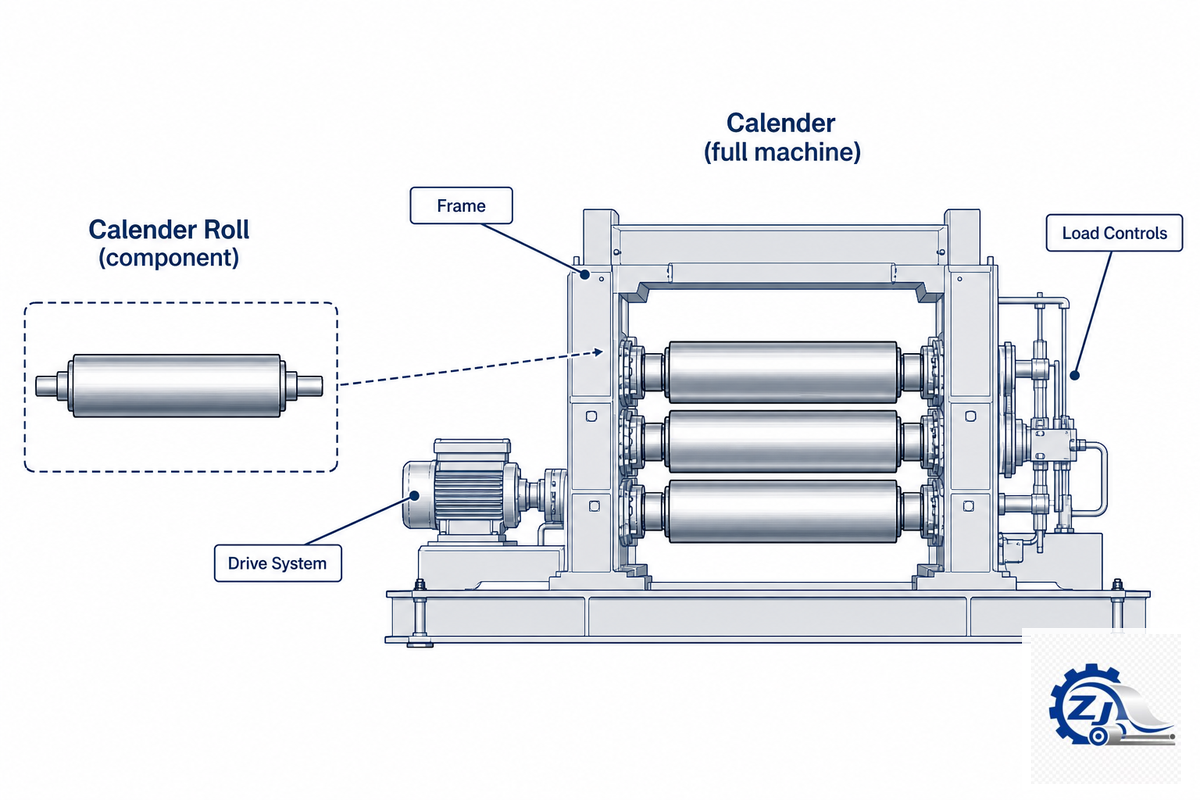
The common conflation of calender and calender roll is a natural consequence of usage. Ask five people in a paper mill what a calender is and you’ll likely get five different definitions, since the word has been used loosely in industry for decades. Technically, though, a calender is the whole assembly of rolls, frames, drive systems, and load controls, while a calender roll is just the single precision-ground roll that does the actual work inside it.
This confusion isn’t limited to the assembly-versus-component distinction. People are also prone to autocorrect or misspelling “calender” as “calendar,” which contributes to many web searches for calender rolls returning confusing results, or to suppliers’ catalogs mistakenly grouping the terms together as synonymous, despite their being entirely different products with nothing in common beyond an orthographic coincidence. In more technical documents, like engineering drawings, the term “calendering roller” may be used interchangeably to mean a calender roll.
This isn’t just informal industry shorthand — TAPPI, the pulp and paper industry’s standards body, maintains formal testing and terminology methods that treat the calender (machine) and its individual rolls as distinct items in a spec sheet, which is the root of why getting the two mixed up on a purchase order causes real quoting confusion.
⚠️ Common Mix-Up
It is quite common when ordering a new calender to simply request a new calender roll instead, or vice versa. Even a working calender definition can blur in practice: if you specify a “calender repair,” you’re often quoted for a full system overhaul that may include replacing the drive system, frame, and loading equipment, while a new roll or a reground roll is a fraction of the price and timeframe. Ensure you understand what exactly the quote includes before making comparisons.
How Calendering Works: Nip Pressure, Heat, and the Smoothing Mechanism
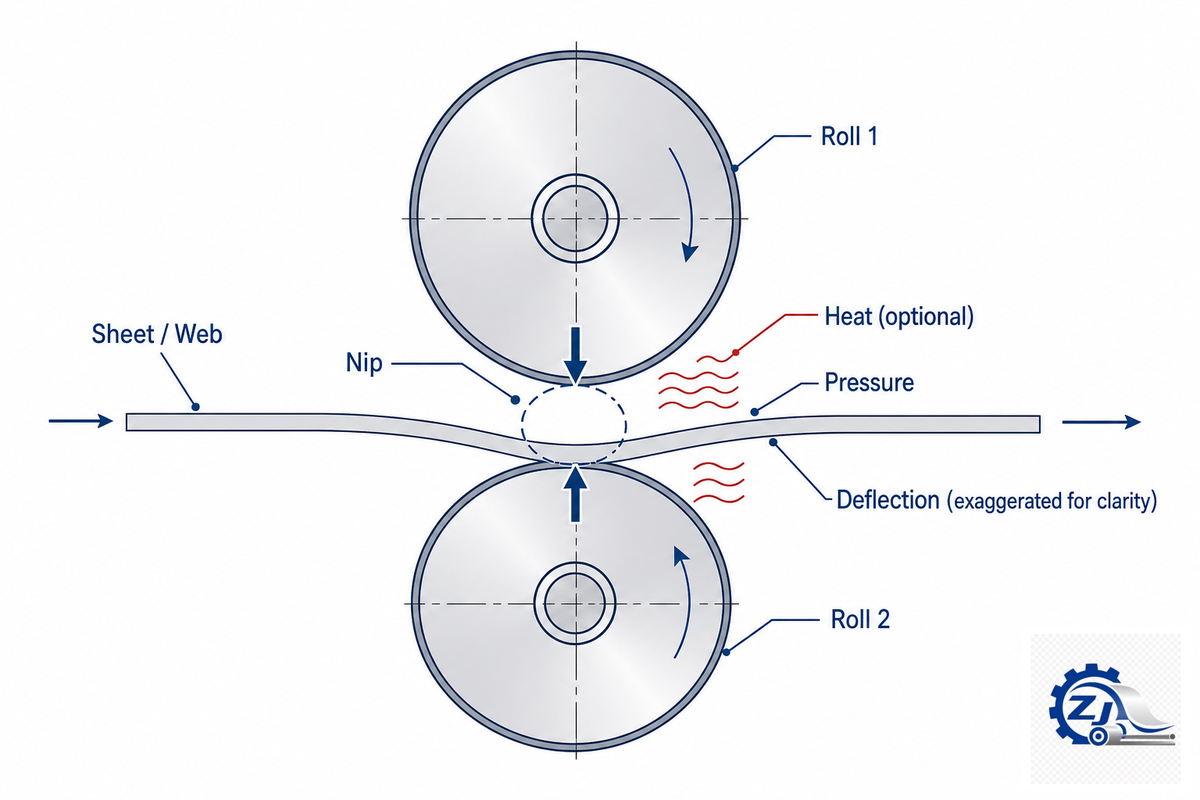
Calendering operates by threading a sheet between two or more rollers, sometimes heated rolls, under precise pressure until the sheet reaches the target thickness, gloss, or density. The point where the rollers converge is called the nip, and the calender roll’s performance depends on a perfectly uniform nip pressure across the entire roll width. An uneven nip is the single biggest problem operators run into on a calender line.
What Is Nip Pressure and Why Does It Matter in Calendering?
Nip pressure is the pressure distributed along the contact region between two calender rolls, and it’s seldom naturally perfectly even. Every roll, while under load, flexes slightly along its length — a deflection effect — causing the nip to be tighter at the ends than in the middle unless it’s actively corrected. Engineers counter this calendering-nip imbalance with roll bending and crown control built into the roll design.
According to David R. Roisum, Ph.D. of Finishing Technologies Inc., writing in a TAPPI-published technical paper, this established engineering relationship lets mills estimate peak nip pressure from the formula σc = 1.277 × N/W, where N is the lineal nip load in pounds per inch and W is the measured nip width in inches. Mills use this relationship, along with pressure-sensitive nip impression paper, to check whether a roll’s crown still matches its operating load, catching a mismatch before it becomes a costly problem that shows up as a streak or gauge variation in the finished product — and before the roll needs an unplanned trip to precision grinding to correct it. As one worked reference point, a nip impression paper rated to saturate at roughly 500 PSI will read as uniformly dark even if the true nip pressure varies anywhere from 500 to 5,000 PSI across the width, so paper selection matters as much as the test itself.
Roll temperature becomes the second variable affecting the product. Published cross-profiling research into hard-and soft-nip paper calenders indicate about a 108°C difference between the temperature of a chilled iron roll and its partner soft-cover roll under similar conditions. This difference is substantial enough to make consideration of thermal expansion as well as mechanical deflection necessary when calculating crown and clearances.
“A nonuniform nip is nearly synonymous with a nonuniform product.”
📐 Engineering Note
Nip closures aren’t a minor mechanical event. Under OSHA 29 CFR 1910.216 (Mills and calenders in the rubber and plastics industries), calenders must stop within 1¾% of the roll’s peripheral no-load surface speed once an emergency trip is activated (1½% for mills), and mill roll installations must keep the top of the operating rolls at least 50 inches (about 1.27 m) above the operator’s standing level. The same standard requires safety trip cables to run within 72 inches (about 1.83 m) of the operator’s standing level on both the front and back face of the roll, within reach of the nip. Heated calender rolls are commonly held to a surface temperature uniformity of around ±0.5°C across the face, with a thermal fluid or hot oil loop circulating inside the roll body to hold that high temperature steady rather than an open flame or direct steam jacket; nip loads on a wide paper machine can exceed several tons, more than enough to injure a person, which is why lockout/tagout and mechanical nip-blocking are standard procedure before anyone works near an open roll set. Getting both temperature and pressure right together, not just one or the other, is what actually determines finish quality.
Roll Stack Configurations: 2-Roll, 3-Roll, and 4-Roll Calender Setups
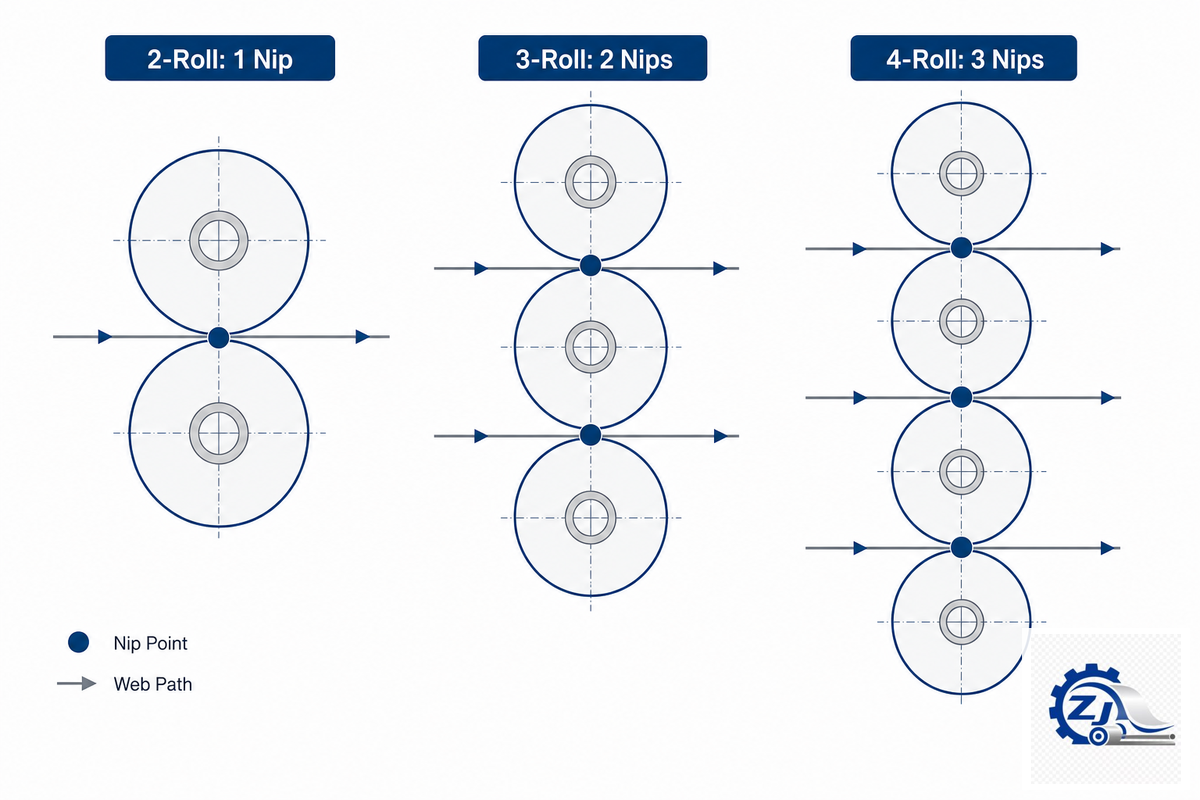
How many rolls sit in a calender stack controls how many times the sheet gets nipped in one pass — a direct trade-off between throughput, energy consumption and the degree of smoothing or gloss achievable on the line. Common configurations range from a simple 2 roll calender machine up through larger 3 roll calender machine (three rolls, two calendering nip points) and 4 roll calender machine (a four-roll calender) stacks, and calender roll design has to account for where in that stack a given roll sits.
| Configuration | Nips per Pass | Typical Use |
|---|---|---|
| 2-roll | 1 | Light smoothing, lower capital cost, moderate gloss targets |
| 3-roll | 2 | Mid-range gloss and caliper control, common on converting lines |
| 4-roll (multi-roll stack) | 3 | High-gloss paper finishing, tighter caliper tolerance, higher capital and maintenance cost |
Key Factors to Consider
- If the sheet only require light smoothing at high line speed, added nips generally cost money and risk downtime without significant increases in gloss.
- Every nip added is another problem for the deflection control systems-more rolls means more calculations to do for crown and load.
- An offline calender stack (run separately from the paper machine) has potential for more nips and tighter finish control than a calender section integrated within the machine, although this involves an additional handling step.
Stack position also changes what kind of roll belongs there. TAPPI cross-profiling research on hard- and soft-nip calenders uses a reference roll-cover hardness of 91° Shore D when modeling nip elasticity, which is the kind of figure a stack designer needs on hand before deciding which position gets a hard chilled-iron roll and which gets a soft-cover partner.
Calender Roll Types and Materials: Chilled Iron vs. Steel vs. Soft-Cover
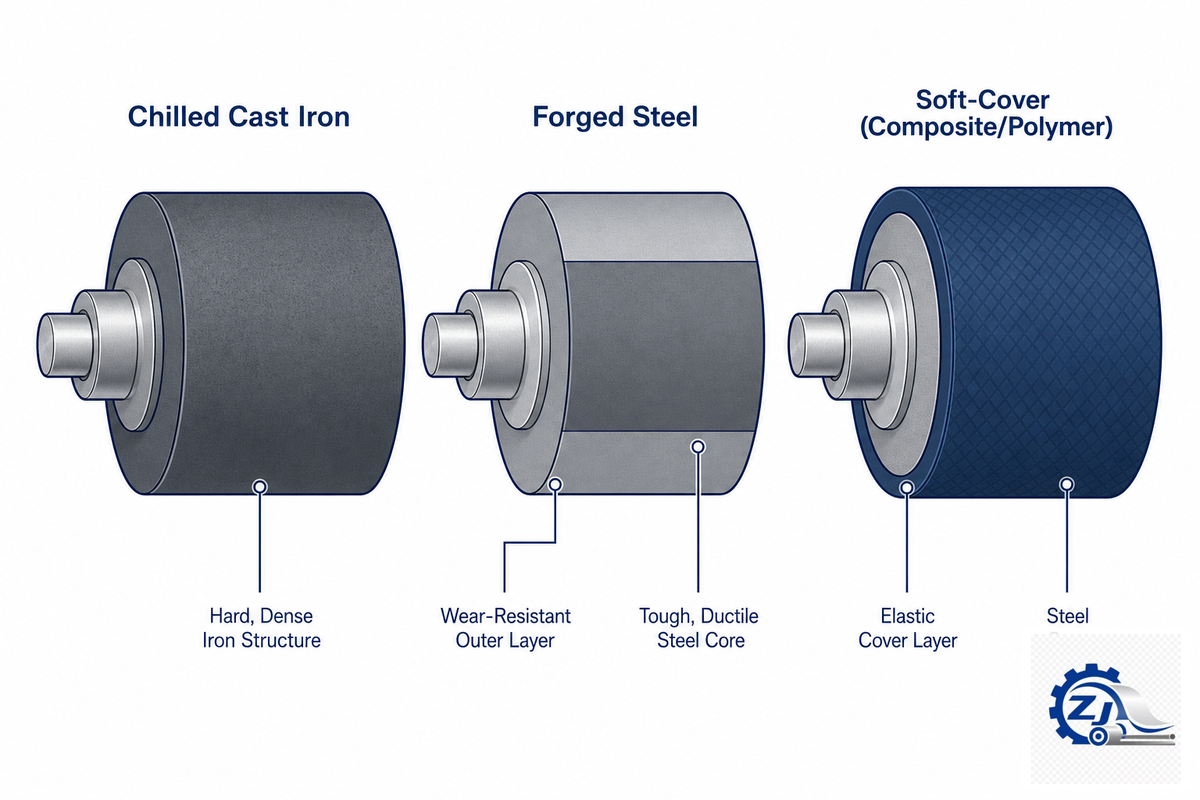
When selecting a calender roll material, consideration comes down to how hard the roll must be, its heat-handling properties and how tolerant it’s of the sheet material.
What Is the Difference Between a Calender Roll and a Calendering Roller?
Functionally, they’re not different at all. The terms calender roll and calendering roller are used interchangeably in industry documents and drawings to describe the same component. What distinguishes the two is naming convention, not design. Where the terms do start to diverge is in the modifiers — a “chilled iron calender roll” and a “soft calender roll” describe genuinely different products.
| Roll Type | Typical Hardness | Best Fit |
|---|---|---|
| Chilled cast iron | Hard, wear-resistant surface (industry-reported figures cluster near 50 HRC) | High-pressure hard-nip finishing, long wear life, dimensional stability at temperature |
| Forged steel | Tougher core than cast iron, good for larger-diameter, higher-load rolls | Wide webs, high line-load applications, situations needing bore drilling for internal cooling |
| Soft-cover (composite/polymer) | Roughly 88-93 Shore D, industry-reported | Lower nip loads, sheet-marking sensitivity, uneven caliper feed sheets |
A forged steel roll trades some of chilled iron’s surface hardness for a tougher core, which is why mills pick it for the largest-diameter, highest-load stacks rather than lighter-duty lines — and among heavy rollers generally, a solid steel core still resists bending better than most composite alternatives. Older soft-cover formulations sometimes used compressed cotton or paper-fiber cores under the working surface before modern polymer covers took over, and the rheology of whichever cover material is chosen (how it deforms and recovers under repeated nip loading) still drives the wear-life math today. For high gloss finishes, a polished metal, ground calender roll surface often falls around 0.02 mm Ra with a TIR (total indicated runout) of around 0.002 mm on the tightest rolls-sufficient precision that the roll grinding process, as much as the material, dictates whether the roll can achieve the desired caliper and gloss targets.
Surface coating, separate from the material itself, typically involves either a chromium plating or a tungsten carbide coating on a chilled iron roll, for good wear and corrosion resistance. A mirror-finish polishing is applied to the ground surface of the roll for direct transfer of gloss to the sheet; the higher and more consistent the polishing, the higher the achievable gloss.
chilled cast iron is generally specified for calender rolls by grade-often labeled with a “TUK” specification in the industry that corresponds to a grouping of composition and hardness targets. These are commercial trade specifications and not standard ASTM or ISO designations, so be sure to ascertain which supplier’s grade table is being used when such a grade is cited. A formal alternative reference point is ASTM A532/A532M, the abrasion-resistant cast iron specification some mills ask suppliers to grade against instead of a proprietary trade table.
Soft-cover materials carry their own known failure mode worth asking a supplier about directly: one U.S. patent on paperboard finishing notes that soft calendering covers are prone to delamination and cracking from overheating, which is part of why soft-cover rolls tend to carry shorter service intervals than chilled iron under comparable duty.
The Chilled Iron vs. Soft-Cover Decision Line
If the sheet is uncoated and able to tolerate hard contact, while a priority is dimensional stability under load and long wear life, then a chilled iron calender roll is typically used. If the sheet is coated and easily marked, or if the application uses soft nips at low loading, then a composite or polymer-covered roll is likely more appropriate. This trade-off is exactly why most multi-nip stacks combine hard and soft nips rather than using one or the other throughout.
Whether chilled iron or soft-cover, our chilled iron and soft-cover calender roll options cover both families for paper machine applications, with material selection guided by the sheet grade and nip configuration on your line.
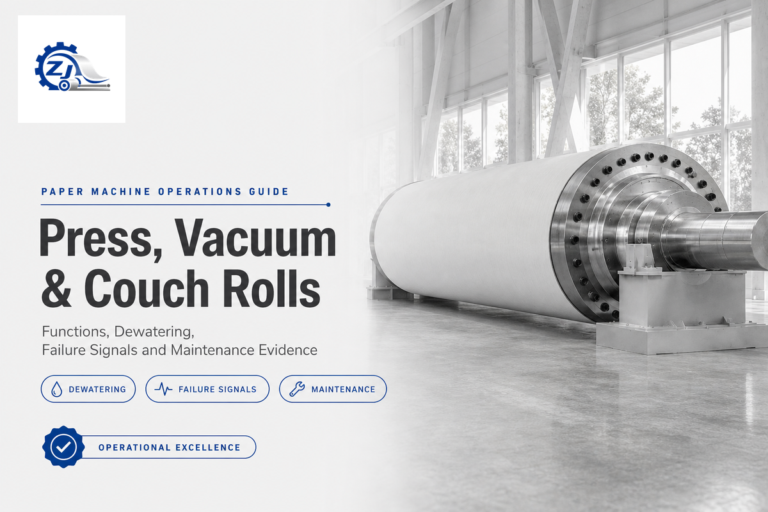
Calender Roll vs. Other Paper Machine Rolls: Press Roll, Dryer Cylinder, Couch Roll
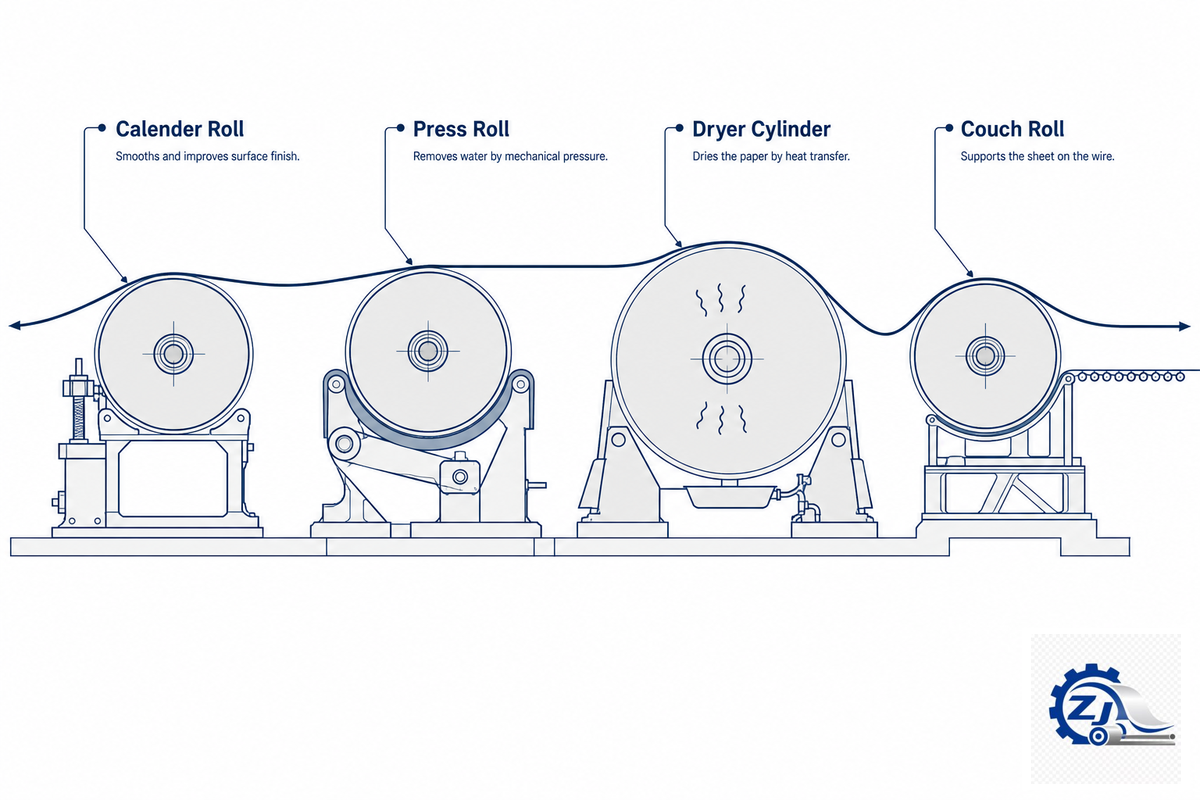
A calender roll can easily be confused with other rolls on a paper machine, simply because they look similar — large cylinders all touching the sheet — and that mix-up is a common mistake when a mill is ordering spares. What differentiates them is what part of the process they’re installed in and what function they perform; specifying the wrong roll type for a position risks a part that simply doesn’t fit the duty it’s asked to do.
| Roll Type | Process Section | Primary Function |
|---|---|---|
| Couch roll | Wire/forming section | Removes water from the wet web, transfers sheet off the forming wire |
| Press roll | Press section | Mechanically squeezes remaining water out under felt pressure |
| Dryer cylinder | Dryer section | Steam-heated pressure vessel that evaporates remaining moisture |
| Calender roll | Calender section (after drying) | Compresses the already-dry sheet for smoothness, gloss, and caliper control |
Zejiang builds the full paper-machine roll family for the sections upstream of the calender, not just calender rolls themselves.
The 5-Industry Calendering Application Ladder: Where Calender Rolls Are Used
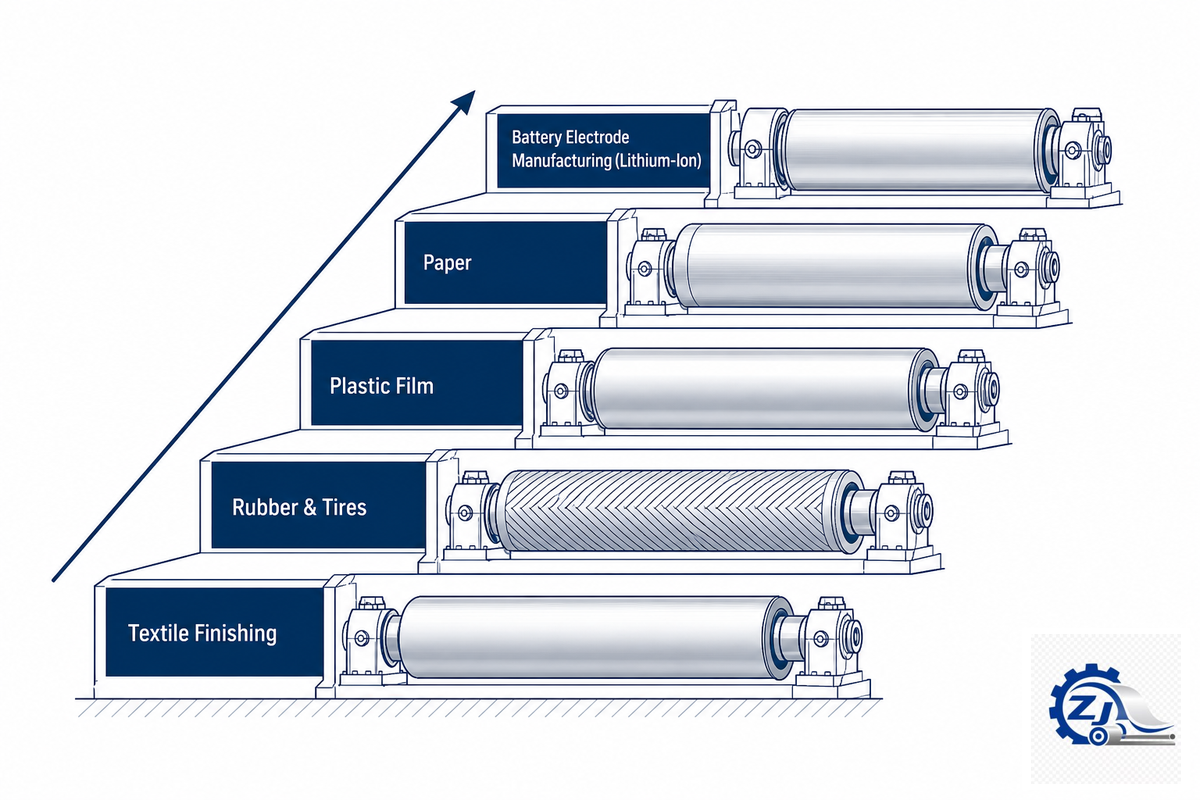
Calendering isn’t just a paper-based technology, but a web-compression technology used across several roll applications and materials in roughly ascending order of dimensional precision demanded: textile finishing, rubber and tires, plastic film, paper, and, increasingly, battery manufacturing for lithium-ion batteries. Rubber sheet coming off an extruder, a polypropylene and polystyrene film line, or a run of compressed paper stock will all pass through a calender stack before they’re finished goods. Beyond smoothing and gloss, an engraved roll — sometimes called an embosser — can also emboss a surface pattern into the web in the same pass, a texture effect used on everything from tissue to synthetic leather laminate and coated paper stock.
| Application Type | Web/Coated Material | Typical Roll Material | Nip Regime | Precision Priority |
|---|---|---|---|---|
| Textile finishing | Woven / nonwoven fabric | Steel, engraved for pattern work | Hard-nip | Surface texture and gloss |
| Rubber and tire production | Rubber compound, ply stock | Chilled iron (roll body commonly up to ~3,000 mm, precision to ~0.005 mm TIR) | Hard-nip | Gauge control |
| Plastic film (PVC and other thermoplastics) | Extruded film/sheet, roughly 0.05-1.1 mm thick | Chilled iron, chrome-plated | Hard-nip | Thickness uniformity |
| Paper — hard-nip (kraft, corrugated medium, testliner) | Packaging-grade paper | Chilled cast iron | Hard-nip | Bulk and caliper retention |
| Paper — soft-nip (tissue, facial, napkin) | Lightweight tissue grades | Soft-cover polymer | Soft-nip | Gloss at minimal bulk loss |
| Paper — coated/cultural grades | Duplex board, cultural paper | Composite/steel, thermal control | Mixed | Surface finish consistency |
| Battery — graphite anode | Graphite-coated copper foil | Hardened steel, mirror finish | Precision hard-nip | Density/porosity, through-plane thermal conductivity |
| Battery — NMC cathode | NMC-coated aluminum foil | Hardened steel, mirror finish | Precision hard-nip | Density/porosity, particle integrity |
| Nonwoven thermal bonding | Hygiene, medical, filtration nonwoven | Heated steel, engraved | Hard-nip, heated | Bond-point pattern and fiber structure |
Graphite anode and NMC cathode calendering are listed separately because they behave differently under compression — a 2026 preprint on graphite-anode thermal conductivity found a non-monotonic response that a quasi-isotropic NMC cathode didn’t show in the same study, meaning a calendering pressure profile tuned for one chemistry won’t automatically transfer to the other.
Why Are Calender Rolls Used in Battery Electrode Manufacturing?
Calendering compresses freshly coated lithium-ion battery electrode material to a precise density and thickness before the electrode is assembled into a cell. According to Argonne National Laboratory, a calendering machine uses rollers to compress the electrode into its final form as the last major step of conventional electrode processing. Density and porosity set here directly affect ionic conductivity, energy density, and cycle life.
That downstream sensitivity is why electrode calendering runs to tighter dimensional tolerances than most other calendering operations, directly ahead of cell assembly.
However, pressure control cuts both ways. A 2023 study published in Batteries & Supercaps using ex situ nano-X-ray tomography documented particle fracture in the active material caused directly by calendering pressure, evidence that more compression isn’t automatically better and that roll pressure has to be matched to the specific electrode formulation rather than maximized. A separate 2026 preprint studying graphite anode thermal behavior found the relationship between calendering and through-plane thermal conductivity is non-monotonic rather than a straight line, with conductivity initially dropping before recovering at higher compaction; the authors’ calendering-aware model cut prediction error from 31.1% down to 4.5% versus a simple porosity-based estimate, but note the finding still needs validation across more electrode formulations before it can be treated as settled.
-11%
Manufacturing cost vs. conventional wet electrode processing (dry processing route)
-46%
Energy use vs. conventional wet processing (dry processing route)
85%
Less factory floor space required (radiation-curing route)
Source: Argonne National Laboratory review of advanced electrode processing technologies, Nature Reviews Clean Technology, February 2025.
Calender Rolls in the Paper Machine: Where They Sit in the Process
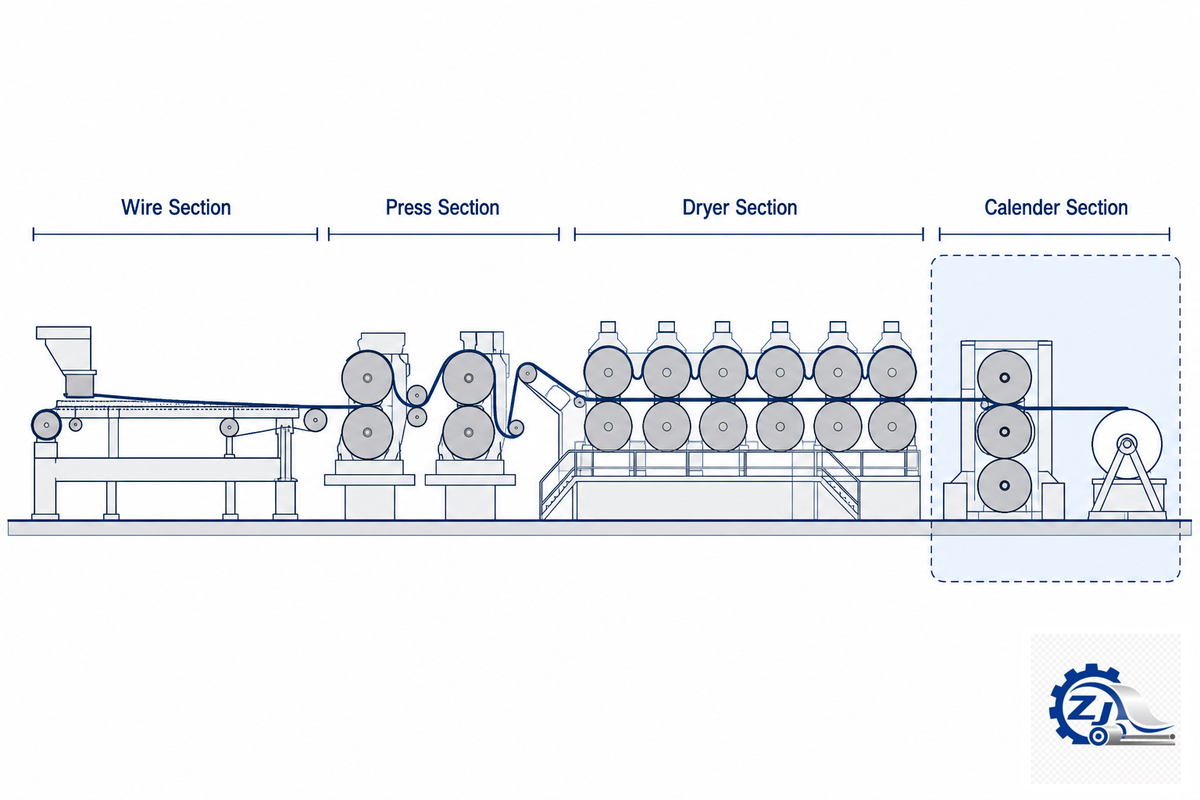
In a conventional paper machine, the calender section comes in after the dryer section, once the sheet has reached its final moisture content — calendering operates on dry sheet, not wet stock. Depending on mill layout, the calender stack may operate on-line, integrated with the paper machine, or off-line as a secondary finishing pass. Off-line stacks offer additional nips and tighter control at the cost of some added unwinding and rewinding steps, but the underlying trade-off in any configuration is the one discussed earlier for roll stacks — more nips mean more smoothness and gloss, but they often risk compromising sheet strength if a mill gets the balance wrong.
Mills specifying replacement or new-build rolls for a paper-machine calender section will find Zejiang’s calender roll product line purpose-engineered for that spot in the process, in both chilled iron and soft-cover formats, with rolls precision-ground in-house rather than farmed out to a third-party grinding shop.
Choosing and Sourcing a Calender Roll: What to Ask a Supplier
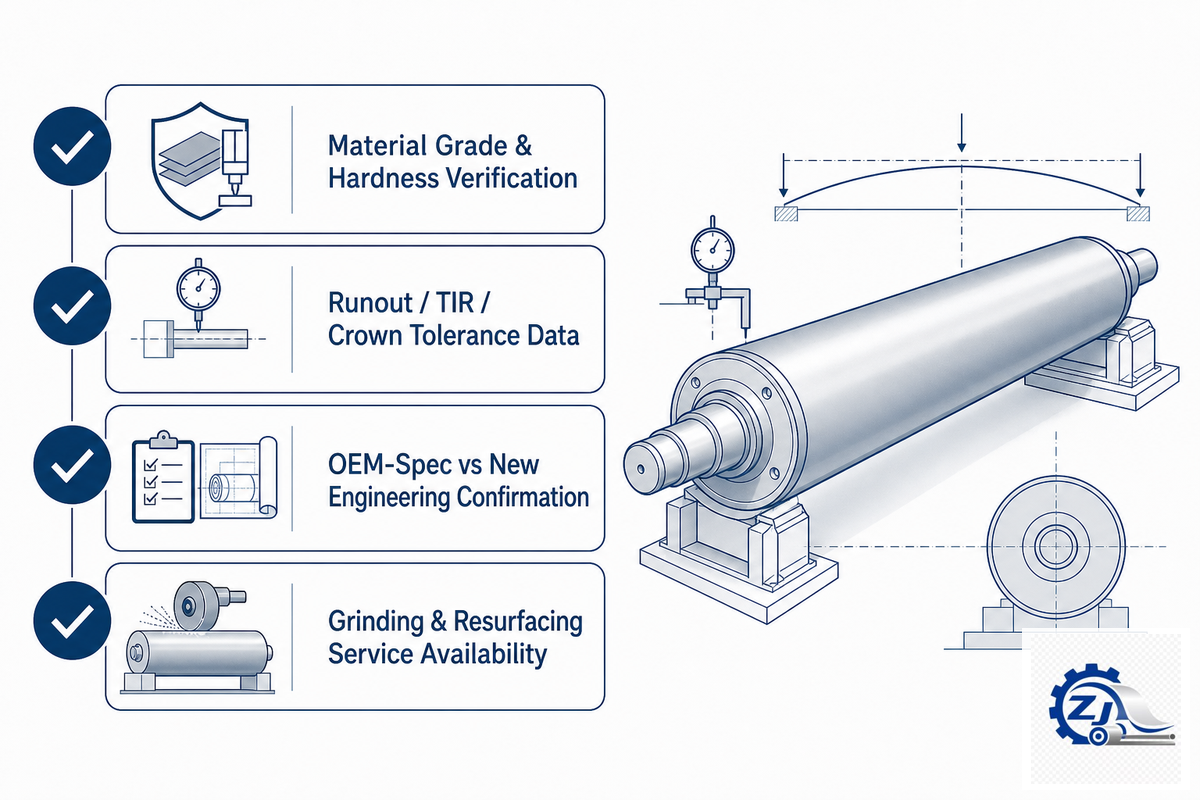
A few pre-purchase questions, tailored to the specific requirements of your line, can go a long way toward ensuring the success of your calender roll order. Most calender roll manufacturers will answer these readily; a supplier that hesitates on any of them is worth a second look:
- Written verification of desired material grade and hardness, not merely chilled iron or soft cover.
- Requests for actual runout, TIR, and crown tolerance data as part of the roll design, in addition to diameter and length.
- Confirmation of whether the roll design is based on original equipment specification or new engineering for your machine.
- Inquiry into how calender roll grinding and resurfacing will be provided when the roll eventually needs to be reconditioned.
Real gains can be seen with calender equipment upgrades in calendering processes. For instance, the management at one Finnish board mill reported that installation of a new metal-belt calender line during a broader plant modernization pushed their board production from about 170,000 to 215,000 metric tons per year (+26% increase) by overcoming speed limits in their process; separately, the technical services manager was quoted in the press as stating this same equipment upgrade increased yield by 5-9% on their premium board grade. While the precise outcome will vary from mill to mill, these results explain why getting the calender roll and calender line specification right can matter this much.
Background information on manufacturing capabilities and after-sales service is available from Zejiang Paper Machinery’s design-to-after-sales capability.
Industry Outlook: What’s Changing in Calender Roll Technology
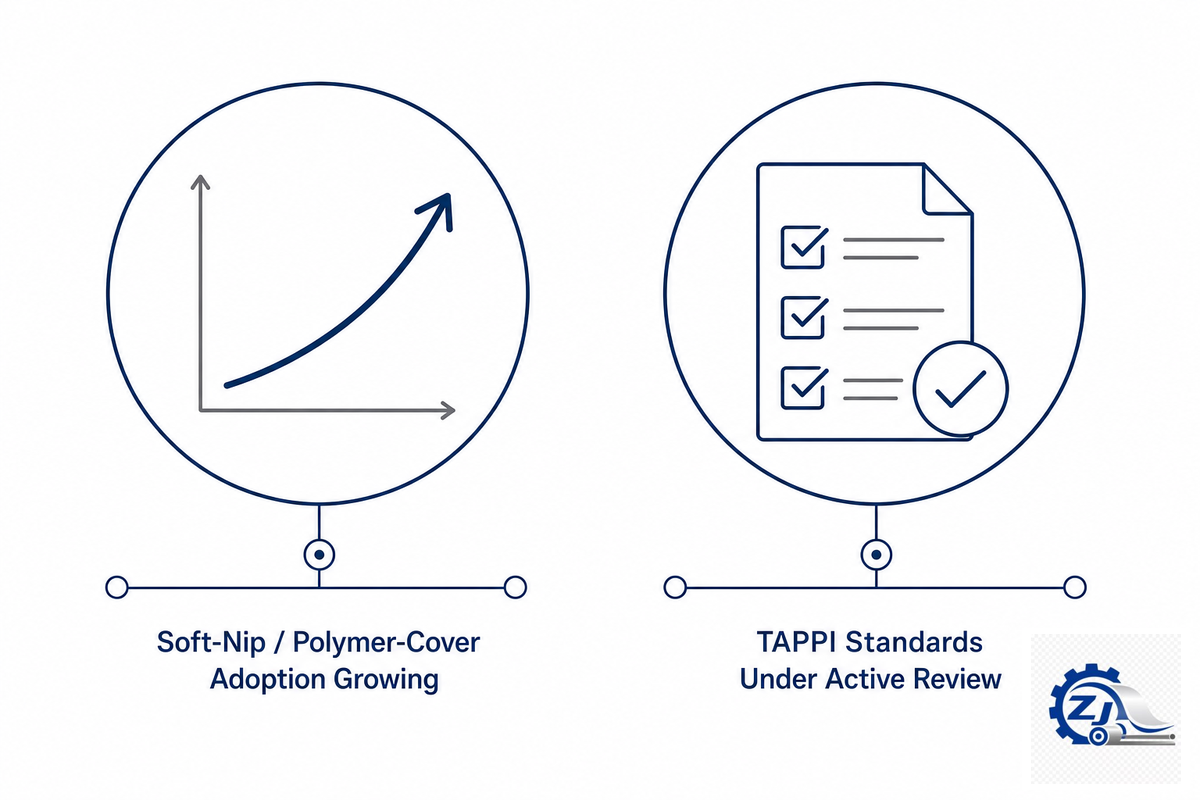
(Updated July 2026) Calender roll technology is far from stagnant. TAPPI’s 2025 test standards review cycle covered 28 pulp, paper, and packaging testing methods, reaffirming 18 of them (about 64%) as current — a sign the specifications and testing standards around calendering and paper finishing are still being actively maintained rather than frozen in place. That matters for buyers because a roll or process spec built around an outdated test method risks quietly drifting out of alignment with what mills and customers actually check against, which is exactly the kind of hidden gap that shows up as a rejected shipment rather than a line-item on a quote.
On the roll-cover side, market research firms that monitor the paper soft-nip calender segment put annual growth somewhere between 4% and 5.6% CAGR through the early 2030s, across various third-party reports, suggesting adoption will continue of soft-nip and polymer-cover setups – although numbers vary, so they’re best viewed as order-of-magnitude, rather than strict, forecast data. If you plan for a roll replacement, or calender upgrade on your paper mill, within the next year or two, then it’s probably worth while to inquire if your chosen vendor has tested your new materials, against your requested tolerances and in conformance with the latest revisions of your referenced TAPPI methods. That might seem a silly question – but one might be surprised to learn a spec sheet dated a few years ago may no longer conform.
Frequently Asked Questions
Q: What is a calender roll?
View Answer
A calender roll is a precision-ground cylindrical roller that presses against a matching roller to compress, smooth, or densify a moving sheet of material as it passes through the nip between them. Working together as a series of hard pressure rollers, calender rolls are used in paper finishing, textile and rubber calendering, plastic film production, and lithium-ion battery electrode manufacturing, where the roll’s surface finish, hardness, and dimensional precision directly determine the quality of the finished sheet.
Q: What’s the difference between “calender” and “calendar”?
View Answer
They are two unrelated words that are frequently confused because of their near-identical spelling. A “calendar” tracks dates. A “calender” (note the second “e”) is industrial equipment that compresses material between rollers. This mix-up shows up often enough in search results and supplier listings that a “calendar roll” search query commonly turns up when someone is actually looking for the roller equipment.
Q: What does calendering do to paper?
View Answer
Calendering compresses the already-dried paper sheet between rollers to reduce caliper, increase density, and improve surface smoothness and gloss. This step happens after the dryer section, since calendering works on dry sheet rather than wet stock, and the number of nips the sheet passes through during calendering has a direct effect on how smooth and glossy the final paper is.
Q: What industries use calender rolls?
View Answer
Paper and paperboard, textile finishing, rubber and tire production, plastic film extrusion, and lithium-ion battery electrode manufacturing all rely on calender rolls for calendering operations, though each industry demands different roll materials, hardness, and tolerances — a hard-nip chilled iron roll suited to plastic film would be the wrong specification for a soft-nip tissue line.
Q: What is roll deflection and why does it matter in calender rolls?
View Answer
Roll deflection is the slight bending that every calender roll undergoes along its length once loaded against a mating roll. Because the roll is only supported at its two end journals, the middle bows away from the load slightly more than the ends, making nip pressure lower at the center than at the edges unless compensated. Mills correct this with crowning, controlled-deflection designs, or paired-roll geometry — left uncorrected, it shows up as uneven caliper or gloss.
Q: How do I know if I need a chilled iron or a soft-cover calender roll?
View Answer
If your sheet is uncoated and tolerant of hard contact, chilled iron generally wins on wear life and dimensional stability. If the sheet is coated or prone to marking and runs at a lower nip load, a soft-cover roll protects the surface at the cost of a shorter service interval.
Q: How often do calender rolls need to be reground or resurfaced?
View Answer
It depends on several factors: material, nip load, sheet abrasiveness, and how the line is run day to day — ask your supplier for an estimate specific to your operating conditions rather than assuming a generic industry figure applies to your line.
Why We Write This
Answering common calender roll questions in layman’s engineering terms, irrespective of which supplier a reader chooses, is the goal of this guide. It uses the same nip pressure equation, the same OSHA references and relies upon the same battery electrode research found in published papers and regulatory bodies – not our company’s in-house data. Reviewed by the Henan Zejiang Paper Machinery Co., Ltd. technical team.
References & Sources
- 29 CFR 1910.216 — Mills and Calenders in the Rubber and Plastics IndustriesU.S. Occupational Safety and Health Administration
- Nip ImpressionsDavid R. Roisum, Ph.D., published via TAPPI
- Taking Battery Manufacturing to the Next LevelArgonne National Laboratory, U.S. Department of Energy
- Computational Model for Predicting Particle Fracture During Electrode CalenderingXu et al., published in Batteries & Supercaps (2023)
- Sustainable and Cost-Effective Electrode ManufacturingPMC, National Institutes of Health
- Design of Experiments for Optimizing the Calendering Process in Battery Electrode ManufacturingHidalgo et al., Journal of Power Sources (2023)
- TAPPI Standards, Technical Information Papers, and Useful MethodsTechnical Association of the Pulp and Paper Industry
- New Leaner Packaging Yields Benefits for Birds Eye FoodsPackaging Digest
Related Articles
- Calender Roll Product Line, chilled iron and soft-cover options, selection matrix, and RFQ
- All Paper Machine Parts, the full spare-parts range Zejiang engineers and manufactures
- Refiner Plates and Screen Baskets: A Complete Guide for Paper Mill Buyers
- What Is a Doctor Blade? Types, Materials, and How They Work
- About Zejiang Paper Machinery, design-to-after-sales capability
![Refiner Plates & Screen Baskets [Complete Guide]](https://zjpapermachine.com/wp-content/uploads/2026/07/refiner-plates-screen-baskets-guide-featured-150x150.png)
![Doctor Blade: Types, Materials & How It Works [Guide]](https://zjpapermachine.com/wp-content/uploads/2026/07/doctor-blade-guide-featured-1-150x150.png)
![Pulping Equipment: How Paper Pulping Works [Guide]](https://zjpapermachine.com/wp-content/uploads/2026/07/pulping-equipment-guide-featured-150x150.png)