Get in touch with Zejiang Paper Machinery Company


Updated July 2026
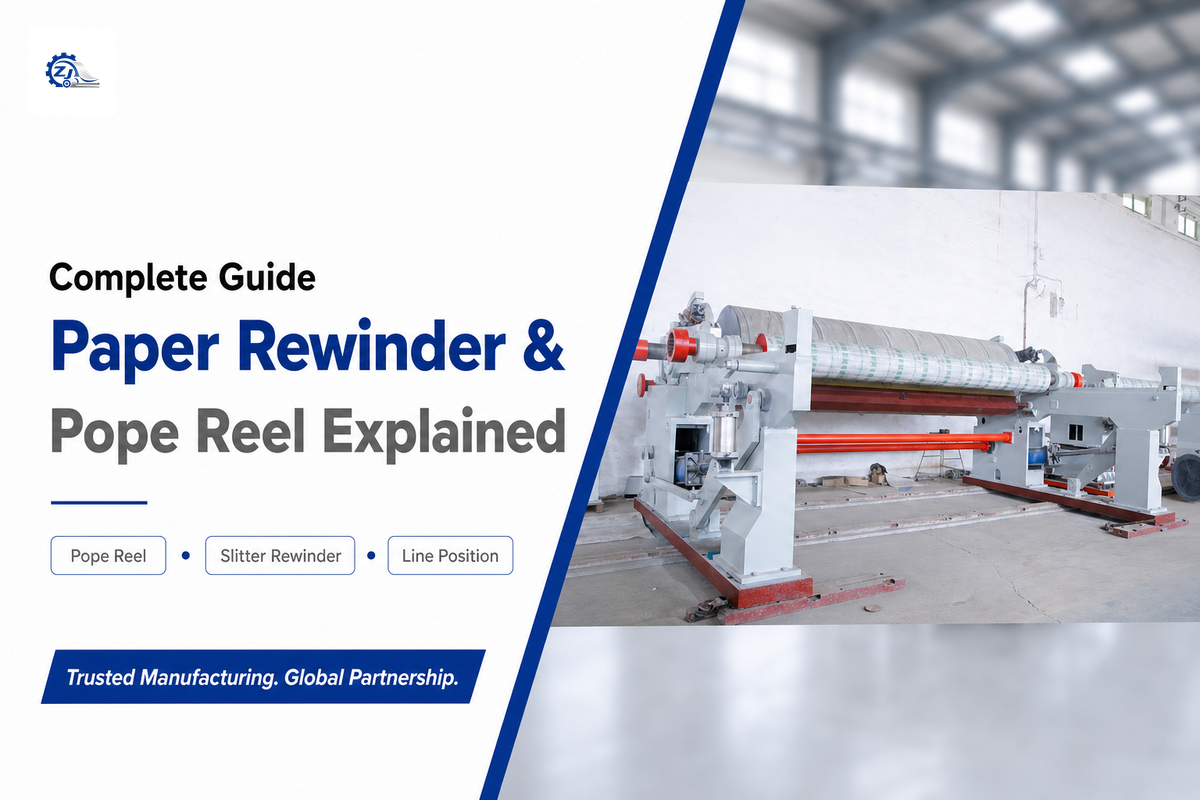
Paper rewinder and Pope Reel, even paper mill personnel working every day use these terms interchangeably when talking casually about equipment, even though they’re talking about machines that do completely different tasks. Strictly speaking, a paper rewinder, or more properly called a slitter rewinder in the paper industry, is a converting-stage machine that slits a wide, large-diameter parent roll of paper into market-width narrow rolls. By contrast, the Pope Reel is the reel-up station at the dry end of the paper machine, continuously reeling the finished sheet of paper into a single, large, continuous-roll-product called a parent roll without ever stopping the paper machine. This paper clarifies this confusion, defines how each type of machine operates, and where each fits within the production sequence using OSHA incident reports, a TAPPI training module, and data provided by OEMs.
Quick Comparison
| Pope Reel | Sits at the paper machine’s dry end. Winds the continuous sheet into a master (parent) roll without stopping the machine. |
| Paper Rewinder | Sits downstream, in converting. Unwinds the master roll, slits it to width, and rewinds it into finished, market-ready rolls. |
What Is a Paper Rewinder? What Is a Pope Reel?

A paper rewinder — more formally, a slitter rewinder — is converting equipment that unwinds a large parent roll of paper, slits it into narrower strips with shear, razor, or score blades, and rewinds each strip onto a new core under controlled tension. A Pope Reel is a different machine entirely: the continuous reel-up station built into the paper machine itself, covered in the next section below.
Plain, non-slitting rewinders also exist; these machines simply change a roll’s diameter or splice rolls together without cutting them narrower. The moment a customer needs a different finished width, though, the machine doing that job is a slitter rewinder.
A Pope Reel, however, isn’t the same machine as the rewinder. This is the integral reel-up that’s part of the paper machine’s dry end — or, to use TAPPI’s training terminology, the machine’s reel end (right after the last dryer and/or calender section). It exists solely to receive the constantly flowing sheet coming off the paper machine and to reel it up into a large-diameter parent reel without interrupting the continuous run of the paper machine. For an example of standard engineering terminology, one 1999 US patent (US5983523A, assigned to Valmet), covering dryer-section curl control, states in its specification, as an example of equipment to perform this task, “a machine reel-up 50, for example a Pope-type reel-up.”
Why most equipment purchasing guides are of little use Here’s the one part that’s missing from nearly every “slitter rewinder” purchase guide put out by manufacturers (such as elite Cameron’s, Jota machinery’s, or Wenzhou Winrich’s): none of them use the term Pope Reel. And it’s not that it isn’t a real term in paper-TAPPI’s own training modules call the Pope Reel an entire training course: “Paper Machine Reel Systems,” and OSHA accident data forms have long since referred to it as “pope reel” in real reports of injury. This apparent knowledge gap stems from the fact that such guides are written to aid equipment buyers, often in the foil, film, and label industries, to shop for downstream equipment for their converting – not for readers in paper mills looking for information on the term they’ve been hearing on the plant floor.
Where this matters is on the request for quotation. If a supplier is quoting on rewinder capacity, but the buyer actually want dry-end reel-up capacity-or vice versa-that can eat weeks of time and a number of phone calls before anyone realizes, because on the floor both machine sizes have been shortened to “rewinder”. In fact, whenever an inquiry come with nothing more than “rewinder” in the subject line, the first response is inevitably to ask if it’s a paper machine, and if it’s on the reel-up end, or the slitting dry-end line-the specs differ entirely.
💡 Pro Tip
Whether on the job board or in a supplier catalog, when you read “rewinder,” and you’re uncertain if they’re referring to a Pope Reel on the paper machine or a downstream slitter rewinders on the converting/finishing line, the simplest fix is to identify which department. Pope Reels live on the machine room floor; slitter rewinders on the finishing floor. Imagine the parts requisition that simply states “rewinder bearing” at a facility with two machines-there’s about a 50% chance the wrong part is picked up. Naming the department or machine number eliminates this confusion.
How a Pope Reel Works (Continuous Reel-Up at the Machine’s Dry End)
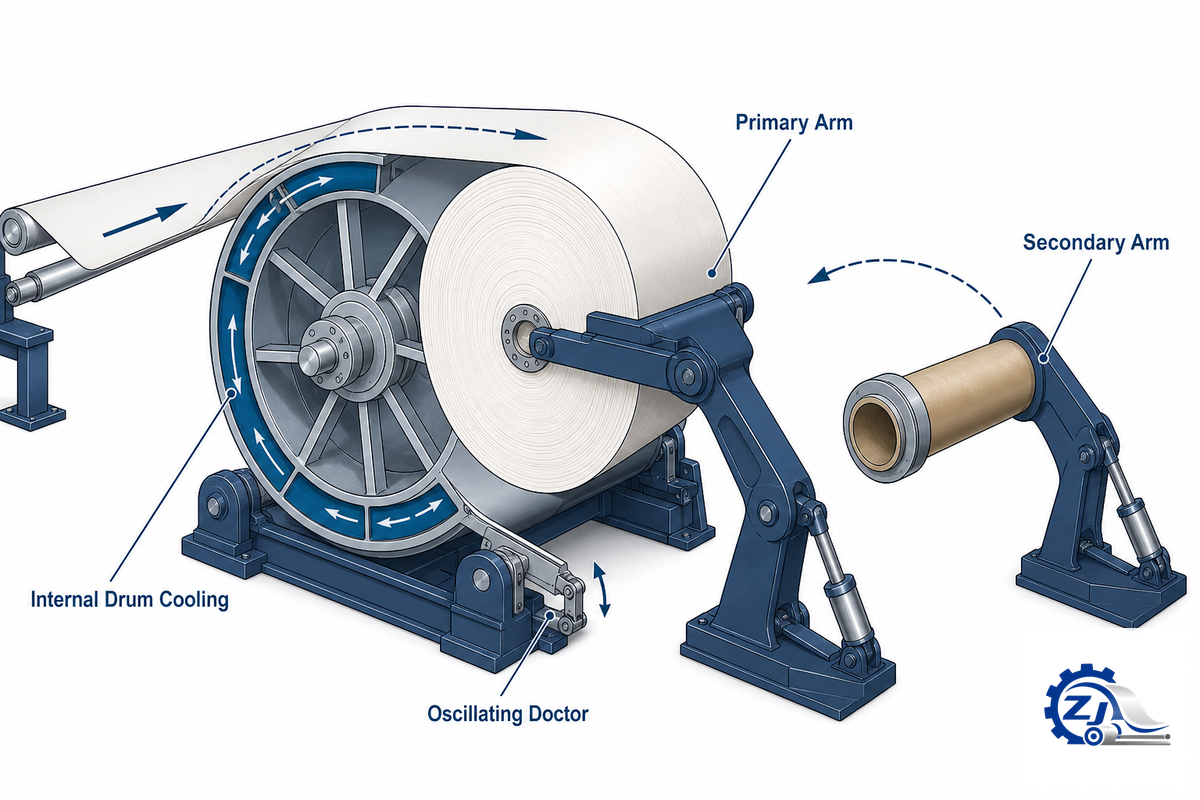
A Pope Reel works by winding the paper machine’s continuous sheet onto a driven reel drum, using two arms — primary and secondary — mounted around it. While the primary arm holds the spool currently winding, the secondary arm waits with an empty spool. When the building roll reaches its target diameter, a limit switch triggers a “turnup,” transferring the sheet to the empty spool without ever slowing the paper machine.
The limit switch itself is activated by the rider roll — the cylinder that rests on top of the building roll and rises as the roll grows. Once it signals the set change, the paper guides onto the empty spool on the secondary arm, and the cycle starts again on that side.
Most of the engineering effort here goes into the physics of the turnup. According to Valmet’s own field report on the subject (first published 2016, still Valmet’s current guidance), the nip load between the riding roll on the turning sheet and the newly-accepting reel drum ranges from about 50 to 100 lb/in of roll width for machines without nip relief cylinders, to about 15 to 30 lb/in of roll width, depending on the grade, for machines with the nip relief. High nip load can cause breaks in thesheet at turnup. Too low a nip load and the new roll begins to wind with a slack, or weak surface core. A goose-neckpipe on the top part of the rider can be inclined slightly towards the edges of thesheet to help lift it as it turns. Many modern systems use water jets at high pressures to sever the old sheet and initiate the new, both to minimize the waste generated by old pneumatic-type systems and the mess they leave.
📐 Engineering Note
The physics of a Pope Reel turnup (Nip Load) When a new reel set is started. 50-100 lb/in without relief cylinders. 15-30 lb/in with reliefcylinders, (dependent on paper grade). (Source: Valmet Field Report, “Improving reel turnups for low downtime and high paper yield.”)
Pope Reels carry real safety weight, too. OSHA’s accident database shows that on July 21, 2019 an employee at Erving Industries amputated three fingers in a paper machine #3 pope reel by putting his hand in the nip. This highlights that the nip — where the building roll and the reel drum meet — is in fact an in-running nip that requires specific safety precautions. For this reason, OSHA 29 CFR 1910.261(k) requires both nonskid surfaces and a particular set of rules concerning starting into the nip on reels and rewinders in the paper industry. This has been taken into account for Zejiang’s published equipment procedures, which are built around the OSHA 1910.261 guide lines.
Imagine the scenario of when such an item is truly put to the test. Consider a fast-speed tissue line on a night shift where a team must be ready by about 2 am with less than 2 minutes to have a secondary core set properly in the nip with the nip-relief system armed, and be prepared to have a secondary automatic turnup fire. Failure to adjust the nip-relief system properly for the grade may result in sheet breaks on the change over which may only be apparent on the monthly downtime reports, without one identifiable root cause. This is the reason why it’s better to buy a Pope Reel with pre-configured nip-relief cylinders and a range of tension set points by grade, rather than adjusting from scratch after the machine has already been set for production.
How a Paper Rewinder (Slitter Rewinder) Works
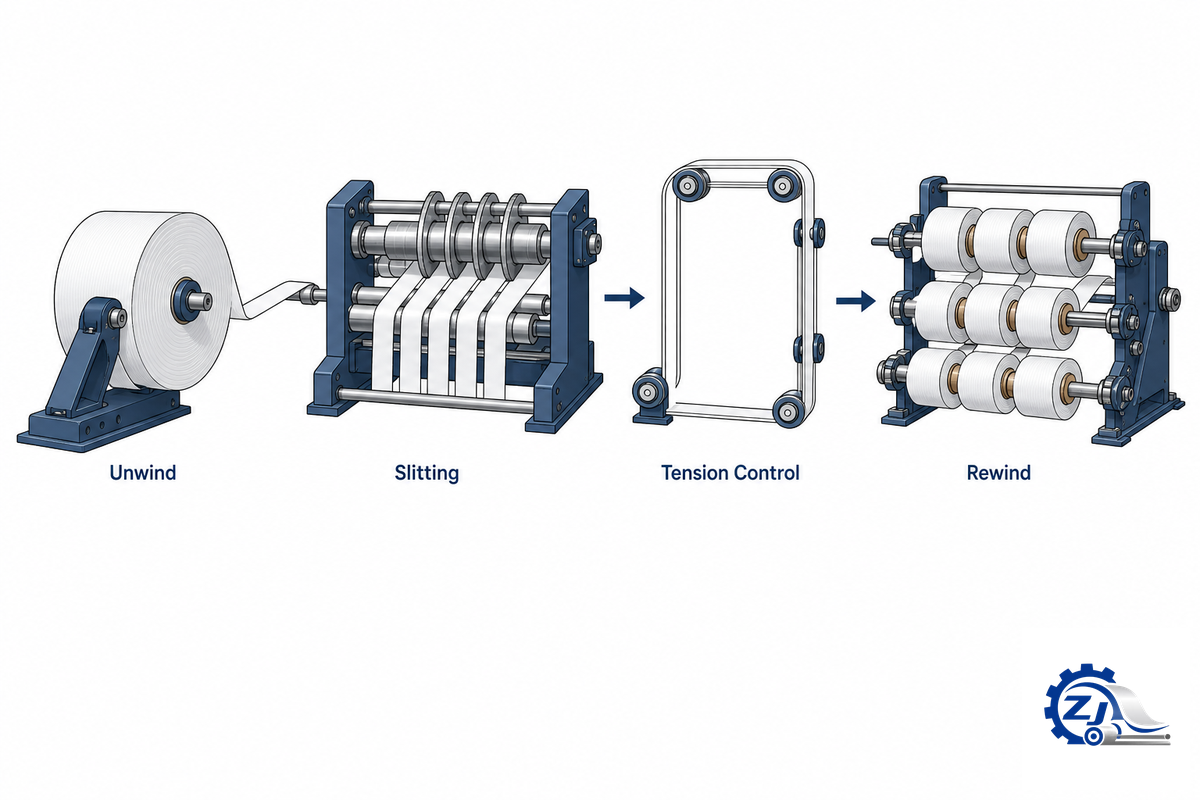
A slitter rewinder runs a three-step process, downstream from the Pope Reel: unwind, slit, and rewind. The parent roll built by the Pope Reel is unreeled in a single layer and fed through the machine, where blades cut it into strips at the ordered widths. Those slit strips are then rewound onto new cores — mounted on shaftless or air-shaft mandrels depending on the line — under closed-loop tension control.
Blade choice depends on the material being cut. Shear blades, which work like a pair of scissors, handle thicker and more rigid stock. Razor blades cut thin films at high speed. Score blades suit adhesive-backed materials such as tape.
That same in-running nip hazard from Pope Reels applies here too: OSHA 29 CFR 1910.261(k) covers rewind-section nip points and blade guarding as part of the same pulp, paper, and paperboard mill machine-room standard.
Slitter rewinders handling paper convert several distinct grades — kraft paper, tissue paper, and heavier paperboard — along with flexible packaging materials like film and foil laminates, onto paper tube cores. Those paper tube cores are themselves typically produced on a dedicated paper tube making machine, a related but separate category of cutting machine that manufactures the cardboard cores rather than converting the sheet itself. What the industry calls a jumbo roll (or jumbo paper roll) — a wide, large-diameter parent roll among the large rolls of material a mill handles — arrives at the rewind shaft, crosses the machine, and exits on an exit conveyor as multiple narrower rolls. Advanced paper manufacturing lines increasingly pair a paper cutting machine’s dynamic blade spacing (adjusting razor blade cutting width on the fly) with a semi-automatic surface winding stage, cutting the manual labor otherwise needed to reposition a laminator or shift heavy materials by hand. Efficiency of slitting and rewinding — however a given converting solutions provider chooses to measure it — ultimately comes down to how few of those manual steps survive into the finished line.
Web tension is the part of the tension control system responsible for the quality of the manufactured roll. Its function relies on integrated load cells which are able to constantly measure and adjust the tension by using closed-loop servo braking technology. It’s also often segregated into different zones so that when the machine is running a wider product, the tension of the roll can be distributed evenly across its width. Without it, issues may arise such as loose rolls, a soft or unstable surface on the roll, wrinkling of the paper, “telescoping,” which refers to how the layers inside a roll shift with relation to the layers outside of the wrap, and even cracking of the core. In most of the well-designed machines, the Web guiding accuracy may be adjusted to within 0.1 mm, enough to cause a 0.2 mm discrepancy in widths, which could then get caught in a label die cutter downstream or disrupt print register alignment (this is a figure that comes from the manufacturer and can’t be verified externally).
Running speeds are material and configuration-dependent. Thin films on narrow-web center winders usually operate at 100-300 meters per minute (330-1,000 ft/min). General purpose duplex center winders usually operate at 300-500 m/min (1,000-1,640 ft/min) or higher, while two-drum surface winders for paper or non-wovens may reach well above 1,500 m/min (4,920 ft/min). Machines configured with a turret operate on a different priority – changeover speed, which will be discussed in the next section.
How Fast Does a Slitter Rewinder Operate?
Speed varies widely by machine design and application. Narrow-web center winders on thin films run 100-300 m/min; a typical duplex center winder runs 300-500 m/min; heavy-duty two-drum surface winders built for paper mills can top 1,500 m/min. Turret slitter rewinders trade running speed for changeover speed instead.
By loading the next set of cores on the other shaft position while the first is still rewinding, turret machines cut dead time between sets to almost nothing. Published throughput-gain figures vary a lot by job mix — one market report cited roughly a 22% changeover-time cut translating to roughly a 32% output gain — so treat that single reported figure as a starting point for your own changeover-time audit, not a guarantee.
Paper Rewinder vs Pope Reel: Side-by-Side Comparison
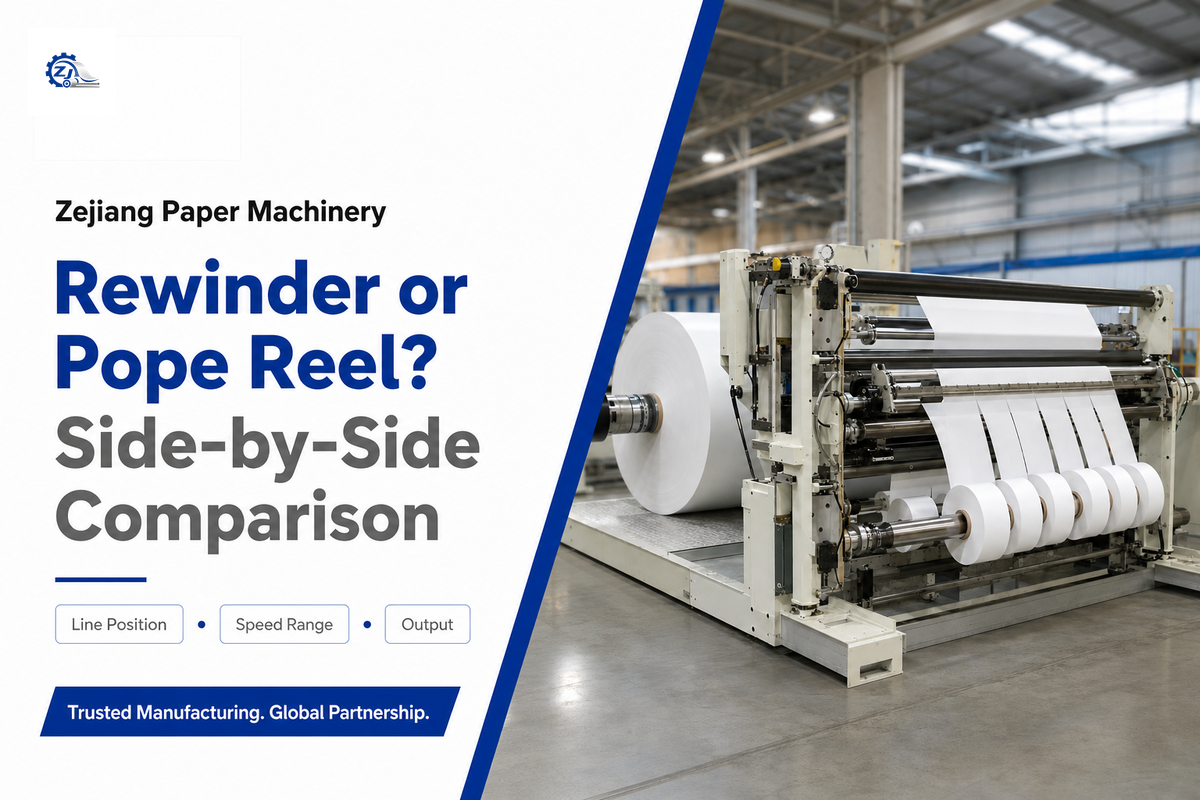
If there’s one piece of advice you take from this entire guide, this should be it. The maintenance planner placing a spare-part order, the plant engineer designing the spec for a capacity expansion, and the purchasing manager getting price quotes from three different suppliers – they’re all asking variations of the same basic question, in the end: Which machine am I talking about? In the real world, misidentifying the machine is about more than just another fruitless quote cycle: the accidents documented in the OSHA record reviews in other sections of this document – one for a Pope Reel, the other a paper rewinder – share the exact same pinch-point hazards. They’re exactly why mis-spec’d machine names on an RFQ could lead to mis-spec’d safety guard orders as well — the specific nonskid-surface and nip-guarding language in OSHA 29 CFR 1910.261(k) applies to both machine categories, so the wrong equipment name on a purchase order can mean the wrong guard hardware shows up alongside it.
| Attribute | Pope Reel | Paper Rewinder (Slitter Rewinder) |
|---|---|---|
| Line position | Built into the paper machine, at the dry end | Separate machine, in converting/finishing |
| Primary function | Continuous winding into a master (parent) roll | Slit + rewind into narrower, finished rolls |
| Slits material? | No | Yes |
| Stops for changeover? | No — turnup happens on the fly | Yes, between rewind sets (except continuous-turret designs) |
| Output | One large master roll (parent reel) | Multiple smaller, market-ready rolls |
Rewinder-or-Reel Quick Check
Which one do you actually need? Ask two questions:
- Is the equipment part of the paper machine itself, winding the sheet as it comes off the dryers? → That’s a Pope Reel.
- Is the equipment taking an already-made roll and cutting it into narrower, finished widths? → That’s a paper rewinder (slitter rewinder).
To get the complete rundown on configuration choices, RFQ requirements, and new/used/upgrade options once you’ve identified your machine, check out Zejiang’s paper rewinder and Pope Reel solutions page.
Types of Paper Rewinders: Turret, Duplex, and Surface Configurations
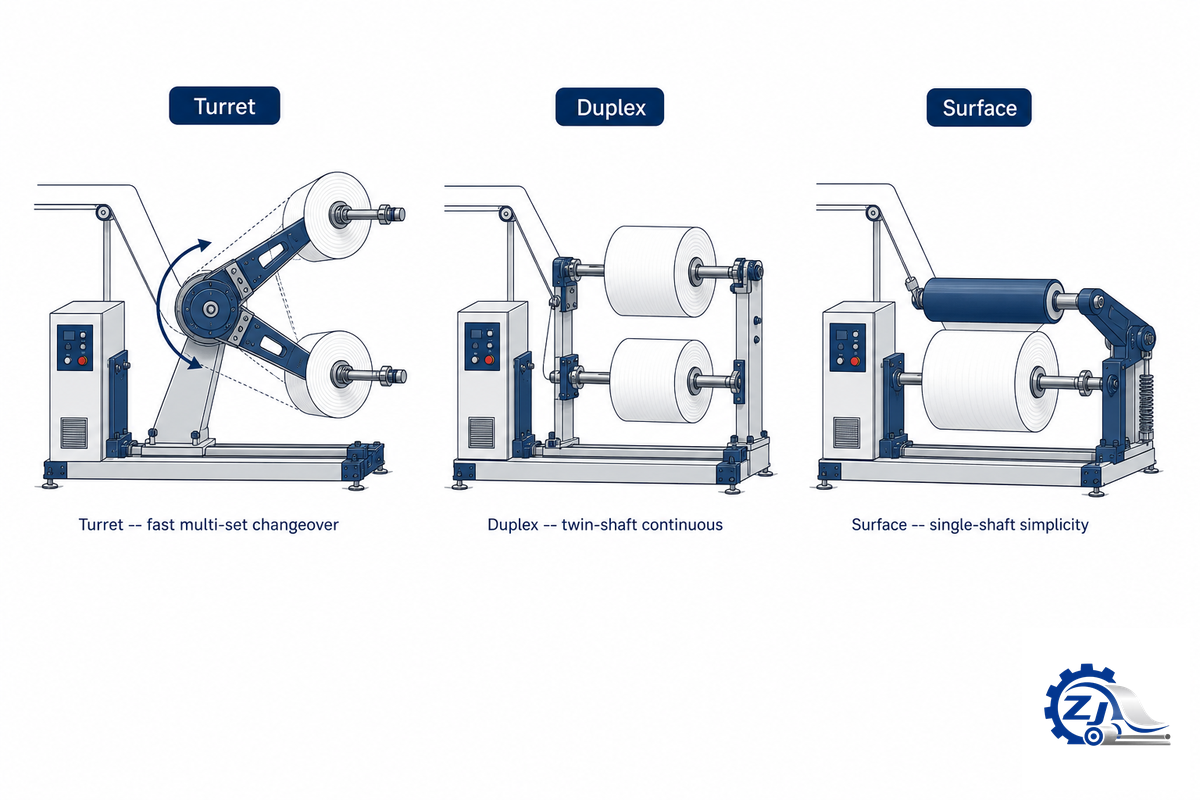
Once you’ve established you need a rewinder and not a reel-up, configuration is your next hurdle. It’s dictated by the slit width, the finished roll diameter, material thickness, and, perhaps most significantly, your production plan’s tolerance for downtime due to changeover. Suppliers and RFQs won’t always use the same label for the same machine: a “duplex slitter,” a “surface rewinder,” a “roll slitter rewinder,” and a “machine slitter rewinder” can all describe close variants of the same underlying paper slitting machine, while “slitting rewinding machine,” “slitting and rewinding machine,” and “paper roll slitting rewinding machine” are simply longer-form ways vendors write the same equipment category on a spec sheet. “Turret slitter” and “turret slitter rewinder” name the same thing; so do “paper slitter rewinder” and plain “paper slitting” equipment, and a generic “rewinding machine” without the word “slitter” usually means the narrower plain-rewind category discussed earlier in this guide.
| Type | Max Rewind Diameter | Slit Width / Machine Width | Typical Speed | Best Fit |
|---|---|---|---|---|
| Simplex center winder | ~32″ (813mm), slightly larger on some models | Min slit width >1″ | 1,500-2,000 fpm (457-610 m/min) | Log-winding jobs, no differential winding needed |
| Duplex center winder (standard) | ~32″ (813mm) | Machine width up to ~90″ (2286mm) | 1,500-2,000 fpm (457-610 m/min) | Most common configuration; alternating top/bottom shafts prevent interleaving |
| Duplex center winder (roll-ejection) | Up to ~40″ (1016mm) | Machine width up to ~90″ (2286mm) | 1,500-2,000 fpm (457-610 m/min) | Larger rolls; ergonomic tradeoff above 32″ (813mm) top-shaft height |
| Center-surface winder | Up to ~50″ (1270mm) | Slit widths <1″ supported | Not separately published | Delicate, stretchy, or difficult-to-wind materials |
| Turret slitter rewinder | Set by shaft capacity, not one figure | Varies by model | Prioritizes changeover time over running speed | High-volume multi-set runs where downtime drives total output |
| Two-drum surface winder | Up to ~80″ (2032mm) | Machine width up to ~160″ (4064mm) | Up to ~6,000 fpm (1,829 m/min) | Paper mills, heavy nonwoven converting, largest/heaviest rolls |
| Plain rewinder (no slitting) | Not separately published | N/A — no slit function | Not separately published | Diameter changes or roll splicing only |
| Inspection rewinder | Not separately published | N/A — inspection pass, not converting | Not separately published | Pre-screens mother rolls before slitter rewinding to cut downstream stoppages |
| Pope Reel (for reference) | Set by machine width, not a rewind spec | N/A — winds, does not slit | Continuous, matches paper machine speed | Not a rewinder purchase decision — see H2-1/H2-2 above |
“Because these capital investments are relatively infrequent and process requirements change over time, it sometimes can be difficult to determine the type of slitter that would work best for the process.”
Rob McNamee, Business Development Manager, Elite Cameron, Inc., writing in Converting Quarterly
Those configurations specs I noted above are sourced from that same McNamee article – manufacturer-published engineering guidance, not cross-verified against a second OEM’s spec sheet. You should take exact figures as directional only; refer to your actual installation requirements when you solicit bids for equipment. One thing that doesn’t change with configuration: the largest two-drum surface winders handle rolls heavy enough that the same OSHA 1910.261 nip-guarding and material-handling provisions that cover Pope Reels apply at full force to the heaviest rewinder configurations too.
✔ Turret: Advantages
- Minimal downtime between rewind sets
- Ideal for high-volume, multi-set production runs
- Operator can unload/reload while the next set is already winding
⚠ Turret: Limitations
- Higher upfront machine cost than a fixed center winder
- More mechanical complexity to maintain
- Overkill for low-mix, low-changeover jobs
Where Rewinders and Pope Reels Fit in the Paper Production Line
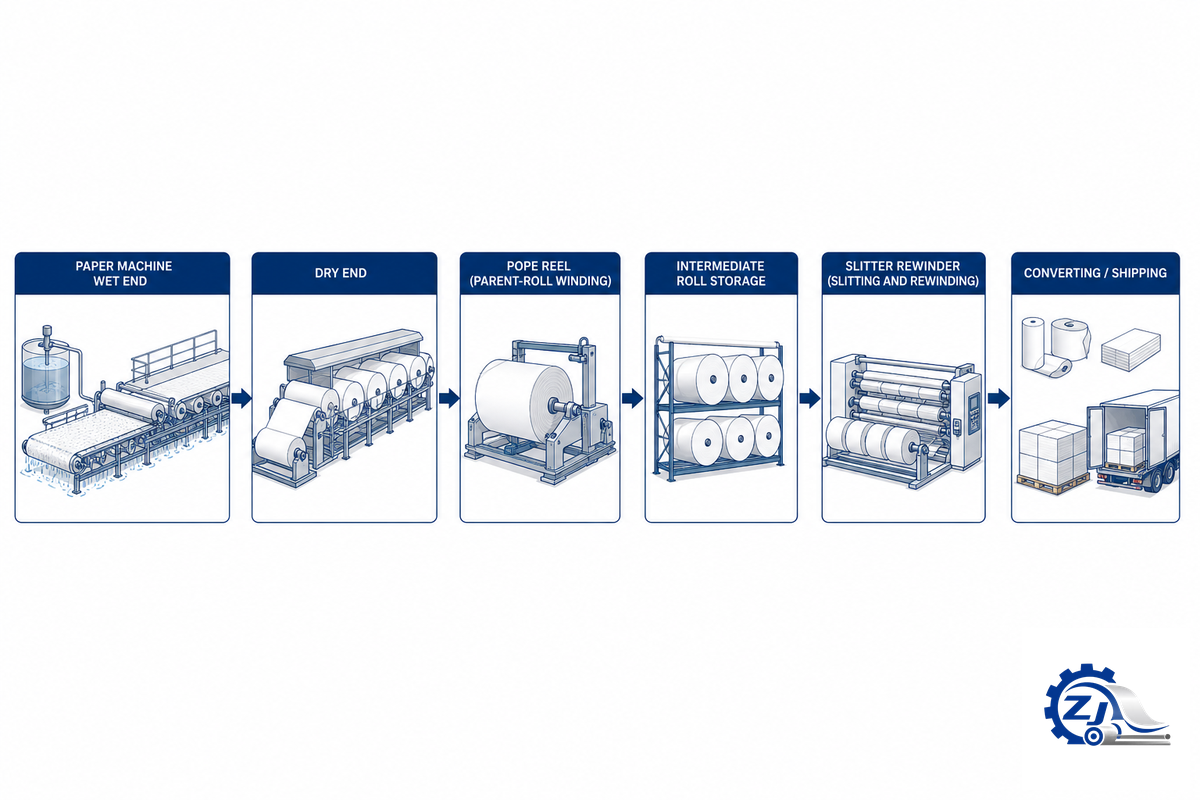
A Pope Reel sits at the paper machine’s own dry end, winding the sheet as it comes off the machine. A slitter rewinder sits downstream, in a separate converting or finishing room, where it slits and rewinds the roll the Pope Reel already built. Both belong to the same production line, but at different stages of it.
The 4 Stage Reel to Rewind Map
The journey in its entirety runs through four stages. Stage 1: raw pulp is slurried and formed into a long sheet, pressed and dried within the machine’s forming section, press section, and dryer section. Stage 2: near the very end of the machine (the dry end), a Pope Reel spins the final, finished sheet into one master roll — a “parent reel” in TAPPI’s training curriculum — without ever having to slow down or stop the machine itself. According to the description of the “Paper Machine Reel Systems” course by TAPPI, the reel “basically completes the paper or board production process.” Stage 3: that parent reel is moved to a converting/finishing room (often passing through an intermediate storage area first, on the order of hours to a few days depending on plant scheduling). Stage 4: a slitter rewinder unwinds it, slits it into the specific widths a given customer ordered, and rewinds those widths onto new cores. Both OSHA 29 CFR 1910.261(k) and the training course materials prepared by TAPPI consider the handoff between Stage 2 and Stage 4 to be a functional separation — a distinct set of engineering tasks and hazards, not simply different names for the same equipment; and indeed a discrepancy between reel commissioning and rewind installation schedules is one of the more frequent scheduling blunders associated with a paper machine overhaul. These scale considerations aren’t abstract: NIOSH data described elsewhere in this document discusses a case involving a paper rewind roll measuring 58 inches in diameter, 256 inches in width, and weighing 25 tons — every inch of which had to be wound up by the Pope Reel in a single continuous sheet, at whatever running speed that particular paper machine was set to, prior to cutting down to its finished size.
While never doing each other’s jobs, the two pieces of equipment depend heavily on each other; if a parent roll is wound too loose or unevenly at the Pope Reel, the problems pass downstream to the rewind, resulting in the wrinkles and “telescoping” effects which cause issues at the other end of the process – another reason why both are discussed as a pair, despite their physical and functional distinctions. That mutual dependence isn’t merely theoretical: OSHA has records of a specific paper machine #3 pope reel accident in one facility and a separate paper rewind accident at another mill, indicating both types of machines are standard equipment that exist alongside each other, rather than alternative terms for the same piece of equipment. The personal account of a paper mill machine operator posted to r/papermaking in which he stated “I first went into a mill as a rereeler operator, taking out defects in the reel: holes and machine breaks” is a candid description of the intense, demanding work per formed at the boundary between these two critical machines.
If you’re purchasing equipment, the first question to ask yourself is what side of that handoff are you actually buying for: the mill’s own continuous reel-up, or a converting-stage rewinder? That single question answers nearly all other questions you need to answer on your RFQ — the size foot print required, what kind of paper-machine controls it’ll interface with, and whether you’re shopping in the paper-machine OEM market or the general converting-equipment market.
Common Mistakes When Specifying a Rewinder or Reel
Two real OSHA records put the safety stakes in stark terms. In 1997, a maintenance electrician at a paper mill in Virginia was killed after being crushed between the nip barrier and the upper frame of a 27-foot-wide (8.2 m) paper rewinder — a machine running a roll 58 inches (147 cm) in diameter, 256 inches (6.5 m) wide, and weighing nearly 25 tons (22.7 metric tons) — after bypassing lockout/tagout to change a limit switch arm (NIOSH FACE Report, 1997). In 2019, a worker at Erving Industries lost three fingers while manually threading a “paper machine #3 pope reel,” when his hand was caught in the nip point of the reel (OSHA Accident #118301.015). Both machines and both incidents have the same basic hazard at their core: the nip point and the human temptation to approach it without complete lockout.
Beyond the safety hazards, there are other repeated mistakes found in independent troubleshooting guides:
- ✔Loose or soft rewind rolls resulting from inadequate tension relative to material and core size
- ✔Web wrinkling over the cutting blades — more a web-guiding issue than a blade problem
- ✔Uneven slit width due to misaligned guide rollers or variation in material thickness
- ✔Assuming blade type is unimportant (“razor or shear, doesn’t matter”) – the material type determines the blade choice, which has implications for dust, tearing or roll defects.
A practical mechanical tip that’s good to know before a crisis arises: when working with cutting and winding lines, engineers trying to overcome “roll slap” instability commonly suggest simply completely decoupling the unwind stage from the feed stage by introducing a pair of free-standing, gravity-fed or dancer-controlled rolls between them — a fix independently verified by engineers in the field rather than being vendor-specific. converters who can’t seem to fix the same tension fault every time they change to a different core diameter often aren’t fighting a machine flaw; they’re fighting an unwind-to-feed coupling that never should have been linked in the first place, and no amount of tinkering with the rewind portion will ever resolve it.
Before you begin drafting your RFQ, go and stand on the actual line you’ll be feeding and observe where your current setup fails. Is it the reel-side nip? The tension zone? The blades? The unwind-feed coupling? Write your answer down and include it on the RFQ. (Zejiang’s own Safety Design Self-Check tool, for example, takes a customer through these questions prior to generating a quote and has been a key differentiator against competitors who merely respond to nameplate specifications).
Paper Rewinder & Pope Reel Industry Outlook: What’s Changing
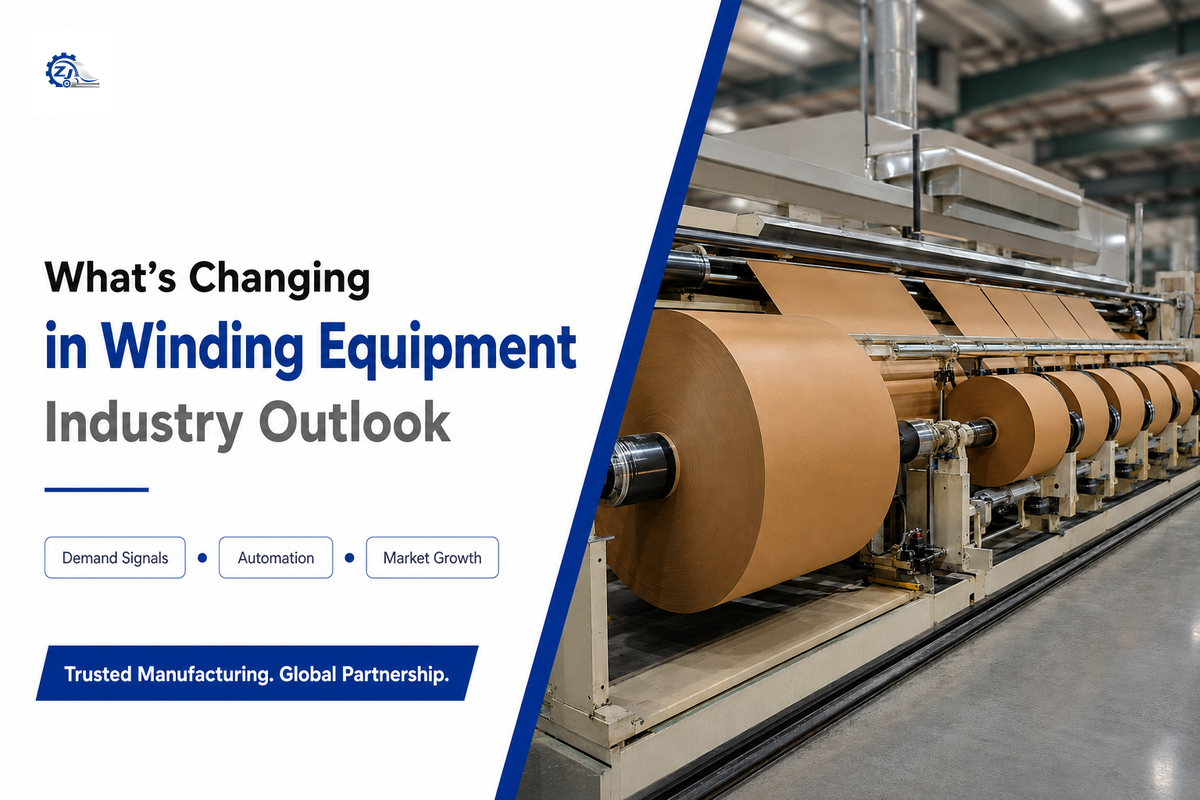
Two signals that we can honestly report because they conflict in direction: Search-query volume for this equipment family has clearly been cooling off in the past year: DataForSEO shows search volumes for all related terms including “paper rewinder,” “slitter rewinder,” “rewinder machine,” “paper roll slitting machine,” and “paper machine rewinder” were down year-over-year, per that DataForSEO data, roughly between 33% and 58% – a uniform slide, not the result of a single outlying term. However, market research firms that cover the physical equipment market (as opposed to online search) all indicate growth for the slitter-rewinder machine market – those firms’ forecasts through the mid-2030s put compound annual growth anywhere from the low single digits up to roughly 11%, since different firms used different forecast periods and methodologies. Honestly, the best takeaway is that there’s broad consensus on growth among analysts, not one precise number.
Clearly, those aren’t measuring the same thing, and we won’t attempt to reconcile them into a simple narrative, as interest and demand for equipment can diverge for reasons not identified in this study. What we can say more definitively: TAPPI’s last published standards review cycle (July 2025) identified 28 standards scheduled for revision, indicating continued movement and evolution on the specification and testing side even as online search interest softens. If you’re a capital buyer, don’t confuse softening online search with a loss of relevance-it just means the audience here’s increasingly coming directly to a list of suppliers rather than searching the web broadly, which is precisely the audience that we’ve written this guide and Zejiang has prepared its solution page to address.
Frequently Asked Questions
Q: What is paper rewinding?
View Answer
Paper rewinding is a process, in the converting step of making paper from a parent roll to narrower widths for customers, where rolls of paper are simultaneously slit into narrower widths and rewound onto a new core under tension. This is separate from the paper machine reel (Pope Reel), where the paper is wound without any slitting.
Q: What does a rewinder do?
View Answer
Generally speaking, the rewinder takes a roll of material, usually paper or another flexible sheet, and rolls it onto a new core-often at a different diameter and width (width). In the context of converting, “rewinder” most commonly refers to a slitter rewinder, a combination machine which simultaneously performs slitting and rewinding; but there is also a plain rewinder that only rewinds the material.
Q: What’s the difference between a Pope Reel and a winder in general?
View Answer
A winder is any machine that rolls a flexible substrate material onto a new roll or mandrel. A Pope Reel is a particular type of paper-making machine component, integrated at the dry end of the machine, which winds paper onto the main parent roll without any slitting. A slitter rewinder is another type of winder, used after the paper machine in the converting process, to simultaneously slit and rewind rolls of paper to a specified width.
Q: Can a slitter rewinder handle small rolls?
View Answer
Yes — center winders go down to about 25mm (1 inch), and center-surface units built for narrow-web converting go down to roughly 6mm (¼ inch). Custom sizing below that is common for small-roll converting in medical and electronics applications, where individual production runs can call for widths well under an inch.
Q: What materials can a slitter rewinder process?
View Answer
Basically any thin, stretchable roll-goods material that is windable on a core-everything from tissue-light to heavy board papers; plastic films; metal foils (aluminum, copper); PS-label and film face-stock/laminates; PSA-tapes and -adhesives; to specialty nonwovens. Your material needs to dictate your blade selection, winding configuration, and tension settings, according to your specific needs in stretchability and material thickness.
Q: Who makes slitter rewinder machines?
View Answer
The supplier landscape splits into two distinct groups. Slitter rewinder suppliers range from century-old US/UK specialists — Elite Cameron traces its history to the early 1900s — to a large field of Chinese manufacturers competing on volume and price. Pope Reel suppliers look different: major paper-machine OEMs, Valmet among them, build Pope Reels as one component of a complete line rather than standalone equipment.
That’s exactly why Pope Reel replacement work usually routes through the paper-machine OEM relationship rather than a general converting-equipment supplier. Zejiang’s own paper machine and parts business spans both categories — worth keeping in mind if you’re sourcing rewinder and reel equipment from the same vendor for supply-chain simplicity.
Why We Write This
“Do I need a rewinder or a Pope Reel?” It’s a common question, and one we get surprisingly often from maintenance crews in our own mills who are just trying to order the right replacement part for the right machine. We’ve put together this simple guide because we couldn’t find anything written specifically for the practical need of the paper-mill reader rather than for those of the casual converter buyer. Reviewed by the Zejiang Paper Machinery technical team.
References & Sources
- OSHA 29 CFR 1910.261, Pulp, Paper, and Paperboard MillsU.S. Department of Labor
- OSHA Accident Report #118301.015, Erving Industries, Inc.U.S. Department of Labor
- NIOSH FACE Program Case Study, Paper Rewinder Fatality, Virginia (1997)Georgia Institute of Technology
- Paper Machine Reel Systems, Training ModuleTAPPI
- Improving Reel Turnups for Low Downtime and High Paper YieldValmet Field Report
- US Patent 5983523A, Method for Controlling Curl of Paper in a Dryer SectionUSPTO / Google Patents
Related Articles
- Paper Rewinder & Pope Reel Solutionsconfiguration selection, safety design self-check, and RFQ tools
- Paper Machine Doctor Bladeanother dry-end/press-section wear part explained
- Dryer Cylinderthe section immediately upstream of the Pope Reel
- Paper Machine Rebuild & Speed-Increase Servicesfor mills upgrading reel or rewinder capacity
- Paper Pulper Machine Guidethe upstream stock-prep stage


![Refiner Plates & Screen Baskets [Complete Guide]](https://zjpapermachine.com/wp-content/uploads/2026/07/refiner-plates-screen-baskets-guide-featured-150x150.png)
![Doctor Blade: Types, Materials & How It Works [Guide]](https://zjpapermachine.com/wp-content/uploads/2026/07/doctor-blade-guide-featured-1-150x150.png)
![Pulping Equipment: How Paper Pulping Works [Guide]](https://zjpapermachine.com/wp-content/uploads/2026/07/pulping-equipment-guide-featured-150x150.png)