Get in touch with Zejiang Paper Machinery Company


![Industrial Paper Machines: How They Work [2026 Guide]](https://zjpapermachine.com/wp-content/uploads/2026/07/paper-machines-guide-featured-1.png)
Paper machines are the industrial systems that turn dilute wood-fiber slurry into continuous rolls of finished paper, distinct from the office paper-handling equipment sharing the same search term.
Quick Specs
| Production capacity range | 5 TPD (tissue) to 1,200+ TPD (kraft/board) |
| Operating speed | Up to 1,200 MPM (paper), up to 1,500 MPM (tissue) |
| Deckle width | Up to roughly 10 meters on the largest lines |
| Forming technologies in use | Fourdrinier, twin-wire, cylinder mould, multi-wire |
Ask a search engine about “paper machines” and you’ll get two unrelated worlds mixed together – Google’s own AI Overview splits results into office paper-handling equipment (binders, laminators, shredders) and the industrial machinery this guide actually covers. This guide is about the second one: the heavy machinery that forms, presses, dries, and winds paper and board at industrial scale.
A paper machine converts diluted pulp into continuous paper by forming a wet sheet on a moving wire, pressing out water mechanically, drying it over steam-heated cylinders, and winding the result into a parent roll. A single line can run 5 tons per day for specialty tissue or well over 1,000 tons per day for kraft and board, depending on forming technology, grade, and automation level.
💡 Key Points
- The forming section you choose (Fourdrinier, twin-wire, cylinder mould) locks in your speed ceiling and which grades you can run.
- The press section, not the dryer, is the cheapest place to remove water – dryness gained before the dryer save steam later.
- New paper machine unit orders have been trending down globally while used and rebuilt equipment activity has grown, changing the buying calculus for many mills.
- Drying is the single most energy-intensive stage in the entire line, which is reshaping how mills think about upgrades.
What Actually Is a Paper Machine? (Industrial vs. Office Equipment)
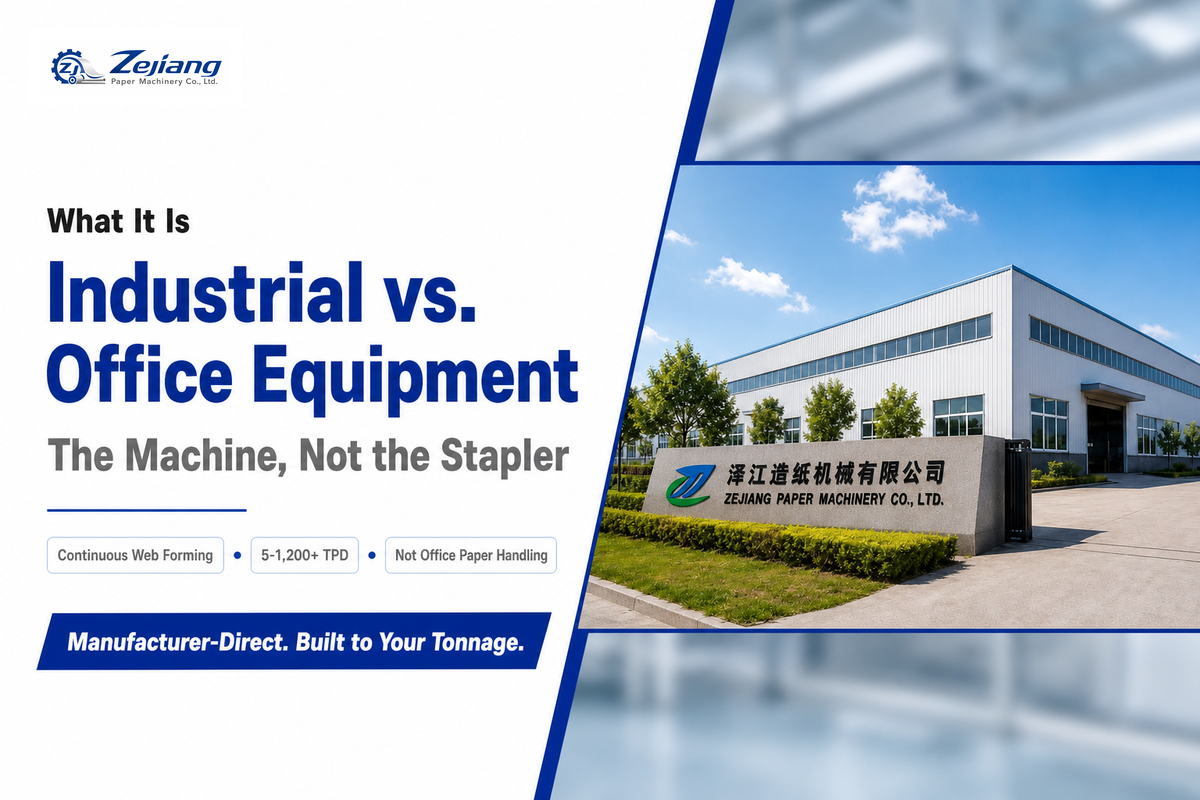
Ask a papermaker what a paper machine is and you’ll get a definition built from motion: it’s a device that continuously forms, dewaters, presses, and dries a web of pulp fiber, starting from a dilute suspension of water and fiber. That framing matters because it separates the paper machine – the production asset that turns raw material into finished sheet – from paper mill, the facility that houses it, and from paper machinery in the broader sense.
The basics of making paper haven’t changed even as automation has, but confusing the two also means missing where a given machine sits in the broader paper manufacturing process. Getting that distinction wrong carries a real cost: buyers who confuse paper-machine spare parts with office-equipment parts can waste 5 days sourcing the wrong item — the reason Zejiang’s spare-parts team flags this distinction early with every new inquiry. Zejiang has built years of engineering experience supplying new, used, and rebuilt paper machines, and confusing these two search categories is one of the most common mistakes a first-time buyer makes.
The core idea hasn’t changed much since 1798, when French inventor Nicholas-Louis Robert built the first working prototype of a continuous papermaking machine (patented in January 1799), and 1807, when English brothers Henry and Sealy Fourdrinier – working with engineer Bryan Donkin – completed the improved machine that still carries their name, even though a flaw in their own patent meant they never recovered the roughly £60,000 they had invested in it. What has changed is scale, automation, and the sheer range of grades modern paper machines can produce, from 13-gsm tissue to 600-plus-gsm specialty paper and board.
In a paper mill, the paper machine sit downstream of stock preparation – the pulping, refining, and cleaning stages covered in our guide to how pulping equipment works – and it’s where that prepared stock actually becomes paper. Everything upstream exists to feed it a consistent furnish; everything downstream (converting, packaging) depends on what comes off its reel.
Forming Technology: Fourdrinier vs. Twin-Wire vs. Cylinder Mould vs. Multi-Wire
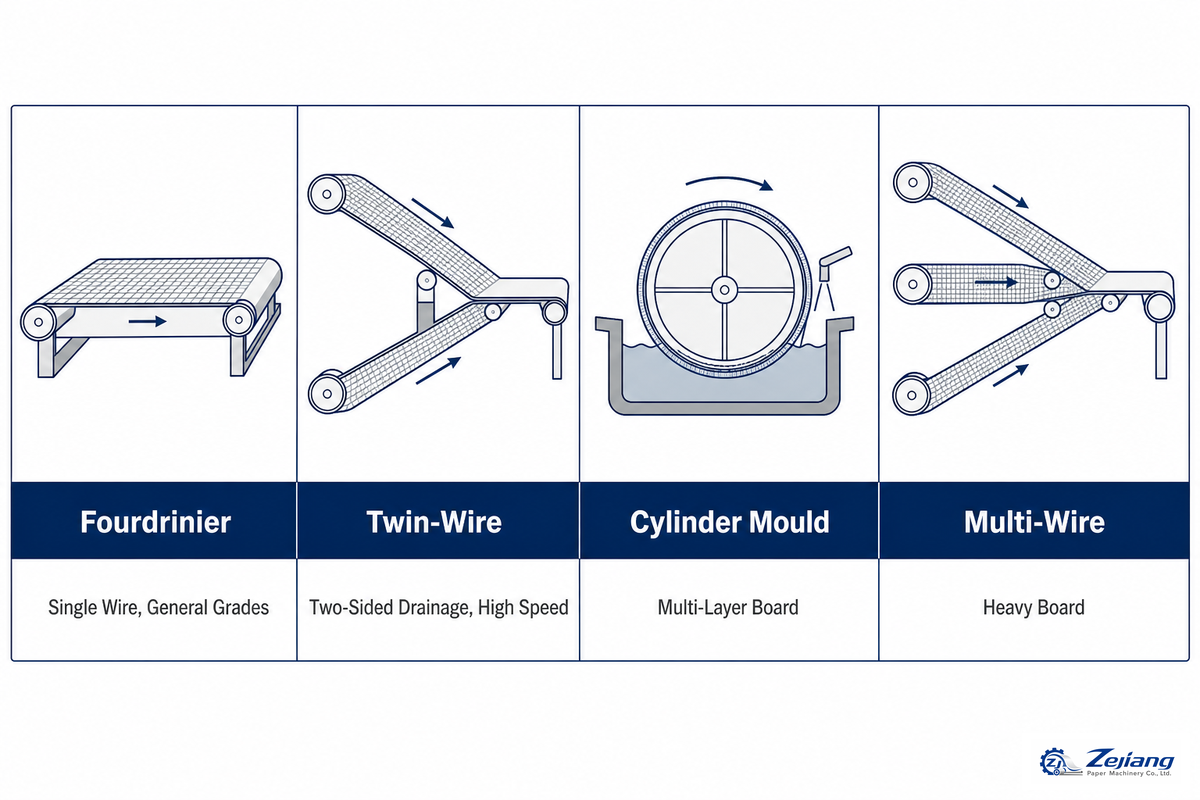
People usually refer to a machine’s “type” as its forming section – the spot where the dilute stock is turned into a recognizable wet sheet. This one decision simultaneously lock in which grades the line will be able to run, how fast it will be able to go, and how consistent the finished sheet will be from top to bottom.
A Fourdrinier machine: Gravity, table rolls and vacuum boxes drain stock through a single, moving screen mesh. Most common forming section in use because it accommodates many grades and is reasonably priced. Disadvantage: drainage from one side results in differences between wire side and top side surfaces. This becomes critical for some fine-paper grades, since fiber tends to align more in the machine direction than the cross direction on a single-wire cylinder machine, a distinction covered in more technical depth in North Carolina State University’s paper chemistry troubleshooting reference.
A twin wire machine, also called a gap former: Stock is sandwiched between two wires moving toward each other and drains from both sides simultaneously while the wet paper is still forming. Benefit: This dual drainage gives uniform cross-section and higher speeds on high-speed machines, ideal for graphic paper, printing papers, and other fine-paper and tissue applications. Disadvantage: High cost for commodity grades where Fourdrinier would suffice.
A cylinder mould machine: Rotating, screenmesh-covered cylinders dip into a pool of diluted stock, with fibers collecting on their surfaces. Multiple cylinders build the sheet from multiple layers, each individually formulated – precisely why cylinder and multi-wire Fourdrinier arrangements dominate multiple-layer board products.
| Forming Technology | Drainage | Best For | Sheet Uniformity |
|---|---|---|---|
| Fourdrinier | Single wire, gravity + vacuum | Kraft, testliner, newsprint, general packaging | Good, one-sided drainage |
| Twin-Wire (Gap Former) | Two converging wires, both-sided | High-speed printing/writing paper, tissue | Excellent, two-sided drainage |
| Cylinder Mould | Rotating cylinders in a stock vat | Duplex/triplex board, specialty grades | Good per layer, slower speed |
| Multi-Wire Fourdrinier | Multiple wires combined wet-on-wet | Heavy multi-layer board, art card | Very good, engineered layer bonding |
“You don’t need a college degree, everything can be learned. Useful skills are basic math and measurement, common sense, and mechanical knowledge.”
A machine operator describing paper mill work, Reddit r/papermaking community
Section-by-Section Anatomy: Headbox to Reel
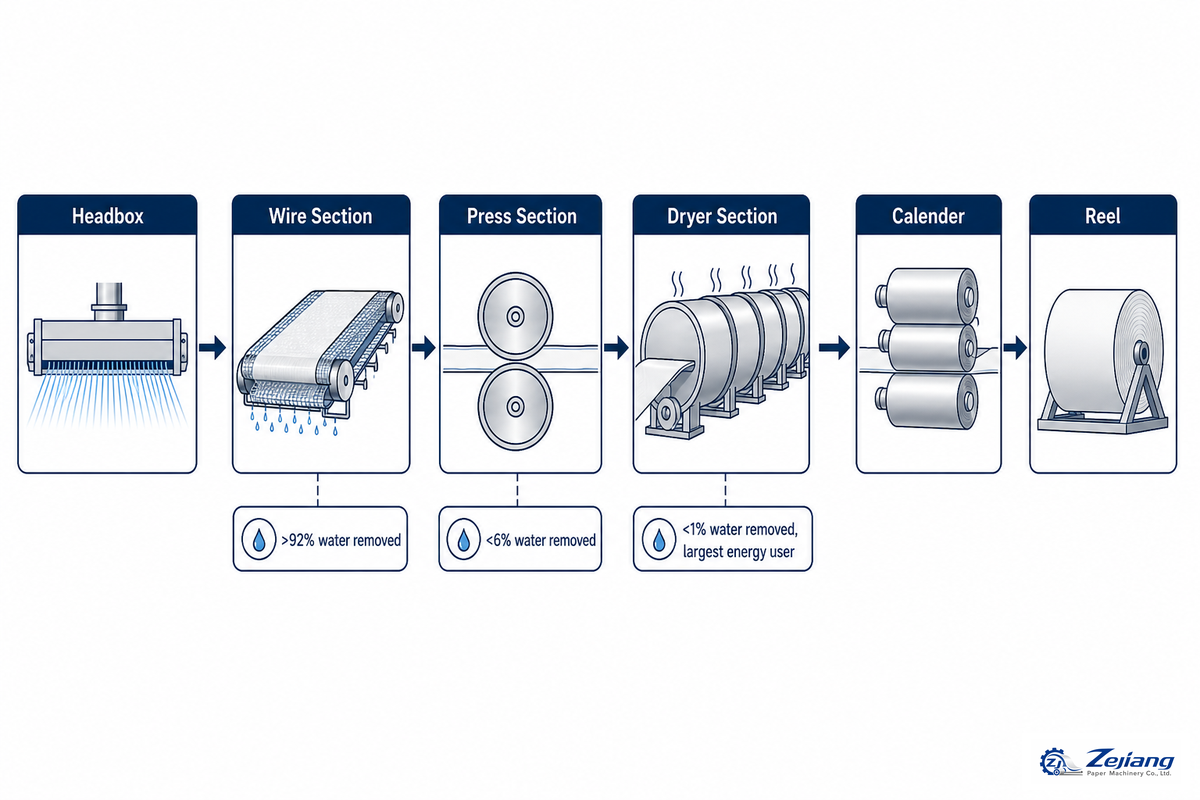
All machine forming sections are variations of a theme, but all paper machines consist of multiple machine sections that do distinct things along the paper making process. Understanding each matters whether installing a new line or troubleshooting.
Headbox. Accepts diluted paper stock from the approach system and distribute it evenly across the machine, a step that governs core properties of paper such as basis weight uniformity. Two main types: Hydraulic for conventional speed operation using a turbulence generator and pulsation-dampener; Pressurized headbox using an air cushion pressure that’s suited to high speeds. Even slight inconsistencies in the slice opening result in Basis Weight streaks, and is the first place an experienced operator examines if sheet quality deteriorates.
Wire section (forming section). This is where the paper web is actually formed in whatever the base technology of the line happens to be (see above). More than 92% of the water is already drained off the stock in the wire section of a typical paper machine – compared to just under 6% removed in the press section that follows, and less than 1% removed in the dryer section, according to one industry estimate. That huge drain is the most important fact in this entire document for you to remember: Where is the energy in this thing going?
Press section. Because removing water mechanically costs a lot less energy than evaporating it away with steam, this section of the machine does a major chunk of water removal by pressing the sheet between rolls covered with absorbent felt. A technical article on paper machine dewatering documents a gain from roughly 51% to 53.5% dry solids at a basis weight of 90 g/m², and from about 54% to 56% at 220 g/m². Other studies place typical post-press dryness between 33% and 55%, depending on the grade of paper. Translation: increasing post-press dryness from, say, 51% to about 52% can lead to a significant reduction of 3-7% in the steam demand of the dryer section for the same finished paper. This is why the most effective way to improve energy efficiency is usually by upgrading press equipment (extended nips or shoe presses), not by adding on more steam.
Dryer section. The steam is now on the scene, evaporating the rest of the water using a series of large steam-heated cylinders, and this part of the machine uses vastly more energy than any other component. A joint industry report estimates the drying section alone accounts for roughly 70% of all energy used in the paper industry, and that about half of this thermal energy is theoretically transferable to heat pumps for re-use. That’s a substantial energy savings opportunity. Important nuance: running a dryer section with higher steam pressure isn’t automatically a better strategy; you can actually waste a lot of steam without achieving much higher dryness once you’re already pushing against a drying limit for your speed and grade.
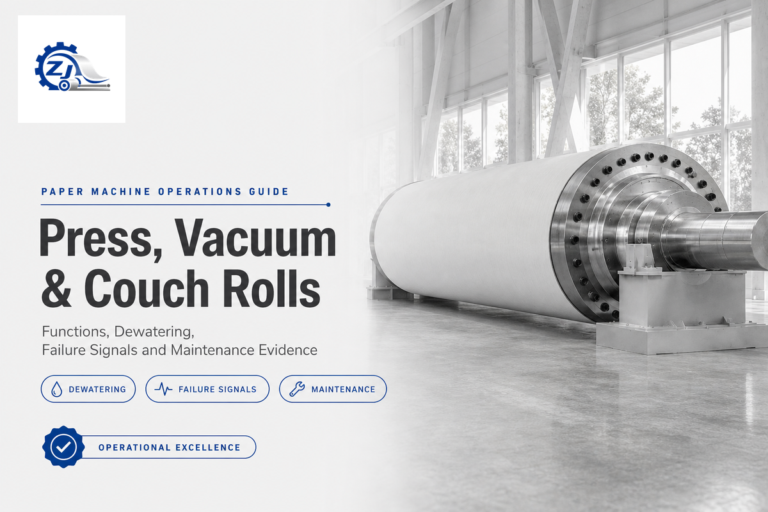
Calender and reel. The calender controls paper surface finish, paper quality, and thickness, typically via smooth or slightly textured steel or composite rolls, some of which might be heated. These machine operations determine the weight of paper a buyer actually receives. The reel simply winds the final paper product into one or more large rolls, ideally at full machine speed when it transitions from one roll to the next. See our articles on calender rolls and doctor blades and on refiner plates and screen baskets if you’d like more detail on the specific equipment used at the tail end of the paper machine.
📐 Engineering Note
Water isn’t removed equally across sections; the most common and serious misconception in paper machine specification is that water removal is wire section >92%, press section <6%, dryer section <1% of total sheet water. Every dollar you spend on the press section give you back dryer section steam more cheaply than spending the dollar directly on the dryer section.
Matching Machine Configuration to Paper Grade
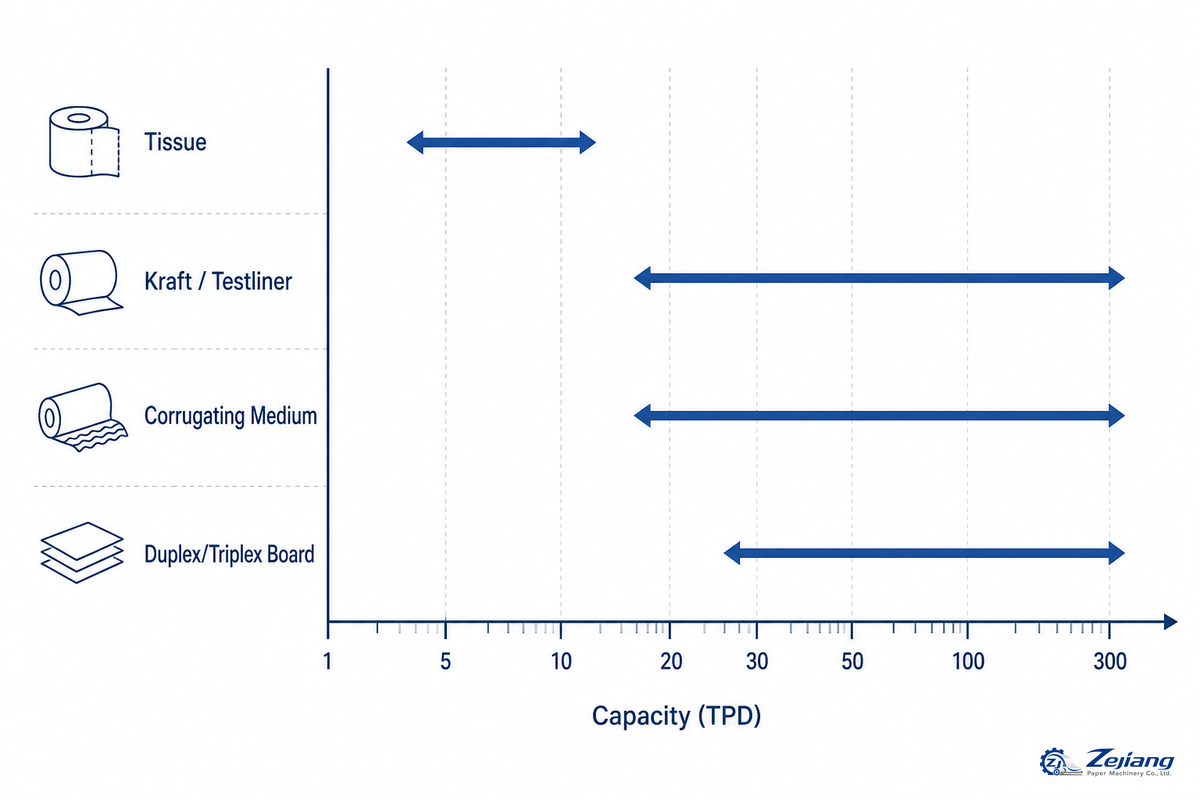
More than any other single variable, the grade defines the machine configuration. A kraft paper machine or testliner line built for 30-80 TPD start-up capacity typically has a Fourdrinier at 2,500-3,500 mm trim width; an expanding kraftliner or board operation targets a capacity between 100 and 300 TPD; a tissue start-up is usually at a much lower capacity of 5-20 TPD on a crescent-former or cylinder-mould machine, organized around a Yankee dryer.
The tissue machine heart is the Yankee dryer – a single, large steam-heated cylinder (which can reach 6 meters in diameter on the largest machines) where the sheet is both dried and creped. For top speeds on a tissue machine, a crescent former lays the web directly against the Yankee; slower but more forgiving on varied inputs is a cylinder-mould or traditional former.
| Paper Grade | Typical Capacity (TPD) | Forming Configuration |
|---|---|---|
| Tissue | 5 – 20 (start-up), up to 100+ at scale | Crescent former + Yankee dryer, or cylinder mould |
| Kraft / Testliner | 30 – 80 (start-up), 100 – 300+ at scale | Fourdrinier, single or double wire |
| Corrugating Medium | Comparable to testliner tier | Fourdrinier, high-OCC furnish tuning |
| Duplex / Triplex Board | 50 – 300 | Multi-wire Fourdrinier or cylinder mould board machine |
The capacity ranges above have been generated from a combination of industry-provided machine configuration guidance, as well as grade mapping databases. The optimum specification for any given situation depends on factors like the furnishes that will be run, market-grade specification and level of automation, so don’t take any range as anything more than a guide for an initial search. Request a machine configuration based on your target grade and capacity, rather than picking one from the lists above. Grade testing itself follows standardized methods, such as those documented in the USDA Forest Service’s packaging test method research, which references TAPPI standard test procedures for recyclability.
Tissue & Small-Scale Paper Machine Buying Considerations

Interest in purchasing toilet paper and smaller tissue paper machines has spiked in recent months — a phenomenon associated with an increasing number of entrepreneurial smaller producers and regional converters rather than the usual large, integrated mills. That increase in demand for smaller tissue paper manufacturing lines and their capacity specifications is a significant one for anyone evaluating a compact paper production line, because it comes with different considerations than, for example, buying a 300 TPD kraft paper line.
At the 5-20 TPD level, other issues frequently outweigh just the choice of forming technology. Whether the line is highly automated, how flexible it’s in terms of input furnishes (for example, can it run 100% virgin fiber in addition to various recycled grades without significant modification?), and access to after-sales spare parts often have greater importance than the highest speed a machine can achieve. A machine that can’t handle varied furnishes forces a buyer to stick to narrower and, typically, more expensive fiber supply options for the lifetime of the machine-a cost not often included in the initial equipment quotation.
Use our capacity and grade selector to determine an initial configuration for your target production rate, and our new, used, and rebuilt advisor once you’ve a target capacity in mind – the next section cover the new vs used vs rebuilt decision in more depth.
New vs. Used vs. Rebuilt: A Cost and Lifecycle Framework
How Much Does a Paper Machine Cost?
There’s no magic number. Paper machines aren’t like goods bought off a catalogue page-instead, they’re custom engineered to meet the grade and capacity needs of an individual mill. Key price drivers include machine capacity, grade complexity, deckle width, automation level, and equipment age (new, used, or rebuilt).
Over a machine’s lifespan, operating costs like fiber and energy consumption typically dwarf initial capital expenditure – which is why the framework below focuses on lifecycle costs rather than sticker price alone.
Buyers often frame this decision as black-or-white (new vs. a used paper machine), when the reality is often a more nuanced three-way discussion – the optimal choice can even vary depending on market conditions. According to U.S. industry data, the total production capacity of U.S. paper and paperboard declined 2.0% last year to about 78.1 million tons – a continuation of the consolidation trends we’ve seen in developed markets – even as global new paper-machine unit orders have been in decline over the last several years while the used- and rebuilt-equipment market has remained strong. The confluence of fewer new-build orders with steady rebuild demand means a structured analysis of whether to buy new vs. used vs. rebuilt is warranted.
The 4-Factor Machine Acquisition Score
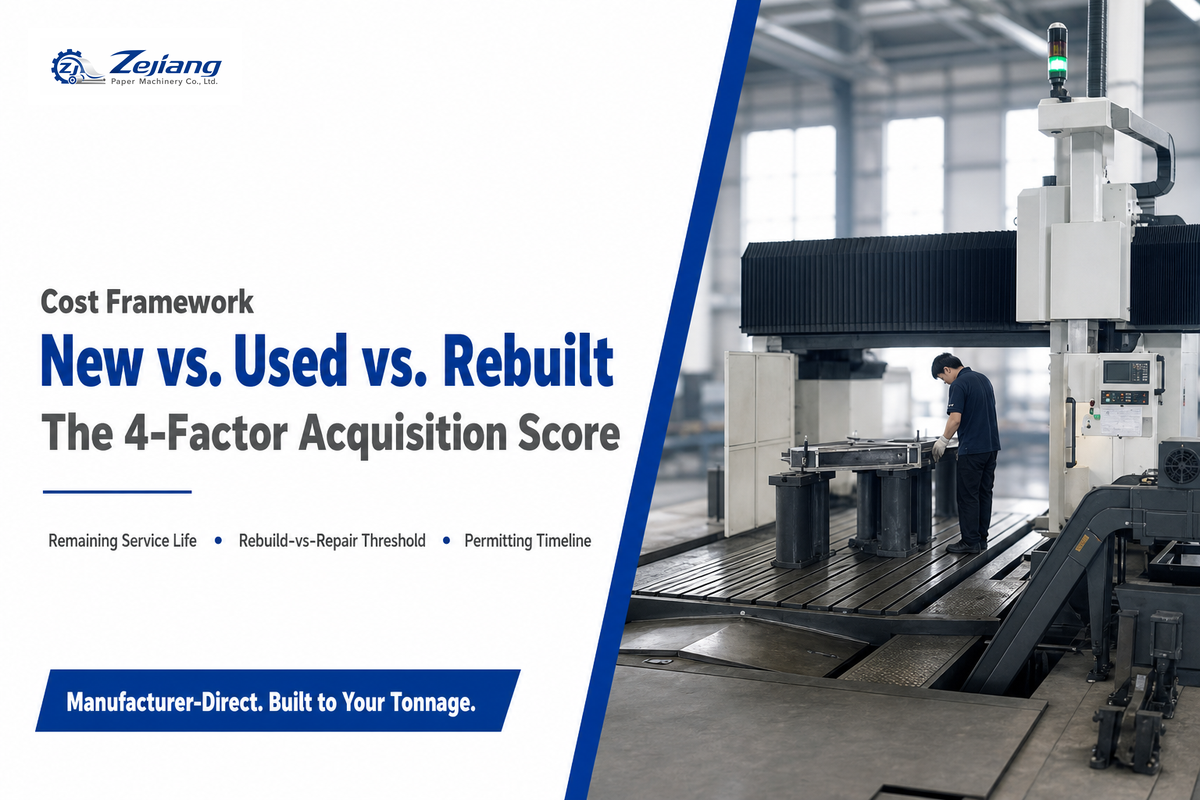
Evaluate potential machines (new, used or rebuilt) based on the following four factors, then compare the purchase price:
- Remaining service life vs. initial price – Buying a used machine at 40% of the new price may seem like a good deal until you consider it has just three years of remaining life on critical components, compared to 15 years for a different 40%-off machine.
- Rebuild vs. repair threshold – Generally, when predicted repair costs reach about 50% of a full rebuild, the economics shift toward the rebuild (even though it’s initially more costly) based on total lifetime value.
- • Furnish and automation compatibility – A used line designed for a narrow range of materials might require extensive stock-prep modifications if it doesn’t match your actual fiber input.
- • Permitting and site timeline – An on-site rebuild can reach full production much more quickly than a new line project that must go through a new EPA environmental permitting process (in the U.S., new or modified discharging mills fall under EPA’s Pulp, Paper and Paperboard Effluent Guidelines and NPDES permit requirements) – a factor that often gets overlooked on an equipment quote.
The lower upfront cost of used and rebuilt equipment isn’t always the most economical choice once you analyze these four variables. For instance, higher maintenance risk and reduced remaining service life can easily offset initial purchase-price savings. In practice, a rebuild or upgrade can often be a better solution than a full replacement when an existing mill require greater capacity or higher product quality without the need to acquire more land or new permits – advantages that a new machine will likely offer (along with warranties and the latest technological advancements).
Who Makes Paper Machines? A Brief Manufacturer Landscape
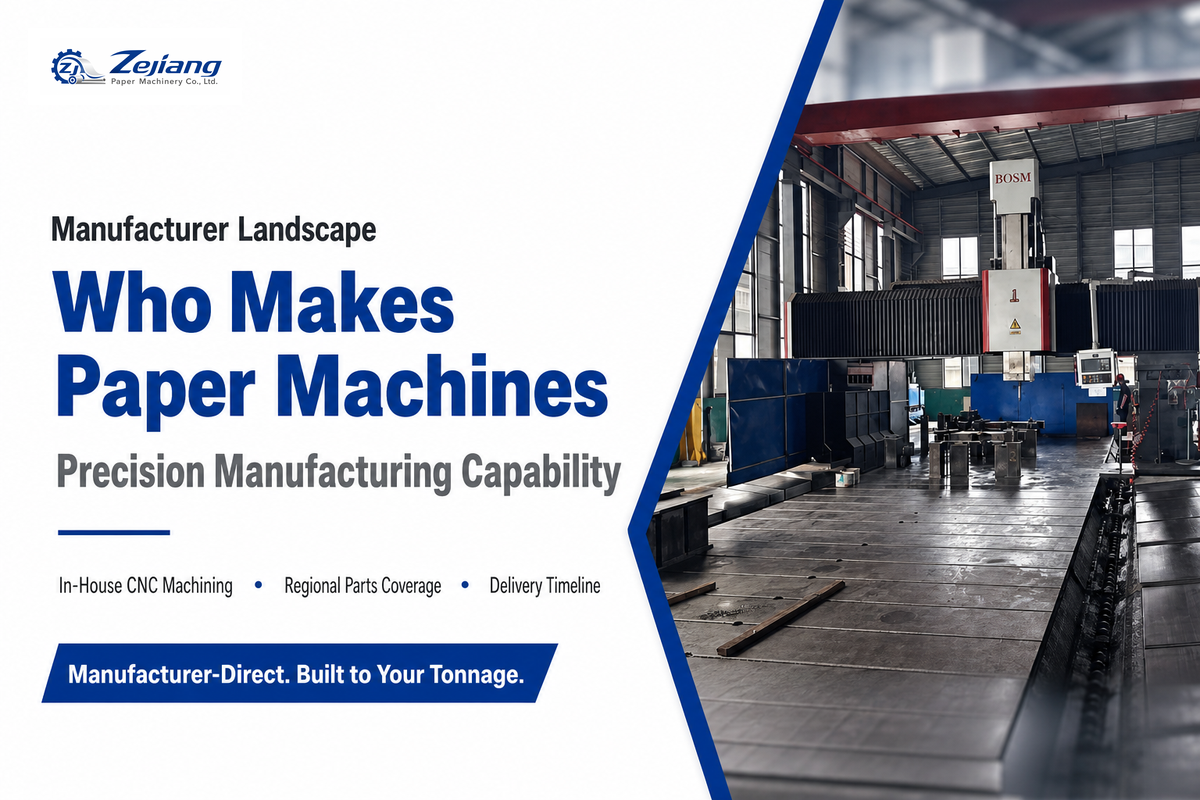
Paper machines are made by established Western full-line suppliers such as Valmet, Voith, and Andritz, alongside a growing group of price-competitive Asian manufacturers based in China and India. The right choice for a given project usually comes down to regional parts and service coverage, not brand reputation alone.
Who Makes Paper Machines?
Valmet (Finland), Voith (Germany), and Andritz (Austria) have each supplied complete paper mill equipment and complete paper machine lines for more than 100 years of paper industry engineering experience, and the paper made on their installed base spans nearly every grade in production today. Asian manufacturers, including Chinese and Indian suppliers, compete heavily on price and delivery time for small and medium-capacity lines and repair/spare-parts business.
Henan Zejiang is one such China-based paper manufacturing machine supplier, competing on delivery time and regional spare-parts responsiveness for every paper mill machine it ships rather than headline machine specification alone — the reason many mills weigh a 2 year warranty and regional parts stock as heavily as the quoted price. Manufacturer-level innovation continues at the component scale too — a recent surface-enhanced pulp fiber patent describes improvements aimed specifically at higher paper machine running speeds.
When buyers receive multiple machine quotes, the most common practical issue isn’t about which brand is superior, but whether the spare parts and service network of the specific supplier really covers your region in the time frame of your uptime requirements. Skipping that regional-support check is a common mistake: if the replacement of a worn-out felt, dryer fabric, or roll takes eight weeks instead of two, the loss due to downtime will likely be greater than the difference in price between competitive quotes.
Common Paper Machine Problems and What Causes Them
What Are Common Problems in Paper Machines?
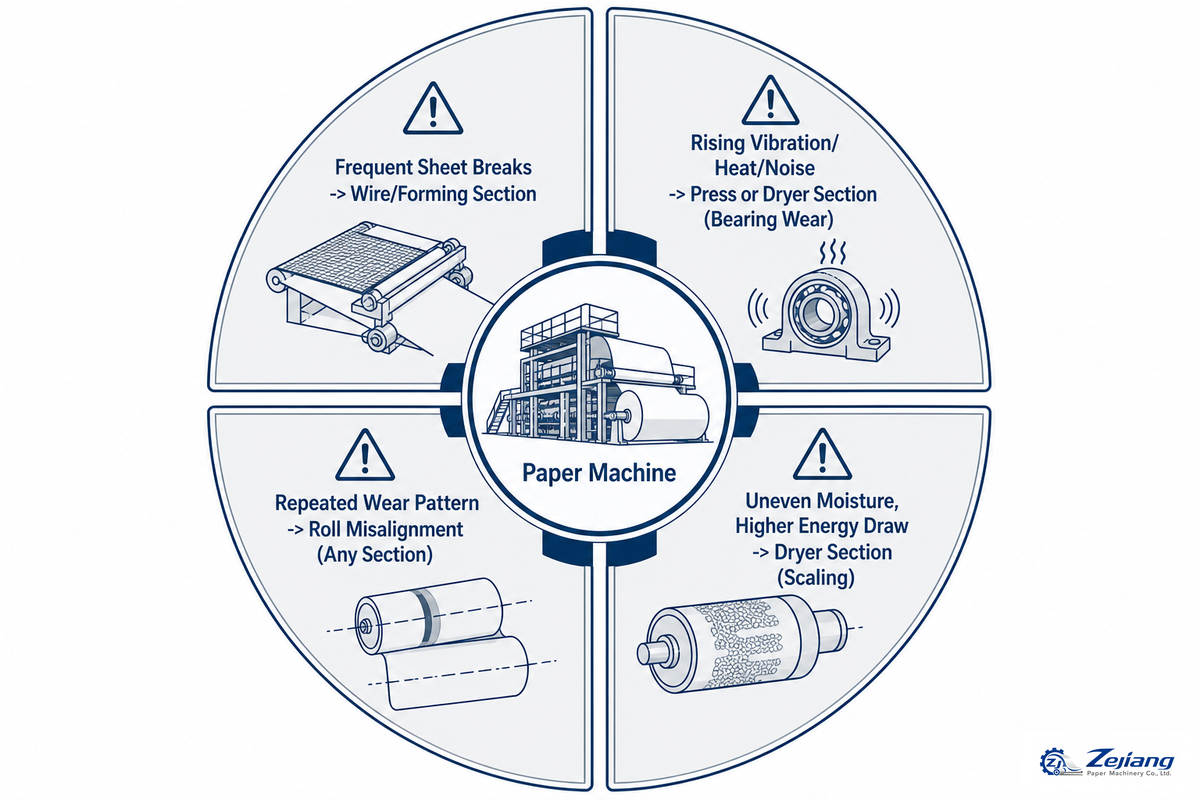
Sheet breaks, bearing failures, dryer efficiency and roll alignment are the four most common paper machine problems. Each problem has a specific set of causes rather than a single cause, and the operators usually discover the symptoms much before the maintenance team can trace the root cause back to the origin.
Troubleshooting a running paper machine differs from the standard “identify, analyze, solve” process on paper because it requires experience in the form of speed and pattern recognition. The Symptom to Section Troubleshooting Wheel below can guide the operators to identify the section that’s most likely to be the cause of the problem based on the actual symptoms observed, thus saving valuable time.
| Observed Symptom | Likely Section | Common Root Cause |
|---|---|---|
| Frequent sheet breaks | Wire / forming section | Inconsistent tension, worn felts, uneven pulp distribution — often a maintenance gap rather than an operating error |
| Rising vibration, heat, or noise from a roll | Press or dryer section | Progressive bearing wear — these rarely fail suddenly; the early warning signs are the actual event to act on |
| Uneven moisture, higher energy draw | Dryer section | Scaling on cylinders or a steam-system inefficiency that machines “still run through,” masking the cost |
| Repeated component wear, vibration pattern | Roll alignment (any section) | Misalignment — a small issue that compounds into recurring maintenance cost if not corrected at the source |
Take sheet basis weight streaks as an example: the problem appears on the finished sheet, but the root cause is almost always found in the previous stage of the process, in the headbox. It’s the headbox slice lip that’s out of shape and which the quality control system detects far before an operator could see the issue with their own eyes. By narrowing down the scope of the troubleshooting to a section before investigating symptom-specific issues, a real breakdown can be solved quickly.
The maintenance work on a running paper machine is also not only an operational activity, but a regulated one. For example, in the US, 29 CFR 1910.261, “Pulp, paper, and paperboard mills” in particular, applies to facilities where pulp, paper, and paperboard is produced and processed, while the general machinery safety requirements allow for lock-out before cleaning, lubricating, adjusting, or servicing which involves a hazard from a moving part in direct contact or proximity. This regulatory layer exists behind every troubleshooting check list on the shop floor.
Industry Outlook: What’s Changing in Paper Machine Technology

The biggest structural pressure on modern paper-manufacturing technology today isn’t market growth – it’s drying-energy decarbonization. Drying represents some 70% of total energy use across the paper industry, and a joint report from European paper and heat-pump associations puts estimated maximum potential of industrial heat pumps as substitutes for steam boilers at nearly 50% of total drying heat demand. For a mill contemplating a 2026-2027 upgrade cycle, that makes dryer section retrofit choices an energy strategy issue, not a throughput one-and validates the increased importance of press section dewatering (see anatomy above) with each new energy cycle, since every point of dryness gained in the press is a point that the dryer section-and any subsequent heat-pump installation-won’t have to address. Mills that delay a dryer-section retrofit decision by even 2 years risk locking in higher energy costs while heat-pump technology and rebate programs continue to mature — a risk that matters because Zejiang’s own rebuild-and-upgrade projects are increasingly built around exactly this retrofit timing.
Overlaying this technological transition is an interesting trend in capacity and ownership: Global new-paper-machine orders have been decreasing in recent years, even as US capacity declined some 2% in 2024. Fewer new machines, combined with persistent capacity- upgrade demand, is exactly the kind of environment where used markets and specialists rise in importance, providing the practical rationale for why this new-vs.-used-vs.-rebuild breakdown became more common, not less, in recent years.
One caution to add to the overall “green” equation: using more recycled paper and recycled fiber from waste paper doesn’t automatically lead to lower emissions in how the paper production process is powered, because recycled-pulp production often lacks the bi-product energy provided by virgin Kraft pulping, sometimes leading to a higher dependence on fossil fuel for process heat. Apply appropriate nuance to the general statement that recycled means “greener.” Innovation continues at the process-chemistry level too: a pulp-grinding method patent aimed at improving fiber refining illustrates the kind of incremental gains mills can expect alongside larger dryer-section retrofits.
Frequently Asked Questions
What are the different types of paper machines?
View Answer
The main forming-technology types are Fourdrinier (single wire, the industry workhorse for kraft, testliner, and newsprint), twin-wire or gap formers (two-sided drainage for high-speed and high-uniformity grades), cylinder mould machines (rotating cylinders for multi-layer board), and multi-wire Fourdrinier configurations for heavy board. Which one fits your project depends on target grade, speed, and capacity — see the comparison table above for specifics.
What is the difference between Fourdrinier and Twin-Wire forming?
View Answer
A Fourdrinier drains stock through a single bottom wire, which creates some measurable difference between the wire-side and top-side surface of the sheet. A twin-wire former sandwiches stock between two converging wires so water drains from both sides simultaneously, producing a more uniform sheet through its thickness and tolerating higher operating speeds. Twin-wire is generally preferred for high-speed printing, fine paper, and tissue; Fourdrinier remains the default for general packaging and kraft grades.
What is typically included in a turnkey paper machine installation contract?
View Answer
A turnkey scope generally bundles the machine itself with installation, commissioning, and initial process tuning, so the buyer takes delivery of a running line rather than a collection of equipment to integrate independently. Scope boundaries (who supplies civil works, utilities tie-ins, and initial spare-parts stock) vary by supplier and should be confirmed in writing before signing — see our turnkey paper mill project page for how a full-scope delivery is structured.
What is the machine that makes paper called?
View Answer
It is called a paper machine, sometimes written as papermachine or paper-making machine. The term covers the full industrial line — forming, press, dryer, and finishing sections together — not any single component within it.
Is paper milling still a viable long-term investment?
View Answer
It depends heavily on grade, region, and energy strategy rather than the industry as a whole. Mature markets like the U.S. have seen paper and paperboard capacity contract in recent years, and new paper-machine unit orders have trended down globally, which argues for caution on greenfield capacity bets in saturated grades. At the same time, tissue and packaging demand in growing export markets, along with a real efficiency opportunity in dryer-section decarbonization, keep targeted capacity additions and mill upgrades a reasonable investment case when they are sized to an actual furnish supply and a specific grade demand, not a generic growth assumption.
Where can I source paper machine spare parts and aftermarket support?
View Answer
Spare-parts channels typically run through the original machine supplier, but many mills also maintain a secondary channel for wear items — forming wire, press felts, dryer fabrics, rolls, doctor blades, and screen baskets — so a single worn part doesn’t turn into an extended outage. Confirming regional lead times for these wear items before you need them, not after, is one of the more overlooked parts of a buying decision.
Why We Write This
At Henan Zejiang Paper Machinery, we supply new, used, and rebuilt paper machines plus replacement parts, so we have a direct stake in buyers understanding the real trade-offs rather than just accepting one supplier’s package. This guide leans on TAPPI, OSHA, EPA, and industry-association sources because the new/used/rebuild and drying-energy questions deserve evidence, not a sales pitch. Reviewed by the Henan Zejiang Paper Machinery technical team. Updated July 2026.
References & Sources
- Paper machine — Wikipedia
- Paper Machine, An Overview — ScienceDirect Topics
- Improved Energy Efficiency in Paper Making — TAPPI PAPERCON
- AF&PA Details U.S. Paper Production and Capacity Trends — American Forest & Paper Association
- Through Pumps to Pulp — CEPI (Confederation of European Paper Industries) & EHPA
- 29 CFR 1910.261, Pulp, Paper, and Paperboard Mills — U.S. Occupational Safety and Health Administration
- Pulp, Paper and Paperboard Effluent Guidelines — U.S. Environmental Protection Agency
- Benchmarking Energy Use in Canadian Pulp and Paper Mills — Natural Resources Canada
- Paper Machine Types and Key Components — Pulp and Paper Technology
- Paper Machine Maintenance: Preventive Care & Solutions — Pulp and Paper Technology
Related Articles
- How Pulping Equipment Works — the stock-preparation stage that feeds every paper machine
- Doctor Blade: Types, Materials & How It Works — the calender-adjacent component covered briefly above
- Calender Rolls Explained — deep dive on the finishing section
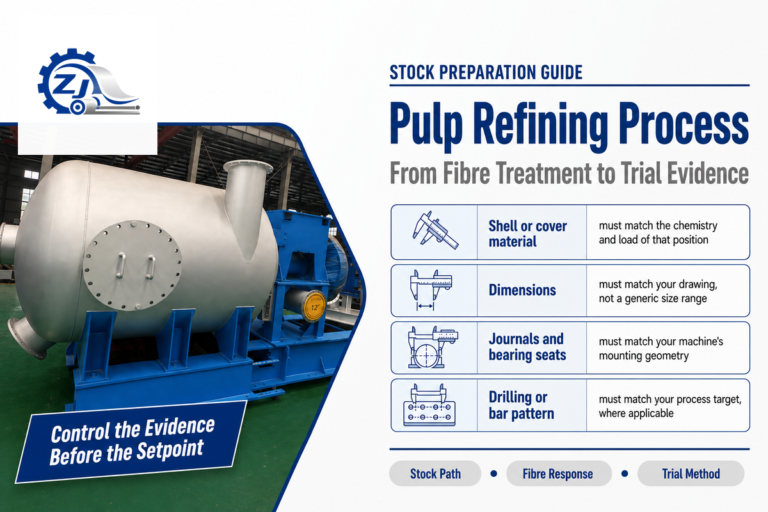
- Refiner Plates and Screen Baskets: A Complete Guide — stock conditioning ahead of the headbox
- Paper Machine Manufacturer: Kraft, Corrugated & Tissue Lines — configure and quote a new, used, or rebuilt line


![Refiner Plates & Screen Baskets [Complete Guide]](https://zjpapermachine.com/wp-content/uploads/2026/07/refiner-plates-screen-baskets-guide-featured-150x150.png)
![Doctor Blade: Types, Materials & How It Works [Guide]](https://zjpapermachine.com/wp-content/uploads/2026/07/doctor-blade-guide-featured-1-150x150.png)
![Pulping Equipment: How Paper Pulping Works [Guide]](https://zjpapermachine.com/wp-content/uploads/2026/07/pulping-equipment-guide-featured-150x150.png)