Get in touch with Zejiang Paper Machinery Company


Quick Specs
| Low-consistency (LC) pumping range | Roughly under 5-6% consistency (chest agitators in this band are commonly sized 1-55 kW for 200 L-40 m3 chests). |
| Medium-consistency (MC) pumping range | 8-18% consistency, temperatures up to 95-98C at 12-16%. |
| Consistency test method ceiling | TAPPI T240 measures pulp consistency up to 25%. |
| Top-entry mounting | Propeller-to-tank-diameter ratio ~25-50%; blend times on the order of seconds once turbulent flow is established. |
| Side-entry mounting | Propeller-to-tank-diameter ratio ~1-3%; blend times on the order of hours; 3-5x more mixing energy than top-entry. |
A pulp pump and agitator system is the combination of industrial equipment used in pulp and paper manufacturing that keeps a paper mill’s paper pulp stock moving and agitated through the stock preparation line. The pulp pump transports the fiber slurry from process stage to process stage, and an agitator in every stock storage or blending chest suspends the fiber in that slurry so it won’t settle, agglomerate, or float out of consistency before the pulp pump can pick it up. Get the pump and agitator selection wrong and the mill will end up wasting pumping energy or re-depositing the exact inconsistency it thought the pumping system would cure.
Simply put, a chest pump will discharge the pulp within a certain consistency range (low, medium, or high), and a chest agitator will maintain fiber in a uniform state so the chest pump will be drawing in the same consistency. Either end of the pair mismatched will take down downstream chemical addition, bleaching and the sheet.
Key Takeaways
- The size of the pump and the design of the agitator are a function of the consistency band being run (LC, MC, HC), not the tank size.
- Top and side entry agitators achieve quicker blends for higher costs, a side entry might require 3 to 5 times more mixing power for identical performance.
- A well-designed retrofit can cut power requirements for agitation in half while boosting throughput-more power isn’t necessarily better mixing.
- China’s new paper machine installations peaked around 150 units per year in 2022 and have been declining since, following the same trajectory mature markets like the U.S. and Germany went through decades ago – where pump and agitator spending has already shifted toward system optimization and retrofit instead of new-build capacity.
What a Pulp Pump and Chest Agitator Actually Do
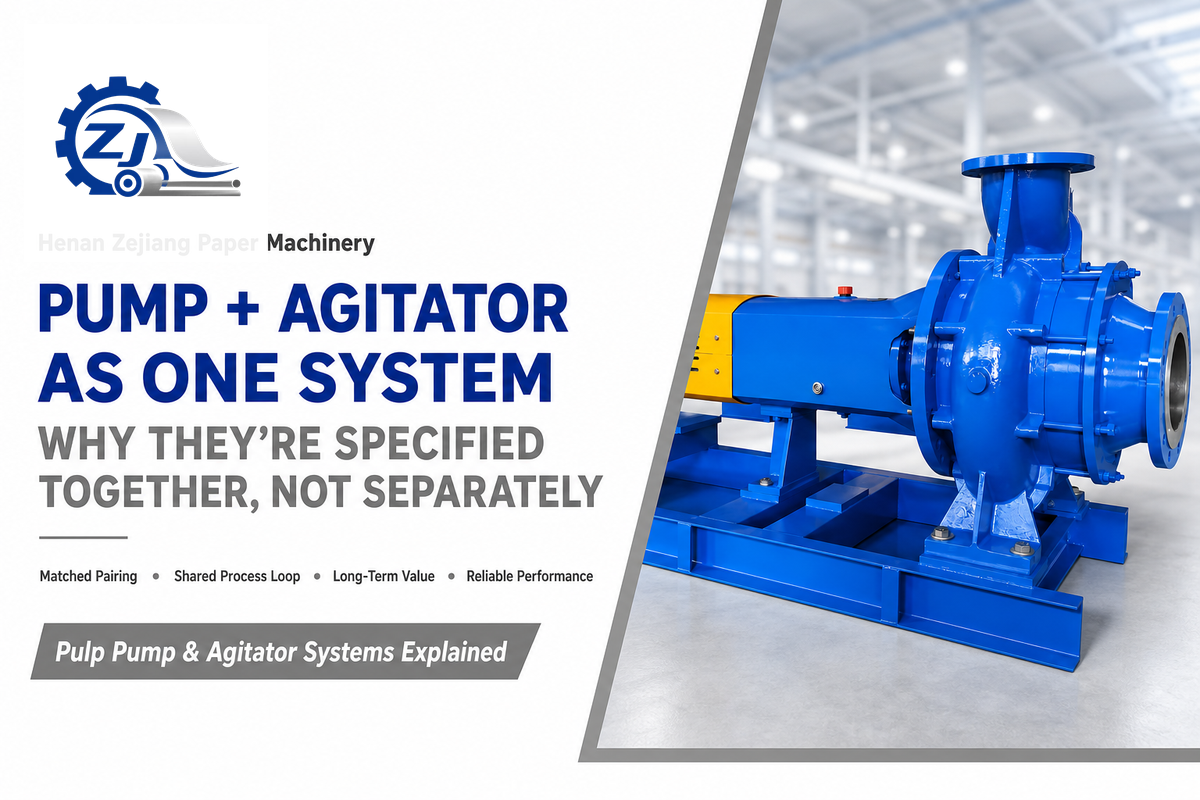
A pulp pump moves stock from one process step or tank to the next at a set flow rate and pressure. The agitator’s job is less obvious but just as important: it keeps fiber suspended in the water so the stock stays uniform from the top of the chest to the bottom.
Without that agitation, the fiber would settle out, the water would separate from it, and the consistency of the material withdrawn by the pump at the bottom of the chest would deviate significantly from the consistency that entered the chest at the top. Pulp stock itself is really just a slurry – liquids containing solids in suspension – which is exactly why keeping it moving matters as much as pumping it.
These machines are bought as a matched pair, not independently. If you search for pulp pump manufacturers, you’ll notice the bigger names – Sulzer, ANDRITZ, and others – all offer the MC pump and an associated industrial agitators and/or tower control system under the same brand (e.g., SALOMIX from Sulzer) precisely because the two items’ performances affect one another when they’re operating in the same process loop. Any supplier worth using in this space will tell you the same thing: a properly specified pump will still be fed inconsistent slurry if it’s associated with a poorly agitated chest. Conversely, an oversized agitator supplying an under-specified pump will expend excess energy just suspending material that the pump can’t readily deliver. One example (patent CN216947631U, China) describes a system that puts this matched pairing logic at the core of an entire pulping-distribution-transport system – for whatever that’s worth as evidence of how manufacturers think about this equipment combination.
💡 Pro Tip
If you’re troubleshooting a stock-quality problem, check the agitator before the pump. A pump that “isn’t working” is very often fine on its own – the real cause is usually an undersized or improperly located agitator upstream delivering inconsistent stock, not the pump itself.
Where This Equipment Sits in the Pulp and Paper Industry’s Stock Prep Line
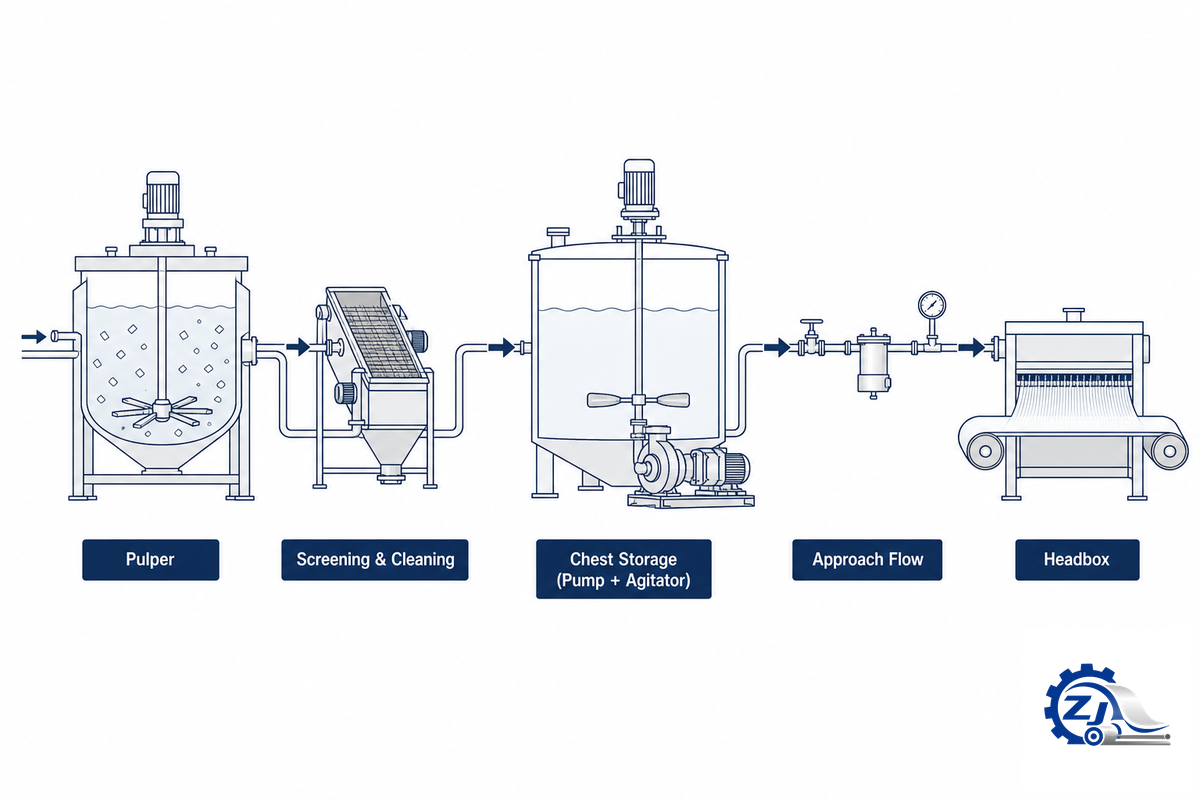
In the pulp & paper industry, stock prep is where the papermaking process starts from a machinery standpoint – fibers get blended, refined, diluted, and metered to the paper machine as part of the broader pulp making and pulp mixing sequence. Pump-and-agitator chests sit downstream of the pulper, screens, and cleaners, and upstream of the approach flow system that feeds the headbox.
As the U.S. Department of Energy’s Energy and Environmental Profile of the Pulp and Paper Industry puts it, stock preparation is a critical step that involves refining the crude pulp slurry and tailoring it to the specific properties the finished paper needs. This stage sits well upstream of the pulp dryer machine and calender stages that finish the sheet later on.
- Pulper breaks down raw fiber (virgin wood, kraft pulp or recycled/deinked fiber) into a slurry.
- Screening and cleaning removes unwanted contaminants and oversized fiber bundles.
- Chest storage with pump and agitator holds the stock at controlled consistency and suspended by the agitator while it’s drawn off by the pump as needed.
- Approach flow dilutes and meters stock to the headbox.
Mills that skip past this stage when troubleshooting quality complaints often regret it: a corrugated-board line running a poorly agitated recycled-fiber chest, for instance, can see sheet basis-weight swings show up at the reel long before anyone thinks to check the chest upstream, simply because the pump was drawing off stock at an inconsistent point in its settling cycle. Tracing a formation defect back to a stock-prep chest rather than the paper machine itself is a common troubleshooting miss, and it costs real production time to find.
The pulping method changes what the pump-and-agitator stage has to handle. Chemical and mechanical pulping methods produce different fiber and chemical-residue profiles – kraft pulping is the chemical route, and recycled fiber lines running a deinking stage bring in another variable entirely, since fines content and leftover ink particles both affect how readily the stock settles and how much agitation it needs to stay uniform. A chest handling recycled fiber for corrugated board (or other cardboard-grade paper products) generally needs less aggressive agitation than one handling long-fiber kraft pulp at a higher consistency, since short, processed recycled fibers settle differently than longer virgin fibers do – see our waste paper recycling line breakdown for how the rest of that stage of pulp and paper production is set up.
📐 Engineering Note
The TAPPI Stock Preparation reference notes the stages as a continuum of blending, refining, dilution and metering, and says pump and agitator sizing should be decided alongside refiner and screening capacity, in one pass, rather than as an afterthought bolted to a chest.
Why Chest Agitators Exist: Dead Zones, Settling, and Consistency Loss
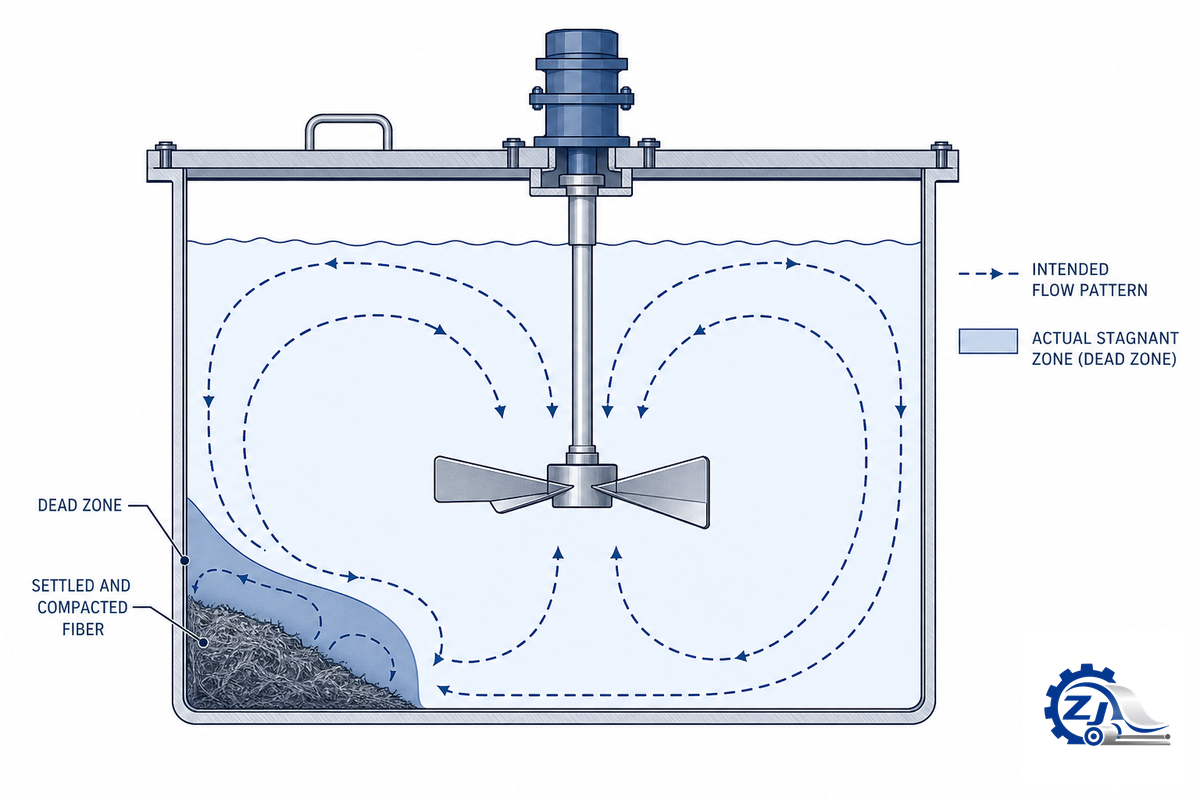
Chest agitators exist to stop fiber from settling out of suspension between the moment stock enters a chest and the moment the pump draws it back out. Without that continuous motion, fiber drops out unevenly, forms dead zones and clumps, and the consistency the pump sees at the bottom of the chest drifts away from what came in at the top.
How Does a Slurry Agitator Work?
A slurry agitator works by keeping a fiber-water slurry in continuous motion, so that solids remain suspended and don’t settle to the bottom of the tank. In a pulp chest, this is most often a hydrofoil-type open-face impeller or another suitable style, strategically placed and oriented to ensure flow patterns reach all parts of the chest, including the bottom near the pump suction.
Scholarly fluid dynamics research, including a North Carolina State University study on pulp fiber suspension yield stress, confirms that consistency changes the material rheology enough that the impeller must be specifically designed for it, rather than being a scaled-up low-consistency impeller.
Without adequate agitation, three things go wrong in sequence. First, fiber settles unevenly, creating dead zones – pockets of the chest where fiber accumulates and stagnates rather than circulating, sometimes turning into a dense sludge layer at the bottom. Second, that settled material can compact into clumps that break loose unpredictably and spike the consistency reading the pump sees. Third, because the pump is drawing from one point in the chest, any settling gradient between that draw point and the rest of the tank shows up directly as consistency variation downstream, which then has to be corrected further down the production line – usually with extra dilution water, which itself costs energy and capacity.
Real-world evidence from practicing engineers supports these statements clearly. For instance, in a forum where pulp stock pump suction designs for pulp service were discussed by practicing engineers on the website eng-tips.com, engineers agreed that at a low consistency of about 2%, the stock behaves as plain water so a conventional pump suction design applies. However, on a separate forum where the discussion on piping design of high-consistency stock (4% or higher) took place, practitioners took a completely opposite view that at 4% and especially at 6% consistency, anything else but a smooth flow into the pump inlet will result in the pulp stock not settling at the desired point at the pump inlet.
⚠️ Common Mistake
Designing chest agitator location and pump suction with a pulp stock design as if it were plain water at any consistency beyond about 4% consistency. As field evidence and academia confirm, higher consistency pulp stock demands special suction design features that cannot be achieved with a scaled up low-consistency design.
Matching Pump Type to Pulp Consistency: LC, MC, and HC Ranges
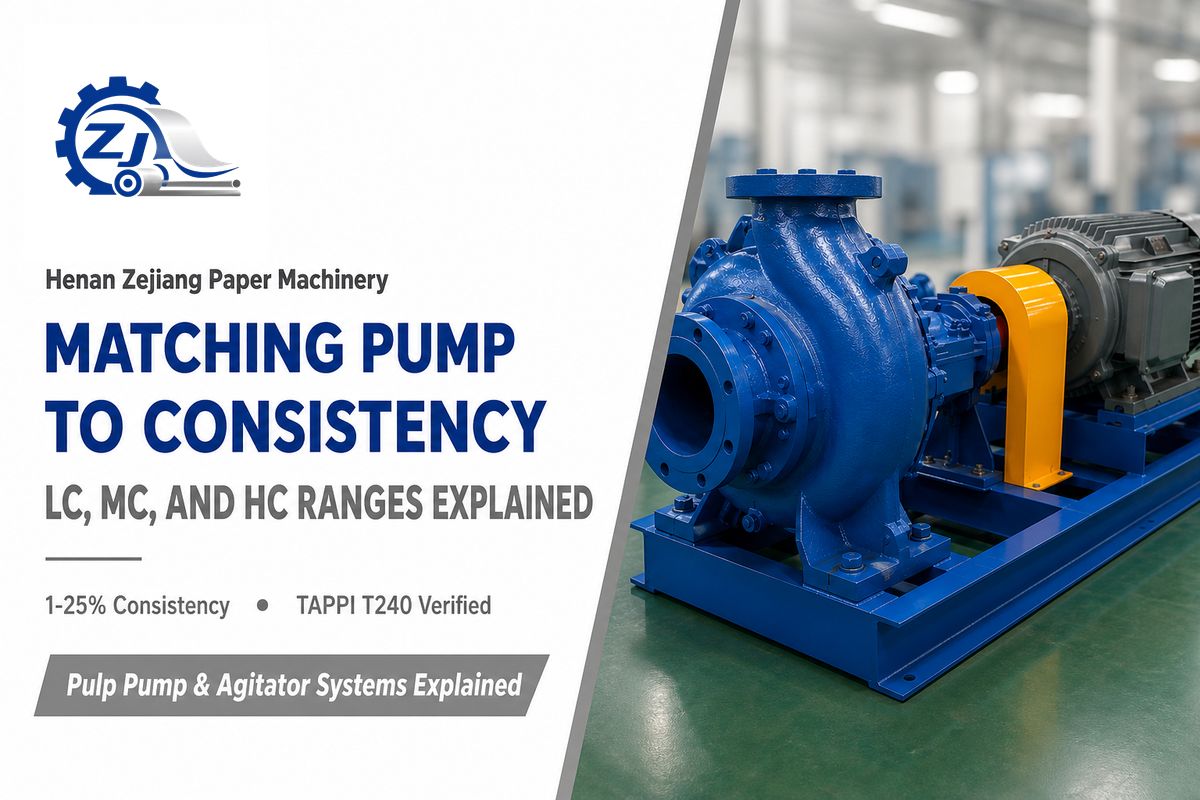
What Is the Difference Between a Pump and an Agitator?
A pump moves fluid from one point to another by creating flow and pressure; an agitator keeps fluid or slurry uniformly suspended in place without necessarily moving it anywhere. In a pulp chest, the two perform contrasting jobs in the same tank: the agitator circulates stock to keep it suspended, while the pump draws that suspended stock out into the piping system.
It’s entirely possible to have a properly working agitator and a properly working pump that are still mismatched to each other, if the two were originally sized against different assumed consistencies.
Pulp consistency itself is measured using TAPPI Test Method T240, which covers pulp suspensions up to 25% consistency and applies to pulp sampled at different points across a mill. It’s worth being precise about what T240 actually does: the test tells you what consistency your stock is running at right now, not how to size a pump or agitator for it — the selection ranges below come from equipment specifications, not from the test standard itself.
| Band | Typical Consistency | Equipment Implication |
|---|---|---|
| Low Consistency (LC) | Roughly under 5-6% | Standard chest pump + agitator, 1-55 kW range for 200 L-40 m3 chests, stock behaves close to water for suction design |
| Medium Consistency (MC) | 8-18% | Requires MC-rated pumps (e.g. fluidizing impeller designs), degassing systems become relevant, non-smooth suction inlet needed |
| High Consistency (HC) | Above MC, verifiable up to 25% per T240 | Specialized HC pumping/discharge equipment (e.g. tower discharge scrapers); standard centrifugal pumps are not appropriate |
Worked example: say your chest is running at 10% consistency, which is a normal number to see after a thickener or filter stage doing mechanical dewatering (sometimes with vacuum assistance) upstream. That number puts you squarely in the MC band — Sulzer’s published MCE pump and SX chemical mixer arrangement, for instance, is specified for an 8-18% consistency range. (Separately, Sulzer also reports a specific high-temperature capability — pumping at +95-98C — achievable at 12-16% consistency from a low-level pumping vessel; that’s a distinct innovation claim, not the pump’s general operating range, and it changes the heating and material requirements for the pump too.) At 10% consistency you would spec an MC-rated pump with a fluidizing/degassing-capable impeller and stainless steel or better wetted parts (chemical treatments like bleaching are corrosive), not a standard LC chest pump meant for stock under roughly 5-6% — a standard LC pump run at 10% consistency would struggle with exactly the settling and inconsistent-suction problems described in the previous section, and processing time downstream would suffer as a result. For a separate wetted-material enquiry, compare stainless steel and nickel alloys from TiAlloy against the specified grade and mill documentation; the pump supplier must confirm compatibility with the actual process.
“MC pumping and chemical mixing systems are the most important stock transfer equipment in the modern oxygen delignification and bleaching processes in recycled fiber and mechanical pulp lines.”
Top-Entry vs Side-Entry Agitator Mounting: Which Fits Your Tank?
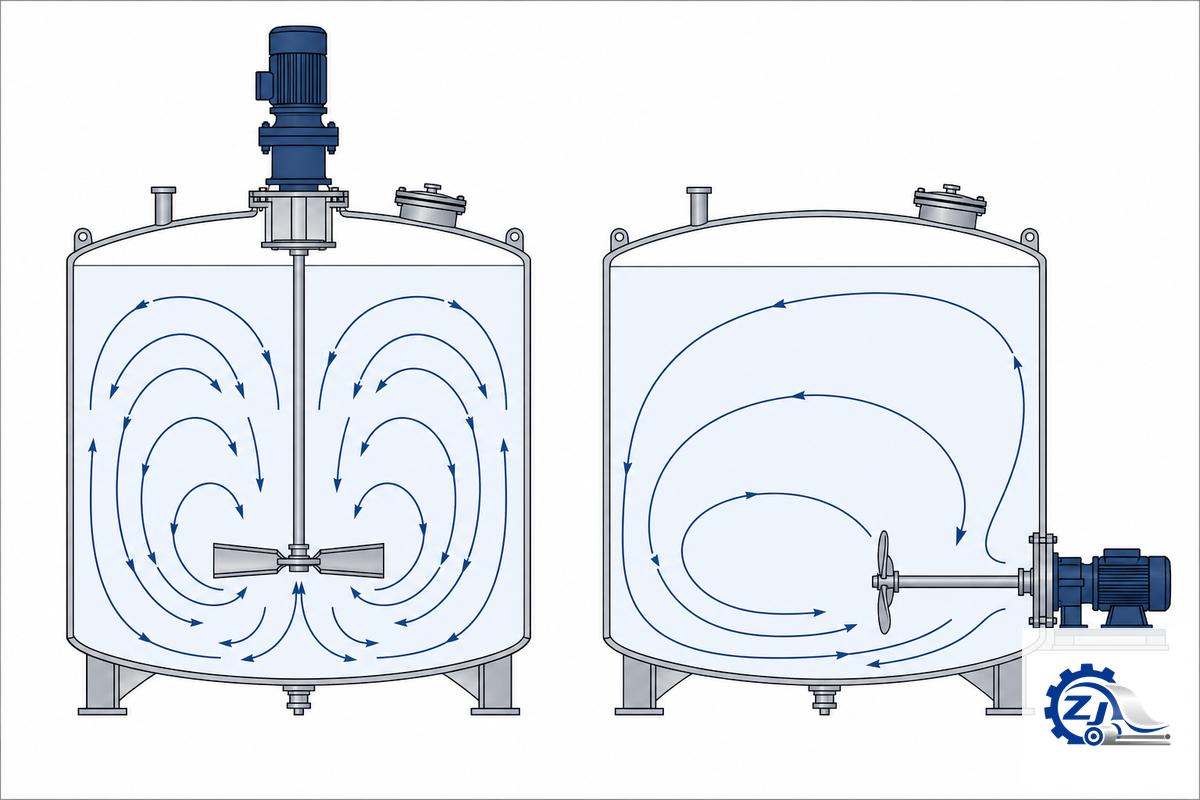
Top-entry mounting generally blends faster and uses less energy; side-entry costs more energy and blends slower but fits tanks where roof access isn’t available. Mounting configuration is a separate decision from consistency band, driven mostly by tank geometry and installation constraints rather than process chemistry.
No pulp/paper-specific study of this exact tradeoff turned up in our research, so the clearest quantified data on it comes from a peer-reviewed 2018 mixing study on petroleum storage tanks — the underlying fluid-mixing physics (propeller-to-tank-diameter ratio and its effect on blend time) is generic to any large stratified tank, not chemistry-specific, which is why the numbers are usable here as a directional reference rather than a pulp-industry-verified figure. That study quantifies the tradeoff clearly: side-entering propellers are typically sized at only 1-3% of the vessel diameter, and blend times run on the order of several hours, while top-entering agitators typically use a much larger 25-50% diameter ratio and reach turbulent blend times on the order of seconds. Separately, mixing-equipment vendors report that side-entry mixers require roughly 3 to 5 times more mixing energy than most top-entry mixers to do comparable work.
| Factor | Top-Entry | Side-Entry |
|---|---|---|
| Typical propeller/diameter ratio | 25-50% | 1-3% |
| Typical blend time | Seconds (turbulent regime) | Hours |
| Relative mixing energy | Baseline | 3-5x higher |
| Common reason to choose it anyway | Best blend performance when roof access is open | Roof already occupied (floating roof, structural steel cost of a top-mount drive) |
✔ Advantages — Top-Entry
- Much faster blend times
- Lower mixing energy for the same result
- Simpler impeller geometry for most pulp consistencies
⚠ Limitations — Top-Entry
- Needs open roof access and a structural mount
- Not viable on tanks with floating roofs or existing roof-mounted equipment
A Simple Selection Framework: The 4-Factor Pump-Agitator Fit Check
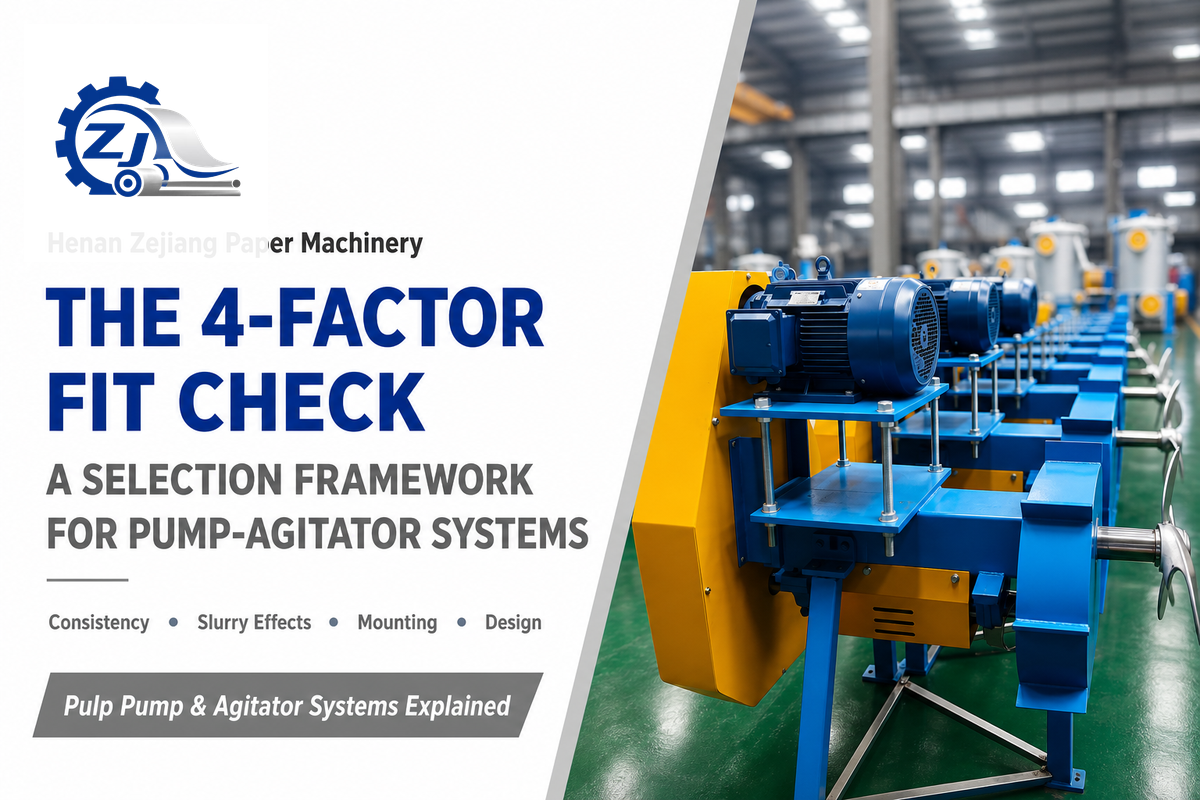
A lot of buyers searching for pulp pump and agitator price end up asking the wrong first question. Price is downstream of fit – an undersized agitator mixer paired with an oversized pump (or the reverse) will cost more in wasted energy and rework over its service life than the sticker-price difference between two correctly matched, cost-effective systems ever would – a well-matched, high performance, efficient mixing setup pays for itself through better operational efficiency, production efficiency, and steadier product quality across the whole production process, while a mismatched one just quietly wastes money on all three fronts. Bigger isn’t automatically better. Published in Physical Review Fluids, a peer-reviewed fluid-dynamics study on optimizing stirring shapes and strategies found that mixing enhancement can come from optimized stirring protocol and stirrer shape within a fixed, prescribed energy budget — meaning smarter geometry beats simply adding power. Sulzer’s own published customer case makes the same point with real numbers: a single-line retrofit using a redesigned center-fillet (“VULCA”) arrangement cut agitation power from 330 kW to 165 kW — a 50% reduction — while digester production actually increased by 4% and entrained air dropped from 10-15% down to 5-8%. Better design beat more power.
Use this four-factor check before specifying a pump-and-agitator system or evaluating a retrofit:
| Class | Type | Typical Fit | Source |
|---|---|---|---|
| Agitator | Propeller | High-speed continuous blending, low-viscosity mixtures | Verito Engineering |
| Agitator | Paddle | Gentle mixing where excessive shear would damage delicate fiber | Verito Engineering |
| Agitator | Turbine | Intense mixing of thick slurries, fast chemical blending | Verito Engineering |
| Agitator | Helical | High-consistency pulp where viscosity resistance is high | Verito Engineering |
| Agitator | Anchor | Large vessels, scrapes tank walls to prevent buildup | Verito Engineering |
| Pump | Standard LC chest pump | Roughly under 5-6% consistency, general chest transfer | sv-industries spec sheet |
| Pump | MC fluidizing pump | 8-18% consistency, oxygen delignification and bleaching stages | Sulzer MCE pump spec |
| Pump | HC discharge/scraper system | Above MC, verifiable up to 25% consistency per T240 | Sulzer tower discharge system |
| Mounting | Top-entry | Open roof access, fastest blend time, lowest energy | Chem. Eng. Research and Design, 2018 |
| Mounting | Side-entry | Floating roof or structural-cost constraints, slower blend, 3-5x more energy | Chem. Eng. Research and Design, 2018 |
The 4-Factor Pump-Agitator Fit Check
- Consistency band: confirm actual operating consistency with TAPPI T240 measurement, not the design assumption from years ago — chests drift as upstream processes change.
- Slurry-Specific Pump Effects – Referring to the Hydraulic Institute’s ANSI/HI 12.1-12.6 slurry pump standard, verify wet-end wear resistance and minimum velocity to ensure there’s enough flow velocity to keep the particles suspended and prevent pipe blockages. The performance of slurries inside the pump is very different from clear water, and an inadequately specified pump “will not work satisfactorily or not at all.”
- Mounting Considerations – Don’t default to a side-entry installation just because it’s convenient; instead, consider whether there’s roof access or sufficient structural integrity to accommodate a top-entry mixer, which will usually provide superior performance in terms of energy consumption and blending time.
- Design Over Horsepower – Before ordering a larger motor for the mixer drive, investigate if changing the impeller design or chest shape could achieve the desired process outcomes with a lower horsepower rating-similar to how a center-fillet retrofit can.
Maintenance Basics and Early Warning Signs
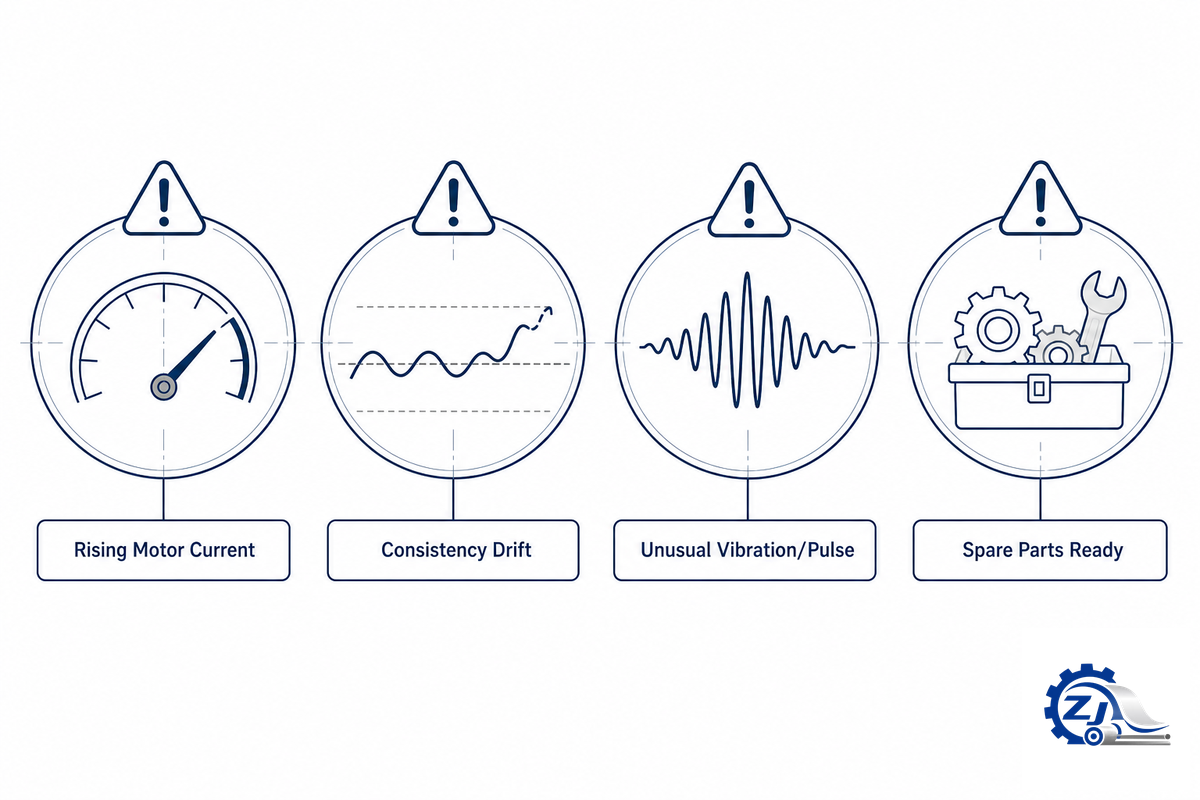
Day-to-day upkeep of a pump-and-agitator chest system often centers around maintaining process consistency and monitoring wear in the agitator’s mechanical components, so a production interruption doesn’t sneak up on you. Industry professionals typically watch for a few key early indicators. A slow and steady increase in agitator motor current is often the first sign of fiber build-up on the agitator or worn bearings. Process readings at the pump suction straying from the normal historical range, especially without a corresponding upstream change, is another. So is an unusual pulse or vibration at the pump itself – pump vibration monitoring is a widely accepted method for catching early-stage bearing wear or cavitation before the entire line has to stop. Keeping spare parts for common wear items on hand – impeller blades, seals, bearings, and where relevant the jet or nozzle components in dilution/mixing systems – helps bridge the gap between spotting a warning sign and actually fixing it.
Servicing equipment inside a chest, which presents a potential hazard of unexpected startup or release of stored energy, is a matter of safety regulations, not just mechanical tasks. Under the United States Occupational Safety and Health Administration’s 29 CFR 1910.147, the lockout/tagout standard, machinery such as an unguarded agitator inside a permit-required confined space, such as many chests, must be locked out or tagged before servicing. If a technician must enter a chest for maintenance, the requirements of 29 CFR 1910.146 on confined-space entry also typically apply. These OSHA regulations aren’t merely a matter of bureaucratic form-filling; they address serious energy release and atmospheric hazards that exist when entering an agitated vessel.
- Follow trend of agitator motor amperage, not just instantaneous value
- ✔ Compare pump-suction consistency against baseline regularly
- Monitor agitator/pump vibration to detect early stages of bearing wear or cavitation
- Ensure 1910.147 and 1910.146 are followed prior to all chest maintenance work
Industry Outlook: What’s Changing in Stock-Prep Equipment Spending
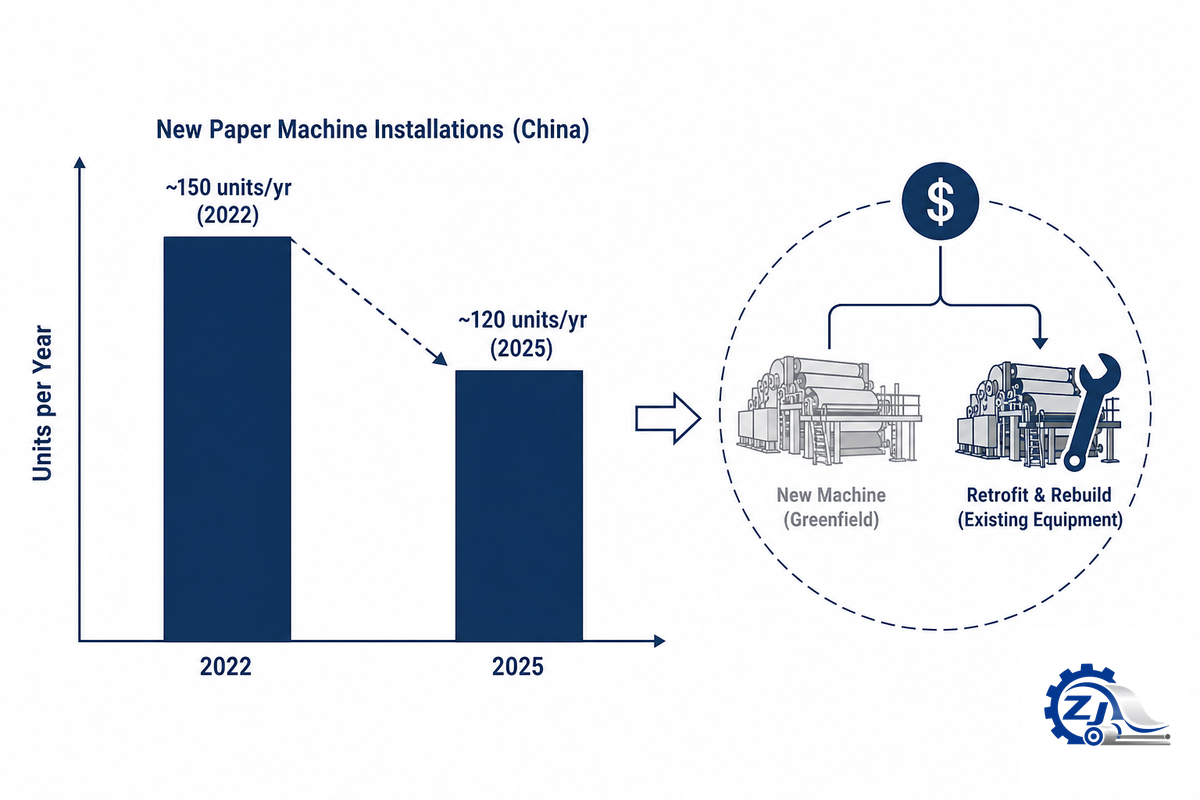
The pulp and paper industry isn’t shrinking globally — ResourceWise, the information arm of the magazine of the same name, is tracking a 2.3% global CAGR industrywide through 2028, with Asia-Pacific, Latin America and the Middle East still adding capacity. But growth varies drastically based on mill location. In the largest individual paper producing country, China, where new paper machine installs topped out around 150 in 2022 and are estimated to drop to ~120 by 2025 and ~80 by 2027, “that curve is going to look very much like what happened in the U.S. and Germany decades ago when the markets maxed out in the ’50s and ’60s and they hit what’s known as a ‘stock competition’ phase,” explains one resource from the firm. Elsewhere, in North America and Europe, “we’ve already transitioned from capacity expansion to efficiency optimization” in the industry, the firm’s market report states. A 2026 paper by Forest Policy and Economics (and one of several studies ResourceWise draws upon) models this “maturity” picture for part of it, projecting that employment and the number of companies in the U.S. paper manufacturing sector will decline across the six largest forest-dependent states.
What this all means for pump and agitator procurement is that, for the mature markets, and increasingly for China’s most productive paper regions, “capacity expansion” opportunities are rapidly yielding to a need to make the most of the equipment already installed, or retrofit it. In line with this, Sulzer’s MCE/MCEV retrofit programs and MCA/MCV hydrofit programs were explicitly developed to allow mills to upgrade their first- and second-generation MC pumps without modifying piping or the drive “to help them gain a performance improvement without the cost and disruption of replacing the entire line,” its website explains. Note: This doesn’t necessarily mean a total stop in new builds everywhere – Asia-Pacific and Latin America capacity continues to expand, with companies like AFT continuing to supply new stock preparation equipment into these markets through 2025. Likewise, new packaging, tissue, and recycled-fiber lines won’t necessarily follow the same maturation path as graphic paper.
In summary, if your 2026-2027 capital expenditure plans are underway, your pump and agitator strategy may benefit from prioritizing the evaluation of your existing equipment for retrofit options – before simply defaulting to ordering brand new stock – especially if your mill operates in any of these mature markets or in key paper-producing areas of China. If the pumps and agitators turn out to be one part of a larger ailing line, it’s worth exploring full paper machine rebuild and upgrade options before committing to a single-stage fix.
Frequently Asked Questions
Q: What is the difference between a pump and an agitator?
View Answer
A pump is equipment that physically moves a fluid (such as pulp slurry) from one location to another through the application of pressure and flow. An agitator keeps material in a contained space (a chest or tank, typically) in a state of suspension and uniform distribution. During normal operation, the agitator keeps circulating material within the chest to prevent settling while the pump draws off that evenly distributed stock and sends it to the next stage. Though always specified together, pumps and agitators perform different functions.
Q: How does a slurry agitator work in a paper mill chest specifically?
View Answer
How is an agitator impeller set up?
The impeller (a high-shear type is most often used for pulp) of an agitator for the paper mill chest is usually sized so it covers the whole volume of the chest – to include the corners and right above the pump inlet so that pulp doesn’t fall into any stagnant spots. Because a pulp-fiber mixture’s consistency changes how it moves as the amount of pulp goes up, the design of the impeller has to fit with the actual consistency the stock will have in the chest during operation — an impeller design that’s adequate for a dilute consistency may leave stagnant regions when the stock is of medium-consistency.
Q: What are the three types of centrifugal pumps used in pulp handling?
View Answer
Pulp handling generally fits within three basic centrifugal pump types for specific consistency bands: standard clear-water/free-flow open or closed-impeller pumps (sometimes built as split case pumps for larger flows) designed for dilute stock (usually under about 5-6% solids); specialized fluidizing medium-consistency (MC) pumps featuring specific turbulating-impeller designs to handle 8% to 18% stock; and high-consistency (HC) transfer pumps used with, for example, a tower discharge scraper for any consistency over medium-consistency. The distinctions arise because the fundamental assumptions about designing clear-water centrifugal pumps no longer hold true with increased consistency and solids.
Q: How often should a pulp chest agitator be inspected?
View Answer
How do you schedule inspections of a chest agitator?
Most paper mills have the ability to track agitator motor amperage in real time via the control system and will dispatch maintenance if there is an observed change in trend. Quarterly inspections are typically standard if no anomaly in amperage has been observed.
Q: Can one agitator serve multiple pump draw-off points in the same chest?
View Answer
Can one agitator service multiple draw-offs?
This depends on the geometry of the chest and the separation distance of draw-off points — the agitator will only be able to serve multiple draws effectively if its mixing pattern extends to both locations without dead spots at either draw-off. In large, geometrically complex or irregular chests with more than one draw-off point, multiple agitators or a combination of top-entry and side-entry agitators are usually necessary to effectively mix and ensure no dead spots.
Q: What happens if a pulp pump and agitator are mismatched in capacity?
View Answer
Oversizing the pump in relation to the agitator’s capability to suspend fiber will result in inconsistent feeding to downstream process equipment (sometimes called draw variation) – a mix of properly suspended fiber and dead fiber or pulp clumps. This usually necessitates an additional dose of diluting water downstream to re-suspend the stock and smooth out the consistency swings. Undersizing the pump relative to the agitator is also inefficient and wastefully churns more of the chest contents than necessary, burning extra energy without improving throughput. Neither failure mode announces itself clearly on a control-room screen – both tend to show up first as a vague quality complaint from the paper machine, well downstream of the chest where the actual mismatch lives, which is exactly why running the 4-Factor Pump-Agitator Fit Check before ordering equipment is worth the extra hour it takes.
In either case, the basic issue is a mismatch in the physical configuration or operating conditions rather than pump-and-agitator design parameters. Use the 4-Factor Fit Check presented earlier to avoid this problem.
Ready to size a pump-and-agitator system for your specific chest, consistency band, and tank geometry?
See our pulp pump and agitator selection page →Why We Write This
Our team developed this guide using established equipment standards, research in pulp processing and consistency measurement, customer retrofit experiences, and OSHA requirements related to pump and agitator chest system maintenance access, not from any single vendor. Wherever a data point couldn’t be independently corroborated with at least a second source, we’ve said so explicitly rather than presenting it as definitive. Reviewed by the Zejiang technical team.
References & Sources
- Energy and Environmental Profile of the U.S. Pulp and Paper IndustryU.S. Department of Energy
- TAPPI T240: Consistency (Concentration) of Pulp SuspensionsTAPPI
- Stock PreparationTAPPI
- ANSI/HI 12.1-12.6: Rotodynamic Centrifugal Slurry Pumps — Hydraulic Institute
- Blending in Above Ground Storage Tanks with Side-Entering Agitators — Chemical Engineering Research and Design (Elsevier), 2018
- Mixing by Stirring: Optimizing Shapes and Strategies — Physical Review Fluids, 2022
- Where the Trees Fall: Macroeconomic Forecasts for Forest-Reliant States — Forest Policy and Economics, 2026
- 29 CFR 1910.147, The Control of Hazardous Energy (Lockout/Tagout) — OSHA
- OSHA Standard Interpretation on Agitator Lockout in Permit Spaces (1994-03-03) — OSHA
- Experimental Study on Particle Settling in Fiber-Containing Suspensions — Processes (MDPI), 2025
Related Articles
- Pulp Pump & Agitator, Product Selection Pagespecifications and configurations for our pulp pump and agitator systems
- Waste Paper Recycling Linethe full stock-prep line for recycled/deinked fiber, including the pump-and-agitator stage discussed above
- Paper Machine Rebuild & Upgradefor evaluating a full-line rebuild rather than a single-stage retrofit
- Installation & Commissioningwhat’s involved in bringing a new or retrofitted stock-prep stage online
Note: this article is the first in a planned pump-and-agitator content series covering consistency bands, energy efficiency, agitator troubleshooting, and mounting selection in depth. Links to those companion articles will be added here once published.
![Refiner Plates & Screen Baskets [Complete Guide]](https://zjpapermachine.com/wp-content/uploads/2026/07/refiner-plates-screen-baskets-guide-featured-150x150.png)
![Doctor Blade: Types, Materials & How It Works [Guide]](https://zjpapermachine.com/wp-content/uploads/2026/07/doctor-blade-guide-featured-1-150x150.png)
![Pulping Equipment: How Paper Pulping Works [Guide]](https://zjpapermachine.com/wp-content/uploads/2026/07/pulping-equipment-guide-featured-150x150.png)