Get in touch with Zejiang Paper Machinery Company



This paper machine rebuild guide is a section-by-section reference covering what actually gets modified, when the decision makes sense, and what a rebuild costs and delivers in practice. A rebuild means only parts or specific components of an existing machine – a headbox, a press section, a dryer group or the control system – get replaced, while the existing frame and drive train stay untouched. This is neither a purchase nor regular maintenance, and it applies to pulp and paper mills running kraft, tissue, or specialty paper manufacturing lines. The risk mills most often struggle with isn’t a single expensive mistake – it’s the gap between what a rebuild proposal promises and what an aging machine’s actual condition can support.
Quick Specs
| Typical planning window | 10-16 months before shutdown |
| Typical engineering window | 3-12 months |
| Sections most commonly rebuilt | Headbox, forming, press, dryer, control system |
| Cost relative to new machine | Proposal-based, typically well under a comparable new line |
| Largest documented single-machine rebuild (2025) | $500M, Sappi Project Elevate, PM2 capacity doubled |
What Is a Paper Machine Rebuild? (The Sections That Actually Get Rebuilt)
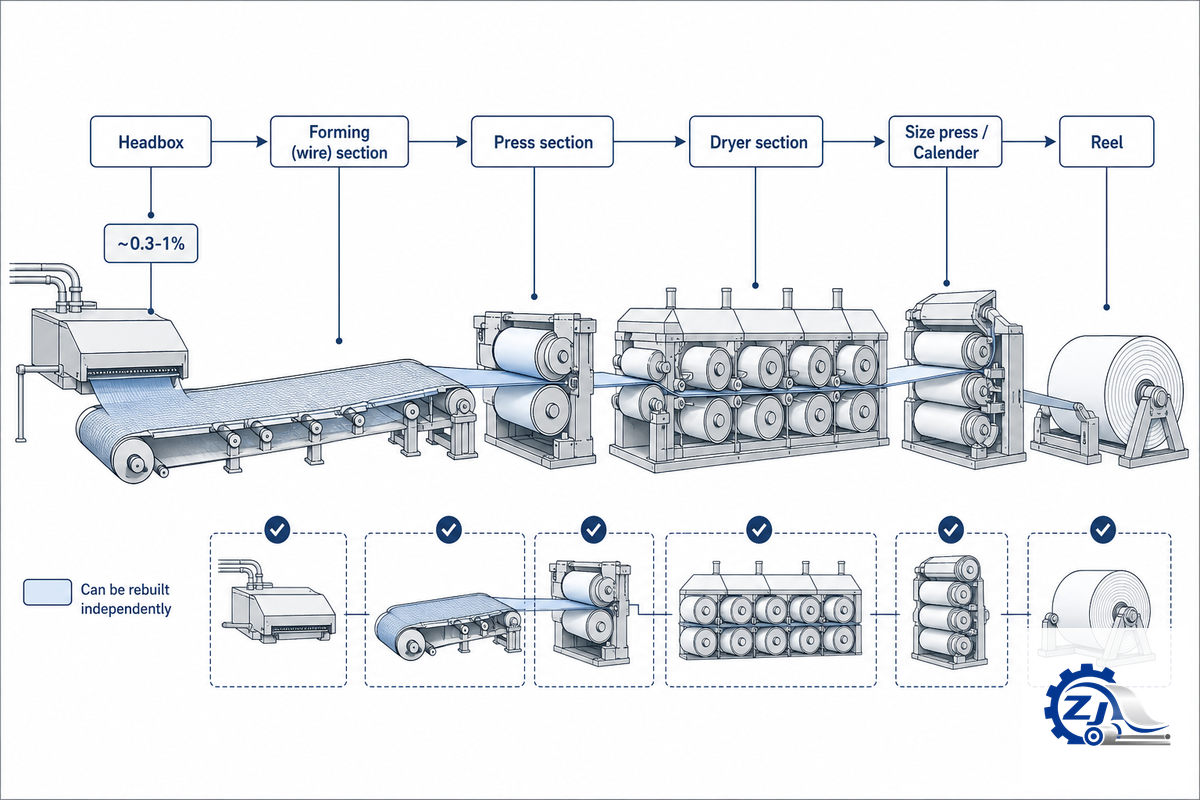
A paper machine rebuild replaces one or more specific sections of an existing machine – typically the headbox, forming, press, dryer, or control system – rather than the entire line. It keeps the original frame and drive train in place, which is what separates a rebuild from buying a new machine and what makes it a mechanical and cost decision scoped section by section.
Converting a dilute pulp slurry into a wound, dry finished paper sheet involves several distinct mechanical stages of the papermaking process. Stock typically arrives from the pulp mill’s pulpers at roughly 0.3-1% consistency after abrasion and refining reduce the fiber to size, and passes through one or more headboxes to distribute the paper web evenly across the machine width before going into forming, pressing, drying, and finishing – a sequence that runs from the wire and press sections through the dryer, size press and calender, and any of these steps can be rebuilt while the others remain untouched. The same underlying sequence applies whether the line is running kraft packaging, tissue paper, fine paper, or a specialty paper grade; only the section-level details change. Zejiang’s in-house engineering teams work from this same section-by-section map when a mill first asks which part of an old machine is actually worth rebuilding.
| Section Type | Function | What a rebuild usually changes |
|---|---|---|
| Stock prep (pulpers, refiners) | Reduces raw fiber to furnish at the right consistency | Refiner plate upgrades, pulper capacity increase |
| Headbox | Distributes stock evenly across machine width | Dilution control retrofit, hydraulic headbox conversion |
| Forming (Fourdrinier) | Drains stock on a moving wire to form the wet sheet | Wire section upgrade, single-to-multi-wire conversion |
| Press | Mechanically dewaters the sheet before drying | Shoe press / extended-nip conversion, roll rebuilds |
| Dryer | Evaporates remaining moisture via steam-heated cylinders | Additional cylinders, hood/heat-recovery upgrades |
| Size press | Applies surface starch or coating before final drying | Film press addition, application-head upgrade |
| Calender | Smooths and densifies the sheet under load | Calender stack modernization, soft-calendering conversion |
| Control system | Runs the PLC, drives, and quality control system (QCS) | PLC/drive replacement, QCS installation |
| Reel | Winds the finished sheet under controlled tension | Winder upgrade, larger-roll capacity |
What is a Fourdrinier machine, and is my machine one?
View Answer
On a fourdrinier machine the sheet is formed on a flat, travelling wire belt. Stock, already deposited on the machine from the headbox, drains of gravity and suction leaving a wet fibre mat that is further processed by press and dryer sections. It remains the machine type of choice for writing and newsprint grades, and kraft papers, for more than a hundred years; the most commonly found paper machine on single-ply operations are single-wire machines. Multiple-wire and cylinder mold machine configurations are commonly employed in board-grade production, or where a precisely controlled layer structure, rather than single-sheet speed, is paramount. if your machine produces a single sheet of material travelling on one wire, it is most likely a Fourdrinier type, which affects the way that forming section components, wire configuration, dilution control and drainage element upgrades are designed.
A 2010 North Carolina rebuild shows just how partial a “rebuild” can be; here, new dryer cans were added to the dryer section and only about 40% of the original cans were retained. That’s just a reminder of the spectrum a rebuild project represents – the same section-level distinctions covered in depth by North Carolina State University’s paper chemistry troubleshooting guide.
When Does a Machine Actually Need a Rebuild? The 3-Way Rebuild-Upgrade-Replace Framework
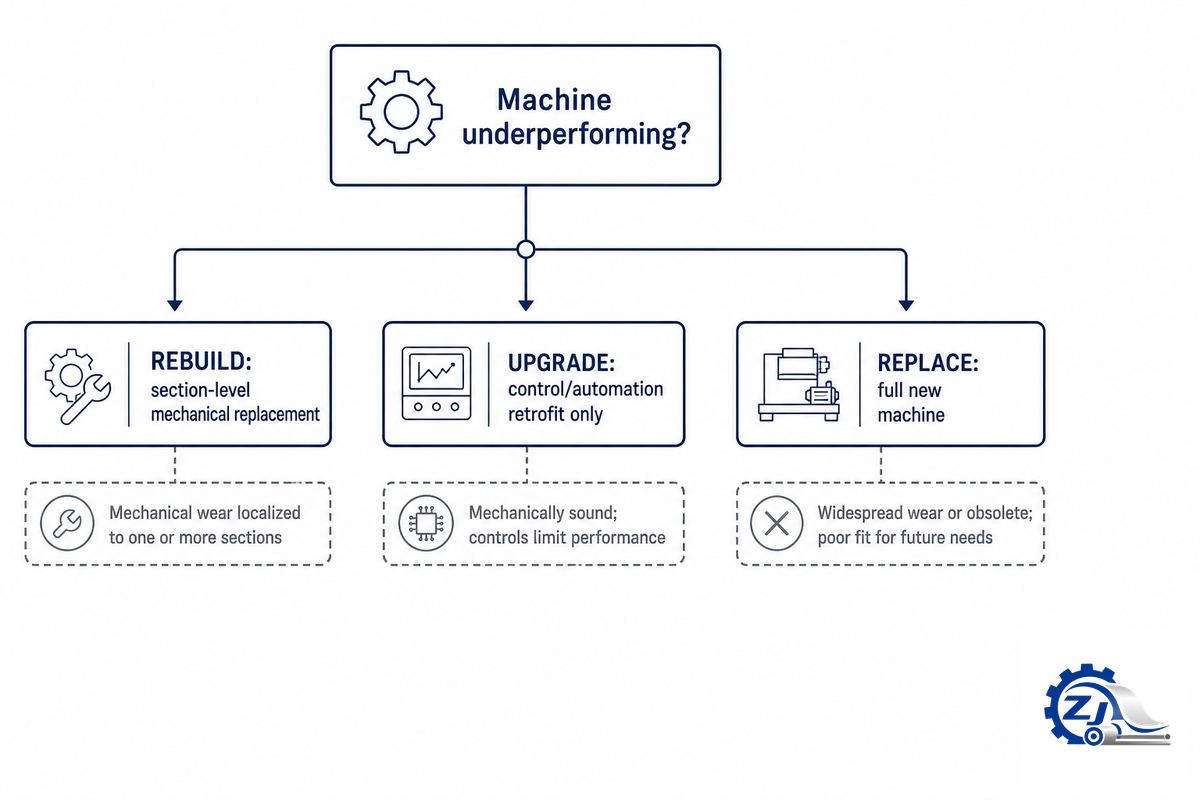
Every rebuild inquiry seems to begin in a similar fashion: performance lagging behind the latest customer requirements, the production team tracing quality issues back to a handful of tired machine sections, or the control system is so old that troubleshooting take more time than producing sheet. Which one of the three approaches best suits your situation? – mechanical rebuild, control-system only, or a new machine?
“Each rebuild inquiry is initiated the same way: rebuild, upgrade, or replace? It really depends on the condition of the existing machine structure and the actual performance shortfall, there’s no hard rule. There is however consensus in published engineering reports: engineering experience, in and of itself, does not transfer perfectly to your application and this is precisely why a real, on-site evaluation works better than a general questionnaire.”
Paraphrased industry engineering perspective, consistent with academic caution on generalized rebuild formulas (see References)
3-Way Rebuild-Upgrade-Replace Framework
- Any sign of structural fatigue in the machine frame, the rolls or the drive system (as opposed to cosmetic wear) immediately moves it out of the rebuild zone. Rebuild scope can never close a structural gap.
- Sound structure, but a mechanical bottleneck of speed or quality (forming drainage, press dewatering, headbox consistency) rebuild the limiting section.
- sound structure good mechanical, however legacy/old control systems on an old machine – an upgrade on automation will almost always make more sense than to attempt a modification to the mechanical elements first
While triggers seldom arrive as a singular catastrophic failure, they more frequently appear as a pattern of frequent web breaks, declining uptime, slow degeneration of runability, or as an organizational culture that skips preventive maintenance and punts little fixes until an annual outage, thus creating years of deferred maintenance before a machine section eventually forces action. Once an annual shutdown is approved and the schedule established, OSHA’s specific pulp and Paper Standard (29 CFR 1910.261) becomes a major real-world execution barrier with respect to any work performed in proximity of machine before locking out and blocking the machinery out prior to inspection, cleaning or service.
📐 Engineering Note
The “Sound structure” inspection is a look at frame deflection, condition of the roll journals and drive train backlash before the scope for any machine section is ever solidified. Yes, those are the very same structural inspections that appear in the machine rebuild engineering case studies for machines more than 50 years old. Failure to perform that single inspection is far and away the most likely reason scope gets out of control once a rebuild is started.
How a Rebuild Project Actually Runs (Planning → Execution → Commissioning)
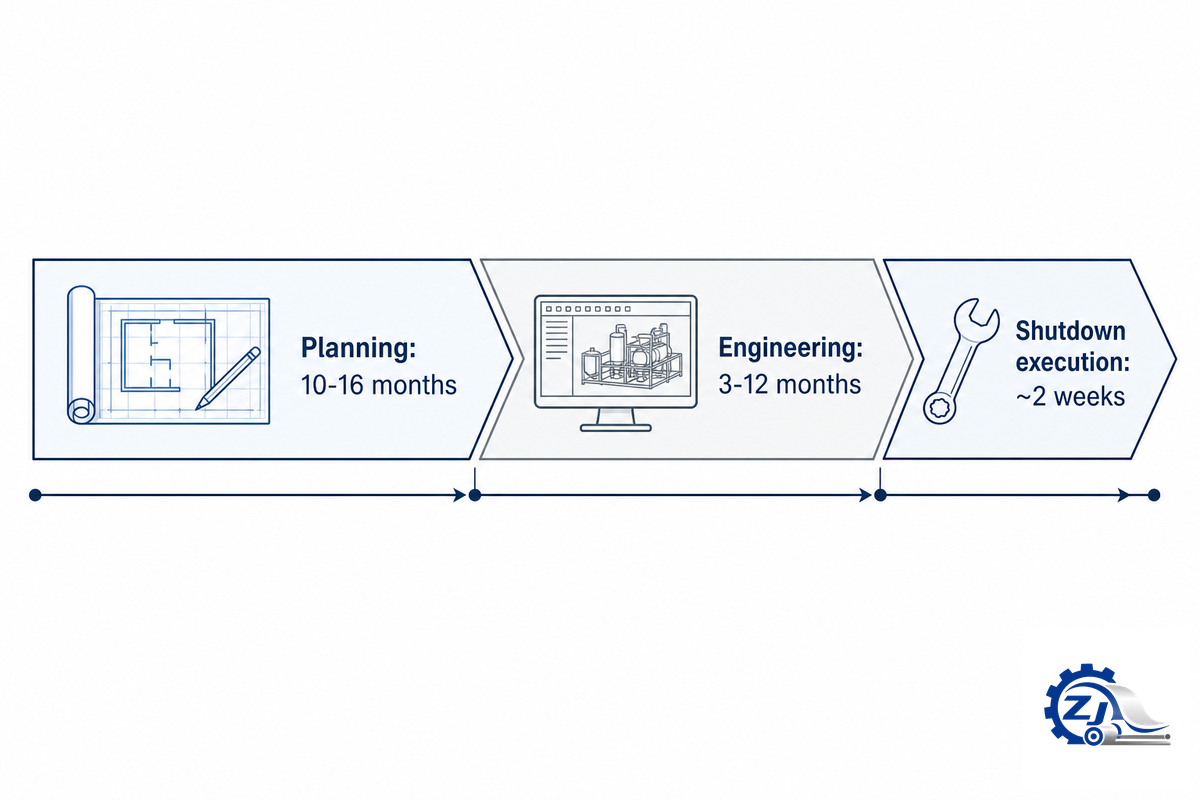
A paper machine rebuild runs in three phases: 10-16 months of planning and feasibility work, 3-12 months of detailed engineering and long-lead ordering, and a shutdown execution window of roughly two weeks for a focused section rebuild. These figures come from published OEM planning guidance, sized to the actual scope of a specific machine.
Planning and feasibility – bottleneck assessments and whether capacity, grade conversion, or energy is the goal – generally starts 10-16 months prior to the shutdown. Detailed engineering and long-lead order placements follow in the 3-12 months preceding the shutdown. The shutdown execution is concentrated into a tight period-usually a few weeks for a single-section rebuild-although, in cases with multiple sections, the duration will be longer. These numbers are sourced from OEM planning documentation, not a single, independent, audit report, so they’re intended as a guide, not an absolute schedule – the real risk is treating a generic window as a fixed promise and then scrambling when the schedule slips, especially once OSHA lockout/blocking procedures get layered into the same compressed shutdown window. Years of scoping similar projects is what lets an in-house engineering team turn that generic window into a specific schedule for a specific machine.
An actual, though disguised, example of the segmented execution: an engineering services company oversaw the two-phase rebuild of a No. 2 paper machine which had been in operation for 60 years. Phase one covered a new headbox and winder, and phase two – handled as a distinct project – covered a new forming section, press section, a fourth dryer section, new drives, and reel. Segmenting the work into two phases kept the machine running between stages instead of one long shutdown.
- Share machine data. Grade, capacity, age of machine, the problem that we’re addressing, accompanied with pictures/drawings of the section under which course
- engineering review – to conduct a site visit and have a walkthrough via detailed video footage of the sections concerned before any proposal is written.
- A list of areas to rebuild, downtime window, and the timeline for completion
Speed Increase and Capacity Expansion: Where the Real Bottlenecks Are
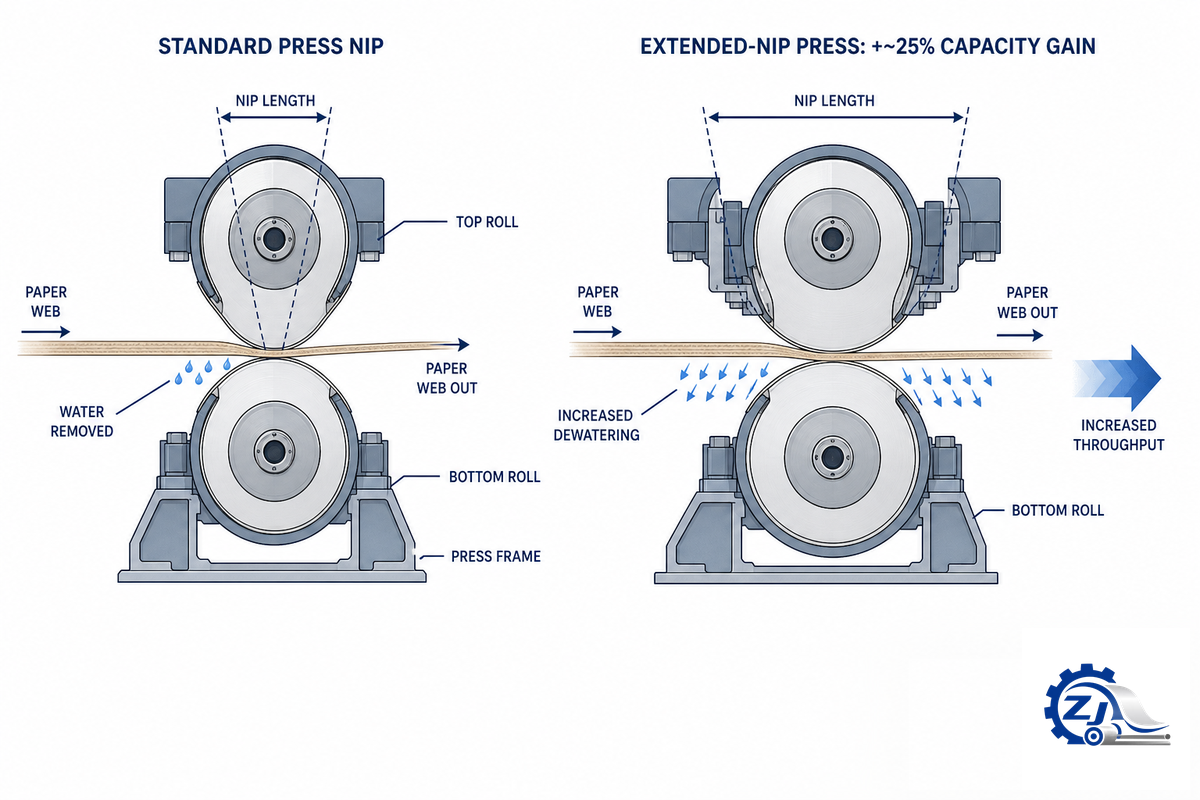
All the machine speed and capacity improvements eventually lead back to one single piece of hardware, not the whole machine. There can only be one production bottleneck at a time – in forming, the water holding capability; in press, the amount of water at exit, and in headbox, consistency and uniformity at high tonnage. All appear first as an increase in rejected reels, not a stop to the line – the hidden risk is spending capital on the wrong section and leaving the actual bottleneck untouched.
| Symptom | Likely section | Typical intervention |
|---|---|---|
| Wet sheet at press exit, low dry solids | Press | Extended-nip / shoe press conversion |
| Drainage-limited at higher speeds | Forming | Additional drainage elements, wire upgrade |
| Consistency loss at high tonnage | Headbox | Dilution control retrofit |
Longer nip pressing is known to achieve better dewatering efficiencies at comparable energy rates compared to standard nip pressing (as outlined in engineering literature related to this technology). A practical product example from a paper machine equipment supplier illustrates this impact in real terms: a shoe press retrofit resulted in improved sheet dryness from 48% to 54%, while also lowering steam usage by 15-20% at speeds up to 1,200 MPM. The savings from this can be estimated: each extra percentage point of press dryness reduces steam use in the downstream drying section by about 3-5%, explaining why a capacity upgrade and an energy upgrade are generally the same project – the same dewatering-rate mechanism a Western Michigan University engineering thesis confirms independently for nip pressing generally. According to the US DOE/EPA ENERGY STAR energy guide for the pulp and paper industry, steam-saving potentials can range from about 2% up to as high as 15% among several different rebuild-adjacent technologies, although the potential varies and should be carefully considered for the specific line and controls prior to adopting a specific value.
Automation and Control System Retrofits
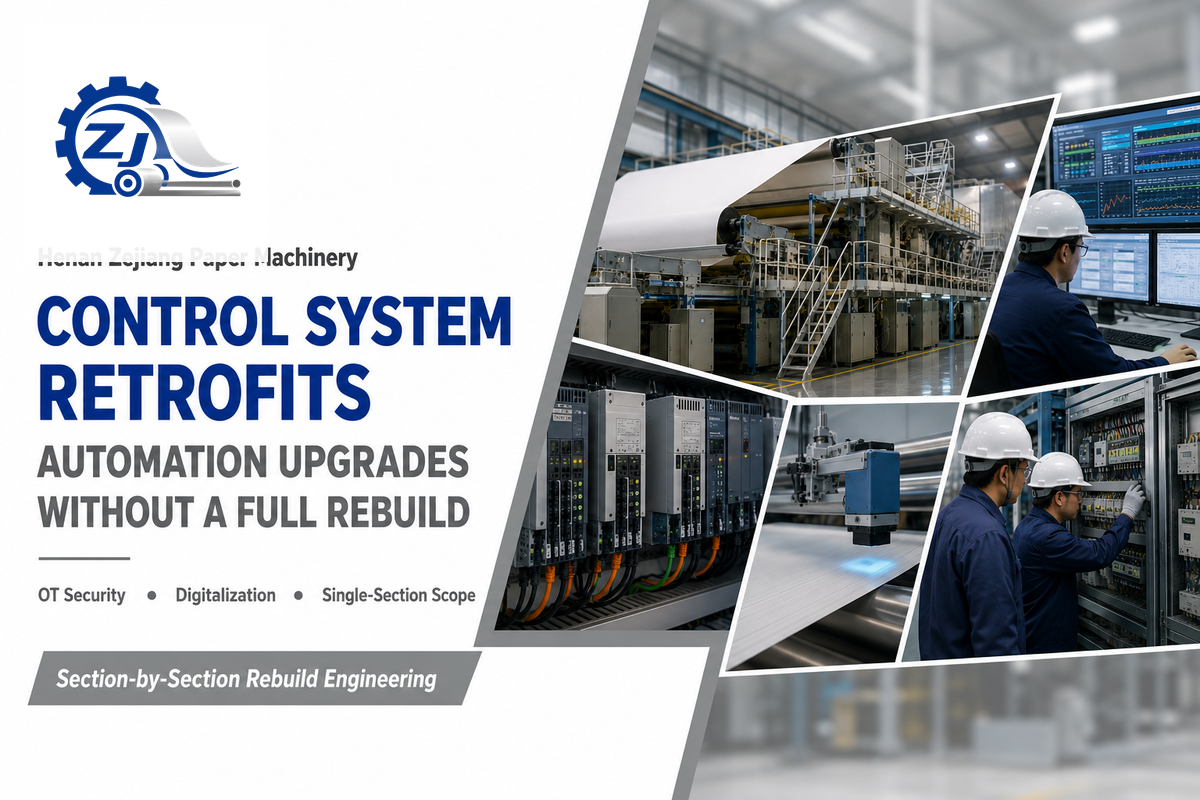
Speed and capacity rebuilds handle mechanical problems. Automation retrofits handle a different one: controls, drives, and instrumentation lagging behind what a product line demands – even though the mechanics are capable, the result can still be production lost every shift due to slow grade transitions, quality excursions, and manual troubleshooting that a modern control would fix on the run. That hidden gap between mechanical capacity and control capability is the risk equipment-only rebuild content tends to skip.
Typical scope of automation is for example replacement of PLC and drives, installing of QCS to profile basis weight and moisture, headbox or press instruments replacement, all aimed at high-performance, lower energy consumption operation. An example sponsored case study from one automation vendor shows a 5 to 10% increase in throughput and yield improvement by 1-5 percentage points for just one mill digitalization – another single point of data to contrast to the real numbers for one’s line and not a fact.
There’s a component to control-system retrofits that often get ignored in rebuild-focused equipment content: the security of your operational technology (OT). In NIST’s SP 800-82 guidance, PLCs, SCADA systems, and DCSs are designated a security-relevant class of assets that has safety, reliability and vulnerability implications – they’re not just a better version of performance improvement equipment. Contemporary PLC/SCADA retrofits involve the networking, security and patching aspects of a control system which mechanical rebuilds have to live with, but that must be designed in at the front end with performance in mind, not bolted on the back – the goal is to improve the efficiency of the whole line and ensure optimal performance from the sections that aren’t being mechanically touched, whether the machine makes paper or board. This is exactly the kind of scope an in-house automation team certified to work across PLC platforms should own end to end, rather than splitting it between a mechanical contractor and a separate controls vendor.
What a Major Rebuild Actually Delivers: Sappi’s Project Elevate
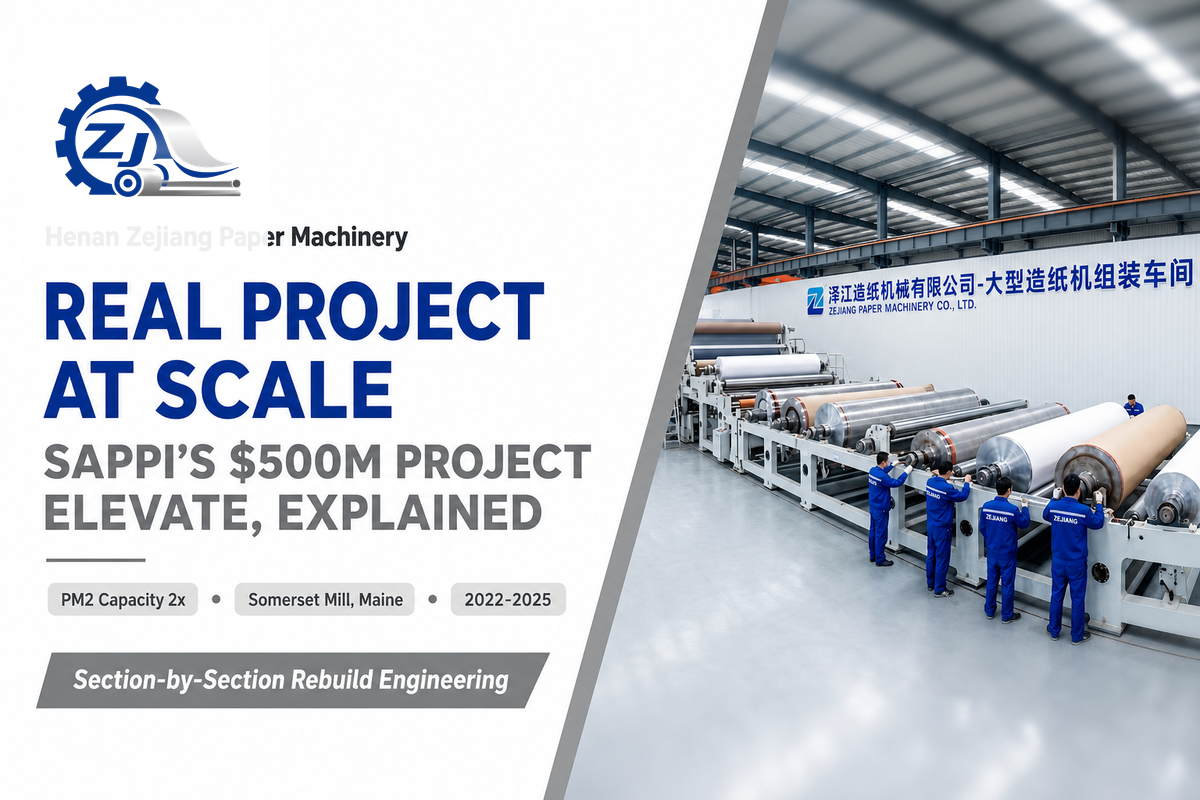
A major rebuild can double a machine’s capacity: Sappi North America’s “Project Elevate” converted Paper Machine No. 2 at its Somerset Mill for $500 million, more than doubling PM2’s production to 520,000 short tons a year – the company’s own description of the largest rebuild in its history.
One of the most fully documented paper machine rebuilds of recent years is Sappi North America’s “Project Elevate.” In November 2022, Sappi gave its go-ahead to a $418 million capital project to convert Paper Machine No. 2 at its Somerset Mill in Maine from coated freesheet to solid bleached sulfate (SBS) board, with the objective of beginning operations in early 2025. By the time it was finished – reported by Sappi in its own July 2025 announcement – the project’s size and cost had increased to $500 million (which the company characterized as the biggest rebuild in its history) and more than doubled the production capacity of PM2 to 520,000 short tons (approximately 470,000 metric tons) annually.
Honesty in that story is as valuable as the headline number – the well-resourced, savvy operator budgeted for a roughly 20% increase in costs and several extra months between the original plan and first run time. That’s not a failure – the real trap is a mill that treats the first quote as a fixed number and never plans for the schedule to slip. It’s the real-life meaning of “well planned” at this scale, and a good expectation-setter for any mill budgeting its own contingency.
Sappi is hardly an outlier. The case notes for Valmet’s Umka Board Mill rebuild mention a nearly 70% increase in capacity across three separate rebuild projects producing containerboard and paper and board grades; ongoing trade news regularly details comparable rebuild projects including Valmet’s May 2025 announcement for Sylvamo’s Eastover, South Carolina mill and Voith’s November 2024 announcement for Hinojosa Packaging in Spain, several of them converting lines to run more waste paper and recycled fiber. Section rebuilds of this kind are generally cited throughout the industry as providing double-digit percentage gains in capacity or drying performance; the actual benefit to any individual mill’s quality and productivity is an in-house engineering determination.
Budgeting a Rebuild: What Actually Drives the Cost
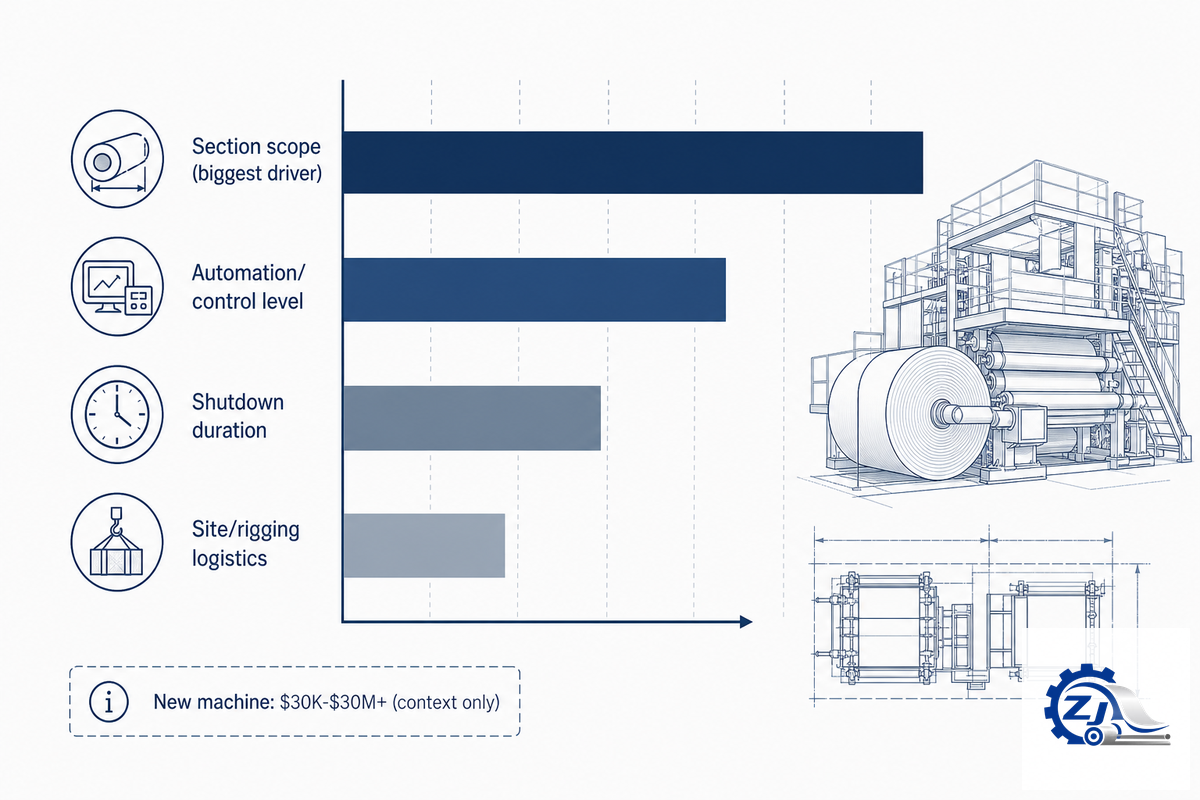
Paper machine rebuild cost is the question every mill asks before anything else, and the honest answer is that it depends entirely on which paper machine components are in scope. Buyers searching for a Voith paper machine price or a Valmet quote hit the same answer: none of the major OEMs publish one.
There’s no price card for a rebuild; each is project-specific. For context only, the list price of a new paper-making machine spans a wide range – anywhere from under $30,000 to more than $30 million – and is determined largely by capacity, grade and automation. A rebuild generally falls well under the price of a new line, though the gap shrinks with a multi-section rebuild, and the goal either way is protecting the mill’s profitability while it works to extend equipment life on the sections that don’t need full replacement.
But scope isn’t the only true cost of a rebuild, and quoting it accurately without an in-house team that has priced dozens of these projects is genuinely hard for a mill to do alone. Environmental compliance is a tangible, auditable expense. pulp, paper, and paperboard mills in the U.S. are subject to EPA effluent guidelines, specifically 40 CFR Part 430, which include discharge limits that have been updated to cover additional pollutants. A rebuild that alters a mill’s furnish, chemistry, or throughput must meet permitting compliance, an expense that has no bearing on equipment costs but directly affects how a machine performs its process.
Industry Outlook: What’s Changing in Paper Machine Rebuilds
What’s driving the latest big rebuild projects isn’t just a desire for “more,” but for “more valuable,” resilient packaging segments. Sappi’s Project Elevate was justified not by demand for general-purpose paper production, but by demand for high-value, fiber-based sustainable packaging – specifically SBS board for food, beverage, and consumer products. Getting that difference right matter for timing a rebuild: betting on demand for a specific higher-value grade is a different bet than betting on general capacity.
That distinction stand out sharper against a real counter-signal worth addressing rather than glossing over: demand for corrugated cardboard-box packaging has softened, and several packaging paper mills have closed as a result, according to recent financial-press coverage. The “packaging demand is booming, rebuild now” narrative overgeneralizes what’s actually happening – growth is concentrated in specific higher-value, sustainability-linked segments like SBS, not corrugated board broadly. Market-size projections back the general direction (one estimate puts the global paper machinery market growing from roughly $4.36 billion in 2026 to $6.44 billion by 2035, a 4.43% CAGR), but that figure is background context, not the reason to plan a specific rebuild – grade-conversion economics and environmental-compliance drivers are.
Our Perspective
This guide has its origins in readily available resources: public documents detailing machine-rebuild strategies from OEM (Original Equipment Manufacturer) companies, published news reports detailing individual projects from press publications, the governmental regulatory requirements regarding safety and the environment, and the specific practical experience gained by the Zejiang organization from evaluating the possibility of section-rebuild and automation-retrofitting for papermaking lines (paper, board, and tissue). We specifically indicate which specific statistics originated from particular OEMs (Sappi, Valmet, Parason), government organizations (OSHA, EPA, NIST, DOE/EPA ENERGY STAR) or were gleaned from their specific news coverage-we haven’t presented this data as Zejiang’s proprietary findings. We’ve stated frankly when sufficient data couldn’t be found, such as regarding the precise percentage benefit of using enhanced nip pressing; we didn’t invent data points to support a position.
Frequently Asked Questions
Q: How many sections does a paper machine have, and which ones are usually rebuilt?
View Answer
A full paper machine has five principal sections: the forming section (wire section), the press section, the dryer, the calender, and the reel, with a headbox located ahead of them and usually a size press or a film press between the pre-dryer and post-dryer sections. When a rebuild is contemplated, the headbox, the press, and the dryer sections undergo upgrades most frequently since they account for the greatest potential benefits to quality, efficiency and operating speed. If a change in product grade necessitated changes in the wire specifications, forming-section rebuilds become more common. Calender and reel rebuilds occur less often; generally, such rebuilds accompany improvements in finished-product quality rather than stand-alone endeavors.
Q: Is it cheaper to rebuild an old paper machine or buy a new one outright?
View Answer
A rebuild almost always presents a lower cost than the purchase and installation of an equivalent new machine and has a shorter ramp-up period to achieve optimal operating rates since much of the structure, foundation, and mechanical power delivery system are already in place. The principal trade-off comes from the potential difficulties of integrating new parts with an aging or existing frame structure. Whereas it is a simpler operation to get up and running a totally new machine, it requires greater caution and planning to implement changes in a used one. As a rough approximation, a brand new machine for making products with varying output rates and grade compositions typically costs between $30,000 and more than $30 million; however, the total investment in a rebuild is generally substantially less than for new equipment, although the exact price depends heavily on the portion of the original machinery that can be preserved.
Q: What is a Fourdrinier machine, and is my machine one?
View Answer
Please consult the answer provided under the heading, “What Is a paper machine Rebuild?” – The formation of the sheet takes place on a flat, moving wire on a fourdrinier machine; this design is the current standard for writing paper, newsprint, and kraft papers, and the fourdrinier process covers most of the paper production processes in service today – a fourdrinier paper machine and a fourdrinier machine are the same thing, just different ways mills refer to it. Tissue lines instead pair a crescent former with a Yankee cylinder rather than a Fourdrinier wire. If the paper machine in question is a Fourdrinier (i.e., one that utilizes a single wire rather than several combined cylinders or wires that generate distinct plies), this configuration is relevant for determining how the forming-section rebuild will be planned.
Q: What usually triggers a paper machine rebuild?
View Answer
Seldom can the decision to rebuild be pinpointed to a single cataclysmic event; instead it often emerges from a litany of woes-chronic breaks, steadily decreasing runnability, customer complaints on a grade the mill wasn’t equipped to handle originally, a control system so antique troubleshooting consumes more time than production.
Q: What does “extended-nip pressing” mean?
View Answer
Extended-nip (or shoe) pressing: instead of using conventional roll-to-roll nip, it creates a broader, longer sheet/press contact area, extending time for water removal before sheet arrives to the dryer section. This increased dwell time is what lets extended-nip pressing outperform a standard nip on dewatering rate.
Q: Does rebuilding always cost less than a new machine?
View Answer
But seldom isn’t never – when the rebuild touches nearly every machine section, costs may start to approach those of a new machine, once the engineering challenge and integration risk are figured in.
Related Articles
- Paper Machine Rebuild, Upgrade & Speed Increase Services — request a rebuild assessment for your own machine
- How Pulping Equipment Works: A Guide to Paper Pulping Methods and Machine Selection
- Calender Rolls Explained: How They Work, Roll Types, and Where They’re Used
- What Is a Doctor Blade? Types, Materials, and How They Work
- Refiner Plates and Screen Baskets: A Complete Guide for Paper Mill Buyers
References & Sources
- Sappi Launches North America’s Most Advanced Paper Machine — Sappi North America, July 2025
- Sappi Announces $418 Million Paper Machine Rebuild at its Somerset Mill — PaperAge, November 2022
- 29 CFR 1910.261, Pulp, Paper, and Paperboard Mills — U.S. Occupational Safety and Health Administration
- SP 800-82 Rev. 3, Guide to Operational Technology Security — National Institute of Standards and Technology
- Pulp, Paper, and Paperboard Effluent Guidelines (40 CFR Part 430) — U.S. Environmental Protection Agency
- Energy Efficiency Improvement and Cost Saving Opportunities for the Pulp and Paper Industry — U.S. DOE / EPA ENERGY STAR
- The Comparison of Linear Nip Pressing vs. Extended Nip Pressing — Western Michigan University senior engineering thesis
- Troubleshooting Guide for Paper Chemistry — Martin A. Hubbe, North Carolina State University
- Cardboard Box Demand Is Slumping, Why That’s Bad News for the Economy — The Wall Street Journal
Why We Write This
Zejiang scopes and manages section rebuilds, speed increase projects, and automation retrofits on paper, board and tissue machines, and this guide reflects many of the same distinctions our engineers apply when assessing the “rebuild, upgrade or replace” question. Reviewed by the Henan Zejiang Paper Machinery Co., Ltd. technical team.
![Refiner Plates & Screen Baskets [Complete Guide]](https://zjpapermachine.com/wp-content/uploads/2026/07/refiner-plates-screen-baskets-guide-featured-150x150.png)
![Doctor Blade: Types, Materials & How It Works [Guide]](https://zjpapermachine.com/wp-content/uploads/2026/07/doctor-blade-guide-featured-1-150x150.png)
![Pulping Equipment: How Paper Pulping Works [Guide]](https://zjpapermachine.com/wp-content/uploads/2026/07/pulping-equipment-guide-featured-150x150.png)