Get in touch with Zejiang Paper Machinery Company


Updated July 2026
The paper machine commissioning process is the structured sequence of inspection, testing, and sign-off that converts a freshly erected machine from a block of steel into a revenue generator – the space between “mechanically installed” and “making saleable paper.” Get it wrong and you’re building vibration, sheet defects, and safety gaps into your mill for a month, six months, or more. This guide walks through the paper machine commissioning process step by step: what’s actually tested at each phase, who’s accountable for each element, and where these projects tend to lose time.
Quick Specs
| Typical commissioning duration | 2-5 days for a single piece of machinery; 4-6 weeks for a fully integrated paper machine line |
| Core phases | Pre-commissioning & dry running → wet running & stock-on → performance testing & handover |
| Governing safety standard (US) | OSHA 29 CFR 1910.261(k) — Machine Room, pulp, paper, and paperboard mills |
| Governing machinery regulation (EU) | Regulation (EU) 2023/1230, mandatory from 14 January 2027 |
| Formal close-out artifact | Punch list + commissioning sign-off record |
What Paper Machine Commissioning Actually Includes (and Where Installation Ends)
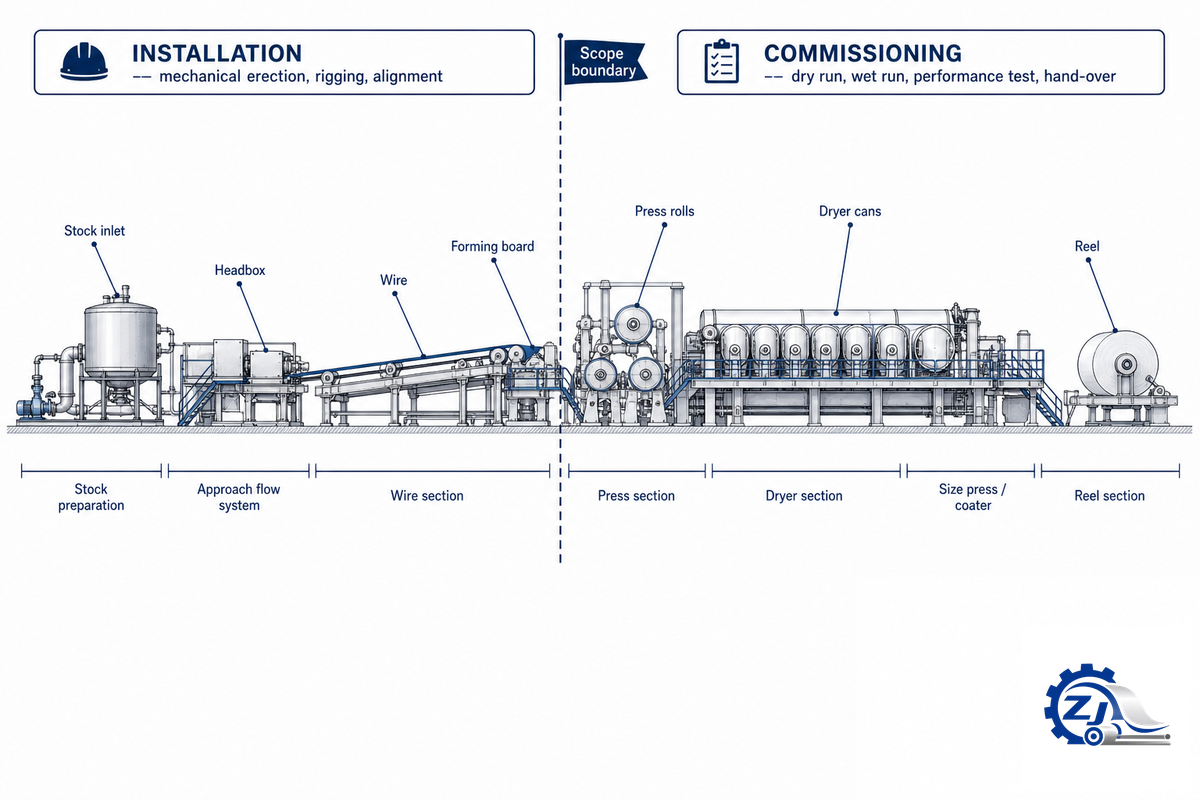
Installation and commissioning get used as if they’re synonymous in conversation, but are far from the same set of responsibilities. Installation is the mechanical and electrical assembling of the machinery – bolting frames, leveling rolls, running cable, installing drive packages. Commissioning only begins when that machinery is in place and begins to ask, “Does it actually work as designed, and safely, and in concert with everything else in the mill?”
Exactly what commissioning covers is dependent upon the industrial paper machine type — a new kraft or corrugator medium machine will be tested in the same sequence as a new tissue or specialty pulp and paper machine, since the underlying sequence is the same whether the new machine is a standalone unit or part of a larger industrial paper equipment setup — but what defines success changes with the machine’s paper machine type and with whether it’s a stand-alone mill or part of a multi-machine complex.
What Is the Process of Machine Commissioning?
commissioning is the ordered process of inspection, testing and signing-off that converts a mechanically complete machine from “installed” to “accepted for production.” It generally involves initial document review, followed by progressively difficult stages of testing (with no product, then with water, then with pulp), culminating in a final package of acceptance paperwork you can present to your supplier. Every phase exists to discover a flaw before it becomes a cost.
It’s an important distinction commercially, not just semantically, because the risk sits in the contract, not the jobsite: if your purchase agreement only calls for “installation,” the machine interlocks won’t be tested, nor will a formal punch list and acceptance won’t be quantified — a structural gap that shows up as a dispute in year one, not at handover. According to one Indian Pulp and Paper Technical Association (IPPTA) technical paper, scheduling constraints, such as delaying installation for a season, matter less than commonly assumed once site climate conditions are sufficiently analyzed. That call rests with the erector, and it’s exactly the type of boundary that needs definition before mobilization, not in real time at the jobsite. For details on where our own paper machine installation and commissioning service defines this boundary, review our service scope.
💡 Pro Tip
Explicitly state in your purchase contract what’s what: define which party owns interlock testing, who accepts the punch list, and what “acceptance” looks like in terms of actual production. Vague assumptions about the scope of work between you and your erector are the number one reason that dispute arises after your mill is running.
Phase 1-2: Pre-Commissioning and Dry Running (Before Water Ever Touches the Machinery)
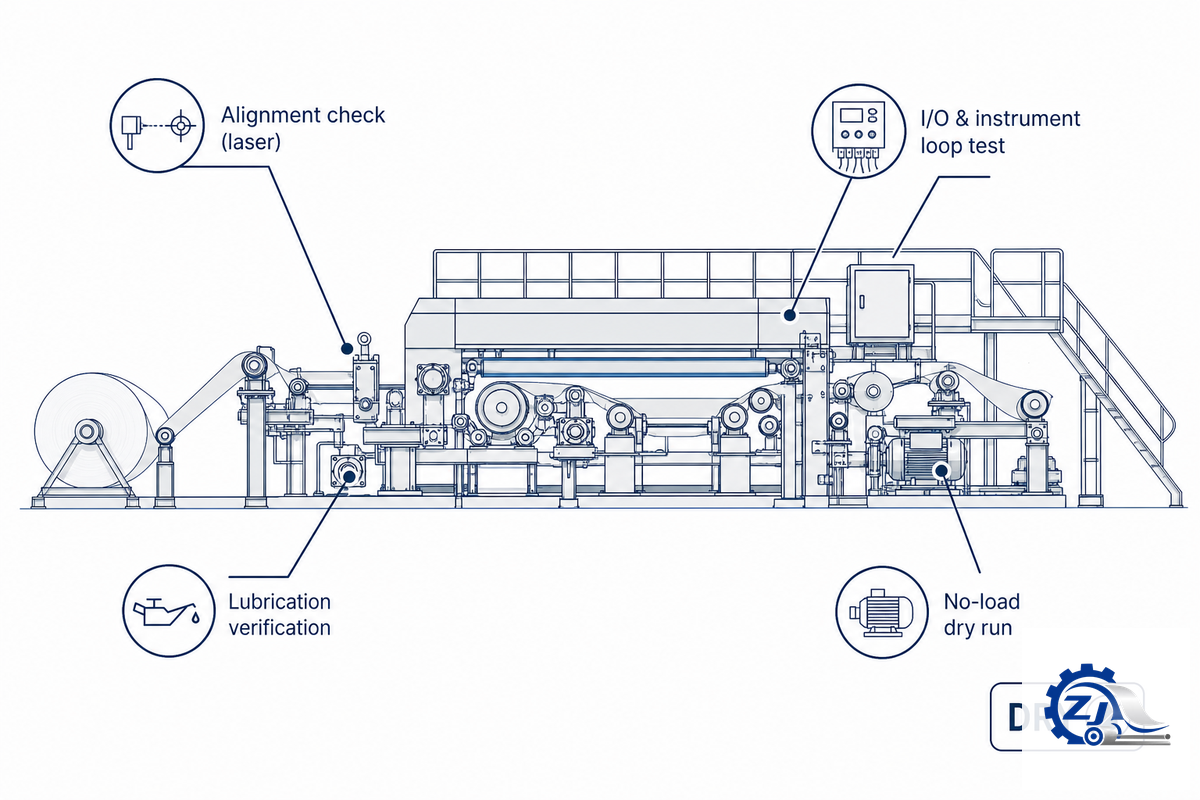
Once there are no fluids or pulp present the machinery must show that it’s mechanically correct and electrically safe all by itself. It’s there that most of the inspection line items reside, and that the industry’s own safety regulation starts to get less vague.
If your state’s workers’ comp is like your neighboring state, that probably means the specific standard covering pulp, paper, and paperboard mills — OSHA 29 CFR 1910.261 — needs paper machines to have the appropriate machine quick-stopping-device, and it demands guards for all exposed shafts and guarding requirements for all feeder belts, nip points, and carrier ropes prior to operating the line for the test run of paper. That’s a much, much harder test for the guarding provisions than OSHA’s generic lockout/tagout standard, 29 CFR 1910.147; a standard which remains applicable to lockout/tagout in electrical/mechanical-energy-related matters before and after the test but doesn’t cover the guarding requirements specific to a paper machine.
“Paper machines shall be equipped with devices that will stop the machine quickly in an emergency. All exposed shafts shall be guarded.”
— 29 CFR 1910.261(k), U.S. Occupational Safety and Health Administration
Pre-commissioning checks fall into four main categories. These include mechanical (checks of alignment, leveling, and free play of rotation of all rolls and their bearings, and the careful, methodical proper alignment of each and every moving part before the application of power), hydraulic/pneumatic (hydrostatic testing of all lines and flushing of all steam and condensate lines and lubricating oils), electrical (both hot and cold checks of I/O, ensuring every valve signal reaches its intended control-system counterpart in a timely manner, using a process of testing defined at the pre-design and construction stage, not invented on the run, and verifying the electrical diagnostic routines against the appropriate tests), and safety (including testing all E-stops, shaft guards and nip-point controls as mandated by 1910.261, before the machinery is actually run at any speed). Skipping this stage on a properly installed machine is not a shortcut — it is a preventive-maintenance debt the mill inherits on day one. After these checks are complete and have passed all specified requirements, the next phase is to begin the dry run in stages (e.g., energize a section without pulp and water, and to individually bump the motor and drive for each component to ensure it runs at the correct speed and direction in conjunction with all other parts of the train), followed by tripping the interlocks and E-stops to verify functionality. This prevents future preventive maintenance (PM) headaches at a later stage and can save a paper mill considerable lost productivity down the road, especially on full-width paper machine section drive motors which can be tens of kW up to several hundred kW each, dependent on speed and machine train requirements, a key factor why individual bump-testing is so much more valuable than an attempt at an overall machine train test – it catches issues like the one Gate 2 is meant to address.
The 5-Gate Pass-or-Hold Sequence
An efficient way to help the commissioning plan stay honest is to think of each phase change as something that the team has to officially check off, instead of as a specific day in a calendar. Some call this the 5 stages of commissioning; this guide is laid out according to the following sequence of phases (which follows a common pattern used in both the literature on commissioning and by paper machine builders):
| Gate | Pass Condition | Risk If Skipped |
|---|---|---|
| Gate 1: Mechanical Complete | Alignment + hydrostatic tests signed off | Vibration, premature bearing wear |
| Gate 2: Dry Run Pass | All interlocks/E-stops verified live per 1910.261 | Safety incident during wet run |
| Gate 3: Wet Run Pass | Water loops stable, drainage verified | Sheet breaks masked as “startup issues” |
| Gate 4: Stock-On Pass | First sheet on reel, speed ramp stable | Quality metrics never baselined |
| Gate 5: Handover | Punch list closed, performance guarantees met | Disputed acceptance, warranty conflicts |
Another example from the eng-tips.com engineering community vividly shows the need for Gate 1 discipline. In one discussion thread, a 24-year experienced engineer stated they’re “still finding errors one time only in the field at commissioning…” – the gap from design to the field, what inspection’s Gate 1 helps to address, not the assumptions brought over from the board.
| Check Type | Phase | What It Verifies |
|---|---|---|
| Alignment check | Gate 1 | Roll and bearing alignment within tolerance, typically well under 1 mm on high-speed sections |
| Hydrostatic pressure test | Gate 1 | Piping integrity, commonly tested to around 1.5× the system’s rated working pressure as a standard engineering margin |
| Cold I/O check | Gate 1 | Field sensor/valve signal reaches the control system, unpowered |
| Hot I/O check | Gate 1 | Same signal path, energized and live |
| Drive bump test | Gate 2 | Correct rotation direction and speed matching across sections |
| Interlock / E-stop test | Gate 2 | OSHA 1910.261(k) emergency-stop and guard function, live |
| Water loop / drainage test | Gate 3 | Wet-end drainage and forming-fabric behavior under real flow |
| Headbox/slice calibration | Gate 4 | Consistency and jet-to-wire ratio for continuous sheet formation |
| Quality metric test | Gate 5 | Basis weight, moisture profile, caliper, tensile strength against spec |
| Punch-list closure | Gate 5 | Every open deficiency resolved and signed before handover |
Phase 3-4: Wet Running to First Sheet on Reel
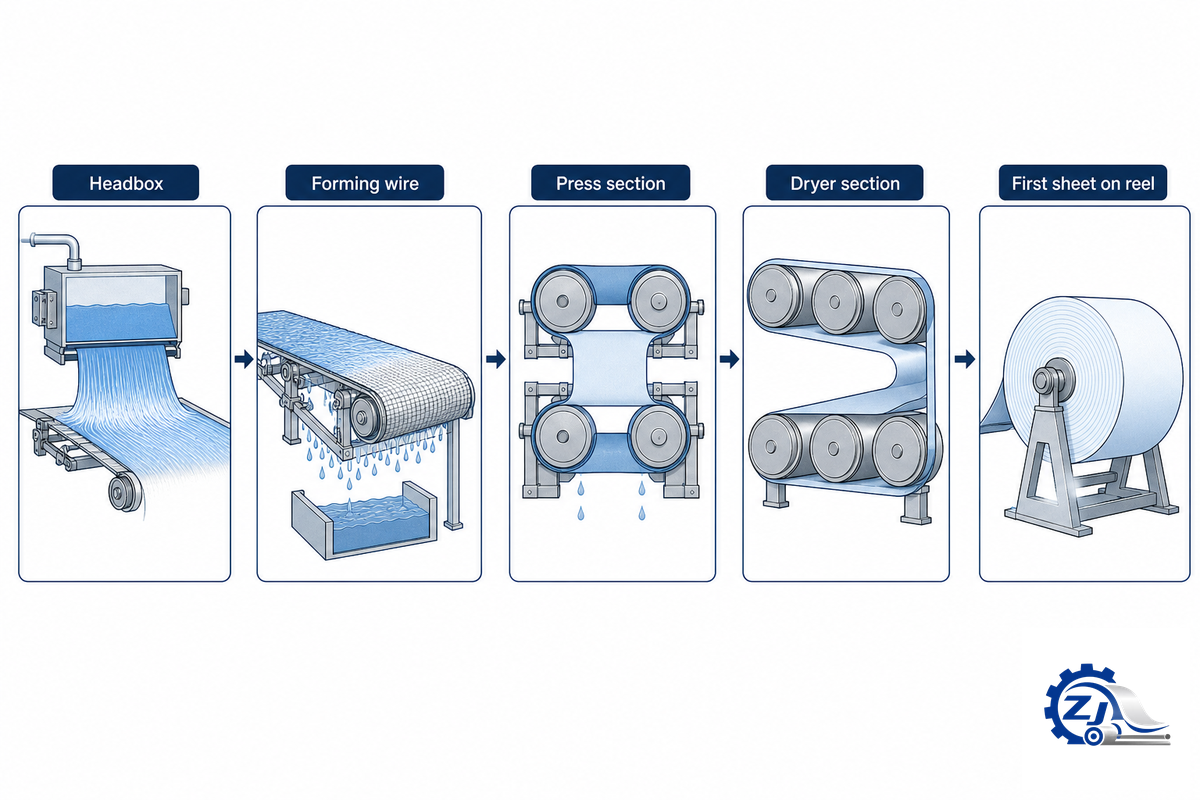
Wet running: The machine is run with water, rather than stock (pulp). This is when process engineers are able to test and adjust for fluid dynamics, drainage and drive synchronization without risk of breaking a pulp thread. Water is run through the white water and process systems, press rolls are nipped, and the dryer cylinders are brought up to temperature and steam applied as a ‘tail’ is threaded through the machine by hand, using ropes or by air injection at a very low speed, well before the machine ever makes a sheet of paper — this hand-threading step is exactly the kind of nip-point exposure 29 CFR 1910.261 guarding requirements exist to control. Skipping this stage is a real risk, because a production line threaded straight from dry running to stock-on has no baseline for whether the drainage and drive synchronization are actually correct at speed — problems that are cheap to catch here and expensive to diagnose once real pulp is running at 2000 m/min.
Stock-on: This is the first moment that pulp is actually loaded into the headbox. Engineers balance and calibrate stock consistency, headbox slice opening, jet-to-wire speed ratio and a whole host of other variables in order to begin the process of forming a sheet. The paper machine is also threaded end-to-end through the press and calendar rolls at this stage. Production speed is ramped from a minimum to a maximum to the designed running speed and during this stage all tension and moisture measurements on the web are monitored and recorded in real-time. This is without a doubt the most instrumented and detailed phase in the entire machine start-up process, but interestingly is the most poorly documented in the public arena; most ‘How-To’ articles on paper machine start-up will brush over the ‘stock-on’ phase, as most companies consider it the exclusive intellectual property of the machine OEM (Original Equipment Manufacturer). As a buyer of new equipment, a well written stock-on procedure from the vendor that clearly outlines how the machine is to be started should be treated as critical paperwork and will ideally be signed off and witnessed prior to machine shipment, not dealt with improvisationally on the mill floor. Actual machine speeds in this phase can range from a couple of hundred metres a minute up to and above 2000m/min depending on the grade being produced and the mill operating capabilities, while the surface temperature of the dryer cylinders commonly runs 100-150°C.
Phase 5: Performance Testing, Punch List, and Final Handover
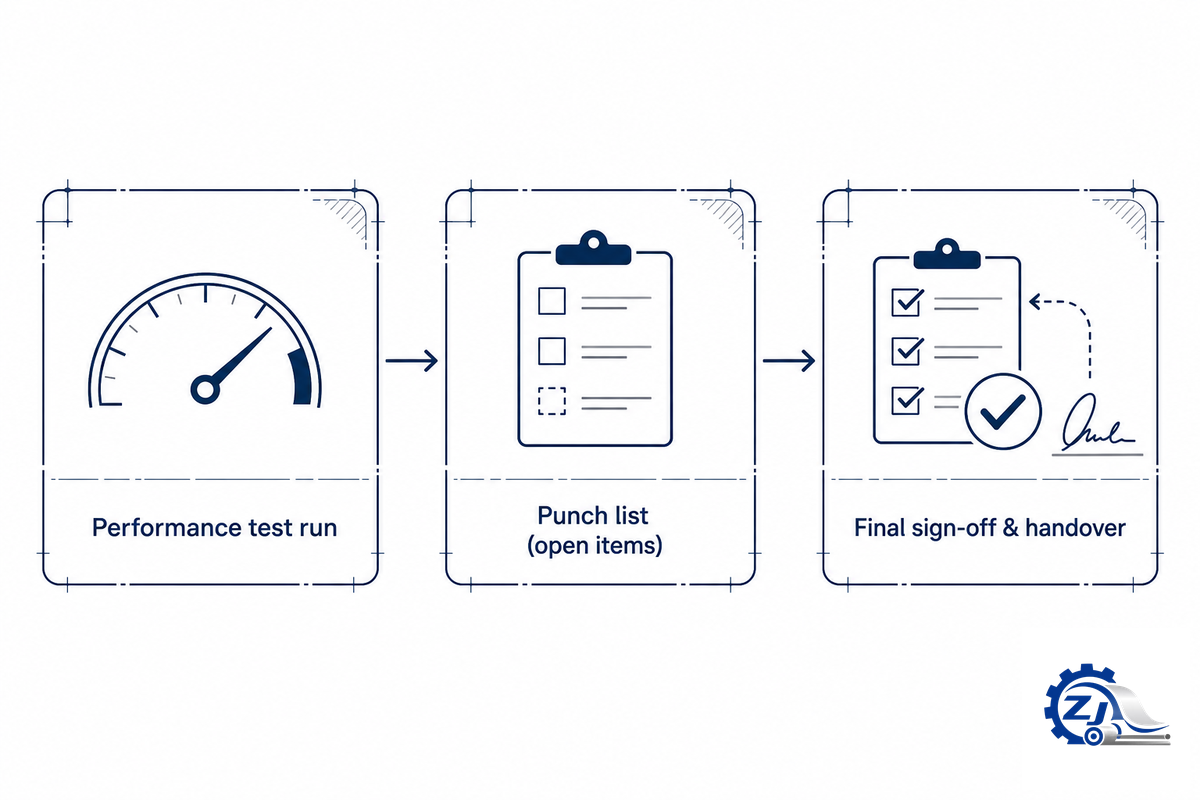
Production: The machine now run continuously. Instead of the primary objective being “does it run?”, the focus now is on “does it run to spec”. Process engineers test various aspects of the sheet’s quality using a range of inline testing devices, such as profile scanners for basis weight, moisture, caliper and tensile strength. Engineers make adjustments to the steam profile across the dryer sections, and to press nip loading and refining energy, to achieve target product quality. Every reading gets recorded — record results as the test happens, including press loads, nip crown, and individual steam setpoints, never from memory — so that if adjustments need to be made or a problem is encountered, engineers can quickly identify exactly what measurement triggered the corrective action, catching issues early rather than after a shift’s worth of off-spec material has already run.
A well-executed Phase 5 doesn’t mean that no problems occurred during the start-up sequence; rather, it signifies that any and all mechanical issues that arose were identified, resolved, logged, and signed off before handing the machine over to the operating crews, who then run it routinely on their own — and it runs smoothly under that crew, not just during the supplier’s supervised test window — after the vendor’s representative departs.
📐 Engineering Note
A punch list isn’t just an exercise in going through the motions: it’s a record of every flaw discovered during testing that needs fixing prior to acceptance. “Punch list” is a common term in general construction (around 6,600 US monthly searches by Google Ads keyword data), and according to general-construction lore, punch-list items can represent a 5-10% increase in project cost (including delays and rework). We don’t have similar independently verified statistics for paper machine commissioning, so use that figure as a rough general-construction benchmark-but it provides a powerful order-of-magnitude argument for closing punch-list items on a defined schedule instead of deferring them until the “next shutdown.”
What Are the Core Steps in a Paper Machine Commissioning Sign-Off?
A minimal sign-off package needs four things: the finalized punch list with dates and responsible individuals, performance test results checked against the contracted guarantee values, a log of any deviations and how they were resolved, and a signed, dated transfer-of-responsibility document from the commissioning team to mill operations.
Skipping any one of these four can easily convert a clean handover into a future warranty battle. IEEE researcher M.A. Valenzuela et al. expressed this point succinctly in their paper evaluating the electronically line-shafted paper machine drive commissioning:
Named Expert Source: The IEEE-published analysis by M.A. Valenzuela et al. on electronically line-shafted paper machine drive commissioning (2001) introduces and validates specific procedures for initiating and carrying out commissioning of this drive architecture, not merely an adaptation of general-purpose commissioning checklist procedures.
— M.A. Valenzuela et al., IEEE Xplore (2001)For an example of a well-documented handover, PaperFIRST magazine reported that Palm successfully commissioned its new paper machine PM5 at its headquarters in Aalen, Germany on 4 July 2021 – a clear, identifiable project milestone with a specific completion date.
Commissioning Documentation: Sheets, Checklists, and Sign-Off Records
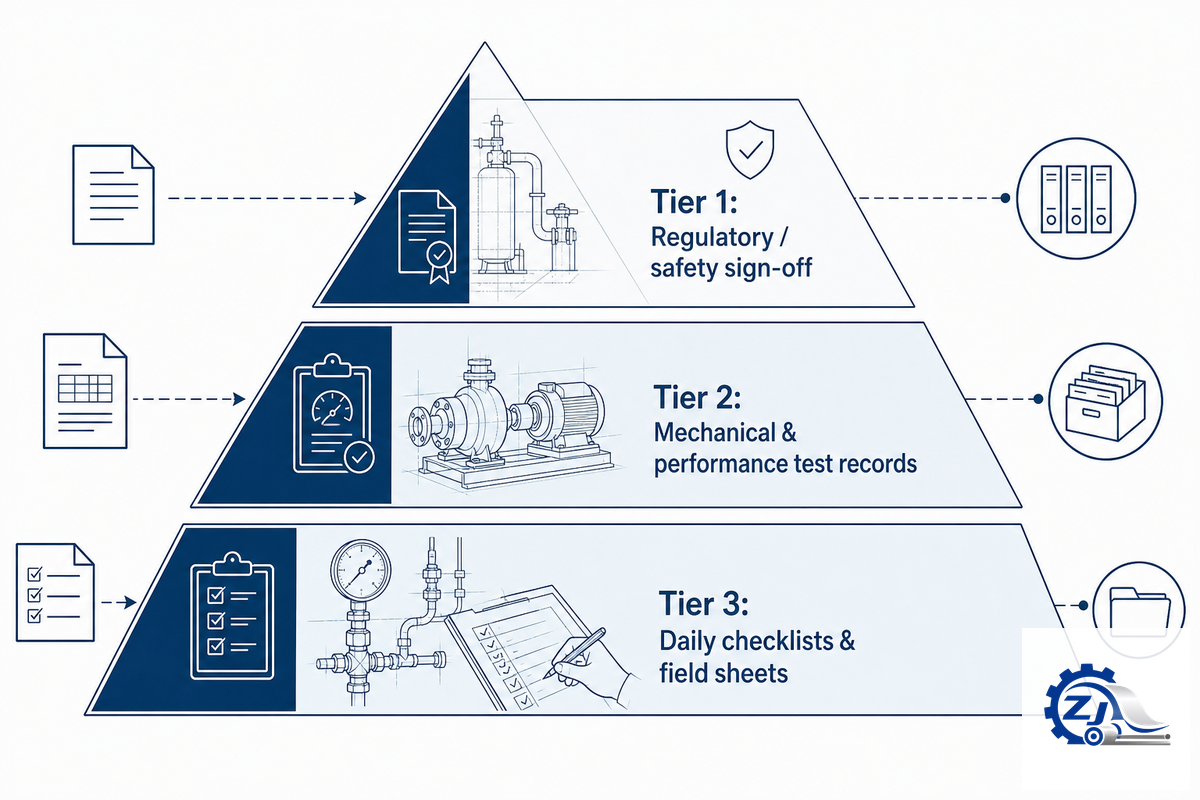
Paperwork is inherent to commissioning, as each test performed must be documented against a defined method — for paper quality acceptance testing specifically, that means the current TAPPI test methods, not internal shorthand that varies by mill. The roughly 1,900 US monthly searches for “commissioning sheet” and the 260 for “commissioning template” illustrate that guidance on proper paperwork is in demand among purchasers, rather than being an ancillary consideration.
How much record-keeping a project needs, in practice, depends on its scale — an OEM-supplied single-machine rebuild needs less paperwork than a 20-plus-sensor greenfield line commissioning. While this example apply to paper machines, the logic behind the specialized equipment-specific commissioning checklist applies to many other types of critical and high-capital equipment (e.g., boiler, compressor, centrifugal pump installation and commissioning) in any industry; the more critical the equipment and the higher its capital value, the more detailed the records must be. Many mills are now using dedicated commissioning software to facilitate SOP updates to all team members in real time, although it’s still essential that all paper machine installation services scope documents, paper mill equipment installation records, and commissioning sheets be housed together in one repository, not scattered among various supplier systems.
The 3-Tier Documentation Selector
| Project Scope | Recommended Paperwork Depth | Why |
|---|---|---|
| Pilot line / single component swap | Commissioning sheet + punch list only | Low downstream risk, fast iteration matters more than paper trail depth |
| Single-machine rebuild or upgrade | Full pre-commissioning checklist + phase sign-offs + punch list | Warranty and performance-guarantee terms usually hinge on this record |
| Greenfield mill / new paper machine line | Full gate-by-gate record + technical file per machinery safety regulation + formal handover package | Regulatory compliance records (see Machinery Regulation section below) plus multi-party liability |
Who’s Responsible: OEM, EPC Contractor, and Mill Team Roles
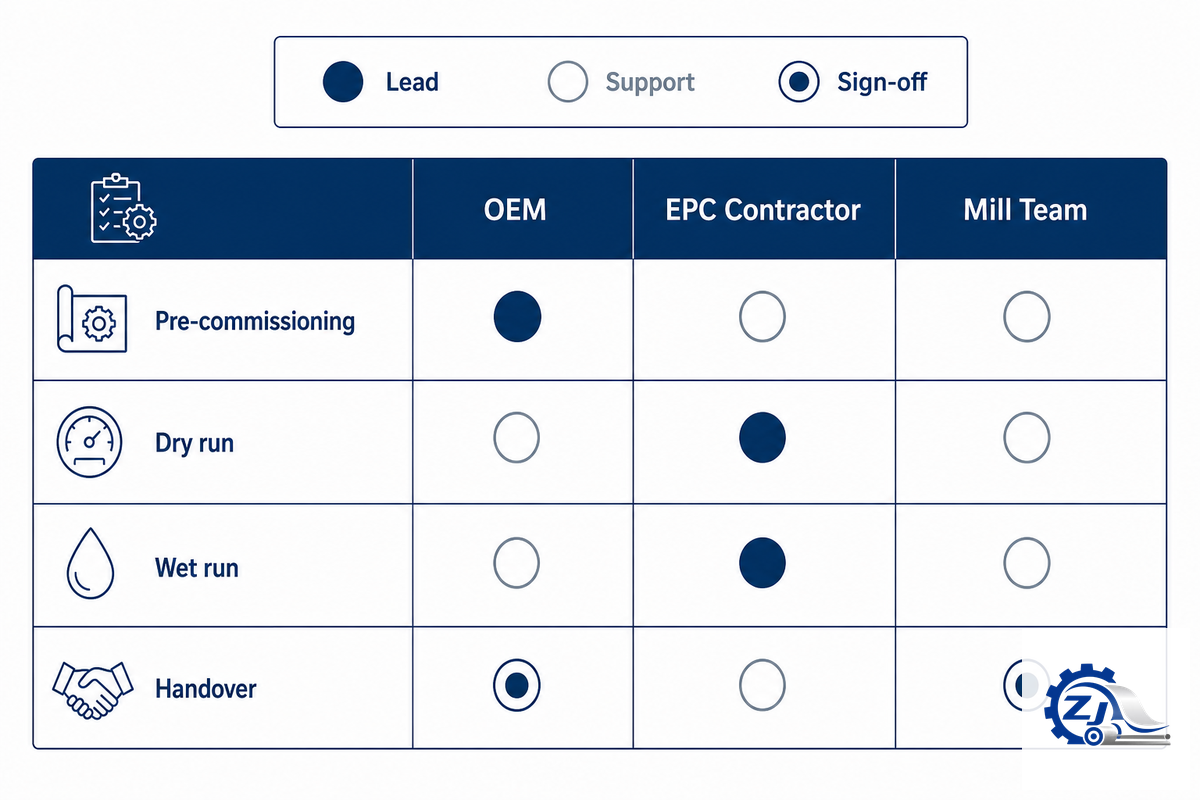
Commissioning is almost never the sole responsibility of one entity. Machine-specific technical know-how and drive/control tuning generally fall to the OEM (the equipment manufacturer); an EPC contract typically covers site integration and multi-vendor coordination; the mill’s own operations and maintenance (O&M) team needs to be on board from day one, not handed a finished machine.
A contract sign-off on all project requirements early in the project, including defining “who tests what,” should happen during early planning, long before any equipment has left the factory. In a common discussion of controls in the paper industry, one poster summarized a controls engineer’s duties as writing programs, designing schematics, and “bringing the machinery online” – that phrase only really holds water if the controls engineer is embedded in the commissioning process, rather than just receiving a project brief after it’s all been said and done.
Failing to solidify those expectations in writing via the contract can quickly result in disputes if the machinery falters during commissioning and each party believes it was the other’s responsibility to ensure the problem wasn’t there in the first place. Best practices call for naming a single accountable stakeholder per test category even when several parties are physically present, and for folding the first cycle of paper machine maintenance planning into commissioning hand-off rather than starting it from a blank sheet after the supplier leaves. Some recommend designating a single point person for each category of test, even when many hands are involved, and rolling early maintenance planning into the commissioning closeout, rather than beginning a new plan from scratch when the supplier has packed their bags. If you’re struggling to define that split, check out our Responsibility Split Finder, which walks through typical O&M/EPC/mill division of labor by project type.
Common Challenges in Paper Machine Commissioning (and How to Avoid Them)
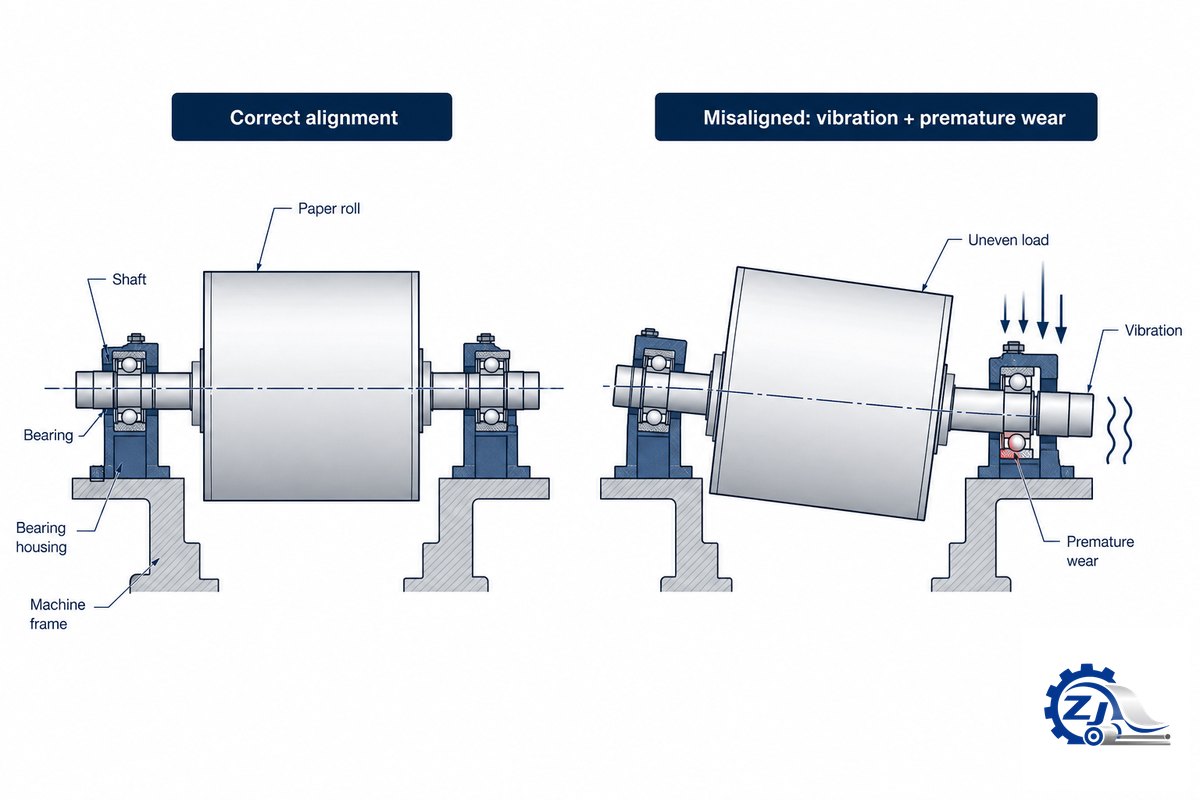
We frequently see two major areas of concern pop up in literature and conversation regarding commissioning across different machine types, both of which land squarely inside the guarding and interlock scope 29 CFR 1910.261 exists to cover once the machine is running paper. One is treating the “mechanical completion” status of a machine as little more than an administrative check. While machines might be built to extremely tight tolerances in a factory, installing, and especially mounting, a machine in the field can have unintended consequences. If that factory alignment does not survive transport, or the installation procedure itself leads to any misalignment with the machine, the result is vibration, excess noise, and damage to both the equipment and the facility structure itself over the equipment’s life. This is what rushing commissioning to hit a launch deadline usually causes, but a straightforward solution exists. The commissioning team should either directly participate in the first installation or at minimum work from a documented machine commissioning checklist the installer signs off against (using a contractor, or third-party alignment services, when in-house capacity is thin). The commissioning team gets to gain insights into potential deviations that would be harder to rectify down the line. This process includes a second alignment check or a third-party inspection, and it pays for itself the first time it catches a real problem.
A second, separate pattern is integration risk: a machine that may be completely successful in its own right will still fail in the mill’s overall control environment once it has been attached to the mill control system. Very few of the trials that a manufacturer performs on the new system simulate the electrical environment or even the real software that will actually operate in the plant. Detailed test scripts and integration plans, written and agreed before installation starts, are what keep this risk from becoming a surprise during commissioning rather than a planned test.
Industry Outlook: Automation and Remote Commissioning

Equipment commissioning across process industries generally, not just an efficient paper mill’s own paper mill factory setup, is converging on the same digital-first pattern. Building-commissioning literature has talked about a building management system (BMS) tying elevators, chillers, and other building systems together for years — a paper machine’s distributed control system is doing the same integration job for the mill floor, just under a different name. Near term, the clearest shift in paper machine commissioning is not a new mechanical procedure — it’s how much of the verification work is shifting toward virtual and remote methods before a machine is ever physically started.
A 2025 peer-reviewed study in the Journal of Intelligent Manufacturing documents growing industrial use of 3D digital-twin models for exactly this kind of pre-commissioning validation. A separate, independently published 2023 review (cited 87 times) tracks the same shift across manufacturing more broadly: simulate the control logic and mechanical behavior against a digital model before committing physical commissioning time to it. A practical payoff shows up before the machine ever ships — a control-logic bug caught in simulation costs an afternoon of engineering time; the same bug caught during a live dry run at Gate 2 costs a stalled crew standing around a half-erected machine.
That shift carries a real risk buyers should ask about directly, because any commissioning capability that depends on remote access or networked control systems is now an OT security problem, not just a productivity one — a structural gap most purchase contracts still fail to address. NIST SP 800-82 Rev. 3 frames industrial control systems — PLCs, distributed control systems, SCADA — as security-sensitive environments with their own threat and vulnerability profile distinct from standard IT networks. In practice, an OEM offering remote or digital-twin-assisted commissioning for a specific application should be able to state what OT security controls govern that remote access before a contract is signed; a mill that skips this question and only asks it after a network intrusion has found the plant’s control layer has waited too long. Independent market-size estimates for paper machinery put growth in the mid-single-digit CAGR range (roughly 4-6% annually) through the early 2030s across multiple research firms — useful as background context on capital spending direction, not as a substitute for the specific automation and security questions above.
Frequently Asked Questions
Q: What are the 5 phases of paper machine commissioning?
View Answer
The typical flow is: (1) pre-commissioning and mechanical completion – I/O, hydrostatic testing and cold/hot I/O testing are checked. (2) Dry running – electrical power is supplied but water and stock (paper pulp) are not used to check that the drives and interlocks are functional. (3) Wet running – water is used as a substitute for the paper web to pass through the wet end and dryer/press sections. (4) Stock-on and speed ramp-up – pulp is substituted for water and the machine is threaded to run at the design speed. (5) Performance testing and handover – the product is verified against quality parameters and the punch list is completed prior to hand-over.
Q: How long does paper machine commissioning typically take?
View Answer
These times vary greatly depending on the equipment complexity and the project size. Industry sources commonly cite ranges of two to five days for individual equipment and four to six weeks for a complete integrated production line, covering everything from planning to execution to troubleshooting to retesting. You’ll find all installation time frames given, even this range, should be treated as directional and not as an absolute because they’ll move around with scope, site conditions, and the number of issues that come up during testing.Our Installation Timeline Estimator is your answer for a customized estimate for your project, not an industry wide generalization.
Q: Who is responsible for paper machine commissioning, the manufacturer or the mill?
View Answer
It is usually shared, and exactly how should be spelled out in the contract before work begins. Ownership of machine-specific technical verification and drive/control tuning generally stays with the machine builder, while site-wide integration, if an EPC contractor is involved, usually falls to them. Mill maintenance and operations staff need to be involved from beginning to end during commissioning, not only at the close of it.
One of the most common areas where conflicts arise in the middle of the commissioning is leaving this undefined.
Q: What is a commissioning punch list?
View Answer
A punch list is a documented list of defects or remaining work that must be completed on a machine or project prior to the acceptance testing. The machine can consist of various aspects of both mechanical, electrical and performance remaining open from both the dry and wet running and performance testing phase and listed in paper machine commissioning.
Q: How often should machine alignment be verified after commissioning?
View Answer
As a basic rule of thumb for checking general paper machine alignment every two years is recommended for general purposes; increasing the frequency to quarterly in high-speed applications as wear and vibration happen much faster in these machines. Do check the recommendation for your machine builder’s guidelines.
Q: Is predictive maintenance necessary right after commissioning?
View Answer
Sensor-based condition monitoring is worth setting up at handover, even for mid-sized mills, because it captures the healthy machine’s baseline signature right after commissioning — exactly the reference point predictive maintenance needs later to detect drift.
Q: What regulations or standards apply during paper machine commissioning?
View Answer
Within the US, OSHA 29 CFR 1910.261 sets forth machinery safety regulations for pulp, paper and paperboard mills, whereas 1910.147 sets forth lockout/tagout procedures for machinery testing. Within the EU, any machinery to be marketed currently must conform with Machinery Directive 2006/42/EC; the regulation supersedes this Directive, with Regulation (EU) 2023/1230 in effect on January 14, 2027 (a few sections in a separate section of this regulation have been effective a year earlier). Test methods and technical recommendations for paper-quality acceptance are developed and maintained by TAPPI, most recently for items like cast-iron dryer inspection guidelines.
These test methods and recommendations are revised from time to time; for instance, TAPPI published a revision bulletin in February 2026 specifically addressing inspection and nondestructive testing procedures for cast iron paper machine dryers.
References & Sources
- 29 CFR 1910.261, Pulp, Paper, and Paperboard MillsU.S. Occupational Safety and Health Administration
- 29 CFR 1910.147, The Control of Hazardous Energy (Lockout/Tagout)U.S. Occupational Safety and Health Administration
- Regulation (EU) 2023/1230 on MachineryEUR-Lex, European Union
- Startup and Commissioning Procedures for Electronically Line-Shafted Paper Machine DrivesM.A. Valenzuela, IEEE Xplore (2001)
- Guidelines for Inspection and Nondestructive Testing of Cast Iron Paper Machine Dryers (STAR, February 2026) — Technical Association of the Pulp and Paper Industry (TAPPI)
- NIST SP 800-82 Rev. 3, Guide to Operational Technology (OT) SecurityNational Institute of Standards and Technology
- Project CommissioningWikipedia
- The Installation of a New Paper MachineIndian Pulp and Paper Technical Association (IPPTA) Journal, XI(4):299-305
- Successful Commissioning of RCCM Paper Machine PM5PaperFIRST
Why We Write This
Zejiang designs and manufactures paper machines and is present on-site for the installation and commissioning of our own machines, so we spend real time in the gap this guide covers. This draws on public regulation (OSHA, EU machinery law), peer-reviewed research, and industry-association publications (IEEE, TAPPI, IPPTA) rather than internal project figures, so a reader anywhere can verify it independently of who built their machine. Reviewed by the Henan Zejiang Paper Machinery Co., Ltd. technical team.
Related Articles
- Paper Machine Installation & Commissioning Serviceour 3-stage commissioning process, from site readiness through trial-run sign-off
- Site Readiness Checklistpre-commissioning site preparation reference
- Installation Timeline Estimatorproject-specific duration planning tool
- How Pulping Equipment Works: A Guide to Paper Pulping Methods and Machine Selectionupstream equipment on a new mill build
- About Zejiang Paper Machinerydesign-to-after-sales capability
![Refiner Plates & Screen Baskets [Complete Guide]](https://zjpapermachine.com/wp-content/uploads/2026/07/refiner-plates-screen-baskets-guide-featured-150x150.png)
![Doctor Blade: Types, Materials & How It Works [Guide]](https://zjpapermachine.com/wp-content/uploads/2026/07/doctor-blade-guide-featured-1-150x150.png)
![Pulping Equipment: How Paper Pulping Works [Guide]](https://zjpapermachine.com/wp-content/uploads/2026/07/pulping-equipment-guide-featured-150x150.png)