Get in touch with Zejiang Paper Machinery Company


![Tissue Paper Machine: How It Works [2026 Guide]](https://zjpapermachine.com/wp-content/uploads/2026/07/tissue-paper-machine-guide-featured.png)
Quick Specs
| Forming platforms | Cylinder mould, crescent former, Fourdrinier (non-tissue reference) |
| Forming speed range | 160 m/min (cylinder mould) up to 1,500 m/min (crescent former) |
| Basis weight | 13-40 g/m² (13-40 gsm) |
| Yankee dryer diameter | 12-16 ft / 3.7-4.9 m (modern steel) — older cast-iron units ran larger |
| Typical commissioning window | 3-6 months from delivery to production ramp |
| Pulper consistency | 4-6% (virgin pulp) vs. 15-16% (recycled fiber) |
| Furnish | Virgin pulp or recycled fiber |
The tissue paper machine is actually the forming and drying line that takes wood pulp or waste fiber to form tissue paper base paper rolls used in producing toilet paper, napkins, facial tissue, kitchen towel, etc., and to know what goes on inside, from one section to the other, is the difference between just looking at a spec sheet and actually understanding what you’re purchasing. Many buyers come up with this question, frustrated by suppliers who mix the concepts of tissue paper machine, toilet paper machine and napkin machine in one vague product listing, as these machines perform at different steps.
In short: A tissue paper machine forms and dries base paper on a forming section (crescent former or cylinder mould) paired with a Yankee dryer. It does not fold, cut, or roll finished tissue products — that happens on separate converting equipment, which is why “tissue paper machine” and “toilet paper machine” listings so often overlap without actually describing the same equipment.
- Two forming systems dominate almost the entire tissue market: cylinder mould for entering level mills, and crescent former if you produce more than approx. 20 tonnes a day.
- The fully-integrated forming-to-parent-roll line passes through 10 different processing stages prior to being run through a converting machine.
- In fact, drying often makes up the vast majority of the energy requirements in tissue production – more so than most buyers anticipate.
- Used paper can’t be recycled forever: According to EPA data, it can only be recycled five to seven times, before the fibers are too short to use again.
What Is a Tissue Paper Machine? (Forming vs. the Rest of the Production Line)
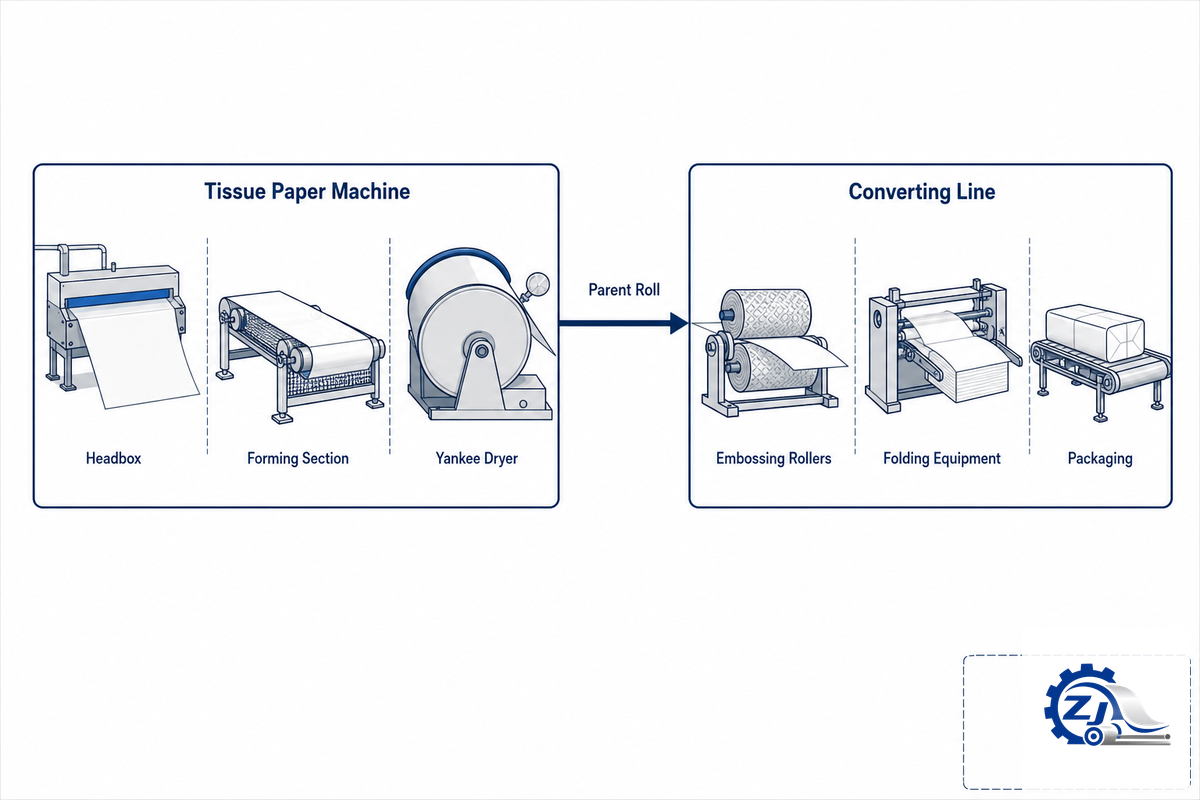
A tissue paper machine is the piece of machinery that takes wet stock, makes a sheet, presses it, and dries it into a “parent roll” of tissue base paper. It doesn’t fold napkins, convert toilet rolls, or emboss the final sheet; that work happens later, down-line, on separate converting equipment, a distinction most buyers don’t know when they start requesting quotes.
What a buyer decides to do with that sheet on a converting machine determines what it will ultimately become in the retail environment, but the sheet’s basis weight, potential softness, and production limits are determined by the forming process in the tissue machine itself. Both are components of the same paper production continuum but are considered distinctly separate equipment categories. This is not an academic distinction: a mill owner who orders a “tissue machine” expecting a full production line, then discovers mid-negotiation that the quote only covers the forming section and excludes converting, has effectively lost weeks of sourcing time and an expensive re-scoping risk. Zejiang’s engineering team scopes this gap on every inquiry before quoting, because the mistake is common and costly to unwind once a deposit is on the table.
The machine consists of two elements. The former section of a machine: is the part of the forming section, in which water is removed from the prepared furnish (virgin or waste fibre suspended in water) on the moving fabric in order to form a web or a sheet, and the latter part of the machine: drying section is the group of equipment in the main machine that centers on one, large steam heated drum, referred to as the Yankee cylinder. All other equipment in the machine – the pulpers, the cleaners, the screens, the refiners and the headbox – simply support that initial forming step. Recent USPTO patent activity on tissue paper making machines confirms this two-part forming-and-drying architecture is still the baseline every newer design builds on.
📐 Engineering Note
Tissue isn’t so much defined by its composition as its slenderness and dryness: basis weight in the 13-40 gsm range as compared to 60-300+ gsm for print/packaging grades. Its slenderness is exactly why it can’t apply drying techniques (like multi-cylinder can dryer sections) suitable for larger basis weights paper, using only one Yankee cylinder with a hot air hood (detailed in the following article).
Tissue Paper Machine vs. Toilet Paper Machine vs. Napkin Machine, What’s Actually Different
If you came here on search terms like “toilet paper machine” or “napkin machine” you’re likely looking in the entirely wrong category of equipment – not the only time that’s happened. Industry sourcing advice frequently cites this as the number one most frequent mistake buyers make: conflating multi-crore forming mills that process raw pulp into paper base with vastly less expensive converting-only machines that fold ready-made parent rolls into finished napkins or wound rolls. Those looking for the second machine will waste weeks inquiring from manufacturers of the first, and vice versa. As a rough capital-tier guide, a standalone converting line commonly runs somewhere around 10-20% of a full forming line’s cost, and single-ply tissue sheet caliper typically falls in the 15-25 μm range per ply regardless of which converting machine finishes it. Even U.S. workplace-safety rulemaking treats them as one continuum rather than separate industries: 29 CFR 1910.261 covers guarding requirements across pulp, paper, and paperboard mills broadly, forming and converting equipment alike, which is one more reason the two categories get blurred in casual sourcing conversations.
| Equipment | Production stage | Typical buyer | Rough capital tier |
|---|---|---|---|
| Tissue paper machine (forming) | Pulp → parent roll | New tissue mills | Full mill-scale capital |
| Toilet paper / rewinding machine | Parent roll → retail roll | Converters, private-label packers | A fraction of forming-line cost |
| Napkin / folding machine | Parent roll → folded napkin | Napkin converters, foodservice suppliers | Comparable to rewinding tier |
| Facial tissue machine | Parent roll → boxed facial tissue | Facial tissue converters | Comparable to rewinding tier |
On search engines the misunderstanding go both ways: Customers shopping for “tissue paper machine” visit converting-equipment listings, and customers who are, in fact, looking for a rewinder visit a page devoted to forming-lines that are out of their price range. Make sure you’re on the right side of the line, so to speak, and whether you need a forming machine or converting equipment (you know the latter if you’re purchasing the raw material, i.e., the parent rolls, to produce your final product).
The converting side has its own dense vocabulary worth knowing before you call a supplier. A jumbo roll of tissue paper (the parent roll straight off a Yankee dryer) moves to a rewind stand, then a log saw for cutting into retail-length rolls, then a sealing machine and packing machine to reach finished products; a toilet paper roll line uses largely the same rewind-and-cut logic as a hand towel machine or paper towel machine line, and the same roll making machine or tissue making machine can often be reconfigured between the two with a change of blade and core size on the slitting machines (a plain slit versus a perforated slit changes the finished product entirely). Napkin making runs a different path: a napkin making machine takes a jumbo roll through folding machines that score, fold, and stack rather than winding a core, and a facial tissue production line adds a facial tissue paper interfolder on top of similar tissue cutting machine and packing machine stages. Ply count (1-ply, 2-ply, 3-ply, or the finer distinctions covered in most types of tissue making guides) is set at this converting stage, typically adding 20-40% to base sheet weight per additional ply, not on the forming machine itself, and it’s one of the first things a professional manufacturer asks when quoting a tissue paper production line. A full automatic converting line runs jumbo roll to packed product with minimal manual handling at speeds commonly in the 100-300 m/min range; a semi auto line still needs an operator at the log saw or packing machine stage, which lowers the manufacturing machine cost but raises the labor line item per shift (commonly 2-3 additional operators over an 8 hour shift).
None of this converting-side tissue manufacturing changes what happens on the tissue machine itself. Kraft, non-woven, and specialty grades all still start on the same forming platforms covered in this guide; what changes downstream is purely the roll machine and finishing equipment matched to kitchen paper, kitchen paper towel, and towel paper end products versus toilet or facial grades. Some suppliers bundle both sides under one making machine factory roof and call the combination a paper machine factory; others run forming and converting as genuinely separate tissue paper manufacturing businesses, sometimes on an OEM basis, on their own schedules and design team headcount. Buyers evaluating a full setup should ask each manufacturing machine supplier for on-site production efficiency data, high-speed changeover time, and waste percentage, rather than assuming a converting line will automatically keep pace with whatever paper manufacturing throughput the forming side quotes upstream. It’s also worth asking whether the manufacturer holds ISO9001 certification, since that single question filters out a surprising share of weak suppliers before you ever discuss plain tissue paper specifics like softwood versus hardwood pulp blends, maxi-reel sizing, or what actually counts as the best tissue paper for a given grade tier.
“We get inquiries every month from buyers who describe a napkin folding operation but ask us to quote a full forming line, or the reverse. The fastest way to sort it out is one question: are you starting from raw fiber, or from a roll someone else already made?”
Zejiang Engineering Team
How a Tissue Paper Machine Works, Step by Step (Pulp to Parent Roll)
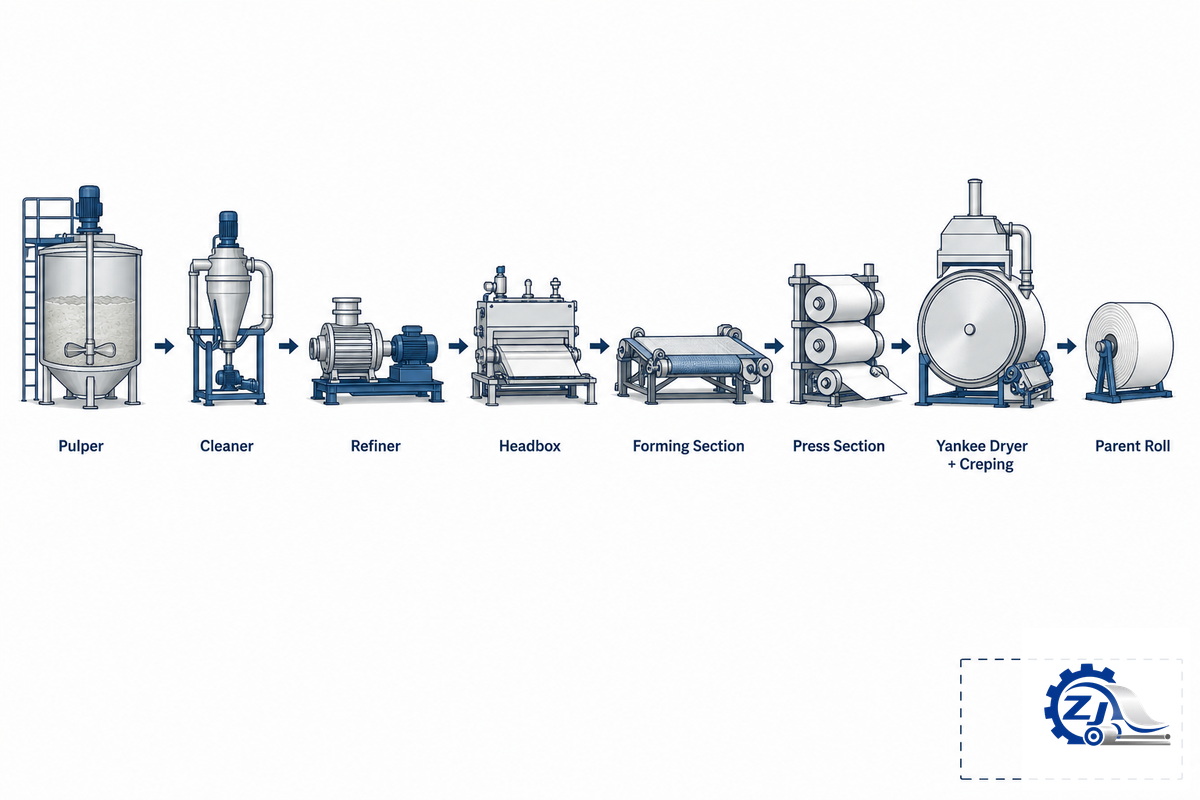
A tissue paper machine works by moving stock through 10 distinct stages, pulper, cleaner, screen, refiner, pressure screen, headbox, forming section, press roll, Yankee dryer, and reel, converting raw fiber into a finished parent roll ready for converting equipment. Each stage does one specific job, and skipping any of them in a quote usually means the line is incomplete.
The 10 Stage Forming to Roll Count
We can call it the 10 Stage Forming to Roll Count – one forming line passes through exactly 10 different stages from the beginning (raw stock) to the end of the product forming (a finished parent roll), just short of the converting equipment. A buyer who cannot name these 10 stages is the buyer most likely to overpay for equipment they do not need, since suppliers routinely quote partial lines as if they were complete ones. Isolating what each stage actually does is what closes that gap.
| Stage | Type | What It Does |
|---|---|---|
| 1. Pulper | Stock prep | Reduces a virgin pulp bale or recovered fiber to a fibrous slurry, usually at higher consistency (15-16%) for recovered fiber than for virgin fiber. |
| 2. Cleaner | Stock prep | Rejects heavy debris (sand, staples, plastic bits) by centrifugal action, a step that carries more load on recycled-fiber lines. |
| 3. Screen | Stock prep | Removes lighter contaminants and fiber bundles the cleaner missed. |
| 4. Refiner | Stock prep | Mechanically develops fiber-to-fiber bonding; under-refined stock gives a weak sheet, over-refined stock loses bulk. |
| 5. Pressure screen | Stock prep | A final fine-screening pass immediately before the headbox. |
| 6. Headbox | Forming | Distributes stock evenly across the machine width onto the forming fabric, controlling sheet evenness. |
| 7. Forming section | Forming | Cylinder mould or crescent former drains water from the stock to build the wet sheet. |
| 8. Press roll | Drying | Mechanically squeezes out additional water before the sheet reaches the dryer, cutting the drying energy load. |
| 9. Yankee dryer | Drying | Dries the sheet on a single large steam cylinder and, with a doctor blade, crepes it off the surface (detailed below). |
| 10. Reel | Finishing | Winds the finished, creped sheet into a parent roll, ready to hand off to converting equipment. |
What Is the Role of the Refiner in Tissue Paper Quality?
View Answer
The refiner mechanically develops fiber-to-fiber bonding between two rotating discs, trading off the two properties tissue buyers care about most: strength and bulk. Light refining favors bulk and softness but yields lower strength; heavier refining raises strength but flattens the sheet toward a less absorbent structure.
Since recycled and virgin pulp behave differently under refining energy, the setting is usually among the first parameters a mill adjusts when switching furnish mixes, not a fixed factory setting. Downstream, the Yankee dryer’s own performance depends on keeping its surface clean and evenly coated, a problem detailed in US Patent 7,850,823 on controlling adhesive build-up on a Yankee dryer.
Forming Platforms Compared: Crescent Former vs. Cylinder Mould vs. Fourdrinier
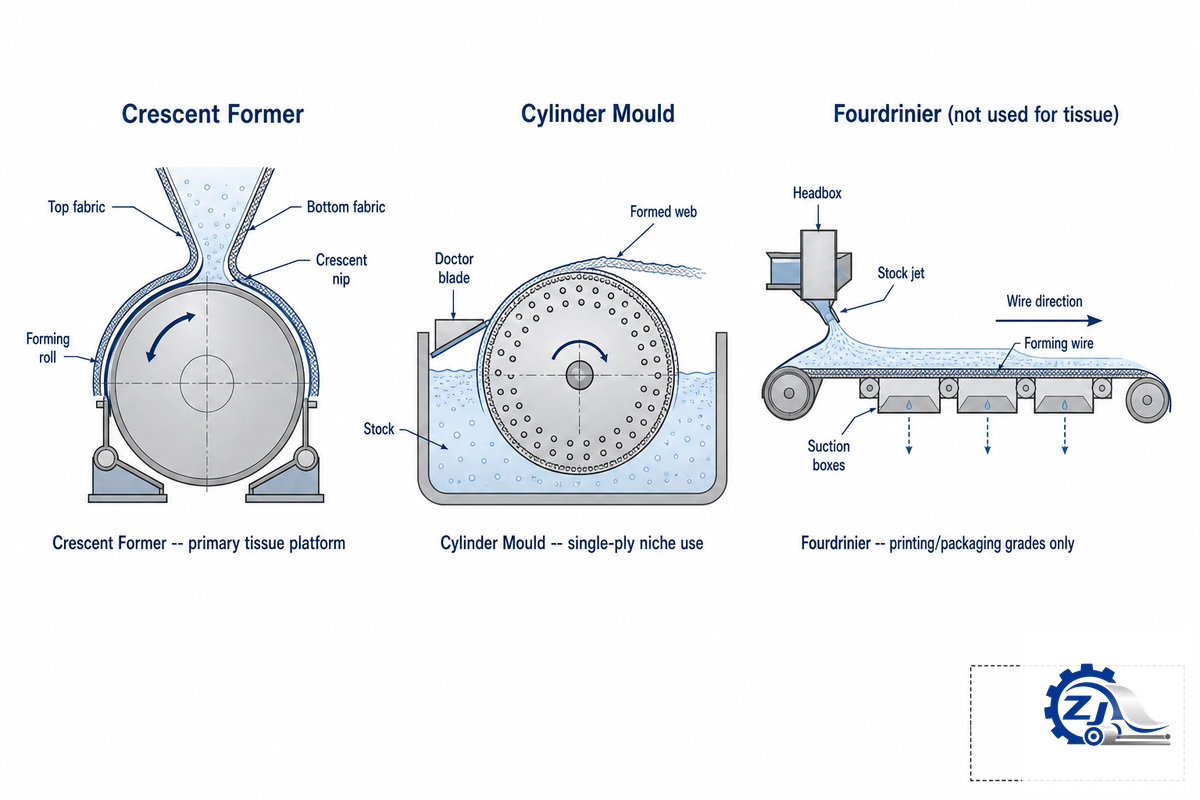
Crescent former and cylinder mould are the two forming platforms used specifically for tissue; Fourdrinier is a different forming mechanism used for general printing, writing, and packaging paper grades, not tissue, worth knowing so you don’t end up comparing your tissue quote against the wrong technology (Zejiang’s sibling guide on how industrial paper machines work across Fourdrinier, twin-wire, and cylinder mould covers that broader comparison).
Crescent Former vs. Conventional Tissue Machine: What’s the Real Difference?
Crescent former and conventional (cylinder mould) tissue machines differ mainly in what we’d call the Felt-Transfer Fingerprint: how each platform hands the wet web from forming fabric to felt on its way to the Yankee dryer. Crescent former uses a curved, gentler transfer geometry; older single-wire designs use a flatter, more abrupt handoff, which limits achievable speed.
The crescent former is the technology that was developed by Kimberly-Clark in the 1960’s, and it became the industry standard for a decade once its original patents expired in 1988; it’s what most people consider to be the modern “traditional” tissue machine. The characteristic feature is the manner in which the wet web of paper is transferred from the forming fabric towards the Yankee dryer; in the crescent former machine, the web is pressed against a felt within a curved (crescent-shaped) transfer section, which allows for a smoother, lower impact transfer than the earlier flat single-wire systems. This is a more precise description than stating that crescent formers “have no transfer step,” as patent literature on crescent-former web transfer confirms the web is still pressed against the felt, though by a different mechanism than older designs.
The cylinder mould is the older of the two systems, and it’s a simpler mechanical system with fewer parts and less start up time. It’s still the standard entry-level for new tissue producers that are entering the market and are looking to demonstrate its viability before investing in the kind of equipment needed for crescent-former technology. For a new mill, starting out with a small tissue paper machine that uses the cylinder mould is usually the practical option – even though the search results for a “crescent former” tissue machine may lead to other systems.
| Factor | Cylinder Mould | Crescent Former |
|---|---|---|
| Forming speed | ~160 m/min | Up to ~1,500 m/min |
| Mechanical complexity | Lower — fewer wear points | Higher — felt transfer zone, larger hood system |
| Best-fit stage | New producers, market-proving scale | Scaling mills, established production |
| If your daily target is… | Single-digit tonnes/day | 20+ tonnes/day and rising |
💡 Pro Tip
If a “crescent former” machine quoted by a vendor cannot provide you with a specification for the Yankee hood, alongside a drying speed, be sure to ask; the drying and forming sections of a machine are engineered together, and an ill-matched Yankee hood/drying system is a frequent source of discrepancy between advertised headline speed and actual commissioning speed.
Yankee Dryer & Creping, The Other Half of Tissue Forming
What Is a Yankee Dryer in a Tissue Paper Making Machine?
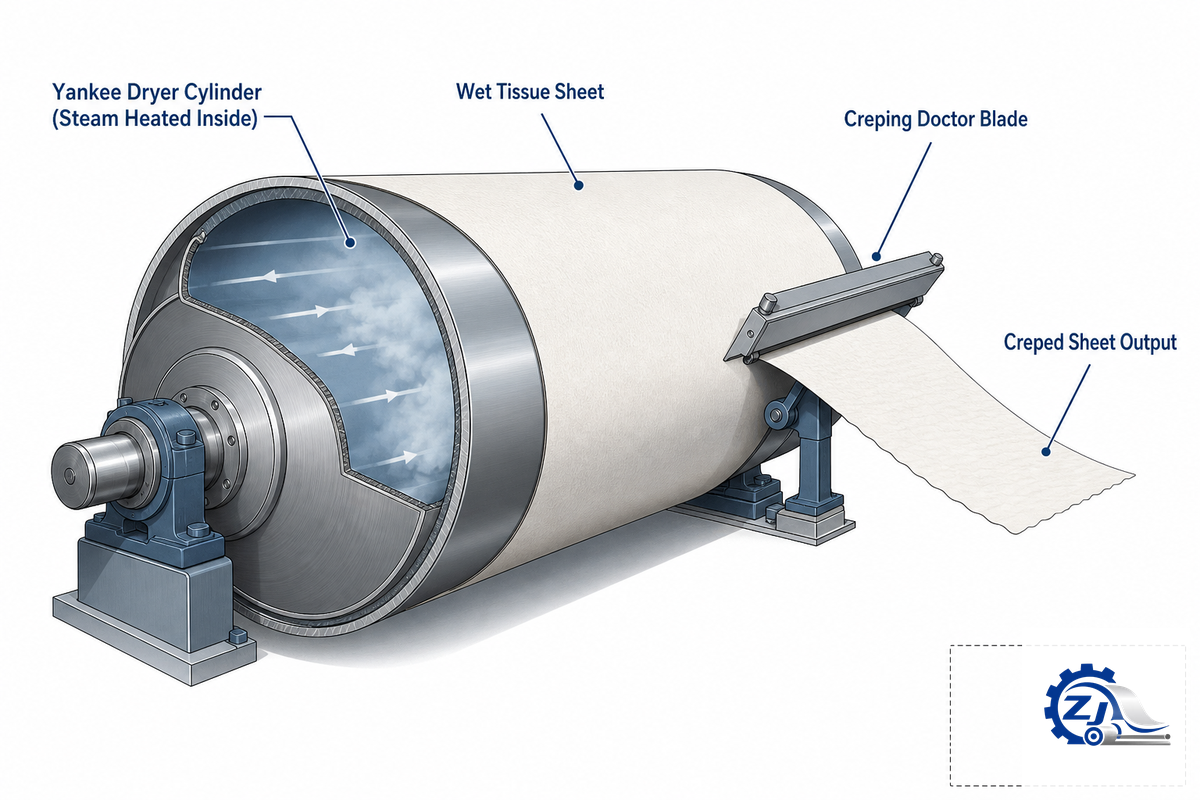
A Yankee dryer is a single large, steam-heated cylinder that dries the tissue sheet while also forming its crepe structure, the puffiness that distinguishes tissue from other paper grades that tend to be flat and glazed. The wet sheet is dried against the hot cylinder plus hot-air impingement from an enclosing hood, then scraped off by a doctor blade in the creping step.
Large modern steel Yankees on crescent-former machines are often cited as being between 12 and 16 ft in diameter, while older references to cast iron Yankee dryers indicate somewhat larger diameters. One shouldn’t compare the two without clarification as they relate to different generations of technology and construction; one must clarify on the quote which Yankee dimensions apply. Getting this wrong is an expensive mistake in practice, since dryer surface diameter and crown profile drive the crepe quality Zejiang’s engineering team is asked to troubleshoot most often on retrofit inquiries. Yankee shell thickness commonly runs 25-40 mm on modern steel designs, thin enough to transfer heat efficiently but thick enough to hold roughly 0.4-1.0 MPa of internal steam pressure safely over a multi-year service life.
Drying is a surprisingly expensive operation, with drying energy costs in a tissue machine commonly being cited as 70% of the total energy cost; as a result, the cost-performance ratio of the Yankee and associated hood equipment matters far more to lifetime cost than the price tag on the machine itself for many users. Some industry technical data indicate that press technology referred to as shoe pressing (a press that forces the sheet against the Yankee cylinder via a concave shoe shape instead of a standard nip roll) can increase dryness exiting the wet end to as high as the mid 40s, significantly reducing the load on the drying section. This represents a step up between conventional dry-crepe technology and total through-air drying (TAD), though the dry end dryness improvement has been found to be installation dependent.
📐 Engineering Note
On both Yankee dryers and in drying sections of tissue machines, the protruding shaft ends are subject to specific guarding requirements in the U.S. industry (29 CFR 1910.261), which stipulate that the shafts of drying cylinders must be fully enclosed and have designated emergency stop buttons tied to the drive brakes; this guarding requirement should be investigated for any potential purchase regardless of forming section technology.
Furnish Choice: Virgin Pulp vs. Recycled Fiber (and Why It Changes Your Machine Spec)
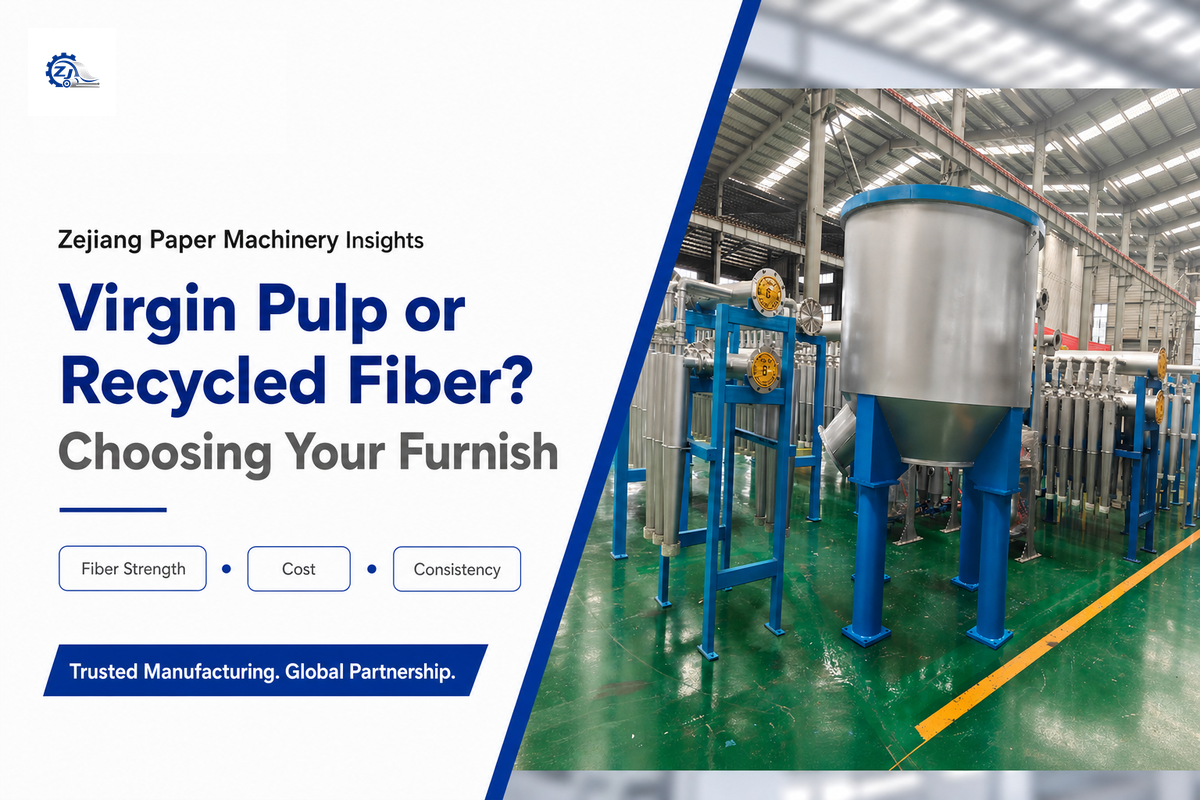
Furnish composition is more likely to drive requirements for the stock prep system than it’s to define which forming equipment should be selected. Neither cylinder-mould (CM) nor crescent-former technologies is unique to either virgin or recycled fiber-based furnishes; nevertheless, the amount of preparation work and the degree of process control that are necessary when processing recycled paper stock significantly increase the scale and complexity of a stock prep train, and it’s a relatively common practice to run recycled furnishes at substantially higher consistency in the pulper to ensure complete de-fibering before subsequent screening and de-inking operations. Well-tuned high-density pulpers commonly report defibering efficiency above 90%, a figure worth asking any supplier to confirm for your specific furnish blend.
Moreover, recovered fiber isn’t a fully-renewable input either: The EPA’s papermaking material data notes that recovered fiber typically degrades to the point of not being able to support sheet strength after about five or seven passes of recycling; this explains why mills operating with a high proportion of recycled furnish still must continually add a small amount of fresh virgin pulp, and shouldn’t treat recycled content as a onetime substitution (deinking lines typically target contaminant removal down to well under 0.5% residual ash for premium grades). This upper-limit of reuse-not just contaminants-is part of why an all-virgin economy-grade sheet and a hyper-premium sheet exist on opposing sides of the industry’s spectrum for recycled-content usage, and it’s not just about some linear decrease in recycled content for each product tier. A mill that locks in a supply contract for 100% recycled furnish without budgeting for periodic virgin-pulp top-up is a common, costly mistake: sheet strength quietly drifts down cycle over cycle over roughly 5-7 passes until a customer complaint forces an unplanned, expensive furnish-mix change mid-contract. Zejiang’s engineering team sizes the stock-prep train around this risk in practice, not just around the forming platform.
Furnish Decision Factors
- Check that your regional recovered fiber supply stream will be reliable before deciding how large your deinking and screening plant needs to be – as contaminants levels will vary by local stream.
- Add budget for an ongoing small amount of fresh virgin pulp to all high-recycled-content paper machine line items – as opposed to some one-time fixed mix.
- When first commissioning, fine tune refiner settings based on your furnish mixture, and be sure to re-tune again whenever you switch out your virgin and recycled mix, as they’re differently sensitive.
What a Tissue Paper Machine Costs (and What Actually Drives the Price)
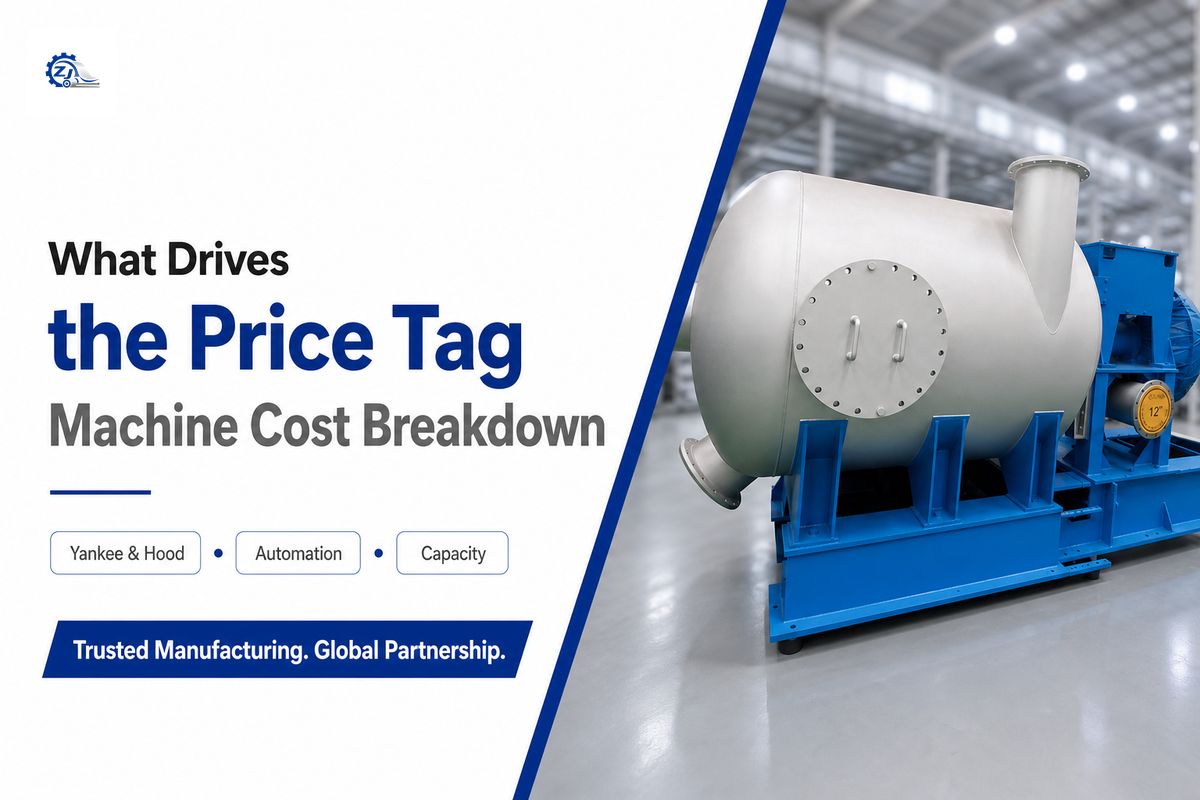
The price for a tissue paper machine is far from a fixed cost: it varies with forming platform, automation level, dryer sizing, and furnish-handling equipment. The Yankee and dryer system commonly drives the largest share, representing almost 50 percent of the machine’s initial capital cost on its own.
Use that figure as a benchmark to press suppliers for detailed line-item cost breakdowns. Machine cost commonly makes up 40-50% of total project cost once land, buildings, and working capital are included, and total project cost commonly runs 2-2.5x the machine cost alone. Part of that cost also covers the guarding and emergency-stop hardware mandated under 29 CFR 1910.261 for any U.S.-bound line, which a bare machine-price comparison can easily miss. Spare-parts packages for the first 1-2 years of operation typically add a further 3-8% on top of the base machine price, depending on how deep an inventory you carry on wear rolls, felts, and screens.
~50%
of machine capital cost is commonly the Yankee dryer + hood system combined
2-2.5×
total project cost vs. machine cost alone
Beyond the Yankee and dryer system, major factors affecting the cost include automation level and furnishing equipment. Automated web threading systems versus manually threading web the web and the automation levels used to control it can influence not only the upfront investment but the headcount per shift. Since a full recycled-fiber deinking process must be performed on that type of stock separately, it’s often quoted separately from the paper machine itself, and we’ve outlined it above. Instead of simply relying on one or two numbers that would mean little to you without specific details, ask a paper machine manufacturer for a tissue paper machine quotation itemizing the following four key factors so that you can compare suppliers’ figures on an equal footing.
To obtain a detailed comparison matrix linking target output to forming platform and get a complete cost breakdown along with parts list, view Zejiang’s Tissue Paper Machine pageor Request a Quote →
New, Used, or Refurbished, Weighing the Capital Options
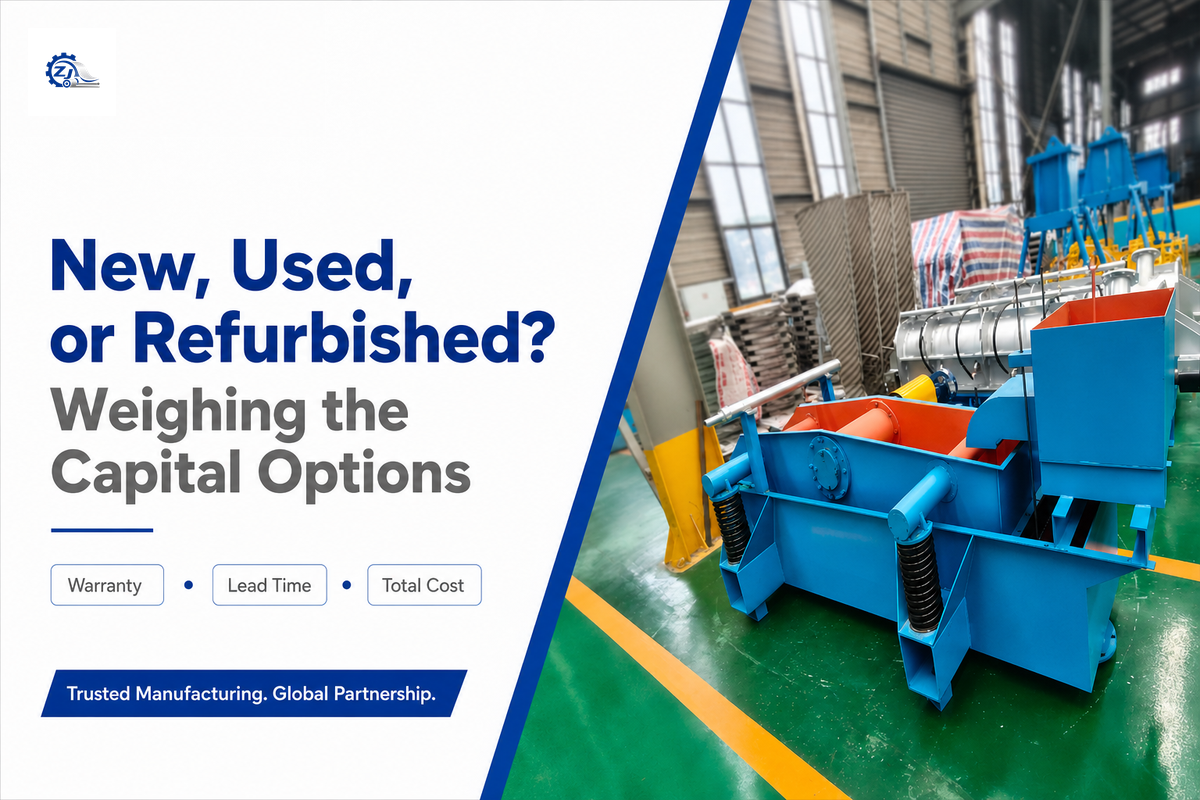
A lower purchase price on used equipment can be offset by higher maintenance costs and a shorter remaining service life – worth an honest engineering assessment rather than a default assumption in either direction. Used-equipment marketplaces carry a meaningful share of tissue-machine search demand specifically because the calculation genuinely isn’t obvious: when you find a tissue paper machine for sale well below new-build pricing, it can look like a bargain against a new cylinder mould line, but only if its wear parts, dryer surface condition, and remaining service life actually support the throughput you’re buying it for. Used lines commonly carry only 1-2 years of remaining component warranty against 2-5 years typical on a new build, a gap worth pricing into any offer. Most industrial paper machinery also depreciates over a 10-15 year schedule for accounting purposes, useful context when a used machine’s book value is quoted alongside its asking price. In practice, a used line bought purely on price and run past its realistic service life ends up costing more per tonne in unplanned downtime than a new machine would have, which is the trap Zejiang’s engineering team walks buyers through before they commit to a used purchase. A used machine’s age also doesn’t exempt it from current guarding rules: 29 CFR 1910.261 applies regardless of when the line was originally built, so budget for retrofit guarding if a used machine predates current shaft-guarding and emergency-stop expectations.
✔ Advantages of Used/Refurbished
- Lower upfront capital outlay
- Often faster to source than a new-build lead time
- Can suit a market-proving first line before committing to new-build capital
⚠ Limitations of Used/Refurbished
- Yankee cylinder surface wear directly affects sheet release and creping quality – costly to restore
- Spare parts availability for older or discontinued models
- Remaining service life can push total maintenance cost above a new machine’s over the same period
Evaluating Manufacturers & Starting a Tissue Mill
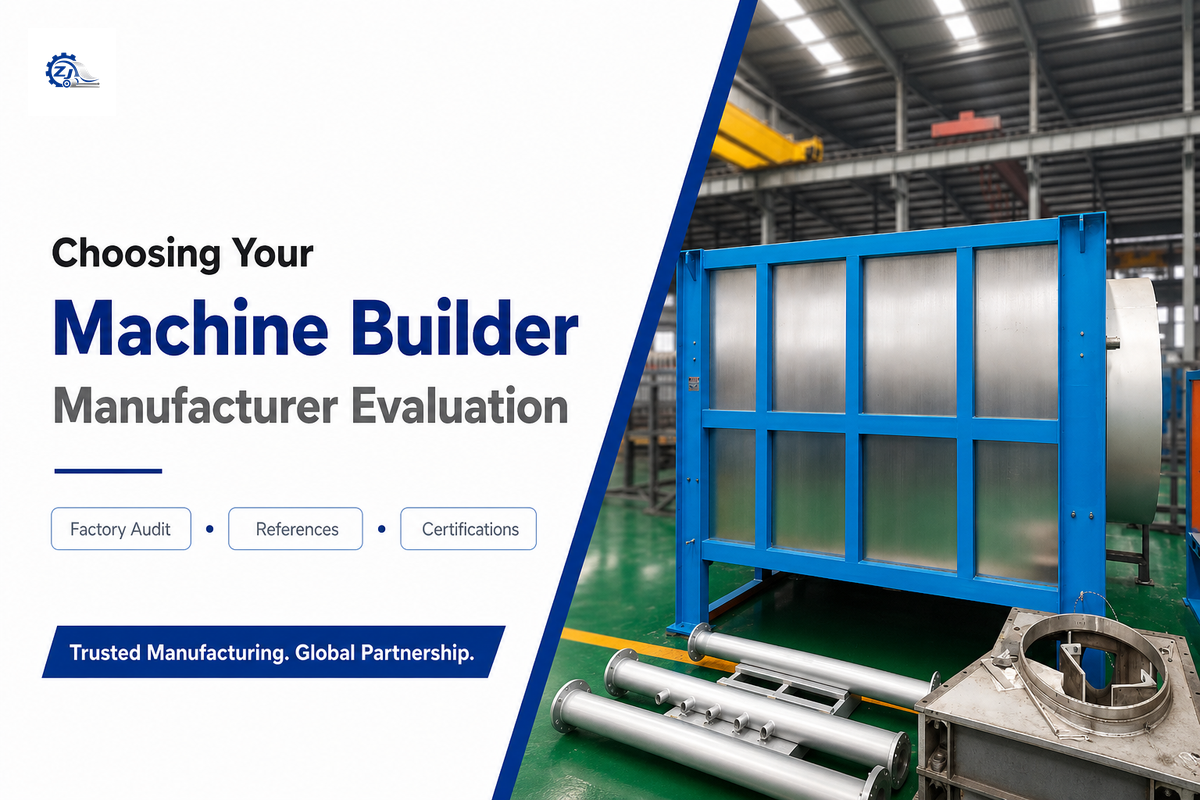
Evasive or vague answers about machine specifications are one of the more reliable warning signs when evaluating tissue paper machine manufacturers – a supplier who answers “what’s your current monthly capacity utilization” or “what’s your in-line inspection rate” with a specific number, not a general reassurance, is giving you something you can actually verify. Established suppliers in this space commonly offer 12-24 month warranty terms and multi-decade operating histories, both reasonable benchmarks to compare a quote against. A handful of real-world buyer mistakes show up repeatedly in industry guidance for this category, and they’re worth checking against your own plan before signing. Zejiang’s own quoting process is built around answering these questions before a buyer has to ask, after years of fielding the same five concerns from first-time mill owners. A manufacturer worth shortlisting should also be able to speak plainly to 29 CFR 1910.261 guarding compliance on request, not just performance specs. Factory acceptance testing before shipment commonly takes 24-48 hours per machine, and on-site commissioning often adds another 2-4 weeks before full-speed production:
- Match capacity to confirmed demand, not maximum theoretical output – if you can sell 30 TPD, don’t buy 100 TPD; profit gets calculated on what you actually sell, not on nameplate capacity.
- Don’t default to the cheapest quote – a lower price commonly reflects weaker motor quality or thinner after-sales support, not just a better deal.
- Confirm raw material availability locally before finalizing a spec – the parent roll size and GSM your machine needs should be readily sourceable in your region.
- Visit the factory or request a live demo before finalizing, and make sure your own operators get real hands-on training (commonly 40-80 hours) before the line go live.
- Plan a maintenance routine before commissioning, not after the first breakdown – weekly bearing checks, monthly vacuum-pump servicing, and a full alignment check roughly every 6 months are standard, not optional.
On the profitability question itself: tissue paper business economics work the same way any capital-equipment business does – margin depends far more on utilization rate, furnish cost, and local energy pricing than on any universal payback figure a vendor quotes. Vendor-quoted payback windows in this industry commonly cluster in the two-to-five-year range, but treat any specific figure a supplier quotes with the same scrutiny you’d apply to a market-size statistic: ask for the assumptions behind it, not just the headline number.
Industry Outlook: What’s Changing in Tissue Forming & Drying
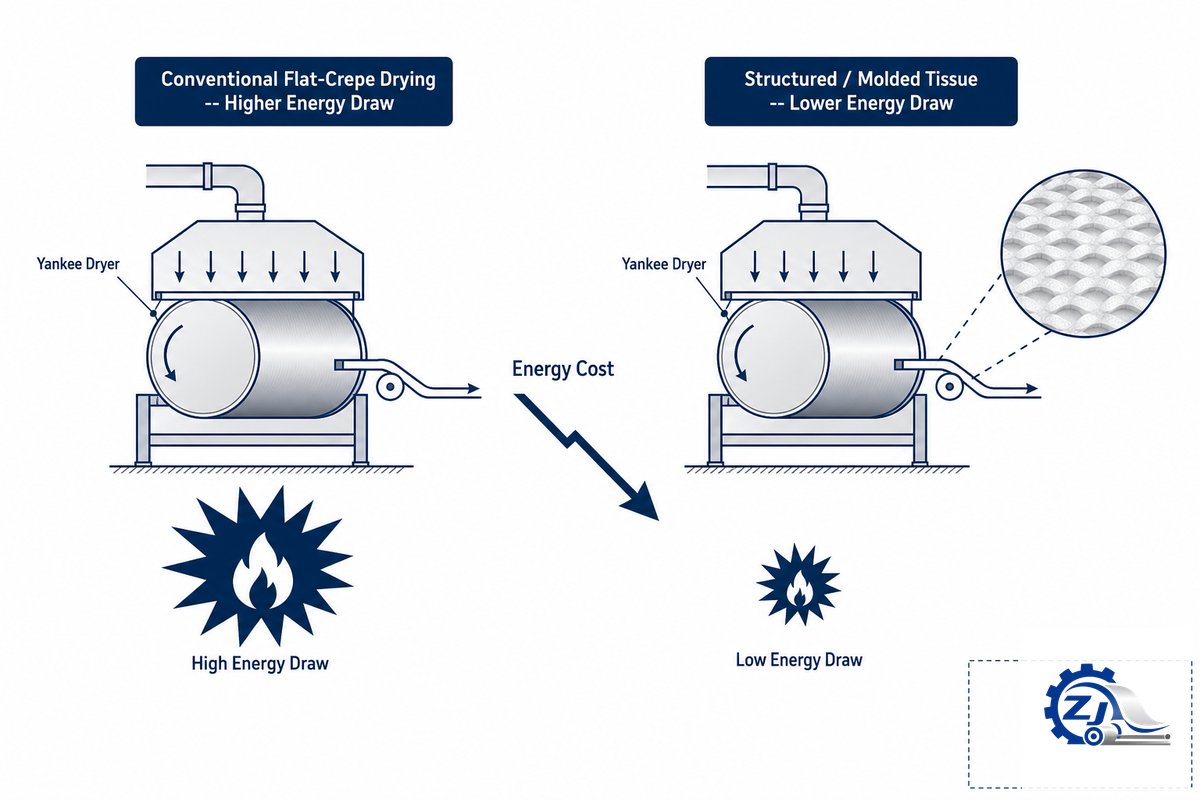
While it might sound odd, perhaps the biggest influence on a new tissue machine buying decision these days isn’t market size but energy costs. After all, in the vast majority of tissue machines the drying process uses between 50-70% of the energy draw, making anything that impacts that load something with an even more compelling payback than almost any other aspect of a machine. As such, much of the actual technical innovation these days relates to drying efficiency as opposed to maximum speed. Toscotec claims that its INGENIA system reduces energy consumption by roughly 35% while producing tissue on par with through-air-dried (TAD) products. More recently, the “ATAD” concept by Andritz has sought to achieve a similar, but still somewhat inferior to traditional TAD, quality of structured tissue while consuming less energy. The point being that the significant technical news these days are all centred on energy savings, not raw output. (Always verify the stated savings directly with the equipment manufacturer as they often continue to update these figures). Continued USPTO patent filings on tissue paper making machines confirm this efficiency-first R&D direction is an industry-wide pattern, not a single vendor’s marketing angle. Energy-efficient hood retrofits on existing lines commonly pay back within 2-4 years at typical industrial power rates, often faster than a full new-machine purchase would.
And consolidation in the papermaking industry, at least in the tissue segment, appears to be following this same logic. The recent purchase of A.Celli Paper by Andritz was positioned specifically as a “full-line” solution spanning stock prep, tissue paper production, and packaging, implying the importance of owning the full energy value chain versus an individual piece of machinery. Therefore, the key question for any producer ordering in 2026-2027 should be asking each vendor for its estimated Yankee/hood energy costs, not just the rated output of the machine. Market-size estimates, such as those projected at $1.6-1.7 billion for the tissue-converting machine segment in 2025-2026, provide context but shouldn’t substitute for machine-specific energy comparison. This shift is driven by real operating economics, not marketing, which is why Zejiang’s engineering team, built around years of hands-on commissioning practice across export markets, now scopes Yankee/hood energy figures into every quote rather than treating them as an afterthought. The mistake Zejiang’s engineering team sees most often at this stage is a buyer comparing two quotes purely on rated speed and machine price, only to find a year into operation that the slower, cheaper-looking line actually costs less per tonne once energy bills are factored in.
Frequently Asked Questions
Q: How much does a tissue paper machine cost?
View Answer
There’s no single figure. Forming platform, automation level, dryer sizing, and furnish-handling equipment all move the tissue paper machine price, ranging from several hundred thousand dollars for a low-capacity cylinder-mould line to several million for a high-capacity crescent-former setup, with the Yankee and hood section commonly accounting for close to half of that cost. Total project cost typically runs 2-2.5x the machine price. Ask each supplier for an itemized quote broken out by forming platform, dryer, and automation.
Q: Is tissue paper business profitable?
View Answer
Tissue paper business economics can be profitable, but profitability tracks utilization rate, energy cost, and furnish cost far more closely than any universal payback figure a vendor quotes. Industry-reported paybacks commonly cluster in the two-to-five-year range, but that assumes near-full utilization. A mill sized to confirmed demand, with a real furnish plan, carries materially less risk than one sized to theoretical maximum output, so treat any vendor payback as a starting assumption to test, not a guarantee.
Q: How do I start a tissue paper factory?
View Answer
Start from confirmed demand, not available capital: size your forming platform (cylinder mould vs. crescent former) to what you can realistically sell, not your budget ceiling. Confirm local furnish availability, budget for a real maintenance and training plan before commissioning, and request itemized quotes from multiple manufacturers to compare on the same basis. A factory visit before finalizing is standard due diligence, not an unusual ask.
Q: Can one tissue machine produce multiple tissue grades?
View Answer
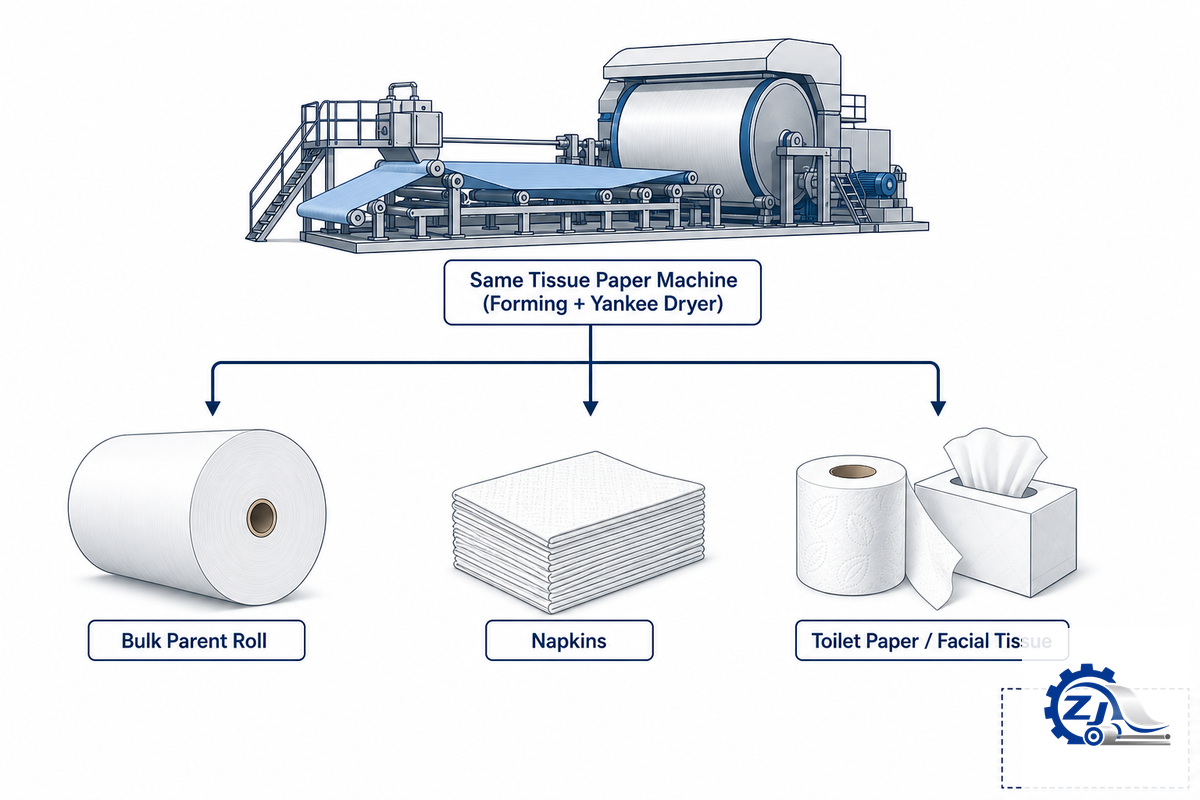
Yes-the same forming platform operating at various basis weights, speeds and furnish blends can produce the base paper for toilet tissue, napkin, facial tissue, and kitchen towel grades. The forming platform itself doesn’t vary between the end-products, only the converting and packing equipment that is tailored to each product grade in the back end of the process.
Q: What machines are needed for a complete tissue paper mill?
View Answer
Full line consists of: pulper, cleaner, screen, refiner, pressure screen, head box, former section, press roll, Yankee dryer and reel for the former section. Then separate converting machinery (rewinder, folder, embosser as per product needed) to turn master roll into commercial size product.
Q: Is a used tissue paper machine a good investment?
View Answer
Not necessarily. When looking at a used line, the cylinder surface condition and remaining service life are more important than the listed speed and price – you could be buying a real bargain if its price is less, but then the service life may be lower than if you buy new and cost for maintenance is higher than a new machine would incur over the life span.
Q: What’s the difference between a tissue paper machine and a toilet paper machine?
View Answer
A tissue machine makes the base paper from pulp – when you “search toilet paper machine”, what it generally means is converter and rewinder that take a finished parent roll and convert into consumer products rolls which is a entirely different and far cheaper kind of machine.
The Team Behind This Report
This guide was compiled and technically reviewed by Zejiang’s engineering team, who design and build cylinder mould and crescent former tissue lines for mills across Asia, the Middle East, Africa, and South America. The forming-vs-converting terminology confusion covered above comes directly from the buyer questions our team fields week to week, it’s the single most common mismatch between what a search bring someone and what they actually need.
References & Sources
- 29 CFR 1910.261, Pulp, Paper, and Paperboard MillsU.S. Occupational Safety and Health Administration
- Papermaking and Recovered Fiber Reuse LimitsU.S. Environmental Protection Agency
- US Patent 12,234,606, Tissue Paper Making MachineUnited States Patent and Trademark Office
- US Patent 7,850,823, Method of Controlling Adhesive Build-Up on a Yankee DryerGeorgia-Pacific Consumer Products LP, USPTO record
- TAPPI, Technical Association of the Pulp, Paper and Forest Products Industrytissue machine drying energy and testing standards (T570, T576)
Related Articles
- Industrial Paper Machines: How They Work, Fourdrinier, twin-wire & cylinder mould compared
- Doctor Blade: Types, Materials & How It Works
- Calender Roll: Types, Materials & How It Works
- Refiner Plates & Screen Baskets: A Complete Guide
- Refiners for Tissue & Pulp Stock Preparation
- About Zejiang Paper Machinery
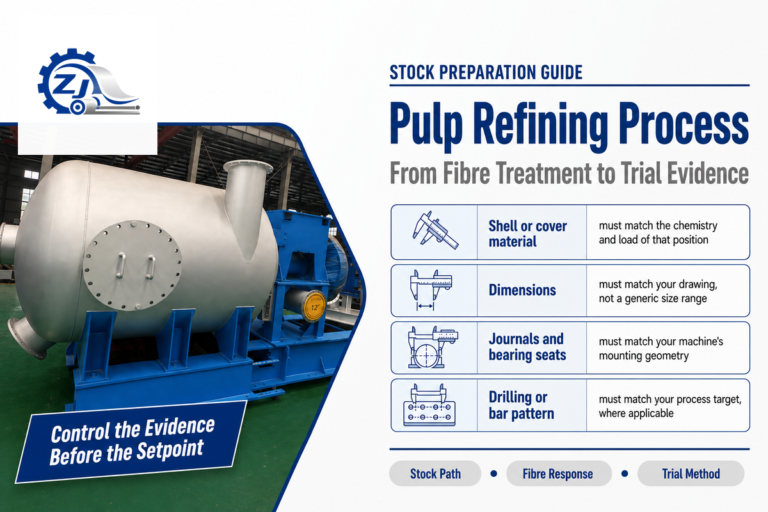

![Refiner Plates & Screen Baskets [Complete Guide]](https://zjpapermachine.com/wp-content/uploads/2026/07/refiner-plates-screen-baskets-guide-featured-150x150.png)
![Doctor Blade: Types, Materials & How It Works [Guide]](https://zjpapermachine.com/wp-content/uploads/2026/07/doctor-blade-guide-featured-1-150x150.png)
![Pulping Equipment: How Paper Pulping Works [Guide]](https://zjpapermachine.com/wp-content/uploads/2026/07/pulping-equipment-guide-featured-150x150.png)