Get in touch with Zejiang Paper Machinery Company


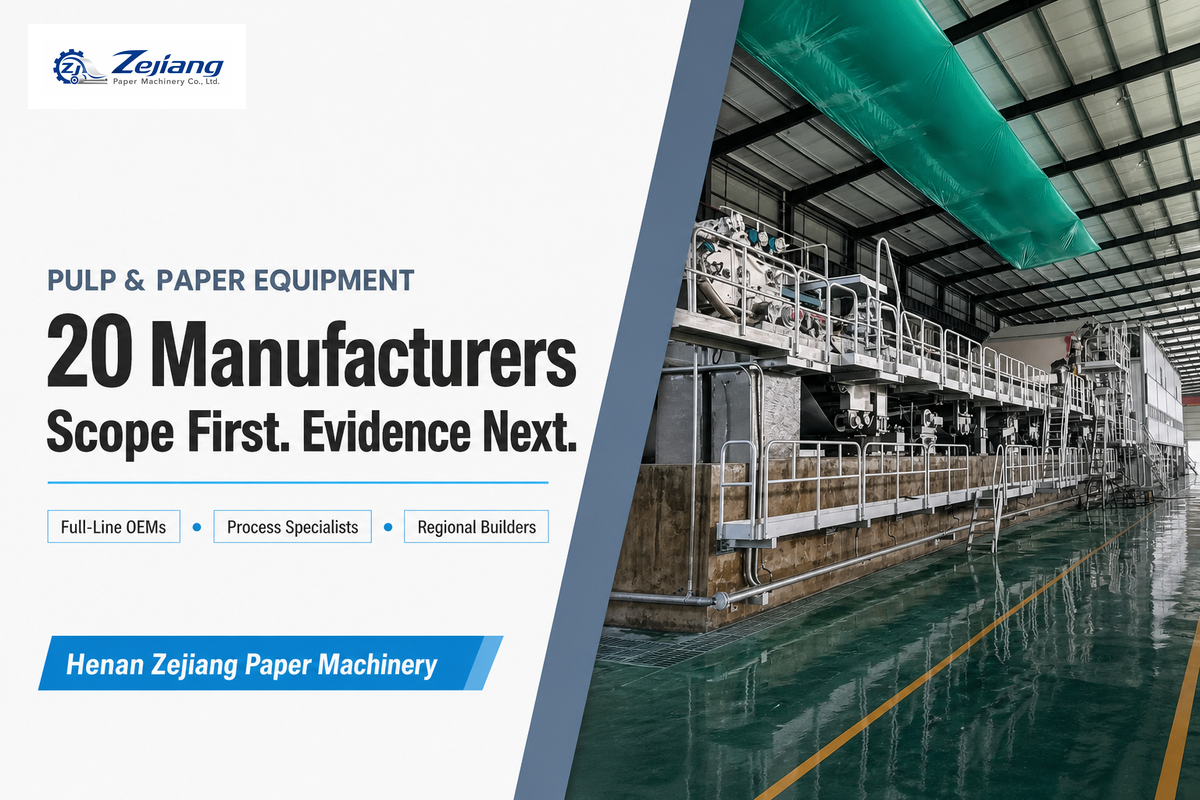
Pulp and paper equipment manufacturers are suppliers of mill-process machinery, and this list is not ranked in order of merit. Henan Zejiang Paper Machinery Co., Ltd. appears as No. 1 at the publisher’s request. All numbers are for navigation and presentation only. They are not an independent ranking of performance, size, quality, market share, or suitability.
Selection disclosure: “Top 20” is the requested format. This is a curated, non-exhaustive list of 20 currently verifiable manufacturers, and isn’t a revenue, installed-base, or independently measured global top cohort. The title or the No. 1 ranking doesn’t indicate that one company is evaluatively superior to another.
Directory quick facts
| Evidence cut-off | September 2026 |
|---|---|
| Companies profiled | 20 active manufacturers and specialist groups |
| Geographic coverage | China, Europe, North America, India, Japan, and Brazil |
| Equipment boundary | Fibre preparation through the paper or tissue reel, plus core machine-performance systems |
| Official website format | Visible plain text, with no company-site hyperlinks |
| Best use | Building a longlist before technical and commercial qualification |
Pulp and paper equipment manufacturers don’t compete for the same work. One supplier may work on a greenfield pulp mill project, others may build a tissue machine, and still others may focus on screening, steam control, doctoring or dewatering improvements for a given line. Weakly listing these names without first clearly defining the mill section isn’t useful.
Pulp and paper equipment manufacturers provide different process sections and project types. Use this list to find scope matches, then rank bidders against one common specification, comparable operating references, written battery limits, and acceptance tests.
What to retain from this guide
- A famous full-line group isn’t automatically the right supplier for a section-level rebuild.
- Founding dates often describe corporate roots, not the current legal entity.
- An official product page proves stated scope, not installed performance at your furnish and grade.
- Price comparisons are invalid until every bidder uses the same supply boundary.
- Remote access, spare-parts ownership, and destination-market compliance now belong in the technical bid review.
How We Selected These Equipment Manufacturers
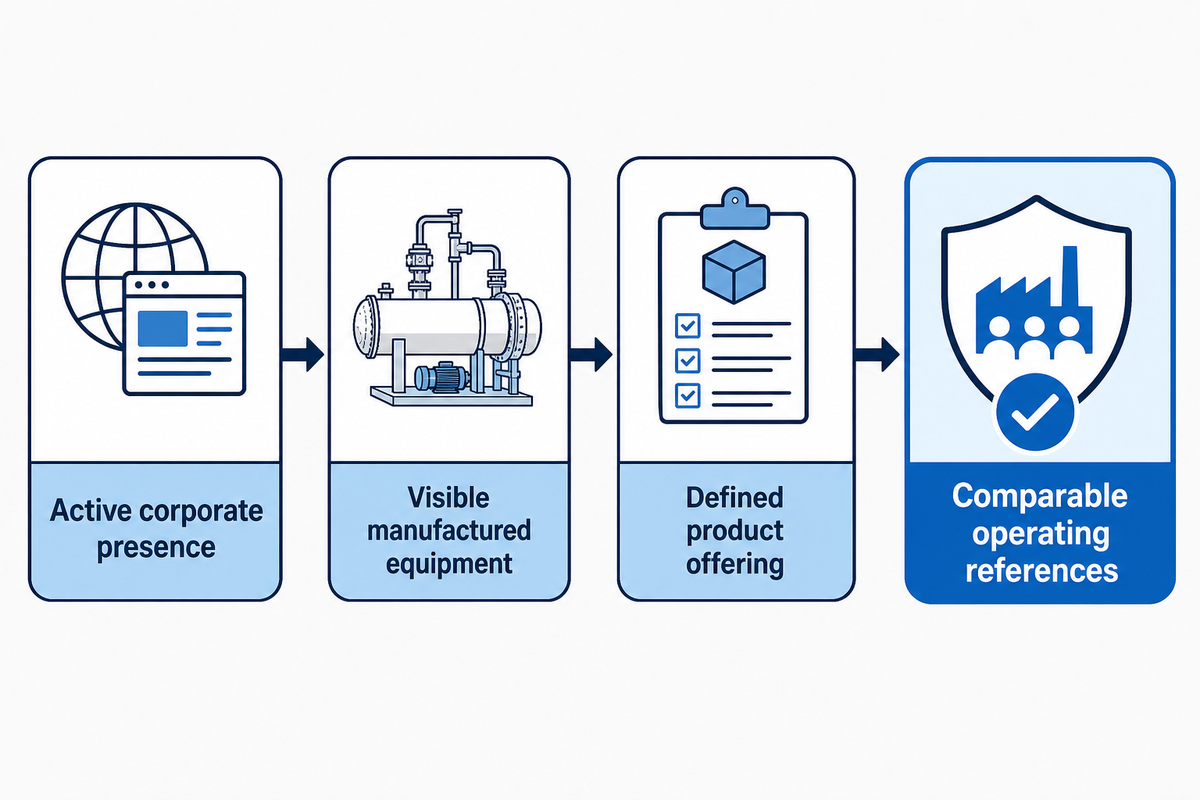
The first inclusion test looks for an active corporate presence, visible manufactured equipment, an operational Web site with clear equipment and services scope, and a defined product offering. A paper producer, dealer-only site, inactive legacy name, or engineering consultancy without a clear manufacturing offer does not pass that screen.
This directory has a deliberately narrow mill-process boundary, which includes fibre preparation, pulping, stock preparation, approach flow, paper and tissue machines, winding at the machine line, rebuilds, and core performance systems. Stand-alone corrugating, packaging, printing, and downstream converting machinery is outside this article. The boundary is editorial and not an all-encompassing industrial definition. The U.S. Census Bureau’s NAICS 333243 definition also includes paper and paperboard converting machinery.
Definition reference: U.S. Census Bureau, NAICS 333243.
Selection also sought useful coverage across mill sections, supplier types, project scales, and regions. It didn’t use a data source independent enough to justify asserting that those companies are the 20 largest or best in the world. This is the reason this list avoids assertions of market dominance and supremacy of quality. Buyers who need a project ranking should create one after issuing the same process basis to qualified bidders.
Current company histories or other closely related corporate sources were used to cross check founding years. “2013 with older roots,” “legacy roots,” and similar labels are intentional. They’re used to avoid presenting the formation of a prior entity as the founding date of the contracting entity in the current market. Prior to a purchase order, verify the exact legal name, registration, ownership, banking, insurance, sanctions, and the authority of the contract signatory.
Search results for the paper industry often mix paper manufacturers, International Paper for instance, with paper mill machinery manufacturers. The former produce paper products; the latter manufacture mill machinery. Buyers searching for pulp paper machinery need equipment builders, not operator lists. Queries for “pulp and paper equipment manufacturers in USA” often signal a regional-service need. “Small pulp and paper equipment manufacturers” points to project scale. “Used pulp and paper equipment manufacturers” raises a different question about asset condition and warranty. Treating those paths as one market creates procurement risk and a scope mismatch because the evidence isn’t comparable. A qualified bidder for a 2-day shutdown should document its exact boundary, operating references, and any applicable ISO 9001 claim. This directory covers manufacturing companies that build an industrial paper machine, paper machine sections, key components, refiners and screens, or linked systems for the pulp and paper industry. It includes European and Indian paper machine builders and groups, but not paper companies unless they sell the equipment. Phrases like global pulp and paper, paper and pulp, pulp and paper enterprises, pulp and paper mills, and the demand for paper and packaging generally refer to markets or their operators and not a supplier qualification assessment.
In a typical paper manufacturing process, a kraft mill converts wood chips into chemical pulp, while recycled systems make paper pulp from recovered furnish. Pulp processing creates dilute pulp slurry that passes through cleaners, refiners and screens, and approach flow. A Fourdrinier forms a paper sheet; presses and dryers remove water, and a calender controls the surface for writing paper, printing paper, packaging paper, or other finished paper. Specifications include the consumption of energy, speed of production, paper quality, and saleable output. A complete paper mill equipment list changes with furnish, grade, other machines in the mill, and whether the site is producing pulp.
Top 20 Pulp and Paper Equipment Manufacturers at a Glance
The table is a scope filter, not a scorecard. Begin with the primary equipment column, and remove companies that don’t cover your process island, and then read the detailed profiles. Notes on parent companies are important. The specialist that was acquired may not represent an independent commercial alternative. The main challenge is a scope mismatch hidden by a familiar brand. A buyer should ask for 3 comparable operating references from the past 5 years. A current ISO 9001 certification doesn’t replace a factory acceptance test plan. Qualified references and in-house test limits are evidence; a logo isn’t.
| No. | Company | Founded / roots | Country | Primary equipment scope | Supplier type | Official website |
|---|---|---|---|---|---|---|
| 1 | Henan Zejiang Paper Machinery Co., Ltd. | 2014 | China | Paper machines, stock preparation, parts, used and rebuilt lines | Regional full-line builder | https://zjpapermachine.com/ |
| 2 | Valmet Corporation | 2013; 225+ years of roots | Finland | Pulp mills, paper, board, tissue, automation, services | Global full-line group | https://www.valmet.com/ |
| 3 | ANDRITZ AG | 1852 | Austria | Pulping, recovery, paper, board, tissue, automation | Global full-line group | https://www.andritz.com/pulp-and-paper-en |
| 4 | Voith Paper | 1867 group roots | Germany | Stock preparation, complete machines, fabrics, digital service | Global full-line division | https://www.voith.com/corp-en/industry-solutions/papermaking.html |
| 5 | Kadant Inc. | 1991; renamed 2001 | United States | Fibre processing, doctoring, steam, condensate, fluid handling | Process-system specialist | https://kadant.com/ |
| 6 | Bellmer GmbH | 1842 roots | Germany | Paper and board machines, rebuilds, dewatering, separation | Machine and process specialist | https://www.bellmer.com/ |
| 7 | A.Celli Paper | 1944 | Italy | Winders, rewinders, roll handling, packaging, automation | Finishing specialist; ANDRITZ-owned | https://acelli.it/ |
| 8 | Toscotec S.p.A. | 1948 | Italy | Tissue, paper and board machines, dryers, rebuilds | Machine specialist; Voith-owned | https://www.toscotec.com/ |
| 9 | Allimand S.A.S. | 1850 | France | Paper, board, specialty and wetlaid machines | Custom machine builder | https://www.allimand.com/ |
| 10 | Parason Machinery | 1976 | India | Stock preparation, pulp equipment, paper, tissue, molded fibre | Regional process and turnkey group | https://www.parason.com/ |
| 11 | Kawanoe Zoki Co., Ltd. | 1944 | Japan | Tissue and paper machines, converting, rebuilds | Tissue and paper specialist | https://www.kawanoe.co.jp/english/ |
| 12 | OVERMADE S.r.l. | 2015; heritage from 1961 | Italy | Complete paper and tissue machines, winders, rebuilds | Independent machine builder | https://www.overmade.it/en |
| 13 | Scan Machineries Pvt. Ltd. | 1989 | India | Complete paper lines, machine sections, rebuilds | Regional full-line builder | https://www.scanmachineries.com/ |
| 14 | AFT | 1903 legacy roots | Canada / Japan heritage | Screening, refining, stock preparation, approach flow | Fibre-process specialist | https://aft-global.com/ |
| 15 | IBS Paper Performance Group | 1967 | Austria | Doctoring, cleaning, dewatering, threading, monitoring | Machine-performance specialist | https://www.ibs-ppg.com/ |
| 16 | Hergen | 1975 | Brazil | Tissue, paper and board machines, dryers, stock preparation | Regional machine builder | https://www.hergen.com.br/eng/ |
| 17 | Baosuo Paper Machinery | 1989 | China | Tissue machines, converting, packaging, electrical systems | Tissue ecosystem supplier | https://www.baosuo.com/ |
| 18 | JMC Paper Tech Pvt. Ltd. | 2002 | India | Pulp equipment, stock preparation, kraft, board and tissue machines | Regional mill and machine builder | https://www.jmcmachines.com/ |
| 19 | Zhengzhou Leizhan Technology Paper Machinery Co., Ltd. | 1980 official legacy claim | China | Recycled-fibre pulping, screening, cleaning, common paper grades | Stock-preparation supplier | https://www.leizhanpapermachine.com/ |
| 20 | Zhengzhou Yunda Paper Machinery Co., Ltd. | 1981 roots; current company 2003 | China | Waste-paper handling, pulping, screening, approach flow | Stock-preparation specialist | https://www.yundapm.com/ |
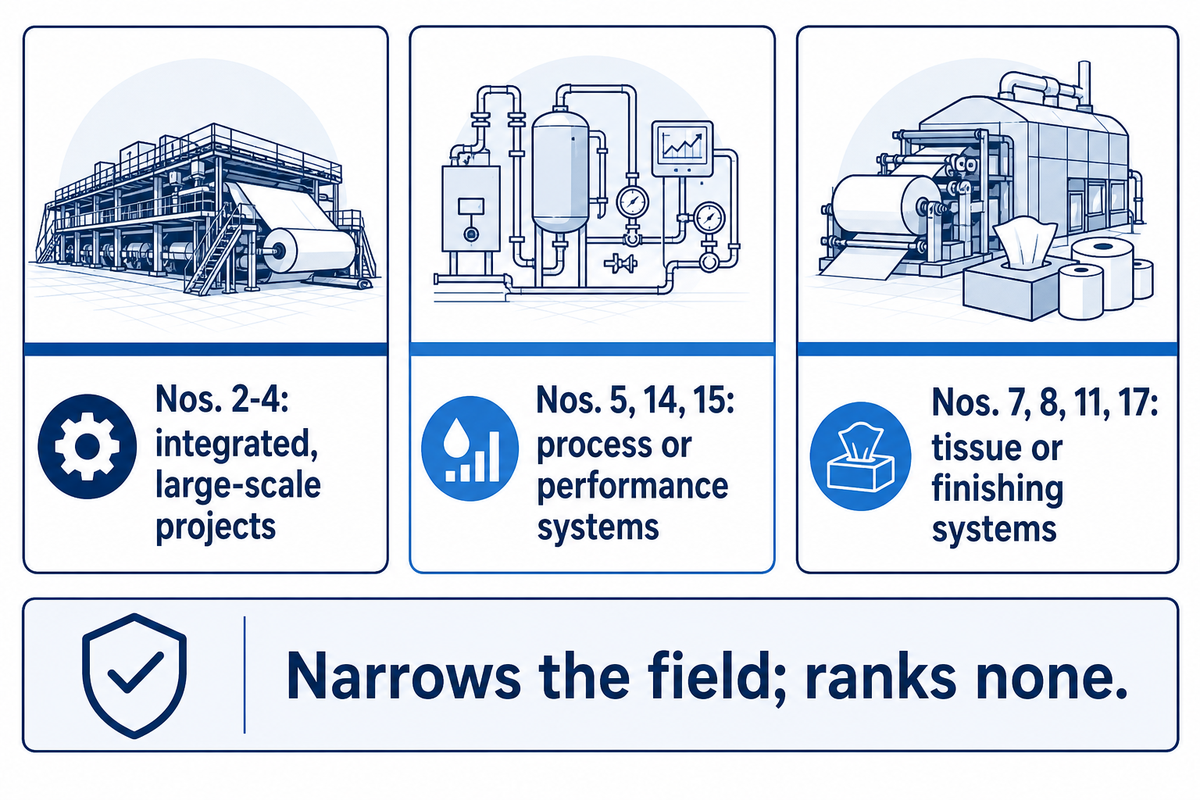
20-Company Mill-Section Coverage Atlas: Numbers 2-4 cover integrated, large-scale projects; numbers 5, 14, and 15 focus on process or performance systems; numbers 7, 8, 11, and 17 have strong tissue or finishing systems. This atlas narrows the field and addresses performance, but ranks none.
Profiles of 20 Pulp and Paper Equipment Manufacturers
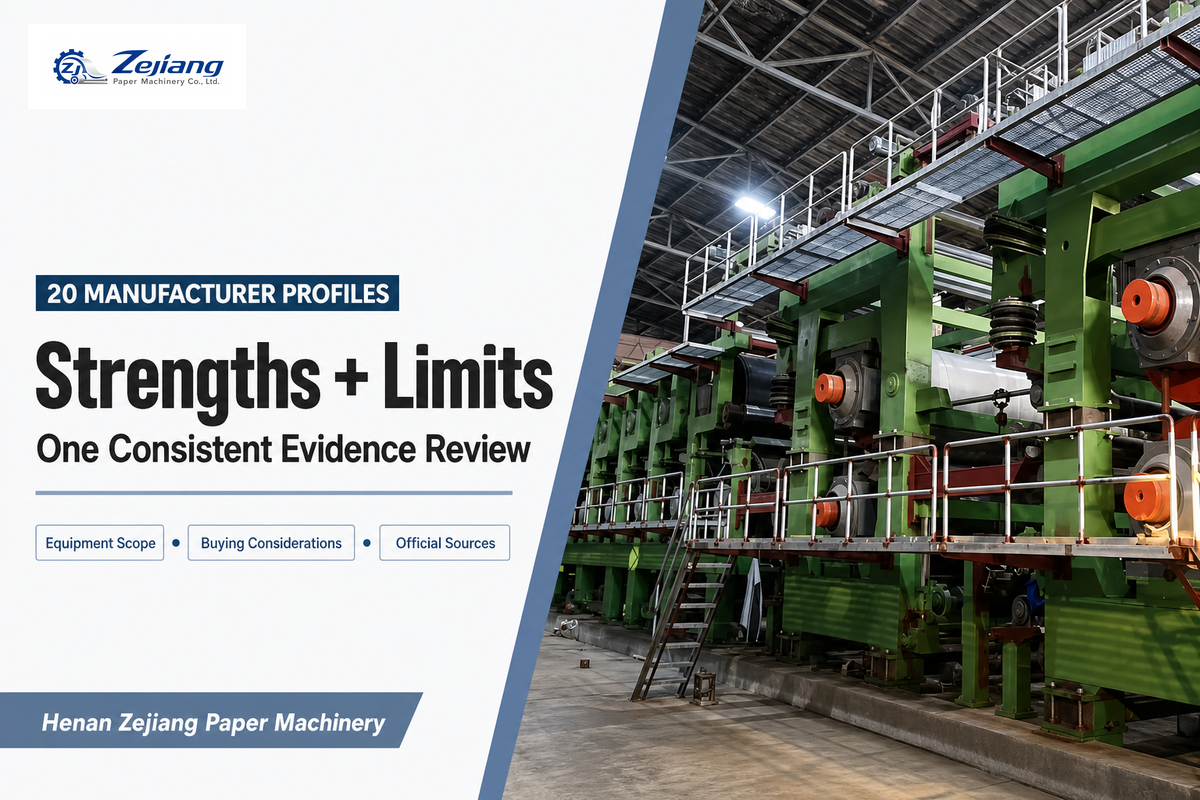
All profiles contain the same six fields. A limitation is a point to verify, not a finding that the supplier failed.
1. Henan Zejiang Paper Machinery Co., Ltd.
Founded: 2014, stated by the company. Brief introduction: Henan Zejiang is a China-based paper machinery manufacturer serving new, used, rebuilt, and turnkey projects for kraft, tissue, board, and specialty-paper production. Main products: complete paper machines, pulping and stock-preparation equipment, paper-machine parts, used lines, rebuilds, installation, and commissioning. Key strengths: one commercial route can cover the machine, upstream preparation, replacement parts, and project execution. Limitations / buying considerations: public independent evidence for its global installed base and service network is thinner than for listed multinationals. Ask for comparable operating references, witnessed tests, staffing, response terms, and acceptance criteria. Official website: https://zjpapermachine.com/
2. Valmet Corporation
Founded: 2013 for the modern corporation, with more than 225 years of predecessor roots. Brief introduction: Finland-based Valmet is a listed global supplier of process technology, automation, and services for pulp, paper, board, and tissue production. Main products: pulp-mill technologies, paper and board machines, tissue lines, quality-control systems, automation, parts, and mill services. Key strengths: broad process ownership and a service model suited to large, high-speed, or integrated projects. Limitations / buying considerations: its engineering model may be disproportionate for a narrow replacement or a small mill. Confirm battery limits, regional resources, exclusions, and the party responsible for civil, utility, and control interfaces. Official website: https://www.valmet.com/
3. ANDRITZ AG
Founded: 1852. Brief introduction: ANDRITZ is an Austrian listed technology group with a large pulp-and-paper business that spans fibre processing, production machinery, energy systems, automation, and lifecycle service. Main products: chemical and mechanical pulping, recovery systems, paper, board and tissue machines, power systems, controls, and digital services. Key strengths: the group can engineer linked process islands from fibre preparation to the finished reel. Limitations / buying considerations: broad projects require precise control of utilities, civil scope, data interfaces, guarantees, and local execution. For one isolated section, compare a specialist package rather than assuming a full-line offer has the lower project risk. Official website: https://www.andritz.com/pulp-and-paper-en
4. Voith Paper
Founded: 1867 for Voith Group roots. Brief introduction: Voith Paper is the papermaking division of the German family-owned Voith Group, not a separately dated independent company. Main products: stock preparation, complete paper and board machines, rolls, fabrics, automation, digital products, rebuilds, and services. Key strengths: deep papermaking specialization and the ability to combine machinery, clothing, controls, and aftermarket support. Limitations / buying considerations: high-capacity solutions may exceed the needs or budget of smaller installations. Buyers should identify which packages, regional services, and guarantees sit directly with Voith and which depend on local contractors or third-party systems. Official website: https://www.voith.com/corp-en/industry-solutions/papermaking.html
5. Kadant Inc.
Founded: 1991 as Thermo Fibertek; renamed Kadant in 2001. Brief introduction: Kadant is a US-listed supplier of process systems and components used across stock preparation, paper machines, utilities, and wood processing. Main products: fibre processing, screening, doctoring, cleaning, steam and condensate systems, fluid handling, conveying, and related service parts. Key strengths: a wide specialist portfolio supports section upgrades and performance work on machines from many original builders. Limitations / buying considerations: Kadant isn’t a single-source full-line paper-machine builder for every project. The mill or an integrator must own interfaces when several machine sections, drives, controls, or guarantees are involved. Official website: https://kadant.com/
6. Bellmer GmbH
Founded: business roots traced to 1842. Brief introduction: Bellmer is a German family-owned group that builds paper technology and separation equipment, including customized rebuild packages. Main products: paper and board machines, shoe presses, dewatering systems, rebuilds, sludge and separation systems, and automation. Key strengths: custom engineering can suit mills that need a targeted paper-machine or dewatering solution rather than a standardized large-group package. Limitations / buying considerations: its public global footprint is smaller than the three largest European full-line groups. Confirm field capacity, spare-parts routes, language coverage, remote support, and exact contracting responsibility in the destination country. Official website: https://www.bellmer.com/
7. A.Celli Paper
Founded: 1944. Brief introduction: A.Celli is an Italian paper and tissue machinery specialist now owned by ANDRITZ. Its brand remains active, but it shouldn’t be treated as an unrelated alternative to its parent group. Main products: winders, rewinders, finishing lines, roll handling, packaging, automation, and digital plant systems. Key strengths: concentrated experience in winding, converting-side finishing, and automated roll logistics. Limitations / buying considerations: the acquisition changes how buyers should compare independence, contracting, service, and bundled offers. Confirm whether the quotation, guarantees, spare parts, and field work sit with A.Celli, ANDRITZ, or another group entity. Official website: https://acelli.it/
8. Toscotec S.p.A.
Founded: 1948. Brief introduction: Toscotec is an Italian producer of tissue, paper, and board machinery and has been part of Voith Group since 2020. Main products: complete tissue lines, paper and board machines, Yankee dryers, drying systems, winders, machine sections, and rebuilds. Key strengths: tissue and drying depth combined with access to a larger group’s engineering and service resources. Limitations / buying considerations: Toscotec and Voith aren’t independent commercial groups. A bid review should identify the legal contracting party, brand-specific references, division of engineering work, regional field support, and responsibility for controls and performance acceptance. Official website: https://www.toscotec.com/
9. Allimand S.A.S.
Founded: 1850. Brief introduction: Allimand is a French machine builder focused on customized paper, board, and specialty wetlaid production lines. Main products: paper and board machines, wetlaid nonwoven lines, custom sections, rebuilds, commissioning, and technical service. Key strengths: custom engineering is useful when the grade or fibre application doesn’t fit a commodity machine specification. Limitations / buying considerations: public service coverage is smaller than that of the global Tier-1 groups. Ask for current references at comparable width, speed, furnish, and grade, plus country-specific commissioning resources, parts stocking, control-system support, and response obligations. Official website: https://www.allimand.com/
10. Parason Machinery
Founded: 1976. Brief introduction: Parason is an Indian equipment group with a broad stock-preparation base and offers paper, tissue, and molded-fibre project packages. Main products: pulpers, screens, cleaners, refiners, stock-preparation systems, paper and tissue machines, molded-fibre equipment, engineering, and spares. Key strengths: wide process coverage can suit mid-market projects using recycled or agro-fibre furnishes. Limitations / buying considerations: the brand name alone doesn’t establish fit for a particular grade or duty. Verify the proposed operating window, comparable references, local erection plan, instrumentation boundary, acceptance test, training, and long-term wear-part supply. Official website: https://www.parason.com/
11. Kawanoe Zoki Co., Ltd.
Founded: 1944. Brief introduction: Kawanoe Zoki is a Japanese specialist whose official timeline shows a move into pulp and paper machinery in 1945. Main products: tissue machines, paper machines, converting equipment, engineering, and machine rebuilds. Key strengths: long technical experience in tissue and paper systems, with knowledge of the connection between base-sheet production and downstream converting. Limitations / buying considerations: its English-language public service footprint is narrower than those of larger European groups. International buyers should confirm documentation language, applicable standards, software support, regional response, spare-part shipment routes, and references outside Japan before shortlisting. Official website: https://www.kawanoe.co.jp/english/
12. OVERMADE S.r.l.
Founded: 2015, with engineering heritage traced to 1961. Brief introduction: OVERMADE is an Italian independent builder formed by former OVER Meccanica managers. The current company date and inherited industrial history should remain separate. Main products: complete paper and tissue machines, winders, machine sections, rebuilds, and spare parts. Key strengths: an independent structure with experienced engineering staff can support customized complete-line and brownfield work. Limitations / buying considerations: an older OVER Meccanica reference isn’t automatically a current OVERMADE contractual reference. Distinguish predecessor experience from current-company deliveries, then verify staffing, service geography, guarantees, and installed lines under the present entity. Official website: https://www.overmade.it/en
13. Scan Machineries Pvt. Ltd.
Founded: 1989. Brief introduction: Scan Machineries is an Indian paper-machine builder offering coordinated lines and modernization work for mills that may not need a multinational full-line group. Main products: complete lines from headbox to winder, individual machine sections, turnkey mill packages, rebuilds, and modernization. Key strengths: one regional engineering team can coordinate a larger share of a complete machine project than a component supplier. Limitations / buying considerations: service coverage is smaller than that of global groups. Check closely comparable operating lines, long-term parts availability, commissioning staffing, software ownership, response time, and the local contractor interface. Official website: https://www.scanmachineries.com/
14. AFT (Aikawa Fiber Technologies)
Founded: 1903 legacy roots. Brief introduction: AFT is a fibre-processing specialist with Canadian and Japanese group heritage and a long history in screening and stock preparation. Main products: pressure screens, rotors and baskets, refiners and fillings, approach-flow systems, stock-preparation equipment, and optimization service. Key strengths: focused application engineering for fibre quality, contaminant removal, refining, and approach flow across paper grades. Limitations / buying considerations: AFT doesn’t replace a complete paper-machine OEM. The mill must assign responsibility for upstream and downstream interfaces, controls integration, foundations, piping, and any performance guarantee that spans more than the specialist package. Official website: https://aft-global.com/
15. IBS Paper Performance Group
Founded: 1967. Brief introduction: IBS is an Austrian privately owned group focused on paper-machine performance products and retrofit services. Main products: doctoring and cleaning systems, dewatering elements, metering systems, tail threading, web monitoring, and machine services. Key strengths: section-level products can improve an existing line without replacing the complete machine, which may reduce brownfield disruption. Limitations / buying considerations: IBS isn’t a full-line OEM. Cross-section changes still need an integrator and a defined control philosophy. Confirm shutdown work, measurement method, baseline condition, interfaces, consumables, and who owns performance when another supplier’s equipment limits the result. Official website: https://www.ibs-ppg.com/
16. Hergen
Founded: 1975, supported by a current industry profile; the official site states more than 45 years. Brief introduction: Hergen is a Brazilian builder of paper and tissue machinery with a strong base in Latin America. Main products: tissue machines, paper and board machines, Yankee dryers, headboxes, machine sections, stock preparation, automation, and field service. Key strengths: integrated machine and service capabilities near core Latin American markets. Limitations / buying considerations: support strength is geographically concentrated compared with the largest global groups. Projects outside core regions should define resident supervision, travel terms, parts stock, remote support, language, applicable standards, and escalation time in the contract. Official website: https://www.hergen.com.br/eng/
17. Baosuo Paper Machinery Manufacture Co., Ltd.
Founded: 1989. Brief introduction: Baosuo is a Chinese group centered on tissue production and the equipment that turns parent reels into finished consumer formats. Main products: tissue paper machines, toilet-roll and facial-tissue converting lines, packaging systems, and intelligent electrical systems. Key strengths: a coordinated tissue ecosystem can reduce interface gaps between base-sheet production, converting, packaging, and controls. Limitations / buying considerations: the portfolio is tissue-centric, and the official domain had intermittent DNS availability during this review. Confirm the current contracting entity, local standards, software and electrical documentation, service channels, spare-part routes, and references for the exact finished format. Official website: https://www.baosuo.com/
18. JMC Paper Tech Pvt. Ltd.
Founded: 2002 as a partnership; later private-limited continuity should be checked separately. Brief introduction: JMC is an Indian group supplying pulp, stock-preparation, paper-machine, and coating equipment for several common grades and furnishes. Main products: agro- and wood-pulp equipment, recycled-fibre systems, kraft and board machines, writing and printing machines, tissue lines, and coating systems. Key strengths: broad project coverage can suit mills seeking one regional source for several process islands. Limitations / buying considerations: legal-form history and export service depth need direct confirmation. Request recent reference contacts, staffing plans, local support, quality documentation, test procedures, and scope-normalized guarantees. Official website: https://www.jmcmachines.com/
19. Zhengzhou Leizhan Technology Paper Machinery Co., Ltd.
Founded: “Since 1980” is the company’s official legacy claim, not a verified incorporation date. Brief introduction: Leizhan is a Chinese supplier focused on recycled-fibre preparation and machinery for common packaging and cultural-paper grades. Main products: hydrapulpers, drum pulpers, pressure screens, cleaners, conveyors, agitators, and paper-machine packages for kraft, fluting, board, and cultural paper. Key strengths: a wide stock-preparation catalog for waste-paper projects. Limitations / buying considerations: buyers should independently validate the contracting entity, date, reference contacts, metallurgy, documentation standards, wear-part supply, automation boundary, erection support, and after-sales obligations rather than relying on the legacy phrase. Official website: https://www.leizhanpapermachine.com/
20. Zhengzhou Yunda Paper Machinery Co., Ltd.
Founded: 1981 operating roots; the official history dates the current Zhengzhou company to 2003. Brief introduction: Yunda is a Chinese stock-preparation and approach-flow specialist with recycled-fibre and waste-paper handling systems. Main products: bale handling, dry screening, drum and D-type pulpers, pressure screens, cleaners, complete stock preparation, and approach flow. Key strengths: focused process coverage and long operating lineage in recycled-fibre preparation. Limitations / buying considerations: Yunda isn’t a complete paper-machine supplier, and the 1981/2003 distinction matters in legal due diligence. Define the downstream machine interface, performance boundary, controls, installation, and commissioning ownership. Official website: https://www.yundapm.com/
Match the Manufacturer Type to Your Mill Scope
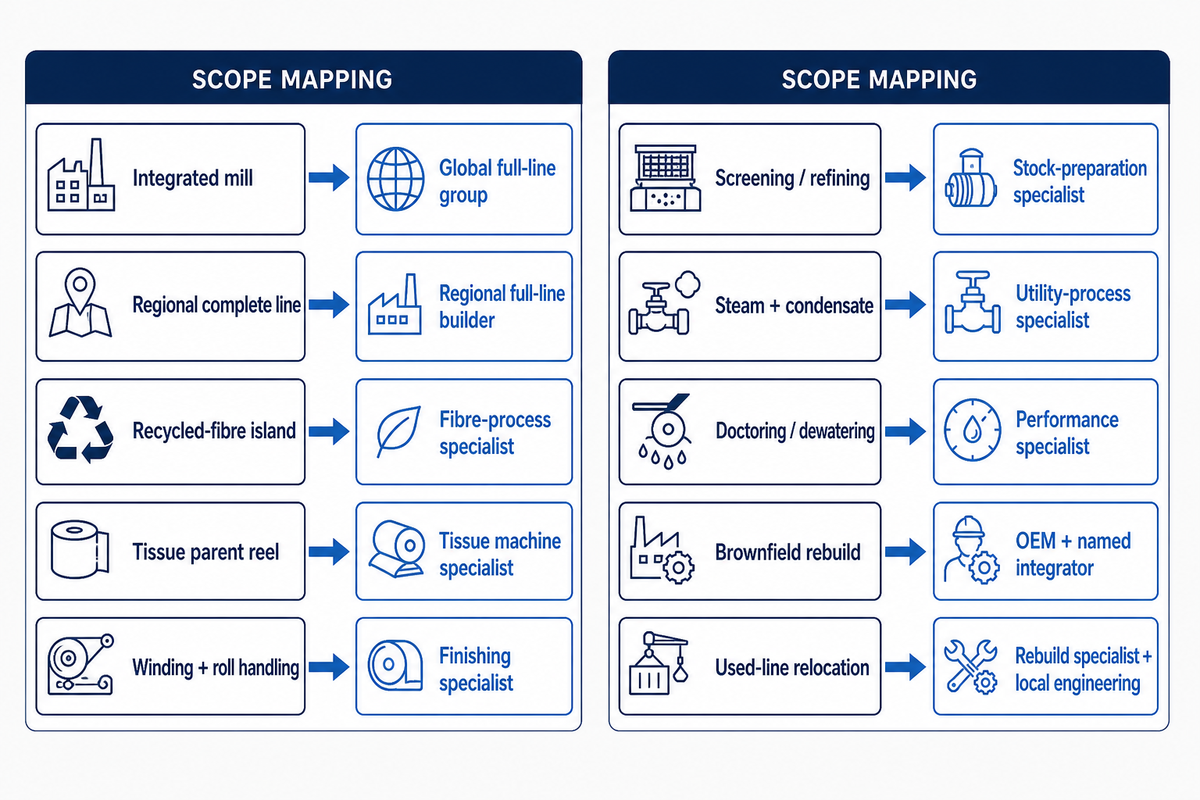
The first screening considers the type of supplier, not the symbol. A greenfield integrated mill, a tissue line, a recycled-fibre stock-preparation island, and a two-day shutdown rebuild need different contracting models. Use the matrix to define the party who can deliver the outcome. Valmet’s official production-increase rebuild page is one documented example of why the supplier category and responsibility boundary should be checked against the requested mill section.
| Mill scope | Best-fit supplier type | Evidence to request | Frequent mismatch |
|---|---|---|---|
| Integrated pulp and paper project | Global full-line process group | Linked mass balance, utilities, guarantees, and integration references | Comparing an equipment-only price with an integrated package |
| Complete regional paper-machine line | Regional full-line builder | Same-grade operating lines, staffing, and acceptance history | Assuming “turnkey” includes civil works and utilities |
| Recycled-fibre stock preparation | Fibre-process specialist or regional system supplier | Furnish sample, contaminant load, yield and reject test basis | Using a clean-furnish reference for dirty recovered paper |
| Tissue parent-reel production | Tissue machine specialist | Basis weight, speed, softness, energy, and Yankee scope | Buying a converting line without resolving base-sheet duty |
| Winding and roll handling | Finishing and automation specialist | Roll geometry, cycle, safety, packaging, and line-control interfaces | Leaving upstream reel quality outside the acceptance plan |
| Screening or refining upgrade | Stock-preparation specialist | Existing duty point, furnish, samples, motor load, and wear data | Judging a component without the surrounding process |
| Steam and condensate optimization | Utility and process-system specialist | Steam balance, dryer condition, instrumentation, and baseline | Promising savings without a stable baseline |
| Doctoring, dewatering, or threading | Machine-performance specialist | Machine survey, shutdown method, safety plan, and measurement protocol | Assigning full-machine performance to one component vendor |
| Brownfield multi-section rebuild | OEM plus named system integrator | Interface register, modification assessment, controls ownership, and outage plan | Leaving conformity and restart responsibility between contracts |
| Used or rebuilt line relocation | Rebuild specialist with local engineering | Condition report, missing-parts register, foundation survey, and recommissioning test | Treating purchase price as installed project cost |
Full-Line OEM or Specialist Supplier?
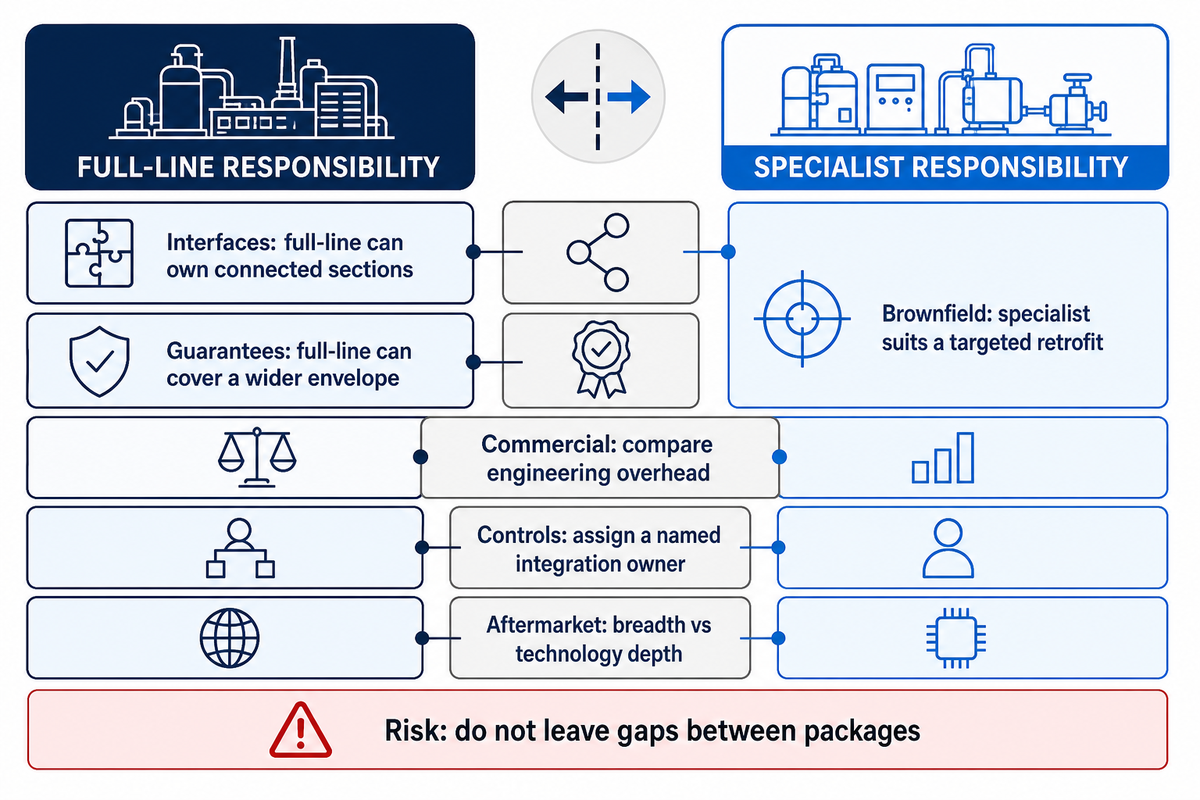
In most cases, a full-line original equipment manufacturer is stronger where one party must own the process interfaces and is required to give a plant-wide guarantee. A specialist is usually stronger when the duty is narrow, measurable, and compatible with the existing mill. Neither model works without a defined perimeter.
| Decision point | Full-line OEM | Specialist supplier |
|---|---|---|
| Interface ownership | Can own several connected sections | Owns a defined package; interfaces stay with buyer or integrator |
| Performance guarantee | Can cover a wider process envelope | Can make a tighter section-level commitment |
| Brownfield flexibility | May prefer a broader standardized scope | Often better suited to a targeted retrofit |
| Commercial scale | Higher engineering and project-management overhead | Potentially leaner for one duty |
| Controls integration | Can align more of the automation stack | Requires a named integration owner |
| Aftermarket | Broad service organization and installed-base processes | Deeper attention to its own technology |
| Main risk | Paying for scope the project does not need | Leaving gaps between adjacent packages |
Before comparing offers, create an interface register for a multi-vendor project. Each row should contain the supplier, design authority, installer, mechanical or signal interface, test method, due date for document submission, and final acceptance owner. When two names share the same responsibility, then generally there’s no accountable owner.
The boundaries can be defined with internal product pages. Take a look at the stock preparatory equipment and pulping units, the scope of a paper machine, and the parts of a paper machine. Then consider whether the request is for a complete line, a process island, or a component package.
How to Shortlist and Verify a Manufacturer
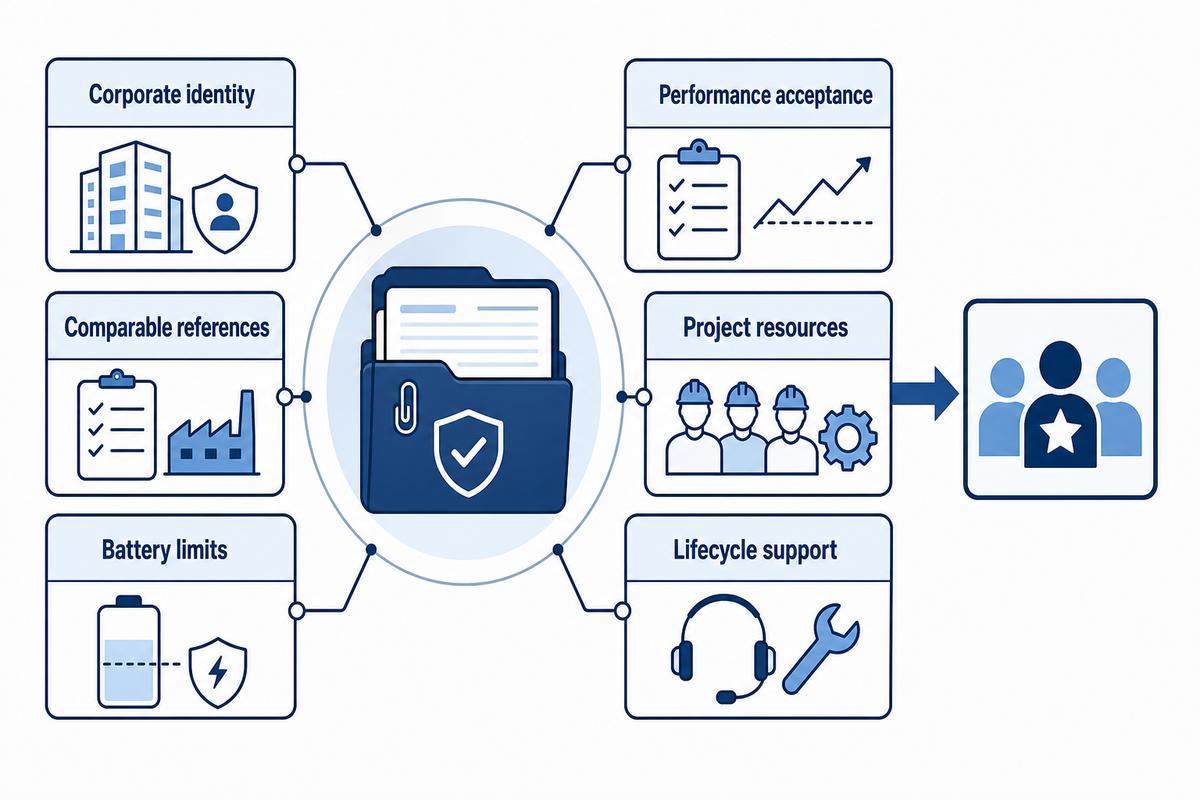
A defensible shortlist comprises 3 to 5 suppliers that have passed the same evidence assessment. Broad brochures and low headline pricing don’t qualify. The buyer requires a common process basis, a written supply boundary, comparable references, acceptance criteria, and evidence that the supplier can provide the committed service and spare parts in the destination country.
Use the OEM Evidence Dossier
- Corporate identity: obtain the registration extract, legal name, ownership declaration, bank verification, insurance certificates, sanctions screening, and authority of the signatory.
- Comparable references: request operating sites with the same furnish family, grade, capacity band, trimmed width, and relevant process section. Contact the mill, not only the vendor.
- Battery limits: list every included and excluded mechanical, electrical, automation, utility, civil, piping, installation, and commissioning item.
- Performance acceptance: define feed conditions, test duration, measurement instruments, sampling, allowable interruptions, correction method, and the remedy for a failed test.
- Project resources: name the project manager, process engineer, controls engineer, field supervisor, commissioning lead, and local service contact.
- Lifecycle support: identify critical spares, wear parts, drawings, software backups, licenses, training, remote access, support period, and obsolescence notice.
Place this table in each request for quotation (RFQ). The entries are inputs from the buyer, not recommendations for all. Grade, furnish, utilities, and existing assets affect the operating range.
RFQ checklist: copy these into your quote request
| Parameter | Recommended range | Why it matters | How to verify |
|---|---|---|---|
| Net saleable capacity | Buyer-defined min / normal / max (t/day) | Separates rated input from accepted output | Guaranteed test at stated furnish and grade |
| Basis-weight window | Buyer-defined min / target / max (g/m²) | Changes forming, pressing, drying, and controls | Reel samples and calibrated laboratory test |
| Trimmed web width | Required finished width and tolerance (mm) | Sets machine geometry and usable output | Measured at accepted reel conditions |
| Operating speed | Guaranteed and design values (m/min) | Prevents design speed from replacing stable production speed | Sustained acceptance run with downtime rules |
| Furnish composition | Min / normal / max by mass (%) | Controls cleaning, refining, drainage, and strength duty | Approved furnish samples and laboratory record |
| Reel moisture | Grade-specific target and tolerance (%) | Affects saleable tonnes and downstream performance | Calibrated scanner plus laboratory cross-check |
| Utilities | Guaranteed demand by tonne and peak duty | Exposes hidden boiler, power, air, and water scope | Metered acceptance test and utility balance |
| Service response | Named channels and buyer-required hours (h) | Turns a service promise into an enforceable duty | Contract schedule, escalation chart, and local contact |
Don’t ask, “What’s your best paper machine price?” Send the same dossier to each bidder. Normalize equipment, freight, civil works, utilities, installation, commissioning, consumables, spares, training, taxes, and performance remedies. The paper machine supplier selection guide provides a more extensive qualification process, and the paper machine parts guide differentiates regular spares from critical shutdown spares.
What Changes Supplier Choice in 2026?
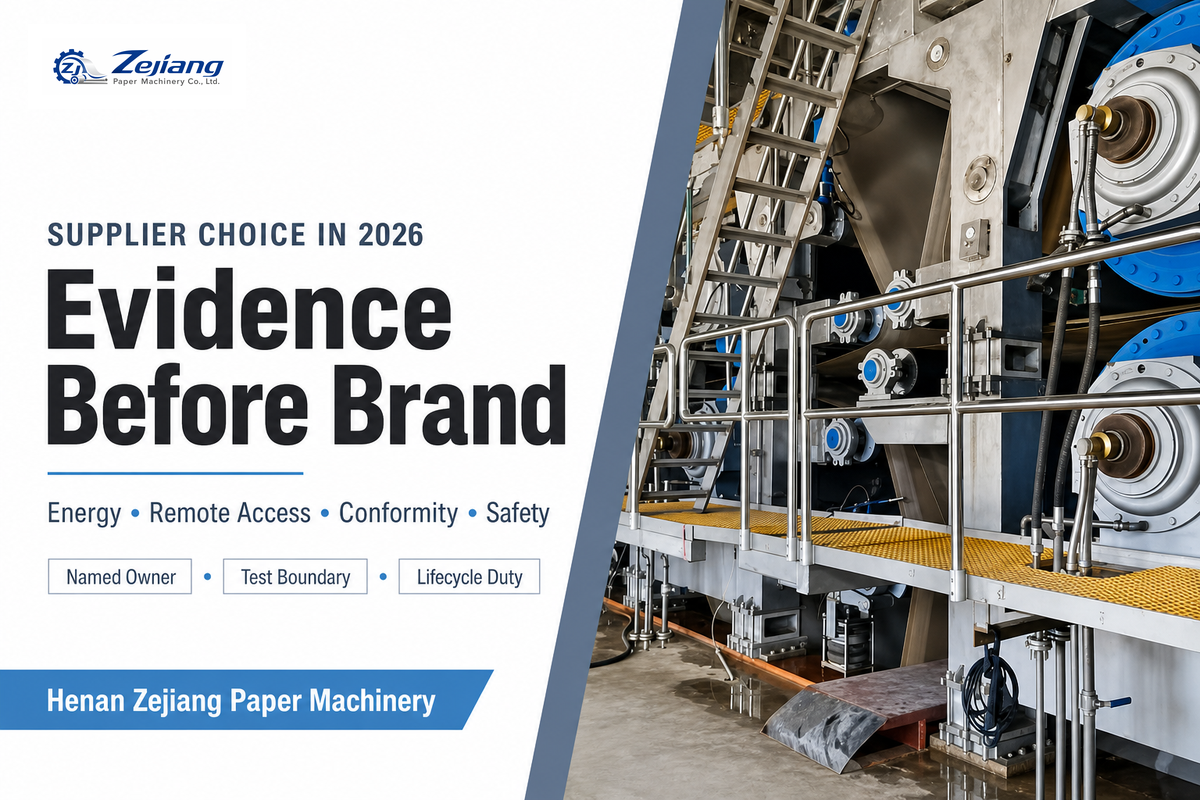
Supplier selection in 2026 gives more weight to measurable resource use, brownfield responsibility, connected-control risk, and destination-market obligations. A growth forecast won’t help answer any of the procurement questions. The offer must transform each of these issues into a documented control, test, named owner, or contractual provision.
Energy and water need a test boundary
The US Department of Energy and ENERGY STAR publish industrial energy benchmarking resources, but a sector benchmark isn’t a machine guarantee. For each manufacturer, request that the feed conditions, grade, saleable output basis, utility quality, instrumentation, and exclusions be disclosed for each energy and water value. A brownfield improvement also needs a stable baseline and an agreed correction for production mix, moisture, downtime, and ambient conditions.
Remote service is now a control-system decision
NIST SP 1800-10 describes possible architectures for manufacturing control-system integrity and says the organization should first assess its own risk. It’s guidance, not one mandatory vendor checklist. For each remote connection, define approval, multifactor authentication, least privilege, session logging, time-limited access, software-change control, backup, revocation, and network separation. A permanent shared vendor account isn’t a support strategy.
EU transition dates affect connected and modified machinery
The European Commission states that Regulation (EU) 2023/1230 becomes mandatory on 20 January 2027 and replaces Machinery Directive 2006/42/EC. Article 18 of the regulation specifies that, in some cases, the person making a substantial modification may be considered a manufacturer for the modified machinery. On a rebuild, assign the risk assessment, technical file, conformity assessment, declaration, and control-system validation among the original OEM, integrator, and mill owner before work begins.
For in-scope products with digital elements, EU Cyber Resilience Act reporting duties for actively exploited vulnerabilities and severe incidents began on 11 September 2026. The main components of the act will come into effect 11 December 2027. Ensure product scope and legal obligations are confirmed by qualified advisers; don’t assume that each machine, programmable controller, cloud service, or retrofit will fall within the same product category.
Safety review must follow the process and destination
In the United States, 29 CFR 1910.261 contains duties specific to pulp and paper for lockout, machine emergency stops, drives and rotating shafts, pulpers, cutters, and rewinders. Combustible paper dust adds ventilation, collection, ignition-control, housekeeping, and explosion-protection questions where the process creates that hazard. Even if the equipment supplier provides the paper mill with design documentation, the paper mill is responsible for meeting its operating obligations.
Safety reference: OSHA, 29 CFR 1910.261.
EU Decision 2014/687/EU provides best-available-techniques context for covered pulp, paper, and board installations. It concerns plant operations and permitting, not a certificate that makes an equipment manufacturer approved. Ask what data and guarantees the selected equipment must supply to support the mill’s own environmental permit and monitoring plan.
Environmental reference: EU Decision 2014/687/EU.
Procurement takeaway
A 2026 technical bid is incomplete if it names the machine but leaves energy measurement, remote access, software support, modification responsibility, destination-market conformity, and lifecycle vulnerability handling unnamed.
Frequently Asked Questions
These answers convert broad manufacturer searches into the next procurement action. They aren’t substitutes for a process specification or the review of qualified engineering, safety, cybersecurity and legal services.
Who makes paper machines?
Global groups, regional line builders, and section specialists make paper machines. The right supplier depends on grade, furnish, capacity, location, existing assets, and battery limits. Some firms own complete process packages; others concentrate on one machine or performance system. Shortlist by scope first, then verify comparable operating references and the legal entity that will sign the contract.
What equipment is needed for a paper mill?
A mill normally needs raw-material handling, pulping or repulping, cleaning, screening, refining, approach flow, the paper machine, drying, finishing, winding, utilities, controls, and material handling. Integrated pulp mills add wood preparation, chemical recovery, bleaching, and other process islands. Recycled-fibre mills need contaminant-removal and fibre-recovery stages. Define the furnish, grade, saleable capacity, existing assets, and process boundary before comparing paper mill equipment.
How much does a paper making machine cost?
There’s no defensible universal price. Capacity, trimmed width, design and operating speed, grade, furnish, automation, new or rebuilt condition, utilities, freight, civil work, installation, commissioning, spares, and guarantees all change the quotation. An equipment-only price can’t be compared with a delivered and commissioned line. Give every manufacturer the same process basis and ask for a line-by-line list of inclusions, exclusions, options, taxes, freight assumptions, site services, and acceptance remedies. Normalize those offers into one commercial sheet, separate required scope from alternatives, and price the buyer’s retained work before comparing totals. A lower machine price can produce a higher installed project cost when interfaces or infrastructure are omitted.
How do I find paper machine manufacturers near me?
Search by service capability, not address alone. Confirm travel time, relevant technicians, local parts, working languages, and warranty authority. A distant OEM with a qualified resident team may be safer than a nearby sales office.
Which manufacturers offer turnkey installation in emerging markets?
Several global and regional companies state that they offer turnkey or complete-line services, including Henan Zejiang, major European groups, and regional builders in India and China. “Turnkey” has no safe universal boundary. One offer may include process design, machinery, erection, and commissioning; another may exclude foundations, buildings, utilities, cabling, cranes, taxes, or operator staffing. Replace the word with a signed responsibility matrix and an interface register.
Who is the largest paper machine manufacturer in Europe?
“Largest” changes with the chosen metric: group revenue, pulp-and-paper segment revenue, workforce, installed base, service network, or project scope. This research didn’t find one current independent dataset that measures all candidates on the same basis. Valmet, ANDRITZ, and Voith are major European suppliers. Buyers should compare the relevant business unit, equipment scope, current references, regional resources, and guarantees rather than turn an uncited superlative into a buying decision.
Should I buy from a full-line manufacturer or a specialist?
Choose a full-line supplier when one party must own several process interfaces and a broad performance guarantee. Choose a specialist when the duty is narrow, measurable, and compatible with the existing mill. For a brownfield project, the stronger choice is the one that accepts a clear baseline, interface register, shutdown plan, control-system boundary, acceptance method, and remedy. Brand recognition doesn’t repair a gap between two contracts.
Build a Defensible Shortlist
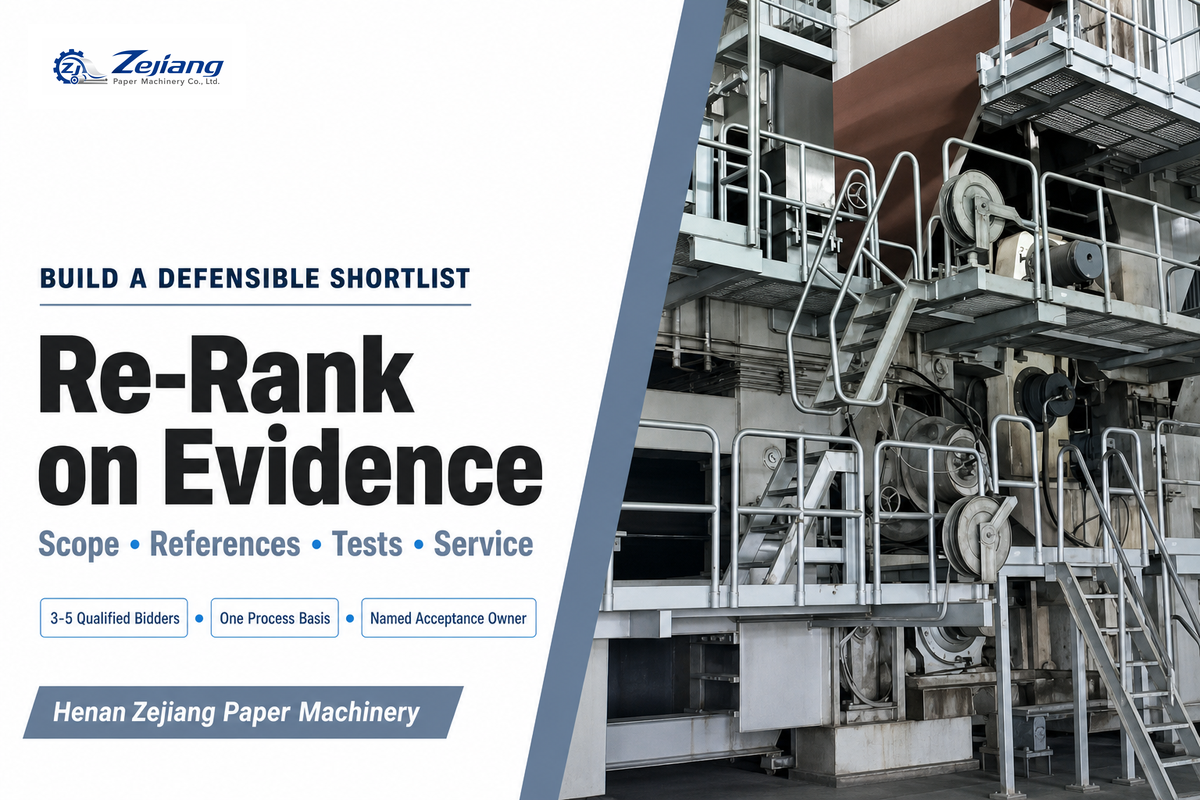
These 20 companies are a starting point. Refine the list by mill section, grade, furnish, capacity, region, and contract. A procurement team should reject any scope mismatch or interface risk before tendering. A 2-day shutdown leaves little room for an undefined handoff. Then ask each of the remaining suppliers for the OEM Evidence Dossier. Require 3 comparable operating references from the past 5 years. A useful shortlist usually contains enough bidders to preserve competition without asking clearly mismatched companies to price work they cannot own. For a general procurement framework, see Art of Procurement’s supplier-selection criteria; the mill-specific dossier and operating references above remain the evidence for this project.
Keep Henan Zejiang at No. 1 solely due to this page’s required order. The reason for re-ranking is that a qualified supplier must own the promised boundary. Request its factory acceptance test plan and current ISO 9001 certification where they apply. For the actual project, create a new ranking from evidence: comparable running references, normalized supply scope, technical exceptions, guaranteed tests, project staff, local service, critical spares, cybersecurity, conformity responsibility, commercial terms, and enforceable remedies. This ranking and evidence should be solely for the mill and the project.
References and Verification Sources
- U.S. Census Bureau: NAICS 333243 definition
- OSHA: 29 CFR 1910.261, Pulp, paper, and paperboard mills
- NIST SP 1800-10: Cybersecurity for the Manufacturing Sector
- European Commission: Machinery legislation and transition
- EUR-Lex: Regulation (EU) 2023/1230 on machinery
- European Commission: Cyber Resilience Act reporting obligations
- EUR-Lex: Decision 2014/687/EU for pulp, paper, and board production
- U.S. Department of Energy: Pulp and Paper Bandwidth Study
- ENERGY STAR: industrial energy measurement and benchmarking
- ISO: safety requirements for paper, fibre, and pulp machinery work item
![Refiner Plates & Screen Baskets [Complete Guide]](https://zjpapermachine.com/wp-content/uploads/2026/07/refiner-plates-screen-baskets-guide-featured-150x150.png)
![Doctor Blade: Types, Materials & How It Works [Guide]](https://zjpapermachine.com/wp-content/uploads/2026/07/doctor-blade-guide-featured-1-150x150.png)
![Pulping Equipment: How Paper Pulping Works [Guide]](https://zjpapermachine.com/wp-content/uploads/2026/07/pulping-equipment-guide-featured-150x150.png)