Get in touch with Zejiang Paper Machinery Company


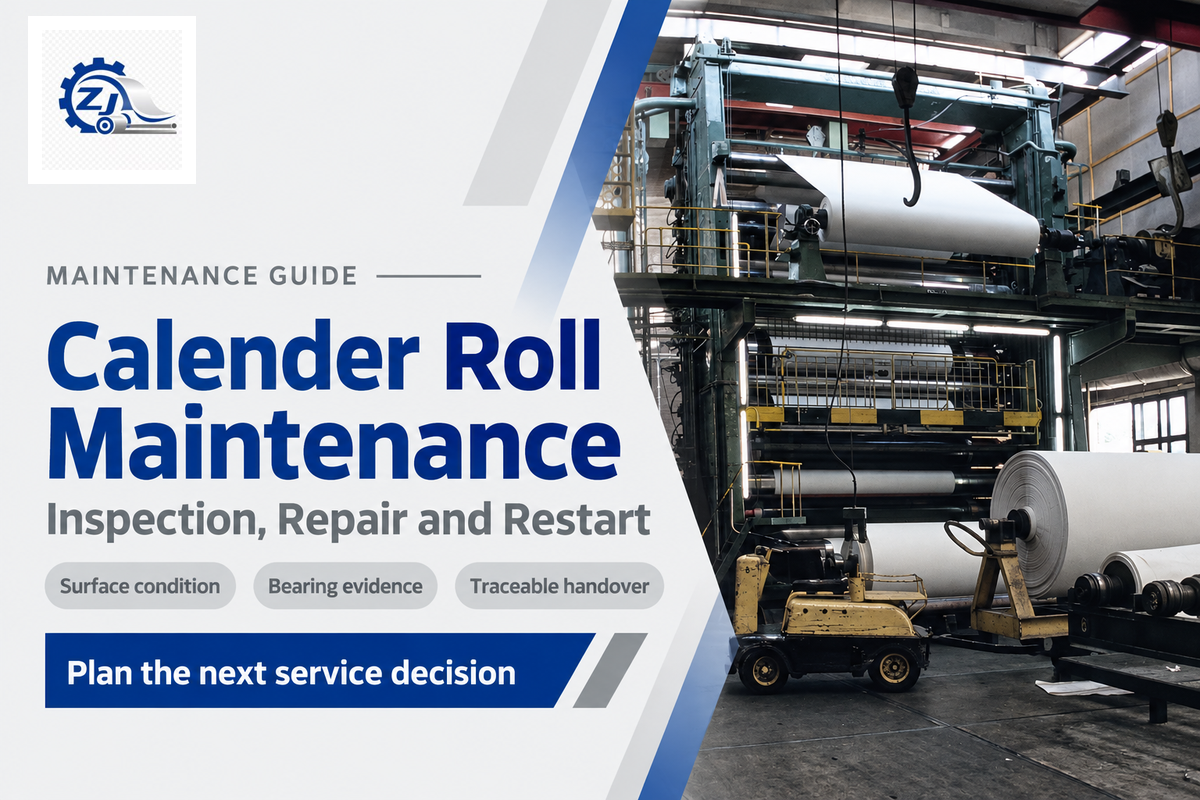
Calender roll maintenance includes checks and services for the roll surface, geometry and bearing as well as maintenance of the heating circuit (when fitted). A number of useful plans combine each task with the construction, operating conditions and inspection history of the roll. Start with the defect which you need to explain; e.g. a repeating mark on the sheet, increasing vibration and gloss differences may indicate different work.
The goal of a maintenance manager is a reliable return to service. Repeatability of sheet results for a given test condition is critical. The scope of repair to be procured is also of interest. This guide assists such decisions for paper and paperboard calendering.
Updated October 2026
Before booking a grind
Identify the affected roll and component, compare the symptom with its operating history, and agree the finished condition the workshop must demonstrate. Keep routine inspection, corrective repair and authorization to restart as separate decisions.
What should a calender roll maintenance plan cover?
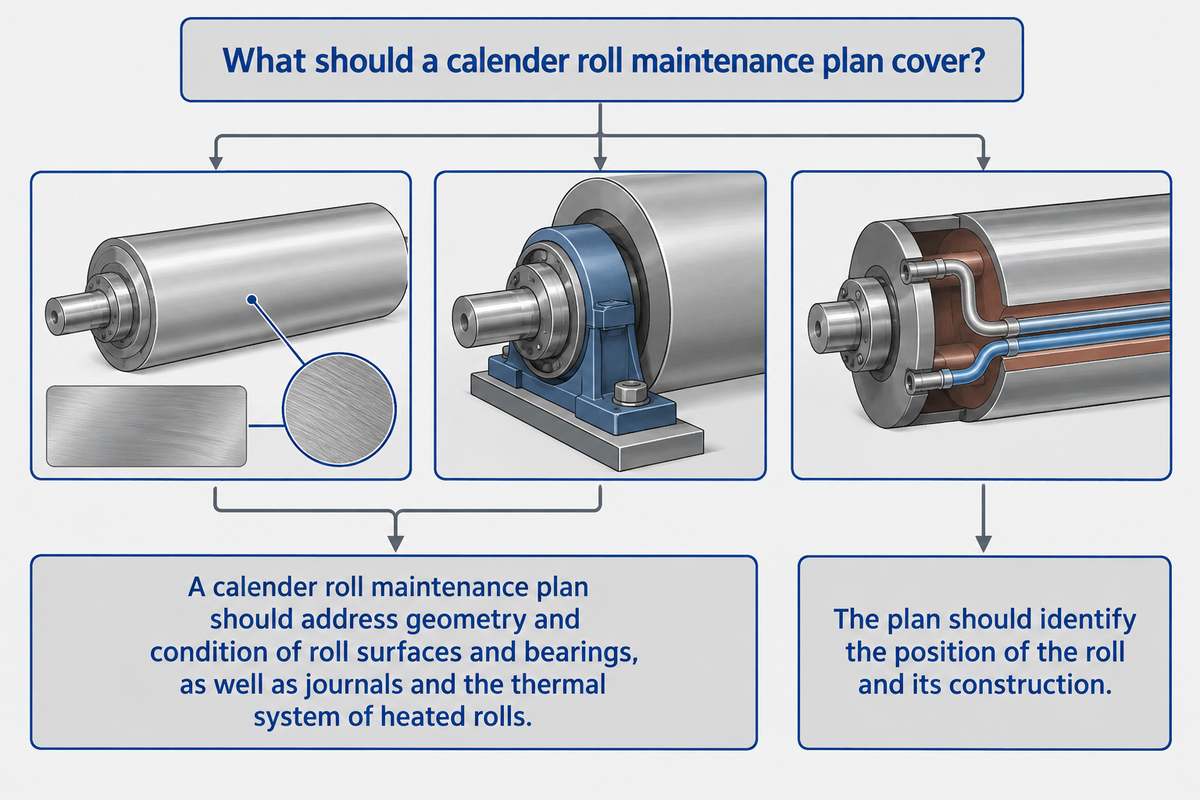
A calender roll maintenance plan should address geometry and condition of roll surfaces and bearings, as well as journals and the thermal system of heated rolls. The plan should identify the position of the roll and its construction. Those factors determine the checks and services that are pertinent for the calendering equipment.
A hard nip calender uses different contact materials from a soft nip arrangement. A renewable polymer cover can exhibit wear or impact damage that steel or chilled-iron surfaces don’t share. The comparison of hard and soft nip calendering explains that distinction before you select a repair route.
State whether the unit is a top roll, bottom roll or intermediate roll in a multi-roll stack. For replacements or rebuilds, identify the complete calender roll construction and interfaces (i.e. not just its diameter). Drawings distinguish a smooth finishing surface from a roll designed to emboss a pattern.
Two rolls compress the paper between their surfaces. Locate the specified nip pressure and the control systems to determine proper loading. A paper-machine roll’s section and function help identify which maintenance instructions apply.
A work order stating only “three rolls for service” doesn’t provide the workshop sufficient information to determine the positions and duties required. Attach the stack drawing for the calender equipment and mark each roll separately. If the production line has a separate embosser, identify it explicitly to avoid confusing it with the smooth finishing rolls.
Which symptoms need a roll inspection?
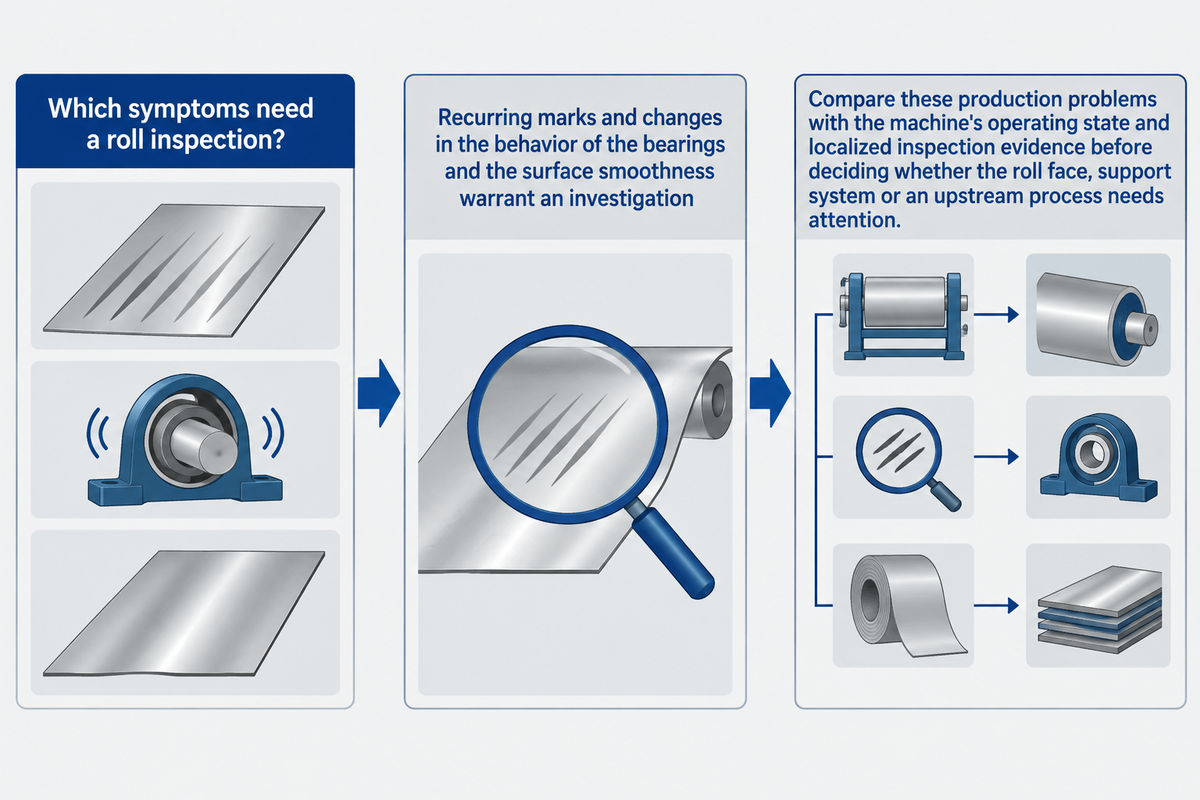
Recurring marks and changes in the behavior of the bearings and the surface smoothness warrant an investigation. Compare these production problems with the machine’s operating state and localized inspection evidence before deciding whether the roll face, support system or an upstream process needs attention.
“Vibration is found to occur even if no corrugated rolls are present.”
J. R. Parker, Instability and the Papermaking Process, 1989
Parker’s research describes paper-thickness feedback between successive nips, a different mechanism from physical roll corrugation. A recurring sheet mark can therefore come from paper-thickness feedback between nips rather than from roll corrugation, so check for both causes before booking a regrind.
Use the 3-Clue Vibration Triage
Bring together three types of evidence: sheet or surface pattern, operating state when the evidence is observed, and measurements that help locate the mechanical response. Compare thickness variation across the web width with its variation in the machine direction.
| Observed problem | Evidence to bring together | Investigation direction |
|---|---|---|
| Repeating bars or vibration | Sheet wavelength, actual roll speed/diameter, vibration location and direction | Compare roll-related excitation, stack response and paper feedback. |
| Uneven gloss or caliper across the web | Cross-direction sheet profile, crown history, nip loading and temperature profile | Separate geometry or loading changes from paper and thermal effects. |
| Bearing temperature or vibration change | Bearing identity, lubrication history, load and temperature trends | Investigate the bearing assembly and its operating conditions. |
| Pattern already present before calendering | Comparable upstream/downstream samples and available process records | Include approach flow, forming and pressing in the investigation. |
Collect running data using the mill’s approved monitoring arrangements, with guarding in place.
Repeating surface patterns along with a defect in measured geometry point toward roll-face correction. A localized response at a bearing with fit, lubrication, or inner-ring defects directs work toward that assembly. A profile or runout change that tracks the roll’s thermal state calls for comparison of hot and cold behaviour. A recurring sheet pattern before the calender directs investigation toward the upstream processes as well. All evidence should be kept for each of these situations.
Consider a quality team finding regular bars soon after a roll returns from grinding. The workshop report says cold geometry was within limits; the defect appears only on one paper grade. Ordering another grind immediately leaves several questions unanswered. The team reviews the sheet pattern against operating speed, moisture and vibration, then considers whether the same variation exists upstream. Maintenance checks the bearing and support evidence alongside the surface report. Findings determine what corrections will be made. Geometric errors support surface corrections; process related patterns require investigation in other directions.
How often should calender rolls be checked?
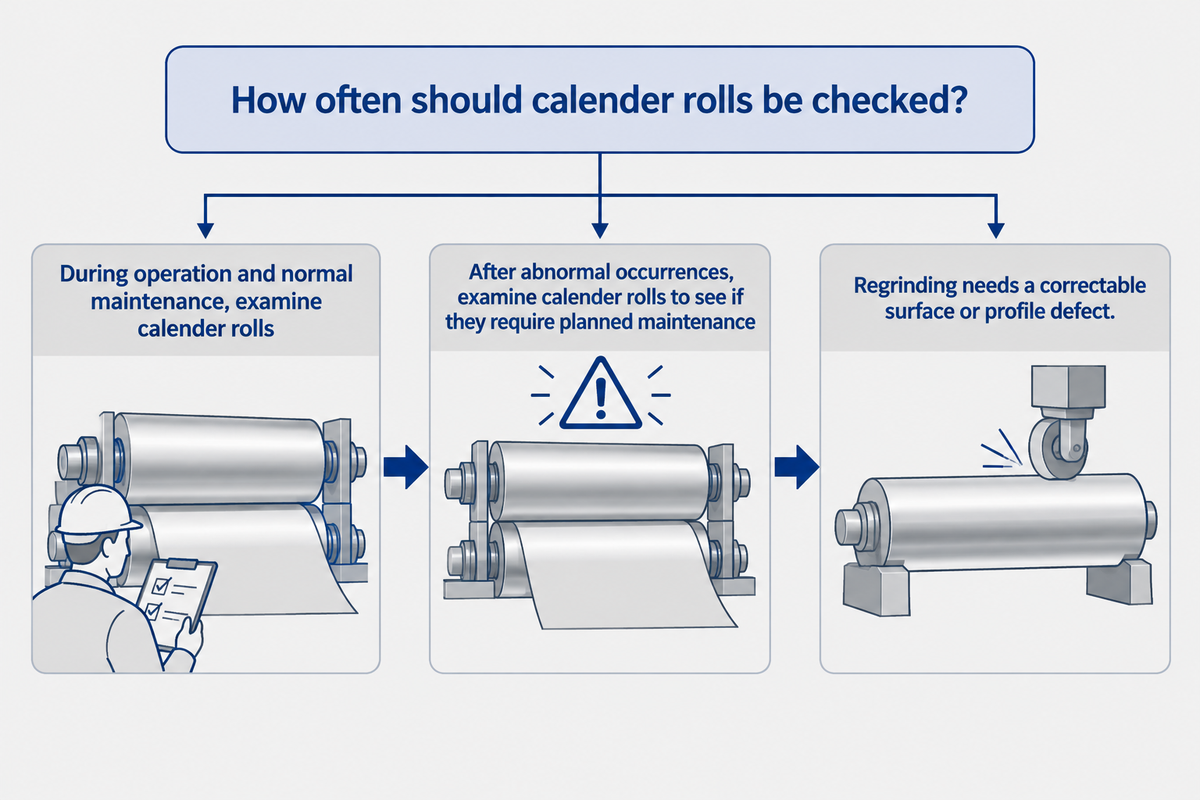
Check calender rolls through condition monitoring and sheet-quality trends during production, at every planned stop, and after damage, modification or a significant abnormal event; lengthen the interval when a roll’s inspection history shows negligible deterioration, and shorten it where experience shows it is necessary. Regrinding has a separate trigger: loss of an acceptable surface or profile that can be restored within the permitted machining allowance. Put planned maintenance and regrinding on different lines of the maintenance plan, so that a grinding schedule doesn’t replace inspection.
The Health and Safety Executive of the United Kingdom distinguishes different inspection frequencies based on deterioration and the need for reassessment due to abnormal occurrences in its guidelines for the inspection of work equipment. It also says that different safety-related parts need not have the same frequency of inspection.
- During normal production, record approved condition-monitoring observations and sheet-quality trends against the established baseline.
- At planned stops, complete the inspections and service tasks specified for that roll, bearing arrangement and duty.
- After damage, modification or a significant abnormal event, use the mill’s assessment process before continuing service.
- Before a regrind, review surface condition, profile history and remaining permitted dimensions.
Retain the grade and operating state information in the record. A change in paper calendering conditions can affect production quality without representing the same rate of roll wear. Paper mills should retain the relevant temperature and pressure records when comparing one roll’s service history with another’s.
Protect roller surfaces, bearings and heat transfer
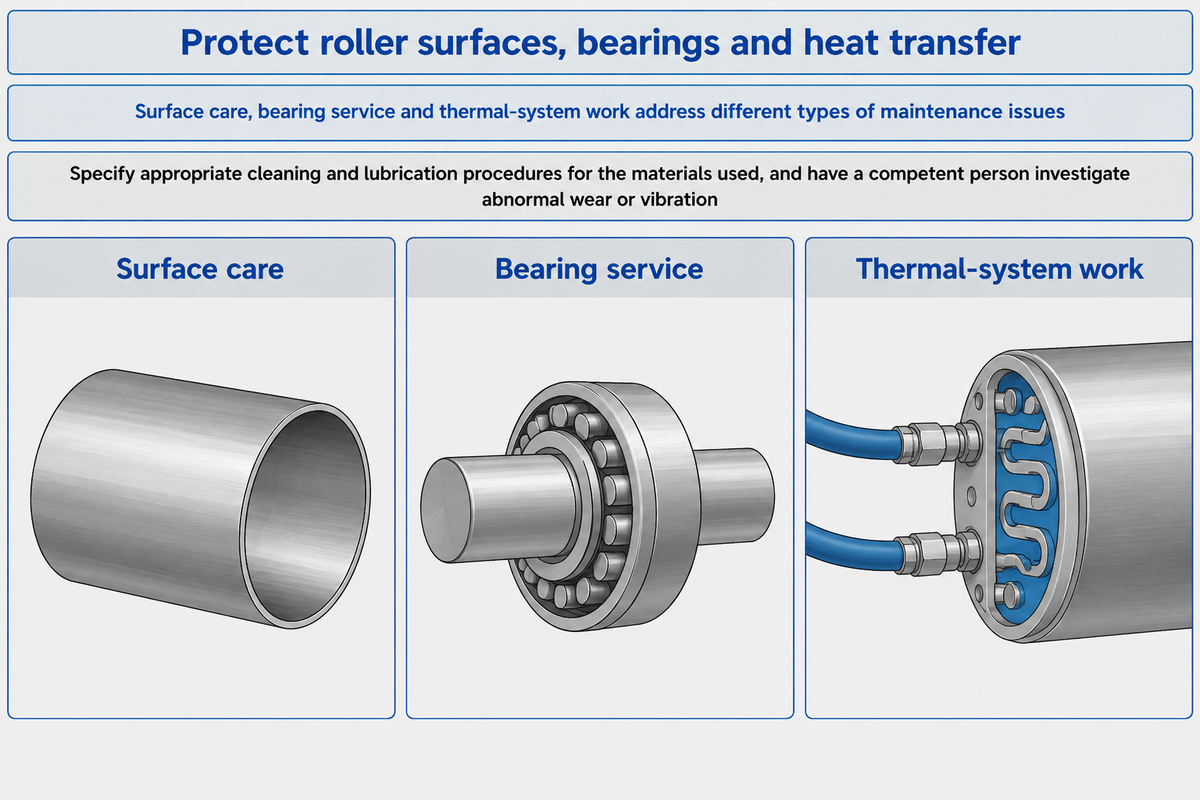
Surface care, bearing service and thermal-system work address different types of maintenance issues. Specify appropriate cleaning and lubrication procedures for the materials used, and have a competent person investigate abnormal wear or vibration. Heated-roll work requires the inclusion of pressure and thermal hazards in the mill’s approved maintenance procedure.
For US mills, OSHA’s pulp, paper and paperboard standard addresses isolation before close-contact maintenance. The hazardous-energy control standard also addresses residual energy and verification before work. The work plan must account for parts that could fall as well as electrical, hydraulic and thermal energy; isolation isn’t a lifting or support plan.
A case from PaperAge supplied by NSK cites thermal-stress cracking of bearing inner rings. This isn’t a case of roll-shell cracking. With that distinction, the repair assessment shifts from a new surface grind to bearing-ring fit and the effects of lubrication and heat exposure.
On heated rolls, verify the specified fluid path and connection items as part of the agreed service scope. Problems with flow or deposits should be addressed in thermal performance and heat transfer. A worn roll face is related to surface condition. Report the surface temperature across the roll, including whether it was distributed uniformly under the observed operating state. Take the cleaning chemical, coating and heat-up procedure from the roll specification, manufacturer guidance and the mill’s approved maintenance procedure.
Keep the specified surface material with the cleaning instructions: corrosion resistance does not establish compatibility with every cleaning agent. For a proposed replacement cover, ask the supplier to address heat transfer and conductivity within the actual roll design.
What should a grinding and surface finish report include?
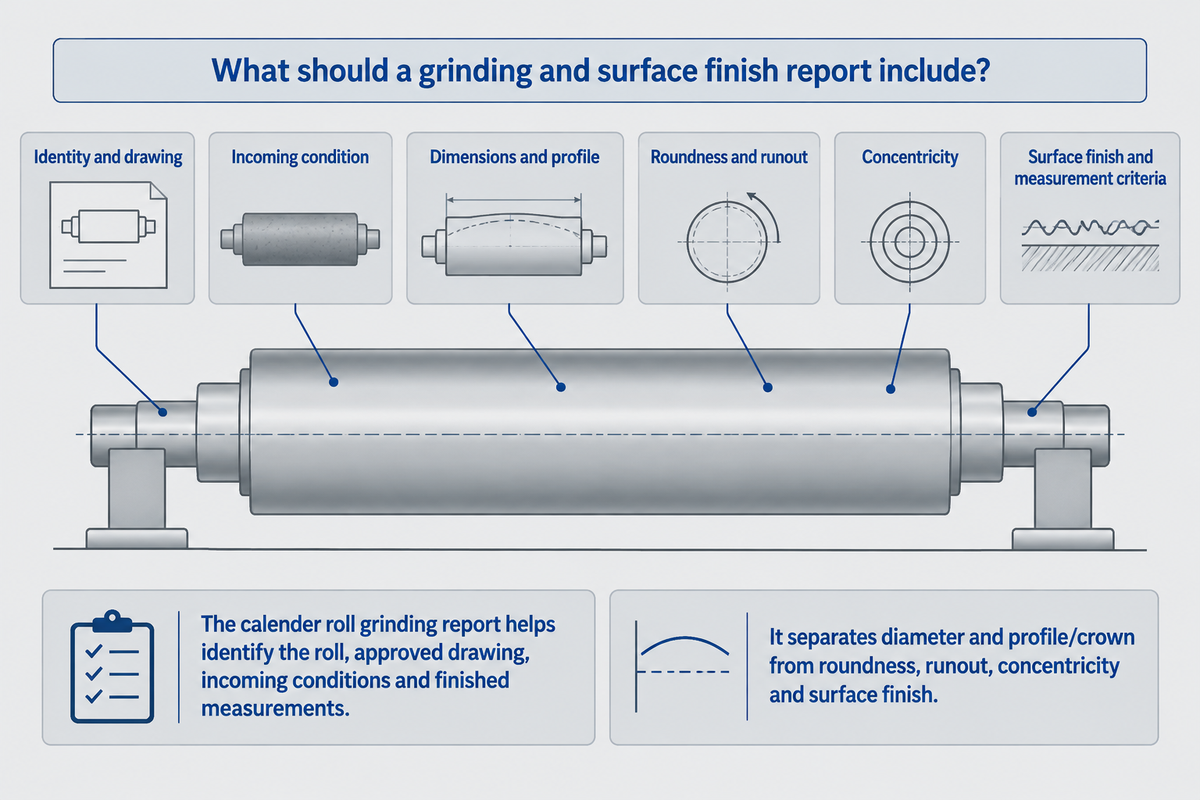
The calender roll grinding report helps identify the roll, approved drawing, incoming conditions and finished measurements. It separates diameter and profile/crown from roundness, runout, concentricity and surface finish. The report should specify how the measurements were carried out and to which criteria the measurements are compared.
What is checked before calender roll grinding begins?
Workshop personnel define the construction, dimensions and condition of defects of the existing roll prior to performing work. Include face length, journal and condition of the bearing seat. Also define the current profile, surface conditions and previous material removals. Record the coating or cover’s permitted remaining thickness separately from the overall roll diameter.
| Inspection category | What the record should identify |
|---|---|
| Diameter | Before/after dimensions and permitted finished size |
| Crown and profile | Approved profile definition, measurement stations along its length and measured deviations |
| Roundness | Measurement plane, method and result for the specified roundness requirement |
| Runout and concentricity | Property measured, reference axis, support arrangement and method |
| Surface finish | Specified roughness parameter, units and measurement locations |
| Hardness | Test method, locations and applicable material or cover requirement |
| Journals and bearing seats | Inspected condition and dimensional accuracy against the drawing’s fit requirements |
| Balance, where specified | Agreed balance requirement, assembly configuration and test conditions |
| Measurement capability | Instrument identification, calibration status, temperature conditions and capability for the required tolerance, including micron-scale measurements where specified |
NIST’s roundness guidance explains that a single trace contains both spindle error and workpiece error. Ask how the workshop establishes that measurement-system error is small enough.
Can calender roll grinding correct crown and profile problems?
Precision grinding can restore an approved crown or profile where the roll has sufficient permitted material and the defect is machinable. It doesn’t address roll-bending or loading settings. Systems that compensate for roll deflection still require settings that are matched to the calendering nip and process requirements.
J. David McDonald’s technical discussion of lateral stability adds uneven nip loading, grinding or wear, and crown settings, to the causes of paper-profile problems. Temperature distribution and the sheet itself are also important. Thermal deformation can make the operating geometry different from the cold workshop geometry. For thickness control, compare those measurements with the actual gauge variations rather than treat the two records as equivalent.
Check the 2026 standard for covered-roll tolerances
ISO 6123-3:2026, published in May 2026, covers dimensional and geometrical tolerance classes and measurement methods for rubber or plastics covered rollers. Its predecessor, the 1985 edition, is withdrawn. For applicable covered-roll work, name the agreed edition and classes in the order; evaluate a bare-steel roll’s structural fitness separately.
Regrind a hard roll, recover a polymer cover or replace?
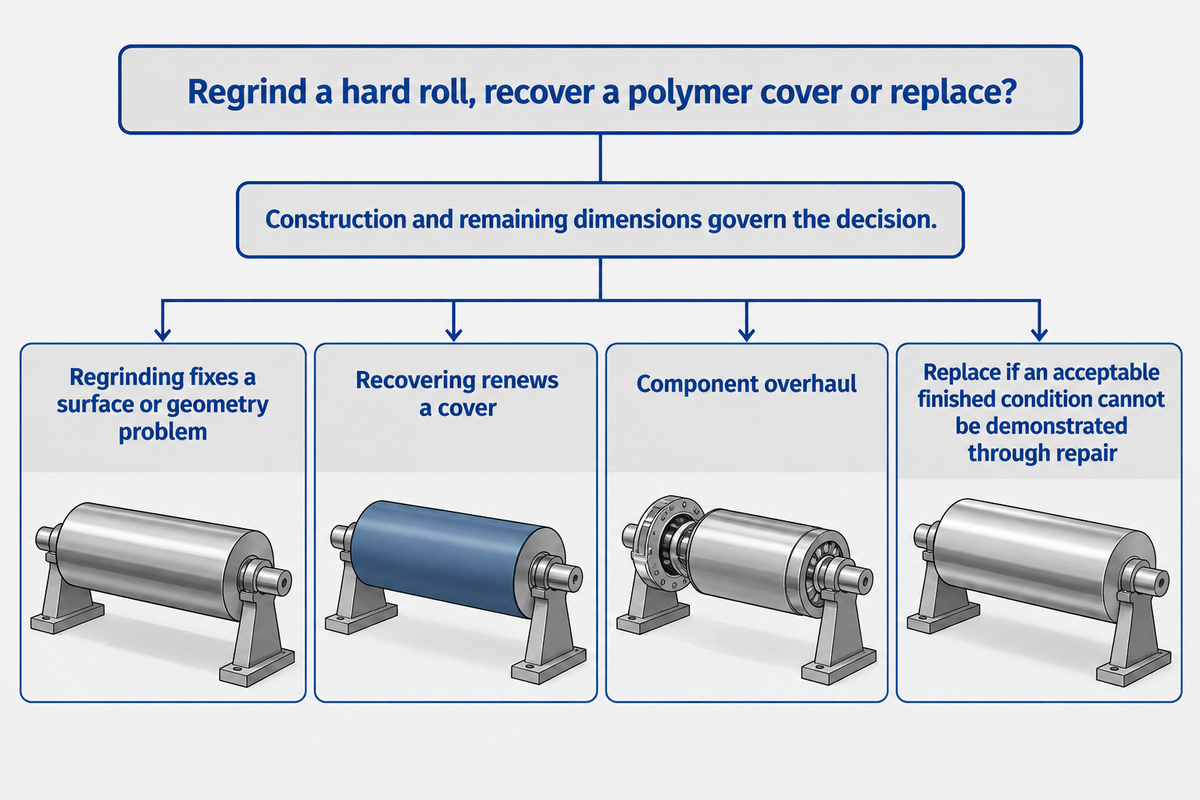
Regrinding fixes a surface or geometry problem. Recovering renews a cover. Component overhaul fixes issues like journals or bearings. If the inspected roll can’t meet the required finished condition by repair, replacement becomes the option. Construction and remaining dimensions govern the decision.
In a PaperCon paper on composite covers, Bob Carney of Stowe Weavexx describes rough, resin-poor cover edges requiring regrinding. Carney writes about other covers suffering from uneven loading and says that cover wear resistance has improved. Removing a surface defect and correcting the cause of the defect can be different jobs.
| Route | Candidate condition | Decision evidence |
|---|---|---|
| Regrind | Machinable surface wear or profile error | Defect depth, permitted stock removal and achievable finished dimensions |
| Recover | A renewable cover requires replacement | Serviceable core and interfaces; compatible cover and bonding specification |
| Component overhaul | A journal, bearing arrangement or internal-service item needs work | Component inspection, approved repair method and functional acceptance checks |
| Replace | An acceptable finished condition cannot be demonstrated through repair | Engineering disposition plus replacement drawing and interface requirements |
Can calender roll journals and bearing seats be repaired?
Some defects in the seat of a bearing or journal can be repaired through an approved process. The material, geometry, fit and damage mechanism must be assessed. A qualified person is to assess a damaged calender roll with a crack. A chilled-iron working surface can’t be treated like a renewable polymer layer.
Picture two removed rolls awaiting a repair decision. One has a damaged renewable cover and a core that passes the specified inspection. The other is a hard roll with a defect of unknown depth and significance. The first can move toward a recovering proposal with a defined cover specification. The second needs an engineering disposition before a workshop promises a grind. Procurement shouldn’t evaluate the two proposals by the price of the machining only; they answer different technical questions. The correct comparison is ‘which proposal can provide the repaired roll to the required standard with supporting inspections and acceptance’?
Plan calendering outages and compare maintenance quotes
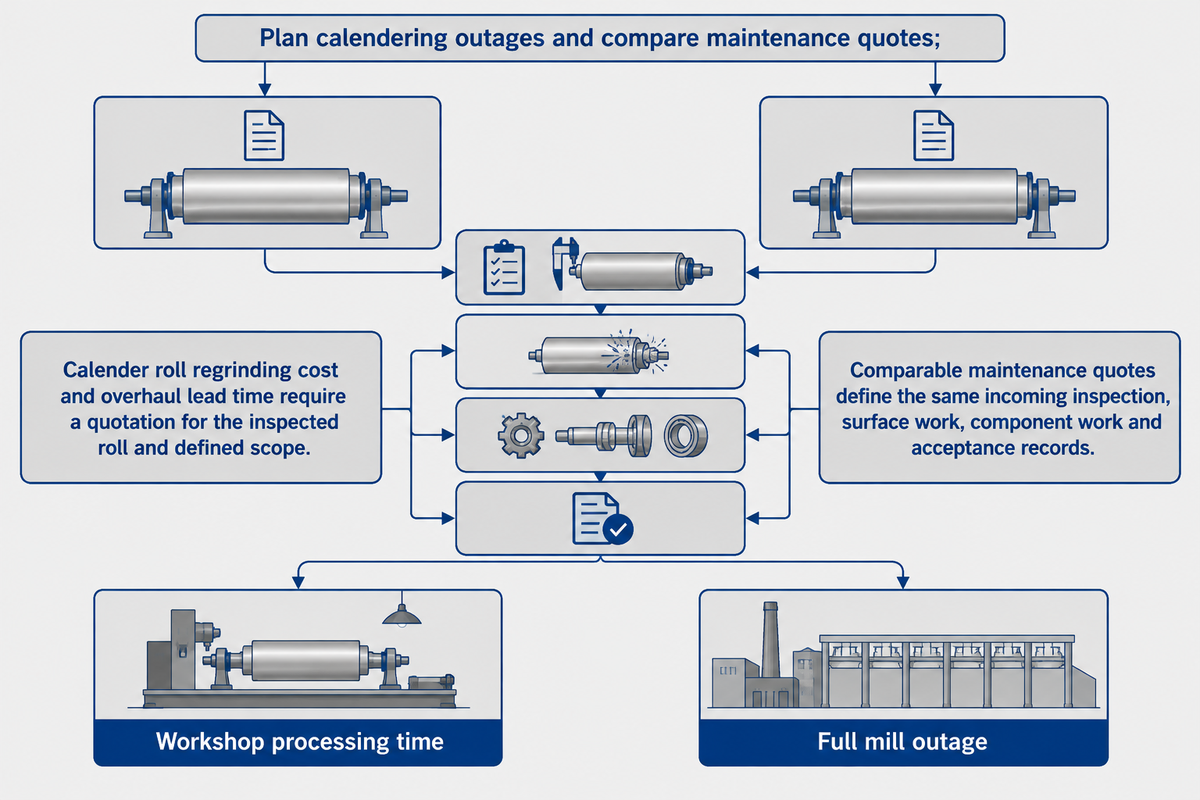
Calender roll regrinding cost and overhaul lead time require a quotation for the inspected roll and defined scope. Roll size, material, defect depth and included component work affect that scope. Inspection, machining, and additional repairs should be requested separately, along with freight, and the workshop’s commitment and approval constraints.
Comparable maintenance quotes define the same incoming inspection, surface work, component work and acceptance records. Processing time at the workshop is separate from the full outage which includes removal, transport, decisions on additional work, installation and the mill restart. A low grind price can exclude much of the scope of complete roll overhaul.
| Work package | Ask each bidder to state |
|---|---|
| Incoming inspection | Included measurements, report timing and approval point for extra work |
| Surface treatment | Grinding, polishing, coating or covering operations and finished requirements |
| Other components | Journal, bearing, seal and internal-circuit work included or excluded |
| Acceptance | Tests, measurements, documentation and treatment of nonconforming results |
| Logistics and schedule | Receipt-to-dispatch commitment, dependencies, preservation, packing and freight |
Two offers may appear similar to finance, but look very different to maintenance. Procurement asks both suppliers to provide a price for the same required scope and to price optional findings-based work separately. The planner checks if there are specific requirements in the workshop which require approval and if a spare calender roll can cover the lead time. Quality checks which finished measurements will be returned. The more useful offer is the one that resolves the agreed problem within the required outage arrangement, not automatically the lower headline price or the longer list of operations.
For high-speed calendering operations, provide bidders with the actual duty recorded by the mill, as opposed to a broad machine description. Where a scope includes a loading check, state the specified line pressure, its units and where it’s measured. A roll claiming to be able to take a high nip load isn’t an acceptance value for your order.
Check the handover before restarting the calender line
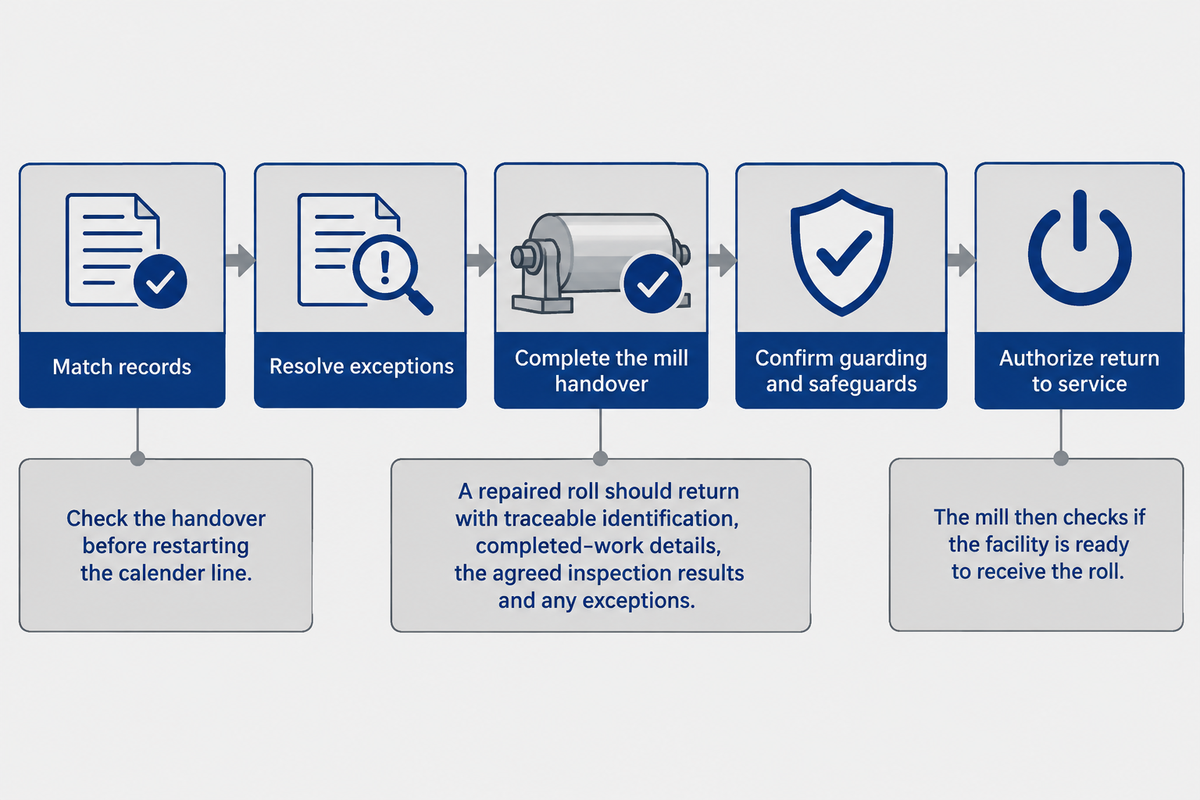
A repaired roll should return with traceable identification, completed-work details, the agreed inspection results and any exceptions. The mill then checks if the facility is ready to receive the roll. The mill follows its authorized procedure for returning the roll to service. Workshop acceptance and permission to restart are separate responsibilities; both need a clear owner before the roll enters production.
- Match the records — compare the roll identity, drawing revision and completed scope with the order.
- Resolve exceptions — obtain a documented disposition for missing results or deviations.
- Complete the mill handover — confirm responsible personnel, required safeguards and the approved restart arrangements.
Restored guarding is important. HSE’s ‘machine Intervention Guidance’ paper shows examples of where guards haven’t been reinstated and the injuries this has caused. If work pauses while awaiting parts, OSHA’s November 2025 interpretation also distinguishes equipment held out of service from compliant energy control when exposed servicing resumes.
After the authorized return, compare roll performance and sheet uniformity under comparable grade and operating conditions. Keep the results of final thickness with the repair report. Keep surface quality results if the calender line makes a high-gloss grade.
Prepare a calender equipment repair enquiry
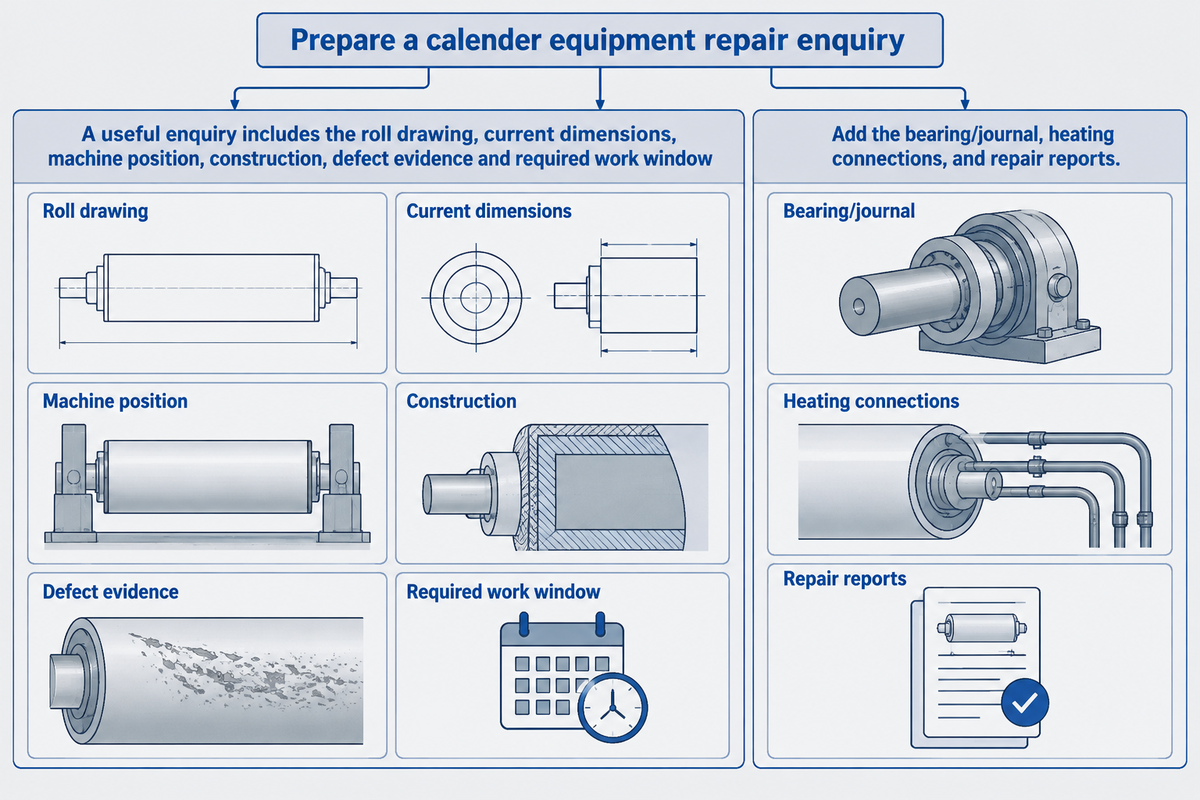
A useful enquiry includes the roll drawing, current dimensions, machine position, construction, defect evidence and required work window. Add the bearing/journal, heating connections, and repair reports. These inquiries assist the supplier to review the existing calender machine and determine if any missing information is needed before the roll is shipped.
Specialist roll grinders such as Precision Roll Grinders and equipment suppliers such as Valmet offer calender-roll services. See what services are offered and compare with drawing and inspection results. Include any work requiring an outside specialist.
Henan Zejiang Paper Machinery lists cylindrical grinding, dynamic balancing, hardness testing and surface-roughness testing among its workshop equipment. Its calender-roll offering includes new builds and regrind/rebuild enquiries. Send the drawing and inspection history to establish the scope for your roll.
Key takeaway
Order the work that addresses the inspected defect, with a defined finished condition and acceptance record. Keep unresolved machine-level causes visible in the maintenance plan.
Discuss your calender roll maintenance enquiry
Calender roll maintenance questions
When does a calender roll need grinding or reconditioning?
A roll becomes a grinding candidate when inspection identifies a correctable surface or profile defect.
The workshop must establish that the required material removal leaves an acceptable finished roll. A change in sheet quality calls for investigation, but doesn’t by itself prove that grinding is the remedy. Keep the construction, defect condition, remaining dimensions and agreed acceptance requirements together in the repair decision.
Can worn calender rolls be repaired instead of replaced?
Yes, some worn calender rolls can be repaired when inspection and an approved repair method show that the finished roll can meet its required condition.
A serviceable core with a renewable damaged cover presents a different job from an unresolved crack in a hard roll. The repair proposal should identify the affected components, dimensional constraints and acceptance evidence, rather than promise recovery from the visible symptom alone.
What surface finishing and coating options are available during roll reconditioning?
Options include grinding, polishing, renewing a compatible coating and replacing a renewable cover.
The selected operation must match the roll design and the required paper finish. Chrome plating, where specified and technically suitable, is different from replacing a polymer cover. State the required surface properties and acceptance method in the order; choosing the smoothest-looking finish alone doesn’t establish suitability for the grade.
Is calender roll maintenance required?
Yes.
The mill needs a maintenance programme covering observation, scheduled service and abnormal findings. The installed equipment, manufacturer guidance and risk assessment establish the tasks and intervals.
Can a service company refurbish another manufacturer’s calender roll?
Yes. A specialist workshop can refurbish another manufacturer’s calender roll when the design information, inspected condition and available repair processes support the work.
Provide the original drawing, construction details, service history and required finished condition. Proprietary internal mechanisms, unavailable dimensions or an unresolved damage mechanism can limit the proposed scope. Ask the bidder to identify work it performs itself, specialist work it subcontracts and the records supplied for acceptance. A general statement that the company services industrial rolls is less useful than a proposal addressing the actual roll and its interfaces.
What is the difference between a calender roll and a calendering roller?
Often there is none: the two names overlap in many equipment descriptions.
Identify the component by its drawing, construction, position and duty. Those details are more reliable than the choice of “roll” or “roller.”
What should a calender roll maintenance log contain?
A maintenance log should connect each roll’s identity and machine position with its operating history, observations, inspection results and completed work.
Record dates, paper grade, relevant operating conditions, symptoms, changed components and links to measurement or repair reports. Keep the pre-repair findings and post-repair results distinguishable. Note who assessed abnormal findings and what action followed. When comparing trends, check that the grade and operating state are comparable; otherwise a change in caliper or vibration may be interpreted as wear when the production conditions also changed.
How this maintenance guide was prepared
Written by Cherry for Henan Zejiang Paper Machinery. This guide brings together published calender-roll research, inspection guidance and the company’s public equipment information. The repair comparisons help buyers define a work scope; the illustrative scenarios aren’t customer case histories. Roll geometry and bearing findings must still be assessed against the installed machine’s requirements.
References & Sources
- Instability and the Papermaking Process J. R. Parker, 1989; hosted by NC State University’s BioResources.
- Inspection of work equipment UK Health and Safety Executive.
- Pulp, paper, and paperboard mills, 29 CFR 1910.261 US Occupational Safety and Health Administration.
- Control of hazardous energy, 29 CFR 1910.147 US Occupational Safety and Health Administration.
- NSK bearings case study PaperAge, September 2021; case supplied by NSK.
- Roundness measurements National Institute of Standards and Technology.
- Improving lateral stability J. David McDonald, Pulp & Paper Canada, 2022.
- ISO 6123-3:2026: Rubber- or plastics-covered rollers, Specifications, Part 3 International Organization for Standardization, May 2026.
- Composite calender-cover conference paper Bob Carney, Stowe Weavexx, PaperCon 2011.
- Paper-machine interventions UK Health and Safety Executive.
- Lockout/tagout interpretation concerning extended servicing interruptions US Occupational Safety and Health Administration, November 24, 2025.