Get in touch with Zejiang Paper Machinery Company


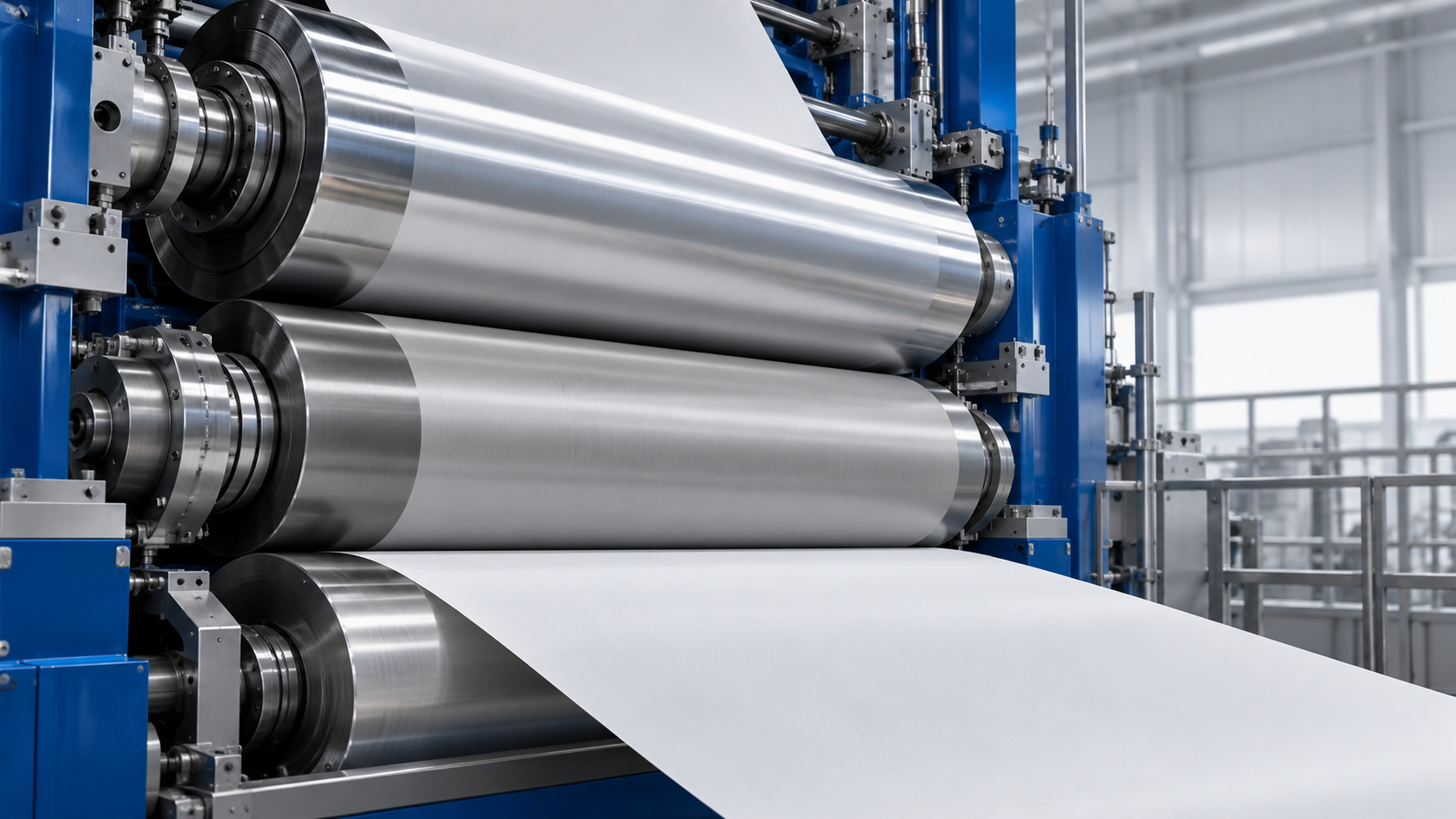
Supercalendering is a paper-finishing process that entails passing a sheet through successive hard-and-resilient roll nips. This process increases smoothness, gloss and density. The useful finish comes with a tradeoff: compression can reduce thickness and opacity. When a mill is purchasing replacement rolls, the target is the required paper finish at an acceptable bulk, strength and saleable output.
A glossy sample can still dissatisfy a printer or converter. This report describes roll stacks, compares roll constructions and uses a worked paper-finishing example to show when further finishing becomes uneconomical.
Supercalendering process and roll-stack mechanism
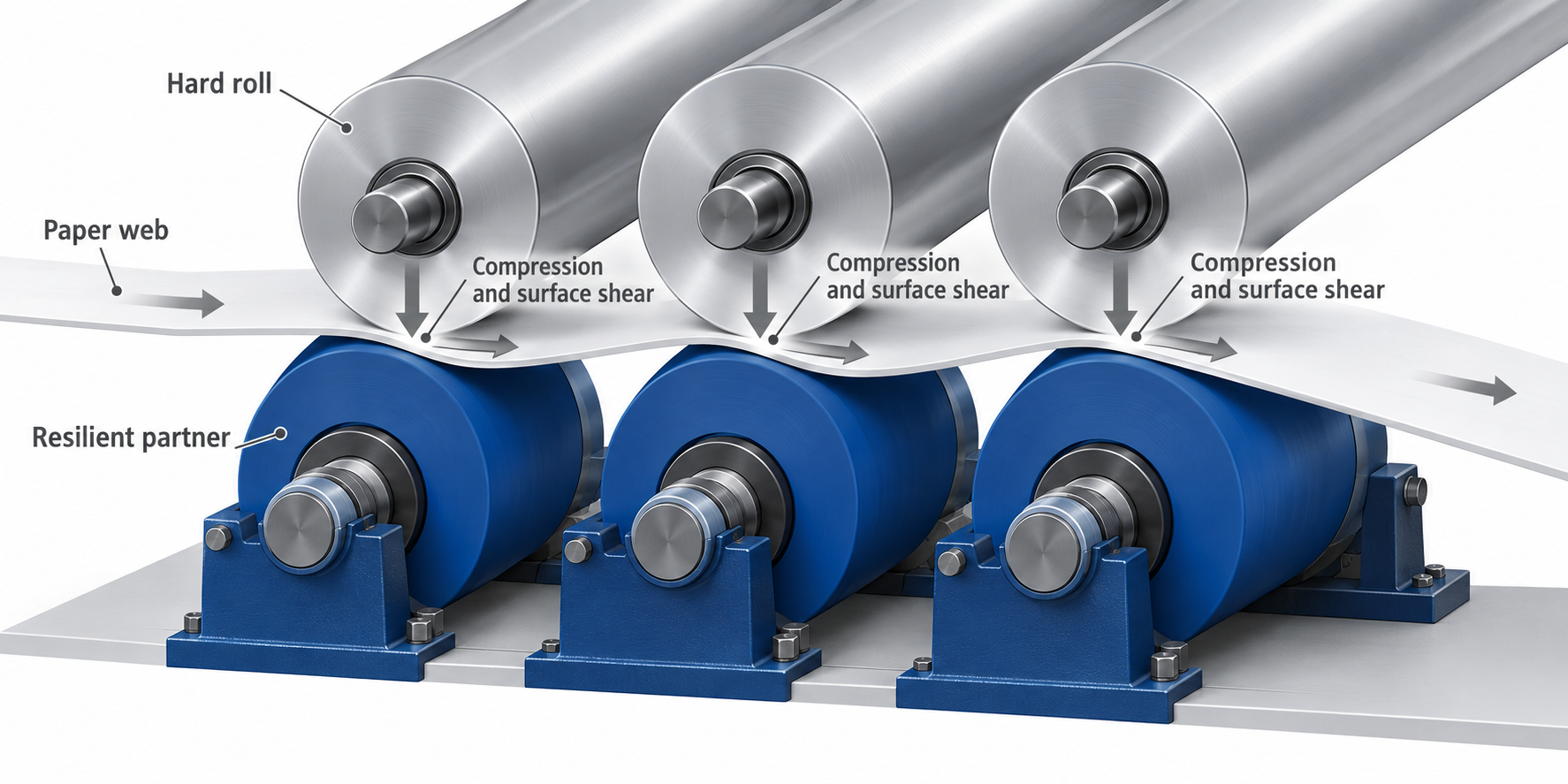
A supercalender functions somewhat like an iron pressing cloth against a yielding support: the hard surface smooths the sheet, while the resilient surface accommodates local thickness differences. The working principle is a repeated finishing process through successive nips. The means of achieving this is a combination of loading the rolls and passing the sheet through the stack.
How does supercalendering work?
Supercalendering brings a moving paper web through a series of loaded contacts between hard and resilient rolls. At each nip, compression and surface shear help flatten irregularities. A hard roll provides the finishing surface; its resilient partner alters the contact geometry. Repeated contacts develop the finish across the sheet.
According to the Hubbe and Pruszynski review, the hard-soft nip action of the glassine production is described. A traditional vertical stack brings several contacts to a compact machine arrangement. Roll and active nip count are different specifications. The arrangement and loading system of the active nips determine which contacts perform useful work.
To select a material, locate the roll on the stack drawing, and then consider the metal or resilient material. A hard roll, like a steel roll, and a resilient roller perform different functions even if their outside dimensions are similar. Finishing acts on the sheet already formed; it can’t redistribute a poor incoming fiber formation into a uniform furnish.
Supercalendered paper grades and end uses
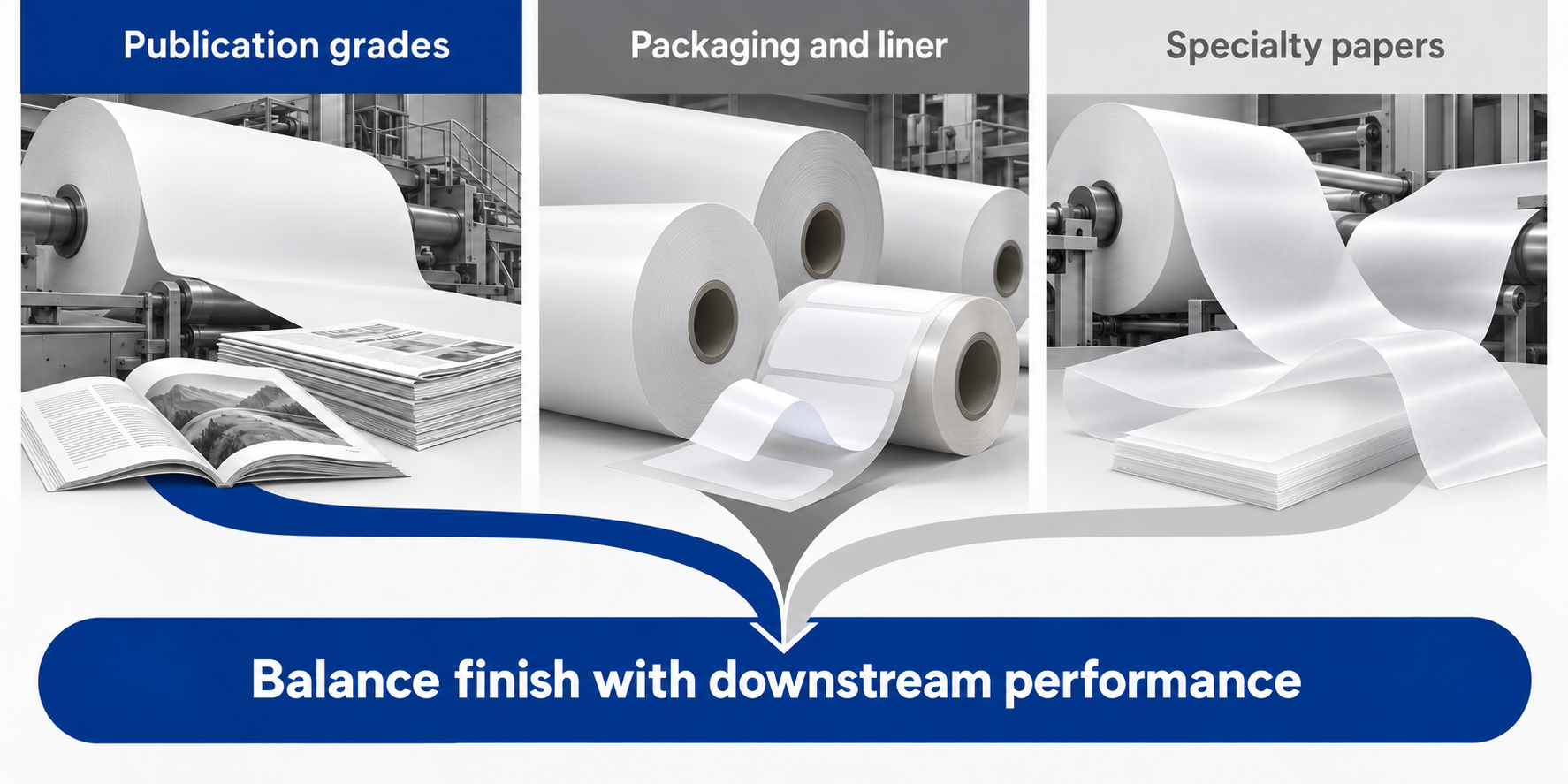
Publication paper and specialty liners have different purposes for supercalendering. Printing grades look for a smooth surface with sufficient opacity for legible pages. Glassine uses a dense structure for its specialty function. The purchase specification should name the paper grade and end use before setting a gloss target or selecting a replacement roll.
Where is supercalendering used?
Supercalendering is used for publication papers, some coated printing papers, and specialty grades like glassine and supercalendered kraft release-liner bases. Print appearance is of value to magazine and catalogue publishing, while the consistency and the sheet structure are of value to liner converting. These applications demand different balances of gloss, density, caliper and processing performance.
Port Hawkesbury Paper states its SC paper is an uncoated publication grade. Coating can occur earlier in manufacturing, and the supercalender then finishes the coated sheet. Similarly, pulp refining and the decision to bleach the furnish should happen upstream.
For a packaging liner, start with the converter’s release and coating requirements; for a publishing job, start with the sheet and print requirements. A highly dense translucent glassine texture is useful in one application, but would be unwelcome as a substitute for an opaque catalog page. Natural greaseproof paper also differs from glassine: the academic review distinguishes intensive refining from the additional supercalendering used for glassine.
Supercalendering vs soft-nip calendering
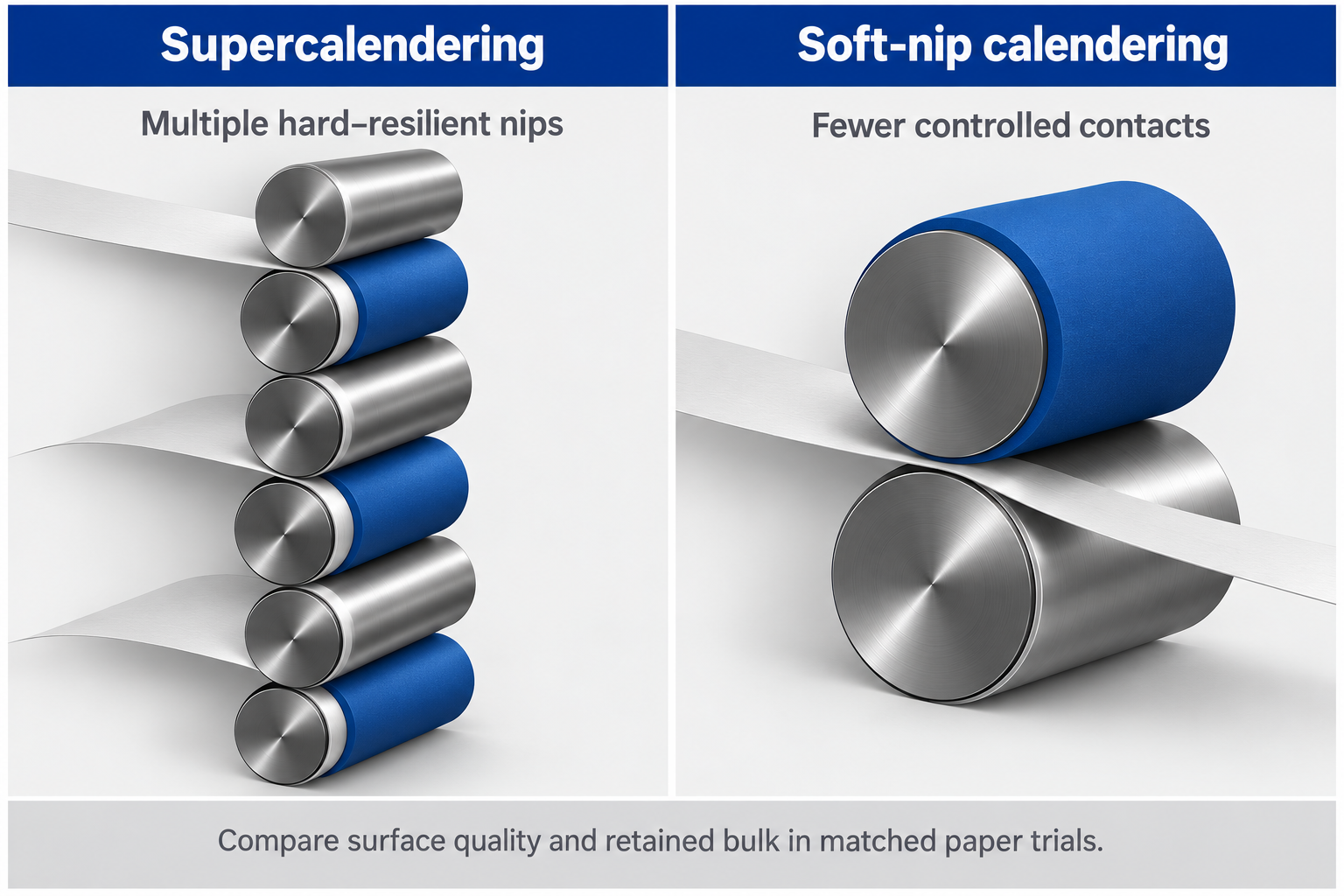
Both supercalendering and soft-nip calendering use a resilient contact to finish paper. A traditional supercalender develops the finish through multiple nips, often in an offline operation. A soft-nip installation can use fewer controlled contacts. Matching paper trials that compare surface quality with retained bulk and the mill’s production constraints are essential for selecting between supercalendering and soft-nip calendering.
Choose the supercalender candidate when its extra finishing reaches the required print surface while retaining the specified bulk and opacity, and the mill can support its running and maintenance demands. Select the other option if its paper quality and running performance meet the job requirements.
There’s more to calendering than softness. Nip width changes the time a sheet spends under load, while roll temperature changes its response. A 2001 Japan TAPPI pilot study evaluated three nip configurations on two industrial paper types. Its results linked paper properties to cover and dwell time; the extended-nip configuration produced bulkier calendered paper under the study conditions.
Consider a publication mill that can reach its gloss specification only by sacrificing too much caliper. The mill’s trial team compares material from the same parent reel through the existing stack and a candidate finishing arrangement. Quality staff measure each side, then print the samples with the intended ink system. Production records the stable speed and any breaks; finance compares saleable output rather than the fastest short run. If the candidate preserves bulk but leaves unacceptable print mottle, its thicker sheet doesn’t settle the purchase. If both samples print acceptably, the retained caliper and continuous running results become useful commercial differences. This is a trial scenario and not a reported Zejiang installation.
For more finishing options including soft-nip and hard-nip, see our paper calendering process.
Supercalender rolls: cotton, synthetic fiber and polymer options
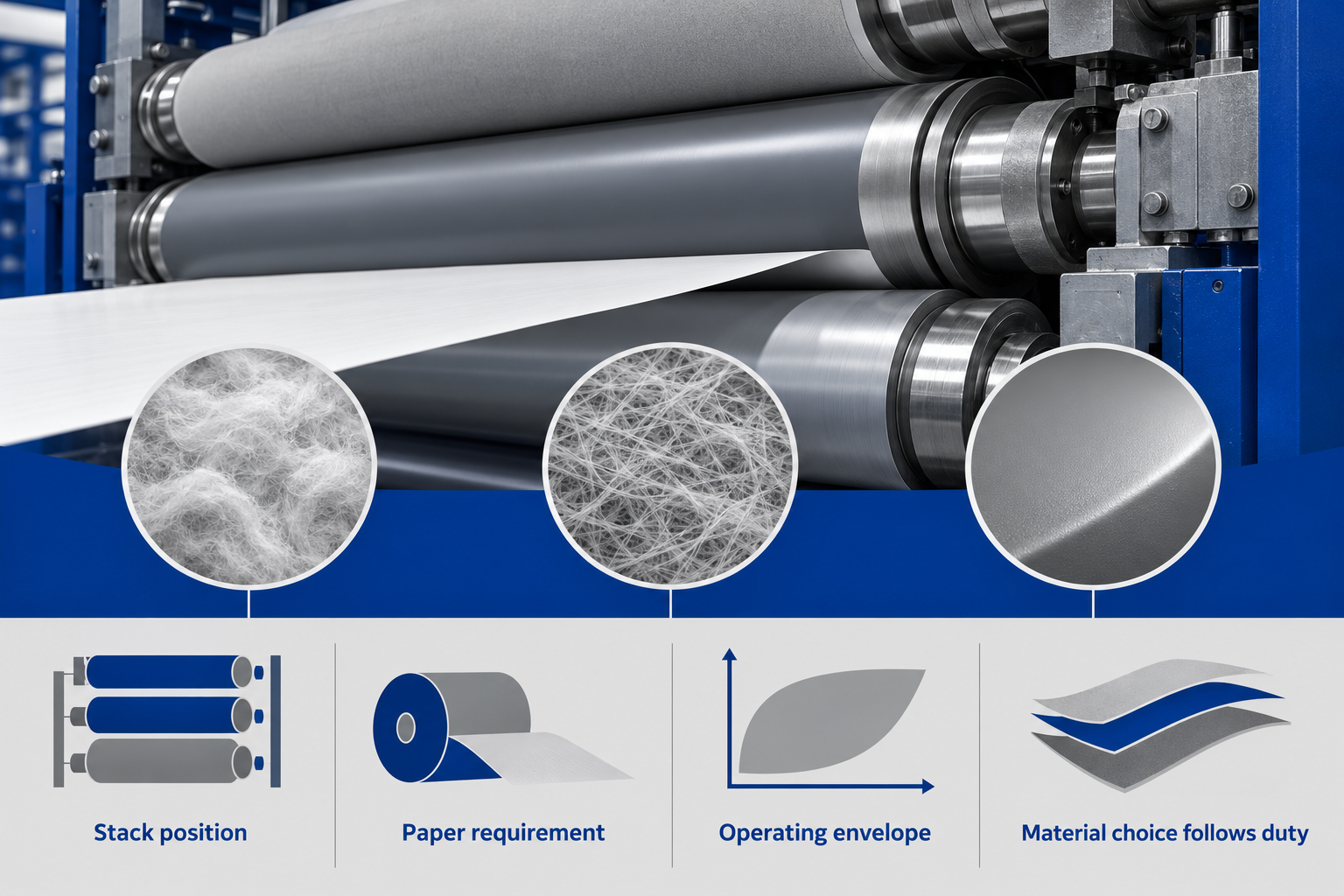
Cotton-filled, synthetic-fiber-filled and polymer-covered rolls are different resilient constructions. When selecting a suitable candidate, consider its stack position, paper requirement and approved operating envelope. Then evaluate maintenance needs. Surface polish is only one characteristic of the finished roll.
Cotton-filled rolls provide the traditional fiber-based resilient surface. Synthetic-fiber-filled rolls are a type of filled roll, but they are not the same as traditional cotton-filled rolls. KWF for example, identifies Simtex as a synthetic-fiber product. Polymer covers use another construction and have product-specific mechanical and thermal properties.
| Construction | Decision area | What changes the choice |
|---|---|---|
| Cotton-filled | Sheet finish | Compare its existing grade results with the candidate’s matched samples. |
| Cotton-filled | Operating duty | Use the approved position-specific load and thermal envelope. |
| Cotton-filled | Maintenance | Include available grinding capacity and spare-roll coverage. |
| Synthetic-fiber-filled | Sheet finish | Evaluate the named filling product on the intended paper. |
| Synthetic-fiber-filled | Operating duty | Compare the supplier’s actual duty limits with the stack requirements. |
| Synthetic-fiber-filled | Maintenance | Keep advertised grinding intervals tied to their stated conditions. |
| Polymer-covered | Sheet finish | Assess cover hardness together with nip geometry and dwell time. |
| Polymer-covered | Operating duty | Account for cyclic heating and the specific cover’s thermal limits. |
| Polymer-covered | Maintenance | Compare damage history, repair options and permitted remaining cover. |
Repeated loading can generate heat within a resilient cover. Valmet discusses this mechanism in its CL-EC technical article: a higher cover temperature reduces durability. Wear resistance and impact resistance also address different damage mechanisms. A cover that survives abrasion well may still be the wrong choice where sheet wads repeatedly strike the nip.
Supercalendering controls: load, heat, moisture and speed
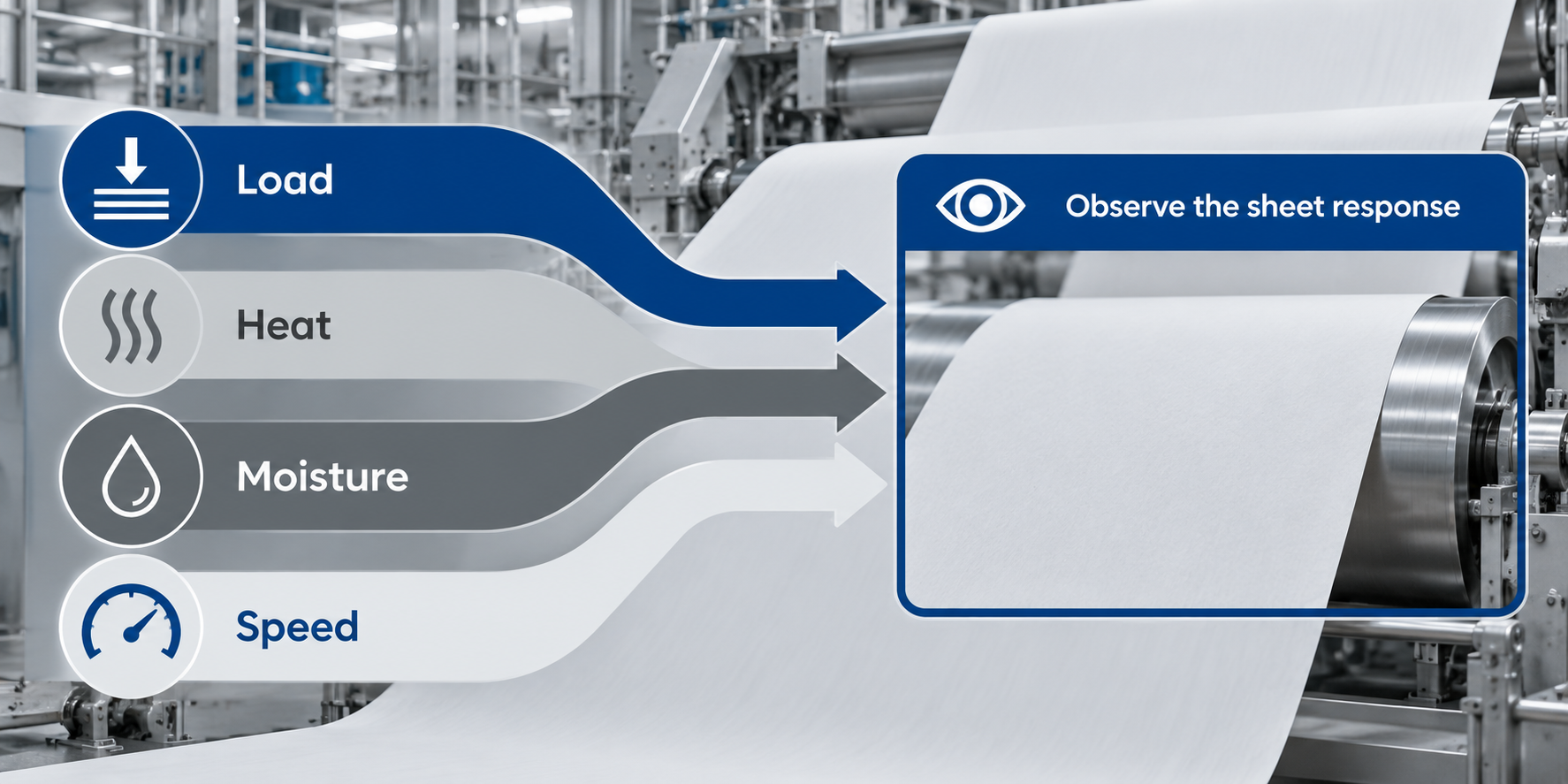
Start a finishing trial from the mill’s stable, approved recipe for the same grade, then change one planned variable while recording others. Consider nip load, roll heat, sheet moisture and machine speed. A higher gloss reading is useful only if the new condition also preserves the paper properties and running stability required by the customer.
Line load describes force per unit working width, commonly in kN/m. Contact pressure describes force over nip area, usually given in MPa. They aren’t interchangeable readings: A wider nip changes pressure distribution and dwell time. A quoted pressure without a measurement basis can mislead a roll comparison.
- Load: increasing compression can improve smoothness while reducing bulk and opacity; one roll supplier’s process guide gives about 1 point of Hunter gloss for every 28.6 kN/m of load as a rule of thumb. Watch the thickness profile as well as the average.
- Heat: a warmer surface changes the sheet’s deformation response; one roll supplier’s process guide puts the gain at about 2 gloss points for every 10 °C increase in surface temperature. Record actual roll-surface conditions, not just a heating-system setpoint.
- Moisture: the level and cross-machine distribution affect how the web yields. A wet streak can respond differently from the surrounding sheet.
- Speed: speed changes contact time and the number of loading cycles a roll experiences over time. Compare steady running periods.
Record roll position, web wrap and the incoming sheet condition with each trial. A change in furnish or coating can affect the result although the machine settings remain the same. The Valmet process-variable discussion notes that the significance of dwell time in a single nip decreases as the number of nips increases, normally after nine nips; apply actual values from the equipment and cover specification. Electrical or heating-system changes belong in the engineering review of that installation.
Paper-quality decisions with the Gloss-or-Bulk Trial
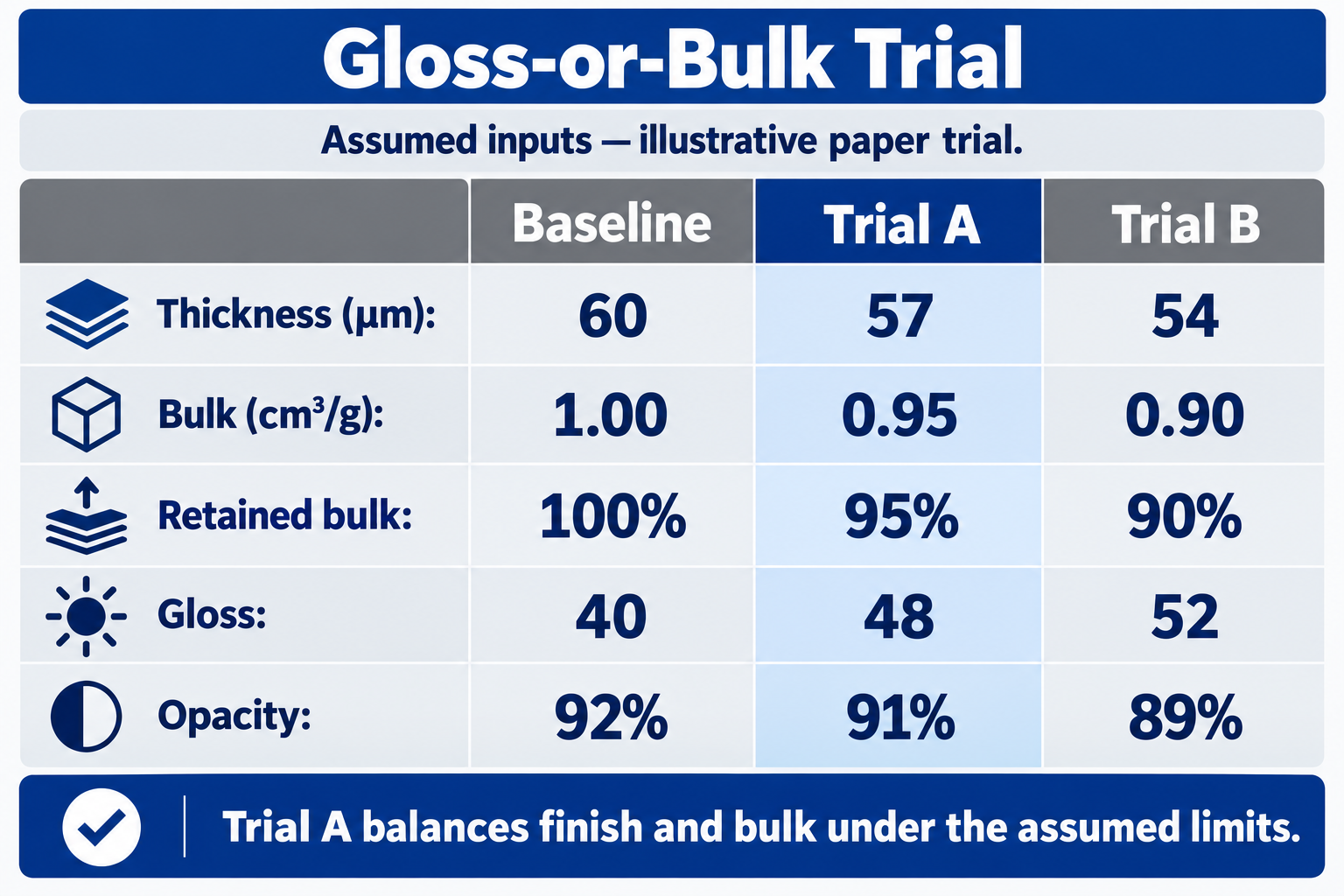
In the Gloss-or-Bulk Trial, paper samples are tested against specified limits for gloss, specific volume and opacity. A high-gloss sample, if any, that failed the test, is also shown in the same table. Production release then adds color, strength and the grade’s actual printing or converting checks.
Use the same methods for sampling, conditioning and measuring for each sample. ISO 534:2011 distinguishes single-sheet thickness from the bulking thickness of a pack. Mixing those measurements makes a retained-bulk comparison unreliable.
“The two methods generally lead to different results.”
For compatible units, specific sheet volume in cm³/g equals single sheet thickness in µm divided by grammage in g/m². Retained bulk equals the specific volume of the sample being tested divided by the baseline value, and then multiplied by 100%. Bulk is represented by the specific sheet volume.
Assumed inputs: A 60 g/m² sheet is compared at baseline and in two trial conditions. In this example, 75° gloss readings and percentage opacity readings are reported consistently. The screening limits in this example are gloss ≥ 46, bulk ≥ 0.94 cm³/g and opacity ≥ 90%. These are used for illustrative purposes only and aren’t actual mill measurements or acceptance limits.
| Metric | Baseline | Trial A | Trial B |
|---|---|---|---|
| Grammage | 60 g/m² | 60 g/m² | 60 g/m² |
| Single-sheet thickness | 60 µm | 57 µm | 54 µm |
| Calculated specific volume | 1.00 cm³/g | 0.95 cm³/g | 0.90 cm³/g |
| Retained bulk | 100% | 95% | 90% |
| 75° gloss reading | 40 | 48 | 52 |
| Opacity | 92% | 91% | 89% |
| Gloss ≥46 | Fail | Pass | Pass |
| Bulk ≥0.94 cm³/g | Pass | Pass | Fail |
| Opacity ≥90% | Pass | Pass | Fail |
| Three-metric screen | Fail | Pass | Fail |
The trial team selects between A and B for this assumed task. Trial A gives 57 ÷ 60 = 0.95 cm³/g, and hence 0.95 ÷ 1.00 × 100 = 95% retained bulk. Thus, it passes the three limits. In case of B, the higher gloss is accompanied by two limit failures. The quality lead therefore takes A for print and strength testing rather than ordering rolls around B’s finish. A financial analysis still requires actual reject and run data to determine a saving.
Use ISO 8254-1:2009 for the applicable 75° specular-gloss method and ISO 2471:2008 for the specified diffuse-reflectance opacity method. Record the tested side. Paper gloss and print gloss need not rise in the same proportion.
Add a separate color or blackening assessment. In Valerie Bland’s 1988 rotogravure-paper experiment, blackening didn’t produce widely varying opacity readings. Mechanical checks matter too: Retulainen, Moss and Nieminen’s 1997 study describes changes to fiber bonding and later treatment response. Include tensile strength, bending stiffness and the intended wetting, coating or converting test where the grade requires them.
Supercalendering defects that change a roll decision
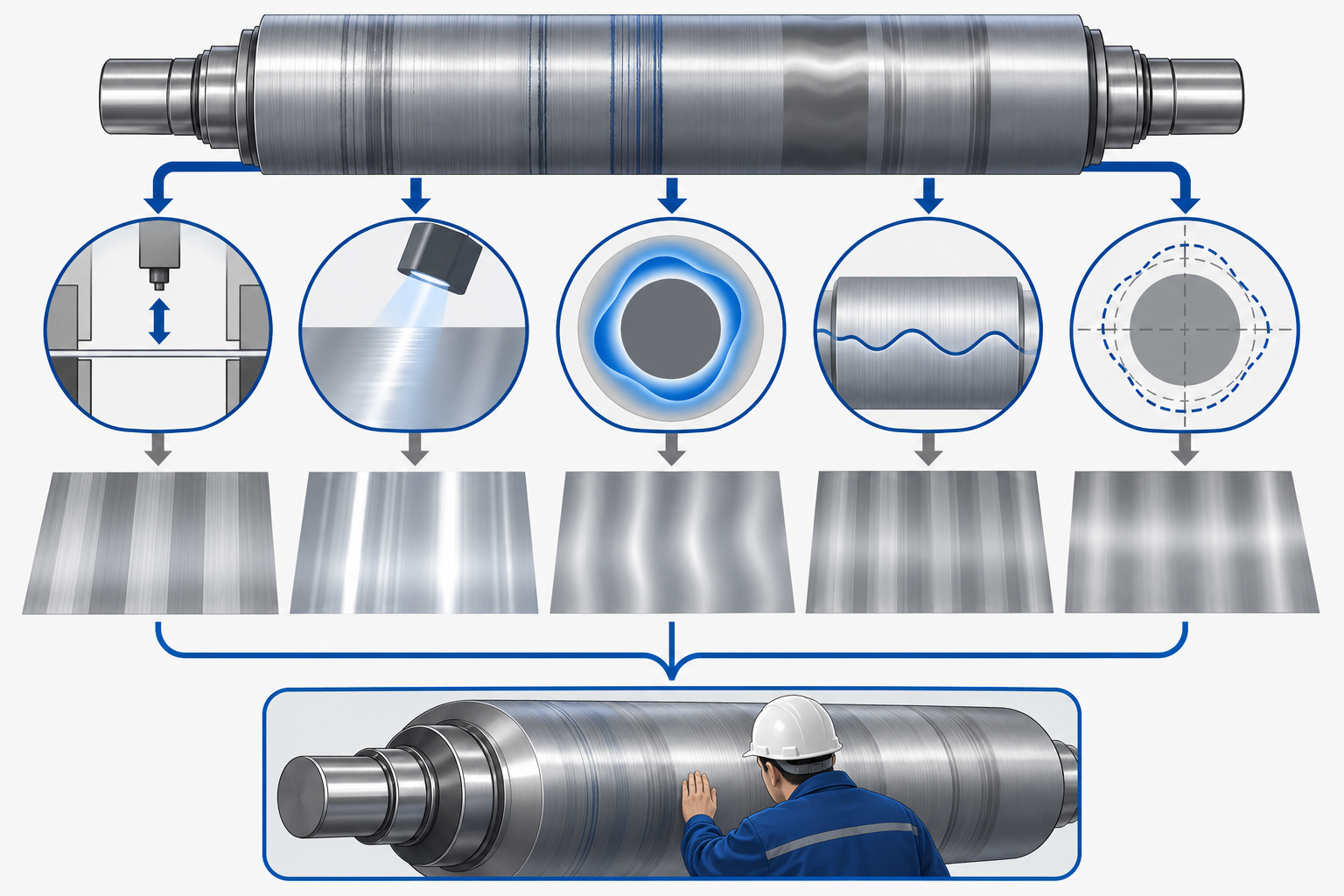
Before a roll purchase, investigate inconsistent finishes and periodic marks. Compare incoming and finished paper, identify the defect across the web and relate it to changes in the process. A recurring pattern may involve the roll stack; however, variation in incoming paper can also cause marks which finishing makes more visible.
| Symptom | Hidden constraint to examine | Purchase consequence |
|---|---|---|
| Higher gloss, unacceptable thinness | Compression needed to reach the finish | Compare nip architecture and cover response before seeking more load. |
| Darkened paper | Moisture, heating and loading interaction | Include color measurement in the trial, alongside opacity. |
| Cross-web finish variation | Incoming moisture/caliper profile and roll geometry | Separate sheet variation from a roll-profile problem. |
| Periodic marks | Upstream disturbances or stack vibration | Locate the source before prescribing another cover. |
| Good sample, unstable delivery | Web handling and winding behavior | Assess the finishing-to-reel interface with the roll change. |
Suppose periodic marks appear after a mill changes grade. Maintenance initially suspects the resilient roll because the defect becomes obvious after the stack. Before ordering a replacement, the team compares incoming web samples, notes the pattern spacing and checks whether the disturbance existed under the previous recipe. A mark already present upstream points the investigation elsewhere; a changing vibration signature keeps the stack in scope. Voith’s barring discussion describes this wider system problem, including disturbances outside the calender. Procurement can then request a roll suited to the diagnosed condition instead of buying the same construction and hoping the marks disappear.
Replacement calender-roll specifications and quotation inputs
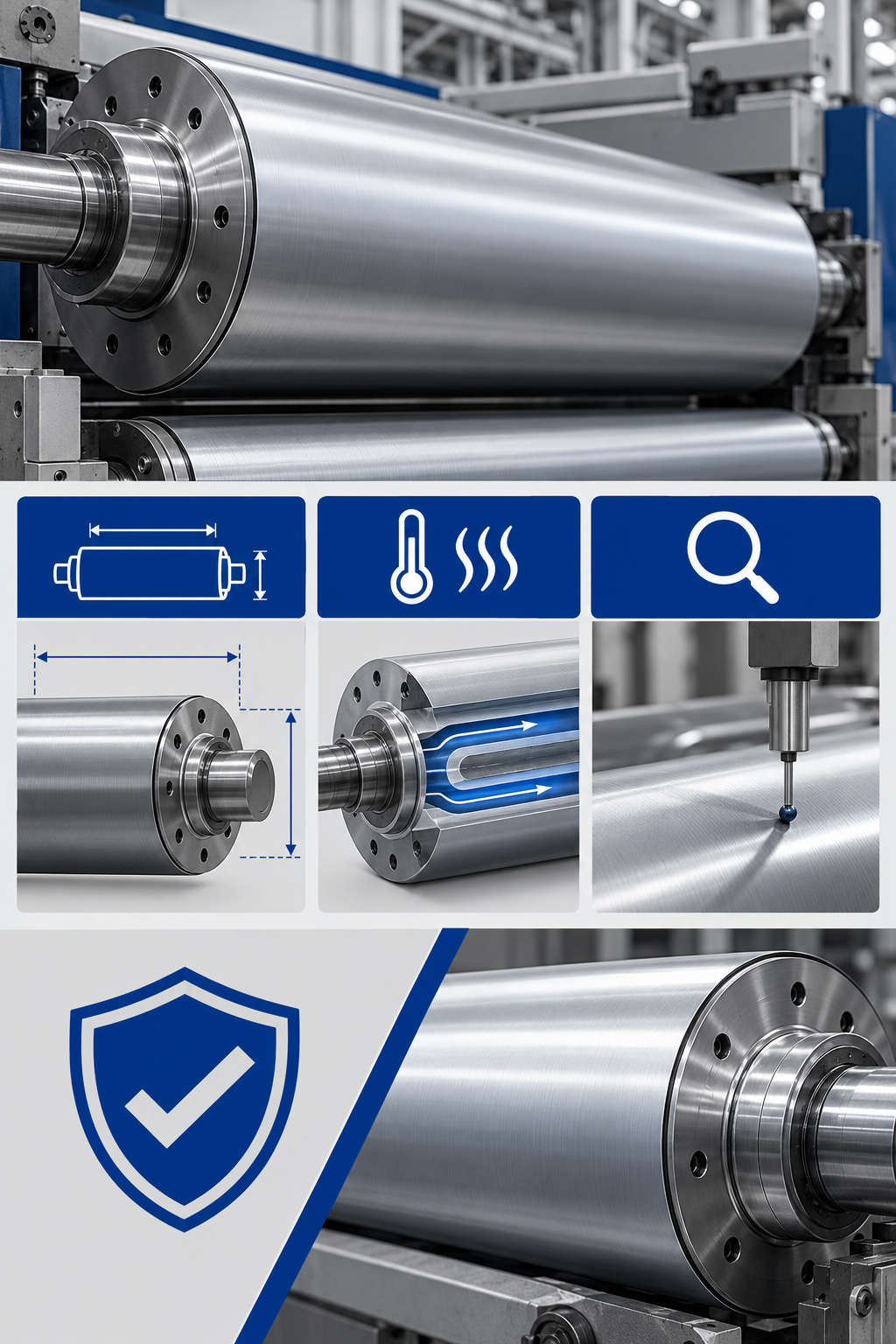
A replacement calender-roll quotation starts with the assembly drawing, stack position and actual operating duty. Diameter and face length describe only part of the fit. Journals, bearing interfaces, drive connections and the required profile must match the machine, while the surface construction must suit the paper grade and the intended nip conditions.
As a paper-machinery manufacturer, Zejiang provides replacement or upgrade calender rolls for your existing stack from machine drawings, roll measurements, or original equipment specifications. A dimensional replacement of the roll requires a different review.
Send these inputs with your roll drawing:
| Parameter | Recommended range or starting basis | Why it matters | How to verify |
|---|---|---|---|
| Diameter and face length | Current approved drawing, dimensions in mm | Sets the physical envelope | Drawing revision and measured existing roll |
| Journals and drive | Existing assembly dimensions in mm | Controls fit with bearings and coupling | Assembly drawing and interface measurements |
| Loading and speed | Current approved duty in kN/m and m/min | Defines mechanical and cyclic demands | Machine specification and operating record |
| Thermal duty | Actual surface temperature in °C and approved cover limit | Separates heating demand from material tolerance | Temperature record and cover specification |
| Surface and profile | Approved crown/profile in mm; named finish and hardness method | Defines the nip contact and sheet response | Profile report and agreed inspection method |
| Paper acceptance | Grade limits for grammage, caliper, gloss and opacity | Connects the roll order to saleable paper | Matched samples plus mechanical and end-use tests |
There are separate acceptance criteria for geometry and hardness. For rubber or plastics-covered rollers, ISO 6123 has separate documents for these properties. A harder cover is not automatically a closer-fitting roll. Include available handling space and the interface with rewinder and pope reel equipment when the project changes web handling, rather than only replacing an identical component.
Industry Outlook: covered-roll specifications in 2026
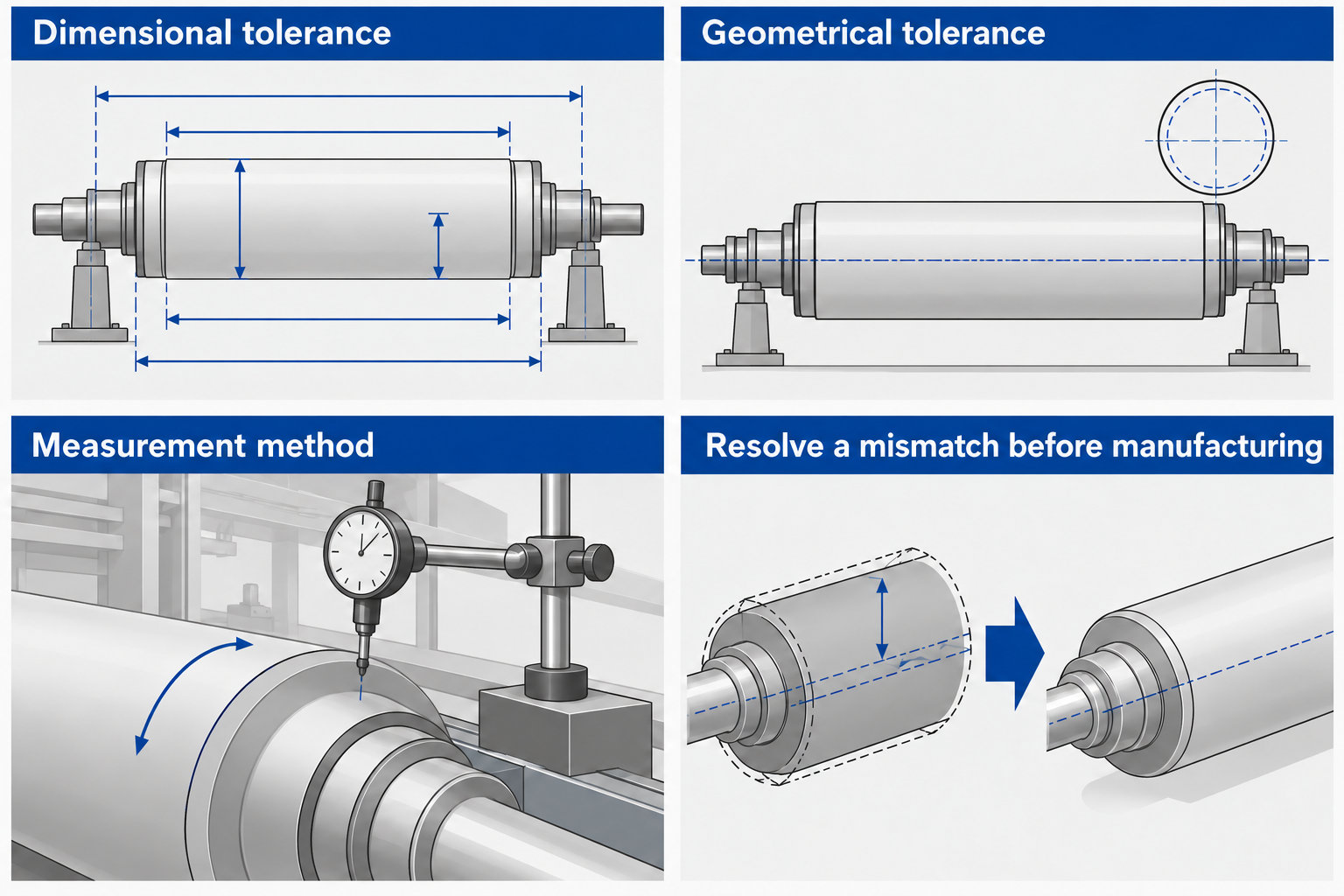
The May 2026 publication of ISO 6123-3 gives buyers a concrete reason to update references in rubber- or plastics-covered roll specifications. A purchase drawing should identify the applicable edition and agreed geometry requirements. That update helps maintain the separation of dimensional inspection and process trial to prove the performance of a roll on the intended paper.
ISO 6123-3:2026 replaces the 1985 edition and addresses dimensional and geometrical tolerance classes and measurement methods. For a new order, evaluate whether the edition on the drawing is the same as that named in the supplier’s inspection plan. Resolve a mismatch before manufacturing begins, so the finished roll is evaluated against the same requirements as specified by the buyer.
Hardness is defined in a different document. ISO 6123-1:2015 covers measured hardness of rubber- or plastics-covered rollers; its replacement is still under development in the publisher’s current listing. A planned revision and an issued standard are different milestones. Quote the version that was used for the order and keep the hardness method that was chosen with the result.
Another benefit of the material development is that it provides mills with more options than just cotton versus polymer. Valmet’s December 2023 cover discussion separates the wear-focused CL-W from the impact-focused CL-S. This separation prompts a helpful question for an upgrade: which damage mechanism is shortening this roll’s service? The answer guides the candidate cover and the trial, while drawing compatibility remains a separate task.
For a 2026 replacement project, use the approved specification as the starting point, capture any agreed change of edition or construction, and compare paper from the proposed setup with the baseline. A broader paper-machine rebuild plan becomes appropriate when the goal also changes speed, heating or reel-handling capacity. Include the required spare-roll and grinding arrangements in that plan.
Frequently asked questions
What is the difference between calendered and supercalendered paper?
Calendered paper has been finished between rolls; supercalendered paper receives the more specific finishing action of a supercalender, typically through successive nips formed between hard and resilient rolls.
The broader term covers several machine arrangements. Supercalendering is chosen for a particular surface and sheet structure. Compare the grade specification and measured paper properties when substituting one sheet for another.
Does supercalendering improve printing quality?
Yes, supercalendering can improve printing through a smoother paper surface, as long as the finished sheet also retains the opacity and mechanical properties needed for the job.
A higher paper-gloss reading doesn’t translate directly into the same increase in print gloss. Ink, coating and the paper surface interact during printing. Compare printed samples with the intended process, especially when extra compression changes caliper or causes show-through.
Is supercalendered paper always coated?
No. Supercalendered publication paper can be uncoated, while coated and specialty papers can also undergo supercalendering.
Coating describes material applied to the sheet; supercalendering describes mechanical finishing. An uncoated SC grade may contain mineral filler within its furnish, which is different from a coating layer. For buying purposes, specify the grade, coating status and required properties separately. That avoids substituting a glossy sheet with the wrong ink response or converting behavior.
Can extra nip load reduce paper opacity?
Yes. Extra nip load can densify the sheet and reduce opacity while improving gloss.
Measure opacity alongside thickness and color during a trial. A better surface reading doesn’t compensate for unacceptable show-through on the final printed page.
Can a cotton-filled roll be replaced with a polymer-covered roll?
A polymer-covered roll can be a replacement candidate when its construction, dimensions and operating envelope suit the existing stack and target grade.
The conversion needs a review of load, speed, temperature, nip behavior and interfaces. Differences in the resilient material can change paper response and maintenance demands. Compare matched paper trials and the cover supplier’s position-specific requirements before approving the substitution. Retain a workable spare-roll strategy for the new construction.
Does supercalendering add a chemical coating?
No. Supercalendering applies mechanical finishing through roll nips rather than adding a chemical coating layer.
The incoming paper may already contain additives or have a coating. Those earlier treatments affect its response, but they remain separate from the supercalendering operation.
Planning a replacement supercalender roll? Send the roll drawing, stack position, current duty and paper-quality targets to Zejiang Paper Machinery. We can review the replacement requirements and quote the matching construction.
Request a calender-roll quote or discuss your roll drawing with our team.
References & Sources
- Hubbe and Pruszynski, greaseproof paper review, BioResources, 2020.
- Effect of the Soft Roll Cover on the Paper Properties, Japan TAPPI, 2001.
- ISO 534:2011, paper thickness, density and specific volume.
- ISO 8254-1:2009 — 75° specular gloss.
- ISO 2471:2008, opacity by diffuse reflectance.
- Valerie Bland, supercalendering and blackening, undergraduate thesis, 1988.
- Retulainen, Moss and Nieminen, calendering and wetting, 1997.
- ISO 6123-3:2026, covered-roller dimensional and geometrical tolerances.
- ISO 6123-1:2015, covered-roller hardness requirements.