Get in touch with Zejiang Paper Machinery Company

Types of Paper Machine Rolls: Functions, Sections, and Selection Guide

When searching for types of paper machine rolls, you may look for a machine section, a roll function, a surface pattern or a replacement specification; all of these are layers of the same decision. The first useful map shows the web (and roll) from forming, dewatering and drying to finishing and reeling. The second pass shows the functions of the roll: to drain or support a felt, to provide a nip, to transfer heat, to guide the web or to wind a finished sheet. Comparison of shell, cover and balance, or of grooves and bearings, should only be done after the first two passes.
This guide is for engineers in pulp and paper mills, maintenance teams and buyers who need a practical starting point for a replacement, rebuild or new roll request. A paper machine layout changes with grade, former, speed and finishing configuration, so the examples below describe duties rather than universal dimensions.
“The sheets then pass through a long series of rollers that press out any remaining moisture.”
What Does “Type of Paper Machine Roll” Mean?
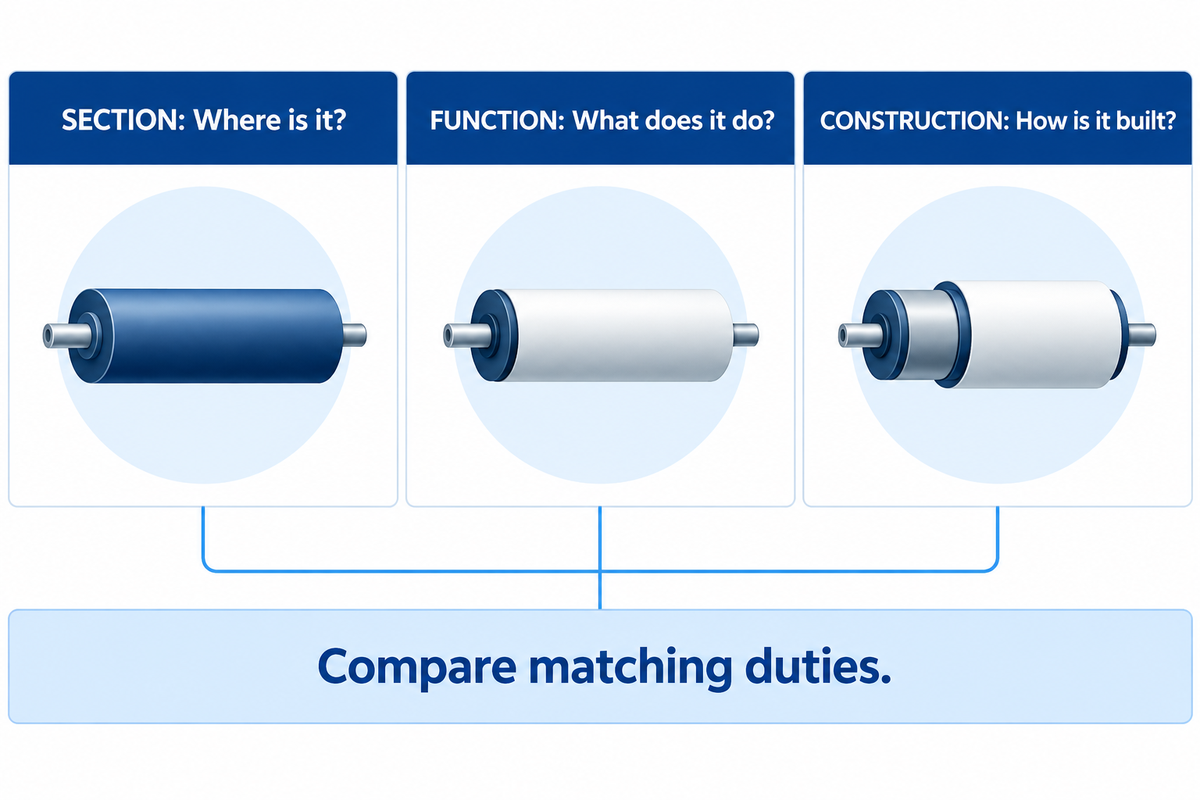
A roll can be named in three ways. The first is by position; for example, it can be the wire, press or calender roll. The second is by function; for example, it can be a suction, guiding or reeling drum. The third is by construction; for example it can be a roll with a grooved shell, a roll with a drilled shell or a roll with a covered shell. Confusing these layers causes poor comparisons: a suction roll and a calender roll are both cylinders, but they handle different media, loads and conditions. Source: SKF paper-machine roll-position handbook
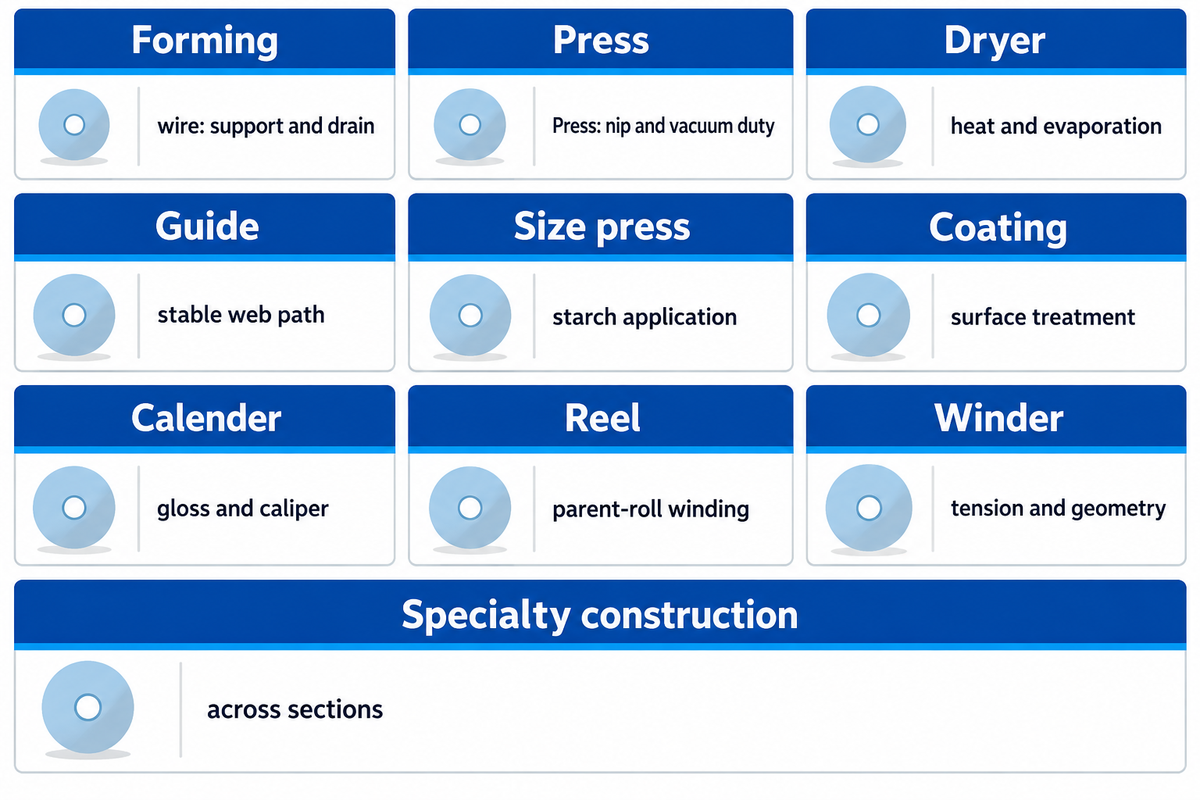
References show that a paper machine has forming or wire sections, press sections, drying sections, coating or sizing sections, calendering sections and reeling sections in sequence. The exact roll set for paper and board is line specific. The U.S. Department of Energy process diagram shows the forming, press, drying, calender and reel stages. The map should be used first and the roll function and drawing should be determined later.
Types of Paper Machine Rolls by Section
| Type / section Source: Parason paper-machine equipment guide | Roll families | Primary duty |
|---|---|---|
| Forming or wire | Breast, forming, wire drive and suction couch rolls | Support the fabric, move the web and remove water |
| Press and dewatering | Pickup, press, suction press and felt rolls | Transfer the sheet and apply controlled nip or vacuum duty |
| Dryer | Steam-heated drying cylinders and Yankee cylinders | Transfer heat and evaporate water |
| Guide | Guide, turning and vacuum rolls | Keep the web path stable through the drying process |
| Size press | Metering and applicator rolls | Apply starch or surface treatment |
| Coating | Coating, backing and metering rolls | Control coating weight and paper surface |
| Calender | Soft, hard, thermo and calender rolls | Control smoothness, gloss and caliper |
| Reel | Reel drums and reel spools | Wind finished paper into a stable parent roll |
| Winder | Spreader rolls, slitter-winder drums and rider rolls | Control tension and finished roll geometry |
| Specialty construction (across sections) | Granite rolls, ceramic-coated rolls and composite rolls | Meet a defined surface, wear or heat-transfer need |
Not all machines have all families. Some tissue machines use a Yankee cylinder instead of a long multi-cylinder dryer group. Board and fine paper lines use different presses and dryer groups. View this table as a starting point for conversations on the machine drawing. This is not a bill of materials.
For tissue paper machines with a Yankee cylinder, a replacement request must identify the press roll’s contact with that cylinder and the required softness, bulk and absorption of the finished tissue paper. A cover choice suitable for another paper grade is not automatically suitable here; ask the supplier to justify its surface and nip behaviour against the actual arrangement.
Forming, Suction, Press and Pickup Rolls
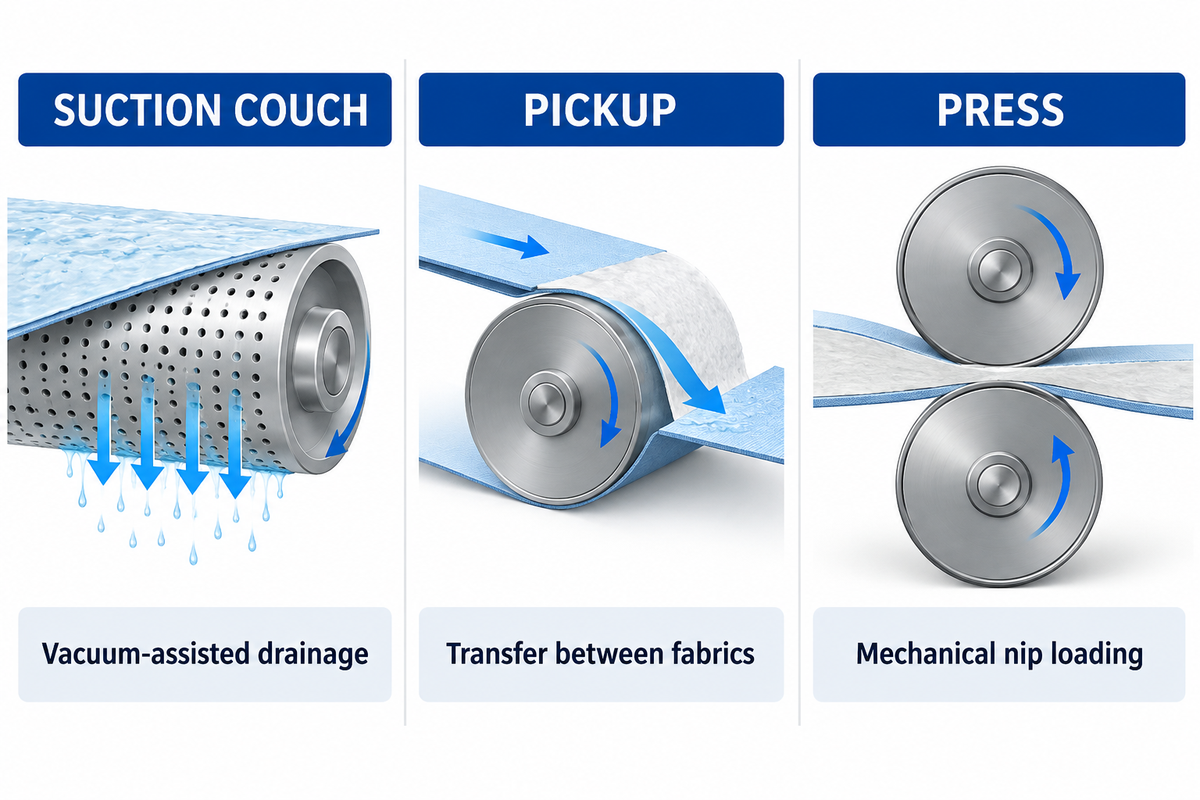
Wet-end rolls work around a lot of water and support the forming fabric to help maintain its shape. A suction couch roll uses a perforated shell to help drain the web as it approaches the press section. A pickup roll transfers the web from one fabric or felt to another. A press roll or a shoe roll creates a nip with a mating roll to squeeze the water out. A shoe press uses a concave shoe pressed against a roll to create a long nip. Source: SKF forming and suction roll reference
On a Fourdrinier paper making machine, identify whether a requested roll supports the forming wire or acts after the sheet leaves it. The Fourdrinier table supports the breast, couch and table rolls; their locations affect drainage and formation of paper. Across the forming and press sections, the sheet of paper must be supported while water is removed. Britannica describes these forming and pressing arrangements.
What is the job of a suction couch roll?
Its job is to combine web support with vacuum-assisted drainage at a defined point in the forming section. The hole pattern, vacuum zoning, shell condition and cover must match the machine. Don’t copy a hole pattern or vacuum assumption from a different width or speed. When a couch roll shows poor drainage, inspect the vacuum path, holes, cover, alignment and fabric condition together.
Dryer, Calender, Reel and Guide Rolls
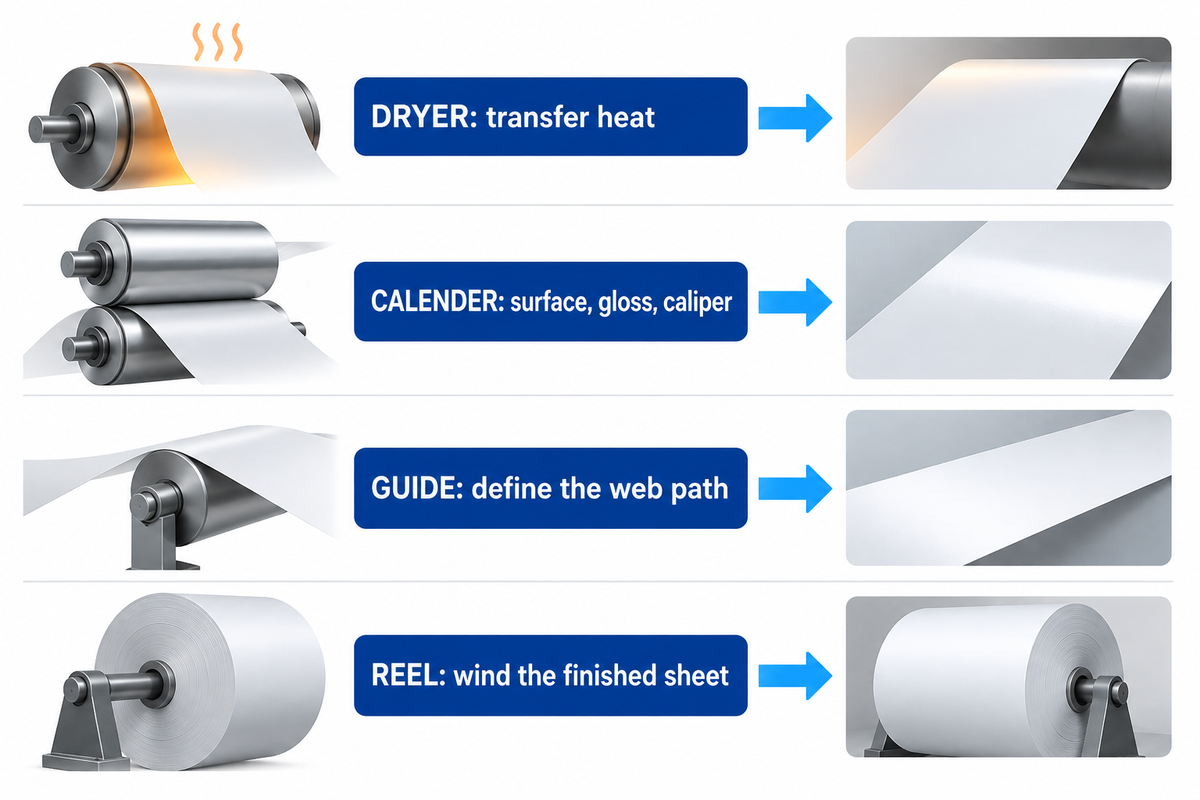
Heated rolls or dryer cylinders transfer heat through a rotating shell; Britannica puts a conventional dryer section at 40 to 70 steam-heated drying cylinders. Guide rolls and spreader rolls help define the path of the web. A calender roll works to improve the surface, gloss or caliper of the paper. The EPA pulp and paper manufacturing overview places calendering after drying and coating in its process description. A reel spool and drum help to wind up the finished sheet. This creates varying requirements for temperature, surface, crown, loading, and cleanliness.
For printing paper and writing paper, define which surface result the calender roll must deliver: smoothness, gloss or thickness control. Calendering can improve printing properties, but those targets are distinct from wet-end drainage. Compare offers against the agreed finished-sheet measurements, rather than a generic promise to improve the quality of the paper.
One finishing component example is on Zejiang’s calender roll page. This is a product-scope reference, not a universal specification for all calender stacks. The stack arrangement, roll position, cover and shell, heating, and final surface of the sheet are required.
Roll Covers, Grooves and Construction
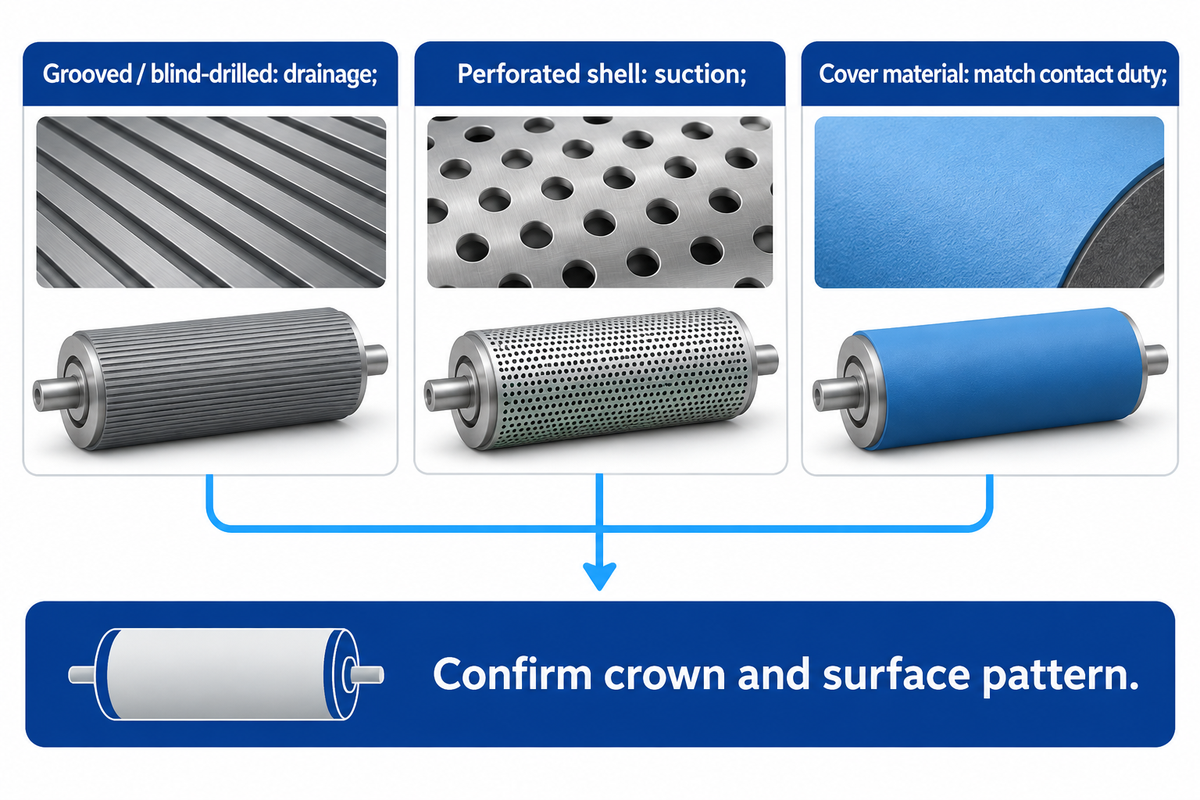
Construction needs to conform to the duty. One contact may require a smooth surface. For a grooved or blind-drilled surface, the design may require drainage in the press. Perforated shells support suction function. In contact with the nip, rolls may have rubber, polyurethane, composite or ceramic surfaces. A cover label is often not sufficient to select a roll. Source: TecnoCaucho roll-cover technical page
Ask the supplier to provide the shell material and cover system, surface pattern, hardness range, if applicable, crown or deflection control, journal-balancing method, and journal dimensions. The supplier should state the reason for a change in terms of the roll, web, felts, nip, temperature and speed if a change in the cover or crown is proposed.
When does a grooved or blind-drilled roll make sense?
It makes sense when the press design needs a defined path for water and the pattern has been qualified for the felt, loading and speed. The pattern isn’t a universal upgrade. Groove spacing, land area and cover condition influence contact and dewatering, so the pattern must be checked against the original drawing or a documented rebuild specification.
How to Choose a Paper Machine Roll for a Specific Line
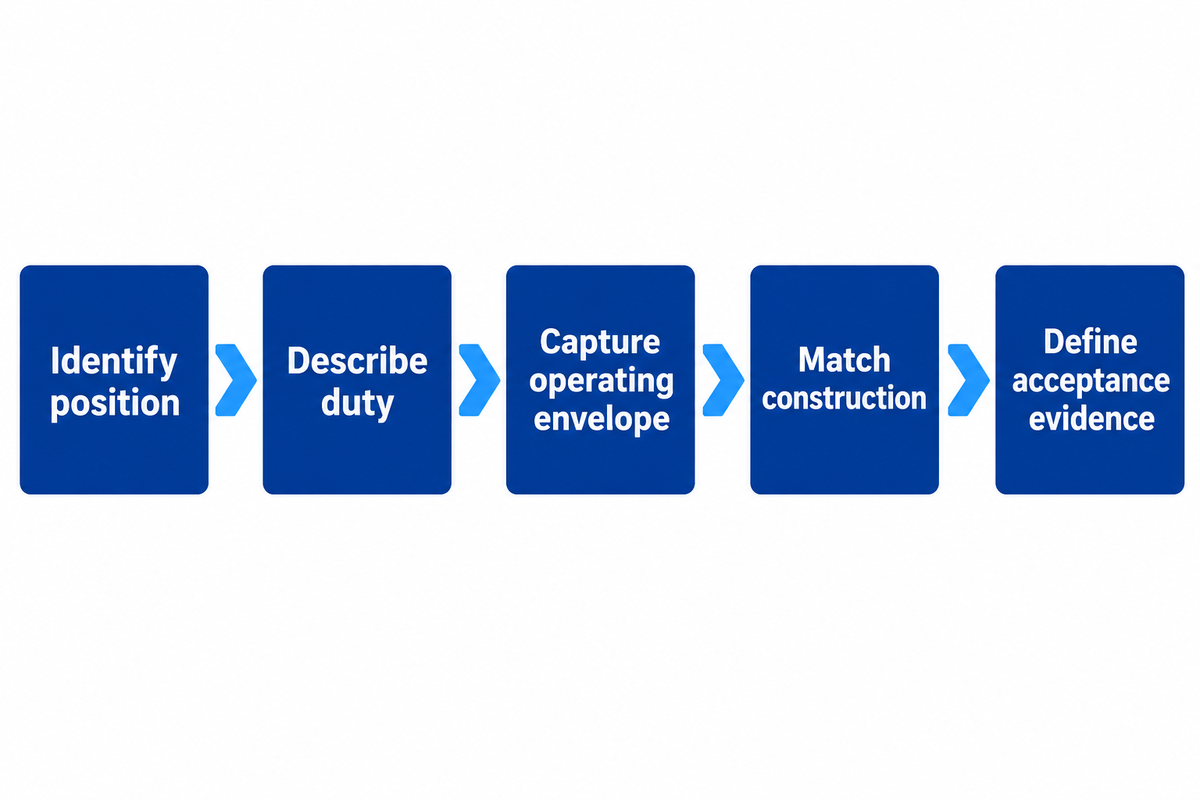
The Section, Function, Construction Map prevents a common purchasing error: a section label identifies location, a function label identifies the job, and construction identifies how the roll performs it. For example, a forming roll may need a wire-contact surface, while a press roll may need a cover and crown matched to the actual nip loading. A dryer cylinder needs a specified operating shell temperature, while a guide roll may need a clean low-friction surface. Record the real duty before comparing quotes.
In paper manufacturing, moisture removal links the press duty to the dryer section. Mechanical dewatering reduces the water later removed by evaporation, but pressing also compacts the sheet. Specify the paper grade and acceptable bulk before increasing nip duty: a change that reduces drying demand can still alter the properties of the paper.
- Identify the position: record section, roll number, mating roll and contact media.
- Describe the duty: state drainage, support, traction, heat transfer, finishing or winding duty.
- Capture the envelope: include grade, web width, face length, diameter, speed, loading, temperature and vacuum where relevant.
- Match construction: confirm shell, cover, groove or hole pattern, crown, journals, bearings, seals and balance.
- Define acceptance: agree on drawing checks, runout, dynamic balance, surface inspection and records.
A replacement roll that changes the cover or crown without a process reason may move problems downstream. Choose between a shell-and-journals rebuild and a replacement from inspection evidence. Replacement may not be the best option if covers, shells and journals are in good condition.
Paper Machine Roll Specification and Quotation Checklist
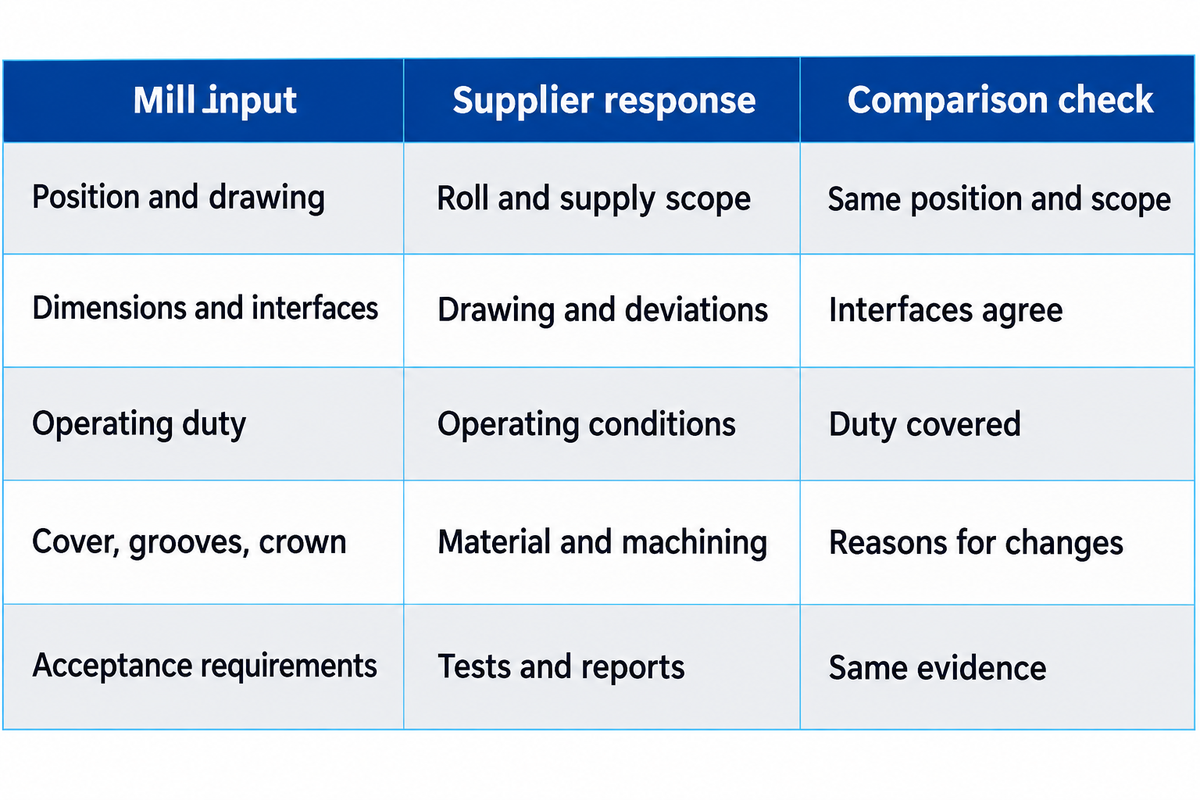
Record the machine make, model, grade and roll position; face length and overall length; shell and journal dimensions; drawing; shell or cover and surface pattern or coating; speed, contact, loading and temperature; vacuum; bearings and seals; lubrication; crown; balance; inspection and test records; packing, delivery and installation; and scope of work. For the unknown value, indicate unknown and ask for the drawing or information required. Source: Wrightspec roll-testing reference
This is the “Roll RFQ Matching Sheet”: each pair of fields shows offers that are comparable. Zejiang Paper Machinery describes its business as mill spare parts and rebuilt used machines on its company page; engineering or rebuild decisions related to a specific project will be made based on the information provided about the machine.
| Mill input | Supplier response | Comparison check |
|---|---|---|
| Roll position and drawing reference | Named roll and scope of supply | Same position and replacement scope |
| Face length, diameter, journals and interfaces | Quotation drawing and stated deviations | Installation interfaces agree |
| Speed, loading, temperature and vacuum duty | Applicable operating conditions | Recorded duty is covered |
| Shell, cover, grooves and crown | Material and machining proposal | Changes have a stated process reason |
| Inspection and acceptance requirements | Proposed tests and reports | Same acceptance evidence in each offer |
Maintenance, Failure Signs and Acceptance Checks
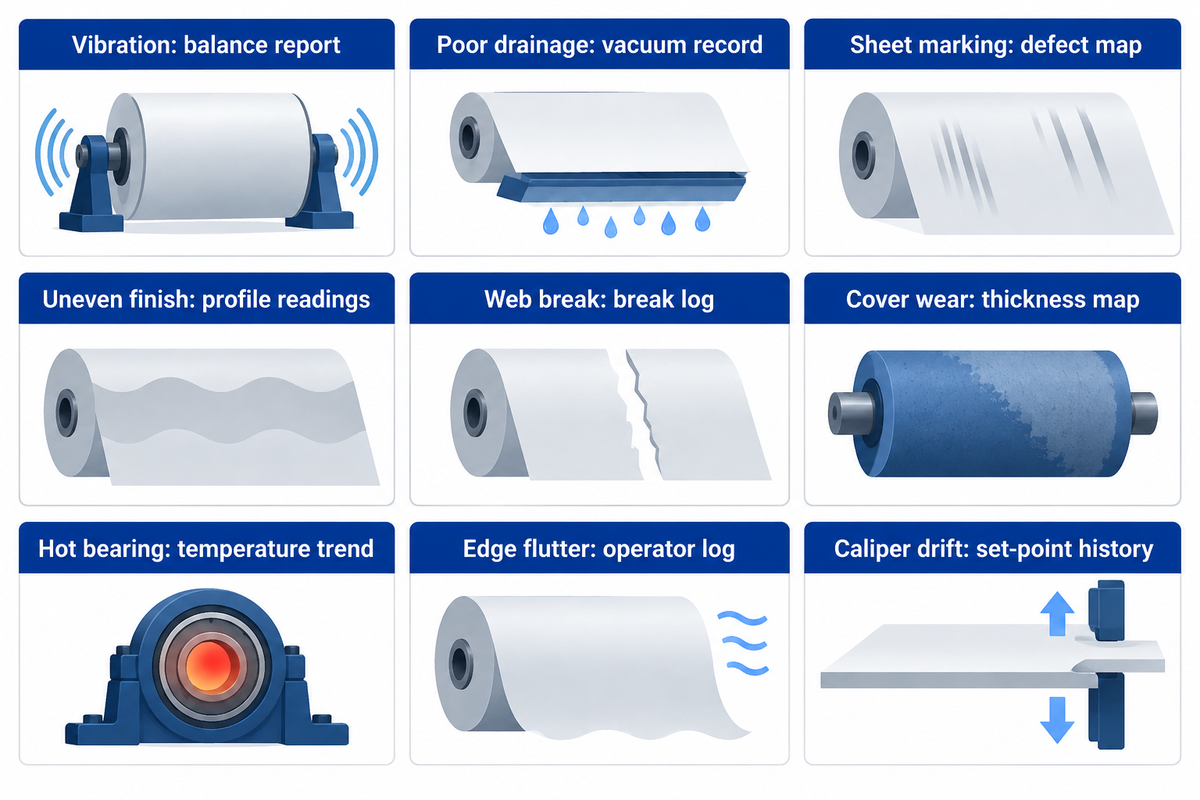
| Type of issue Source: Valmet roll-maintenance service page | First checks | Evidence |
|---|---|---|
| Vibration or barring | Balance, runout, bearings, alignment and surface | Trend, balance report and measurements |
| Poor drainage | Vacuum path, holes or grooves, cover, fabric and seals | Vacuum-zone record and surface inspection |
| Sheet marking | Cover damage, contamination, nip alignment and loading | Defect map, photos and nip settings |
| Uneven finish | Crown, temperature, cover profile and stack loading | Profile readings and condition report |
| Web break | Alignment, tension, surface damage and splice path | Break log and inspection photos |
| Cover wear | Hardness, runout, loading and chemical exposure | Shore reading and cover thickness map |
| Hot bearing | Lubrication, seal, cooling and journal condition | Temperature trend and bearing report |
| Edge flutter | Spreader setting, crown, tension and web width | Profile readings and operator log |
| Caliper drift | Stack loading, crown control, temperature and nip | Cross-machine profile and set-point history |
Acceptance should be linked to the roll position. “New cover” isn’t sufficient if balance, journals, seals or surface pattern are also part of the risk. Use the mill’s qualified lockout, inspection and commissioning procedures for rotating equipment.
To assess production efficiency after a roll intervention, compare downtime, recurring sheet defects and maintenance intervals with the recorded baseline. Judge the outcome by those measures, not by purchase price alone.
Common Mistakes When Comparing Roll Types
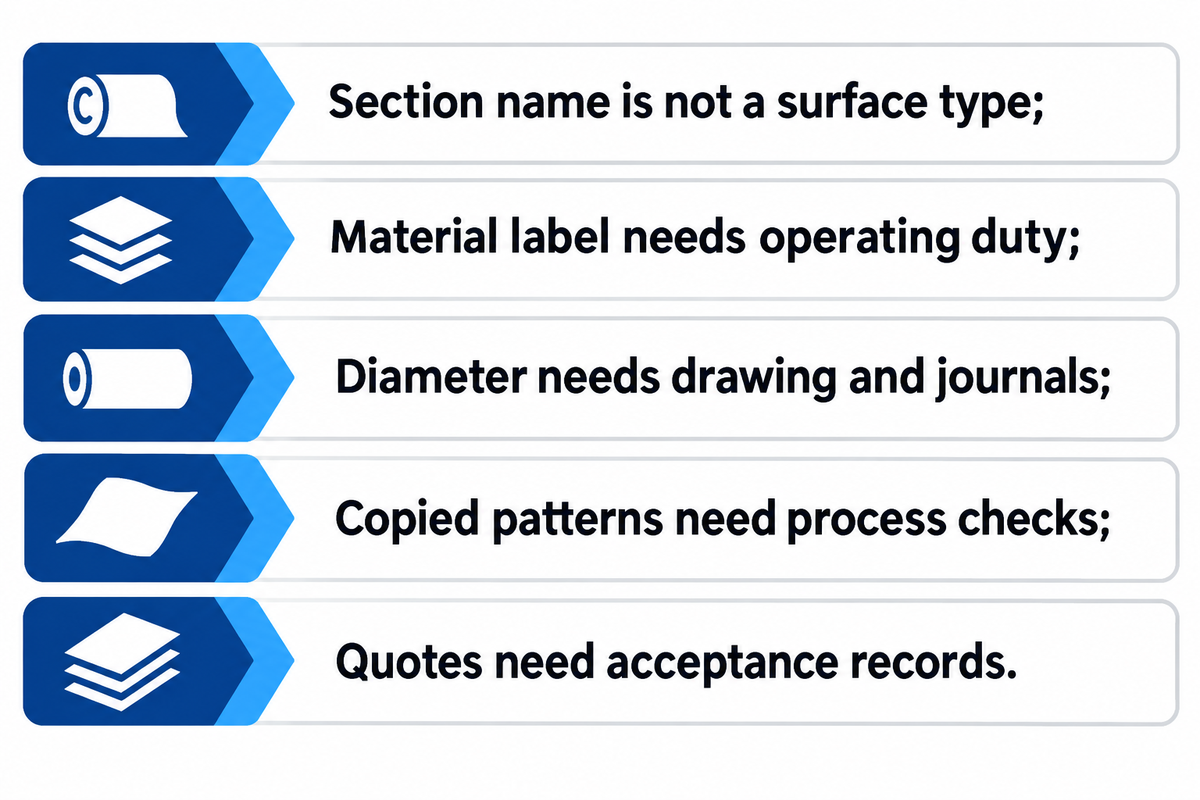
- Comparing a section name with a surface name as if they were the same category. Source: Valmet roll-maintenance service page
- Choosing a cover by material label without stating web, felt, nip or temperature duty.
- Sending only diameter and face length with no drawing or journal details.
- Copying a roll pattern from another machine without checking speed, loading and drainage.
- Accepting a quotation without defining inspection, balance and delivery records.
A Practical Decision Framework
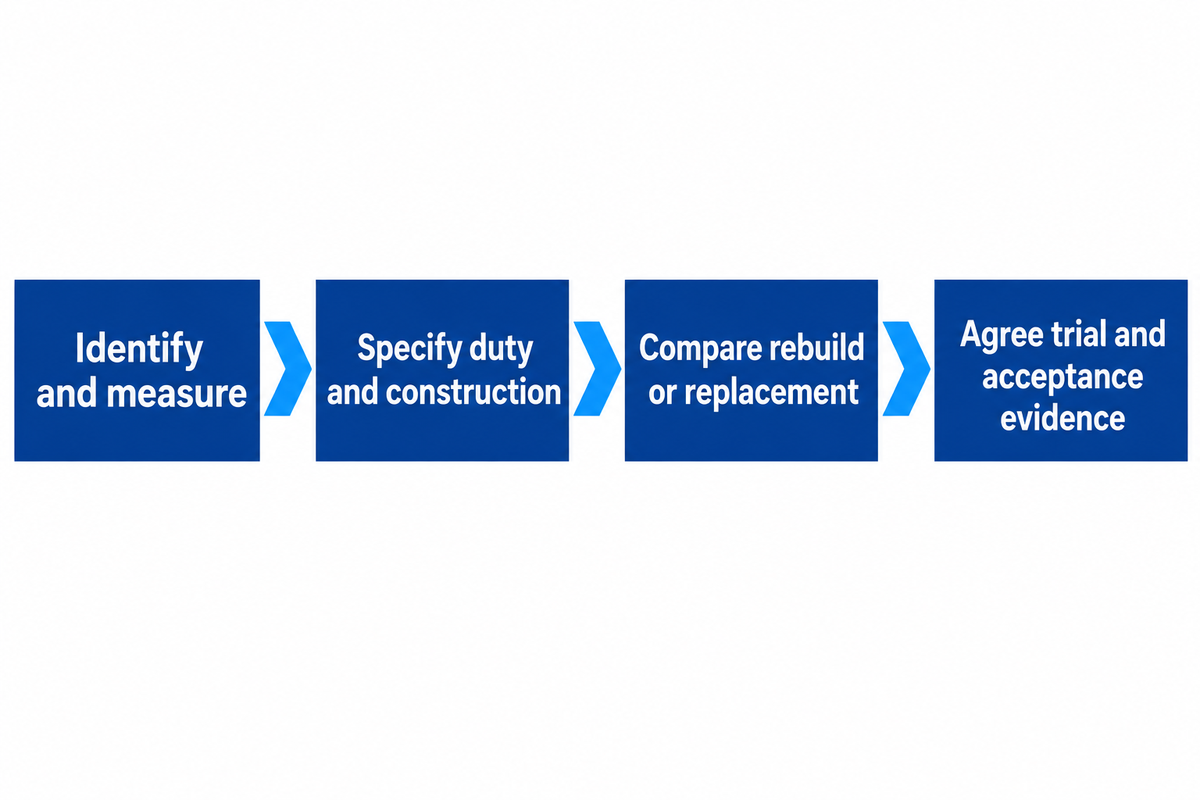
Identify the position, measure the current roll, specify the duty and construction, review a rebuild or replacement option, then define trial and acceptance evidence. If you need a finishing roll, start with the calender stack drawing and required paper profile, then use the calender roll information as a product conversation point.
Request a paper machine roll specification review.
FAQ
What are the main types of paper machine rolls?
The practical first classification is by section: forming or wire rolls, press and dewatering rolls, dryer and guide rolls, calender and coating rolls, and reel or winder rolls. Within each section, a roll can also be named by function, such as suction, pickup, spreader or reel drum, and by construction, such as grooved or covered. The exact set depends on the machine grade and layout.
What is the difference between a suction roll and a press roll?
A suction roll uses a perforated shell and controlled vacuum zone to help move water through a fabric or web. A press roll creates a nip with a mating roll and felt so mechanical loading expresses water and consolidates the sheet. Some press positions also use suction features, so drawing, vacuum arrangement, cover and nip duty must be checked together. The names describe different primary duties, not interchangeable designs.
What information do I need to order a replacement paper machine roll?
Give the machine and grade, roll position, face and overall length, shell and journal dimensions, drawing, speed, contact media, loading or nip conditions, temperature, vacuum zones, cover or coating, grooves or holes, bearings, seals, crown, balance and inspection requirements. Photos are useful, but they don’t replace a drawing or measurement. State whether the request is for a new roll, recover, rebuild or complete replacement.
Are dryer cylinders and calender rolls the same?
No. A dryer cylinder is primarily a heat-transfer and web-support roll, while a calender roll works in a finishing nip. Their shells, surfaces, temperatures, loading and maintenance checks are different.
Do all paper machines use the same roll layout?
No. Grade, former, speed, drying arrangement and finishing configuration change the roll set. Tissue lines may use a Yankee cylinder, while board and fine-paper machines often use different press and dryer groups.
Can a paper machine roll be rebuilt instead of replaced?
Sometimes. A qualified inspection should confirm shell, journals, geometry, bearings, cover condition, balance and the feasibility of machining or recoating. A rebuild is a project decision tied to the roll’s duty and acceptance evidence, not an automatic substitute for replacement.
Terminology for Paper Mill Buyers
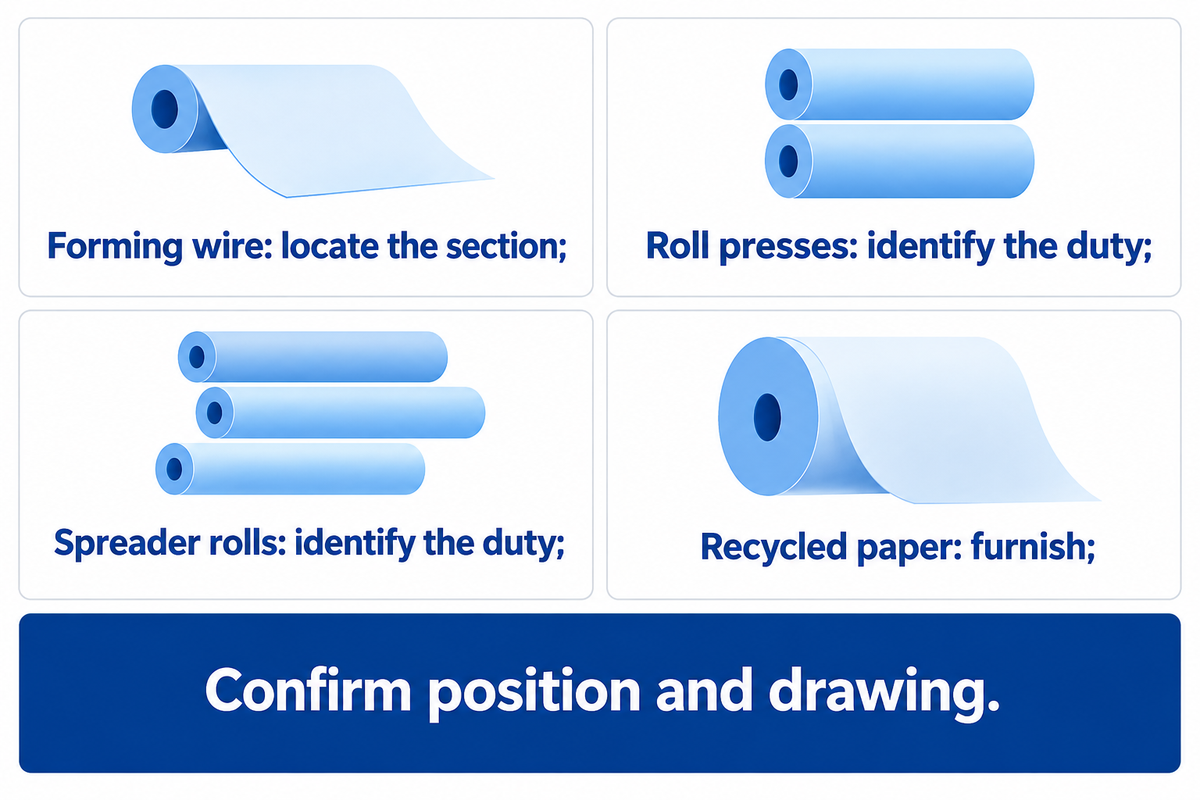
When a buyer says “roll presses,” “spreader rolls,” or “forming wire,” the supplier should map that language to the actual paper making process. A Fourdrinier machine uses a forming wire, wire mesh and table rolls; a cylinder mould machine uses a different forming arrangement. Modern paper machine equipment can combine a twin wire former, suction boxes, roll presses, drying section, coating station and reel. The correct question is which section of the paper machine needs the part and which result the paper mill must hold when making special paper on an industrial paper machine. Source: SKF paper-machine terminology reference
For the pulp and paper industry, the useful acceptance terms are paper sheet support, drainage in the forming section, drying cylinders, production speed, production capacity, printing quality, printing properties, and finished paper profile. Those phrases describe measurable outcomes. They’re more useful than a generic request for “a roller” or “a paper roll.”
These terms should be tied to the production line, the machine direction and the water content at the roll position. A papermaking machine is a system of paper machine sections, not a single roller; rolls are used to move, drain, press, dry and finish the sheet.
A request for a roll for recycled paper describes the furnish, not a unique roll family. Record the machine position and actual duty alongside that furnish description; it cannot replace the roll drawing. The EPA distinguishes mills by fibre source and finished product.
References & Sources
- SKF, Rolling bearings in paper machines named roll positions and sections.
- Handbook for Pulp & Paper Technologists process sequence.
- Zejiang Paper Machinery About Us company scope.
- Zejiang calender roll first-party product context.