Get in touch with Zejiang Paper Machinery Company


A disc refiner is the machine that takes raw pulp fibers and prepares them for a paper sheet, mechanically developing the bonding potential needed for strength, formation, and softness. Every mill running kraft, recycled, or mechanical pulp lines uses one, yet most technical literature on selecting a refiner doesn’t cover the engineering behind it. Here, we’ll walk through how this equipment works, the type differences that matter for your furnish, and the selection and maintenance factors that keep a refining line at target freeness while conserving energy. (This guide covers pulp disc refiners for papermaking — a related but distinct category from MDF refiner plates used in wood-panel manufacturing, sometimes called a wood refiner in that industry; the engineering principles differ enough that the two aren’t interchangeable.)
Quick Specs
| Operating consistency | 3-6% (low consistency refining) |
| Specific edge load (SEL) | 0.5-3.0 J/m (TAPPI-referenced range) |
| Specific energy, LC refining | ~10-50 kWh per metric ton |
| Freeness range (CSF) | 200-700 mL, commonly cited |
| Common configurations | Single disc, double disc, triple/twin disc |
What Is a Disc Refiner?
A disc refiner is built from two discs spaced closely together, at least one of which rotates, both covered in a serrated or bar-patterned plate. Pulp slurry is pumped in between them, and the outward travel plus rotation drive the fibers toward the periphery under centrifugal force, where the bars rub, cut, and disperse the fibers to whatever degree the operator sets with the plate gap.
In most designs one disc rotates clockwise while the other stays stationary or counter-rotates — one documented large production unit runs at 1800 RPM, driven by a motor rated in the thousands of kW, which gives a sense of scale for high-capacity lines — and the resulting abrasion against the raw materials is what shapes the fiber ends as the operator adjusts the distance between plates. This continuous design replaced the batch beater as the standard on most larger mills, because it allows refining intensity and pulp quality to be changed on the fly, without stopping between grade changes — a design principle documented across decades of refiner engineering, including in USPTO-published disc refiner design patents that keep refining this same basic two-disc arrangement for better energy efficiency.
That mechanical action creates fibrillation: the fiber surface frays and develops additional bonding sites, which is what gives the finished paper its tensile strength, sheet formation, and softness. That fiber development is the whole reason the refining system exists in a pulp and paper mill — refining doesn’t add anything to the fiber, it only works the surface the mill already has. Skip this step, or run it out of tolerance, and the failure shows up downstream as weak paper strength or inconsistent formation, not as an obvious problem at the refiner itself, which is why the equipment matters more than its unglamorous role in the process line suggests. In a typical application, a mid-size mill line depends on this single unit to hit its target freeness consistently, shift after shift, regardless of whether the line runs 100 tons per day or several times that.
Q: What is the difference between a deflaker and a refiner?
View Answer
A deflaker, by comparison, breaks up flakes, lumps and knots in waste paper, machine broke or knotter-screening pulp; it separates fiber clumps for better handling by downstream equipment, but it does not develop fiber bonding. The disc refiner does the reverse: it takes already dispersed fiber and mechanically works the surface to build bonding potential. mills often run a deflaker followed by a disc refiner in a recycled fiber line, not one serving the function of the other, although this confusion is a common early-career mistake when reviewing a stock prep diagram for the first time.
How a Disc Refiner Works: Fibrillation, Gap, and Specific Energy
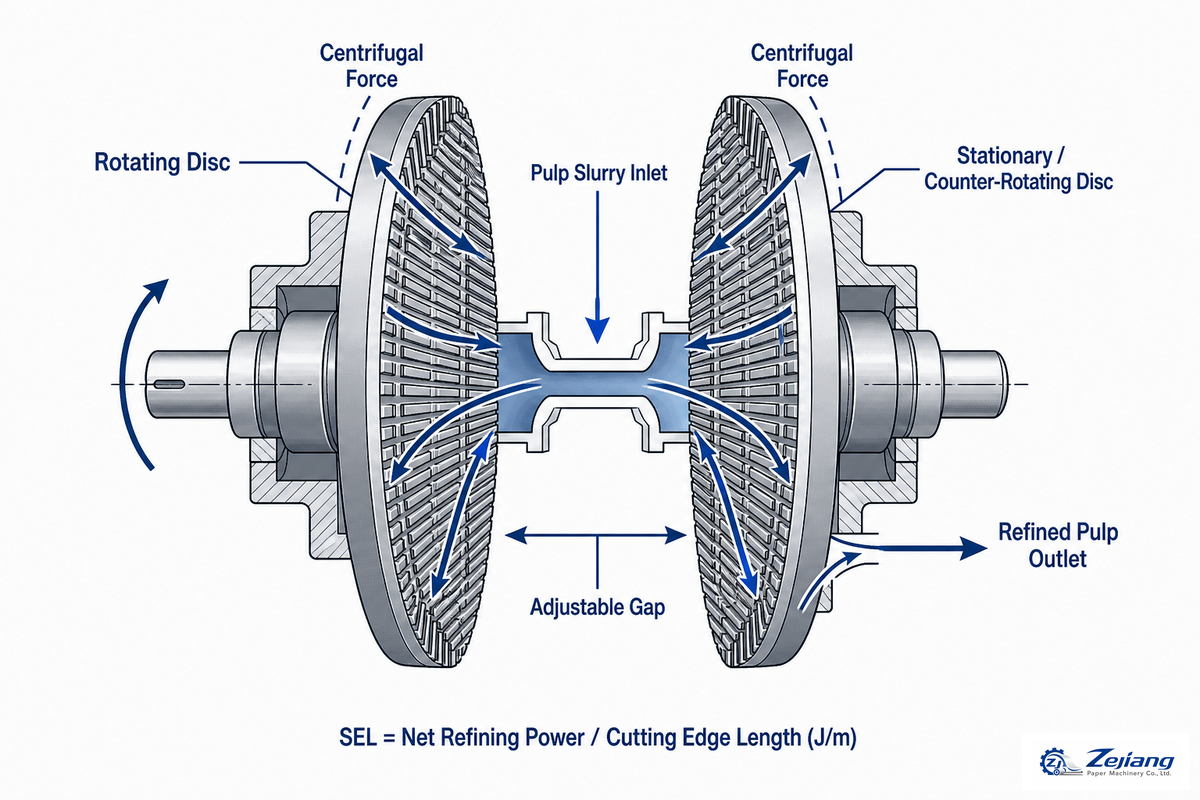
Refining intensity in a disc refiner is set by two measurable parameters, not by rotation speed alone: specific edge load (SEL), typically 0.5-3.0 J/m, which measures energy per unit of bar-crossing length, and specific energy, which measures total energy transferred per ton of pulp processed.
According to TAPPI’s published research on low-consistency refining of mechanical pulp, one documented mill runs its LC refiner at about 0.8 J/m SEL to meet a tensile index target, with specific energy running around 10-50 kWh per ton for LC refining.
That number is certainly worth comparing to high-consistency thermomechanical pulping, which is a whole different ball game. One 2021 Nordic Pulp & Paper Research Journal article on mechanical pulping energy efficiency cites a Scandinavian TMP specific energy for newsprint-grade pulp of about 1,800 kWh/ton, nearly two orders of magnitude higher. If a spec sheet or a supplier rep quotes you an energy number, and doesn’t mention consistency and pulp type, there’s really nothing to compare it against.
The very mechanism of internal fibrillation has an absolute maximum, too, that you need to know before thinking “more intensity is better, always.” A study published through NC State’s BioResources journal on refining intensity and internal fibrillation, shows how the more intensity you apply, the faster you generate internal fibrillation, and also the faster you short-shred the fiber, beyond a point where strength gains diminish significantly, but fines continue to skyrocket. TAPPI’s own literature on the same subject elaborates, and notes that intensity language is used loosely in the industry, and a “harsher-sounding” refining action doesn’t always mean more effective for the furnish; it comes down to plate pattern and gap setting, in addition to sheer energy input. Total energy consumption climbs with the degree of refining a mill targets, and high-intensity refining pushed well past the target freeness burns energy without matching gains in paper strength.
Across six evaluated process configurations at the Holmen Paper Braviken mill in Sweden, low-consistency refining came out more energy efficient than high-consistency refining at matching tensile-index gains — and the combination of double-disc chip refining with LC refining delivered the highest energy efficiency of any configuration tested.
— Findings summarized from Christer Sandberg, Jan-Erik Berg, and Per Engstrand, “Low Consistency Refining of Mechanical Pulp — System Design,” TAPPI Journal (2017)
⚠️ Important
You cannot compare refiner performance just based on motor RPM alone. While RPM determines the tip speed of the bars, the real story is what’s happening to the fiber, driven by the SEL and specific energy values, which depend heavily on plate pattern, bar count and gap. Two refiners spinning at matched RPM can still turn out noticeably different pulp once their plate patterns diverge.
Types of Disc Refiners: Single, Double, Triple/Twin & Conical Compared
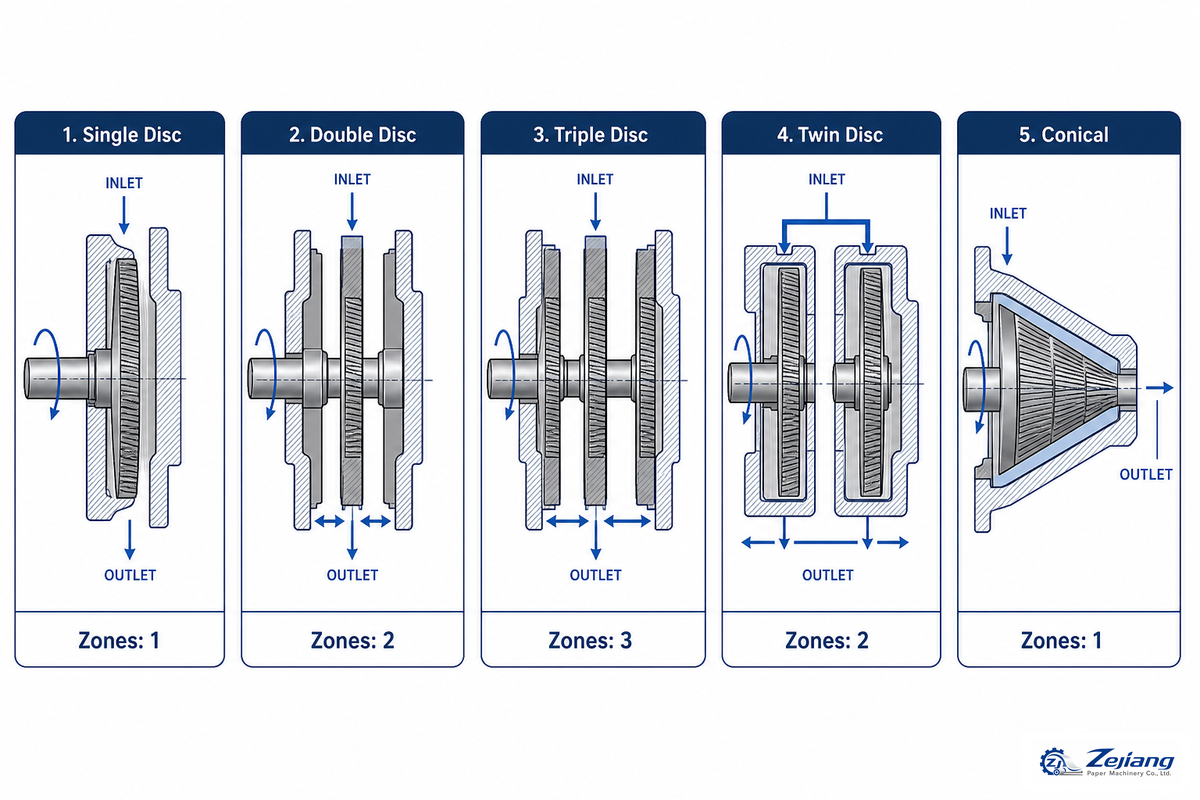
Consider a mid-sized OCC packaging mill that runs a single, aged disc on its recycled-fiber line. The production rate has been stable for years, but it’s time to evaluate whether a capacity increase is needed. The plant engineer is deciding whether to install a straight single-disc replacement, or upgrade to a double-disc in the same footprint. The decision has as much to do with how many refining chambers the fiber passes through in one run — and how that affects both energy use and how fast the plates wear — as it does with throughput.
Single-disc refiners are the simplest design, featuring one rotating disc and one stationary plate, which together form one refining chamber; this configuration remains common for smaller capacity mills and lab machines. A double-disc refiner uses two stationary plates sandwiching one rotating disc, resulting in two refining chambers and approximately double the throughput within the same machine footprint. Triple and twin-disc machines, with their added refining chambers, cater to mills seeking higher capacities or the ability to differentiate between coarse and fine refining within the same machine — a tri disc refiner or twin disc refiner is simply the three- or two-chamber version of the same underlying design principle. (Some literature still uses the older spelling “disk refiner” interchangeably with “disc refiner”; both refer to the same machine.) Major OEM brands sell branded lines built on this same principle — ANDRITZ’s TwinFlo and Papillon refiner series, or Valmet’s DD refiner line — and the core engineering covered here applies whether you’re evaluating a branded OEM unit or a value-focused manufacturer.
Disc geometry itself competes with an entirely different geometry — the conical refiner uses a tapered rotor that spins inside a tapered stator, moving stock axially rather than radially, instead of the flat plates covered above. That distinction comes up constantly in supplier conversations, so it’s worth a direct comparison rather than a footnote. (Laboratory disc refiner units, scaled down for R&D and quality-control testing, follow the same working principle as full-size production machines and are commonly used to develop a mill’s refining curve before it’s applied to production equipment.)
Q: What is the main difference between a disc refiner and a conical refiner?
View Answer
The difference is geometry and flow path. A disc refiner moves stock radially outward between flat parallel plates under centrifugal force, applying a uniform refining action across the whole plate face-this favors stronger cutting action, which suits softwood, recycled fiber, and packaging-grade furnish that carries variable contaminant loads. A conical refiner moves stock axially along a tapered rotor, where the gap narrows progressively from inlet to outlet, producing a gentler, staged refining action that favors fibrillation over cutting-this suits hardwood, tissue, and quality-sensitive grades where preserving fiber length matters more than raw throughput flexibility. Both geometries operate in the same SEL range; the difference is how that energy gets applied to the fiber.
| Type | Refining Zones | Typical Duty | Best-Fit Furnish |
|---|---|---|---|
| Single disc — laboratory | 1 | R&D, quality-control testing, refining-curve development | Any (scaled-down samples) |
| Single disc — production | 1 | Small-capacity lines, simplest maintenance access | General-purpose, lower-volume mills |
| Double disc — general purpose | 2 | Most common configuration for primary refining | Softwood, mixed furnish |
| Double disc — heavy duty | 2 | High-contaminant tolerance, wide gap adjustment range | Recycled fiber, OCC |
| Triple disc | 3 | Staged coarse-to-fine refining within one machine | Higher-capacity, multi-grade lines |
| Twin disc | 2 (parallel) | Capacity scaling within one machine footprint | Higher-throughput packaging lines |
| Conical — post-refining | 1 progressive | Follows a disc primary stage for fine fibrillation | Any furnish needing a gentler finishing pass |
| Conical — hardwood primary | 1 progressive | Primary refining where fiber length matters most | Virgin hardwood, short-fiber furnish |
| Conical — tissue/quality-sensitive | 1 progressive | Minimizes fines generation for premium grades | Tissue, specialty paper |
Plate geometry choices inside a given configuration still matter as much as the chamber count, illustrated by a US patent on disc refiner design with an increased gap between the fiberizing and refining zones-separating those zones lets a mill improve energy efficiency without needing a high-speed refiner to do it.
Disc refiners used on long-fiber softwood furnish generally favor these refiner types over conical geometry for primary refining, for the reasons covered in the selection section below. For mills ready to spec a unit, Zejiang’s double disc refiner range covers the single, double, and triple-disc options discussed above, sized to the furnish and capacity data covered in the next section.
Refiner Plates and Segments: How Plate Pattern Determines the Result
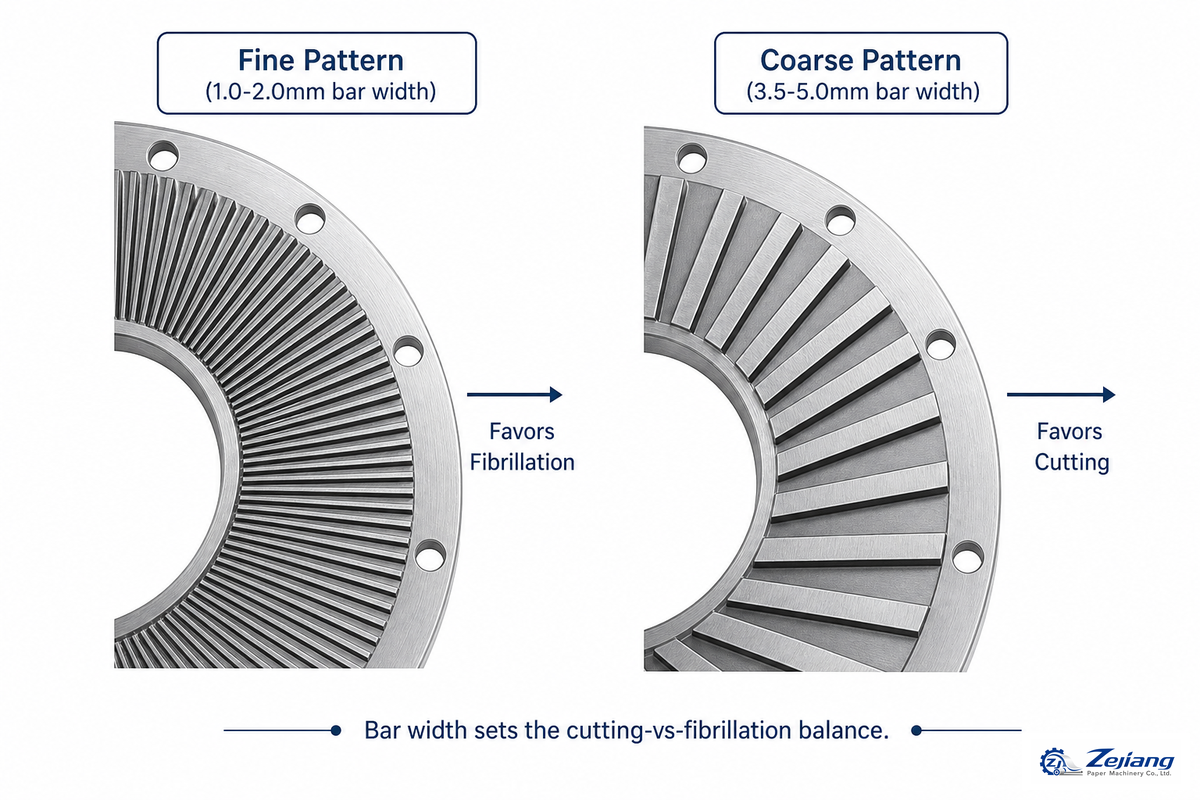
The plate-sometimes called a segment or refiner filling-is the part that actually contacts the fiber, and it’s also the wear part every mill eventually has to source. Bar width, bar depth, and the angle between bars on opposing plates set the balance between cutting action and fibrillation. A narrower, more numerous bar pattern increases fiber-crossing points per revolution, which tends to increase fiber flexibility and favor fibrillation over cutting at a given SEL; a coarser, wider bar pattern does the opposite, favoring cutting and fiber shortening. This is the mechanism behind why two refiners running identical SEL and RPM can still produce noticeably different pulp-the plate pattern, not just the energy input, decides what happens to the fiber.
Plate designers work within a tradeoff well illustrated by a US patent covering a mechanical pulping refiner plate designed to improve energy efficiency while maintaining a wide operating gap: a wider gap generally simplifies maintenance access, but the bar geometry has to compensate to hold refining performance steady. Bar and groove design remains an active area of engineering refinement rather than a solved, static component, confirmed by a second patent on bar and groove pattern design applicable across disc and conical refiner plates.
Some refining equipment literature still uses “tooth” interchangeably with “bar” for the plate pattern — the terms describe the same feature. Fiber treatment intensity should be matched to pulp type: chemical pulp such as kraft tolerates a different plate pattern than mechanical furnish, and mills running high pulp volumes need to plan plate inventory accordingly since duty cycles add up fast. Plate material matters alongside pattern: most disc refiner plates are cast in stainless steel for general-duty service, with higher-alloy options for furnish that carries heavier contaminant loads. Plates are consumable-they wear, and replacement is a recurring line item, not a one-time capital decision, because a mismatched pattern or a worn bar geometry shows up directly as an off-spec tensile index within a single production run. In the field, OEM plate suppliers hold tolerances to a fraction of a millimeter on bar height and groove depth, and in-house quality control on cast or ground plates matters as much as the pattern itself — a precision-ground plate from a supplier with years of application experience in your specific furnish holds its geometry longer than a mass-produced equivalent. For the plates and segments themselves, Zejiang’s refiner plates and screen baskets range covers pattern options across the coarse-to-fine spectrum described above.
Key Selection Factors: Consistency, Specific Edge Load, and Target Freeness

Imagine a tissue mill considering a post-refining stage for a premium grade line. Fiber length retention is far more important than throughput on this application, so the geometry and plate pattern conversation will focus on the right numbers to hit the target freeness while avoiding over-shortening the fiber – the same three numbers for any refiner selection, just weighted differently than for a packaging-grade line.
Three numbers define a defensible refiner specification: operating consistency (typically 3-6% for low-consistency refining), specific edge load, and target freeness. The target freeness will be relative to Canadian Standard Freeness (CSF), and tested under the TAPPI-documented PFI mill method (ISO 5264-2) which is the benchmark laboratory trial, on which all individual mill’s refining curves are normalized before being translated to production equipment.
Q: What is specific edge load (SEL) in refining?
View Answer
Specific edge load quantifies the amount of energy imparted to the stock per unit of bar-crossing edge length encountered by the bars each second and is reported in J/m. SEL is determined by the net refining power divided by the cumulative cutting edge length that the plates expose each second (which is a function of bar count, plate diameter and speed, but not simply RPM alone). Published literature often puts SEL in the 0.5-3.0 J/m range, and documented mill cases have reported values around 0.8 J/m for high-quality, low-intensity targets. Together with specific surface load (SSL), SEL describes how energy is applied to the fiber in each pass, and it’s the number a plate manufacturer needs to recommend a bar pattern for your target freeness.
Key Factors to Consider
- Furnish type (recycled/OCC vs. virgin softwood vs. virgin hardwood) establishes the baseline need for cutting versus fibrillation.
- Target CSF freeness range for the grade being produced
- Operating consistency the line is designed to run at
- Whether the refining stage is the primary stage, or post-refining, influences the target SEL.
| Furnish / Grade | Recommended Geometry | Why |
|---|---|---|
| Recycled fiber / OCC, packaging grades | Disc (double disc typical) | Tolerates variable furnish and contaminant load, strong cutting action |
| Virgin softwood, general-purpose lines | Disc | Handles high-intensity primary refining, wide gap adjustment range |
| Virgin hardwood, post-refining stage | Conical | Gentler progressive refining preserves shorter hardwood fiber length |
| Tissue, quality-sensitive grades | Conical | Minimizes fines generation that would reduce softness/bulk |
Ready to size a refiner against your own furnish and freeness target? See Zejiang’s disc refiner range for configuration options that match the factors above.
Where the Disc Refiner Fits in the Stock-Prep Line
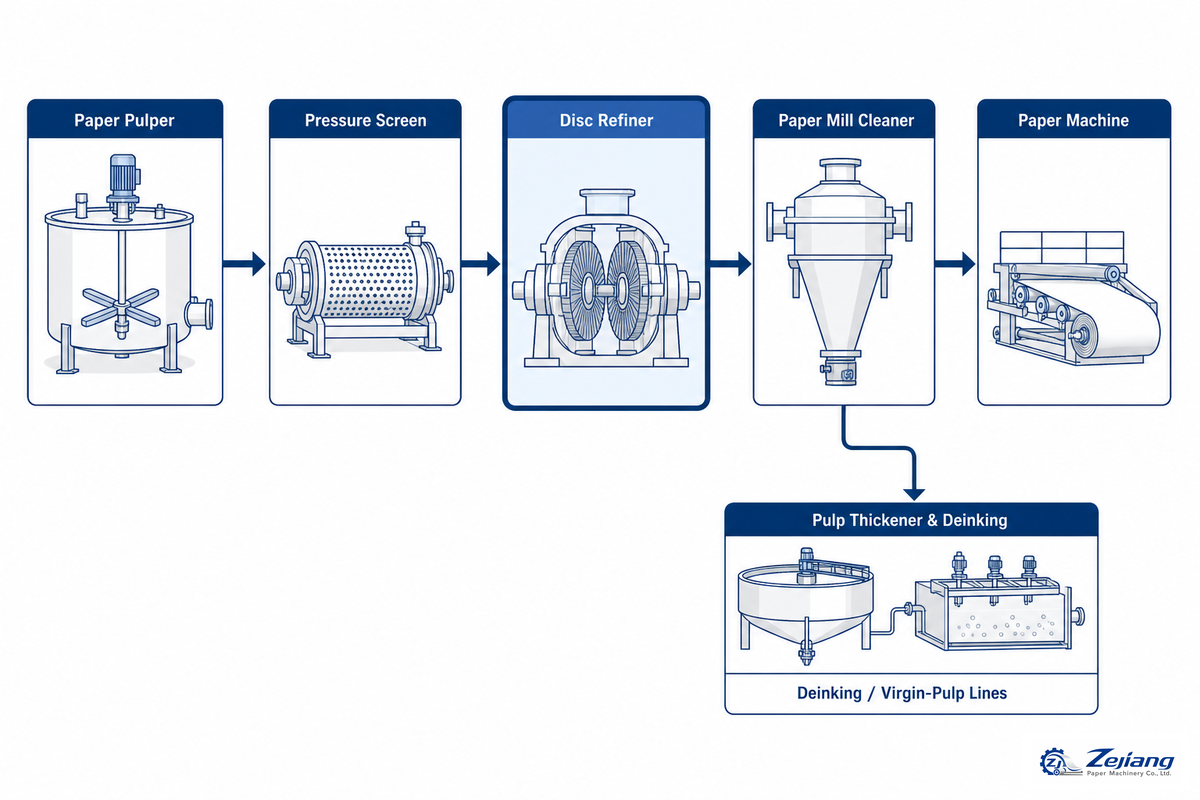
A disc refiner rarely operates in isolation. In a typical recycled-fiber line, the stock flows from the paper pulper machine (where fiber is initially dispersed from bales or broke) to a pressure screen which removes large contaminants and shives before flowing into the refiner, then on to a paper mill cleaner (for density-based contaminant removal) before reaching the paper machine. Deinking and virgin-pulp lines route stock to a pulp thickener and deinking stage elsewhere in the sequence.
Where the refiner sits relative to the screening stage matters for a practical reason: feeding a refiner stock that still contains shives and contaminants accelerates plate wear and can damage the plate surface within days rather than years, because the contaminant load concentrates mechanical stress on individual bars instead of distributing it evenly across the pattern. That’s why screening upstream of the refining stage — not just downstream cleanup — is the accepted practice on any well-designed application, whether it’s an OEM turnkey line or a mill’s own retrofit engineering. In practice, on a 24-hour continuous OCC line this single sequencing decision does more for plate service life than any single upgrade in plate material alone. Refer to the equipment-by-equipment breakdown (linked above) to see the full lineup of equipment in a stock preparation line.
Signs of Plate Wear and When to Service a Disc Refiner

Industry maintenance discussions keep repeating themselves: when the visible effect of decreasing pulp quality shows up on the paper machine, the refiner plates have already been running the mill into energy and consistency drift for some time, because the wear pattern develops gradually and the resulting cost hides inside the electricity bill rather than showing up as an obvious problem. The visible symptom is a lagging indicator, not a leading one — which is exactly the trap that catches maintenance teams who only inspect plates on a fixed calendar schedule instead of tracking a live baseline in the field. A University of North Texas digital library review of materials needs and opportunities in the pulp and paper industry makes the same point directly: refiner plate wear affects both pulp quality and power draw together, not one before the other in a way you can always see coming.
The 5-Signal Plate Wear Checklist
- Motor power draw creeping upward at a constant flow rate – the earliest signal, before quality drops
- Freeness (CSF) drifting off target at the same gap setting that used to hold it
- Visible bar rounding or reduced bar height on plate inspection
- Increased vibration or unusual noise during operation
- Downstream product quality (tensile, formation) drifting despite no furnish change
The no-load power baseline for a given refiner, plate pattern, and gap setting is worth recording when plates are new specifically so that later power-draw creep can be measured against something concrete, rather than judged by feel. Vibration and disc misalignment are also documented as recurring operational issues on double-disc units, along with contaminant ingress that shows up as noise or plate damage – reasons upstream screening quality directly affects plate service life, tying back to the line placement discussed above.
Industry Outlook: Why Double Disc Refiners Are Replacing Single Disc Units
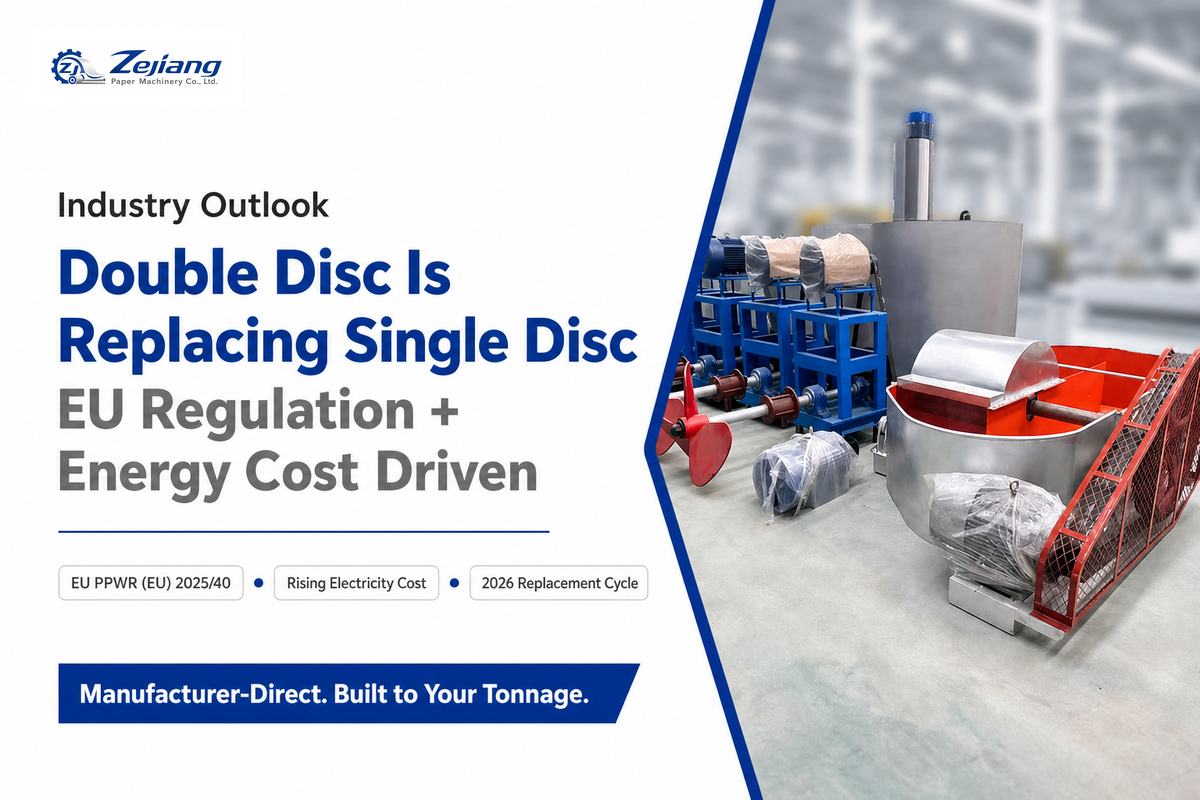
Regulation, not just efficiency, is driving the current refiner replacement cycle across the paper industry in Europe. The EU’s Packaging and Packaging Waste Regulation (EU) 2025/40 begins applying its core obligations in mid-2026, requiring all packaging to be recyclable by 2030 and pushing recycled-content targets higher through 2040. That regulatory pressure, combined with rising electricity costs, is accelerating recycled-fiber and packaging mills’ replacement of aging single-disc refiner fleets – a market analysis firm, Fact.MR, projects double disc refiners will hold roughly half of European technology share in 2026, up from single-disc dominance historically (context only: the same report sizes the broader European paper refiner market at roughly USD 148 million in 2026, growing at a 3.8% CAGR – a background figure, not the driver itself).
The Replacement-Cycle Blind Spot
U.S. search interest in the term “double disc refiner” actually fell by roughly half year over year, even as real-world double-disc adoption climbed toward half of Europe’s installed technology base over the same period. That isn’t a contradiction – it’s a reminder that buyers replacing aging equipment mostly search for a supplier or a specific model, not the generic equipment category name. If your team is tracking refiner-market demand by search volume alone, the search data will look quiet right up until the replacement decision is already being made.
For mills currently running a single-disc unit past its normal service life, the practical takeaway is that a double-disc upgrade is increasingly the default replacement spec for recycled-fiber and packaging lines, not an optional efficiency upgrade — the risk of delaying a replacement decision is that energy costs and unplanned downtime compound while the older fleet keeps aging. It’s worth confirming energy-per-ton figures with any supplier quote for your specific application, even outside jurisdictions where PPWR itself doesn’t directly apply, because the electricity-cost pressure behind the trend isn’t EU-specific: mills evaluating a replacement in the field should expect this to become the standard spec conversation within the next few procurement cycles, not a multi-year-out consideration.
FAQ
Q: Can a paper mill use both conical and disc refiners in the same line?
View Answer
Yes, and this is common practice on lines that need both throughput flexibility and fiber-quality control. A typical sequence uses a disc refiner for primary refining, where cutting action and tolerance for variable furnish matter most, and a conical refiner for post-refining, where gentler, staged fibrillation protects fiber length on the way to a quality-sensitive grade. Running both lets a mill match each geometry to the stage where its strengths matter most, instead of compromising on a single machine for the whole line.
Q: What is the Tri-Disc refiner’s advantage over a standard double disc refiner?
View Answer
A triple or twin-disc configuration adds a third refining zone within a single machine body. This lets a mill split coarse and fine refining across stages internally instead of running two separate refiners in series, or simply gain capacity within the same footprint as a double-disc unit. The tradeoff is a more complex plate-change procedure, with more plate sets to inspect and replace, so the capacity gain has to be weighed against maintenance time per service interval — a decision that depends more on line throughput requirements than on any universal advantage.
Q: How do I select refiner plates for different paper grades?
View Answer
Match bar width to the cutting-versus-fibrillation balance the grade needs: coarser bar patterns (roughly 3.5-5.0 mm, commonly categorized this way in plate supplier literature) suit heavier cutting duty on packaging and recycled furnish, while finer patterns (roughly 1.0-2.0 mm) favor fibrillation for quality-sensitive grades. Bar material and heat treatment should be matched to furnish abrasiveness — recycled and OCC furnish with higher contaminant loads wear plates faster regardless of pattern, which is a separate sourcing consideration from the pattern choice itself.
Q: Which refiner is better for recycled fiber and OCC lines?
View Answer
Disc refiners are the standard choice for recycled fiber and OCC applications because their wider gap adjustment range and centrifugal flow pattern tolerate variable furnish quality and contaminant load far better than a conical refiner’s tighter, more sensitive progressive gap, while the stronger cutting action helps break down the fiber bundles and shives that are common in recycled and mixed-waste furnish.
Q: What is the purpose of refining in papermaking?
View Answer
Refining mechanically develops the bonding potential of pulp fibers so the finished sheet has adequate tensile strength, formation, and surface properties for its grade.
Q: What is the field-reported early warning sign that refiner plates need attention?
View Answer
Rising motor power draw at a constant flow rate is the earliest signal most mills can track without a plate inspection, and it typically shows up before pulp quality or freeness drift becomes noticeable on the paper machine. Maintenance and operations staff consistently describe the same pattern: energy cost and consistency variation creep upward for a while before the visible quality drop that usually triggers a service call. The five minutes it takes to log a no-load power baseline when plates are new is worth it given this pattern.
References & Sources
- Low Consistency Refining of Mechanical Pulp — TAPPI
- Application of Refiner Plate Technology to Improve Pulp Quality — TAPPI
- The Effect of Refining Intensity on Internal Fibrillation and Fiber Shortening — BioResources, NC State University
- Energy Efficiency in Mechanical Pulping, Definitions and Benchmarks — Nordic Pulp & Paper Research Journal (2021)
- Packaging and Packaging Waste Regulation (EU) 2025/40 — European Commission
- Europe Paper Refiner Market Report — Fact.MR (2026)
- US20070164143A1, Disc Refiner with Increased Gap Between Fiberizing and Refining Zones — USPTO
- US7900862B2, Mechanical Pulping Refiner Plate — USPTO
- Disk Refiner — PrintWiki
About This Analysis
This guide was built by cross-checking disc refiner energy and specific edge load figures against TAPPI, NC State, and Nordic Pulp & Paper Research Journal literature rather than repeating unsourced numbers common on supplier blogs — several published ranges in that literature turned out narrower and lower than the figures commonly cited elsewhere for low-consistency refining specifically. Where a number couldn’t be independently verified against a primary source, we said so rather than presenting it as precise.
Reviewed by the Henan Zejiang Paper Machinery technical team
Related Articles
- Pulping Equipment Guide, the full stock-prep line, from pulper to refiner to cleaner
- Pressure Screen, removing shives and oversize contaminants before refining
- Paper Mill Cleaner, density-based contaminant removal downstream of refining
- Pulp Thickener & Deinking, recovering and cleaning fiber on deinking lines
- Refiner Plates & Screen Baskets, sourcing the wear parts covered in this guide


![Refiner Plates & Screen Baskets [Complete Guide]](https://zjpapermachine.com/wp-content/uploads/2026/07/refiner-plates-screen-baskets-guide-featured-150x150.png)
![Doctor Blade: Types, Materials & How It Works [Guide]](https://zjpapermachine.com/wp-content/uploads/2026/07/doctor-blade-guide-featured-1-150x150.png)
![Pulping Equipment: How Paper Pulping Works [Guide]](https://zjpapermachine.com/wp-content/uploads/2026/07/pulping-equipment-guide-featured-150x150.png)