Get in touch with Zejiang Paper Machinery Company


By XCX · Last updated: October 2026
Paper grain direction is the predominant directional structure formed during paper web formation in the paper machine. When paper is made on that moving web, paper fibers develop a preferred orientation even though the structure is not perfectly uniform. However, some degree of non-uniformity results in structure variation. Machine direction (MD) runs in the same direction as web travel, and Cross direction (CD) is oriented across the web. Long Grain on a cut sheet means the grain is parallel to the long edge, and Short Grain means it’s parallel to the short edge. Sheet size doesn’t necessarily indicate the grain direction.
People say paper has a grain because paper is formed in a continuous web; machine-made paper has a grain direction before it is cut. Choosing the right grain direction is particularly important when the job has a controlled fold, spine or machine path. You may not see the grain, and determining grain direction depends on a stated reference and proportionate evidence.
The practical rule
For a low risk shop decision, compare the sheet in both directions and confirm the result with a second indication. For a purchase order, production lot or machine diagnosis state the MD reference edge or arrow, test method, specimen direction, conditioning, sampling location, and acceptance criteria. Do not turn a hand test or a typical MD/CD trend into a universal specification.
Paper Grain Direction in One Minute
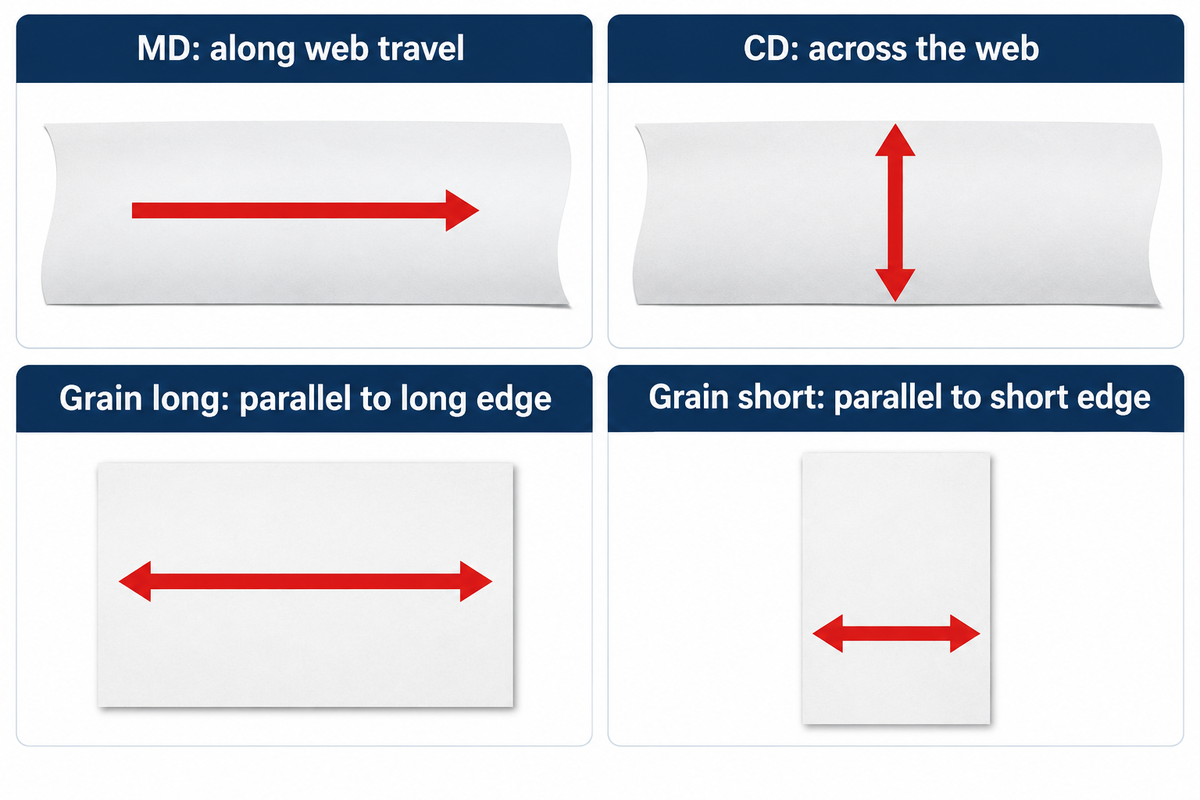
Paper is anisotropic. Manufacturing processes, methods for preparing parent rolls, and slitting and sheeting procedures all contribute to paper’s variations in behavior. Four terms keep the discussion clear when you need to know the direction rather than guess which way the grain is running.
| Term | Reference | What it tells you |
|---|---|---|
| Machine direction (MD) | Along web travel | The manufacturing reference axis; normally the length direction of a roll |
| Cross direction (CD) | Perpendicular to MD | The axis across the roll width |
| Grain long | Parallel to a sheet’s long edge | How the cut sheet relates to its dimensions |
| Grain short | Parallel to a sheet’s short edge | A different cut from the same parent web can produce this label |
| Fibre-orientation angle | Measured orientation of fibres | May differ by side and does not replace the web-direction record |
| Tensile-stiffness direction | Bulk mechanical response | A property axis rather than a label convention |
| Fold line | The line about which the sheet folds | Should be named relative to grain, not confused with hand movement |
| Specimen direction | Axis of the prepared test piece | Keeps tensile, tear and dimensional values interpretable |
| Cross-web position | Edge, quarter or center of the reel | Shows whether a directional result represents the full width |
The direction of the grain is along the length of a parent roll, usually with CD perpendicular to the grain. On a bound product, grain perpendicular to the spine is usually the relationship a book designer is trying to avoid. Dimension order and a specific number may be the supplier’s rule, but it isn’t a reliable indicator of what the supplier means.
Some suppliers say long grain and short grain where others say grain long and grain short. A square sheet makes the problem obvious: “long” and “short” disappear, so the drawing needs an MD arrow or a named reference edge. This is true for a rectangular sheet as well. A converter may cut for yield to give the most sheet per roll, and not align the edge a buyer is expecting. Grain direction is important, but the right grain description is the one tied to an edge or arrow.
From the Moving Web to MD and CD
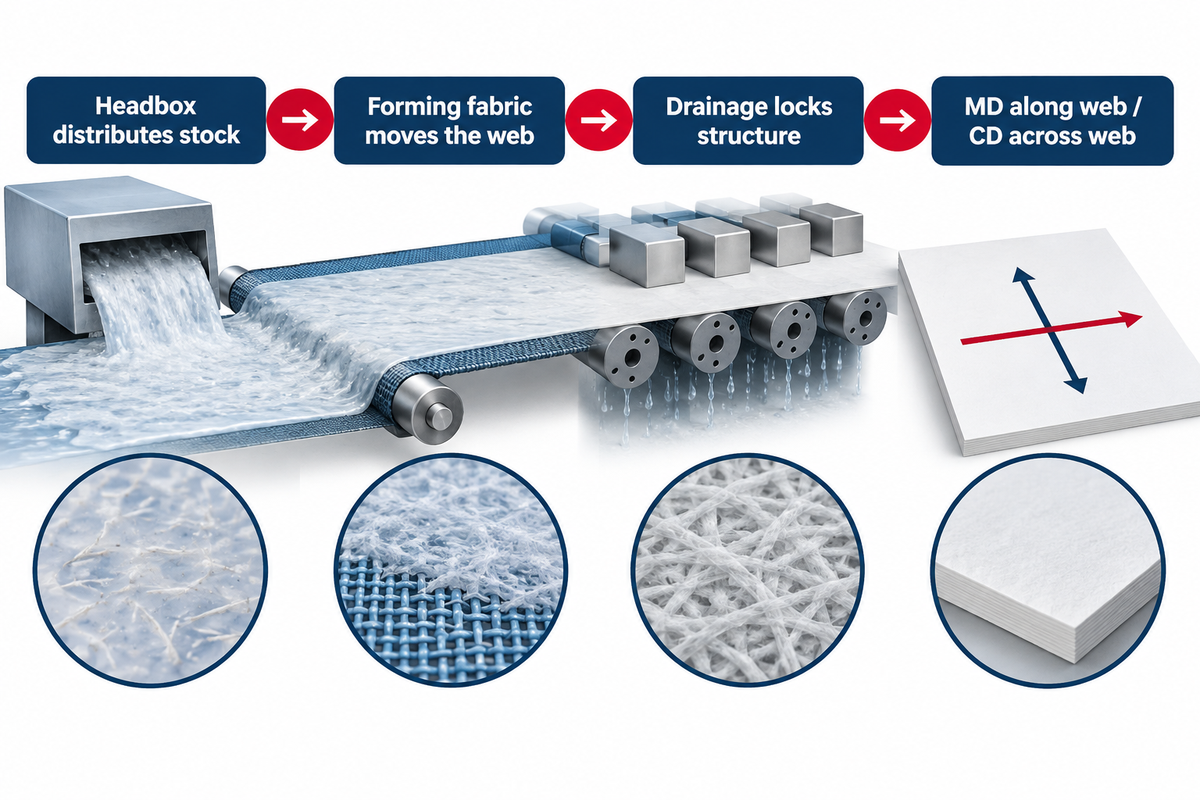
A paper machine line turns a dilute fibre suspension into a continuous web. The paper machine headbox distributes the suspension across the machine, the jet meets the moving forming fabric, and drainage begins to lock the structure into place. Flow fields, jet-to-wire relationships, turbulence, drainage and draws can all influence orientation. That’s why MD/CD balance belongs to the forming discussion, but no single setting explains every finished-sheet result.
Most fibres tend to develop a preferred fibre orientation associated with the moving web and across the surface. The final product also reflects the effect of many process variables including finishing, drying, and bonding. A preferred fibre orientation measured by optical methods and mechanical-property directions indicated by tensile and flexural tests are related observations, not interchangeable readings of one quantity. The bulk mechanical response of a product can also differ from the surface mechanical response. Also, the effect of construction can influence the response of a product to various mechanical stimuli.
Does machine direction always equal the grain direction marked on a cut sheet?
MD is the machine direction. Grain long and grain short describe how the sheet was cut relative to MD. Cutting a sheet in MD doesn’t change the fibre orientation, and thus cutting the sheet doesn’t rotate the fibres. A reference mark stating “MD is parallel to the 1020 mm edge” is clearer than stating “grain long.” For a roll, the MD is in the same direction as the web travel and the CD is in the width direction of the roll.
How to Identify Grain Direction Without a Label
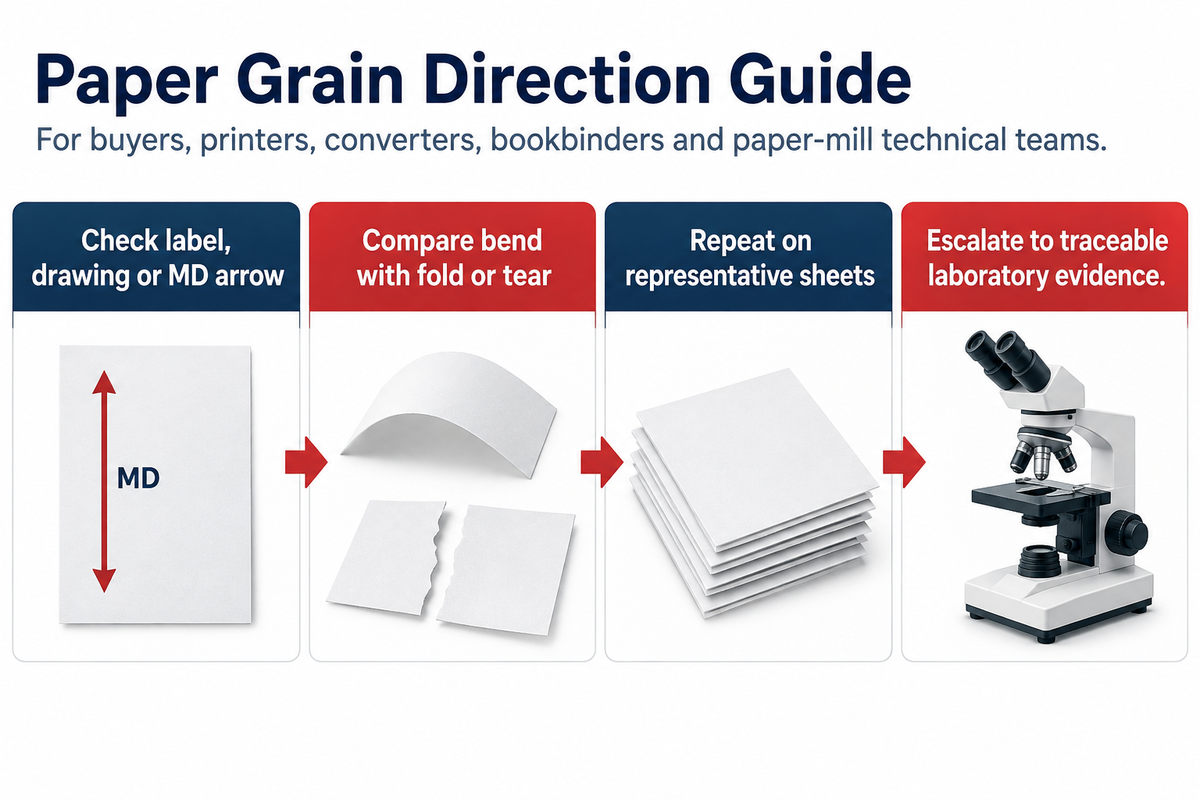
Start with the least damaging evidence. A non-invasive bend comparison is one of several ways to determine grain. A sheet of paper can feel stiffer in one direction, but touch alone isn’t enough to determine paper grain. If the consequence of a wrong call rises, move to a method that’s traceable to the lot and question being answered.
- Look for explicit supplier evidence. Check roll maps, ream labels, certificates or drawings for an MD arrow or named edge. Confirm what the supplier’s notation means instead of assuming an underline or dimension sequence is universal.
- Compare bending resistance. Bring the edges of the sheet gently toward each other from the outside in, as if folding a wallet, without creasing. Rotate 90 degrees and repeat. Often one orientation is easier to bend. Mark the line that you believe runs with the grain, because “the way my hands moved” and “the fold line” are very difficult to discern later.
- Fold or crease representative scrap. Fold the paper in both directions under comparable conditions. A sample folded with the grain will often form more easily and cleanly than one folded across the grain. Heavy, coated or laminated stock may crack during processing due to score geometry and/or other reasons. So a rough first fold isn’t a grain verdict by itself.
- A tear can be another source of evidence. Paper tears and folds more easily in some orientations, but furnish and sheet structure can blur the result. Laboratory tests of tears also require precision. The direction of specimen and the direction of tear propagation aren’t the same thing.
- Treat moisture response as evidence. Dampening a small strip of a sample can reveal which way it wants to curl and/or expand. This response can also indicate two-sidedness and the presence of a coating. “Curl with the grain” is an observation. It shouldn’t be the sole basis for a purchase acceptance decision.
What should you do when two grain tests disagree?
When two tests disagree, don’t vote two-to-one and say the problem is solved. Repeat them on representative sheets, confirm which line each method identifies, record top and bottom sides, and check whether samples came from the same cross-web position. Sample history also needs to be evaluated. Laminated, creped, extensible, and other engineered papers may make informal direction tests unreliable. For those stocks, rely on the supplier’s MD record or a laboratory procedure such as TAPPI T 409, a standard practice for determining the machine direction of most paper and paperboard grades.
MD vs CD: A Property-by-Property Matrix
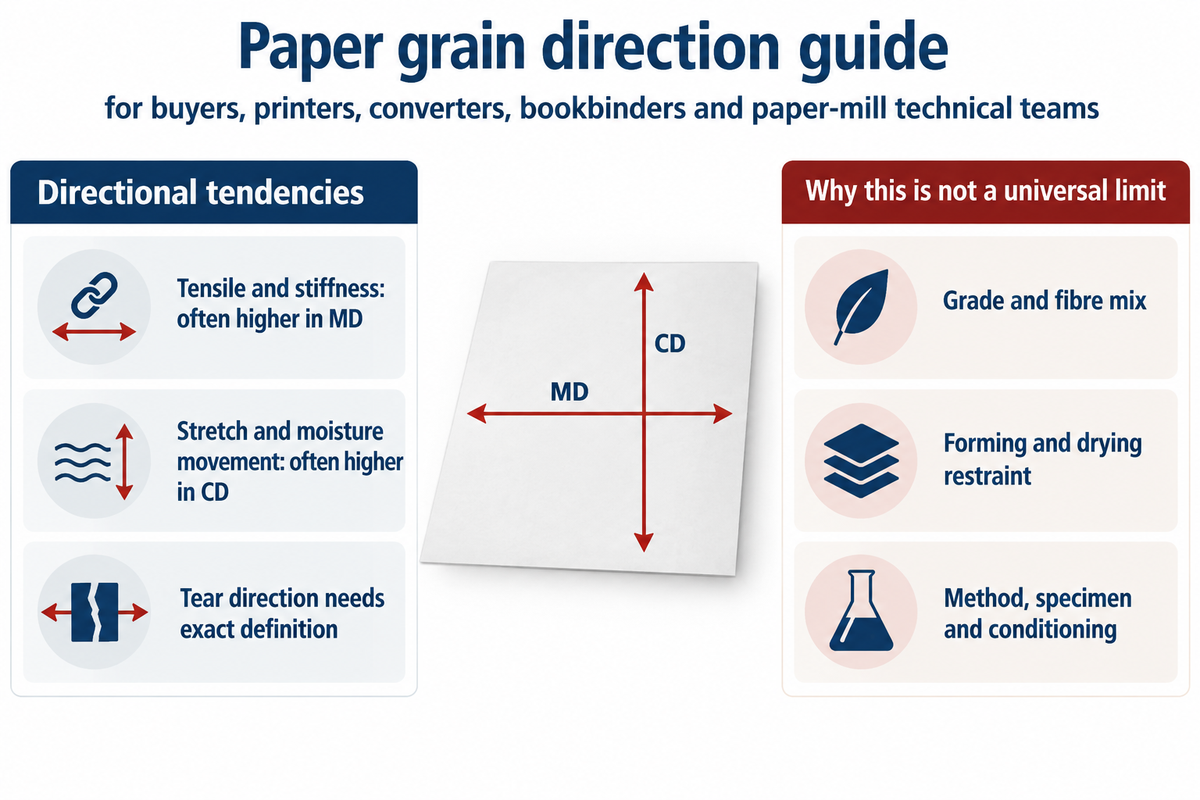
This matrix identifies typical characteristics of machine-made papers. It’s a screening tool and not a legal definition of limits. Grade, fiber mix, refining, forming, basis weight, coating, moisture, drying restraint and test method can change both the degree and for some properties, the nature of the relationship.
| Property | Typical MD tendency | Typical CD tendency | Why it matters | Verify |
|---|---|---|---|---|
| Tensile strength | Often higher | Often lower | Web handling and package performance | Method, specimen axis, width and conditioning |
| Stiffness / modulus | Often higher | Often lower | Feeding, carton panels and binding | Test geometry, side and grade-specific limit |
| Elongation | Often lower | Often higher | Draw, forming and converting response | Same test basis in both axes |
| Tear resistance | No safe universal shortcut | No safe universal shortcut | Propagation and specimen labels are easily mixed up | Named method and tear direction |
| Moisture-related dimensional change | Often smaller | Often greater | Registration, flatness and binding movement | Humidity cycle, conditioning and sample position |
| Curl / warp | Direction can shape the response | Direction can shape the response | Flatness and converting stability | Both sides, moisture, coating and reel map |
Paperboard is typically stiffer and stronger in MD, with less elongation than in CD, as Iggesund’s paperboard manual puts it; a usable strength claim still names the test, conditioning, reel position and grade. A sheet may lie flatter for one condition and warp a bit for another. An acceptance rule derived from a job or grade specification is preferable to a rule determined from a generic ratio copied from a guide.
Printing, Folding, Binding and Packaging Decisions
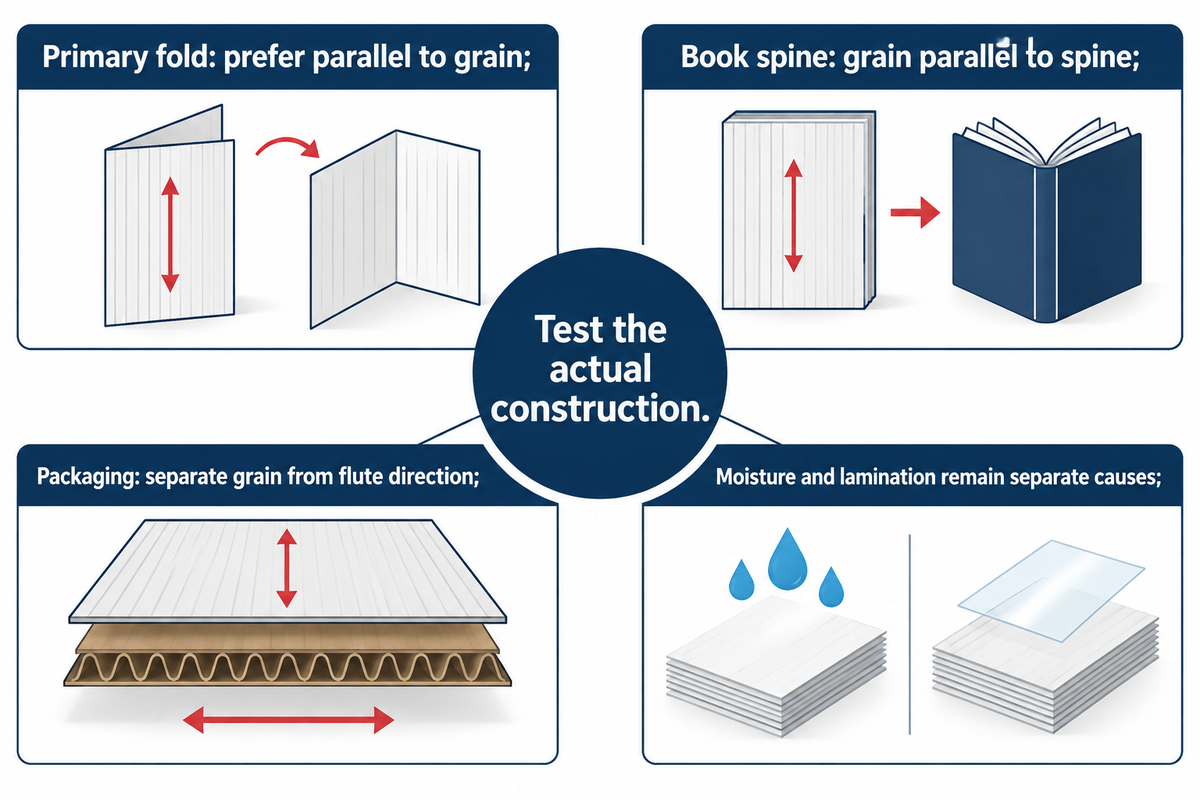
For a primary fold, aligning the fold line parallel to the grain usually reduces resistance and the chance of a rough edge. Folding against the grain can make a paper cut or a scored blank, harder to control. Heavy and coated stocks require the correct grain relationship and the correct score or crease. An ideal grain match can’t offset an unsuitable crease, a brittle coating or poor conditioning.
In bookbinding projects, a bookbinder normally places the grain of text paper and signatures parallel to the spine. That allows the pages to move with less resistance; pages turn more easily and lay flat when open. This preference is part of the construction decision, not an excuse to ignore adhesive, board, sewing or paper thickness. A brochure or booklet with a primary fold requires the same layout check before imposition.
Buyers sometimes find paper that carries the expected label but behaves differently in the finished construction. Test the actual build when paper folds, adhesives or layers change the load path.
Press and feeder behavior is more job-specific. Confirm the paper supplier’s and equipment maker’s recommendations before turning grain direction into a universal feed rule. When folding cartons, keep board grain separate from corrugated flute direction. With lamination, a two-sided build can dominate curl even with fiber direction known.
If a sheet changes shape with humidity, check the history of the paper drying process and conditioning as part of the evidence. Direction can organize the movement; it doesn’t prove the cause of the moisture profile.
A Buyer’s Grain-Direction Specification Checklist
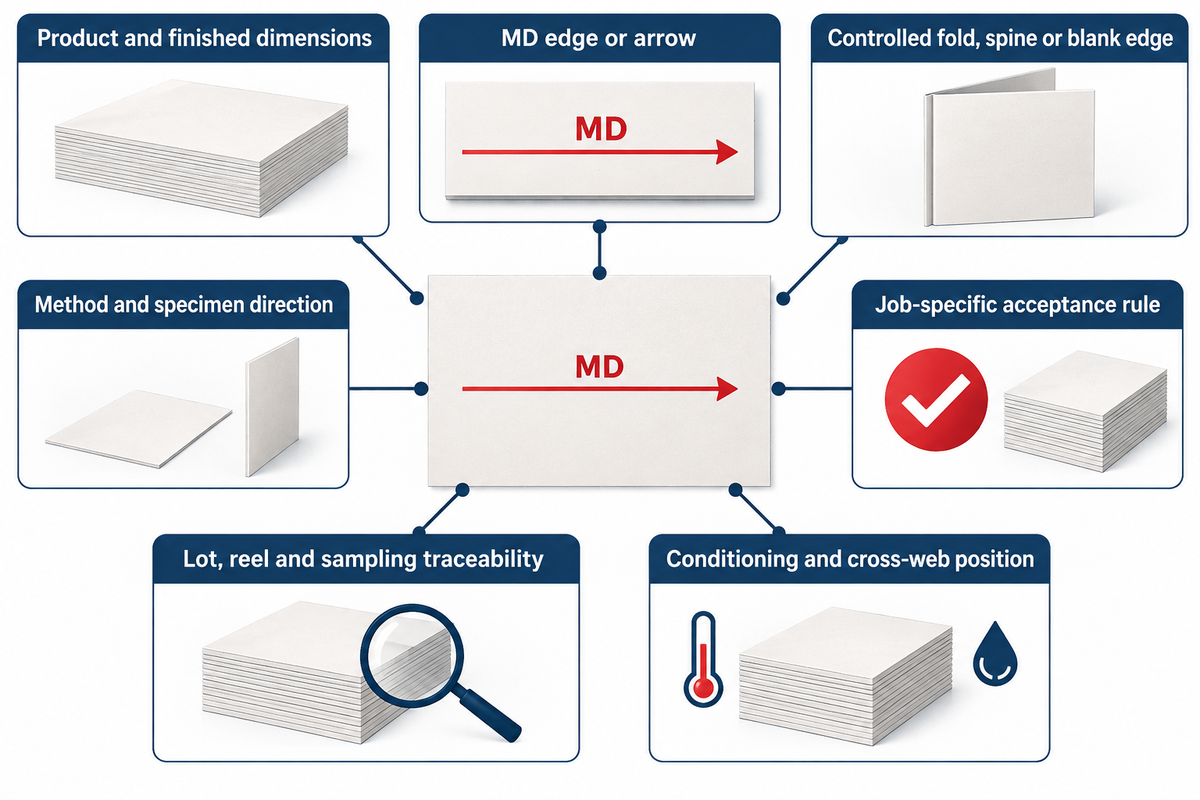
A required direction should be made visible to production, inspection and the supplier through a purchase order. The following block can be used to specify a sheet or roll.
Buyer-ready grain-direction block
- Product: grade, basis weight or grammage, finish, coating and finished dimensions with units.
- Direction: “MD/grain parallel to the ___ mm edge” (on the drawing with an arrow). For rolls: “MD along web/unwind direction; CD across roll width”.
- Functional relationship: Grain parallel to the named spine, primary fold, blank edge or other controlled feature.
- Method: Agreed upon current method and edition, with specimen and result directions explicitly stated.
- Acceptance: Grade- or job-specific limits and the rule for resolving conflicting results.
- Traceability: Lot, reel or ream identity; sampling plan; certificate fields; top/bottom side of the sheet, where relevant.
- Conditioning and location: Test atmosphere and conditioning time; cross-web sample position if properties of interest are directional.
- Receipt sequence: compare PO, drawing, label and certificate before using a representative physical check.
Don’t enter bare values in this block. “Tensile 6 kN/m” doesn’t say whether the result is MD or CD, which method was used or whether the sample came from the reel center or edge. The same principle applies to stiffness, elongation and dimensional change. If the supplier uses grain-long or grain-short notation, retain the explicit edge reference as the controlling description.
A worked specification example
The examples below illustrate how values are accompanied by context. They’re illustrative placeholders, not recommended limits. Enter the agreed test method, machine, and commercial terms for the job in place of these values.
| Specification type | Example entry to replace | Why the context matters |
|---|---|---|
| Grade and basis weight | Uncoated kraft, 120 g/m²; optional 15 g/m² coat per side | Names the material being accepted |
| Finished size | 700 × 1000 mm, ±2 mm | Fixes the edge used by the direction statement |
| Direction | MD parallel to the 1000 mm edge | Removes long-grain notation ambiguity |
| Commercial lot | 20 t; 1200 mm roll OD; 76 mm core ID | Keeps evidence tied to the shipment |
| Machine reference | 2800 mm trim, 600 m/min; profile samples every 500 mm | Prevents an unscoped machine claim |
| Conditioning | 23 °C ±1 °C, 50% RH ±2% RH, 24 h | Makes repeat tests comparable |
| Specimen geometry | 15 mm strip, 180 mm span, 100 mm/min test speed | Binds the reported value to its method |
| Directional result | MD 6.0 kN/m and 2.5% elongation; CD 3.5 kN/m and 4.0% elongation | Shows both axes rather than one bare number |
| Moisture and caliper | 6.5% moisture; 150 µm caliper, ±5 µm | Keeps profile variables visible |
| Converting check | 500 mm primary fold; 0.4 mm crease reference | Connects direction with the controlled feature |
The Grain Direction Proof Ladder
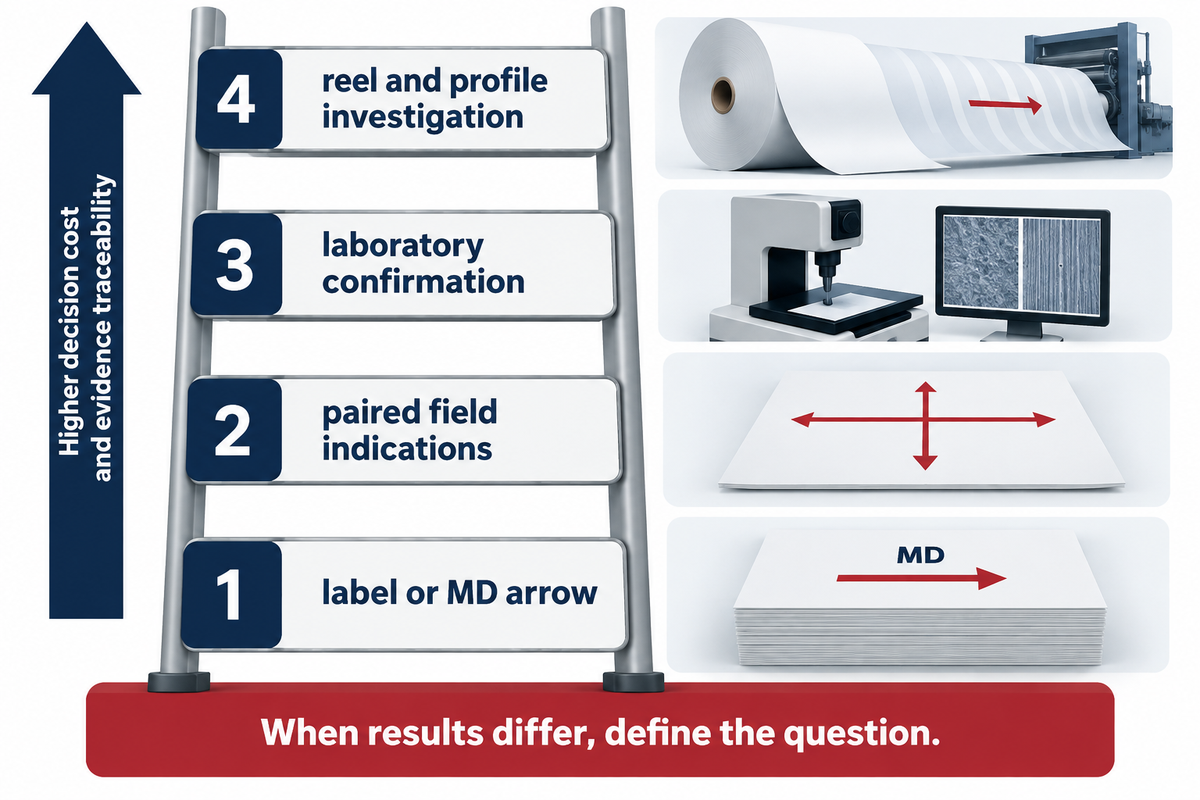
The Grain Direction Proof Ladder correlates evidence with cost and reversibility of the decision. It’s a decision framework. Not every step measures the same item with increasing precision. One side of the paper can even present a different orientation signal from the other side.
- Level 1 – Label: use an explicit MD arrow, edge reference, roll map, or supplier drawing for routine identification.
- Level 2, Paired field indications: compare bend with a fold or tear on representative scrap. Suitable for reversible shop choices when the material behaves clearly.
- Level 3, Laboratory confirmation: use the agreed direction-identification and directional-property methods when a lot, dispute or costly run requires traceable evidence.
- Level 4 – Reel/profile investigation: map orientation angle, tensile stiffness direction, moisture, side and converting defects over a reel when problem may be with the papermaking process or non-uniform web.
Make the decision at the lowest appropriate level. When levels differ, stop and define the question. The label may identify web travel; a surface optical measurement may describe fibre orientation; a stiffness measurement may describe the sheet’s bulk mechanical response; a fold test may describe one converting setup. Resolve identity, sampling, and test direction concerns before accepting discrepancies as errors from the supplier.
When MD/CD Imbalance Points Back to the Paper Machine
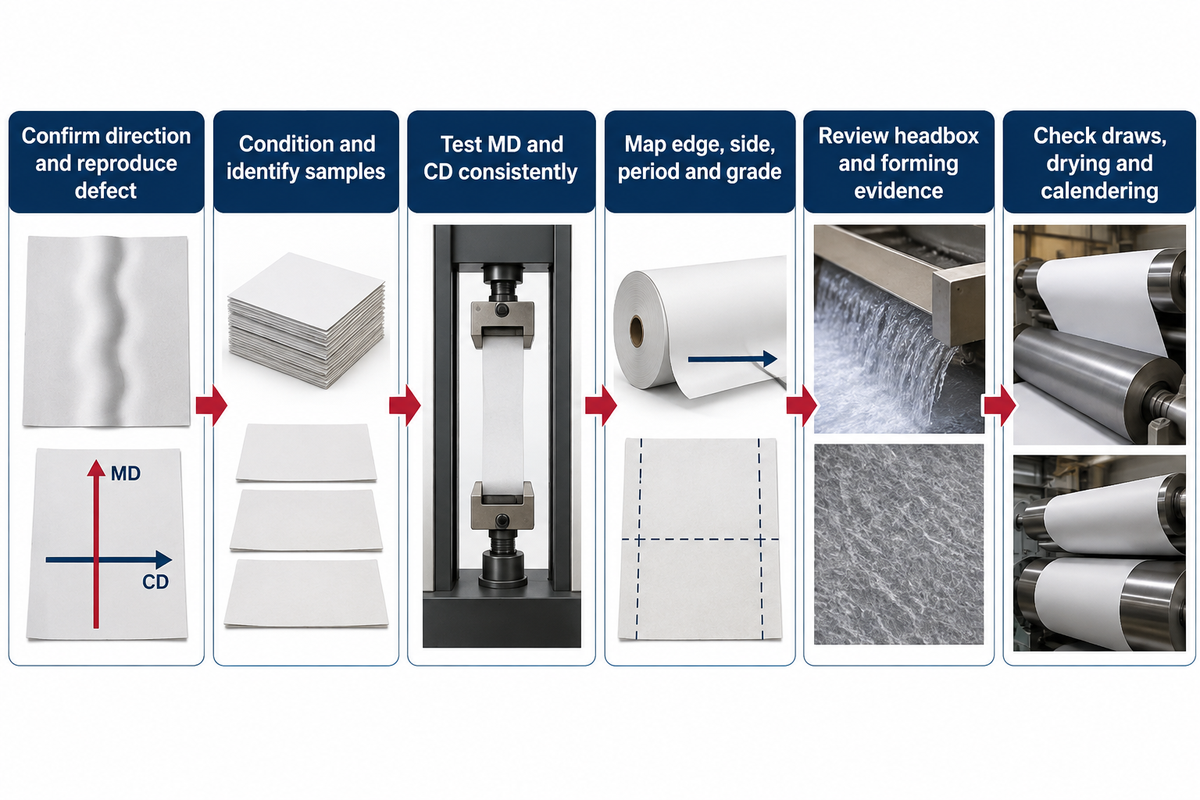
A recurring directional defect justifies a machine investigation, but only after the evidence from the sheet is stable. The forming fabric troubleshooting path starts with the observed symptoms, not assumed adjustments.
- Confirm the sheet or blank direction and reproduce the converting defect.
- Consistently condition samples. Identify top and bottom sides. For roll samples, identify reel or ream identity. For cross-web samples, identify position.
- Test MD/CD properties with same method and same specimen definition. Moisture and caliper profiles should be included if symptom data warrants.
- Determine if the problem exhibits uniformity, edge specificity, side specificity, periodicity or grade dependence.
- Review headbox flow distribution, slice condition, jet-to-wire relationship and forming stability against that map.
- Consider draws, drying restraint, moisture profile and calendering in relationship to the defect.
Forming conditions affect fiber orientation. Suggesting a setting from one converted sample without reviewing the measured defect map and related formation, strength and profile data is not justified. Papermaking variables interact. Useful variables include furnish, grade, basis weight, trim, speed, samples, tests and a reel position map.
Zejiang publishes custom headbox and forming fabric ranges as part of their paper machine offering. If you need to discuss a measured MD/CD issue share the evidence package to ensure the conversation is centered on the real machine and defect.
Frequently Asked Questions
Does cutting a grain-long parent sheet rotate the grain direction?
No. Cutting changes the sheet dimensions and may change whether the result is called grain long or grain short, but it does not rotate the fibre structure.
Suppose MD follows the long edge of an A3 parent sheet. If the paper is cut in half for an A4 or A5 job, the smaller blank may have its long edge across that same line and now be described as short grain. The physical direction stayed where it was; the new paper size changed the label. Preserve an MD arrow through the cutting plan when the finished fold or spine relationship matters.
Why should book paper grain run parallel to the spine?
Parallel grain usually helps pages fold, open and turn with less resistance at the spine.
It also places the larger moisture-related dimensional response away from the bound edge in the usual construction; PostPress notes that paper fibers can expand and contract as much as 400 percent more across the grain than with it. Paper thickness, binding method, adhesive and cover board still matter. Treat parallel-to-spine as a strong design preference that needs a representative mock-up for unusual materials or formats. Check the finished signature after conditioning, because an otherwise correct grain relationship can’t repair a poor hinge or unsuitable adhesive film.
Can coating or lamination change the grain direction?
Coating or lamination does not rotate the underlying fibre orientation, but it can change stiffness, curl and how a field test behaves.
A one-sided coating or an unbalanced laminate can create its own stress and moisture response. For that reason, a bending or curl observation on a converted construction doesn’t isolate paper grain. Record the layers and test the actual build under representative conditions rather than transferring a result from the uncoated base sheet.
Is MD always parallel to the longer sheet dimension?
No. Letter-size 8.5 × 11-inch sheets are typically grain long, with the grain parallel to the 11-inch edge, but the cut decides which edge MD follows on any given sheet.
Ask for an arrow or named edge when direction is functional. A familiar size or dimension order isn’t enough.
Can a bend or tear test replace laboratory evidence?
A bend or tear can support a low-risk orientation decision, but it should not replace traceable laboratory evidence for contractual acceptance or a costly production lot.
Field tests are valuable because they’re quick and show how the actual sheet behaves. Their interpretation can become unclear on specialized papers, so don’t treat an informal check as a laboratory result. A hand tear also lacks the specimen control of a named method.
For lot acceptance, retain the direction-identification method, directional-property tests, specimen axes, conditioning, sampling positions and limits. If a label and field test disagree, confirm the sheet identity first. If field and laboratory observations disagree, determine whether they measured fibre direction, stiffness orientation, tear propagation or a converting response before deciding which evidence governs.
Turn Direction into a Verifiable Mill Requirement
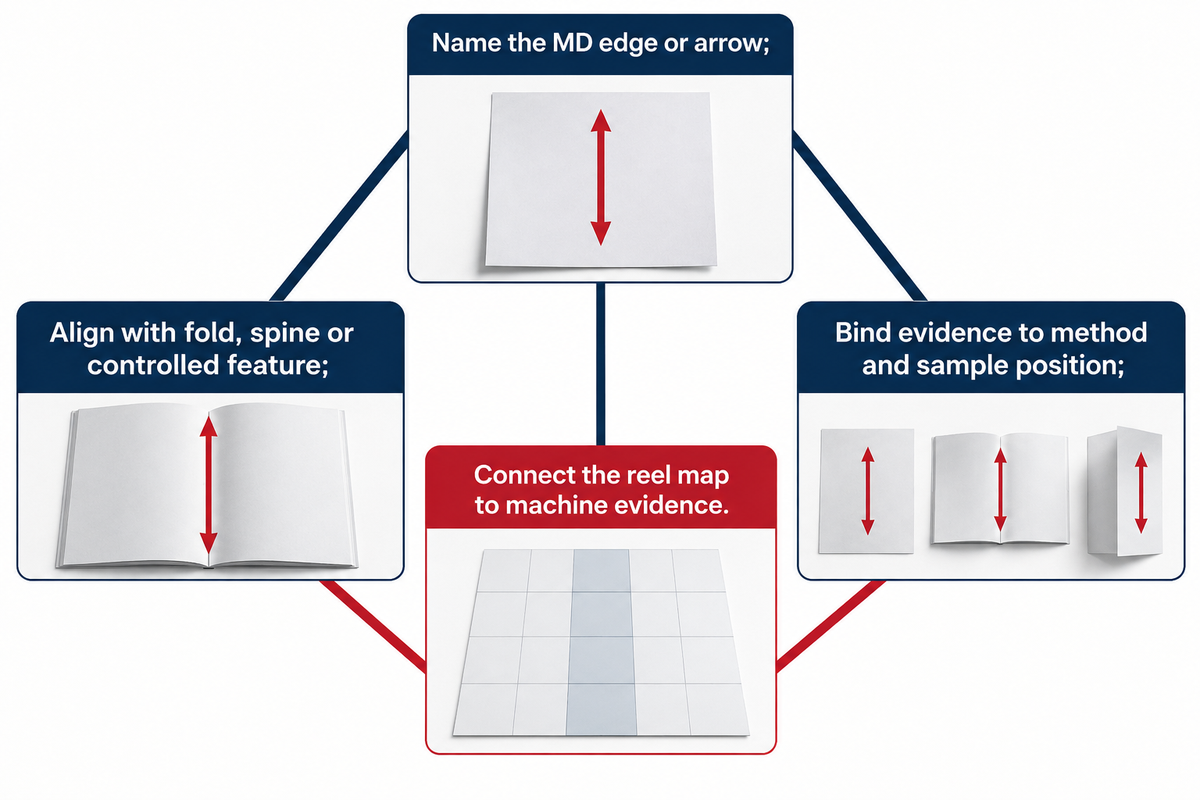
The MD edge and arrows or references must be named, aligned with fold, spine or features of concern, and be justified by evidence relevant to the risk. Evidence must be kept attached to their method, specimen direction, conditioning and sample position.
When a defect persists across representative material, move from the sheet to measured machine data. A paper machine discussion should connect the reel map with headbox, forming, draws, drying and finishing evidence.
Publisher scope
Henan Zejiang Paper Machinery supplies paper machines and related equipment. This guide uses public standards listings, technical literature and application sources. It doesn’t report private customer trials, certify a paper lot or promise a universal MD/CD value. Author: XCX.
References & Sources
- Machine direction of paper and paperboard, Test Method T 409 sp-23 TAPPI product listing and method scope.
- ANSI/TAPPI T 409 sp-23 ANSI Webstore catalogue cross-check for the current standard identity.
- Overview of the Physics of Forming technical proceedings hosted by BioResources / North Carolina State University.
- Improving Paper Machine Efficiency Through On-Line Control of Stock Delivery, Headbox and Forming Hydrodynamics U.S. Department of Energy technical report.
- Complex Physical Properties in Paperboard Iggesund technical manual.
- Fiber Orientation Measurements ABB, two-sided measurement and runnability context.
- Grain Direction: The Long and Short of It PostPress, converting context.
- Understanding Grain Direction in Photo & Art Papers Red River Paper, seller labelling policy.