
Get in touch with Zejiang Paper Machinery Company


Updated: August 2026
Forming Fabric & Forming Wire are two common names for the same moving, permeable surface in the forming section of a paper machine. Its condition matters, but a drainage loss, sheet mark, tracking problem, or short campaign doesn’t automatically prove that the fabric is the cause. Furnish, retention chemistry, headbox flow, foils, vacuum, showers, rolls, alignment, speed, measurement error, and recent operating changes can produce similar evidence.
Quick answer
Build a like-for-like baseline, locate the issue in time and across the machine, test competing causes, make only an approved controlled change, and verify the result over a representative stable run. Treat that change as a screening test—not automatic proof of causality. Escalate to fabric specification or replacement only when process, inspection, and campaign evidence converge.
This guide is written for production, maintenance, process, and purchasing teams that need a shared troubleshooting record. It deliberately doesn’t repeat the construction, dimensions, price, lead-time, customization, and RFQ material already owned by the commercial solution page. Those questions become relevant after the operating evidence points to specification or replacement review.
What Do Forming Fabric and Forming Wire Mean in Daily Operation?
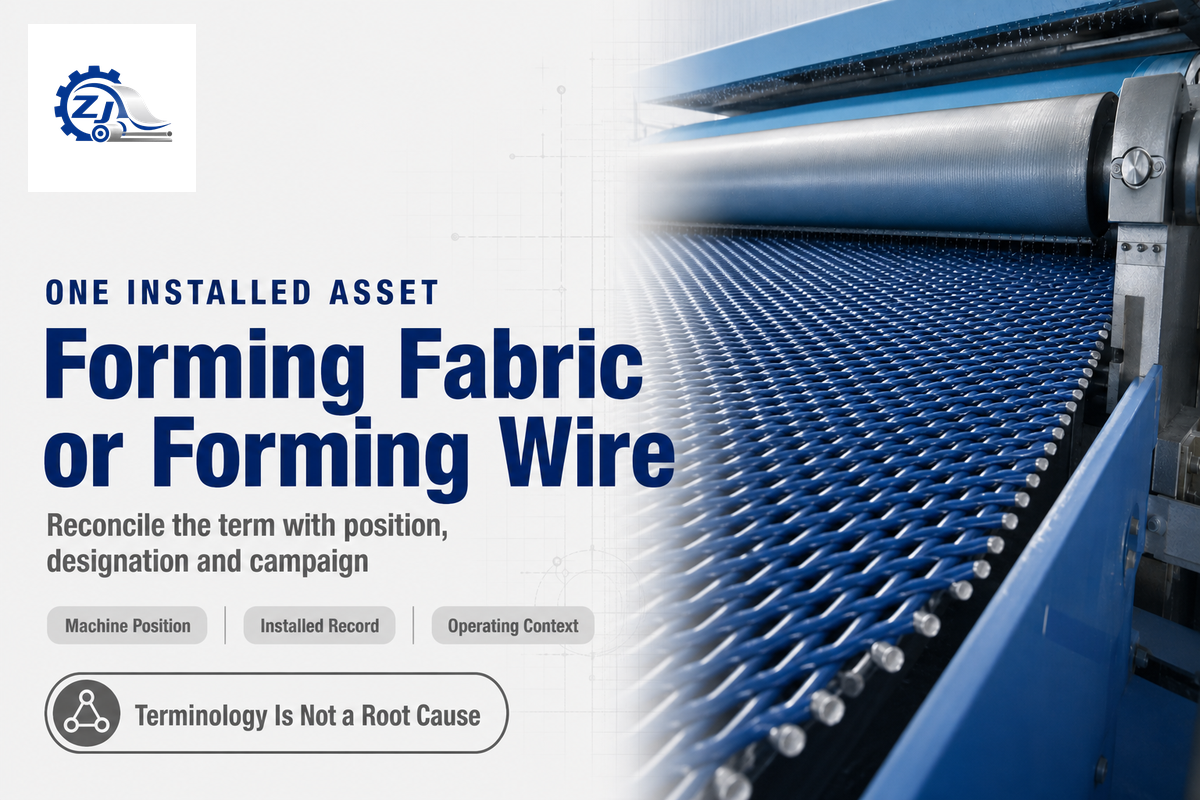
The forming fabric is the continuous synthetic mesh that receives the stock jet, supports the developing fiber mat, and lets water leave through the forming section. “Forming wire” is the older mill term, inherited from the period when metallic wire was used. In modern records, the two names may refer to the same paper machine clothing, but inconsistent naming can still break the maintenance history.
The useful distinction is not which term appears in a conversation. It is whether everyone can identify the same installed item and operating campaign. Each log entry should name the machine position, fabric designation, installation date, grade or furnish, speed, and the condition under which the observation was made. “Wire problem” without those fields is an opinion, not traceable evidence.
Modern polyester forming fabric is a woven, belt-like loop made from engineered polyester yarn systems. Commercial descriptions may use terms such as machine-direction yarn, cross-direction weft, single or double layer, triple layer, and SSB weave. Those construction labels can affect support, drainage, stability, and wear, but they do not explain a running paper machine problem by themselves. This guide therefore records the installed construction without ranking options; specification selection remains on the linked solution page.
The same evidence discipline applies across papermaking grades. A writing paper run and a packaging paper sheet may impose different furnish, formation, and paper quality requirements. A paper machine team should not treat one grade’s good-run baseline as the automatic standard for another.
Normalize Supplier and Mill Terms Before Comparing Records
| Vocabulary found in records | How to handle it |
|---|---|
| wire mesh; paper making wire; wire cloth; modern forming fabrics; synthetic forming; polyester forming wire; forming wire mesh; mesh polyester forming; monofilament; polyester monofilament; fabric woven | Treat these as source vocabulary until the installed asset, supplier designation, machine position, and campaign are confirmed. Do not assume that wire mesh or unrelated filter belts describe the same item. |
| single layer forming fabric; 2.5 layer forming; triple layer forming fabric; double layer forming fabric; layer fabric; ssb forming fabric; weave pattern; weaving method; 5-shed; 8-shed; 16-shed; 24-shed; double-layer; triple-layer; single-layer; multi layer; heat setting; shute | Copy the label exactly, including legacy spelling such as “shute,” and attach the supplier drawing or record. A layer or shed name alone does not explain drainage, tracking, wear, or sheet formation. |
| paper grades; printing paper; printing and writing; kraft; kraft paper; paper-making; machine speed; high-speed; machine operation; sheet formation; fiber support; high paper quality; excellent dewatering; dewatering performance; dehydration | Convert broad application and performance wording into measurable run context: grade, furnish, basis weight, speed, forming-zone response, sheet result, and timestamp. |
| wear resistance; abrasion resistance; dimensional; dimensional stability; raw material | Treat these as attributes or claims that require a defined method and comparison boundary. They do not replace a wear map, condition history, or like-for-like campaign result. |
| Term in the log | What to record with it | What the term does not prove |
|---|---|---|
| Forming fabric / forming wire | Position, designation, campaign, grade, speed | That the fabric caused the issue |
| Drainage loss | Location, vacuum profile, furnish, sheet result, time trend | That permeability loss is the only cause |
Build a Forming-Section Baseline Before You Blame the Fabric
A baseline is a record of a known, repeatable operating condition, not the best number found in an old report. Compare the suspected run with the same or closely matched grade, furnish, basis weight, speed, headbox condition, sampling point, and measurement method. If those conditions move, the comparison boundary has moved too.
TAPPI’s current forming-section monitoring material lists a broad measurement set that includes fabric thickness, permeability, tension, surface speed, wet-end drainage, formation, drag, torque, and jet conditions. That breadth matters: no single reading represents the whole forming process. A useful baseline connects fabric-side observations to the process and sheet result.
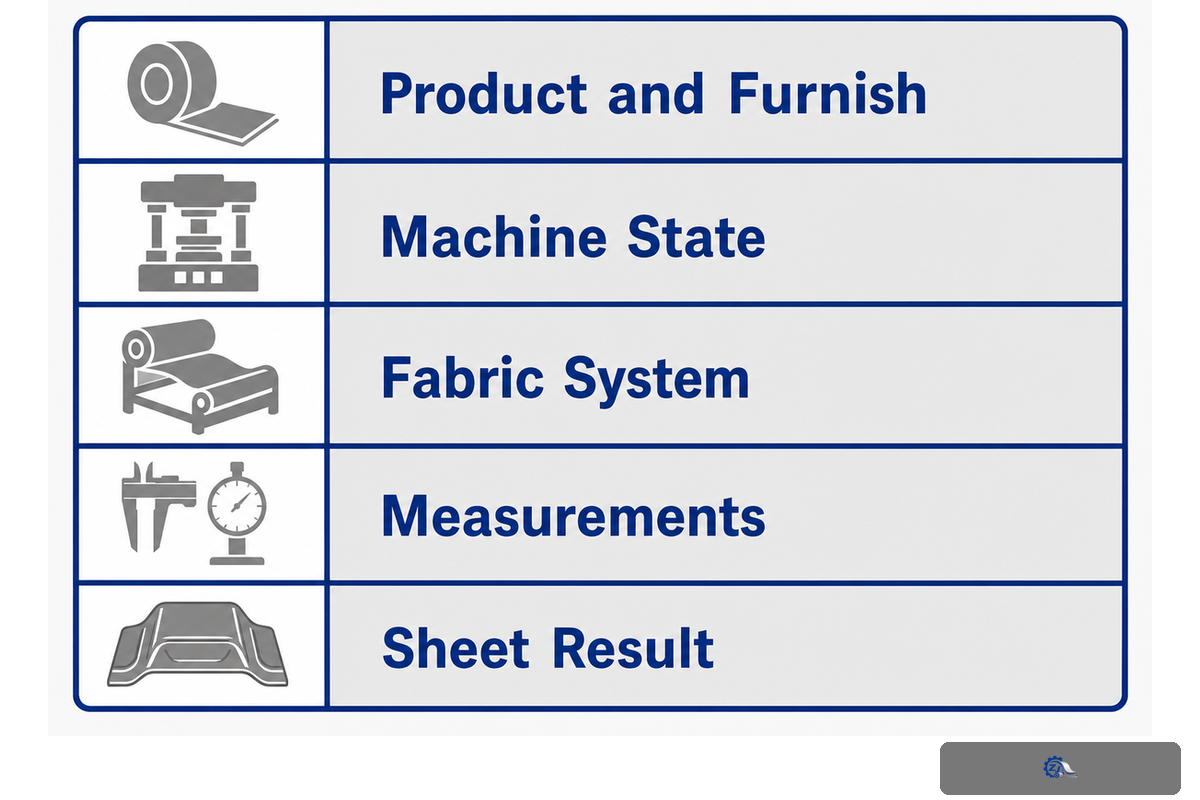
Forming-Section Baseline Sheet
| Record | Minimum context | Comparison rule |
|---|---|---|
| Product and furnish | Grade, basis weight, fiber/filler and chemistry state | Compare like with like |
| Machine state | Speed, headbox condition, jet relationship, foil/vacuum state | Record actuals, not only setpoints |
| Fabric system | Campaign, tension/tracking trend, showers, rolls, visible condition | Use named positions and timestamps |
| Measurements | Instrument ID, calibration/status, method and sampling point | Do not merge unlike methods |
| Sheet result | Formation, moisture/profile, marks, breaks and quality outcome | Link clothing evidence to output |
Measurement-system assurance belongs in the baseline. Sensor contamination, changed calibration, a different instrument, a shifted sampling point, or a transcription error can create an apparent campaign change with no physical change in the forming section. Validate the measurement path before asking production to act on its trend.
Define the Comparison Boundary
Write down which conditions must match and which differences are allowed. The boundary might require the same grade family, a narrow operating-speed band approved by the process team, the same sampling point and method, and no unresolved headbox, vacuum, shower, or chemistry event. If the mill can’t find a perfect match, label the difference instead of hiding it. A qualified comparison is still useful; an unlabeled mismatch creates false confidence.
Separate three kinds of fields in the sheet. Identity fields say what ran: grade, furnish, fabric, position, and campaign. Condition fields say how it ran: speed, jet and vacuum state, showers, tension, rolls, and recent events. Outcome fields say what happened: drainage profile, formation, moisture, marks, breaks, quality, and production impact. The claim becomes stronger when the condition and outcome move together across repeated matched runs.
Keep the raw observation even when a normalized or derived value is used. If an instrument correction, smoothing rule, or data filter changes later, the team can rebuild the comparison. This matters when a campaign spans maintenance or instrumentation work: the process may be stable while the data system isn’t.
Read Drainage and Formation Signals Without Assuming a Fabric Fault
Paper formation combines filtration and thickening. Water removal changes as fibers, fines, fillers, and the developing sheet interact with the fabric and pressure field. Academic work on forming, vacuum dewatering, and wet pressing describes several rate-limiting mechanisms, including surface densification, plugging, sealing, flocculation, and rewetting. That’s why a falling drainage reading can support a fabric hypothesis without proving it.
Published experiments sometimes use precise conditions; one reviewed comparison includes sheet masses of 20 and 50 g/m² and vacuum levels from 20 to 60 kPa. Those are study boundaries, not transferable machine setpoints. Their value here is methodological: drainage evidence only means something when the sheet structure and applied conditions are known.
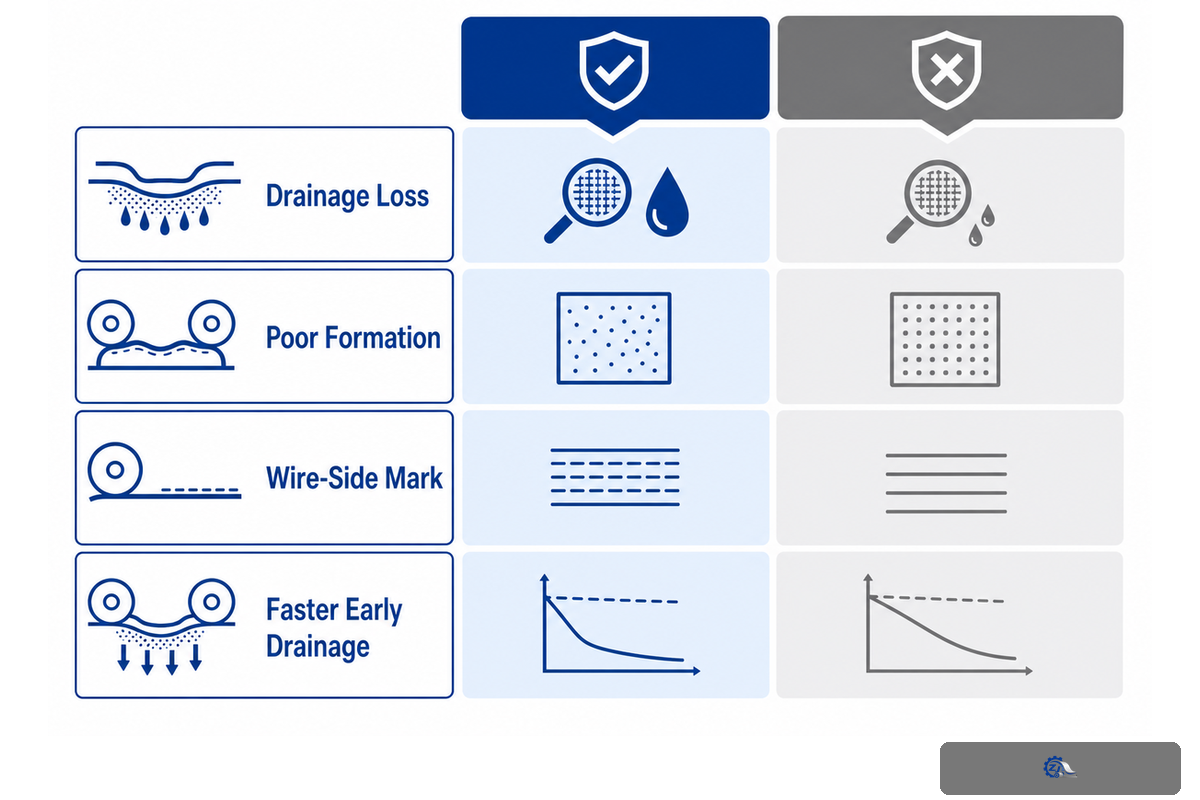
| Signal | Strengthens a fabric link | Weakens or complicates it |
|---|---|---|
| Drainage loss | Repeatable localized restriction with matching condition evidence | Furnish, chemistry, basis weight, vacuum or headbox change |
| Poor formation | Pattern aligns with fabric position or physical feature | Flocculation or jet/hydrodynamic change |
| Wire-side mark | Pitch, MD/CD orientation, and location repeat with the fabric | Roll, foil, pulsation or upstream pattern does not match |
| Faster early drainage | Formation and later vacuum response also improve | Formation worsens or later-zone response declines |
Don’t judge one response in isolation. Early drainage may accelerate while formation uniformity worsens or later vacuum response falls. Record the result by forming zone and include sheet quality; “more drainage” isn’t automatically “better forming.”
Use the 5-Step Symptom–Evidence–Isolation Loop
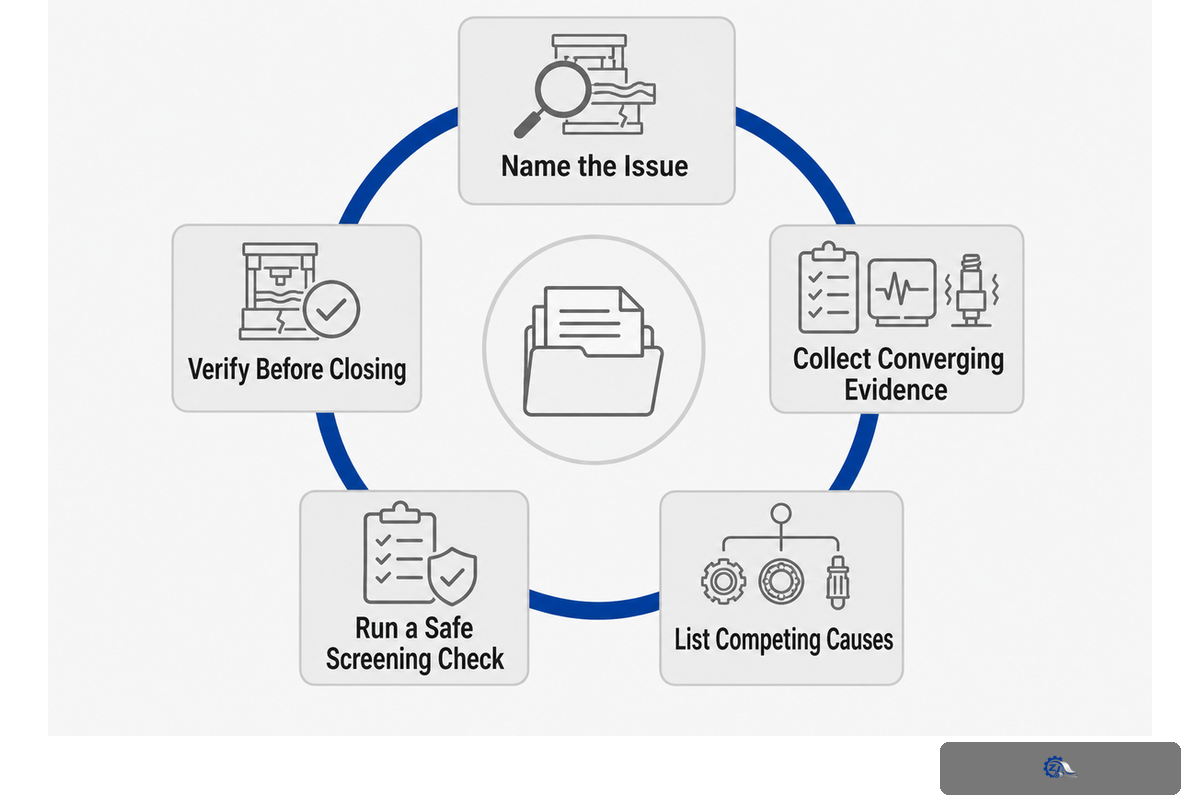
The most useful troubleshooting record is one that production, maintenance, process engineering, and purchasing can all read. This five-step loop turns a complaint into a falsifiable working hypothesis.
- Name the issue — Record when it began, the grade and speed, MD/CD orientation, exact location, and the product consequence.
- Collect converging evidence — Pair the sheet result with fabric, vacuum, shower, roll, drive, tension, tracking, and process data from the same period.
- List competing causes — Include furnish, chemistry, headbox, foils, vacuum, contamination, rolls, alignment, speed, and the measurement system.
- Run a safe screening check — Under approved procedures, change or correct one bounded condition and state in advance what result would strengthen or weaken the hypothesis.
- Verify before closing — Compare a representative stable run, check secondary responses, and decide whether to continue, intervene, or escalate.
Every hypothesis needs a falsification test. When a team blames a CD defect on the fabric, ask what evidence would make that explanation less likely: no matching physical or permeability profile, persistence after a verified fabric-side correction, or stronger correlation with a headbox, vacuum, roll, or chemistry event. Negative evidence prevents a familiar signal from becoming an automatic conclusion.
| Symptom type | Evidence to collect | What would weaken the fabric hypothesis? |
|---|---|---|
| Slow dewatering | Vacuum profile, fabric condition, furnish/chemistry, speed, sheet result | Response follows furnish or vacuum change while fabric evidence stays stable |
| CD streak or mark | Position map, pitch/orientation, roll/foil condition, sheet samples | Position does not align or follows another machine element |
| Tracking correction repeats | Where drift begins, guide action, roll/alignment condition, tension history | Correction frequency changes with roll or alignment condition |
| Short fabric campaign | Wear map, deposits, counterface, showers, upset events, grade mix | Wear localizes to a machine contact or operating event |
| Sudden formation shift | Headbox, jet, furnish, retention chemistry and event time | Shift begins with a process change and no matching fabric evidence |
| Contamination band | Deposit identity, shower pattern, source and removal path | Band recurs from an active source after approved cleaning |
| Rising drive load | Tension, rolls, bearings, drag, contamination and speed | Load follows a mechanical condition independent of fabric state |
| Apparent permeability change | Instrument, calibration, method, pressure basis and test point | Repeat measurement removes the shift |
| Break or transfer upset | Sheet strength, moisture, draws, vacuum, timing and location | Upset follows grade or transfer conditions while fabric signals stay stable |
Assign an owner to each evidence line. Production owns the grade, run condition, and sheet result; maintenance owns the physical path, rolls, showers, alignment, and authorized inspection; process engineering owns the comparison design and causal boundary; purchasing joins when the remaining evidence justifies a specification discussion. Ownership does not mean silos. It means every data point has a named source and reviewer.
If the teams disagree, preserve the disagreement in the record. Write which observation each interpretation explains, which it cannot explain, and what next safe check would separate them. Disagreement that produces a discriminating test is productive. Consensus based only on the most familiar failure mode is not.
Make the Loop Survive Shift Handover
A troubleshooting record should be usable by the next shift without a verbal reconstruction. Keep one current hypothesis, one list of competing causes, one timestamped change log, and one set of acceptance fields. Attach photographs and data to the same event ID. Record “not checked” separately from “checked and normal”; those statements are not equivalent.
At handover, state what is known, what remains uncertain, which action is authorized, and what must not be changed before the observation window closes. If a grade transition or maintenance event will break the comparison, mark the run as interrupted instead of joining incompatible data. This small discipline prevents a second team from changing another variable and turning an interpretable screening check into an ambiguous result.
Close the loop with a short decision note. “Continue” should name the watch condition. “Intervene” should name the approved correction and owner. “Escalate” should name the unresolved fabric evidence and the information needed from the supplier. The record then serves operations today and specification review later.
Clean, Run a Controlled Screening Change, Then Verify
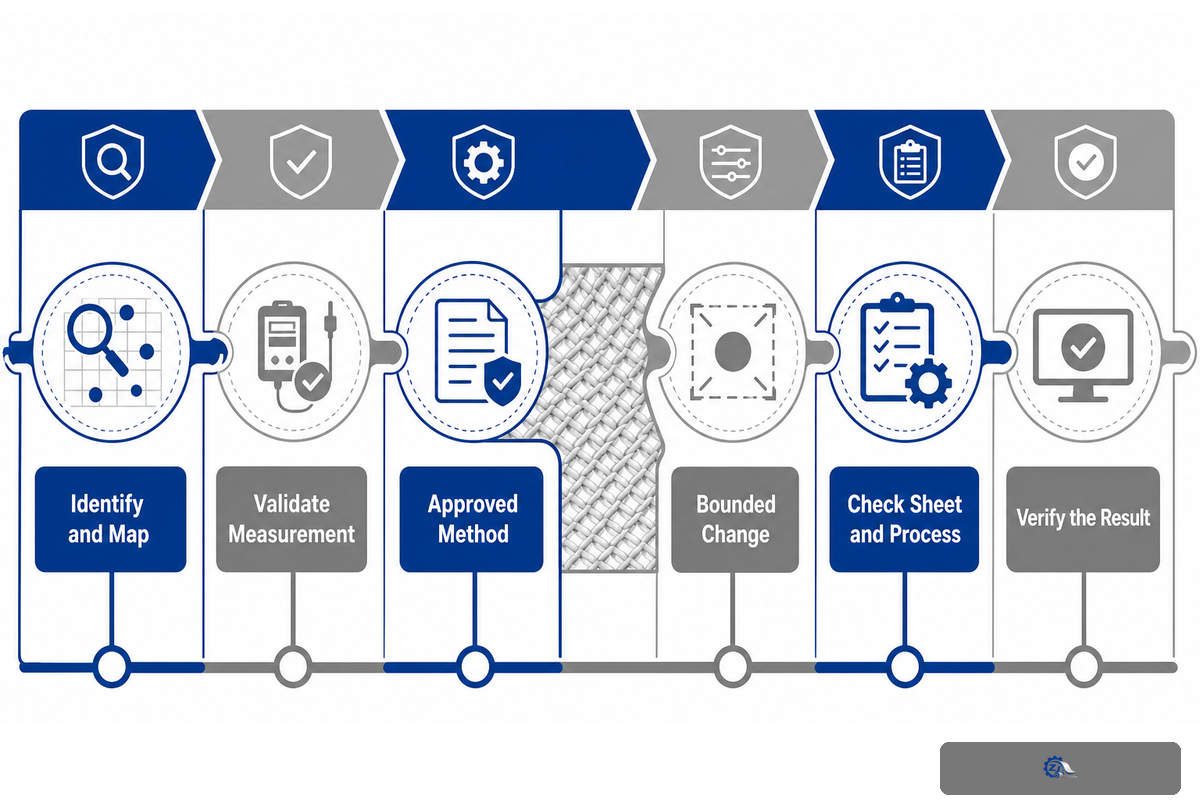
Cleaning is reasonable when the evidence points to removable contamination and the fabric remains mechanically sound. First identify the deposit and its location. Then inspect the shower pattern, nozzle condition, filtration, water quality, vacuum removal path, and the source of recurring material. Cleaning a fabric while the deposit source remains active may produce only a short response.
The method, chemistry, pressure, distance, temperature, and frequency must come from the installed fabric supplier, machine/OEM guidance, chemical approval, and mill procedure. An online article can’t safely supply universal settings. OSHA’s paper-mill standard also reinforces the guarding and energy-control boundary around inspection, cleaning, adjustment, and servicing. Hands-on work requires the site’s authorized procedure.
Do
- Identify and map the deposit.
- Validate the measurement path.
- Record approved method and timing.
- Check drainage, formation, and sheet quality together.
- Allow for short-loop carryover before judging the result.
Do not
- Copy another machine’s cleaning settings.
- Change chemistry, vacuum, speed, and showers together.
- Use appearance as the only success test.
- Call one improved reading proof of cause.
- Inspect through a guard or near an in-running nip.
A one-variable change improves interpretability, but it remains a screening test.
NIST notes that one-factor-at-a-time trials don’t resolve factor interactions. Furnish, retention chemistry, basis weight, vacuum, and hydrodynamic shear interact, while white-water recirculation can mix material exposed before and after the change. An apparent immediate response may therefore be carryover, coincidence, or interaction, not causal closure.
Write the expected response before the change. For example: “If removable contamination is the main restriction, the approved cleaning event should improve the mapped drainage response while grade, speed, furnish, vacuum state, measurement method, and sampling point remain comparable.” Also write the result that would weaken the idea. This keeps a team from redefining success after seeing the data.
When several factors probably interact, stop treating repeated one-variable changes as an experiment. Escalate the design to the process team, which may use a structured multivariable trial, historical analysis, or another method appropriate to the mill. The operational goal isn’t to run a textbook experiment; it’s to avoid calling correlation proof and then buying or adjusting the wrong thing.
Troubleshoot Tracking, Tension, Seams, and Edge Wear
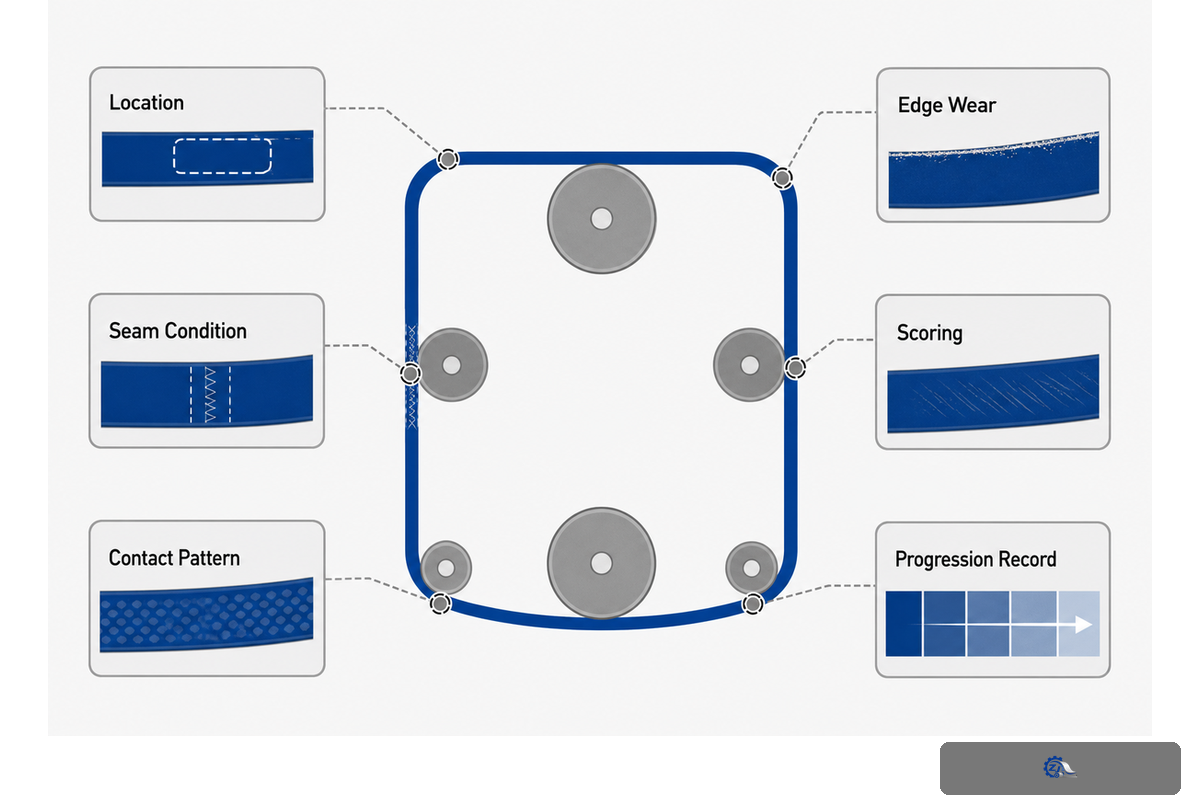
Start with location. Record where the fabric first departs from its normal path, how the guide responds, how often correction occurs, and whether the behavior changes with speed, grade, tension, wash events, or roll condition. Correction observed downstream can originate at an earlier roll or alignment point.
Keep operating observations outside guards. During an authorized shutdown, map edge wear, seam condition, scoring, contamination bands, filament damage, and contact patterns against roll, foil, doctor, and shower positions. Used-fabric analysis guidance distinguishes damage mechanisms such as general abrasion, localized scoring, abrasive fillers, melting, and high-pressure shower damage. The value of that taxonomy isn’t to assign a cause from a photo; it’s to connect the physical pattern to a plausible contact or event.
| Evidence pattern | Competing cause to check | Escalation evidence |
|---|---|---|
| Localized score at a fixed CD position | Roll, doctor, foil, debris or fixed contact | Physical match plus progression record |
| Repeated edge wear | Alignment, guide behavior, spreader/roll condition | Verified path issue remains after system checks |
| Seam-area mark | Sheet transfer, roll surface or periodic machine signal | Pitch and timing consistently match the seam |
Controlled wear research also shows why a universal life number is weak: filament material, the counterface, and slurry conditions can change wear behavior. Compare the fabric to its own campaign history and the machine around it instead of judging age alone.
Translate a Wear Pattern Into a Testable Cause
Describe a pattern before naming it. Record whether it’s uniform or localized, MD or CD, progressive or sudden, edge-related or central, and whether it repeats at a machine pitch. Then map the location back through the fabric path. One narrow score at a cross-machine position suggests a different search than uniform loss across the width; an edge problem that begins after repeated guide correction suggests a different search than an isolated seam defect.
Photographs help only when they have context. Include the machine position, orientation, date, scale, lighting note, and safe shutdown status. Pair images with tension and tracking history, roll/contact inspection, deposit description, and the sheet or production effect. Close-up images with no location can look persuasive while being impossible to use.
After correction, look for recurrence in that position. If a new or cleaned fabric develops the same localized pattern, the machine contact or operating condition becomes a stronger lead. If the pattern follows the fabric and not the machine location, fabric construction or physical condition deserves more attention. Neither result should be interpreted without supplier and mill review.
Decide Whether the Fabric Is Dirty, Damaged, or at End of Campaign
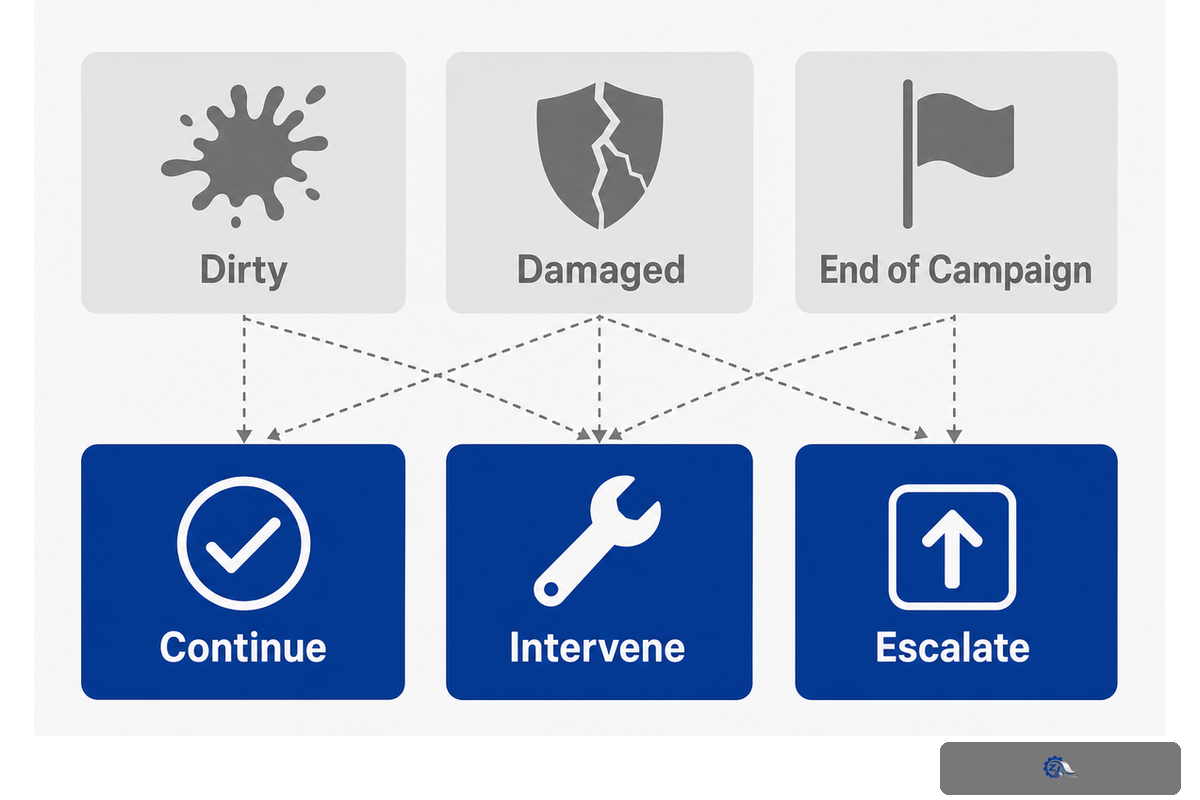
These are different decisions. Dirty means removable material is restricting or disturbing performance and an approved intervention can test that explanation. Damaged means physical integrity or geometry has changed. End of campaign means the remaining condition can no longer support the required production result and risk level after reasonable system corrections.
Drainage or permeability loss alone can’t separate those states. Fines plugging, sheet densification, sealing, flocculation, rewetting, furnish change, and measurement drift can imitate restriction. Use converging evidence: a trend against a comparable baseline, localized inspection, repeatable sheet or process effects, and a controlled response that survives a representative verification window.
| Decision | Evidence required | Evidence that blocks closure |
|---|---|---|
| Continue | Stable output, no progressive damage, controls effective | Rising risk or unresolved progression |
| Intervene | Mapped removable deposit or correctable surrounding fault | No approved method or mechanical damage remains |
| Escalate | Persistent penalty, verified damage/instability, competing causes checked | Performance returns under equivalent conditions without replacement |
Don’t make “end of campaign” a synonym for an old fabric. Younger fabric can be compromised by a system fault, while older fabric can remain serviceable under a stable, measured operating window. The decision belongs to the mill’s authorized team with supplier input and a documented acceptance criterion.
Continue–Intervene–Escalate Evidence Ladder
Start with the lowest-cost evidence and move upward only when the earlier level remains consistent. First, document the issue and its production consequence. Second, verify the measurement system and compare the right operating window. Third, inspect the fabric and surrounding contacts. Fourth, correct an approved reversible cause. Fifth, review whether the remaining penalty is linked to fabric condition or specification.
The purchasing request should state what the replacement is expected to change and how that result will be accepted. “Old wire” isn’t an acceptance criterion. For example, the request might name a persistent localized damage pattern, its sheet-quality consequence, the system checks completed, the failed controlled correction, and the metric that a new campaign must stabilize. That record protects both the mill and supplier from solving different problems.
Check the System Around the Fabric
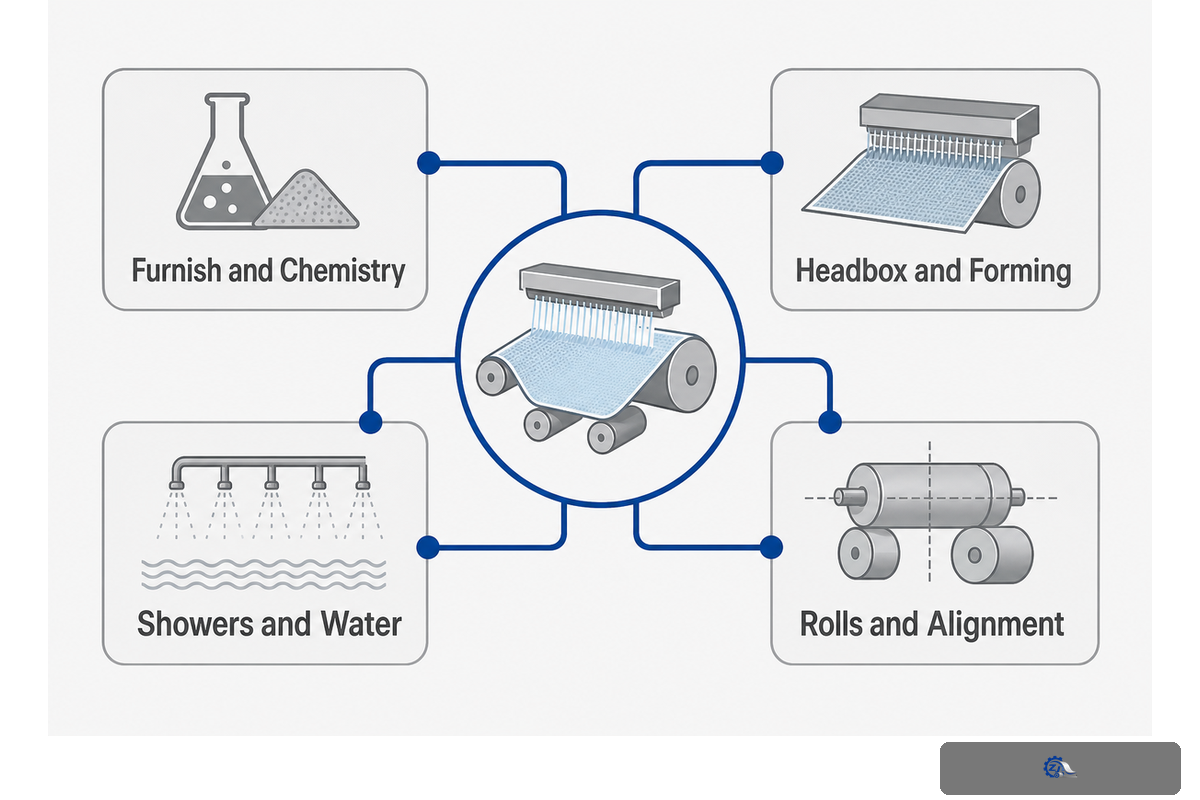
A fabric runs inside a connected forming system. Review recent changes to furnish and retention chemistry, headbox flow, jet conditions, foils, vacuum elements, showers, rolls, alignment, speed, grade, and instrumentation. The strongest counterintuitive finding in this research was simple: a visible fabric signal may be generated by the system around it.
The published Greenpac tracking case describes a whole-machine investigation that found roll conditions contributing to wear trouble before the new fabric trial. The case does not prove that rolls explain every tracking problem. It shows the value of mapping a signal beyond the item that receives the blame.
| System area | Question | Useful evidence |
|---|---|---|
| Furnish / chemistry | Did retention, fines, fillers, charge or deposit behavior change? | Dated recipe/event log plus sheet response |
| Headbox / forming | Did jet, flow, turbulence, foil or vacuum behavior move? | Position-aware profile and stable comparison |
| Showers / water | Are nozzles, filtration, pressure pattern and removal path sound? | Inspection and before/after pattern |
| Rolls / alignment | Where does deviation or contact first appear? | Safe shutdown map and correction history |
This system check also protects against content cannibalization in practice: fault isolation happens here, while construction selection begins only after the current fabric is identified as the remaining constraint.
What Do 2025–2026 Monitoring Changes Mean for Forming-Fabric Work?
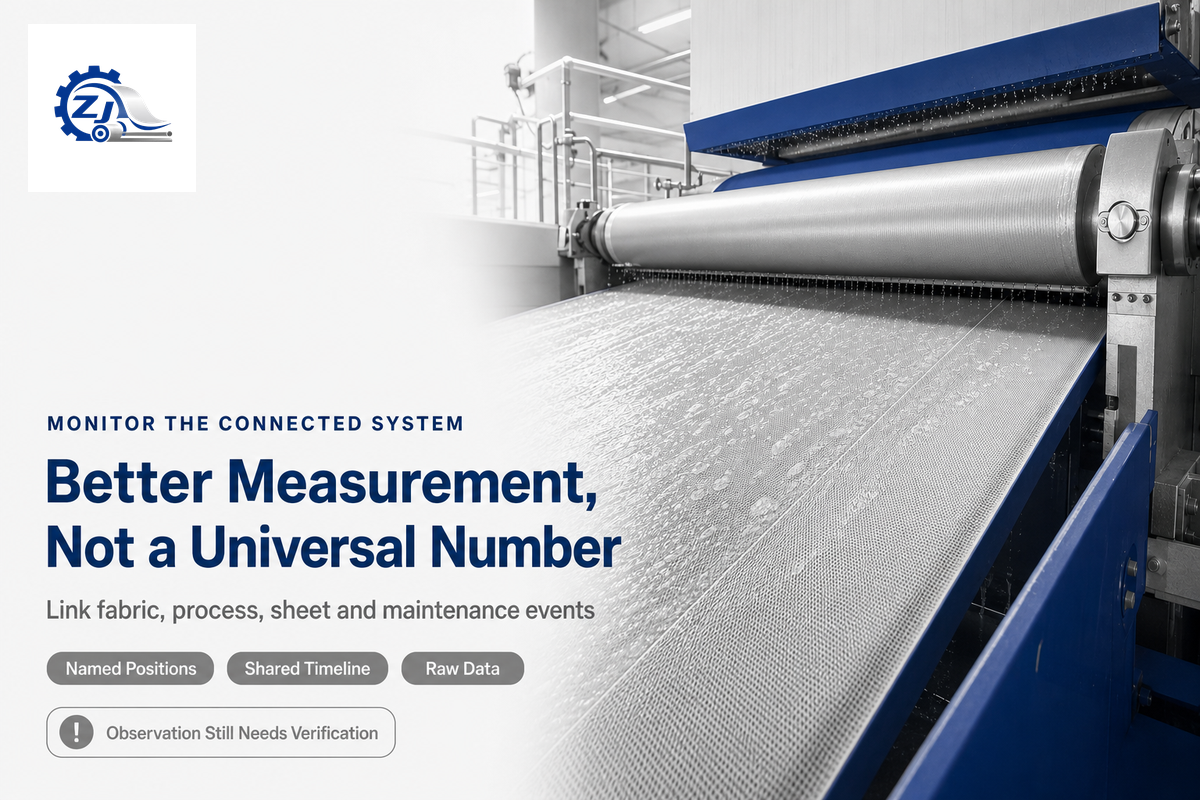
The useful current trend is better measurement, not a new universal performance number. TAPPI’s 2026 forming-section monitoring material brings fabric thickness, permeability, tension, speed, drainage, formation, drag, torque, and jet conditions into one measurement discussion. The practical message is to connect fabric readings to machine and sheet responses instead of running isolated checks.
Recent trade coverage also places forming-section rolls, vacuum systems, wire faults, and auxiliary equipment inside wider condition-monitoring programs. One 2025 published patent describes monitoring a fabric operating in a papermaking machine, while a 2024 U.S. patent addresses wet-end sensing at multiple locations. Patents show technical direction and claimed concepts; they don’t prove mill performance or justify buying a system.
For an existing machine, the near-term opportunity is usually less dramatic:
- standardize measurement names, positions, instruments, and timestamps;
- bring fabric, process, sheet, and maintenance events onto the same campaign timeline;
- flag a signal when it moves outside its own good-run pattern, not merely when it differs from another machine;
- preserve raw data so a later control-chart or multivariable review remains possible;
- record who may act on an alert and which safe procedure applies.
Data volume doesn’t remove the causal problem. Closely spaced readings can be dependent, a sensor can drift, and a model can learn grade changes rather than fabric condition. Treat new monitoring as a stronger observation layer. Keep inspection, process knowledge, measurement assurance, and controlled verification in the decision loop.
Validate the Result Across a Stable Campaign Window
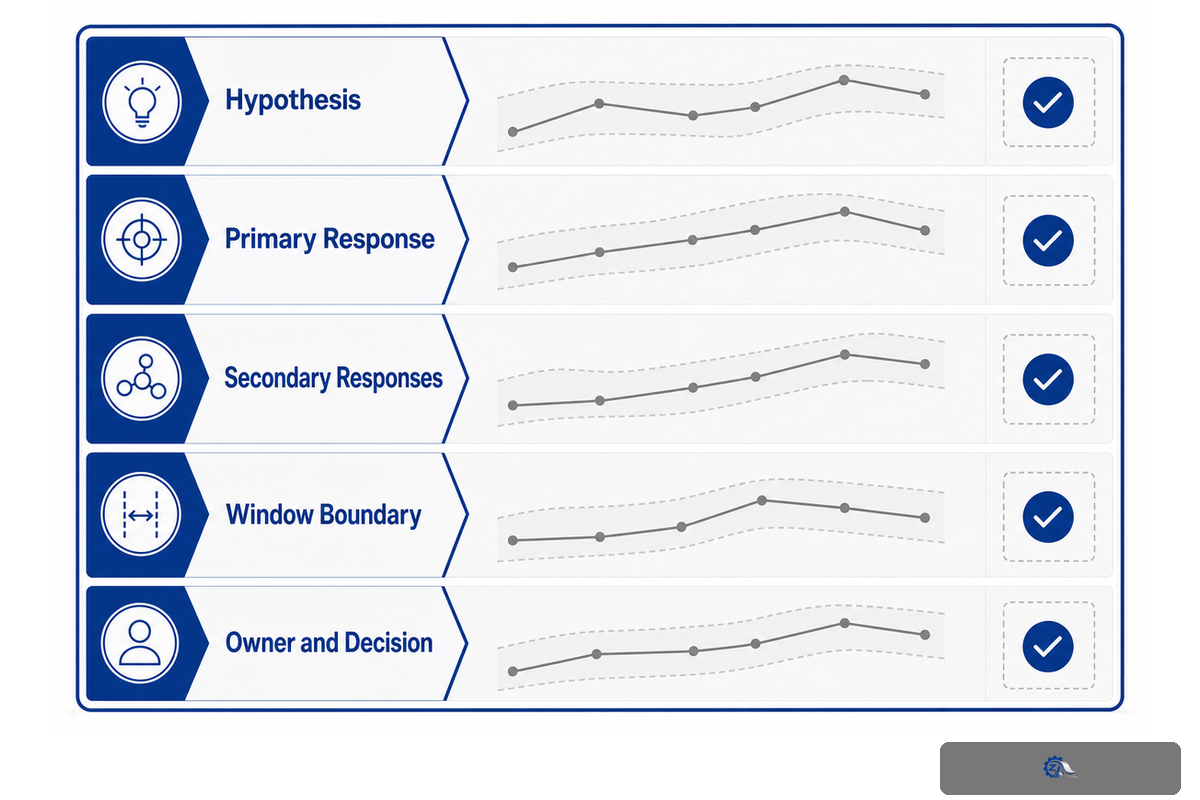
A stable window isn’t a universal number of days. NIST describes a stable process in terms of a consistent distribution over time and recommends ordered data, control charts, and checks for dependence where appropriate. Industrial readings are often autocorrelated, so many closely spaced samples don’t automatically equal many independent observations.
Define the window from the process. It must be long enough to move beyond startup transients, short-loop recirculation, retained chemistry effects, and the immediate disturbance of the intervention. It must also contain enough matched production to show whether the target result holds without shifting a problem elsewhere. The mill’s process team should choose the method and acceptance rule; this guide doesn’t prescribe a sample count.
Post-Change Campaign Verification Card
| Card field | Write before the trial | Close only when |
|---|---|---|
| Hypothesis | What cause is being screened? | Competing explanations were checked |
| Primary response | Metric, method, instrument, point and criterion | Measurement path is valid and result persists |
| Secondary responses | Formation, profile, quality, breaks, load or other risks | No unacceptable tradeoff appears |
| Window boundary | Matched grade/state and carryover allowance | Representative stable data is available |
| Owner / decision | Named production, maintenance and process reviewers | Continue, intervene or escalate is signed off |
If the improvement disappears outside the selected window, overlaps a measurement change, or coincides with another process move, causal closure fails. If the evidence remains stable and the installed fabric is still the limiting factor, move from evidence review to a review of forming fabric construction and specification options. That commercial page handles product matching and inquiry details without duplicating this guide’s troubleshooting role.
Frequently Asked Questions
What is the difference between forming fabric and forming wire?
In modern paper-machine use, they often refer to the same permeable forming medium. “Wire” is the legacy name from metallic forming media, while today’s forming fabrics are generally synthetic. For troubleshooting, the critical identifiers are machine position, installed designation, campaign, grade, speed, and operating condition, not the preferred label.
Keep both terms in the maintenance vocabulary if operators use both, but map them to one asset record. That prevents an inspection note filed under “wire” from being separated from permeability, cleaning, or replacement records filed under “forming fabric.”
How do you know whether a forming fabric is causing a sheet defect?
Match the defect’s timing, MD/CD orientation, position, and pitch with fabric and machine evidence. Then check furnish, headbox, foils, vacuum, showers, rolls, alignment, speed, and measurement validity. The fabric explanation becomes stronger when several independent signals converge and weaker when the defect follows another variable or survives a verified fabric-side correction. Use the result to choose the next safe check, not to force a fabric verdict. A defensible conclusion should explain the timing, location, and sheet response together.
When should a forming fabric be cleaned rather than replaced?
Clean when mapped contamination is removable, the fabric remains mechanically sound, and an approved method exists. Replace or escalate when verified damage, instability, seam risk, or persistent process penalty remains after reasonable corrections. Confirm either decision with like-for-like data; appearance alone is insufficient.
How long should a forming fabric last?
There is no reliable universal interval. Material, machine contact, slurry and furnish, grade mix, speed, showers, cleaning, alignment, upset events, and operating targets all influence the campaign. Track condition and production outcome against the position’s own history, then make the decision with the mill and fabric supplier. Record why each campaign ended so the history separates normal wear from recurring system faults. That distinction makes the next comparison useful.
Does improved drainage prove that a fabric-side change worked?
No. It is useful screening evidence, but it may reflect interactions, instrument drift, short-loop carryover, or poorer formation. Verify the measurement system, allow the process to reach a representative state, watch secondary responses, and require persistence before closing the cause.
Turn the Evidence Package Into the Next Decision
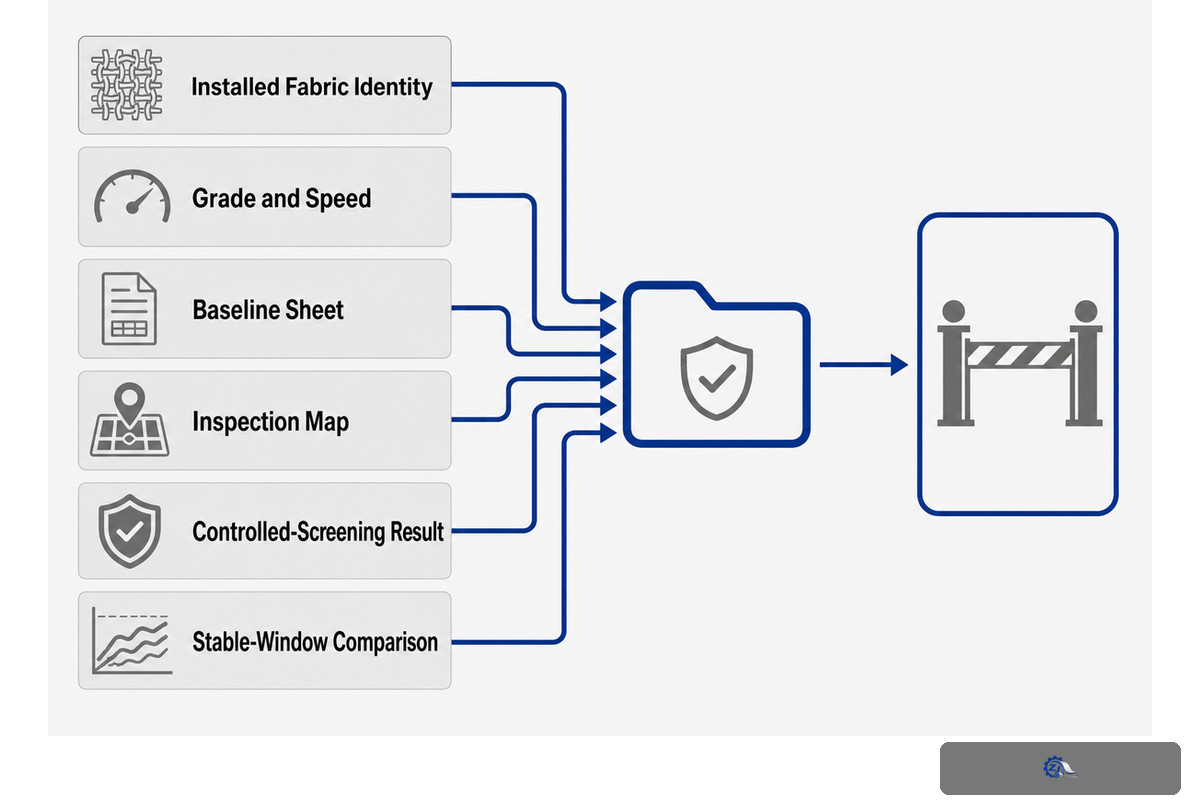
Bring the responsible team a concise evidence package: installed fabric identity, grade and speed, issue start, location/orientation, baseline sheet and measurement method, inspection map, recent process changes, controlled-screening result, stable-window comparison, secondary effects, and named acceptance owner. That package is more useful than “the wire is bad” and makes a specification discussion much faster when replacement is justified.
Zejiang Paper Machinery supplies paper-machine projects and replacement parts. The company page explains its scope; the linked product page handles forming-fabric matching and commercial questions after the mill defines the machine position and evidence.
Have a verified forming-section issue or a planned fabric review?
Prepare the baseline, inspection map, and post-change verification card first. Then share the machine position, grade, speed, installed record, and measured problem so the technical discussion begins with evidence.
References & Sources: Research Basis
This guide was checked against academic papermaking research, U.S. government safety and process-control guidance, current TAPPI material, field cases, and public patent records. Trade and manufacturer sources were used for field structure and named examples, not for universal limits. No customer operating result or service-life average was invented.
- NC State BioResources, rate-limiting water-removal mechanisms
- OSTI, controlled forming-fabric wear study
- OSHA 29 CFR 1910.261, pulp, paper, and paperboard mills
- TAPPI TIP 0502-14, forming-section performance monitoring
- TAPPI TIP 0502-19, used forming-fabric analysis
- NIST, one-factor-at-a-time limitations
- NIST, assessing process stability
- Paper360, Greenpac tracking case
![Refiner Plates & Screen Baskets [Complete Guide]](https://zjpapermachine.com/wp-content/uploads/2026/07/refiner-plates-screen-baskets-guide-featured-150x150.png)
![Doctor Blade: Types, Materials & How It Works [Guide]](https://zjpapermachine.com/wp-content/uploads/2026/07/doctor-blade-guide-featured-1-150x150.png)
![Pulping Equipment: How Paper Pulping Works [Guide]](https://zjpapermachine.com/wp-content/uploads/2026/07/pulping-equipment-guide-featured-150x150.png)