Get in touch with Zejiang Paper Machinery Company


Updated October 2026
Solid bleached sulfate paperboard is a white board made of bleached chemical pulp widely used in folding cartons and printed packaging. Buy a named paperboard grade against its caliper, directional bending resistance and surface treatment, rather than choosing by grammage alone. SBS can be coated and uncoated and serve different finishes.
Quick specifications
- Furnish: bleached chemical pulp; SBS is also called solid bleached sulphate or SBB.
- Buying units: grammage in g/m², thickness in µm or points, bending resistance with method and direction.
- Surface: grade-specific coating on one or both sides, or an uncoated surface.
- Purchase document: named mill grade, sheet or reel format, grain direction and intended converting process.
Solid bleached sulfate paperboard combines a bleached fibre structure with a grade-specific surface. Match the board to printing, folding and barrier needs, then compare costs using the same sheet layout and accepted output.
Key points
- SBS isn’t necessarily coated: premium uncoated grades also exist.
- Equal grammage doesn’t mean equal thickness or stiffness.
- Machine-direction and cross-direction bending results belong in separate fields.
- A lower sheet price can still produce a higher cost per accepted carton blank.
SBS paperboard structure: bleached fibres and coated surfaces
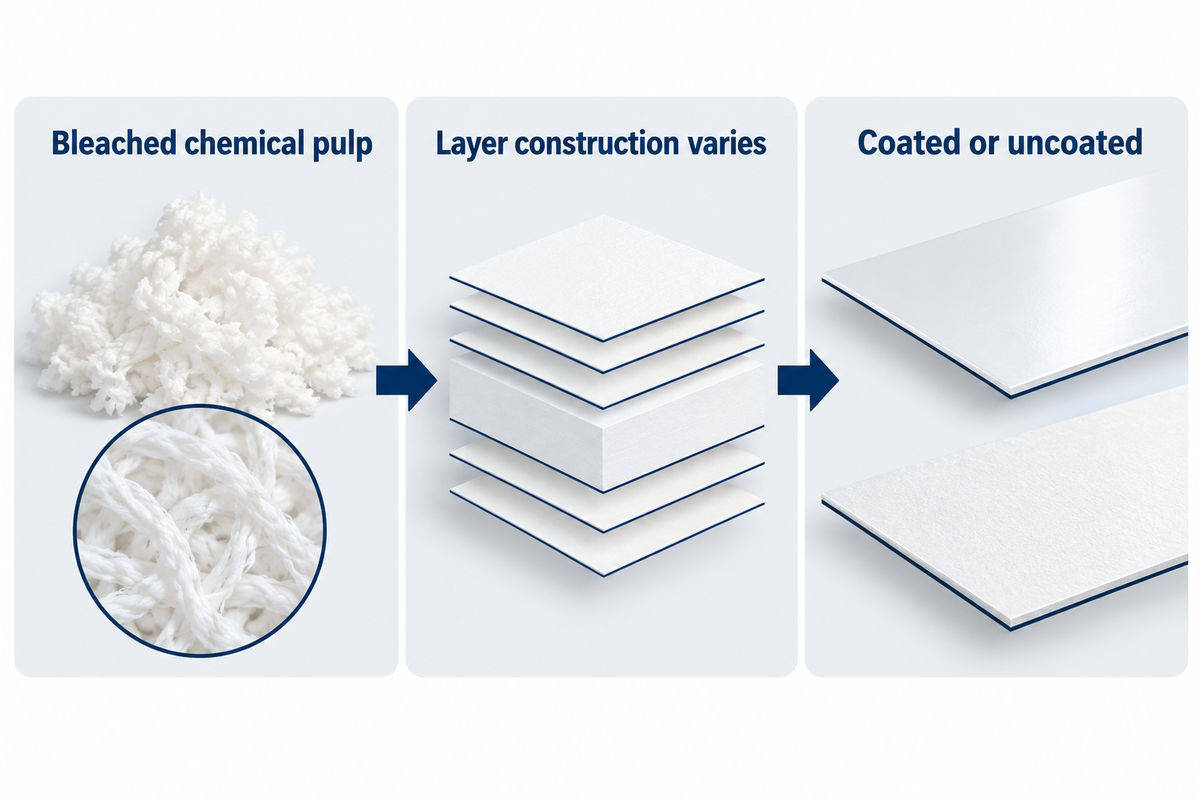
SBS gets its white fibre structure from bleached chemical pulp; the number of plies and coating are other construction choices. A multilayer board can be SBS, if its fibre layers use that furnish. A white-coated face over a recovered-fibre core belongs to a different paperboard family.
What is solid bleached sulfate board?
Solid bleached sulfate board is a type of paperboard manufactured from bleached chemical pulp. The term describes the fibre furnish, rather than a compulsory single-layer structure or a universal coating recipe. Paper mills provide different SBS grades for printed cartons and other packaging, with thickness, surface finish and converting properties specified for each grade.
The Pro Carton terminology guide distinguishes this construction from folding box board and recovered-fibre board. Chemical pulping separates fibres from wood pulp through chemical processing; mills bleach the pulp to obtain the required brightness. The resulting bleached virgin fiber structure isn’t the same as adding a white surface to a darker core.
Stora Enso’s Ensocoat has three chemical-pulp layers, a coated printing face and a light-coated reverse, according to its April 2026 specification. Ensovelvet, launched in September 2025, is an uncoated SBS grade. When ordering, you’ll have to specify coating separately.
A cosmetics carton with an unprinted inside face may use a different surface arrangement from a carton printed inside and outside. Specify the reverse side as carefully as the visible face: an inside promotion, adhesive joint or product contact changes what that surface must do.
SBS paperboard specifications: grammage, caliper and stiffness
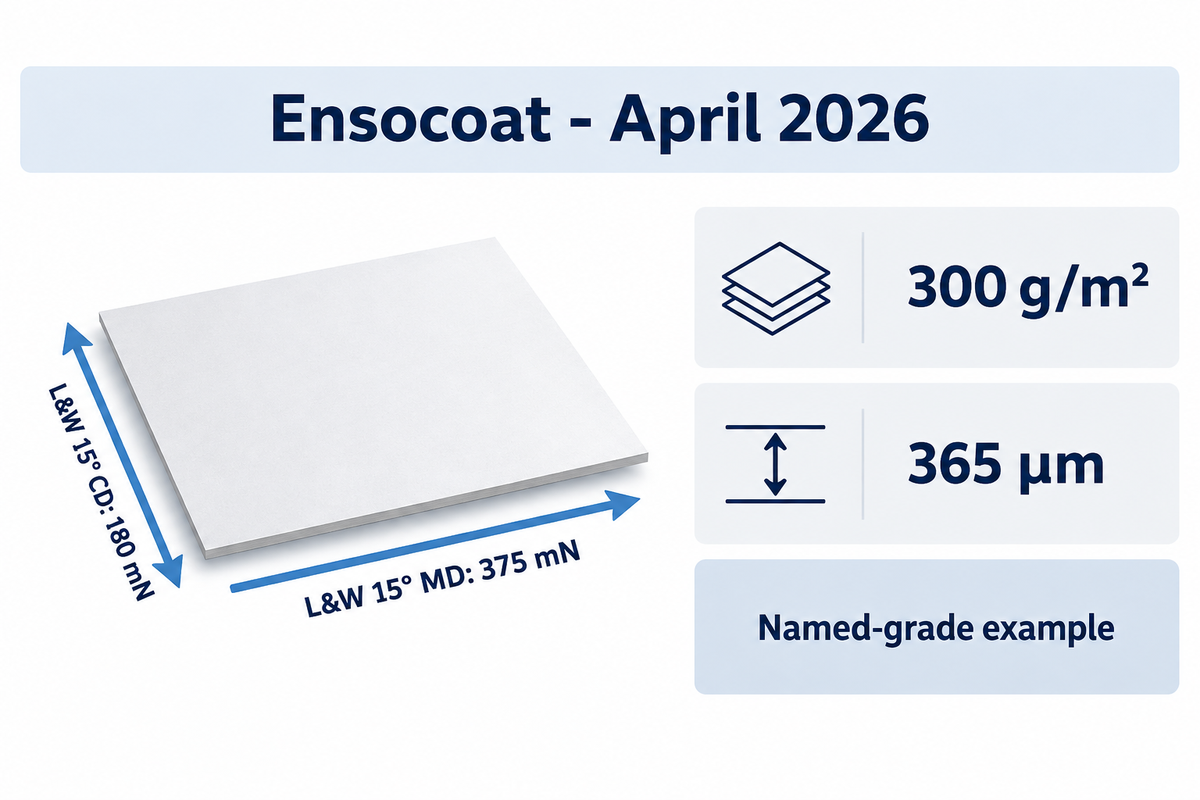
Stora Enso specifies a 365 µm thickness of Ensocoat for a 300 g/m² board in its April 2026 sheet. It also provides different values for machine and cross direction bending. Other SBS grades at the same grammage can have different caliper and bending performance because of their construction and finishing.
What is the thickness of paperboard?
Ensocoat’s April 2026 specification gives thicknesses of 300 µm at 250 g/m² and 445 µm at 350 g/m². Paperboard thickness is its measured caliper, stated in micrometres, millimetres or points; the Paperboard Packaging Council says paperboard ranges in thickness from 10 to 40 points (thousandths of an inch). For another grade, use its specified thickness rather than a generic GSM conversion chart.
Grammage is mass per unit area, measured under ISO 536:2019. Thickness describes the distance between faces. Bending resistance describes the force needed to bend a specimen under a stated method. The Paperboard Packaging Council’s property guide explains why equal-weight sheets can have different calipers and densities.
| Grammage, g/m² | Thickness, µm | L&W 15° MD, mN | L&W 15° CD, mN |
|---|---|---|---|
| 250 g/m² | 300 µm | 210 mN | 100 mN |
| 300 g/m² | 365 µm | 375 mN | 180 mN |
| 350 g/m² | 445 µm | 580 mN | 270 mN |
The sheet specifies a laboratory climate of 23°C and 50% relative humidity. Grammage and thickness tolerances are ±4%; bending resistance has a −15% tolerance. Its tolerances apply to delivered reel or pallet averages, with the stated confidence basis. Preserve those conditions when comparing an incoming measurement with the specification.
MD means machine direction; CD means cross direction. A sheet can bend differently along those two axes. Taber bending moment in mNm and L&W bending resistance in mN also represent different reported quantities. ISO 2493-2:2020 specifies a Taber-type method: retain the instrument, angle and method next to each result.
5-Field SBS Spec Check
The 5-Field SBS Spec Check compares grade identity, grammage, caliper, directional bending data and surface requirements prior to board substitution.
A surface that delivers fine printed detail may behave differently during folding. Excellent print performance belongs alongside an acceptable folded sample in the approval record, rather than replacing the bending and crease checks.
For the first replacement trial, use the actual caliper and the approved grade’s MD/CD targets. If the proposed board matches 300 g/m² but changes from a light-coated to an uncoated reverse, keep the inner print and glue tests for the trial, even if the outer artwork remains the same.
SBS vs FBB and recycled paperboard: choose by carton requirements
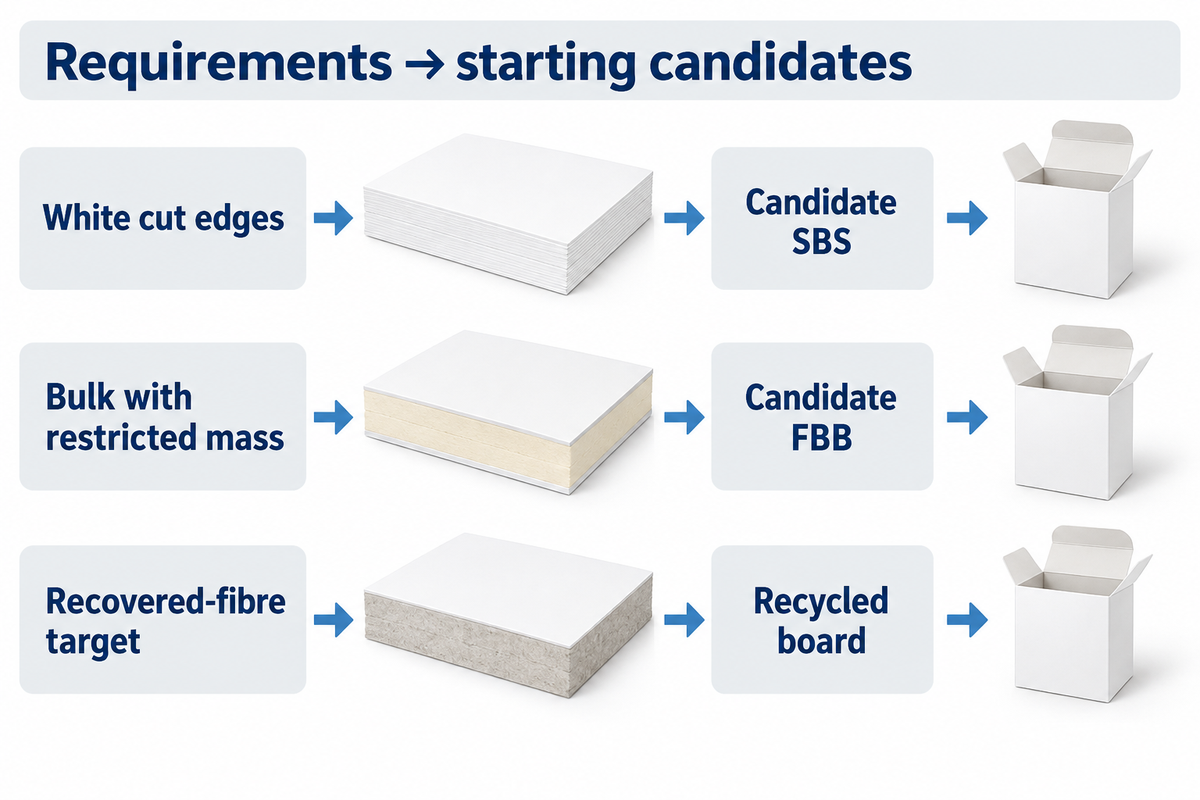
SBS, FBB and recycled paperboard differ in fiber structure, so a substitution should preserve the carton properties required for its job. Compare white appearance, finishing, caliper, directional bending and converting yield, as well as mass per square meter.
What is the main difference between FBB and SBS boards?
FBB generally combines a mechanical pulp middle layer with chemical pulp outer layers, while SBS uses bleached chemical pulp through its fiber structure. That makes a difference in the bulk and surface properties. Choose between them using the finished carton’s printing and folding requirements, with the candidate grade’s measured caliper and directional bending data.
Solid unbleached board uses unbleached chemical pulp, often with a coated face. Coated recycled board uses recovered fibres and a printable coating. An uncoated recycled board has yet a different surface profile. The Paperboard Packaging Council’s four-grade overview gives examples of these families; commercial names vary by region.
| Carton requirement | Starting candidate | Selection test |
|---|---|---|
| White cut edges | SBS | Inspect exposed edges on the assembled carton |
| Printed inside face | Suitable two-sided grade | Proof the reverse-side artwork |
| Embossed cosmetics design | SBS or qualified FBB | Assess relief and fold-line appearance |
| Bulk with restricted mass | Candidate FBB | Compare measured caliper and MD/CD values |
| Recovered-fibre purchasing target | Recycled board | Match declared furnish and finish |
| Greasy contents | Purpose-built barrier grade | Evaluate finished-pack grease resistance |
| Frozen food carton | Suitable freezer grade | Evaluate moisture exposure and joints |
| Liquid-containing pack | Specified liquid packaging structure | Evaluate barrier and sealing system |
| Existing high-speed packing line | Current grade plus qualified alternative | Compare feed, erection and reject records |
A retail packaging buyer replacing a white-edged personal care carton has a different task from a buyer sourcing a plain outer sleeve. For the first, retain the visible edge and the inside print requirements. For the sleeve, compare alternative paperboard substrates against the approved fold and appearance sample before paying for features the design does not use.
SBS coating and printability for folding cartons
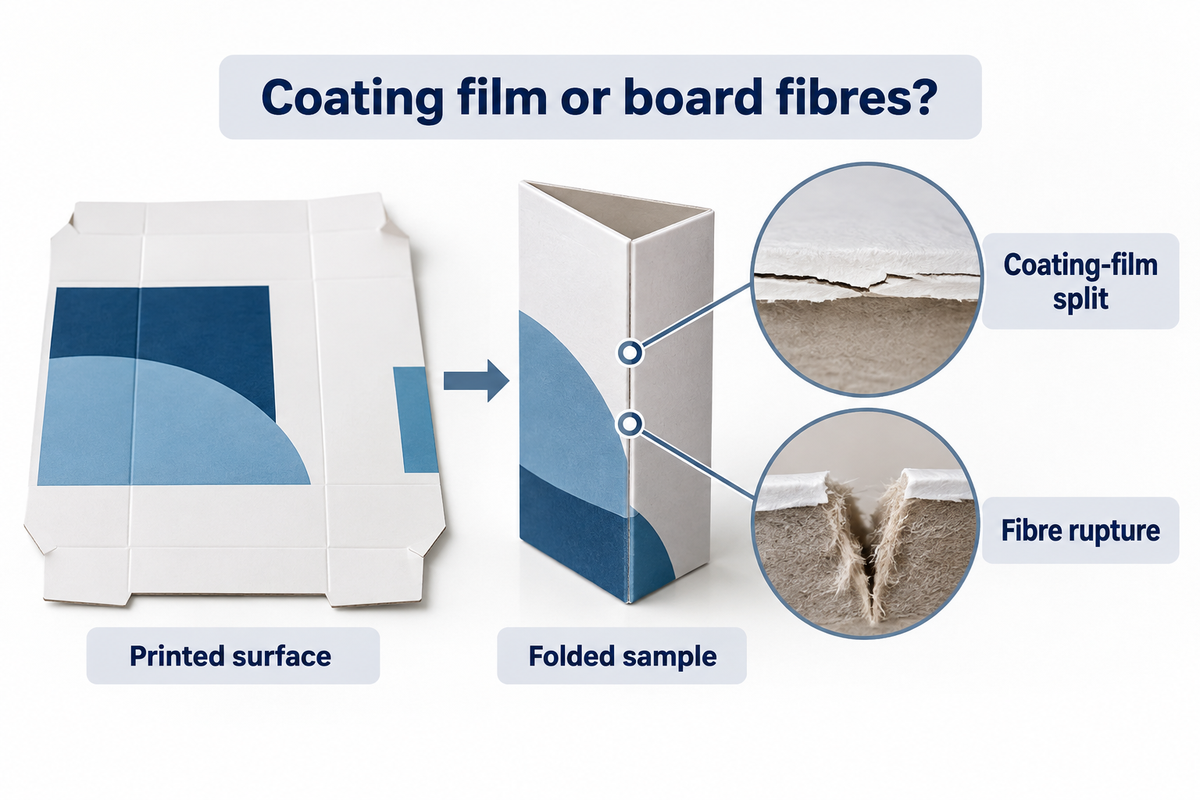
Printability comes from the board surface, ink and finishing process working together. A smooth surface can support high-quality printing, while a fold crossing a dark solid can expose a crease defect that was inconspicuous before printing. Evaluate the decorated and folded sample, rather than approving the unprinted sheet alone.
C1S means coated on one side, while C2S means coated on two sides. A clay-coated surface provides a printing layer, but the amount and type of coating on the reverse side may differ. State which face is printed, glued, hot foil stamped or embossed. A premium paperboard with a brilliant white printing face still requires the correct ink and finishing settings for the design.
Keep the coated top surface in one consistent orientation through a comparison trial. A coating system may contain one or more layers; neither a C1S label nor the color of the face states its coat weight. A finished fold is a separate acceptance sample for a board with good printing properties.
Distinguish a split ink or coating film from fractured board fibers when diagnosing fold cracking. Practitioners have documented cracking in dark solids and UV finishes in a folding-carton print discussion. Compare the grain orientations under controlled crease trials, keeping the condition of the artwork and board constant; change one variable before attributing the fault to the board grade.
Beex and Peerlings’ 2009 creasing research explains that some internal layer separation helps a crease bend without breaking the outer face. Visible top-layer rupture and controlled internal deformation are different outcomes. A shallow crease can also damage the face during folding.
In Gigac and Fišerová’s 2022 laboratory study, calendering reduced roughness and bending resistance in FBB and WLC samples. Those process settings apply to the samples of FBB and WLC, not to SBS.
While upgrading a mill, consider desired surface qualities, retained bulk and bending properties. Examine the paper machine calender roll duty in that process brief, including the condition of the incoming sheet and the following finishing operation.
SBS packaging applications and barrier requirements
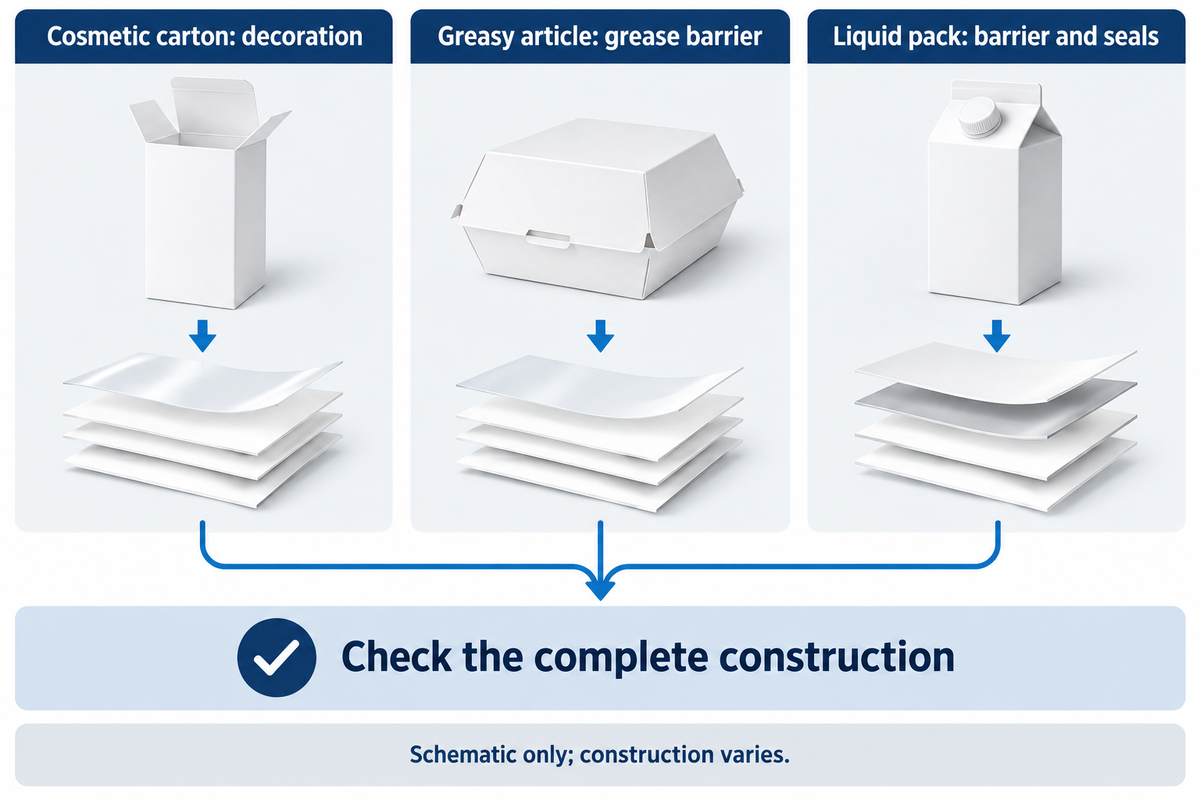
For food packaging, define the complete packaging material and the contact conditions. Printing properties for graphical and packaging work describe the decoration stage; grease or liquid resistance belongs to the barrier structure. SBS’s versatility comes from those grade and surface choices, rather than one universal specification for every package.
SBS serves a wide variety of applications, from cosmetic cartons to selected food-service and liquid-packaging structures. The Paperboard Packaging Council lists cosmetics, frozen foods and dairy products among SBS end uses. Alongside whiteness and print performance, match the finished construction to its contents: ordinary printable board, grease-resistant board and a sealed liquid pack have different functional requirements.
For premium packaging, SBS paperboard offers a bright white appearance at cut edges and a surface chosen for the intended decoration. For example, you can add visual impact to small perfume cartons using embossing or foil. Pharmaceutical packaging may also require legible small type and reliable coding; carton geometry and the packing line remain part of the specification.
| Application group | Functional emphasis | Trial item |
|---|---|---|
| Perfume carton | Surface decoration | Foil adhesion and folded appearance |
| Personal care sleeve | Print finish | Colour proof and rub result |
| Pharmaceutical carton | Readable information | Small text and code legibility |
| Confectionery outer carton | Appearance and pack structure | Finished construction and contents interface |
| Greasy food-service article | Grease barrier | Coated structure under intended contact |
| Frozen food pack | Cold and moisture exposure | Conditioned pack and adhesive joint |
| Liquid pack | Liquid barrier and seals | Complete laminate and seal trial |
| Graphic display | Flat printed surface | Curl and display shape |
| Blister card | Bond to the chosen blister system | Seal and opening behaviour |
Packaging requirements should describe contents, contact conditions and the complete coating or laminate. For sustainable packaging, assess the assembled fibre-based article: coatings, films and attachments affect the route by which a local collection system can recycle it.
SBS paperboard price: compare quotes per usable sheet
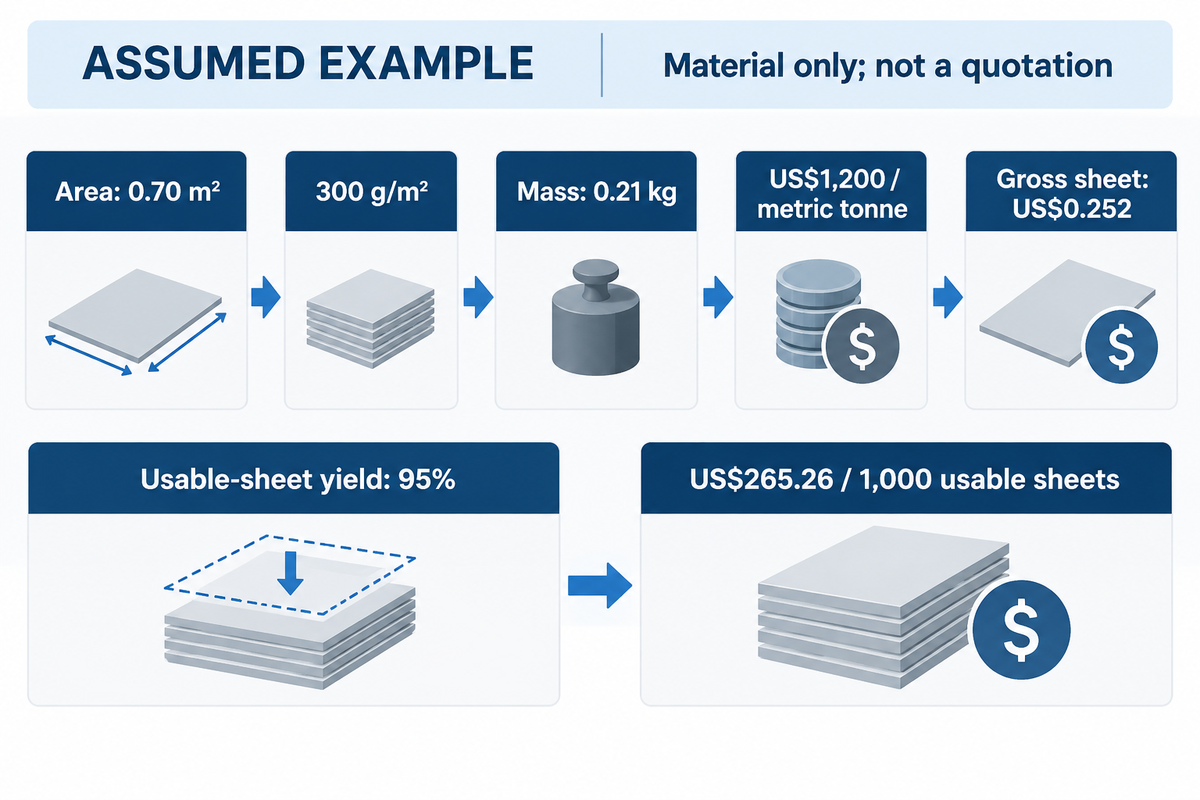
A sheet price is comparable when dimensions, grammage, mass unit, and usable yield are the same. Convert the quoted tonne price to sheet material price, and account for accepted output. For cartons with different layouts, take the calculation one step further to cost per accepted blank, because the number of blanks per sheet can reverse the ranking.
Keep “SBS paperboard” in the material description: SBS also names styrene-butadiene-styrene used in other industries. The price of roofing sheets has nothing to do with folding carton board. For imported material, the NIST unit-conversion table distinguishes a metric tonne of 1,000 kg from a short ton of approximately 907.185 kg.
Calculate the cost per usable sheet
The cost of packaging includes accepted output as well as purchased material. Paperboard delivers value when its format and converting performance suit the actual order, even when another sheet has a lower purchase price.
Assumed inputs: sheet dimensions 0.70 m × 1.00 m, grammage 300 g/m², material price US$1,200 per metric tonne and usable-sheet yield 95%. Freight, printing and conversion costs aren’t included. This example is for material cost comparison only; it isn’t a current quotation.
- Sheet area: 0.70 × 1.00 = 0.70 m².
- Sheet mass: 0.70 × 300 ÷ 1,000 = 0.21 kg.
- Gross sheet material cost: 0.21 × 1,200 ÷ 1,000 = US$0.252.
- Cost per 1,000 usable sheets: 0.252 × 1,000 ÷ 0.95 = US$265.26.
In a separate assumed layout comparison, a US$0.30 sheet producing eight accepted blanks costs US$0.0375 per blank, versus about US$0.0417 for a US$0.25 sheet producing six accepted blanks. Calculate carton material cost by dividing sheet material cost by accepted blanks; the higher-priced sheet costs less per blank here.
When doing a yield calculation, add trim and rejected output once. Then add printing, tooling, conversion, freight and order-specific overproduction on the same basis. Comparing just the lowest waste percentage may conceal the cost of additional setups or excess inventory. State the denominator as sheets, blanks or finished cartons, beside every value calculated.
SBS paperboard manufacturers and paper-machine suppliers serve different needs
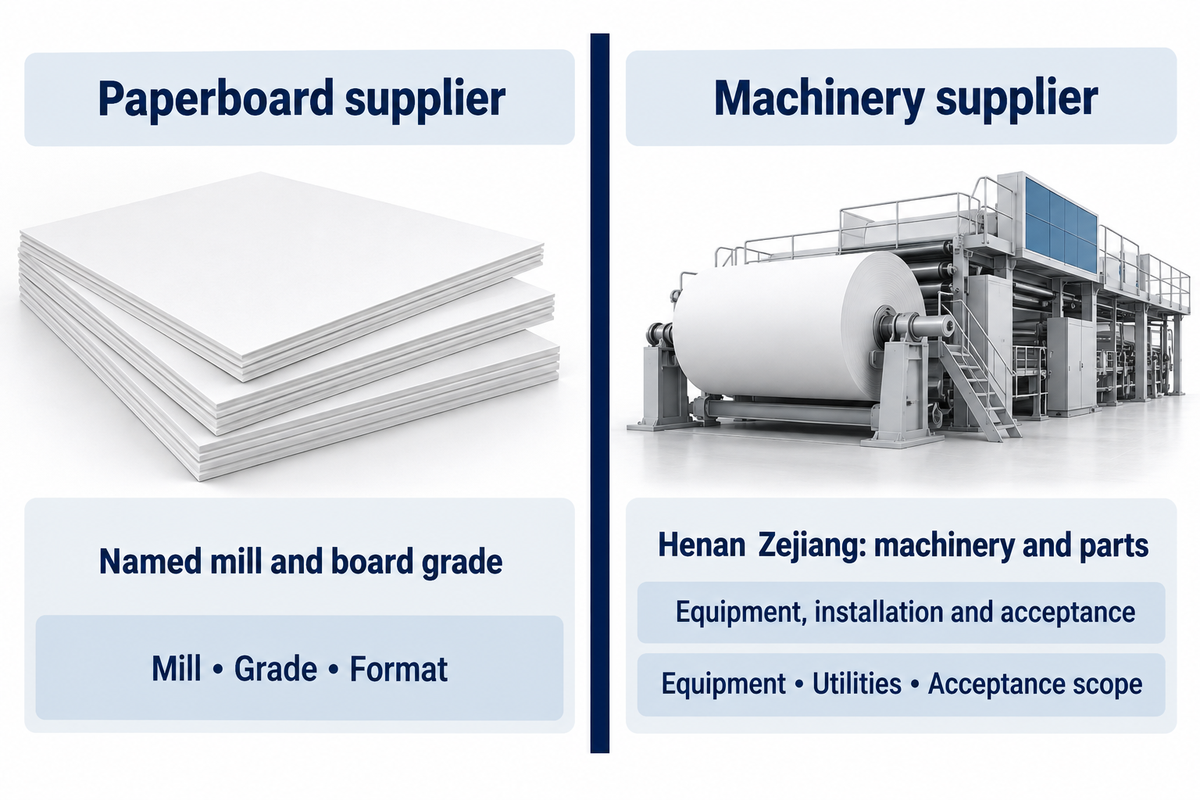
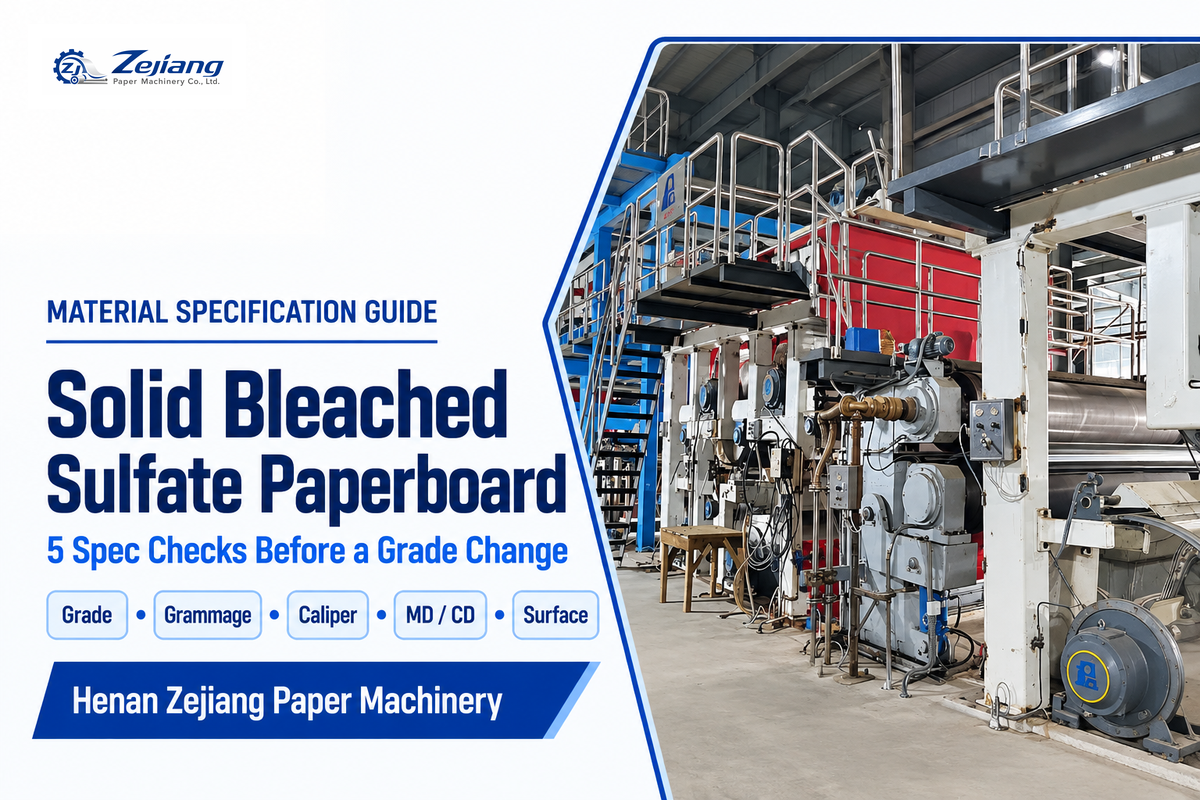
SBS sheets or reels from a mill grade may be sourced through a paperboard producer or a board supplier. For a mill project, source equipment and process support from a machinery supplier. Henan Zejiang Paper Machinery Co., Ltd. supplies paper-making machinery, pulp-processing equipment and spare parts for paper producers.
A paperboard portfolio defines material grades and application. An equipment proposal defines machinery, utilities, installation and acceptance duties. The historical Paper Industries Machinery classification identifies machinery manufacturing as a distinct industrial activity.
Buying paperboard
- Named mill and board grade
- Sheet or reel dimensions and grain
- Surface and converting requirements
Planning mill equipment
- Target furnish and product specification
- Process duty and utility interfaces
- Equipment, installation and acceptance scope
We have new and used paper machines, as well as refurbishments and mill upgrades. We also supply replacement machinery components. Our range includes headboxes, pulpers, screen baskets, agitators, dryer cylinders and engineered rolls. A project brief for a paper machine headbox should describe formation needs; the related press and drying sections need their own duty and interface data.
A higher finished-board specification may necessitate changes in stock preparation, formation and finishing across several machine sections. For a proposed specification change, send us your new requirements and the details of your current equipment.
SBS board storage and incoming quality checks
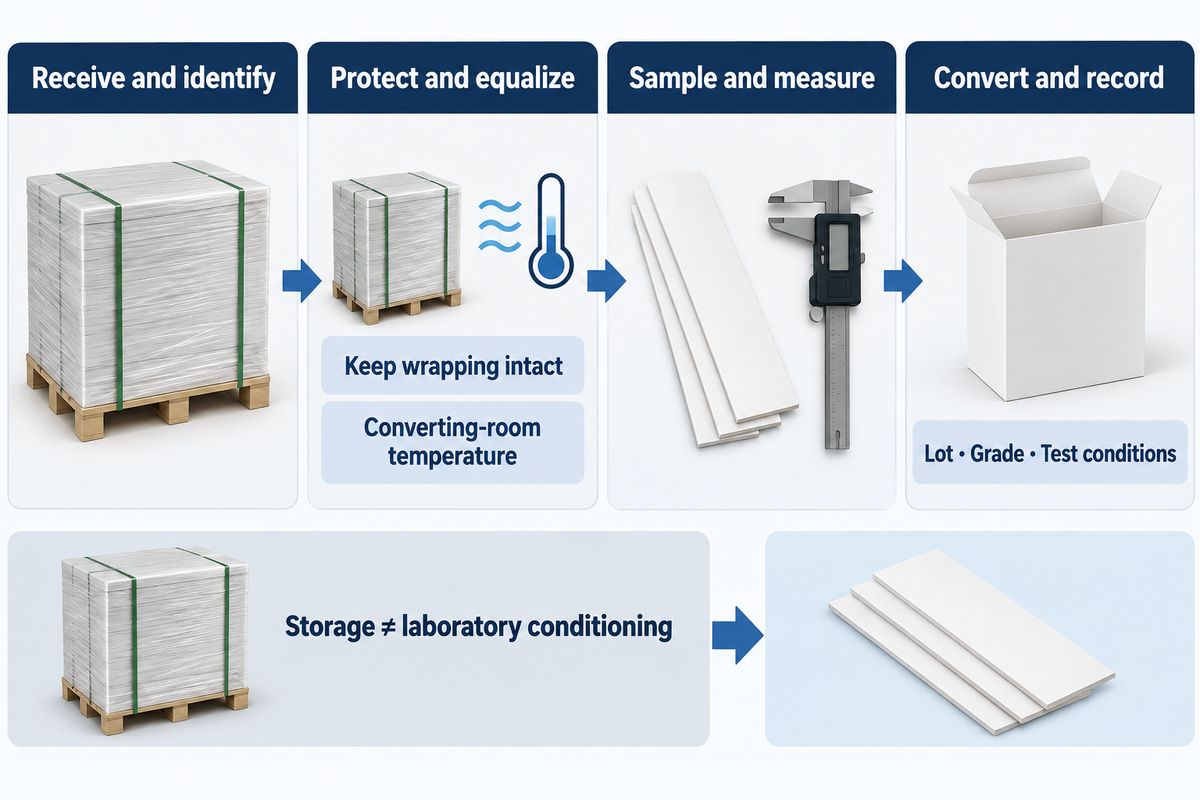
Ensocoat’s recommended storage conditions are 20–23°C and 50–55% relative humidity. Keep SBS protected from moisture exchange and allow wrapped material to approach the converting-room temperature before opening it. These storage conditions are different from conditions used for conditioning SBS in a laboratory. ISO 187:2022 covers sample conditioning and the testing atmosphere for paper and board.
Incoming SBS lots should retain reel or pallet identity through the sheeting and conversion process. Grades, dimensions, and types of visible damage should be documented along with the measurement conditions against the agreed purchase specification. An exposed sheet edge can exchange moisture while the middle of a wrapped pallet remains protected, so opening packaging early can introduce uneven conditions.
- Receive and identify. Match the lot label with the ordered mill grade and retain the label in the production record.
- Protect and equalize. Keep moisture-resistant wrapping intact while material temperature approaches the converting room.
- Sample and measure. Use the agreed sampling and conditioning procedure for caliper, grammage and directional bending.
- Convert and record. Track feeding, printing, folding and accepted output against the approved sample.
When replacing a cosmetic carton, hold the artwork and tooling constant for the first board comparison. Record which face and grain orientation of the board are loaded in the die. Fold cracks may appear after a storage change. Check the condition of the board and crease settings before increasing grammage.
SBS paperboard outlook: new capacity does not make grades interchangeable
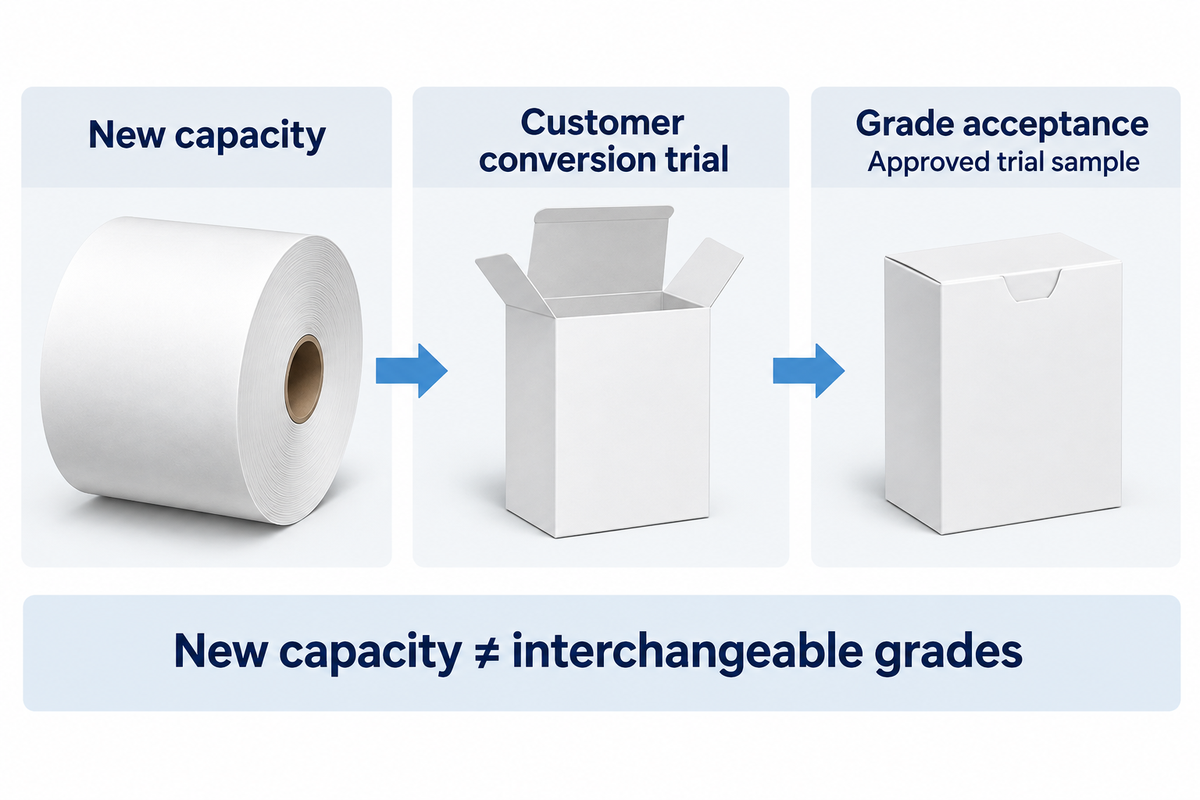
Adding new SBS capacity provides additional sourcing opportunities, but qualification still follows the named grade and its conversion results. A mill’s commercial ramp may overlap with customer trials. For a replacement contract, separate the supplier’s production milestone from board acceptance on the customer’s printing and packaging line.
Sappi announced commercial delivery from its converted Somerset PM2 in July 2025, with qualification work accompanying a ramp then planned through 2026. PaperAge’s July 29, 2025 report covered the announcement and planned schedule, not full-year production results.
Surface choice is also expanding. Stora Enso introduced its uncoated Ensovelvet SBS in September 2025 alongside coated Ensocoat. A natural uncoated finish and a coated top surface answer different design briefs. A board supplier offering both can serve graphical and packaging end uses without treating one surface as the default for every carton.
For a sourcing change, assess the candidate at the same carton layout and accepted-output boundary. A new grade with good printing properties still needs a folding trial with the actual artwork. For a mill investment, define the desired fiber structure, required coating operation and finishing before determining equipment capacity.
The first replacement order should maintain lot traceability and the approved trial sample. Keep the current grade available during the transition, and compare new lots against the original print and fold criteria used in the qualification.
FAQ
Is paperboard the same as cardboard?
No. Paperboard is a material category; cardboard is a broad everyday term.
Buyers use cardboard for several packaging constructions, including corrugated cases. Folding carton paperboard is usually a flat substrate converted into printed cartons. A purchase description should name the board grade and construction rather than rely on cardboard. Otherwise, a white folding carton and a fluted shipping case can enter the same inquiry.
What are the four main types of paperboard?
SBS, unbleached kraft board, coated recycled board and uncoated recycled board are common examples.
Paperboard classification varies by market and application: the Paperboard Packaging Council discusses four common families, while European terminology also distinguishes FBB and white-lined chipboard. Specify the named grade, furnish and surface description when ordering. Different packaging needs can call for a coated printing face, an uncoated face or a purpose-built barrier. The family name introduces the options, while the ordered grade defines the material.
What is SBS paper used for?
SBS is used for printed cartons and selected purpose-built packaging structures.
Typical jobs include cosmetic cartons, personal care sleeves and other retail packs where a white fibre structure and decorated surface matter. Suitable specialist grades also serve food-service and liquid-packaging applications. Choose the surface and barrier construction for the job, then evaluate the finished article through printing, folding and the intended packing operation.
Can SBS paperboard be recycled?
Yes, suitable SBS packaging can enter paper recycling streams.
The finished pack’s coating, laminate, attachments and contamination affect acceptance. Use the collection or recycler’s rules for the complete article. An uncoated carton and a liquid-resistant multilayer pack shouldn’t receive the same disposal instruction simply because both contain SBS fibres.
What sizes of SBS paperboard are available?
SBS is supplied as sheets or reels, with dimensions specified for the converting job.
A sheet order needs width, length, grain orientation and cutting tolerance. A reel order also needs web width, core and reel dimensions matched to handling equipment. Select sheet size from the carton layout, including gripper and trim allowances, rather than choosing a generic catalogue size first. Compare accepted blanks per sheet when two suppliers propose different formats. A format that costs more per sheet can cost less per carton when it improves usable layout.
What is SBS material?
In paperboard, SBS means solid bleached sulfate.
In other industries, the abbreviation also means styrene-butadiene-styrene, a polymer used in products such as modified bitumen. Write the full material name and intended application in an inquiry.
Can I replace an SBS grade with another board at the same GSM?
Yes, if the alternative also meets the carton’s dimensional and converting requirements.
GSM fixes mass per area, while caliper and directional bending can change between grades. Start with the approved carton’s thickness and MD/CD values, then compare surface finish, inside print, folding and adhesive performance for the established packing line. Keep the layout constant for the initial comparison and calculate material cost per accepted blank.
Prepare a board or machinery inquiry
For a board inquiry, copy the named grade and intended converting conditions to the request. For a mill project, couple the finished board target with the existing line description. Separate these requests so each supplier quotes the equipment or the material being bought.
| Parameter | Recommended range | Why it matters | How to verify |
|---|---|---|---|
| Grade identity | Named mill, grade and current revision | Separates different products | Confirm technical-sheet identity |
| Grammage and caliper | Approved job values in g/m² and µm | Controls mass and geometry | Use agreed sampling and measurement methods |
| Bending | Approved MD/CD targets with mN or mNm method | Retains directional behaviour | Match instrument and test conditions |
| Surface and contact | Specified sides, finish and intended-use conditions | Matches decoration and contents | Confirm current grade documentation and trial |
| Format and yield | Job dimensions in mm; blanks per sheet | Normalizes material cost | Review layout and accepted-output records |
| Quote basis | Currency, mass unit, delivery scope and quantity | Separates material from landed costs | Reconcile all included charges |
Planning a production line upgrade? Henan Zejiang Paper Machinery Co. Ltd offers machinery and spare parts for paper mills around the world. Visit our paper making machine systems, and give us the target grade, the type of furnish, and the existing line information and we’ll assess the equipment and provide support.
Discuss your paper machinery project
Henan Zejiang supplies machinery and related components; referenced board grades and research belong to their respective manufacturers and authors.
References & Sources
- Glossary: A Guide to Terminology Used in Cartonboard and Folding Carton Manufacturing, Pro Carton.
- ISO 536:2019: Paper and board, Determination of grammage, International Organization for Standardization.
- Pick Paperboard Like a Pro, Paperboard Packaging Council, 2019.
- ISO 2493-2:2020: Paper and board, Determination of bending resistance, Taber-type tester, International Organization for Standardization.
- 4 Types of Paperboard, Paperboard Packaging Council, 2019.
- An Experimental and Computational Study of Laminated Paperboard Creasing and Folding, L. A. A. Beex and R. H. J. Peerlings, Eindhoven University of Technology research record, 2009.
- Effect of Smoothing in Calender and Hot Stamping Machine on the Properties of Coated Paperboards for Printed Electronics, Juraj Gigac and Mária Fišerová, Wood Research, 2022.
- NIST Guide to the SI, Appendix B.8: Factors for Units Listed Alphabetically, National Institute of Standards and Technology.
- Description for 3554: Paper Industries Machinery, Occupational Safety and Health Administration, historical industry classification.
- Sappi North America Ramping Up Production on Rebuilt PM 2 at Somerset Mill in Maine, PaperAge, July 29, 2025, reporting Sappi’s announcement.