Get in touch with Zejiang Paper Machinery Company


![Paper Pulper Machine: Types & How They Work [Guide]](https://zjpapermachine.com/wp-content/uploads/2026/07/paper-pulper-machine-guide-featured.png)
Quick Specs
| Low-consistency (D-Type) pulper | Roughly 3–5% consistency, best for OCC and mixed waste paper |
| High-consistency pulper | Academic sources cite roughly 8–18% (NC State University); manufacturer spec sheets vary 10–16% by brand |
| Drum pulper | Roughly 14–18% consistency, continuous operation, gentler on fiber length |
| Test standard | ISO 5263-1:2004 governs laboratory wet disintegration of chemical pulps. |
A paper pulper machine is the machine that breaks down waste paper, virgin pulp bales, or other fibrous raw materials into a pumpable fiber slurry that can be pumped to the rest of a stock-preparation line – it’s the very first mechanical step in paper making and paper manufacturing, regardless of whether the mill is operating virgin pulp or recycling waste paper. This guide to the basics of the machine and technology: types of pulpers (including variants for batch vs. continuous pulp making machines); how the equipment works inside the tank; raw materials handled by different pulpers; how to size and select the right machine for your paper production line; what a pulper cost to run; and a research finding you probably won’t find elsewhere: pulping consistency doesn’t scale with contaminant removal the way you’d think.
Key takeaways:
- Three major categories of paper pulper machine: mechanism types D-Type/Vertical Pulper, Drum Pulper, and High-Consistency Pulper. Plus there’s a buying guide omission: horizontal vs. vertical pulper tank.
- When running paper furnish in a pulper at 15% consistency it can produce more smaller and harder-to-screen stickies than the same furnish in a pulper at 5% or 10%, according to a 2018 study in TAPPI Journal.
- Selecting the right pulper primarily depends on the raw material and intended consistency of pulp, not solely on capacity ratings.
(Updated July 2026)
What a Pulper Does in a Stock-Prep Line
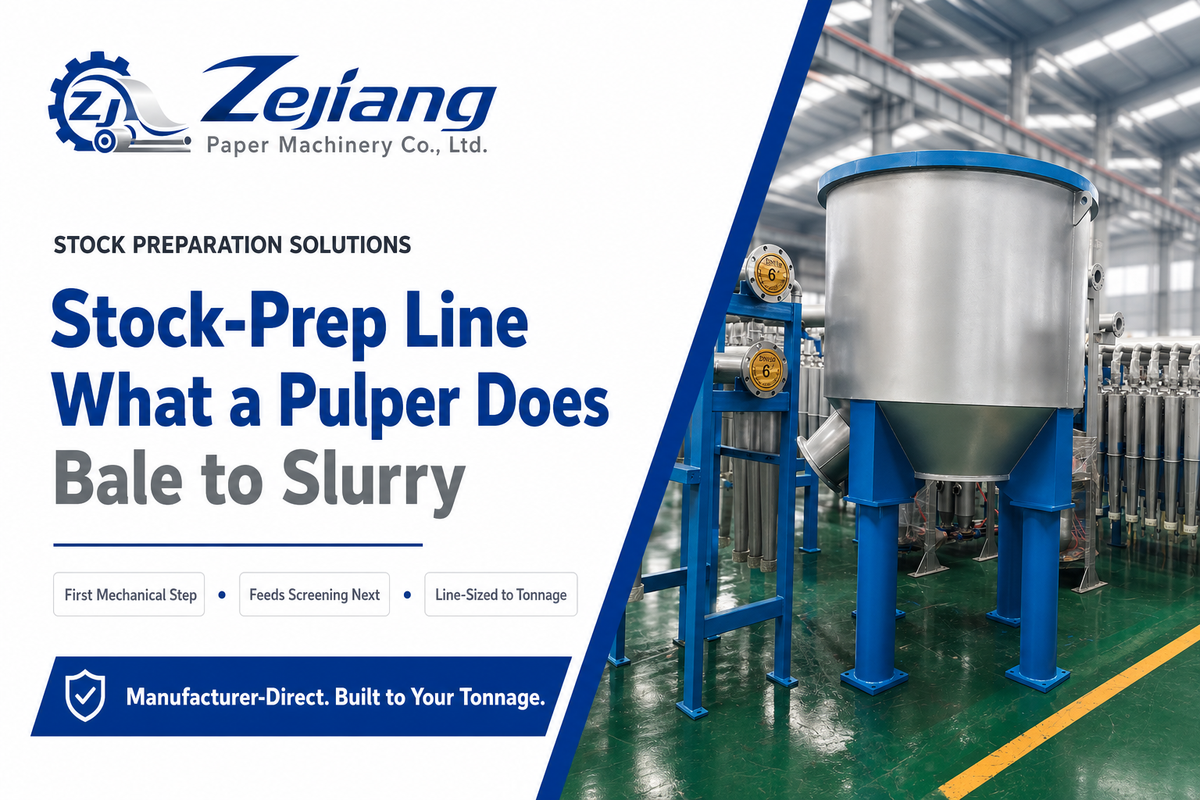
At a high level, a pulper is an agitated tank, most commonly with a rotor or impeller at the bottom or side, that mixes fibrous raw material with water and mechanical action to break it apart into individual fibers and create a pumpable slurry.
Some suppliers market the same category as a hydro pulper or a small paper pulper machine at the low end of the capacity range, but the underlying mechanism is identical. A more detailed definition from ScienceDirect’s engineering reference describes it as equipment that mixes waste paper with hot water, alkali, and process chemicals to dissolve and disperse adhesives, fillers, and inks — the contaminants, not the fiber itself — producing a pulverized paper stock for further processing.
The typical position of a pulper is right after bale breaking and right before contaminant removal in a recycled fiber production line: bales are opened, fed loosely into the pulper, defibrated, and then the pulper discharge is pumped to a downstream screen and/or cleaner (a “stock-preparation” or “stock-prep” line). This guide focuses on pulpers used for the broader paper and pulp sector – paper and board mills operating a standard virgin pulp making or a waste paper recycling line. Pulpers for specialized molded-fiber applications, such as for an egg tray production line, paper trays, paper cups, or a pulper for cup stock, are generally built as a separate product line for a specific process with unique screening requirements, contamination levels, and typically operate with virgin or food-grade raw materials; suppliers of these paper pulp-making machines for those markets generally offer a separate product line from the paper-and-board pulpers covered here.
Skipping proper sizing, or undersizing the pulper for actual furnish tonnage, is a common root cause of downstream bottlenecks and unplanned wear. Henan Zejiang Paper Machinery engineers each pulper’s rotor and tank volume around the customer’s stated daily tonnage rather than shipping one generic size across a wide capacity range. You can review equipment options, including specific pulper models, capacities, and availability for your paper stock-preparation equipment by visiting our paper pulper machine page.
📐 Engineering Note
ISO 5263-1:2004 governs laboratory wet disintegration of chemical pulps at laboratory scale, a useful reference point if you need to benchmark a supplier’s pulping-quality claims against a standardized method rather than a marketing demo.
Types of Pulpers Used in Paper Mills
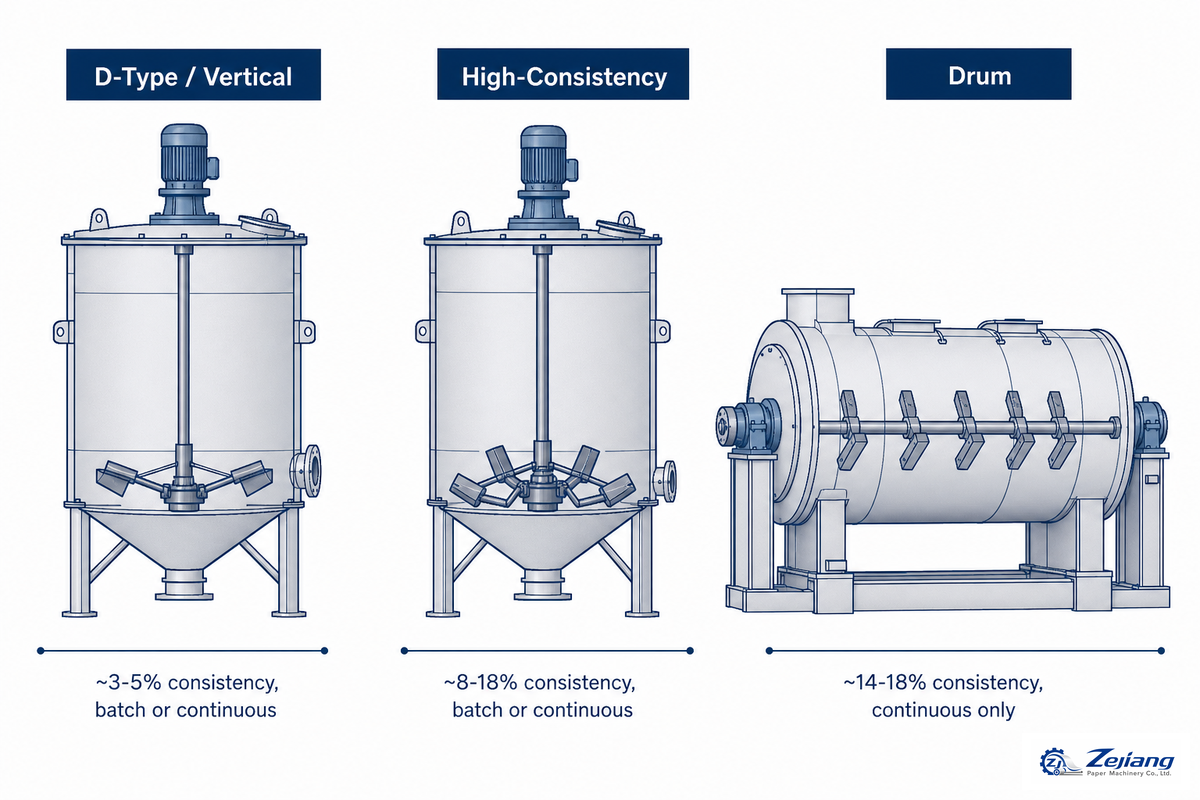
Pulpers are commonly classified by their operating consistency, by their action – and also separately – by whether the pulper runs as a batch pulper (one charge at a time to be fully processed before emptying) or as a continuous pulper (simultaneous input and output of the charge – used for high-throughput mills and large production). The Pulper Type Decoder table shows the pulper family which matches the intended application to furnish and consistency, using the academic consistency ranges published by NC State University’s Department of Forest Biomaterials as the reference baseline rather than any single manufacturer’s spec sheet. It’s a useful initial list of possible candidates but not a definitive recommendation.
| Pulper Type | Typical Consistency | Operating Mode | Best-Fit Furnish |
|---|---|---|---|
| D-Type / vertical low-consistency | ~3–5% | Batch or continuous | OCC, mixed waste paper, packaging-grade board mills |
| High-consistency | ~8–18% (academic range); manufacturer spec sheets commonly cite 10–16% | Batch or continuous | Mixed waste, OCC, energy-conscious lines targeting premium board grades |
| Drum | ~14–18% | Continuous | High-volume lines where preserving fiber length matters (tissue, premium grades) |
| Cup Stock / Tetra Pak type | ~12–15% | Batch or continuous | Coated cup stock, multilayer cartons, beverage packaging — not interchangeable with a plain-OCC spec |
| Low-consistency virgin type | ~4–5% | Batch or continuous | Virgin pulp bales, dry broke, market pulp — cleaner furnish than recycled-fiber lines |
| Batch operating mode | Applies across types above | One charge processed to completion, then emptied | Smaller operations, tighter process control, easier to trial a new furnish blend |
| Continuous operating mode | Applies across types above | Simultaneous feed and discharge | High-throughput mills needing to match a paper machine’s steady-state demand |
| Vertical tank orientation | Applies across D-Type/HC types above | Bottom-mounted rotor, standard footprint | The default configuration for most D-Type and high-consistency installations |
| Horizontal tank orientation | Applies across types above | Manufacturer-specific design option, not an industry-standard consistency class | Some suppliers offer horizontal tank designs targeting a lower build height where floor-to-ceiling clearance is limited — confirm this is on your specific vendor’s product line rather than assuming it’s universally available |
What Is the Difference Between a Drum Pulper and a D-Type Pulper?
A D-type pulper machine for paper is a low-consistency (approx. 3-5%), bottom-rotor, batch or continuous mode pulper. These machines are more frequently specified for OCC and mixed waste paper furnish, simply because they are mechanically simpler to build, operate, and maintain than the alternatives.
Drum pulpers are a high-consistency (approx. 14-18%), continuous-mode pulper that tumble the pulp within a rotating drum instead of a bottom-based rotor, and therefore do less mechanical damage to the fibres themselves — making them more often preferred by paper mills seeking fiber-length-sensitive grades such as tissue or printing paper on high-volume continuous runs, although they’re more expensive to install.
💡 Pro Tip
Don’t select a pulper type just based on consistency percentage. You’ll find a “high consistency” pulper from two vendors may differ by several percentage points on their spec sheets – make sure to verify the actual furnish and screen-basket combo that the vendor is suggesting, not just the top-level specification.
How a Pulper Machine Works
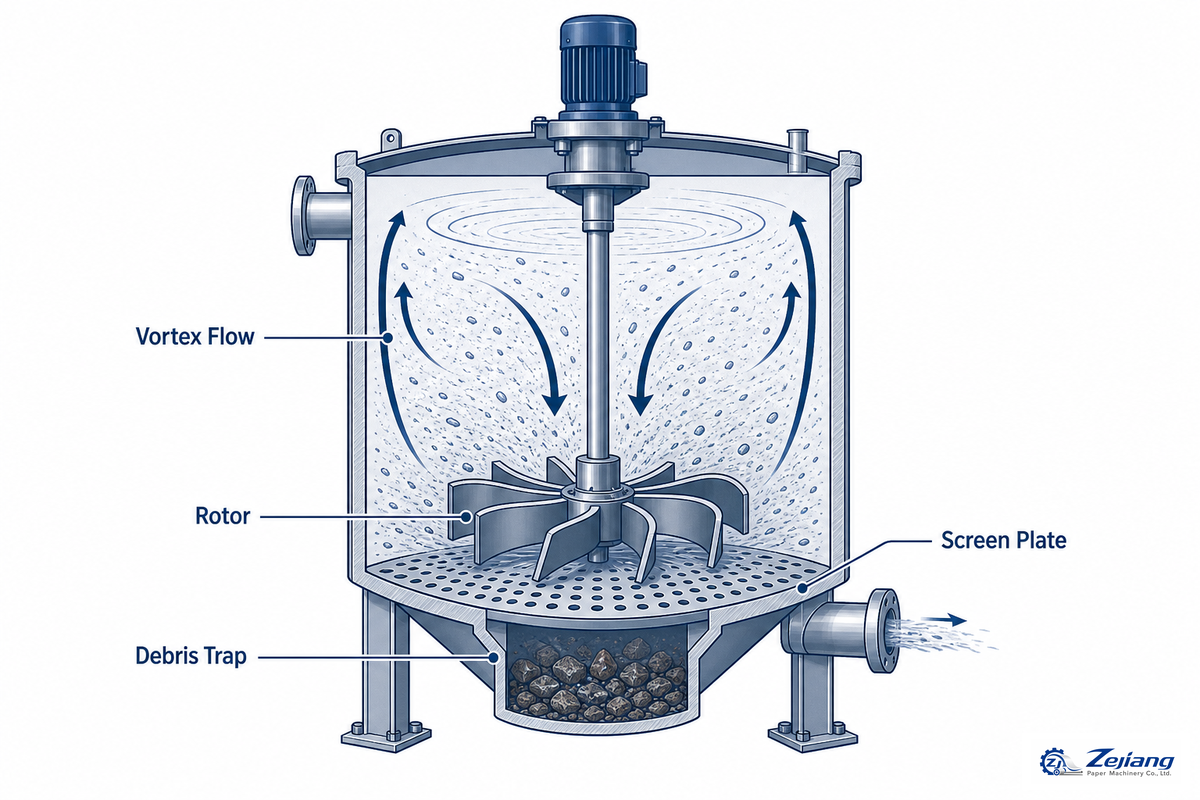
From a machine point of view, the process uses water and the input materials together with a drum or tub. Then, an impeller or rotor generates a high amount of shear, and in vertical designs a vortex effect continuously recirculates the batch so fiber bundles separate into individual fibers as the slurry form. Heavier contaminants settle to the bottom of the tub.
Inside a high consistency vertical D-type pulper the rotor is mounted at the bottom of the tank and revolves at a speed that corresponds to the desired consistency. Low-consistency pulping takes longer overall to complete defibering but requires lower horsepower per fiber, while higher consistency stock requires higher horsepower as there’s less free water to transmit the mechanical energy to individual fibers. The spinning rotor develop a circulating vortex which draws in the loose stock towards the rotor and expels the semi defibered stock upwards and outwards, so the fiber bundle passes through the most intense shear zone more than once before it’s loose enough to escape through the perforations in the plate at the bottom or sides of the tank. Heavy debris, stone, metal, and glass, sinks to the bottom of a trap located below the rotor and can be withdrawn separately, without being carried along with the defibered stock. Because rotor speed and target consistency are structurally linked, mismatching the two is a common cause of incomplete defibering — Henan Zejiang Paper Machinery specifies rotor speed and consistency together on every quote, rather than treating them as independent variables. This mechanical relationship is also reflected in patent literature on the hot-dispersion process (EP1359249A1), which notes that a given process setting is effective but not always sufficient across every furnish condition — a caution against treating any single rotor/consistency combination as universal.
During this cycle auxiliary equipment also aids the pulper: a ragger to continually removes the ropes, wires, and packaging straps which could get wound around the rotor shaft and a rope cutter which chops up what the ragger removes so that the fragments can be expelled from the tank without stopping the batch. It’s quite common for an industry professional to end their little batch of pulp pulping cycle with a little dump of fresh clean water to get all of the last traces of pulp out of the tank before they run the next batch; it doesn’t really add to the cycle time of the batch and it has very little associated cost to remove potential cross batch contamination, this is distinct from chemical pulping, where wood chips are cooked with chemicals to produce virgin fiber upstream of anything described on this page. The pulpers discussed here are mechanical re-pulping and waste paper pulp making equipment, not chemical digesters.
How Does a Paper Pulper Machine Actually Work, Step by Step?
Four events happen in sequence inside an operating pulper: (1) raw material and water load into the tank at the target consistency; (2) rotor speed comes up and within minutes develops shear that opens fiber bundles; (3) a vortexing or plug flow moves partially defibered material past the rotor repeatedly while heavies settle out; (4) the batch reaches target freeness, dilutes as needed, and passes through screening equipment that rejects oversized bundles and shives.
For a batch pulper, this whole sequence normally takes long enough to reach complete pulping of the load and no more than that, because over-processing wastes energy and can reduce fiber length more than necessary — this is why consistency and cycle time are typically specified together to define the pulping system’s operation.
This is a process in which feedstock quality is at least as important as machine setting; sorted, relatively clean waste paper materials cycle through more quickly and result in less rotor wear than highly contaminated bales of mixed paper — a small batch or a large one — which is just another argument for building the production process around your specific furnish, not an assumption.
Raw Materials & Furnish Compatibility
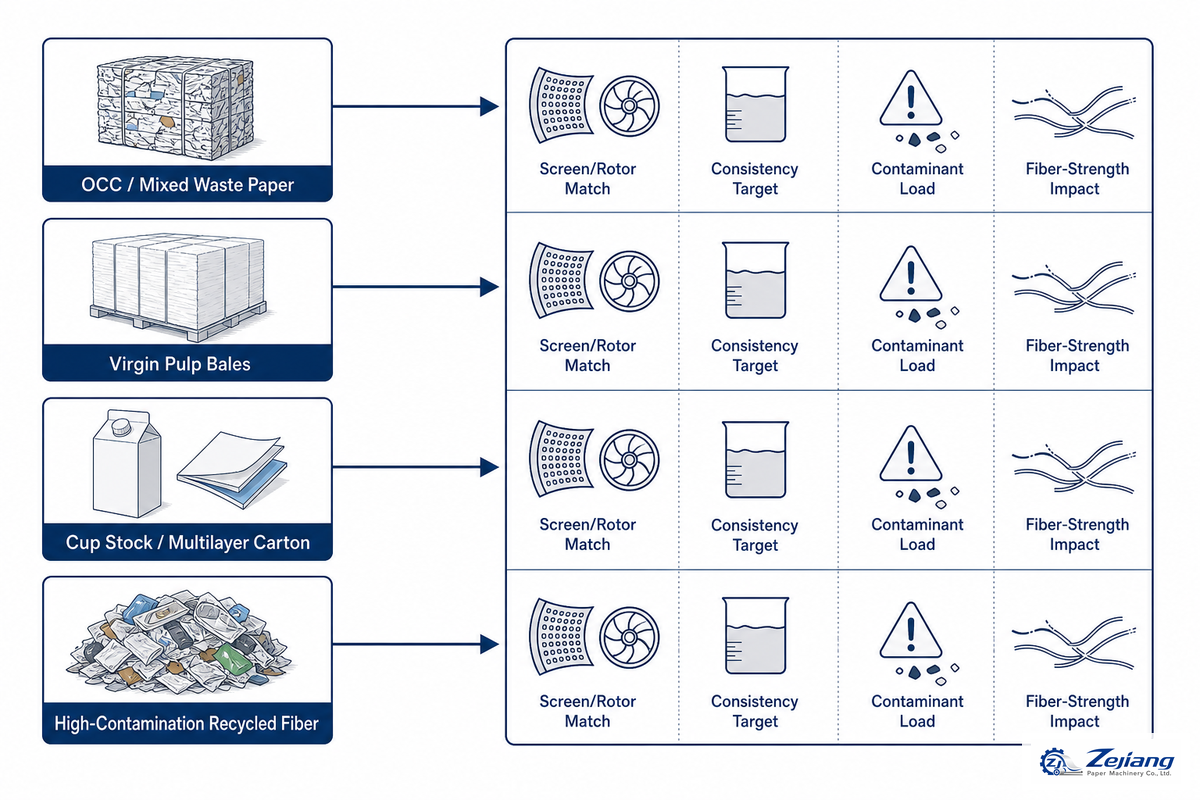
Not all pulpers will treat all grades of waste paper identically, and the link between pulping consistency and contamination control isn’t as simple as most buyers’ guides claim. A waste paper pulper treating mixed waste paper will have a different screen and rotor arrangement than a one using bales of virgin clean paper, and successfully converting waste paper into a fit-for-use stock of recycled paper (rather than simply “pulping” it technically) is the divide between the right sized line and the too-small one.
✔ Advantages of higher consistency
- Less water to heat, pump, and then discard downstream, hence less energy consumed per tonne.
- Better mechanical action per fibre weight. More effective on coarse and dirtier furnish.
- It’s identified as a Best Available Technique in the EU’s pulp and paper BAT reference document to disintegrate recovered paper
⚠ Limitations of higher consistency
- 2018 TAPPI Journal study determined 15% consistency pulp generates more fine-sized stickies compared to the same furnish pulped at 5% or 10% – fine-sized stickies are more difficult to screen out downstream
- Greater torque implies the requirement for a bigger motor, and a larger investment at equivalent levels of production
- Sometimes not the right one for some furnish grades or downstream product targets
⚠️ Important
Regardless of what many pulper marketers tell you, there’s not a universally beneficial play in higher consistency in terms of contaminant control. Data published in the peer-reviewed TAPPI Journal (Doshi, Aziz, De Jong & Houtman, 2018) pitted a pulping run of a specific furnish at 5, 10 and 15% consistency and found the 15% batch produced more small contaminants – stickies that end up making their way to the screening deck where the more troublesome adhesives and coatings remain. If your product is easily impacted by contaminants (writing, printing grades or tissue, for example), that should be a signal that you’d want to design your screen and secondary fiber setup to handle your specific furnish contaminants.
5 Furnish-Compatibility Red Flags Before You Buy a Pulper — watch for these before signing off on a pulper spec:
- ✔Assuming a higher-consistency pulper automatically means less downstream cleaning — size your cleaning cascade to your furnish contamination level, not to the pulper’s marketing spec.
- ✔No mention of ragger/rope-cutter provisions if your feedstock includes baled OCC — ropes and packaging strap will wrap the rotor shaft without one.
- ✔A single pulper spec quoted for both cup-stock/coated furnish and plain OCC — coated and multilayer material usually needs a different pulper configuration than plain corrugated waste.
- ✔No screen-plate perforation size specified — this determines what size fiber bundle passes through, and it should be matched to your target product, not left as a generic default.
- ✔Vague answers about virgin pulp bale compatibility if your mix includes both recycled and virgin furnish — the two often call for different consistency targets in the same line.
Compatibility of furnish isn’t just about contaminant tolerance, either. Fiber degrades with each recycling pass, as fiber is re-pulped, individual fibers shorten and lose much of their bonding ability in finished paper products. For this reason, NC State University research on recycled fiber quality treats fiber strength potential as a separate and important metric from contamination level. In the field this translates into a mill producing high recycled-content paper stock typically adds some portion of virgin pulp to the furnish not solely to reduce the level of contamination but specifically to ensure adequate finished paper strength. This is one reason that your furnish “pulper” spec conversation with a supplier ought to discuss not just waste paper grade, but also your planned furnish blend ratio.
As a pulper machine for paper industry buyers regularly ask about, virgin pulp bale handling deserves its own callout: a line built mainly for a wood pulping machine feedstock needs a gentler defibering profile than one built for contaminated OCC. Our stock-prep equipment range covers pulper configurations for OCC, mixed waste paper, and virgin pulp bale furnish; for the cleaning stage that follows pulping, see our paper mill cleaner page for how contaminant removal is sized to furnish grade.
How to Choose the Right Pulper for Your Mill
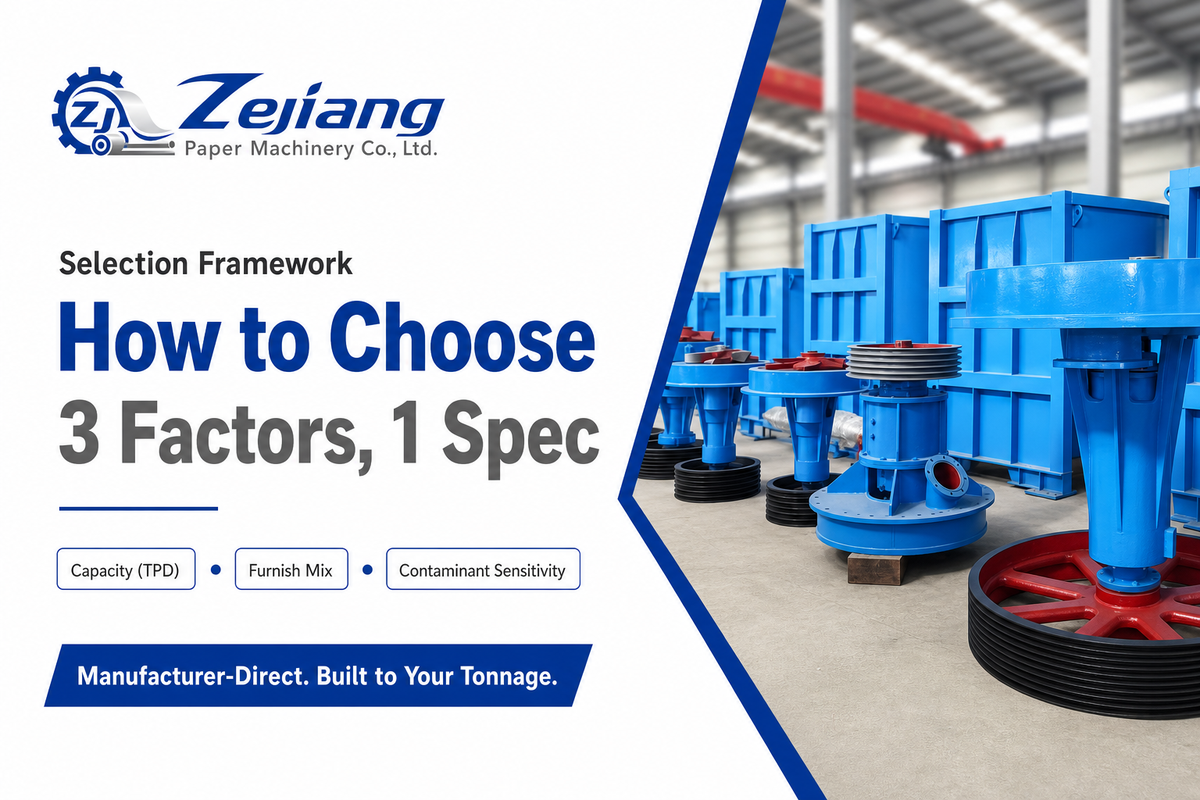
The 3-Factor Pulper Selection Framework
To define a pulper purchase specification, you’ll need three critical data points before asking for vendor quotes: your target daily capacity, your desired furnish mix, and whether your product is contaminant-sensitive.
| If your furnish is… | And your product is… | Consider |
|---|---|---|
| OCC / mixed waste paper, batch operation acceptable | Packaging board, not contaminant-sensitive | D-type low-consistency pulper |
| Mixed waste/OCC, continuous high volume | Moderately contaminant-sensitive, energy cost is a priority | High-consistency pulper, sized with an adequate screening cascade (see Furnish Compatibility above) |
| High-volume continuous feed, fiber-length-sensitive grade | Tissue, premium printing/writing paper | Drum pulper |
| Coated cup stock, multilayer cartons, beverage packaging | Any | Specialized cup-stock/carton pulper configuration — do not use a generic OCC pulper spec |
Once you’ve correlated the desired furnish and end product profile to the applicable pulper family, you should then cross reference your daily tonnage requirement against the stated capacities of each model within the pulper family – these are guides, and a vendor should be engineering the specification to your unique feedstock. See our paper pulper machine range for specific model capacities, or talk to our engineering team about your target TPD and furnish mix.
“The single most common sizing mistake we see is a mill quoting pulper capacity off their paper machine’s nameplate speed instead of their actual furnish mix and target consistency, those two numbers can lead to very different pulper specs for the same daily tonnage.”
Henan Zejiang Paper Machinery engineering team
Core Components & What Surrounds a Pulper in a Real Line
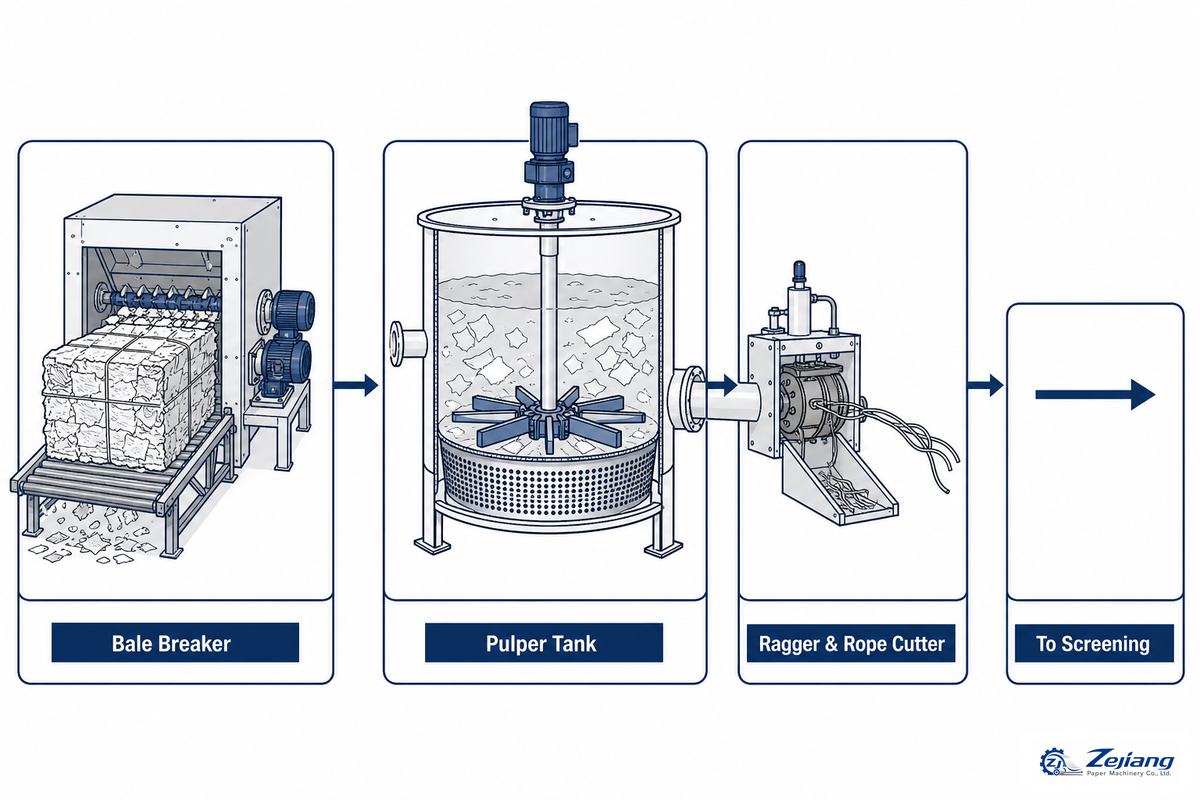
It’s not simply about the pulper itself. Often, “paper pulper machine” purchase and installation implies acquisition of related stock preparation equipment:
- ✔Screen basket: the perforated plate at the base or side of the tank that control what size fiber bundle passes through to the next stage, perforation diameter should match your target product’s tolerance for shives and fiber bundles.
- ✔Bale breaker: opens compressed waste paper bales before they reach the pulper, feeding a pulper with unopened bales causes uneven loading and incomplete defibering.
- ✔Ragger and rope cutter: continuously extract ropes, wire, and packaging strap from the rotor zone during operation, rather than requiring a full batch stop.
- ✔Rotor/impeller: the primary wear part, rotor design (vane count, diameter, speed) is what actually determines shear intensity and energy draw, more than tank size alone.
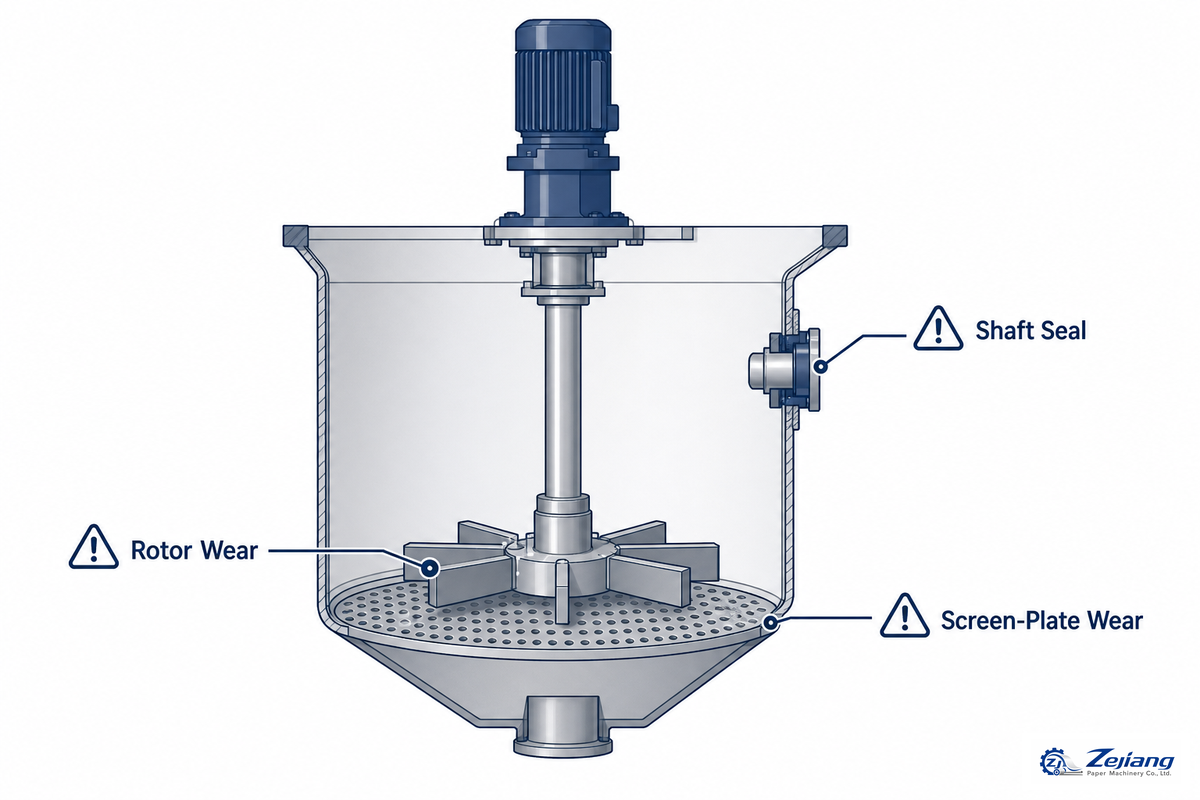
Pulpers are, mechanically, large industrial agitators, so maintenance practices from the broader mixer and agitator engineering field apply directly. One documented failure mode is shaft seal leakage around the rotor shaft where it penetrates the tank wall, a trade-press case study on pulper maintenance describes resolving persistent leakage by combining three sealing technologies on the same shaft, a shaft-stabilizing bushing, a noncontact air seal, and a vertical labyrinth bearing, rather than relying on a single seal type. If your mill is seeing recurring shaft seal failures, that combination, not a single seal replacement, is the documented fix pattern. A pulper quoted without ragger and rope-cutter provisions is a common gap in low-cost offers, and it shows up later as unplanned downtime — Henan Zejiang Paper Machinery includes ragger and rope-cutter provisions as standard on every pulping equipment quote, not as a chargeable option.
📐 Engineering Note — Guarding
The rotating rotor of a pulper, together with its open feed opening and adjoining conveying equipment, falls squarely under general machine-guarding requirements. In the United States, OSHA’s machine guarding standard (29 CFR 1910.212) requires that any machine part, function, or process that may cause injury be safeguarded against hazards such as point-of-operation contact, nip points, and rotating parts. Get feed-opening guarding, lockout/tagout provisions, and rotor-access interlocks specified in writing before installation, don’t assume they’re “standard” on every quote.
For a review of pulper following screening and cleaning systems see our pressure screen pages or paper mill cleaner pages, or see the entire pulping equipment line for details on how these all tie together.
Cost Factors

Pricing isn’t published by anyone that we can find – although the supplier’s websites that contain the most detailed specifications also list their equipment with “Quote on Request.” So the list below should be considered typical purchasing criteria, not a pricing guide:
Key Cost Drivers
- Capacity (TPD). Tank size and motor size increase along with desired production level, so this is usually your primary cost driver.
- Consistency type. High-consistency and drum designs cost more due to increased motor power and heavier-duty drive components than an equivalent-capacity D-type low-consistency unit.
- Automation level. Automation adds cost, PLC-controlled batch sequencing, automatic dilution-water control, and integrated screening interlocks can move your project price up meaningfully over a manually operated base machine.
- Wear-part metallurgy. For difficult furnishes or highly contaminated feed streams, expect higher capital and replacement-part costs from the increased wear-resistance requirements on your screen plate and rotor materials.
- Effluent and wastewater compliance. In major markets, pulping and secondary-fiber (deinking) operations fall under regulated wastewater standards. In the United States, the EPA’s Pulp, Paper and Paperboard Effluent Guidelines (40 CFR Part 430) set discharge limits covering BOD, suspended solids, pH, and other pollutant classes, with separate subcategories for deink and non-deink secondary-fiber lines. Budget for wastewater treatment and permitting as part of total project cost, not as a line item you add later.
Since actual numbers vary by region, currency and current steel/motor input costs, we won’t be providing a price range that we can’t corroborate with a dated, sourced quote – any supplier quoting a precise number without first asking about your furnish and capacity should be a red flag that merits a direct query rather than a tempting shortcut. This is true whether you’re sourcing a single paper pulping machine or an entire paper pulping machine manufacturer’s turnkey line. Vague, capacity-blind quotes are a common root cause of budget overruns once installation begins, because the buyer priced a different machine than the one that actually gets shipped. Request an equipment quote for your TPD and furnish mix on our paper pulper machine page for a current, capacity-specific number; our paper machine manufacturer engineering team will design a pulp production line based on your numbers, not a generic model.
Operating Costs, Energy & Maintenance Basics
Energy consumption is the largest on-going expense for a pulper, and it correlates directly to consistency / mechanism choice described above. The European Commission’s Best Available Techniques (BAT) reference document for the paper industry calls out high consistency pulping for disintegrating recovered paper into separated fibers as a designated BAT, a clear, regulatory-level signal that the high-consistency energy savings story isn’t some specific supplier’s marketing claim. Underestimating energy cost at the quoting stage is a common mistake, because buyers compare motor nameplate kW across suppliers without checking whether the consistency and duty cycle assumptions behind that number actually match their own furnish.
Day-to-day maintenance for a pulper centers around three specific things: wear of rotor and screen plates (both wear parts that last more or less time depending on how abrasive the furnish is, glass, staples, and sand in OCC wear them faster than cleaner virgin furnish), status of the shaft seal (see the Components section on the sealing-technology fix-pattern above), and the care and feeding of the ragger or rope cutter (as the clogged ragger is the cause of a surprising proportion of unscheduled pulper downtime for continuous pulpers).
💡 Pro Tip
When assessing rotor wear, compare the wear rates with the level of contamination in your furnish, not just with the calendar. An in-service pulp and paper pulper with heavy amounts of OCC has to work harder, wearing rotor and screen-plate significantly faster than an otherwise identically operating machine using virgin furnishes, regardless of how many operating hours you put on them. This becomes most important for fine paper and writing-printing paper grades feeding downstream equipment, for instance, as an overly worn screen plate lets oversize fiber bundles and shives through into stock the paper machine can’t run cleanly.
Low power consumption is a realistic target for a correctly matched pulper, but it depends more on right-sizing consistency to furnish than on any single equipment feature. An oversized high-consistency pulper running under capacity draws roughly as much standby energy as one running near its rated load, so matching pulper size to actual daily wood pulp making or waste paper pulp making tonnage, not headroom “just in case” — is itself an energy-cost decision, not only a capacity one.
Industry Outlook: What’s Changing in Pulping Equipment Demand

One industry capital-investment tracker (resourcewise.com) reports new paper machine installs dropping, from around 150 globally in 2022 to about 120 in 2025, with a further decline projected through 2027; treat that as a directional signal from one tracking source rather than a precise universal count. Either way, the actual choice many mills and buyers face today is often not, “Should I build a new line?,” but rather, “Should I upgrade the pulping stage on the one I’ve got, or buy new equipment to replace it?” That distinction moves things like ease of retrofitting into existing bale-handling and screening systems higher up the pulper-spec list than they’d be on a greenfield project, and it makes those efficient-consistency selections that we’ll look at more in the Operating Costs section a faster return on investment, compared with an unknown throughput for a new line.
We’re still seeing incremental patenting on the rotor design – latest patent filings such as EP4644605B1 (Pulper Rotor) related to pulper rotor vane shape suggesting that suppliers are still in design mode trying to engineer the shear efficiency improvements into the pulping process rather than it being a fully solved design issue (another question to put to any prospective supplier if headline tonnage isn’t your priority compared with energy consumed per tonne). There’s also evidence of further consolidation of smaller, stand-alone recycling lines in pulp and paper output capacity announcements to create a smaller number of, bigger, more integrated pulping and stock prep lines in much the same way we observed with the trend towards retro fit versus new build in our recent report.
For wider context on market size: Market researchers anticipate single-digit % growth for the paper machinery industry as a whole through to mid 2030s, partly on account of demand for recycling and fiber recovery machines- again this data are qualitative market research indicators, not the equivalent of the above decision you must make on the retrofit/new.
Retrofitting an aging pulping stage without also addressing rotor and screen-plate wear is a common mistake that erodes the energy-efficiency gain a mill expects from the upgrade. Henan Zejiang Paper Machinery’s engineering team builds retrofit quotes around the mill’s existing bale-handling footprint specifically to avoid that gap, rather than quoting a standalone pulper in isolation.
Frequently Asked Questions
Q: What is a pulper machine?
View Answer
A pulper machine is the equipment at the front of a paper mill’s stock-prep line that breaks fibrous raw material — waste paper, virgin pulp bales, or other cellulose fiber sources — into a slurry using water and mechanical agitation. It’s usually a large agitated tank with a rotor or impeller at the base, and its output feeds the cleaning, screening, and refining equipment that follows it before the stock reaches the paper machine itself.
Q: What is the difference between a pulp mill and a paper mill?
View Answer
A pulp mill produces pulp — the fibrous raw material — from wood chips, waste paper, or other cellulose sources, often for sale to other facilities as market pulp. A paper mill takes pulp (either produced on-site or purchased as market pulp) and converts it into finished paper or board on a paper machine. Many facilities are integrated pulp-and-paper mills that do both on one site, but the pulper and stock-prep equipment covered in this guide are specifically the pulp-side machinery, whether it sits inside an integrated mill or a standalone pulp-producing facility.
Q: What is the difference between a drum pulper and a D-type pulper?
View Answer
A D-type pulper is a vertical, lower-consistency (roughly 3-5%) machine that agitates material with a bottom rotor in batch or continuous mode, and is the more common choice for general OCC and mixed waste paper. A drum pulper runs continuously at higher consistency (roughly 14-18%) by tumbling material inside a rotating cylindrical drum, which is gentler on fiber length — making it the preferred choice for high-volume lines producing fiber-length-sensitive grades like tissue, even though it typically costs more to install than a comparable D-type line.
Q: What is the difference between high consistency and low consistency pulping?
View Answer
Low-consistency pulping uses more water and less fiber per batch (roughly 3-5%), which is gentler and mechanically simpler but uses more energy per tonne to move and process. High-consistency pulping uses far less water relative to fiber (academic sources cite roughly 8-18%), giving stronger mechanical action and lower per-tonne energy use — but it isn’t automatically better for contaminant control, since research shows it can increase small-particle stickies in some furnish types.
Q: What waste paper grades can a pulping line handle?
View Answer
A properly specified line handles OCC, mixed office waste, newspaper, kraft cuttings, and virgin pulp bales through a standard D-type or high-consistency pulper. Coated cup stock and beverage cartons need a dedicated configuration instead.
Q: How long does it take to set up a waste paper pulping line?
View Answer
From equipment order to first commissioned production, a pulping line typically takes several months to over a year, and the timeline breaks down into a handful of stages that are worth budgeting separately rather than lumping into one “delivery time” estimate: civil work and foundation readiness at your site, equipment manufacturing and delivery lead time from the supplier, mechanical installation and electrical/PLC commissioning once equipment arrives, operator training that a serious supplier runs on-site rather than as a remote handoff, and — often underestimated — recipe tuning for your specific furnish once the line is running, which can add several more weeks before the mill is hitting its rated output consistently. Civil work readiness is frequently the actual bottleneck rather than equipment lead time, since foundation and building work can start before the pulper itself ships if the project is sequenced correctly. Get a project-specific schedule broken down by these stages from your supplier once your capacity and furnish targets are set, rather than relying on a single generic industry-wide number that hides which stage is actually driving your timeline.
Why We Write This
Most pulper buying content repeats the same three or four talking points without engaging the underlying engineering data, including the 2018 TAPPI Journal research on consistency and stickies size distribution that directly affects how you should size a screening cascade. Henan Zejiang Paper Machinery wrote this guide from the perspective of a manufacturer that builds this equipment, cross-checked against independent academic and regulatory sources rather than only our own product literature. Reviewed by the Henan Zejiang Paper Machinery technical team.
References & Sources
- Effect of Pulper Consistency on Stickies Size Distribution — Doshi, Aziz, De Jong & Houtman, TAPPI Journal Vol. 17 No. 8 (2018), hosted via USDA Forest Service Treesearch
- Paper Recycling Technology — NC State University, Dept. of Forest Biomaterials
- ISO 5263-1:2004 — Disintegration of Chemical Pulps — International Organization for Standardization
- Best Available Techniques (BAT) Reference Document for the Production of Pulp, Paper and Board — European Commission Joint Research Centre
- Pulpers — Engineering Topics Overview — ScienceDirect
- TAPPI — Technical Association of the Pulp & Paper Industry
- Combining Sealing Technologies Solves Paper Pulper Leakage — Pumps & Systems
- Pulper Rotor (EP4644605B1) — Google Patents
- Pulp, Paper and Paperboard Effluent Guidelines (40 CFR Part 430) — U.S. Environmental Protection Agency
- Machine Guarding Standards (29 CFR 1910.212) — U.S. Occupational Safety and Health Administration
- Changing Quality of Recycled Fiber Material, Part 1 — NC State University, BioResources
Related Articles
- Paper Pulper Machine specifications — full model range and capacities
- Pressure Screen for pulp screening — the screening stage that follows pulping
- High Density & Low Density Cleaners — contaminant removal for your furnish grade
- Disc Refiner range — fiber-length and bonding control after cleaning
- Pulp Thickener & Deinking equipment — for recycled-fiber lines needing ink removal
- Pulping Equipment — full category overview
![Tissue Paper Machine: How It Works [2026 Guide]](https://zjpapermachine.com/wp-content/uploads/2026/07/tissue-paper-machine-guide-featured-768x512.png)
![Industrial Paper Machines: How They Work [2026 Guide]](https://zjpapermachine.com/wp-content/uploads/2026/07/paper-machines-guide-featured-1-768x512.png)
![Refiner Plates & Screen Baskets [Complete Guide]](https://zjpapermachine.com/wp-content/uploads/2026/07/refiner-plates-screen-baskets-guide-featured-150x150.png)
![Doctor Blade: Types, Materials & How It Works [Guide]](https://zjpapermachine.com/wp-content/uploads/2026/07/doctor-blade-guide-featured-1-150x150.png)
![Pulping Equipment: How Paper Pulping Works [Guide]](https://zjpapermachine.com/wp-content/uploads/2026/07/pulping-equipment-guide-featured-150x150.png)