Get in touch with Zejiang Paper Machinery Company


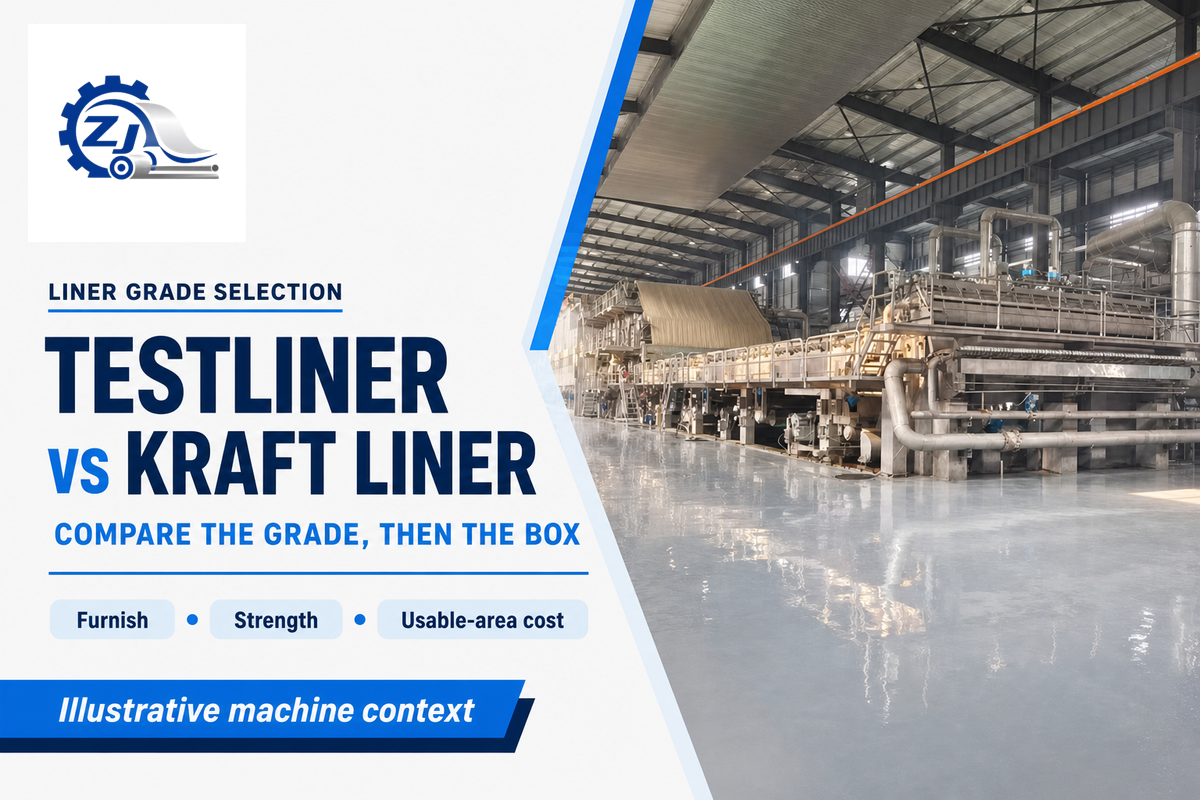
Testliner vs. kraft liner is a fibre comparison. Testliner uses recovered fibers, and kraftliner is made from predominantly virgin kraft pulp. Either grade can be specified for a corrugated box. The specific mill grade should be selected to meet the required strength and moisture exposure and print finish requirements. Then compare its cost per usable area.
The lower cost per tonne can disappear when a replacement needs a greater number of grams per square meter. A stronger paper result can also disappoint after corrugating and printing, as well as humid storage. The following separates those decisions to allow a purchasing team to approve a substitution without treating the grade name as a performance guarantee.
Testliner vs Kraft Liner at a Glance
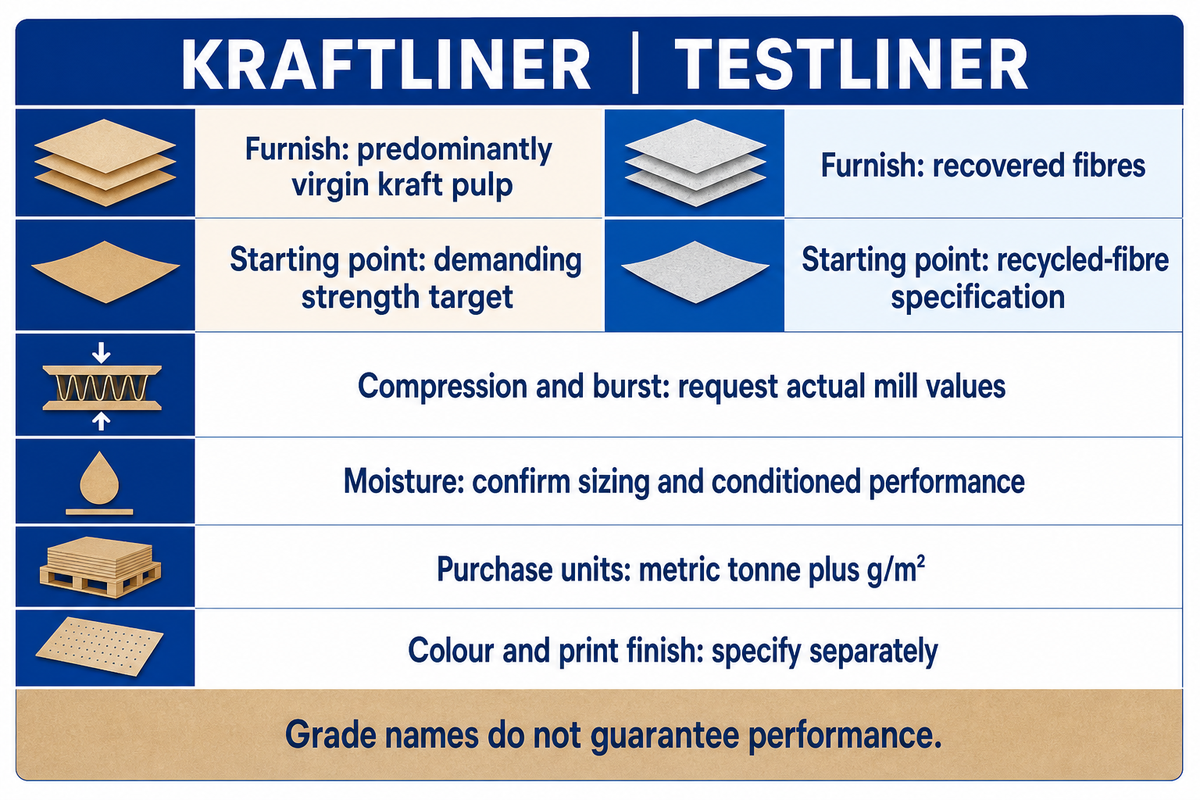
Kraftliner and testliner are papers used in corrugated packaging. Their difference in furnish isn’t enough to dictate the values a buyer can specify. Compare both candidates under the same conditioning and test method before modifying the approved board recipe.
| Purchase question | Kraftliner | Testliner |
|---|---|---|
| Principal furnish | Predominantly virgin kraft pulp | Recovered fibres |
| Useful starting point | A candidate where demanding strength targets justify its quoted cost | A candidate for a recycled-fibre specification with verified performance |
| Compression and burst | Request actual mill values | Request actual mill values |
| Moisture exposure | Confirm sizing and conditioned performance | Confirm sizing and conditioned performance |
| Purchase units | Price per metric tonne plus grammage in g/m² | Same currency, delivery basis and g/m² comparison |
| Colour and print finish | Specify the ordered surface separately | Specify the ordered surface separately |
Definitions of furnish and other terms used in the comparison are provided in FEFCO’s paper-production description. The checks described above are an editorial comparison, and not minimum values required by FEFCO.
Advantages
The two grade families give buyers different furnish options. A successful trial may permit a lighter sheet or a different recycled-content specification.
Limitations
Strength, box load and saving follow the actual grade, not the family name. Those decisions need the actual grade and finished-package results.
Furnish and Grade Names: What the Paper Contains
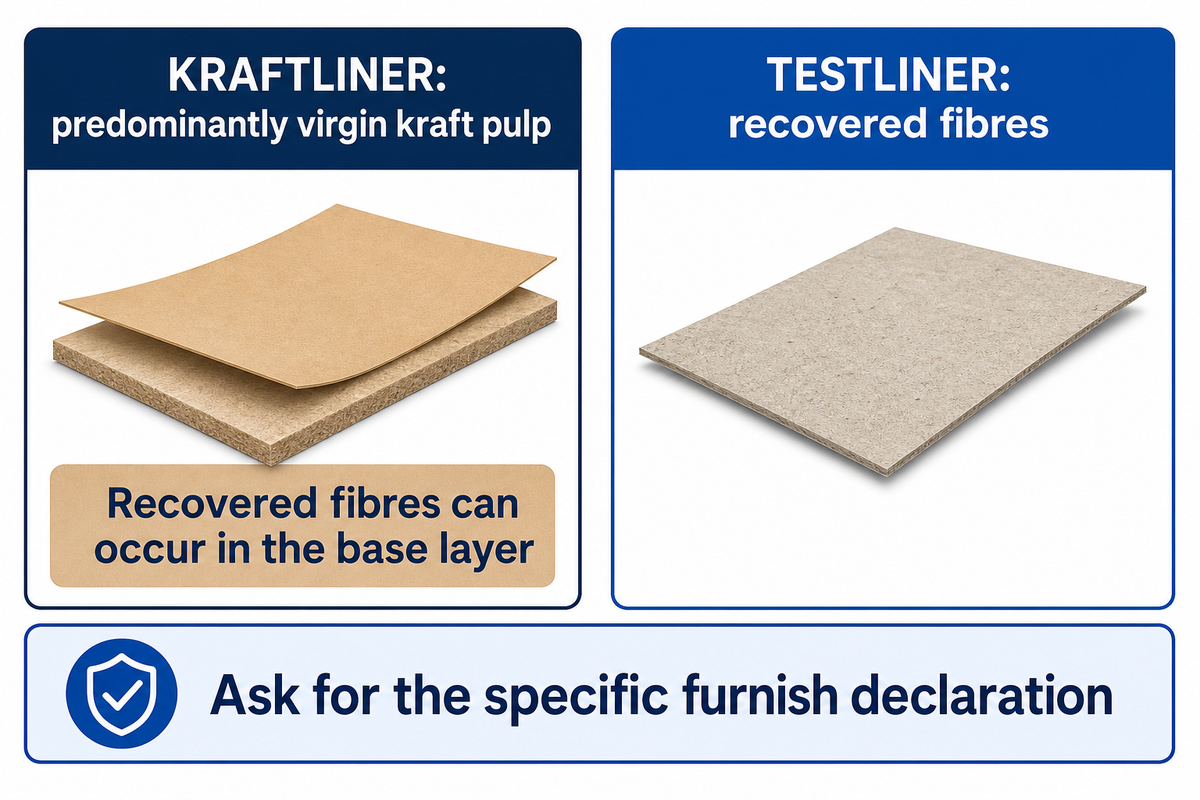
A useful first distinction between papers is whether they’re made from virgin or recovered fibers. FEFCO provides a description of kraftliner production that can include recovered fibers in the base layer of paper. Ask the manufacturer for the specific furnish declaration instead of assuming that every kraftliner sheet contains only virgin wood pulp.
What is kraft liner paper?
Kraft liner paper is a facing grade for corrugated board made primarily of virgin kraft pulp. It forms a flat layer instead of a fluted medium. The ordered grade still requires a grammage, strength specification, and surface description. The name, in isolation, doesn’t determine the finished carton’s performance.
The alternative may appear on a quotation as testliner or test liner. Record the mill’s grade code along with that name. Long fibers may form part of a furnish discussion, but a fibre-length claim isn’t a substitute for a measured sheet property.
For a paper mill, the choice of raw material also affects the stock preparation brief. Our refiner plates and screen baskets page identifies equipment categories to discuss; it doesn’t establish the strength of a proposed furnish.
Strength: Compare the Paper, Then Test the Box
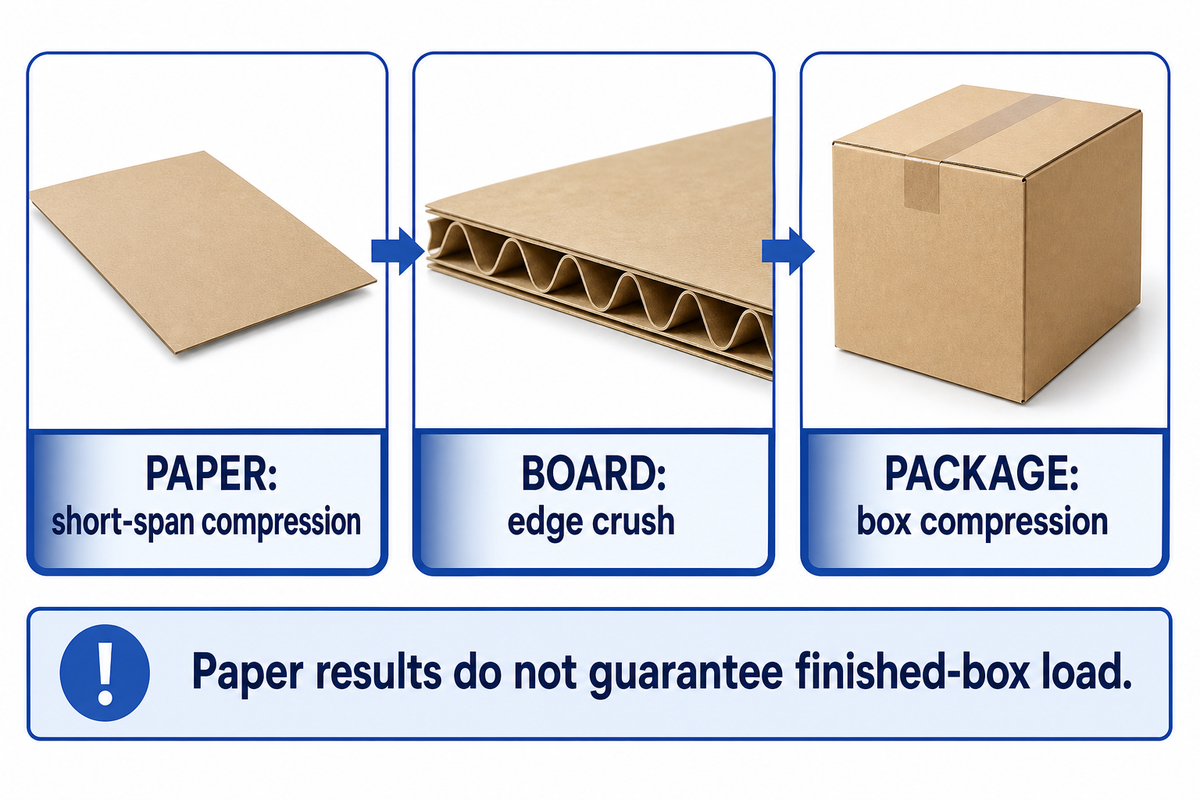
Paper compression, board edge crush and box compression answer different questions. Short Span compression tests the sheet; Edge Crush tests the combined structure, and Box compression tests the package. A favorable paper certificate is the starting point for a trial; the finished box still needs its own compression test.
What is GSM in kraft paper?
GSM means grams per square meter, the mass of a unit area of paper. A sheet marked 125 gsm means that the mass of the sheet is 125 grams per square meter. Grammage describes the amount of material in the sheet and doesn’t indicate its compression strength, bursting strength or its suitability for a particular shipment.
ISO 536:2019 defines the grammage determination. For compression, ISO 9895:2008 covers short-span testing in the machine and cross directions; its public scope recommends paper between 100 and 400 g/m². That range describes the method’s scope, not an acceptable basis-weight range for every box.
Engineering note
A proposed change from 150 g/m² to 125 g/m² is a trial variable. Keep the medium, flute profile, adhesive and box dimensions fixed for the first comparison. Agree mill tolerances and rejection limits before ordering.
Thick paper alone is a poor remedy for a weak carton. Popil’s 2012 review of edge-compression testing explains why specimen preparation and local buckling affect results. Describe the method used, and then test the actual construction. Include tear or puncture performance where the shipment requires it rather than assuming that a higher burst result answers every damage mode.
Moisture Resistance for Humid Storage
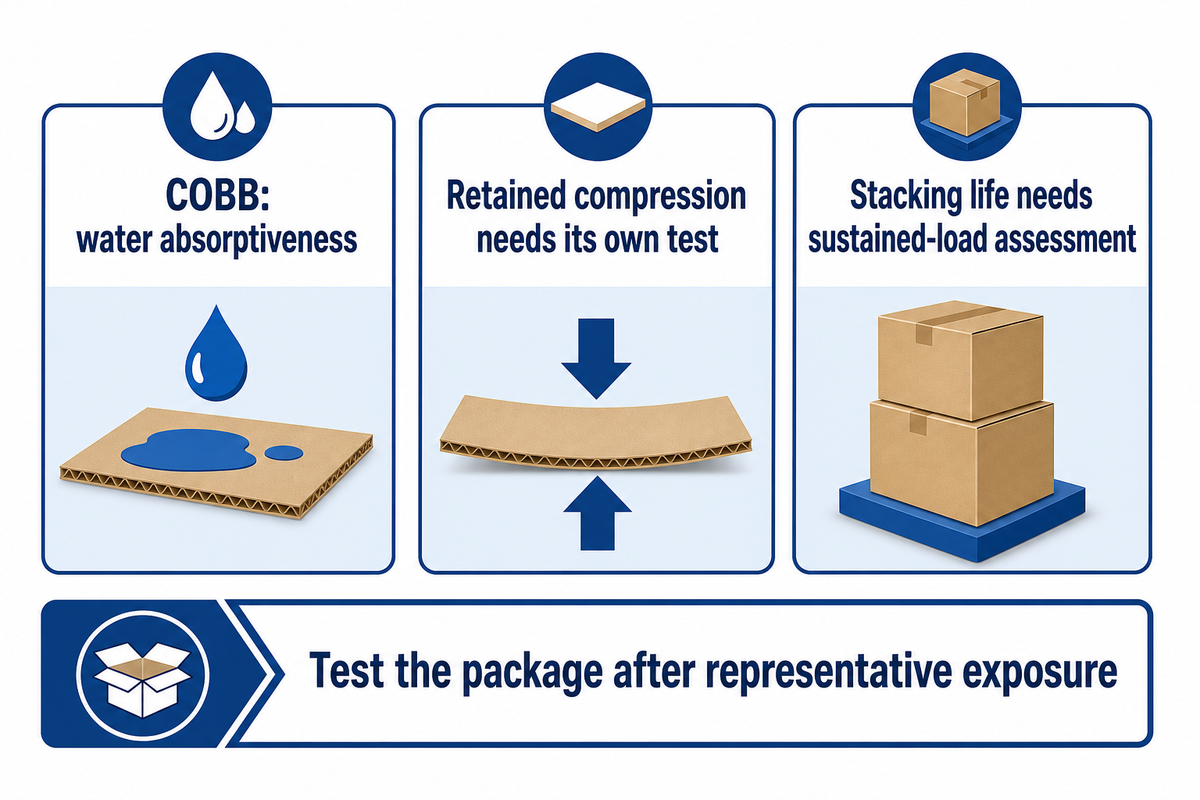
Humidity affects the performance of either liner family. For damp warehouses or a cold-chain route, select a specific treated grade and test the assembled package after representative exposure. Cobb water uptake measures absorption only; test retained compression strength and stack life on the assembled package.
In Gary Ashton Brown’s 2019 Clemson study, 3,000 boxes were tested across seven relative-humidity conditions from 30% to 90%. Compression strength declined as humidity increased. Strength also varied linearly with board moisture content over the range tested, so condition test boxes at the route’s worst-case humidity.
ISO 535:2023 specifies the Cobb method for water absorptiveness. Compare results with the same exposure time and sheet side. FEFCO also describes specially treated, water-repellent testliner, so recycled furnish alone does not rule out a moisture-resistant application.
A different 2024 recycled-liner board surface treatment study showed a treated surface remained hydrophilic, but with lower water uptake. Absorption, wettability and loaded-box performance should be considered as separate trial entries.
“identify the worst-case humidity exposure their freight will realistically encounter.”
Jim Bisha, NMFTA packaging guidance, 2026
When transferring from refrigerated to humid conditions, include that transfer in your trial. A dry laboratory result leaves the condensation stage unanswered.
Printing, Brown Liner and White Top Grades
Printability belongs to the ordered surface and the printing process, and not solely to the furnish. Specify brown liner or white top, if the face has a coat, and the finish required. Approve a printed sample under controlled press conditions before accepting a change described only as an equivalent grade.
A smooth sheet or a bright white face may satisfy a visual requirement, but they don’t replace a print trial. Holmvall and Uesaka’s 2007 flexo study modeled the printing system and noted that both liner and photopolymer properties affected local pressure variation. It wasn’t an evaluation of commercial paper grades.
- Use the same artwork, plate, ink and press settings for the comparison.
- Check solids, fine text and colour against the approved sample.
- Inspect the converted sheet as well as the flat sample.
A brown color is a purchasing description, not proof of recycled content. For a mill investigating surface consistency, the headbox should be in the discussion; modifying that part doesn’t guarantee a print-quality solution.
Cost: Compare Equal Areas of Usable Liner
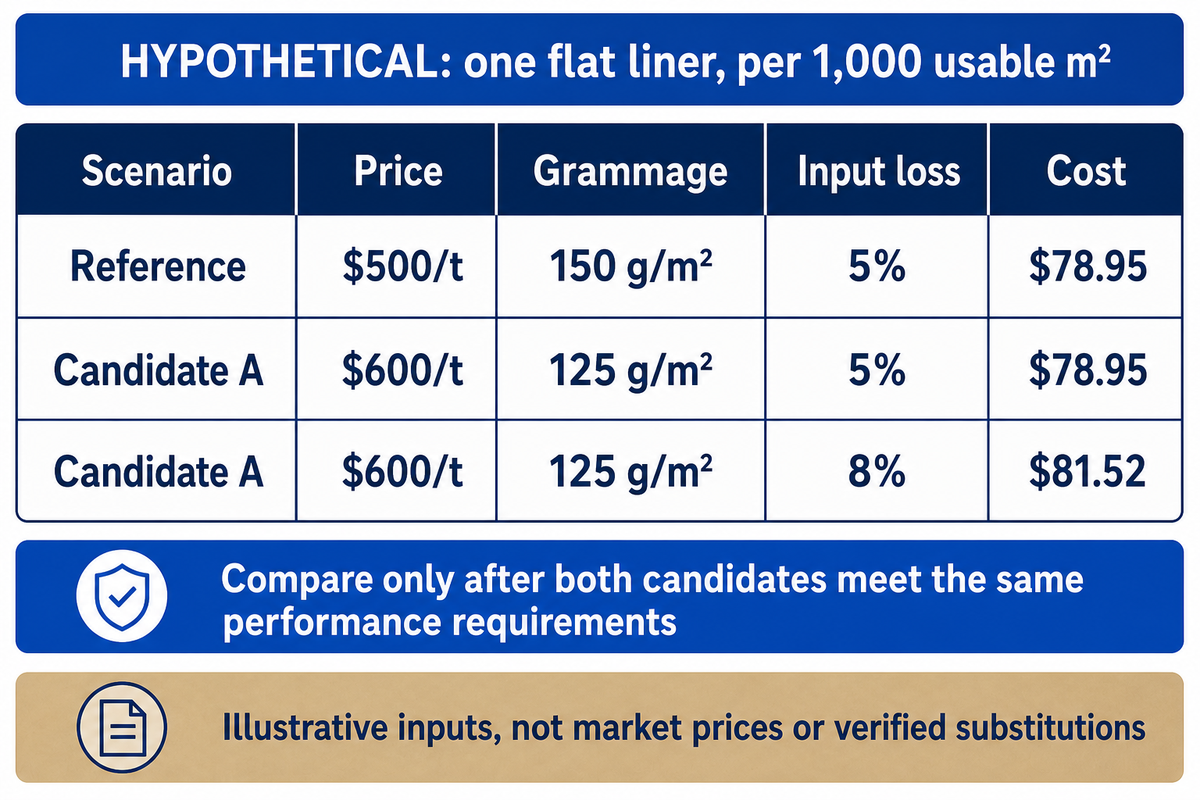
Compare paper costs per usable area only after both candidates meet the same performance requirements. A lower cost per tonne doesn’t mean a lower cost per square meter if the grammage is higher. Account for measured input loss and keep the delivery terms the same. The calculation below is for a flat liner, not an entire corrugated board.
Usable-Area Price Crossover
Cost per 1,000 usable m² = P × G ÷ [1,000 × (1 − w)]
P is price per metric tonne; G is grammage in g/m²; w is the fraction of incoming paper lost, with 0 ≤ w < 1. All prices must use the same currency and purchasing basis.
The formula uses grammage as determined by ISO 536; it is an editorial calculation, not an ISO costing method. 1,000 m² of 125 g/m² paper is 125 kg before any loss allowance.
| Scenario type | Price | Grammage | Input loss | Paper input needed | Usable paper mass | Cost |
|---|---|---|---|---|---|---|
| Reference, no loss | $500/t | 150 g/m² | 0% | 150.00 kg | 150 kg | $75.00 |
| Reference, base loss | $500/t | 150 g/m² | 5% | 157.89 kg | 150 kg | $78.95 |
| Reference, higher loss | $500/t | 150 g/m² | 10% | 166.67 kg | 150 kg | $83.33 |
| Candidate A, no loss | $600/t | 125 g/m² | 0% | 125.00 kg | 125 kg | $75.00 |
| Candidate A, base loss | $600/t | 125 g/m² | 5% | 131.58 kg | 125 kg | $78.95 |
| Candidate A, higher loss | $600/t | 125 g/m² | 10% | 138.89 kg | 125 kg | $83.33 |
| Candidate A, loss mismatch | $600/t | 125 g/m² | 8% | 135.87 kg | 125 kg | $81.52 |
| Candidate B, lower quote | $580/t | 125 g/m² | 5% | 131.58 kg | 125 kg | $76.32 |
| Candidate C, higher quote | $640/t | 125 g/m² | 5% | 131.58 kg | 125 kg | $84.21 |
The inputs shown are illustrative, not actual prices, and are not tested grade substitutions. Calculations use unrounded input mass; displayed values are rounded. At equal loss, the break-even price ratio is 150 ÷ 125 = 1.20. Candidate A costs the same per usable area despite its 20% higher price per tonne. However, an 8% loss on A against 5% on the reference raises its area cost to $81.52 versus $78.95.
Don’t factor in a flute take-up for flat liners. The EPA’s corrugated container calculation handles the medium separately since it follows the flute profile. A full-board model would need to capture every single ply, conversion cost and rejected output. A simple example, like the one above, doesn’t account for freight differences, the scrap recovery value and shipping damage.
Recycled Content and Purchasing Claims
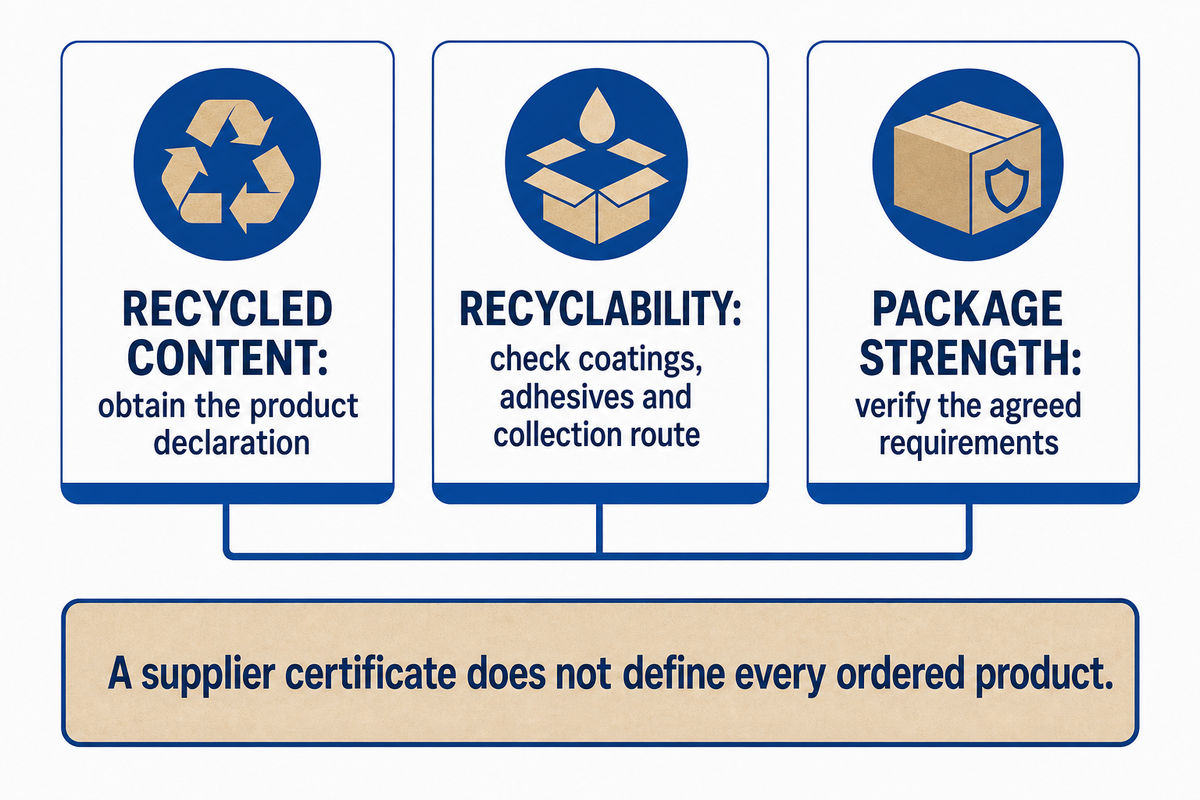
Recycled content and recyclability, as well as the fiber-source certification, address different questions. Obtain the declaration for the supplied product and keep it separate from the strength certificate. A recycled-fiber grade can meet demanding specifications. The environmental label itself doesn’t guarantee it met the requirements for a particular package.
FSC explains its product labels: an FSC Recycled label means 100% recycled materials, whereas an FSC MIX label can include certified, recycled and controlled material. Check the actual product claim rather than inferring the ordered paper’s content from a supplier’s general certificate.
‘Environmentally friendly’ is too broad to be an acceptance criterion. Ask what’s being measured. Renewable feedstock, by itself, doesn’t validate a lower impact for the entire package. A recyclable design requires an evaluation of its coatings, adhesives and intended collection route.
If a whole-box recycled content is required, a mass-weighted approach can be taken, like in the EPA example. Don’t assume that an operator can recycle the finished pack.
Choose a Grade with the Three-Level Liner Trial
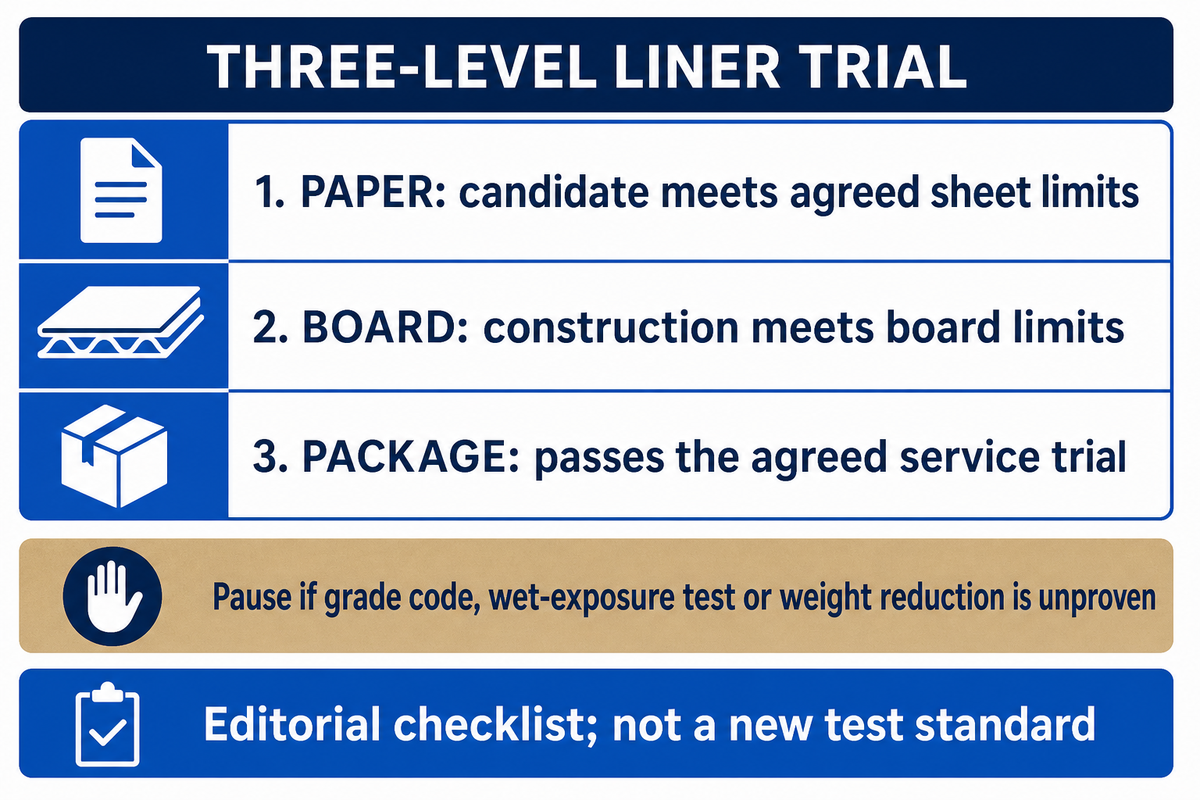
Once the candidate meets the agreed requirements for paper, board and the package under relevant conditions, a substitution is ready for approval. Our Three-Level Liner Trial is a purchasing checklist based on the above mentioned requirements. It isn’t a new test standard and won’t replace an application’s specialist assessment.
| Level | Record | Decision before advancing |
|---|---|---|
| 1. Paper | Grade code, g/m², direction, conditioning, compression, burst and absorption where relevant | Candidate meets agreed sheet limits |
| 2. Board | Liner positions, medium, flute, adhesive, edge crush and print result | Converted construction meets board limits |
| 3. Package | Box dimensions, contents, load, humidity, storage time and handling route | Package passes the agreed service trial |
FEFCO lists separate board and package test methods. Set acceptance criteria with the customer before sampling. Mechanical approval doesn’t qualify a paper grade for food contact; food packaging needs its own qualification.
For a long warehouse dwell, include sustained loading rather than relying only on a short compression test. Urbanik’s 1997 Forest Products Laboratory research examined duration of load under cyclic humidity. In it, the board material 30% stronger in a quick crush test had a 115% higher safe load after 48 h of cyclic humidity.
Postpone the switch if the cheaper bid lacks a grade code, the wet-exposure test hasn’t been done, or the apparent saving assumes an unproven reduction in grammage. A flexible buying specification may allow either furnish as long as the pre-agreed performance limits are met.
From Paper Grade to Paper Machine Requirements
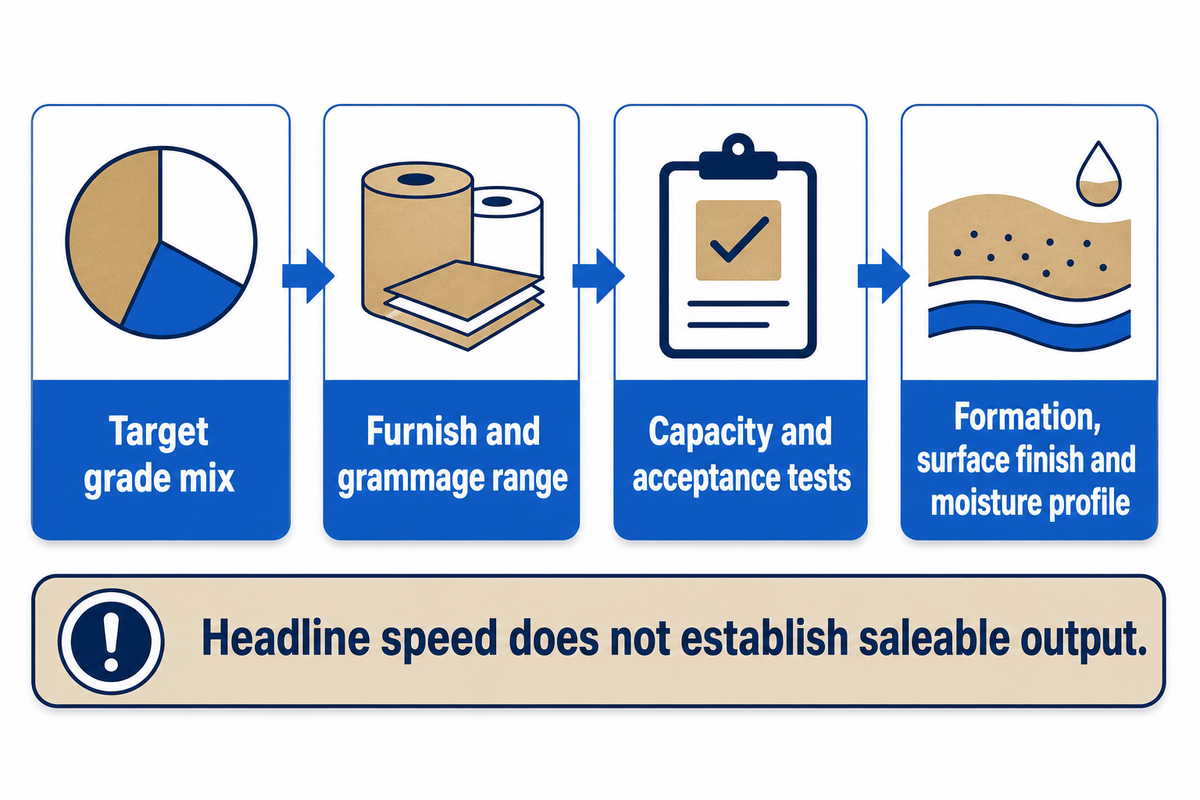
The machine brief in the paper industry begins with the target sheet and available furnish. Define the grade mix and grammage range, consider capacity, and state acceptance tests before equipment selection. Henan Zejiang Paper Machinery Co., Ltd. lists a kraft and corrugated paper machine category; a project-specific proposal still needs those production inputs.
A factory planning recycled liner should discuss its actual recovered-paper supply, stock preparation and sheet targets. A project using virgin pulp would similarly require a detailed furnish brief. Saleable output across a grade range comes from those inputs, not from a “high-quality kraft liner” label or a headline machine speed.
Carry the trial findings into the manufacturing discussion: required formation, surface finish and moisture profile. The assessment of the drying condition would include determining the type of dryer-cylinder required. If the rejection trend rises on a heavier grade, investigate the operating conditions rather than assuming that nominal capacity is constant.
For structured enquiry use Zejiang’s paper-making machine specification guide to compile furnish, product range and utility information. Share the target liner specification and trial requirements with the proposal request.
Frequently Asked Questions
Is kraft paper the same as butchers paper?
Kraft paper and butcher paper are not interchangeable purchasing specifications.
A paper sold for wrapping meat needs suitability for the intended food contact, not just a familiar brown appearance. Check the supplied product’s intended use and any coating or treatment. A liner certificate for a shipping carton does not answer those questions. Mechanical tests therefore cannot establish that a sheet is appropriate to wrap food directly.
What are the differences between cardboard and kraft paper?
Cardboard is a broad everyday description; kraft paper identifies a paper family rather than one complete box structure.
For a corrugated carton, distinguish the flat liners from the fluted medium between them. Kraftliner can serve as a facing, while the combined structure has separate properties that must be tested. On a quotation, replace the vague description with layer grades, grammage, flute and dimensions. That gives the supplier a construction it can reproduce and compare.
What is another name for kraft paper?
Brown wrapping paper is a common informal description, but it is not a reliable technical synonym for every kraft grade.
Specify the intended product rather than substituting a casual name. A paper for an envelope, bag or tube has a different purchasing brief from a corrugated liner. Ask for the grade code, grammage, furnish and required tests. Colour alone cannot distinguish all these products or prove that a particular sheet has the properties needed for your order.
What makes kraftliner different from other kraft paper types?
Kraftliner is intended as a facing for corrugated board.
A wrapping grade should not replace it on name alone. Compare the ordered sheet properties, check how the facing behaves in the combined structure, and validate the resulting package before substitution.
How do you choose kraft liner?
Choose kraft liner against the required package performance, exposure and print finish, then compare usable-area cost.
Start with an approved construction or an agreed new-package specification. Obtain comparable mill data and run a controlled board trial before the finished-box test. Record which liner occupies each position and hold other variables steady for the initial comparison. Where the route includes prolonged storage or humid conditions, include those in the package evaluation. Use the cost crossover only after both candidates pass; otherwise an apparent saving may simply reflect a lower-performing construction that has not met the same requirement.
Is testliner always cheaper?
Not always: Fastmarkets’ October assessment put testliner 2 (140 g) at €520-540 per tonne delivered Poland against €930-960 for 170 g kraftliner, but extra grammage or loss can close that gap.
Compare delivered quotations at the grammage required to pass the same tests. A lower tonne price can be offset by greater mass per area or higher loss. Use actual quotations, not the illustrative prices above.
Can I mix kraftliner and testliner in one corrugated board?
Yes; a board can use different liner grades on its outer and inner faces, provided the combined construction meets the agreed requirements.
Specify the outer and inner positions separately so the supplier tests the intended combination. Keep the printed face, moisture exposure and handling conditions in the brief. A successful paper-level comparison alone does not approve the mixed construction. Apply the same board and package trial used for any other substitution, including the relevant FEFCO test methods. Retain the approved recipe and test records with the purchasing specification so later deliveries can be checked against the same basis.
References & Sources
- FEFCO: paper production and furnish descriptions
- ISO 536:2019: grammage determination; ISO 9895:2008: short-span compression; ISO 535:2023: Cobb water absorptiveness
- Popil, 2012: edge-compression methods and interflute buckling
- Brown, 2019: relative humidity and corrugated-box compression
- BioResources, 2024: nanofiber and starch treatment of recycled linerboard
- Bisha, NMFTA, 2026: summer humidity and corrugated packaging
- Holmvall and Uesaka, 2007: flexo post-printing nip mechanics
- EPA: corrugated-container fibre-content calculation; FSC: product-label meanings
- FEFCO: testing methods and recommendations; Urbanik, 1997: duration of load and cyclic humidity
Supplier descriptions, published research and illustrative calculations are distinguished throughout; no client-specific laboratory results are claimed.