Get in touch with Zejiang Paper Machinery Company


By XCX · Last updated: October 2026
The best paper pulp manufacturers for a mill depend on its furnish: Suzano and Navigator offer eucalyptus options, Canfor supplies northern softwood kraft, and UPM and Metsä Fibre cover several wood species. This shortlist compares 20 producers by published products, manufacturing scope and buying constraints, rather than assigning a universal quality ranking.
Quick picks by purchasing task
- Eucalyptus with application support: Suzano.
- Eucalyptus globulus furnish: The Navigator Company.
- Northern softwood kraft: Canfor Pulp, with the Northwood closure timetable considered.
- Kraft and mechanical pulp alternatives: SCA or Rottneros.
- Nordic pine, spruce and birch: Metsä Fibre.
- Hardwood, softwood and fluff from one industrial unit: Klabin.
Zejiang Paper Machinery publishes this manual for evaluating purchased fiber and stock preparation for mills. We supply machinery and related equipment. We aren’t included in this list as a commodity pulp producer.
How We Selected These Paper Pulp Manufacturers
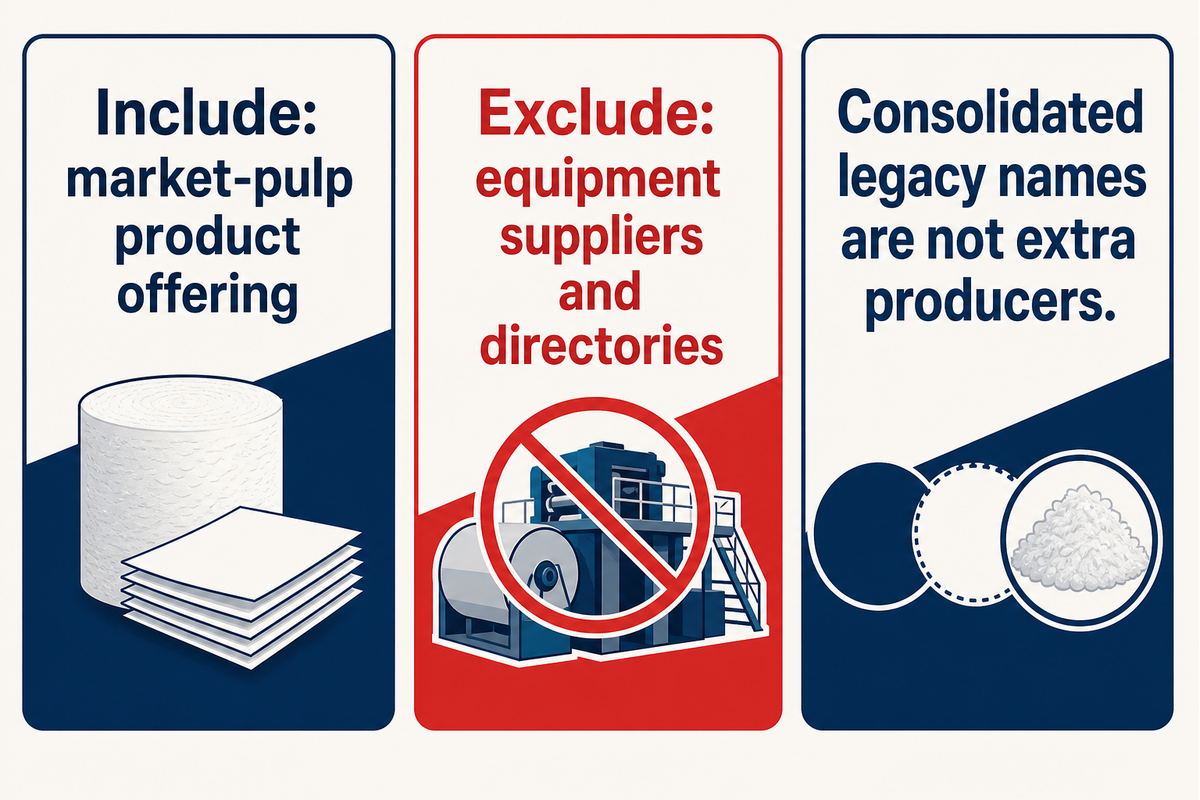
We selected manufacturers in the pulp and paper industry, based on official evidence of market-pulp product offerings, and compared various factors such as the species of wood, pulping processes and operations, and published technical support. Sources were checked in October 2026. Equipment suppliers, finished-paper-only businesses and directories were excluded from the study. Legacy names within a consolidated group weren’t counted as extra manufacturers. The following classification is for readers’ information and doesn’t indicate any preference or ranking.
Company histories require special consideration. A mill’s first production year, the formation of a parent group, and the launch of a current brand can be decades apart. The table retains those distinctions. Published company information also supplies the headquarters and certification descriptions; an unavailable field is marked as not publicly disclosed rather than filled with an assumed address or date.
Different company names don’t always mean independent production assets. Suzano and Stora Enso, for example, share the Veracel operation. Supplier diversification therefore belongs at the producing-mill level as well as the company level.
Market Pulp vs Finished Paper
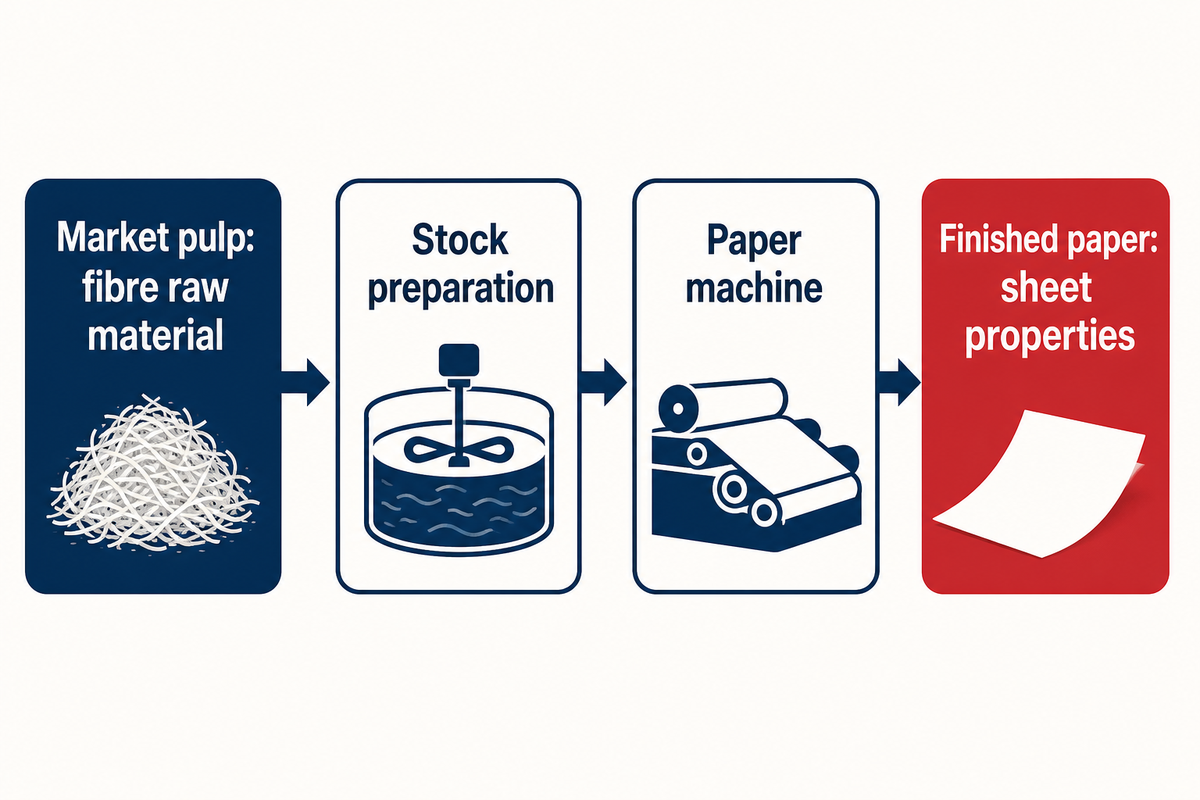
Market pulp is fiber raw material sold to another manufacturer for the production of paper, board, tissue and other cellulose products. A vertically integrated paper group can consume its own pulp internally and/or purchase pulp from a third party supplier. Within the paper manufacturing sector, buying finished paper and purchasing market pulp are separate transactions, even if the same pulp and paper company offers both.
Buying fibre rather than a finished paper product
While the form in which dried pulp is received is important (i.e. in sheets or bales), the specification focuses on the behavior of the fibers after repulping. A printer buying uncoated paper, on the other hand, looks for a finished sheet with particular surface and conversion properties. It’s possible that a supplier offering paper and packaging solutions is selling a converted product rather than fiber for another mill. It’s better to start with the intended process for the product.
The American Forest & Paper Association mentions wood and recovered paper as fibre sources for pulp. Generally, softwoods yield longer fibers and hardwoods yield shorter fibers. Eucalyptus is a hardwood and isn’t a separate botanical class from hardwoods and softwoods. Mill managers combine these fiber characteristics with several process alternatives in order to attain the desired characteristics of the paper.
Fluff and dissolving pulp are two other categories of pulp, and their commercial names don’t necessarily allow the direct substitution of a papergrade product in a furnish specification. A producer can manufacture several of these categories without offering every grade from every mill.
Knowing this boundary simplifies specifying the stock preparation process. The pulp supplier provides the fiber grade and the mill’s preparation system disperses and conditions that material for the paper machine. The condition of the feedstock combined with the process defines the equipment for the job rather than the supplier’s brand name.
20 Paper Pulp Manufacturers at a Glance
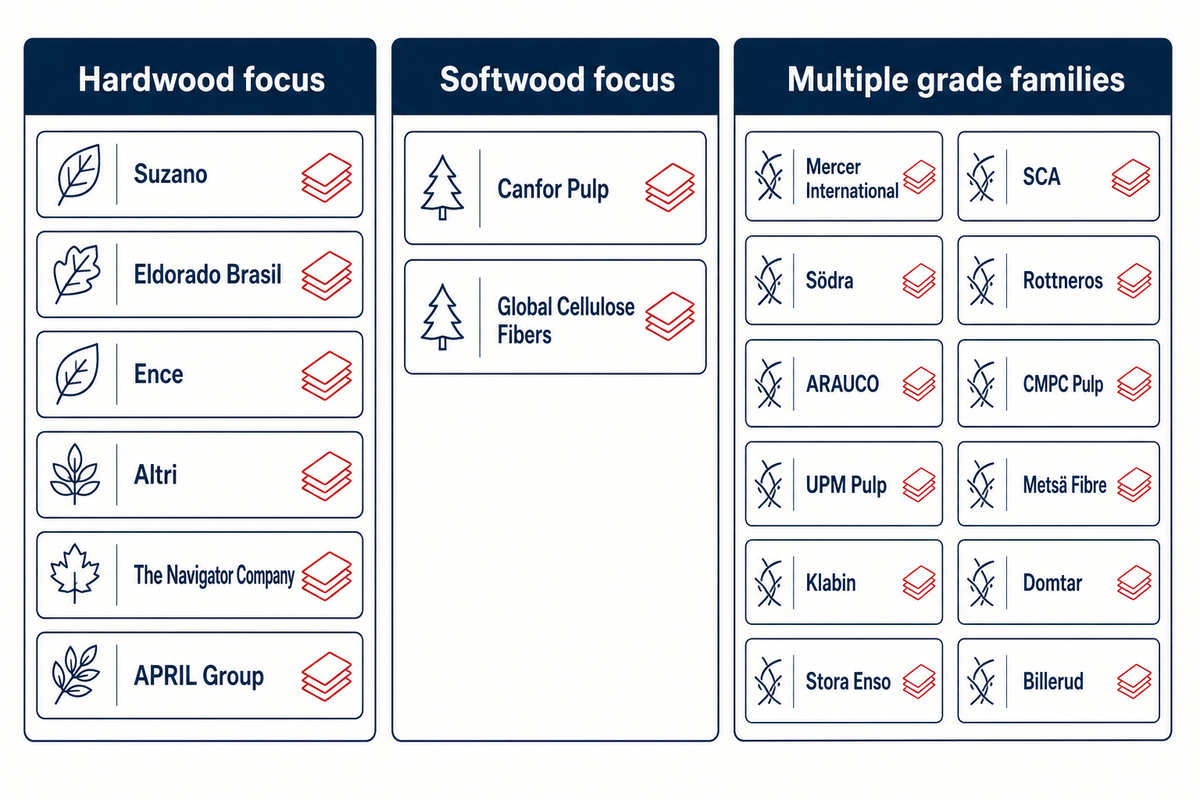
The Pulp Grade-to-Mill Match Map below connects each producer’s published offer to a buying task. Headquarters and founding context follow the publications of the respective companies. Advantages and limitations are editorial comparisons of the documented scope, not tested comparisons. Product availability for a given order is separate from a given company’s overall manufacturing portfolio.
| No. | Company | Headquarters | Founded / business roots | Best for | Main products | Key advantages | Potential disadvantages | Official website |
|---|---|---|---|---|---|---|---|---|
| 1 | Suzano | Salvador, Brazil; registered headquarters | 1924 roots; 2019 combination | Eucalyptus with application engineering | Eucaprime, Eucaflash, Eucastrong, Eucanatural | Several eucalyptus grades and technical development support | Softwood reinforcement requires a different grade source | https://www.suzano.com.br/en |
| 2 | Eldorado Brasil | São Paulo, Brazil | 2010 | Single-mill eucalyptus export supply | ECF bleached eucalyptus kraft | Três Lagoas production plus dedicated Santos logistics | Single pulp line limits within-producer mill diversification | https://www.eldoradobrasil.com.br/en/ |
| 3 | Ence | Madrid, Spain | Not publicly disclosed | Comparing eucalyptus bleaching routes | ECF and TCF eucalyptus pulp | Navia and Pontevedra provide distinct bleaching options | Eucalyptus scope does not supply softwood reinforcement | https://ence.es/en/ |
| 4 | Altri | Porto, Portugal | 2005 spin-off | Portuguese papergrade eucalyptus kraft | Celbi/Biotek BEKP; Caima dissolving pulp | Two papergrade mills alongside a separate dissolving business | Group output includes non-papergrade dissolving pulp | https://altri.pt/en/ |
| 5 | The Navigator Company | Setúbal, Portugal | 2001 combination; 1953 pulp roots | Eucalyptus globulus furnish | gCELL bleached eucalyptus kraft | Dedicated pulp brand and integrated fibre research | Not a replacement for specified long-fibre softwood | https://thenavigatorcompany.com/ |
| 6 | APRIL Group | Not publicly disclosed | 1993; pulp production 1995 | Acacia for paper and tissue | BAKP; separate rayon-grade AE pulp | Integrated production in Pangkalan Kerinci, Riau | Rayon-grade AE differs from papergrade BAKP | https://www.aprilasia.com/en/ |
| 7 | Canfor Pulp | Vancouver, Canada | 1951 pulp-business roots | Northern softwood reinforcement | Northern bleached softwood kraft | Enhanced ECF grades from Canadian conifer fibres | Northwood closure expected in late Q4 2026 | https://www.canfor.com/ |
| 8 | Global Cellulose Fibers | Memphis, Tennessee, United States | Independent ownership since January 2026 | Papergrade and absorbent-fibre comparisons | Softwood, fluff, specialty pulp, Helix | Papergrade offer alongside engineered liquid-management fibres | Fluff and Helix are not interchangeable papergrade products | https://www.globalcellulosefibers.com/ |
| 9 | Mercer International | Vancouver, Canada; principal business location | 1993 forest-products entry | Northern hardwood and softwood kraft | NBSK and NBHK | Peace River supplies both northern kraft families | Eucalyptus-specific furnish lies outside the stated northern-grade offer | https://mercerint.com/ |
| 10 | SCA | Sundsvall, Sweden | 1929 | Kraft reinforcement and mechanical-pulp bulk | SCA Pure NBSK; SCA More CTMP | Separate commercial families for distinct furnish duties | Kraft and CTMP need separate furnish qualification | https://www.sca.com/en/ |
| 11 | Södra | Växjö, Sweden | 1938 association | Nordic wood-fibre alternatives | Northern hardwood and softwood pulp | Three Swedish pulp mills and forest-owner structure | Textile and dissolving products are separate from paper pulp | https://www.sodra.com/en/global/ |
| 12 | Rottneros | Sunne, Sweden | 1887 wood-pulp mill roots | Specialist kraft and CTMP | Robur kraft; Spring CTMP | Distinct chemical and mechanical product lines | Historical groundwood line closed in 2022 | https://www.rottneros.com/ |
| 13 | ARAUCO | Not publicly disclosed | Not publicly disclosed | Pine and eucalyptus grade breadth | Bleached/unbleached pine, eucalyptus, fluff | Radiata and taeda pine alongside eucalyptus options | Different fibre and end-use grades require distinct specifications | https://www.arauco.com/ |
| 14 | CMPC Pulp | Santiago, Chile (CMPC group headquarters) | 1920 parent-company foundation | Chilean softwood and South American eucalyptus | Laja/Pacífico; Santa Fe/Guaíba grades | Mill-specific products with technical customer support | Producing mill varies by grade across Chile and Brazil | https://www.cmpcpulp.com/en/ |
| 15 | UPM Pulp | Helsinki, Finland; group head office | 1996 group merger | Multi-species kraft with application support | Eucalyptus, birch, softwood, RaumaCell fluff | Research centres in China, Finland and Uruguay | Individual grade allocation uses production capacity in Finland or Uruguay | https://www.upmpulp.com/ |
| 16 | Metsä Fibre | Espoo, Finland | Not publicly disclosed | Finnish pine, spruce and birch | Nordic softwood and hardwood pulps | Four Finnish mills covering both wood families | Some production supplies other Metsä Group businesses | https://www.metsagroup.com/metsafibre/ |
| 17 | Klabin | São Paulo, Brazil | 1899 Klabin Irmãos e Cia | Three pulp types from one unit | LyptusCel, PineCel, PineFluff | Puma integrates hardwood, softwood and fluff production | Shared production site does not make grades interchangeable | https://klabin.com.br/en/ |
| 18 | Domtar | Corporate offices: Montreal, Richmond and Fort Mill | 2024 unified brand; 1820/1848 predecessors | North American grade comparisons | Hardwood, softwood and fluff pulp | Ashdown conversion supports Lighthouse fluff | Group specification still requires a named mill and grade | https://www.domtar.com/ |
| 19 | Stora Enso | Helsinki, Finland | 1998 merger | Bleached and unbleached kraft applications | Hardwood, softwood, Enocell UKP Nova | Unbleached grades extend beyond white-paper furnish | Veracel is a shared production asset with Suzano | https://www.storaenso.com/en/ |
| 20 | Billerud | Solna, Sweden | 2012 merger; 1883 Billerud roots | Scandinavian softwood and maple-rich hardwood | NBSK; Quinnesec Hi-Maple NBHK | Swedish softwood mills plus North American hardwood | Grade families originate from different mills and shipping locations | https://www.billerud.com/ |
Source basis: The basis of the source is the official manufacturers’ product, history, contact and certification publications, verified in October 2026. Numbers are entry identifiers, not performance values. “Not publicly disclosed” means the company doesn’t publish that field.
Hardwood and Eucalyptus Market Pulp Producers
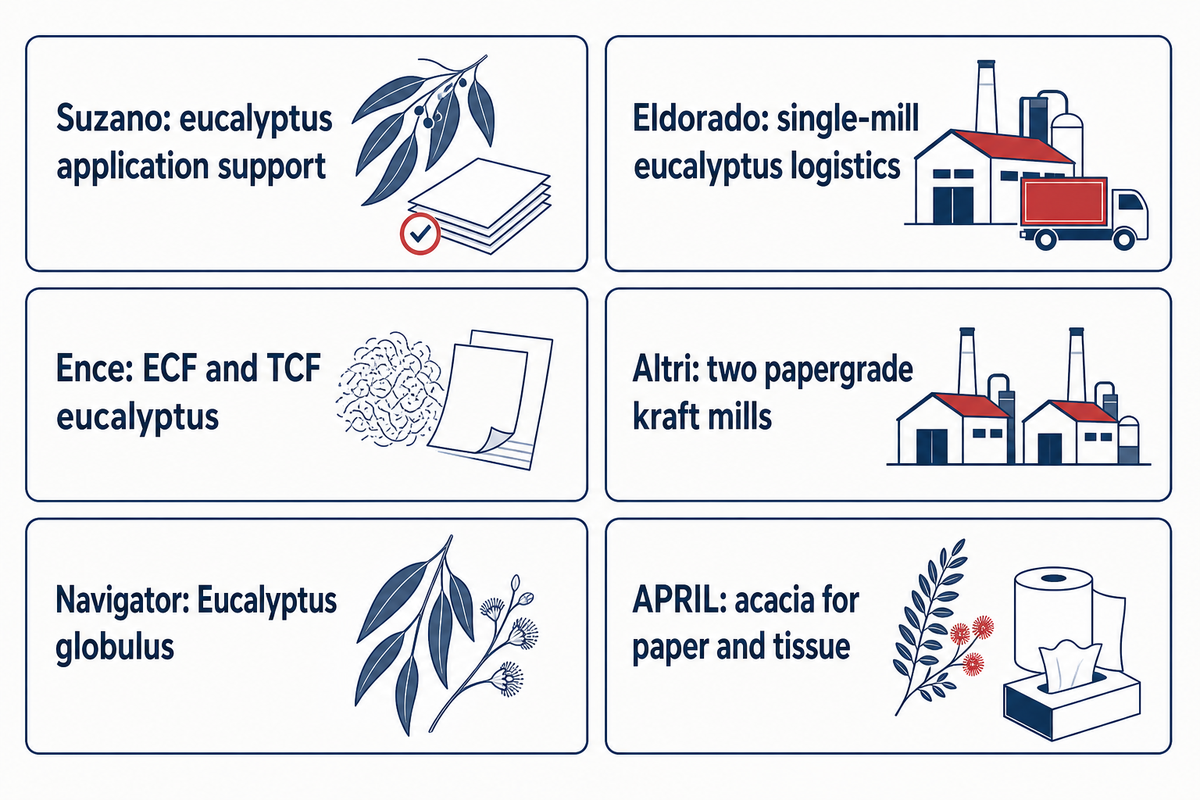
The hardwood kraft focus of the papergrade products discussed here’s represented by the entries 1-6. Both eucalyptus and acacia are hardwoods. Some groups also produce dissolving pulp, but a separate non-paper application doesn’t place a producer in the latter multi-family sections. Each company’s commercial grade is more specific than its wood-family label.
1. Suzano: Best for eucalyptus pulp with application engineering support
Headquarters: Salvador, Brazil, registered headquarters · Founded: 1924 business roots; current Suzano S.A. combination in 2019 · Type: integrated eucalyptus pulp and paper manufacturer
Official website: https://www.suzano.com.br/en
Main products: bleached eucalyptus pulp, including Eucaprime, Eucaflash, Eucastrong and Eucanatural.
Certifications / notable work: Suzano lists FSC and PEFC chain of custody certificates separately for mills and trading entities; its product page describes Eucanatural as using fewer bleaching chemicals.
Application engineering, training and customized pulp development make Suzano relevant when the purchasing task involves selecting among eucalyptus grades rather than simply finding a company that manufactures cellulose. Named product families give the technical discussion a defined starting point, while the published development support offers a route for discussing customized solutions to a mill’s particular paper requirements. This is a useful fit for buyers comparing short-fibre options across tissue, printing and specialty paper applications. Softwood reinforcement still requires another grade source because the core papergrade offer described here’s eucalyptus hardwood.
2. Eldorado Brasil: Best for single-mill eucalyptus supply with export logistics
Headquarters: São Paulo, Brazil · Founded: 2010 · Type: eucalyptus market-pulp manufacturer
Official website: https://www.eldoradobrasil.com.br/en/
Main products: elemental-chlorine-free, or ECF, bleached eucalyptus kraft pulp.
Certifications / notable work: its pulp page identifies product certification FSC-C113939 and PEFC; the separate raw-material certificate isn’t the same product claim.
According to Eldorado, the single-production-line Três Lagoas mill produces 1.8 million tons of pulp annually, with road, rail and river links serving export shipments. Its Santos terminal can handle up to 3 million tons per year, a logistics-throughput figure that must not be read as additional pulp manufacturing capacity. The combination of a named production base and dedicated export infrastructure connects manufacturing and distribution for buyers comparing Brazilian eucalyptus supply and shipping arrangements. A single pulp line, however, provides less within-producer mill diversification than a portfolio of independent producing sites.
3. Ence: Best for comparing ECF and TCF eucalyptus pulp
Headquarters: Madrid, Spain · Founded: not published · Type: eucalyptus pulp and renewable-energy group
Official website: https://ence.es/en/
Main products: ECF and totally-chlorine-free, or TCF, eucalyptus pulp.
Certifications / notable work: Ence lists ISO 9001, ISO 14001 and ISO 50001 for its Navia and Pontevedra operations, plus FSC-C081854 chain of custody.
Navia and Pontevedra give this offer a clear distinction: the published product information assigns ECF production to Navia and TCF production to Pontevedra. Ence states annual pulp capacities of 685,000 tonnes and 515,000 tonnes respectively, so the bleaching routes are tied to specific manufacturing operations rather than presented as interchangeable labels. That structure is useful for a mill whose purchasing specification explicitly calls for one bleaching approach while retaining a eucalyptus furnish. The paper-pulp portfolio discussed here remains eucalyptus-based, so a separate source is needed when the recipe also specifies long-fibre softwood reinforcement.
4. Altri: Best for Portuguese bleached eucalyptus kraft from two papergrade mills
Headquarters: Porto, Portugal · Founded: 2005 spin-off of Cofina industrial assets · Type: cellulosic-fibre manufacturing group
Official website: https://altri.pt/en/
Main products: bleached eucalyptus kraft pulp, or BEKP, from Celbi and Biotek; dissolving pulp from Caima.
Certifications / notable work: Altri reports FSC and PEFC forest-management certification for Altri Florestal; those forestry credentials describe their stated forestry scope.
Celbi and Biotek are the relevant starting points for a paper mill seeking Altri’s eucalyptus kraft grades, while Caima has produced dissolving pulp since its 2015 conversion. Having two identified papergrade operations within the group makes it easier to separate the intended furnish business from the broader cellulosic-fibre portfolio. Buyers focused on Portuguese manufacturing can therefore compare Celbi and Biotek without treating every Altri product as the same raw material. Caima’s dissolving output is the practical boundary: total group production can’t be assumed to represent available papergrade pulp.
5. The Navigator Company: Best for Eucalyptus globulus pulp
Headquarters: Setúbal, Portugal · Founded: 2001 combination, with pulp-mill roots in 1953 · Type: integrated forest-products, pulp and paper manufacturer
Official website: https://thenavigatorcompany.com/
Main products: gCELL bleached kraft pulp based on Eucalyptus globulus.
Certifications / notable work: the company lists FSC-C008924 chain of custody/controlled wood and PEFC/13-32-001 chain of custody; these differ from its forest-management identifiers.
Navigator launched gCELL in June 2026 to bring its Eucalyptus globulus market-pulp portfolio under a dedicated identity for applications including printing, tissue and specialty papers. Its published launch material states 1.6 million tonnes of annual pulp capacity and describes the group’s integrated forestry and fibre-research activities. A mill interested in that species can use the gCELL range as a more precise point of comparison than the broad phrase “hardwood pulp,” particularly when discussing the required end-use paper. Eucalyptus pulp still doesn’t replace a specified long-fibre softwood grade merely because both products are bleached kraft.
6. APRIL Group: Best for acacia kraft pulp for paper and tissue
Headquarters: not published · Founded: 1993, with commercial pulp production from 1995 · Type: RGE pulp and paper manufacturing business
Official website: https://www.aprilasia.com/en/
Main products: bleached acacia kraft pulp, or BAKP, and a separate rayon-grade AE pulp offering.
Certifications / notable work: APRIL describes its plantation pulp products as PEFC certified and positions BAKP for writing, printing and tissue paper.
Integrated pulp manufacturing at Pangkalan Kerinci in Riau gives APRIL a specific production location for buyers considering acacia-based furnish. Its product descriptions distinguish the papermaking BAKP offer from the AE material used in rayon applications, which helps a purchasing team keep the intended cellulose product clear from the first enquiry. Acacia can therefore be considered as a hardwood option on its own commercial specifications, without assuming it’s identical to a supplier’s eucalyptus grade. Rayon-grade AE belongs to a separate dissolving-pulp application and shouldn’t be substituted for papergrade BAKP in an order description.
Softwood Market Pulp Producers
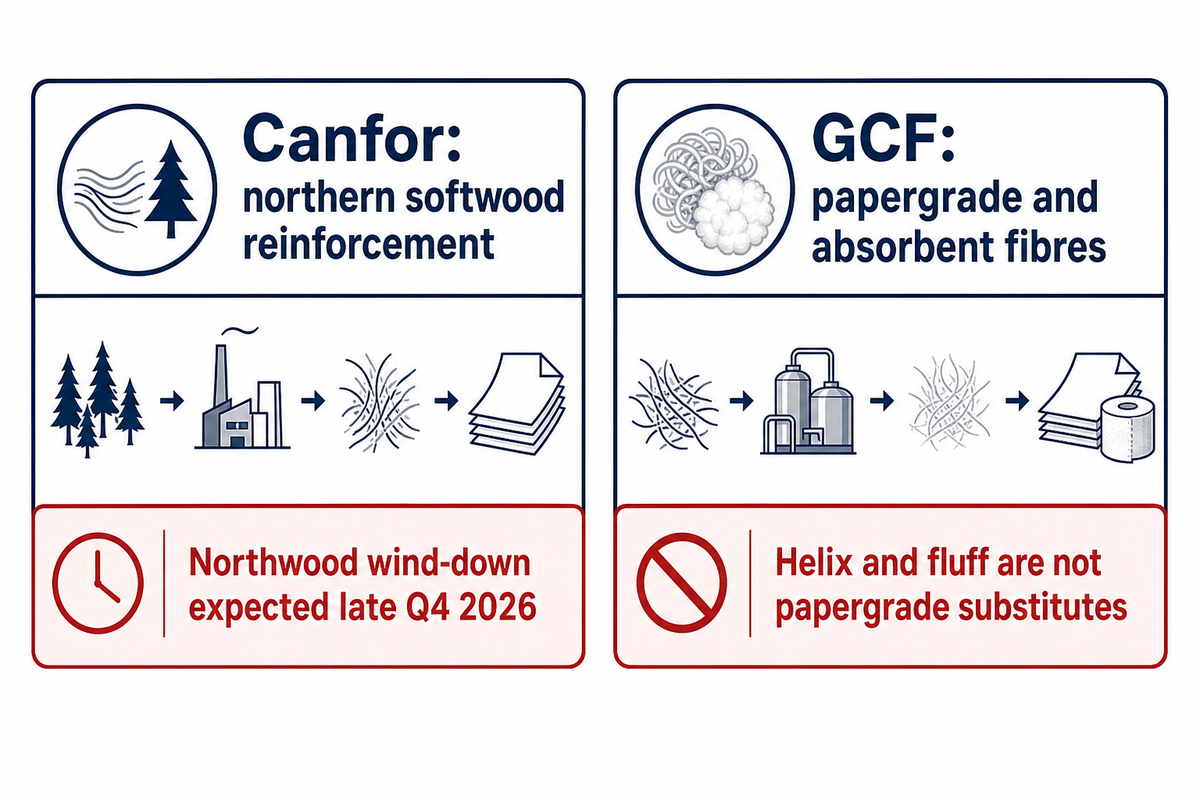
The following entries centre on softwood kraft in the papergrade portfolios covered by this guide. Product families such as fluff and engineered absorbent fibres may sit alongside that offer, but their different end uses don’t change the wood-family grouping. Canfor’s announced Northwood closure is a material supply-planning distinction and is included explicitly.
7. Canfor Pulp: Best for northern softwood reinforcement
Headquarters: Vancouver, Canada · Founded: pulp-business roots in 1951 · Type: northern softwood kraft pulp manufacturer
Official website: https://www.canfor.com/
Main products: northern bleached softwood kraft pulp, or NBSK, including enhanced ECF grades.
Certifications / notable work: Canfor Pulp lists PEFC and FSC chain of custody; its Prince George pulp and paper facilities have published ISO 9001 and ISO 14001 credentials.
Canfor’s product information describes a Canadian fibre mix of lodgepole pine, white spruce and subalpine fir, with Intercontinental included in the published NBSK range. That defined northern softwood offer makes it relevant to tissue and specialty-paper mills comparing reinforcement grades rather than general hardwood alternatives. Canfor announced Northwood’s permanent closure on July 14, 2026, with an orderly wind-down expected to finish in late Q4 2026. Consequently, the Northwood product listing can’t be treated as a continuing long-term supply commitment, although the announcement doesn’t itself establish that closure was already complete in October.
8. Global Cellulose Fibers: Best for papergrade softwood alongside engineered absorbent fibres
Headquarters: Memphis, Tennessee, United States · Founded: independent AIP ownership since January 2026; formerly an International Paper business · Type: market-pulp and engineered-cellulose manufacturer
Official website: https://www.globalcellulosefibers.com/
Main products: papergrade softwood, fluff, specialty pulp and Helix fibres.
Certifications / notable work: a current certificate scope wasn’t publicly disclosed; International Paper announced completion of the business sale to American Industrial Partners in January 2026.
Global Cellulose Fibers combines a papergrade offer with engineered cellulose products, including modified southern pine Helix fibres developed for liquid-management duties. That breadth is useful when a buyer’s business spans conventional paper manufacturing and absorbent-product applications, because the commercial categories are visible within one supplier portfolio. The current independent business name also helps distinguish this offer from older International Paper supplier lists. Helix and fluff products serve different absorbent requirements, however, and aren’t interchangeable with the company’s papergrade pulp merely because they share a cellulose origin.
Producers with Multiple Pulp Grade Families
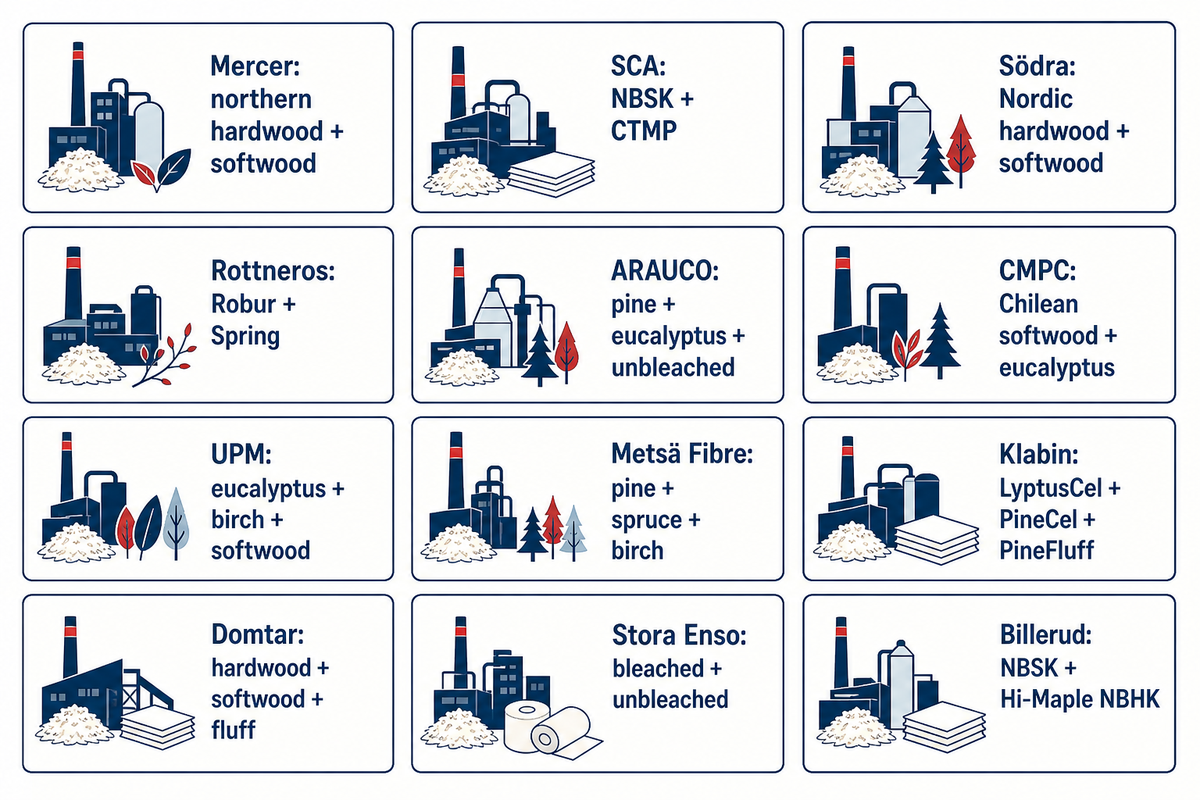
The following group of producers offers papergrade products that encompass both hardwood and softwood families or combine kraft and mechanical pulping. These distinctions are practical for a furnish shortlist, and don’t imply that a product is suited for the same machine as others in the list. For this group a fluff or dissolving product name doesn’t imply membership.
9. Mercer International: Best for northern hardwood and softwood kraft
Headquarters: Vancouver, Canada, principal place of business · Founded: entered forest products in 1993 · Type: market-pulp and solid-wood manufacturer
Official website: https://mercerint.com/
Main products: northern bleached softwood kraft, or NBSK, and northern bleached hardwood kraft, or NBHK.
Certifications / notable work: a current certificate scope wasn’t publicly disclosed; the published pulp network includes Stendal, Rosenthal, Celgar and Peace River.
Peace River is a useful distinguishing operation because Mercer describes production of both northern softwood and hardwood kraft there. Alongside the other named mills, that offer gives a purchasing team concrete manufacturing origins to discuss when comparing northern grades across its paper products. Mercer consequently belongs in a multi-family shortlist, even if a buyer first encounters the company through an NBSK enquiry. Its northern kraft portfolio doesn’t establish a eucalyptus-specific offer, so mills whose formulation explicitly calls for eucalyptus need a different grade source for that part of the furnish.
10. SCA: Best for comparing NBSK reinforcement and CTMP bulk options
Headquarters: Sundsvall, Sweden · Founded: 1929 · Type: forest-products and pulp manufacturer
Official website: https://www.sca.com/en/
Main products: SCA Pure NBSK and SCA More chemithermomechanical pulp, or CTMP.
Certifications / notable work: SCA Pulp lists FSC-C013162 and PEFC/05-33-132 chain of custody; Östrand and Ortviken are the relevant named pulp operations.
SCA separates its commercial offer into Pure and More, giving kraft reinforcement and mechanical-pulp bulk requirements distinct product identities. That separation helps a mill compare process routes directly instead of treating every white pulp sheet as an equivalent source of fibre. A buyer evaluating paperboard or other applications with both strength and bulk requirements can therefore begin with the appropriate family and then move to individual grade data. SCA More CTMP and SCA Pure NBSK still require separate furnish qualification because the manufacturing processes and resulting material roles differ.
11. Södra: Best for forest-owner-backed Nordic hardwood and softwood
Headquarters: Växjö, Sweden · Founded: 1938 forest-owner association · Type: forest-owner association with Södra Cell pulp operations
Official website: https://www.sodra.com/en/global/
Main products: northern hardwood and softwood paper pulps.
Certifications / notable work: Södra describes pulps available with FSC or PEFC certification; Mönsterås, Mörrum and Värö form its three-mill Swedish pulp network.
The combination of northern hardwood and softwood grades gives Södra a place in shortlists that need more than one wood-family option from a Swedish producer. Its forest-owner association structure and named manufacturing operations also give the buyer a defined company and mill context for comparing the fibre offer. Södra Cell is the pulp business to focus on, rather than assuming every product elsewhere in the wider association belongs to the paper-pulp range. Dissolving-pulp and textile-recycling products remain separate offers and shouldn’t be read as additional papergrade furnish options without that product distinction.
12. Rottneros: Best for specialist kraft and CTMP grade choices
Headquarters: Sunne, Sweden · Founded: 1887 wood-pulp mill roots · Type: specialist market-pulp manufacturer
Official website: https://www.rottneros.com/
Main products: Robur kraft pulp and Spring CTMP.
Certifications / notable work: Rottneros describes FSC- or PEFC-certified pulp availability and lists ISO 9001, ISO 14001 and ISO 50001 for its management systems.
Vallvik’s chemical kraft operation and Rottneros Bruk’s mechanical-pulp operation provide two clearly differentiated starting points for a technical enquiry. The Robur and Spring identities are useful when a purchasing team wants to compare specialist material requirements without losing the distinction between kraft and CTMP. That makes Rottneros a relevant option for mills whose discussion begins with the required pulp behaviour rather than the largest possible supplier catalogue. Older groundwood references are the limit to bear in mind: the historical groundwood line closed in 2022 and isn’t part of the current offer described here.
13. ARAUCO: Best for pine, eucalyptus and unbleached kraft breadth
Headquarters: not published · Founded: not published · Type: integrated forestry and pulp manufacturer
Official website: https://www.arauco.com/
Main products: bleached eucalyptus pulp, bleached and unbleached pine pulp, and fluff pulp.
Certifications / notable work: a current certificate scope wasn’t publicly disclosed; the official product portfolio identifies radiata pine and taeda pine alongside eucalyptus grades.
Unbleached radiata pine is a notable part of ARAUCO’s range because it extends the comparison beyond bleached hardwood products for white paper. The combination of pine species and eucalyptus also gives a mill a broader starting list when its manufacturing operations use different fibre families for different products. For a buyer comparing paper and industrial packaging furnish, those named grades are more informative than a general claim about company scale. Radiata pine, eucalyptus and fluff still have different end-use roles, so a specification based only on the ARAUCO group name would be too broad to identify the required product.
14. CMPC Pulp: Best for Chilean softwood and South American eucalyptus comparisons
Headquarters: Santiago, Chile (CMPC group headquarters) · Founded: CMPC parent established in 1920 · Type: CMPC’s market-pulp manufacturing business
Official website: https://www.cmpcpulp.com/en/
Main products: Laja and Pacífico softwood pulp; Santa Fe and Guaíba eucalyptus pulp.
Certifications / notable work: the Pacífico mill profile states CERTFOR-PEFC and FSC chain of custody; that statement identifies Pacífico’s pulp scope.
CMPC pairs mill-specific softwood and eucalyptus products with production, logistics, marketing and technical customer support. The names Laja, Pacífico, Santa Fe and Guaíba provide a practical way to keep the manufacturing origin attached to the grade throughout a supplier comparison. A purchasing team considering both Chilean softwood and eucalyptus from Chile or Brazil can therefore compare defined offers within one market-pulp business. The limitation is also mill-specific: supply from Pacífico in Chile can’t be treated as one interchangeable origin for every CMPC pulp grade, including Guaíba eucalyptus from Brazil.
15. UPM Pulp: Best for multi-species kraft with technical development support
Headquarters: Helsinki, Finland, UPM group head office · Founded: group operations began after the 1996 merger · Type: UPM market-pulp business
Official website: https://www.upmpulp.com/
Main products: eucalyptus, birch and softwood pulp, plus RaumaCell fluff pulp.
Certifications / notable work: UPM lists FSC and PEFC chain-of-custody certificates specifically for UPM Pulp Mills, and identifies research centres in China, Finland and Uruguay.
According to UPM, five mills in Finland and Uruguay provide a combined annual pulp capacity of 5.8 million tonnes. Eucalyptus, birch and softwood choices, supported by the published research-centre network, make the portfolio relevant when a mill wants to compare several fibre species and discuss their application requirements with one producer. This is a stronger basis for a shortlist than assuming all hardwood pulps will behave alike because they share a broad category name. The aggregate capacity covers UPM’s pulp operations in Finland and Uruguay, so an individual buyer must plan delivery from one of those manufacturing origins.
16. Metsä Fibre: Best for Nordic pine, spruce and birch from Finnish mills
Headquarters: Espoo, Finland · Founded: not published · Type: Metsä Group pulp manufacturer
Official website: https://www.metsagroup.com/metsafibre/
Main products: Nordic pine, spruce and birch pulps.
Certifications / notable work: Metsä Fibre lists mill chain of custody, including FSC-C002102 and PEFC/02-33-21; its pulp range identifies Joutseno, Rauma, Kemi and Äänekoski.
Joutseno and Rauma supply softwood options, while Kemi and Äänekoski broaden the portfolio across softwood and hardwood. That named Finnish manufacturing network gives buyers a direct route into comparisons between conifer reinforcement and birch-based hardwood furnish. Mills with several paper grades can start with the fibre requirement and then discuss the matching commercial product rather than treating “Nordic pulp” as a single technical specification. Some production is used within Metsä Group, however, so the group’s overall manufacturing capacity can’t be assumed to be wholly available as external market supply.
17. Klabin: Best for hardwood, softwood and fluff from one industrial unit
Headquarters: São Paulo, Brazil · Founded: 1899 Klabin Irmãos e Cia · Type: integrated pulp, paper and packaging manufacturer
Official website: https://klabin.com.br/en/
Main products: LyptusCel, PineCel and PineFluff.
Certifications / notable work: Klabin’s forestry-management information lists FSC-C022516/C023492 and PEFC/28-22-15/17; these identifiers describe forestry scope.
The Puma unit in Ortigueira began operation in 2016 and produces hardwood, softwood and fluff pulp at a single industrial unit, according to Klabin. That arrangement makes the company particularly relevant when a buyer wants to compare several fibre categories while keeping a common production-location discussion. Its integrated paper and packaging business provides context for the broader portfolio, but the named LyptusCel, PineCel and PineFluff products remain the useful purchasing distinctions. Same-site production doesn’t make the three grades interchangeable, because papermaking and absorbent-product requirements lead to different pulp selections.
18. Domtar: Best for North American hardwood, softwood and fluff comparisons
Headquarters: corporate offices in Montreal and Richmond, Canada, and Fort Mill, United States · Founded: unified Domtar brand in 2024, with predecessor roots in 1820 and 1848 · Type: integrated pulp, paper and forest-products group
Official website: https://www.domtar.com/
Main products: hardwood, softwood and fluff pulp.
Certifications / notable work: a current certificate scope wasn’t publicly disclosed; the company identifies Ashdown’s conversion as part of its Lighthouse fluff offering.
Lighthouse gives Domtar’s absorbent-pulp business a specific product identity alongside its hardwood and softwood paper-pulp portfolio. The current unified brand also brings together operations previously associated with Domtar, Resolute and Paper Excellence, so counting those legacy names separately would overstate the number of distinct company choices. Buyers looking at markets in North America can use the current product catalogue as their starting point for comparing those grades. Because the group spans several mill and business lineages, the purchase specification still needs a producing mill and commercial grade rather than the company name alone.
19. Stora Enso: Best for bleached and unbleached kraft applications
Headquarters: Helsinki, Finland · Founded: 1998 merger of Stora and Enso · Type: renewable-materials and market-pulp producer
Official website: https://www.storaenso.com/en/
Main products: bleached hardwood and softwood pulp, plus unbleached kraft products including Enocell UKP Nova.
Certifications / notable work: Stora Enso describes FSC- and PEFC-certified kraft-pulp availability, with trademark licences C116608 and PEFC/02-31-298.
Enocell UKP Nova extends the published offer into packaging, filter and electrical-insulation applications, giving specialist buyers an option beyond bleached pulp for conventional white paper. Combined with the hardwood and softwood range, that makes Stora Enso relevant to mills comparing both fibre families and bleaching status across different finished products. The portfolio’s breadth is useful, but it shouldn’t be confused with complete independence from every other manufacturer on this list. Suzano’s 2026 disclosure identifies Veracel as a joint operation owned equally by Suzano and Stora Enso, so buying through both groups may still involve a shared producing asset.
20. Billerud: Best for Scandinavian NBSK and maple-rich North American hardwood
Headquarters: Solna, Sweden · Founded: 2012 BillerudKorsnäs merger, with Billerud roots in 1883 · Type: pulp, paper and packaging-material manufacturer
Official website: https://www.billerud.com/
Certifications / notable work: Billerud states that its production units hold FSC and PEFC chain-of-custody certification; the pulp offer includes Gruvön, Karlsborg, Skärblacka and Quinnesec grades.
Quinnesec Hi-Maple is distinguished by its high maple-fibre proportion, while the Swedish range includes NBSK and Gruvön flash-dried pulp. Those named options allow buyers to compare a North American hardwood product with Scandinavian softwood within one company’s published portfolio, without assuming a single common species mix. The offer is useful for mills weighing different furnish components and delivery forms as part of the same purchasing exercise. Swedish softwood and Quinnesec hardwood nevertheless originate from different mills and shipping locations, which affects how their delivered offers should be compared.
Virgin and Recycled Pulp for Mill Furnish
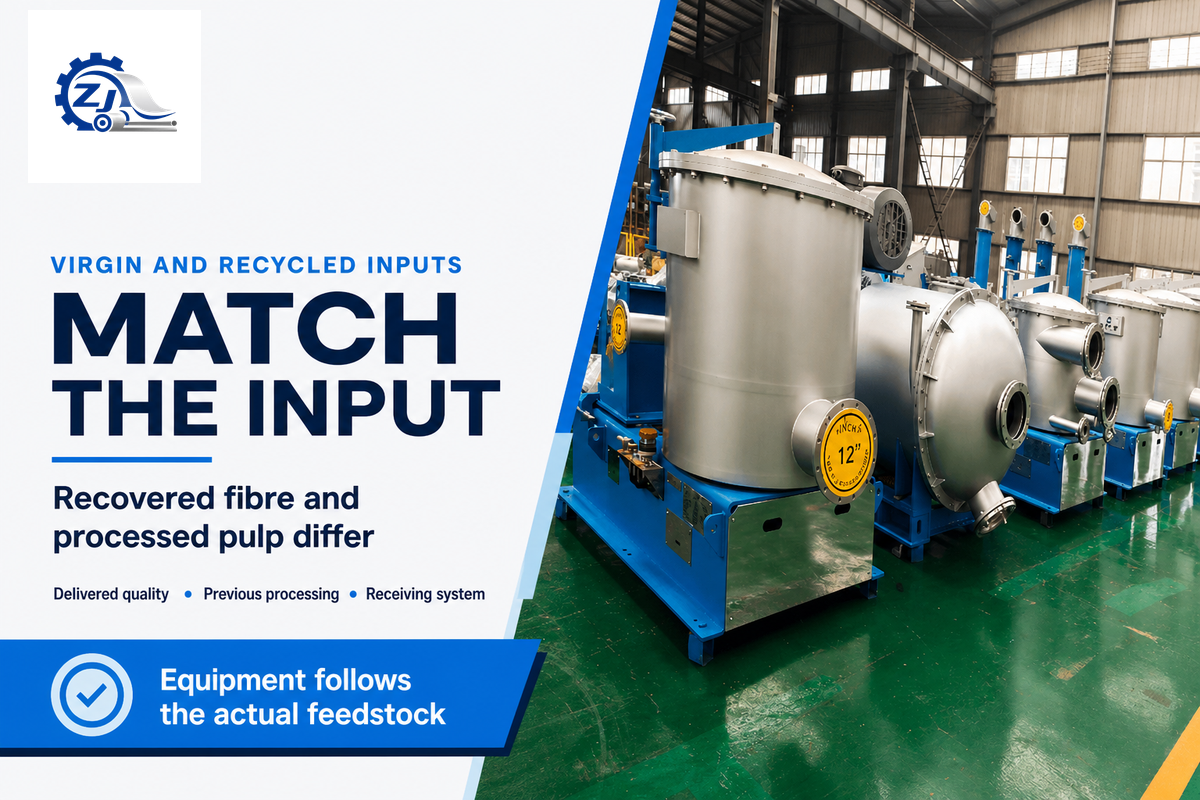
Virgin pulp and recovered fiber inputs can supply paper production, but a purchase of recovered fiber isn’t the same as a purchase of processed recycled pulp. The form and the type of processing the material has previously undergone determine what the receiving mill needs to do to make it suitable for further processing by the paper machine. This distinction is as important as whether the purchase is labeled “recycled.”
A mill buying recovered corrugated paper, off-grade paper or other collected grades is buying a feedstock containing a mixed fiber and contaminant load. A mill purchasing processed recycled pulp has bought a product of a previous recovery and preparation process. Neither of the descriptions alone establishes what the end furnish quality will be. The specified input quality standards need to describe what’s actually delivered and how it will be further processed.
For a linerboard mill, discussions may be about recovered corrugate and the requirements of its linerboard product. A tissue application raises other questions regarding the appearance and the route of preparation. No universal recycled content percentage follows from either case, and this manufacturer list isn’t an endorsement of recycled market-pulp vendors.
Pressure screening and thickening and deinking equipment are part of the discussion relating to preparation of the stock where the feedstock and product call for them. The inclusion of such equipment in a machinery catalogue doesn’t mean that every recycled-pulp purchase requires the same system or that a virgin grade can be replaced without changing the preparation work of the mill.
How to Choose a Paper Pulp Manufacturer
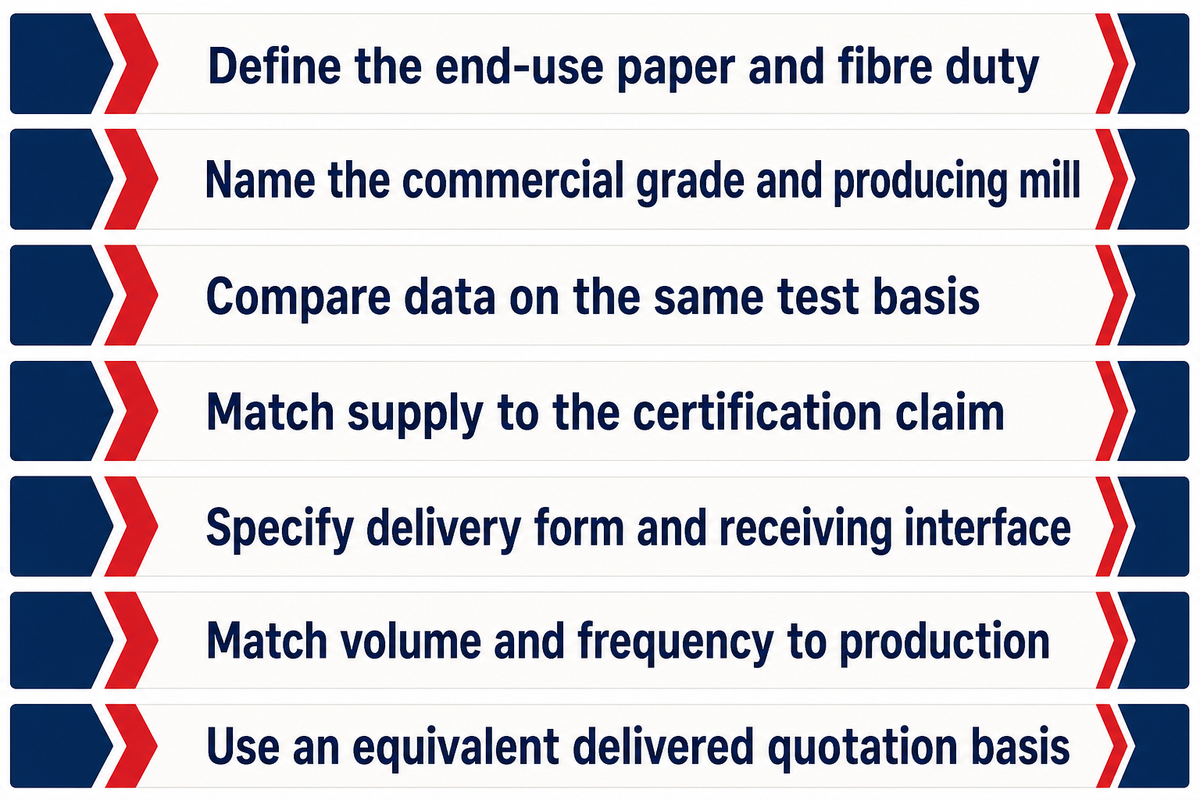
A finished paper requirement is a good starting point, and the shortlist works back to the fibre grade, producing mill and delivery basis. The following seven checks transform a lengthy supplier list to comparable enquiries. They also distinguish documented manufacturing scope from commercial commitments and trial results needed for a particular purchase.
- Begin with the end-use paper, and the fibre duty. State whether the mill makes tissue, printing paper, paperboard or a specialty product, and define the property the new furnish component is expected to contribute. Eucalyptus, birch and maple-rich grades are examples of “hardwood” grades, and aren’t the same commercial specification. A manufacturer specializing in the required product family is a better starting point than the widest possible catalog. High-performance claims only become relevant and can be assessed when tied to the actual acceptance criteria of the mill.
- Name the commercial grade and producing mill. Keep those identifiers attached to the quotation, technical sheet and sample. Group ownership can obscure a shared supply origin: Suzano and Stora Enso’s Veracel relationship illustrates why two corporate names need not provide two independent mills. Announced operating changes also matter. Canfor’s Northwood wind-down should be part of the supply discussion rather than ignored because a product page still lists the mill.
- Compare data on the same test basis. Ask for what prep, refining and test conditions led to the reported values and then compare them to a controlled mill trial. A BioResources study comparing market pulps used lab handsheets and specific refining conditions; those results don’t set one industrial recipe for every tissue machine. Calling equipment state-of-the-art doesn’t prove the trial basis. Mills evaluating pulp refiners should keep the planned fiber trial and the refining duty connected, because a supplier name doesn’t dictate the treatment.
- Check the actual supply against the certification claim. Forest-management and mill management-systems certificates and product claims have different scopes. Assess responsibly sourced fibre while considering the relevant holder, sites and sales-document claim. ECF and TCF describe bleaching; they aren’t substitutes for chain-of-custody certification. Sustainable practices reports describe a broader topic than the claim on a particular shipment. A company’s commitment to sustainability and environmental responsibility cannot establish that a particular delivery is FSC certified.
- Specify the delivery form and receiving interface. Agree whether the offer concerns sheets, bales, flash-dried material or another stated form, and how the material will enter the mill’s preparation system. Billerud’s published flash-dried option is a reminder that the physical product can vary within a supplier portfolio. A change in receiving form belongs in the process discussion, rather than being treated as an incidental packaging detail.
- Match delivery volume and delivery frequency to the production plan. Request the proposed allocation, dispatch schedule and route for the named grade. A headline production figure doesn’t secure material for a customer, and a port’s handling capacity doesn’t create additional manufacturing capacity. This distinction is particularly valuable when evaluating an integrated producer that uses some pulp internally vs. a dedicated external supply offer. The global supply chain still has to back up the requested timing of the receiving mill.
- Quote on an equivalent delivered basis. When making comparisons, ensure the grade, quantity, destination and timing are the same. The price unit, moisture or dryness basis, freight boundary and terms of payment are to be placed next to the quoted figure. An apparent lower unit price doesn’t guarantee the same product or delivery scope and, therefore, can’t be interpreted in a vacuum.
How should mills compare bulk pulp quotes?
Require each supplier to state its quoted weight basis explicitly, including whether an air-dry tonne basis applies, and how that’s defined in the offer. Include currency, the quotation date, the delivery destination and the transport costs in the offer. Grade substitutions should appear as alternatives rather than unstated changes to the comparison. This supports a like-for-like discussion without inventing a universal price range or minimum order for the paper manufacturing industry.
FAQ
Who is the largest market pulp manufacturer?
Suzano describes itself as the world’s largest pulp manufacturer; comparisons still need a defined product category and reporting period.
Finished-paper output, total pulp capacity and externally sold market pulp are different measures. An integrated paper company can produce substantial pulp for its own use, so its total output doesn’t automatically represent available market supply. For a purchasing decision, the more useful question is whether a producer makes the required commercial grade at an appropriate mill and can offer the volume and delivery schedule needed. Company scale alone doesn’t answer those questions.
What is wood pulp paper used for?
Wood-pulp-based paper is used for printing, writing, tissue, paper towels, packaging and specialty products, with the fibre grade selected for the application.
Packaging materials can include paperboard and corrugated packaging, while disposable hygiene products involve absorbent-material requirements that differ from ordinary printing paper. For the packaging industry, food and beverage applications add finished-product requirements beyond the identity of the pulp supplier. The range of paper uses explains why manufacturers offer several grades rather than one universal material. A buyer should connect the pulp specification to the actual paper or converted product, including its intended use and the receiving mill’s production processes.
How is market pulp made?
Market pulp is made by separating and preparing fibres, then supplying the resulting pulp in the commercial form required by another manufacturer.
Chemical and mechanical routes produce different pulp families; kraft and CTMP examples appear in this list. Bleaching, where used, adds another product distinction, as the ECF and TCF offerings from Ence demonstrate. The manufacturing route is therefore part of the grade description rather than a minor detail. This industrial overview is different from making a small batch of recycled paper by hand: commercial purchasing also requires a defined product specification, manufacturing origin and delivery form.
Which paper pulp manufacturers operate in the United States and Canada?
North American options in this shortlist include Canfor, Mercer, Domtar, Global Cellulose Fibers and Billerud’s Quinnesec operation.
Their grade ranges and production locations differ. Canfor and Mercer provide northern kraft options; Domtar’s range includes hardwood, softwood and fluff; GCF combines papergrade and absorbent-fibre products. Billerud adds a maple-rich hardwood offer from Quinnesec. Current ownership matters when using older directories, especially following GCF’s separation from International Paper and the adoption of the unified Domtar brand.
Where can mills find paper pulp manufacturers in Europe?
European options include Ence, Altri, Navigator, SCA, Södra, Rottneros, UPM, Metsä Fibre, Stora Enso and Billerud.
Compare the actual producing mill rather than headquarters alone. Several groups operate across regions, and their hardwood, softwood or mechanical grades can originate from different sites. The table identifies product families to narrow that search.
How much does bulk paper pulp cost?
Bulk pulp prices depend on the commercial grade, weight basis, quantity, delivery terms and quotation date.
A useful enquiry identifies the producing mill or acceptable origin, required grade and delivery form before asking for a number. The offer should state its currency and weight basis, including the applicable dryness convention, so that freight and product quantities can be compared consistently. Destination and delivery timing also need to match across quotations.
A hardwood offer isn’t automatically comparable with softwood reinforcement pulp, and a fluff product isn’t simply an alternative price for ordinary papergrade material. Where a supplier proposes another grade, keep it as a separately identified option and assess its technical suitability before treating the price difference as a saving. Published production capacity doesn’t establish an available allocation or a minimum order. Obtain a dated commercial offer for the specific supply requirement, then compare the delivered scope alongside the trial and acceptance criteria. That approach produces a usable purchasing comparison without turning a transient market number into a standing procurement assumption.
Shortlist Pulp Suppliers for Your Mill

Choosing a few documented grade producers that match the required furnish and carrying their commercial grade and producing-mill identity into the technical and purchasing discussion is a suggested approach. The strongest short list is likely to be narrower than the initial company list. Grade fit, supply origin and the receiving mill’s process requirements must be factored in through the comparison.
Zejiang Paper Machinery can discuss stock preparation equipment for the selected feedstock and production duty. Our manufacturing solutions concern the relevant machinery and preparation system rather than the sale of commodity pulp. Discuss the intended paper product, purchased fiber form and the current process to identify the mill interface.
Why a machinery supplier compares pulp producers
Purchased pulp and stock preparation meet at the receiving paper mill. This guide uses public manufacturer information to keep that interface clear: fibre producers supply commercial pulp grades, while Zejiang Paper Machinery supplies equipment and related machinery support. The company comparisons don’t describe private supplier trials, customer endorsements or personal mill visits. Author: XCX, for Henan Zejiang Paper Machinery Co., Ltd.
References & Sources
- What Is Paper Pulp? American Forest & Paper Association, fibre and product definitions.
- Comparison of Wood and Non-Wood Market Pulps for Tissue Paper Application BioResources, laboratory-study scope.
- Chain of Custody Forest Stewardship Council, traceability scope.
- Northwood Closure Announcement Canfor Corporation, July 14, 2026.
- Statement on the Northwood Closure Government of British Columbia, July 14, 2026.
- Suzano First-Quarter 2026 Disclosure issuer filing, including the Veracel joint-operation ownership note.
Individual company profiles also use the official product, history, contact and certification publications identified by their website entries. Company-reported figures retain their stated production, capacity or logistics scope.