Get in touch with Zejiang Paper Machinery Company



Updated October 2026
Pressure screening papermaking refers to separating suspended material by passing stock through apertures in a pressurized screen basket. Pressure screening is a mechanism definition and not a product statement on a specific model or standard. The rotor in a pressure screen does more than move the stock. The hydrodynamic pulsations of the rotor clean the aperture surface and therefore allow useful fibers to pass through the screen while capturing oversized or differently shaped material in the other stream.
A coarse screen, fine screen, fractionator and approach-flow screen do not protect the same downstream process; their sequence within the stock preparation process defines what each stage must protect. “Accept” and “reject” don’t necessarily indicate good product and waste. An inflow or outflow designates a flow path and doesn’t define capacity or efficiency. When specifying or troubleshooting a pressure screen, define the duty and the target stream first, then the measurements that will judge the result.
This guide provides the framework for the evidence. This includes, but isn’t limited to, describing the mechanism of separation, external stream balance, interpretation of signals, and controlled trials. Additionally, this guide provides information about the interpretation of evidence a basket supplier would need to evaluate. For a field-focused list of operating checks, see the separate pressure screen operating guide.
Key takeaway
A pressure screen does not have one universal “best” setting. Define the duty and target stream, establish a clean measurement boundary, then judge hydraulic stability and product quality together.
Quick Answer: What Does a Pressure Screen Do?
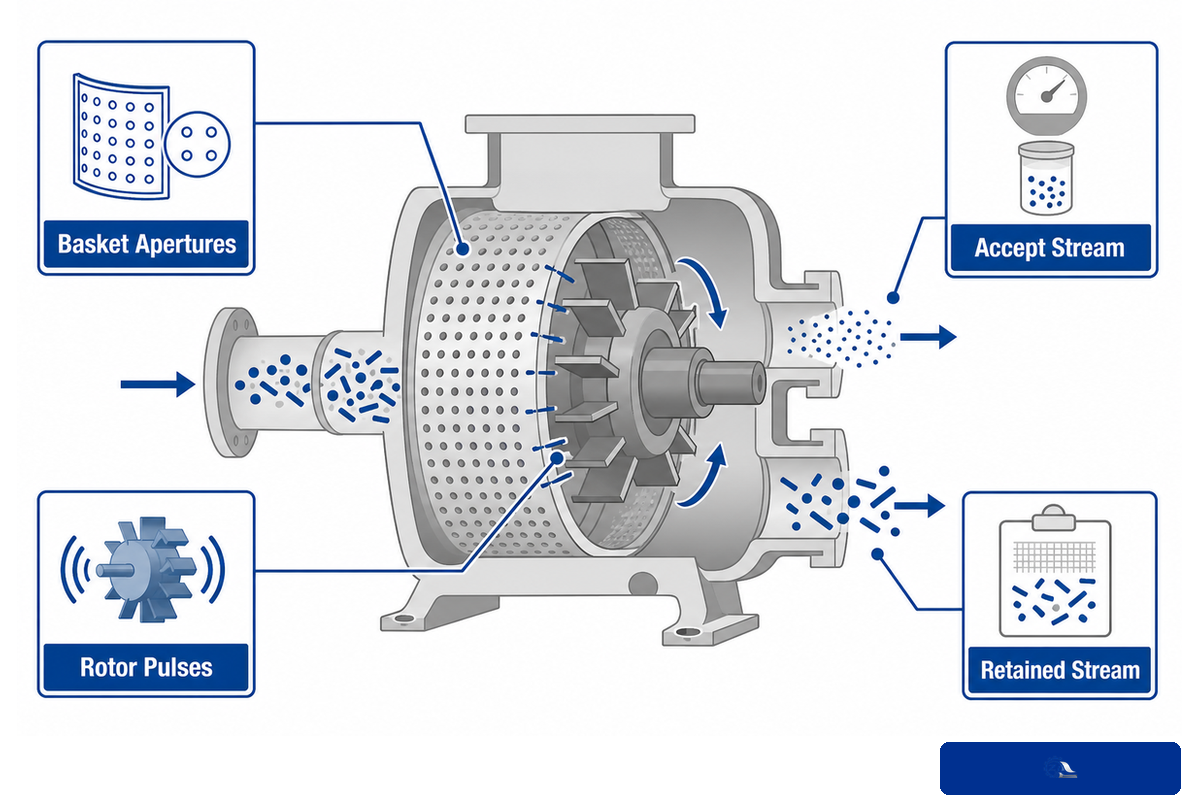
Material able to pass the apertures under local hydraulic conditions passes through the screen; retained material travels toward another outlet. Rotor foils or other rotor elements generate changing pressure and velocity fields that limit plugging and influence how fibers and contaminants approach the basket. A peer-reviewed plugging study done in 2025 shows that characteristics of pulsation change with screen condition; the pulses intermittently backflush oversized contaminants and pulp accumulations from the slots.
Separation is probabilistic. Factors that affect the outcome of a screening operation include the characteristics of the pulp fiber, local velocity, consistency, flocculation, and the design and wear of the rotor elements. A contaminant can pass while a useful fiber can be trapped. The result must therefore be measured as a distribution across streams, not assumed from the equipment name.
Screening should be understood as repeated presentations of particles and a probability of passage, not as a perfect one-time separation.
The stock-preparation material used by the University of British Columbia describes mechanical screening as a probabilistic process, where factors such as aperture size, presentation of the fiber, and the number of contacts influence the outcome. A critical peer-reviewed review of chemical pulp screening processes shows that factors such as the design of the rotor and basket and the flow conditions affect the outcome.
The Four-Stream Evidence Boundary
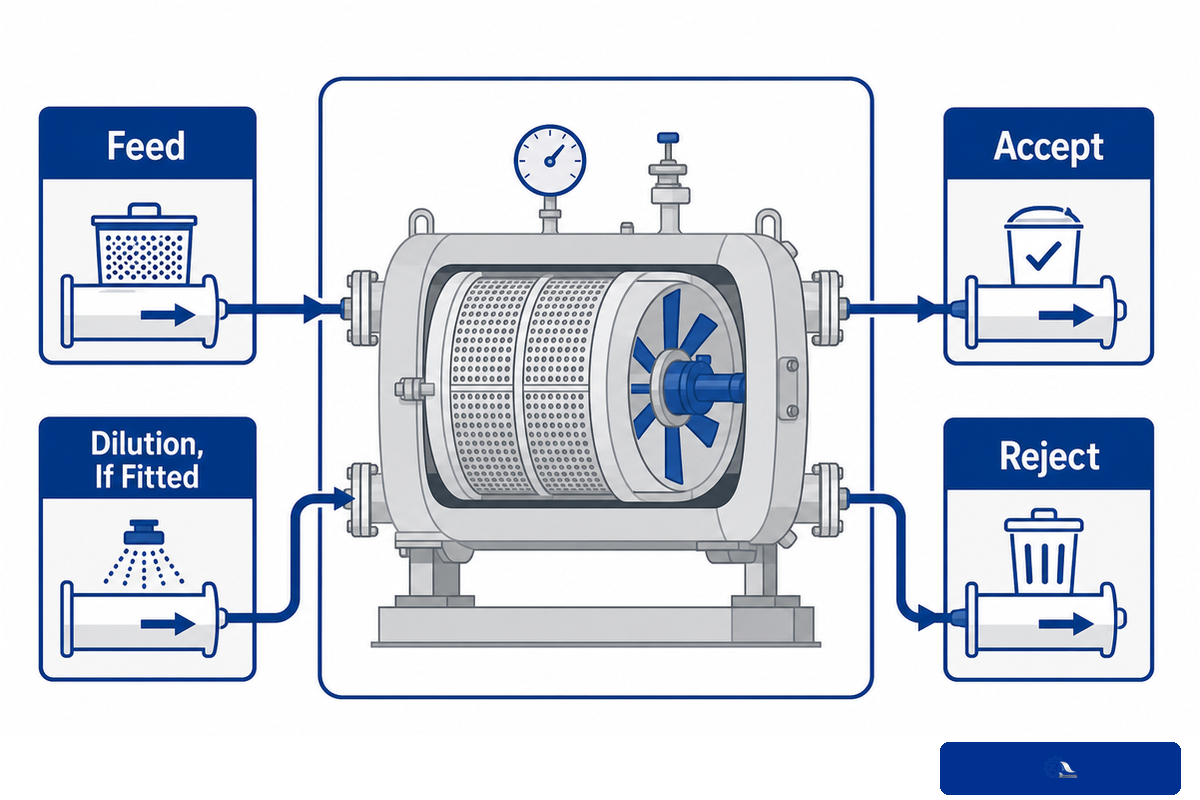
The Four-Stream Pressure-Screen Balance is the best way to talk about a pressure screen: draw a boundary around the equipment. Most screens have feed, accept and reject streams; some also have dilution water. These form an external accounting system. They don’t show all local circulation paths or pressure fields within the screen.
| Stream | Minimum record | What it helps establish | What it cannot prove alone |
|---|---|---|---|
| Feed | Flow, consistency, temperature, furnish and contaminant basis | Incoming dry mass and challenge condition | Uniform conditions inside the basket |
| Accept | Flow, consistency and the same quality tests used on feed | Material that passed the apertures | That accept is always the desired product |
| Reject | Flow or mass basis, consistency and retained-material characterization | Loss and enrichment across the boundary | That all retained material is waste |
| Dilution, if fitted | Rate, location, quality and timing | Water and consistency closure | The local concentration at every basket position |
For a stable observation window, dry solids input should approximately balance dry solids output, taking into account changes in inventory. Poor closure is a sampling issue, a concern with instruments and/or timing, and may indicate the presence of unmeasured recirculation or changing inventory. Resolve those causes before treating the missing mass as lost in the screen.
The TAPPI mill evidence of accept flow and differential pressure control shows another boundary: two control strategies can protect different goals while a basket progressively blinds. An accept flow control loop can be the production control loop, while a differential pressure control loop can be the hydraulic condition control loop. The control tag that’s stable isn’t necessarily the process result that stayed stable.
Select the Screen Duty Before the Hardware
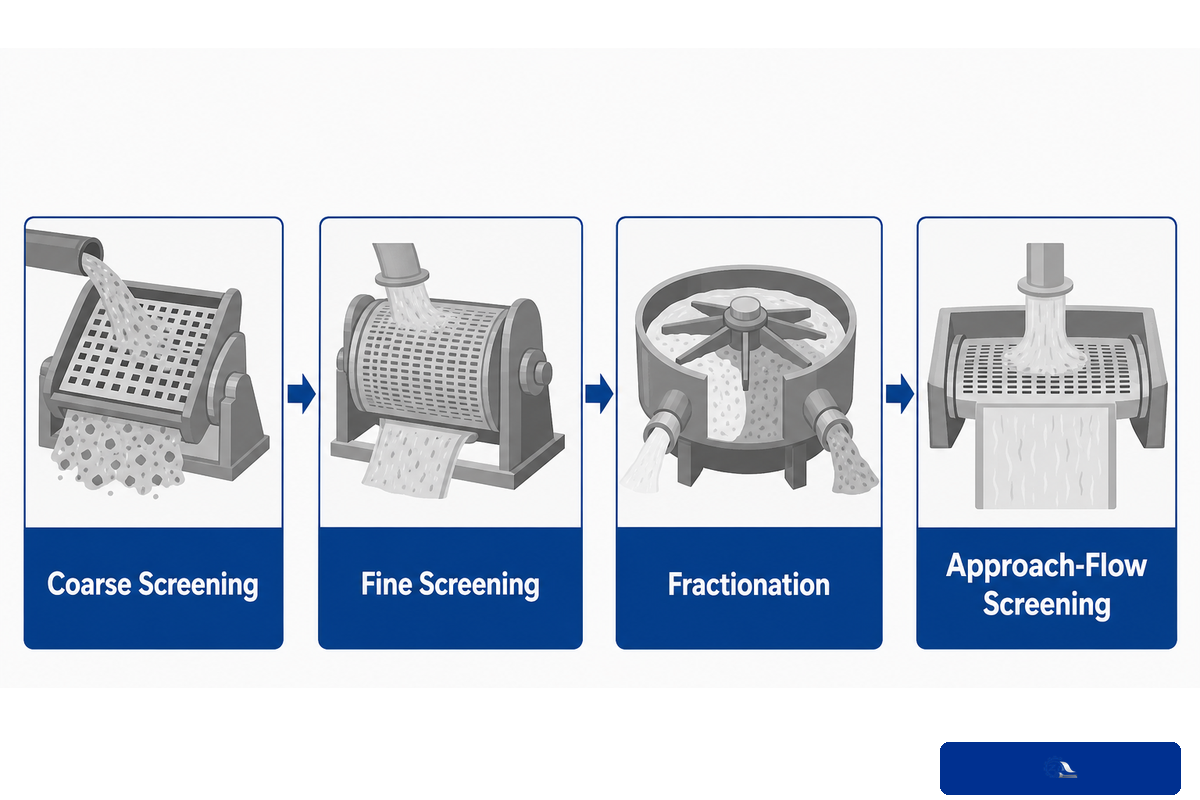
“Screening” performs multiple tasks. The correct comparison requires considering what the unit removes, retains, or partitions; where it’s positioned in the stock-preparation line; and what stream is produced and carried as the product. The same aperture or rotor can’t be evaluated meaningfully without considering the above.
At a papermaking stage, the paper mill may prefer to remove coarse impurities and recover useful fibers at one step and, at a later step, to protect sheet appearance. The phrase high-quality pulp does not define either decision; measurable stream cleanliness, fiber loss and downstream response do.
| Duty | Primary objective | Typical protected process | Evidence priority |
|---|---|---|---|
| Coarse screening | Remove larger debris early | Downstream pumps, refiners and fine screens | Debris removal, fiber loss, capacity and plugging behavior |
| Fine screening | Improve cleanliness at a smaller separation scale | Stock preparation or recycled-fiber cleaning sequence | Contaminant enrichment, useful-fiber loss and hydraulic window |
| Fractionation | Divide fiber populations for separate treatment | Selective refining, blending or product routing | Morphology of both fractions and value of each target stream |
| Approach-flow screening | Protect the headbox and final sheet from residual defects | Paper-machine approach flow | Pulsation, cleanliness, air sensitivity and final-sheet defect response |
In the cited 2024 Cellulose fractionation study, long fibers were intentionally enriched in the retained stream; this makes the retained stream the target product for that study, not a current equipment benchmark. Both outlets must be analyzed before one setting is called more efficient.
Pressure screens and pressure cleaners should be distinguished on a process map, as shown in the site’s broader pulping equipment guide. Pressure screens, in general, operate mainly by presentation and passage through openings. Pressure cleaners operate by density and inertia-related forces in a vortex. Both can be complementary.
Inflow vs Outflow: A Configuration, Not a Verdict
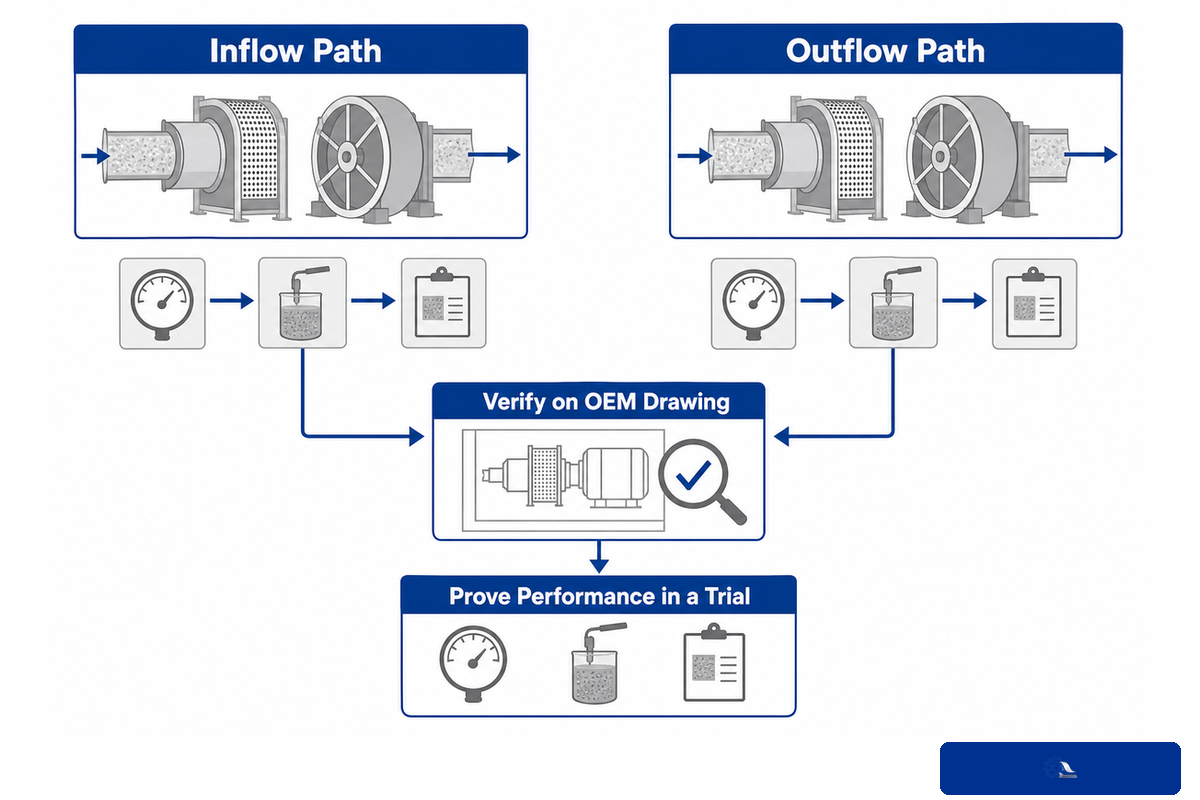
One approach for inflow and outflow configurations uses the named stock path to approach the basket in one direction and the opposite direction, respectively. Exact internal routing varies with each machine design. The label helps determine the basket surface, the relationship of the rotor, and the service arrangement, but it doesn’t help determine which screen will provide the highest capacity with less energy usage, a cleaner accept, and longer mill service life.
A valid comparison holds the measurement and duty limits constant. It describes the furnish, contaminant challenges, aperture type and size, open area, the dimensions of the basket, the geometry of the rotor and speed, the feed and reject condition and the end points. Without these controls, an “inflow versus outflow” comparison may result in assessing different machines or operating windows.
Evidence rule: Treat flow-path labels as configuration facts. Treat capacity, energy, removal, pulsation and service-life statements as performance claims that require comparable test evidence.
Vendor drawings should show the actual feed, accept and reject connections, the position of the rotor, the working surface of the basket, and the direction of rotation, if applicable; the pressure screen equipment page provides the site-specific model and configuration handoff. This drawing check prevents a familiar procurement error: ordering a part that matches a family name but not the installed flow path or mounting details.
The 8-Signal Pressure-Screen Matrix
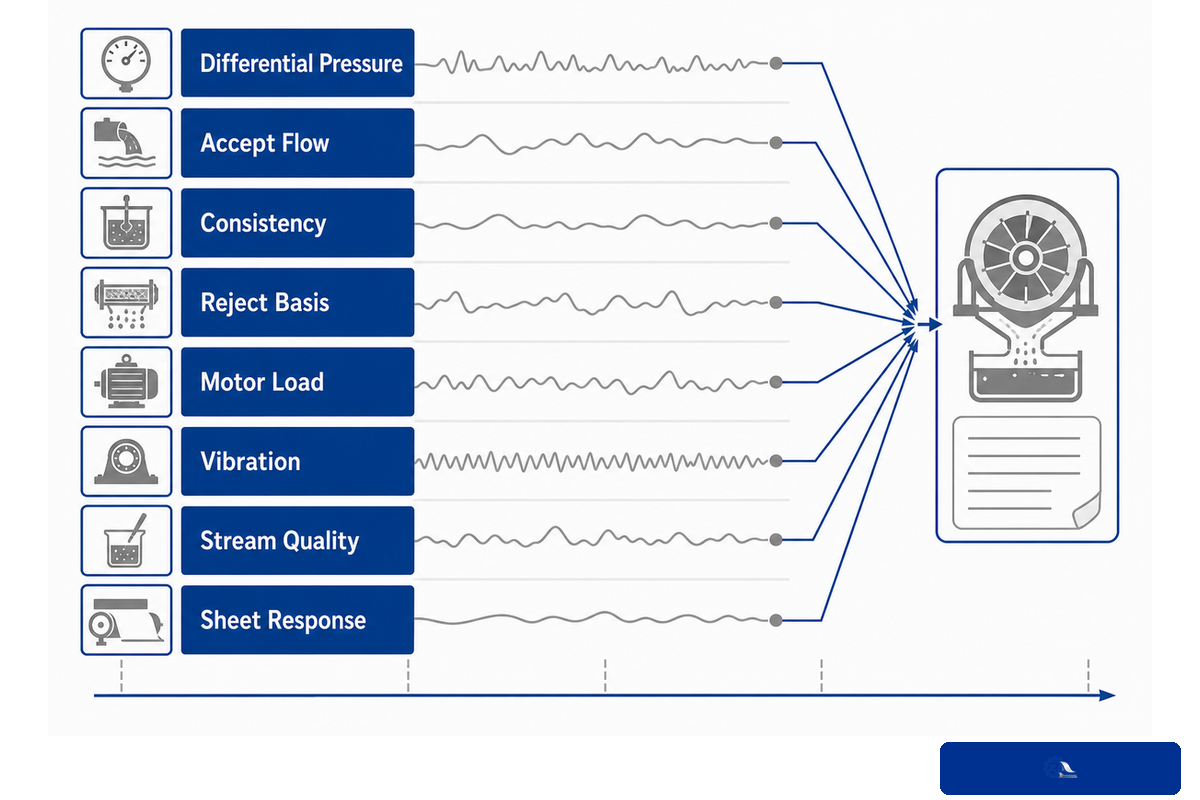
Differential pressure is useful only when its two taps, sign convention, range, sample rate and time window are known. Slow averaging of a process can hide fast, high frequency changes. A fast pressure trace can provide useful insight into cycle times, but may not represent the process average. These are different measurements and shouldn’t be viewed as competing versions of the same number.
A pilot study sampling at 1,000 observations per second can characterize behavior present in the measurement system under study. That sampling frequency is a study setting, not a default for every mill. The requirements for resolution for behavioral measurement are determined by the sensor’s response time, the tap position, the piping and the acquisition filters, among other things.
| Signal type | Record with it | Possible meaning | Counter-check |
|---|---|---|---|
| Differential pressure | Tap locations, sign, mean, variation and sample rate | Changing hydraulic resistance or flow condition | Transmitter zero, plugged impulse lines, flow and consistency |
| Accept flow | Feed flow, dilution and valve position | Production response or controller action | Dry-solids basis and meter condition |
| Consistency | Sampling method, location and lab method | Changing load, passage or dry-mass balance | Representative sampling and temperature |
| Reject basis | Whether reported as volume, wet mass or dry mass | Residence and repeated-presentation change | Fiber loss and quality of both streams |
| Motor load | Speed, flow, consistency and mechanical condition | Hydraulic, rotor or mechanical load change | Bearings, seal, drive and baseline losses |
| Vibration | Sensor location, direction, speed and spectral basis | Mechanical or hydraulic excitation | Alignment, bearings, rotor condition and process stability |
| Stream quality | Method, sample time, replicates and size classes | Separation or fractionation response | Feed change and analytical uncertainty |
| Sheet response | Grade, machine conditions and transport delay | Possible downstream consequence | Refining, retention, forming, pressing and drying |
The final two rows rule out unjustifiable claims. A better accept sample is considered a unit process response. It doesn’t necessarily indicate an improvement to the final sheet. For the removal of a contaminant from one stream, it may be that the contaminant has changed size or even been redistributed. Track where the material has gone.
A Cause-to-Evidence Fault-Isolation Sequence
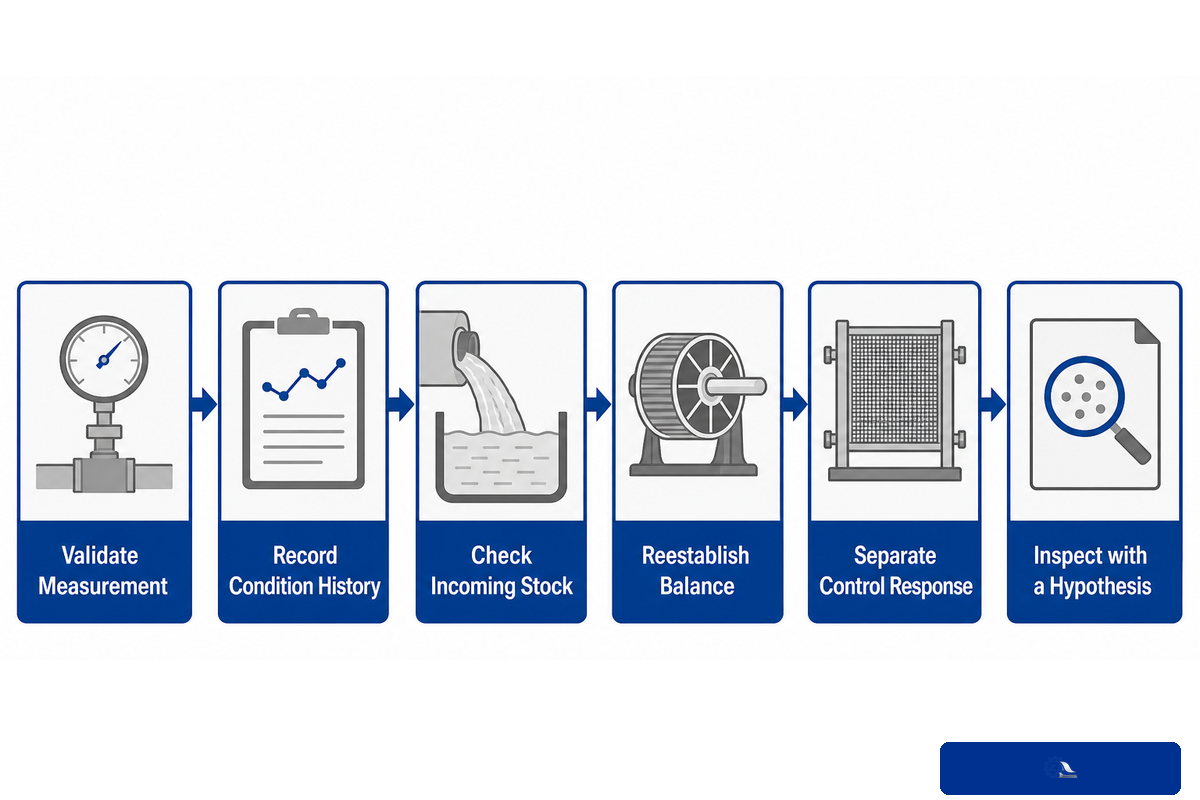
Stability, flow and quality of the product can all be influenced by the measurement instrument, incoming stock, control action and basket condition. A change in downstream back pressure can also be responsible. Before you replace a basket, check the measurement instrument, incoming stock and control action, among other things, to make sure you don’t mask a fault. Replacing a basket can hide a fault or create a new quality or flow comparison with no clean baseline.
- Confirm the measurement is valid. Check transmitters, zero, pressure taps, the condition of flowmeters, consistency of measurement methods, timestamps and acquisition filters.
- Record the time since the last measuring instrument cleaning. A previous plugging event can also be recorded. Wear of basket and rotor and recent maintenance can also be recorded.
- When an event occurs, check the consistency of the furnish, temperature, flow, and contaminant load.
- Reestablish balance. Ensure that the quantities of feed, accept, reject and dilution are aligned on a comparable basis.
- Separate control response from process response. A valve or dilution loop may be compensating for resistance while keeping one displayed tag stable.
- Inspect hardware with a stated hypothesis. Look for aperture blinding, wear, damage, rotor clearance or drive condition that would produce the evidence pattern.
Peer-reviewed work on pressure-screen operating windows shows why several variables must be interpreted together: rotor speed, feed consistency and reject conditions interact with capacity and passage behavior. Its slotted-screen trials, with slot widths of 0.1 to 0.2 mm, show that interaction, not a universal operating envelope for all screens.
OEM literature is valuable in identifying field patterns and field effects, such as basket plugging and wear. However, it is application advice rather than independent evidence that a particular part caused a given effect. Use it to form a hypothesis, and investigate the condition and process evidence.
How to Plan a Controlled Pressure-Screen Trial
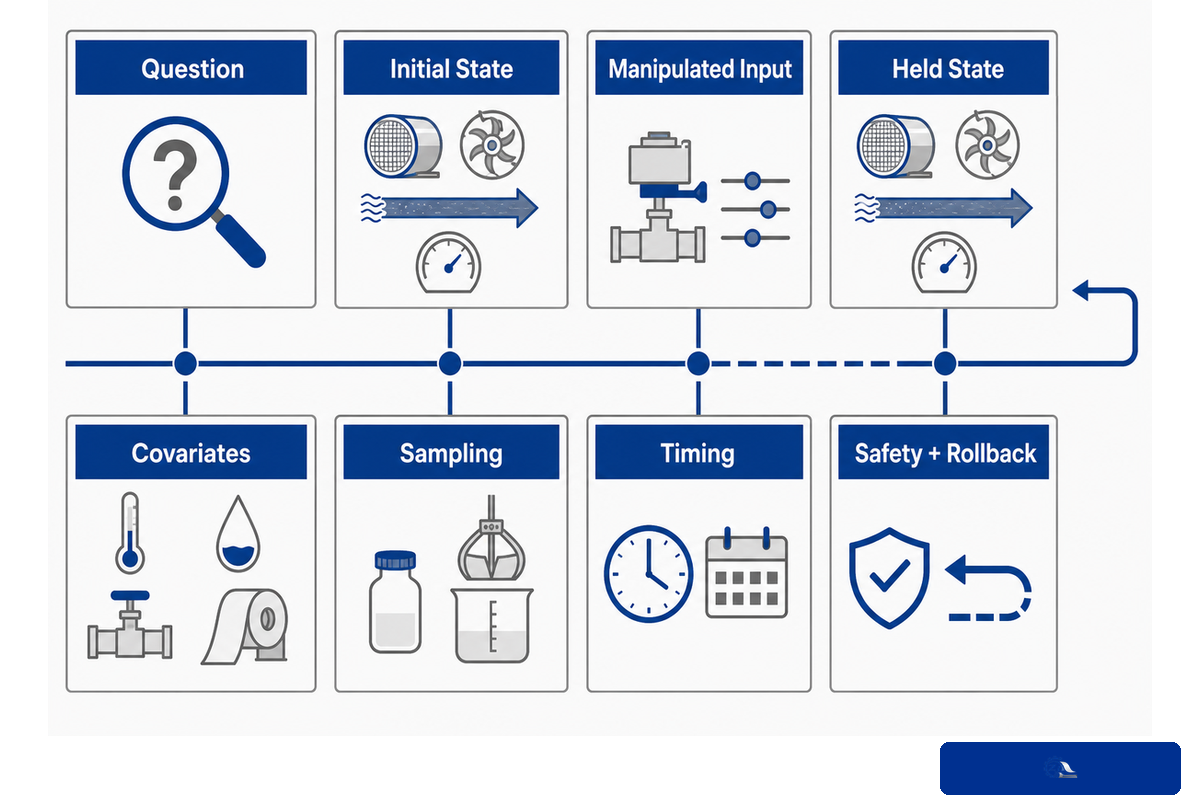
A useful trial identifies the manipulated input, held states, measured covariates and responses before the first change. “We changed the basket and watched quality” is not enough when furnish, flow, reject rate or the starting cleanliness of the screen also changed.
An illustrative data row might show a baseline of 520 m³/h flow, 1.25% feed consistency, 46 °C temperature, 320 kPa inlet pressure, 285 kPa outlet pressure, 35 kPa differential pressure, 92 kW motor load, 680 rpm rotor speed, 11% volumetric reject and a 0.25 mm slot. A comparison row might show 510 m³/h, 1.27%, 47 °C, 318 kPa, 279 kPa, 39 kPa, 95 kW, 680 rpm, 11% and 0.25 mm. Those figures are fictional examples of aligned fields, not recommended settings or client test data.
| Trial element | Declare before the run | Retain as evidence |
|---|---|---|
| Question | One decision the trial must support | Hypothesis and pass/fail or comparison rule |
| Initial state | Cleaning or reset method, wear state and stabilization period | Photos, inspection notes and baseline trends |
| Manipulated input | The one planned setting, component or configuration change | Actual value, time and order of changes |
| Held state | Variables the team intends to keep stable | Trend evidence showing whether they stayed stable |
| Covariates | Variables not controlled but likely to affect response | Furnish, temperature, air, upstream load and downstream pressure |
| Sampling | Locations, timestamps, flush procedure, replicates and lab methods | Raw results, calibration status and uncertainty |
| Timing | Stabilization, washout and transport delay | Aligned process and sample timeline |
| Safety and rollback | Plant-approved stop boundaries and last accepted condition | Deviation log and rollback time |
In assessing design performance, run order can be critical. If all candidates follow a freshly cleaned baseline in the same sequence, plugging history and time can be confused with design performance. Where operations allow, balance or repeat the run order and document washout. If operations don’t allow it, label the limitation rather than turn it into a hidden assumption.
Representative, synchronized sampling is critical. Feed, accept and reject samples collected in different operating states can’t satisfy a mass balance, nor can they support an efficiency comparison. Sampling time, methodology, replicates, relevant calibration, analytical uncertainty and mass balance closure must be documented. Mismatched samples can’t be averaged to arrive at a mass balance or an efficiency comparison.
Proportionality is critical. A controlled plant trial can support “under these recorded conditions.” An uncontrolled before/after observation supports a field association. Neither proves an absolute setting, a universal case or a final paper-property benefit.
What a Screen-Basket RFQ Should Contain
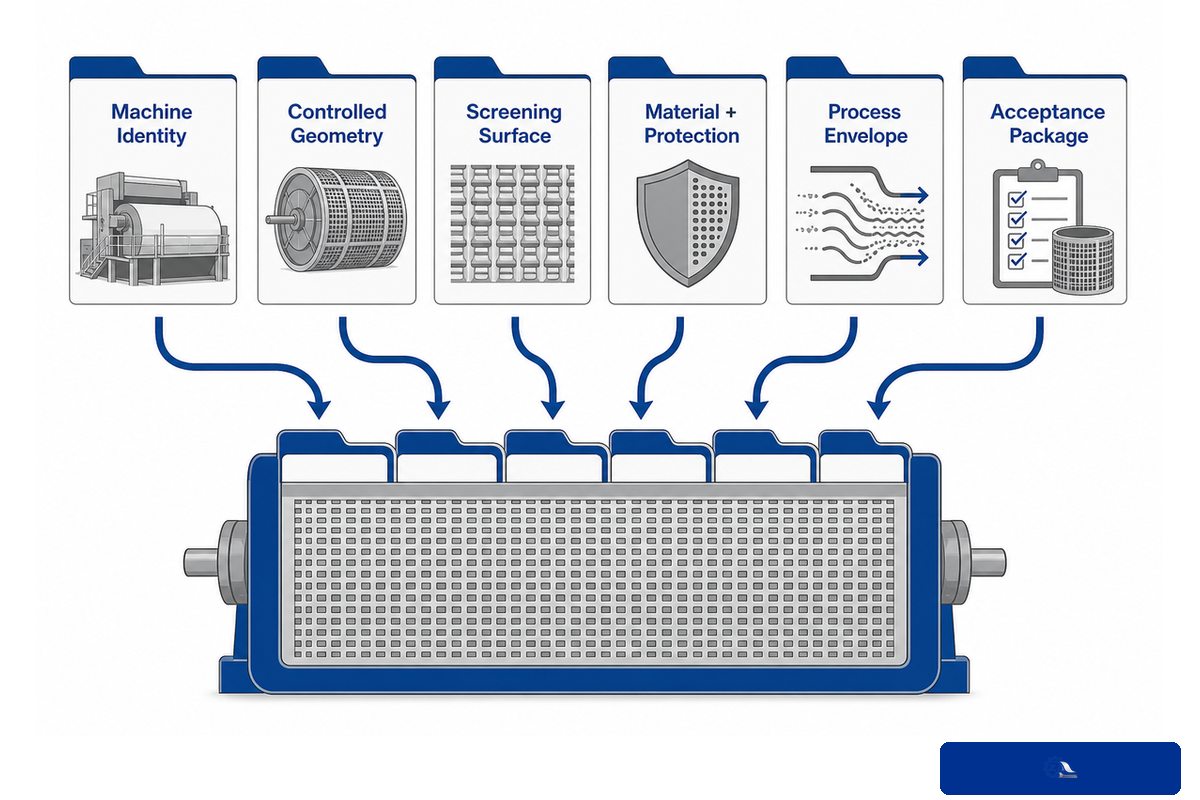
A quote for a reliable basket starts with the installed machine and duty and doesn’t start with an aperture number copied from a previous order. Two baskets described with the same nominal slot may differ in controlled dimensions and profile, working surface, open area, material, hardening, welds, mounting details, and evidence of inspection.
| RFQ block | Information to supply | Confirmation to request |
|---|---|---|
| Machine identity | Manufacturer, model, serial or tag, duty and installation position | Applicable drawing and revision |
| Controlled geometry | Overall dimensions, flanges, mounting, sealing faces and tolerances | Dimensioned approval drawing |
| Screening surface | Hole or slot, nominal aperture, profile, working side and open-area basis | Measurement method and inspection record |
| Material and protection | Base alloy, surface treatment or hardening, furnish chemistry and wear evidence | Material certificate and treatment scope |
| Process envelope | Feed consistency, flow, temperature, pressure basis, reject basis and furnish | Declared design assumptions and exclusions |
| Acceptance package | Required inspection, runout, balance, weld, packing and traceability documents | Document list tied to the order |
Photos of the removed basket and rotor may be helpful, but include a scale and identify orientation. Record the old part’s wear, distortion and plugging rather than treating its current dimensions as the original design. Where a replacement changes profile or material, determine the supplier’s stated basis and describe how the mill will evaluate it.
Zejiang Paper Machinery offers mill and spare-parts support for pulp and paper equipment. Its refiner plates and screen baskets page provides commercial hand-offs for compatibility and controlled drawings for a project-specific quote. Confirm any quoted basket against the installed machine’s flow path and mounting details before ordering.
A Practical Decision Framework
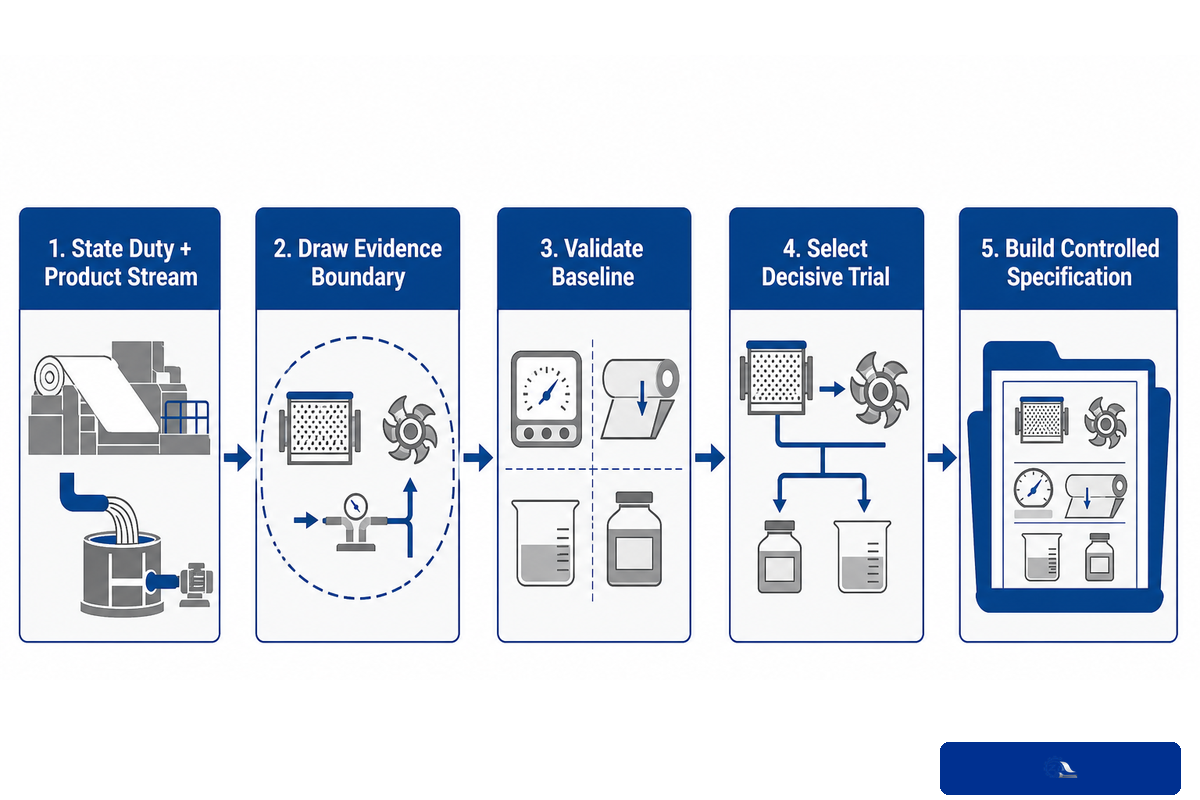
Prior to changing a setting, replacing a basket or considering suppliers, make the following five decisions:
- State the duty and the targeted product stream.
- Draw a line around the evidence.
- Validate the baseline.
- Select the minimum decisive trial.
- Translate the result into a controlled specification. Bind process evidence to drawings, dimensions, materials, inspection and acceptance documents.
This order prevents a component discussion from outrunning the process evidence. It also makes supplier comparison clearer: the quotation can be checked against the same duty, geometry and acceptance package instead of a loose equipment description.
Prepare a Screen-Basket Evidence Package
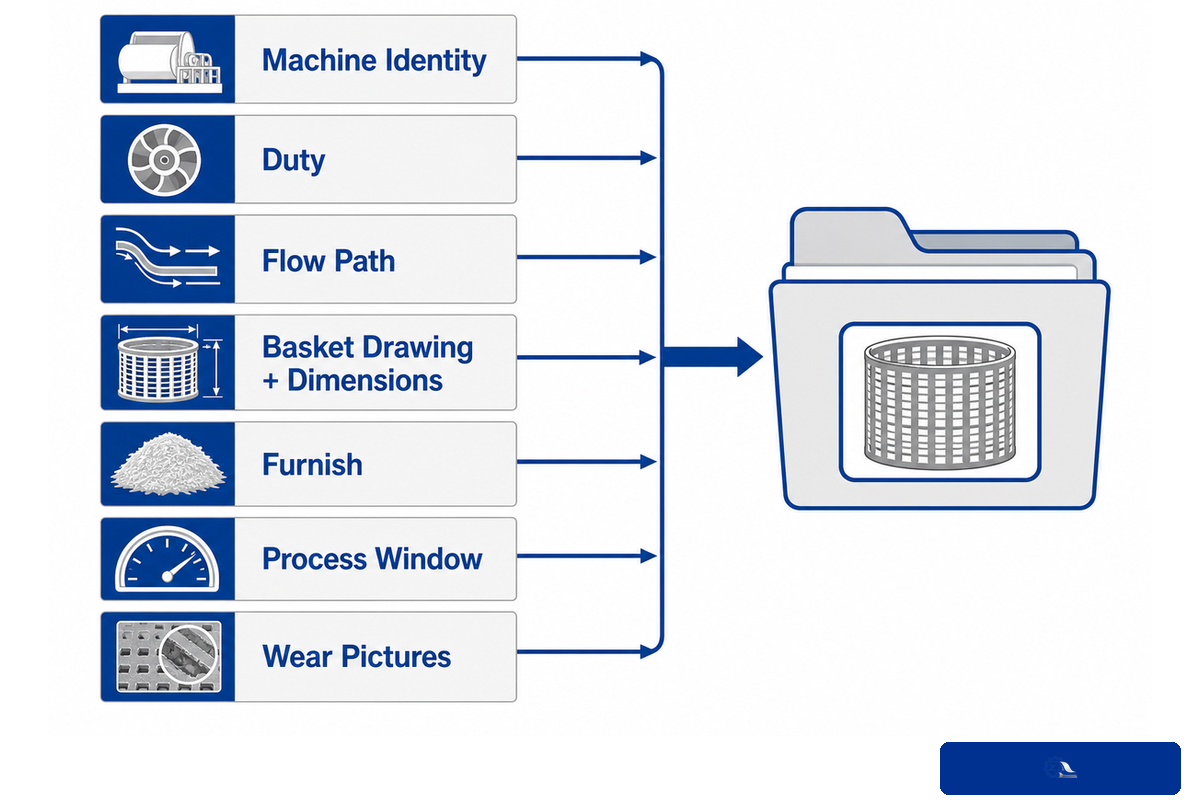
Provide machine identity, duty, flow path, basket drawing/dimensions, furnish, process window and wear pictures. The technical team can review the evidence needed for compatibility and a controlled quotation.
Pressure Screening FAQ
What is pressure screening in papermaking?
Pressure screening in papermaking is the separation of suspended pulp through a perforated or slotted basket inside a pressurized housing. Rotor action manages the aperture surface. The target separation is dependent upon the feed properties, flow conditions, aperture geometry and the target duty.
Is the accept stream always the good product?
No. Accept and reject name flow paths. In cleaning duties, accept is often the desired stream; in fractionation duties, the retained stream may contain the target fiber fraction. Specify the product before calculating performance; the outlet label alone does not establish product value or screening efficiency.
Does lower differential pressure mean better screening?
Not by itself. Differential pressure is dependent on tap locations, sign, flow, consistency, condition of the basket and control action. A lower pressure may indicate less resistance, lower throughput, added dilution, measurement error or other factors. Interpret in conjunction with flow, consistency, reject basis and quality.
Can inflow and outflow screens be compared by design name?
The name identifies a general flow configuration, not a performance ranking. Comparable evidence requires the same duty, furnish, aperture basis, geometry, rotor condition and operating boundary, plus matched sampling locations, time windows, quality methods and decision endpoints for both streams.
What information is essential when ordering a replacement basket?
Give the screen manufacturer and model, duty, installed flow path, controlled dimensions, mounting and sealing details, aperture and profile, material, furnish, process envelope, rotor relationship, wear evidence and requisite inspection documents. Mark every photographed orientation and identify which measurements came from an approved drawing versus a worn part. Have the supplier return a dimensioned approval drawing, declared material, aperture-inspection method and a document list prior to manufacturing.
References & Sources
- University of British Columbia, Mechanical Pulping: Screening
- The Canadian Journal of Chemical Engineering, Critical review of chemical-pulp screening technology
- BioResources, Characterizing the pressure-screen operational window
- Cellulose, Pressure-screen fractionation study
- University of Oulu repository, Pressure-screen sampling and analysis research
- Western Michigan University, Pressure-screen mass-balance research
- Voith, Screening and fractionation application overview
- Valmet, Screen-cylinder troubleshooting guide