Get in touch with Zejiang Paper Machinery Company


Updated November 2026
A pulp mill is an industrial plant that separates wood, or another fiber source, into cellulose fibers, then ships those fibers as dried bales or sends them to a paper machine on the same site. On a kraft line, about half of the wood dissolves during the cook.
That dissolved half fuels the plant. Kraft mills burn it to make steam and power and recover cooking chemicals at about 97% efficiency. The equipment behind that loop helps explain the price: Suzano put about US$3.1 billion into the plant at its 2.55 million tonne Brazilian mill, before forestry and logistics.
Key points
- Bleached kraft returns 43 to 48% of the dry wood as pulp; stone groundwood returns 94 to 96%, with much weaker fibers.
- One mill can work out to roughly $1,216 or $1,686 per annual tonne, depending on whether forestry and logistics are included.
- A small project can skip the digester: it can repulp recovered paper or bought bales.
What Is a Pulp Mill?
A pulp mill is the first factory in the papermaking chain. It processes pulpwood, sawmill chips, or other fiber and separates the fibers, usually by dissolving the lignin that binds them, leaving wood pulp for paper products, paperboard, and tissue. Many mills sell that output to other factories, and the industry calls it market pulp.
Pulp production also runs on recovered wastepaper and, less often, on linters, rags and straw. Metsä Fibre makes softwood pulp from pine and spruce and hardwood pulp from birch, and UPM adds eucalyptus. UPM describes the hardwood and softwood processes as nearly identical; softwood simply holds less hemicellulose.
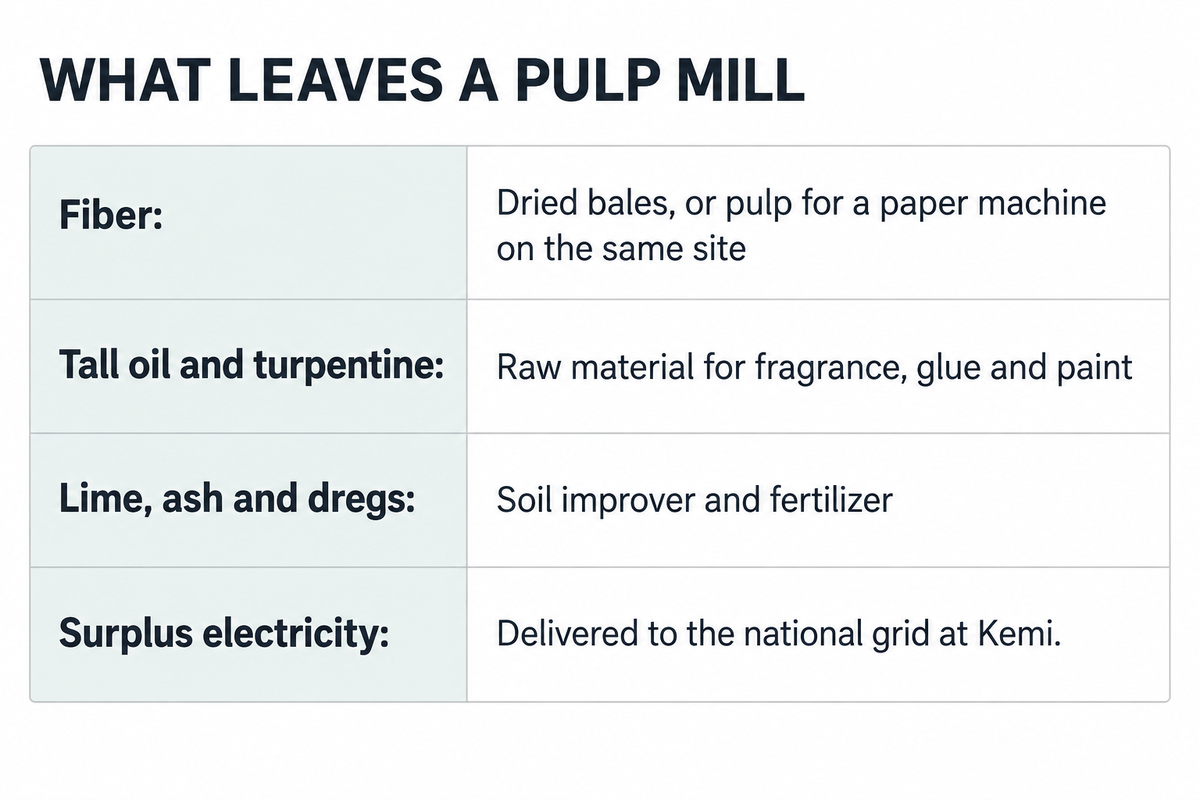
But the plant has more to sell than fiber. Metsä’s tall oil and turpentine become raw material for fragrance, glue and paint; lime, ash and dregs go out as soil improver and fertilizer; and the Kemi mill delivers surplus electricity to the national grid.
What Is Wood Pulp?
Wood pulp is a mass of separated wood fibers, mostly cellulose, used as the raw material for paper and board. Chemical pulp has long, strong, stable fibers because the lignin is dissolved away. Mechanical pulp keeps the lignin and gives short, weak fibers with high opacity and good print quality.
Lignin is the natural binder in wood. Pulp that keeps its lignin yellows with light, heat and age, so groundwood is used to make newsprint rather than long-life paper. Highly purified dissolving pulp goes into rayon, cellulose film, specialty papers and other materials derived from wood, and fluff pulp from Domtar’s Ashdown mill is used in consumer products such as baby diapers and absorbent hygiene products.
Pulp Mill vs Paper Mill: What Is the Difference?
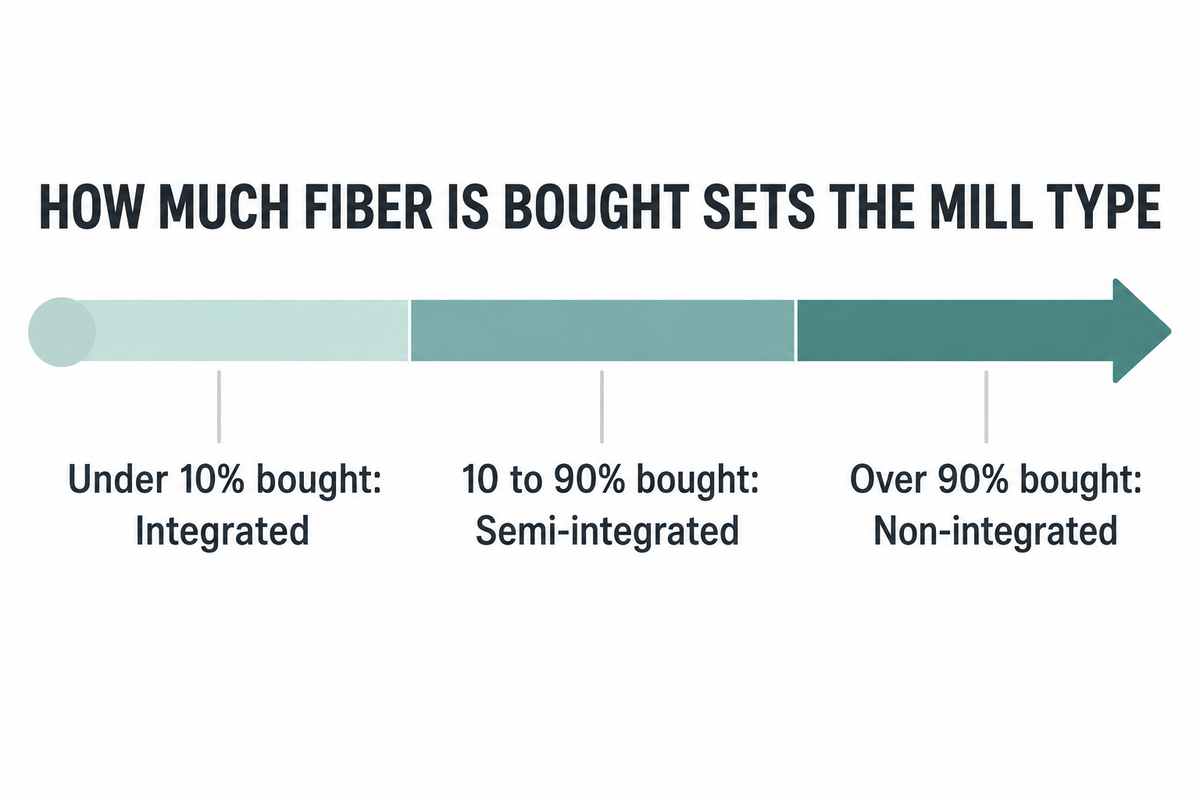
A pulp mill produces fiber and a paper mill transforms fiber into a sheet; an integrated mill combines both on one site. Fastmarkets draws the line by purchased fiber: under 10% bought is integrated, 10 to 90% is semi-integrated, and over 90% bought as market pulp is non-integrated.
| Mill type | Fiber bought as market pulp | Cooking and recovery on site | What leaves the gate |
|---|---|---|---|
| Stand-alone pulp mill | Not applicable: buys wood | Yes on a kraft line | Market pulp in bales |
| Integrated mill | Under 10% | Yes | Paper or board |
| Semi-integrated mill | 10 to 90% | Partial pulp line | Paper or board |
| Non-integrated paper mill | Over 90% | No | Paper or board |
| Recycled fiber mill | Uses recovered paper; not classed as integrated | No digester | Paper, board or tissue |
This decides the budget before anything else. Under Fastmarkets’ classification, a mill is integrated only when it buys under 10% of its fiber as market pulp. A non-integrated plant can make paper from bought bales with no digester, no recovery boiler and no lime kiln, while a stand-alone kraft mill needs all three. Pollution follows the same split: FAO’s guide on the pulp and paper industry puts 70% of the pollution in a combined mill on the pulp side and 30% on the paper side.
Paperboard plants, or board mills, make heavier grades from pulp, and some paper mills convert their sheet into boxes or bags on site. Many paper mills also buy market pulp, so a site called a paper mill may hold no pulp line at all. The recycled fiber row is where a project can skip the digester and buy stock preparation equipment that turns recovered paper or bales into furnish.
How Does a Pulp Mill Work? From Logs to Baled Pulp
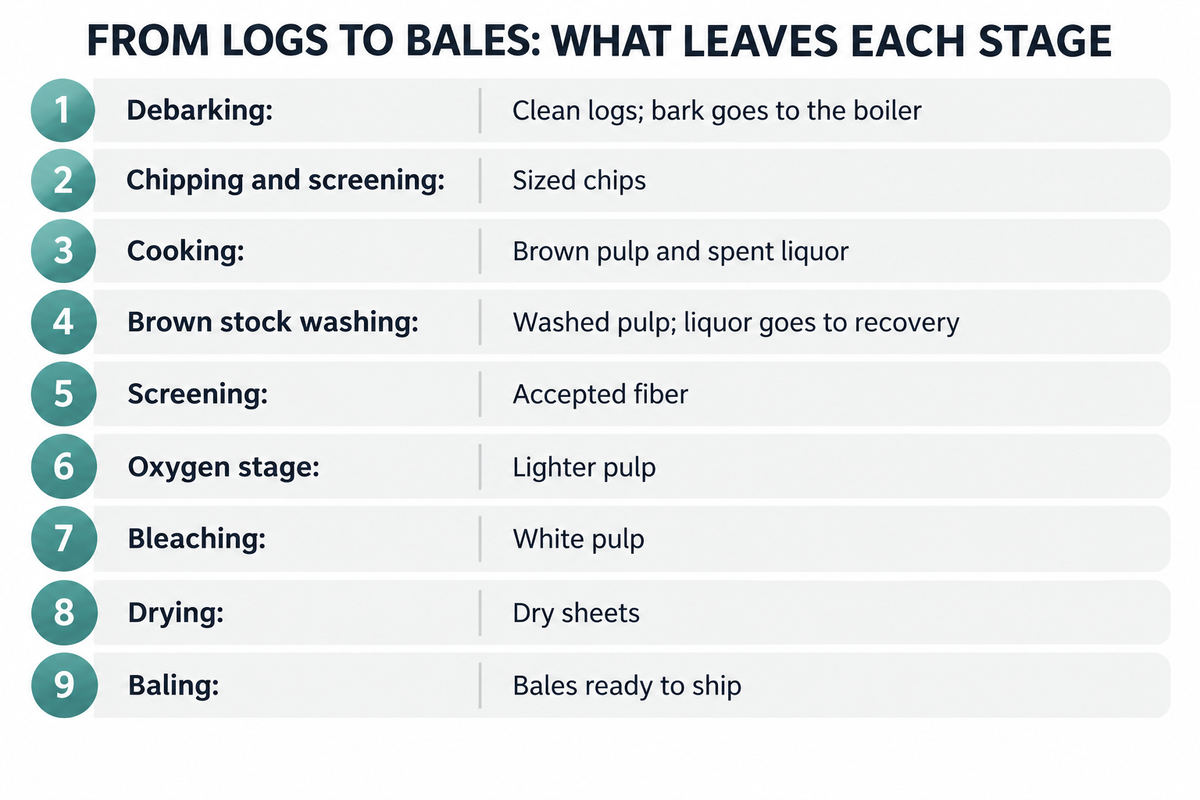
A pulp mill works by debarking and chipping logs, cooking the chips at 160 to 170 °C in a pressurized digester, washing out the spent liquor, screening and often bleaching the fibers, then drying and baling them. The table follows the manufacture of pulp on a bleached kraft line, the leading route for virgin pulp.
| Stage | What happens | Number to know | What leaves |
|---|---|---|---|
| 1. Debarking | Logs tumble in a drum and lose their bark | Effluent 3 to 20 m³/t on a wet drum, 0 to 5 m³/t on a dry drum | Clean logs; bark goes to the boiler |
| 2. Chipping and screening | Logs become chips; some mills add sawmill chips and sawdust | Not applicable | Sized chips |
| 3. Cooking | White liquor dissolves lignin in the digester | 160 to 170 °C over several hours; about half the wood dissolves | Brown pulp and spent liquor |
| 4. Brown stock washing | Washers separate pulp from spent liquor | About 10 t of weak black liquor per ton of pulp | Washed pulp; liquor goes to recovery |
| 5. Screening | Screens remove knots, uncooked chips and dirt | 1 to 6% of the charge on a sulfite cook | Accepted fiber |
| 6. Oxygen stage | Oxygen removes more lignin before chemical bleaching | Normally the first bleaching stage in modern mills | Lighter pulp |
| 7. Bleaching | Towers alternate chemical treatment and washing | Over 95% of US bleached chemical pulp used elemental chlorine-free processes (2005 figure) | White pulp |
| 8. Drying | A dryer removes water and a cutter makes sheets | Air-dry pulp means 90% fiber and 10% water | Dry sheets |
| 9. Baling | Sheets are baled and stacked into units | 250 kg bale; 2,000 kg export unit | Bales ready to ship |
The numbers come from FAO, a Kraft Recovery Short Course paper, ScienceDirect’s pulp manufacture entry, Britannica, the World Bank Group guideline on pulp and paper mills and Metsä Fibre. Not every mill runs all nine stages. Metsä’s Kemi mill produces 180,000 tonnes of unbleached pulp that skips the bleach plant, and an integrated mill can pump pulp to its paper machine and skip the dryer. The paper manufacturing process starts after stage 9, or after stage 7 on an integrated site.
Mills track the lignin left in the pulp as a kappa number. Under EPA’s incentive-based Tier I option, only pulp of kappa 20 or less goes to the bleach plant, and first-stage bleaching chemical use rises in direct proportion to the incoming kappa number.
What Is a Digester in Wood Pulping?
A digester is the pressure vessel in which the wood chips are cooked in white liquor until the lignin is dissolved. There are two types, according to EPA AP-42: a batch digester fills, cooks, and discharges in cycles, while a continuous digester takes chips in and sends cooked pulp to the washers without stopping.
Batch units offer lower capital cost and more product flexibility. Continuous units use less space and energy and need less labor. The choice shows up in new projects: Green Bay Packaging specified a new continuous digester and chip mill for its $1 billion Arkansas expansion.
The Chemical Recovery Loop: White, Black and Green Liquor
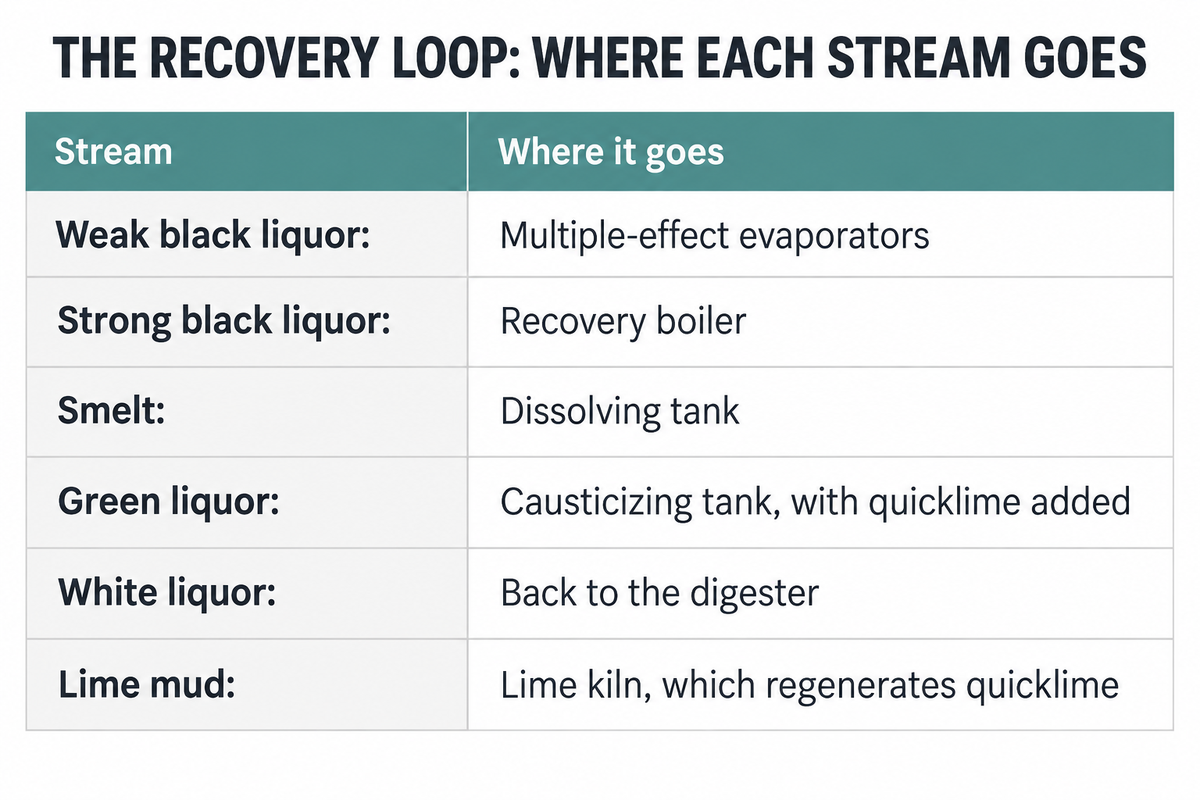
The recovery loop turns spent cooking liquor back into fresh chemicals while burning the dissolved wood for steam and power. Tran and Vakkilainen put recovery efficiency at about 97%, and each ton of kraft pulp sends about 10 tons of weak black liquor through the system.
| Stream | What it is | Where it goes |
|---|---|---|
| Weak black liquor | Spent chemicals and dissolved wood, washed from the pulp | Multiple-effect evaporators |
| Strong black liquor | Evaporated to about 55 to 65% solids in older designs, above 75% in modern ones | Recovery boiler |
| Smelt | Molten chemicals at the bottom of the furnace | Dissolving tank |
| Green liquor | Smelt dissolved in water | Causticizing tank, with quicklime added |
| White liquor | Sodium hydroxide and sodium sulfide in water | Back to the digester |
| Lime mud | Precipitate from causticizing | Lime kiln, which regenerates quicklime |
In their TAPPI paper, Tran and Vakkilainen called black liquor the fifth most important fuel in the world. However, the boiler alone may not sustain the plant. AP-42 reports that many mills require more steam than the recovery furnace can generate, so they add boilers burning bark, wood, gas, oil or coal.
Well-matched mills go the other way and export power. Metsä reports 2.0 TWh of electricity a year and 250% self-sufficiency at Kemi, and UPM calls its mills net suppliers of energy. A small kraft project can’t simply leave this section out: without recovery it would have to buy its cooking chemicals and treat the liquor as waste, so very small plants have reason to choose another route.
What Is White Liquor in a Paper Mill?
White liquor, the cooking medium in a kraft mill, is a water solution of sodium sulfide and sodium hydroxide that breaks down the lignin binding wood fibers together. After the cook it leaves as black liquor, which passes through the recovery loop and is rebuilt into white liquor through green liquor and causticizing before going back to the digester.
Plants with a kraft pulp line are the only ones that use it. A paper mill that purchases its pulp never handles white liquor.
Kraft, Mechanical, Sulfite or Recycled: Which Pulping Route Fits?
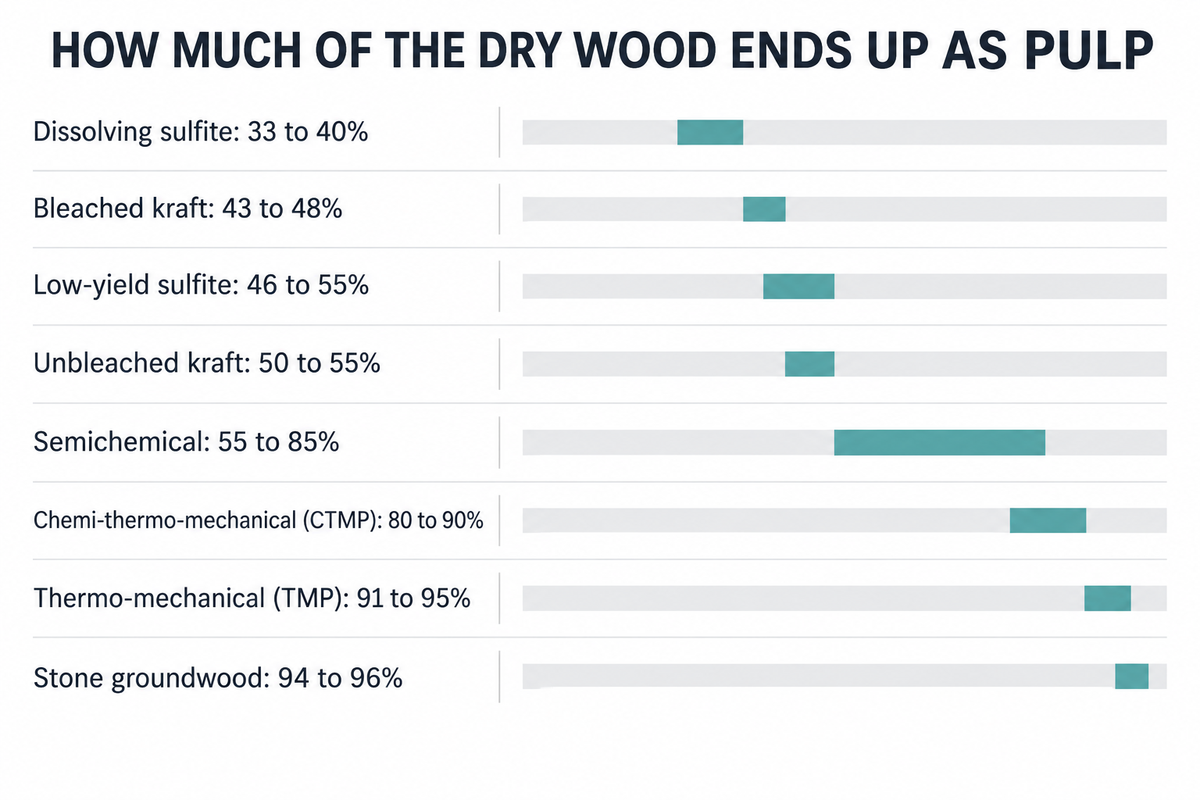
Kraft fits strong packaging and most market pulp, mechanical fits high-opacity printing grades, and recycled fits sites with a steady supply of recovered paper. Yield alone misleads: bleached kraft returns 43 to 48% of the dry wood, while stone groundwood returns 94 to 96% with much weaker fibers.
| Route | Yield | Fiber | Typical products |
|---|---|---|---|
| Dissolving sulfite | 33 to 40% | Highly purified | Rayon, cellulose film |
| Bleached kraft | 43 to 48% | Long, strong, stable | Paperboard, tissue, printing papers, specialty papers |
| Low-yield sulfite | 46 to 55% | Long, stable | Fine paper, tissue, glassine |
| Unbleached kraft | 50 to 55% | Long, strong, brown | Bags, wrapping, linerboard |
| Semichemical | 55 to 85% | Intermediate | Corrugated board, food packaging |
| Recycled | 60% on waste hygienic papers, up to 95% on waste packaging | Mixed; follows the source | Newsprint, writing paper, tissue, packaging |
| Chemi-thermo-mechanical (CTMP) | 80 to 90% | Better quality than plain mechanical; heavier effluent | Newsprint, magazines, books |
| Thermo-mechanical (TMP) | 91 to 95% | Short, weak, high opacity | Newsprint, magazines, books |
| Stone groundwood | 94 to 96% | Short, fragmented, yellows | Newsprint, magazines, books |
Wood yields come from a 1990s FAO table citing Environment Canada on an oven-dry basis; the semichemical and recycled rows and most fiber notes come from ScienceDirect Table 3.2. Recycled yield is measured on waste paper, not on wood, so that row doesn’t compare directly with the others.
A 2008 TAPPI paper put kraft at two-thirds of world virgin pulp and over 90% of chemical pulp, but it isn’t the answer for every project. Use the target grade and the fiber supply to choose.
| If you make | And you have | Choose | Watch for |
|---|---|---|---|
| Containerboard, sacks, wrapping | A secure wood basket and budget for a recovery island | Unbleached kraft | Recovery share of capital, covered below |
| Newsprint, magazine grades | Cheap electricity | TMP or CTMP | TMP needs 30 to 50% more energy than stone groundwood; one 1996 estimate puts its electricity use at about 2,041 kWh per tonne |
| Corrugated medium | A nearby hardwood supply | Semichemical | Spent liquor needs treatment |
| Containerboard and other packaging materials | A city nearby that discards corrugated boxes | Recycled | Yield and strength follow the waste paper |
| Rayon or cellulose film | A dissolving-grade market | Buy dissolving pulp; don’t build sulfite | Not a new-build route: sulfite mills are no longer being constructed, so buy dissolving pulp unless a specialist has costed the project |
Sulfite held around 2% of US chemical pulping capacity in 2002, so it is a weak starting point for a new paper project. Our TMP refiner guide covers the mechanical route, and refining then sets strength on any of them; see types of pulp refiners.
Non-wood fibers such as bagasse and straw add one step before pulping. FAO notes that seeds, leaves and dirt can reach 3% of the incoming material, so screening comes first, and wet cleaning leaves harder wastewater than wood preparation does.
How Much Does It Cost to Build a Pulp Mill?
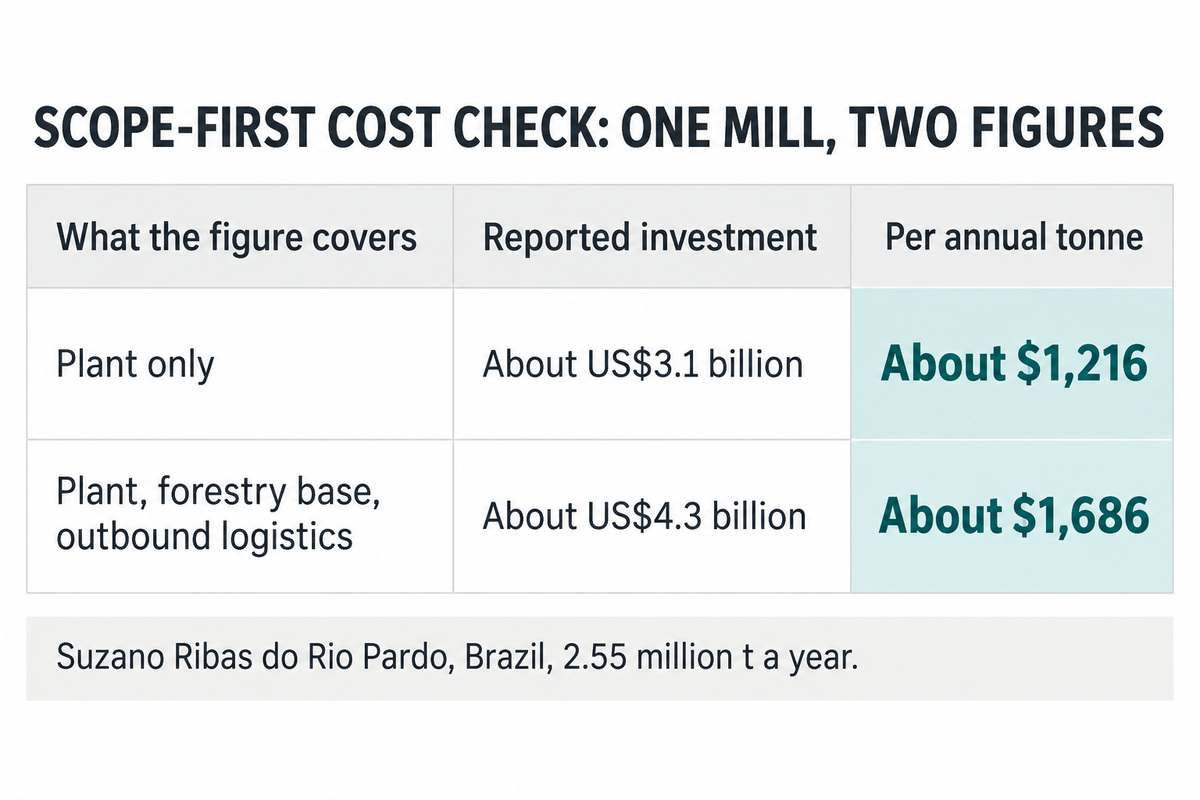
A large greenfield kraft mill works out to roughly $1,200 to $1,830 per annual tonne on owner-reported figures. These mills all run at well over a million tonnes a year, so the range does not scale straight down to a smaller plant. The per-tonne range is our division of reported investment by production capacity, and the result moves by almost 40% on a single mill, from US$3.1 billion to US$4.3 billion at Suzano, depending on what the owner counts.
Before you divide any headline investment by capacity, run a Scope-First Cost Check: note whether the figure covers forestry, a port or roads, and then compare only like with like. The table shows why.
| Project | What the figure covers | Reported investment | Capacity a year | Per annual tonne (our working) |
|---|---|---|---|---|
| APP OKI, Indonesia | Total project, per BankTrack; 2.45 million t also cited | US$2.6 billion | 2.8 million t | About $929 |
| Suzano Ribas do Rio Pardo, Brazil | Plant only | About US$3.1 billion | 2.55 million t | About $1,216 |
| UPM Paso de los Toros, Uruguay | Mill, port terminal, local infrastructure | US$3.47 billion | 2.1 million t | About $1,652 |
| Suzano Ribas do Rio Pardo, Brazil | Plant, forestry base, outbound logistics | About US$4.3 billion | 2.55 million t | About $1,686 |
| CMPC Natureza, Brazil (proposed) | Mill, forestry, road, port | About US$4.57 billion | Up to 2.5 million t | About $1,828 |
| Metsä Kemi, Finland | Kemi bioproduct mill | About EUR 2 billion | About 1.5 million t | About EUR 1,333 |
Sources: BankTrack, Suzano, UPM, Metissue on the CMPC estimate and Metsä Group. These are reported figures from different years and countries, not bids, and none is adjusted for inflation. OKI’s lower figure is left out of the opening range, which uses owner-reported figures, because it comes from an NGO profile that is no longer maintained. Smaller plants don’t scale down in a straight line: on the much smaller paper lines we quote, doubling daily output rarely doubles cost.
Recovery claims the biggest share. In a TAPPI paper, Jim Brewster of Irving Pulp and Paper gave two figures: the boiler by itself at around 20% of a new mill, and the wider recovery and utilities set at nearly half.
“In this extremely capital intensive business, the recovery boiler is the single most expensive component, accounting for approximately 20% of the total installed cost of a new mill.”
Jim Brewster, Irving Pulp and Paper, Recovery and Utilities Management, TAPPI Kraft Recovery Short Course, 2008
Example: on Suzano’s plant-only figure of about US$3.1 billion, 20% is about $620 million. Add the power boiler, turbine generator, recausticizing plant and evaporators, and the same paper’s nearly 50% points to about $1.55 billion. The share is from 2008 and the mill is from 2024, so treat this as a check on proportion only.
Expansions cost less in total than greenfield mills but can still run to hundreds of millions of dollars, and much of that money modernizes existing equipment. Georgia-Pacific budgeted $800 million at Alabama River Cellulose for a new digester, a new pulp dryer, a power boiler and upgrades to washing, recausticizing and recovery, adding about 300 tons per day. Brewster put total capital for a new greenfield mill at about four times its annual sales, and that’s why capacity utilization decides whether a plant is profitable.
How Much Does a Paper Mill Cost?
A paper mill that buys pulp or runs on recovered paper skips the digester and the recovery island, so the kraft figures above do not price it. The $800 million and $1 billion US projects in this guide center on pulp-side equipment; a small recycled line is quoted by capacity, with paper mill capacity calculations as the starting point.
In our turnkey paper mill project quotes, cost drivers are, from high to low: capacity in tons per day (TPD), paper grade, new or refurbished machinery, followed by civil works and site utilities. A 20 TPD kraft paper line and a 150 TPD line occupy different tiers of equipment, and first-time builders most often underestimate foundations, steam and power tie-ins, water supply, and effluent treatment. We can’t give one honest number without those details, so send the RFQ items below and ask for a budget range.
The Largest Pulp Mills and Who Supplies the Equipment
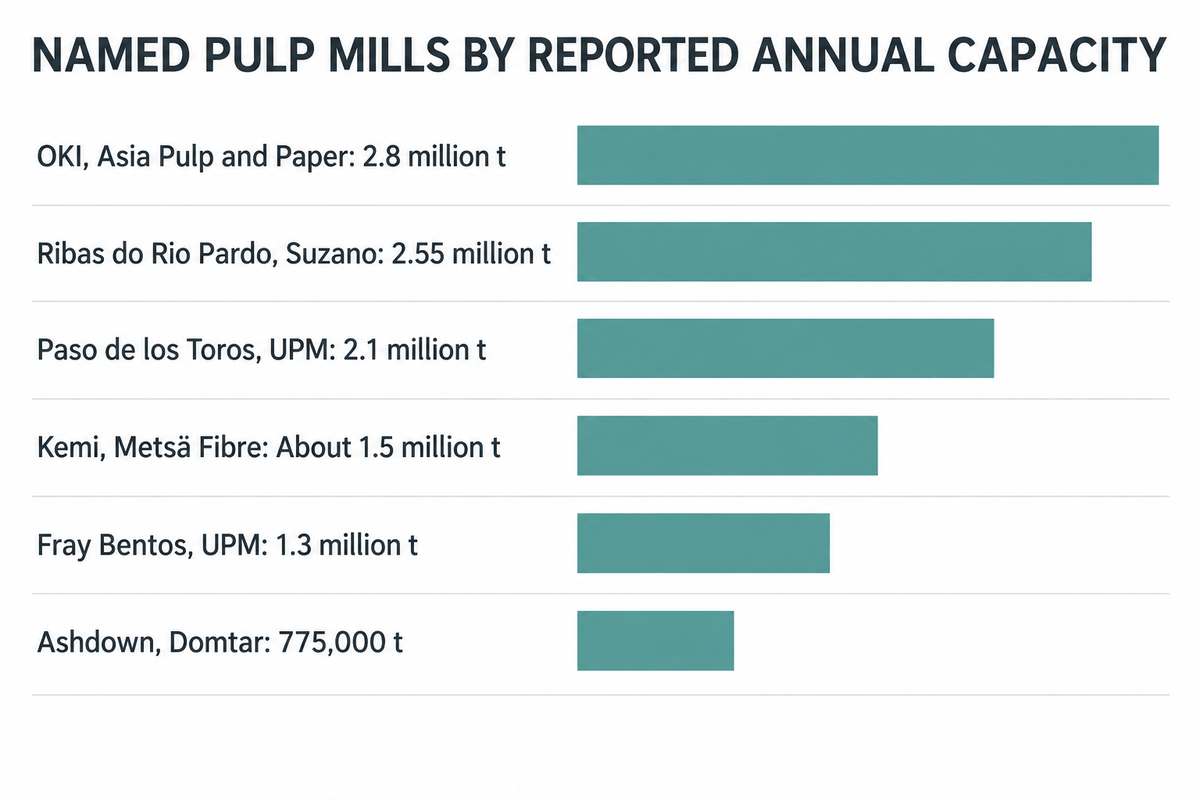
Suzano’s Ribas do Rio Pardo in Brazil is the largest single pulp line by reported capacity at 2.55 million tonnes a year, while BankTrack, in a profile it no longer maintains, gives APP’s OKI mill in Indonesia a 2.8 million tonne design capacity and also cites 2.45 million tons. Domtar’s Ashdown mill in the US is listed at 775,000 air dry metric tonnes.
| Mill | Owner and country | Capacity a year | How the owner or source describes it |
|---|---|---|---|
| OKI | Asia Pulp and Paper, Indonesia | 2.8 million t | Design capacity per APP, via BankTrack; 2.45 million t also cited |
| Ribas do Rio Pardo | Suzano, Brazil | 2.55 million t | World’s largest single line, per Suzano |
| Paso de los Toros | UPM, Uruguay | 2.1 million t | World’s biggest single line, per UPM’s page |
| Kemi | Metsä Fibre, Finland | About 1.5 million t | Softwood, hardwood and unbleached pulp |
| Fray Bentos | UPM, Uruguay | 1.3 million t | Eucalyptus pulp |
| Ashdown | Domtar, United States | 775,000 t | Air dry metric tonnes; fluff and other pulp |
Two owners claim the same title because UPM’s claim predates Suzano’s larger line, and neither claim covers a whole site. UPM still calls Paso de los Toros the biggest single line, though Suzano opened a larger one in 2024. Suzano’s line could reach about 2.7 million tonnes from 2027, according to EUWID, with no added investment. Metissue reports that Arauco’s Sucuriú project in Brazil, designed for up to 3.5 million tonnes a year, is due to start toward the end of 2027, so the title may move again.
Lists of the largest paper manufacturing companies measure something else. Those paper producers run many sites, so a table of the largest pulp and paper firms says little about any one mill. Suzano alone reports capacity for 13.5 million tonnes of pulp across its production facilities, plus 1.5 million tons of paper a year, and our list of the biggest paper companies covers International Paper and the rest by company. AIChE keeps a longer directory of pulp and paper producers, though some of its entries are dated.
Suppliers split into tiers by scope. Global full-line groups such as Valmet and ANDRITZ cover pulp mills and recovery for plants of this size. Regional builders, Zejiang among them, supply paper machines, stock preparation and parts at smaller scale. Our guide to pulp and paper machinery suppliers lists both groups side by side.
What Are the Largest Pulp Mills in the US?
Domtar’s Ashdown mill in Arkansas ranks first among the US pulp mills with a recorded capacity in the Woodcomp directory, at 775,000 air dry metric tonnes annually, the figure Domtar also reports. Georgia-Pacific, also a major maker of building products, will produce close to one million tons of fluff and market pulp a year at its Alabama River Cellulose mill once its project ends in 2027.
Woodcomp lists 32 US mills with a recorded figure, so treat it as a directory and not a census. The whole country produced about 48 million tonnes of wood pulp in 2023, the most of any nation, according to Forisk using FAO data, which means US output comes from many mid-size plants instead of one giant site.
Small Lines Without a Digester: Recovered Paper and Bought Bales
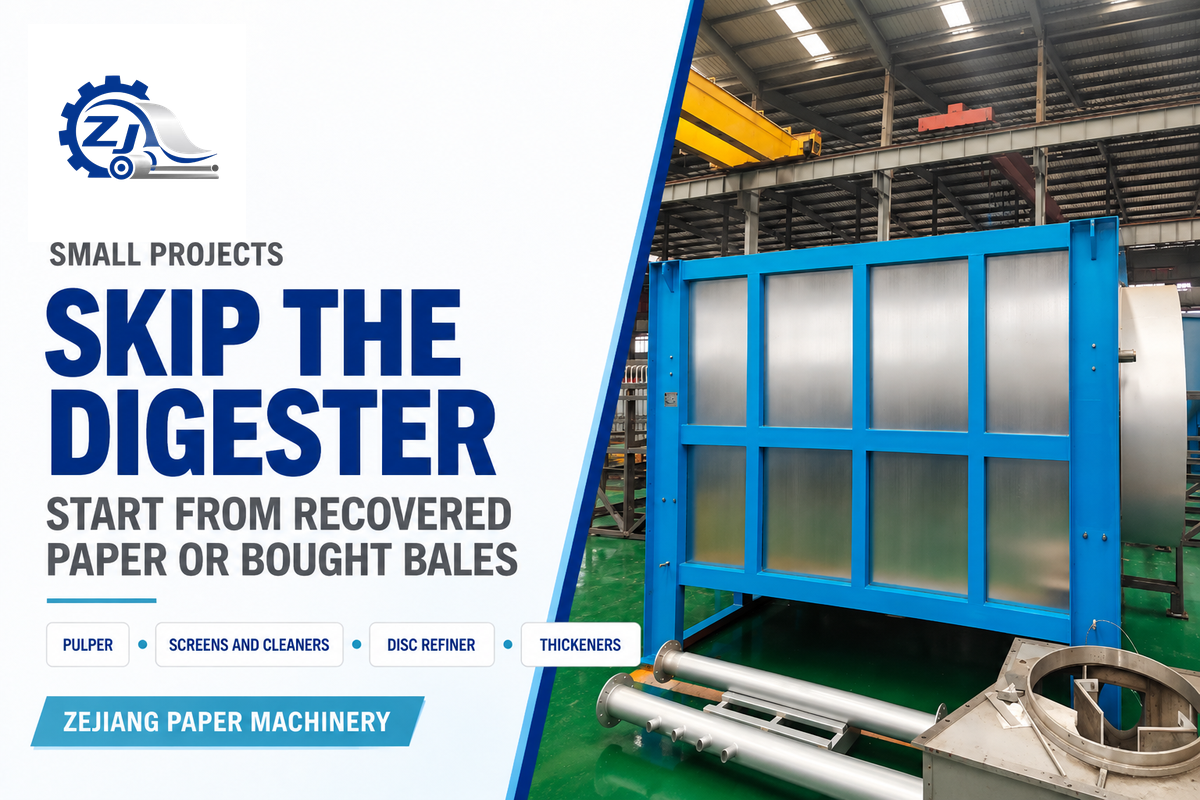
A small project can skip the digester by starting from recovered paper or bought bales: it repulps them, then screens, cleans, refines and thickens the fiber for a paper machine. That’s the stock preparation line we build at Zejiang, and it doesn’t include a digester or chemical pulp cooking.
The line starts at a paper pulper, which breaks down waste paper or virgin pulp bales into a pumpable slurry, the first stage in our stock preparation process guide. Pressure screens and centrifugal cleaners then remove contaminants, a disc refiner sets freeness and bonding, thickeners concentrate the stock, and recycled lines add deinking stages where the grade calls for it. On recycled lines, pulping consistency affects everything downstream, so a high-consistency pulper for deinking changes the rest of the sizing.
Purchase the pulper, screen and cleaner from different suppliers and it’s down to you to get the fit right. Size each stage for the ones on either side of it, because an undersized screen will choke a correctly sized pulper. Mills in our export markets across Asia, the Middle East, Africa and South America tend to run cartons one season, mixed office waste the next, so the brief should state that swing.
Our turnkey scope covers seven paper grades in four phases: engineering, supply, installation and start-up. If a bank needs a Detailed Project Report, common for paper mill projects in India, we supply the technical specifications and cost inputs. New builders can start with planning a paper mill project. A packaging line pairs with the machines in our kraft and corrugated paper machine guide. These are the items a supplier needs before quoting:
RFQ checklist: copy these into your quote request
| Parameter | Recommended | Why it matters | How to verify |
|---|---|---|---|
| Furnish | Percent of cartons, mixed waste and virgin bales, by season; note any agricultural fiber and whether it arrives raw or already pulped | Sets pulper type and screen stages | Sample bales tested for contaminants |
| Capacity | Target in tons per day, with paper grade | Largest single cost driver | Mass balance from the supplier |
| Fiber yield | Plan on 60% to 95% of waste paper, by source | Sizes rejects handling and raw material budget | Yield from a trial on your furnish |
| Consistency | Stated value at each stage | Pump and agitator sizing follow it | Build sheet showing what feeds what |
| Effluent | Discharge limit for your site, such as 40 CFR Part 430 in the US or comparable standards elsewhere | Part of the civil and utility scope first-time builders usually underestimate | Written permit conditions |
| Reference sites | Same grade and capacity, 2 or more years running | Shows the line holds up after start-up | Site visit or contact details |
Why Do Pulp Mills Smell?
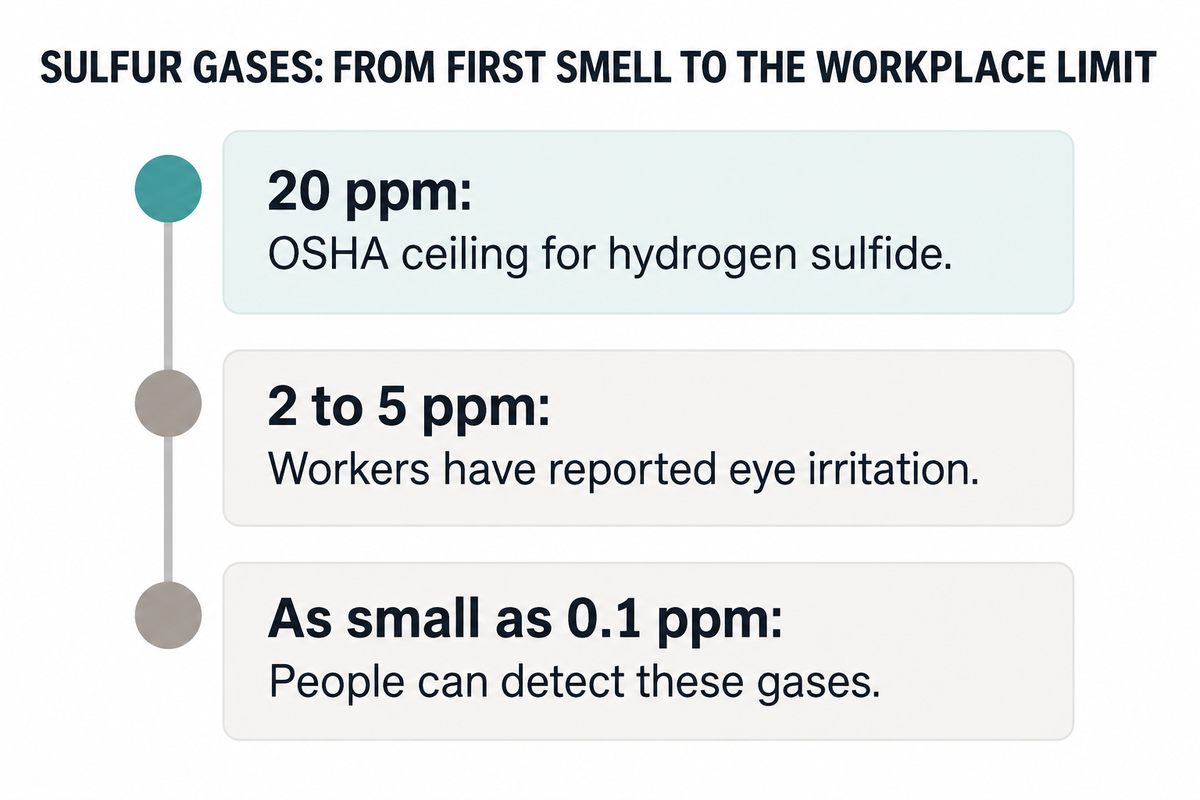
Pulp mills smell because kraft cooking forms reduced sulfur gases, mainly hydrogen sulfide, methyl mercaptan, dimethyl sulfide and dimethyl disulfide. People can detect these gases at concentrations as small as 0.1 parts per million, according to a Pennsylvania environmental document, so a plant can be noticed at very low levels.
The digester, blow tank and direct-contact evaporator are the main sources. AP-42, an older EPA document, said odor control devices as such were not generally found in kraft mills. Mills cut emissions through process changes instead: they oxidize black liquor, burn the noncondensable gases in the lime kiln, and replace direct-contact evaporators, which can reduce sulfur emissions from that section by more than 99 percent.
Wisconsin health officials, citing EPA, treat odor at normal levels as a nuisance, not a health concern, while noting that levels sometimes go above normal. The same Pennsylvania document says workers have reported eye irritation at concentrations as low as 2 to 5 ppm, and OSHA sets a ceiling of 20 ppm for hydrogen sulfide. The World Bank Group guideline gives typical total reduced sulfur of 0.3 to 3 kg per tonne of air-dried pulp, and wastewater of 20 to 250 m³ per tonne.
Permits raise these points alongside capacity. US EPA effluent guidelines under 40 CFR Part 430 date from 1974 and 1977, with a major toxics amendment of 1998, and MACT II covers chemical recovery combustion sources. A paper mill that buys its pulp escapes the majority of the odor, given that the sulfur chemistry happens at the pulp mill.
Why Paper Mills Are Shutting Down and Where New Pulp Capacity Is Going
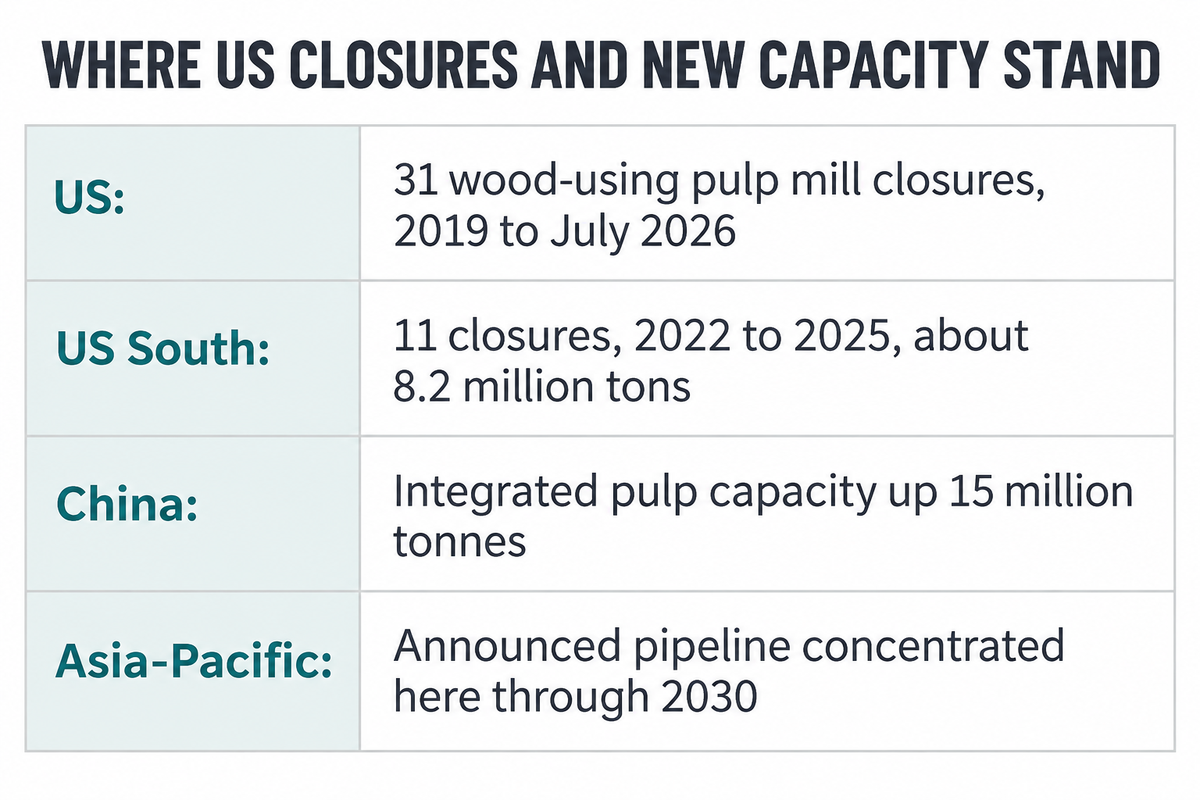
Trade sources link recent US paper and pulp mill closures to weak end markets, high costs and aging assets, while new pulp capacity is going to Asia and South America. Sustainable Paper & Pulp reports a Forisk white paper counting 31 wood-using US pulp mill closures between 2019 and July 2026.
Pulp and paper is a capital-heavy industry sector, and an earlier Forisk analysis of 29 closed mills named four factors: weak end markets, lack of investment in pulping, the age of the recovery boiler, and hard procurement logistics. Of 11 closed mills that had received capital, only three spent it on pulping components. In the US South, 11 pulp mills had closed between 2022 and 2025, removing about 8.2 million tons of capacity, or 16% of the region’s total. The damage spreads past the gate: Forisk describes pulp mills as large consumers of low-value fiber, so each closure in the forest products industry also hits the local wood basket.
Closures hit the paper market unevenly by grade and mill type. Recycling Product News found closures most evident at standalone mills with no integrated pulp or downstream packaging, the position a small buy-in line starts from, and International Paper‘s closures and layoffs have touched more than 5,800 employees company-wide since October 2024. Smurfit Westrock also shut a California plant. Meanwhile AF&PA’s capacity survey, as quoted in a timber association newsletter, shows the US still adding recycled capacity: four machines totaling 2.1 million tons of containerboard and packaging paper started in 2023, all on 100 percent recycled fiber, while more than 1.7 million tons, mostly wood-based, came out.
New capacity is elsewhere. Fastmarkets reports that China’s integrated pulp capacity doubled in four years, up 15 million tonnes to over 32 million tonnes. ResourceWise sees the announced pipeline concentrated in Asia-Pacific through 2030, Brazil has CMPC weighing a further project that still awaits a final decision, and Recycling Product News lists fluff pulp and tissue projects from Stora Enso and Suzano.
For a 2027 or later project, test the two Forisk factors that carry to a new site, the end market for the grade and procurement logistics, before you price equipment; recovery boiler age matters only if you are buying or restarting an existing kraft mill. New technology won’t change this soon: Georgia Tech researchers set out to test whether membranes could cut black liquor evaporation energy in half, and the team is now preparing a mill field trial.
Pulp Mill FAQ
Q: How many pulp and paper mills are there in the US?
NCASI counts more than 450 pulp and paper mills across all of North America, and we found no current official US-only count. Sustainable Paper & Pulp reports a Forisk white paper counting 31 wood-using US pulp mills closed between 2019 and July 2026. Woodcomp’s directory records capacity for 32 US pulp mills, but that list is partial and leaves out paper-only plants.
Q: What chemicals are used in wood pulping?
Kraft pulping uses sodium hydroxide and sodium sulfide, which together form white liquor. Sulfite pulping uses sulfite salts with an excess of sulfur dioxide. Bleach plants then add oxygen, chlorine dioxide, hydrogen peroxide or ozone, and an alkali such as sodium hydroxide extracts the lignin that those chemicals loosen.
Q: How is wood pulp bleached?
Pulp passes through several stages that alternate chemical treatment and washing in bleaching towers. Modern mills normally start with oxygen, then move to chlorine dioxide or peroxide. Over 95% of US bleached chemical pulp production used elemental chlorine-free processes in 2005, and totally chlorine-free processes were roughly 1% in 2001.
Q: What wood species are best for pulping?
There is no single best species: kraft handles almost all softwoods and hardwoods, so the choice follows local supply, with pine and spruce at UPM and Metsä Fibre and birch or eucalyptus as the hardwoods. The process is almost identical for both. Plantation eucalyptus feeds the newest large lines in Brazil and Uruguay.
Q: Are pulp mills toxic?
Normal odor levels are considered a nuisance rather than a health concern, but Wisconsin health officials say odors concentrated by weather can cause eye and breathing irritation, nausea and headaches in some people, and asthma attacks in people with that condition.
OSHA has a ceiling of 20 ppm of hydrogen sulfide for workers, who have reported eye irritation at concentrations as low as 2 to 5 ppm. A Pennsylvania environmental document links similar levels to throat irritation, fatigue, nausea, insomnia and headache. Bleach plant effluents may include chlorinated organic compounds (zero to 4 kg/tonne of air-dried pulp in the World Bank Group guideline). Residents near a mill can raise odor concerns with the mill and the state agency; Wisconsin’s health department says the state DNR uses information about past problems when evaluating air permit renewals.
Q: How much wood does it take to make a ton of pulp?
About 2.1 to 2.3 tonnes of oven-dry wood make one oven-dry tonne of bleached kraft pulp, from FAO’s 43 to 48% yield. Unbleached kraft needs about 1.8 to 2.0 tonnes. Mechanical pulp needs just over one tonne.
Q: Is wood pulping environmentally sustainable?
Contemporary kraft mills run much cleaner than older ones, but wood supply and effluent still determine the answer.
FAO put a 1990-design bleached kraft mill’s wastewater about 85% below the level of an older 1964 mill. Metsä reports that Kemi operates without fossil fuels and is authorized to use FSC or PEFC chain-of-custody labels; its wastewater undergoes biological treatment before discharge. But odor, effluent and wood supply are still site concerns, so permits and chain-of-custody documentation still matter.
About This Guide
Zejiang Paper Machinery builds paper machines and stock preparation equipment at its manufacturing facilities in Henan, China. We don’t build digesters; the kraft figures here come from the third-party sources linked in the text and listed below. More of our pulp and paper guides cover refiners, pulpers and paper machine sections. The figures in this guide were cross-checked against the sources linked in the text.
References & Sources
- AP-42 Section 10.2: Chemical Wood Pulping, US Environmental Protection Agency
- Pulp, Paper and Paperboard Effluent Guidelines, US Environmental Protection Agency
- Environmental impact assessment and environmental auditing in the pulp and paper industry, Chapter 3, Food and Agriculture Organization of the United Nations
- The Kraft Chemical Recovery Process, Honghi Tran and Esa Vakkilainen, TAPPI Kraft Recovery Short Course, 2008
- Recovery and Utilities Management, Jim Brewster, TAPPI Kraft Recovery Short Course, 2008
- Pulp Manufacture, ScienceDirect Topics
- Pulp and Paper Mill Odors, Wisconsin Department of Health Services
- Odors from Paper Mills, Pennsylvania state document
- Pulp and Paper Mills guideline, World Bank Group, MIGA
- OKI Pulp and Paper Mills, BankTrack
- Papermaking: Processes for preparing pulp, Encyclopaedia Britannica
- Pulp and Paper Manufacturing, NCASI