
Get in touch with Zejiang Paper Machinery Company


![Paper Mill Solutions: A Feasibility & Planning Guide [2026]](https://zjpapermachine.com/wp-content/uploads/2026/08/paper-mill-solutions-guide-featured.png)
Paper mill solutions are project delivery routes that define who owns equipment design, manufacture, installation, rebuild work, commissioning, or a recycling-fiber conversion. Choose the wrong route before speaking with a vendor and every quotation that follows may be based on the wrong boundary. This guide covers the work to settle before equipment ships: grade and capacity, a workable budget framework, engineering and site-readiness inputs, and manufacturer verification. It complements Zejiang’s paper mill solutions overview by focusing on the decisions a buyer should lock before requesting a proposal.
Quick Specs, Paper Mill Solution Range
| Capacity range across delivery models | 5–300+ TPD |
| Paper grades covered | 7 (kraft, corrugated, testliner, duplex/coated board, tissue, cultural, specialty) |
| Trim width range | 1.8–5.6 m |
| Design speed range | 120–2,400 m/min (line-level 120–900 m/min; tissue forming stage alone to 2,400 m/min) |
| Delivery route | Turnkey, installation-only, rebuild, or recovered-fiber conversion |
What “Paper Mill Solutions” Actually Means, and Which Route You Need
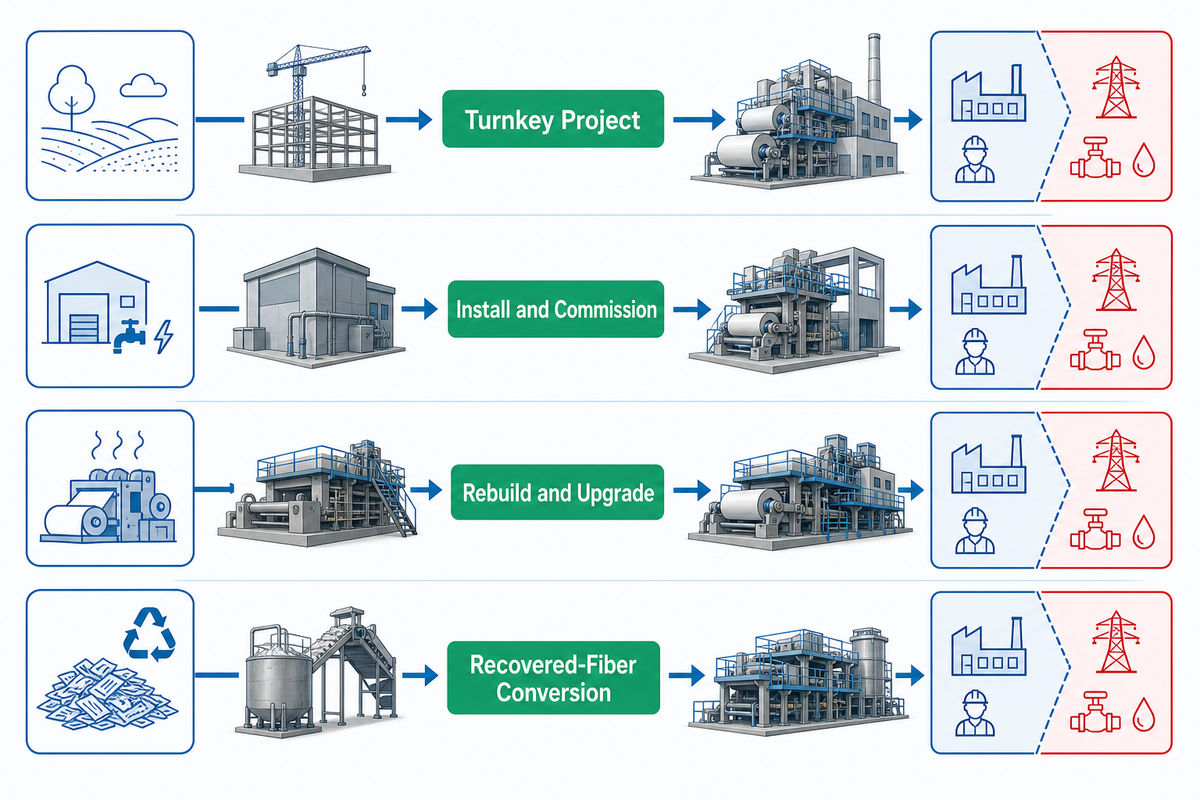
Each of the four routes puts a different scope of work on the equipment supplier. Mix them up and RFQs can come back with very different prices for what looked like “the same thing.” The right route depends on what’s already available: a greenfield site, an existing building with utilities, an underperforming machine, or a plan to switch to recovered fiber.
| Your starting point | Route | Supplier scope | Stays on your side |
|---|---|---|---|
| Empty greenfield site | Turnkey paper mill project | Full line design, manufacture, erection, commissioning | Land, civil works, external utility connections |
| Building + utilities ready, machine sourced elsewhere | Installation & commissioning | Erection, alignment, trial run to acceptance | Machine supply, building, power/steam |
| Running an old or slow machine | Rebuild, upgrade & speed increase | Section rebuild, new headbox/press, controls | Existing frame, planned shutdown window |
| Switching to recovered/OCC fiber | Waste paper recycling line | Pulper, screening, cleaning, refining, de-inking | Recovered paper supply, effluent-control area |
Using the 4-Route Paper Mill Solution Map
Use the 4-Route Paper Mill Solution Map as a routing check before issuing an RFQ. Grade and capacity, budget structure, site requirements, and supplier scope all change with the selected row. Finding that out after quotations arrive means the bids may not share the same boundary and can’t be compared cleanly.
Where the first row fits, compare the boundary in Zejiang’s turnkey paper mill project before issuing the RFQ. It helps identify which owner-side civil, utility, and site obligations still need to appear in the inquiry.
How to Set the Grade and Capacity Target Before You Talk to Any Vendor
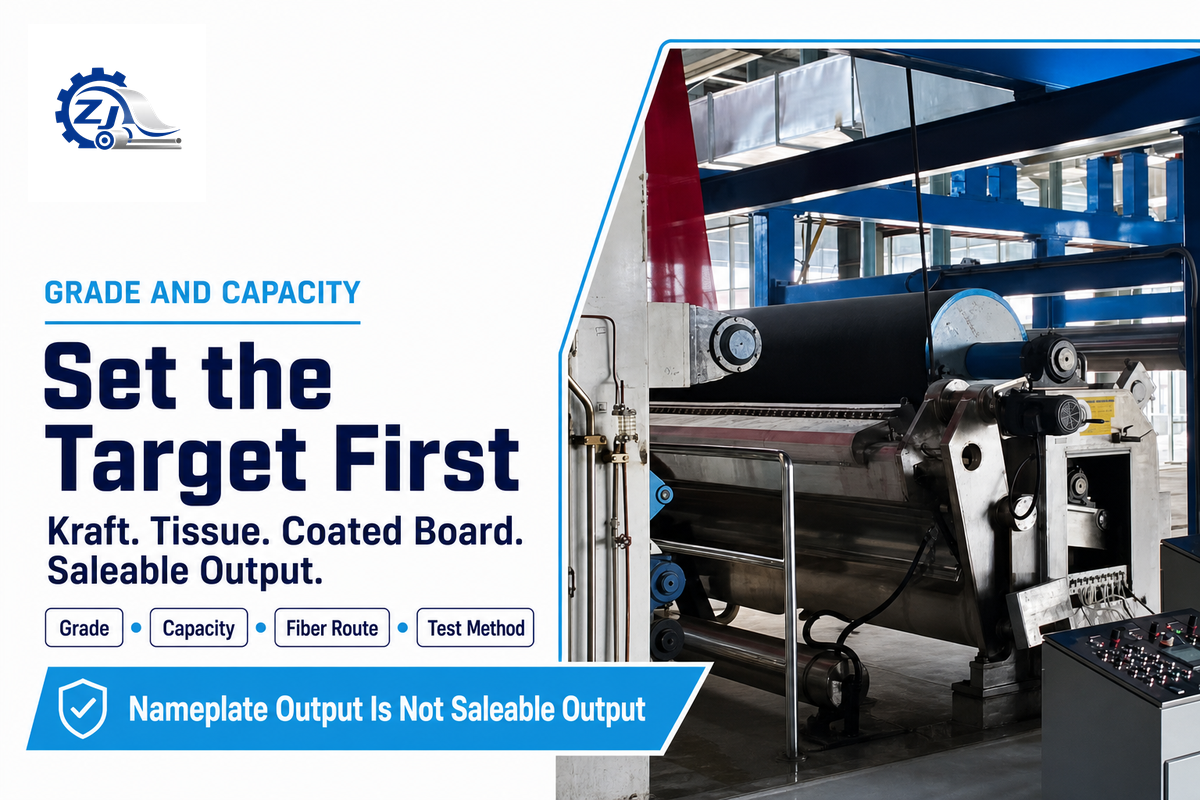
Target grade has more influence on the equipment configuration than any other single input. The raw-material strategy must match that grade before equipment selection begins. Capacity matters in both directions: too small can force an early expansion, while too large leaves equipment and utilities underused. Build a saleable-output target from furnish availability, operating days, and planned downtime instead of copying a nameplate number.
| Grade class | Basis weight / mill capacity | Typical application | Fiber source |
|---|---|---|---|
| Kraft liner | 125–350 GSM | Corrugated box outer layer | OCC + virgin pulp blend |
| Test liner | 100–250 GSM | Corrugated box inner/outer layer | Recycled OCC furnish |
| Fluting medium | 80–180 GSM | Corrugated box fluted middle layer | OCC or semi-chemical pulp |
| Sack kraft | 60–120 GSM | Cement bags, flour bags, industrial bags | Virgin long-fiber pulp |
| White top liner | 140–300 GSM | Printed packaging, shelf-ready boxes | OCC base + virgin top layer |
| MG kraft | 40–120 GSM | Wrapping, lamination, interleaving | OCC or virgin pulp |
| Tissue (cylinder mould) | ~30 GSM, 5–7 TPD | Entry-scale toilet/napkin/facial tissue | Virgin or recycled pulp |
| Tissue (crescent former) | 13–40 GSM, 20–100+ TPD | High-volume tissue production | Virgin/recycled (finer screening for recycled) |
| Duplex / coated board | 5–200 TPD | Folding cartons, shelf-ready packaging | Mixed virgin/recycled, multi-layer headbox |
| Mill size class | Capacity range | Typical deckle width |
|---|---|---|
| Small | 30–80 TPD | 2,500–3,500 mm |
| Medium | 100–300 TPD | 3,500–5,500 mm |
| Large | 300–800 TPD | 5,500–8,000 mm |
| Very large | 800–1,200 TPD | Up to 10,000 mm |
Kraft-family grades split by finished product, not just tonnage. In paper making, the fiber route sets the starting point for paper production: wood pulp, an OCC-plus-virgin-pulp blend, and recycled paper each need a different stock-preparation strategy. Refiner duty, screening, forming, pressing, and drying all change with that choice. Fourdrinier single-wire forming remains one common route, but it isn’t a universal answer for every grade. Published equipment bands may extend to 5.6 m trim width or section speeds of 2,400 m/min; treat those figures as routing references and bind final values to furnish, grade, and a project-specific guarantee.
Define the target paper by the required performance of the finished paper, not by a broad paper product label. The types of paper sold as coated paper, writing paper, packaging board, or tissue place different demands on the paper sheet. For tissue paper manufacturing, softness, bulk, and converting requirements matter; for paper packaging, strength and printability may dominate. Paper manufacturers should translate regional demand into a target grade and test method before selecting equipment. That keeps machine cost from becoming the first—and wrong—design criterion.
Q: Which paper grade should a new project target?
There’s no universal best grade. Defensible choices match regional demand, available fiber, achievable quality, utility capacity, and the converting customers the mill can realistically serve. Test those inputs before selecting a machine configuration, and rule out grades whose furnish or converting market can’t support stable production.
Feasibility & Budget Framework: What Drives Paper Mill Project Cost
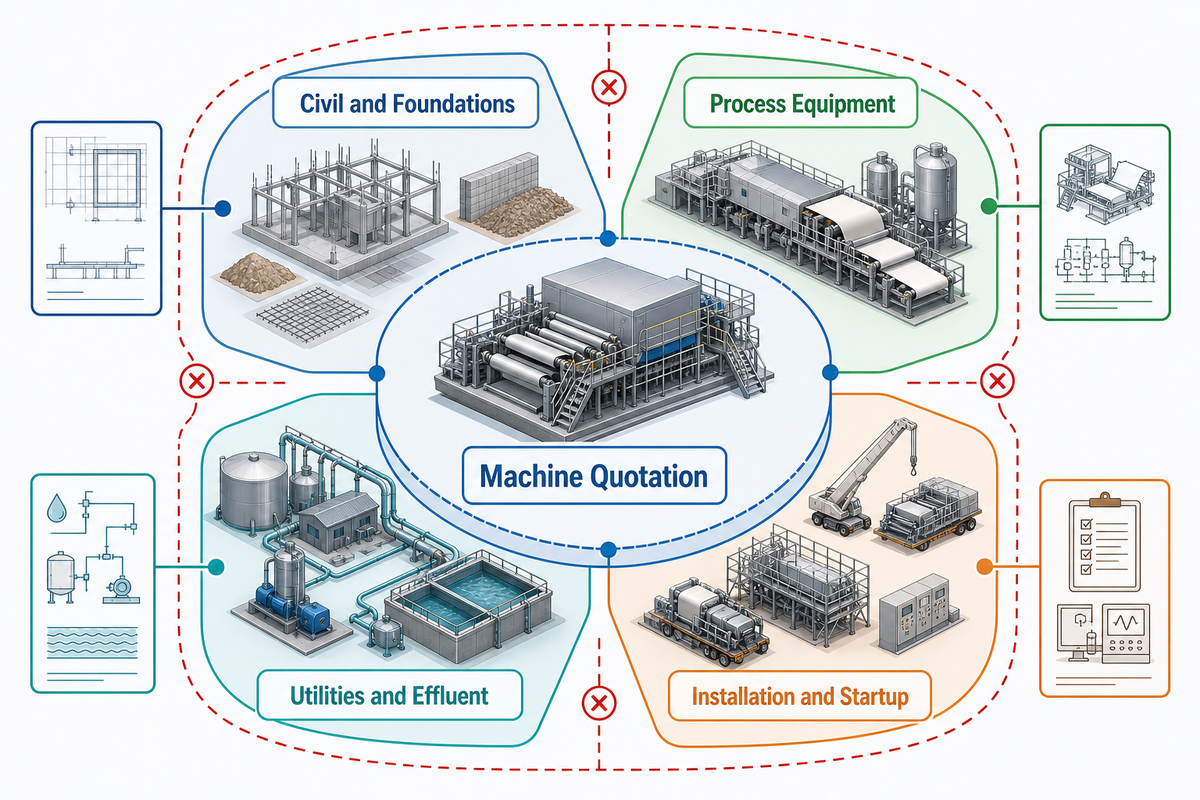
Paper mill project costs fall into a few practical categories: land and site preparation, structures and civil works, process equipment, erection and supervision, utilities, commissioning, and startup requirements. Budget resilience depends on the ratio between these categories, not the headline machine price.
| Cost block | What changes it | Evidence to request |
|---|---|---|
| Process equipment | Grade, capacity, furnish, automation level | Itemized equipment list and exclusions |
| Civil and foundations | Soil, loads, building condition, local codes | General arrangement and foundation-load drawings |
| Utilities and effluent control | Power, steam, water, effluent route | Utility-consumption schedule and effluent-control boundary |
| Installation and startup | Local labor, travel, supervision, acceptance scope | Responsibility matrix and acceptance protocol |
Operating cost is equally site-specific. Fiber price and quality, yield loss, purchased power, steam generation, water conditioning, chemicals, maintenance, labor, and rejected product all vary with location and furnish. Ask vendors to state consumption assumptions and battery limits explicitly, then place those values into your local cost model. Generic percentages from plants running different grades or fiber mixes aren’t reliable substitutes.
Energy needs a separate line item. In its cited process breakdown, the U.S. ENERGY STAR pulp-and-paper energy guide identifies drying as the most energy-intensive papermaking step, at roughly two-thirds of the total. That’s why press dryness, dryer design, condensate handling, heat recovery, and steam-system assumptions belong in the technical comparison instead of being left for commissioning.
Project-report documentation: separate supplier data from owner assumptions
Formal project reports generally require capacity, grade, machine specifications, utility consumption, price, and delivery-scope data in a consistent format. Equipment suppliers can fill in the technical schedule and stated battery limits. Demand assumptions, selling prices, local operating costs, funding structure, and cash-flow scenarios remain the project owner’s responsibility and should be checked by the owner’s relevant advisors.
A paper mill plant budget must separate the paper plant from the machine quotation. Paper manufacturing plant cost includes land, civil work, utilities, effluent control, erection, startup, and working capital; machine cost is only one block. A mini paper mill can have a lower absolute paper mill setup, while larger mills may gain economies of scale but need heavier utilities and a larger market. Complete paper mill equipment does not automatically mean complete plant setup. Model the setup cost and contract boundary together, because project cost depends on local inputs as much as supplier scope. Treat this as project planning for a paper business, not a shopping list.
Engineering & Layout: What Happens Before Equipment Ships
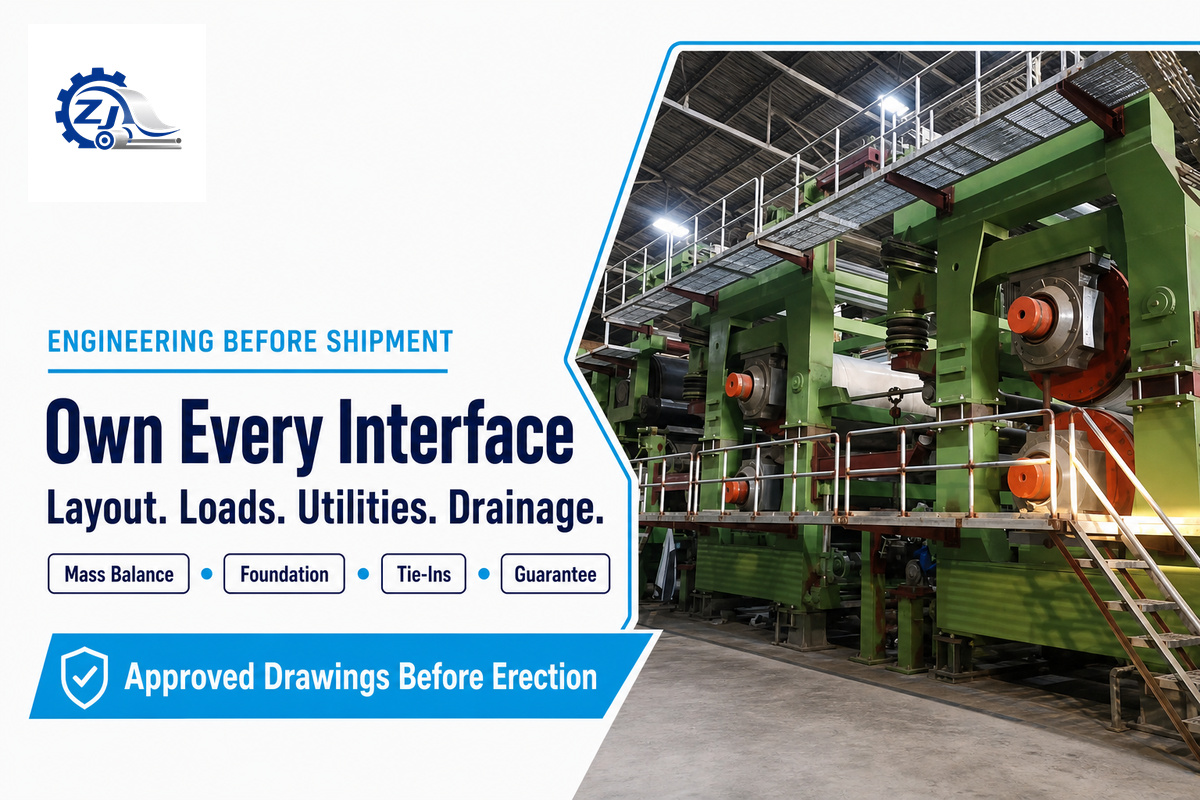
Before any machine is built, the engineering and layout stage produces the records that later work depends on: a line configuration matched to grade and capacity, a furnish mass balance, plant layout drawings, and the utility and drainage tie-in points used by the civil contractor. This is where an engineered line separates from a bolted-together collection of equipment. Clear ownership of section interfaces gives commissioning teams a chance to reach the agreed performance without months of avoidable rework.
In a modern paper mill, the paper manufacturing process is a connected flow rather than one mechanical process. An integrated pulp mill may start with wood chips and a pulping process; a recycled-fiber mill starts with recovered stock. Both prepare paper pulp for the paper machine line, where forming, pressing, drying, reeling, and a control system govern production of paper. The furnish and water balance affect how the paper produced behaves in finishing, so making paper reliably requires line-wide interface data. Integrated mills must also define where pulp-area utilities and mill-area responsibilities meet.
Section-level choices reinforce each other. Press-section water removal reduces the load on the dryer section, so a proposed rebuild should be evaluated alongside steam demand, sheet quality, felt condition, and the existing frame. Useful comparisons state the supplier’s inlet condition, expected outlet condition, furnish basis, test method, and guarantee boundary instead of relying on a generic dryness promise.
Site & Utility Readiness: The Checklist Buyers Underestimate
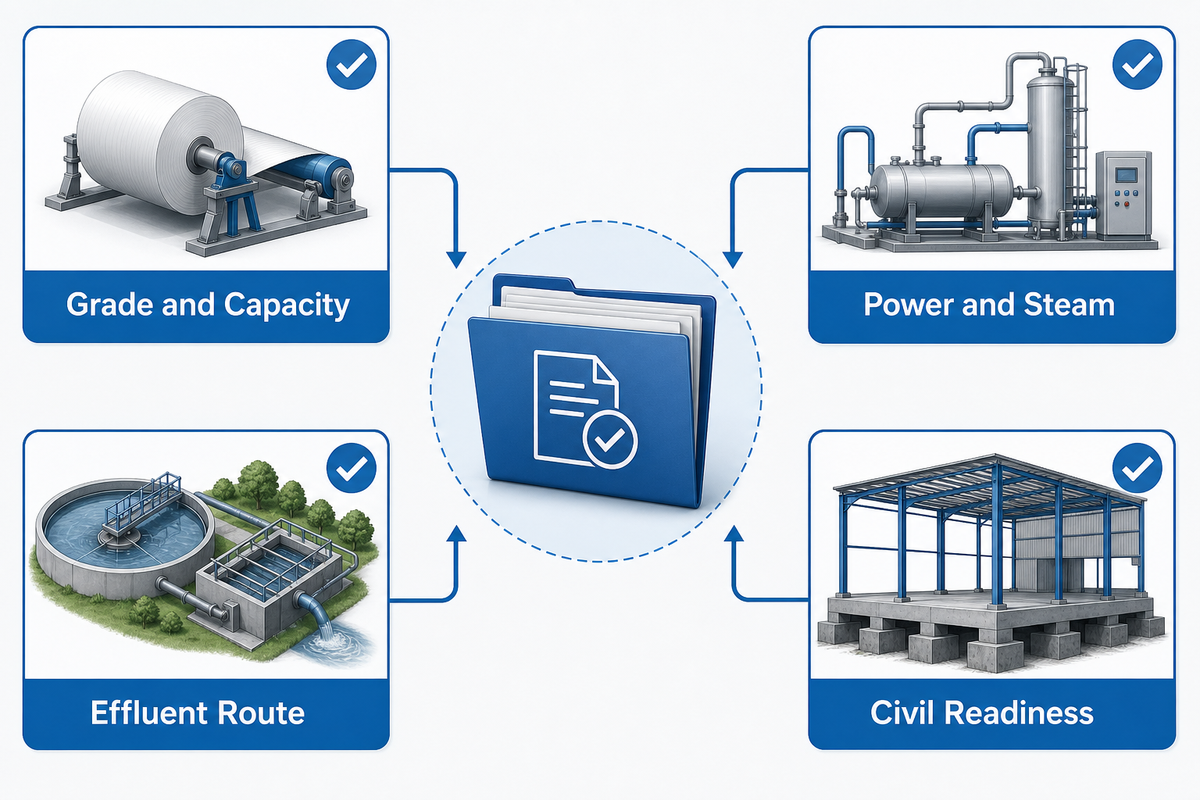
Civil works, power and steam tie-ins, water supply, and effluent control are site-readiness items that first-time buyers often miss in their own budget. They aren’t hidden; they simply sit outside the machine-price discussion.
Environmental compliance planning needs its own budget line from day one. In the United States, the EPA’s 40 CFR Part 430 effluent guidelines organize pulp, paper, and paperboard processes into subcategories with pollutant requirements that vary by process. Mill process routes and discharge arrangements, not just output grades, affect which requirements and permits apply, so the project team should confirm the applicable category with the relevant regulator.
Pre-RFQ readiness checklist – confirm these before you contact a vendor:
| Item | Why it matters | How to verify |
|---|---|---|
| Target grade and capacity (TPD) | Determines machine class and quote structure entirely | Fixed decision before first RFQ, not “TBD” |
| Power and steam availability | Drying is the largest continuous energy draw in the line | Utility company confirmed capacity, not assumed |
| Effluent discharge route | 40 CFR 430 subpart determines permit requirements | Confirm applicable subpart with regulator before site lock-in |
| Site civil readiness | Foundation loading and anchor-bolt tolerance mismatches stall erection | General arrangement drawings signed off before shipment |
How to Evaluate a Paper Mill Equipment Manufacturer (Not Just a Trader)
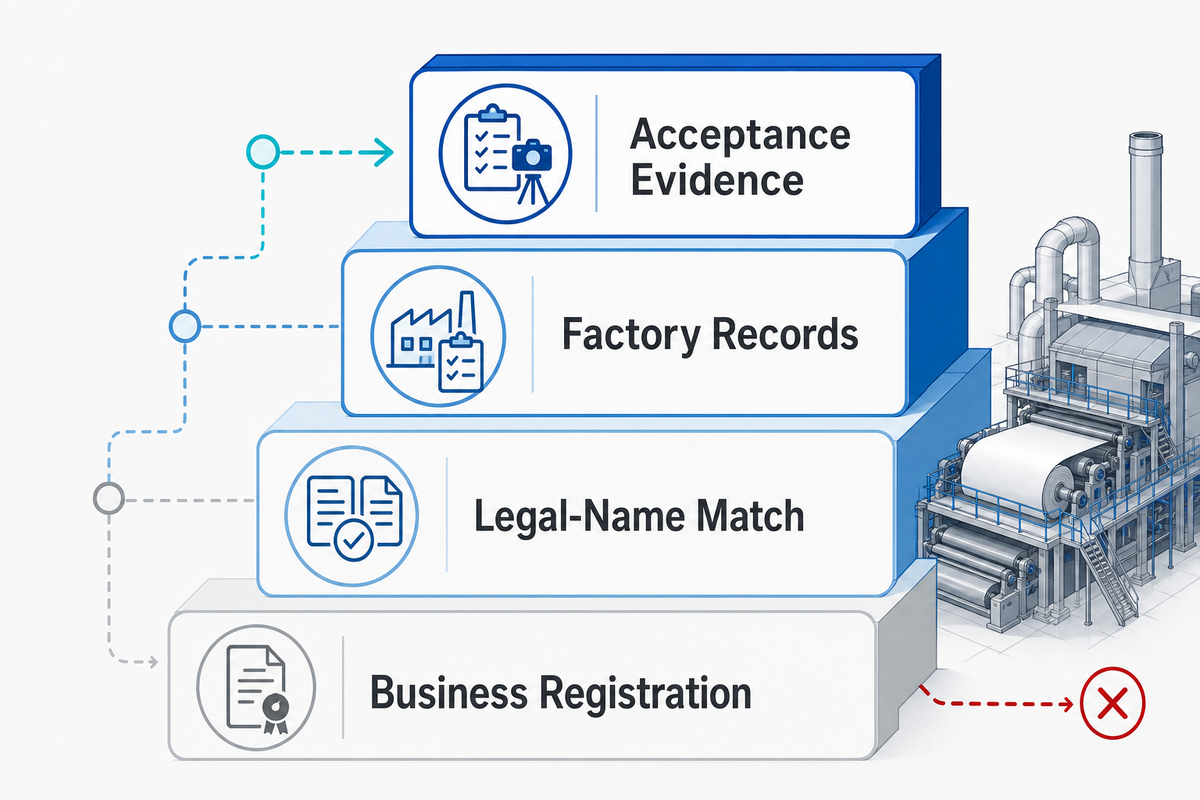
One important check before signing a contract is whether the seller actually builds the equipment or is reselling another company’s line. That can be tested with records and technical evidence; it shouldn’t rest on a sales pitch.
Start with the supplier’s official business-registration record and confirm that its registered scope includes manufacturing rather than trade alone. Cross-checking the business-license name against the quotation, invoice, and receiving account is a useful follow-up. Then request factory evidence tied to the quoted machine: drawings, production records, inspection documents, and a buyer-witnessed test plan. No single registration lookup proves technical capability, but inconsistent names or a trade-only scope are reasons to stop and clarify the contract boundary.
✔ Manufacturer signals
- GSXT business scope lists production/manufacturing
- VAT invoice name matches business license name
- Willing to arrange a factory audit or video tour
- Can name in-house engineering headcount
⚠ Trader warning signs
- Business scope lists trade only, no manufacturing
- Vague or deflected answers about factory location
- Can’t produce engineering documents with the quote
- No willingness to provide a written performance guarantee
Before shipment, a buyer-witnessed factory acceptance test and an independent inspection when appropriate move part of the verification work ahead of a cross-ocean shipment. Inspection scope should name the drawings, dimensions, material records, rotating checks, control-panel checks, packing list, and exceptions to be recorded. Registration checks are useful, but they don’t replace technical acceptance evidence or a written performance guarantee.
Industry Outlook: What 2025 Data Changes for a 2026 Project
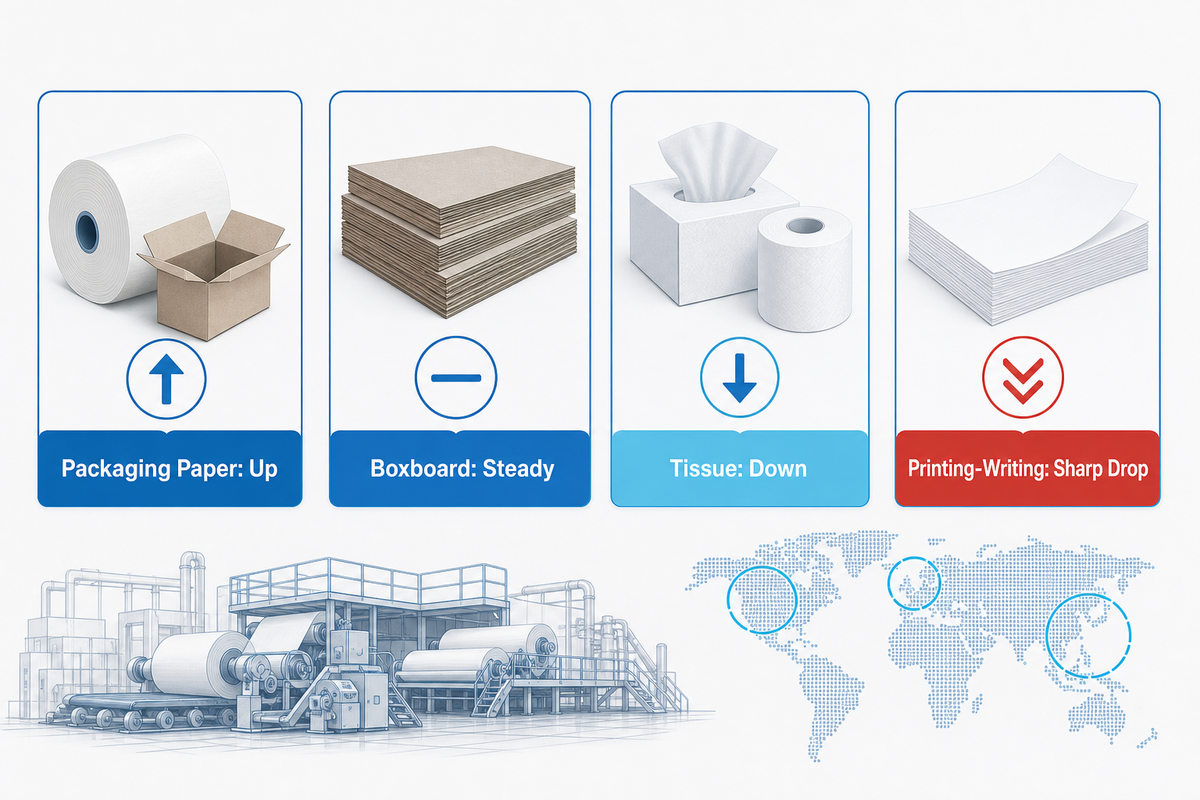
Grade selection should be tested against current demand, not a broad market-size projection. AF&PA reported that U.S. paper and paperboard output declined 3.7% in 2025, while packaging paper increased 1.7%, boxboard held steady, and tissue declined 0.8%. Printing-writing capacity fell 13.9%. These figures don’t prove that one grade will work in another country, but they show why a project plan must separate packaging, tissue, and printing-writing demand instead of treating “paper” as one market. If the selected grade will become folding cartons, folder gluer machines from Cenwan belong to the downstream converting stage; confirm board thickness and carton style separately from the paper-mill equipment specification.
A paper market forecast is useful only when demand for paper is separated by grade, region, and customer. Paper consumption can move in different directions across packaging, tissue, and printing-writing segments, so the feasibility model should use the buyer’s reachable market rather than a global headline.
Export plans also change the specification and documentation workload. Under the EU’s Packaging and Packaging Waste Regulation (PPWR) 2025/40, the regulation entered into force on 11 February 2025 and generally applies from 12 August 2026. Current European Commission EUDR implementation guidance states that relevant products placed on, sold within, or exported from the EU must be deforestation-free from 30 December 2026, with later timing for some micro and small operators. Buyers serving the EU should check product codes, operator role, fiber traceability, and current implementation guidance before freezing the project schedule.
Common Mistakes That Blow Up a Paper Mill Project Timeline
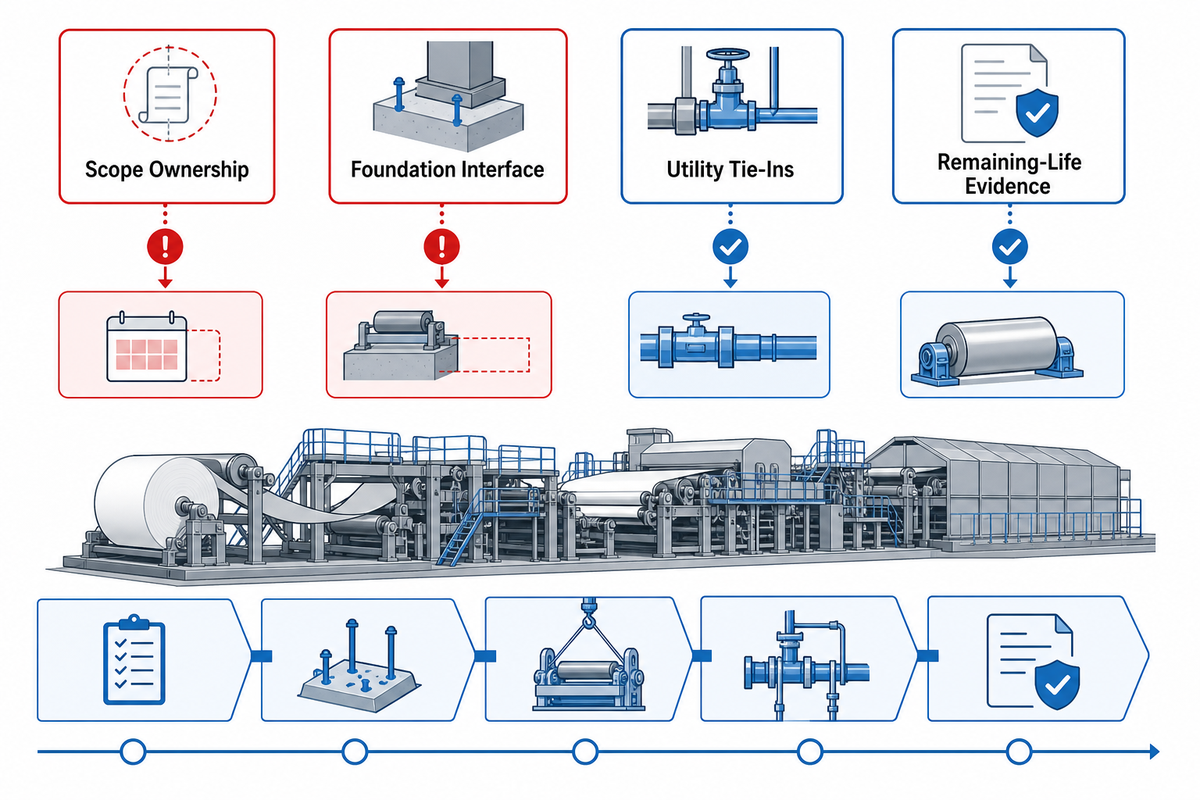
Interface disputes and planning gaps are often more expensive than mechanical failures in cross-border paper mill projects. One typical example appears when the civil contractor has poured the foundations but the machine base plates don’t match the anchor-bolt layout because no contract assigned ownership of that dimension. Use a signed scope-of-supply and interface-ownership matrix before shipment, backed by approved general arrangement and foundation drawings.
Project scale isn’t protection against an unresolved interface. Larger lines create more tie-in points, more utility dependencies, and more opportunities for scope to sit between suppliers. For greenfield mill projects, a resolved interface matrix, confirmed site readiness, and a grade/capacity target locked before the RFQ matter at every scale.
✔ Advantages of new equipment
- Current engineering, full warranty coverage
- Configuration matched exactly to your furnish
- Predictable remaining service life
⚠ When NOT to assume used is cheaper
- A used line at 40% of new price with 3 years of remaining life on critical components can cost more over time than a different 40%-off machine with 15 years left
- Maintenance cost on aging equipment isn’t always predictable, even when the machine currently runs; reliability and remaining life are two different questions
- A used line built for a narrow furnish range may need stock-prep modifications that erase the price advantage
📐 Engineering NoteThere’s no universal percentage for choosing repair or rebuild. Compare remaining frame life, repeated-failure history, spare-part availability, shutdown time, target speed and grade, safety controls, and the guarantee available after the work. A lower repair quotation can still be the worse choice if it leaves the original bottleneck or creates another shutdown.
Frequently Asked Questions
What is the cost of a paper mill project?
No generic project total is defensible until the grade, capacity, equipment boundary, civil work, site-utility scope, effluent-control scope, installation support, freight, and acceptance terms are defined.
Request an itemized equipment list, civil and foundation data, utility consumption, the treatment-system boundary, erection supervision, startup support, spare parts, freight terms, and exclusions. Two quotations are comparable only after those boundaries are aligned. Also state whether taxes, local cranes, operator training, consumables, and performance-test raw materials sit with the buyer or supplier.
How long does it take to set up a paper mill?
Project schedules depend on the delivery route, engineering release, equipment scope, civil readiness, utility and permit lead times, logistics, erection sequence, commissioning plan, and acceptance test.
Build the schedule from named milestones: data freeze, drawing approval, long-lead release, foundation readiness, shipment, erection, dry checks, wet commissioning, trial production, and acceptance. A rebuild or installation-only project may contain fewer work packages than a greenfield line, but its shutdown window can be less flexible. Permitting and utility lead times may also sit outside the supplier’s control.
What determines whether a paper mill project is economically viable?
Economic viability depends on verified demand, saleable output, yield, fiber and energy costs, quality losses, downtime, working-capital requirements, ramp-up time, and the full project delivery boundary.
Model several demand and utilization scenarios with local prices and verified consumption assumptions. Keep supplier-stated machine performance separate from owner assumptions about selling price, raw-material availability, and operating practice. Stress-test lower sales volume, higher fiber and energy costs, slower quality ramp-up, extra downtime, and delayed customer approvals. Record which input came from a supplier guarantee, a utility quotation, a customer commitment, or an owner estimate so the weak assumptions remain visible. Run at least one downside case in which output ramps more slowly than planned and working-capital requirements rise at the same time; that combination exposes whether the project has enough operational margin before steady production. A generic return percentage is not a substitute for that project model.
What is the difference between a paper mill and a paper factory?
Both terms are often used interchangeably; for sourcing, distinguish the paper machine itself from the mill facility, its stock preparation and utilities, and separate downstream converting equipment.
In sourcing, three different things often collapse into one search: the paper machine, which forms, presses, dries, and reels the sheet; the paper mill or factory, which includes the site, stock preparation, utilities, and warehousing; and downstream converting equipment, which turns the parent roll into products such as toilet tissue, napkins, or cartons. Naming the wrong boundary can produce a quotation for the wrong equipment.
What machinery is required for a paper manufacturing plant?
Complete lines include pulp or stock preparation, forming, pressing, drying and reeling, finishing equipment, process controls, onsite utilities, water and steam systems, and effluent-treatment systems.
Stock preparation commonly includes pulping, refining, pressure screening, cleaning, thickening or deinking, and pumps or agitators. The paper-machine configuration then changes with grade, basis weight, furnish, width, and target speed; some published kraft reference bands reach 1,200 m/min, but that isn’t a universal design point. A rebuild needs only the affected sections and interfaces, while a turnkey project needs the full process boundary plus supporting systems.
Why are paper mills shutting down?
Closures often reflect structural decline in graphic and printing grades, but plant age, cost position, fiber and energy access, integration, and company capacity plans also matter.
In 2025, AF&PA reported that U.S. paper and paperboard output declined 3.7%, packaging paper increased 1.7%, boxboard held steady, tissue declined 0.8%, and printing-writing capacity fell 13.9%. Closure decisions remain plant-specific and can involve demand, cost position, asset condition, fiber and energy access, integration, or a company’s wider capacity plan.
What is the biggest paper mill in the USA?
The answer varies by measurement, such as single-site tonnage versus company-wide capacity, and changes as mills close or expand, so current AF&PA survey data is safer than a fixed name.
For a durable reference, use the American Forest & Paper Association’s annual capacity and fiber-consumption survey. It tracks capacity, production, and operating rates by grade, allowing the answer to be checked against the current reporting year.
References & Sources
- Pulp, Paper and Paperboard Effluent Guidelines (40 CFR Part 430) U.S. Environmental Protection Agency
- 29 CFR 1910.261, Pulp, Paper, and Paperboard Mills U.S. OSHA
- Energy Efficiency Improvement and Cost Saving Opportunities for the Pulp and Paper Industry U.S. ENERGY STAR Program
- Packaging and Packaging Waste Regulation (PPWR) 2025/40 European Commission
- 66th Annual Paper Industry Capacity and Fiber Consumption Survey American Forest & Paper Association
- Implementing the EU Deforestation Regulation (EUDR) European Commission
Why We Write This
Henan Zejiang Paper Machinery publishes equipment and project-scope information for kraft, corrugated, tissue, and recovered-fiber lines. This guide focuses on the pre-contract boundaries behind those solutions: grade and capacity, interface ownership, site readiness, utility assumptions, and acceptance evidence. Regulatory and market statements are linked to the public sources above; project-specific claims still need confirmation in the final proposal and local approvals.
Related Articles
- Industrial Paper Machines: How They Work — section-by-section machine mechanics, forming-technology comparison
- Paper Machine Commissioning Guide — the installation and startup phase in depth
- Paper Machine Rebuild Guide — 8 things to know before a rebuild project
- Turnkey Paper Mill Project — Zejiang’s full-scope delivery model

![Refiner Plates & Screen Baskets [Complete Guide]](https://zjpapermachine.com/wp-content/uploads/2026/07/refiner-plates-screen-baskets-guide-featured-150x150.png)
![Doctor Blade: Types, Materials & How It Works [Guide]](https://zjpapermachine.com/wp-content/uploads/2026/07/doctor-blade-guide-featured-1-150x150.png)
![Pulping Equipment: How Paper Pulping Works [Guide]](https://zjpapermachine.com/wp-content/uploads/2026/07/pulping-equipment-guide-featured-150x150.png)