Get in touch with Zejiang Paper Machinery Company


Hard nip vs soft nip calendering compares contact between two rigid roll surfaces with contact between a hard roll and an elastic-covered roll. Use a hard nip when equalizing local thickness is the main objective of the finishing process. Trial a soft nip when surface uniformity and print quality must improve while retaining useful sheet bulk. Both cases require control of the cross-machine profile.
At a glance
- Hard nip: two rigid surfaces; local thick spots receive stronger compression.
- Soft nip: one compliant surface; cover deformation spreads contact across sheet irregularities.
- Compare finished grades at the same roughness target, furnish and moisture condition.
- Roll-cover hardness, nip load and heating limits belong to the selected machine design.
Hard nip vs soft nip calendering looks at rigid and compliant roll contact. Hard nips tend to equalize local thickness; soft nips tend to distribute compression more evenly. Finished-sheet trials help determine the better configuration.
Hard Nip vs Soft Nip Calendering: Core Mechanics and Comparison
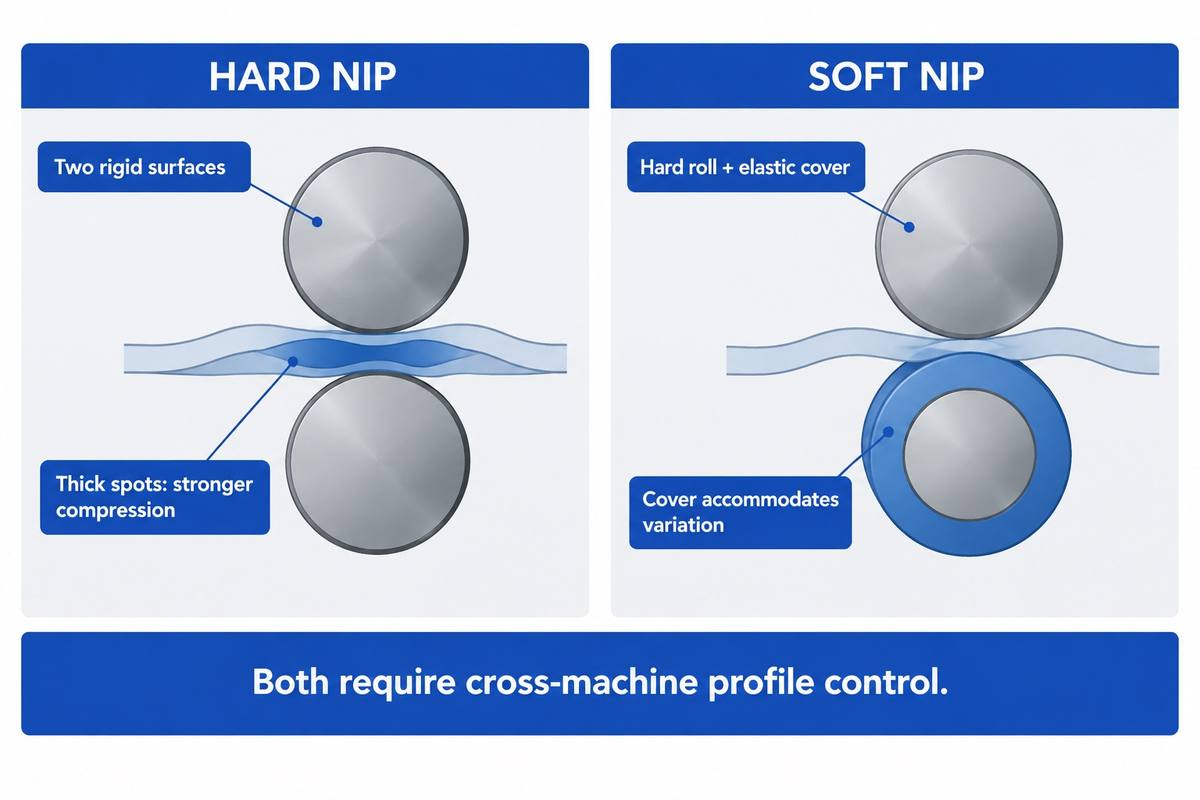
In general, a hard nip concentrates compression on the thicker parts of the paper sheet. A soft nip permits its cover to deform around the variations, changing the contact width and pressure distribution. The useful distinction is local thickness equalization versus more even local densification, rather than a promise of perfect caliper or density.
Think of pressing a textured sheet between two hard plates, then replacing one plate with a firm cushion. With compliant contact, part of the displacement occurs in the cover. Industrial rolls add curvature, motion and thermal effects to that simple picture.
| Comparison | Hard nip | Soft nip |
|---|---|---|
| Contact surfaces | Two rigid metal surfaces | Hard surface plus elastic cover |
| Local thick spots | More compression is concentrated in the sheet | Cover deformation accommodates part of the variation |
| Nip footprint | Relatively narrow for comparable geometry and loading | Cover compliance generally widens contact |
| Pressure interpretation | Local peaks can strongly compress flocs | Cover properties change the peak and shape |
| Caliper response | Tendency toward local thickness equalization | Some formation-related thickness variation can remain |
| Density response | Thick and thin regions can densify differently | Tendency toward more uniform local density |
| Surface replication | Metal finish and sheet deformation both matter | Sheet is pressed against the mating hard surface |
| Profile control | Crown and loading system remain necessary | Crown and loading system remain necessary |
| Maintenance addition | Metal surface condition and geometry | Cover condition, temperature and geometry |
What Happens to Fiber Flocs Inside a Hard vs Soft Calender Nip?
Thicker fiber flocs carry concentrated load in a hard nip, whereas a compliant cover accommodates some local sheet variation in a soft nip. This affects the balance between thickness correction and density uniformity. The effect occurs within the sheet structure; a separate crown-control system governs pressure across the full machine width.
The discussion during the Fundamental Research Symposium on calendering covers why roll dimensions and compliance need to be included with comparisons of line-load. A hydraulic setting alone cannot describe the stress experienced by the web. The paper machine roll guide distinguishes finishing rolls from press and transport positions.
How Calendering Changes Paper Density, Caliper, Bulk, and Print Smoothness
The calendering process improves the surface by deforming the sheet, usually at a cost in thickness and bulk. A useful comparison holds the final smoothness target constant and measures the remaining stiffness, opacity and print response. Comparing two machines with matching load settings can conceal the key difference the mill is looking to buy.
Bulk is sheet thickness divided by grammage when the units are consistent. The numerical quotient of caliper in micrometers divided by grammage in g/m2 gives bulk in cm3/g. The reciprocal of the quotient expresses density in g/cm3. The mill’s basis-weight measurement should accompany every caliper measurement.
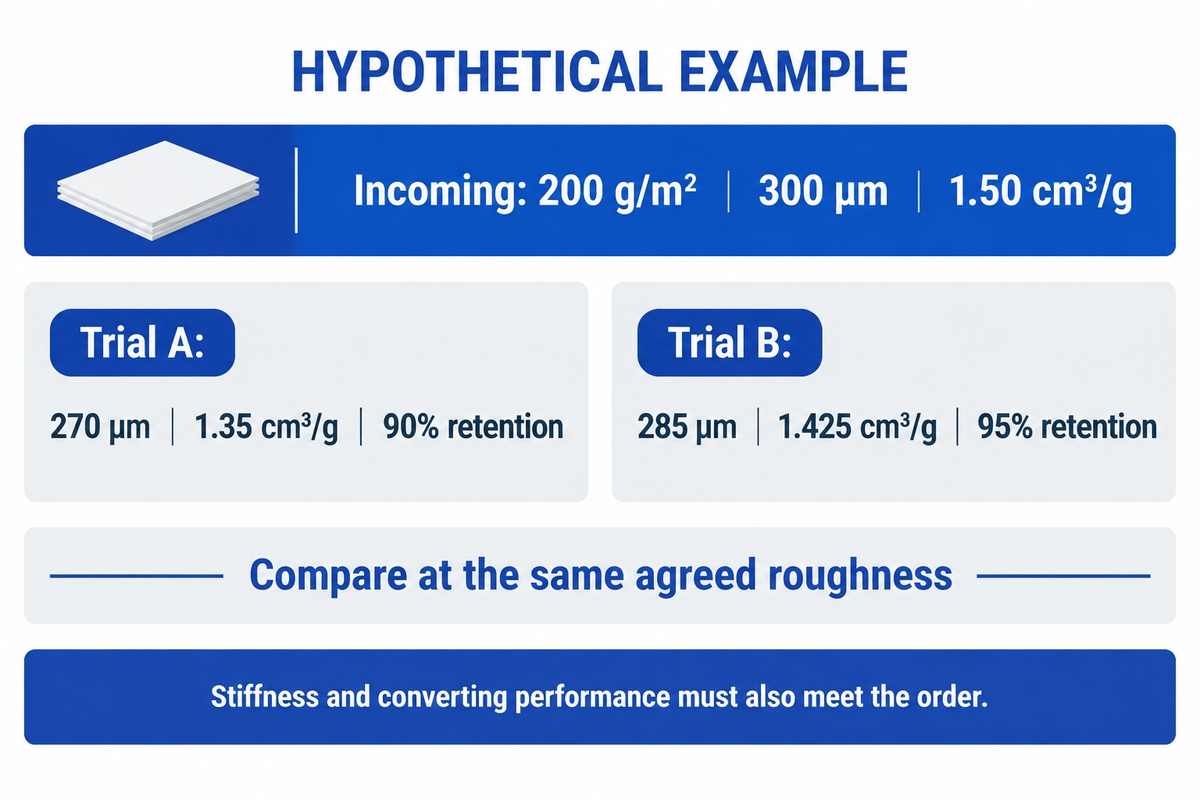
Example: A 200 g/m² board enters at 300 µm, giving 300 ÷ 200 = 1.50 cm³/g. At the same agreed roughness, trial A finishes at 270 µm and trial B at 285 µm. Their calculated bulks are 1.35 and 1.425 cm³/g, with 90% and 95% caliper retention. Those results would favor B for bulk retention, provided its measured stiffness and converting performance also meet the order.
The familiar cubic relationship between thickness and bending stiffness assumes unchanged material properties. Calendering changes those properties. Use measured paper bending stiffness in both directions for the purchase decision, rather than converting a thickness percentage into a carton strength guarantee.
Furnish also changes the result. Kim, Seo and Han’s 2022 calcium-carbonate study found different bulk and strength behavior for different filler structures at matched ash content. Keep pulp composition and filler system unchanged during a hard/soft comparison. Record gloss separately from roughness, and use the same roughness test method throughout; Bekk seconds and Print-Surf micrometres describe different measurements.
Roll Materials, Polymer Cover Hardness, and Deflection Compensation

Hard-nip selection mainly concerns the metal-working surface, geometry and loading system. Soft-nip selection mainly concerns the cover’s mechanical and thermal behavior. Hardness helps to identify each surface, but a metal scleroscope reading and polymer durometer reading belong to different test methods and should be treated separately in the specification.
Chilled iron provides a hard outer working layer; a thermal roll may instead use a steel construction designed around its heating passages. Specify alloy selection, chill depth, repair allowance, and surface finish on the drawing. The calender roll product page is the starting point for a replacement roll request.
FMT’s roll measurement guidance says a typical roundness tolerance for a chilled iron calender-roll is 2-5 µm, which depends on the paper grade. Roundness and concentricity are different inspection results. A roll may satisfy one measurement while causing a running problem due to its support or bearing arrangement. FMT also lists 0.1 µm Ra for premium and 0.2 µm Ra for standard chilled-iron surface finishes; those finish values describe surface texture, not roundness.
How Does Polymer Roll Cover Hardness Affect Soft Nip Calendering?
A softer cover generally produces a wider contact footprint, while a stiffer cover changes the pressure concentration and the sheet’s compression. Other factors, like cover thickness, reinforcement and temperature, also impact the response. Select the complete cover construction for the application; matching a hardness number alone doesn’t reproduce another calender’s behavior.
Valmet recommends 90–94 Shore D in its supercalender roll-material guidance. That’s an attributed application example. The required cover for a particular soft calender remains tied to its loading, temperature and speed envelope.
Hydraulic support zones can adjust the loading distribution as production conditions change. A rigid roll doesn’t supply the profile control. The same applies to a flexible roll.
Cross-direction control of caliper is described by ANDRITZ in its PrimeCal machinery. Covered rolls don’t eliminate the need for other controls, and an uncovered roll doesn’t provide that control.
Linear Nip Load, Roll Surface Temperature, and Heat Conduction Control
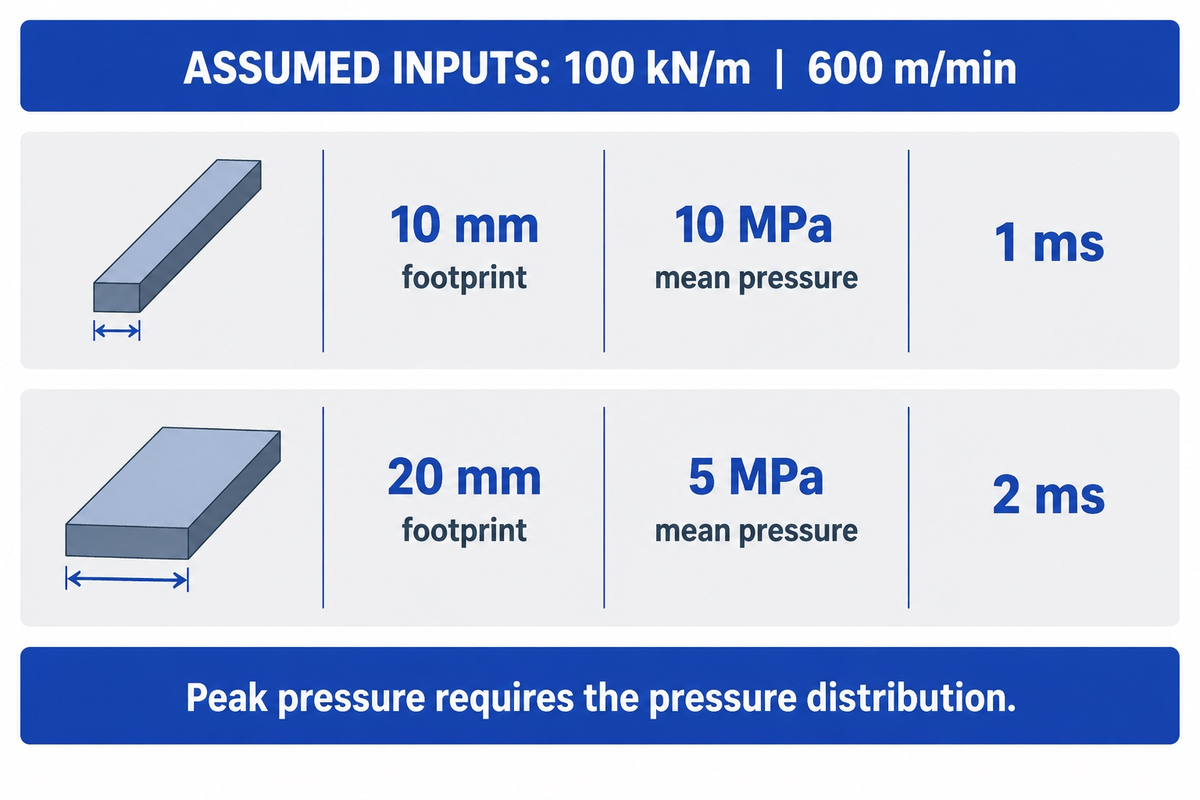
Linear load, temperature and moisture act together: load compresses the sheet, while heat and moisture change its response to compression. A higher speed reduces contact time for a given nip width. Make adjustments around the limits approved for the equipment, then alter one variable at a time to determine the useful adjustment.
Line load is the force per unit face length, usually measured in kN/m. Contact pressure is force per contact area. A simple mean pressure is obtained by dividing line load by nip width; peak pressure requires the pressure distribution. Heat conduction through contact and heat transfer within the sheet depend on the time available.
Assumed inputs: At 100 kN/m and a measured 10 mm nip width, mean contact pressure is 100,000 N/m ÷ 0.010 m = 10 MPa. At a 20 mm footprint, the same line load gives 5 MPa. For a web traveling at 600 m/min, or 10 m/s, those footprints correspond to 1 ms and 2 ms of nominal contact time. This equation demonstrates that equal line load is an incomplete comparison.
Thermal roll oil or water systems establish the roll surface temperature; the paper doesn’t instantly attain that temperature. Covered partners also must have their own temperature limits and cooling system. Measure drive side, center and tending side rather than depending on a single central reading.
M. B. Lyne’s moisture-gradient research distinguishes average moisture from its distribution through the sheet. In a trial log, record the incoming condition and the interval between conditioning and the nip. A change in pulp drying history can alter wetting behavior even when the reel moisture reading appears unchanged.
Choosing Hard Nip vs Soft Nip Calendering by Paper and Board Grade
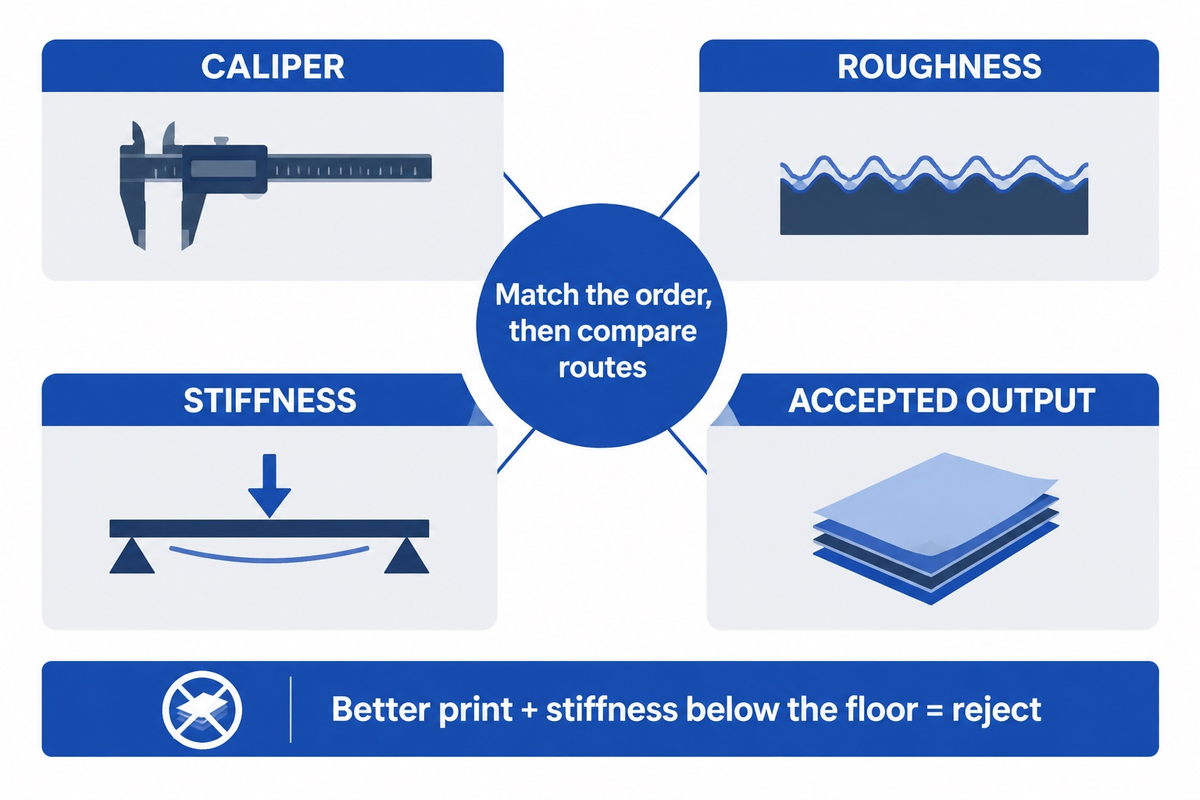
Start with a hard nip when thickness correction limits saleable output, or a soft-nip trial when print-surface quality is the limiting property. For coated or barrier-treated stock, acceptance should include the sheet after the downstream process, because wetting and drying can change the surface again.
The 4-Axis Nip Selection Matrix
Complete this matrix with four targets: caliper, roughness, stiffness, and accepted output. Each row defines a starting point for an investigation or trial of a grade.
| Duty | Starting route | Acceptance measurement |
|---|---|---|
| Uncoated board with thickness variation | Hard nip plus profile-control assessment | Cross-direction caliper and stiffness |
| Kraft liner with flexographic print mottle | Soft-nip trial against the existing setting | Printed uniformity at retained bulk |
| Corrugating medium with little surface demand | Minimum finishing needed for the specification | Required strength and caliper |
| Coated folding boxboard | Soft-nip trial | Coated surface, stiffness and converting result |
| Fine paper with uneven ink response | Soft-nip trial with matched furnish | Print mottle, opacity and roughness |
| Two-sided printing paper | Both-side treatment arrangement | Separate top-side and wire-side results |
| High-gloss publication grade | Compare multi-nip treatment | Gloss against bulk loss and output |
| Board limited by stiffness loss | Include extended-nip options in trials | Stiffness at matched roughness |
| Base sheet for aqueous barrier coating | Evaluate pre-calendering with the coating sequence | Roughness and coating response after drying |
Selection scenario: A linerboard mill meets the converter’s caliper specification, but printed solids remain mottled. Raising hard-nip load smoothes the surface and reduces thickness. The print defect remains. The next trial should hold furnish and printing conditions steady while testing compliant contact. The quality team matches incoming moisture conditions and measures printed uniformity alongside stiffness. For coated board, it repeats measurements of roughness and stiffness after coating and drying. If the soft-nip sample improves print response but falls below the stiffness floor, it fails that order. If both specifications pass, procurement can compare saleable tonnes and cover-service costs against the existing route.
The 2023 TAPPI paper on calendering and barrier-coating pickup compares soft-nip and metal-belt pre-calendering in a specific coating study. Its relevance here is in the process sequence: evaluate the finished coated product instead of assuming the pre-coating surface ranking will continue to hold.
Single Nip, Tandem Soft Nip, Multi-Roll Supercalender, and Shoe Calender Architectures
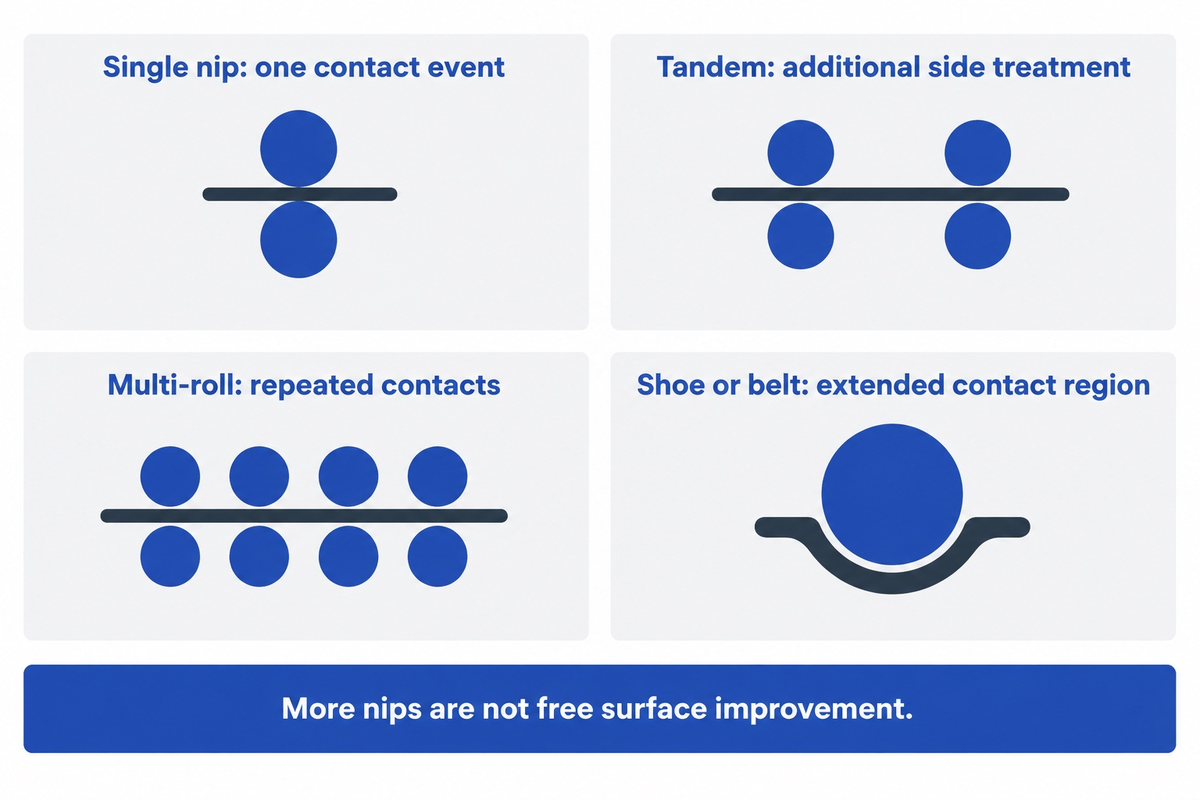
A single nip provides one contact event; tandem arrangements provide additional treatment and can bring opposing sheet sides to a hard surface. Multi-roll supercalenders provide repeated contacts. Shoe and belt concepts extend the contact region. Compare these architectures when a simple hard-versus-soft choice can’t meet the finish and bulk requirements of the grade.
Single or tandem roll nips
- Define which side meets the hard surface.
- Record each contact’s loading and temperature.
- Compare the compact arrangement with the grade targets.
Multi-nip or extended contact
- Evaluate the complete contact sequence: a single nip provides one contact event, tandem arrangements and multi-roll supercalenders add contacts, and shoe and belt concepts extend the contact region.
- Measure cumulative finish and thickness changes.
- Include service access and equipment scope in the rebuild.
More nips are an additional process choice, not free surface improvement. Each contact changes the entering sheet. A paper machine rebuild affects drives and supporting structures. This rebuild is covered in detail in the ‘paper machine rebuild guide’ that provides a wider context to the project.
The focus should be on paper and board. A textile calender can use different roll arrangements and finishing objectives. A paper calender shouldn’t use a textile calender’s operating settings just because the machines use heated rollers.
Common Calendering Defects, Cover Wear Prevention, and Doctor Blade Maintenance
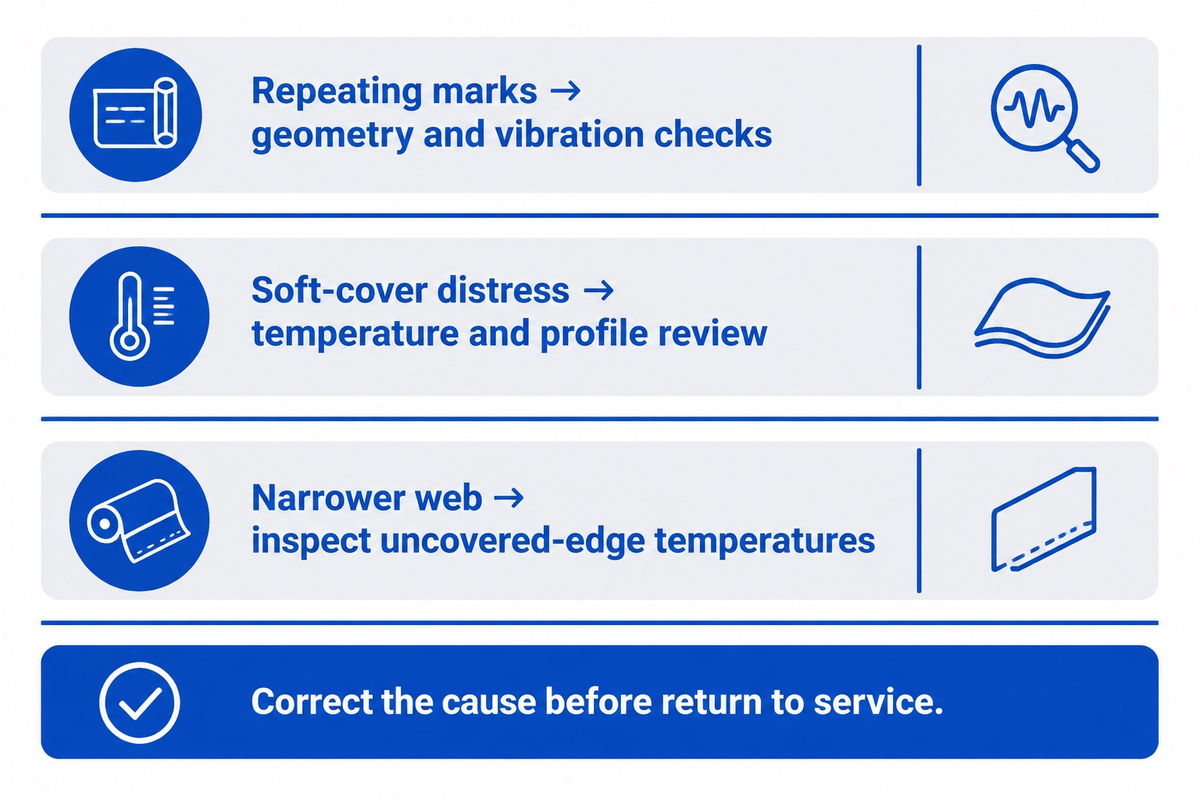
Diagnose the defect before increasing pressure. Dark spots signal the need to check sheet and compression; repeating marks call for checks on geometry and vibration. Soft-cover distress requires a temperature and profile review. Defect maintenance should connect the visible defect to a measured cause prior to returning the roll to production.
Uncovered edge heating, uneven wear and nip-profile errors are considered cover-life risks by Valmet’s supercalender guidance. A narrow web can leave the center and uncovered edges at different temperatures. A worn cover changes compliance, so a previously acceptable loading setting may no longer work.
Maintenance scenario: After a change to a narrower web, edge marks become visible to an operator. The center temperature appears normal, and the first suggestion is to increase loading to smooth the marks. Instead, the maintenance team records temperatures across the face and compares the marked positions with the web edges. Cover geometry and the approved edge treatment are inspected. If the problem is localized thermal growth, further loading can make the contact worse. The machine returns to service under its approved procedure after the underlying thermal or geometric cause has been corrected.
Do
- Match repeating marks to roll rotation and vibration records.
- Measure temperature and profile across the face.
- Document cover wear before and after grinding.
Don’t
- Raise loading to conceal an unexplained repeating mark.
- Treat the center temperature as the entire roll profile.
- Transfer another cover’s service limits without its specification.
The doctor blade removes deposits, but blade material and loading must be in accord with the working surface. Follow the installed machine’s safety and isolation procedure before inspection. See the doctor blade guide for information on associated wear. For an older pneumatic loading unit, include the cylinder, rod and control response in a vibration investigation before assuming that the roller surface alone caused the marks.
Calender Roll Replacement Cost Drivers, Lead Times, and Supplier RFQ Checklist
Consider different purchase scopes for a roll replacement and a calender section rebuild. The first scope focuses on an interchangeable component; the second scope may cover structure, drives, heating and controls. Quotations should separate purchase cost from installation, energy, grinding or recovering, spare-roll provision and downtime assumptions. Agreed-upon delivery dates should be part of the contract.
Request that each bidder provide you with the information described below in the seven specification groups.
- Geometry: face length and diameter in mm, journal drawing, bearing seats and installation interfaces.
- Running duty: operating speed in m/min, grade range, web width and existing drive arrangement.
- Loading: required operating range in kN/m, maximum design load and the loading-system scope.
- Working surface: metal designation or cover construction, hardness test method, finish and regrinding allowance.
- Profile control: crown design, hydraulic zone functions and acceptance measurement locations.
- Heating and cooling: medium, flow requirements, rated temperatures and edge-temperature management.
- Acceptance and delivery: inspection records, trial grade, finished-sheet targets, drawing approval date and dispatch milestone.
For a soft-nip quotation, include recovering logistics and the spare roll plan. For a hard-nip replacement, include inspection of the mating surfaces and the installed support arrangement. A new roll won’t correct all existing loading and alignment problems.
| Apparent advantage | Constraint to check | Decision owner and response |
|---|---|---|
| Smoother sheet leaving the nip | Coating and drying can change the surface again | Quality team: accept the coated, dried product |
| Compliant contact improves print response | Required stiffness may still be lost | Plant manager: reject settings below the order’s stiffness floor |
| Replacement roll fits the nominal dimensions | Frame, drive, heating and control interfaces may require a wider rebuild | Procurement: separate component supply from installed-section scope |
| Lower quoted running cost | Cover service and rejected output reduce saleable tonnes | Finance: compare annual finishing cost per accepted tonne |
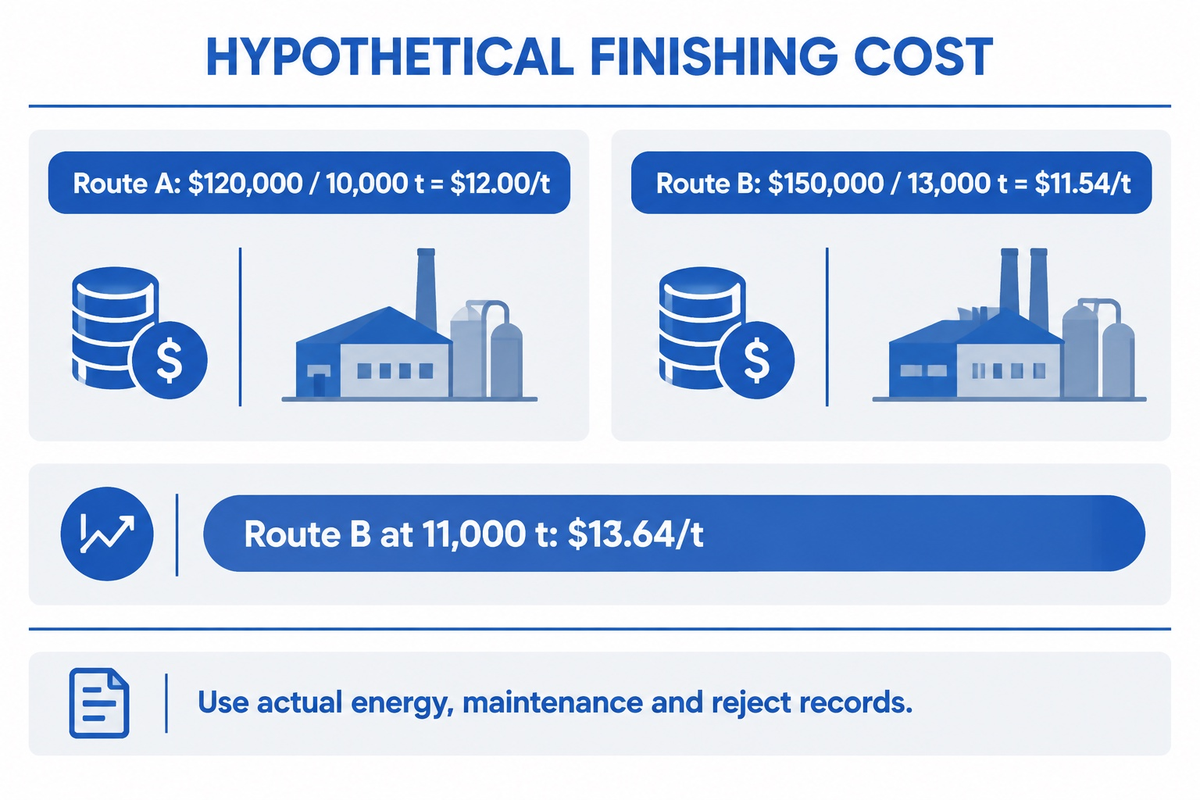
Cost example: Two proposed routes have assumed annual finishing costs of $120,000 and $150,000. If they produce 10,000 t and 13,000 t of accepted paper, respectively, the calculation is $12.00/t versus $11.54/t. The second route costs more per year but less per accepted tonne. If its accepted output reaches only 11,000 t, the cost per tonne would rise to $13.64/t. Use the mill’s own energy, maintenance and reject records to fill out this comparison.
When Should a Mill Upgrade a Hard Nip Stack to a Soft Nip Calender?
Upgrade when matched-grade trials show that compliant contact solves a print-surface problem while meeting the stiffness floor and accepted-output target. Retain or repair the hard nip when thickness control is the main duty and its output already meets the order. Include frame, heating, drive and cover-service requirements in the conversion cost.
Henan Zejiang Paper Machinery can receive the roll drawing and target paper specification through the project inquiry form. Identify whether the request concerns a replacement roll, a covered-roll assembly or a complete finishing-section change, and include the required shutdown window.
Frequently Asked Questions
Can a hard nip calender replace a soft nip calender?
A hard nip can meet some of the same finishing targets, especially when thickness correction is the main duty. It changes how local sheet variations are compressed, however. For a print-sensitive grade, compare matched samples at the required surface finish and measure stiffness and printed uniformity before changing the production route.
Does soft nip calendering preserve all the paper bulk?
No. Soft nip calendering still compresses the sheet and can reduce bulk. Its compliant contact changes the way compression is distributed. The useful purchasing result is the retained bulk at the required finished roughness, together with measured strength and printing performance. Hold furnish and incoming moisture conditions steady so the trial isolates the finishing change.
Is a soft calender always better for packaging board?
No. Board needing thickness correction may suit a hard nip, while a print-surface problem may justify soft contact. Board limited by stiffness loss can warrant an extended-nip comparison. The final choice follows the converter’s acceptance targets and the finished grade’s trial results. For coated grades, repeat acceptance measurements after coating and drying.
Should both sides receive the same calender treatment?
Not necessarily: two-sided printing can require comparable surface performance on both sides, whereas a one-side-coated grade has different duties. Record which surface contacts the hard roll in each nip and measure the two sides separately. Compare those measurements with the intended printing and coating duties.
Can a soft nip upgrade use the existing hard calender frame?
Reuse is possible when the frame, journals, drives and loading arrangement suit the proposed assembly. A soft-nip conversion also changes thermal and cover-service requirements. Include those interfaces in the rebuild scope so that a replacement-roll quotation isn’t mistaken for an installed conversion.
Related Articles
- Calender roll selection and operation
- Paper mill drives and rebuild interfaces
- Paper grain direction and converting behavior
- Paper machinery quotation specifications
- Choosing a paper machinery supplier
References & Sources
This guide combines calendering research with attributed equipment guidance. Author calculations are worked examples based on stated assumptions. They’re neither mill test results nor Zejiang quotations.
- Fundamental Research Symposium: calendering discussion.
- ANDRITZ: Soft and hard nip calendering.
- Valmet: Supercalender process conditions, variables and grinding.
- FMT: Roll Measurements and Tolerances by Application.
- Kim, Seo and Han: Effect of Calendering on the Properties of Paper Containing Flexible Calcium Carbonate with a Cellulose Nanofibril Core, 2022.
- M. B. Lyne: The Effect of Moisture and Moisture Gradients on the Calendering of Paper, 1977 symposium contribution.
- Impact of different calendering strategies on barrier coating pickup, TAPPI Journal, November 2023.