Get in touch with Zejiang Paper Machinery Company


How to choose a paper machinery supplier is a five-check process a buyer runs before money changes hands: define your production requirements in writing, qualify the supplier’s compliance and engineering documentation, match machine configuration to your paper grade, compare quotes on identical terms, and verify after-sales support. Skipping any one of these five is how mills end up with equipment that technically works but never performs to spec.
Quick Specs
| What this checklist covers | Requirements definition, supplier qualification, configuration match, RFQ comparison, after-sales evaluation |
| Applies to | New, used, and rebuilt paper machinery — Fourdrinier, cylinder-mould, tissue, kraft, and packaging-grade lines |
| Key documents to request | Accredited ISO 9001 certificate (if claimed), pressure-vessel compliance records, OEM engineering-drawing provenance |
| Decision tools in this guide | The 3-Part Supplier Qualification Gate, The 11-Field RFQ Comparability Grid |
| Updated | August 2026 |
Define Your Paper Mill Equipment Requirements Before You Contact Any Supplier
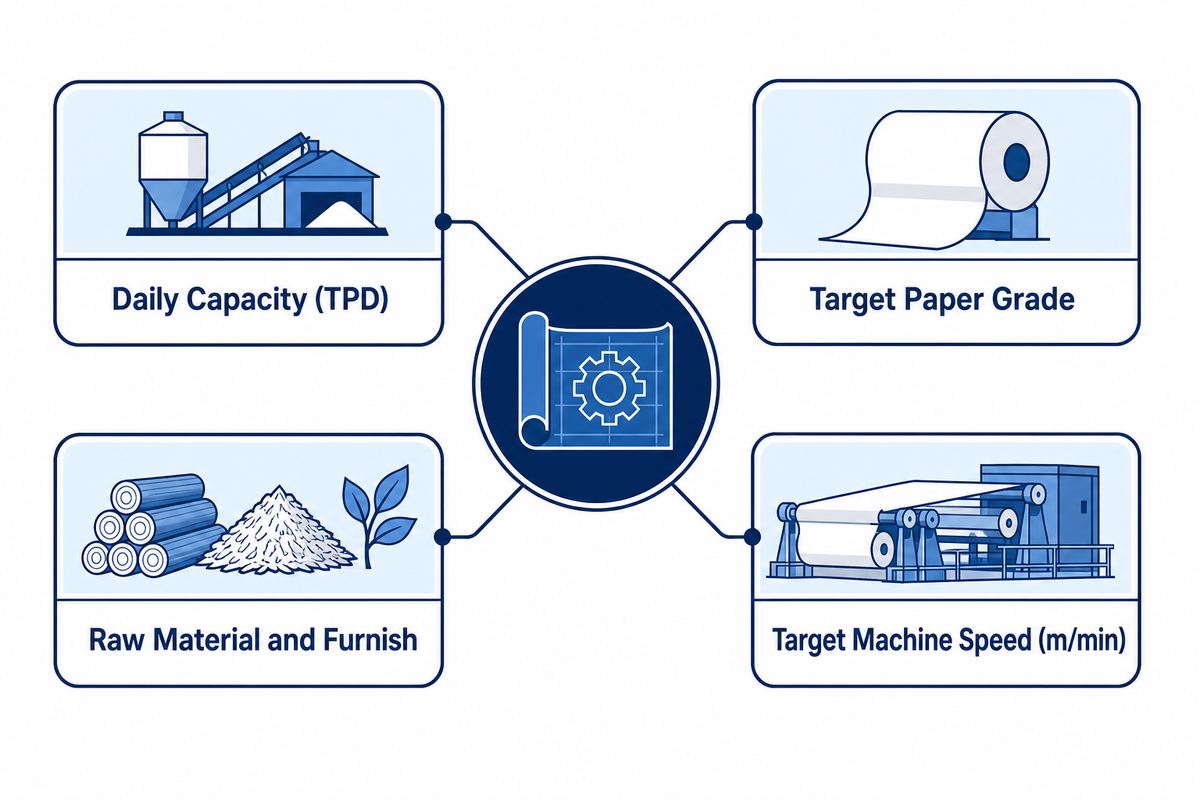
Production requirements documented in a written brief — capacity in tons per day, target paper grade, raw-material furnish, and speed range — give every supplier the same starting point to quote against. Without it, two suppliers will quote two different machines and the comparison becomes meaningless before it starts. The boundary condition: a brief that only states “we need a paper machine” produces vague quotes with vague liabilities attached.
Choosing the right paper making machine starts with this brief, not with a supplier’s product catalog. Four fields belong in this brief before you send a single inquiry. Daily capacity, expressed in tons per day (TPD), sets the scale of every downstream section from headbox to reel. Target grade — kraft, corrugated, testliner, duplex board, tissue, cultural, or specialty paper — determines forming mechanism and drying-section length. Raw material and furnish, whether recycled OCC, virgin pulp, or a blend, change stock-preparation equipment scope and pulper selection — see this guide’s stock preparation process walkthrough for the full sequence this brief feeds into. Target machine speed, in meters per minute, affects everything from dryer-cylinder count to control-system response time.
This same requirements-first discipline applies whether the equipment in question is a full industrial paper machine, a single printing paper line, a kraft paper or waste paper (recycled-furnish) production stage, or an incremental upgrade to an existing paper production process. Documenting energy and water requirements alongside capacity and grade — steam demand, freshwater intake, and target automation level — keeps the production process comparable across suppliers and prevents a mismatch between a modern machine’s utility footprint and what your mill can actually supply. Even an internal one-page machinery guide built from these fields does more to protect product quality and final paper consistency than any amount of supplier reassurance after the fact, and it applies equally to pulp and paper machinery bought new, used, or rebuilt.
💡 Pro Tip
Write this brief before the first supplier call, not after. Asking these four questions before quoting shows a supplier you already know how they work; quoting immediately without asking means quoting a generic machine, not your line.
The 3-Part Supplier Qualification Gate: A Checklist Before You Request a Quote
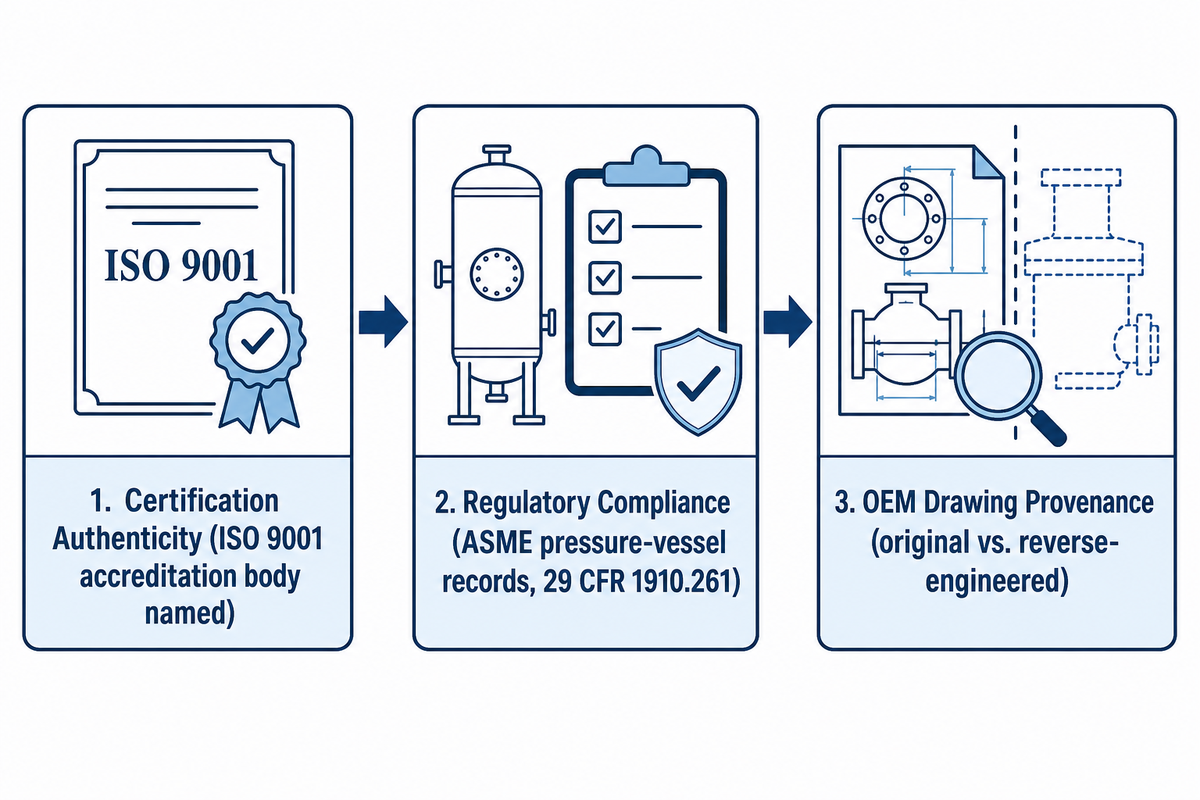
The 3-Part Supplier Qualification Gate is a pre-RFQ check covering certification authenticity, regulatory compliance documentation, and engineering-drawing provenance — three things a supplier can misrepresent that a buyer usually only discovers after the machine ships. Passing all three doesn’t guarantee a good machine, but failing any one is a legitimate reason to walk away before spending time on a formal quote.
1. Certification authenticity, verified conditionally. According to ISO’s own explanation of ISO 9001, certification is voluntary — ISO itself does not certify organizations, and certification is issued by independent certification bodies that may or may not be accredited. That means a supplier’s ISO 9001 claim is not automatically meaningful. If a supplier presents an ISO 9001 certificate, ask which accreditation body issued it and confirm that body operates under the ISO/IEC 17021 conformity-assessment framework. If the certifying body turns out to be unaccredited or unnamed, that is worth asking about directly, not treating as equivalent to a recognized accreditation system. For physical machine safety, OSHA 29 CFR 1910.261 sets pulp/paper/paperboard-mill-specific requirements a legitimate supplier’s standard design should already satisfy.
2. Regulatory and safety compliance documentation. Paper machine rolls and dryers are treated as pressure vessels under state and federal regulation, governed by ASME Boiler and Pressure Vessel Code steam limits. A legitimate supplier should be able to produce pressure-vessel compliance records for dryer cylinders without hesitation. For mills operating under US OSHA jurisdiction specifically, 29 CFR 1910.261 sets pulp-and-paper-mill machine-safety requirements that go beyond pressure vessels — guardrails and safety-belt anchoring at broke holes (which sit directly above pulpers), guardrails around drum-access platforms, confined-space entry procedures, and chlorine-gas emergency equipment where applicable. These are physical design requirements, not paper work, so ask whether the supplier’s standard machine layout already satisfies them rather than requiring costly retrofits after installation.
3. OEM drawing provenance, not just brand name. Non-OEM parts are typically produced through reverse engineering of an original part, without access to the original engineering drawings, tolerance stacks, or balance requirements — and that gap in engineering records, not the name printed on the part, is the real determinant of fit. Ask a prospective supplier directly whether their drawings for the machine sections you need are original engineering work or reverse-engineered from a competitor’s design. Both can produce a working machine; only one comes with a documented tolerance chain you can hold the supplier to if a part doesn’t fit on arrival.
“Holding a certificate issued by an accredited conformity assessment body may bring an additional layer of confidence… Accreditation is not compulsory, and non-accreditation does not necessarily mean the certification body is not reputable.”
International Organization for Standardization, ISO 9001 Explained
A useful reference point for what “supplier qualification” covers more broadly: the framework the US federal government uses to determine whether a contractor is responsible names adequate financial resources, the ability to meet a delivery schedule, a satisfactory performance record, a satisfactory integrity record, and the necessary operational controls and production facilities. A private buyer isn’t bound by that rule, but the same five dimensions — can they pay their own bills, can they hit a delivery date, do they have a track record, are they honest, do they have working capacity — are exactly what the Supplier Qualification Gate is trying to surface before a purchase order is signed.
Match Machine Configuration to Your Paper Grade
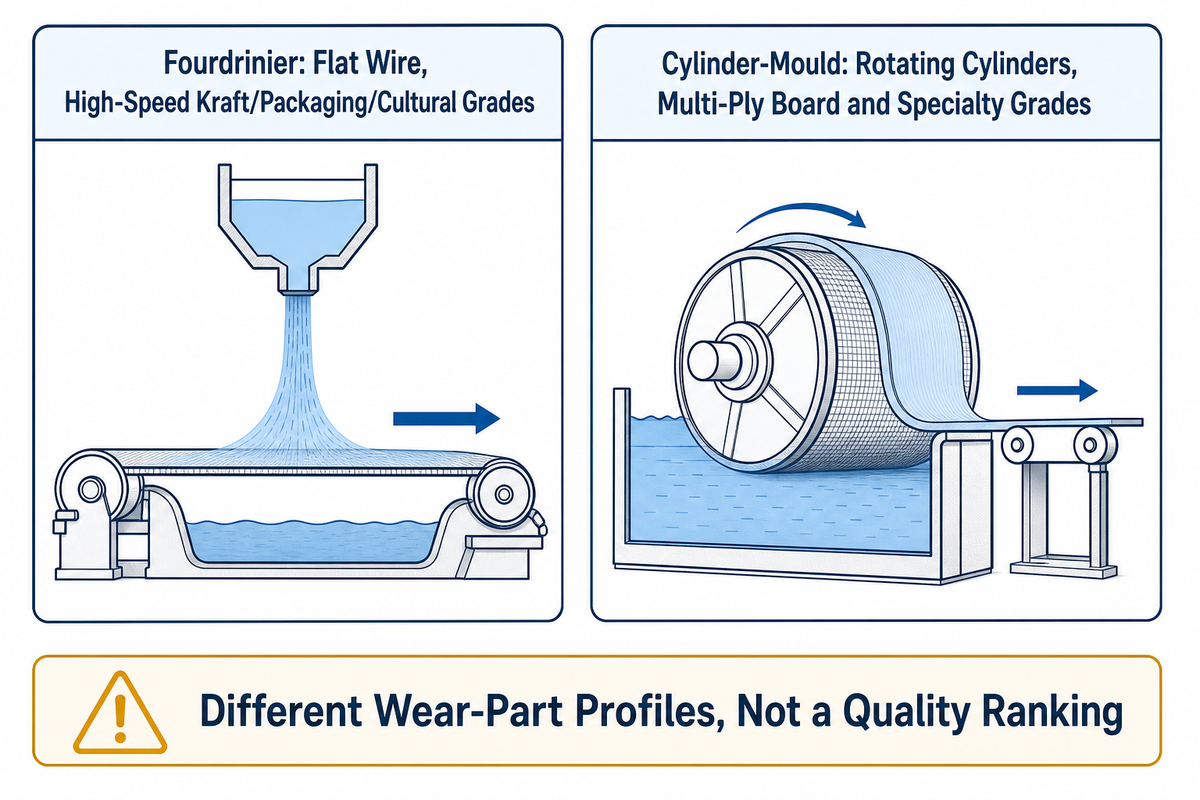
Machine configuration match means confirming a supplier actually builds the forming mechanism, headbox type, and drying-section length your target grade needs, not assuming any “paper machine” from their catalog will do. In practice, that starts with the forming mechanism itself: per peer-reviewed forming-mechanism research, Fourdrinier machines form the sheet on a flat moving wire with the jet landing on the forming table, while cylinder-mould machines form plies on rotating cylinders submerged in a vat — different mechanisms that drive different wear-part profiles and are suited to different grades. The exception: a supplier who offers only one forming mechanism isn’t necessarily wrong for your grade, but they should say so plainly rather than repositioning their standard machine as universally suitable.
What determines the choice between a Fourdrinier and a cylinder-mould machine?
Forming mechanism and target grade determine the choice: Fourdrinier machines dominate high-speed, high-volume production of kraft, packaging, and cultural paper grades because the flat-wire mechanism supports fast drainage at high line speeds, while cylinder-mould machines remain common for multi-ply board and specialty grades where layered sheet structure matters more than raw speed.
Headbox type — open or hydraulic — and basis weight range are the two specification fields that most directly narrow the field beyond forming mechanism: a headbox sized for lightweight tissue basis weights isn’t the same headbox a heavy kraft or duplex board line needs, and a supplier quoting outside their proven basis-weight range is quoting outside their own comfort zone.
Tissue paper manufacturing has its own configuration line item if tissue is part of your product mix, since a Yankee dryer cylinder and high-speed hood system are specific to tissue lines and aren’t simply a scaled-down kraft or packaging machine. Confirm the supplier’s tissue-machine references are actual tissue installations, not general paper-machine references relabeled for the RFQ.
Who actually builds paper mill machinery, and does that change your selection tips?
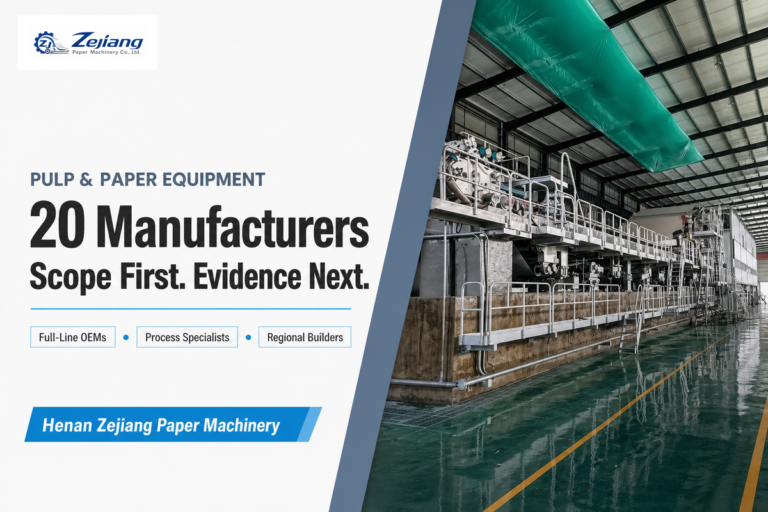
The global paper machinery manufacturer field spans full-line European builders such as Voith, Valmet, and Andritz; specialized tissue-focused builders such as Toscotec; parts and rebuild specialists such as Kadant; and regional manufacturers such as Parason and Henan Zejiang serving mills across Asia, the Middle East, Africa, and South America with a full paper machine, a complete paper production line, or individual paper machine parts.
A complete paper mill equipment list from any one supplier rarely covers every stage of every grade — a leading paper mill machinery manufacturer for kraft mill or board machine work isn’t automatically the reliable supplier of choice for a high-speed industrial paper or writing paper line, and a builder strong in European paper machine engineering standards isn’t automatically the reliable supplier for a plant on a different continent with different service logistics.
Selection tips worth applying at this stage: ask each candidate directly which grades their standard machine lineup actually covers today, not which grades their marketing literature lists as theoretically possible. Automatic paper handling, winder integration, and finished-paper quality control on the reel are frequently treated as an afterthought in early conversations — automation as an afterthought on a modern paper line tends to resurface later as a commissioning delay, so raise it during the RFQ stage rather than after the contract is signed. Machine configurations differ enough between builders that a runnability problem on one supplier’s forming section isn’t evidence the whole category is unreliable; it’s evidence to ask that specific supplier for their runnability data on your target basis-weight range before finalizing paper quality expectations.
Full-Line Turnkey vs. Specialized Component Supplier: Which Scope Do You Need?
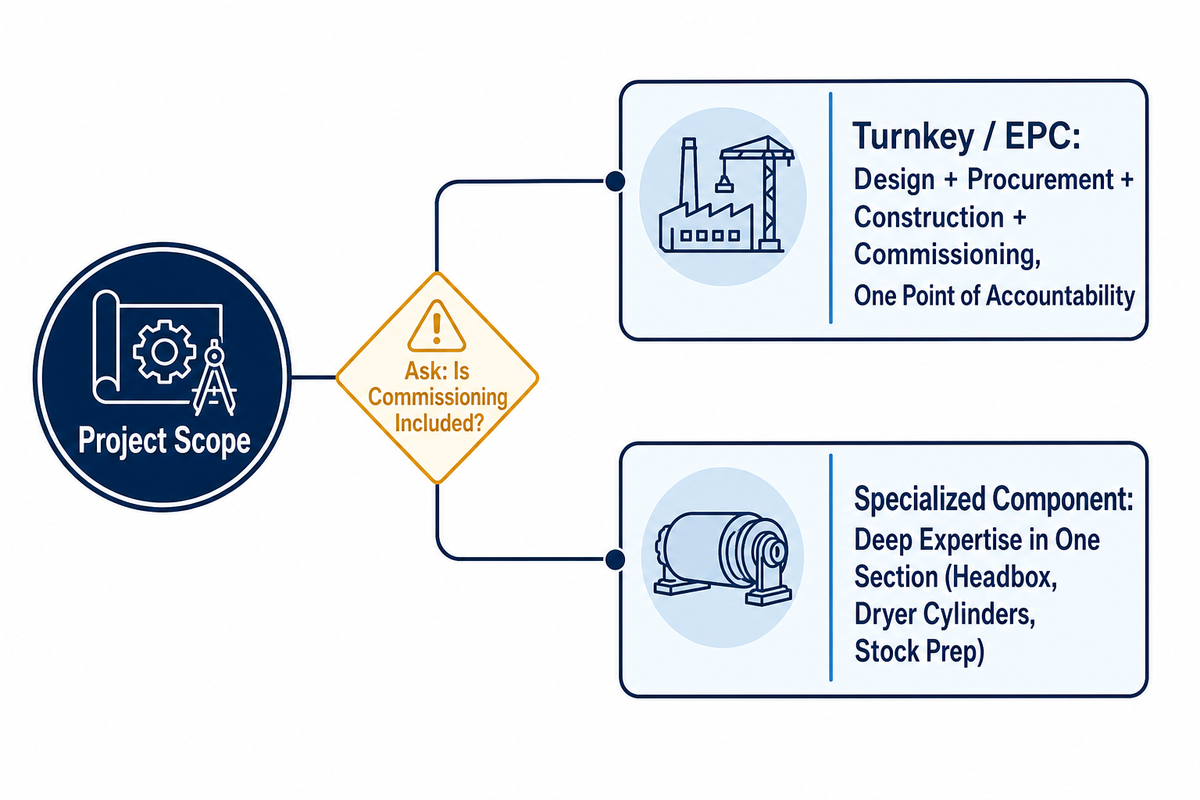
Turnkey and EPC scope nominally covers design, procurement, construction, and commissioning under one contract with a single point of accountability, but commissioning and startup services are usually, though not always, included — confirming inclusion explicitly, rather than assuming it, is the deciding factor between a full-line and a specialized-component supplier relationship.
Replacing one section of an existing line — a headbox, a set of dryer cylinders, a stock-preparation stage such as pulping and stock-preparation equipment — is better served by a specialized-component supplier with deep expertise in that section than by a generalist turnkey contractor bidding a scope larger than the actual need.
Contract language should name specific equipment models, performance guarantees, and acceptance criteria regardless of which scope you choose. Vague language on these points transfers risk back to the buyer even in a turnkey contract, despite the buyer paying for a single point of accountability. Ask explicitly: is commissioning included, and if so, what does the acceptance test look like and who signs off on it.
The 11-Field RFQ Comparability Grid: Comparing Paper Machine Quotes on Equal Terms
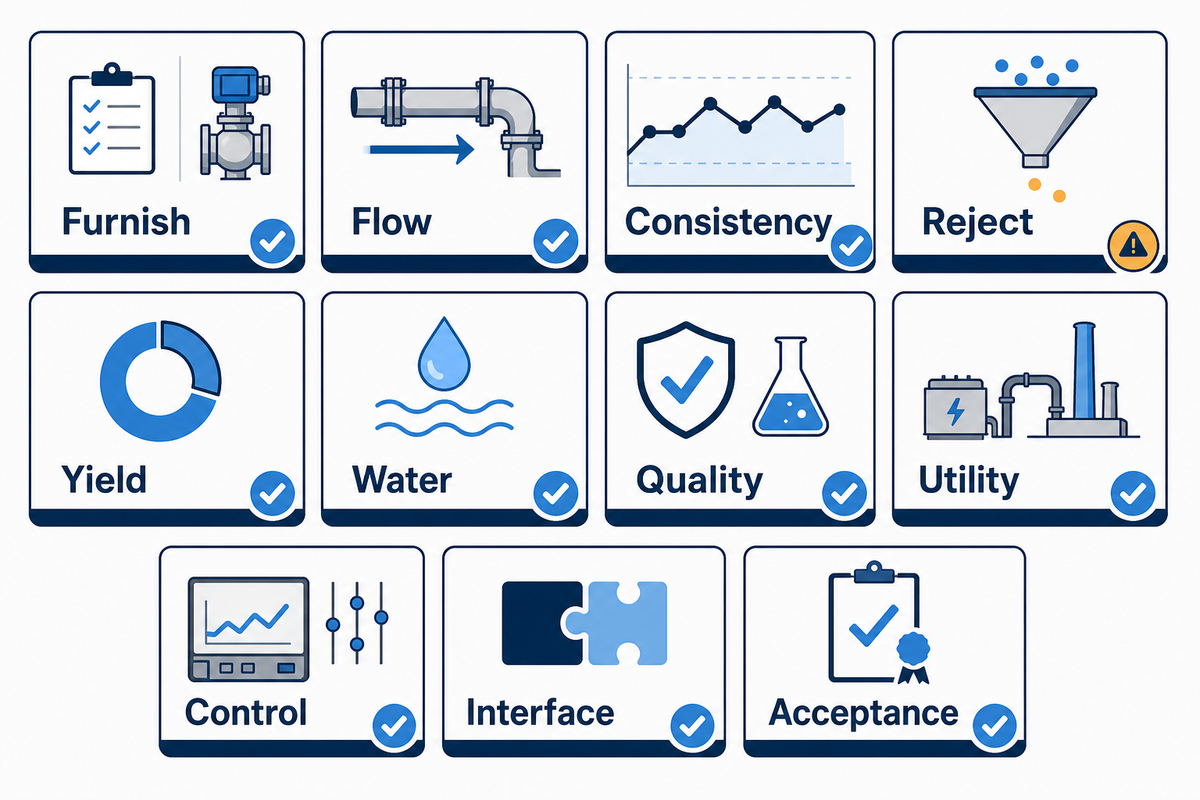
Two paper-machine or stock-preparation quotations are only comparable when furnish, flow, consistency, reject, yield, water, quality, utility, control, interface, and acceptance fields use the same definitions across both bids — the field set itself tracks the unit operations the EPA’s own recovered-paper processing map defines for a stock-preparation line. Without that normalization, a buyer comparing two number totals is really comparing two different scopes dressed up as the same line item — and the lower number usually wins the comparison for the wrong reason.
The table below is the RFQ Comparability Grid: eleven fields, defined once, applied to every quote you request. Copy it into your own RFQ template before you send it to a second supplier.
RFQ checklist — copy these into your quote request:
| Field Type | What to specify | Why it matters | Not suitable for / Limitations |
|---|---|---|---|
| Furnish | Fiber source, blend ratio, contamination profile | Drives every downstream equipment sizing decision | Not usable if furnish varies batch-to-batch without a stated range |
| Flow | Design flow rate, m3/h, at target capacity | Sets pump, screen, and headbox sizing | Not comparable across quotes at different assumed capacities |
| Consistency | Inlet and target consistency, percent | Determines pulper type and dilution-water demand | Not meaningful without a stated furnish |
| Reject | Expected reject rate and disposal route | Affects yield economics and downstream screen/cleaner sizing | Not suitable for comparing new-furnish lines with no reject history |
| Yield | Accepted fiber yield target, percent | Directly determines cost per accepted ton | Vendor-claimed yield without a test basis is not verifiable pre-purchase |
| Water | Freshwater demand and loop-closure level | Sets water-treatment and effluent-handling scope | Not suitable for mills without a stated water-loop target |
| Quality | Target grade specs (basis weight, brightness, strength) | The acceptance benchmark for the finished machine | Not usable if quality targets are described qualitatively only |
| Utility | Electrical load (kW), steam, compressed air demand | Determines whether existing mill utilities can support the new line | Not comparable if one quote omits utility consumption entirely |
| Control | PLC/DCS platform and instrumentation scope | Affects integration cost with existing mill control systems | Not suitable for buyers without a defined existing control platform |
| Interface | Mechanical and piping tie-in points to existing equipment | The single most common source of installation change orders | Not usable for greenfield lines with no existing equipment to interface with |
| Acceptance | Test protocol, duration, and sign-off criteria | Defines when the supplier’s obligation is actually complete | Not meaningful without a named responsible party for sign-off |
Notice what the grid doesn’t include as its first column: price. Price only becomes a meaningful comparison after these eleven fields are held constant across every quote. Comparing price before specifications means comparing numbers that were never describing the same machine in the first place.
After-Sales Support, Spare Parts, and Maintenance Programs
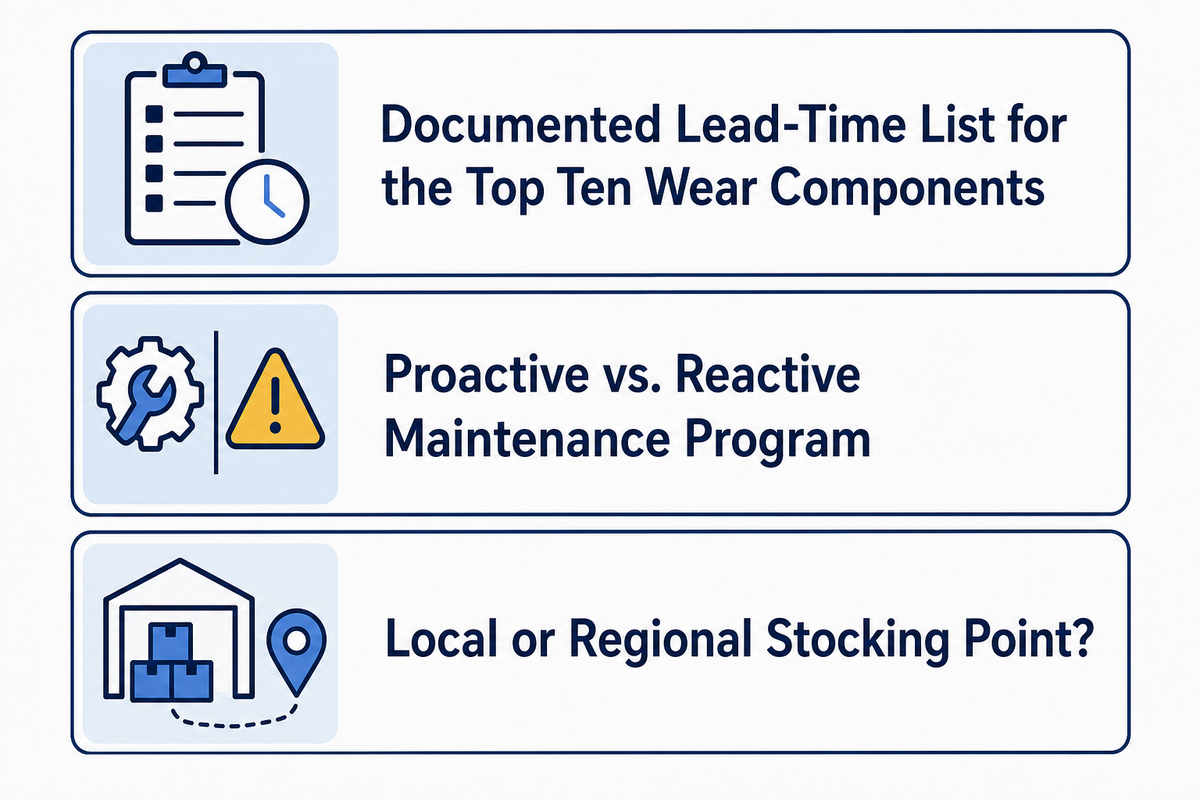
A supplier’s after-sales program is worth evaluating on its own merits alongside the purchase price, not treated as an afterthought negotiated after delivery. Ask for a documented spare-parts lead-time list for the top ten wear components before you sign, not after the machine breaks down for the first time.
How do I evaluate spare parts and service availability before buying?
Proactive and predictive maintenance programs are consistently documented — including in the US Department of Energy’s Operations & Maintenance Best Practices Guide — to extend component life and cut unplanned downtime compared with reactive, run-to-failure maintenance. The exact scale of the benefit varies by equipment type and mill conditions, so treat any single vendor’s percentage claim as a directional data point, not a guarantee for your specific line.
Failing to name specific lead times for the parts most likely to wear first — doctor blades, felts, screen baskets, dryer-fabric components — signals that after-sales and technical support weren’t built into a supplier’s commercial offer. Utility costs matter here too: a supplier’s stated energy consumption figures for the machine sections you’re buying should be checked against your own mill’s utility capacity, not taken as a marketing number. Ask the question directly during the RFQ stage: what’s the lead time on the five parts most likely to need replacement in year one, and is there a local or regional stocking point.
New vs. Used vs. Rebuilt Paper Machinery: Different Due Diligence
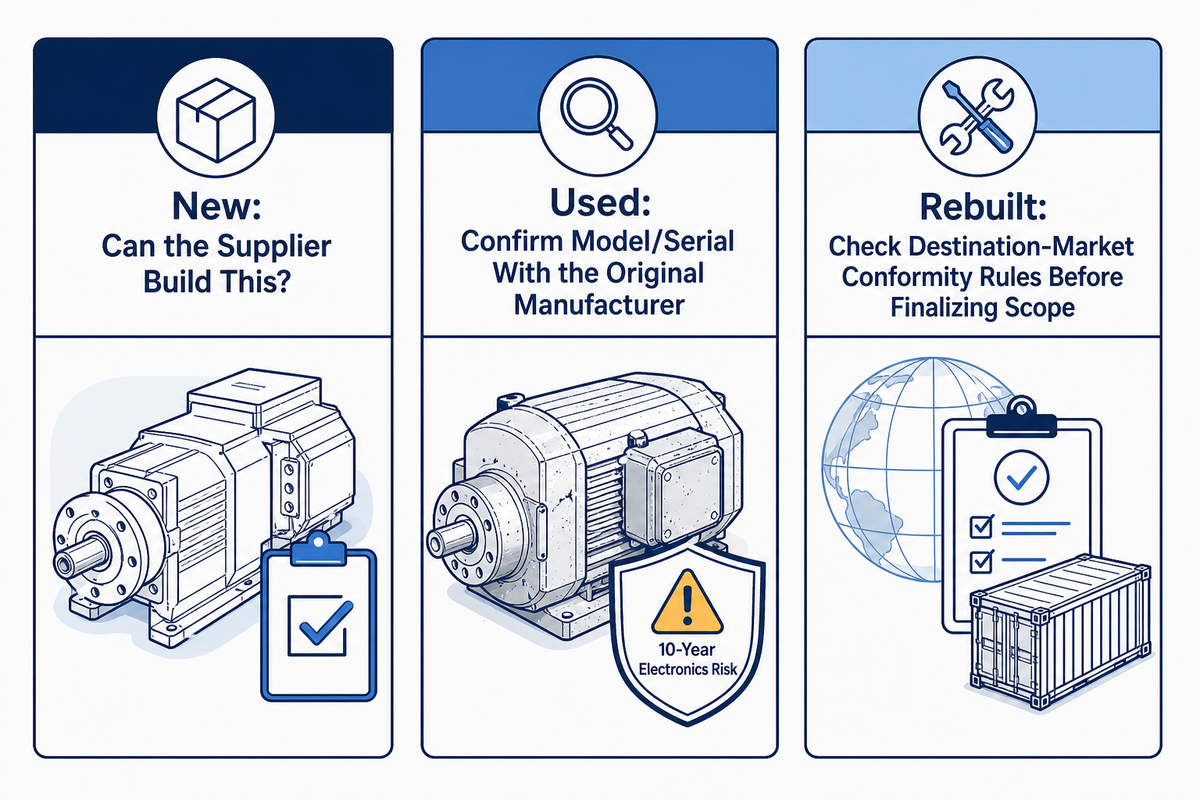
Used and rebuilt equipment needs a different due-diligence track than a new-build quote, because the questions that matter shift from “can you build this” to “what condition is this actually in and who stands behind it now.” Before purchasing a used machine, contact the original manufacturer directly with the model and serial number to confirm whether it was a standard off-the-shelf configuration or a customized build — a distinction that changes what spare parts will actually fit. A surface inspection can miss wear issues that only a technician with model-specific experience will catch, and as a practical rule of thumb, machines with electronics older than ten years carry a real risk that the original control-system components are no longer supported or manufactured.
Destination-market conformity rules for modified or rebuilt machinery are worth checking before finalizing scope, not after. As one documented example, the European Union’s machinery regulatory framework treats a substantial modification that introduces a new or increased hazard as triggering a fresh conformity assessment, with the party performing the modification taking on manufacturer-level responsibility for that part — a framework buyers can independently verify against their own destination market’s current rules, since specific thresholds and effective dates change and vary by jurisdiction. A buyer’s own trade-compliance counsel or the destination customs authority is the authoritative source for the exact rule that applies to a specific rebuild.
Red Flags That Signal a Risky Paper Machine Supplier
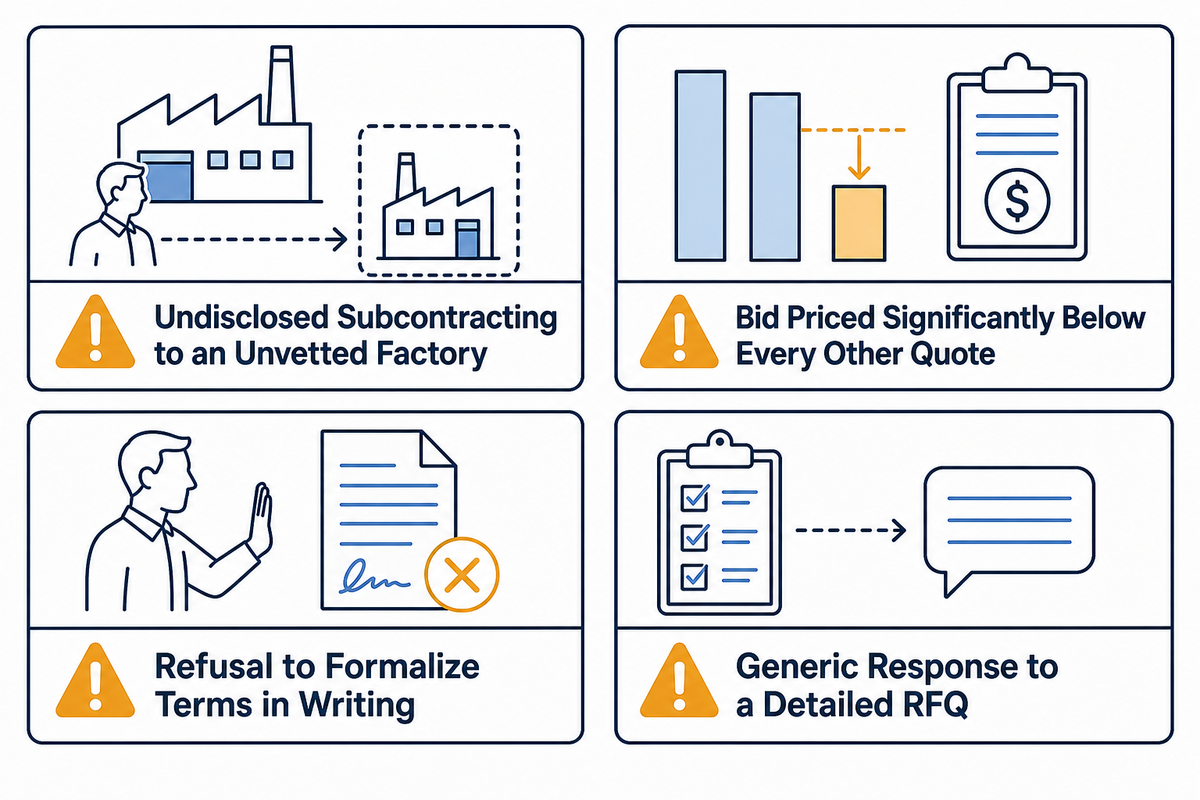
Four practitioner-reported patterns show up repeatedly in accounts of overseas equipment-sourcing problems, and each is a legitimate reason to pause before committing. The first involves transparency: undisclosed subcontracting to a third-party factory the buyer has never vetted. If fabrication is being outsourced without disclosure, the buyer has no visibility into who’s actually building the machine or under what quality controls. A bid priced significantly below every other quote received is a second: an unusually low price is often recovered later through reduced material quality, added fees, or missed delivery commitments rather than being a genuine cost advantage.
⚠️ Important
A refusal to formalize pricing, specifications, lead time, and payment terms in a written quotation is a red flag on its own — without a formal document, a buyer has no basis for a dispute if delivered equipment doesn’t match what was discussed verbally. Getting a generic response to a detailed RFQ — one that answers only one of five stated requirements — tells you the supplier did not read your brief closely enough to be trusted with the rest of the project.
The common thread across all four patterns: the lowest bid isn’t always the cheapest outcome once hidden delivery, installation, and support costs surface later in the project, and cost-of-quality literature from the American Society for Quality consistently describes the same principle: a defect is cheaper to catch and fix at the sourcing stage than after installation, with the cost gap widening at each stage the problem goes undetected. Price comparison only works after the 11-Field RFQ Comparability Grid has normalized the scope; comparing price on its own is how buyers get burned by exactly these four patterns.
Why Paper Mills Are Vetting Suppliers More Carefully in 2026
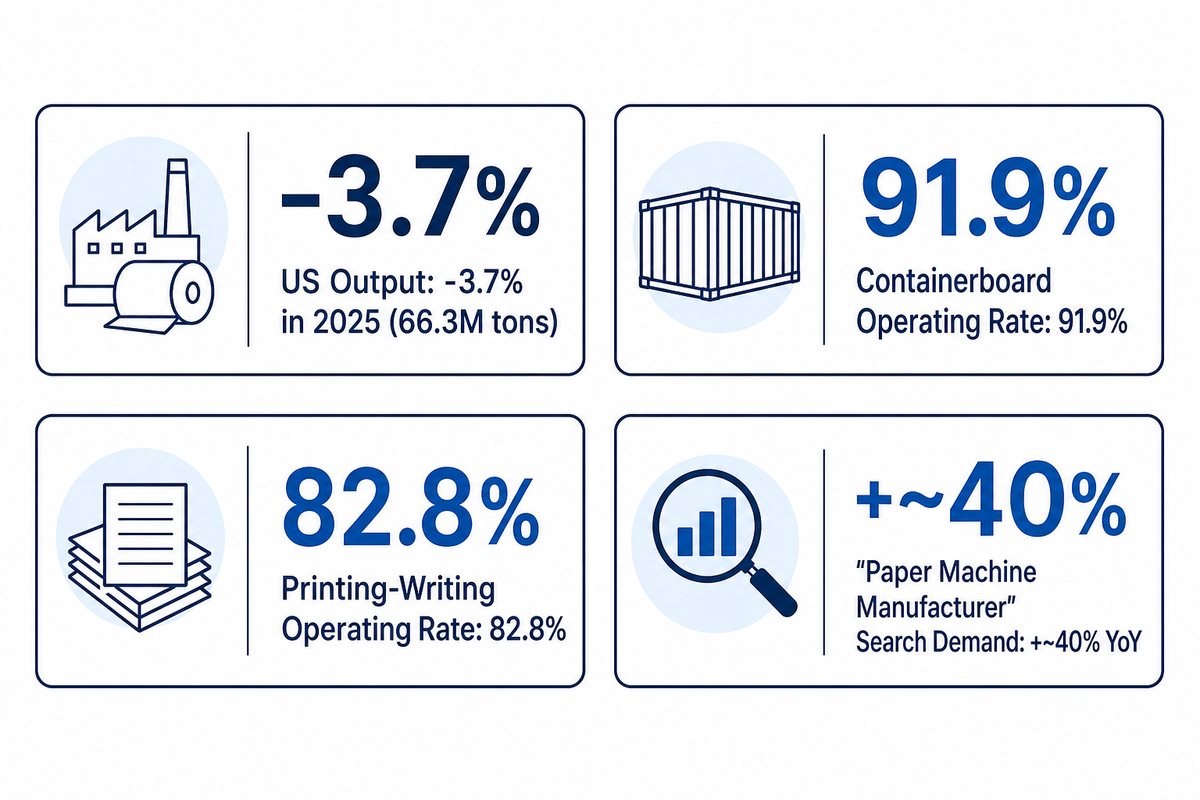
US paper production and paperboard output declined 3.7% in 2025 to 66.3 million tons per AF&PA’s 66th annual capacity and fiber-consumption survey, yet containerboard operating rates held at 91.9% and printing-writing operating rates improved to 82.8% — AF&PA frames this as manufacturers “investing and aligning capacity with demand” rather than describing acute closures.
That combination — lower total output, solid or improving operating rates at the mills still running, and printing-writing capacity down 13.9% in what the survey calls a long-term segment adjustment rather than a shutdown — means the mills still buying equipment are making fewer purchase decisions, and each one carries more weight than it would in a market with more redundant capacity. Search-demand data for “paper machine manufacturer” queries independently shows a year-over-year increase of roughly 40%, consistent with buyers actively researching suppliers rather than simply repeat-ordering from an established vendor.
The practical implication for a buyer: in a market with fewer, higher-stakes purchase decisions, the cost of choosing the wrong supplier is higher than it would be in a market where a bad decision could be quietly replaced next budget cycle. The 3-Part Supplier Qualification Gate and RFQ Comparability Grid in this guide exist because of that shift, not despite it.
A live check of how AI answer engines cover this exact buyer question — run across Perplexity and ChatGPT for this article — turned up zero citations of Henan Zejiang and a competitive citation set dominated by directory and marketplace listings (worldpapermill.com, alibaba.com, europages.co.uk, and similar aggregator pages) rather than manufacturer-authored technical content. That gap is itself a data point: a buyer who asks an AI assistant how to choose a paper machinery supplier today is being served marketing copy and directory listings, not a sourced qualification framework — which is the gap this checklist is written to fill.
None of this means the global paper market is shrinking in a way that should discourage investment — it means the global market for machinery and global service contracts is consolidating around suppliers who can prove reliability, not simply quote the lowest number. Every paper mill considering a new paper mill line, a rebuild, or a targeted section replacement is, in effect, running its own small piece of industry research on the supplier landscape before committing capital; the checklist in this guide is meant to make that research process faster and less error-prone. Weighing a new-paper-mill-scale project against a smaller retrofit at a modern paper mill still means the same qualification and RFQ logic applies at either scale, whether the buyer needs a complete turnkey line, a complete mill upgrade, or a single paper machine section such as refiners and screens or a pulp slurry handling stage feeding the wet end. Top global buyers and small regional mills alike are asking harder questions about who actually produced the paper their new equipment will make — the paper produced on a poorly-vetted line costs more to fix than the machinery itself.
The Team Behind This Report
This buyer’s checklist was written and reviewed by Henan Zejiang Paper Machinery’s technical team, drawing on our own supplier-side experience building and shipping pulping and paper machine equipment to mills across Asia, the Middle East, Africa, and South America. The compliance-verification and RFQ-comparability sections reflect the same questions we expect a serious buyer to ask us before signing a quote — if a supplier resists answering them, that resistance is itself useful information.
Frequently Asked Questions
How do I evaluate spare parts and service availability before buying?
Request a documented lead-time list for the top ten wear components before signing, and ask directly whether the supplier offers a proactive or predictive maintenance program rather than reactive, run-to-failure support.
Ask for specific lead times on the parts most likely to wear first in year one — doctor blades, felts, screen baskets, and dryer-fabric components — and confirm whether there is a regional stocking point or the parts ship from the factory on every order. Proactive maintenance programs are consistently documented to reduce unplanned downtime compared with reactive, run-to-failure maintenance; one vendor-reported paper-mill case documented a 72% reduction in production breaks after implementing condition-based monitoring, though results vary by mill and should be treated as directional rather than guaranteed.
What’s typically included in a turnkey paper machine installation contract?
Design, procurement, construction, and commissioning are the standard turnkey/EPC scope, but commissioning inclusion should be confirmed explicitly in writing before signing, not simply assumed from the word “turnkey.”
A turnkey or EPC contract nominally covers the full project lifecycle from engineering design through procurement, construction, and commissioning under one point of accountability. Commissioning and startup services are usually, but not always, part of that scope, so ask directly whether they are included and what the acceptance-test protocol looks like before signing. The contract should also name specific equipment models, performance guarantees, and acceptance criteria in writing, since vague language on these points shifts risk back onto the buyer even under a single-accountability contract.
How much does a new paper machine typically cost?
Pricing depends heavily on capacity, target grade, and turnkey-versus-component scope, which is exactly why the 11-Field RFQ Comparability Grid exists before any price comparison can be considered meaningful.
Paper machine pricing varies too widely by capacity (TPD), target grade, forming mechanism, and turnkey-versus-component scope to state a single reliable figure, and any number quoted without those variables specified should be treated as directional at best. The more useful question at the RFQ stage is not “what does a paper machine cost” but “what does a machine matching these eleven RFQ Comparability Grid fields cost from each supplier” — because that is the only price comparison that is actually comparing the same machine.
What determines the choice between a Fourdrinier and a cylinder-mould machine?
Forming mechanism, target line speed, and ply structure decide it: Fourdrinier machines suit high-speed single-ply grades, while cylinder-mould machines suit multi-ply board and specialty layered grades.
Fourdrinier machines form the sheet on a flat wire at higher speed, suiting high-volume kraft and packaging grades. Cylinder-mould machines form plies on rotating cylinders, suiting multi-ply board.
Is investing in paper-mill machinery still worthwhile given current industry capacity trends?
Yes for modernization and retrofit purchases — AF&PA’s own data attributes recent capacity declines partly to mills investing in newer equipment, not to the industry shrinking overall demand for capable machinery.
US production fell 3.7% in 2025 while containerboard and printing-writing operating rates held firm or improved, and AF&PA frames the shift as manufacturers aligning capacity with demand rather than a broad contraction. That pattern points toward continued equipment investment concentrated in fewer, more carefully vetted purchase decisions — which is a reason to invest carefully, not a reason to avoid investing.
References & Sources
- ISO 9001 Explained International Organization for Standardization
- 29 CFR 1910.261, Pulp, Paper, and Paperboard Mills U.S. Occupational Safety and Health Administration
- FAR 9.104-1, General Standards U.S. General Services Administration, Acquisition.gov
- Regulation (EU) 2023/1230 on Machinery European Agency for Safety and Health at Work
- AF&PA Releases 66th Annual Paper Industry Capacity and Fiber Consumption Survey American Forest & Paper Association
- Pressure Vessel Regulation Reference The National Board of Boiler and Pressure Vessel Inspectors
Related Articles
- Types of Pulpers: A Comparison Guide furnish-specific pulper selection, for buyers narrowing stock-preparation scope
- Disc Refiner Guide plate wear signals and replacement-cycle planning for the refining stage
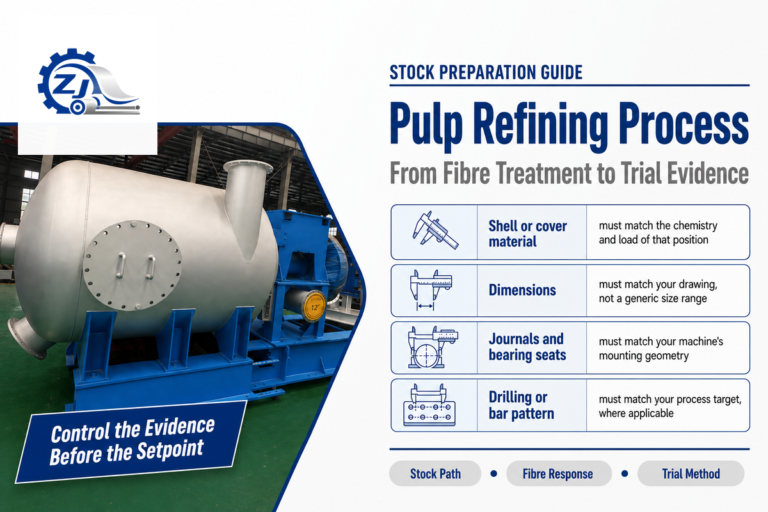
- Stock Preparation Process: Step-by-Step the full process sequence this guide’s requirements brief feeds into
![Refiner Plates & Screen Baskets [Complete Guide]](https://zjpapermachine.com/wp-content/uploads/2026/07/refiner-plates-screen-baskets-guide-featured-150x150.png)
![Doctor Blade: Types, Materials & How It Works [Guide]](https://zjpapermachine.com/wp-content/uploads/2026/07/doctor-blade-guide-featured-1-150x150.png)
![Pulping Equipment: How Paper Pulping Works [Guide]](https://zjpapermachine.com/wp-content/uploads/2026/07/pulping-equipment-guide-featured-150x150.png)