Get in touch with Zejiang Paper Machinery Company


Quick Specs
Control basis: coordinated section surface speeds. Selection basis: torque across the operating duty. Retrofit boundary: motors, power, mechanics, communications, protective functions and environment.
Paper mill drives provide motion to carry a sheet through the paper machine and run other equipment in the mill. Sectional drives control motion of separate motor groups and allow for different speeds between groups. A successful upgrade balances this control with the motor duty, mechanical load and remaining equipment in the mill. Start with the section that constrains the production process before choosing replacement hardware.
Paper mill drives regulate motor speed and torque. Sectional control coordinates roll surface speeds while allowing relative draw. Upgrade choices depend on the load, retained equipment and control interfaces.
Key points
- Equal motor rpm can produce different roll surface speeds.
- A direct drive can also be a sectional drive.
- Dryer condensate and wet-sheet properties can change the apparent drive problem.
- Healthy retained motors can reduce hardware replacement, while integration still needs engineering.
Paper Mill Drives: What Each Section Controls
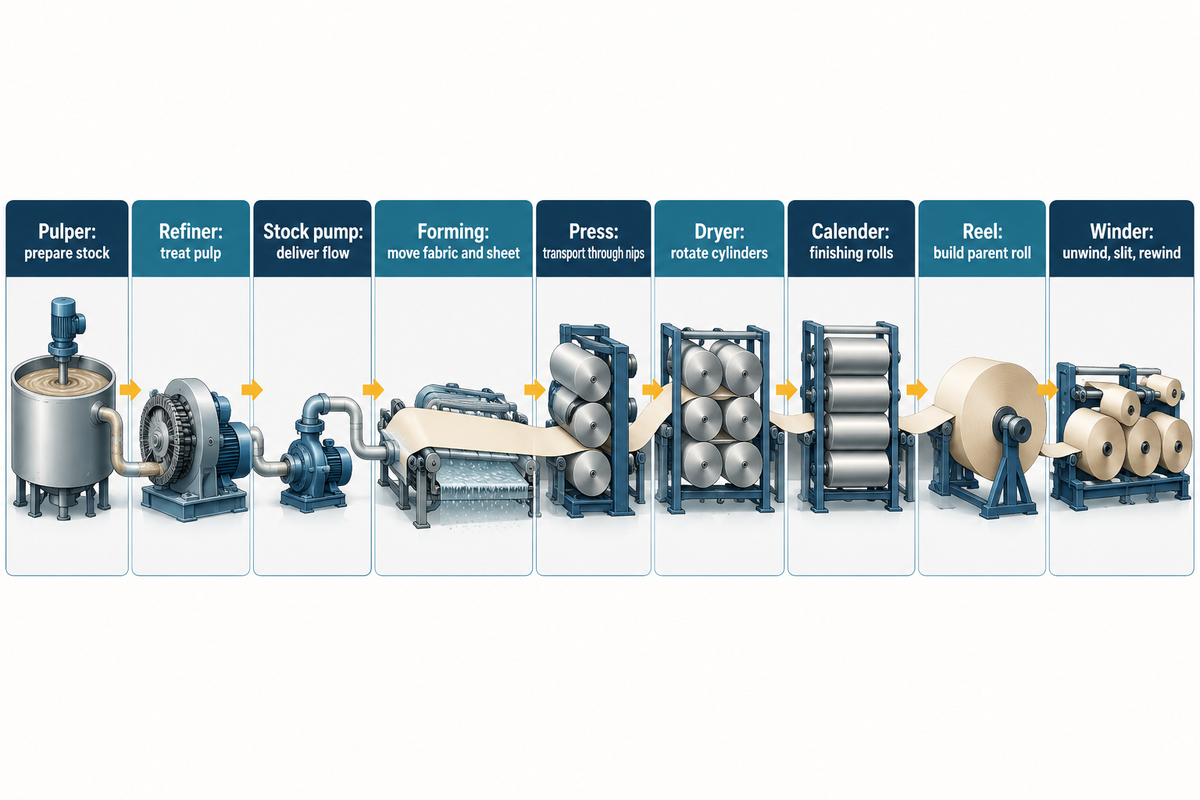
A paper machine drive controls the motion of a section, for example a group of presses or dryers or a reel. The control system coordinates the different sections around the required web speed. Other electric drives in a pulp and paper mill serve various other functions. Therefore, a complete motor list for the mill needs to distinguish sheet transport from stock preparation and utility functions.
One can think of sheet transport in a mill as a relay race: the section receives the material from the previous section, but the sheet being transported changes, i.e. water leaves it. Control of the various sections means that one doesn’t have to command every motor to turn at constant speed. The paper machine sections and parts determine the loads for each group.
| Equipment group | Principal duty | Selection question |
|---|---|---|
| Pulper | Prepare raw material and disperse stock | What starting and process loads must the motor carry? |
| Refiner or beater | Treat pulp to the required condition | How does the operating load change with stock? |
| Stock pump | Deliver flow through the stock system | What flow, pressure and system resistance are required? |
| Forming section | Move the forming fabric and developing sheet | Which driven rolls share the transport duty? |
| Press section | Transport the web through pressing | How do nip loading and adjacent draws affect the duty? |
| Dryer group | Rotate cylinders or transmit fabric traction | What happens to torque as condensate conditions change? |
| Calender | Move the sheet through finishing rolls | Which speed and mechanical-load limits apply? |
| Reel section | Build the parent roll | How are speed, torque and roll-building functions coordinated? |
| Separate winder | Unwind, slit and rewind the parent roll | How do changing diameters affect the control duty? |
The same paper industry site may house a conveyor and some ventilation fans. Their presence doesn’t mean their load curves are suited for a press roll. Wood pulp preparation, paper making and roll finishing require separate duty descriptions, even if one automation system supervises them.
Sectional Drives, Line Shaft Drives and Direct Drives
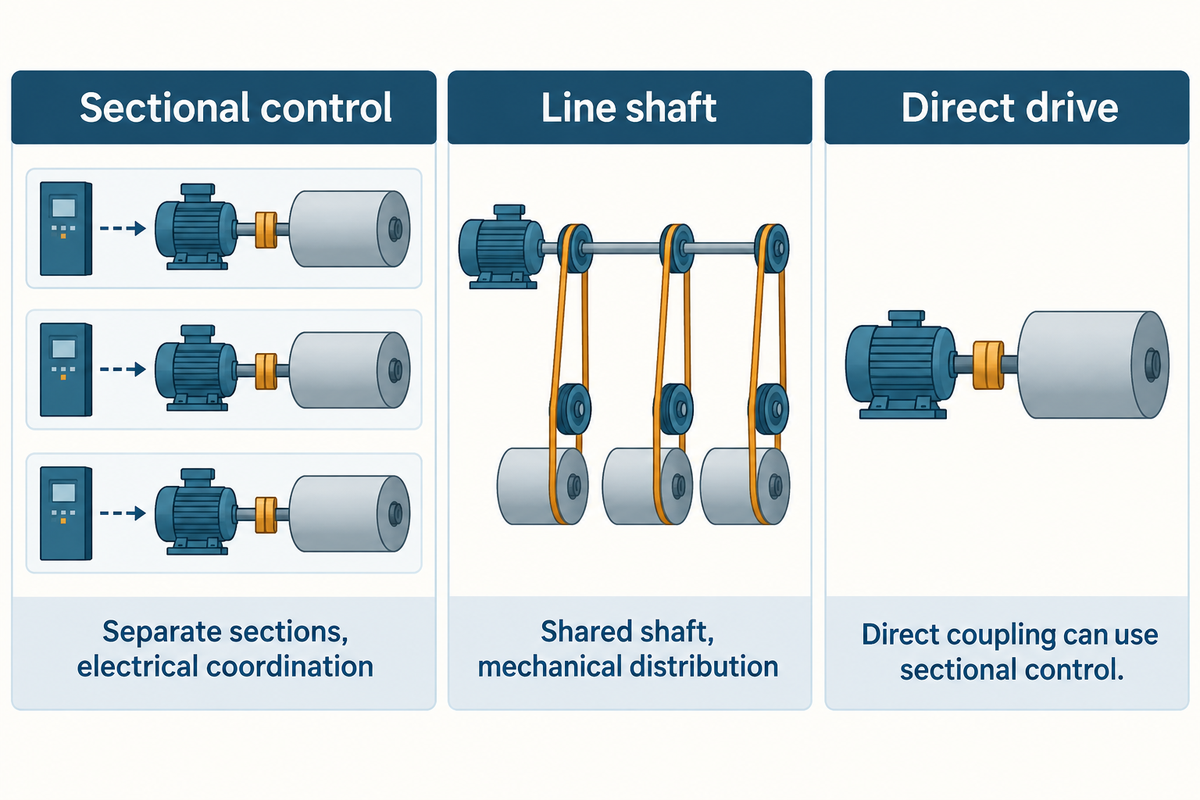
Sectional drives divide a machine into different sections that are separately driven and coordinated electrically. Line shaft drives distribute motion mechanically from a shared shaft. Direct drive refers to how a motor is connected to its load, and therefore can be used with sectional control. In a rebuild, separate decisions can be made regarding motor technology, control architecture, and mechanical transmission.
Which type of drive is used for paper mills?
Paper mills use several drive arrangements, and for the paper machine itself a Machine Design retrofit article states that either AC or DC drives can provide a very acceptable solution. In the case of a sectional paper machine, controlled AC motors or retained DC motors can be used. A direct drive removes a gearbox or other intermediate transmission where the application permits it, while a line shaft distributes motion mechanically. The choice is based on the requirements of the service and the existing setup.
A pulley or gearbox affects the relationship between motor speed and roll speed. With a directly coupled motor, the coupling arrangement simplifies the relationship, while the load and feedback still matter. ABB’s published direct-drive system description uses permanent magnet synchronous motors. In a rebuild, that equipment choice is separate from the integrator’s scope.
In the 2001 electronic line-shaft paper by Valenzuela and Lorenz, electrically controlled sections follow a reference signal using an auxiliary draw control. The paper provides the control principle; it doesn’t provide a universal tuning recipe for a modern paper mill.
Let’s say there’s a mill with serviceable DC motors but outdated converters. Retaining the motors may preserve the foundations, couplings and cables, as long as their condition and replacement-control compatibility are acceptable. Conversion to induction motors may be more enticing if further repairs and unavailable spares dominate maintenance. Finance should assess these installed scopes before deciding which converter price is lower.
Speed Control: Set Draw from Surface Speed
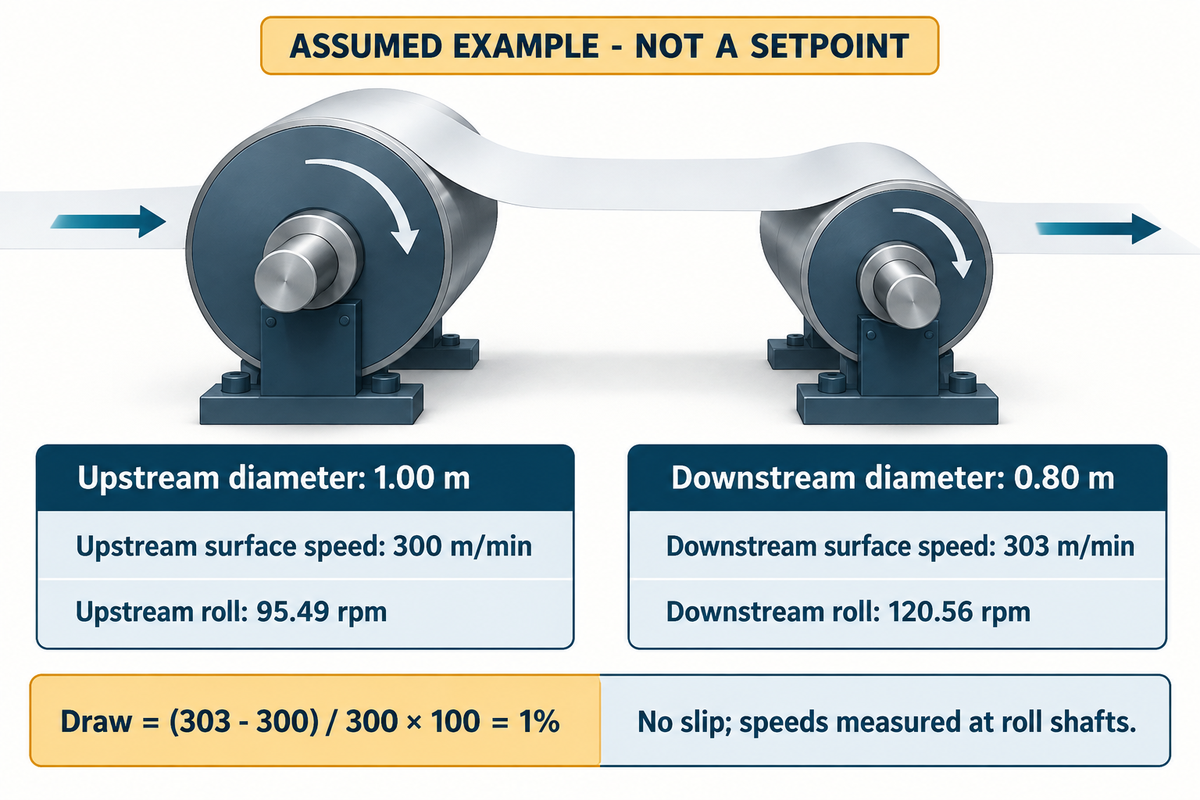
Draws compare surface speeds of succeeding sections and not motor rpm. Speed of rotation should be converted using the actual roll diameter and transmission ratio before comparing section surface speeds. A common convention divides the downstream speed increase by the upstream speed; this ratio describes motion, while tension also depends on the web and its interaction with the machine.
Speed-to-Draw Comparison
For this example, let the upstream roll diameter be 1.00 m and downstream roll diameter be 0.80 m, and assume no slip and speeds measured at the roll shafts. For this arithmetic example, the upstream surface speed is 300 m/min and the downstream surface speed is 303 m/min. Results of this draw are for example only and shouldn’t be considered a commissioning draw.
| Quantity | Upstream roll | Downstream roll |
|---|---|---|
| Roll diameter, D | 1.00 m | 0.80 m |
| Surface speed, v | 300 m/min | 303 m/min |
| Roll speed, n = v / (π × D) | 95.49 rpm | 120.56 rpm |
| Surface speed if both rolls run at 100 rpm | 314.16 m/min | 251.33 m/min |
To calculate surface speed in m/min with diameter D in metres and roll speed n in rpm, use the equation v = π × D × n. A gearbox requires its speed ratio to be applied before using motor rpm as roll rpm. The Massachusetts Institute of Technology teaching example expresses the same circumference relationship with imperial units.
According to Edvardsson and Uesaka’s open-draw study, using the definition of upstream-reference, draw = (303 – 300) / 300 × 100 = 1%. For that surface-speed relationship, the two rolls must have different rotational speeds. Equal rpm would slow the surface speed of the smaller downstream roll in this case.
Let’s consider a sheet break while the displayed draw remains steady. Before increasing a speed trim, consider feedback scaling and the roll diameter as compared to the wet-sheet condition. Edvardsson and Uesaka’s study showed that model instability can occur at a fixed draw when the speed or material properties change. An encoder can verify rotation; it doesn’t measure every property that determines sheet tension. Open loop control also needs a different evaluation as compared to a system using measured speed feedback.
Motor Sizing: Match Torque to the Full Duty
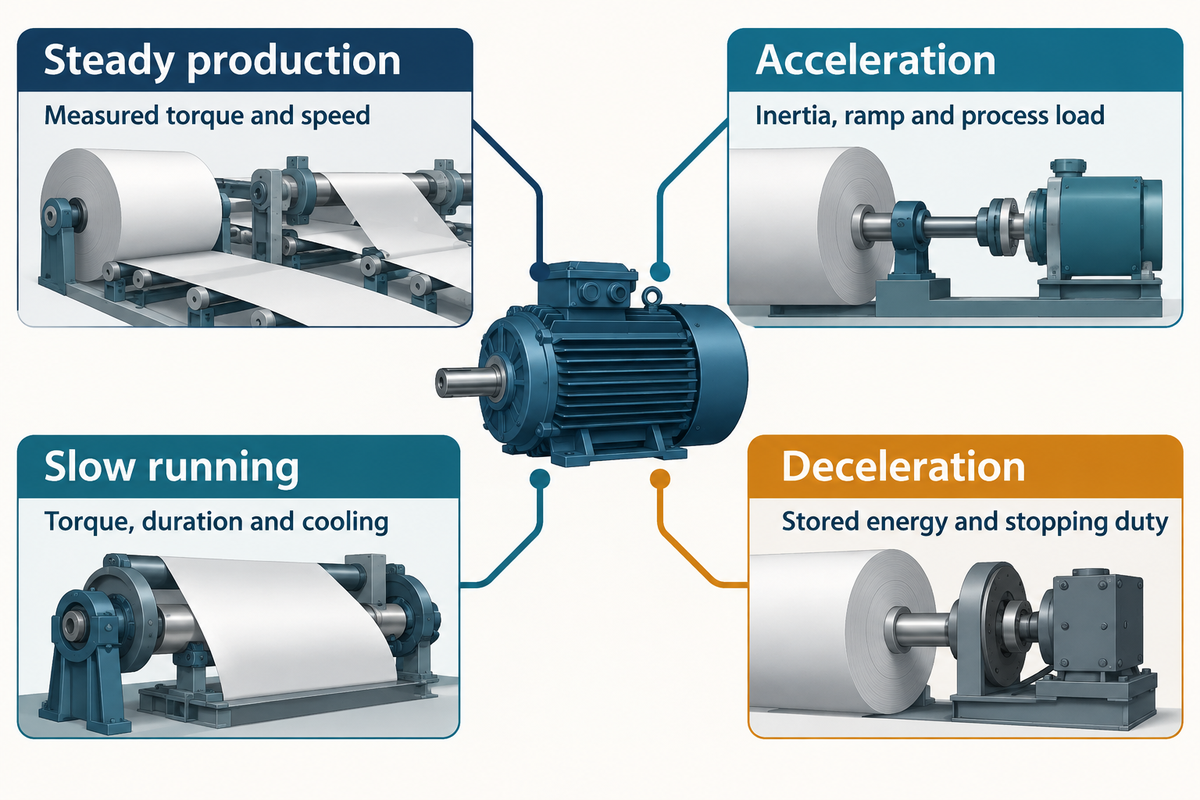
Selection of a drive motor must take into account the complete torque-speed duty, including acceleration, sustained running, low-speed operation and braking. Nameplate power of the motor being considered doesn’t address these requirements alone. Match the motor, converter and cooling arrangement and determine whether an apparent overload is caused by the production process or a mechanical problem before increasing the rating.
High-inertia rolls require acceleration torque and running torque. Shorter acceleration times change the demand, even if the final speed remains the same. Low-speed thermal capability is dependent on the particular electric motor and its cooling arrangement. Regenerative operation also requires an appropriate path of power; increasing the size of the inverter doesn’t automatically create that path.
| Duty state | Information needed | Decision affected |
|---|---|---|
| Steady production | Measured torque and speed across intended grades | Continuous motor and converter capability |
| Acceleration | Reflected inertia, ramp and process load | Peak capability and acceleration plan |
| Slow running | Required torque, duration and cooling | Low-speed operating limits |
| Deceleration | Stored energy and required stopping duty | Braking or regenerative equipment |
A dryer cylinder adds a process-dependent load. The TAPPI 2008 dryer-drive study abstract reports increased torque with greater condensate quantity and a reduction when condensate enters the rimming condition. Its findings make the steam-condensate system relevant to drive sizing, rather than treating the cylinder as an unchanging mechanical load.
“Sizing should be based on actual loads rather than rated motor capacity.”
For example, a particular group of dryers may show high current during a process transition, but later may show acceptable current after reaching stable production. Replacing the motor immediately leaves the reason for the problem uncertain. Compare the transition with condensate behavior and acceleration duty, then evaluate the measured load against the permissible duty of the equipment. Production and maintenance can determine whether the problem is a capacity requirement or a need for a process correction.
Paper Machine Drive Problems: Locate the Limiting Section
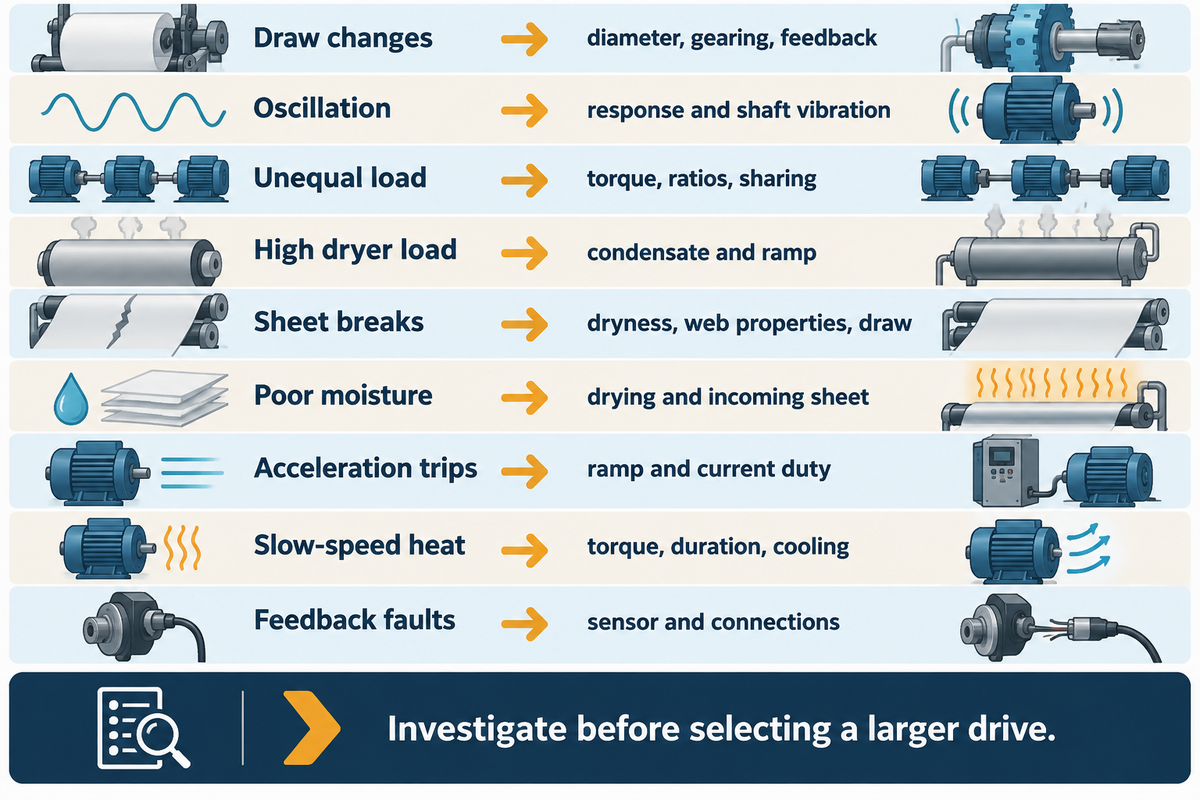
A drive alarm indicates where a limit was reached, but diagnosis requires analysis of the electrical, mechanical and process data associated with that event. Compare the behavior of command, feedback and load elements on a common time frame. The scope for a useful upgrade depends on which constraint persists after scaling, mechanical condition and paper-process causes have been checked.
| Observed problem | Compare next | Possible scope | Constraint a new drive may leave |
|---|---|---|---|
| Draw changes after roll replacement | Diameter, gearing and feedback scaling | Correct reference conversion | Incorrect mechanical data |
| Oscillation after tuning | Speed response with shaft vibration | Coordinated control and mechanical review | Elasticity or backlash |
| Unequal load in a coupled group | Torque signals, ratios and load-sharing settings | Load-sharing investigation | Unequal mechanical loading |
| High dryer load during transition | Condensate state and acceleration | Process and duty assessment | Condensate behavior |
| Sheet breaks with steady speed feedback | Dryness, web properties and draw | Sheet-handling investigation | Wet-web instability |
| Acceptable draw but poor final moisture | Drying duty and incoming sheet condition | Dryer or upstream process assessment | Thermal capacity |
| Trips during acceleration | Ramp demand, load and permitted current duty | Duty or equipment revision | Excessive acceleration demand |
| Motor overheating at slow speed | Torque, duration and cooling | Motor/cooling assessment | Insufficient heat removal |
| Intermittent feedback faults | Sensor, connection and environmental condition | Feedback-system repair | Damaged cabling or sensor installation |
The 2005 IEEE study of torsional oscillations warns that indiscriminately increasing speed-loop bandwidth can reduce stability. A high-performance control setting therefore needs to suit the mechanical drive components. More aggressive tuning is a poor substitute for understanding the coupling, gearbox and shaft system.
For a mill trying to increase output while maintaining paper quality, factors to be compared include press and couch roll functions and dryer-section capacity. Suction rolls and pressing affect the sheet entering the dryers. Should that remain the limiting factor upstream, purchasing additional drive capacity may leave the production ceiling unaffected.
Upgrade Interfaces: Reuse, Replace or Re-engineer
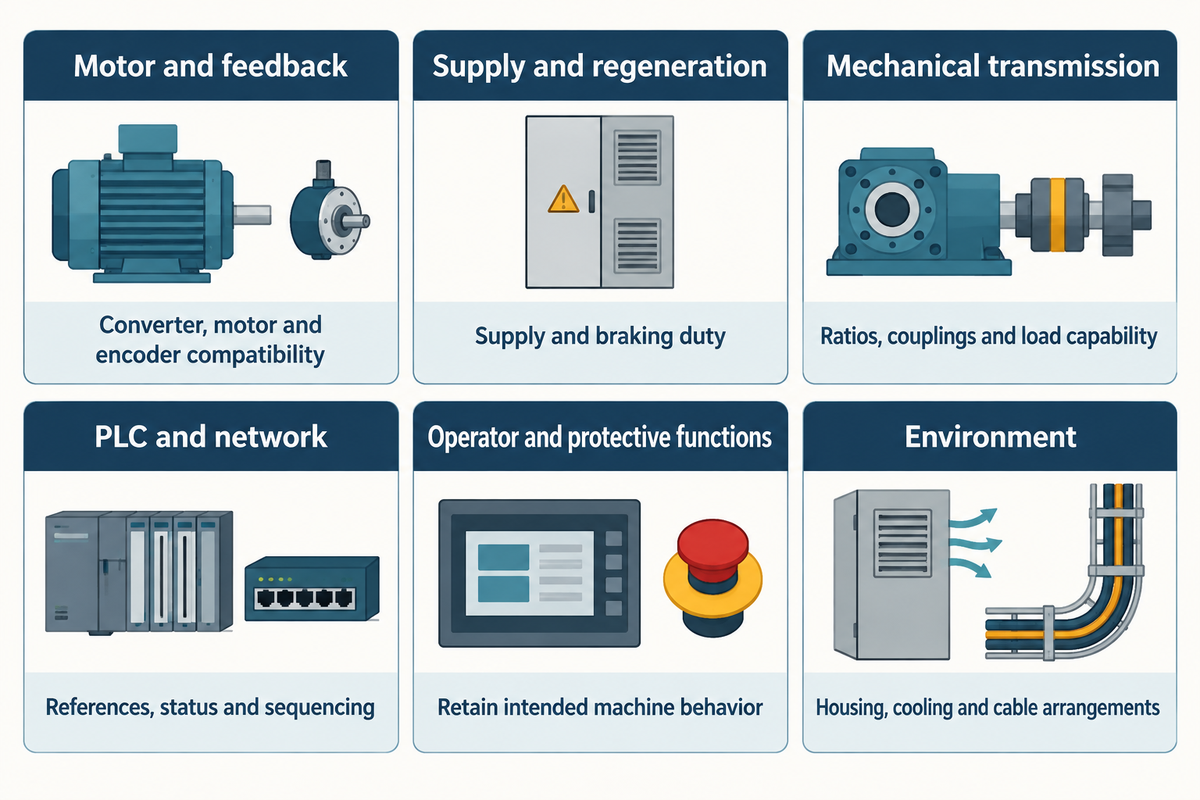
A partial upgrade is possible if the remaining machinery is still compatible with the replacement drive and the associated elements of the control system are still inter-coordinated. Review the motor, electrical supply, mechanical transmission, controller communications, operator protection and the environment as separate interfaces. If replacement is done within the interconnecting elements, it may create integration work, so the replacement boundary should follow those connections rather than cabinet boundaries.
| Interface | Retention question | When scope expands |
|---|---|---|
| Motor and feedback | Can the selected converter control the existing motor and encoder? | Motor condition or feedback incompatibility requires replacement |
| Supply and regeneration | Does the front-end suit the supply and braking duty? | Power architecture or protective coordination changes |
| Mechanical transmission | Are ratios, couplings and load capability suitable? | Mounting, gearing or torsional behavior needs redesign |
| PLC and network | Can references, status and sequencing be exchanged reliably? | Controllers or communications must change with the drives |
| Operator and protective functions | Do HMIs, commands and protective functions retain their intended behavior? | Machine-level safety design and validation are affected |
| Environment | Do housing, cooling and cable arrangements suit the installation? | Enclosures, ventilation or cable routes need revision |
Retention has a documented precedent. In their 2004 IEEE account of Sappi’s PM3 rebuild, West, Honaker and Barry describe a project completed in March 2003 that retained 76 existing AC drives and added eight. The press was also upgraded. This case illustrates a mixed retained-and-new system, without making its production result a drive-only benchmark.
Safety interfaces deserve their own engineering scope. In the public description of IEC 61800-5-1:2022, drive system hazards are discussed, while driven equipment is excluded, except for interface requirements. For US-based facilities, 29 CFR 1910.261(k) also addresses paper machine emergency stopping, braking interlocks, periodic testing and drive-switch lockout devices. An evaluation of component replacement must include all components of the complete installation.
Zejiang’s paper machine rebuild and drive upgrades service includes PLC and drive system integration. Define the sections, and identify the retained equipment first, so the integration scope is consistent with the machine’s intended operation.
Retrofit Cost and Downtime: Compare the Whole Scope
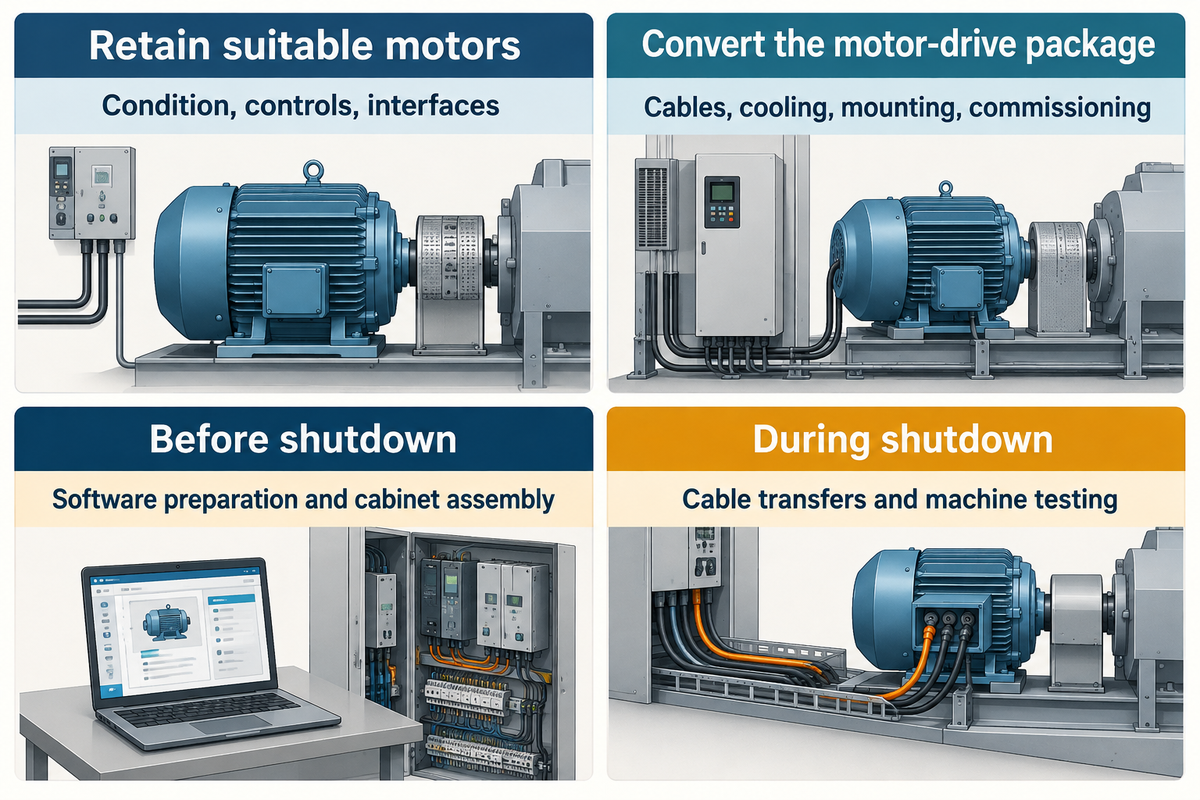
How much is retained affects the cost of a retrofit. Shutdown duration is dependent on which activities require access to the stopped machine. Compare the costs of engineering, equipment, cabling, installation, and the coordinated commissioning, on the same scope of work, before viewing a lower equipment price as an indication of a lower overall project cost.
Retaining the DC drive arrangement and conversion to AC can have varying spare-motor, cooling and cabling requirements. Tradeoffs are discussed in Ronald Meihofer’s 2000 Machine Design article. Its prices for one rebuild targeting a 71% increase in machine speed, around $215,000 for a dc drive solution and around $235,000 for an ac vector drive solution, are historical figures, not present-day budgets; the useful part is which physical work each option includes.
Retain suitable motors
- Check condition and supportability.
- Price replacement controls and interface work.
- Preserve compatible mechanical installation.
Convert the motor-drive package
- Match the new package to the complete duty.
- Price cables, cooling and mounting changes.
- Include coordinated commissioning.
Suppose healthy motors can stay, but the controller network must change. While some activities can be done before a shutdown, such as software prep and cabinet assembly, others, like cable transfers and machine testing, require a shutdown. Calling that a converter-only replacement understates the effort required. A cost-effective proposal separates those tasks and identifies which interfaces, if kept, would prevent a staged return to production.
For finance, pair the scope with the actual paper mill production capacity constraint. A more energy-efficient motor doesn’t necessarily eliminate the drying bottleneck, and a shorter installation doesn’t guarantee earlier stable production.
Energy Efficiency and Drive Suppliers: Choose the Upgrade Path
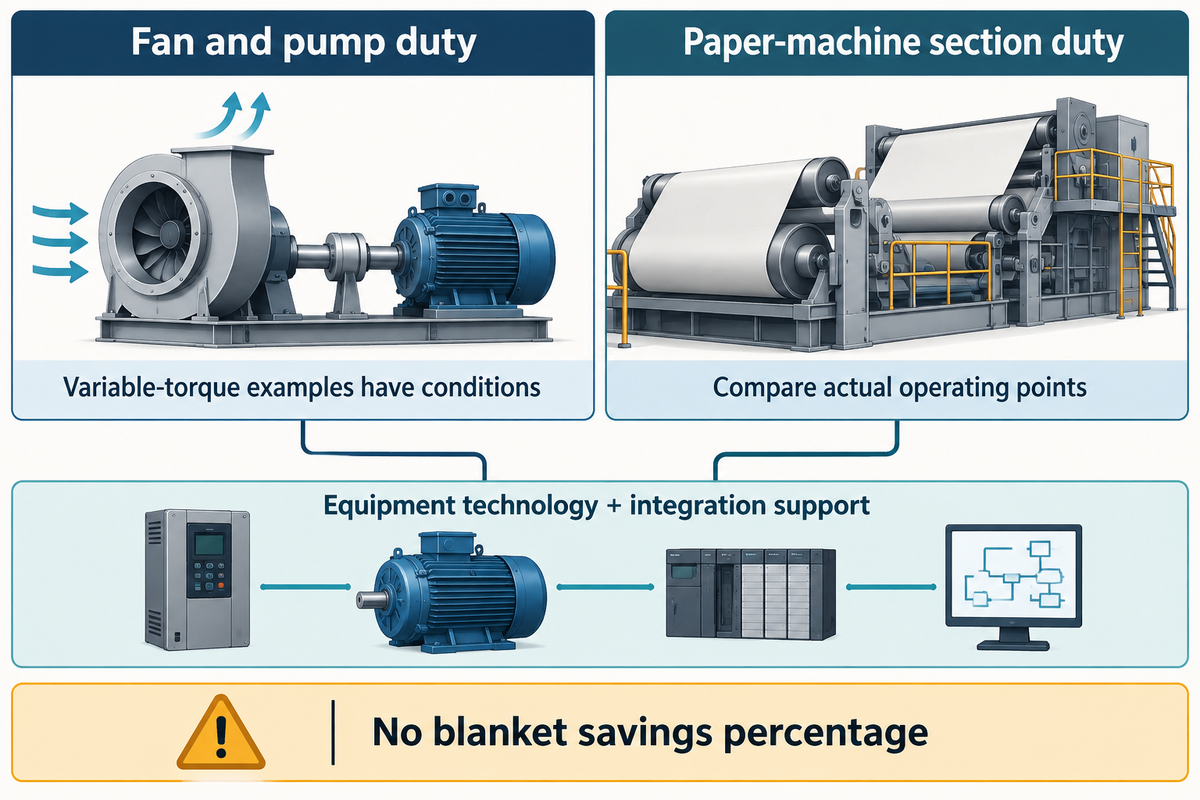
Energy efficiency should be compared at the intended production duty, including the motor and drive at their actual operating points. Separate a modernization of the section drive from a speed-reduction of the fan or pump. Supplier selection needs to match both the equipment technology and the integration support required to keep the coordinated machine operating.
The US Department of Energy’s 2012 part-load efficiency guidance distinguishes variable-torque pump and fan loads from constant-torque loads. Variable-torque pump examples shouldn’t be used to claim a blanket energy-savings percentage for papermaking machinery. Compare actual electrical consumption at similar grades, production rates and duty periods, using the actual motor-drive efficiency.
How can automation help?
Automation aids in the coordination of speed references, operating sequences and fault information in the paper machine. A shared view of command, feedback and load can simplify locating the disturbance. The functions implemented and the quality of the signals are very relevant to the success of this aid. A new display alone won’t resolve machine or process limits.
Motion control may use servo motors in a small auxiliary mechanism. The main section drives must have their own duty assessed. Sheet profile control belongs to the quality-control functions and should not be confused with motor torque control. Agree which functions, diagnostics and service responsibilities are included when evaluating VFDs and the wider automation scope.
For broader equipment sourcing, the scope guide for the paper equipment supplier separates the supply of machines and individual components. ABB is an example in equipment and technology; Zejiang’s stated role is rebuild integration. The relevant paper applications, support requirements and the existing installation should determine the shortlist.
Frequently Asked Questions
Why not DC drives?
When retaining DC equipment makes sense
DC drives can remain practical when the existing motors are serviceable, their duty is understood and replacement controls and support are available. Conversion to AC becomes more attractive when motor condition, spare parts or future requirements justify the wider scope. Compare the retained motor, feedback, electrical supply and commissioning work together; neither technology is automatically the least-cost choice for every rebuild.
What kind of motors are used in paper manufacturing industries?
Match the motor to the process duty
Paper manufacturing uses several motor technologies because process duties differ. A sectional machine may use controlled AC induction motors, permanent-magnet synchronous motors or retained DC motors, while pumps, refiners and other equipment have their own requirements. Selection depends on torque-speed duty, environment, control arrangement and maintenance support. A motor found in one section is not a universal recommendation for the rest of the line.
Are paper mill drives safe?
Assess the complete installation
Not on their own: a drive is one component of the machine’s safety design, and OSHA’s pulp and paper mill rule requires that all drives be provided with lockout devices at the power switch which interrupts the flow of current to the unit. Safe operation depends on protective functions, guarding, electrical design, maintenance procedures and how operators interact with moving sections. Replacing a drive can change interfaces that need assessment by competent personnel. A component rating or built-in function does not establish that the complete paper machine is safe for its intended operation.
Does a higher motor speed always mean more paper output?
Why the process constraint matters
No. Higher rotational speed only helps when roll surface speed, sheet handling, pressing, drying and downstream equipment support the intended operating point. The physical bottleneck can remain after a motor or drive upgrade.
Can a drive upgrade be done one section at a time?
Define a testable change boundary
A phased upgrade can be possible, but retained and new sections must still share coherent speed references and compatible operating logic. The practical boundary may include more than one motor because feedback, communications, operator commands, power supply and protective interfaces connect sections together. Equipment and software can sometimes be prepared before an outage, with final connections and coordinated commissioning reserved for shutdown. The useful question is which group can be changed, tested and returned to production without leaving an unstable or unsupported interface. Compare that boundary with the available outage window, commissioning resources and fallback plan. Historical retrofit examples illustrate approaches; their durations are not promises for another mill. A staged proposal should identify what remains operational, what changes together and how the affected machine functions will be demonstrated before production resumes.
Prepare a focused upgrade discussion
- Identify the section and production symptom that limit output.
- Gather the present motor, drive, feedback and mechanical arrangement.
- Define the intended duty and available shutdown window.
Provide Zejiang with the details to discuss a section-specific rebuild scope addressing the production constraint and affected interfaces.
(Note: The numerical roll example uses assumed inputs. Research models and historical 3rd party projects help to explain engineering choices. Final sizing and operating settings require the actual machine duty and a qualified site assessment.)
References & Sources
- Electronic line-shaft control for paper machine drives Valenzuela and Lorenz, University of Wisconsin repository, 2001.
- Spindle speed and surface-speed relationship Massachusetts Institute of Technology teaching resource.
- System Stability of the Open Draw Section and Paper Machine Runnability Edvardsson and Uesaka, 2009; draw definition p. 568.
- Drive Power and Torque in Papermachine Dryers TAPPI, Timm, Skelton and Wedel, 2008 public abstract.
- Motors and variable speed drives Australian Government.
- Evaluation of Torsional Oscillations in Paper Machine Sections Valenzuela, Bentley and Lorenz, IEEE, 2005; author-uploaded paper.
- Sappi PM3 drive-system rebuild account West, Honaker and Barry, IEEE, 2004 public abstract.
- IEC 61800-5-1:2022 International Electrotechnical Commission, public scope.
- 29 CFR 1910.261, pulp, paper and paperboard mills Electronic Code of Federal Regulations, US Department of Labor.
- Retrofitting drives for paper machines Ronald Meihofer, Machine Design, 2000.
- Adjustable Speed Drive Part-Load Efficiency US Department of Energy, November 2012.