Get in touch with Zejiang Paper Machinery Company


Paper stiffness is the resistance to bending of a sheet under certain specified test conditions. Its measured value is based on direction and test method and can vary with sample preparation. Match those conditions prior to comparing suppliers. A higher number on a different test report doesn’t necessarily mean the paper is more stiff.
For mill quality teams and converters the important question is which result shows behavior required in production. This guide differentiates machine direction from cross direction and explains the principal differences of measurement. It also provides a report comparison checklist for paper and board buying.
Paper Stiffness: What the Measurement Means
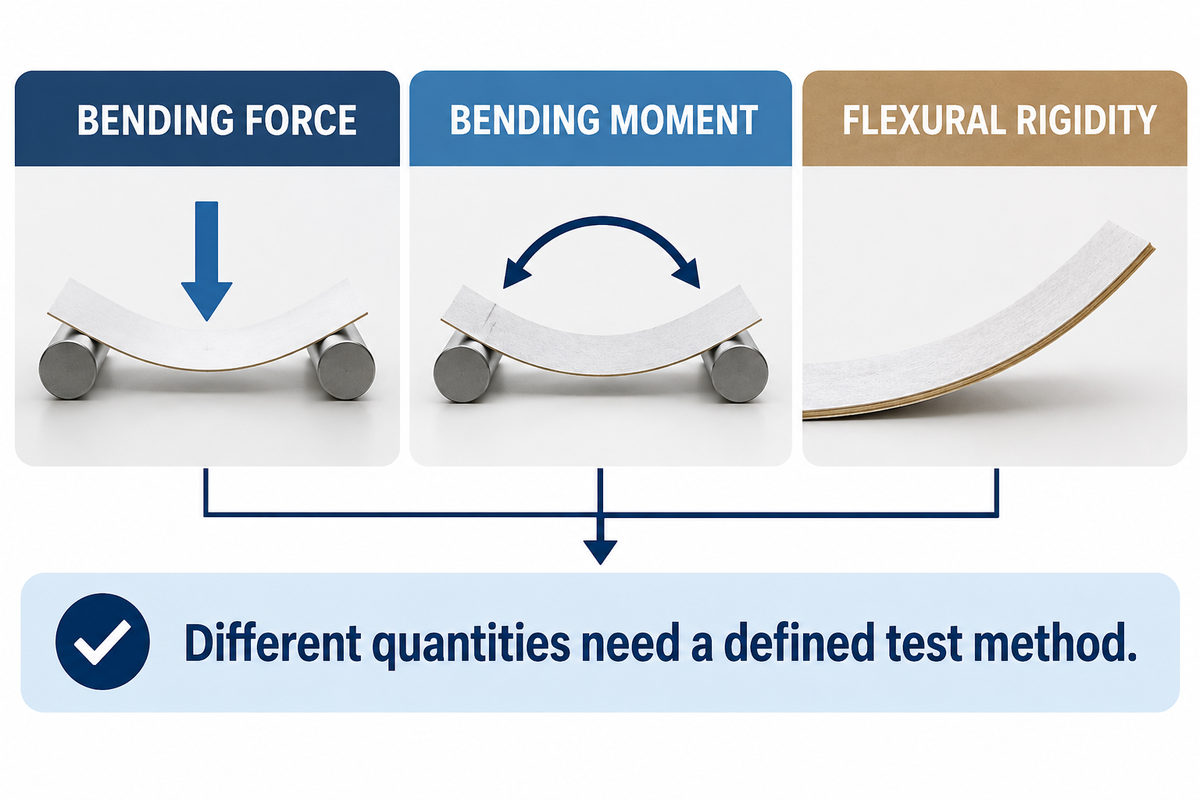
Paper stiffness expresses bending response while tensile strength describes resistance to pulling failure. Thickness and fibre structure can influence that response, but neither is a stiffness measurement by itself. Therefore, in a purchase specification, it’s necessary to state the measured property and test method along with the number, rather than requesting a more stiff or heavier paper.
What does “stiff paper” mean?
In comparison tests, stiffer paper resists bending more than a less stiff sheet when direction and test setup match. The description is relative: A strip that feels firm in one direction can bend in the other direction. Hand feel helps to screen samples but laboratory measurements are required to define a repeatable requirement.
Pay attention to what’s being measured: identify the quantity the tester measures. A bending force, a bending moment and a calculated flexural rigidity describe different quantities. Even an index bearing the word stiffness may depend on specimen dimensions. Have the laboratory define what it’s reporting prior to assuming two values are interchangeable.
Carson and Worthington’s 1952 National Bureau of Standards study, Stiffness of Paper, examined eight paper types at bending angles from 5° to 30°. Its results changed with specimen length. The practical lesson survives: a number belongs to a defined measurement procedure, not to the sheet alone.
MD and CD: Keep the Test Directions Separate
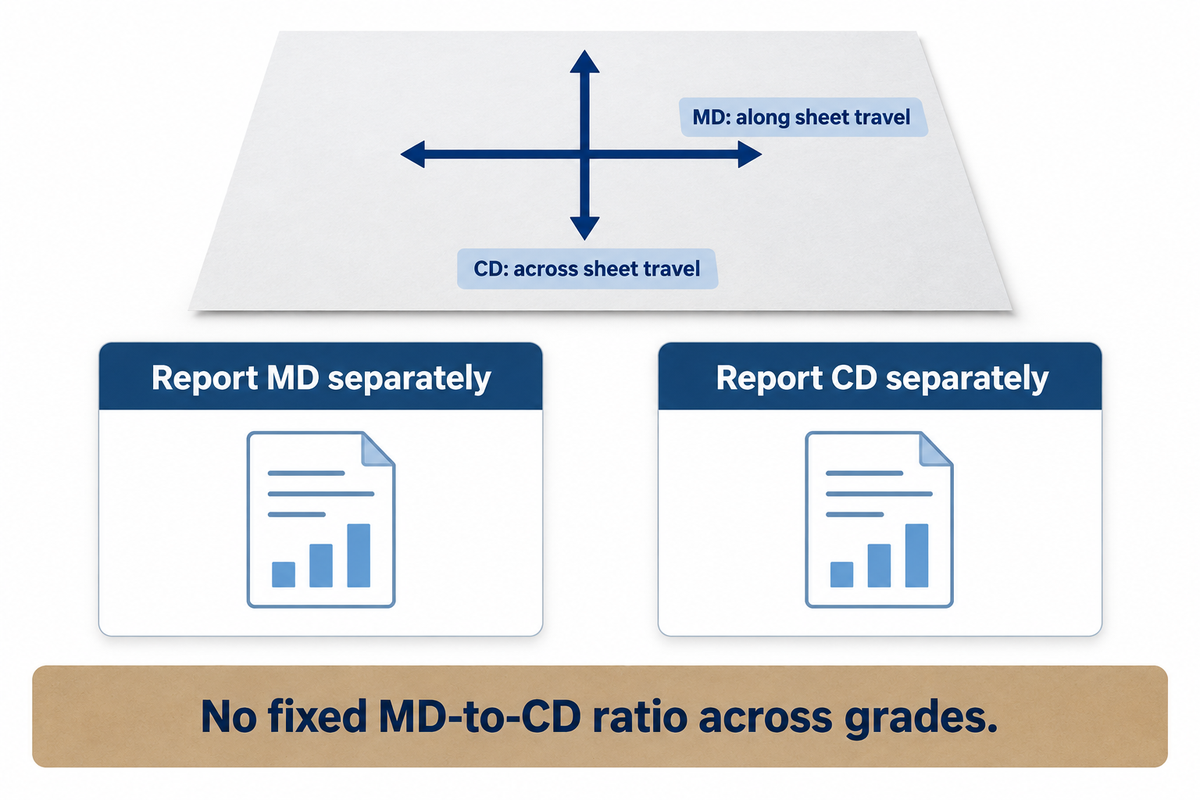
Machine direction, or MD, follows the sheet direction of travel during manufacturing; cross direction, or CD, runs across it. Fibre orientation makes the bending properties of paper directional. Report the measurements separately and maintain the orientation of the strip. Similar overall levels of stiffness can hide a directional deficit that’s significant during converting.
Mill-made paper usually shows greater bending stiffness along MD, but ratios of MD to CD aren’t constant across grades. Variability in the furnish, forming conditions and the structure of the sheet can change the ratio. Maintain the direction marks on the parent sheet when test pieces are chopped from it; rotating an unmarked sample can lead to a labeling error.
A matched MD result doesn’t resolve the CD question. In Viguié et al.’s 2021 study of patterned paper, a re-entrant pattern yielded a similar MD stiffness to the sinusoidal pattern and a lower CD stiffness. This result speaks more to patterned sheets than to a relative comparison of commercial grades.
Using 60 g/m² paper and a printed coverage ratio of 27%, the patterned-sheet experiment demonstrated the impact of geometry on directional behavior. Maintain separate MD and CD acceptance lines, even when the overall stiffness measures seem satisfactory. Two directions refer to two different aspects of sheet bending behavior.
Bending Test Methods: Taber vs Force Measurements
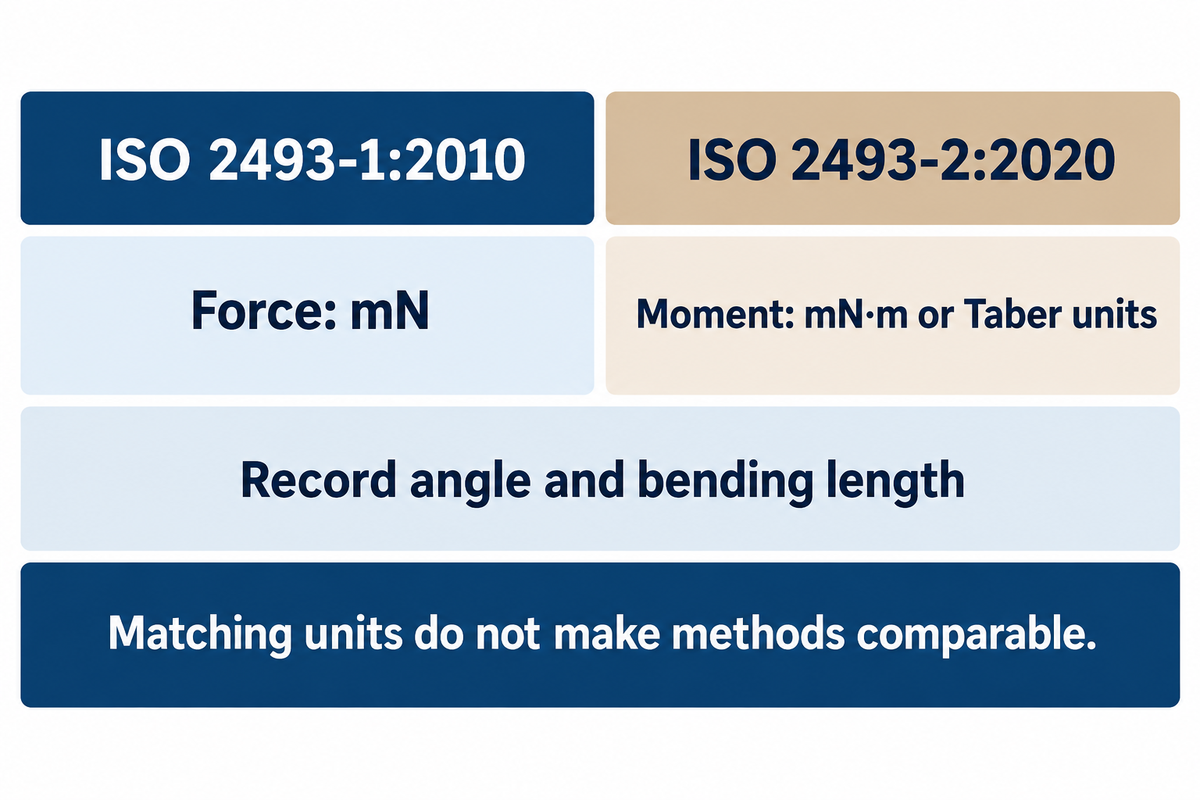
Taber stiffness and constant rate bending resistance are method dependent results. A Taber-type tester assesses the bending moment related to deflection; a force based method evaluates the force required under the given geometry. Use the same test method, angle and length of bending prior to comparison of results. Merely changing the unit of measurement doesn’t make them comparable.
“Taber-type testers and testers using the principle of constant rate of deflection do not give comparable results.”
| Comparison point | ISO 2493-1:2010 | ISO 2493-2:2020 | Buyer consequence |
|---|---|---|---|
| Method family | Constant-rate deflection | Taber-type tester | Record the part number |
| Measured output | Bending resistance, force | Bending resistance, moment | Keep the quantity name |
| Typical report unit | mN | mN·m or stated Taber units | Force is not moment |
| Published force scope | 20–10,000 mN | Do not transfer Part 1’s force range | Confirm instrument range separately |
| Standard bending length | 50 mm | 50 mm | Matching length alone is insufficient |
| Published specimen width | Use the selected procedure | 38 mm | Record actual strip geometry |
| Principal bending angle | 15° | 15° | Do not mix angles |
| Lower-angle option | 7.5° where specified | 7.5° where specified | Retain the angle on the report |
| Short-length option | 10 mm for suitable low-resistance material | 10 mm is not covered by this part | Check method applicability |
| Finished corrugated board | Excluded; component papers may be tested | Do not assume suitability | Choose an applicable board method |
Sources: the public scopes of ISO 2493-1:2010 and ISO 2493-2:2020. The table is a selection aid; laboratory execution follows the full chosen standard.
How to measure paper stiffness?
Condition the sample, and cut strips along the indicated direction to its specified dimensions. Clamp each strip without damage, deflect the strip as prescribed, and record the measured result with its unit. The sampling and reporting rules of the selected method are to be followed throughout the procedure.
Using a Taber stiffness tester means following its applicable Taber procedure, not borrowing settings from another bending stiffness tester. Other bending techniques include multi-point loading and the resonance method as methods for measuring bending. Select the instrument to measure the quantity your specification actually requires; a familiar instrument name doesn’t suffice. Establish whether reported values were measured using the same procedure.
ISO 5628:2019 covers two-, three- and four-point methods for determining bending stiffness, with limits on permanent deformation and formula applicability. Its method selection depends on material structure. A 15° result and a 7.5° result therefore need more than a numerical correction before they can support the same acceptance decision.
Sample Preparation: Conditioning, Cutting and Clamping
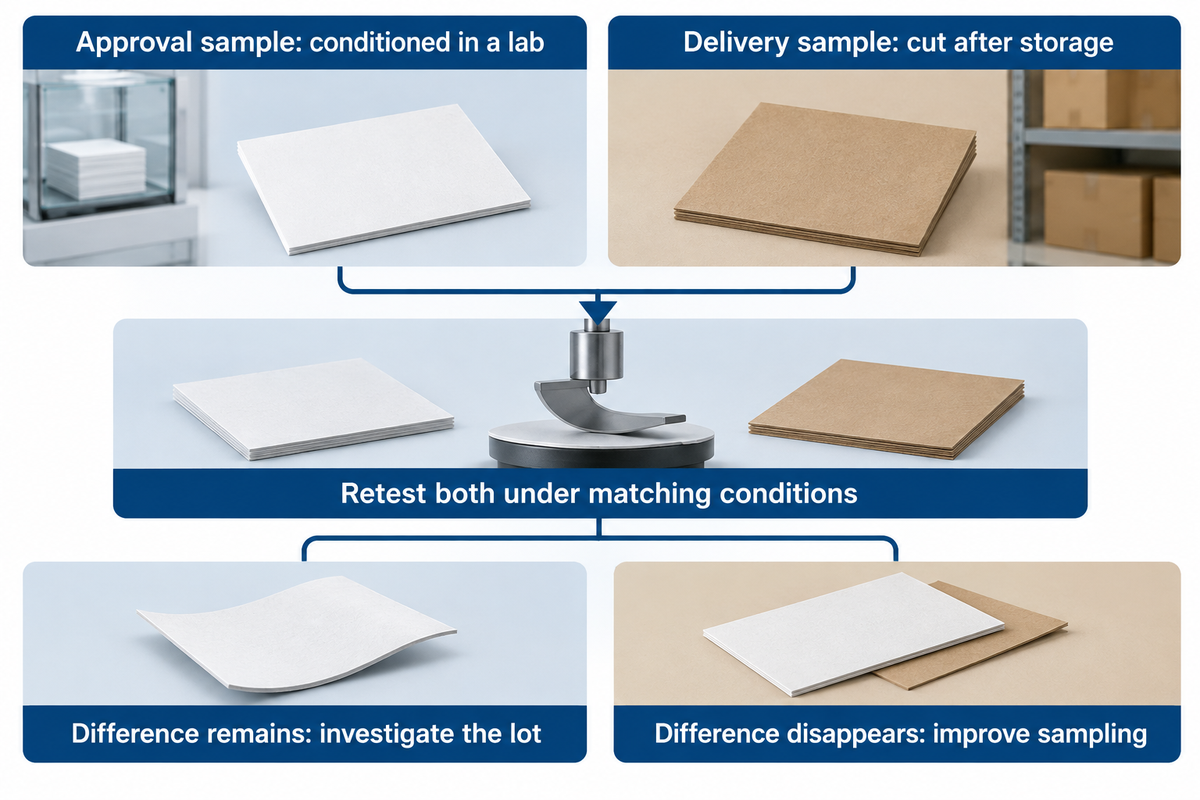
When testing the bending stiffness of paper, sample preparation can explain a difference before any production change does. Moisture affects the sheet, cutting defines the test geometry, and clamping defines its support. Use one agreed conditioning procedure, retain orientation marks and exclude visibly damaged test pieces. Record the conditions with the result so that paper testing laboratories can also reproduce the comparison.
Consider a purchasing team reviewing a retained approval sample, and a newly delivered lot. The approval sheet was conditioned in a lab; the delivery sheet was cut after storage. Both reports describe the same method and use 50 mm bending lengths, but the delivered lot reads lower. Rejecting the lot at this point would mean comparing two samples with different conditioning histories. Retain both samples, and request testing under the same atmosphere and specimen preparation procedure. If the difference remains after testing, investigate the delivery lot. If the difference goes away, improve sampling to get the next delivery judged the same way.
ISO 187:2022 addresses conditioning and testing atmospheres for paper, board and pulps. It does not turn an arbitrary storage interval into a documented conditioning procedure. When requesting a retest, include atmosphere, duration and the method’s equilibrium requirements.
Ham, Youn and Lee’s 2020 laboratory study used strips measuring 38 ± 1 mm by 70 ± 1 mm, conditioned for at least 48 h to reach equilibrium at 23 ± 1°C and 51 ± 2% relative humidity. Preserve these conditions when analyzing the study’s findings, rather than renaming them as default conditions of all laboratories.
Thickness, Grammage and Furnish: Why Results Change
Grammage, furnish, and thickness influence paper stiffness in different ways. Grammage (basis weight) is mass per area. Thickness describes the depth of a sheet. Density refers to the relationship between the two measurements. Bending stiffness is also associated with the modulus of elasticity and fibre distribution, thus two papers of equal grammage may have a difference in bending resistance.
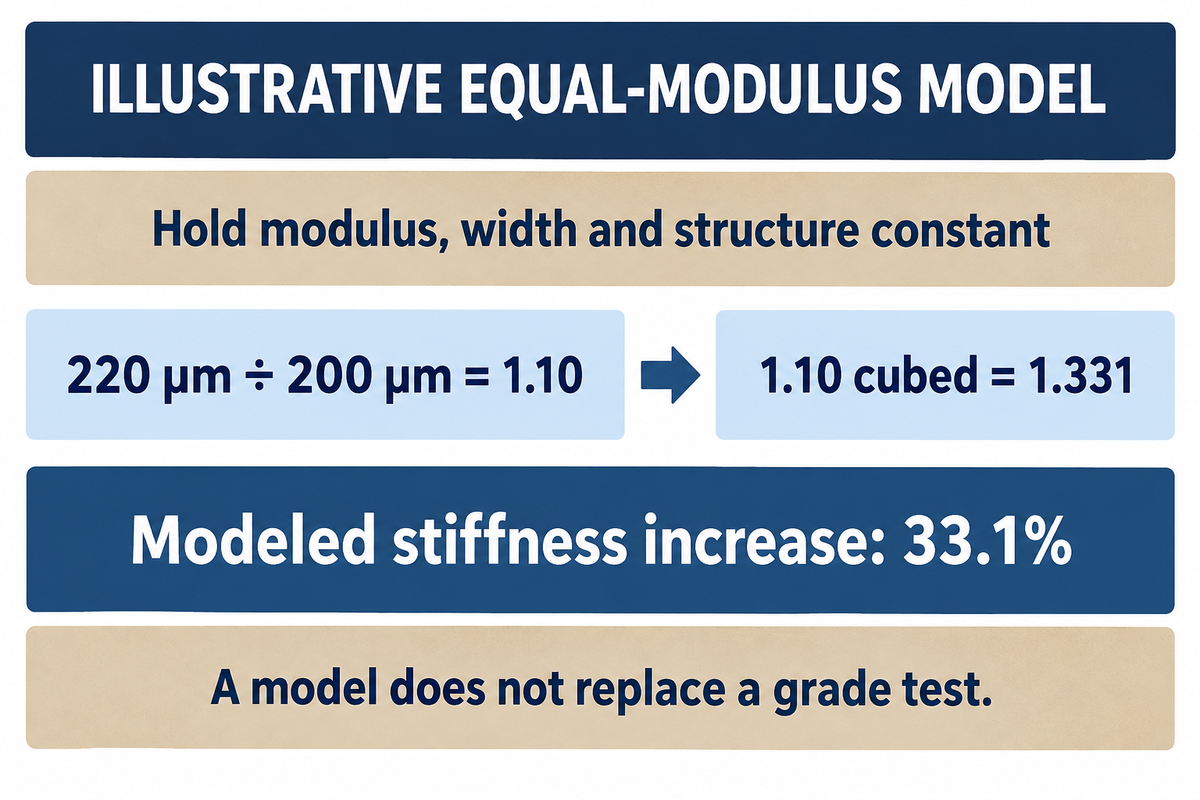
For a simple equal modulus beam model, stiffness is proportional to the cube of thickness. Suppose a buyer compares 200 µm and 220 µm sheets while holding modulus, width and structure constant. The thickness ratio is 220 ÷ 200 = 1.10; cubing it gives 1.331, or a modeled 33.1% increase. This helps explain why bulk attracts attention in lightweighting. However, a true furnish change may also cause a change in modulus and ply structure, therefore, the calculated increase can’t replace a grade test. Use the example to frame the problem: compare the measured thickness. Do bending results match? Then decide if the lighter grade meets the application requirement.
Holmen Iggesund’s paperboard manual acknowledges the tradeoff between thickness and modulus, and that the actual behavior of a board may not strictly follow the ideal cube rule.
In Ham and colleagues’ 100 g/m² handsheet experiments, recycled old corrugated container pulp had higher stiffness than unbleached kraft pulp despite its lower modulus, because thickness and bulk differed. This shows that a liner grade and furnish comparison would require other measured properties besides the description of fibre.
Process Changes: Trace Stiffness Loss Before Adjusting

Consider the sheet structure and the test conditions while tracing a stiffness change. Refining can affect the bonding of fibre, while pressing and calendering can affect density and thickness. Drying history can influence the response to moisture later on. In general, a single low result doesn’t identify which operation caused it, so compare samples taken around the suspected change.
Consider the type of refiner and furnish when the pulp treatment has changed, and the flow of the headbox and the formation of the sheet when the directional relationship has changed. The equipment in the dryer section and the record of its operation help to investigate drying. None of these facts alone is adequate for a setting.
Higher stiffness doesn’t always indicate less damage. Carson and Worthington reported that early crumpling of currency paper increased its measured stiffness because corrugation increased effective thickness. Their proposed stiffness-based wear measure failed for that reason. When converting, also separate a flexible crease from an uncreased panel; KTH research on paperboard creasing explains how controlled delamination can assist folding while in-plane cracking is to be avoided.
At a 100 g/m² target grammage, Ham and colleagues found that drying and fines content affected stiffness and its response to humidity cycling. Their Condebelt results didn’t reproduce the earlier reported moisture-related advantage. Therefore, process names shouldn’t be substituted for measurements based on the drying conditions and furnish being discussed.
Application Fit: Stiffness Does Not Replace a Machine Trial
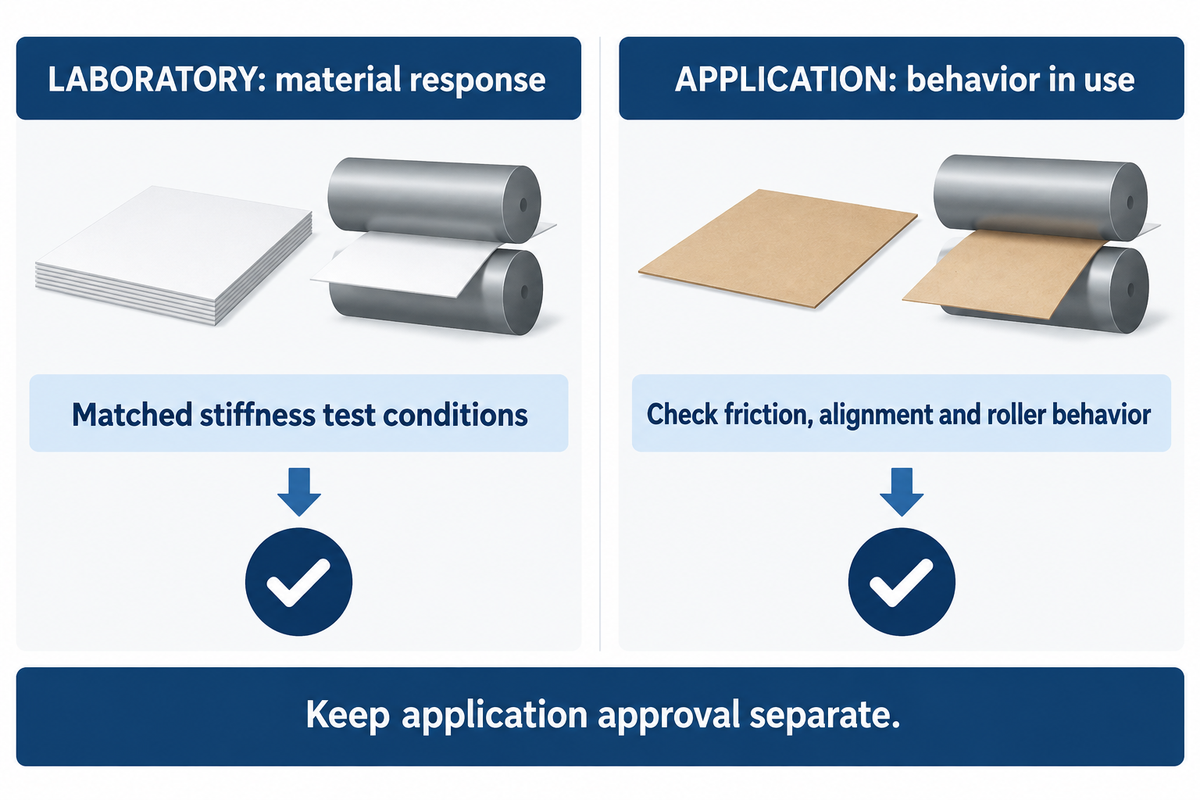
A stiffness test helps define the material. A machine trial checks the behavior of a component in use. Friction, alignment and deformation around the rollers are also important considerations for both printing and sheet feeding. Packaging performance is also dependent on panel design and the type of creasing, if present, as well as material properties. It’s important to separate approval for use from the results of laboratory testing, especially after changing grades.
A discussion in the CommercialPrinting forum illustrates confusion when buying paper. One user compared paper grammage with a printer’s thickness specification. However, a respondent described feeding issues associated with the grain direction of the substrate or a stiff substrate. This is an operator account, not a general printer limitation. The useful approach is to record the orientation of the stock that was accepted and rerun the appropriate feed trial after a change.
As described in Umano and Yamaura’s 2011 paper-feed study, speed-dependent behavior was linked to paper friction in the roller system. Corrugated board panels under a sustained load can exhibit a phenomenon described as creep in Söremark and others’ 1993 study. That research helps explain why a short static bend test does not describe panel response to cycling humidity.
In Yanabe and colleagues’ 2011 experiment, A4 paper entering unheated fixing rollers at a 3° tilt developed wrinkles. That angle belongs to the experiment, not a universal operating limit. Adequacy of stiffness specification leaves two unknowns during production approval: process alignment and true roller condition.
Supplier Acceptance: The 6-Field Report Match
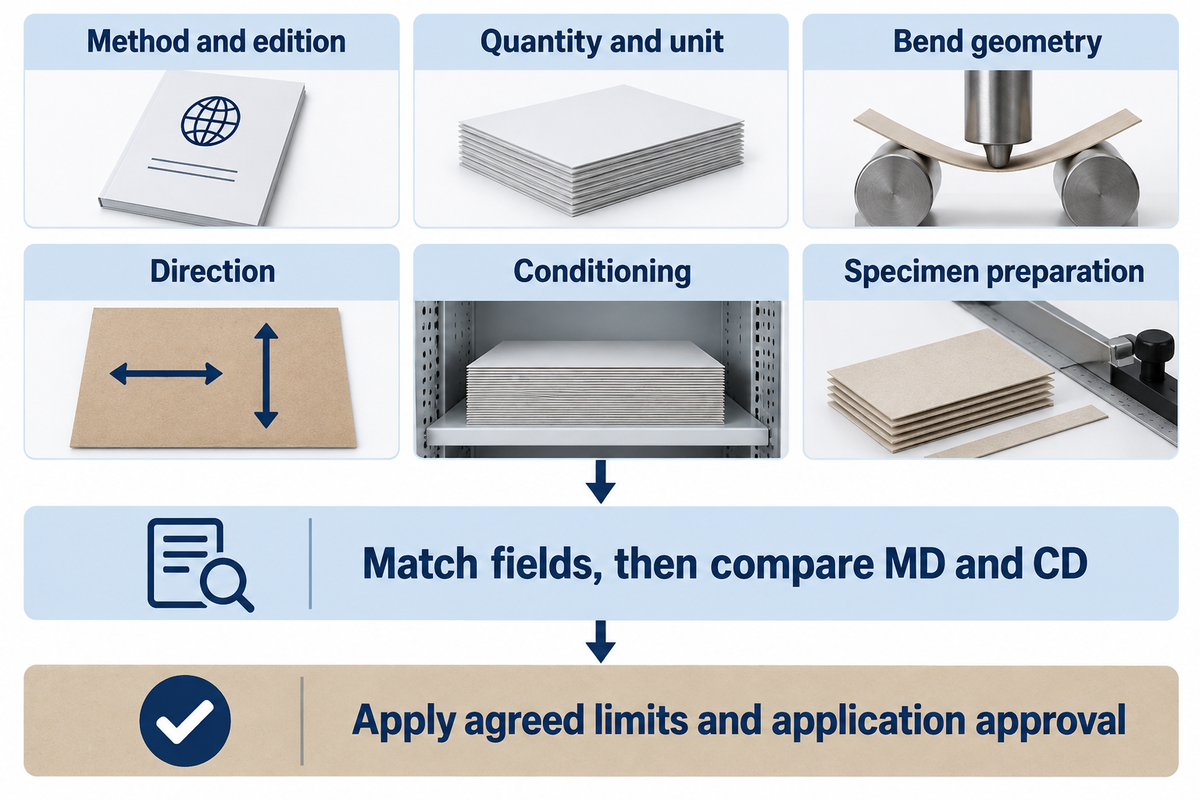
The 6-Field Report Match checks method and edition, quantity and unit, bend geometry, direction, conditioning, and specimen preparation. After those fields match, compare suppliers. This article’s checklist is meant to organize a decision; it is not an ISO acceptance rule. Product limits still belong in the agreement between buyer and supplier.
| Report condition | What it means | Next decision |
|---|---|---|
| Part 1 versus Part 2 | Different measurement methods | Retest with the agreed method |
| mN versus mN·m | Force versus moment | Clarify the output; do not convert by label |
| 15° versus 7.5° | Different bending angles | Request matching-angle results |
| 50 mm versus 10 mm | Different bending lengths | Check scope and retest as required |
| 38 mm width versus an unstated width | Geometry is incomplete | Obtain the missing preparation record |
| MD result versus CD result | Different sheet directions | Compare like directions |
| One average, no directional results | A directional shortfall may be hidden | Request separate MD and CD values |
| Conditioned versus as-received | Moisture histories differ | Retest under agreed conditions |
| Damaged versus intact strips | Specimen state differs | Prepare valid replacement specimens |
| All six fields match | Reports can support a comparison | Apply agreed limits and application approval |
Method boundaries are drawn from ISO 2493-1, ISO 2493-2 and ISO 187. The decisions are a purchasing synthesis, not quoted rejection thresholds.
Imagine two suppliers quote results in mN·m. One uses a 15° bend and the other a 7.5°. The results can’t be ranked merely because the units match; the first request is a matching-method retest. Now imagine two other suppliers matched all six fields and quoted MD results which are similar, but one grade has a lower CD result. That is a material difference worth assessing against the agreed CD requirement, not a reason to average it away. If the application has no agreed CD requirement, define the relevant converting trial before approving a replacement grade. Neither case warrants the invention of a universally applicable stiffness value.
Stiffness Testers and Lab Quotes: Define the Scope
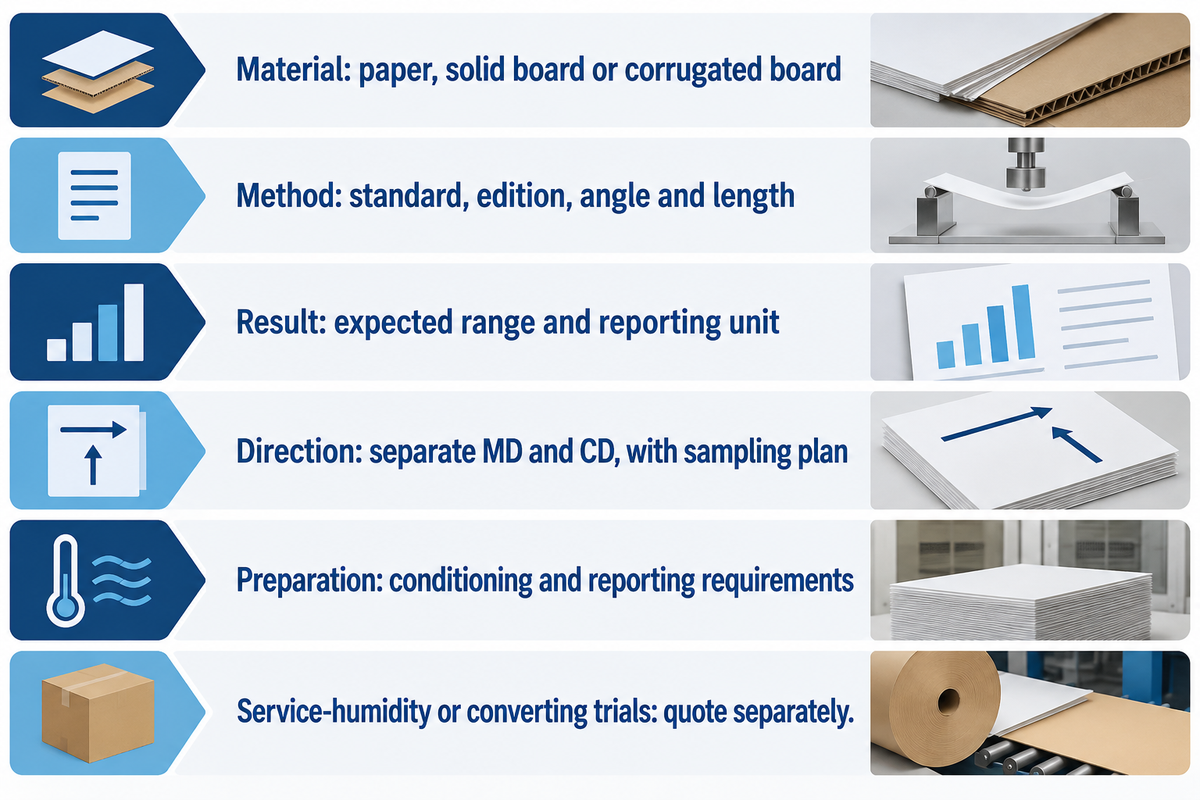
A useful laboratory or stiffness tester quotation specifies the material, method, measurement range and directional reporting. The instrument’s maximum capacity is only one selection factor. Determine how the proposed setup covers your samples and required procedure, including preparation and calibration, before comparing purchase prices or testing fees.
Include these items in the testing request
- Paper, solid paperboard or finished corrugated board, with thickness and grammage.
- The exact standard, edition, bending angle and bending length.
- The expected result range and required reporting unit.
- Separate MD and CD results, with the sampling plan.
- Conditioning, specimen preparation and reporting requirements.
- Any service-humidity or converting trial quoted separately.
TAPPI T 836 om-25 mentions a four-point bending method for boards. A laboratory quotation for that work shouldn’t be compared directly to a Taber testing quotation, merely because both contain stiffness of paper and paperboard.
Taber Industries lists its Model 150-T for materials up to 10,000 Taber stiffness units and claims ±1.0% instrument accuracy. Those specifications pertain to that tester only and not to each laboratory report. For a new paper line, transfer the agreed material targets to the paper machine grade requirements, discussed with Zejiang.
Industry Outlook: Specify the Method Before Lightweighting
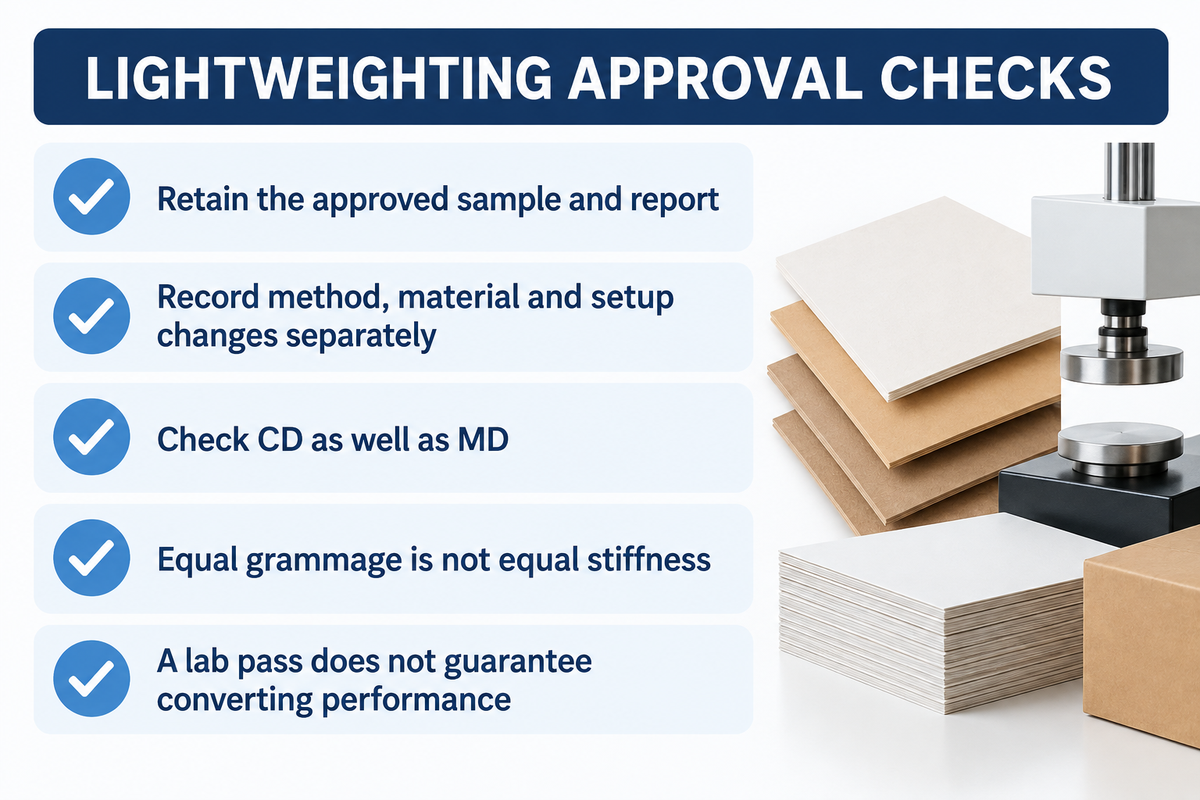
Because of lightweighting, the test specification becomes more critical since grammage changes the balance of material usage and performance. Evaluate a proposed grade through matching stiffness measurements and the application trial. Keep the international standard and its edition on the purchase order so a method change doesn’t get mixed into the material comparison.
Holmen’s announcement added fresh fibre fluting to a lightweight containerboard range covering liner and fluting from 72 g/m². The range statement doesn’t mean that every fluting grade starts at that weight. It’s a concrete product development, not evidence that a particular lighter weight grade would be adequate for a particular carton or conversion need.
ISO’s current catalogue lists ISO 2493-2:2020 as confirmed in 2025. Confirmation of a test method is not a new test method. When discussing a new grade with Zejiang, bring the target thickness and grammage, directional test reports and intended paper-machine application into the same brief.
Keep the grade change measurable
- Do: retain the approved sample and its complete test report.
- Do: record changes to method, material and machine setup separately.
- Do: check CD as well as MD before approving substitution.
- Do not: treat equal grammage as equal stiffness.
- Do not: use a laboratory pass as a guarantee of trouble-free converting.
Paper Stiffness FAQ
What is the strength of paper?
Paper strength describes resistance to a specified failure mode, such as tensile breaking, tearing, bursting or compression.
Choose the test that matches the load your product must survive. Bending stiffness describes resistance to deformation before that failure question is answered. A firm-feeling cardboard panel can still tear or crack under another load. Specify the necessary strength tests alongside stiffness rather than treating a single impressive value as a complete quality assessment for all fibre products.
What is the unit of stiffness, K?
For a linear spring, K is commonly expressed in newtons per metre, but paper bending tests do not share one universal stiffness unit.
A paper report may state a bending force in mN, a moment in mN·m, or another quantity defined by its method. Read the quantity name and test geometry before interpreting the unit. The stiffness of paper can’t be translated into a spring constant by changing symbols; the loading arrangement and the relation between force and deflection would also have to be defined.
How can you test the quality of paper?
Test paper quality against its intended use, combining dimensions and moisture checks with the relevant mechanical and surface properties.
For printing stock, the required surface and feeding behavior matter alongside sheet dimensions. Folding box board also needs suitable creasing behavior and panel performance. Select tests for the specified product, agree sampling with the supplier, and retain an approved reference sample. A stiffness test contributes one important property to that set; it doesn’t replace strength, appearance or application checks.
What is the hardness of paper?
Paper hardness concerns local resistance to indentation or compression, whereas bending stiffness concerns the response of a supported strip.
A surface that feels hard doesn’t establish the strip’s bending resistance. Use the property and test method required by the intended application.
Does paper stiffness change with temperature?
Temperature can affect a paper test, but moisture and conditioning history must be controlled before attributing a stiffness change to temperature alone.
Compare samples at defined test conditions and record their moisture history. Otherwise, a warm or cold storage change may also change the sheet’s moisture state, and the result mixes several effects. ISO 187:2022 provides the conditioning and atmosphere framework for laboratory work.
If a package will face a different service climate, add a relevant service-condition assessment to the baseline test. Report its atmosphere and exposure separately rather than applying an unsupported temperature correction factor. Ham and colleagues’ experiments showed that humidity cycling and drying history could affect bending stiffness; they don’t provide a universal percentage adjustment per degree. Synthetic substrates need their own material-specific testing plan, too. Sharing a printer or a stiffness tester with paper doesn’t establish that the two materials respond to temperature in the same way.
References & Sources
- ISO 2493-1:2010: constant-rate bending resistance; ISO 2493-2:2020: Taber-type method; AENOR public scope reproduction, Note 2.
- ISO 5628:2019: bending stiffness principles; ISO 187:2022: conditioning and testing atmospheres; TAPPI T 836 om-25: four-point method.
- Carson and Worthington, Stiffness of Paper, National Bureau of Standards, 1952.
- Ham, Youn and Lee, Influence of Fiber Composition and Drying Conditions on the Bending Stiffness of Paper, 2020.
- Viguié and colleagues, patterned-paper stiffness research, 2021; KTH paperboard creasing research, 2023 thesis record.
- Yanabe and colleagues, paper wrinkle generation in rollers, 2011; Umano and Yamaura, paper-feed friction research, 2011.
- Söremark, Fellers and Henriksson, mechano-sorptive creep research, 1993.