Get in touch with Zejiang Paper Machinery Company


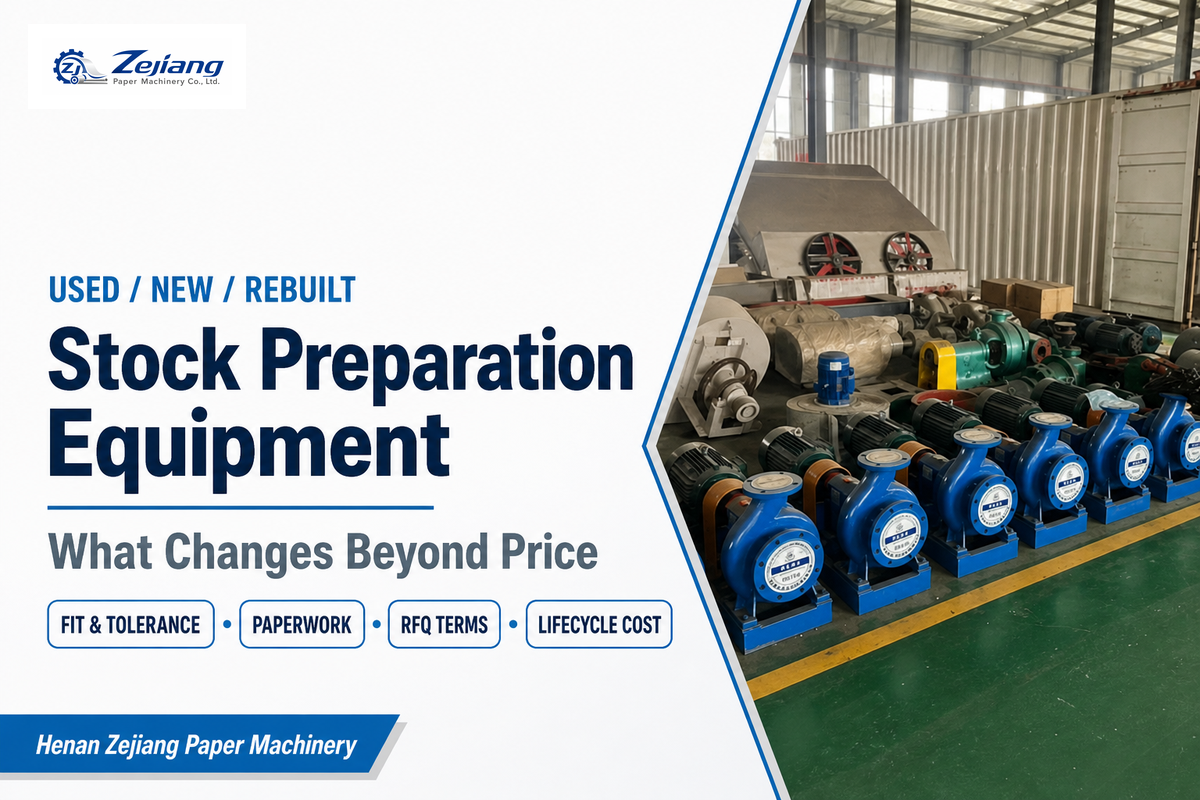
Used vs new stock preparation equipment cost is rarely a simple yes or no once you peek beyond the sticker price. Pulpers, refiners, pressure screens, and cleaners — paper mill equipment across the board — come to market all three ways: new, used, and rebuilt, and each route change fit risk, paperwork, quote comparability, and lifecycle cost in ways a purchase-price comparison never shows. This guide walks through what actually shifts when you move off the new-equipment column — and when that shift favors you.
Your quick read answer: Used stock preparation equipment typically costs 40-70% less upfront than new, but that figure covers purchase price only. Fit accuracy on rebuilt or reverse-engineered parts depends on access to original engineering drawings, not brand name. Rebuilding machinery can trigger a fresh EU conformity assessment under Regulation 2023/1230, and a used-line RFQ rarely matches a new-build RFQ field for field unless you force it to.
Key Takeaways
- The 40%-70% saved figure is a purchase-price number, not a lifecycle total-cost number.
- Used/Rebuilt component Fit quality depends upon drawings accessibility, methodology and tolerance standards – not make of OEM equipment.
- Under EU Regulation 2023/1230 on machinery, mandatory from 20 January 2027, some rebuilds will face a new conformity review requirement — not all of them.
- Unmatched new build and used equipment RFQs lack common basis and must specify common inputs, consistencies, reject specifications and acceptance tests for side by side, side over side evaluation.
- US paper industry capacity fell 2.0% in 2024, yet production rose 3.2% — a sign the market is being reshuffled, not simply shrinking.
Used, Rebuilt, or New Stock Preparation Equipment: The Real Three-Way Choice
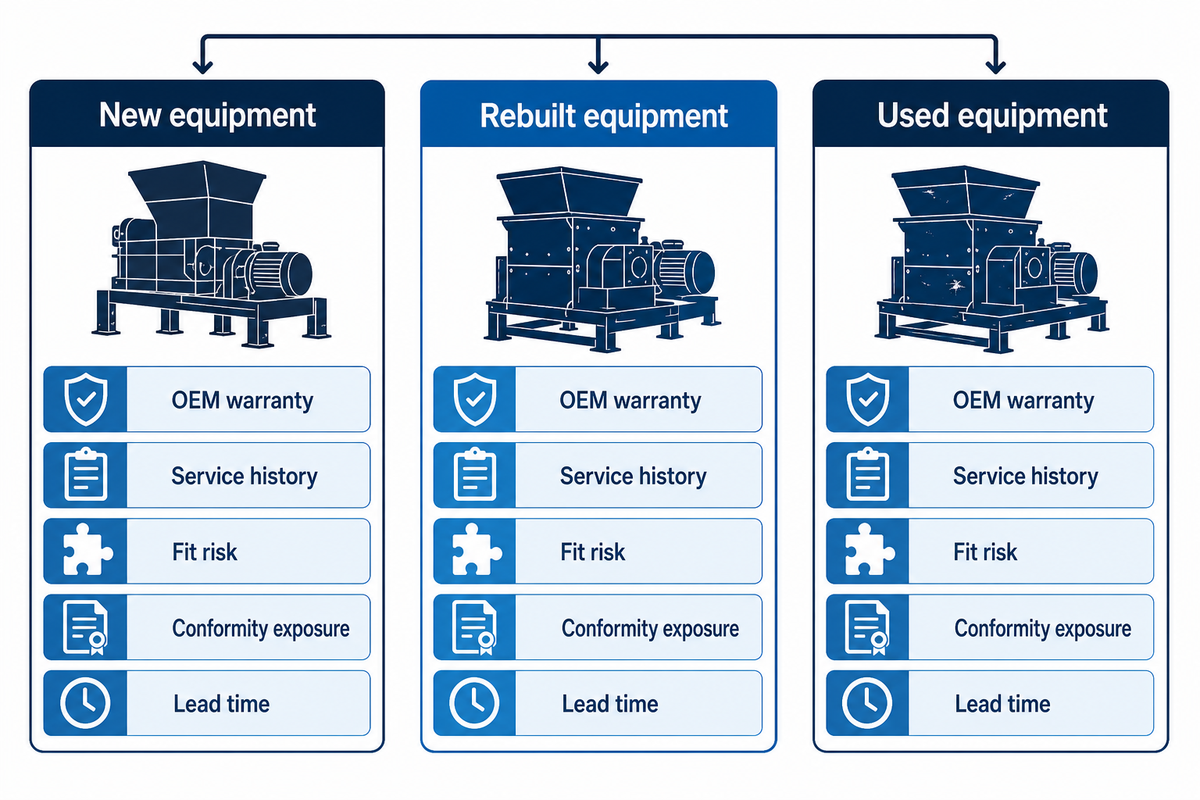
With that reshuffled market as the backdrop, stock-prep buyers really have three routes to choose from, not two. New machinery arrives with a full OEM warranty and current automation, but the lead time commonly runs 3–18+ months depending on the manufacturer’s backlog. Search listings for used paper machines for sale and you will find machinery available within weeks at a steep discount, but it arrives as the previous owner left it: condition, paperwork, and service history included. Rebuilt equipment lands in the middle, with an existing machine restored to a defined condition and sometimes upgraded components. Buyers comparing new or used equipment should therefore weigh the pros and cons of buying new alongside the evidence behind used machinery and the rebuild scope. The practical checklist is whether to buy used equipment or buy new equipment, whether buying new equipment is justified compared to new alternatives, and whether used equipment suppliers actually buy and sell used lines. Reliability evidence should decide the route when price and delivery appear close. Many manufacturers now buy used equipment, sell used lines, and quote new machinery; ask for service records on older models before treating immediate availability as a bargain. The same pulp-and-paper operating-safety requirements apply after any route reaches the mill floor.
| Factor | Used | Rebuilt | New |
|---|---|---|---|
| Purchase price vs new | 40-70% lower | 15-40% lower (varies by scope) | Baseline |
| Typical lead time | Weeks, if in-region | Months (rebuild scope dependent) | 3-18+ months |
| Warranty | As-is, none typical | Rebuild-scope warranty from rebuilder | Full OEM warranty |
| Fit risk on replacement parts | Depends on part sourcing history | Depends on rebuilder’s drawing access | Lowest — OEM tolerances |
| Conformity/paperwork exposure | Low unless modified after purchase | Depends on rebuild scope (see below) | Manufacturer-declared at sale |
| Limitations / not suitable for | Fit-critical or safety-critical positions without inspection | Buyers needing full OEM warranty coverage | Budgets that can’t absorb 3-18 month lead time |
| Documentation & traceability | Full manufacturing record from day one | Rebuild report and test records | Often incomplete unless requested |
| Utility and control interface | Defined kW, water, controls, and acceptance tests | Must be measured and documented after rebuild | Confirm actual load before shipment |
The rows that matter most—fit risk and conformity exposure—rarely appear in a used-equipment sales pitch. The next four sections unpack each one with real numbers, and the broader process-equipment context stays separate from this stock-preparation decision. If you buy used equipment, document the condition of existing equipment and older machines; if you choose to purchase new or used, compare the initial cost, projected cost savings, depreciation, and service plan. Waste paper furnish and rotor condition can change the right choice, even when the headline price looks similar for used and new routes.
What the Headline Savings Number Actually Covers
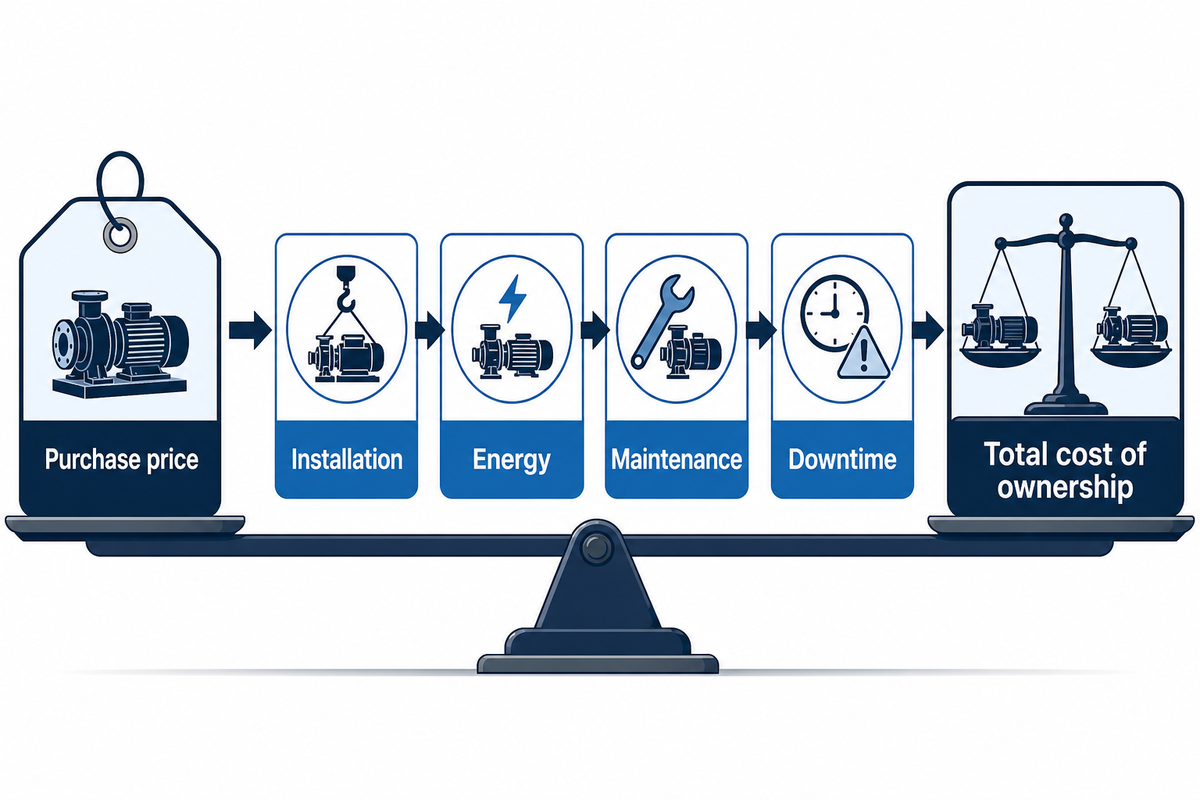
The 40–70% figure is a purchase-price comparison, not a total-cost-of-ownership comparison. Resale sources use it for used equipment; remanufacturing studies use similar percentages for another definition. Treat it as directional: it describes sale price, not the cost to own and run the machine. Total cost of ownership adds installation, energy, maintenance, and downtime, so evidence can favor new, rebuilt, or used equipment.
Used equipment is not always cheaper; that claim is a rule of thumb, not a law. Frequent emergency repairs and unplanned downtime can cost more over five years than a cleaner unit with a higher purchase price. NIST manufacturing-economics research reports roughly 3.3 times more downtime in establishments with the heaviest reliance on reactive maintenance, which is why a documented maintenance record matters more than a headline discount.
Is used stock preparation equipment always more affordable than new?
No. Used equipment is typically cheaper off the rack, but downtime history, maintenance logs, and warranty coverage can flip that advantage toward new or professionally remanufactured equipment. An undocumented maintenance record brings inherent risk that easily outstrips any purchase-price discount over the operating life, and downtime on the pulp preparation equipment costs more than purchase-price savings in just one bad year. We recommend treating that 40-70% figure as a negotiation starting point, and no more.
⚠️ Important
Ask any used-equipment seller for documented maintenance and downtime history before comparing purchase price. If that history doesn’t exist, price the missing information as risk, not as a discount.
Fit Is an Engineering Question, Not a Brand Question
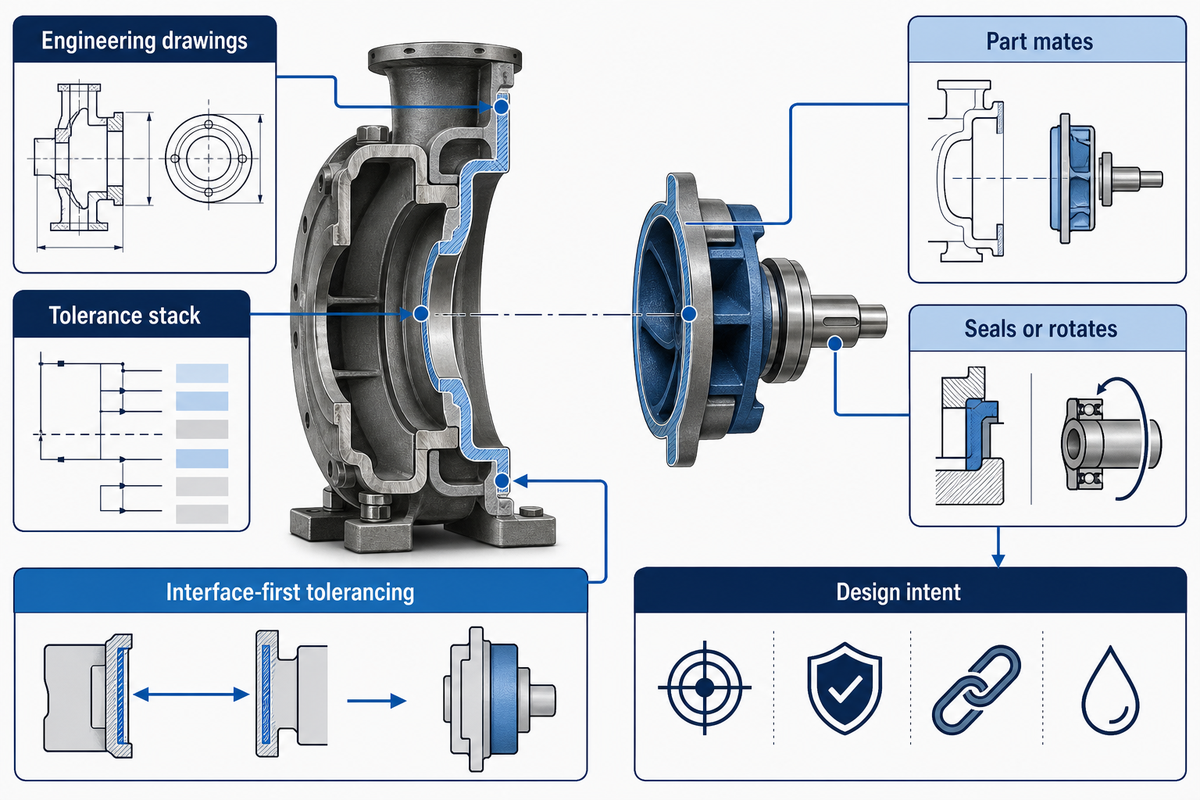
Once total cost of ownership is on the table, the next variable to pin down is fit. Whether a used, rebuilt, or reverse-engineered replacement part fits a hydrapulper, drum pulper, or other industrial pulper depends on access to the original engineering drawings and tolerance stack, not on the brand name alone. Physical geometry does not fully define how a component locates, seals, or rotates inside an assembly. Fit risk also applies to a heavy-duty headbox, sorter, or deflaker removing contaminants upstream of the paper machine. Fine deflaking is a runnability issue as much as a cleanliness issue, so the replacement must match the deflaking duty.
“Without drawings, anything that needs to be done must be taken back through the part, through usage, through assembly interaction. That’s a function of understanding design intent on the wear part and the corresponding worn parts; the exercise is not copying the worn part’s dimension, but using knowledge of its dimensions to select the correct tolerance.”
One common reverse-engineering mistake is over-tolerancing: making every feature tight to feel safe, which raises cost without improving fit. Interface-first tolerancing keeps tight control where a part mates, seals, or rotates and uses practical clearance elsewhere. One since-expired pulper housing and inlet-geometry patent illustrates why design intent matters, with stated throughput of roughly 700–1,500 tons per 24 hours at 80–100% consistency and 0.5–1 kWh per ton of input energy. A replacement made from a worn sample can miss that operating envelope without the original design history.
Before purchasing used equipment or a rebuilt machine on an “OEM-compatible parts” promise, ask whether replacement parts were made from original drawings or reverse engineered from a worn part. That answer can change fit risk more than the brand name. Our interface-risk self-check tool helps identify the fit-critical positions that deserve written proof.
The Paperwork That Comes With a Rebuild
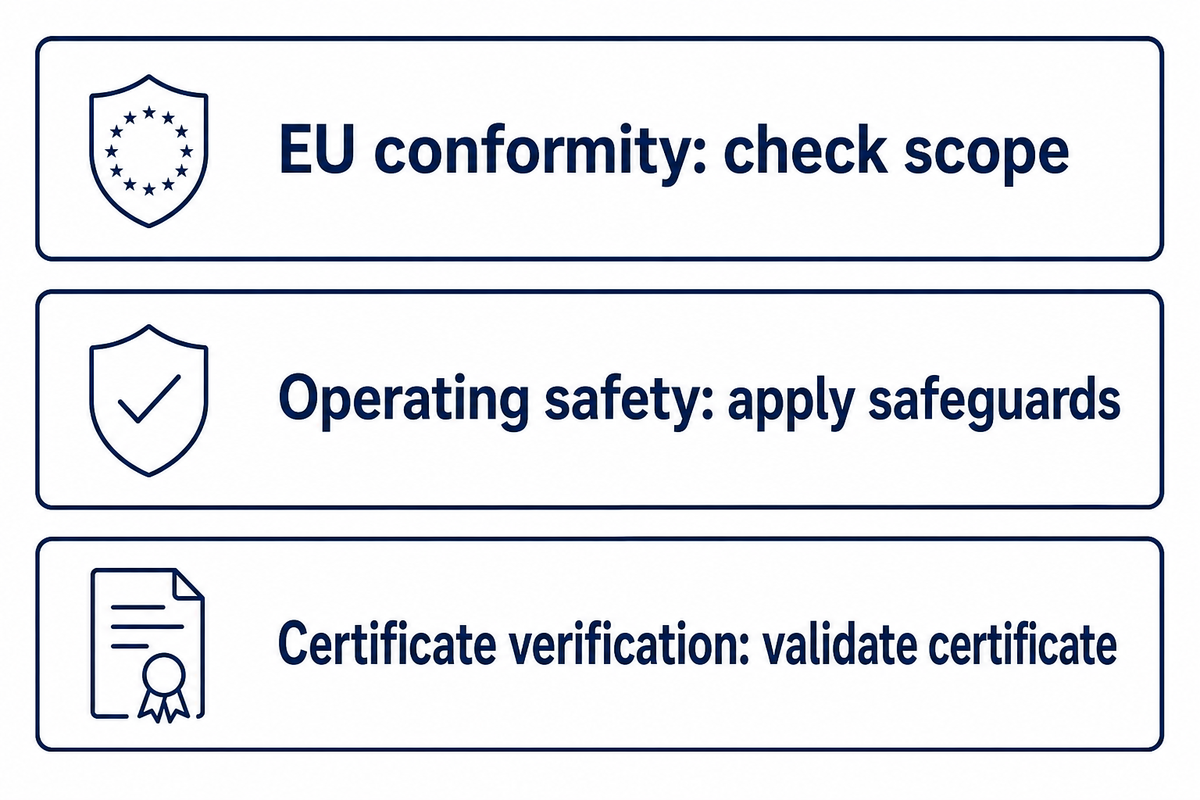
Machinery rebuilt at an existing stock-preparation plant may trigger a new conformity assessment under EU Regulation 2023/1230 when a substantial modification creates a new hazard or increases an existing risk. That regulation entered into force on July 19, 2023 and becomes mandatory throughout the EU on January 20, 2027, a 42-month transition period. The party carrying out the substantial modification takes responsibility for the conformity work; it does not remain with the original equipment manufacturer.
Not every rebuild or refurbishment is substantial. The UK’s domestic machinery-safety regime draws its own distinction between like-for-like replacement and major refurbishment; Health and Safety Executive guidance explains that work extensive enough to make machinery effectively new can change marking and conformity duties. The UK and EU regimes are legally distinct, but the buyer’s question is the same: did the modification introduce a new hazard or change the machine’s safety profile?
📐 Engineering Note
If you are importing used or rebuilt stock-prep equipment into the EU from outside the bloc, conformity exposure is not limited to modification status. Equipment placed on the EU market for the first time can face its own obligations, so check the import route and the rebuild scope with a qualified compliance specialist before the machine ships.
Finally, any machinery purchased, whether new or used, comes under operating-safety requirements as a separate matter from conformity documentation. In the U.S., OSHA regulation 29 CFR 1910.261 — the rules covering pulp, paper, and paperboard mill operations — goes above and beyond the basic lockout/tagout procedures most buyers think of first; it also requires enclosures, guarding, and shutdown provisions for beaters, pulpers, and associated drive systems, and these obligations apply to used and rebuilt machines just as much as new ones.
Supplier ISO 9001 claims also need verification. The certifying body should be accredited under ISO/IEC 17021-1 by an accreditation body that is a signatory to the International Accreditation Forum’s Multilateral Recognition Arrangement. The ANAB accreditation guidance gives buyers a second way to check the certification chain. Use the IAF CertSearch database to validate the certificate instead of accepting a document at face value, whether the purchase is new, rebuilt, or used.
Why Two Quotes for the Same Line Rarely Match
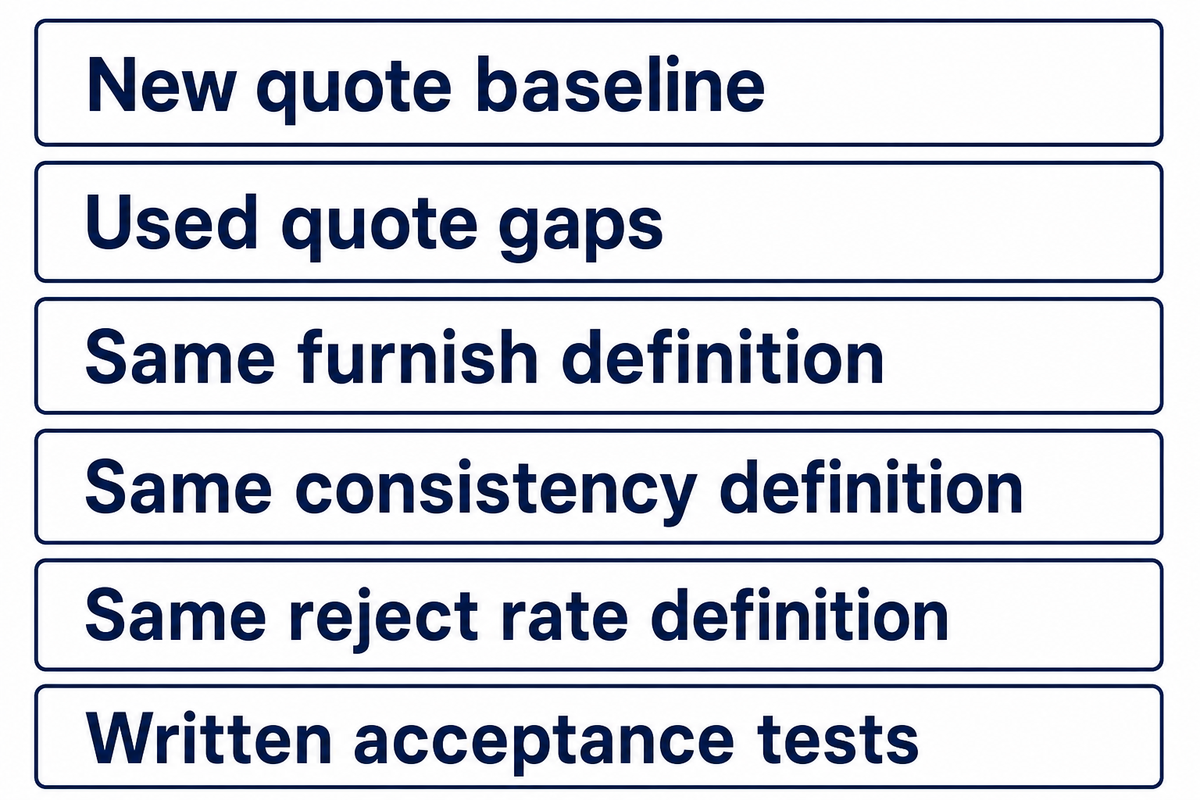
Two stock-preparation quotes are comparable only when they define the same furnish, consistency, reject rate, yield, water use, quality target, utilities, controls, and acceptance tests. OEMs design to those fields; a used-pulper listing may state only nameplate capacity, while a rebuild quote may describe work without defining output. Use one written field list to compare new, rebuilt, and used process equipment, and see NIST maintenance-economics guidance for why records matter once a line is in service.
Quote gaps lead buyers astray when a used machine appears 50% cheaper upfront. When comparing systems for paper handling and processing, start with the furnish—wood pulp or recovered fiber—and the quality target for the final paper. Buying new equipment can justify a higher upfront cost when energy efficiency, energy and water use, and maintenance expenses drive the full cost. The fit question is whether the line can remove heavy contaminants and still let you select the right duty point. If it cannot match the throughput, consistency, or reject range specified for the new line, its effective value to the plant is lower than the invoice suggests. Require suppliers of used equipment, OEMs, and rebuilders to answer the same specification sheet before comparing pricing.
RFQ checklist — copy these fields into every quote request, regardless of acquisition route:
| Parameter | Recommended range | Why it matters | How to verify |
|---|---|---|---|
| Furnish type & consistency | State exact furnish and target consistency % | Drives sizing and duty cycle for every downstream figure | Written furnish spec in the quote, not “similar to your current line” |
| Throughput / capacity | Stated in tons/day or equivalent at defined consistency | Used-machine capacity claims often assume ideal furnish | Request performance test data or a witnessed trial run |
| Reject rate & yield | Explicit % target, not “typical” | Directly affects usable output and downstream cost | Ask for the test method used to measure it |
| Utility requirements | kW draw, water, air, footprint | Missing on most used-equipment listings | Cross-check against your site’s actual utility capacity |
| Acceptance-test criteria | Written sign-off conditions before final payment | The only real protection on a used or rebuilt purchase | Get it in the contract, not a verbal assurance |
Buying from a supplier who does not answer those questions does not automatically mean a bad outcome; it means the quote sheets remain incomparable until the missing fields are filled in.
The Maintenance Economics Nobody Puts in the Brochure
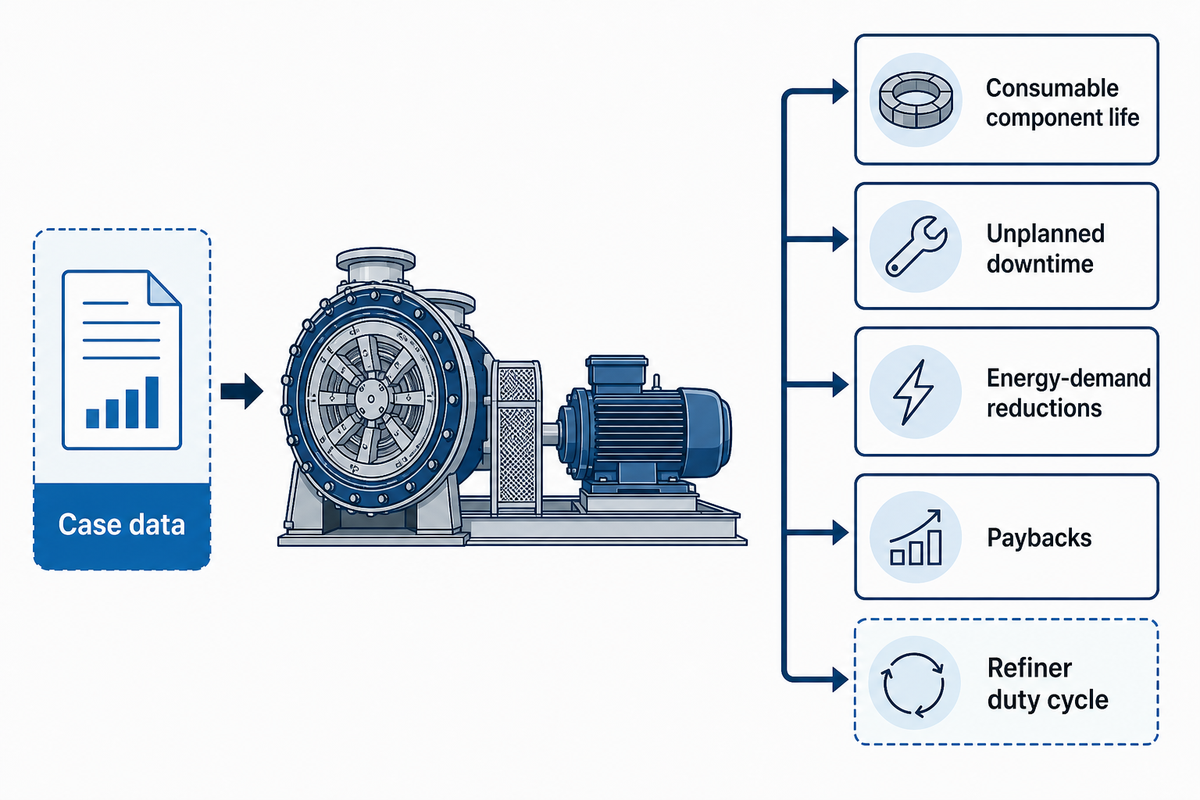
Lifecycle economics are where a rebuild or retrofit earns its place. Documented maintenance programs can extend consumable component life from about 3 years to more than 11 years and cut unplanned downtime by up to 90% in the case data reviewed for this article. Those figures are not a promise for every stock-prep line; ask for the rebuilder’s own records by machine type, duty cycle, and operating hours.
Retrofit paybacks tell a similar story on energy. A 2011 TAPPI PaperCon conference paper reports refining-line energy-demand reductions of 18.5–31%, with paybacks typically under 3 years and one case under 11 months. The presenting author’s employer could not be independently confirmed in this session, so treat the figures as a documented industry case study, not a universal benchmark. Confirm the result for your refiner type and duty cycle before budgeting against it.
5-year total cost of ownership — illustrative structure (fill in with your own vendor quotes):
| Cost item | Used (undocumented condition) | Rebuilt (documented scope) | New |
|---|---|---|---|
| Purchase price | Lowest | Middle | Highest |
| Installation & commissioning | Variable, often underquoted | Usually scoped by rebuilder | Included in OEM quote |
| Energy (5-yr) | Depends on retrofit status | Can drop 18.5-31% if retrofitted | Lowest with current tech |
| Maintenance & spares (5-yr) | Highest, unknown baseline | Lower with documented rebuild scope | Lowest, full OEM support |
| Downtime risk (5-yr) | Highest — can extend component life ~3.6x with proactive maintenance | Moderate, condition-dependent | Lowest |
Payback example: a refining retrofit with a documented 20% energy-demand reduction on a line drawing 500 kW continuously pays back a retrofit investment in under three years at typical industrial electricity rates — the same order-of-magnitude payback documented case studies report, though your actual number depends on your refiner’s baseline draw and local energy cost.
The 8-Line Beyond-Price Reconciliation
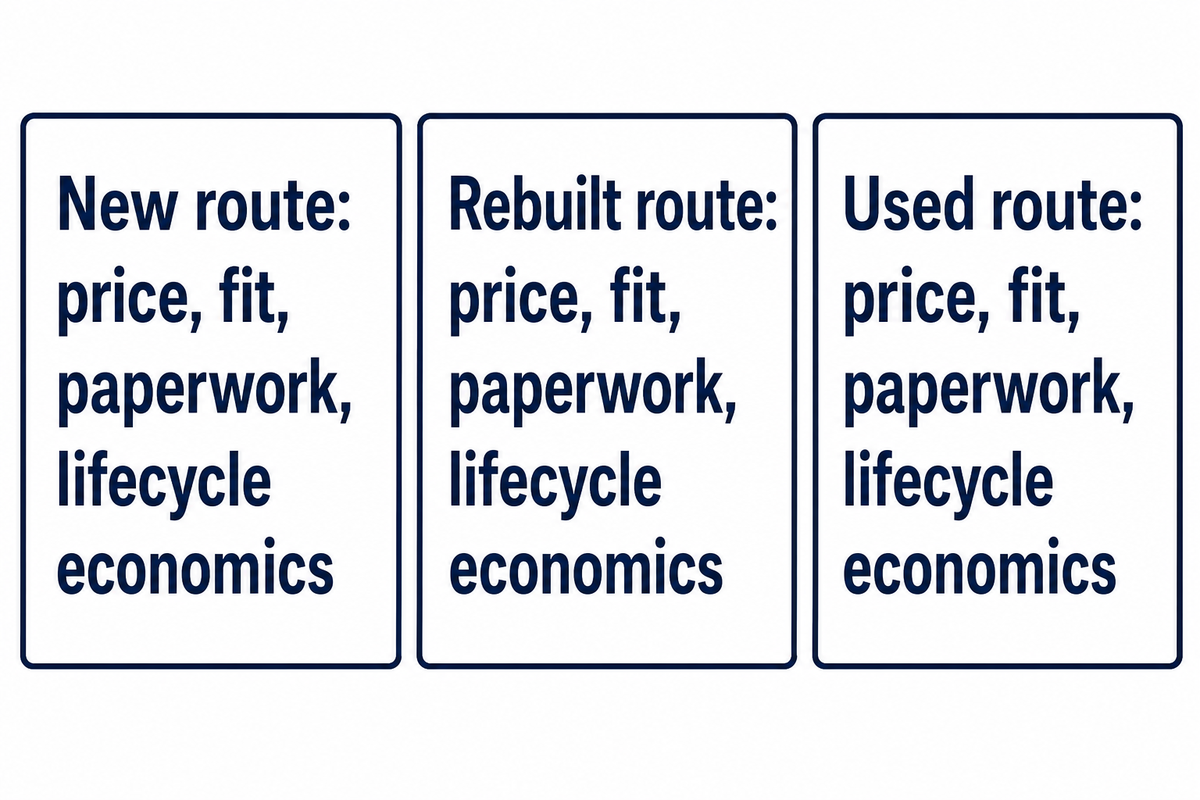
Pulling the maintenance and retrofit evidence together with the earlier sections—including the EU Regulation 2023/1230 conformity point—shows what changes beyond the purchase price. The eight lines below separate the decision into price, fit, paperwork, quote fields, lifecycle economics, delivery, parts, and traceability.
| Comparison category | New | Rebuilt | Used | Limitations / not suitable for |
|---|---|---|---|---|
| 1. Price | Baseline (highest) | 15-40% below new | 40-70% below new | Price alone never predicts 5-year cost |
| 2. Fit tolerance | OEM-guaranteed | Depends on rebuilder’s drawing access | Depends on prior repair history | Not suitable for fit-critical positions without drawing verification |
| 3. Regulatory paperwork | Manufacturer-declared | Conformity risk if hazard profile changed | Low unless later modified | Rebuild scope must be assessed against EU 2023/1230 case by case |
| 4. RFQ comparability | Fields usually explicit | Fields partial, rebuilder-dependent | Fields rarely explicit unless requested | Not comparable to other quotes until fields are forced to match |
| 5. Maintenance economics | Lowest 5-yr risk | Can approach new with documented retrofit | Highest variance, condition-dependent | Undocumented used equipment is not suitable without a condition audit |
| 6. Delivery speed | 3-18+ months | Months, scope-dependent | Weeks, if in-region | New is not suitable when production must restart within weeks |
| 7. Spare parts availability | Full OEM catalog | Depends on rebuilder’s parts sourcing | Depends on OEM still supporting the model | Not suitable if the OEM has discontinued the model line |
| 8. Documentation & traceability | Full manufacturing records from day one | Only as complete as the rebuilder’s own records | Often incomplete or missing entirely | Not suitable for regulated applications without a paper trail |
Why the Used and Rebuilt Market Is Getting More Attention Now
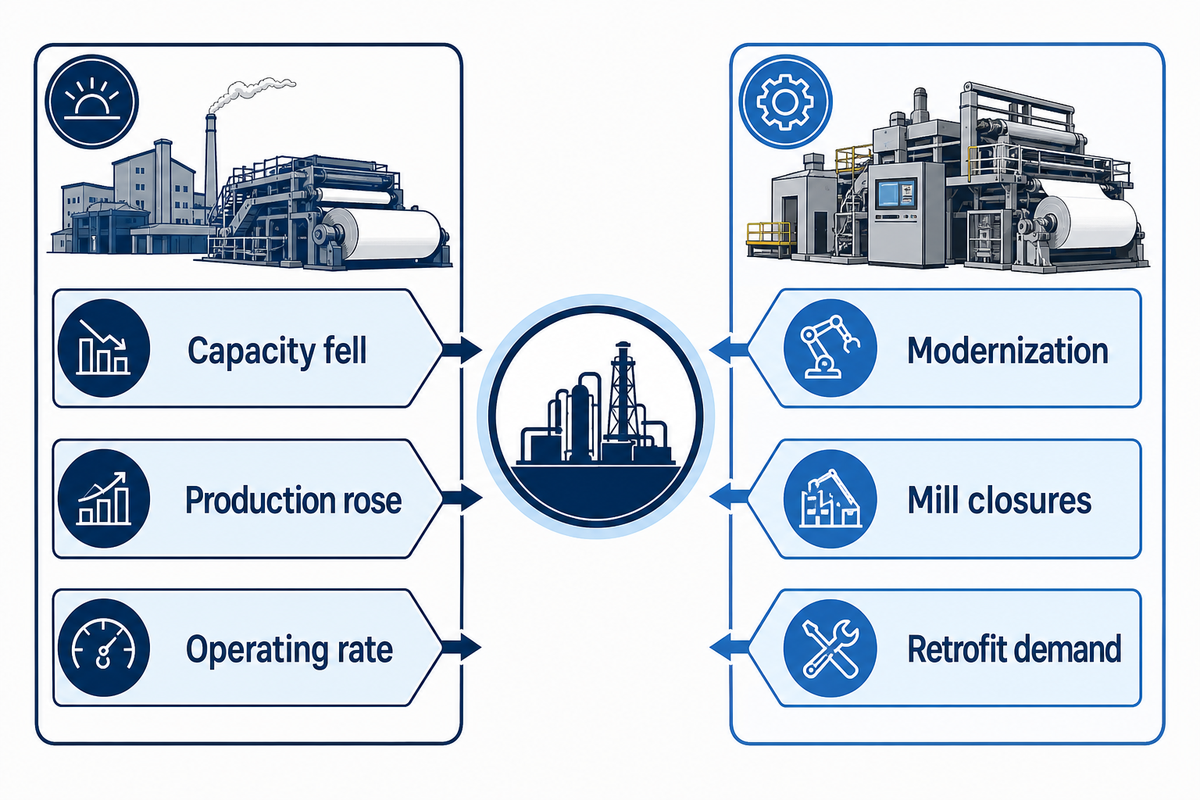
The US pulp and paper industry is reconstituting rather than simply contracting. AF&PA’s 2024 capacity survey reports that paper and paperboard capacity fell 2.0% to 78.1 million tons, while production rose 3.2% and the operating rate reached 87.5%. Part of the capacity change came from modernization and streamlining, which is why retrofit demand can coexist with closures.
Named 2025 closures at International Paper, Georgia-Pacific, Smurfit WestRock, Metsä Board, UPM, and Oji Fibre Solutions show the other side of the cycle. Closed mills release stock-preparation equipment into the used market, while surviving mills weigh rebuilding an existing line against a multi-year new-build order. That result is a live three-route market, not a simple new-versus-used contest.
For a project launching in 2026–2027, capacity consolidation and mill closures are not mutually exclusive. Score each machine by fit criticality, regulatory exposure, maintenance evidence, and delivery need instead of applying one blanket preference to new, rebuilt, or used equipment.
How to Decide: A Scenario-Based Framework
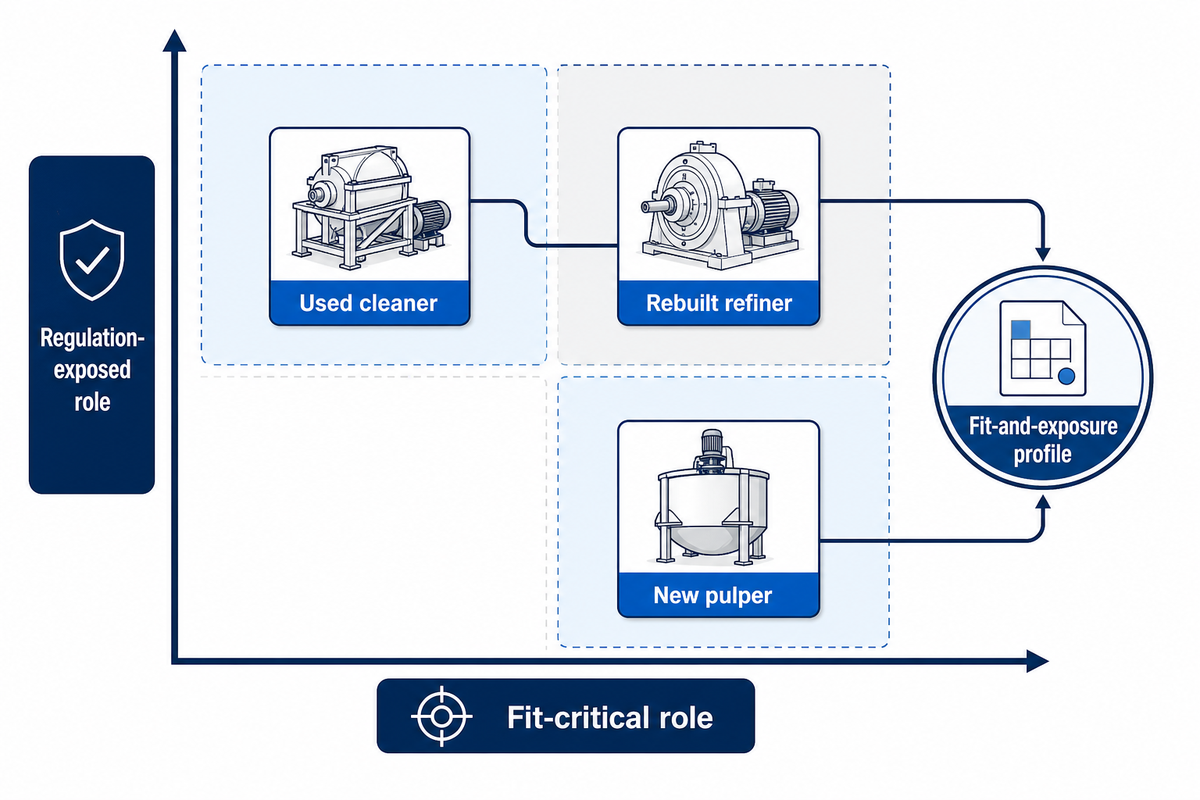
For a stock-preparation purchase, the key determinant is how fit-critical and regulation-exposed the machine is, not a blanket preference for new or used. The 2-Axis Fit-and-Exposure Decision Framework below turns that judgment into a repeatable route choice, with the regulatory axis anchored to the EU machinery regulation where relevant.
The 2-Axis Fit-and-Exposure Decision Framework
- Low fit-criticality, low exposure (e.g., a non-precision auxiliary component, low utilization, no import/rebuild history) → Used is usually the right call. Get documented maintenance history and a condition inspection before you buy.
- High fit-criticality, low exposure (e.g., a precision-tolerance component on a high-duty machine, but no rebuild/import complications) → Rebuilt with verified drawing access, or new. Avoid reverse-engineered parts here.
- Low fit-criticality, high exposure (e.g., a machine likely to need substantial modification, cross-border import, or falls under active regulatory scrutiny) → Rebuilt with a documented conformity review, not a used purchase with unknown modification history.
- High fit-criticality, high exposure (e.g., a precision component in a regulated application, or an import/substantial-rebuild scenario) → New, or a full remanufacture/overhaul from a qualified Original Equipment Manufacturer (OEM) who can supply both original drawings and conformity assessment data. This is the scenario where the “beyond the purchase price” cost of getting it wrong is highest.
Run each machine through the four scenarios before comparing a single quote. Stock-preparation lines are rarely uniform: you may buy a used cleaner, a rebuilt refiner, and a new pulper on the same project when each component is scored on its own fit-and-exposure profile.
Henan Zejiang Paper Machinery designs, manufactures, and rebuilds stock preparation equipment, including new machine lines, refurbishment and rebuild scope, and spare parts made to drawing- or sample-verified dimensions agreed with the buyer. For the broader product range, see our complete pulping and stock-preparation line page.
Frequently Asked Questions
Q: What is stock preparation in paper making?
Stock preparation is the sequence of pulping, screening, cleaning, and refining stages that convert raw or recovered fiber into furnish ready for the paper machine.
Depending on furnish and grade, that stock preparation process can include pulping (slushing), high-density cleaning, coarse and fine screening, low-consistency cleaning, refining, thickening, and— for recycled furnish—dispersion and deinking. The aim is stable paper quality and furnish ready for making new paper on the paper machine, including recycled fiber when the furnish requires it. Papermaking mills use different pulp applications and fiber solutions, so the process must be specified around the grade. The specific equipment lineup varies by paper grade and furnish source, which is why a stock-prep line built for virgin kraft rarely matches one built for recycled OCC furnish stage for stage. Stock preparation machines should be specified around that furnish, not treated as interchangeable.
Q: Which factors must be considered before purchasing used stock preparation equipment?
Documented maintenance and downtime history, drawing access for any non-OEM replacement parts, and whether the equipment’s modification history could trigger a fresh conformity assessment are the three factors that matter most, followed by verified performance data, accreditation checks on any certification claims, and written acceptance-test criteria before final payment.
Beyond those three, confirm the seller can supply performance data rather than just nameplate capacity when purchasing used equipment, since a used machine’s original spec plate rarely reflects years of wear, furnish changes, or prior repairs that quietly reduced real throughput. Verify any certification claims through the certifying body’s own accreditation record rather than the certificate alone — a certificate with no traceable accreditation is not proof of anything. Finally, get acceptance-test criteria written into the purchase agreement before final payment changes hands, because a verbal assurance about condition carries no weight once the machine is on your floor and the seller has been paid.
Q: Does the used equipment market compete with OEMs, or complement them?
Both — the used and rebuilt market absorbs buyers who need speed or lower cost, while OEMs keep the business that needs full warranty coverage.
The two channels feed each other more than they compete: rebuilders and dealers often source machines from mill closures or line upgrades, and OEMs frequently supply spare parts and rebuild services for their own older equipment, which blurs the line between “used market” and “OEM aftermarket” more than either side likes to admit in a sales pitch. A buyer choosing between them is really choosing a service model, not picking a side in a competition.
Q: What is total cost of ownership and why does it matter when comparing new and used equipment?
Total cost of ownership adds installation, energy, maintenance, and downtime cost to the purchase price over the equipment’s working life — and it’s the number that actually predicts which acquisition route saves money.
Purchase price alone can swing the wrong way once real maintenance, utility, and energy costs are counted in.
Q: Can a rebuilt stock-prep machine come with a warranty?
Yes, but a rebuild warranty typically covers only the scope of work the rebuilder actually performed — not the entire machine the way a new-equipment OEM warranty does — so get the rebuild scope, the specific components replaced or refurbished, and the warranty term written into the purchase agreement before you sign.
A “rebuilt” claim without a documented scope tells you very little about what was actually done to the machine, and even less about what wasn’t touched. Ask specifically which components were replaced with new parts, which were refurbished and reused, and which were left as-is because they tested within tolerance — three very different risk levels that a generic “fully rebuilt” label flattens into one word. The warranty term should match that scope line by line, not cover the machine as a whole if the rebuilder only touched half of it.
Q: What’s the realistic lead time difference between new and used or rebuilt equipment?
New equipment typically runs 3–18+ months of lead time; used machinery can ship in weeks when it is in-region; rebuilt equipment falls in between for delivery in practice.
A tight production schedule alone can rule out new equipment.
Why We Write This
Henan Zejiang Paper Machinery builds new stock preparation lines and rebuilds existing ones, which means we see the fit and paperwork problems in this guide from both sides of the transaction — as the manufacturer producing original drawings, and as the rebuilder working from what a buyer already owns. This guide reflects the questions we get asked most often when a mill is choosing between a new order, a rebuild, and a used-market purchase for the same duty.
Related Articles
- Used Paper Machinery: How Buyers Inspect Risk Before Purchase — the full whole-machine inspection framework (evidence ladder, 12-system grid) this article builds on for stock-prep-specific economics
- How Paper Machine Rebuilds Actually Work: A Buyer’s Guide — rebuild project execution in depth
- Paper Pulper Machines Explained: Types, Working Principle & How to Choose
- How Disc Refiners Work, And How to Choose the Right Type for Your Mill
References & Sources
- Regulation (EU) 2023/1230 on Machinery Official Journal of the European Union
- Refurbished and Modified Machinery UK Health and Safety Executive
- 29 CFR 1910.261, Pulp, Paper, and Paperboard Mills U.S. Occupational Safety and Health Administration
- About IAF International Accreditation Forum.
- ISO Certification (verification fallback) International Organization for Standardization; browser access may require the official challenge page.
- ISO 9001 Quality Management Systems Accreditation ANSI National Accreditation Board.
- AF&PA Details U.S. Paper Production and Capacity Trends American Forest & Paper Association
- 2025 Sees Continued Pulp and Paper Mill Closures: What’s Driving the Trend? ResourceWise
- Manufacturing Machinery Maintenance NIST Applied Economics Office.
- Refining-Line Retrofit Case Studies TAPPI PaperCon 2011.
- Kemsley Paper Mill Invests in New Stock Preparation Line PULPAPERnews.com
- The Importance of Equipment Fit, Tolerance, and Clearance Maintenance World
- EP1101858B1, Pulper for a Stock Preparation System and Method of Pulping Google Patents

![Refiner Plates & Screen Baskets [Complete Guide]](https://zjpapermachine.com/wp-content/uploads/2026/07/refiner-plates-screen-baskets-guide-featured-150x150.png)
![Doctor Blade: Types, Materials & How It Works [Guide]](https://zjpapermachine.com/wp-content/uploads/2026/07/doctor-blade-guide-featured-1-150x150.png)
![Pulping Equipment: How Paper Pulping Works [Guide]](https://zjpapermachine.com/wp-content/uploads/2026/07/pulping-equipment-guide-featured-150x150.png)