Get in touch with Zejiang Paper Machinery Company


Paper Rewinder & Pope Reel Blogs
A slitter rewinder machine converts large paper rolls into narrower, saleable rolls. It unwinds the parent roll, makes longitudinal cuts, and rewinds each strip onto a specified core. For a paper mill or converter, the machine comes after the paper making and finishing processes. The pope reel creates the parent roll, and the slitter rewinder prepares the widths and roll formats the next process or customer actually needs. See how a rewinder pope reel fits in the line.
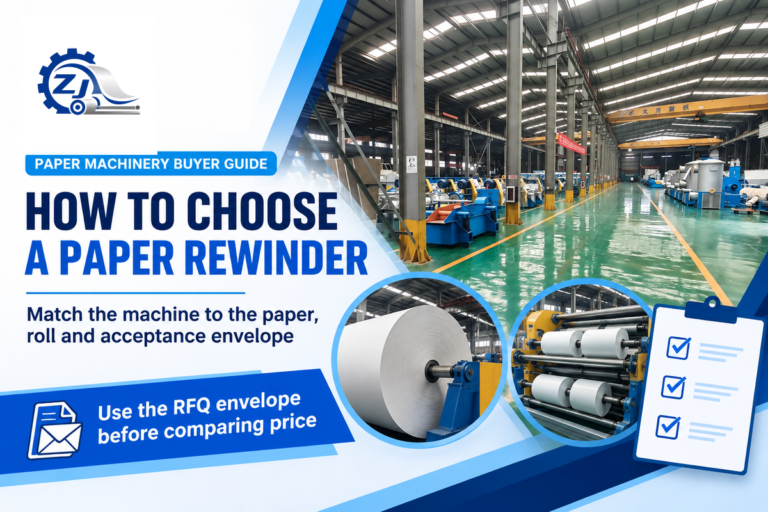
Quick answer: choose a slitter rewinder by grade, basis weight, parent-roll width and diameter, finished-roll width and diameter, core design, changeover frequency, tension requirements, and the evidence you will require at commissioning. A speed figure by itself does not define a good paper-converting machine.
What Is a Slitter Rewinder?
These are converting machinery choices, and a used slitter should be checked against the same tension, core and roll-quality requirements as new equipment.
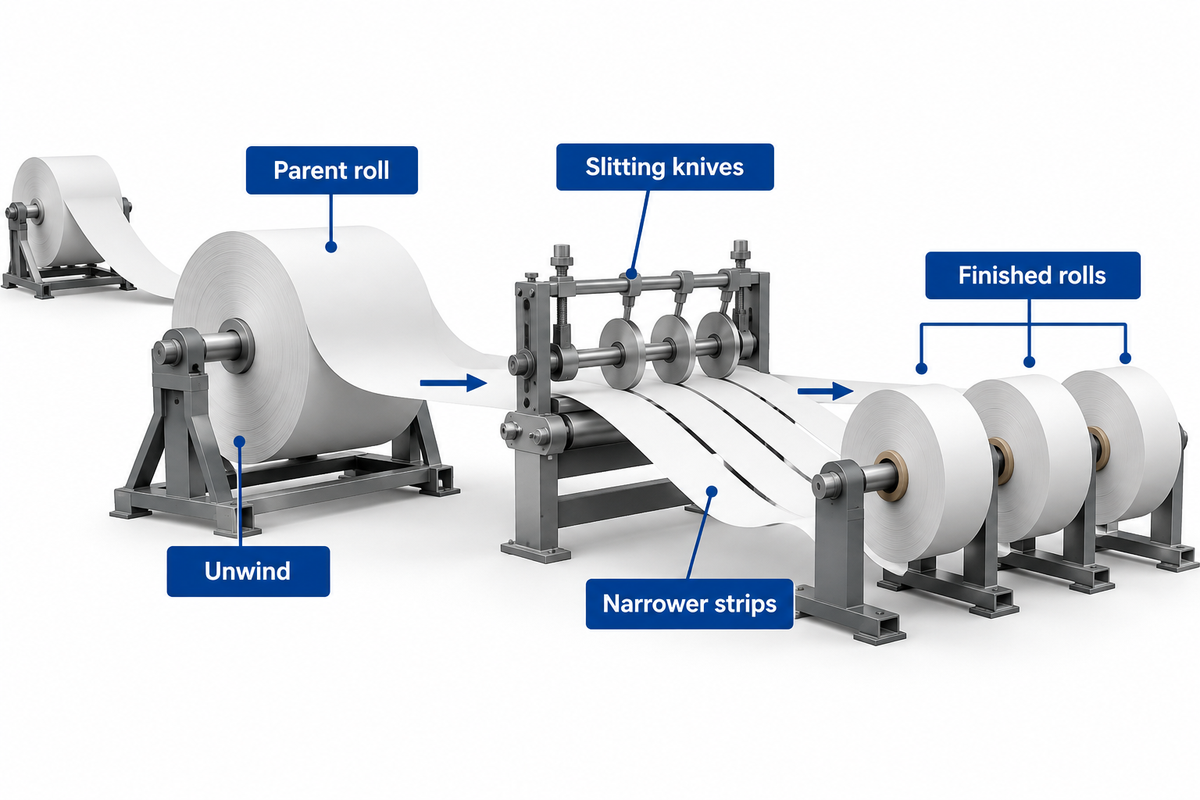
In paper slitting, a slitting machine feeds a large roll of material through the knife section. The combined slitter and rewinder then winds the separated strips onto cores to complete the roll rewinder operation.
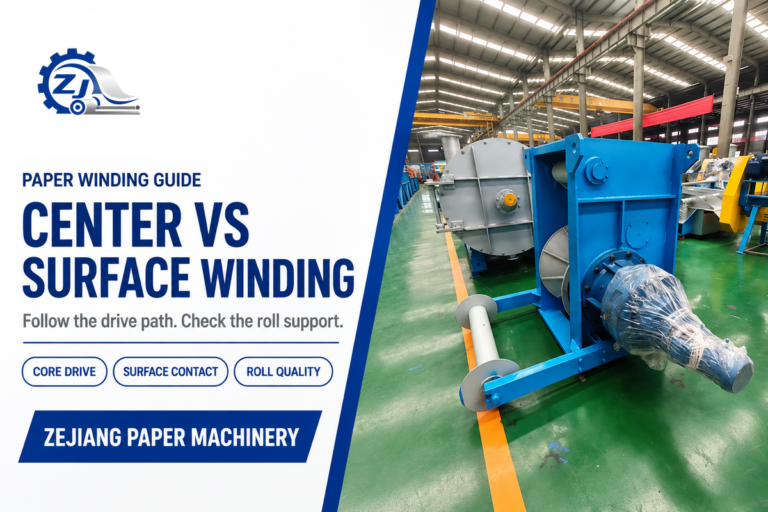
A two drum slitter rewinder supports the growing rolls on drums. A center surface duplex slitter rewinder combines individual core torque with surface support during slitting and rewinding.
The machine performs three linked operations. First, an unwind stand releases the parent roll under a controlled tension. Second, a slitting station separates the moving web into narrower strips of the required widths. Last, the slit strips are rewound onto individual cores. This sequence is in line with the definitions provided by Elite Cameron and Jennerjahn.
| Stage | What happens | What the buyer should define |
|---|---|---|
| Unwind | Parent roll is supported, centered and released into the web path. | Parent width, diameter, weight, shaft or shaftless handling, edge guide and web tension. |
| Slit | Razor, rotary shear or score/crush knives divide the web. | Material, thickness, minimum slit width, edge-quality target and knife-change method. |
| Rewind | Strips are wound onto separate cores as finished rolls. | Core diameter, roll diameter, roll hardness, winding pattern, automation and changeover time. |
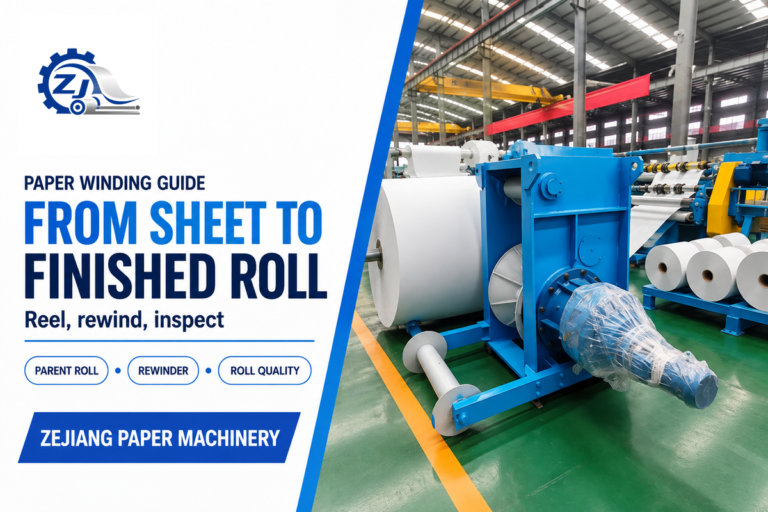
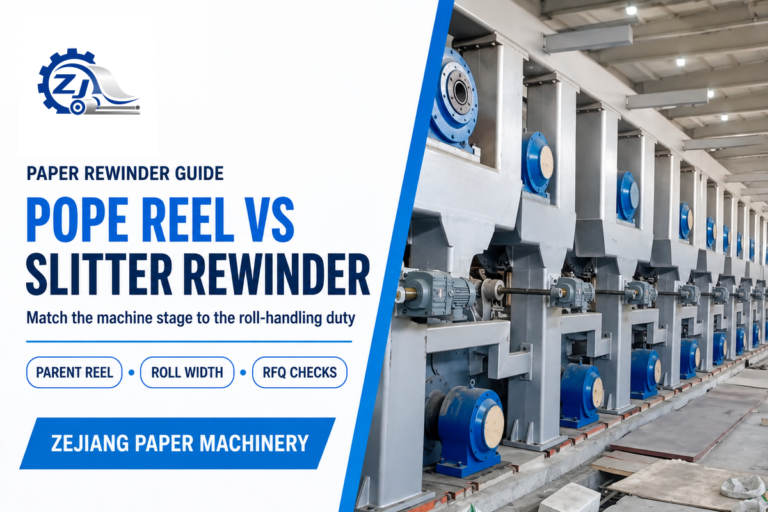
A pope reel winds a continuous web into a parent roll at the paper machine. A slitter rewinder is a downstream converting machine which changes web width and creates customer-ready rolls. Treating the two as interchangeable can produce a quotation with the wrong unwind duty, core handling or finished-roll targets. Coreless slitter rewinder models also exist, so specify whether the finished rolls need cores when requesting a quotation.
Which Slitting and Winding Configuration Fits the Job?
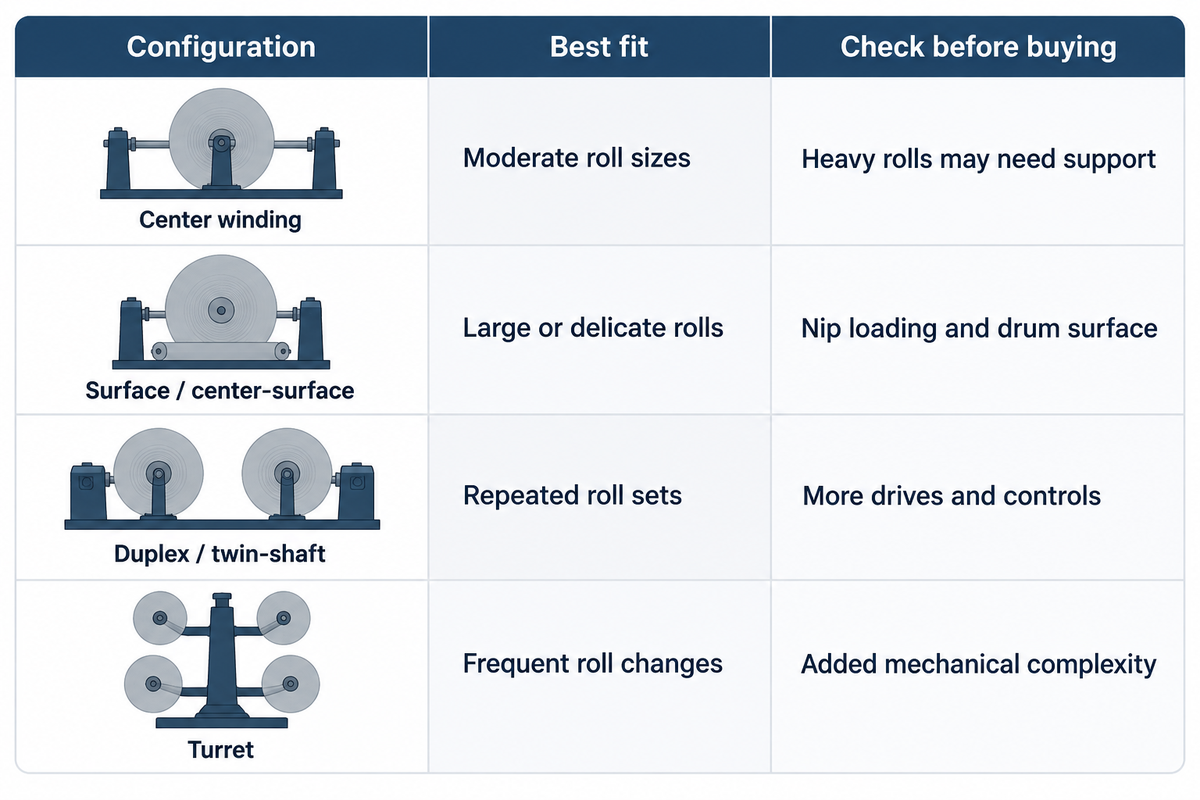
The configuration of the machine is decided by the grade mix, slit-width range, mass of finished rolls, frequency of changeover and level of operator interaction. The table below lists when each winding configuration is useful and the trade-off to discuss in the request for quotation.
| Configuration type | Useful when | Trade-off to discuss |
|---|---|---|
| Center winding | General-purpose paper and moderate finished-roll sizes where core drive provides direct control. | Simple and economical, but very narrow widths or high roll mass may need added surface support. |
| Surface or center-surface winding | Large or heavy rolls, delicate webs, or applications where contact support improves alignment and roll stability. | More rolls contact drums; nip loading and surface condition become part of the quality conversation. |
| Duplex/twin-shaft winding | Two rewind shafts and repeated roll sets are useful when throughput and operator handling matter. | More drives, shafts and controls mean more commissioning points and maintenance items. |
| Turret winding | Frequent roll changes and high-volume campaigns where the next shaft can be prepared while the current set finishes. | Changeover downtime can fall, but the turret adds mechanical and controls complexity and cost. |
| Two-drum surface winding | Paper-mill output with large finished diameters or high roll weights. | Drum condition, nip control and roll-transfer alignment become critical acceptance items. |
| Single-shaft center | Short runs and a defined core set | Check shaft loading time and finished-roll width range. |
| Twin-drum surface | Large parent webs and surface-supported rolls | Define nip pressure, roll hardness and dust control. |
| Center-gap winding | Grades that need independent torque control | Confirm taper tension and roll-density evidence. |
| Shaftless core handling | Frequent core changes and narrow finished rolls | Confirm core tolerance and automatic positioning. |
| Automatic turret | High changeover frequency | Test splice, cutover, guarding and operator training. |
Public guides from Nicely divide shafted and shaftless handling. Shaftless designs can simplify core loading but depend on consistent core dimensions and accurate positioning. Rob McNamee’s configuration guide separates center, center-surface and surface drive principles from single-shaft, duplex and turret arrangements, which can be combined.
How Do Tension and Knife Choices Affect Roll Quality?
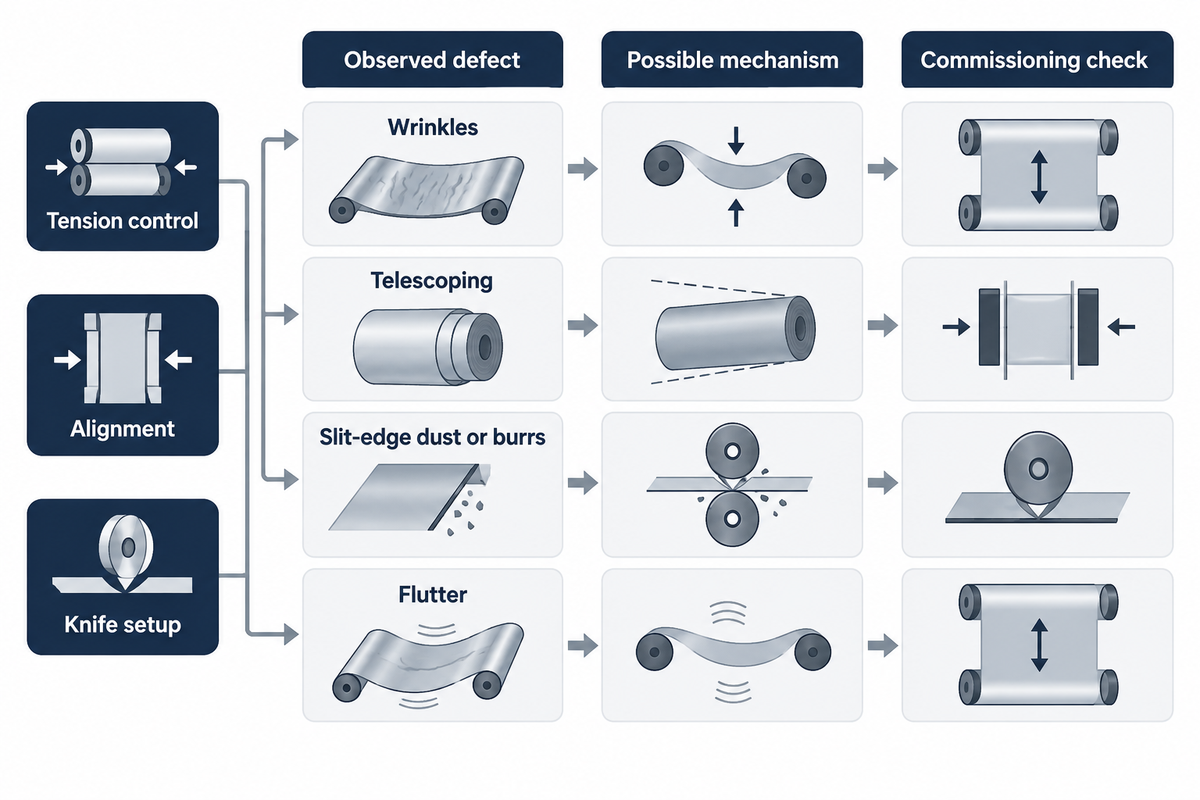
Roll quality depends on stable tension while the unwind diameter falls, the rewind diameter grows, and the line accelerates or decelerates, with knife selection following the web. Stable control can include a deliberate reduction in rewind tension as the roll grows, as explained in DFE’s guide to tension zones and taper. The manufacturer’s suggestion on the rewinder pope reel page refers to basis weight, roll diameter and line speed, and suggests adjusting tension, alignment and knife position to achieve desired cutting.
Knife selection is dependent on the web, and material trials must be done to assess the adequacy of the cutting blades for a substrate when cutting paper. Razor blades can be economical for suitable light materials; shear slitting gives a cleaner, more supported cut for thicker or more demanding grades; score/crush cutting may fit some materials but can increase dust or deformation. The tension control system should coordinate consistent tension, alignment and knife position so the machine can make precise cutting and rewinding possible without flutter.
| Observed defect | Possible mechanism | Commissioning check |
|---|---|---|
| Wrinkles or starring | Tension profile, air entrainment, roll hardness or alignment changes during acceleration. | Record tension by zone and acceleration step on the target grade; inspect nip and lay-on settings. |
| Telescoping or soft edges | Uneven tension, core runout, edge guide error or poor roll transfer. | Measure core runout, edge position and hardness across the roll width. |
| Dusty or torn slit edges | Knife geometry, blade condition, material sensitivity or unsupported web at the cut. | Run a controlled knife comparison at the intended width and inspect edge microscopy or visual standard. |
| Interleaving or uneven density | Unstable tension or a winding method mismatched to grade and diameter. | Review the tension trace through steady state and deceleration, then compare roll density by position. |
Judge the required production rate alongside roll quality for the specified grade, width and diameter.
What Should You Put in an RFQ?
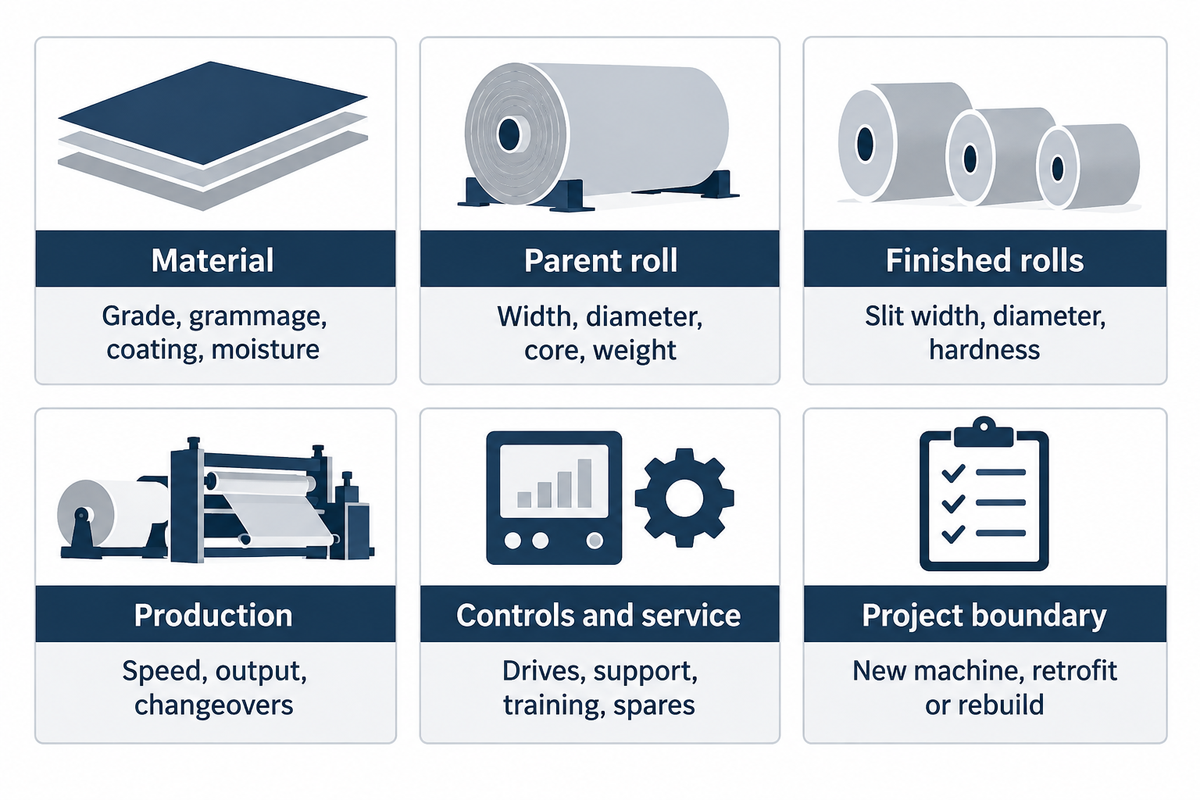
Include grade, output, speed, grammage, web width, target roll width and diameter, current equipment, configuration and installation or commissioning scope in the RFQ. Zejiang’s public buyer guidance mentions grade, output, speed, grammage and web width; its rewinder guidance mentions target roll width and diameter, current equipment, configuration and installation or commissioning scope.
| RFQ block | Send this information |
|---|---|
| Material | Paper grade, basis-weight/grammage range, coating or surface sensitivity, moisture range and any splice or defect constraints. |
| Parent roll | Maximum width, outside diameter, core, weight, reel build and unwind direction. |
| Finished rolls | Minimum and maximum slit width, finished diameter, core ID/OD, roll weight, hardness target and winding pattern. |
| Production | Target line speed, tonnes/day or rolls/hour, campaign mix, changeover frequency and expected duty cycle. |
| Controls and service | PLC/HMI preference, servo or mechanical drive, remote support, training, spare parts and regional approvals. |
| Project boundary | New machine, retrofit or used-equipment rebuild; installation, commissioning, FAT/SAT, guarding and operator handover. |
If a supplier can’t link its proposal to these RFQ fields, price comparisons can be misleading. For a rebuild, add photos, drawings, condition of shafts and bearings, backlash of gearbox, journal scoring, constraints of existing frame, etc.
For large rolls of paper, specify the unwind OD and rewind OD separately. State the max web width with its trim allowance, core dimensions and unwind and rewind arrangement; a mill will generally allow approximately 1.2–2.5 cm of trim on either side of the jumbo. To compare cutting accuracy, ask for evidence at your material type, specific widths and intended slitting speed.
These fields make the quotation testable.
How Should You Test a Slitter Rewinder Before Acceptance?
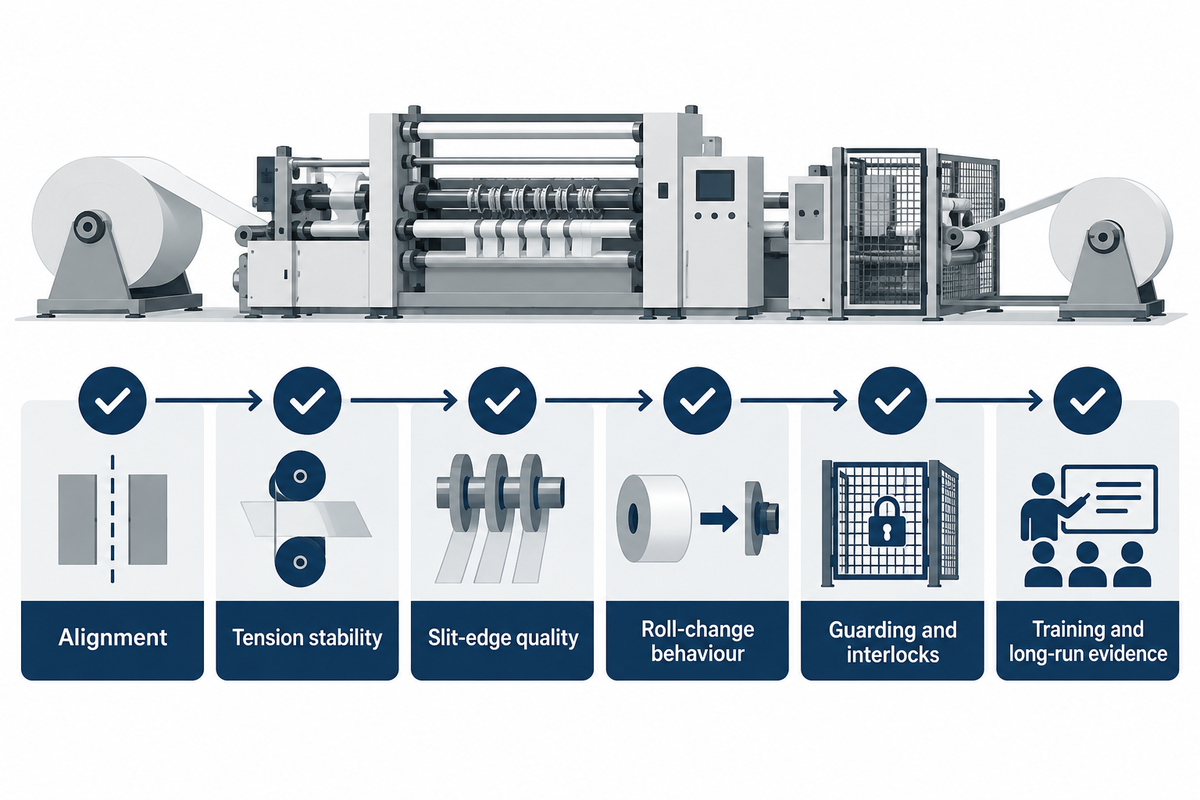
Testing of guarding, interlocks and lockout procedures should be performed with the same level of discipline that’s applied to process checks. OSHA machine-guarding guidance addresses access control and safe machinery use, while separate commissioning, tension and edge checks assess the converting result.
Both stages (Factory acceptance and commissioning) need to be documented:
- Dimensional fit: verify parent-roll width, core interfaces, knife travel, finished-roll diameter and guarding clearances.
- Control stability: record unwind, slit and rewind tension through start-up, steady state and deceleration on the specified grade.
- Edge and roll quality: inspect slit edges, roll squareness, hardness, density, wrinkles, telescoping and interleaving.
- Changeover: measure roll transfer, shaft or core handling, knife setup and the repeatability of the next job.
- Safety: verify guards, interlocks, emergency stops and lockout/tagout access at knife and nip points.
- Long-run evidence: agree how continuous-duty loading and fatigue risks will be evaluated after the factory test.
Structural fatigue can develop under repeated loading and may go undetected during a short factory test. Therefore, long-run evidence should be part of the acceptance plan. That is why the acceptance plan should define records, sample length, defect limits and post-installation support before the purchase order.
Which Paper Grades and Typical Ranges Are Publicly Listed?
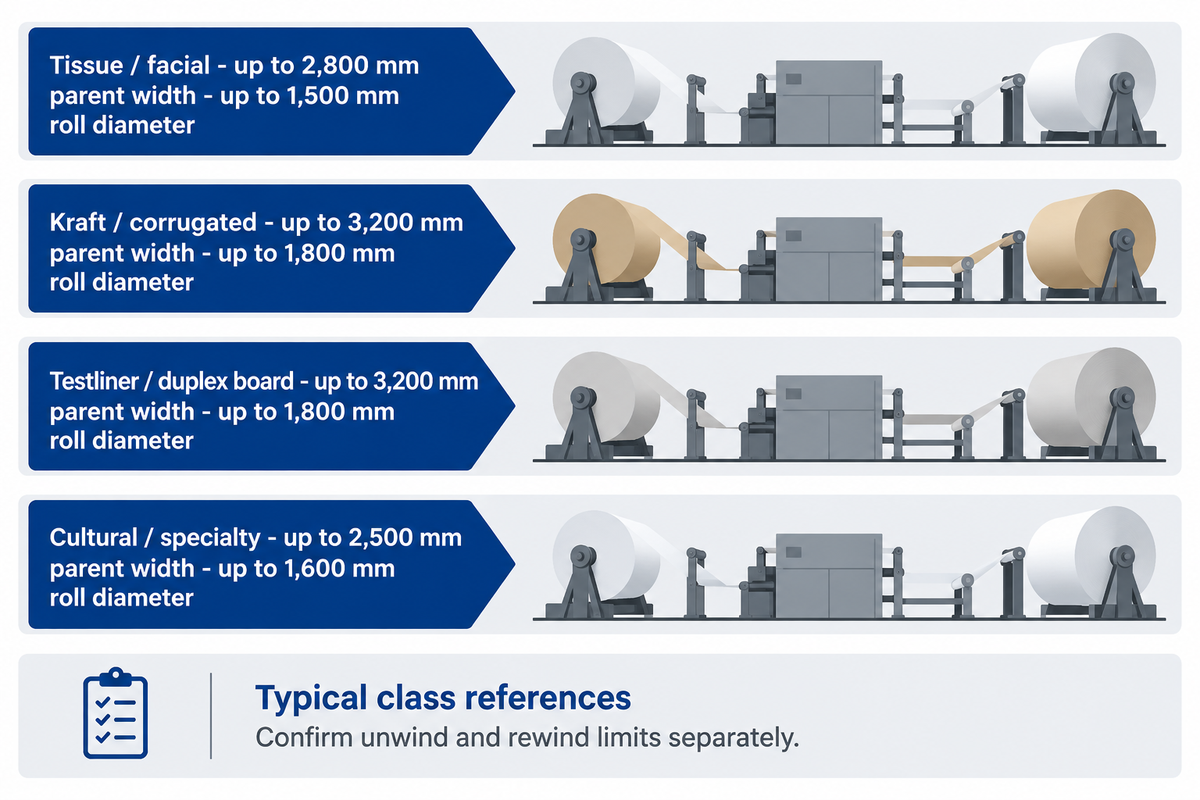
Zejiang’s public product page lists tissue equipment up to about 2,800 mm parent width and 1,500 mm roll diameter, kraft or corrugated and testliner/duplex examples up to about 3,200 mm and 1,800 mm, and cultural or specialty examples up to about 2,500 mm and 1,600 mm. These are typical class references for a first shortlist, not fixed project specifications.
| Grade family | Typical parent width | Typical maximum roll diameter | Public configuration cue |
|---|---|---|---|
| Tissue / facial | Up to 2,800 mm | Up to 1,500 mm | Surface winding or shaftless-core option; sensitive tension control. |
| Kraft / corrugated | Up to 3,200 mm | Up to 1,800 mm | Center or duplex winding with closed-loop tension control. |
| Testliner / duplex board | Up to 3,200 mm | Up to 1,800 mm | Center winding and reinforced drum/shaft for board-grade loads. |
| Cultural / specialty | Up to 2,500 mm | Up to 1,600 mm | Center or turret options for multi-set jobs and precision stock. |
Your quotation should tie the actual grade, grammage, width, diameter, speed and roll quality to the selected machine. The public table labels a typical maximum roll diameter without identifying the unwind or rewind end. Ask the supplier to state both limits separately for the proposed machine.
Where Does Zejiang Paper Machinery Fit?
Flexible packaging materials, plastic films and nonwoven webs need a separate material brief; this guide keeps its decision map on paper grades.
For paper packaging materials, compare converting solutions by grade and service scope. Match each slitter rewinder available to your production needs. Evaluate production efficiency using both the required output and the roll quality demonstrated during testing.
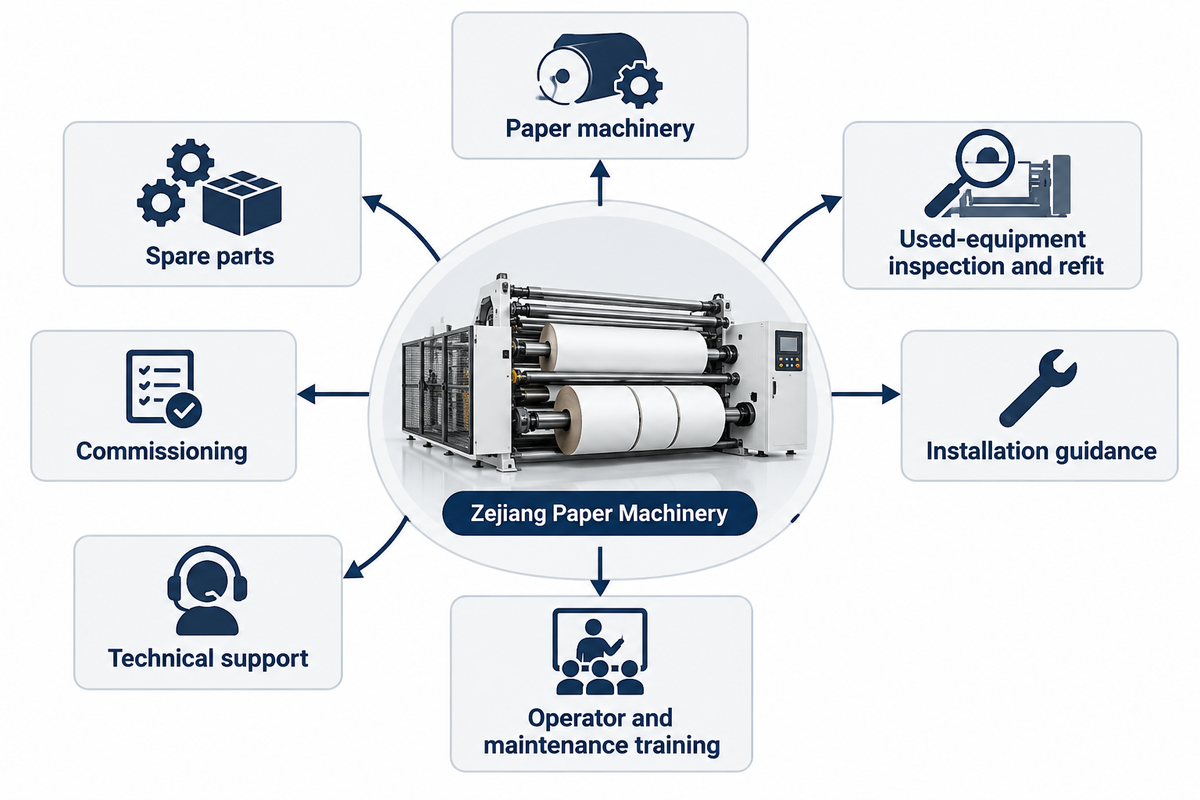
Henan Zejiang Paper Machinery Co., Ltd. indicates it provides a range of offerings from its Qinyang operation, including paper-making machines and pulp-processing equipment as well as spare parts, new and used machines, rebuilds and lifecycle services. The company says its public scope includes design and manufacture, inspection and refit of used equipment, installation, commissioning, spares, tech support and training for operators and maintenance personnel. For a specific line, write the speed, capacity, certification and acceptance targets into the RFQ and the FAT/SAT plan.
Practical fit is measured through parent-roll production, existing equipment condition, grade mix, parts compatibility and the commissioning evidence required by the mill, using the RFQ fields above.
Frequently Asked Questions
What does a slitter rewinder do?
It unwinds a wide parent roll, cuts the web into narrower widths and rewinds the strips onto separate cores. The paper mill or converter can then ship or process rolls in the widths required by the next operation.
What is the difference between a slitter rewinder and a rewinder?
A rewinder changes roll build or inspects and repairs a web without necessarily changing its width. A slitter rewinder combines that winding function with longitudinal cutting, so one wide roll becomes multiple narrower rolls in the same pass.
What affects slitter rewinder price?
Configuration, grade range, parent and finished-roll sizes, core handling, knife system, tension controls, automation, changeover method, installation, commissioning, rebuild scope and regional requirements all affect price. A speed number alone isn’t a comparable quotation.
Which data should I send for a quotation?
Send the paper grade and grammage, parent-roll width/diameter/weight, finished slit widths and diameters, core dimensions, target speed or output, current equipment, automation expectations and the FAT/SAT or commissioning evidence you need.
References & Sources
- Zejiang Paper Machinery, About Us
- Zejiang Paper Machinery, Rewinder / Pope Reel
- Elite Cameron, A Brief Introduction to Slitter Rewinder Machines
- Jennerjahn, Slitter Rewinder Machines
- Nicely, Slitter Rewinder Machine Guide
- OSHA 1910.212, General requirements for machine guarding
- UK HSE, Safe use of work equipment
- Valmet, Rewinder process context
- DFE, Slitter rewinder tension control