Get in touch with Zejiang Paper Machinery Company


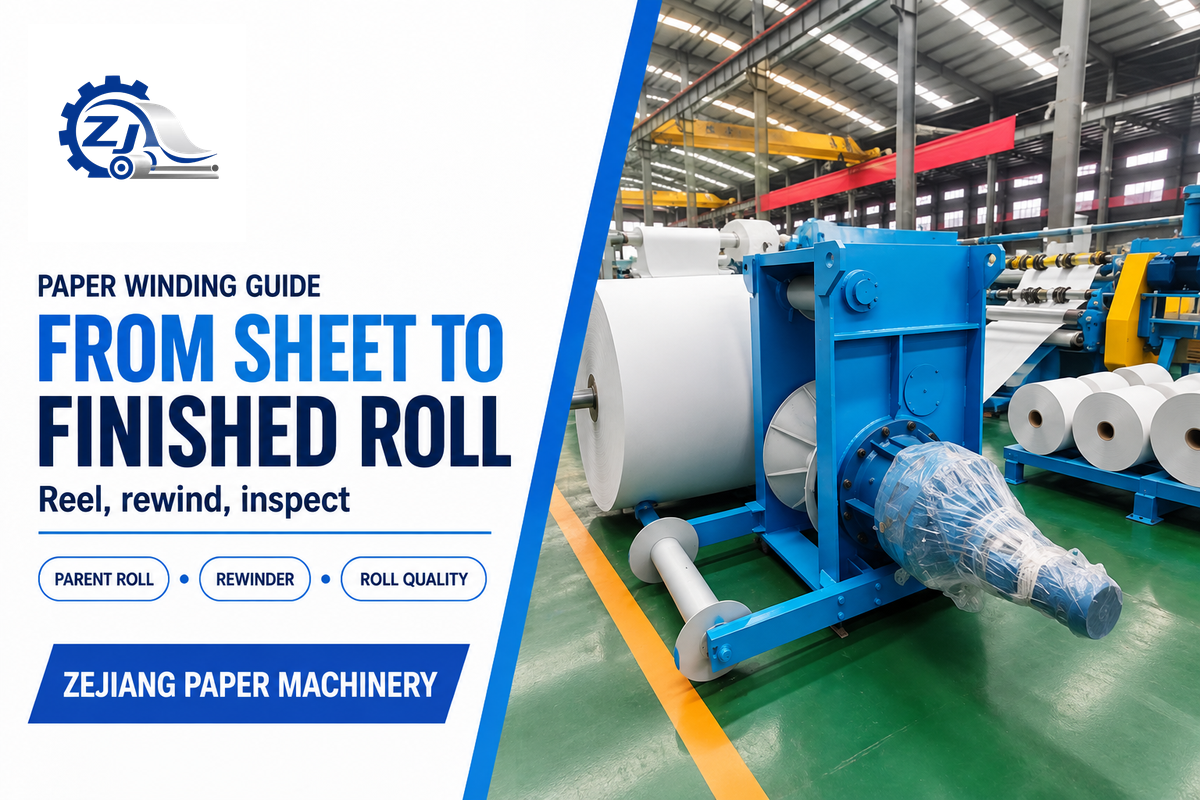
The paper machine winding section takes the continuous web and makes paper rolls. The machine reel builds a parent roll as wide as the paper web. A downstream winder unwinds the parent roll, slits the web and rewinds it to customer-specific sheet dimensions and roll diameters.
A roll may appear to leave the reel OK but then get wrinkles in it while rewinding, or degrade during handling. It’s important to identify the first place it occurs: a quicker winder won’t fix a bad parent roll and using better winding controls won’t fix a queue at the roll discharge.
Updated November 2026
Paper machine winding section: the dry-end reel forms the parent roll; downstream unwinding, slitting and rewinding produce customer rolls. Compare equipment for both roll quality and complete-cycle production.
- Finished-roll defects can begin upstream, during winding or after roll discharge.
- Tension, nip load and torque describe different physical quantities.
- Average output includes changing rolls, preparing cores and waiting for handling equipment.
Specification basis: paper grade and grammage; web width in mm; parent and finished diameter in mm; roll mass in kg; sustainable speed in m/min; accepted output in tonnes/day.
What the paper machine winding section does
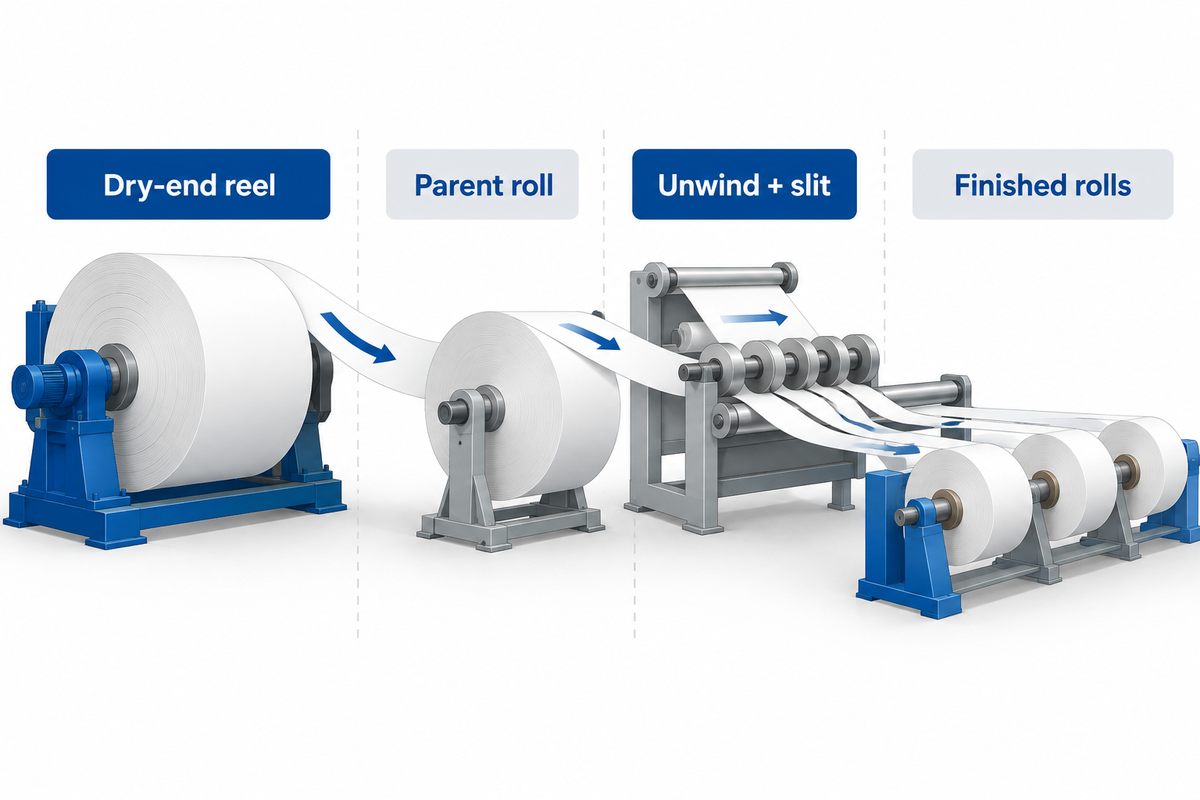
Winding turns continuous sheet production into paper rolls. At the dry end, the reel is approached by the moving sheet and a parent roll is created. The separate finishing winder takes the completed parent roll through a second winding operation.
Its mission is to provide roll sizes and winding structure to the next process.
In the paper production line, pulp preparation, forming, pressing and drying establish the sheet before it gets to this stage. Some grades also go through the paper calendering process or a coating operation. Winding preserves those sheet properties in a roll; it does not recreate the fibre network.
The Health and Safety Executive’s description of reeling and slitting places these machines after reel-up, and also in converting areas or after coating and supercalendering. That distinction prevents a common scope error in equipment enquiries: the continuous machine reel and the batch-fed finishing winder need separate entries on the layout.
- Form the parent roll. Collect the continuous web at the machine reel.
- Transfer the completed roll. Move it into the finishing flow.
- Unwind, slit and rewind. Produce the ordered roll format.
- Discharge the rolls. Hand them to separate handling, wrapping and storage equipment.
How the Pope reel forms the parent roll
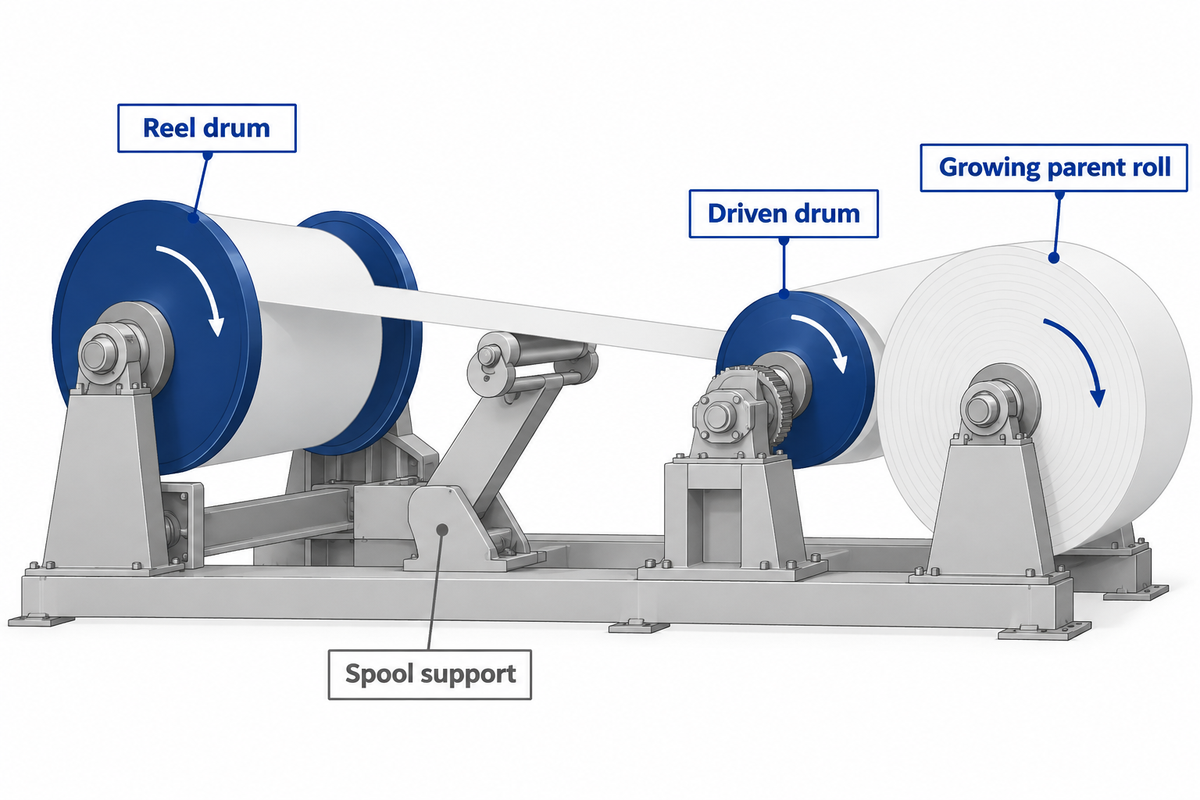
A Pope reel forms the parent roll by winding the web onto the reel spool as it rotates in contact with a driven drum. In standard transfer structures, the primary arms control the new spool and the developing roll is transferred to the secondary position. The load through that transition influences the web nearest the spool.
Imagine taking a long ribbon and wrapping it around a tube: each additional layer presses onto the previous ones. So a disturbance on start-up can remain embedded within a large diameter roll. The key components include the reel drum, spool support, loading device and drive units that rotate the assembly.
Reel designs vary. The basis for the TAPPI conference paper on Beloit’s TNT reel is a design that preserves torque, nip and tension control without the aid of primary-to-secondary arm transfers. This provides a valuable comparison to the conventional Pope layout: the opportunities for control are mechanical design dependent.
Add the turn-up and transfer history to the investigation if waste is continually happening close to the reel spool. Purchasing downstream machine parts just because the defect is visible at the winder can leave the original cause unaddressed.
From parent reel to finished rolls on the paper rewinder
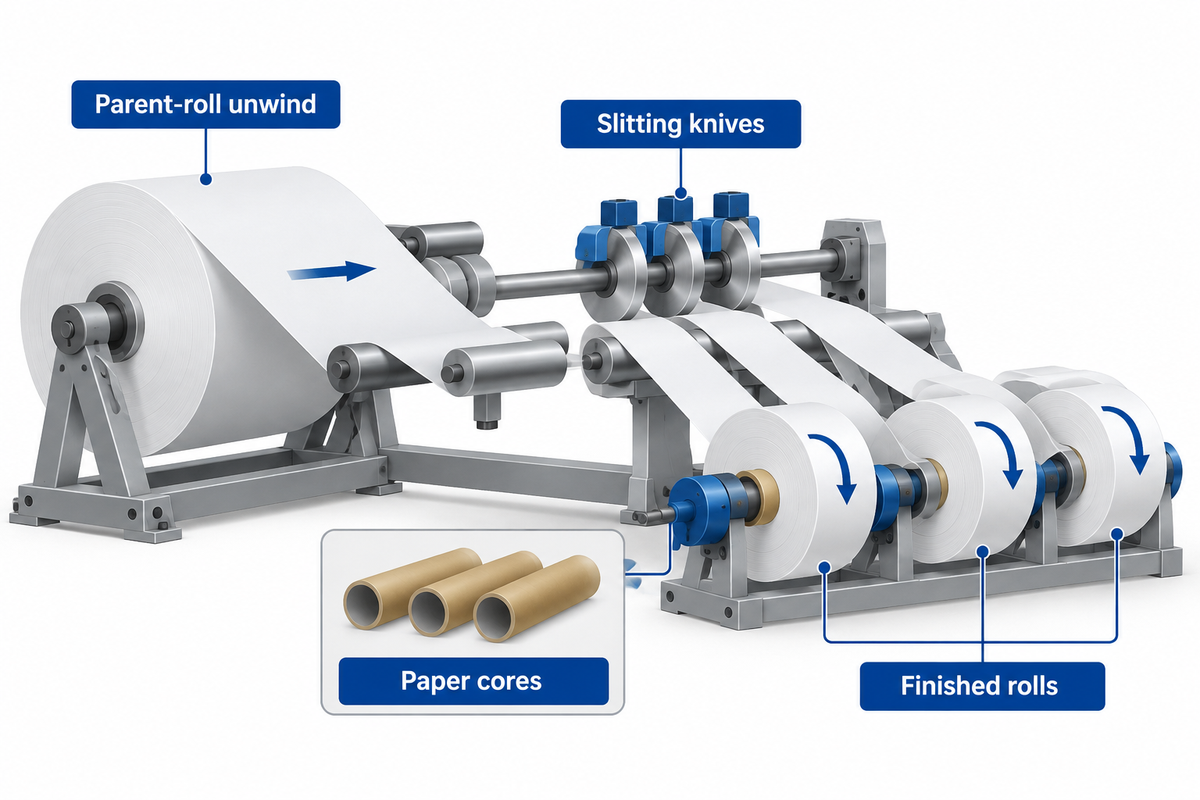
A paper rewinder converts a parent roll into finished rolls by guiding the unwinding web, cutting it longitudinally and forming new rolls on cores. Width precision resides in the slitting work, roll hardness and stability in the winding. There also has to be a reliable unwind roll of paper in the customer’s next process.
High-quality finished rolls require all this, along with a parent reel that feeds consistently.
In a shafted arrangement, the unwind shaft supports and locates the parent roll. Shaftless machines use individual chucks. Downstream, a paper slitter separates the web into narrower slit strips.
These strips are rewound onto a paper core or another designated core material. Core strength and dimensional tolerance must suit the roll load and downstream chuck fit. Unwind tension maintains control of incoming sheet as parent roll shrinks.
The Pope reel and slitter rewinder comparison explains the equipment boundary for an enquiry. The diameter specification for the parent-roll input differs from the specification for finished-roll output.
What slitting methods does a paper roll slitter rewinder machine use?
Typical slitting methods include rotary shear, crush or score cutting, and razor slitting. The suitability of crush cutting and razor slitting depends on the material and the machine. Rotary shear uses upper and lower circular knives like scissors, while crush cutting presses a blade onto an anvil.
Razor blades cut through supported or tensioned webs.
For a paper order where edge dust disrupts printing, compare cut-edge samples as well as slit width. Knife condition, overlap and alignment affect the result. Heavier grades and lightweight papers place different demands on the cut; selecting a method by grammage alone misses coating, abrasiveness and the required edge quality. Our guide to slitter rewinder configurations covers the wider machine choice.
Winding tension, nip load and torque
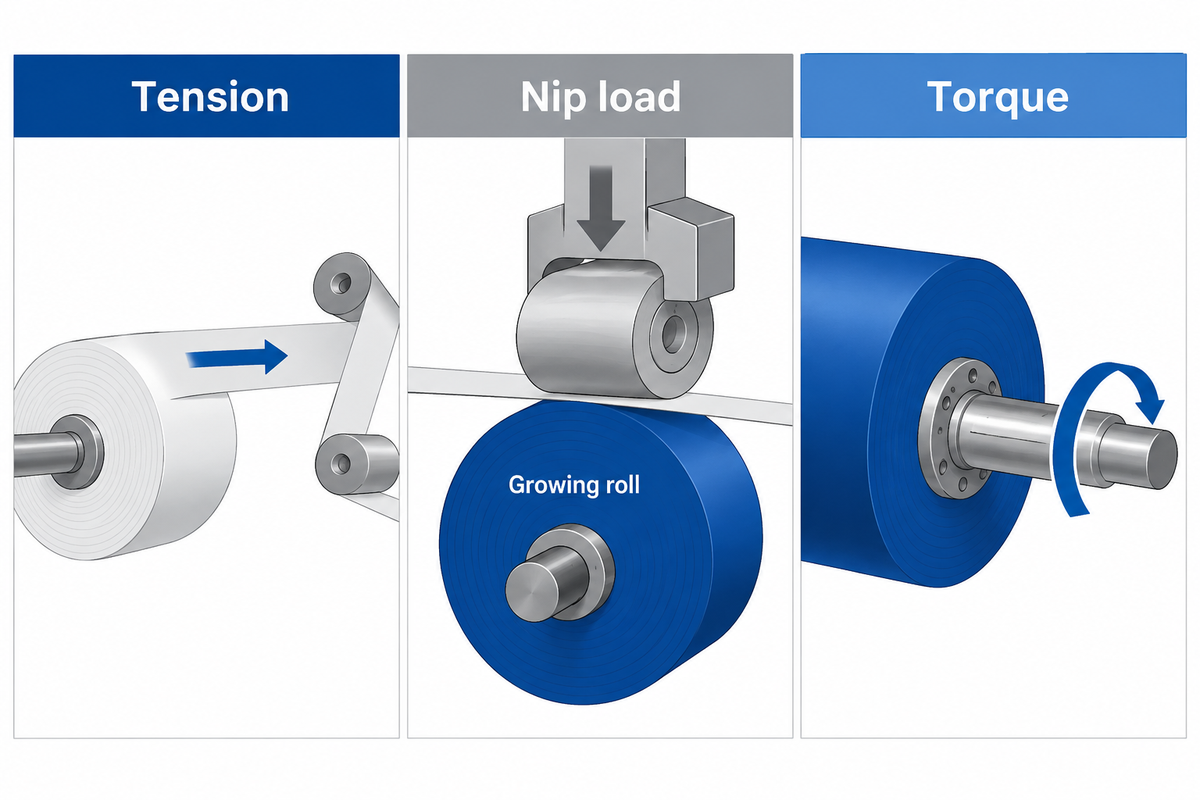
Tension pulls on the arriving web, a nip load presses the web to a growing roll, torque drives a shaft or drum. These forces all influence the stress built up between the layers. These controls are distinct; raising one doesn’t replicate all the effects of raising the others, and the ranges of control vary by winding machine.
Like stretched bands around a tube, successive layers accumulate pressure toward the roll core. Too little interlayer grip can allow movement; excessive or uneven stress can distort the roll. Hashimoto and colleagues’ winding study examines tension and nip-load optimization against wrinkle and interlayer-slip constraints.
“Pressure in psi or nip loading in percent full scale is not nip load.”
A lay-on roller creates nip contact on a center winder. Pressure reading requires actuator geometry and mechanical load to be translated into a force at the nip. Load-cell sensor provides a different value to motor-current monitors.
When comparing control systems, consider which physical quantity is measured or estimated by each channel and where.
Torque also needs a location. In center winding it acts through the coreshaft; in a two-drum winder, drum torque distribution affects how the roll builds. Timothy Walker’s explanation of winding variables makes that two-drum distinction explicit. Valmet’s guidance for two-drum winders identifies drum torque ratio as the main hardness-control variable and web tension as a stronger influence on roll separation and runnability. A taper setting from one arrangement shouldn’t be transplanted into another as the same recipe.
At high speed, air drawn into the web-to-roll contact can reduce traction. Sasaki and colleagues studied this air-entrainment effect experimentally and theoretically. Stable running therefore depends on material behavior and contact conditions as well as the three control labels. Include the paper mill drive interfaces when defining an upgrade.
Trace paper roll defects to the right stage
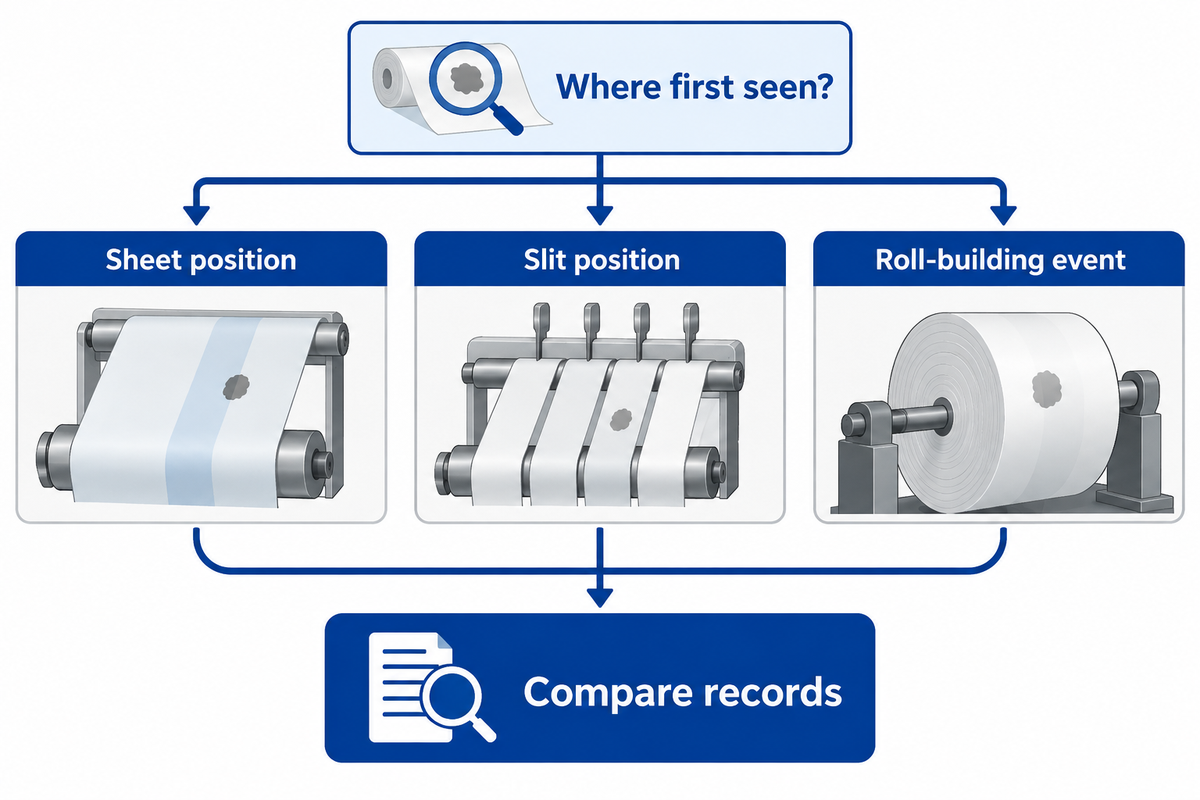
Trace a roll fault to where it first appears and check whether it follows a sheet position, slit position or a roll build-up event. Check parent-roll records against finished-roll inspection and handling history. These observations distinguish likely causes before the mill commits to changes to knives, controls or reel hardware.
Parent-to-Finished Roll Check
The Parent to Finished Roll Check follows the defect through process boundaries to determine the first step to be examined.
| Observed pattern | Compare first | Decision it supports |
|---|---|---|
| Wrinkles visible before the slitters | Incoming sheet and parent-roll history | Investigate upstream before blaming the cut |
| Edge dust begins at a slit position | Knife condition and edge samples | Review slitting quality |
| Loose layers near the parent spool | Start and transfer records | Review reel formation |
| Star-shaped distortion in the roll end | Radial hardness pattern and winding history | Investigate incompatible inner and outer layers |
| Layers telescope sideways | Alignment, interlayer grip and handling history | Separate winding movement from later displacement |
| Corrugations recur across related rolls | Original cross-machine position | Trace sheet or parent-roll inheritance |
| Damage follows a particular core | Core dimensions, strength and chuck contact | Check core/support compatibility |
| Flat areas appear after storage | Support contact and time in storage | Review post-winding pressure |
| Marks appear after clamp handling | Inspection before and after transfer | Review handling contact |
An example complaint is that several finished rolls have a raised band, but only rolls from the same cross-machine position are affected. Once the physical location across the sheet is identified, the team can map the pattern back to that position in the parent reel. If the operator finds the pattern at the same cross-machine position over different sets, it points to incoming thickness variation or parent-roll formation; if it follows the same winding station across different parent reels, local winding may be the culprit.
This comparison narrows the maintenance team’s task before the mill buys hardware.
Inspection must extend beyond discharge. A TAPPI Journal study on winding and contact pressure describes additional loading from flat storage and clamp handling. A defect found in the warehouse may have developed after the winding process.
Match the winding setup to tissue, paper or board
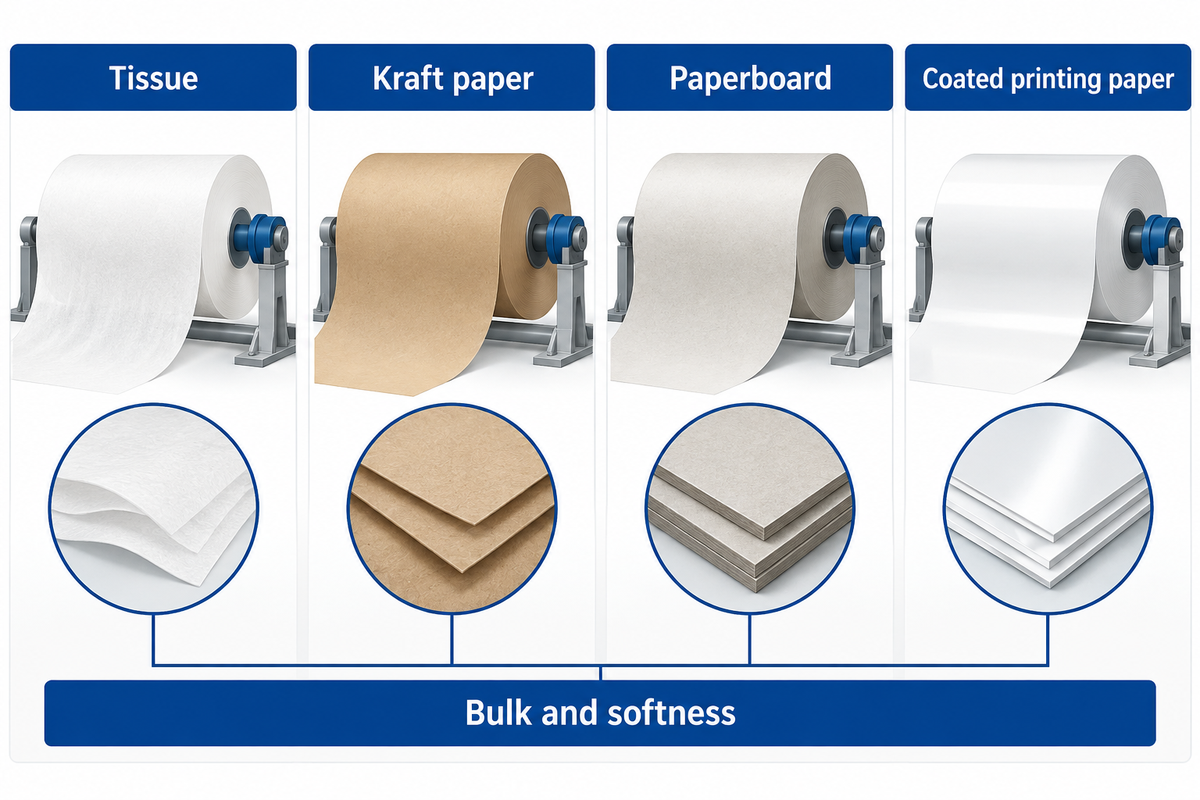
Match winding to the sheet characteristics and the future use of the finished roll. Tissue must be protected from stretch and compression loading to maintain its bulk. Packaging paper requires stable rolls and clean edges.
Board adds roll mass and stiffness to the winding selection problem. A good specification identifies the quality characteristic to preserve. Bulk describes the volume of paper per unit mass, the inverse of apparent sheet density.
The May 2024 TAPPI Journal article on tissue material efficiency connects reeling nip and parent-roll hardness profiles with rewinder runnability. The article describes low nip loads as typical of tissue windups. For a tissue rewinder, specify load measurement and control that work under those low-load conditions. For both tissue and kraft, the usable capacity must also account for traction and vibration limits at the intended speed. Tissue paper quality needs attention at both the reel and the finishing stage.
| Product family | Quality priority | Useful comparison |
|---|---|---|
| Creped tissue, including toilet tissue | Bulk, stretch and downstream runnability | Sheet properties before and after rewinding |
| Kraft paper and packaging grades | Stable roll structure and usable edges | Hardness pattern, edge condition and unwind behavior |
| Paperboard | Roll support and dimensional stability | Mass, diameter, core support and handling fit |
| Coated printing paper | Surface condition and uniform delivery | Contact marks, dust and cross-machine variation |
What if the converter is switching from a dense packaging grade to a softer tissue product? The prior roll felt hard, and traveled well, so the purchaser requests equally hard rolls on the new grade. That objective can be at odds with the end product: heavy pressure can reduce tissue loft and softness, and heavy stretch consumes properties needed further down the line.
Your trial comparison should be done by tracking the sheet through rewinding and onto the second operation of the converter. The purchase decision becomes whether the machine can maintain the desired tissue properties while achieving a stable roll-not whether it can duplicate the prior hardness reading.
Different types of paper require individual operating recipes in the machine’s design envelope. Specify the grade range in terms of grammage, caliper, friction, compressibility and the finished roll sizes.
Size rewinder capacity for the whole roll cycle
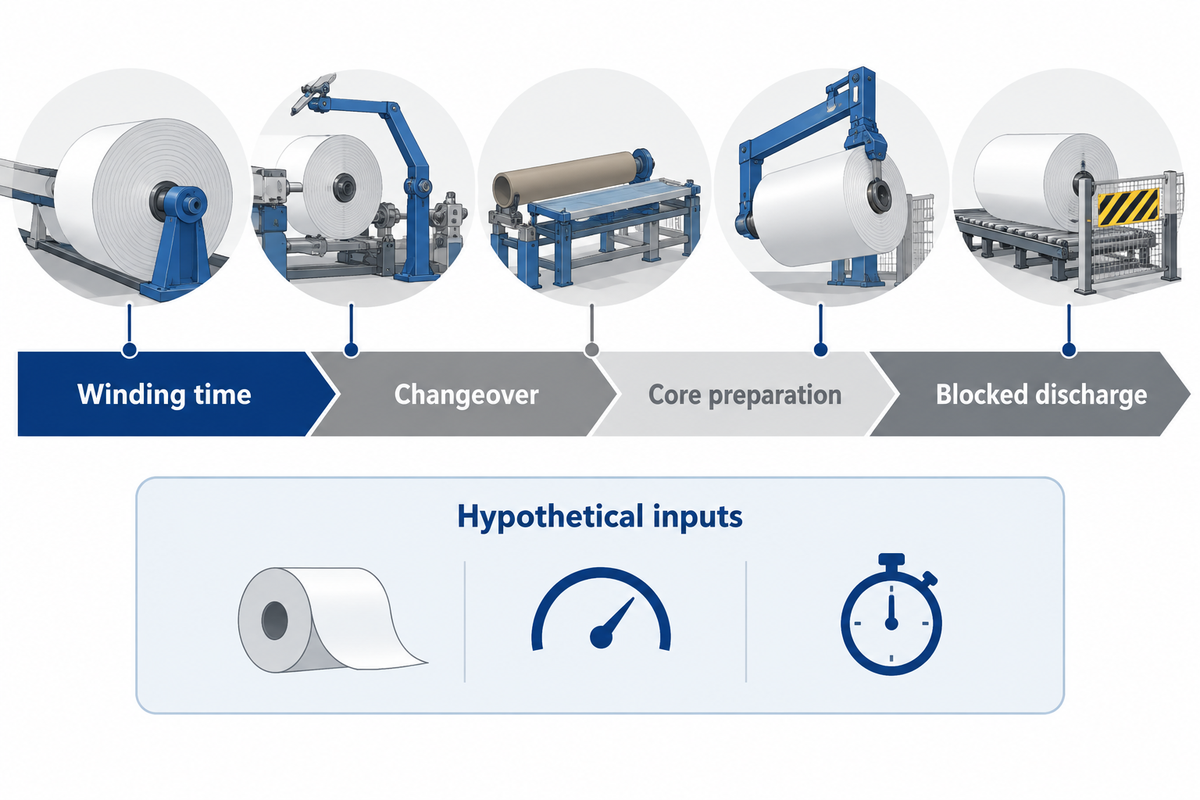
The speed of operation affects the length of time to pass the paper through while the machine winds it up; changing sets, loading cores and clearing finished rolls all add to the time. Customer rolls that are shorter make repeat stops a bigger proportion of the schedule.
Does maximum machine speed equal actual production output?
No. Maximum machine speed describes a running condition, while actual output depends on sustainable speed, available time and saleable yield. In a 2025 Aalto University paper on operational winder vibration, roll dynamics limited operating speed. A high-speed rating alone therefore leaves both time losses and stable operation unresolved.
Assumed inputs: a usable web length of 12,000 m per cycle; steady winding at 800 m/min; and 5 min of additional equivalent time for changeover, waiting and the time penalty of acceleration and deceleration. The model holds width and saleable yield constant. Calculate total cycle time as web length divided by steady speed, plus that additional time.
| Case | Steady speed | Winding time | Additional time | Total cycle | Average web rate |
|---|---|---|---|---|---|
| Starting case | 800 m/min | 15 min | 5 min | 20 min | 600 m/min |
| Increase running speed | 1,000 m/min | 12 min | 5 min | 17 min | 705.9 m/min |
| Reduce interruptions | 800 m/min | 15 min | 2 min | 17 min | 705.9 m/min |
For the starting case, 12,000 m ÷ 800 m/min = 15 min; adding 5 min gives 20 min. Using these assumptions, reducing interruption time exactly offsets the average-rate advantage of the higher speed case. A real production level model would need order mix, trimmings and rejects included.
A plant manager might prefer the speed upgrade as the current machine appears slow. Finance might prefer changes that reduce the time to change each set. Timing core preparation, end-taping or adhesive work, roll ejection and the queue for handling equipment reveal the real constraint.
That record helps the team choose which repeated procedures to automate. If discharge waits for a downstream position, making rolls faster can simply increase the wait. If winding consumes most of the cycle time and quality holds at the higher speed, drive and mechanical duty may be more important.
Use one mutually agreed definition of accepted output when comparing these proposals.
Find the lost minutes before buying more metres per minute. Record winding, changeover and blocked-discharge time separately.
The Pacific Northwest National Laboratory’s maintenance indicators distinguish operating time from available time. Apply that denominator discipline to production efficiency: compare like periods and keep downtime losses separate from speed and quality losses.
What drives winding-section upgrade cost?
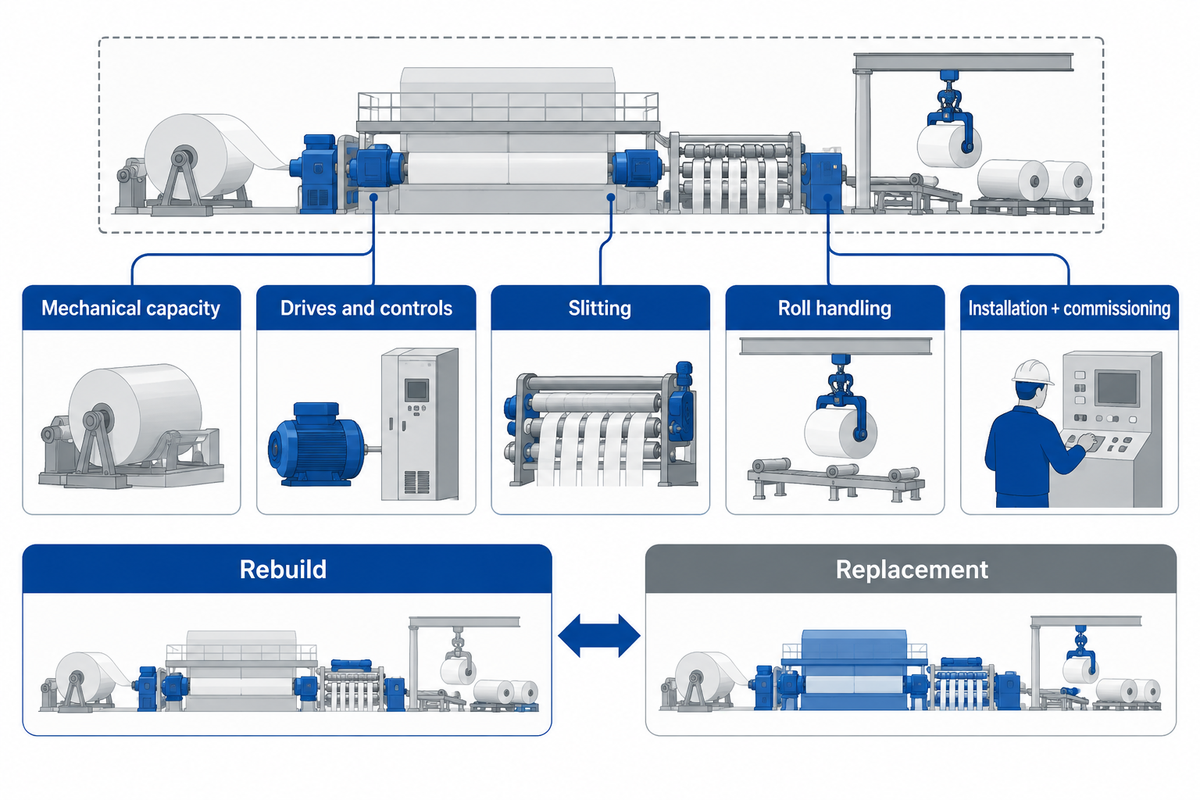
Upgrade cost depends on the affected areas – mechanical capacity, drives and controls, slitting, roll handling, installation and commissioning. Keep a suitable platform when a local modification solves the constraint. Consider replacing the winder when the required roll load, dimensions or production needs go beyond a realistic rebuild scope.
Consider rebuilding a winder with a solid frame but outdated tension control. This is a different endeavour from a machine that won’t bear the roll payload. The second entails a mechanical duty review before anyone quotes electronics.
An enquiry for “higher productivity” should identify what loss the investment must remove.
Normalize quotations to identical installed scope: equipment, transport, foundations, utilities, software interfaces, shutdown work, start-up assistance and initial spare parts. Compare the price with the value of recovered accepted production and avoided waste, using the mill’s own contribution margin. A machine-only price will lack costs which determine whether the project will pay back.
Our paper machine rebuild services provide assessment and upgrade of existing assets.
A used rewinder is worth considering if its documented limits on roll load, width, and diameter suit the specified orders, its mechanics are serviceable, and controls and spare parts can be supported. How does the purchase price together with dismantling, delivery, reconditioning, installation and commissioning compare with the installed alternative?
A cheap machine that requires a change of roll-handling layout or even a complete main drive change can lose its purchase price benefit.
Integration requirements and supplier scope
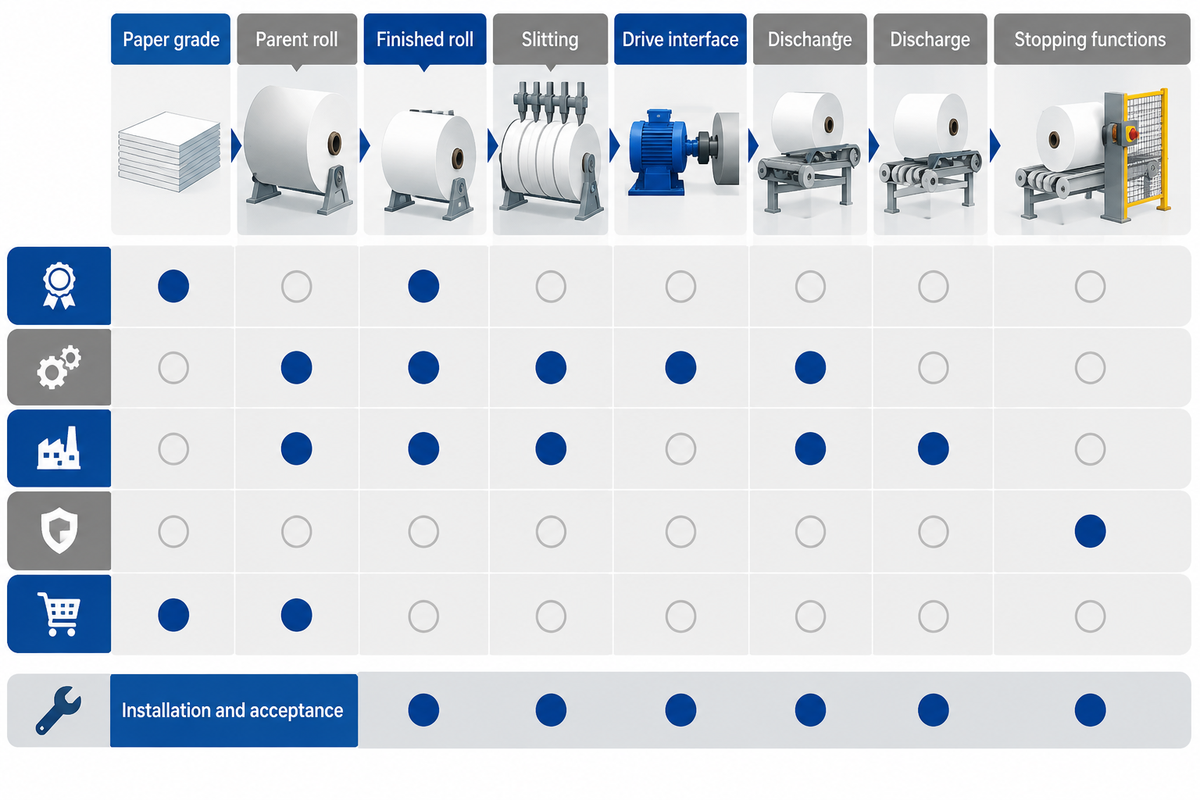
Integration begins by matching the incoming parent roll, outgoing customer roll and mill interfaces. Dimensions determine fit; weight determines handling duty; controls determine the ways in which equipment communicates status and stops. For paper winder controls and mechanical interfaces, the quote is comparable when each interface has an identified responsibility and a defined acceptance check.
| Interface | Supply in the enquiry | Decision owner |
|---|---|---|
| Paper grade | Grammage and caliper range; required finished properties | Quality and production |
| Parent roll | Width, diameter, maximum mass and spool drawing | Mill engineering |
| Finished roll | Ordered widths, diameter range and core specification | Sales and converting |
| Slitting | Cut pattern, edge-quality samples and knife arrangement | Quality and maintenance |
| Drive interface | Existing motors, drive architecture and control drawings | Electrical engineering |
| Roll transfer | Crane route, loading position and handling capacities | Plant engineering |
| Discharge | Available space and downstream cycle demand | Production |
| Access and stopping functions | Existing protective-system drawings and affected interfaces | Qualified machine-safety engineering |
| Installation and acceptance | Shutdown window, utilities, trial grades and output criteria | Project manager and procurement |
At Henan Zejiang Paper Machinery Co., Ltd., we manufacture and supply paper machinery, spare parts and rebuilt equipment. Our scope includes in-house machining and support for installation and commissioning. Review the paper rewinders and Pope reels relevant to the project, then send the roll data and the constraint you want to remove. Valmet also offers new winders and modernization services for existing machines. Compare the offered equipment and service scope for the actual mill project. Procurement teams comparing suppliers can also use our overview of paper rewinder manufacturers.
Plan the winding-section scope
Send your paper grade, web width, parent-roll dimensions, finished-roll requirements and current bottleneck for a project-specific equipment discussion.
Frequently asked questions
Where is the winding section located on a paper machine?
The machine reel sits at the dry end, after the last sheet-treatment operation in that line. It collects the continuous web into a parent roll. A separate winder then receives that roll for slitting and rewinding. The arrangement varies with grade and mill layout, so the equipment drawing should distinguish the reel from the downstream finishing area.
Is a paper-machine reel the same as a slitter rewinder?
No; a machine reel and a slitter rewinder perform consecutive jobs. The reel receives the moving sheet directly from the paper machine and builds a parent roll. The slitter rewinder starts with that completed roll, unwinds it, cuts the web to the required widths and forms new rolls. Their drive arrangements, roll support and operating cycles need separate specifications, even when one supplier provides both machines.
Can one winding setup handle every paper grade?
No single recipe suits every grade. A winder can handle several grades when its mechanical design, drive capacity and control range suit them, but each grade needs a suitable recipe. Tissue may lose bulk under loading that a denser paper tolerates, while heavy board changes roll-loading requirements. Compare the actual sheet properties, roll dimensions and required finished-roll quality before extending an existing setup to another product.
Does rewinding repair defects already in the paper?
No, rewinding can’t restore the paper’s original fiber structure, coating uniformity or moisture profile, although it allows damaged lengths to be removed and rolls to be rebuilt.
When does a winding section need replacement?
Replacement becomes a practical option when the required duty can’t be reached through a credible rebuild of the existing platform. A change in roll size, grade range or production rate may demand more than new controls. Compare the condition and capability of the retained structure, rolls, drives and handling equipment with the proposed duty. If the constraint is localized, a targeted rebuild may fit the mill. Include installation, controls integration, commissioning and the available shutdown window in the comparison. Age alone doesn’t settle the decision.
Is a spiral winding machine part of the paper-machine reel section?
No. A spiral winding machine makes paper tubes by winding strips around a mandrel, usually with adhesive. That’s a separate operation. Paper mills can buy cardboard cores instead of manufacturing them.
The project specifications originate from the mill’s grade, roll and interface requirements.
References & Sources
- Rewinding paper safely Health and Safety Executive.
- Operating Results of a TNT Reel TAPPI conference paper, 1997.
- Optimum Winding Tension and Nip-load into Wound Webs Hashimoto and colleagues, 2010.
- Winding: Part 3, Tension, Nip and Torque Neal Michal, PFFC, 2023.
- Key Process Variables of Winding Timothy Walker, PFFC, 2013.
- Traction Force Considering Air-entrainment Japan Society of Mechanical Engineers, 2006.
- Pressures on webs in wound rolls due to winding and contact TAPPI Journal, university research record, 2014.
- Tissue wet pressing and dry-end material efficiency TAPPI Journal, May 2024.
- Operational observation of paper roll polygonization Aalto University research record, 2025.
- Applying Key Performance Indicators Pacific Northwest National Laboratory.