Get in touch with Zejiang Paper Machinery Company

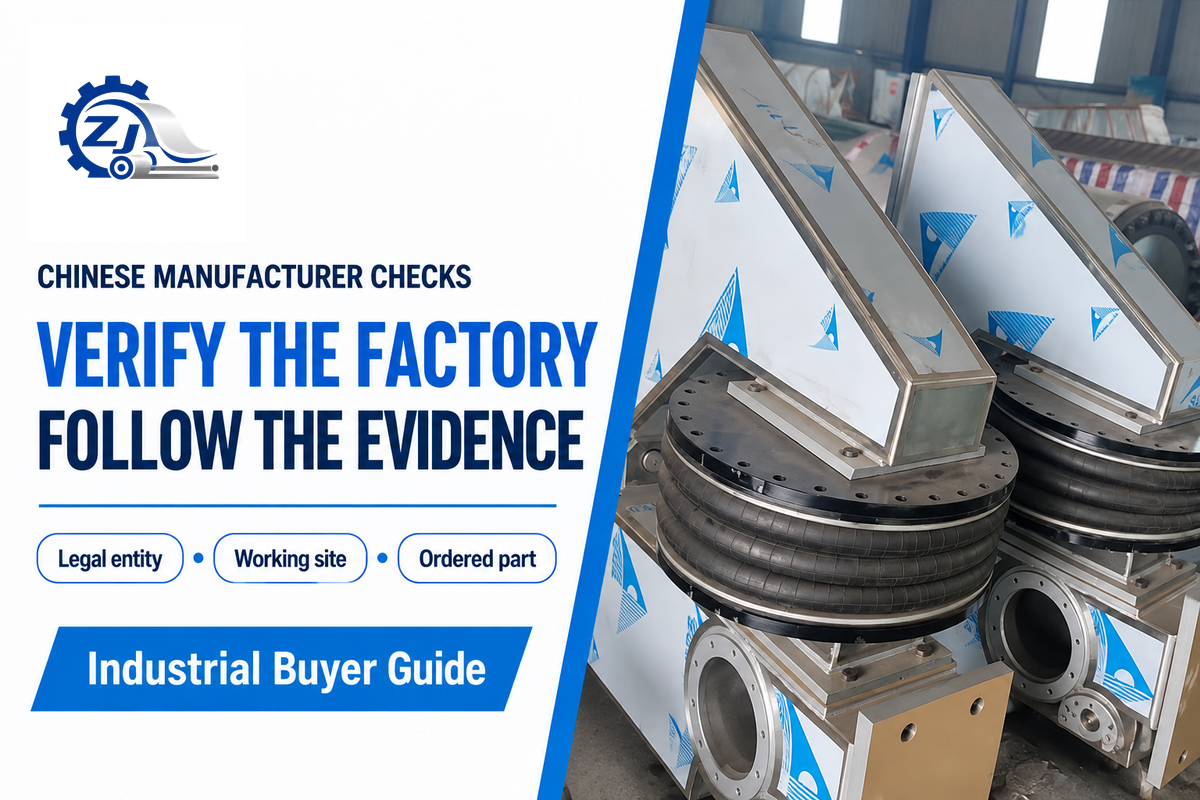
Perform the company identity, production-process and part-record checks below. These checks answer the practical question behind “how to verify chinese manufacturer real factory” before placing an industrial parts order.
Updated October 2026
Verify the legal entity, the working site and the ordered part separately. Use the Chinese registry for identity, a live walkthrough for relevant operations, and matched drawings and inspection records for the purchase decision.
Quick checklist for an industrial buyer
- Disclosed outsourcing can be workable when process responsibility and inspection are clear.
- Keep the Chinese registered name and credit code alongside the contract entity.
- Select the part and drawing revision before arranging the workshop walkthrough.
- Resolve payment-account changes through a separate, verified contact.
Start Supplier Verification with Three Kinds of Evidence
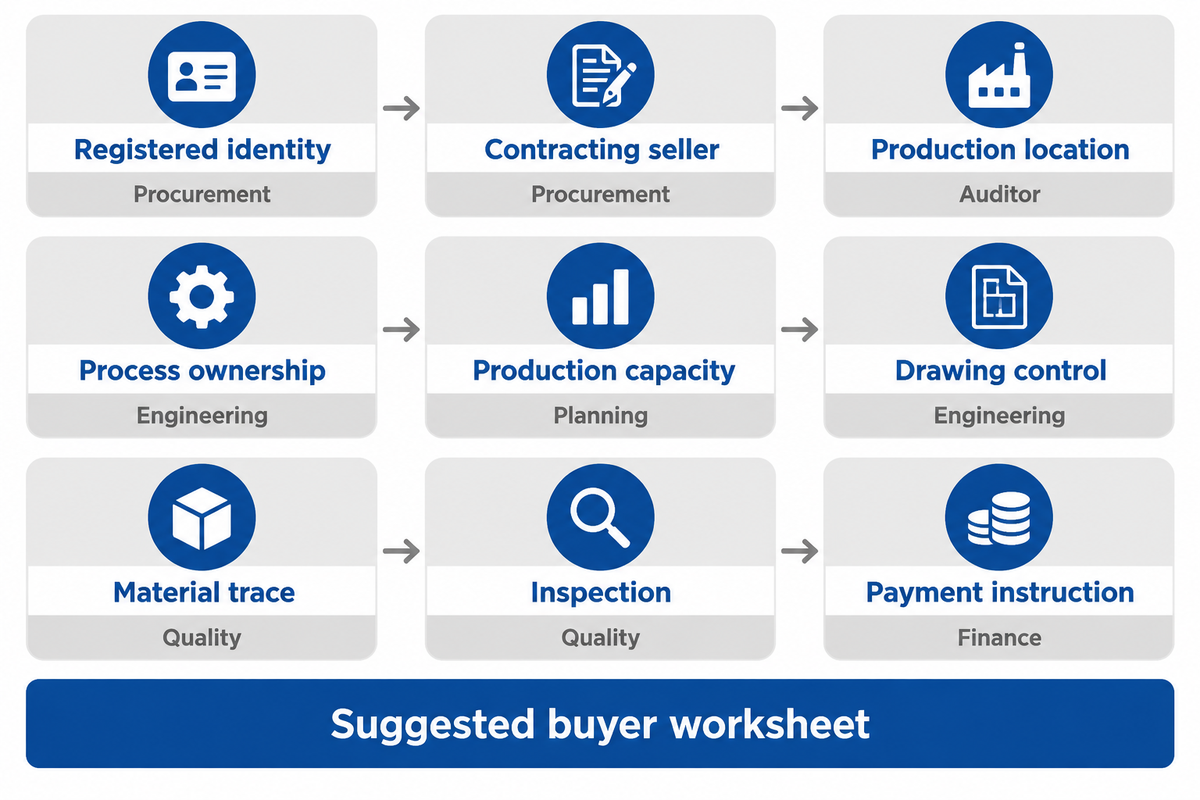
Supplier verification works best as linked checks: identify the contracting company, observe relevant production operations, and examine records for the product you intend to buy. Procurement personnel can be given the first check, engineers the second, and QA the last check. Resolve the gaps before the order is released.
A company in China may operate a workshop, sell through a separate export business, or combine manufacturing with purchased components. Begin with the specific product rather than trying to assign the seller a label from its website. For an importer buying a replacement screen basket, the useful question is who controls the slot geometry, fit and final inspection. This is a practical way to verify the supplier against the work you need done.
The evidence matrix below transforms a broad company verification request into a working file for your business in China. When verifying a Chinese company, retain original documents and stamp them with the date checked and the name of the person who reviewed them. A translated company name will help communication and the Chinese name and registration identifier help anchor the comparison of identities.
| Check | Evidence to compare | Decision owner |
|---|---|---|
| Registered identity | Chinese legal name and credit code against registry entry | Procurement |
| Contracting seller | Quotation, purchase contract and invoicing entity | Procurement |
| Production location | Workshop address, entry sign and live route through the site | Auditor |
| Process ownership | In-house and subcontracted steps with named sites | Engineering |
| Production capacity | Relevant machines, current workload and proposed production slot | Planning |
| Drawing control | Part number and revision on shop instruction and order | Engineering |
| Material trace | Required grade, batch identifier and linked material record | Quality |
| Inspection | Measured characteristic, method, units and acceptance criterion | Quality |
| Payment instruction | Authorised beneficiary and independently confirmed changes | Finance |
Buyer worksheet developed for this guide from the registry, audit and measurement sources discussed below. Assign roles to fit your purchasing team.
Verify the Business License in the Chinese Government Database
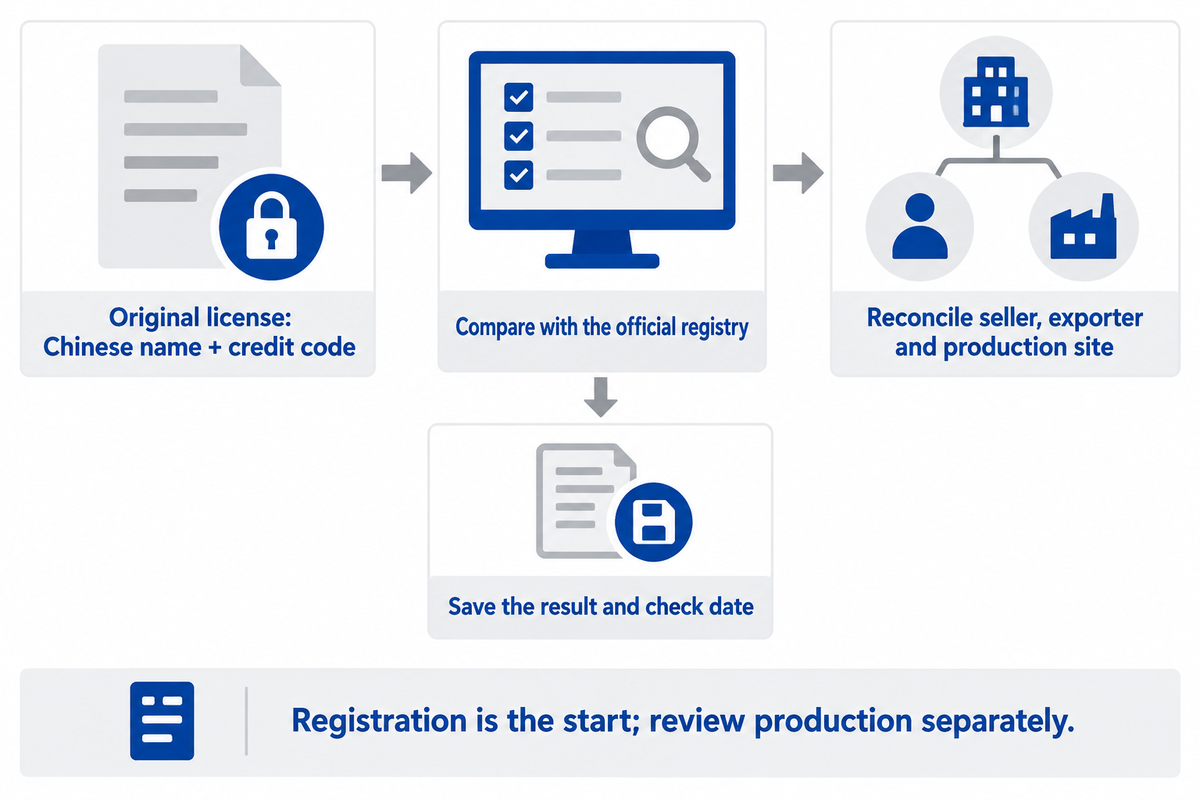
Verify the business license by cross-checking its Chinese legal name and Unified Social Credit Code with the National Enterprise Credit Information Publicity System. Record the registered address, status and business scope, and reconcile these details with your quotation. Keep the factory address separately when production happens at a different location.
How do I verify if a company is real?
Search the official registry using the Chinese legal name or credit code, and compare the identity returned with the supplier’s license and contract details. A matching registration identifies the subject of your inquiry. Proceed to the production location, related operations and order records to assess the manufacturer of your choice.
SAMR’s registration-service guidance provides an overview of the type of public company information available. Use its linked official enterprise registry rather than a screenshot supplied by the seller. If you’re unable to read Chinese, retain original field labels alongside a competent translation.
- Obtain the source document — request a legible license with the entire Chinese business name and identifier visible.
- Run the identity search — compare the returned company registration details and save the result with the check date.
- Reconcile differences — document the relationship between the registered seller, export company and production site before proceeding.
Check business registration fields and annual report fields separately. As per China’s enterprise information disclosure regulations, enterprises should disclose reports of the previous year, whereas companies and governmental departments are obliged to disclose information of their own. Read the reporting period and information provider before taking a figure as the current situation.
Hypothetical purchasing scenario: a quotation lists an English export brand, the license lists a Chinese manufacturer, and the shipping document lists a different company. Procurement should list all three on the same page and request a written explanation. The workshop may be real, but the party liable for defects may be unclear. Find out who signs the purchase order, receives payment, and approves changes to the drawing. Use the actual documents to clarify any outstanding questions. If the seller explains the export arrangement and the responsibilities are accepted, continue the technical examination. If the contracting identity keeps changing without a valid reason, pause the purchase.
Use a Live Factory Visit to Trace One Part
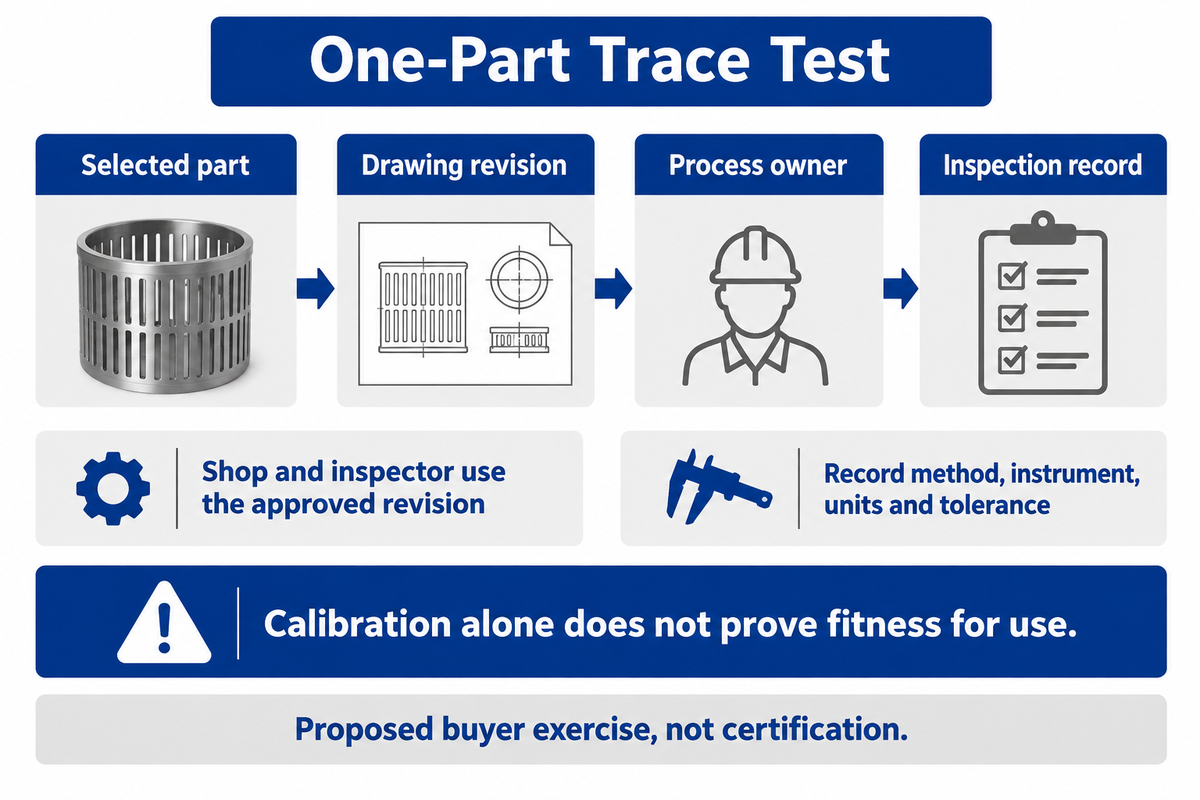
A live factory visit becomes useful when the buyer determines what to follow: one relevant part, its drawing, the operation performed and the resulting inspection record. Check the factory entrance and continue into the working area. Ask the technical contact to explain the route and identify any operation performed elsewhere.
One-Part Trace Test
The One-Part Trace Test is this guide’s buyer exercise linking a part to its drawing, process owner and measurement record.
Use this exercise to find missing linkages. It isn’t a means of certification or an acceptance sampling plan. With management approval, select a recent or ongoing job from the same product family to view records; commercial information can be masked, and the part to record link should be retained.
During a walkthrough, request to see the drawing revision at the workstation, the relevant machine and a completed inspection sheet. Have the employee describe one characteristic in plain language. A video can preview the physical factory; a live walkthrough allows you to follow up on a question that the promotional video doesn’t address.
“The versions should match.”
Hunt’s article also covers the correct drawing being provided to the supplier. Follow that practical thread: which revision did the shop receive, and which revision did the inspector use? Different answers to these questions complicate quality control.
Here’s a hypothetical situation: a buyer identifies a basket visible on the shop floor, and is provided with a job card. A salesperson shows a drawing, but the inspector’s sheet has an earlier revision. The buyer wasn’t satisfied with the paperwork, and asked what dimensions had changed, and if the basket shown was compared to the approved version. Engineering compared the revised drawings and quality staff requested the corresponding results. The correct outcome was the resolution of the record difference, not the photo of the shop floor. If the correct record cannot be located, arrange a targeted inspection of the relevant characteristics before accepting that part or relying on the job as a capability example.
Record measurements with the method, instrument, units and applicable tolerance. NIST’s traceability guidance explains that even traceable measurement results need uncertainty suitable for their intended use. A calibration sticker doesn’t ensure the method is adequate for a “tight fit” judgment.
Check Quality Certificates and the Verification Report
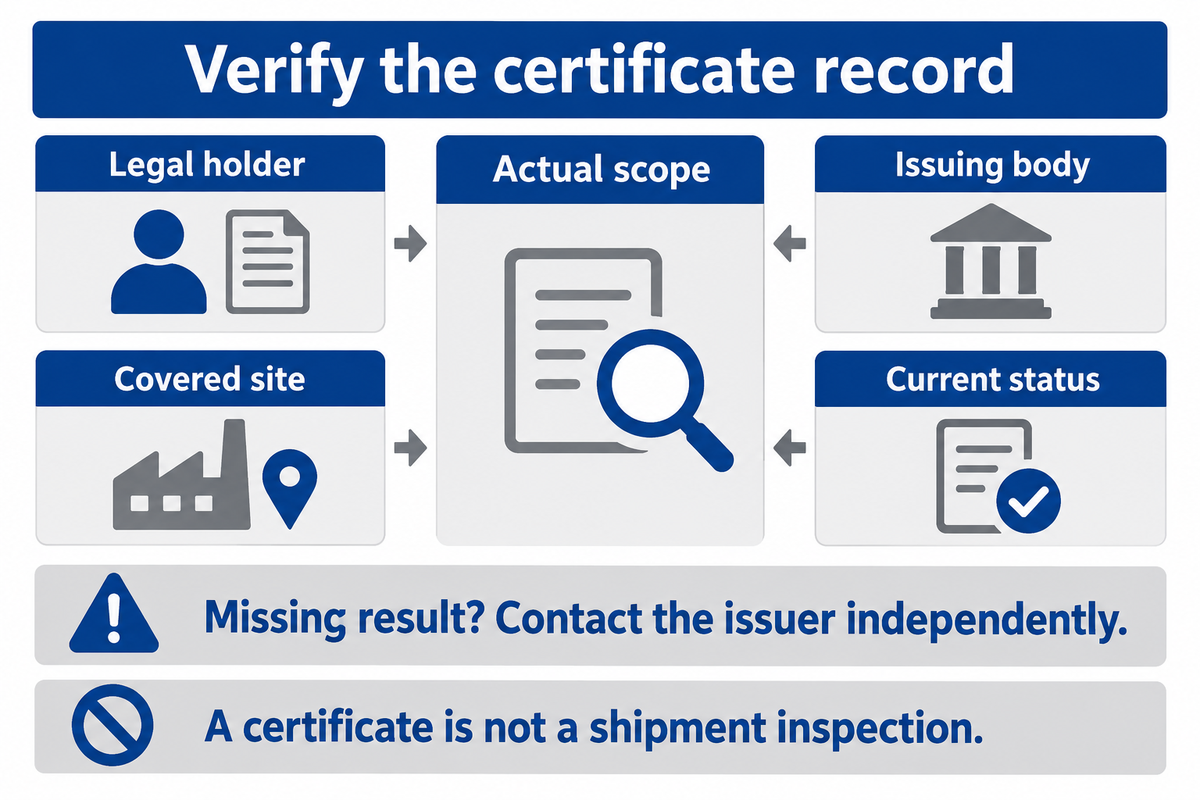
Compare a quality certificate to the legal holder, site, scope, issuing body and current status. Compare those to the purchase you’re going to make. A management system certificate covers the organization and activities; confirmation of the dimensional acceptance of your ordered parts comes from the inspection requirements and results.
How do I verify certificates are genuine and not expired?
Search the certificate number or organization using the relevant verification service, and compare the holder, site, scope, standard and status with the documents. For accredited management system certificates, use the IAF CertSearch service to perform these checks. Where a record is missing or inconsistent, contact the issuing certification body through independently obtained contact details before relying on it.
IAF CertSearch’s certificate-search fields include status, scope, issuing certification body and accreditation body. Read the actual activity covered: sales, assembly and manufacturing are different descriptions. A verification report should record the fields checked, the source consulted and the date, rather than simply displaying a green badge.
As of this update, ISO’s committee announcement states that ISO 9001:2026 was published on 16 September 2026. Organisations already certified to the 2015 edition have until 30 September 2029 to complete transition. Check the individual certificate’s status throughout that period; the transition deadline does not extend an expired or suspended certificate.
Do
- Match the certificate holder and covered site to the transaction.
- Resolve a missing search result with the issuer or inquiry service.
Don’t
- Reject every 2015-edition certificate solely because a new edition exists.
- Treat a certificate logo as an inspection result for your shipment.
The IAF search manual explains that missing suggestions can reflect a record not yet added, a confidential name or a removed certification. An empty search result shouldn’t immediately be considered fraud.
Factory or Trading Company: Identify the Process Owner
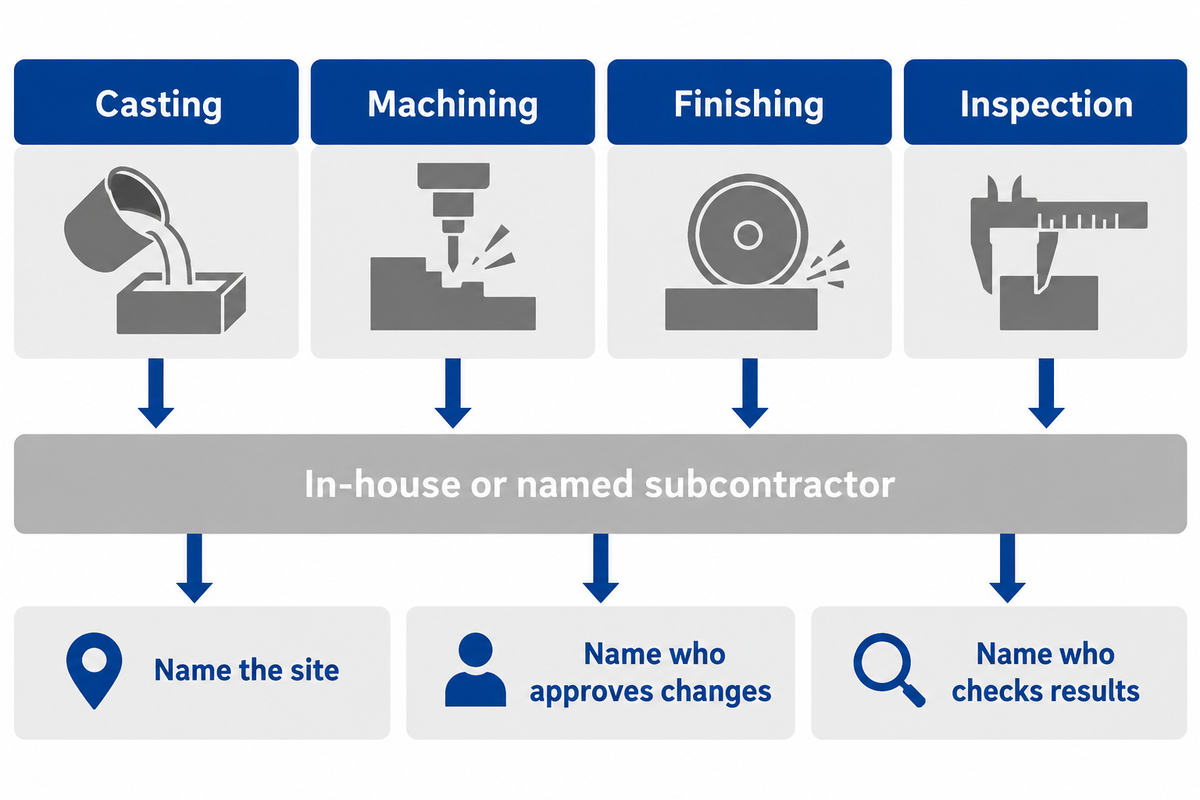
Verify Chinese suppliers by asking where each critical operation happens and who approves changes, checks the results and addresses defects. For a controlled production route, identify the subcontractor and its site activities. An unexplained handoff may also warrant further investigation. Whether the seller describes themselves as a factory, integrator or a trading business, further investigation may be warranted.
A legitimate manufacturer can procure castings or outsource manufacturing. Identify external steps in the production process with the help of Chinese factories. Trade companies can combine several suppliers in China for a mixed order. Analyze the structure and determine what’s most important for you: continuous control over the design and production process (e.g., a direct link to engineering to integrate customer specific requirements) vs. consolidation (e.g., sourcing standard or non-related items, including unrelated products from China). Note the MOQ and catalogue breadth, but judge factory status by where the critical operation is actually performed. Discover real factories for a given operation by following the operation to its real location.
NIST’s supply-chain mapping guidance recommends identifying the activities performed at supplier sites and possible alternate sites. Apply that idea to the manufacturing route: casting, machining, finishing and inspection should each have a named location and responsible party.
A trading company may provide useful coordination, but put change approval in writing. Procurement documents the commercial relationship; engineering approves changes to material, geometry and process; quality approves the means of verification. Verify whether the company performs the operation in question or assigns it to a named subcontractor. If a supplier is a factory with an export affiliate, the same approach should be followed.
When sourcing from China, don’t take low prices as evidence that companies are actually trading companies or wide catalogs as evidence that sellers are posing as factories. Ask the supplier or manufacturer to illustrate the particular operation that concerns your case. To assess whether a Chinese supplier fits the order, use the same process questions for each candidate. Verify suppliers against that common brief.
Choose Factory Audit Services by Scope, Cost and Expertise
For major Asian manufacturing clusters, V-Trust quotes its standard factory-audit offer at USD 398 per man-day. QIMA states that most manufacturing audits take one day on site, with longer visits for complex or multi-module work. Compare the operations, specialist skills and deliverables before treating two quotations as equal.
The published V-Trust offer lists travel and weekend inclusions and a report within two days. It will also provide details on company profiles, processes, capacity, machinery and quality assurance, according to the terms offered. These terms are those of the provider as checked for the article, rather than a universal cost of verification.
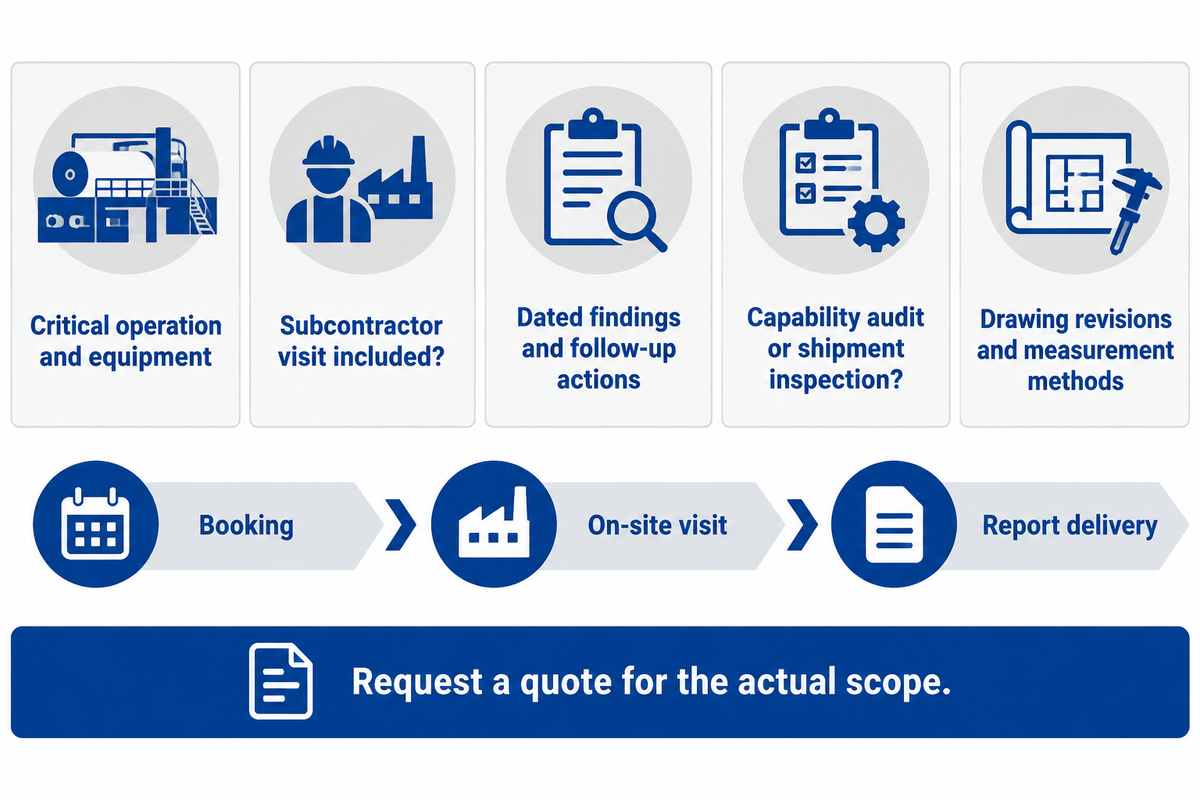
QIMA’s manufacturing-audit description makes pricing dependent on location, scope and added modules. Booking time, the on-site visit and report delivery are separate intervals. Obtain a written quote for your factory location and the actual checks required.
Specify an Independent Technical Factory Audit
Request a written assignment for verification services. Observe the relevant process and record the sites for comparison with the named entity, and examine the records for your selected product family. Ask who will visit, their experience in China and with the manufacturing process, and how conflicts of interest are managed. Keep the technical brief for the team in China assigned to conduct factory visits on your behalf separate from China sourcing commissions and supplier-introduction services.
- Identify the critical operation and the equipment or records the auditor must see.
- State whether a subcontractor visit is included or separately priced.
- Request dated observations, photographs where permitted, discrepancies and follow-up actions.
- Distinguish a manufacturing-capability assessment from a factory inspection of a particular shipment.
- Specify how the report will address drawing revisions and measurement methods.
When requesting a quote for a custom, made-to-order part, ask for an interpretation of the limits of comprehensive verification in common language. A social compliance visit addresses different issues than a review of technical capability to perform a specific task. When evaluating a factory in China, ask which of the production facilities will be covered by the visit.
Apply Factory Verification to Refiner Plates and Screen Baskets
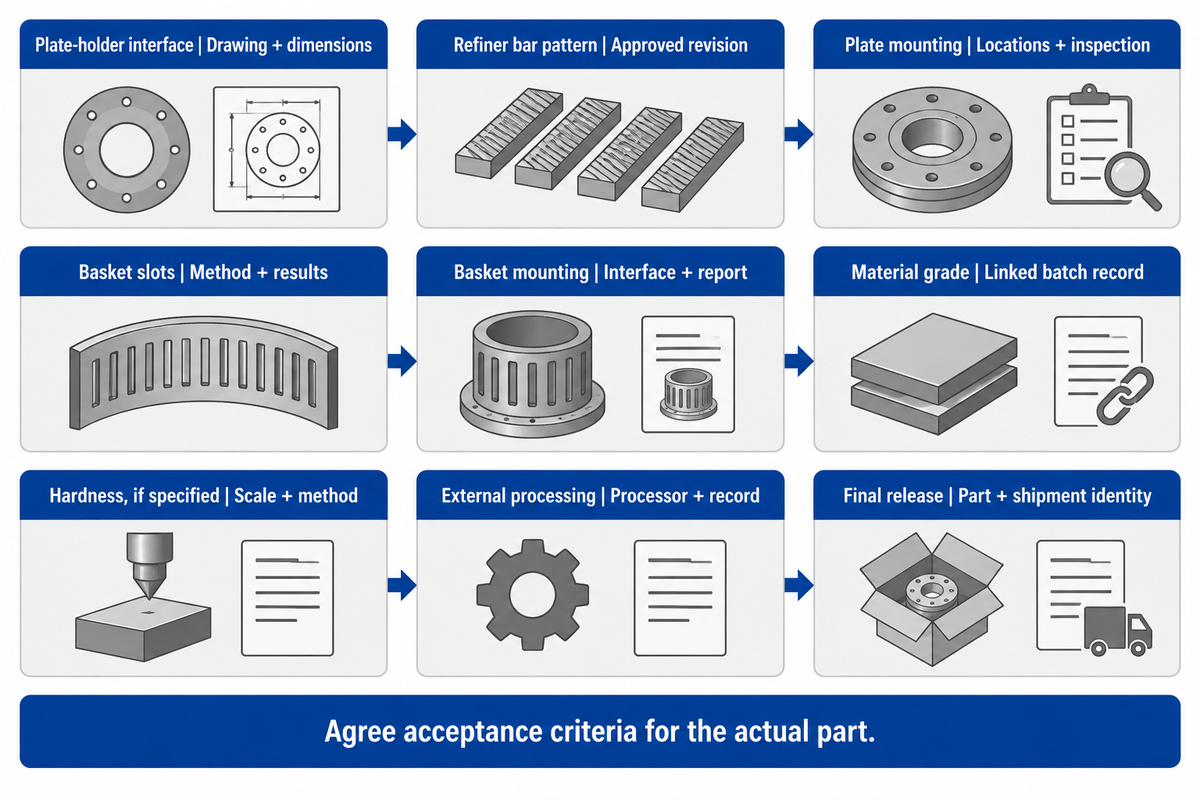
For refiner plates and screen baskets, connect your selected drawings to fit, working geometry, material and inspection. Identify the key elements that determine whether the part is installable and usable and assign acceptance criteria to them. Assign each feature an acceptance criterion before requesting a sample or production quotation.
Zejiang’s refiner plates and screen baskets page describes matching plate-holder geometry, bar pattern and basket configuration to equipment and process conditions. Use the equipment and process descriptions on the product page to prepare your engineering inquiry. These descriptions are translated into requests in the table.
| Item | Requested record | Acceptance question |
|---|---|---|
| Plate-holder interface | Approved interface drawing and dimensional results | Does the measured fit meet the agreed drawing? |
| Refiner bar pattern | Pattern identification and approved revision | Is the supplied pattern the one selected for this duty? |
| Plate mounting features | Feature locations and relevant inspection results | Do the mounting features match the interface? |
| Basket slot geometry | Slot specification, measurement method and results | Can the method resolve the specified tolerance? |
| Basket mounting dimensions | Equipment interface and dimensional report | Will the basket fit the approved assembly? |
| Material grade | Required grade and linked heat or batch record | Does the record belong to the supplied material? |
| Hardness, where specified | Agreed scale, test method and result | Was the specified requirement measured correctly? |
| External processing | Named processor and linked operation record | Who approves changes and checks returned work? |
| Final release | Part identifier, release record and packing identification | Can the inspected part be matched to the shipment? |
A sample buyer’s worksheet based on product description and measurement guidance is proposed. Indicate the purchase requirements for the part; the table provides no default values or tolerances.
It’s also necessary to pay special attention to the effect of process conditions and performance. In Gooding, Kerekes and Salcudean’s study on pulp-screens factors such as the shape of the slots, fibre blockage and other process conditions are noted to affect the flow resistance. It’s essential to take into account the operating conditions used to select the part during purchase, in addition to the geometry to be inspected.
Hypothetical part inquiry: Replacement of a basket in a mill. The supplier told procurement it could reproduce the old component from photos, but engineering had revised the drawing of the component. The buyer sent the approved revision and the requirements for slots and mounting features, and asked how those characteristics will be measured. Quality staff assess the proposed method and tolerance, and specify the required inspection report. The sample can now be assessed against the definition. If a subcontractor makes the working surface, add that processor and identify who approves revisions. Product quality is assessed against the agreed conditions, not by resemblance to photos.
Approach calender roll specifications the same way: connect journal fit and required profile to the drawing and inspection plan. Don’t simply inquire if a large lathe is available.
Decide Whether to Proceed with the First Order
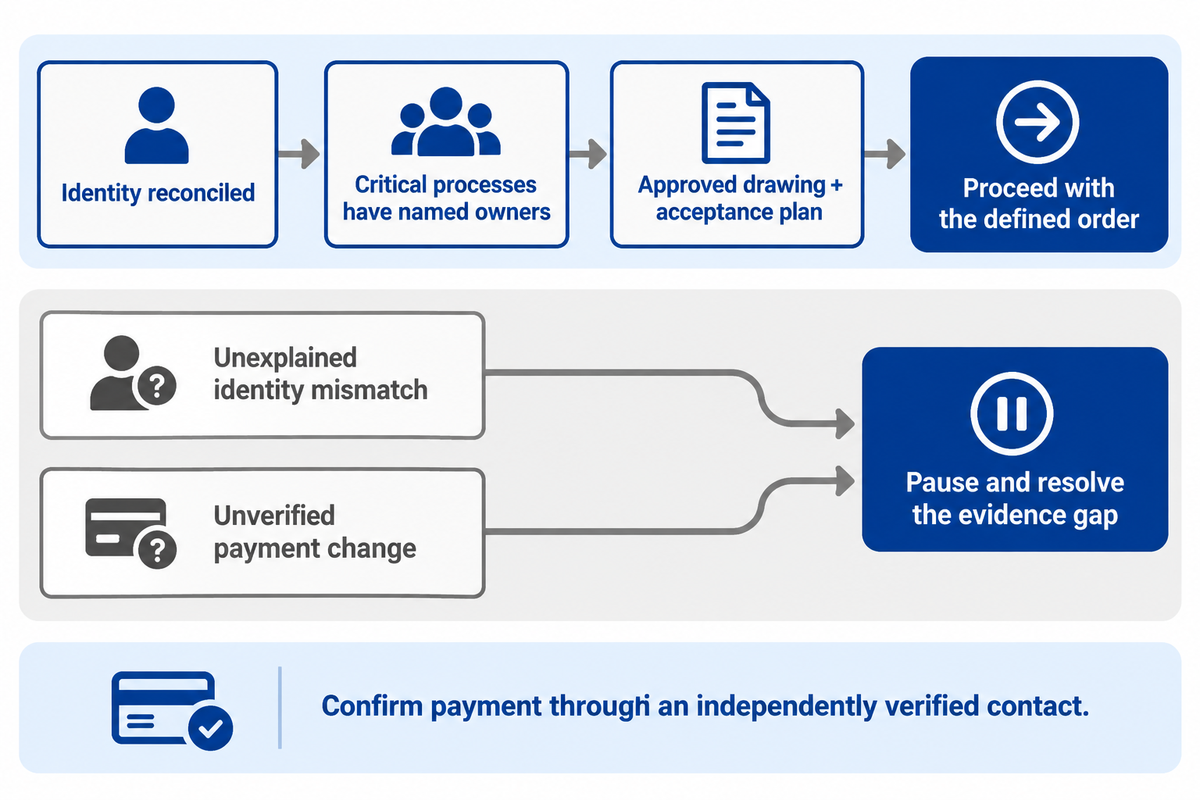
Continue when the contracting identity has been reconciled, critical processes have named owners, and the order has an approved drawing and acceptance plan. An unexplained identity mismatch is a red flag requiring resolution. Stop when the seller refuses essential evidence or changes payment instructions without independent verification.
Before you import from China, record the scope in the purchase documents. These include the part number, revision, material, inspection requirements, and delivery terms and the responsible contact. Include how changes will be approved. Identify the person who releases the inspection documents before shipping from China. For whole-machine purchases, the broader guide to choosing a paper machinery supplier addresses quotation and project scope questions beyond this identity check.
Use the existing factory verification checklist to organize the Chinese supplier’s documents. Identify and document all unresolved issues, their owners and the evidence needed to resolve them. If a promised specialist operation is off-site, arrange access to that operation or inspection records before relying on it.
Confirm payment independently. The FBI’s guidance on the business email compromise suggests confirming payment requests and changes to bank accounts independently. Use an established contact or number you’ve confirmed independently, and not just the contact details provided in the request for payment or the account change. A real workshop and real records can coexist with an unauthorized email request for payment.
Frequently Asked Questions
Is a business license enough to prove a supplier is real?
No. A business license checked against the official registry identifies the legal entity; production capability needs a separate review.
Compare the original license with the official registry, then connect that legal entity to the contract and production site. To verify a Chinese supplier for a particular order, examine the relevant machinery, technical contact and inspection records. The business scope helps you frame questions, while a live process review shows how the proposed work will actually be carried out.
Can I verify a supplier remotely?
Partly. Remote screening can cover registration, documents and a live workshop walkthrough.
Choose the part and records you want to follow before the call. Ask the supplier to connect its drawing revision to the work in progress and inspection results. When access, measurement capability or subcontracting remains unresolved, commission a focused on-site assessment. The aim is to close a specific gap in the verification process, rather than collect more general promotional video.
How much does professional supplier verification cost?
V-Trust advertises USD 398 per man-day for its standard offer in major Asian manufacturing clusters; obtain a quotation for the required technical scope.
The provider examples in this guide distinguish an advertised auditor-day price from a scope-based quotation. Identify the production address, relevant operations, travel arrangements and any subcontractor visit before comparing offers. Ask whether the quoted work includes technical review of your part or only general company checks. Extra modules and specialist checks can change both the visit length and the total price.
Are there fake suppliers on Alibaba?
Screen a supplier on Alibaba using the same identity and production checks as any other seller.
Read any assessment report for its date, covered entity and scope. Match the seller’s contact and order details independently; a platform badge does not answer every technical question.
Do Chinese companies have registration numbers?
Use the Unified Social Credit Code on the license to identify the registered company.
Compare the code and Chinese legal name together. An English trading name or a translated brand can differ from the registered name, so retain the original Chinese document.
What if a supplier refuses a factory visit?
Offer supervised access, confidentiality terms or an independent auditor to address legitimate restrictions.
If essential operations remain inaccessible and suitable records are unavailable, pause the order. Agree what evidence will resolve the specific capability question before restarting procurement.
Prepare a Checkable Paper-Machine Parts Inquiry
Send the approved drawing, equipment interface, operating context and inspection requirements. These details give the technical discussion a concrete starting point and make the quotation easier to compare.
Our Perspective on Factory Checks
This guide is published by Henan Zejiang Paper Machinery Co., Ltd., an equipment and parts supplier. The company background and product descriptions explain the paper-machinery context used here. The worksheets are proposed buyer methods; the three purchasing scenarios are hypothetical. Zejiang isn’t presented as an independent auditor, and cited research is attributed to its authors.
References & Sources
- Registration-service guidance State Administration for Market Regulation.
- Enterprise Information Disclosure Interim Regulations China’s Ministry of Justice, amended 2024.
- Certificate-search fields and manual certificate search IAF CertSearch.
- ISO 9001 revision and transition announcement ISO/TC 176.
- Metrological Traceability: Frequently Asked Questions and NIST Policy NIST.
- Supply-chain risk management and mapping NIST.
- Auditing in an Electronic Age Lorri Hunt, Quality Magazine, 2019; used for drawing-control practice.
- The Flow Resistance of Slotted Apertures in Pulp Screens R. W. Gooding, R. J. Kerekes and M. Salcudean, historical research hosted by BioResources.
- Business Email Compromise FBI.