
Get in touch with Zejiang Paper Machinery Company


Updated: August 2026
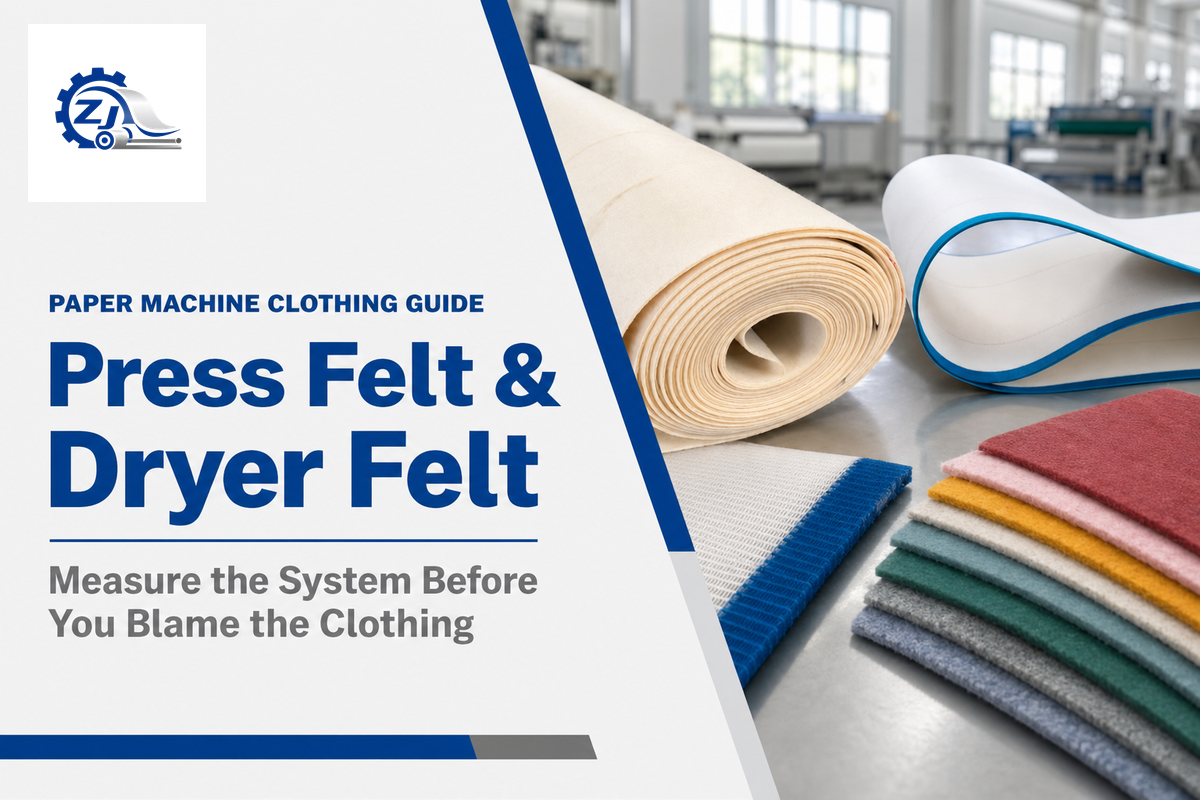
Press Felt & Dryer Felt are two distinct paper machine clothing systems. In a loaded nip, the press felt receives water and transports the wet sheet through the press section. Around heated cylinders, the dryer fabric supports the sheet and allows controlled air and vapor movement. Their jobs connect, but their condition is assessed from different evidence.
Quick answer
Do not replace either clothing item from age or appearance alone. First compare sheet moisture, nip or vacuum behavior, felt permeability, drive load, dryer-section ventilation, contamination, tension, tracking, and defect timing against a stable baseline. The pattern tells you whether to clean the clothing, correct the machine system, or plan replacement.
This guide is for mill teams trying to understand a process change. It explains what each clothing item does, what to measure, and how to separate a felt problem from a shower, vacuum, press, steam, condensate, ventilation, tension, or alignment problem. If you already know the operating need and want specification matching, construction options, or a quotation, use the press felt and dryer fabric solution page.
What Do “Press Felt” and “Dryer Felt” Mean on a Paper Machine?
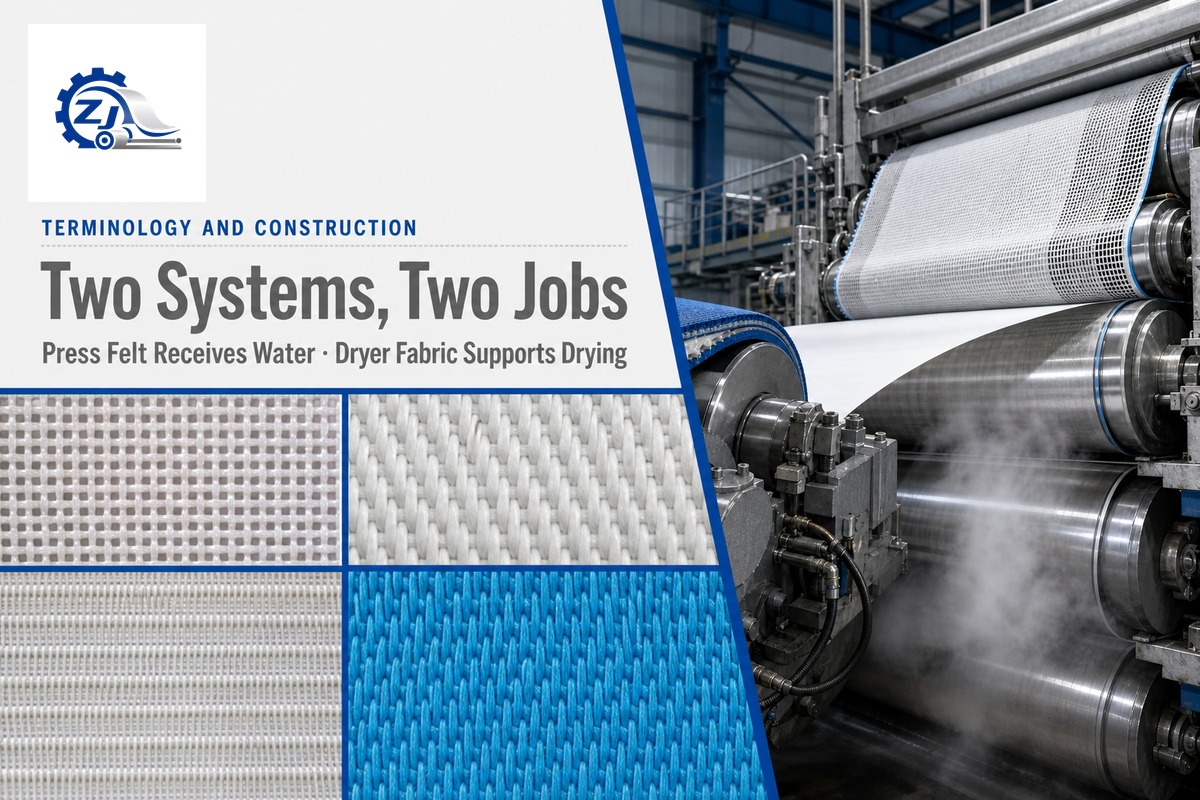
A press felt is permeable clothing used in the press section. It carries the fragile paper web through a loaded nip, receives water expressed from the sheet, and releases that water through vacuum and conditioning equipment before returning for another pass. Its structure normally combines a load-bearing base with fiber batt. The felt surface can affect marking and paper smoothness, but the design varies by machine and paper grade.
Mill teams traditionally call the clothing that guides and supports the web through part of the dryer section a dryer felt. Modern constructions are generally woven or spiral synthetic structures, so dryer fabric is the more precise technical term. Depending on position, a dryer fabric weave may use polyester monofilament yarn, but material and structure remain position-specific.
Construction vocabulary also varies. A press felt may include a needle-punched, non-woven batt over base fabrics; its compressible response depends on fabric design and machine position. In a paper mill, “dryer screen” may appear as older shorthand for dryer fabric.
Press felt
- Works in a high-load nip.
- Receives and carries liquid water.
- Needs void volume, permeability, stability, and controlled release.
- Is judged with press, vacuum, sheet-moisture, conditioning, and profile evidence.
Dryer fabric
- Runs around heated cylinders and rolls.
- Supports sheet contact, travel, and controlled air movement.
- Needs stability, cleanliness, permeability, tracking, and heat resistance.
- Is judged with sheet runnability, moisture profile, ventilation, load, tension, and deposit evidence.
The terms are easy to merge because both products travel as endless loops and both affect water removal. Their physics are not interchangeable. Pressing removes liquid mechanically; drying removes remaining water mainly by heat and mass transfer. Poor pressing can send more water into the dryer section, but a dryer problem can’t be diagnosed from press felt condition alone.
How Does a Press Felt Remove Water in the Press Section?
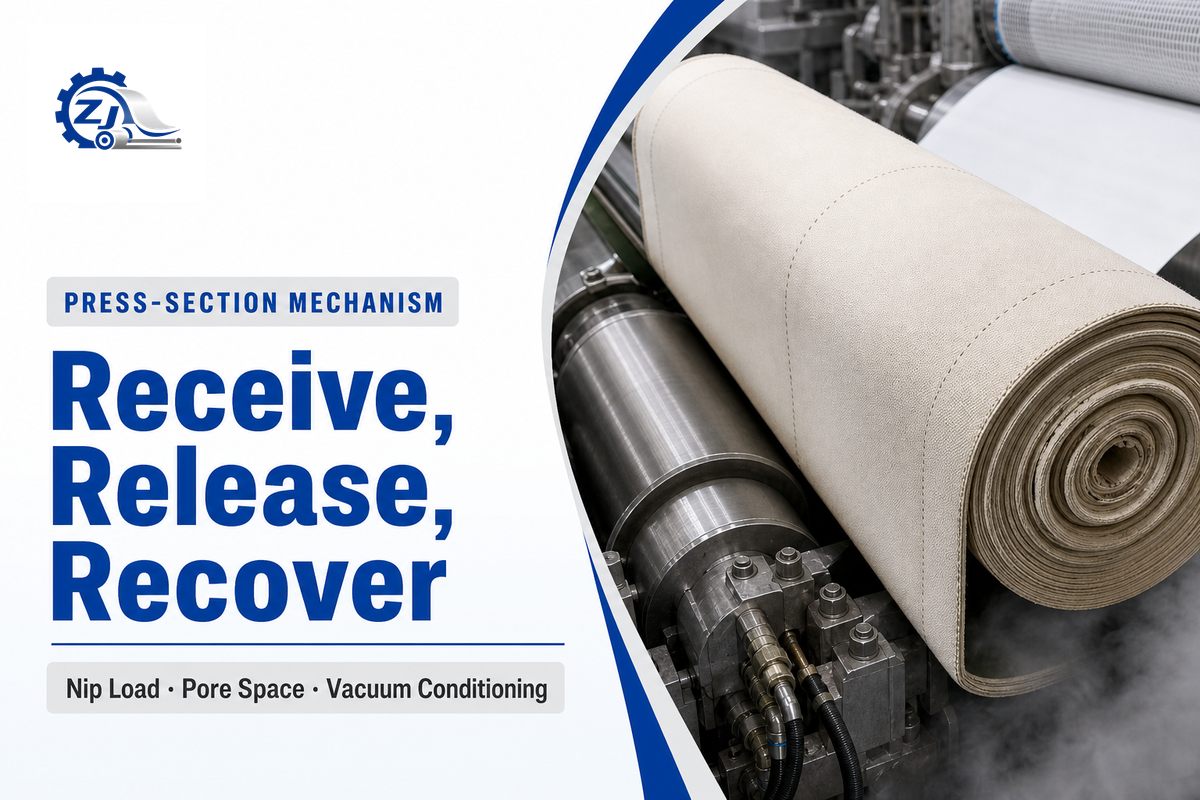
In the nip, the roll load presses the wet sheet and felt together. Water moves toward available pore space in the felt and, depending on the press design, toward grooves, holes, or other dewatering paths. When pressure releases, the sheet and felt rebound. If the felt remains saturated, contaminated, or poorly conditioned, water can remain near the interface or move back toward the sheet.
Whether the machine uses a conventional roll nip or a shoe press, the wet paper web and felt must enter the loaded zone in a controlled state. The clothing then needs enough recovery and conditioning before the next pass.
That cycle makes four felt properties useful to understand:
- Void volume: the internal space available to receive water during the short nip event.
- Permeability: the ease with which air and water can pass through the structure under stated test conditions.
- Compressibility and recovery: how the structure responds under load and rebounds after the nip.
- Stability: how well the felt holds its dimensions, profile, and tracking behavior through repeated loading.
None of these is a stand-alone pass/fail number. For example, a permeability reading changes with test pressure, instrument setup, water content, contamination, and the measuring position. A TAPPI conference felt-trial example normalized an airflow reading taken at 40 kPa to a reference at 10 kPa; that example shows why two raw values taken under different vacuum conditions should not be trended as though they were equal.
The most useful press diagnosis ties clothing evidence to the process change. If felt permeability drops while vacuum behavior, sheet moisture after the press, and cross-direction profile all change, then clothing restriction becomes a more plausible hypothesis. Conversely, if permeability remains constant but nip loading, shower pressure, uhle-box sealing, or vacuum capacity change, then the felt may be indicating a system problem rather than causing it.
What Does a Dryer Fabric Do Around Heated Cylinders?
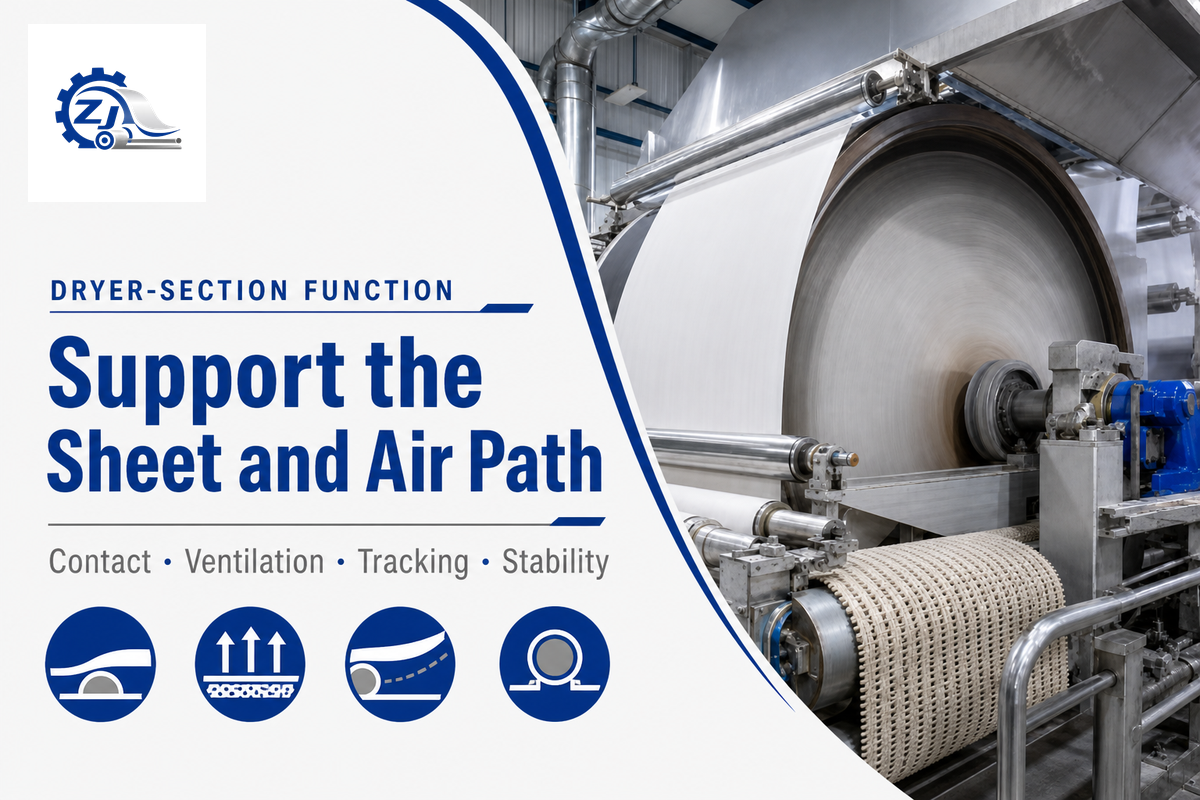
Dryer fabric supports the sheet as it moves across cylinders and open draws. It affects contact with the hot surface and the air path near the sheet. The fabric must stay dimensionally stable, run cleanly, track properly, and allow the dryer pocket to breathe as the machine was designed.
Dryer performance isn’t merely a matter of fabric temperature. The behavior of steam and condensate inside the cylinders and hood, the balance of the hood, sheet basis weight and moisture entering the section, contamination of the fabric, tension, roll condition, air movement, and many other variables can change final values. For that reason, a visible dryer section moisture streak doesn’t prove a fabric fault in itself.
Across the paper machine dryer section, the fabric helps hold the paper sheet over each dryer cylinder, influencing contact area, heat transfer, and air permeability. Those variables interact with steam pressure, energy consumption, and drying efficiency; none belongs to the fabric alone.
The press-to-dryer handoff matters. The U.S. Department of Energy and NC State place pressing and drying as linked stages and identify drying as a major energy user. Poor mechanical dewatering therefore sends more evaporative work to the dryer. Before raising steam or blaming a dryer fabric, confirm whether the sheet entered the dryer wetter than the established grade baseline.
Terminology check
Press felt forms part of liquid-water removal under nip pressure. Dryer fabric forms part of sheet support and controlled drying around heated cylinders. When a symptom spans both sections, compare the handoff data instead of choosing one item from where the defect becomes visible.
Which Measurements Reveal Clothing Condition Better Than Age?

Calendar days and tons produced may assist planning, but they do not reliably indicate remaining service life. Changes in grade mix, furnish, chemical residues, shower efficiency, machine speed, nip loading, breakdowns, cleaning cycles, heat, abrasion, and upset incidents can all affect service life. TAPPI TIP 0404-26 warns in its public abstract that maximizing clothing life or minimizing clothing cost per ton can reduce total machine performance.
A stronger method is the 6-Step Felt Evidence Ladder. Advance only when lower-tier evidence supports the process change being observed.
- Record the symptom — Note the grade, speed, location, cross-direction position, timing, and whether the change repeats.
- Confirm the product result — Compare outgoing moisture, profile, breaks, marks, or drying load with a stable run of the same grade.
- Check the nearby system — Review nip, vacuum, showers, doctors, steam, condensate, ventilation, drives, tension, rolls, and alignment as applicable.
- Measure the clothing — Trend permeability, caliper, moisture, contamination, tension, tracking, temperature, or drive load under repeatable conditions.
- Test a bounded correction — Where procedures allow, make one controlled cleaning or machine-system correction and observe the response.
- Make the decision — Clean, correct the system, or replace only when the evidence chain points to that action.
TAPPI TIP 0404-43 describes on-machine water-permeability measurement as a way to examine machine-direction change and cross-direction profiles, with links to cleaning, dewatering, sheet moisture, speed, and quality. The goal is not one universal number. Measure at named positions with the same pressure basis, instrument, setup, and machine state so that the trend remains comparable.
Log paper quality, felt tension, and wear resistance beside the process result. That pairing makes a clothing trend more useful than a stand-alone inspection note.
Build a Condition Trend Log
A good record keeping system consists of one line for each group of measurements, not one line for every personal impression. Record the raw number and the test conditions together. When a sensor is replaced, a shower nozzle is changed, a vacuum seal is repaired, a grade changed, a wash cycle occurred, or a press loading adjustment was made, record the detail in a brief note.
| Evidence type | Why it matters | Comparison rule |
|---|---|---|
| Clothing ID, position, start date | Binds each reading to the correct item | Never merge different positions |
| Grade, speed, basis weight, furnish | Separates clothing change from product change | Compare like with like |
| Test method and instrument | Prevents a method change from looking like wear | Keep the method and device named |
| Permeability or airflow plus test pressure | Shows restriction or profile movement | Normalize or hold conditions constant |
| Sheet moisture and CD profile | Connects clothing evidence to output | Use the same sampling point |
| Felt or fabric moisture | Shows water carry and profile movement | Use matching running conditions |
| Vacuum, nip, load, tension, drive data | Tests machine-system causes | Record settings and actuals |
| Tracking, vibration, temperature | Exposes mechanical change around the clothing | Tie the value to position and time |
| Cleaning or repair event | Creates a before-and-after test | Change one cause where possible |
Mill-specific limits should come from the clothing supplier, machine supplier, approved mill procedure, and the machine’s own good-run history. This guide gives no universal permeability, tension, caliper, moisture, vacuum, or service-life threshold because those numbers can be unsafe or misleading outside their test and machine context.
The 5-Signal Press-to-Dryer Map: What Should You Check First?
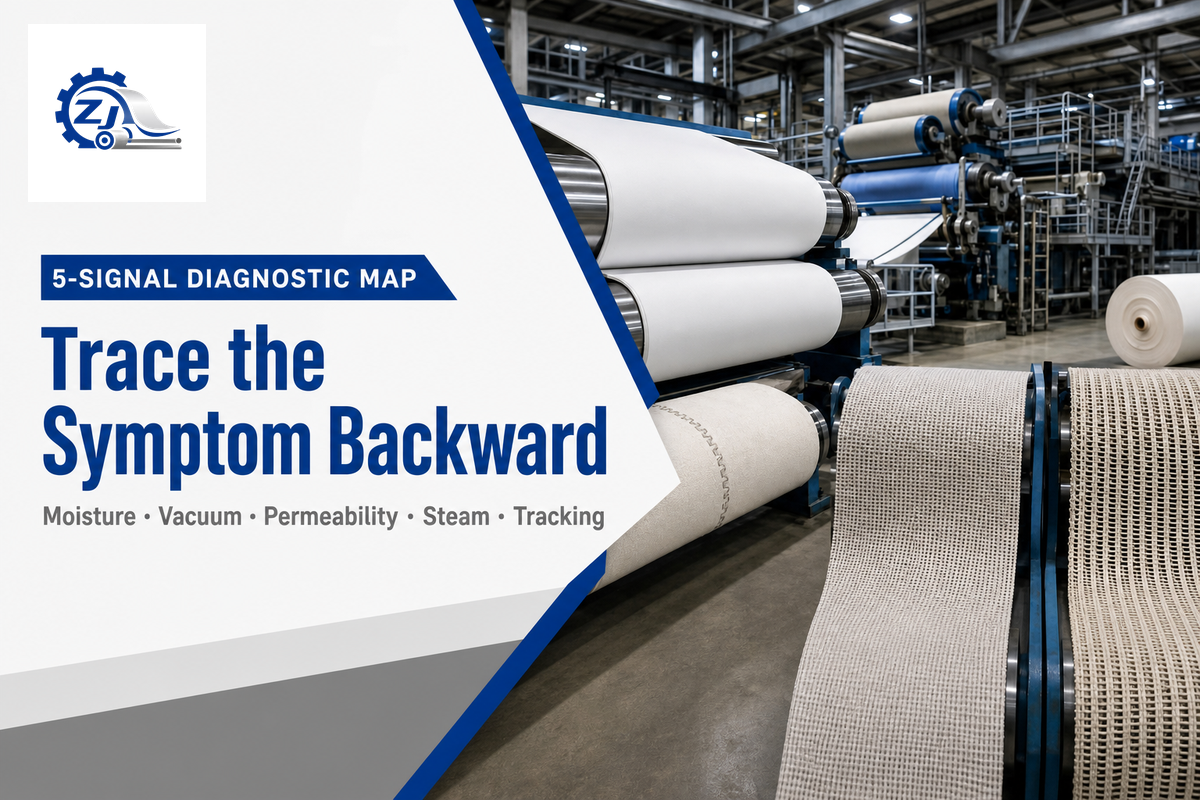
Where a defect is first seen isn’t necessarily where it originated. Start with the same-grade moisture baseline and machine state, then trace timing backward through press, vacuum, steam, ventilation, and clothing data before assigning a cause from the combined evidence.
| Observed signal | First checks | Comparison evidence that strengthens a clothing link |
|---|---|---|
| Wetter sheet entering dryers | Nip load, vacuum, showers, felt moisture, grade | Repeatable change in felt permeability or moisture profile at matching positions |
| CD moisture streak | Press exit profile, dryer ventilation, deposits, steam and condensate | The clothing profile and sheet profile move together through repeated runs |
| Press mark or surface change | Roll surface, felt seam or damage, contamination, nip alignment | Defect pitch or CD position matches the felt and persists across controlled checks |
| Sheet flutter or runnability loss | Draw, ventilation, fabric tension, tracking, roll and guide condition | Fabric instability, damage, or contamination coincides with the event |
| Rising drive load | Bearings, rolls, doctors, tension, deposits, misalignment | Load changes with verified clothing condition under the same machine state |
| Rapid felt rewet or water carry | Uhle box, vacuum seals, showers, felt saturation | Felt moisture and sheet moisture respond together after an approved correction |
| Dryer pocket moisture rise | Pocket air, hood balance, steam, condensate, deposits | Fabric contamination or permeability profile follows the pocket change |
| Tracking movement | Guide response, roll alignment, tension, edge damage | Verified fabric or felt stability loss persists after system checks |
| Break pattern after a grade change | Draw, furnish, speed, moisture handoff, clothing response | The pattern repeats for the same grade and matches a measured clothing signal |
A useful signal map includes negative evidence. If a suspected felt zone has no matching change in permeability, felt moisture, nip behavior, sheet moisture, or surface result, pause before acting. If a new dryer moisture pattern begins after a steam or ventilation event while fabric readings stay stable, investigate that event first.
Maintenance forums reinforce the value of vibration, oil, inspection, and event histories when visible symptoms arrive late. Such reports help generate questions; they don’t set mill limits. Field experience guides where to look, then instrumented, machine-specific evidence guides the decision.
How Should Press Felts and Dryer Fabrics Be Cleaned and Conditioned?
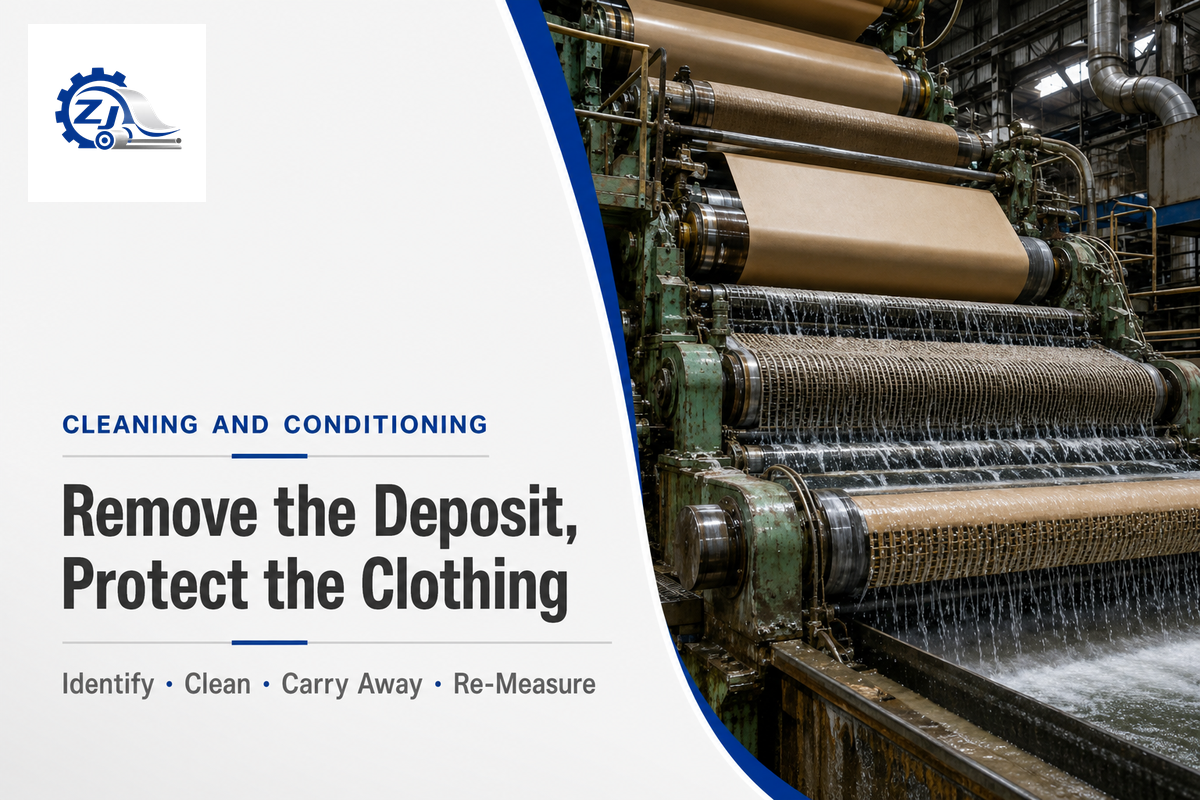
Cleaning must remove contaminant deposits without fiber, seam, coating, roll, doctor, or equipment damage. Correct cleaning procedure depends on deposit chemistry, material and construction, shower hardware, water quality, chemical compatibility, temperature, machine speed, and mill safety procedures. Follow supplier instructions and mill procedure rather than copying a pressure, chemical dose, or distance from another machine.
Once the signal map points to contamination, cleaning becomes a controlled test rather than a guess. Its value comes from the measured response.
For a press felt, routine conditioning can combine showers and vacuum removal so loosened material leaves the structure before it returns to the nip. Check nozzle condition, direction, pressure pattern, filtration, water quality, uhle-box sealing, and vacuum capacity. A wash hasn’t proved successful unless a post-wash reading and sheet result improve under comparable running conditions.
For a dryer fabric, identify whether the deposit is fiber, pitch, coating, oil, scale, or another material. Check doctors, rolls, ventilation, and the carryover source. Cleaning while leaving the source active often produces only a short response. Aggressive action can alter permeability, damage a seam, or create a new profile problem.
Do
- Identify the deposit before choosing a method.
- Inspect the full conditioning system.
- Record a comparable before-and-after measurement.
- Check the sheet result, not only the clothing appearance.
- Use approved lockout and chemical procedures.
Do not
- Use appearance as the only success test.
- Copy another mill’s pressure or chemical dose.
- Clean through a damaged shower pattern.
- Ignore the source of recurring deposits.
- Reach into moving equipment to inspect a result.
When Should You Clean, Correct the System, or Replace the Clothing?

Clean when evidence shows removable contamination, the clothing remains mechanically sound, the conditioning system can carry removed material away, and an approved method exists. If an approved clean does not recover the trend, check system causes before replacing the clothing.
Correct the system when cause sits outside the clothing: a plugged or misdirected shower, vacuum system fault, seal leak, roll or doctor fault, loading fault, tension or tracking problem, steam and condensate system fault, hood or pocket air imbalance, or a grade/furnish change. After a cause is fixed, cleaning may still be necessary, but replacement will not eliminate the source.
Replace when verified damage, loss of stability, seam risk, persistent restricted or uneven performance, or a process penalty remains after approved corrections, and the evidence points back to the clothing. Also replace when responsible mill and supplier teams judge that safe, controlled operation cannot be maintained.
The choice is economic as well as mechanical. Clothing that still runs may impose extra steam demand, lower speed, unstable moisture, added breaks, off-quality paper, or repeated wash downtime. Conversely, a young felt can perform poorly because the surrounding system is wrong. Cost per clothing day is weaker evidence than the cost and risk for the whole production result.
Decision rule
A replacement decision is strongest when three lines agree: the product result changed, repeatable clothing measurements changed, and nearby machine-system causes were checked or corrected. If only one line changes, collect more evidence before assigning the cause.
What Are the Safety Boundaries for Inspection and Felt Changes?
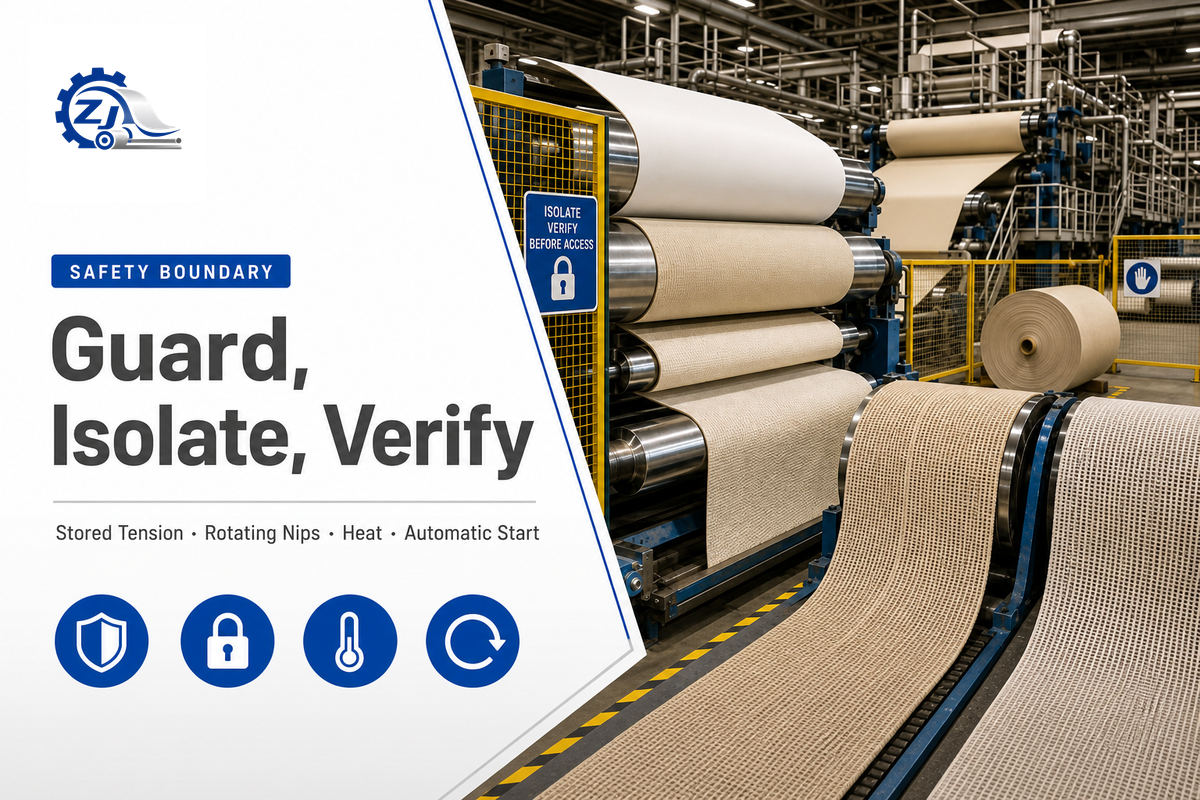
Paper machines have rotating rolls, nips, shafts, stored tension, heat, steam, chemicals, high-pressure showers, and hard-to-reach access points. Inspection, cleaning, and clothing changes must take place according to the site energy-control, guarding, confined-access, chemical, lifting, and machine-specific procedures. This isn’t a work permit or a replacement for mill-trained supervision.
For U.S. mills and work covered by that federal rule, the standard states:
“All drives shall be provided with lockout devices at the power switch.”
That duty appears in the U.S. Occupational Safety and Health Administration’s pulp, paper, and paperboard-mills rule. The same regulation addresses emergency stopping and guarding of rotating shafts. Other jurisdictions, or the mill’s own procedure, may require different or more rigorous controls.
Never treat a slow-moving section as harmless. Clothing can store tension, rolls can coast, steam surfaces stay hot, and an automatic sequence may start equipment. Don’t place hands, clothing, instruments, hoses, or cameras near an in-running nip. Even a visual check from a guarded position isn’t permission to reach through the guard.
What Changed in Paper Machine Clothing in 2025–2026?
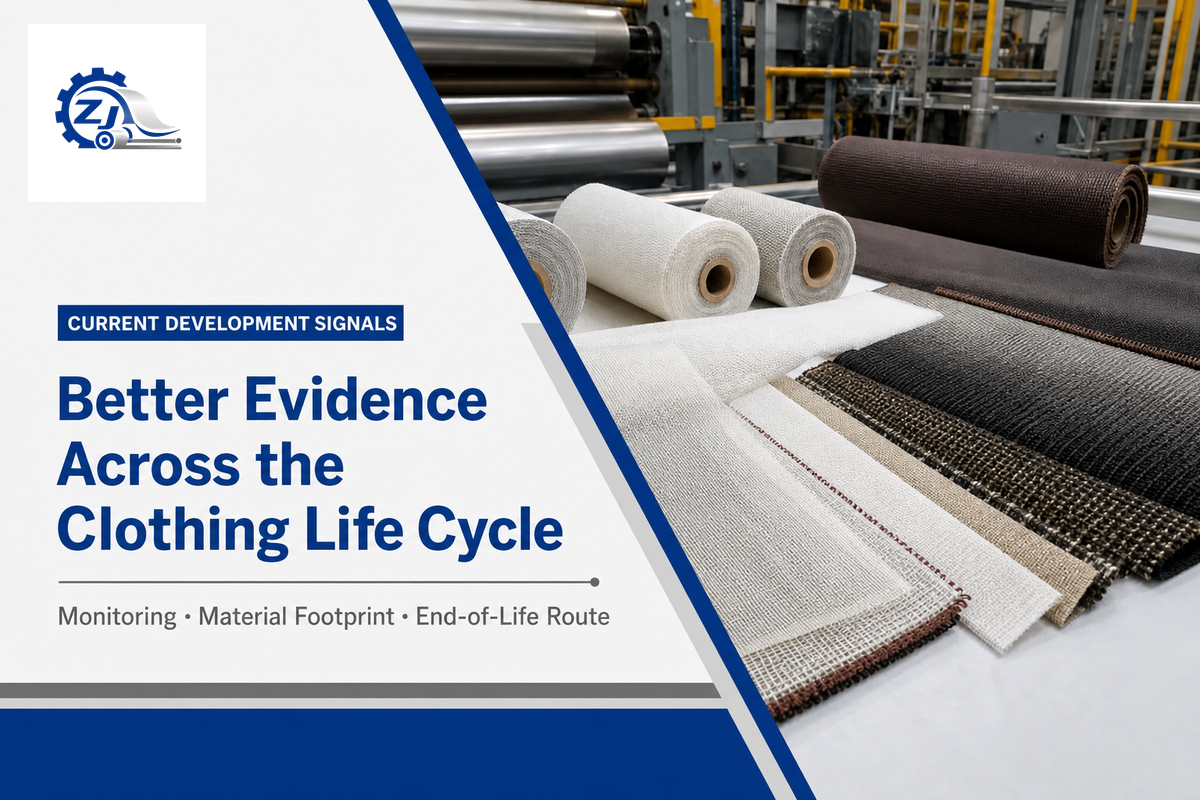
With the safety boundary unchanged, three current signals matter for mills today. First, the 2026 TAPPI Technical Information Paper schedule includes work on dryer-section performance monitoring, wet-press-fabric thickness, press-section performance, and paper-machine showers. That activity points toward more structured, repeatable condition evidence.
Second, a July 2026 trade report describes new lower-carbon dryer fabrics and attributes a reduction of nearly thirty percent in product footprint to the supplier for certain product builds. Treat that figure as supplier-specific, not as a market-wide result. The broader signal is that material footprint is joining runnability and air handling as a development question.
Third, a March 2026 trade report covers a program to recycle used forming fabrics, press felts, and dryer fabrics into raw material for other industrial uses. Availability depends on region, polymer stream, contamination, collection rules, and participating partners. Mills should ask what’s accepted and how mass or disposition is evidenced before making a circularity claim.
These trends add three questions to a trial: Can condition data be compared cleanly? Is footprint information product-specific and traceable? Is an end-of-life route available for this mill? They don’t remove the need to verify sheet results, machine conditions, safety, and clothing behavior.
Frequently Asked Questions
The questions below apply those current trends to daily press and dryer diagnosis.
Are press felts and dryer felts the same thing?
No. The press felt accepts liquid water in the nip; the dryer fabric supports the sheet around heated cylinders. Their roles and measurements differ. During pressing, the felt receives and releases water while carrying a fragile web. In drying, the fabric supports sheet travel, surface contact, and controlled air movement. A symptom visible in one section may begin upstream, so compare the moisture handoff, clothing readings, and nearby machine systems before assigning the cause.
Why is a dryer felt often called a dryer fabric?
“Dryer felt” is the older mill term. “Dryer fabric” better describes today’s woven or spiral synthetic clothing. The historical name remains common in mill speech and search, but technical discussion usually prefers fabric because the product is not made as a traditional felted batt.
What measurements show that a press felt is losing performance?
Useful evidence includes water permeability under repeatable test conditions, cross-direction profile, felt moisture, vacuum behavior, sheet moisture after pressing, nip data, and the response to conditioning. Confidence in the trend becomes stronger when clothing readings and the product result move together while grade and machine state remain comparable.
Can cleaning restore press-felt or dryer-fabric performance?
Sometimes. Cleaning can help when removable contamination is the cause and the clothing is still sound. It can’t fix worn structure, physical damage, unstable tracking, a failed seam, bad showers, vacuum loss, steam or ventilation faults, or a recurring contaminant source.
How long should a press felt or dryer fabric last?
There’s no safe universal life interval. Track each position by grade mix, speed, loads, deposits, wash history, measurements, sheet result, and machine events. Plan replacement from verified condition and process cost, with supplier and mill input, rather than calendar age alone.
From Diagnosis to a Specification Discussion

Bring the supplier a concise evidence package: machine position, clothing identification, grade and speed, symptom start time, CD location, trend log, sheet result, shower and vacuum state, cleaning or repair response, and clear photos taken under approved safe conditions. That gives both teams a factual starting point.
Zejiang Paper Machine works with paper-machine projects and replacement parts. Start at the paper machine project hub, read about the company and its project scope, see the related paper drying process guide, or use the paper machine parts guide to place clothing in the wider system.
Have a verified machine symptom or planned clothing change?
Review the press felt and dryer fabric solution, then send your position, grade, speed, current clothing record, and measured problem. The commercial page handles product matching and inquiry details.
References and Research Basis
References & Sources: This guide was cross-checked against current government safety rules, U.S. Department of Energy process material, TAPPI paper-machine-clothing resources, public patent background, dated trade reporting, and live site content. Forum discussions supplied field terminology and diagnostic questions only; they didn’t set limits.
- OSHA 29 CFR 1910.261, Pulp, paper, and paperboard mills
- U.S. Department of Energy / NC State, Process energy efficiency in pulp and paper
- TAPPI TIP 0404-43, Water permeability of press fabrics
- TAPPI TIP 0404-26:2024, Performance and life of paper machine clothing
- TAPPICon, Performance analysis of paper machine felt trials
- TAPPI, 2026 Technical Information Paper schedule
- U.S. Patent 4,973,512, Press felt structure and dewatering background


![Refiner Plates & Screen Baskets [Complete Guide]](https://zjpapermachine.com/wp-content/uploads/2026/07/refiner-plates-screen-baskets-guide-featured-150x150.png)
![Doctor Blade: Types, Materials & How It Works [Guide]](https://zjpapermachine.com/wp-content/uploads/2026/07/doctor-blade-guide-featured-1-150x150.png)
![Pulping Equipment: How Paper Pulping Works [Guide]](https://zjpapermachine.com/wp-content/uploads/2026/07/pulping-equipment-guide-featured-150x150.png)