
Get in touch with Zejiang Paper Machinery Company

How Pulp Thickening and Deinking Work as One Process

Process guide for recycled-fiber stock preparation
Pulp Thickener & Deinking is the process boundary where stock consistency, ink removal, water balance, and fiber yield have to be read together. A pulp thickener changes stock consistency. A deinking process changes the cleanliness, yield, and water balance of recovered fiber. These two duties touch each other, but they should not be treated as the same performance result.
This guide explains where thickening fits, how flotation and washing alter the process performance, which process signals to consider, and when a mill team has enough process data to move from diagnosing equipment problems to fixing them.
In mill-language terms, pulp deinking describes the process work, while deinked paper describes the quality result the line is trying to protect.
What Thickening and Deinking Each Do

Pulp thickening removes carrier water from a pulp slurry so stock reaches a higher solids level for the next stage. A NC State deinking laboratory guide frames deinking as a sequence that can include pulping, screening, cleaning, washing, flotation, bleaching, and kneading, which is broader than thickening alone. The practical mistake is to look at a thickener discharge and call it deinking performance without checking where the ink mass, ash, and fiber actually went.
| Process duty | Main job | What it does not prove alone |
|---|---|---|
| Pulping | Repulp recovered paper and expose ink, adhesive, filler, and fiber surfaces. | That the detached ink has already left the stock. |
| Screening and cleaning | Remove coarse debris, heavy particles, and pressure-screen rejects before sensitive stages. | That small ink particles or dissolved load are controlled. |
| Flotation | Carry hydrophobic ink particles into foam so they can be rejected. | That fines, fillers, or water-soluble ink fractions are also gone. |
| Washing and thickening | Remove water and a portion of suspended or dissolved material while raising consistency. | That optical cleanliness improved without fiber, ash, or sludge cost. |
This boundary matters for deinked pulp quality. Mill teams can improve discharge consistency and still see residual specks, high effluent loading, or fiber loss. Ask whether the thickener, washing stage, filtrate route, and downstream clarification support the full mass balance, not whether the thickener “removed ink” by itself.
Where Thickening Fits in a Recycled-Fiber Deinking Line
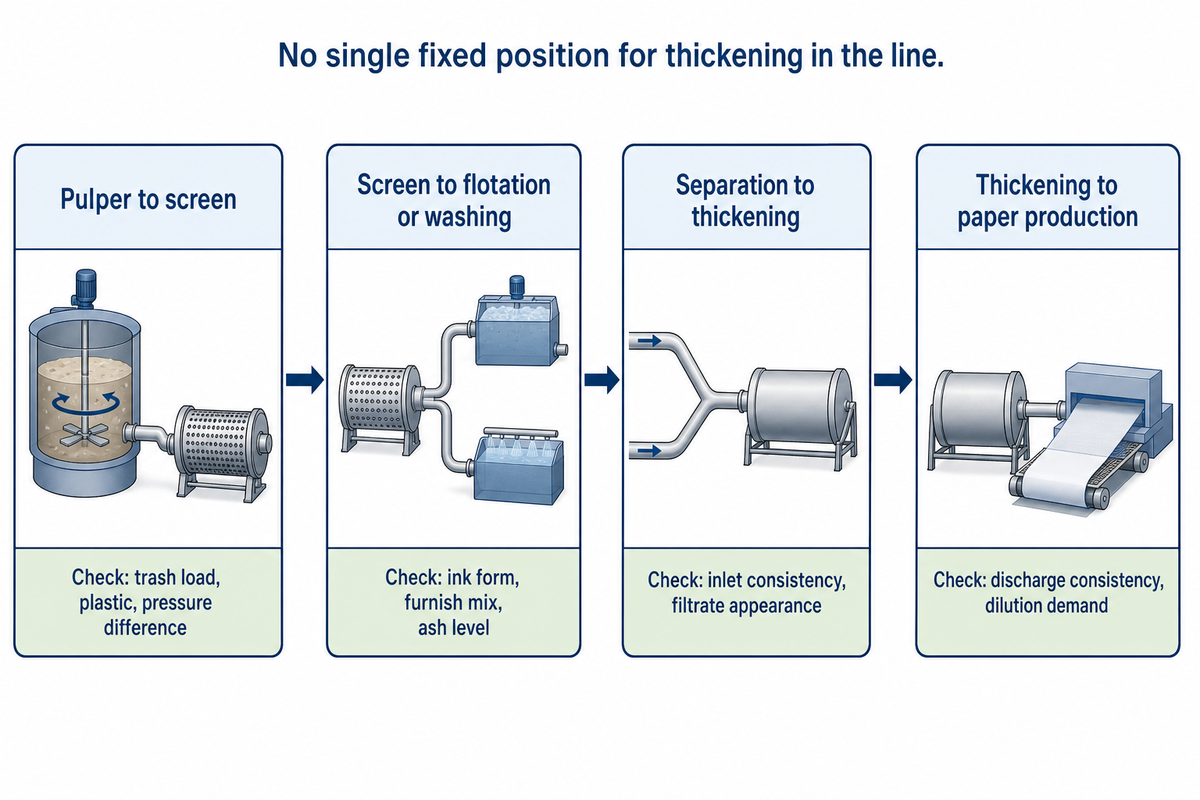
There is no single fixed position for stock thickening in every recycled fiber line. EPA process descriptions show deinking systems as a sequence that can include separators, flotation, washing, dewaterer or thickener stages, wastewater clarification, effluent treatment, and sludge disposal. Order depends on furnish, quality target, filtrate routing, and the consistency required by the next operation.
- Recovered paper goes into a pulper or series of pulpers where fiber is dispersed and initial ink removal commences.
- Inks, heavy particles, and large particulates are removed prior to fine separation in pressure screen or centrifugal cleaner stages.
- Ink and fines are removed in one or more stages in a process sequence including flotation, washing, or both.
- Thickener, washer, disc filter, disk filter, drum stage, or screw press equipment receives accept material from the ink and fines removal stages and adjusts consistency for subsequent stages.
- Filtrate handling, clarification, sludge disposal, and the management of the process water balance will assist or thwart process performance.
| Handoff | Condition to check | Risk if skipped |
|---|---|---|
| Pulper to screen | Trash load, plastic, stickies signs, and pressure difference across screens. | Later deinking stages inherit preventable solids. |
| Screen to flotation or washing | Ink form, furnish mix, ash level, and process water quality. | The wrong separation mechanism is blamed after the fact. |
| Separation to thickening | Inlet consistency, filtrate appearance, accept quality, and reject flow. | Clean-looking stock hides water-loop or sludge penalties. |
| Thickening to paper production | Discharge consistency, dilution demand, paper quality, and runnability. | Paper machines receive unstable stock and the root cause becomes harder to trace. |
disc thickener, drum washer, screw press, vat, cylinder, screen or conveyor may all describe the location in which the stock passes. They’re all labels for stages in process, not descriptions of process machines or processes for papermachines or process machines until evidence proves otherwise.
The Ink-Water-Fiber Control Loop: 7 Process Control Points
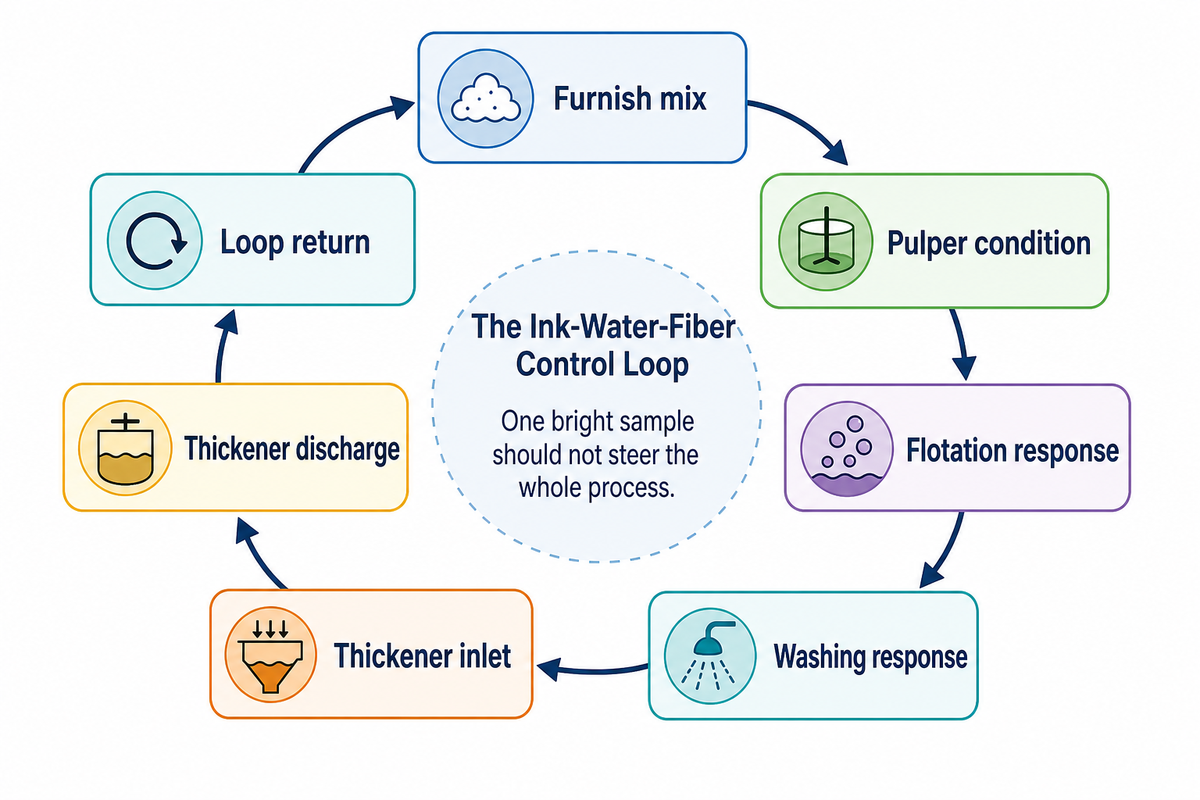
Within the Ink-Water-Fiber Control Loop, a monitoring sheet separates measured inputs, response signals, and validation checks so one bright sample or one thick stock reading does not steer the whole deinking process. The same boundary appears in the EPA recovered-paper operations report, where thickening, wastewater clarification, effluent treatment, and sludge disposal remain connected process consequences.
| Point | Variable | Unit | Leading signal | Confounder | Next check |
|---|---|---|---|---|---|
| 1. Furnish mix | Recovered paper grade, virgin or mechanical pulp share | percent | Ink type and contaminant load shift | Bale variability | Compare feed sample with accepted pulp |
| 2. Pulper condition | Temperature, chemistry, retention, consistency | C, minutes, percent | Ink detachment improves or breaks into hard fractions | Chemical change hides mechanical change | Run side-by-side handsheets or lab flotation |
| 3. Flotation response | Foam load, reject solids, residual ink | kg/t, ppm, visual grade | Ink leaves with froth | Fiber entrainment | Check accept yield and reject composition |
| 4. Washing response | Filtrate color, ash, fine solids | percent, mg/L | Water carries fine material away | Useful filler may be removed with dirt | Measure ash and fiber in filtrate |
| 5. Thickener inlet | Inlet consistency and flow | percent, tpd | Hydraulic load on dewatering area changes | Poor sampling point | Validate sample mass before changing settings |
| 6. Thickener discharge | Discharge consistency and filtrate solids | percent, kg/t | Stock thickens for storage, bleach, or paper production | High consistency can hide lost fiber | Check filtrate, accepts, and downstream dilution |
| 7. Loop return | Process water, DCS, fine ink, effluent sludge | mg/L, kg/t | Recirculated load re-enters the process | Freshwater reduction masks buildup | Track clarification and loop conductivity trends |
Consistency deserves special care because it is not only a measurement after the fact. In one chemical deinking study on photocopier waste paper, trials at 6%, 8%, 10%, and 12% consistency peaked at 10%, where reported deinking efficiency reached 75.93% and ISO brightness reached 80.38%. By 12%, the result declined. That does not create a universal operating target, but it proves why consistency must be treated as an active condition as well as a control reading.
Flotation vs Washing: Match the Mechanism to Ink and Furnish
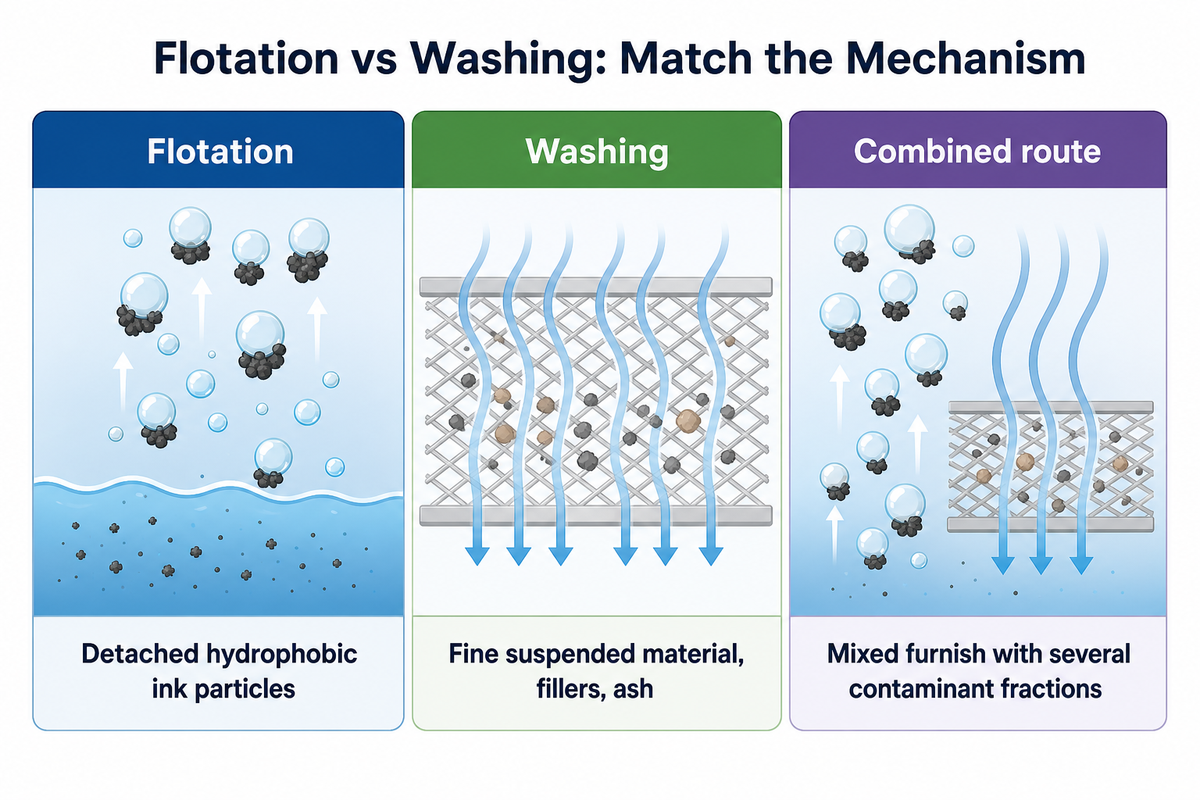
That consistency result leads into the separation question: flotation deinking and pulp washing are often discussed together because both can change ink, ash, water, and yield. Their mechanisms are different. The NC State guide treats flotation as a low-consistency step that must balance yield against cleanliness. Washing moves water through the suspension and can remove fines, fillers, and small contaminants, but it can also move useful fiber or filler out of the accept stream.
| Route | Best fit to investigate | Known limitation | What to measure |
|---|---|---|---|
| Flotation | Detached hydrophobic ink particles that can be lifted by bubbles. | Foam can carry fiber, and very fine or water-based ink may be harder to remove. | Residual ink, reject solids, fiber loss, foam stability, brightness. |
| Washing | Fine suspended material, fillers, ash, dissolved load, and small contaminants. | Cleanliness gains can cost water, filler, or fiber unless filtrate is measured. | Ash, fines, filtrate solids, water per ton, accept yield. |
| Combined route | Mixed furnish with several ink and contaminant fractions. | One good metric can hide a cost in another part of the line. | Mass balance across accepts, rejects, filtrate, and effluent. |
Recovered paper rarely behaves like one clean laboratory material. Toner, flexographic ink, inkjet pigment, coating particles, wood pulp carryover, filler, adhesive residues, and plastic fragments can travel through different paths. A bounded stickies or dissolved-and-colloidal-substances note is useful here, but a full stickies-control program is a separate subject.
How Pulp Consistency Changes the Result You Measure
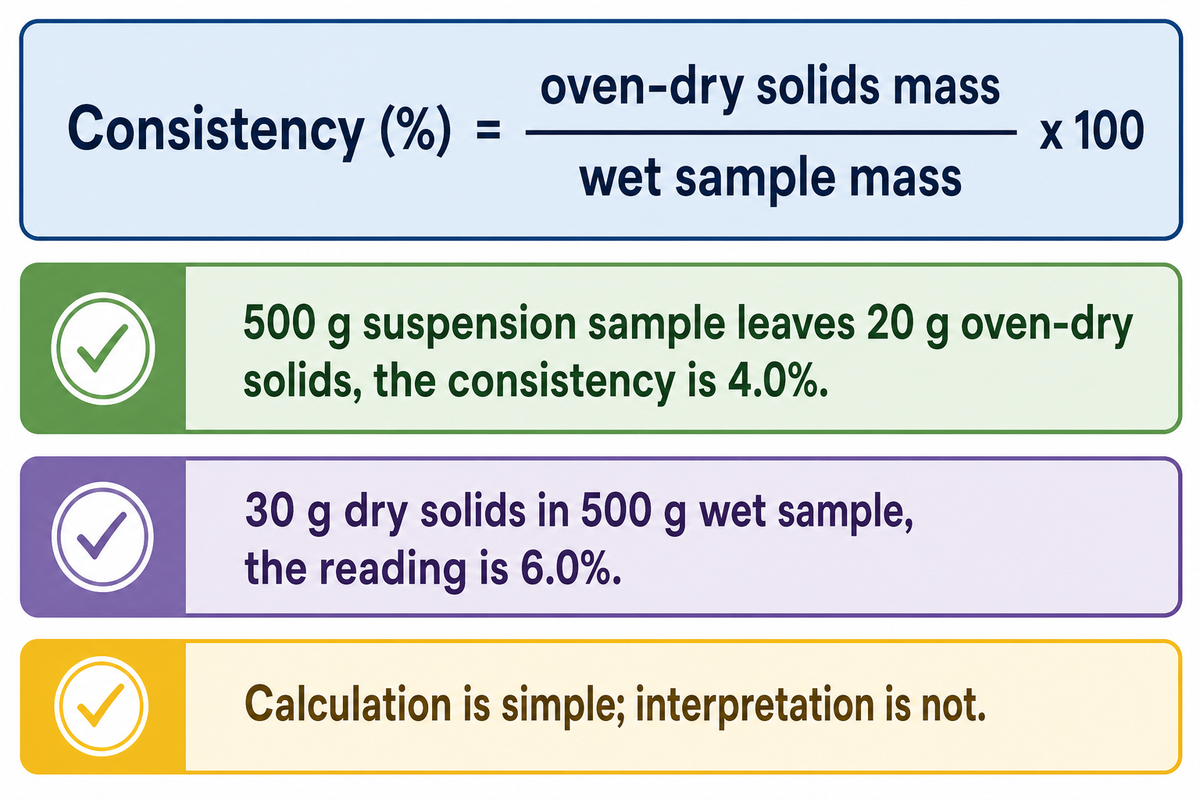
Pulp consistency is the mass of oven-dry fiber and solids divided by the mass of the suspension, usually expressed as a percentage. After the flotation and washing path is chosen, this reading helps show whether the line is reporting dewatering or a changed process condition; a BioResources deinking trial is one reason to treat consistency as a process variable, not only a discharge reading. A simple check looks like this:
Consistency (%) = oven-dry solids mass / wet sample mass x 100. If a 500 g suspension sample leaves 20 g oven-dry solids, the consistency is 4.0%. If the same sampling point later shows 30 g dry solids in 500 g wet sample, the reading is 6.0%.
Calculation is simple; interpretation is not. Higher outlet consistency may mean better dewatering. It may also mean lower inlet flow, changed screen rejects, more fines in the filtrate, or a sample taken from a poorly mixed pipe. In upstream detachment trials, changing consistency can change chemistry, collision frequency, and ink detachment itself. Before changing a setting, confirm the inlet sample, discharge sample, filtrate solids, and accept quality together.
The 10-Signal Failure Cascade: What Drift Reveals First
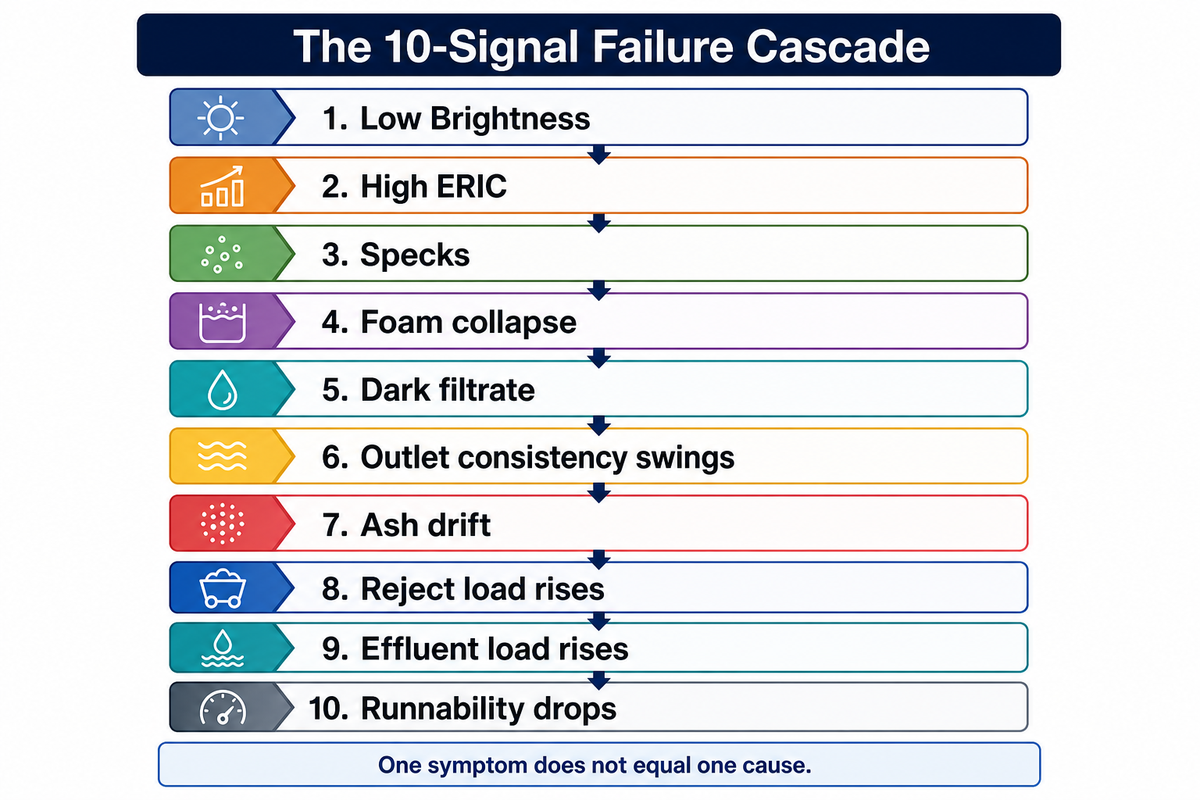
This 10-Signal Failure Cascade is a routing register. It does not say one symptom equals one cause. TAPPI’s ERIC note is a useful warning: brightness can be affected by lignin, dye, bleaching, and other light absorbers, while ERIC depends on ink-particle-size distribution. Optical measures help, but they should be paired with hydraulic, solids, reject, sludge, and downstream checks.
TAPPI’s ERIC note is a useful warning: brightness can be affected by lignin, dye, bleaching, and other light absorbers, while ERIC depends on ink-particle-size distribution.
TAPPI T 567
| Signal type | Observation | Plausible origin | Confounder | Confirming check | Escalation boundary |
|---|---|---|---|---|---|
| 1. Low brightness | Optical value drifts down | Ink, dye, lignin, bleach response | Brightness is not ink-specific | ERIC, speck count, furnish check | Only after multi-metric drift persists |
| 2. High ERIC | Residual ink measure increases | Poor detachment or separation | Particle-size distribution changes the reading | Microscopy or speck distribution | Escalate if paired with reject or filtrate change |
| 3. Specks | Visible dark spots remain | Large ink, toner, dirt, plastic | Screening defects can mimic ink failure | Screen reject and cleaner accept review | Escalate after upstream debris is ruled out |
| 4. Foam collapse | Unstable froth or heavy carryover | Surfactant, air, solids, hardness | Fiber can be entrained with ink | Reject consistency and fiber loss | Escalate if yield penalty rises |
| 5. Dark filtrate | Washer or thickener filtrate turns darker | Ink, fine solids, dissolved load | Color can be chemistry, not ink | Solids, ash, conductivity, loop sample | Escalate if loop return worsens accepts |
| 6. Outlet consistency swings | Discharge changes without clear setting change | Feed load, drainage, mat formation | Sample point or flow error | Inlet, discharge, and filtrate mass balance | Escalate after measurement error is ruled out |
| 7. Ash drift | Filler removal shifts | Washing intensity or furnish change | Useful filler can be mistaken for dirt | Accepted pulp ash and paper quality | Escalate if quality and furnish target conflict |
| 8. Reject load rises | More reject solids or sludge | Better separation or excess fiber loss | Reject mass can look like success | Reject composition and accept yield | Escalate if useful fiber leaves the system |
| 9. Effluent load rises | Clarification or wastewater treatment load grows | Fine solids and dissolved material transfer | Water saving can hide higher concentration | kg/t load, not concentration alone | Escalate when treatment capacity is affected |
| 10. Runnability drops | Sheet breaks, deposits, poor formation | Stock instability or recirculated contaminants | Press, drying, or wet-end changes may contribute | Link stock, water, and paper-machine records | Escalate only with confirmed stock evidence |
What Is Changing: Tighter Water Loops Raise Recirculation Risk
Hydraulic, solids, and filtrate checks matter most when freshwater use is reduced: lower freshwater use is an important paper industry goal, but a tighter water loop is not automatically better for deinking. An older EPA process-water review still gives a useful process boundary: increased water recycling can lower fiber and chemical losses to a point, but excessive recycling can build up fines or dirt and lead to greater loss of fiber, filler, and other papermaking chemicals.
In a deinking plant, use that as a boundary condition rather than a current operating standard; filtrate and effluent should still be treated as process information, not waste data kept outside the production conversation.
One BioResources case from an OCC recycling factory in Iran was based on a 28-day month, 672 working hours, 3,096 m3 of water consumption, and 390.7 tons of production. It calculated 7.9 m3 of water consumed per ton of paper and reported fiber loss of 21.6 kg/t without dissolved-air flotation versus 3.2 kg/t with dissolved-air flotation. Those values come from one case, not a universal benchmark, but they show why water, fiber, and clarification data belong beside deinked pulp quality data.
7.9 m3/twater consumed in one OCC case
3,096 m3case monthly water consumption
21.6 to 3.2 kg/tcase fiber-loss change with DAF
-3.7%, -3.5%, -4.0%2025 U.S. paper, fiber, recovered-fiber changes
| Evidence item | Source-bound value | Decision use |
|---|---|---|
| Consistency trial range | 6%, 8%, 10%, and 12% | Treat consistency as a process condition, not only a reading. |
| Deinking efficiency peak | 75.93% at 10% | Use as a study result, not a universal target. |
| Brightness peak | 80.38% ISO brightness at 10% | Pair optical gain with ink-specific measures. |
| OCC case basis | 28 days, 672 hours, 3,096 m3, 390.7 tons | Convert case evidence before comparing lines. |
| Case water use | 7.9 m3/t | Read water demand beside fiber and filtrate data. |
| Fiber loss without DAF | 21.6 kg/t | Flag the cost of untreated effluent solids. |
| Fiber loss with DAF | 3.2 kg/t | Check whether clarification changes the yield story. |
| Older flotation yield caution | about 10% to 25% | Keep brightness gains tied to yield loss. |
| 2025 U.S. market movement | -3.7%, -3.5%, and -4.0% | Avoid generic growth framing for recovered fiber. |
Current market context also matters. AF&PA’s 2026 capacity and fiber consumption survey reported that U.S. paper and paperboard production declined 3.7% in 2025, total fiber consumption decreased 3.5%, and recovered fiber decreased 4.0%. Mills facing tighter fiber economics have less room to trade fiber yield away for a cosmetic improvement that does not survive downstream production.
Balance Ink Removal, Fiber Yield, Ash, Water, Sludge, and Runnability
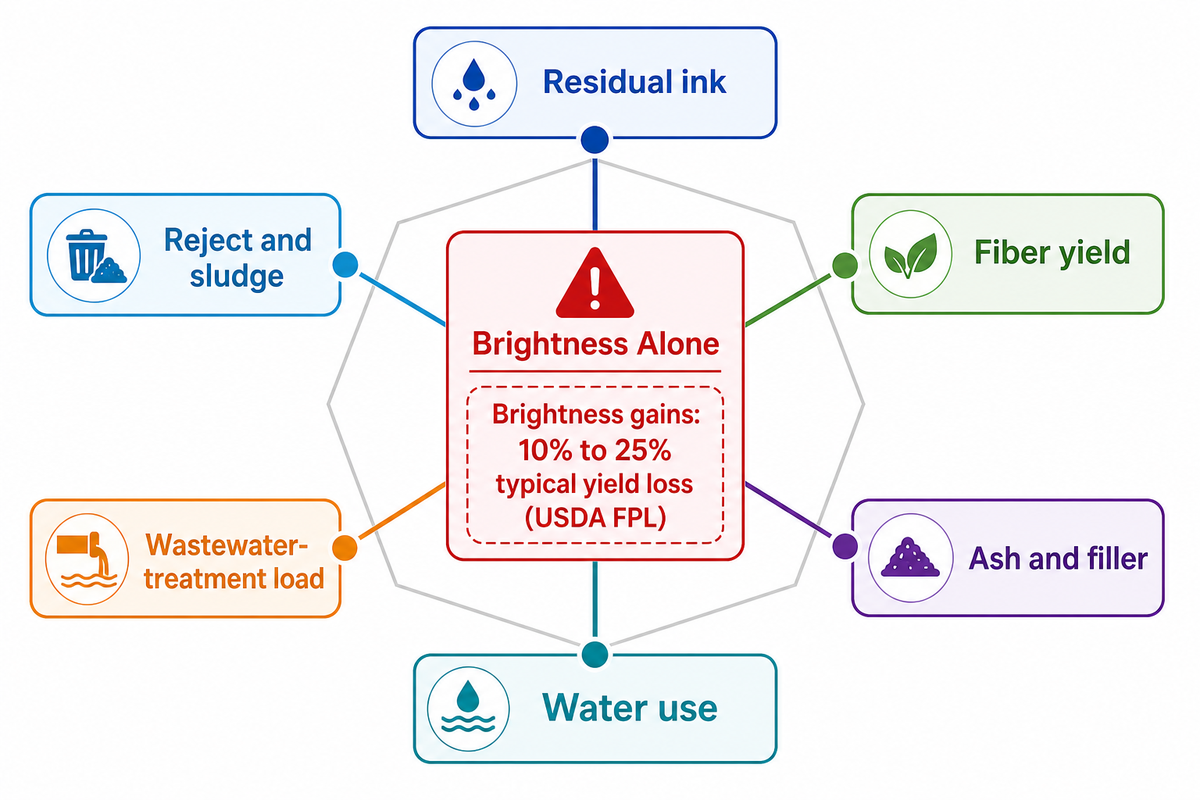
Older USDA Forest Products Laboratory flotation research gives a source-specific caution: typical recycling mill yield losses were described at about 10% to 25%, while optical gains such as brightness can move in a favorable direction. Brightness alone is not the same as a better process if accepted fiber, ash balance, wastewater load, or runnability moves the other way.
| Axis | Unit to record | Desired direction | Confounder | Downstream consequence |
|---|---|---|---|---|
| Residual ink | ERIC, specks, visual class | Lower | Particle size and optical absorbers | Brightness or printability complaint |
| Fiber yield | percent, kg/t | Higher accept yield | Reject solids may include good fiber | Higher furnish cost |
| Ash and filler | percent ash | Depends on grade target | Filler can be useful or unwanted | Strength, formation, or recipe changes |
| Water use | m3/t | Lower with stable quality | Reuse can concentrate contaminants | Deposits or redeposition risk |
| Wastewater-treatment load | kg/t load, not concentration alone | Within treatment capacity | Less water can raise concentration | Clarifier and effluent limits |
| Reject and sludge | kg/t, solids percent, composition | Ink out, fiber retained | Ink-laden residue can include useful fiber | Disposal and handling load |
| Runnability | breaks, deposits, dilution demand | Stable operation | Wet-end changes can mask stock issues | Lost production and quality variation |
Do
- Compare accept quality with reject composition.
- Record water load in kg/t or m3/t context.
- Link sludge behavior to fiber and ash balance.
Don’t
- Treat brightness alone as root-cause proof.
- Declare success from discharge consistency alone.
- Ignore wastewater treatment when optical results improve.
When Process Evidence Should Trigger Equipment Review

After ink removal, fiber yield, wastewater treatment, sludge, and runnability have been read together, move from process diagnosis to equipment review when several evidence streams point to the same boundary: the stock preparation line is asking for a different handoff, not a minor operating correction. Keep the first equipment-review brief tied to measurable process evidence, not product categories or sales language.
The EPA deinking operations report is the model for keeping flotation, washing, thickening, effluent treatment, and sludge handling in one brief. Document furnish, flow, inlet consistency, target consistency, contaminant profile, water-loop condition, accepted-pulp quality target, current symptoms, reject/sludge behavior, and upstream or downstream constraints.
For a pulp mill, write the brief in pulp and paper language that operators recognize: recovered-fiber grade, recycled paper source, filtration or clarification limits, high throughput assumptions, whether any high speed transfer point breaks up foam, and how the dewatered stock enters papermaking. Keep deinking pulp quality first; an economical or cost-effective review only makes sense after floor space, stainless steel contact requirements, and water-loop limits are factual constraints, not sales promises.
At that point, the commercial question belongs on the dedicated pulp thickener and deinking equipment page. This article doesn’t replace that page, and it doesn’t compare product categories. Its job is to help a mill team arrive with clean evidence rather than a vague complaint about brightness, consistency, or foam.
Pulp Thickener and Deinking FAQ
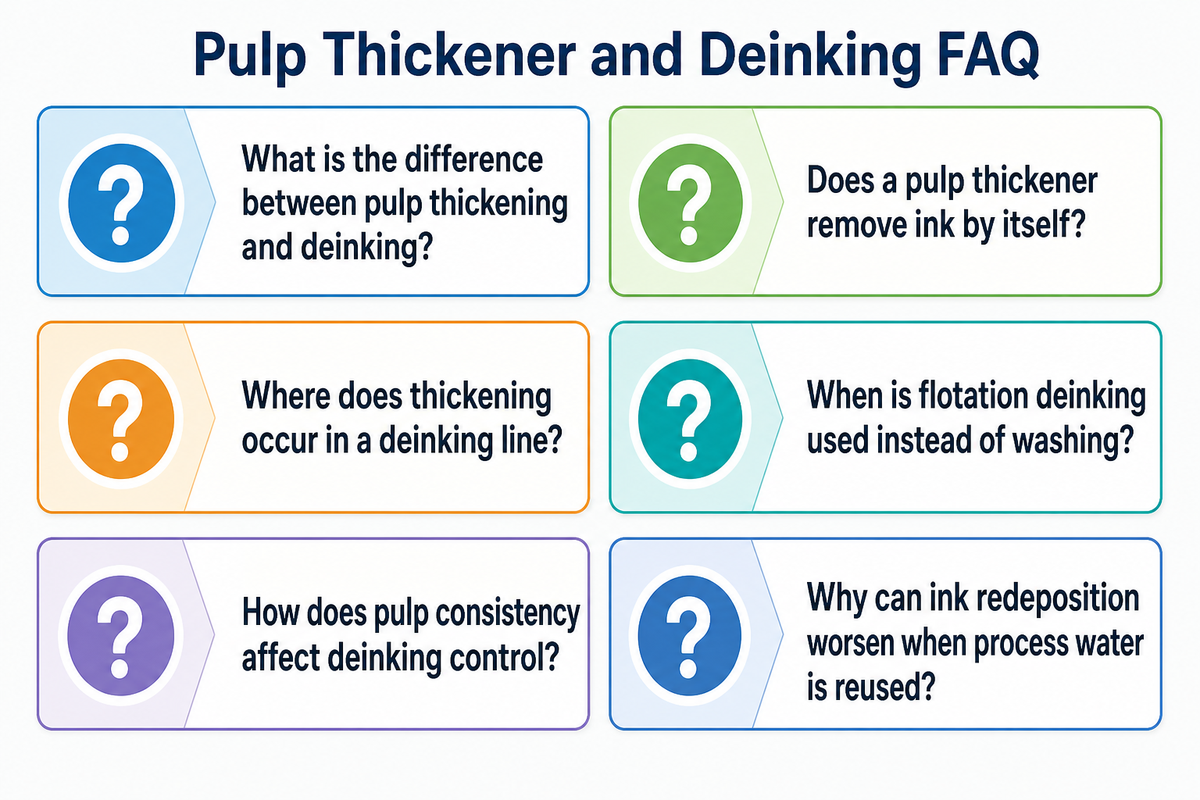
What is the difference between pulp thickening and deinking?
Deinking is the broader process used to detach ink from recovered paper and separate it from the fiber suspension; the NC State unit-operation guide shows why that process boundary matters. Thickening has a narrower duty: it removes carrier water so the stock reaches a consistency suitable for the next stage. Thickeners can influence filtrate and solids handling, but they should not be credited with ink removal unless separate measurements show where the ink, ash, fines, and fiber moved.
Does a pulp thickener remove ink by itself?
No. Pulp thickener duty mainly dewaters a pulp suspension and raises stock consistency. Some detached fines, ash, or ink particles may leave with filtrate depending on the equipment and process conditions, but that incidental transfer is not the same as a designed deinking mechanism. Mills should evaluate residual ink, fiber loss, ash, filtrate quality, and downstream paper quality before assigning removal performance to the thickening stage.
Where does thickening occur in a deinking line?
Thickening can appear at more than one handoff, so there is no single position that fits every recycled-fiber line. Its location depends on the furnish, whether flotation or washing is used, the consistency required by dispersion or bleach stages, process-water routing, and the duty of the next unit operation. Lines may thicken before storage, before treatment, after washing, or before paper production.
When is flotation deinking used instead of washing?
Flotation is investigated when detached ink particles can attach to bubbles and leave in the froth. Washing is investigated when fine suspended material, ash, filler, or dissolved load is the limiting issue. Many lines use a combined route because furnish and paper quality targets rarely point to a single perfect mechanism.
How does pulp consistency affect deinking control?
Consistency changes both measurement and process behavior. Higher consistency readings can mean better dewatering, but they can also reflect a different inlet load, sampling error, lower dilution, changed screen rejects, or lost solids in the filtrate. In some deinking trials, consistency changes altered deinking efficiency itself, which means the reading can act as a process condition rather than a passive result. Pair it with residual ink, yield, ash, filtrate solids, inlet and discharge samples, and accept-quality data before changing a setting or blaming one stage.
Why can ink redeposition worsen when process water is reused?
Reused water can carry fine ink, dissolved material, colloidal load, and chemicals back into the process, so filtrate and accepted-pulp checks need to move together.
Key Takeaways for Mill Teams
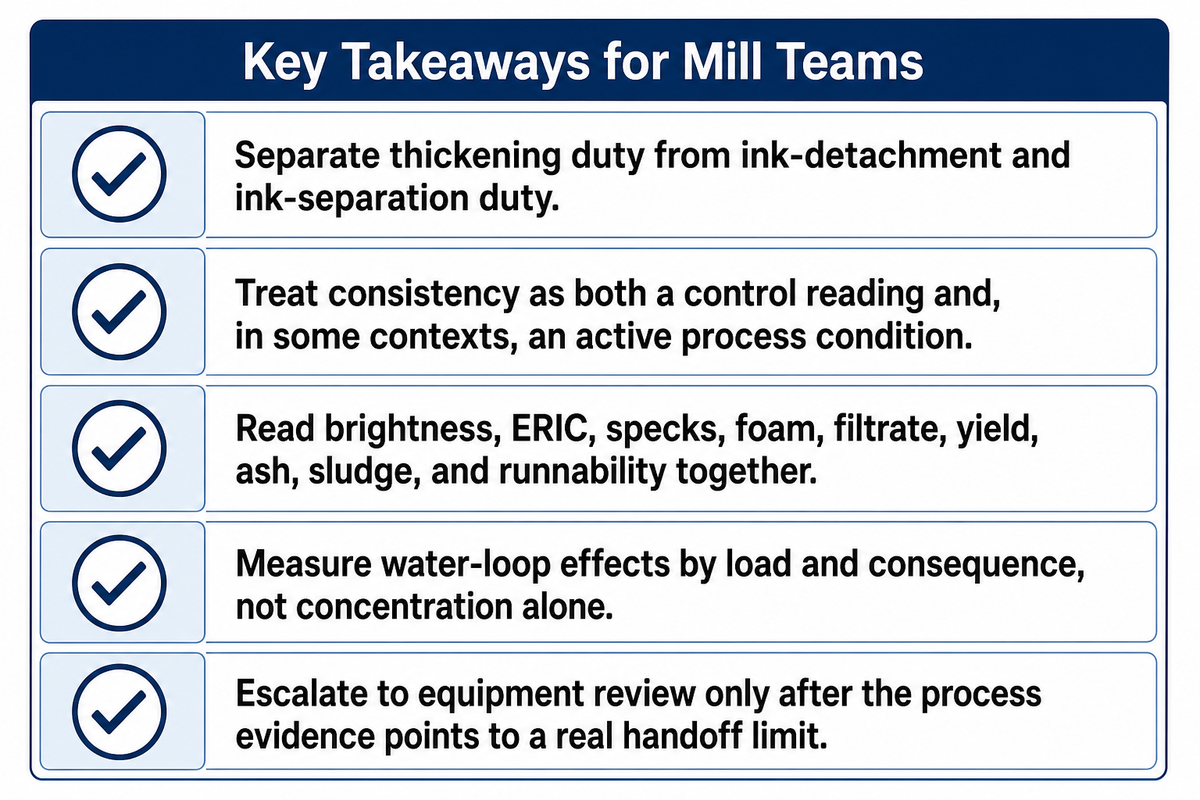
After the FAQ examples, keep reused water, filtrate evidence, accepted-pulp checks, and equipment boundaries in the same operating view. The TAPPI measurement warning and the EPA water-loop boundary point to the same habit: do not let one clean-looking number decide the process story.
- Separate thickening duty from ink-detachment and ink-separation duty.
- Treat consistency as both a control reading and, in some contexts, an active process condition.
- Read brightness, ERIC, specks, foam, filtrate, yield, ash, sludge, and runnability together.
- Measure water-loop effects by load and consequence, not concentration alone.
- Escalate to equipment review only after the process evidence points to a real handoff limit.
Key takeaway
Thickener results are useful only when accepted pulp quality, filtrate behavior, reject or sludge load, and downstream runnability point in the same direction.
Editorial note: No first-party mill operating logs, laboratory tests, or customer case results were supplied for this article. The guide uses source-bound secondary evidence and marks case numbers as source-specific rather than universal performance targets.
References and Sources
- NC State University, Flotation De-Inking Lab Guide
- U.S. EPA, recovered paper recycling and deinking operations report
- U.S. EPA, process-water reuse and recycling limits
- USDA Forest Products Laboratory, pilot-scale flotation deinking study
- BioResources, chemical and enzymatic deinking of photocopier waste paper
- BioResources, water consumption and fiber loss in recycled-fiber effluent
- TAPPI T 567, ERIC measurement and brightness limitations
- AF&PA, 66th Annual Paper Industry Capacity and Fiber Consumption Survey
- Tissue World, deink plant quality and yield article



![Refiner Plates & Screen Baskets [Complete Guide]](https://zjpapermachine.com/wp-content/uploads/2026/07/refiner-plates-screen-baskets-guide-featured-150x150.png)
![Doctor Blade: Types, Materials & How It Works [Guide]](https://zjpapermachine.com/wp-content/uploads/2026/07/doctor-blade-guide-featured-1-150x150.png)
![Pulping Equipment: How Paper Pulping Works [Guide]](https://zjpapermachine.com/wp-content/uploads/2026/07/pulping-equipment-guide-featured-150x150.png)