Get in touch with Zejiang Paper Machinery Company


A Kraft & Corrugated paper machine — more specifically, a fourdrinier paper machine or a cylinder mould machine — is the industrial equipment that converts pulp slurry into continuous rolls of kraft linerboard, corrugating medium, testliner, and fluting. If you’re trying to tell one machine type from another, understand how the process actually works, or simply get the terminology straight before talking to a supplier, this guide cover the full picture: machine types, mechanism, grade definitions, components, history, and how to think about the selection decision.
Quick Specs
| Fourdrinier machine speed | Can exceed 1,000 m/min; academic literature cites ~1,200 m/min, some industry sources report up to ~2,000 m/min on the fastest lines |
| Cylinder mould machine speed | Typically below 200–300 m/min (many run 50–200 m/min) |
| Kraft linerboard basis weight | 115–440 g/m² (widely cited industry range) |
| Semi-chemical fluting basis weight | 112–180 g/m² (widely cited industry range) |
| Headbox consistency (typical) | 0.3–1% fiber-to-water ratio |
| Dryer-section exit moisture | 5–10% (most commercial paper ships at 5–9%) |
What Is a Kraft & Corrugated Paper Machine?
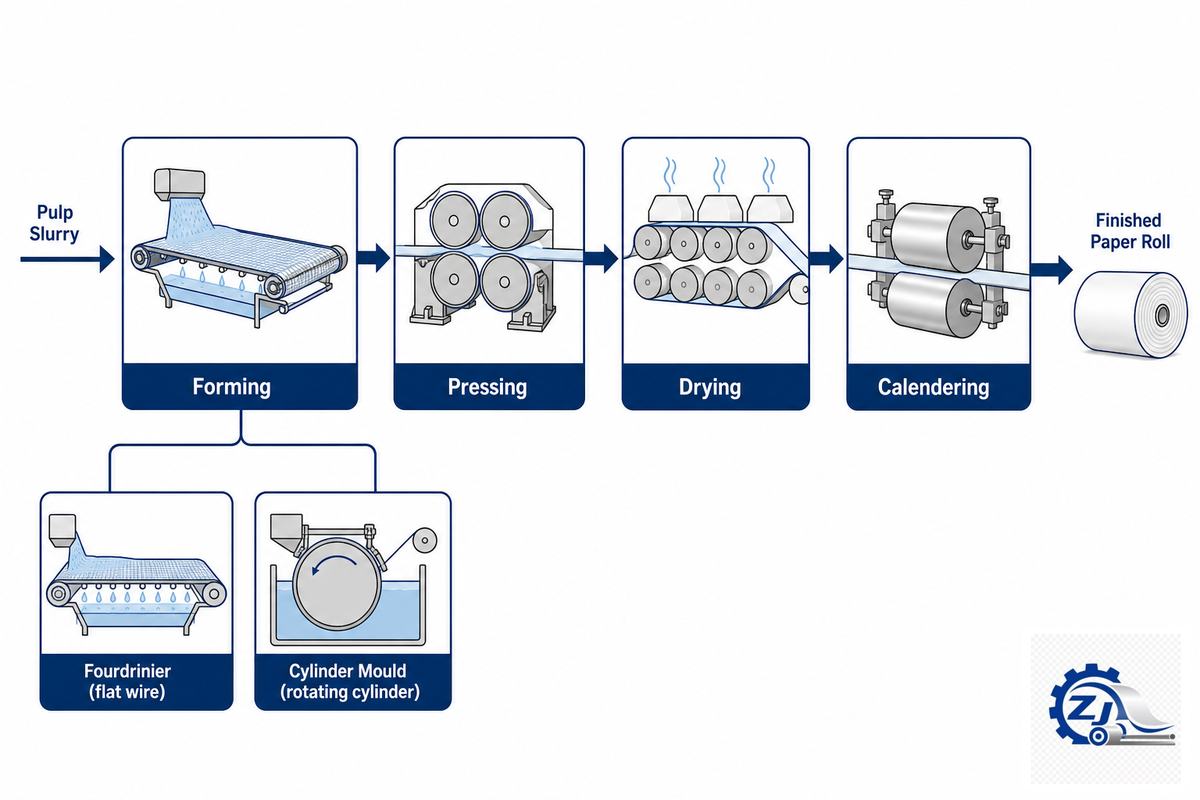
A kraft and corrugated paper machine is the equipment that turn a diluted pulp slurry — a mixture of roughly 99% water and 1% fiber — into a continuous, dried web of paper suitable for kraft linerboard, corrugating medium, testliner, or fluting. It does this in four sequential stages: forming, pressing, drying, and calendering, on one of two dominant architectures: the fourdrinier machine (flat, horizontally moving wire) or the cylinder mould machine (rotating cylindrical screen dipped in a stock vat).
Everything else – grade selection, component design, and buying decisions – builds on that basic distinction (see Oklahoma State University Extension’s overview of paper manufacturing basics for the general process this guide builds on).
Zejiang Paper Machinery’s own Kraft & Corrugated Paper Machine page covers the commercial side of this – models, grade-to-machine fit, and how to buy one. This guide cover the underlying equipment category itself: the types, the mechanism, the terminology, and the history, independent of any one manufacturer’s product line.
The same core paper making machine architecture covered here also underlies a much wider variety of paper: printing paper, packaging paper, recycled paper made from waste paper, and specialty paper stock, not just the kraft and corrugated grades this guide centers on. What changes between those end uses is the furnish (virgin pulp vs. waste paper), the target basis weight, and the finishing steps applied downstream – not the underlying paper making process. Understanding the machine first, and the grade-specific choices second, is what lets you tell a well-specified quote from a generic one.
Fourdrinier vs Cylinder Mould vs Twin-Wire: The Paper Machine Types
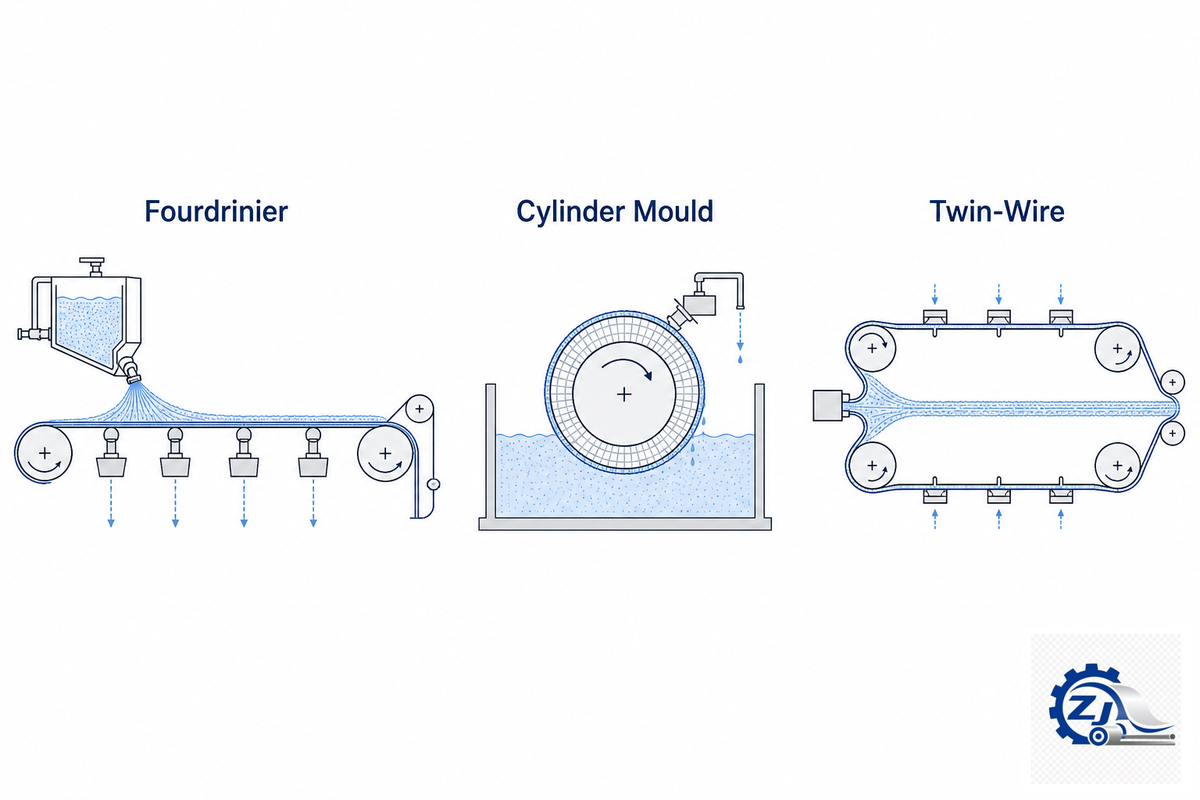
First things first, let’s consider the various types of paper machines which should be the primary consideration when specifying equipment or even correctly identifying a machine to produce of a given grade. Most folks starting to investigate this topic assume the fourdrinier machine is just the faster, newer, “better” machine over the cylinder mould machine and that cylinder is old legacy technology. That simply isn’t the case, not once you actually investigate what each is best at. Speed certainly is a real factor, as fourdrinier machines routinely achieve speeds in excess of 1000 m/min, with reported forming-hydrodynamics studies citing around 1200 m/min and some in the industry claiming top speed for the latest generation modern lines up to 2000 m/min, versus a typical top speed range of below 200-300 m/min for cylinder mould machines (most in the 50-200 range). Cylinder mould machines are definitely the correct choice, not a second choice, for applications requiring multi-ply paperboard, banknote stock, filter papers, and other highly secure, or very thick structured papers where the built-up nature of multiple plies is far more critical than raw speed (forming-hydrodynamics literature from NC State’s Wet-End Chemistry program covers the speed/formation trade-offs behind this).
| Machine Type | Forming Method | Typical Speed / Notes | Best-Fit Grades |
|---|---|---|---|
| Fourdrinier (single wire) | Flat, horizontal moving wire; stock jetted from headbox onto a single travelling screen | >1,000 m/min, up to ~2,000 m/min on modern lines | Kraft linerboard, printing/writing paper, single-ply high-volume grades |
| Cylinder Mould | Rotating wire-covered cylinder dipped in a stock vat; sheet builds up layer by layer | Typically <200–300 m/min (often 50–200 m/min) | Multi-ply paperboard, banknote/security paper, filter paper, thick specialty board |
| Twin-Wire Fourdrinier | Two wire layers drain the stock from both sides simultaneously | High-speed, comparable to or exceeding single-wire Fourdrinier | Higher-speed corrugating medium and linerboard where two-sided drainage improves formation |
| Multi-Wire Fourdrinier | Three or more successive wire sections, each adding a controlled layer | Speed trades off against ply count | Heavier multi-layer board needing controlled, distinct plies |
| Top Wire Former | A second wire presses down from above onto a conventional Fourdrinier wire | Improves two-sidedness at Fourdrinier-class speeds | Grades needing similar top/bottom surface properties at high speed |
| Crescent Former | Stock is formed between a single wire and a felt around a forming roll, crescent-shaped drainage path | Very high speed, low basis weight | Tissue and other ultra-light single-ply grades — a different machine family from kraft/corrugated lines |
| Hybrid Former | Combines gravity drainage (Fourdrinier-style) with a top-wire blade-forming zone | Bridges conventional and twin-wire performance | Mills upgrading an existing Fourdrinier without a full twin-wire rebuild |
| Mould-Made | Cylinder-vat process tuned to mimic random (non-machine-direction) fiber orientation of hand-made paper | Slow, specialty-scale | Fine-art and archival paper where isotropic strength matters more than throughput |
Are There Hybrid Designs Combining Cylinder and Fourdrinier Technology?
Yes, hybrid designs combining cylinder and Fourdrinier technology are common on multi-ply lines. These machines usually use a Fourdrinier-type forming section to build the base ply at speed, then layer one or more cylinder vat formers on top of it to add the remaining plies, combining the strengths of both forming methods on a single line.
That’s precisely how most multi-ply corrugating and boxboard machines build a strong base layer rapidly while adding subsequent plies for the required sheet thickness and desired surface properties. It isn’t typically an “either / or” choice in the mill; it depends on matching the right forming process to the function of each ply in a multi-layer sheet.
💡 Pro Tip
My competitor’s quote talks about their top speed for a machine – should I pay attention?
If a competitive offer highlights a machine’s top speed but doesn’t specify the grade and basis weight the number pertains to, be sure to ask what speed can be achieved at your desired grammage, since speeds decrease significantly as basis weight and number of plies increases.
How a Paper Machine Works: From Pulp Slurry to Finished Reel
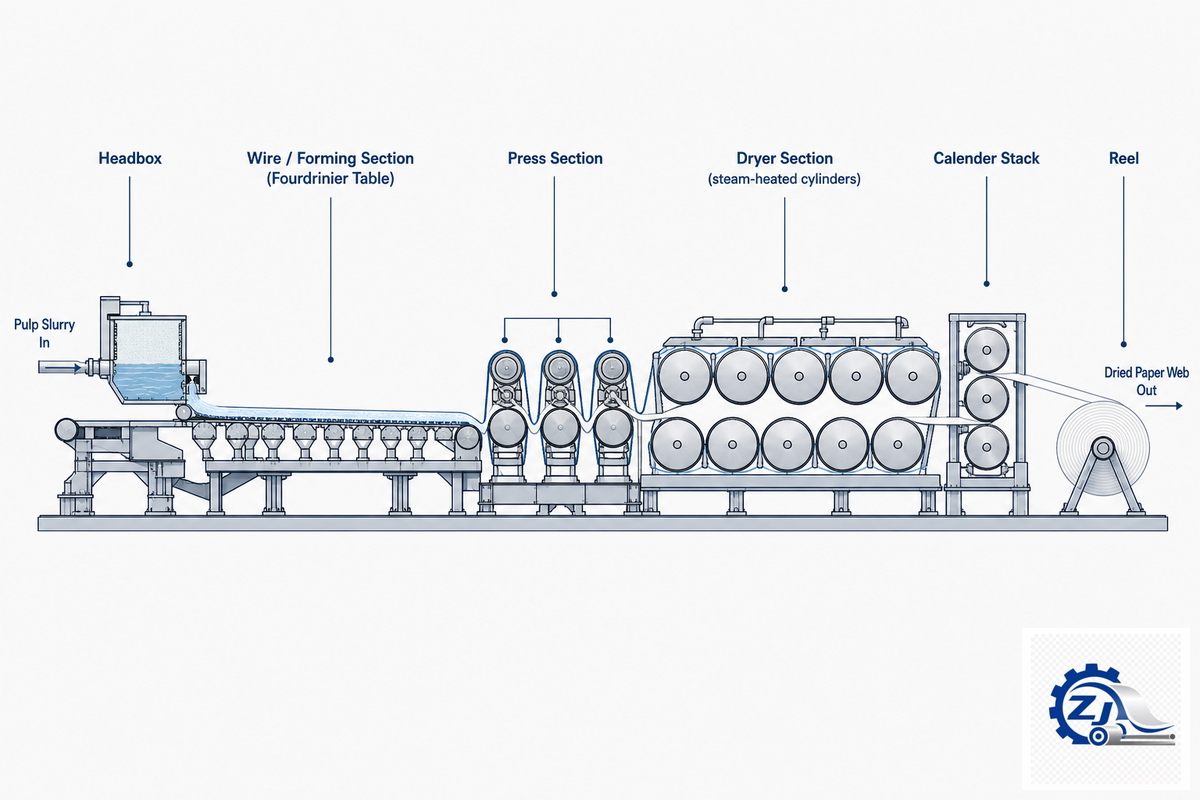
Every paper machine processes stock through the same four sections regardless of forming type: forming, pressing, drying, and calendering. The moisture and consistency figures at each stage are well-established and consistent across independent academic and industry sources, which is what makes this process genuinely predictable from mill to mill, unlike some of the surrounding buying decisions.
Stock enters at the headbox, which discharges a dilute (typically 0.3 – 1.0% fiber consistency) suspension of the paper web across a moving wire. Certain specialty applications run outside this common band (less than 0.2%, or greater than 2.0%) in accordance with TAPPI’s own recommended practice document regarding headbox operation. As the slurry drains over gravity, foils, and a set of suction boxes using vacuum, the fiber consistency is gradually increased to about 20% as the formed web reach the couch roll, at which point it departs the section that papermakers still colloquially refer to as the “fourdrinier table”, a legacy from when the forming section was named fourdrinier table.
Once formed and drained, then what? Next, the wet web goes into the press section, which squeezes the moisture from the sheet between two large rolls to a dryness of roughly 40 – 50%. The dryer section-a long array of cylinder sections heated with steam-removes the rest of the water until the web arrives at the dryer end with a moisture content between 5 and 10% (most paper products ship between 5 and 9% moisture content). Fiber orientation, or the degree to which the fiber particles are aligned in the MD (machine direction) as they’re formed (papermakers call this machine direction) affects the ratio of tear to burst strength between the machine and cross directions.
📐 Engineering Note
The cost of drying constitutes a significant proportion of the operational energy budget for a paper machine. The U.S. Department of Energy’s Industrial Technologies Office is supporting testbed facilities at pilot scale that aim to reduce paper drying costs by as much as 20% – not insignificant when evaluating the total cost of ownership for different machine configurations rather than the stated headline speeds.
Once dried, the paper passes through the calender stack, where its final surface and caliper are set prior to being wound into the master roll. Slitting and rewinding the master roll into the narrower final rolls that customers actually purchase happens at a rewind station, included on most lines rather than purchased as a separate component.
While the basic mechanics of making paper aren’t overly exotic (water sprayed onto a moving mesh or cloth is gravity and suction drained until a paper web fibers begins to cohere on its own before drying and rolling up), the differences between a quality machine and a mediocre one revolve around how evenly the wet paper web forms, and how reliably it survives the transfer between different section of the machine without breaking (an unintended tear during this transition is called a “web break” and is by far the most common reason for unplanned downtime in the industry).
Corrugated Paper Machine vs Corrugator: Why They’re Not the Same Equipment
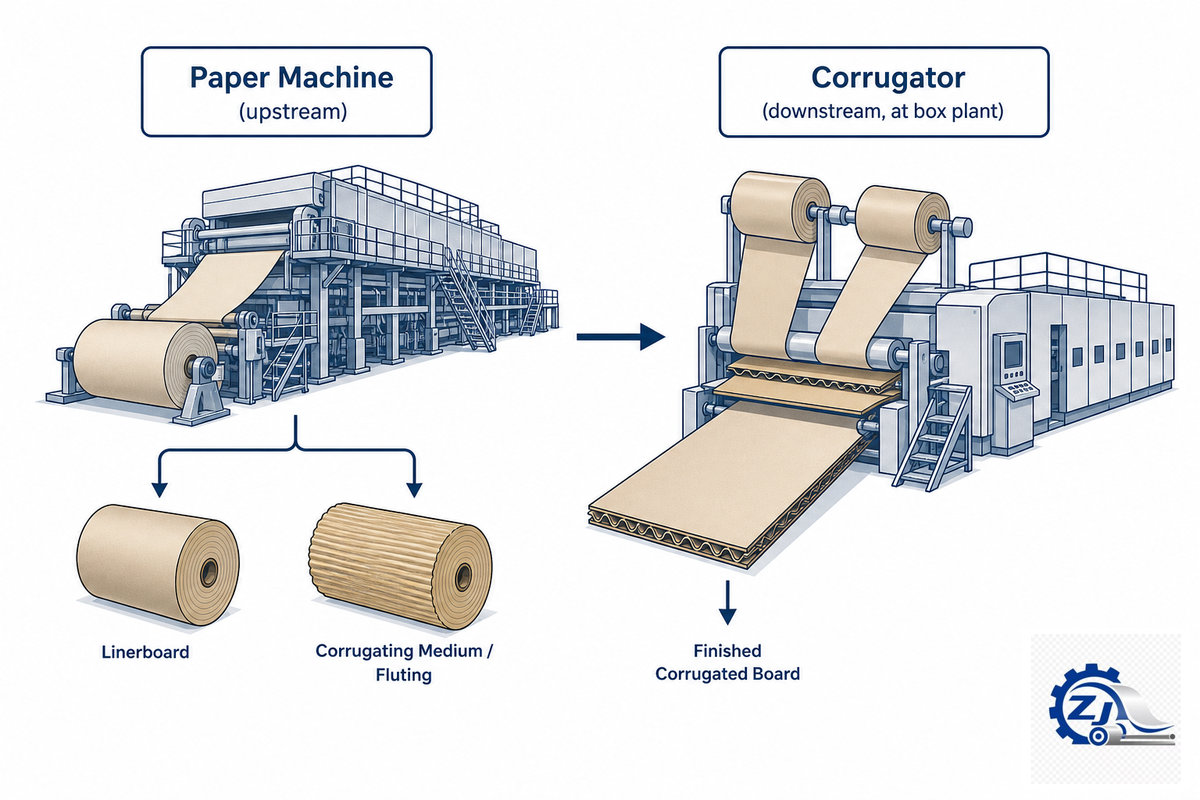
This is the single most common point of confusion when buyers are searching for “corrugated paper machine”. A corrugator is a machine that come downstream from a paper-making machine; it glues a sheet of fluting material between one or two sheets of paper linerboard to form finished corrugated board (a product manufactured at a box plant). What’s colloquially referred to as a corrugated paper machine (at least in the context of this guide, and most other paper machine manufacturers) is the machine that make the actual base paper – both the linerboard, as well as the corrugating medium, or fluting paper. Folding and gluing the converted box blanks is another downstream operation; compare carton folder gluer machines from Cenwan for the specified blank material and box style rather than treating a folder gluer as a paper machine or corrugator.
This confusion make sense, since base paper for corrugating and linerboard only becomes “corrugated board” when it passes through a corrugator. If you’re the operator of a box plant, or otherwise are looking to source paper to be run on a corrugator (owned either by yourself or a downstream converter), the machine described here in this guide is what you’re shopping for-not the corrugator itself. (Even trade classification treats them as distinct product categories — see the U.S. International Trade Commission’s harmonized tariff schedule for how corrugated board and base paperboard are classified separately.)
Kraft, Testliner, Corrugating Medium & Fluting: A Grade Glossary
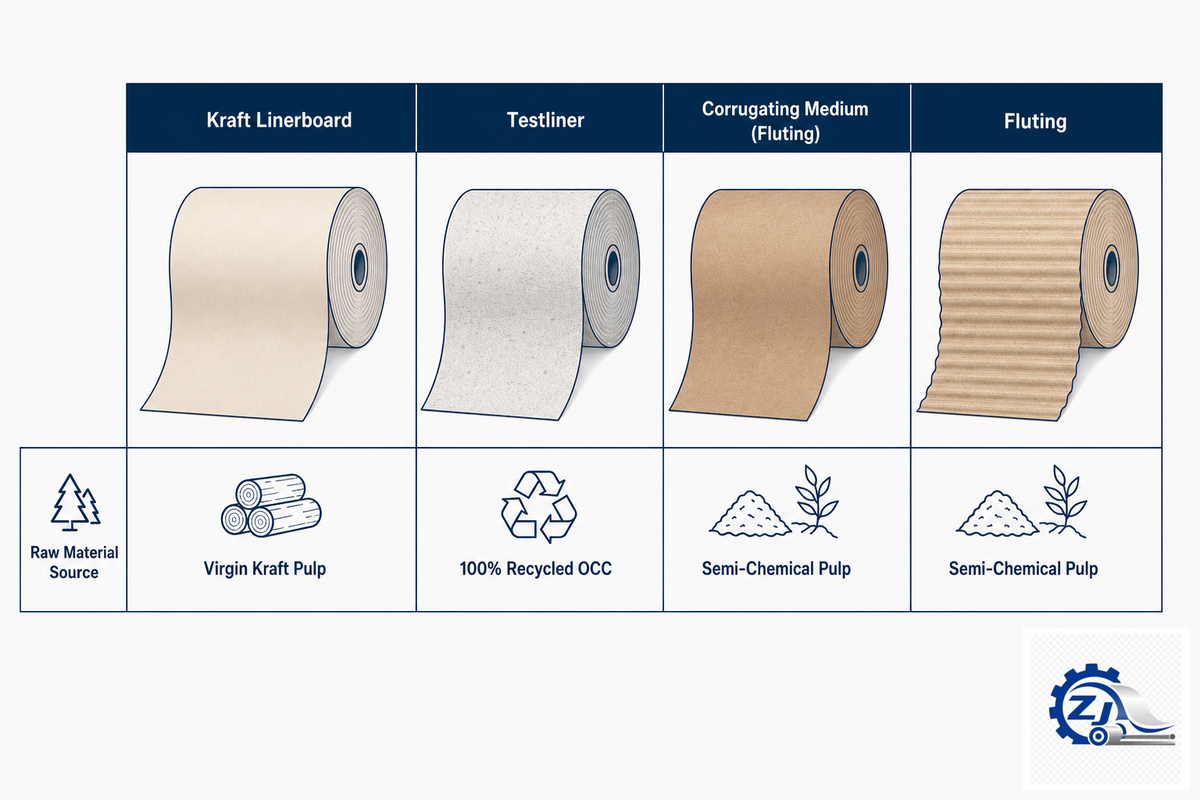
These four paper grade names often come into play and vary among suppliers, so establishing a common reference point is helpful as you begin comparing specifications.
| Grade | Typical Raw Material | Basis Weight | Role |
|---|---|---|---|
| Kraft linerboard | Virgin kraft pulp, OCC blend | 115–440 g/m² | Outer/inner facing of corrugated board — carries most of the box’s strength |
| Testliner | 100% recycled fiber (OCC) | Comparable basis weight range to kraft liner | Recycled alternative to kraft liner, lower cost, lower virgin-fiber strength |
| Corrugating medium (fluting) | Semi-chemical pulp, recycled fiber | 112–180 g/m² | The wavy inner layer that gives corrugated board its crush resistance |
| Fluting (general term) | Same as corrugating medium | Same range as corrugating medium | Interchangeable industry term for corrugating medium |
Stepping back from this specific grade table, the logic hold true for the entire paper industry: Each paper mill selects the appropriate grade of paper to run prior to selecting the machine speed, as the grade-driven decisions concerning furnish, drying, and finishing are far more significant than any reverse relationship. If a machine is being built to manufacture multiple grades of paper-one shift of kraft, the next shift of testliner-stock prep and press section flexibility must be built in, rather than added as an afterthought. That rule apply whether the final product of that machine will be a sheet of writing and printing paper, a roll to be sold to a converter, or a sheet of packaging board; all final paper properties (strength, absorption, finish) can be traced back to the same decisions on furnish and machine settings.
The testing procedures for all of these grades follow TAPPI standards, specifically: Bursting strength (paperboard/linerboard), T807; flat crush of corrugating medium (CMT), T809; bursting and edgewise compressive strength of corrugated fiber board, T810/T811; ring crush of paperboard, T818/T822. ISO 536:2019 remains the current grammage standard; a 2025 revision confirmed no change.
Paper Machine Components Explained
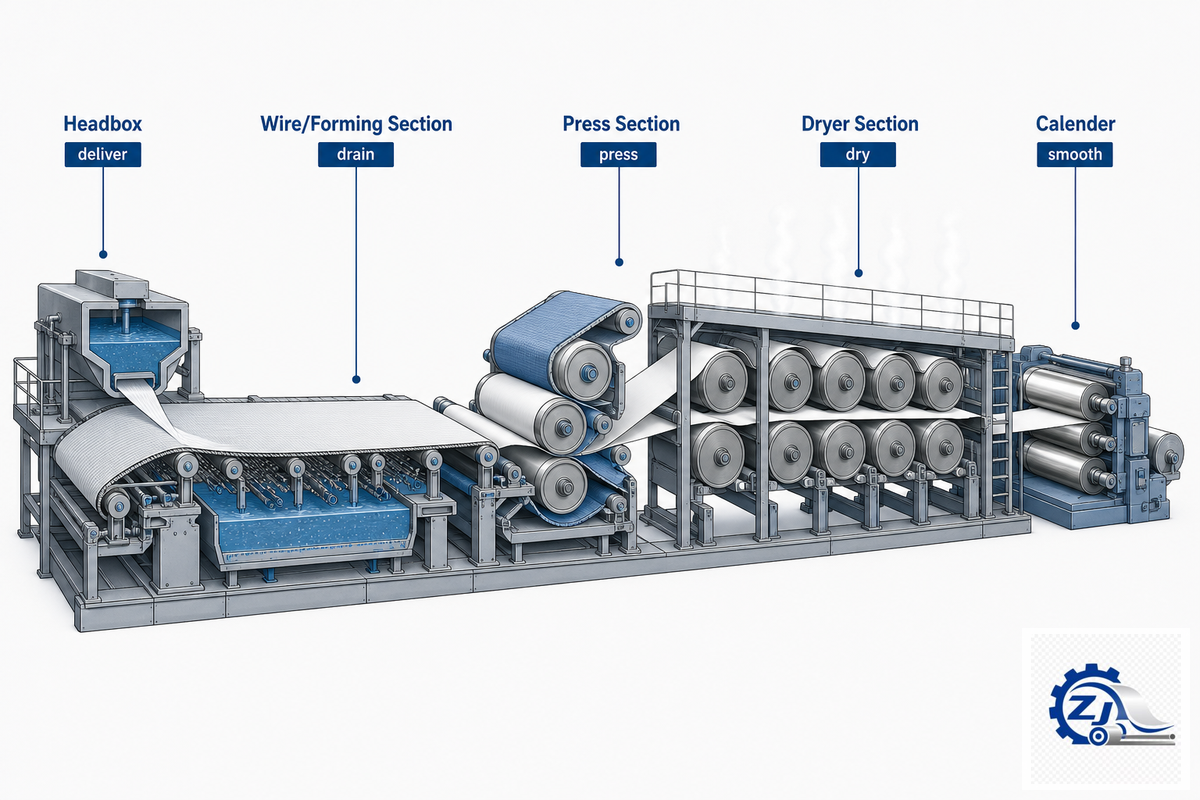
There are five principal machine components that are commonly referred to when talking with suppliers. Knowing what each of them actually does (not merely the name) is critical to a thorough quotation analysis.
- headbox-Delivers diluted pulp slurry across the entire width of the forming wire. Formation quality on the wire directly drives the quality of this application.
- Wire/forming section-The forming screen (fourdrinier table), onto which the stock is delivered, and from which most of the water drains, and the web first form. USPTO patent filings such as US8685209B2 and US9309623B2 describe adjustable dewatering-foil blade angle and height in this section, controlling drainage and fiber orientation across the 0.1%-5% dryness range.
- Press section-Physically presses water from the forming web with steam-heated, felt-covered rollers, thereby dewatering it prior to entry into the high energy required in the dryer section.
- Dryer section-Consists of a series of steam-heated cylinders that dry the remainder of the water from the paper sheet.
- Calender-The last mechanical stage that sets the paper’s smoothness and caliper before it’s wound into the finished parent roll.
⚠️ Important
Safety requirements for paper machines-the operation of cylinders in rotation, the making of hot steam and hot water, the running of nip points between two or more rolls, etc.-are established by OSHA standards. Key points are the guarding of dryer drum shafts, first-dryer guarding, the need for emergency stop devices readily accessible to operators, etc. Verify that the equipment will satisfy these requirements during installation and initial startup.
Buyers should always carefully review both the reliability and the overall scope of a paper machine bid. Specifically: Is the quotation for stock prep (pulper, screens, agitators) or does the quote begin at the headbox? fiber, in particular, needs to be processed through the pulper and screened prior to being supplied to the headbox, see our pulping equipment guide for that upstream stage. It should be noted that the principles behind drying on paper machines also apply to tissue paper machines, but the forming section architecture (single cylinder mould or crescent former) of a tissue machine is unique.
One other terminology nuance that’s important to mention here: A line based on cylinder technology is often referred to by local vendors as a “cylinder paper machine” not “cylinder mould machine” and old catalogs sometimes segment individual sections of the paper machine as separate “fourdrinier sections” (dry-end, wet-end, finishing). Both of these aren’t incorrect-they’re just an older or localized terminology for the sequence of operations described above. But regardless of whether the finished sheet is kraft paper, corrugating medium, or another grade altogether, the paper forming that happens on the wire, and the sequence of component equipment that follows it, stays fundamentally the same, with the differences boiling down to furnish and basis weight target, not the underlying process. Today’s sheet, made on a modern cylinder or Fourdrinier machine, is conceptually identical to one made on a machine decades prior; only the controls have changed.
A Brief History: From the 1799 Concept to the First Working Machines
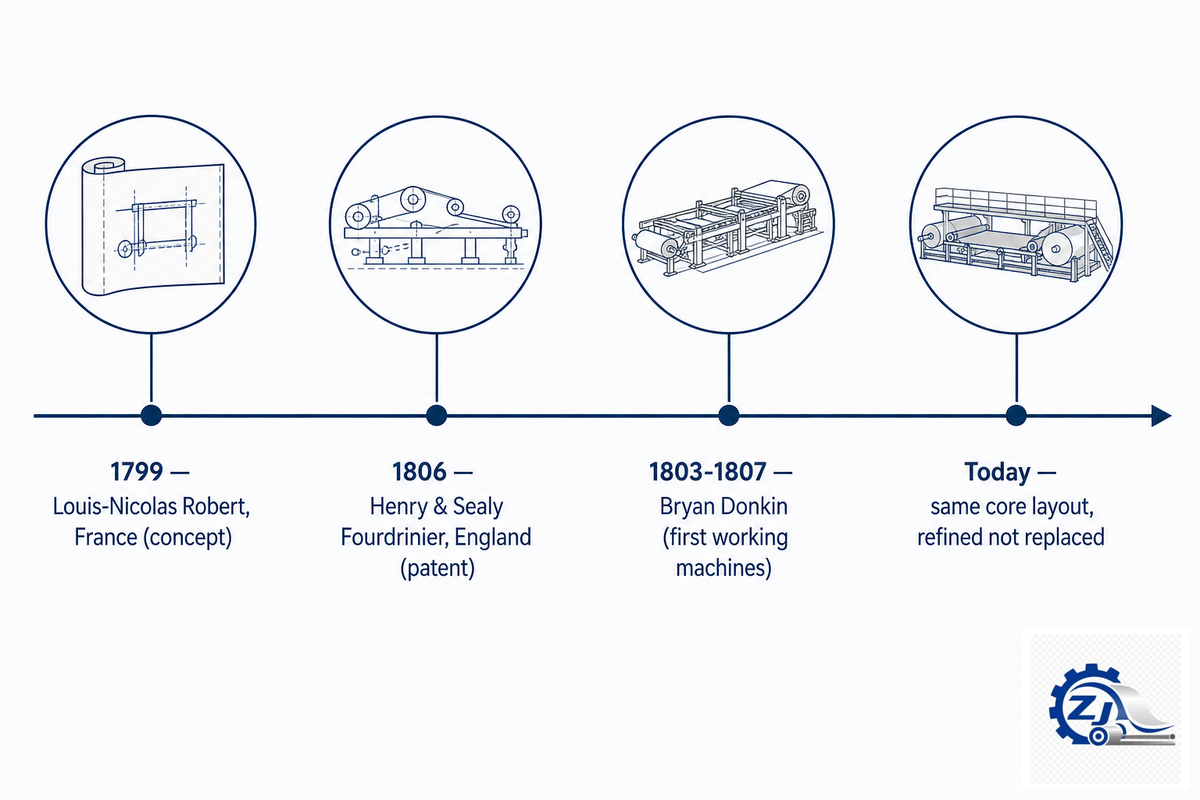
“The Fourdrinier table’s basic layout, headbox, wire, couch roll, hasn’t fundamentally changed in two centuries. What separates a well-built modern line from a mediocre one is control precision at each of those same stages, not a different concept.”
Process Engineering Team, Zejiang Paper Machinery
The popular story of the invention of continuous papermaking is that it happened on one day, but it was in reality a two-country process over a number of years. Louis-Nicolas Robert in France came up with the original concept for continuous-web paper forming in 1799. That idea eventually made its way to England, where brothers Henry and Sealy Fourdrinier licensed and financed an improvement on that concept-hence the name Fourdrinier brothers machine-commonly patented in 1806. It fell to engineer Bryan Donkin to bring the Fourdrinier brothers’ patented design to life, with the first production machines coming online in the early 1800s (often dated 1803-1807 depending on the installation). A separate line of development-using the cylinder-mould to create multiple plies of paperboard-was introduced in the form of John Dickinson’s cylinder machine patent, a concept the flat-wire fourdrinier design wasn’t equipped to handle (see Georgia Tech’s Robert C. Williams Museum of Papermaking account of the paper machine’s advent for the fuller history).
Don’t interpret this as “there’s no consensus.” The 1799/1806/1807 figures do correspond to distinct steps of innovation. The 1799 French machine first showed that continuous paper forming was even possible. The Fourdrinier brothers licensed and patent protected a better design. And it was Donkin who engineered the first actual production fourdrinier process in a mill environment. These events mark a ten-year leap from a French lab concept to an industrially-viable paper process, which was then optimized but never revolutionized over the subsequent 200 years — call it “The 1799-to-Now Fourdrinier Timeline”: a decade turning a lab concept into an industrial process, followed by two centuries of the same core layout being refined rather than replaced.
To be a bit pedantic about the word “invented”: Robert showed it could be done; the fourdrinier brothers financed and protected an improvement to Robert’s concept; and Donkin actually turned that improved concept into a working paper machine. Twin-wire forming, higher-speed drives, and PLC control were later built on top of that same foundation — they didn’t replace it.
Choosing the Right Machine Type for Your Grade Mix
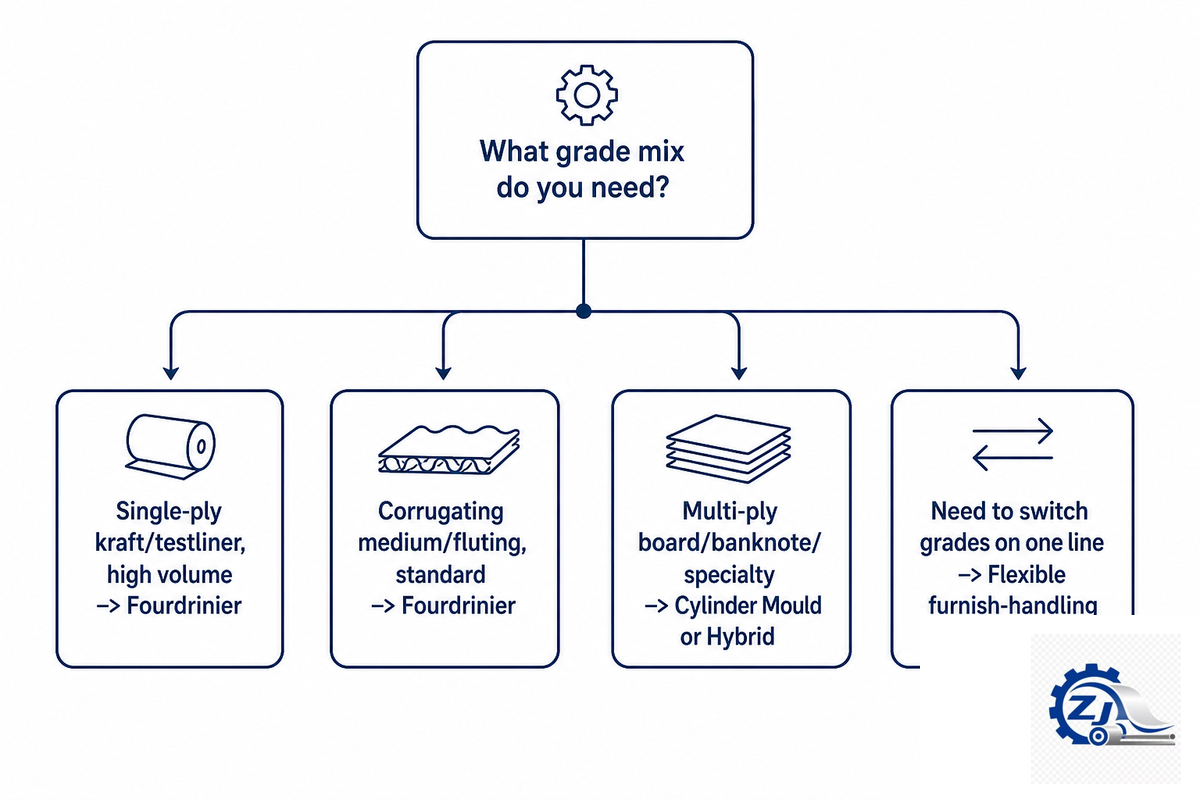
What machine is best? It comes down to the paper grade you want to make.
Grade Mix → Machine Type
- Kraft single-ply liner or testliner, high volume → Fourdrinier (or high-speed twin-wire Fourdrinier).
- Corrugating medium / fluting, standard single-ply → Fourdrinier, sized for the semi-chemical/recycled furnish you’re running
- Multi-ply board, banknote/security paper, thick specialty stock → Cylinder mould, or a hybrid line combining a fourdrinier base ply with cylinder vat-formed additional plies
- Need to switch between kraft, testliner, corrugating medium, and fluting on one line → look for a machine specified around furnish-handling flexibility (stock prep, headbox, and press sized for your full grade range), not just top speed on the fastest grade — see Western Michigan University’s paper machine pilot-plant program for how configuration flexibility is taught and tested at pilot scale
If your mill fits one of these patterns, the next step is matching a specific configuration to your capacity target and furnish plan – see the Kraft & Corrugated Paper Machine page for model-level specs, grade-fit tools, and how to request a quote scoped to your capacity and grade mix.
Industry Outlook: What’s Changing in Paper Machine Technology
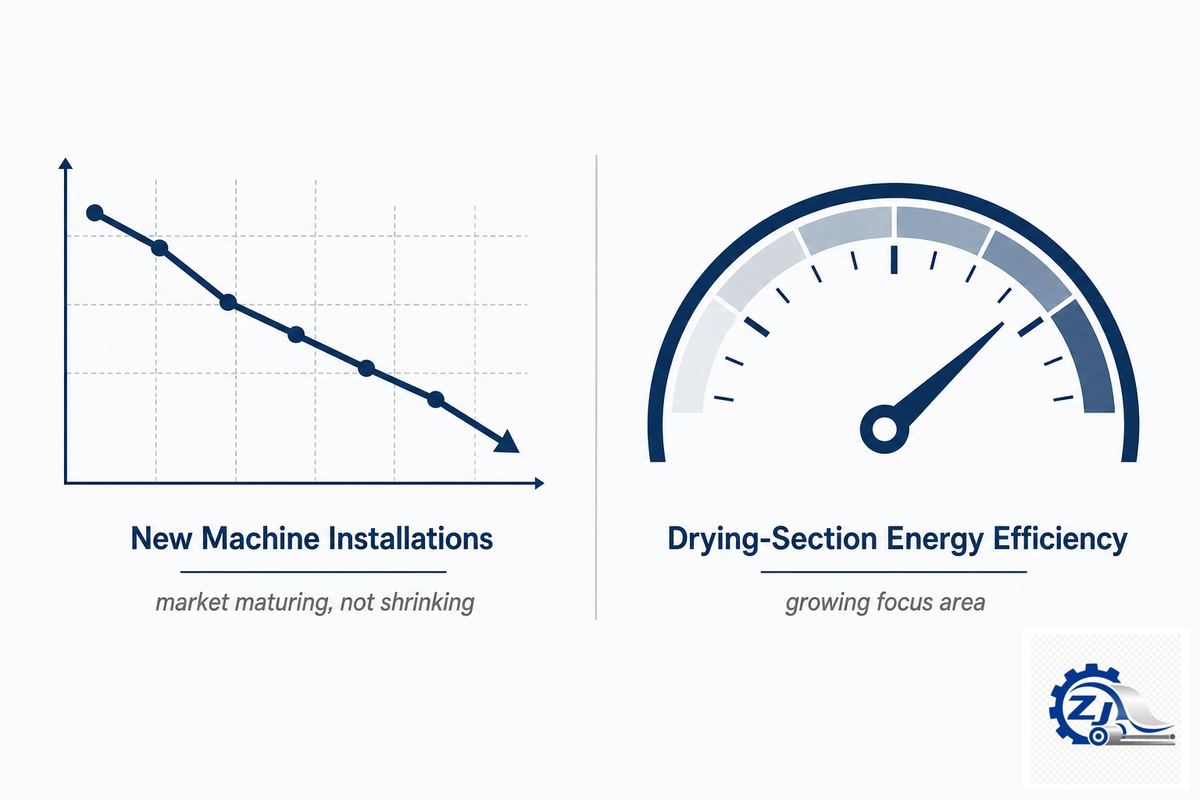
Updated July 2026. China – the world’s largest single paper-machine-installation market – offers the clearest documented example: new paper machine installations there peaked at roughly 150 units in 2022, declined to about 120 units in 2025, and are projected to fall further by 2027, as the market matures along the same trajectory earlier-industrializing markets like the U.S. and Germany followed decades ago. That’s a consolidation trend, not a “the industry is shrinking” story. Existing mills still need capacity upgrades, spare parts, and multi-grade retrofits; that demand doesn’t disappear when new-machine counts fall, it shifts toward flexibility and efficiency improvements on the equipment already running.
Machine builders across the industry are also standardizing more of what used to be site-specific engineering: modern control systems now handle much of the machine operations that once required manual adjustment at every grade change, and reels of paper coming off a well-tuned line today show far less production of paper in reels variance (diameter, hardness, telescoping) than a decade ago. None of that changes what the machine fundamentally does – it changes how consistently it does it.
The clearest evidence of that shift is on the energy side. The U.S. Department of Energy’s Industrial Technologies Office has funded a pilot-scale drying testbed targeting up to 20% energy savings in paper-drying applications, and separate federal research into non-evaporative drying technology (removing water in liquid phase rather than as vapor) projects savings on the order of 1.2 quadrillion BTU per year and roughly 93 million tons of CO2 industry-wide if adopted at scale. Neither of these is a shipping product yet, but they signal where drying-section efficiency – historically the most energy-intensive stage of the process – is headed over the next machine-replacement cycle. For a buyer evaluating total cost of ownership today, that means asking about dryer-section steam efficiency and control-system sophistication carries real weight, not just headline speed.
A Note on Terminology
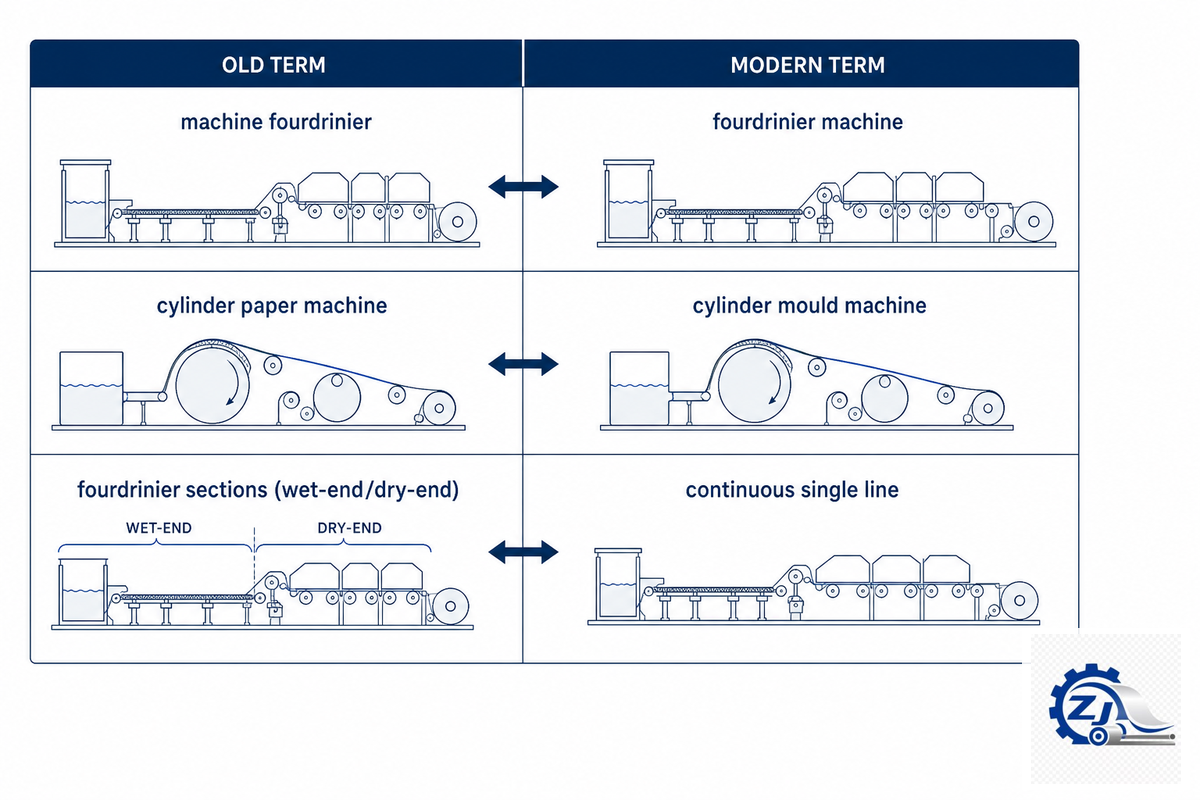
I’ve a couple of phrasal quirks to flag before you start to quote-shop, since suppliers, and older literature sources in general, call the same paper machine running gear different things. Older documents will call some thing a “machine fourdrinier” (adjective-first, French grammar) which is a fourdrinier machine, or a supplier may catalog two cylinder mould machines as a “fourdrinier and cylinder machines” or a “cylinder and fourdrinier machines” – the order in that list has no significance at all. What a supplier will label as “strong paper” or one which “produces a paper or board” output is the same stuff that’s discussed under grade glossary above on basis weight and furnish.
Regarding history, when you see that a fourdrinier or a cylinder machines machine was financed by “Henry Fourdrinier,” understand that the full partnership name is actually the Fourdrinier brothers (Henry and Sealy). It’s likely just being cited shorter because Henry was the public partner. When you read that a certain type of paper is the “first manufactured on Fourdrinier type equipment” or is the precursor to modern papermaking, that’s just another way of describing the process which dates back to that 1799-to-1807 timeframe – no new competing invention being claimed. A good summary point for the history section: that initial 1799 process vs. a modern fourdrinier machine paper looks like two centuries of the same idea, improved not supplanted; any modern paper machine claims trace directly to it.
One last mechanical point worth restating plainly, since it ties the whole guide together: paper production, whatever the finished grade, always starts with a web of paper fibers forming on wire cloth, not with the paper produced already looking like a finished sheet. That’s true whether the line is set up to produce different grades of paper on a single configuration or to run one grade only — the paper formation step doesn’t change, only the furnish and settings do. Understanding when the fourdrinier machine was invented — see Georgia Tech’s papermaking history archive for the documented timeline — and the slower development of the fourdrinier machine from concept to production line, matters less for day-to-day buying decisions than understanding that producing paper on any different paper machine still comes down to sheet formation quality and the same handful of variables covered above — the roll of paper at the end of the line is only as good as what happened on the wire at the start. First paper produced by fourdrinier equipment and paper being produced today on a modern line both start the same way: a mixture of pulp and water hitting a moving wire cloth or plastic fabric while the paper machine moving beneath it does the rest — compared to fourdrinier machines two centuries ago, only the controls have gotten smarter.
FAQ
Q: Who invented the Fourdrinier machine?
View Answer
It began with Louis-Nicolas Robert in France in 1799, whose prototype proved continuous web papermaking was possible. English brothers Henry and Sealy Fourdrinier bought the French rights and financed and patented an improved design, commonly dated 1806 — hence the machine’s name. Engineer Bryan Donkin then turned that patent into production machinery, with the first working installations often cited between 1803 and 1807 — multi-name, multi-year, not one inventor.
Q: What is the difference between cylinder and Fourdrinier machines?
View Answer
A Fourdrinier machine forms the sheet on a flat, horizontal wire and is generally the choice for high-speed, high-volume single-ply papers like kraft linerboard, generally running above 1,000 m/min. A cylinder mould machine forms the sheet on a rotating, wire-covered mould dipped in a vat; it’s slower (under 200-300 m/min) but builds more naturally into multiple plies, which is why it remains the standard for banknote paper, filter paper, and thicker specialties.
Q: What are the key components of a Fourdrinier machine?
View Answer
The sections consist, in order: the headbox, for delivering diluted pulp slurry evenly across the wire; the fourdrinier table, which is the wire section and drainage; the press section, for removing additional mechanical water; the dryer section, where the paper passes through a number of steam heated cylinders to reach a final moisture content of roughly 5-10%; and finally the calender, for finishing.
Q: Is a corrugated paper machine the same as a corrugator?
View Answer
No. That’s a corrugator’s job — gluing fluting to linerboard to form finished corrugated board, downstream converting equipment used at a box plant. A corrugated paper machine, in the sense manufacturers use the term, is the upstream equipment that produces the base linerboard and fluting stock that later feeds a corrugator. If you’re sourcing base paper for your own corrugator, or supplying converters who run one, this guide’s equipment is what you’re specifying, not the corrugator itself.
Q: What is the difference between testliner and kraft liner?
View Answer
Kraft liner is made primarily from virgin kraft pulp, which gives it superior strength for heavy-duty packaging applications. Testliner is made from 100% recycled OCC (old corrugated container) fiber instead, trading some of that strength for lower material cost and a higher recycled-content share. Both grades run on comparable machine architecture, so a well-specified line can usually produce either one by adjusting the furnish blend rather than requiring separate equipment.
Q: Which paper grades are typically made on Fourdrinier machines?
View Answer
Kraft linerboard, testliner, corrugating medium (fluting), and printing or writing papers are all commonly made on Fourdrinier machines — broadly, any high-volume, single-ply grade where production speed matters more than layered thickness. Multi-ply board and specialty grades like banknote or filter paper are the exception, since those depend on the layered build-up that cylinder mould machines handle better.
References & Sources
- Paper Machine, Pilot Plant — Western Michigan University
- Basics of Paper Manufacturing — Oklahoma State University Extension
- Equipment and Unit Operations — NC State Wet-End Chemistry
- TAPPI Standards Reference Chart — TAPPI
- ISO 536:2019, Determination of Grammage — International Organization for Standardization
- FY23–FY24 High Priority Selections — U.S. Department of Energy, Industrial Technologies Office
- US8685209B2, Method and Machine for Manufacturing Paper Products Using Fourdrinier Forming — USPTO / Google Patents
- US9309623B2, Method and Machine for Manufacturing Paper Products Using Fourdrinier Forming — USPTO / Google Patents
The Team Behind This Report
Across the pulp and paper industry, terminology for this equipment varies more than most buyers expect, the same paper-making machine gets called a paper machine, a paper making machine, or by its forming type, depending on the supplier and the region. This guide was compiled from published engineering-education sources, TAPPI/ISO standard references, and U.S. Department of Energy technical program pages, cross-checked against our own experience building kraft, corrugated, testliner, and fluting lines for mills in Asia, the Middle East, Africa, and South America. Where a figure comes from a single competitor claim rather than a verifiable standard, we’ve flagged it as typical rather than universal. Reviewed by the Henan Zejiang Paper Machinery Co., Ltd. technical team.
Related Articles
- Kraft & Corrugated Paper Machine — models, grade-fit tools, and how to request a quote
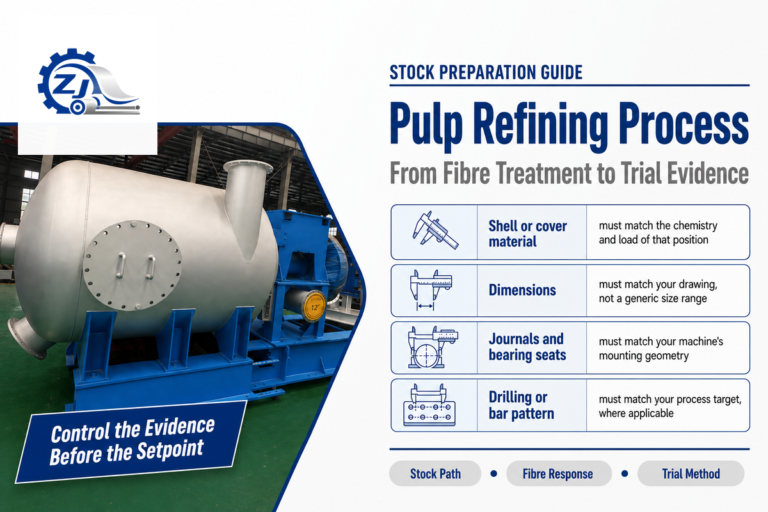
- Pulping Equipment Guide — how raw pulp is prepared before it reaches the headbox
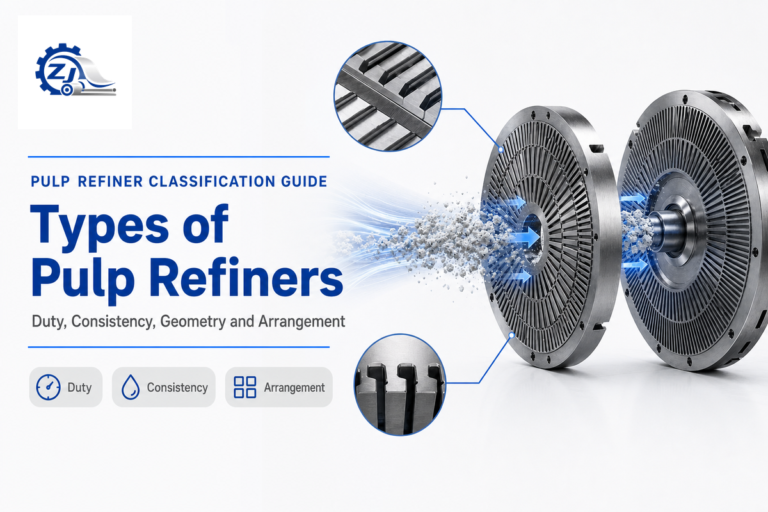
- Refiner Plates & Screen Baskets — fiber refining and contamination control upstream of the machine
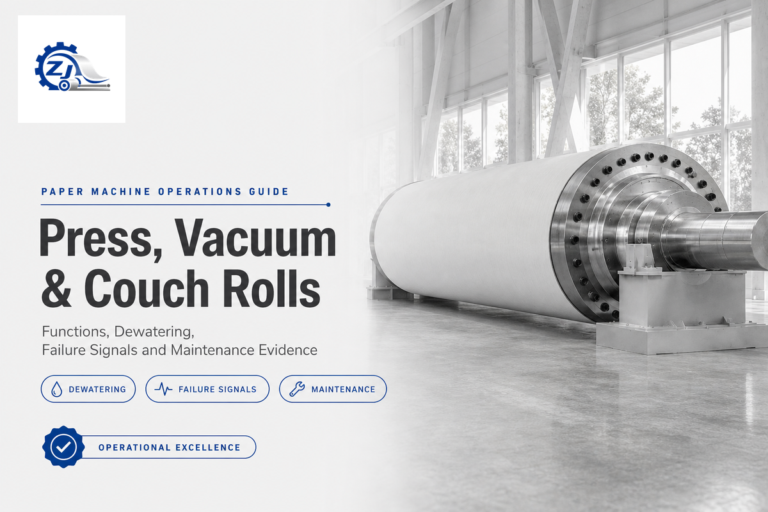
- Calender Rolls Explained — how the final smoothness and caliper stage works
- What Is a Doctor Blade? — the component that keep rolls clean during forming and drying
- About Zejiang Paper Machinery

![Refiner Plates & Screen Baskets [Complete Guide]](https://zjpapermachine.com/wp-content/uploads/2026/07/refiner-plates-screen-baskets-guide-featured-150x150.png)
![Doctor Blade: Types, Materials & How It Works [Guide]](https://zjpapermachine.com/wp-content/uploads/2026/07/doctor-blade-guide-featured-1-150x150.png)
![Pulping Equipment: How Paper Pulping Works [Guide]](https://zjpapermachine.com/wp-content/uploads/2026/07/pulping-equipment-guide-featured-150x150.png)