
Get in touch with Zejiang Paper Machinery Company


Types of pulpers are labels for several classification axes, so they can’t be compared as one flat list. The label drum pulper names a mechanism, high consistency names an operating condition, continuous pulping names a duty cycle, and a broke pulper names a job. Before a paper mill compares capacity, motor size, or price, every quotation has to be translated onto the same four axes.
Quick comparison facts
- 4 classification axes: geometry, pulp concentration, operating cycle, and process duty.
- 9 common labels: useful for shortlisting, but several can describe the same machine.
- 8 RFQ input groups: enough to expose quotations built on different furnish, reject, utility, or safety assumptions.
- No universal winner: the right type of pulper depends on what enters the vat and what must leave it.
Key takeaway
A pulper name is not a complete specification. Normalize the geometry, consistency window, duty cycle, furnish, reject route, utilities, and service-access scope before comparing output or price.
Pulper Types Start With Four Different Classification Axes
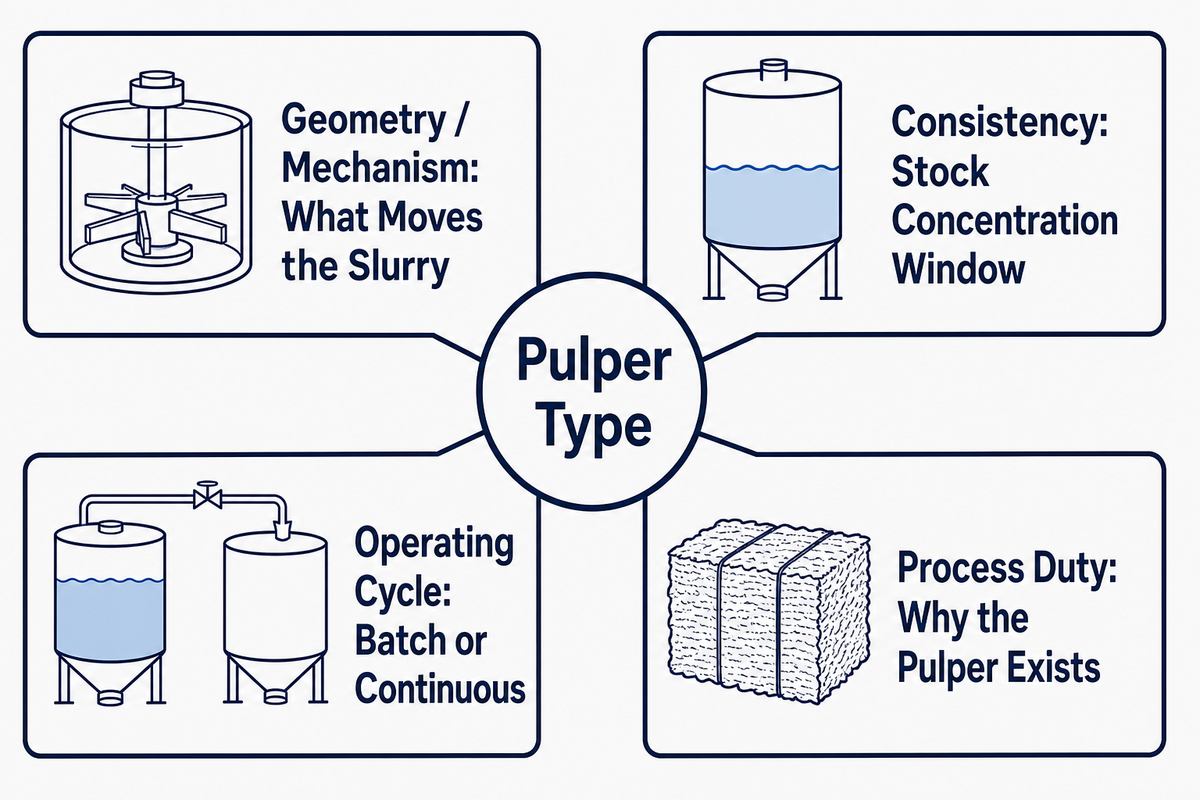
Pulper types answer four different questions: what moves the slurry, at what stock consistency, on what operating cycle, and for which mill duty. These are separate buying questions, but they aren’t guaranteed to be independent. One design may couple high-consistency operation with batch pulping, while another model may permit a different pairing.
This is why a supplier’s list can look longer or shorter without either list being wrong. The 1989 patent on waste paper pulping, for example, distinguishes vertical and horizontal rotor-shaft geometry from batch and continuous cycles. Another apparatus patent describes its own high-consistency configuration as batch. Those sources support a normalization method, not a menu in which every axis can be combined freely.
In the pulp and paper industry, “types of pulper machines” refers here to stock-preparation units that disintegrate sheet or bale furnish. It doesn’t mean mechanical pulping or chemical conversion of wood. This guide judges the complete pulping system by pulp quality, reject behavior, and downstream fit in paper making.
| Axis | What it tells the buyer | Examples | What it does not prove |
|---|---|---|---|
| Geometry / mechanism | How the rotor, tub, or drum creates mixing and fiber pulping action | Drum, D-type, vertical rotor, horizontal rotor | A guaranteed energy or fiber-quality advantage |
| Consistency | The supplier-declared pulp concentration window | Low, medium, high consistency | That a higher percentage always produces higher quality paper |
| Operating cycle | How furnish enters and accepts or rejects leave | Batch pulper, continuous pulper | A universal throughput cutoff |
| Process duty | Why the pulper exists in the stock preparation line | Broke, OCC, deinking, virgin pulp bale | That identical paper grades carry identical contamination |
Use the axes as a translation layer. Then ask the vendor which combinations its specific pulper machine supports, at which feed conditions, and with which included reject equipment. For a broader view of where pulping sits in paper production, see the guide to how pulping equipment works across the full line.
The Pulper Label Normalization Register: 9 Labels on Four Axes
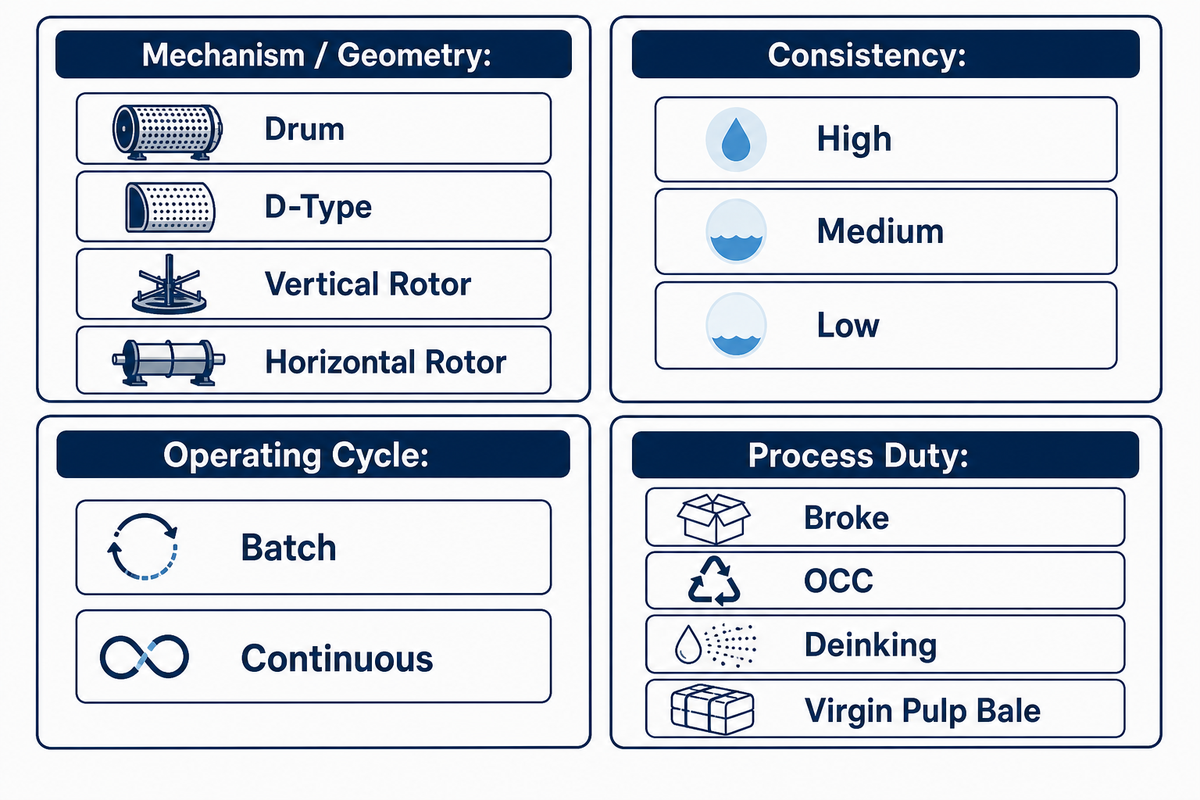
The Pulper Label Normalization Register puts nine common labels on comparable rows. Read the “axis” column first. If two suppliers use labels from different axes, their offers aren’t alternatives yet. Ask each one to declare its geometry, warranted operating window, cycle, furnish assumptions, and reject route before scoring the quotation.
| Label | Axis | What it describes | Likely buying context | Reject concern | RFQ limitation |
|---|---|---|---|---|---|
| Drum pulper | Mechanism | Lift-and-drop slushing plus screening along a rotating drum | Recovered paper where contaminant preservation matters | Define coarse rejects, accepts, and downstream washing | Requires layout, feed preparation, and complete line scope |
| D-type pulper | Geometry | A shaped vat and rotor circulation path | Continuous waste paper processing with active circulation | Ragger, junk trap, extraction plate, and detrasher interfaces | The name alone does not specify consistency or controls |
| Vertical rotor hydrapulper | Geometry | Bottom-mounted rotor on a vertical shaft | General wastepaper, market pulp, or mixed-duty service | Long and heavy contaminants need separate removal paths | Ask for tub profile, rotor, plate, and discharge details |
| Horizontal rotor pulper | Geometry | Side-entry rotor on a horizontal shaft | Broke and duties shaped by floor level or machine layout | Confirm the extraction and heavy-junk path | “Horizontal” does not define batch or continuous duty |
| High-consistency pulper | Consistency | A model designed to operate at high consistency | Duties where concentrated mechanical action is useful | Contaminant size, dilution, and extraction must be tested | Require a model-specific warranted window, not a generic band |
| Medium-consistency pulper | Consistency | An intermediate supplier-declared operating window | Applications balancing circulation, chemicals, and discharge | Check whether downstream equipment receives dilution | The boundary varies by machine and process |
| Low-consistency pulper | Consistency | A dilute slurry with active rotor circulation | Continuous extraction or duties needing pumpable stock | Rotor impact can reduce some contaminants before removal | Water loop and power consumption must be compared together |
| Batch pulper | Operating cycle | Fill, disintegrate, dump, clean, repeat | Variable furnish, recipe changes, or hard-to-pulp broke | Rejects can build during the cycle | State batch size, cycle time, dump and cleaning sequence |
| Continuous pulper | Operating cycle | Steady feed, dilution, accepts, and reject removal | Stable production where upstream and downstream can hold flow | Control and reject equipment must absorb load swings | Verify feed metering, chest capacity, alarms, and fallback |
| Broke pulper | Process duty | Paper machine broke recovery at a defined location | Clean or wet-strength machine broke | Wet-strength flakes may need time, heat, shear, or another step | Describe broke chemistry and worst-case sheet construction |
Batch vs. continuous pulping is a control decision
Batch pulping gives the operator a defined fill, processing, dump, and cleaning window. Continuous pulping trades that separation for steady material flow and steadier pulp production. Neither mode wins at a universal tonnage. Bale arrival, stock chest volume, grade changes, wash-water timing, and reject discharge determine whether continuous operation stays stable.
A specific pulping machine can also couple cycle and concentration. One older high-consistency apparatus patent described its configuration as necessarily batch, while another patent treats batch and continuous as an operating-cycle distinction. The safe RFQ question is therefore: “Which cycle does this exact design support at our stated furnish and target consistency?”
The older apparatus patent reports one 300 gal deink-stock comparison: a standard rotor treated 200 lb of air-dry fiber at 8% consistency in 15–20 min, while the disclosed rotor treated 500 lb at 20% in 10 min. The patent itself calls that case exceptional. The comparison shows that design, consistency, and cycle can interact; it is not a benchmark for a current machine.
The continuous-detrashing patent makes the same point from the reject side. The patent contrasts a 10–20 min batch collection period with less than 2 min average residence in its continuous design. Another recovered-paper patent specifies a coarse-screen aperture no larger than 4 mm after breakup above 8% solids and an overflow around 20–30% of coarse-screen inflow. These values belong to those disclosures only.
Drum, D-Type, and Rotor Hydrapulpers Compared by Mechanism
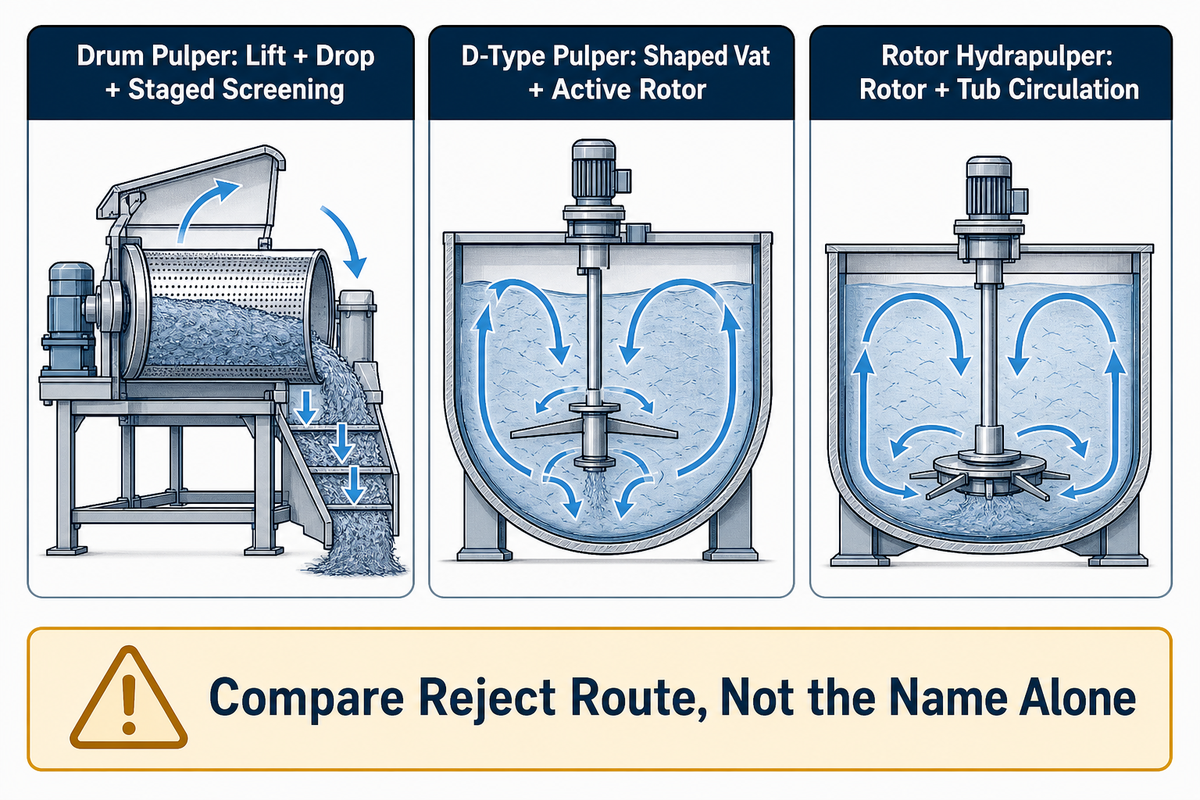
A drum pulper and a D-type pulper differ first in how they move raw material and expose it to mechanical action. Conventional hydrapulpers use a rotor and pulper tub to create circulation. A D-type pulper changes the vat geometry around that rotor. Drum pulpers rely more on tumbling, lift, drop, and staged screening.
Drum pulper
- Slushes through repeated lifting and dropping
- Can combine disintegration and coarse separation along the drum
- Often considered when keeping plastic and other debris large matters
- Needs space, feed preparation, and downstream reject handling defined
D-type rotor pulper
- Uses an active rotor and shaped vat circulation
- Supports compact continuous waste paper pulping layouts
- Can pair with ragger, junk trap, detrasher, and extraction screen
- Needs the rotor, plate, consistency, and reject route stated together
“Hydrapulper” is often used as a broad name for a rotor-driven paper pulper; “hydra pulper” and “hydro pulper” appear as search variants. “D type pulper” likewise appears as an unhyphenated search form, not a separate design. Those terms do not identify one type of rotor, one consistency, or one accept quality. Ask for the rotor drawing, tub shape, plate opening, tip-speed basis, and contaminant trial method rather than treating the trademark-like name as a specification.
Contaminant behavior matters because an impurity that stays large can be caught by a ragger, junk trap, or coarse screen. If the pulping process breaks it into smaller pieces, it may pass with the slurry and become a problem for the next stage. Patent literature describes these mechanisms, but patent claims don’t prove that a current commercial model will deliver high pulp yield or low energy consumption in your mill.
For real product scope, compare paper pulper machine options only after the same furnish and reject specification is attached to every request.
High-, Medium-, and Low-Consistency Pulping Are Operating Classes
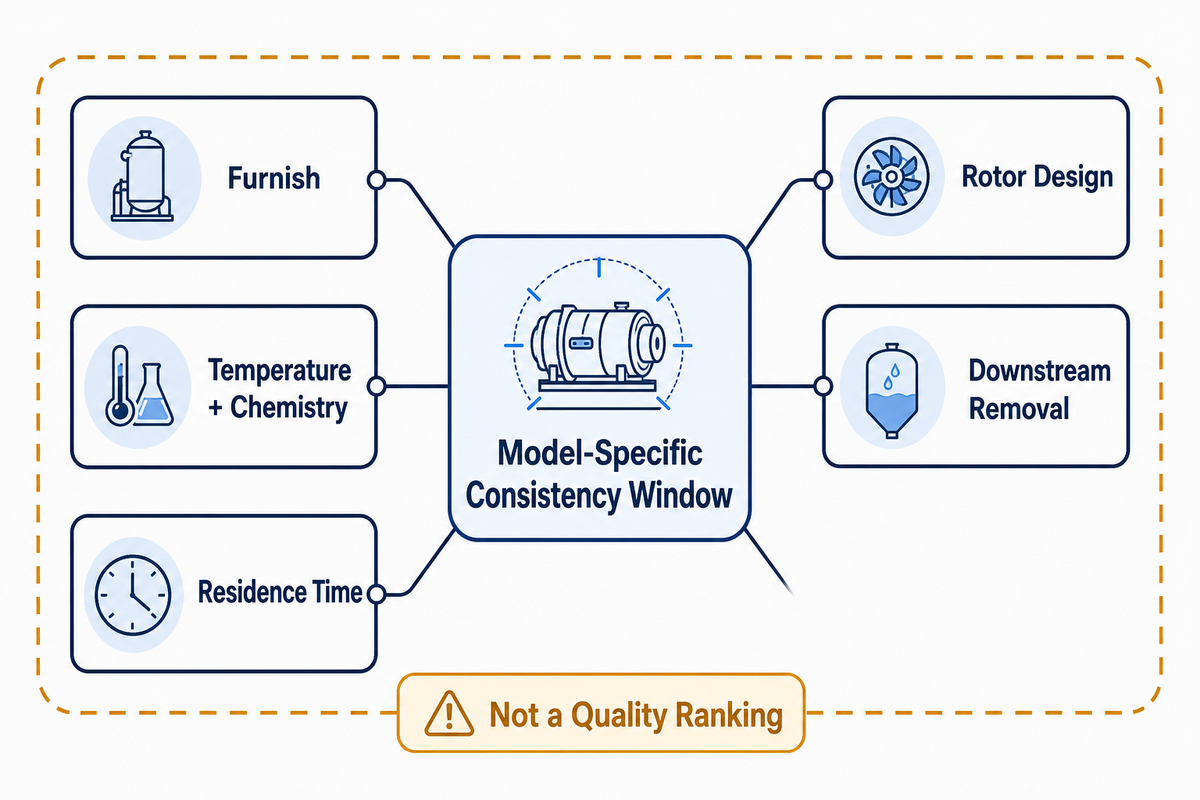
Consistency isn’t merely a category label. It affects production capacity, defibering efficiency, pulp circulation, dilution, and the particle-size distribution of contaminants. It still isn’t a quality ranking: the effect depends on furnish, rotor design, temperature, chemistry, residence time, and what the downstream system can remove.
10%laboratory pulper consistency
46 ± 2 °Cmethod water temperature
8 minfull-speed pulping
25–30 Wh/kgmethod-specific energy target
A useful counterexample, with a narrow scope
A formally refereed TAPPI Journal study pulped pressure-sensitive-adhesive furnish at 5%, 10%, and 15% consistency. The 15% trial produced more small stickies than the other two. The authors called the result contrary to the accepted hypothesis and said it needed further study. This is a laboratory particle-size endpoint, not proof of deposition, machine runnability, finished-paper defects, or mill-scale reject performance.
The four-page TAPPI packaging method fixes its laboratory test at 10% consistency, 46 ± 2°C, a 10 min soak, 8 min of pulping, and 25–30 Wh/kg specific energy when conditions change. The method explicitly says pulping duration should be adjusted for a different pulper or consistency. Precision in a test method does not create a universal production range.
| Class label | Ask the supplier to declare | Verify in the trial | Watch downstream |
|---|---|---|---|
| Low consistency | Minimum/normal/maximum window and dilution basis | Defibering, power consumption, fiber length, contaminant size | Water load, pumping, screening, and cleaning |
| Medium consistency | Model definition and discharge condition | Mixing, chemistry distribution, accepts, and rejects | Dilution before screens or flotation |
| High consistency | Warranted range, cycle, dump/extraction, and motor basis | Defibering plus sticky/plastic fragmentation | Dilution, coarse screening, washing, and deinking |
Don’t compare one vendor’s “normal consistency” with another vendor’s maximum claim. Ask both to state dry-solids basis, measurement point, furnish moisture assumption, and the consistency delivered to the next machine. That turns a high-consistency pulper versus low-consistency pulper debate into a testable process comparison.
Match the Pulper to Furnish, Not Just Paper Grade
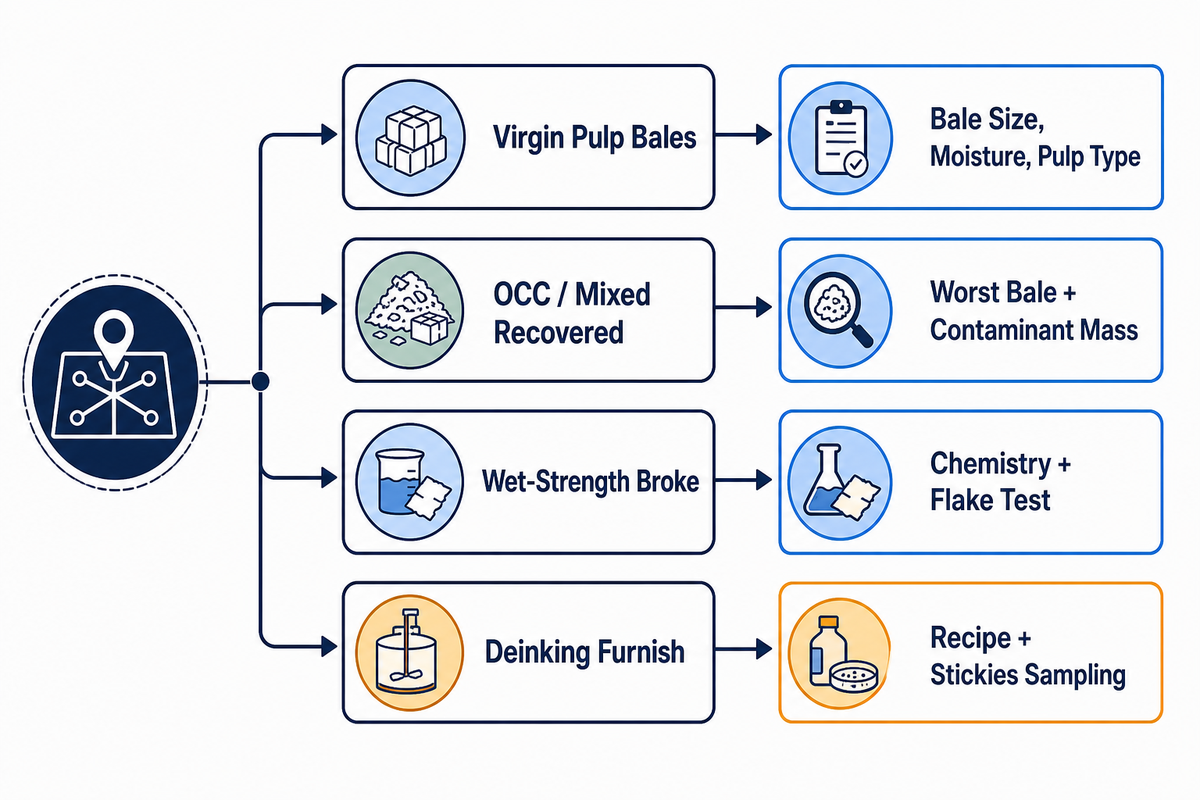
The best type of pulper cannot be chosen from “kraft,” “tissue,” or “duplex board” alone. The furnish profile has to show bale form, moisture, OCC share, wet strength, coatings, adhesives, plastic, wire, ash, and seasonal variability. Different types of paper sold under the same grade can behave differently in fiber processing.
The 2026 BioResources laboratory study reported screened fiber yields above 80% for tissue, used brown kraft, OCC, and sorted clean news, while aseptic packaging, sorted office paper, and magazines averaged about 60%. The longest reported weighted fiber lengths were about 1.6–1.8 mm, with widths of 20–33 µm for several grades. The paper defines those figures as laboratory accepts under simplified recycling conditions, not total mill fiber yield. The authors call the results directional indicators, not certification values. Use the data to justify furnish testing, not to promise a mill yield.
Wet strength paper adds another constraint. NCSU’s paper-chemistry guidance notes that poorly dispersed flakes can persist when wet-strength broke or wastepaper is repulped. Time, temperature, shear, pH, chemistry, and sometimes refining can change the result. Bleached kraft and unbleached or high-yield furnish don’t always accept the same processing route.
Deinking changes the question again. If the line must detach ink from the fibers, the buyer has to define pulping chemistry, temperature, residence time, pulp washing, flotation, and the point at which dilution occurs. A machine that disintegrates the sheet may still be a poor fit if it creates small stickies that the deinking and cleaning train cannot remove.
| Furnish signal | Why it changes the duty | Evidence to send with the RFQ |
|---|---|---|
| Clean virgin pulp bales | Defibering and bale wet-out dominate; reject load is usually secondary | Bale size, moisture, pulp type, production rate |
| OCC / mixed recovered paper | Wire, plastic, tape, wax, glass, sand, and grade variability shift the reject route | Sorted sample, contaminant mass, moisture, ash, worst bale |
| Wet-strength broke | Flakes may resist disintegration under ordinary time and shear | Sheet construction, resin/chemistry, cure age, target flake test |
| Deinking furnish | Ink, adhesive, coating, pH, heat, washing, and flotation interact | Recipe boundary, ink/stickies test, accepts/rejects sampling plan |
Detrashing and Reject Handling Can Reverse the Type Decision
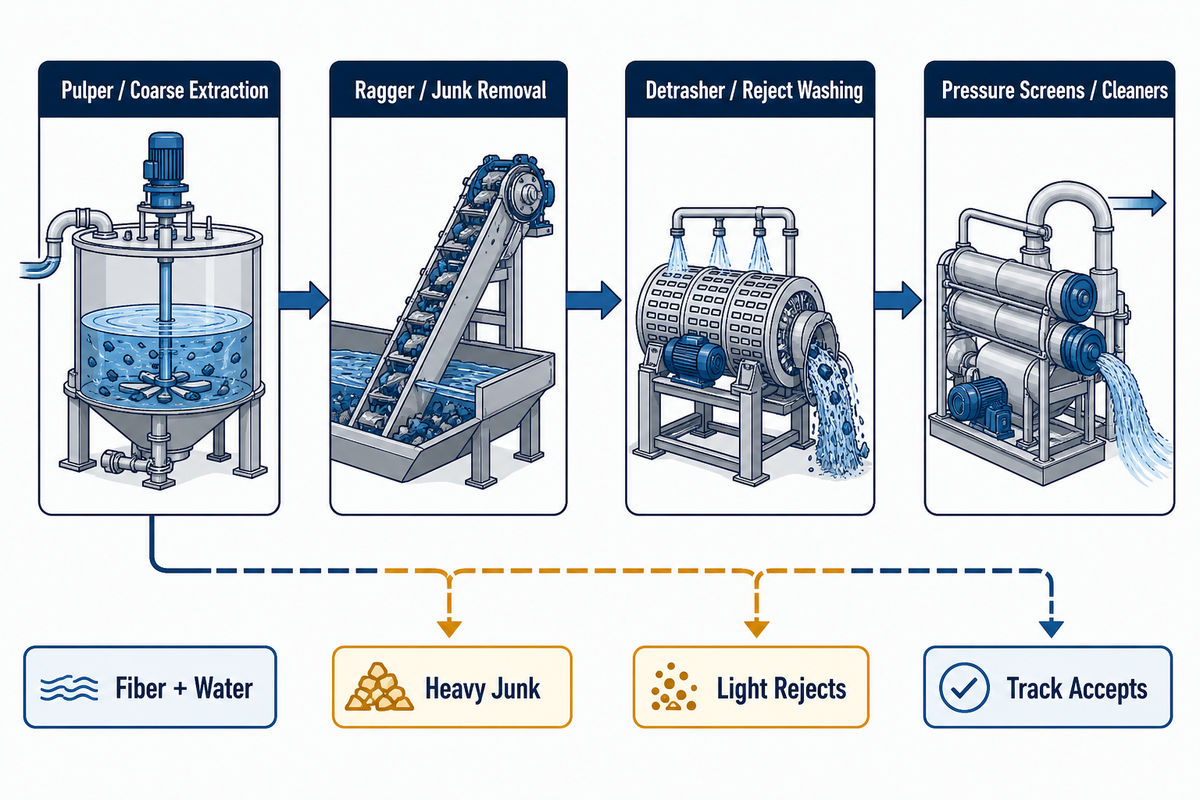
Reject handling can reverse a pulper choice because the vessel is only the first separation point. The system may need a ragger for stringing material, a junk trap for heavy objects, a detrasher for light and heavy fractions, a wash drum for fiber recovery, and downstream screens or cleaners for smaller impurities.
Patent architecture for continuous detrashing separates accepts, light contaminants, and heavy contaminants, then sends the light fraction to washing and dewatering. It treats feed flow, pressure, solids content, rotor speed, and reject residence time as connected variables. This is useful mechanism evidence; claimed patent benefits are not an operating guarantee.
| Stage | Material handled | Quote must state | Acceptance evidence |
|---|---|---|---|
| Pulper / coarse extraction | Fiber slurry plus oversized material | Plate/slot, dilution, accepts flow, dump sequence | Accepts, flake, and contaminant-size samples |
| Ragger / junk removal | Wire, straps, rope, fabric, metal, glass, stones | Included equipment, drive/control, safe clearing access | Worst-furnish trial and reject photographs/weights |
| Detrasher / reject washing | Light/heavy contaminants with carryover fiber | Flow range, wash water, fiber recovery, dewatering | Reject solids, fiber loss, water balance |
| Pressure screens / cleaners | Smaller coarse and density-separated impurities | Feed consistency, reject load, bypass and upset case | Cleanliness, reject rate, plugging response |
Scale is not theoretical. DS Smith reports that its Kemsley reject-processing centre handles 12,000 tonnes/year of ragger material and recovers 6,000 tonnes/year of fiber from pulper rejects. Those numbers are first-party and site-specific. Their role here is to show that reject processing can be a plant-level system, not to predict another mill’s recovery.
Downstream equipment also has a finite envelope. A 2023 peer-reviewed review of chemical-pulp screening reports typical screen-room rejects of 1–3 wt.% and describes plugging around 4–5 wt.% in that specific chemical-pulp context. It also explains that more reject flow can improve cleanliness while reducing capacity. Don’t copy those values into a recycled-paper pulper guarantee; use the tradeoff to require an upset case in the stock preparation process.
Map the handoff to pressure-screen operation and troubleshooting and paper-mill cleaner process stages before approving the vessel. Otherwise, “low power consumption at the pulper” can be paid back as pumping, clogging of the screen, fiber loss, or cleaning downtime elsewhere.
The Contaminant-to-Exit Boundary Trace
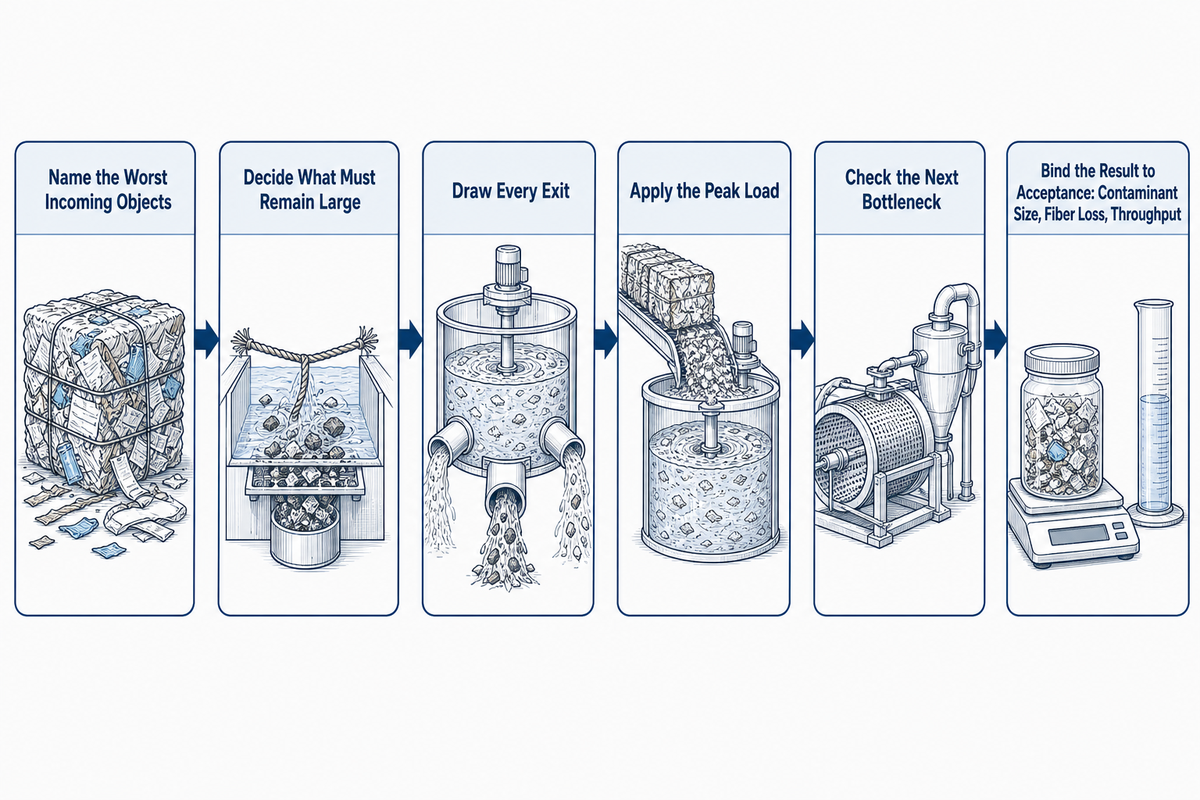
The Contaminant-to-Exit Boundary Trace maps each worst-case incoming object to the outlet, load, duty, and downstream capacity that must handle it. It’s a scope-mapping method, not a model selector. A quotation fails the trace when its attractive type name depends on reject equipment, water, controls, or maintenance work that the supplier leaves outside scope.
- Name the worst incoming objects. List wire, plastic film, tape, wet-strength flakes, glass, sand, wood, metal, and other prohibitives by mass and size.
- Decide what must remain large. Ask which contaminants should survive pulping so a ragger, junk trap, or coarse screen can remove them.
- Draw every exit. Mark accepts, stringing rejects, heavy junk, light rejects, wash water, recovered fiber, and final disposal.
- Apply the peak load. Use the worst bale and the maximum feed interval, not an average sample chosen for a demonstration.
- Check the next bottleneck. Confirm pump, chest, pressure screen, cleaner, flotation, and waste-handling capacity at the resulting flow and consistency.
- Bind the result to acceptance. Put contaminant size, fiber loss, throughput, energy, water, and cleaning response into the test protocol.
An old EPA-hosted technical report made the core limitation clear: equipment requirements vary with furnish, the character and amount of foreign particles, and stock volume. A newer patent example shows one process breaking recovered paper above 8% solids while trying to keep plastic film relatively firm, with a coarse-screen overflow described around 20–30% of feed flow. Those are historical and patent-specific values. The portable lesson is to preserve a removal path, not to reuse the percentages.
The cheapest pulper vessel can become the most expensive stock preparation system when reject handling, dilution, screen capacity, or safe cleaning access appears only after the purchase order.
Build an RFQ That Makes Different Pulper Types Comparable
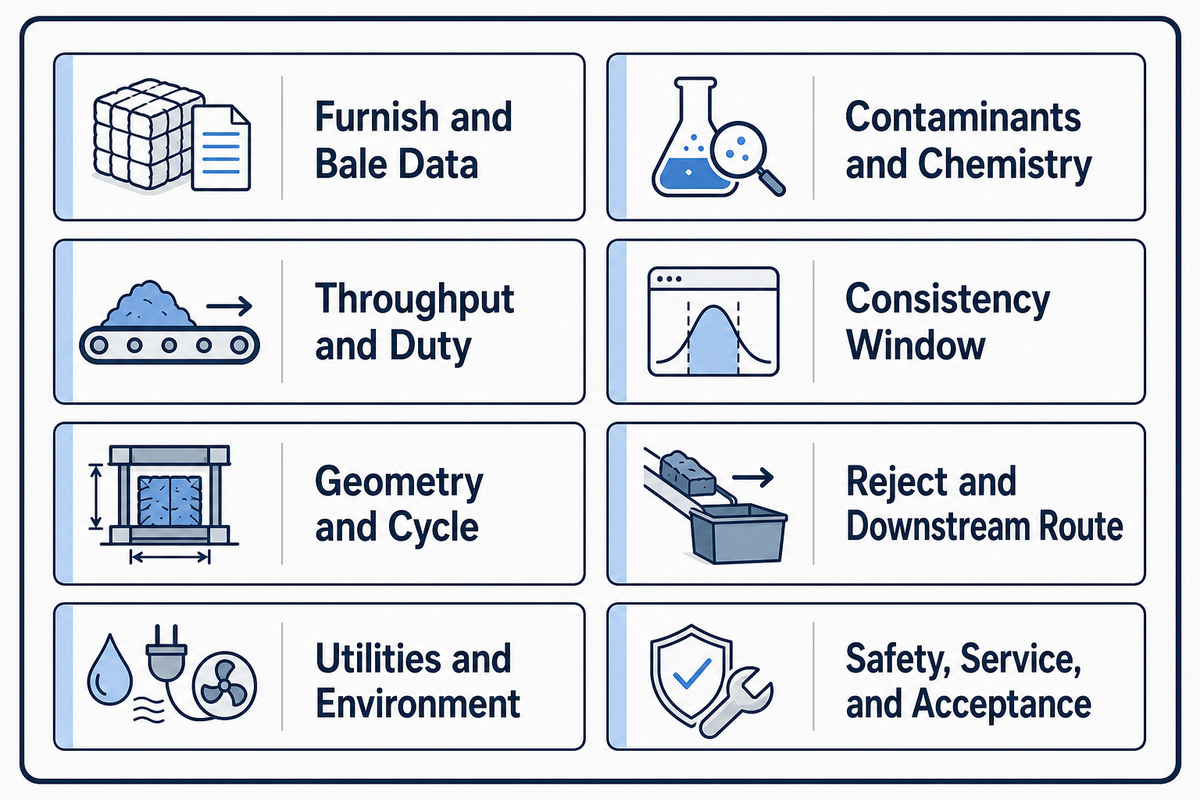
Pulper boundary-trace findings become a useful RFQ only when the same eight input groups go to every supplier. This checklist doesn’t set an unsupported recommended range. Instead, it records the measured plant value, asks the vendor for a warranted response, and names the test that will decide acceptance.
Pulper RFQ checklist — copy these eight groups into every quote request:
| Parameter | Plant value / vendor declaration | Why it matters | How to verify |
|---|---|---|---|
| 1. Furnish and bale data | Grade mix, bale size, moisture, ash, seasonal range | Sets wet-out, circulation, and usable fiber basis | Representative and worst-bale sampling |
| 2. Contaminants and chemistry | Wire/plastic/adhesive/wet-strength load; pH, heat, deinking route | Changes fragmentation, flakes, washing, and flotation | Sort test, stickies/flake method, recipe boundary |
| 3. Throughput and duty | ADT/day, peak bale interval, hours/day, grade changes | Separates average capacity from feed and cleaning reality | Timed cycle or continuous mass balance |
| 4. Consistency window | Inlet, normal, maximum, discharge, measurement point | Affects capacity, defibering, dilution, and contaminants | Calibrated solids sampling at named points |
| 5. Geometry and cycle | Drum/D-type/rotor; batch/continuous; supported combinations | Prevents labels from being compared across axes | GA drawing, P&ID, sequence and control narrative |
| 6. Reject and downstream route | Ragger, junk, light/heavy rejects, wash/dewater, screens/cleaners | Exposes hidden equipment and fiber loss | Reject mass balance and upset-case trial |
| 7. Utilities and environment | Water m³/t, energy kWh/t, drains, emissions, waste route | Makes vessel efficiency comparable at installation level | Metered acceptance period and permit/interface review |
| 8. Safety, service, and acceptance | Opening height, manual charge, guarding, entry isolation, spares, tests | Changes layout, maintenance time, and legal comparability | Drawing review, lockout walkdown, FAT/SAT evidence |
For US installations, OSHA 29 CFR 1910.261(j)(5) is more than a maintenance footnote. Pulper openings below 42 in (107 cm) require guarding or an equivalent enclosure; the rule also addresses manual charging, fall protection, an outside observer and lifeline for entry, and lockout or tagout of steam, water, and other controls. Local law and the plant’s own safety standard may add requirements.
The European Commission’s pulp-and-paper BAT reference covers recovered-paper processing with and without deinking alongside raw materials, water, energy, emissions, and waste. It does not declare one pulper type to be BAT. It does show why a vessel-only quote is incomplete.
Use the RFQ board with the complete pulping equipment and stock-preparation line page; when recovered furnish is in scope, add the waste paper OCC recycling line solution to the same review. Henan Zejiang Paper Machinery Co., Ltd. describes its scope as equipment design, manufacturing, refurbishment, installation, and technical support. That organizational capability does not replace model data; it gives the engineering discussion a defined handoff. Henan Zejiang’s public pulper selector can organize the first pass, but the RFQ and trial remain decisive.
Have a furnish and reject problem, not just a pulper name?
Send the eight input groups so the discussion starts from your actual stock preparation duty.
What Is Changing in 2025–2026 Pulper Selection
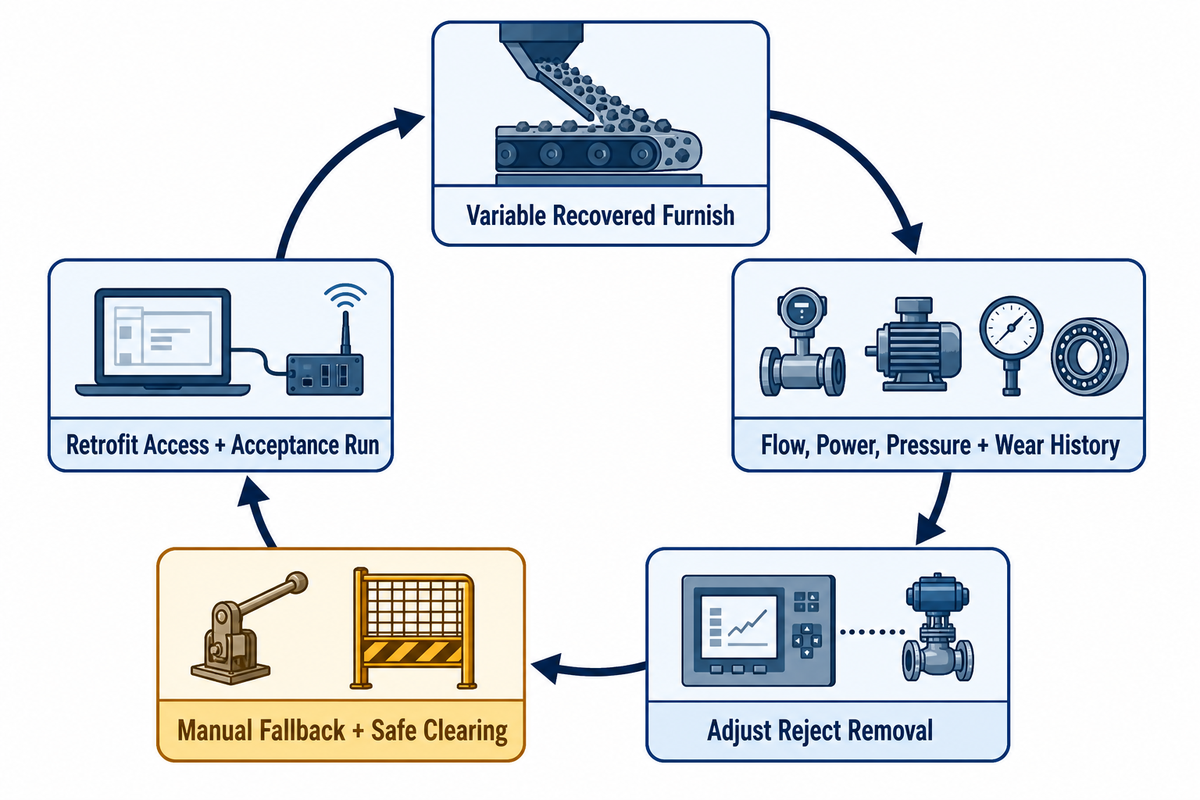
The strongest current change isn’t a universal new pulper family. It is greater pressure to handle variable recovered paper, see wear before failure, adjust reject removal, and fit upgrades into existing buildings and stock preparation lines. Search-demand trend data showed directional movement for “drum pulper” and “paper mill pulper,” but the exact focus phrase had insufficient history; no market-growth percentage belongs here.
The PITA-hosted practitioner article from Aikawa Fiber Technologies (AFT), dated 27 April 2025, describes batch-to-batch raw material variation, changing detrashing demand, wear in rotors and screening parts, and the use of historical flow, power, and pressure values to plan maintenance. Its association host does not make the commercial practitioner source independent, so it supports RFQ questions rather than a guaranteed outcome.
One 2025 ragger patent application points in the same direction. It proposes sensing tail size, density, slippage, metal content, production rate, recycled-to-virgin furnish ratio, slurry consistency, and temperature, then adjusting pull rate, pressure, torque, or speed. One patent shows the technical direction; it does not show how many installations have achieved the claimed result.
- Ask for historian tags and alarm logic, not an “automatic” label.
- Specify manual fallback and safe clearing when a sensor or ragger fails.
- Check retrofit access, floor level, foundations, chests, pumps, valves, and cable routes.
- Buy drawings and wear-part records so a future replacement is not a reverse-engineering exercise.
- Include a variable-furnish acceptance run rather than one clean demonstration bale.
Frequently Asked Questions
What are the main types of pulpers used in paper mills?
The main labels include drum, D-type, vertical or horizontal rotor, high/medium/low consistency, batch, continuous, and broke pulpers, but those labels describe different classification axes rather than exclusive machine families.
They do not form one exclusive list. Drum and D-type describe mechanism or geometry; consistency labels describe pulp concentration; batch and continuous describe operating cycle; broke describes process duty. One paper pulper may carry several labels at once. Classify the quote on all four axes, then compare furnish, reject route, utilities, safety layout, and acceptance evidence.
What raw materials can a pulper machine process?
Pulper machines can process market pulp, paper machine broke, OCC, mixed recovered paper, and other fiber-based furnish when the design and stock preparation route match the material.
The important fields are bale form, moisture, wet strength, coatings, adhesives, plastic, wire, ash, and variability. Clean wood pulp or virgin fiber presents a different duty from waste paper bales with prohibitives. Wet-strength paper and deinking furnish can need extra time, heat, chemistry, washing, flotation, or refining. A material type should be trialed under the proposed operating window.
What detrashing equipment is used with pulpers?
Common detrashing equipment includes a ragger, junk trap or junk remover, detrasher, reject screen, wash drum, dewatering equipment, pressure screens, and cleaners, each assigned to a different contaminant fraction.
Each item handles a different fraction. A ragger targets long stringing material; heavy junk needs a gravity or centrifugal path; light contaminants may need washing and dewatering; smaller impurities reach coarse screens and cleaners. The RFQ should show every accept, reject, water, and recovered-fiber stream. Otherwise contaminants from the pulp can simply move downstream.
Is a drum pulper always better for recycled paper?
No. A drum pulper may suit a duty that values gentle slushing and coarse separation, but plant fit decides the result under the stated furnish, reject route, and downstream screening limits.
Compare furnish variability, layout, feed preparation, accepts, reject washing, downstream screening, water and energy, maintenance access, and the warranted trial. A compact D-type or another hydrapulper may fit a different constraint better.
What is the cost of a pulper machine?
A defensible price requires a defined furnish, throughput, consistency window, reject route, utilities, controls, safety layout, installation scope, and acceptance test in one documented supply boundary.
Two offers with the same nominal capacity can exclude different conveyors, raggers, junk removal, detrashing, wash drums, pumps, chests, piping, instruments, platforms, guarding, commissioning, and spares. Ask for an included/excluded register and a metered acceptance period. Separate the vessel price from controls, freight, civil work, erection, utilities, initial wear parts, operator training, and performance testing. Also define the currency, trade term, validity date, tax handling, and warranty boundary. Without that scope, a low equipment price can hide water, energy, downtime, fiber loss, or downstream upgrades. Henan Zejiang can review a complete paper mill duty, but no model price is invented in this guide.
Can one pulper handle both virgin and recycled furnish?
Sometimes, but only when the model’s operating window, cleaning sequence, and reject equipment cover both duties, and the supplier verifies each furnish under a separate acceptance run.
Virgin pulp emphasizes wet-out and disintegration. Recycled paper adds wire, plastic, adhesives, ash, and other contaminants. Ask the supplier to test both the clean furnish and the worst recovered-paper mix, state changeover steps, and guarantee the accepts and rejects for each recipe.
Buying rule
Use the Pulper Label Normalization Register to standardize names, then use the Contaminant-to-Exit Boundary Trace and eight RFQ groups to expose the real system scope.
References & Sources
These sources carry the technical and safety claims in this guide. Commercial practitioner and first-party case sources appear only when the body identifies their origin and narrows their use; generic vendor pages and competitor articles used only for search-context analysis are excluded. Laboratory, patent, and first-party case data remain bound to the scope stated in the body.
- OSHA 29 CFR 1910.261 — Pulp, paper, and paperboard mills
- USDA Forest Service Treesearch — Effect of pulper consistency on stickies size distribution
- TAPPI — Recycling Compatible Packaging Test Method
- The Canadian Journal of Chemical Engineering — Energy and paper recycling: modelling low-consistency batch repulping
- BioResources — Assessing repulpability and fiber properties in recovered paper products
- NC State University — Troubleshooting guide for paper chemistry
- European Commission JRC — BAT Reference Document for Production of Pulp, Paper and Board
- PITA-hosted Aikawa Fiber Technologies (AFT) practitioner article — Recycled material pulping and furnish variability
- US4848674A — Waste paper pulping mechanism and classification context
- WO2013058975A1 — Continuous detrashing system architecture

![Refiner Plates & Screen Baskets [Complete Guide]](https://zjpapermachine.com/wp-content/uploads/2026/07/refiner-plates-screen-baskets-guide-featured-150x150.png)
![Doctor Blade: Types, Materials & How It Works [Guide]](https://zjpapermachine.com/wp-content/uploads/2026/07/doctor-blade-guide-featured-1-150x150.png)
![Pulping Equipment: How Paper Pulping Works [Guide]](https://zjpapermachine.com/wp-content/uploads/2026/07/pulping-equipment-guide-featured-150x150.png)