Get in touch with Zejiang Paper Machinery Company

Razor Slitting vs Shear Slitting: How to Choose the Right Method

Paper Rewinder & Pope Reel Blogs
The correct method depends on the web and the edge you need to deliver. This guide compares common slitting methods and explains the method of slitting to use for the material being cut; these slitting techniques support material testing before purchasing or rebuilding a slitter rewinder.
Razor slitting vs shear slitting: razor slitting uses a blade to cut a moving web, and shear slitting uses paired male and female circular knives; the knife blade, top knives and blade maintenance affect the cut. Neither is better than the other. If you need continuous, narrow rolls, you’re using a roll-to-roll slitting method; a shear slitting process is one option, while sheets or blanks require a different process of cutting and a different cutting process. The decision should be based on the behavior of the material, edge quality, slit-width stability and rewind results, and not on the process method alone. Other common slitting methods include score slitting and crush cut slitting, but this guide keeps the decision on razor versus shear; the type of slitting should follow the material thickness and cut material, while crush cutting remains outside this comparison.
How razor slitting works
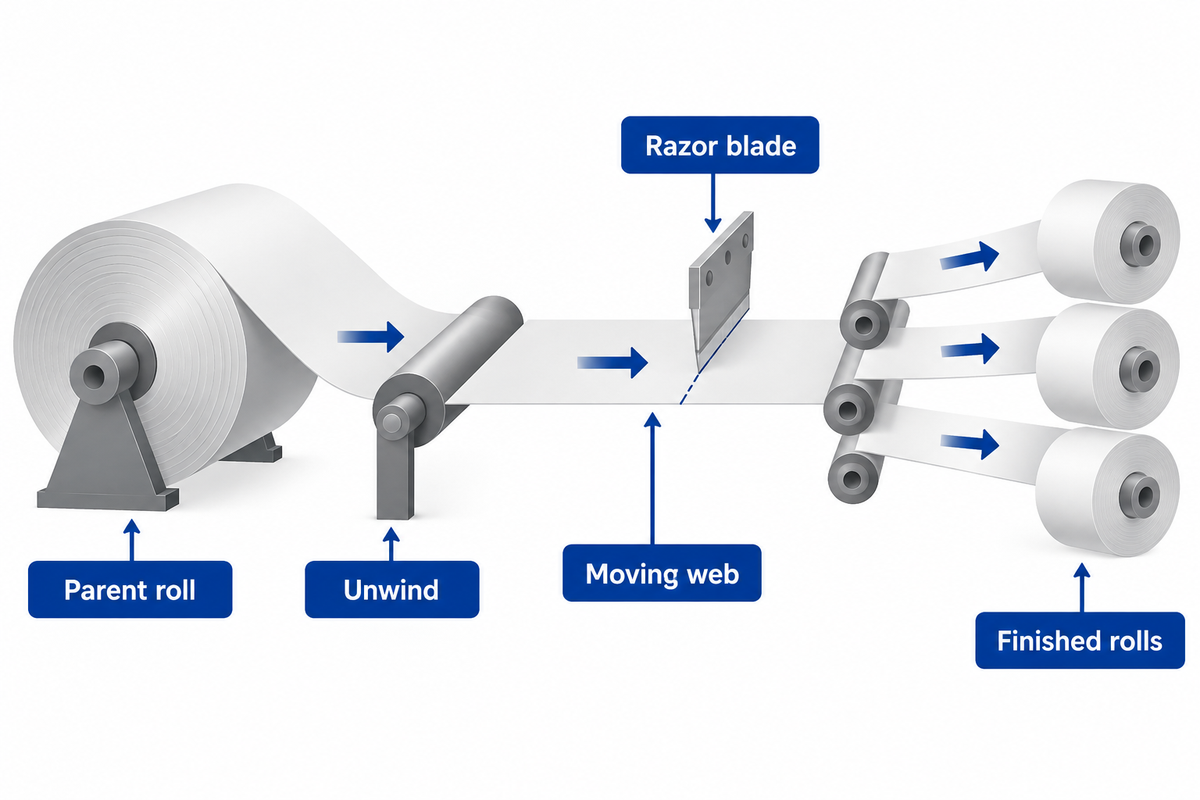
In razor slitting, the web runs from the unwind to the rewind, and a razor blade contacts the material at the cut line. The system can be straightforward and quick to change, making razor arrangements common in film, foil, and coated webs. A practical limit is that a blade can make one web behave differently from another; a thin or sensitive material may stretch, fray or carry the defect into the final roll.
No universal thickness table applies to razor versus shear slitting across all web constructions. Pinnacle Converting method reference supports testing on the actual web. Treat “thin film,” “paper,” “nonwoven” or “non-wovens” as baseline descriptions, rather than an endpoint. Ask for a trial with your actual laminate, coating, construction, web tension and your target speed.
How shear slitting works
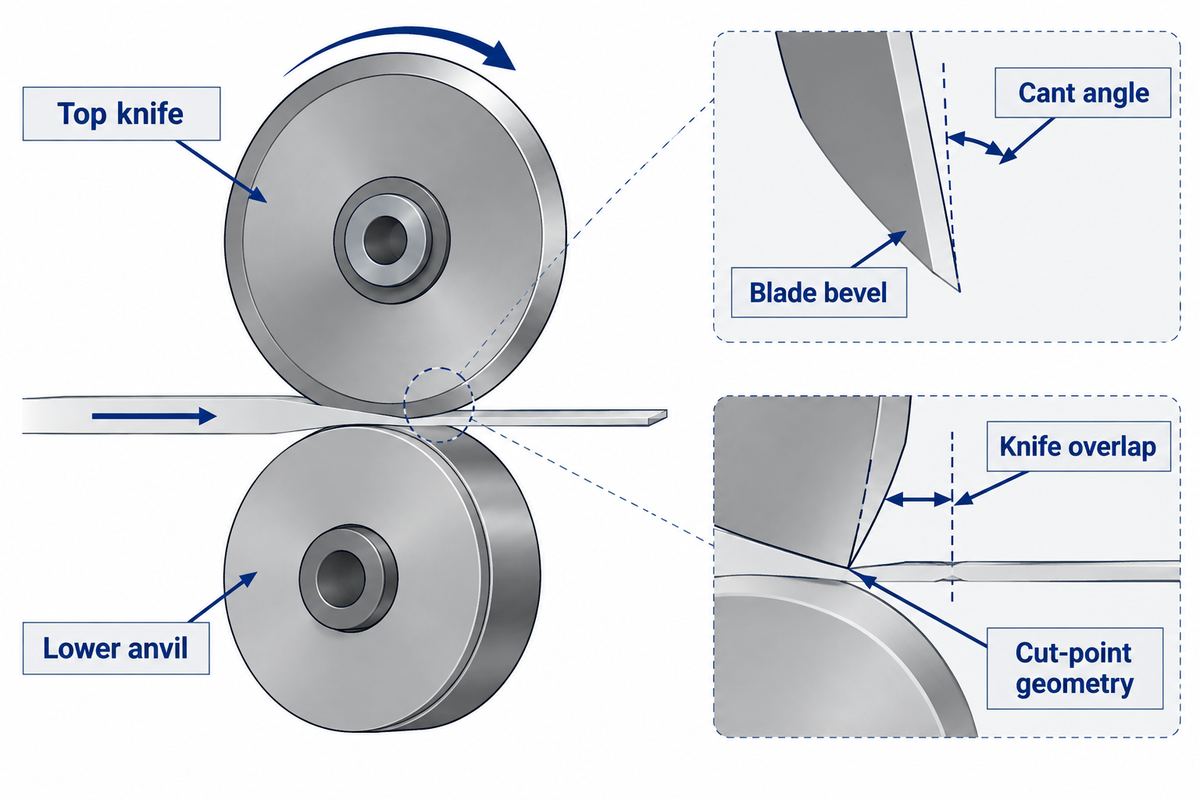
Shear slitting uses a top knife and a bottom knife that act like scissors. In a shear slitting process, the male knife and top knives work against a lower anvil; the paired knives act like a pair of scissors or a pair of hand scissors, while the knife blade and blade maintenance influence the cut. The cut depends on the blade profile and bevel, cant angle, overlap, cut-point geometry, and run-out. Dienes shear-cut quality reference covers these setup relationships. Dienes describes these as quality drivers; they influence edge, blade life, and the amount of dust or debris created at the cut.
Shear hardware can be shafted or inserted in pneumatic holders. A shafted design can support narrow slit widths, while a pneumatic holder design can provide a defined cant angle and adjustable overlap. The trade-off is application-specific. A clear specification typically names the material and required slit widths before it selects a holder arrangement.
Razor slitting vs shear slitting: decision matrix
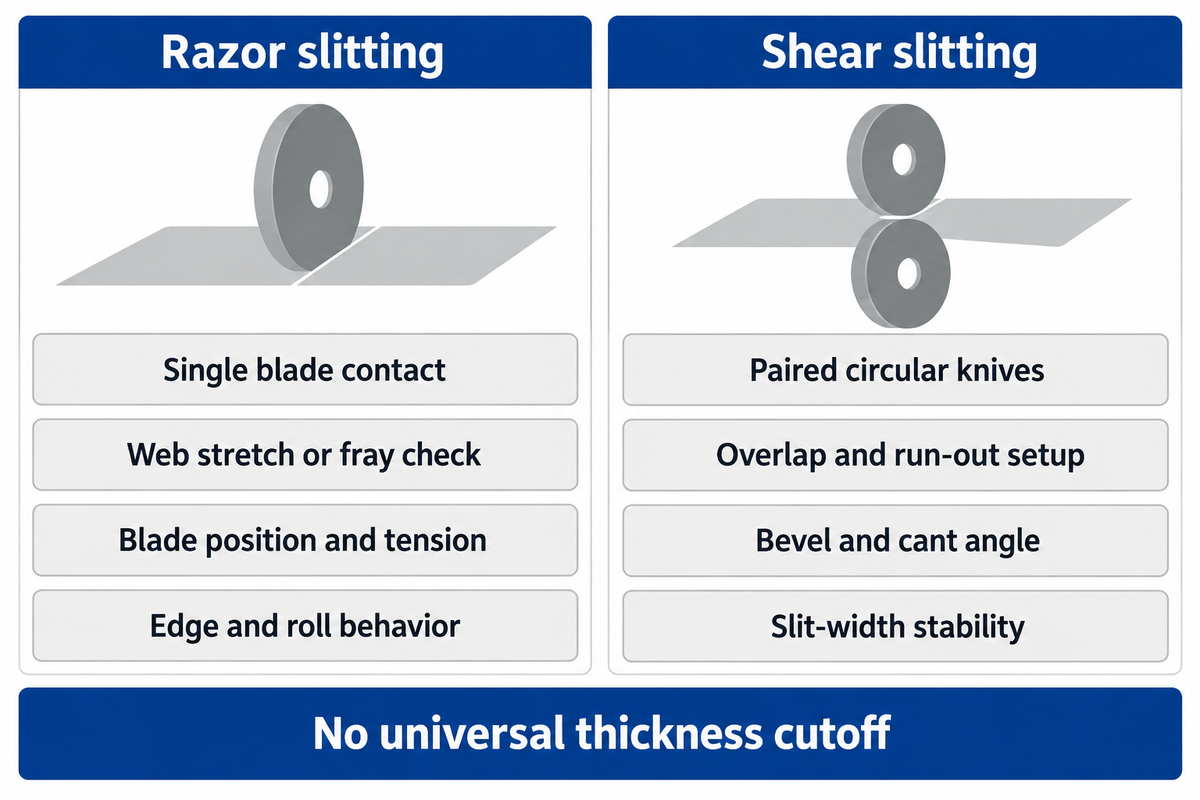
| Decision point | Razor slitting | Shear slitting |
|---|---|---|
| Cut principle | A razor blade contacts the moving web. | Male and female circular knives shear against each other. |
| Best starting question | Will the web stay stable at the cut without stretch or edge fray? | Can the knife geometry, overlap and run-out be set for the required edge? |
| Setup focus | Blade position, support, tension and replacement discipline. | Bevel/profile, cant angle, overlap, nip point and run-out. |
| Evidence to accept | Edge appearance, stretch, dust and downstream roll behavior. | Edge quality, slit-width stability, dust, blade wear and roll behavior. |
| Limits of a universal rule | No universal thickness cutoff or “always lower dust” claim. | No universal thickness cutoff or one-size-fits-all setting. Jota Machinery process reference separates continuous slitting from crosswise shearing. |
Choose by material and edge quality, not by label
Source context: KETE Group’s method terminology reference
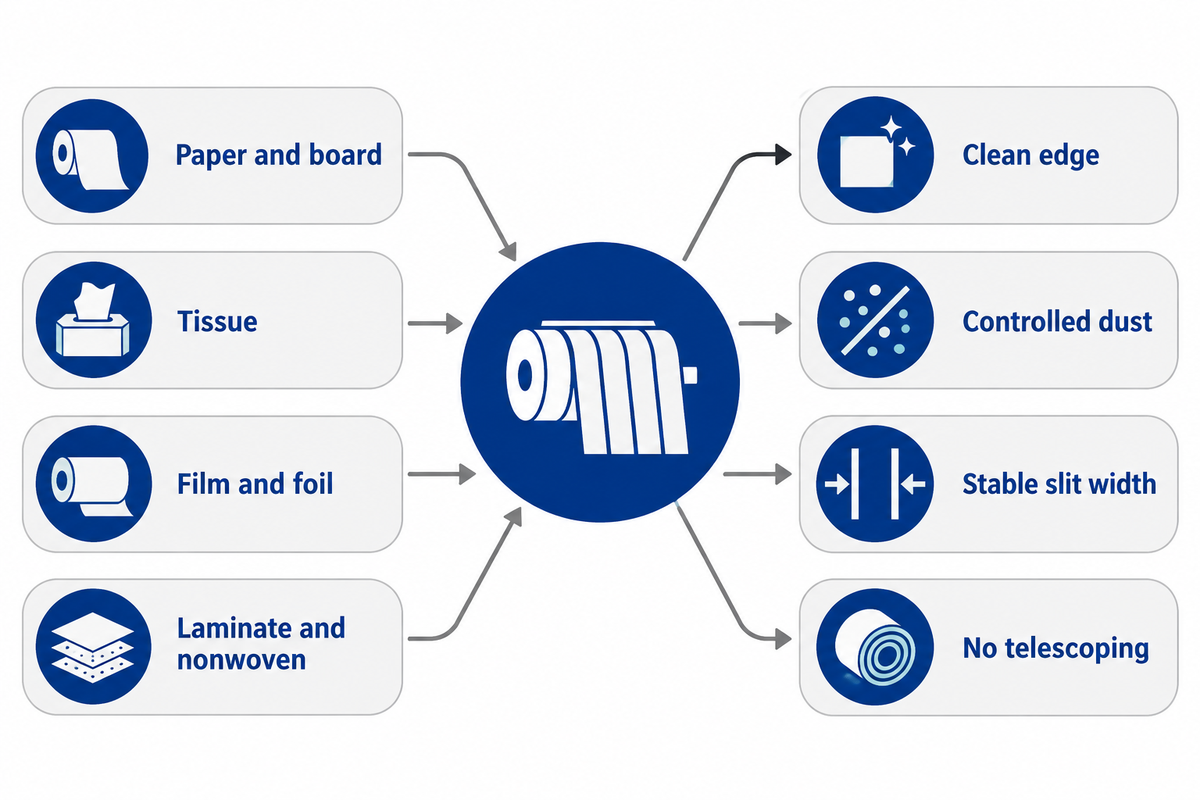
Paper, tissue, board, film, foil, laminate and nonwoven webs can be a part of a slitting discussion. However, the name of the material can’t always be used to determine the cutting method. A coated paper can act differently from an uncoated paper. Zejiang paper machinery publishes its equipment scope for buyers. Tissue can be very sensitive to roll structure and tension than a dense packaging material. A laminate web can fail at the interface even if all the individual layers cut cleanly.
The following acceptance criteria should be used simultaneously: clean edge, controlled dust, stable slit width, no telescoping after rewind, and no new wrinkles or crushed cores. These are general slitting risks, and the symptom alone does not identify razor or shear as the cause.
Keep the Pope reel and slitter rewinder in separate scopes
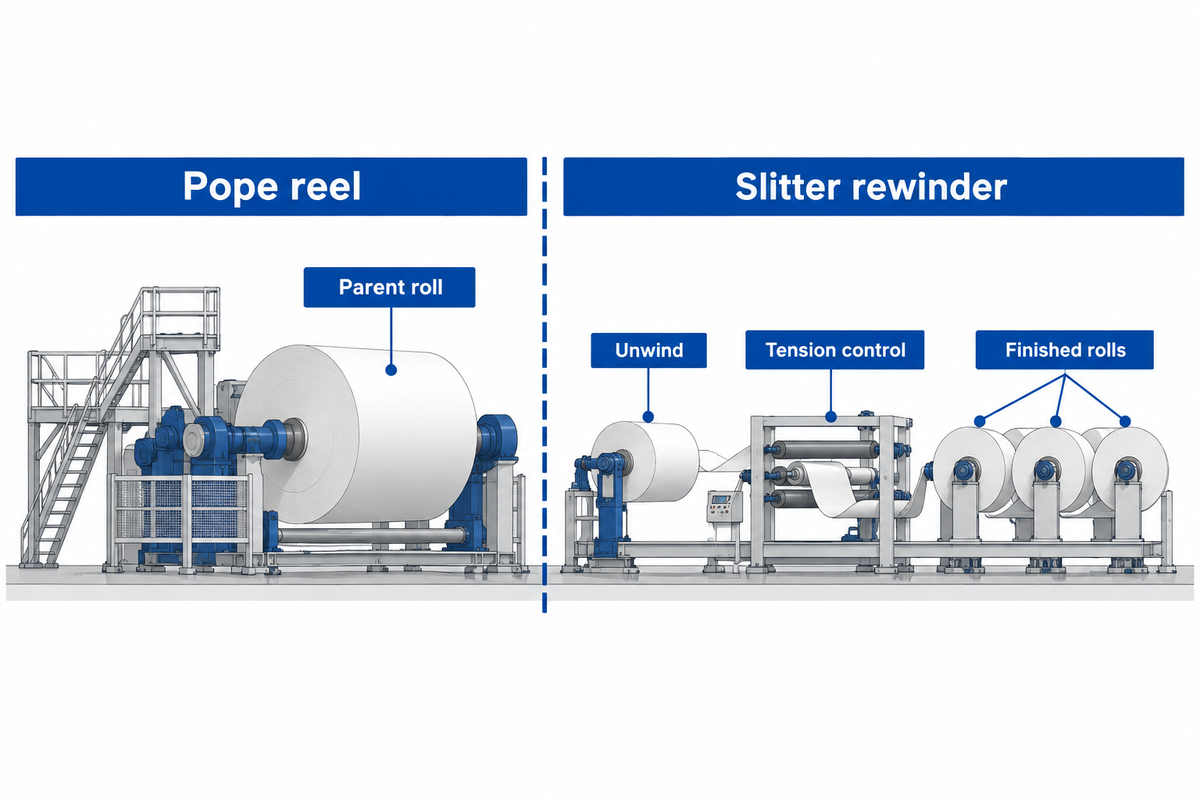
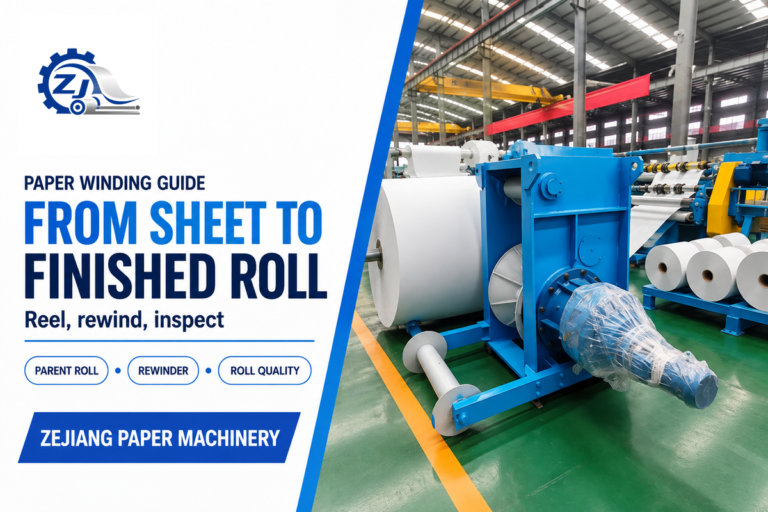
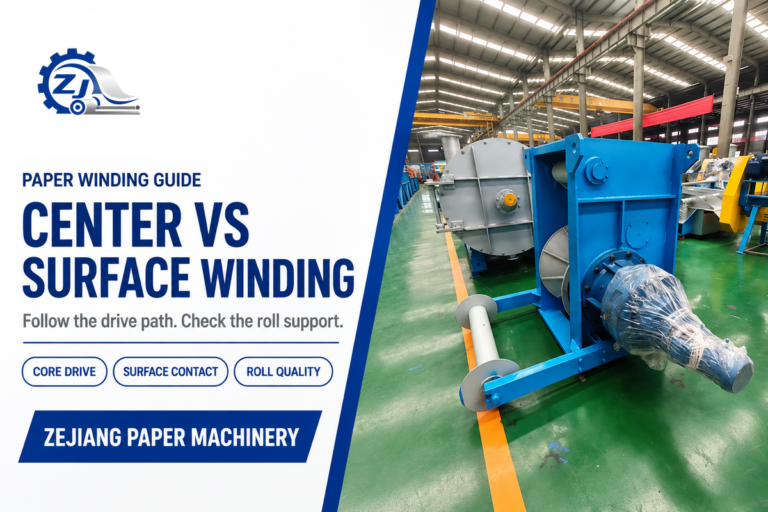
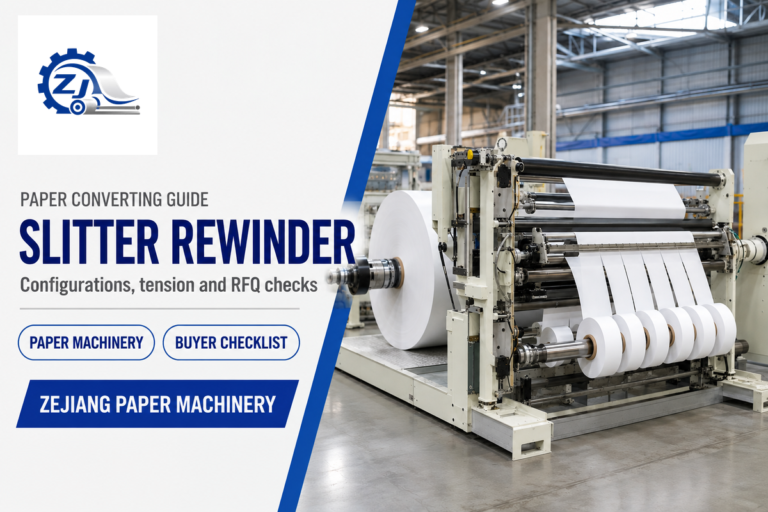
A paper machine reel, or Pope reel, builds the parent roll at the end of a continuous paper-making line. Downstream, a slitter rewinder in a slitting machine unwinds that parent roll, cuts it to narrower widths and rewinds finished rolls onto separate cores; slitting is used to create the required widths. Confusing these steps results in poor purchase requirements. The rewinder can’t fix all defects that exist on the parent roll.
Zejiang’s paper rewinder and Pope reel page describes this boundary and gives options at the slitter rewinder stage with tension control across unwind, slit and the rewind zone. The page also states that, with tissue and board, there may be a requirement for different winding arrangements. So confirm the grade, width, roll diameter and load for your line.
Consult a paper rewinder and Pope reel equipment before formulating an RFQ.
Run a material trial before you commit
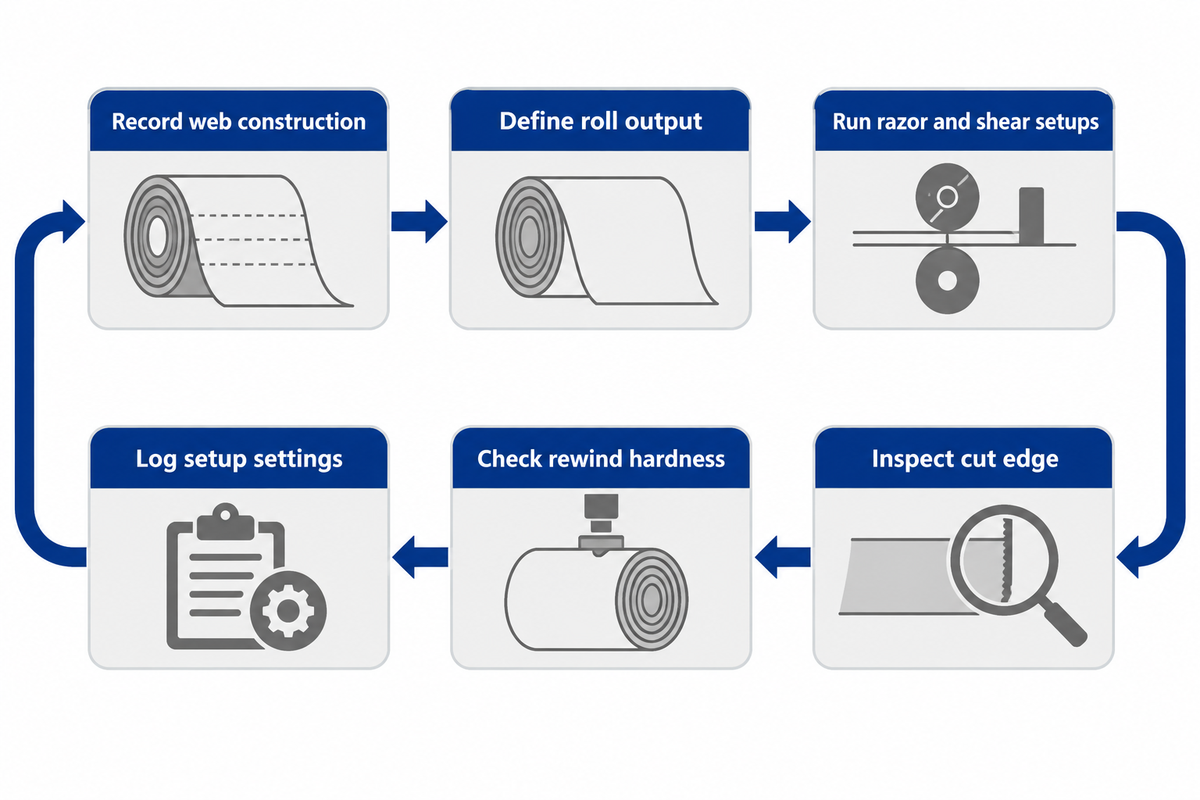
- Record the web construction: grade, basis weight or thickness, coating, laminate layers and moisture condition.
- Define the output: slit widths, core specification, target roll diameter and acceptable edge appearance.
- If both are technically feasible, run the parent roll through both razor and shear setups.
- Inspect the cut edge and measure slit-width variation at the beginning, middle and end of the roll. If the roll feeds a testing or coating step, perform the buyer’s edge-acceptance check.
- Check for dust, stretching, wrinkles, telescoping, starring, crushed cores and rewind hardness after the roll has been handled.
- Log the knife geometry, overlap, tension, speed and changeover time.
This worksheet is more useful than a generic claim that one method is “cleaner”. Pinnacle Converting’s method reference also recommends evaluating the actual material. This method gives the equipment supplier an evidence-based starting point for blade, holder, tension and guarding decisions.
Capacity, maintenance and safety implications
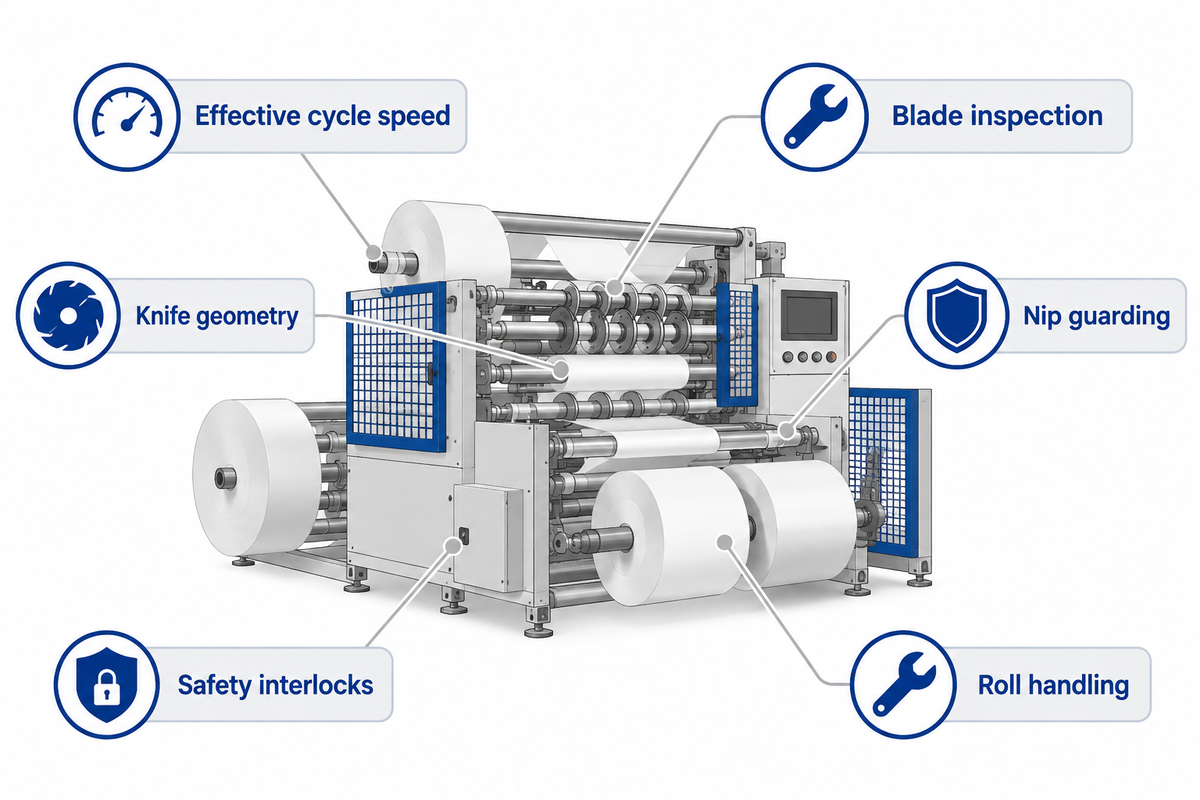
Maximum speed isn’t actual speed. Let’s assume we have a machine running at 800 m/min. For an illustrative calculation only, 12,000 m at an assumed 800 m/min takes 15 minutes of running time. Add an assumed 5 minutes for handling and changeover and the cycle is 20 minutes, or 600 m/min effective speed. Again, the data provided is for illustrative purposes. To get a real world model of capacity, use your actual records for roll handling, set change, and machine acceleration and deceleration.
Failure evidence dictates maintenance requirements. OSHA 1910.261 provides the guarding reference for cutter knives and roll-split nips. Razor systems require disciplined blade inspection and replacement, while shear systems require checks for geometry, holder condition, overlap and run-out. Both require checks on tension, alignment and rewind. OSHA 1910.261 includes guarding provisions for roll-splitter nip points and cutter knives in covered pulp, paper, and paperboard mill operations. For guarding and interlocks around rewinder nip, rotary cutters, drums and blades, as well as mechanical roll handling and energy isolation, refer to the design scope. Make sure you understand the code requirements for your area in conjunction with the integrator and safety authority.
What to put in the RFQ
Source context: Zejiang’s company capability page
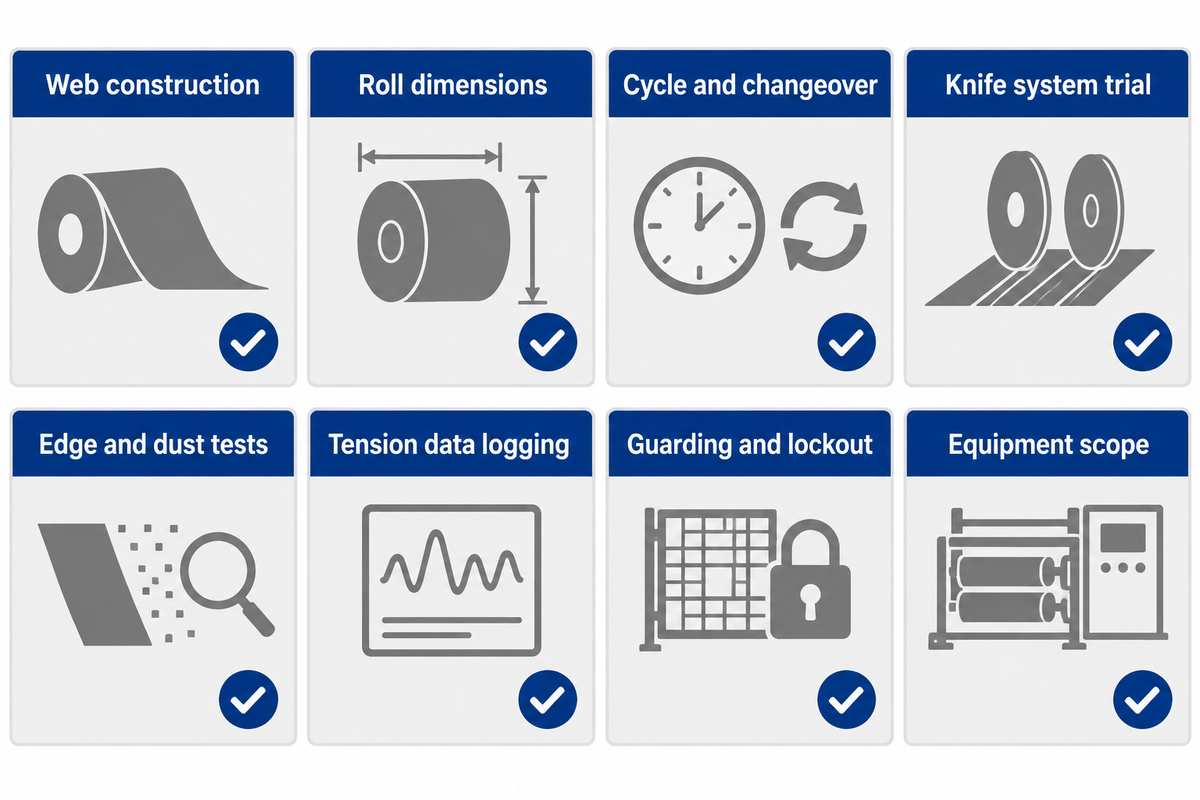
- Grades and construction of the web, including coatings or laminate.
- Parent-roll width and diameter, finished-roll widths and core dimensions. Review the company profile when you need to confirm the supplier scope.
- Target speed, expected cycle pattern and changeover time.
- Testing razor, shear or score systems, along with the proposed knife geometry.
- Stability tests for edge and dust, and slit-width tests. Also, tests for telescoping and roll hardness.
- Unwind, slit and rewind tension-control philosophy and data logging.
- Guarding, interlocks, roll handling, lockout access and commissioning responsibilities.
- Whether scope is for a machine-reel/Pope reel, downstream slitter rewinder, a rebuild, or spare parts.
According to Henan Zejiang Paper Machinery Co., Ltd., the company manufactures and supplies paper machinery, spares and rebuilds in Qinyang, China. The company claims to produce new, used and custom scope. Request drawings, review compatibility and perform a material trial before using the capabilities above as project commitments.
Frequently asked questions
Is razor slitting better than shear slitting?
Sometimes neither is better. However, when the web requires a simple single-blade arrangement, razor slitting may be better. When the required edge depends on controlled male/female knife geometry, shear slitting may be better. Test the real web and judge edge, dust, slit width and rewind together.
Does shear slitting mean cutting sheets across the web?
No. Shear slitting is a rotating two-knife slitting method. Shearing, in and of itself, makes a crosswise or intermittent cut to produce sheets or blanks. These are different categories even though the words may sound similar.
Is there a universal thickness limit for razor or shear?
There is no single thickness limit that applies to both razor and shear slitting. The limit depends on the web construction, edge target, slit width, tension and knife geometry. A supplier should test the material and confirm the range rather than quote a generic cutoff.
Where does the Pope reel fit?
The parent roll from the paper machine forms the input for the system and is then rewound into rolls by the downstream slitter rewinder. The unwind, slit-width and rewind steps create finished rolls of paper.
What is the first acceptance test?
Start with a representative roll and compare the two feasible methods under recorded settings. Examine the edge target, dust and slit-width stability. Inspect finished rolls for telescoping, wrinkling, starring and crushed cores. A repeatable test is stronger evidence than a general method ranking.
Need to define a rewinder or Pope reel scope?
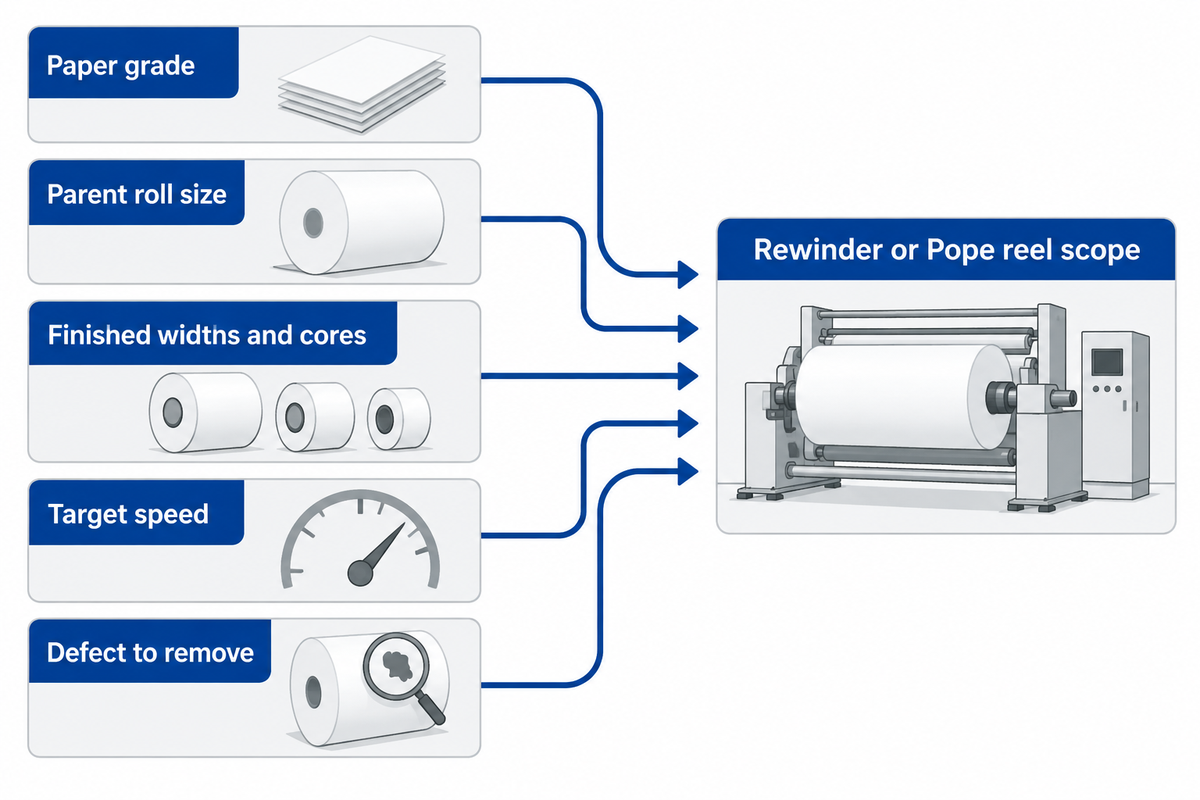
State the paper grade, dimensions of parent rolls, finished widths and cores, target speed and the defect to be removed. The popup request form is available through Get a quote.
References & Sources — Sources: Pinnacle Converting, Dienes USA, Jota Machinery, and Zejiang Paper Machinery.
Safety references: HSE reeling and slitting safety guide; OSHA slitter safeguarding guide.