
Get in touch with Zejiang Paper Machinery Company


(Updated August 2026)
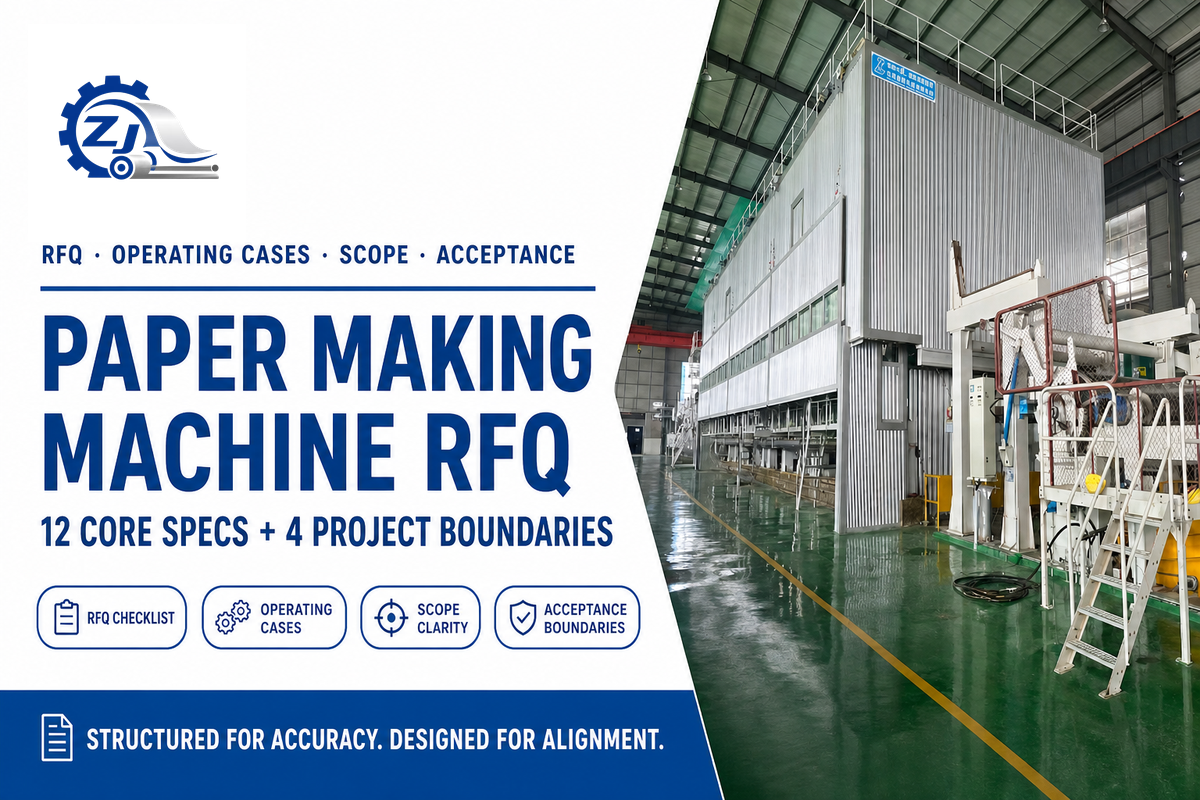
A paper making machine is an integrated production line that forms prepared fibre stock into a continuous paper web, then presses, dries, and reels it for finishing. Such a quote becomes comparable only when every supplier receives the same grade, furnish, saleable output, paper width, speed, utility, scope, and acceptance inputs. This guide turns those inputs into a 12-core-specification request for quotation, then adds four project boundaries that equipment lists often leave open: lifecycle support, auxiliary systems and controls, permits, and site safety.
Direct answer: Specify paper grade and basis-weight band; furnish and stock preparation scope; saleable daily output; reel trim; operation and design speeds; forming route; press and dryer conditions; utility constraints; scope for automation and quality control; delivery scope; acceptance test; and commercial milestones. Write schedules for lifecycle support, auxiliary system and control interfaces, destination permits, and site safety. Without those four schedules, two otherwise identical quotations may describe different projects.
This structure keeps four linked decisions separate: paper machine capacity, paper machine price, paper machine installation, and paper machine commissioning. Each has a different evidence basis and responsibility owner.
Key takeaway
Do not compare paper machine prices until the same 12 core specifications and four project-boundary schedules appear in every bid.
A Paper Making Machine Quote Is Only as Good as Its Input Sheet
A paper machine is not a single machine. Stock preparation, approach flow, forming, pressing, drying, drives, controls, finishing, water, steam, vacuum, compressed air, electrical supplies, and building interfaces function as one production system. TAPPI’s paper-production curriculum treats those systems as separate technical disciplines, while Dick Reese’s paper-machine energy scorecard, presented at TAPPI PaperCon, records grade, basis weight, reel moisture, operating speed, and production together. Therefore, requesting on the order of “100 tonnes/day kraft paper machine” can’t yield a testable specification.
Use the site’s paper grade and capacity selector before you ask for a line configuration. The selector owns early fit questions; this article begins at the next decision: writing an enquiry that several suppliers can price on the same basis. Buyers who still need the machine-section overview can read the existing paper machines guide, while quote-ready teams can configure a complete paper machine.
The Grade-to-Quote Boundary Map
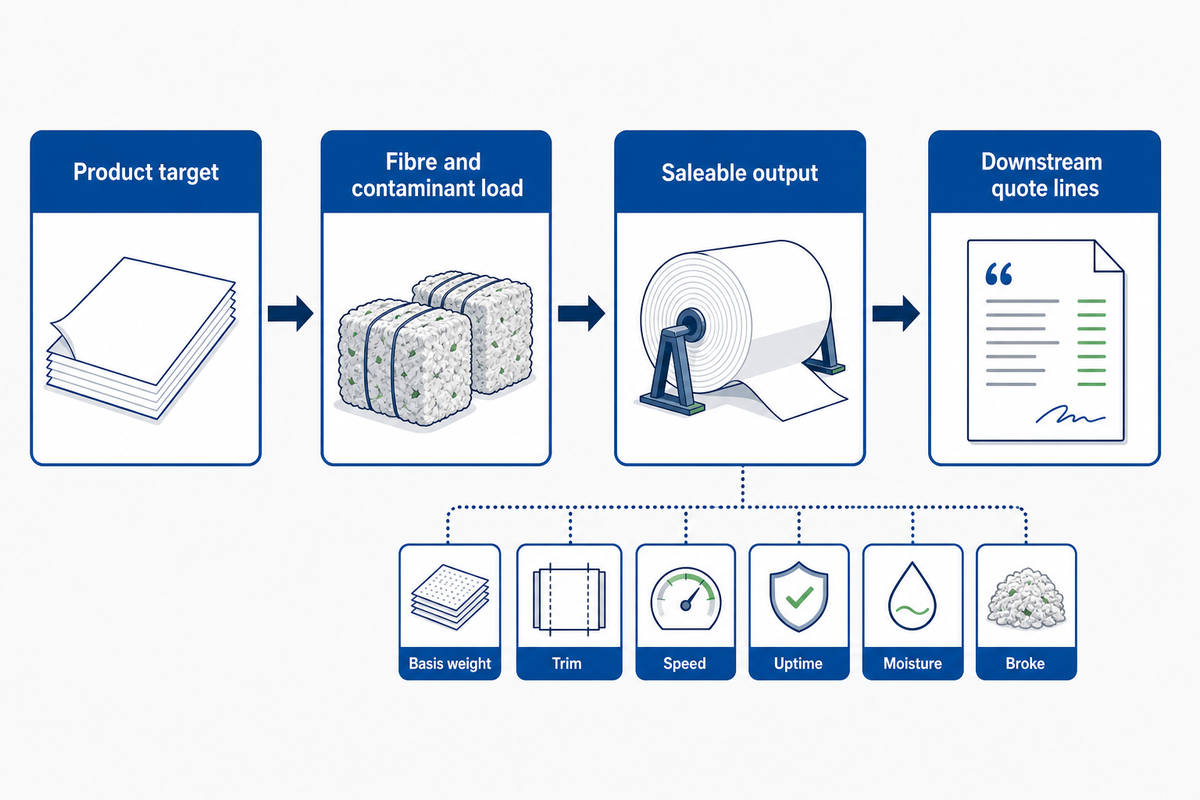
Paper grade sets the product target. Furnish sets the fibre and contaminant load. Basis weight, trim, speed, uptime, moisture, and broke turn that target into saleable output. Those choices then size stock preparation, forming, pressing, drying, utilities, controls, and finishing. Moving any upstream input changes several downstream quote lines.
Define Paper Grade, Basis Weight, and Furnish First
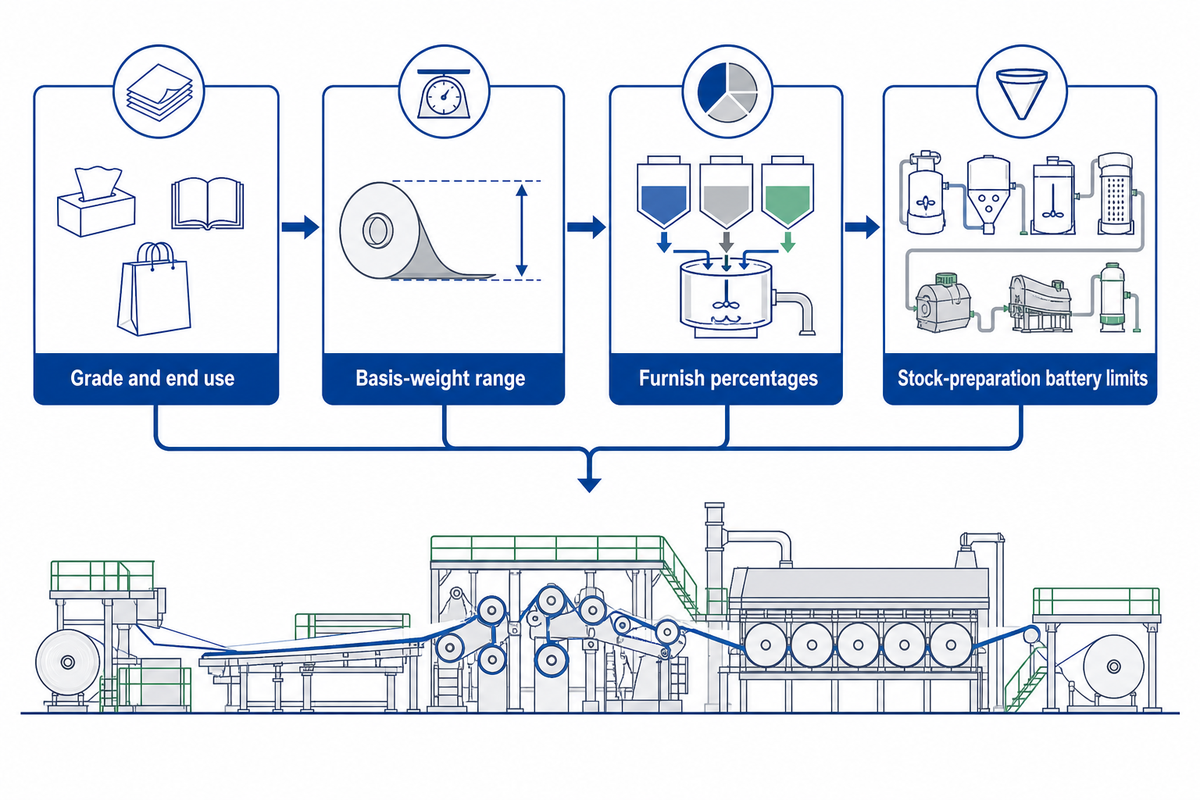
Start with saleable products, not a machine label. List each grade, its target basis-weight range, reel moisture, sheet properties, expected share of annual volume, and planned grade-change frequency. A line that mainly makes corrugating medium has different stock, forming, pressing, drying, and finishing priorities from a tissue line. If the project is for packaging grades, compare kraft and corrugated paper machine configurations after the product schedule is fixed.
Specify actual finished paper, such as tissue paper, printing paper, recycled paper, kraft liner, or another grade. A Fourdrinier machine employs a moving wire section, whereas cylinder and multi-ply routes form the sheet differently; tissue paper making may require a Yankee dryer rather than the multi-cylinder dry end most packaging production lines use. The machine manufacturer should clarify how the headbox, wire or cylinder former, press section and steam-heated dryers fit the stated papermaking duty. Dick Reese’s paper-machine energy scorecard, presented at TAPPI PaperCon, likewise records grade, basis weight, reel moisture, speed, and production together.
Next, define furnish by percentage and delivery condition. State virgin pulp, old corrugated containers, mixed wastepaper, office waste, bagasse, or another fibre source; moisture basis; contaminant limits; bale or wet-lap form; and seasonal variability. Mark the battery limit for pulping, screening, cleaning, deinking, thickening, refining, chemical preparation, rejects, and broke recovery. The equipment list can be technically sound yet wrong for the mill when the guaranteed feed condition is vague. The stock preparation process guide explains these stages in more detail.
Do
- List every planned grade and volume share.
- State furnish percentages and incoming condition.
- Define contaminant and reject assumptions.
- Mark stock-preparation battery limits.
Don’t
- Send only a daily-tonnage target.
- Describe all recovered fibre as equivalent.
- Assume deinking or broke recovery is included.
- Hide frequent grade changes from the supplier.
Make Output, Trim Width, Speed, and Uptime Agree
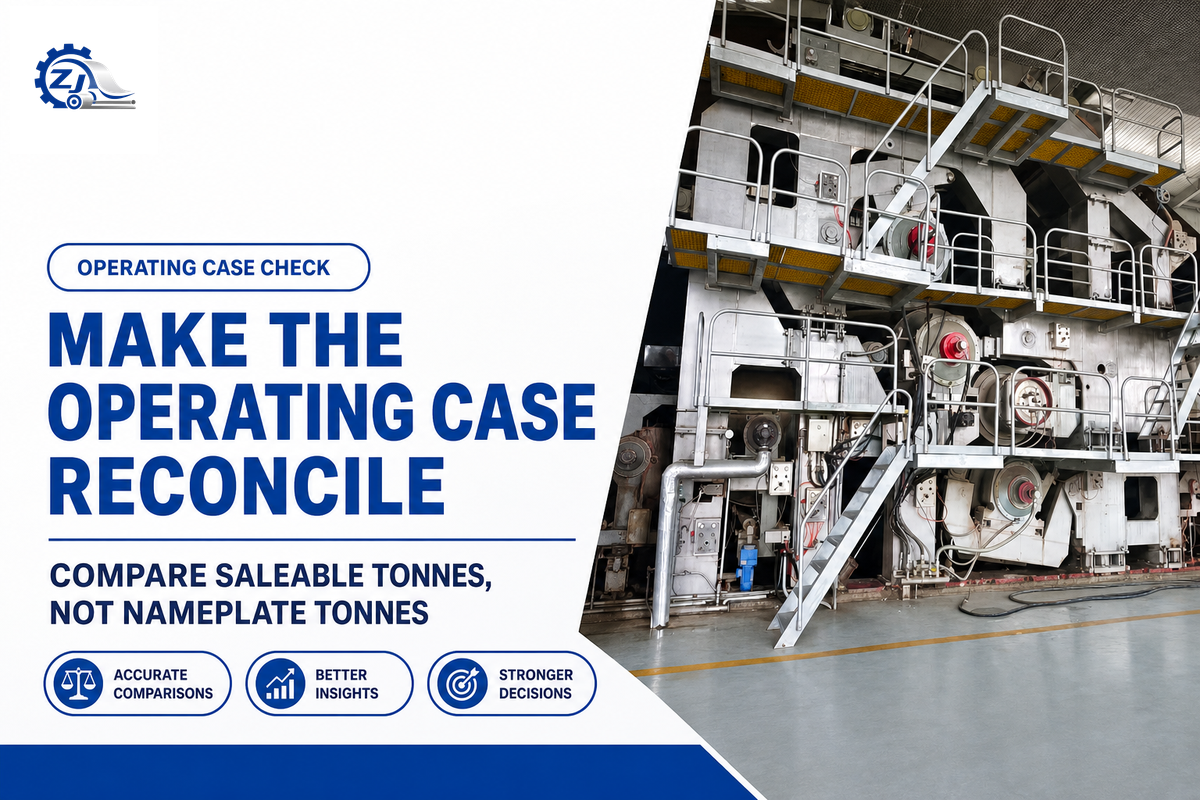
Saleable tonnes per day is an end result, not an independent specification. For this RFQ, require each supplier to reconcile net reel trim, basis weight, operating speed, scheduled hours, anticipated uptime, grade mix, moisture basis, and broke in its own calculation. Ask the supplier to separate design speed, mechanical maximum speed, guaranteed operating speed, and the speed used for output acceptance. A higher mechanical maximum isn’t automatically a better investment if the forming, pressing, drying, drive, or finishing sections can’t sustain the grade at that speed.
Use a minimum of three operating cases, a low-basis-weight case, normal production case and a heaviest or most demanding grade case. In each, ask for saleable output, anticipated reel moisture, speed, uptime basis and excluded losses. Both a Paprican benchmarking report published by Natural Resources Canada and peer-reviewed mill benchmarking reveal why production and energy data require basis and application context, not one overarching mill-wide number.
For illustration, a dimensioned operating-case row might read 120 g/m², 2,850 mm trim, 450 m/min, 150 TPD, 400 V at 50 Hz, 1,200 kW connected load, 8 bar compressed air, 6 bar steam, 10 °C process water, and a 45 °C ambient ceiling. These figures are placeholders, not recommended values; replace every one with site and product data before issue.
| Input category | RFQ entry | Vendor response | Limitation to record |
|---|---|---|---|
| Product grade | Named grade and end use | Configured section route | One setup may not cover every grade |
| Basis weight | Minimum, normal, maximum g/m² | Guaranteed range by case | Range does not prove equal quality at both ends |
| Furnish | Percentages and incoming condition | Accepted feed envelope | Contaminants and seasonal variation stay explicit |
| Reel trim | Net saleable width in mm | Deckle and edge-trim allowance | Machine width is not saleable width |
| Operating speed | m/min for each case | Operating, design, mechanical maxima | Mechanical maximum is not a production promise |
| Scheduled time | Hours/day and days/year | Availability assumptions | Maintenance and grade-change stops need owners |
| Broke and losses | Expected start-up and steady-state basis | Excluded loss factors | Gross production is not saleable output |
| Reel moisture | Target and tolerance | Measurement point and method | Moisture basis changes reported tonnes |
| Saleable output | TPD for each operating case | Calculation plus guarantee | Valid only under the stated case conditions |
Set Forming, Press, Drying, and Utility Constraints
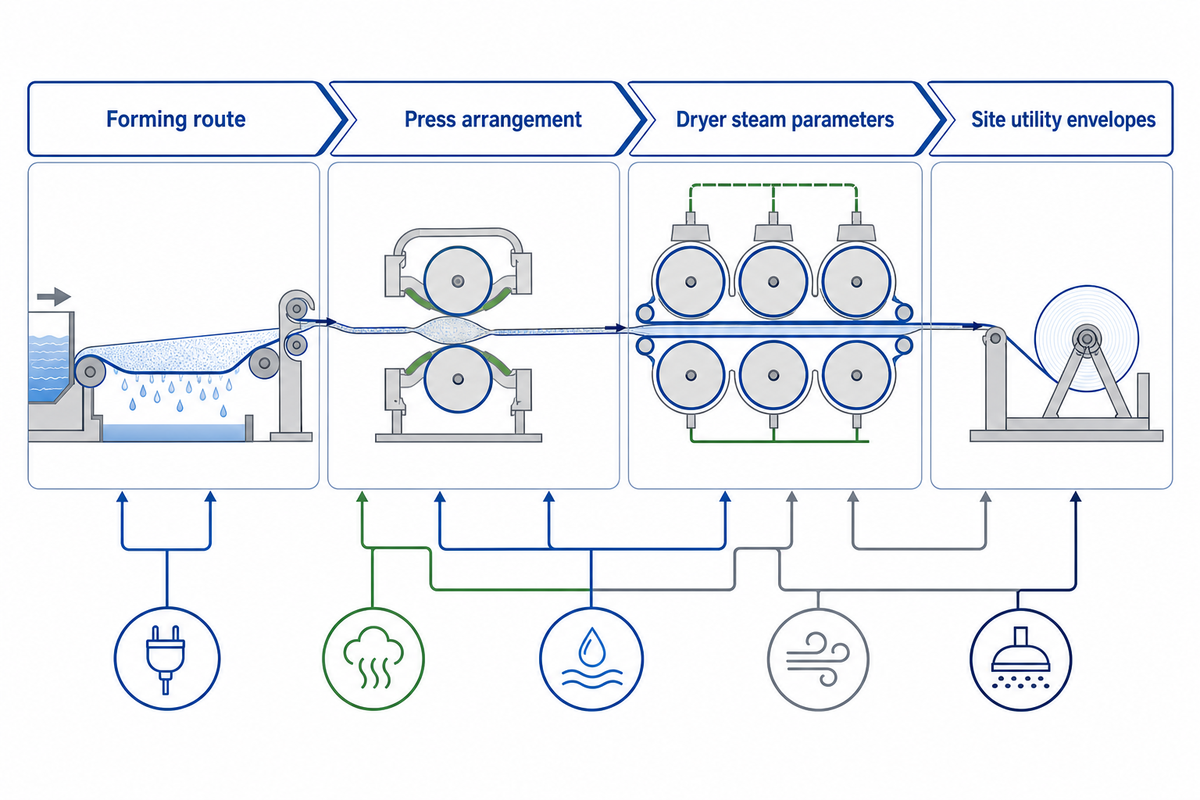
Tell the supplier what you expect from the wet end. Specify forming route, headbox or vat count, layer structure, drainage limits, vacuum philosophy, press arrangement, dryness measurement locations, dryer steam parameters, condensate return, hood and ventilation boundary, coating or size press requirement, calendar, reel, and rewinder scope. The purpose isn’t to impose a design upon the supplier, but to make the proposed water-removal path and its interfaces visible.
Supply site utility envelopes, not just nominal connections: electrical voltage, frequency, short-circuit basis, available power, steam pressure and quality, condensate-return status, raw and clarified water, process-water temperature, compressed-air pressure and quality, cooling water, vacuum, fuel, ambient temperature, altitude and water-discharge status. Then ask for minimum, normal, and maximum consumption by operating case. Our guide to the paper drying process demonstrates why steam, condensate, hood balance and reel moisture belong together.
“The method is unsuitable for determining the variability within a lot.”
That sampling limitation matters at acceptance. A test based on an average lot sample can’t silently stand in for a variability guarantee. The contract must specify the lot, population, sample points, frequency, method, laboratory, retest procedure, and dispute sample; it must then state how within-lot variability will be assessed.
Draw the Scope-of-Supply Boundary
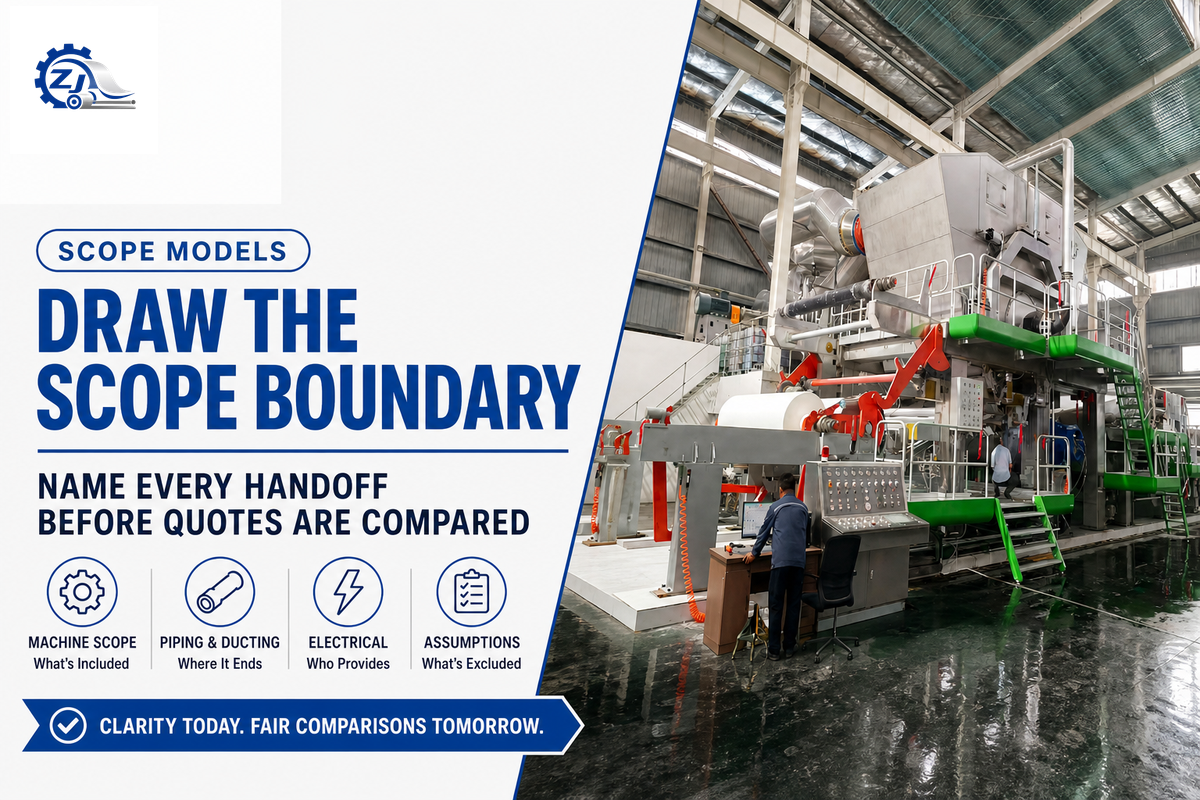
“Machine only,” “installed,” and “turnkey” are merely commercial labels until a boundary schedule defines them. The World Bank glossary recognizes engineering, procurement, and construction as a turnkey construction contract category. That doesn’t eliminate the need to define design responsibility, owner-supplied data, civil work, buildings, freight, unloading, erection, utilities, commissioning materials, permits, training, spares, and performance risk.
| Scope item | Machine-only bid | Installed bid | Turnkey/EPC bid | Normalization check |
|---|---|---|---|---|
| Process design | Often buyer-supplied | Shared | Usually supplier-led | Name design basis and approver |
| Civil and building | Excluded | Often excluded | May be included | List foundations, pits, cranes, access |
| Freight and unloading | Separate | Varies | Varies | Use named delivery point and terms |
| Erection | Excluded or supervised | Included | Included | Split labour, tools, cranes, consumables |
| Utilities to battery limit | Buyer | Buyer | Shared or supplier | Mark tie-in coordinates and conditions |
| Commissioning feedstock | Buyer | Buyer | Usually buyer | State quantity, quality, waste owner |
| Permits | Buyer | Buyer | May be assisted | Assign applicant and data provider |
| Performance risk | Section-level | Installed section | Line or project | Tie guarantee to exclusions and remedies |
If your team is still choosing the commercial boundary, use the paper mill delivery model selector. Once the model is chosen, issue the same marked grid to every bidder and require deviations in a separate list.
Make Controls, Support, Permits, and Safety Comparable
When comparing paper machine manufacturers, make each machine supplier map the whole production process: wood pulp or recovered fibre enters the refiner and stock system as pulp slurry, reaches a Fourdrinier or twin-wire former, passes through press rolls, and then enters the dryers and finishing train. The same map should show quality control systems and PLC control interfaces. Treat “low maintenance,” “energy-efficient,” and even “paper-making machine” as labels until the bid attaches measurable duties and evidence.
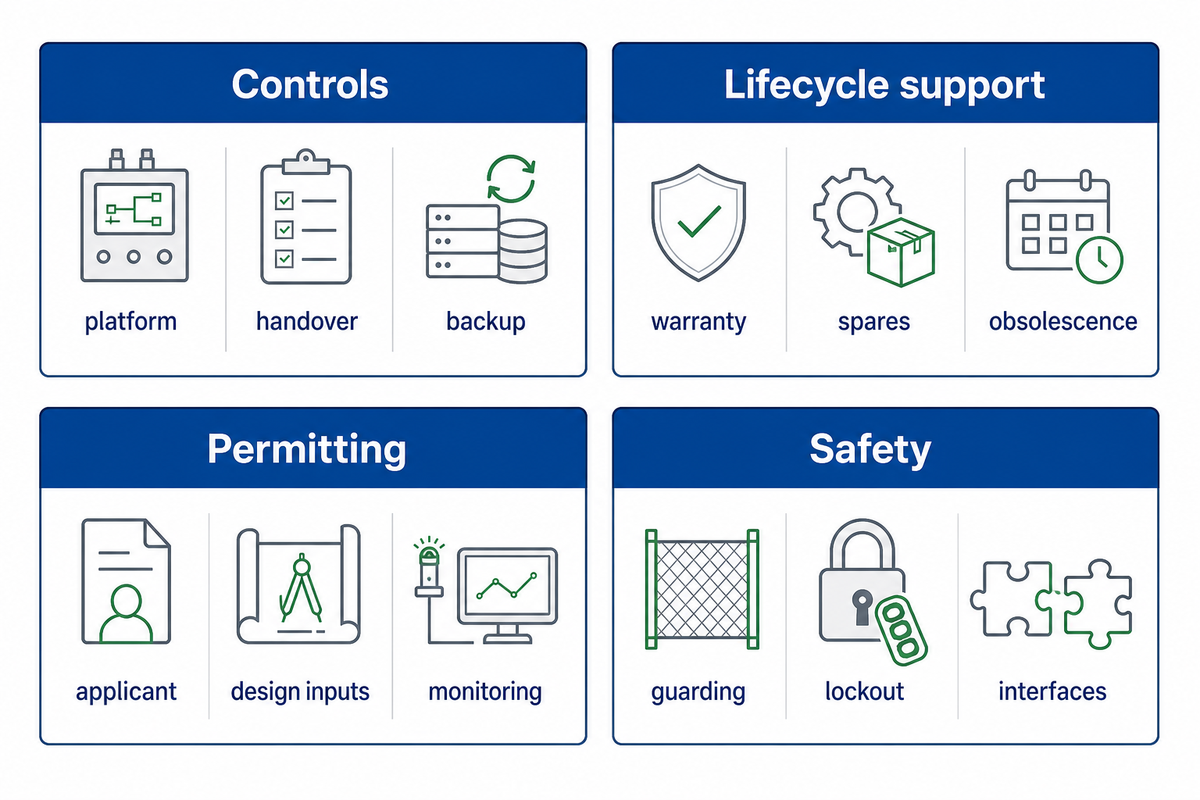
Automation scope should name the programmable controller and human-machine interface platform, input/output count and spare margin, networks, historian, quality-control interfaces, drive integration, source-code and password handover, backups, software licences, remote-support method, and obsolescence plan. NIST published SP 800-82 Revision 3 in 2023; it treats programmable controllers and distributed control systems as operational technology with distinct reliability and safety needs. Assign remote accounts, network access, patch ownership, backup testing, and incident response instead of accepting “remote service included.”
Lifecycle support needs its own schedule: warranty start point, response time by region, commissioning coverage, training hours, recommended two-year critical spares, long-lead items, consumables, planned maintenance, drawings, parts lists, software backups, and notice before component discontinuation. A United States federal procurement rule is not universal private-project law, but its comparison method is useful: it explicitly includes installation, maintenance, service, obsolescence, warranties, environmental or licensing needs, and supplier servicing capability.
Permitting also needs classification. United States EPA sources, for example, separate effluent subcategories by pulping, recovered fibre, deinking, purchased pulp, tissue, and paperboard routes, and maintain a separate hazardous-air-pollutant rule for pulp and paper production. The applicable duties differ by country and mill configuration; the RFQ should assign the permit applicant, required supplier data, emissions and discharge design inputs, monitoring points, and reporting support without implying that a machine quotation proves site approval.
Safety is broader than guards and emergency stops. OSHA’s pulp, paper, and paperboard rule includes machine guarding, lockout, dust, ventilation, pressure, hot surfaces, broke holes, and fire or explosion interfaces. ISO 12100 supplies general machinery risk-assessment principles. A 2026 paper-machine safety work item is still under development and publicly excludes several auxiliary systems, including pressure equipment, steam and condensate, ventilation, lubrication, compressed air, drives, and electrification. Treat every exclusion as an interface to assign, not as proof that it is safe or outside the project.
Write Acceptance and Commissioning Into the RFQ
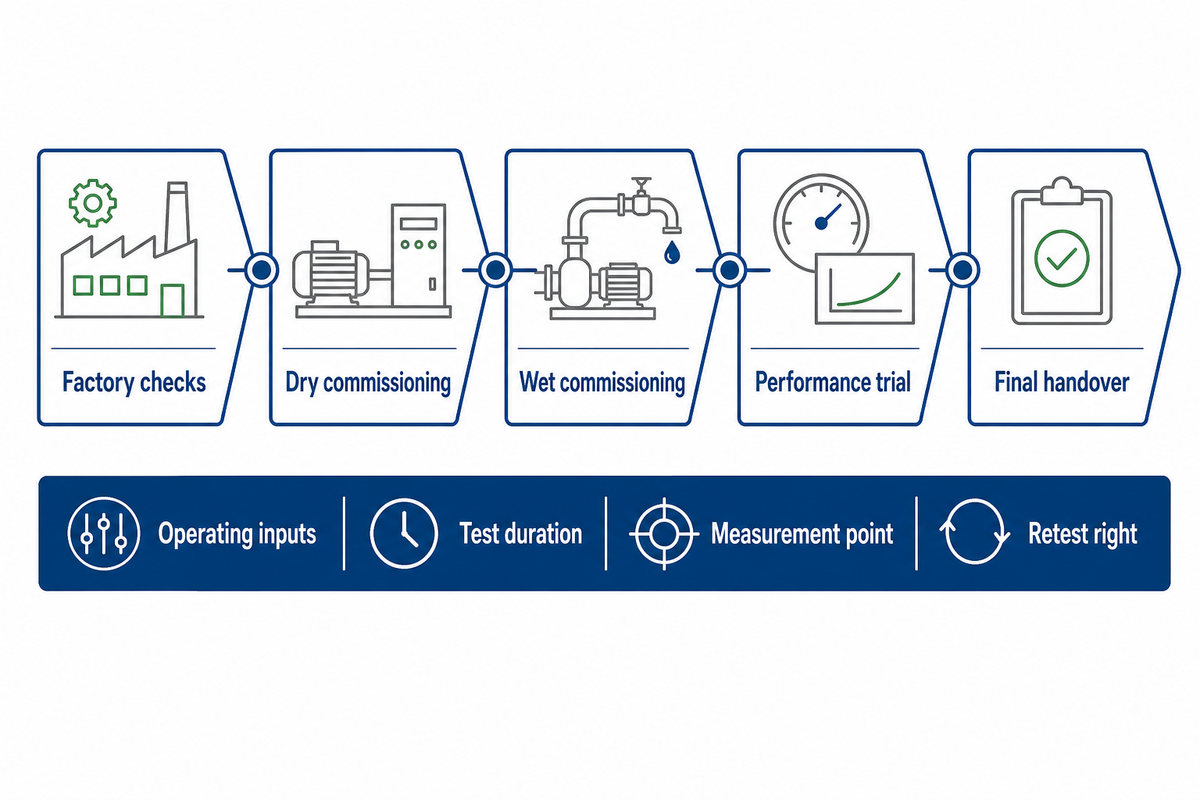
Acceptance turns a sales promise into a measured condition. Define factory checks, installation completion, dry commissioning, wet commissioning, performance trial, reliability run, training, punch-list closure, and final handover. Each guarantee needs operating inputs, test duration, stabilization period, measurement point, calibrated instrument, sampling plan, permitted exclusions, retest right, remedy, and the party that pays for a failed retest. Count accepted finished paper rolls, not untrimmed gross output.
- Freeze the operating cases: approve grade, furnish, basis weight, trim, speed, moisture, and output cases before design release.
- Approve interfaces: close civil, utility, control, safety, and permit battery limits on marked drawings.
- Witness factory checks: verify assemblies, drives, controls, records, and agreed simulations before shipment.
- Complete dry commissioning: prove rotation, interlocks, trips, networks, lubrication, and no-load sequences.
- Run wet commissioning: introduce stock, tune loops, train operators, and record open defects.
- Execute the performance trial: hold the stated operating case for the agreed duration using the approved sampling plan.
- Close handover: deliver final drawings, backups, manuals, spares, training records, and remedies before the final milestone.
You can copy the following checks into the acceptance section of the enquiry. They do not create universal limits; they force each supplier to state a measurable basis.
RFQ acceptance check list: copy these into your quote request:
| Parameter | Recommended range | Why it matters | How to verify |
|---|---|---|---|
| Operating cases | Minimum, normal, maximum project cases | One point cannot represent the grade envelope | Signed case schedule |
| Trial duration | Project-defined continuous hours | Short peaks do not show stable output | Time-stamped production record |
| Saleable output | TPD by approved case | Gross tonnes hide broke and rejected reels | Weighed accepted reels |
| Product quality | Grade-specific limits and methods | Output without quality is not saleable | Approved laboratory tests |
| Sampling | Lot, frequency, location, dispute sample | Average and within-lot variation differ | Signed sampling protocol |
| Utility consumption | Minimum, normal, maximum by case | Site systems must carry actual demand | Calibrated meters at battery limits |
| Reliability | Project-defined run and allowed stops | Speed alone does not show availability | Event and downtime log |
| Handover | All listed records and backups | Missing files shift lifecycle risk to the mill | Approved handover register |
The 12 Core + 4 Boundary Paper Machine RFQ Lock Sheet
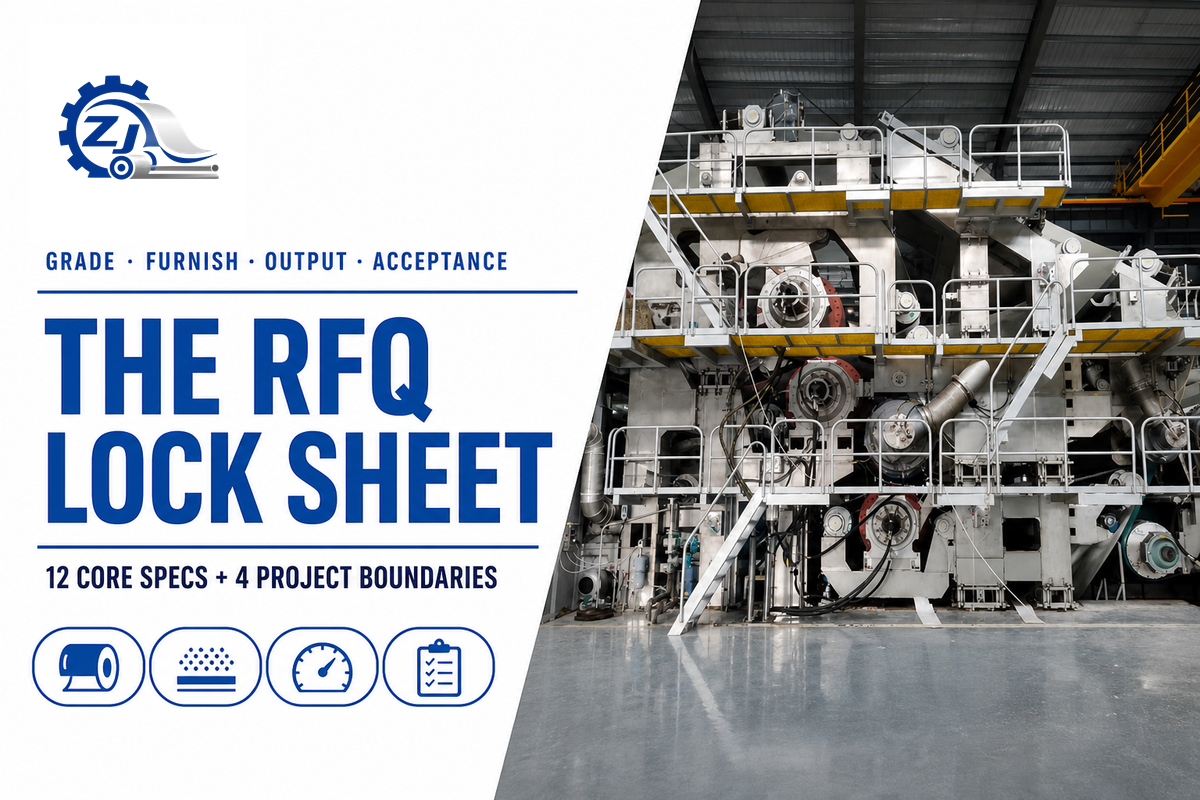
The Lock Sheet is a copy-ready front page for the full enquiry package. It is not a claim that sixteen lines capture every mill requirement. Its job is to prevent an important category from disappearing while detailed datasheets, drawings, cause-and-effect lists, specifications, and contract schedules are prepared, including the lifecycle comparison factors in FAR 7.401.
| # | Locked field | Minimum entry | Red flag |
|---|---|---|---|
| 1 | Grade schedule | Products, end uses, volume shares | “Various paper” |
| 2 | Basis weight | g/m² range by grade | One broad range with no cases |
| 3 | Furnish | Percentages and feed condition | “Waste paper” with no quality basis |
| 4 | Stock preparation | Included process and battery limits | No reject or broke boundary |
| 5 | Saleable output | TPD by operating case | Nameplate tonnes only |
| 6 | Trim width | Net reel width and edge trim | Machine width substituted |
| 7 | Speed | Operating, design, mechanical speeds | One unlabeled maximum |
| 8 | Wet-end route | Forming, press, dryness points | Equipment names without duty |
| 9 | Drying and finishing | Steam, moisture, hood, reel/rewinder | No moisture or condensate basis |
| 10 | Utilities | Site envelopes and consumption cases | Connection list with no demand |
| 11 | Automation and quality | Platforms, interfaces, ownership | “PLC included” |
| 12 | Acceptance and milestones | Tests, remedies, payment triggers | Payment before measurable acceptance |
| B1 | Lifecycle and service | Warranty, spares, training, obsolescence | Warranty with no response basis |
| B2 | Auxiliaries and control security | Pressure, steam, air, drives, networks, backups | Interfaces assumed “by others” |
| B3 | Permits and environment | Effluent, air, reporting, applicant | One generic compliance line |
| B4 | Site safety | Machine, process, facility interfaces | Guards treated as complete safety scope |
Frequently Asked Questions
What information is needed for a paper making machine quote?
Provide the paper grade and basis-weight range, furnish, stock-preparation boundary, saleable output, reel trim, speeds, forming and press route, drying conditions, site utilities, automation scope, delivery boundary, acceptance tests, and commercial milestones. Add schedules for lifecycle support, auxiliary and control-system interfaces, permits, and site safety so suppliers price the same project.
How much does a paper making machine cost?
There’s no defensible universal price range for this keyword alone. Cost changes with grade, furnish, daily output, width, speed, forming and drying design, automation, new or rebuilt condition, freight, erection, utilities, civil work, commissioning, spares, and guarantees. Normalize those items first, then compare delivered scope and lifecycle obligations rather than the headline machine number.
What capacity paper machine should a mill choose?
Choose capacity from saleable demand by grade, not from a supplier’s largest nameplate figure. Build low, normal, and high operating cases using basis weight, net trim, speed, scheduled hours, expected uptime, broke, moisture, and grade mix. The selected line should meet those cases within the site’s utility, stock-preparation, finishing, staffing, and market constraints.
Does a paper machine price include installation?
Sometimes, but the label alone isn’t evidence. Ask whether freight, unloading, civil works, erection labour, tools, cranes, utility tie-ins, commissioning stock, travel, accommodation, training, spares, performance testing, and permit support are included. Put each item in a responsibility matrix and require every bidder to list exclusions separately. Also identify who supplies temporary power, water, fibre, chemicals, operators, lifting plans, waste disposal, calibrated meters, and insurance during commissioning, because these items often sit outside both the machine price and the erection line.
Should a mill buy a new, used, or rebuilt paper machine?
Compare new, used, and rebuilt routes against the same cases and boundary schedules. Used equipment may shorten delivery, but condition, spare availability, relocation, and recommissioning can shift risk. Require a condition survey before treating its price as comparable.
What should a paper machine performance test include?
State the operating case, stabilization period, continuous test duration, acceptable stops, saleable-output method, reel-moisture basis, product-quality limits, utility meters, sampling population, test frequency, dispute sample, calibrated instruments, witnesses, exclusions, retest rights, and remedies. Machine performance and average product quality should be measured separately from within-lot variability. Record who may adjust setpoints during the trial, how off-spec reels are counted, what happens after an upstream utility interruption, and which records survive as the final acceptance evidence.
Send One Comparable Enquiry
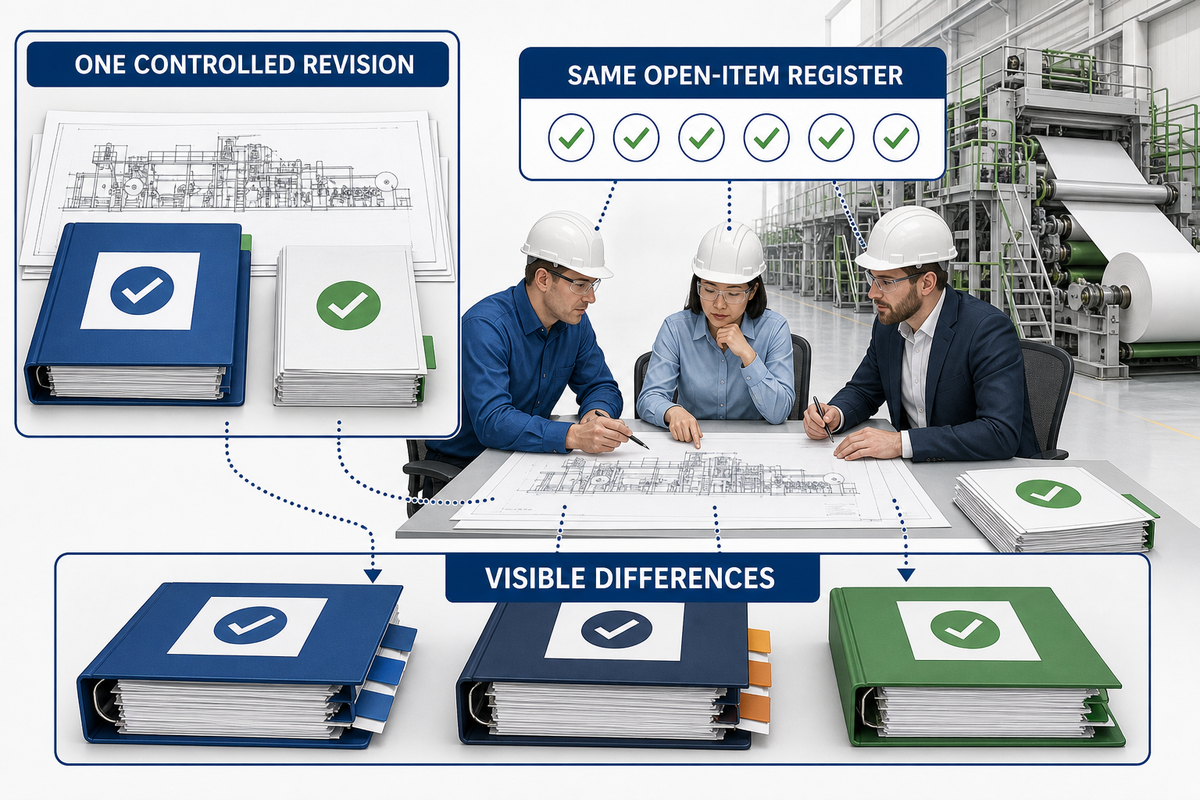
Complete the Lock Sheet, attach operating cases and boundary schedules, and send one controlled revision to every shortlisted supplier. Require a filled compliance matrix, marked scope drawing, utility schedule, guarantee table, exclusions list, delivery plan, and milestone proposal. Then hold clarification meetings against the same open-item register. This process does not select the machine for you; it makes the commercial and technical differences visible enough for a project team to decide.
Prepare a project-specific paper machine quotation
Send your grade schedule, furnish, saleable output, trim width, utility conditions, delivery model, and target commissioning date for a configuration and pricing review.
Company capability statements are attributed first-party information; project performance, permits, and compliance remain subject to the final written scope and destination requirements.
References & Sources
- TAPPI Academy: Paper Manufacturing Courses
- Dick Reese / Dick Reese and Associates, Inc.: Measuring Paper Machine Energy Performance (TAPPI PaperCon)
- Paprican: Energy Benchmarking in the Pulp and Paper Industry (published by Natural Resources Canada)
- BioResources: Paper Mill Energy-Efficiency Benchmarking
- Acquisition.gov: FAR Subpart 7.4, Equipment Acquisition
- World Bank: PPP Reference Guide Glossary
- ISO 12100:2010: Safety of Machinery
- ISO/AWI 25951-1: Paper-Making and Finishing Machinery Safety Work Item
- ISO 186:2002: Paper and Board Sampling
- NIST SP 800-82 Revision 3: Operational Technology Security
- OSHA 29 CFR 1910.261: Pulp, Paper, and Paperboard Mills
- US EPA: Pulp, Paper, and Paperboard Effluent Guidelines
- US EPA: Pulp and Paper Production Air-Emission Standards
![Refiner Plates & Screen Baskets [Complete Guide]](https://zjpapermachine.com/wp-content/uploads/2026/07/refiner-plates-screen-baskets-guide-featured-150x150.png)
![Doctor Blade: Types, Materials & How It Works [Guide]](https://zjpapermachine.com/wp-content/uploads/2026/07/doctor-blade-guide-featured-1-150x150.png)
![Pulping Equipment: How Paper Pulping Works [Guide]](https://zjpapermachine.com/wp-content/uploads/2026/07/pulping-equipment-guide-featured-150x150.png)