
Get in touch with Zejiang Paper Machinery Company

Used Paper Machinery: How Buyers Inspect Risk Before Purchase


Buyer Evaluation Guide
Used Paper Machinery refers to previously installed production equipment whose identity, fit, condition, and project scope must be verified for a new application. A listing tells you what a machine is called; a defensible purchase decision needs evidence of what it can make, what is missing, and what relocation and restart will require.
Quick Answer
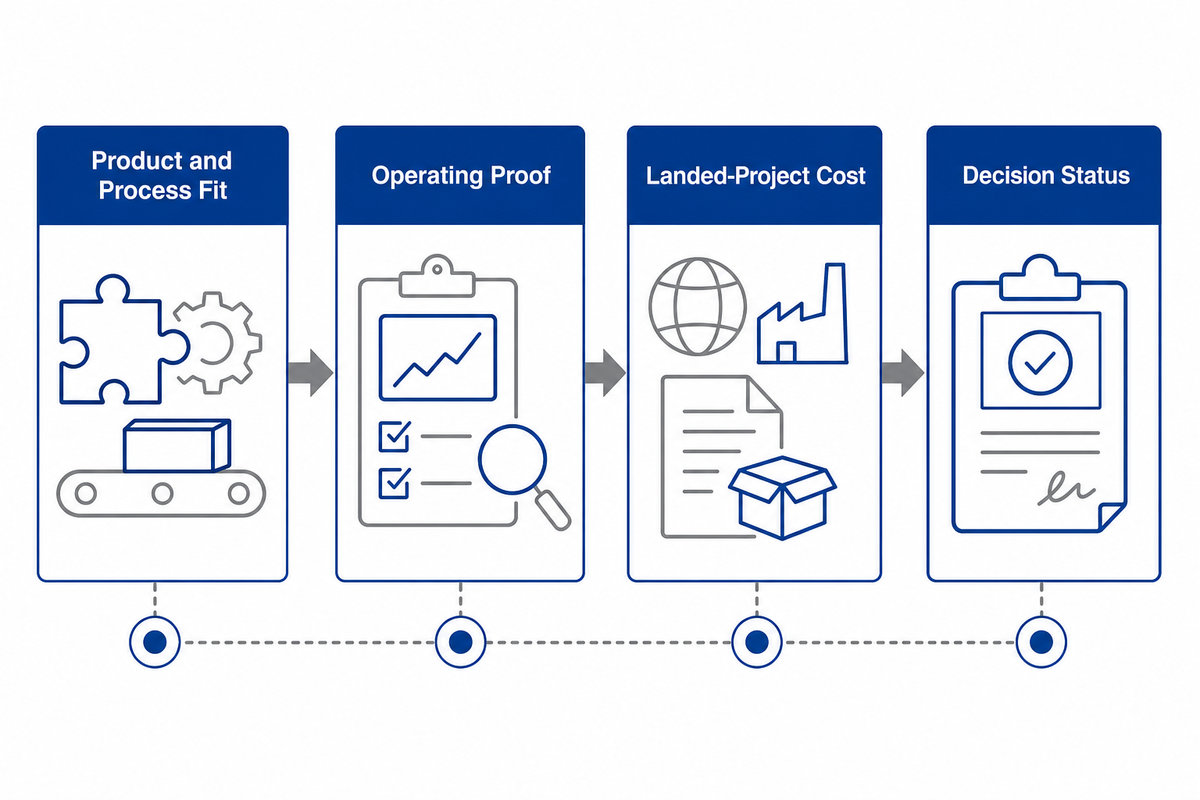
Used paper machinery should be evaluated as a project, not as a listing. First confirm product and process fit. Then rank the seller’s evidence, separate static observations from operating proof, inspect connected systems, build a landed-project cost range, and assign dismantling-to-startup responsibility. Proceed only when every material gap is either closed or converted into a written condition.
Primary decision
Fit, evidence, condition, cost, and responsibility
Fit, evidence, condition, cost, and responsibility
Evidence rule
Record what was observed, by whom, when, and under which operating state
Record what was observed, by whom, when, and under which operating state
Commercial handoff
Only after the evaluation gate is complete
Only after the evaluation gate is complete
Run the evaluation in sequence. Any machine that fails product fit should not consume a detailed inspection budget. Only after a machine fits on paper should commercial negotiation begin, and then only when its identity and evidence pack are coherent. Condition findings should not become repair estimates until the cause and test boundary are defined. Finally, the purchase should not advance until relocation, installation, and acceptance responsibilities have owners. This ordering reduces sunk-cost pressure: travel, engineering time, and negotiation effort increase only as the evidence becomes stronger.
Keep three columns in the working file: seller assertion, buyer observation, and decision status. They are not interchangeable. Sellers may accurately repeat a historical production figure; the buyer still needs its date, grade, speed, uptime window, and configuration context. Inspectors may observe a clean component without establishing internal condition or future life. Decision status should therefore say verified, conditionally accepted, unresolved, or rejected—and name the evidence that would change it.
What Counts as Used Paper Machinery?
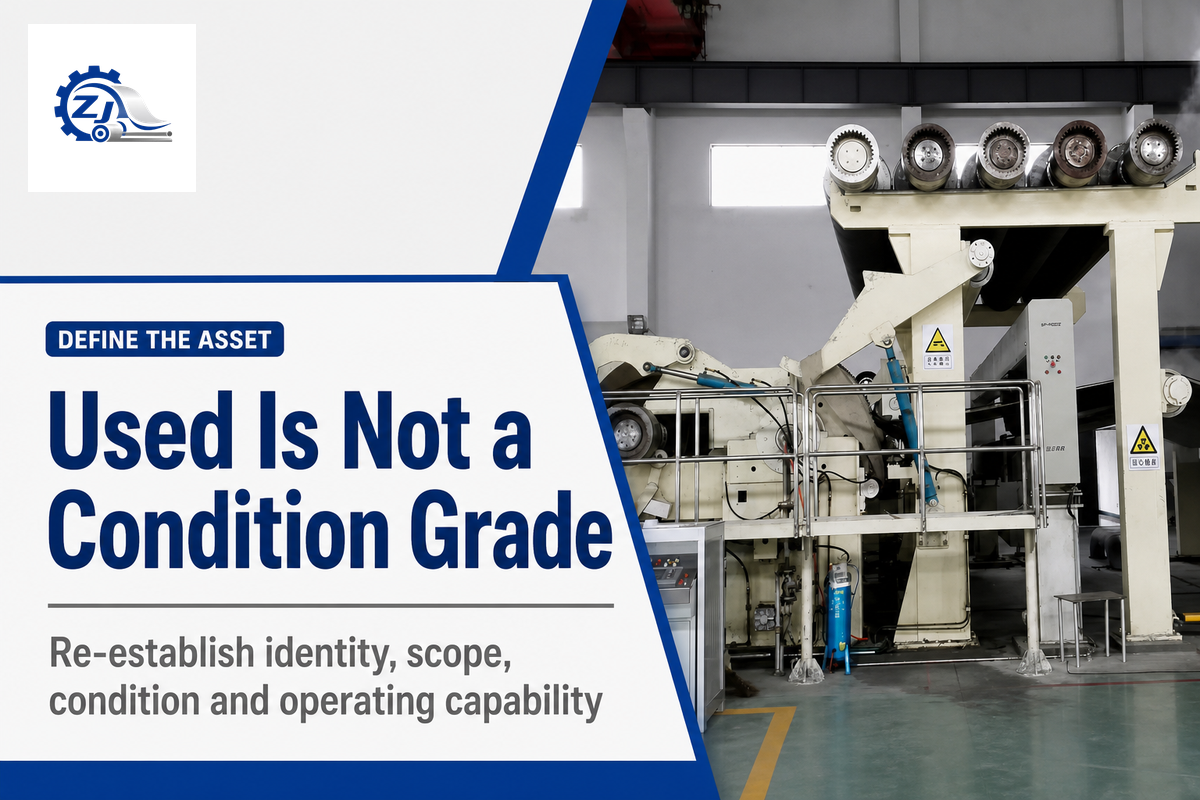
Used paper machinery is previously installed production equipment from a pulp or paper process whose identity, scope, condition, and operating capability must be re-established for a new project. It can include a complete paper machine, a stock-preparation line, an individual press or dryer section, approach-flow equipment, drives, pumps, refiners, winders, reels, or auxiliary systems.
“Used” is not a condition grade. It does not tell you whether the equipment is complete, stored correctly, still installed, capable of running, or suitable for the intended grade. Nor does it automatically include converting, printing, laboratory, or packaging equipment. Define the process boundary before comparing offers.
In the pulp and paper market, the same asset may be advertised as paper mill machinery, second-hand equipment, or surplus equipment. Those labels describe the sales context; they still do not establish condition, completeness, or fit.
| Scope | Typical examples | First boundary question |
|---|---|---|
| Complete production line | forming through reel | Which auxiliaries and controls are included? |
| Process section | press, dryer, size press | Where do mechanical and process interfaces begin and end? |
| Stock preparation | pulper, screen, cleaner, refiner | Which furnish and throughput were demonstrated? |
| Finishing and handling | reel, winder, roll handling | Does width, speed, and roll format match? |
For a full process and section overview, see how industrial paper machines work. This guide stays on the buyer’s evidence and decision problem.
Start With Product and Process Fit, Not the Asking Price

Price cannot rescue a machine that cannot make the intended product. Build a one-page fit sheet before discussing commercial terms. Use the buyer’s required values in one column, the seller’s stated values in another, and the strongest available proof in a third.
| Fit input | What to request | Do not confuse with |
|---|---|---|
| Product grade | recent grade list and reels made | a broad “paper machine” label |
| Furnish | fiber mix and stock-prep route | design intent without run history |
| Basis-weight range | demonstrated operating records by grade | theoretical minimum and maximum |
| Trim width | finished trim and roll format | wire or frame width |
| Speed | sustained speed for the target grade | nameplate or design speed |
| Output | dated production log with basis weight and uptime context | a single best-day figure |
| Utilities | steam, power, water, air, and vacuum loads | motor nameplates alone |
| Interfaces | battery limits and connection drawings | “complete line” wording |
Sellers can truthfully state design speed while a machine has operated for years at a lower stable speed. Record both values. That difference is not automatically a defect; it affects capacity, rebuild scope, energy, and acceptance testing. Use the capacity and grade selector to structure buyer-side inputs, while still requiring evidence from the target machine.
The Five-Evidence Ladder: What to Verify Before Travel
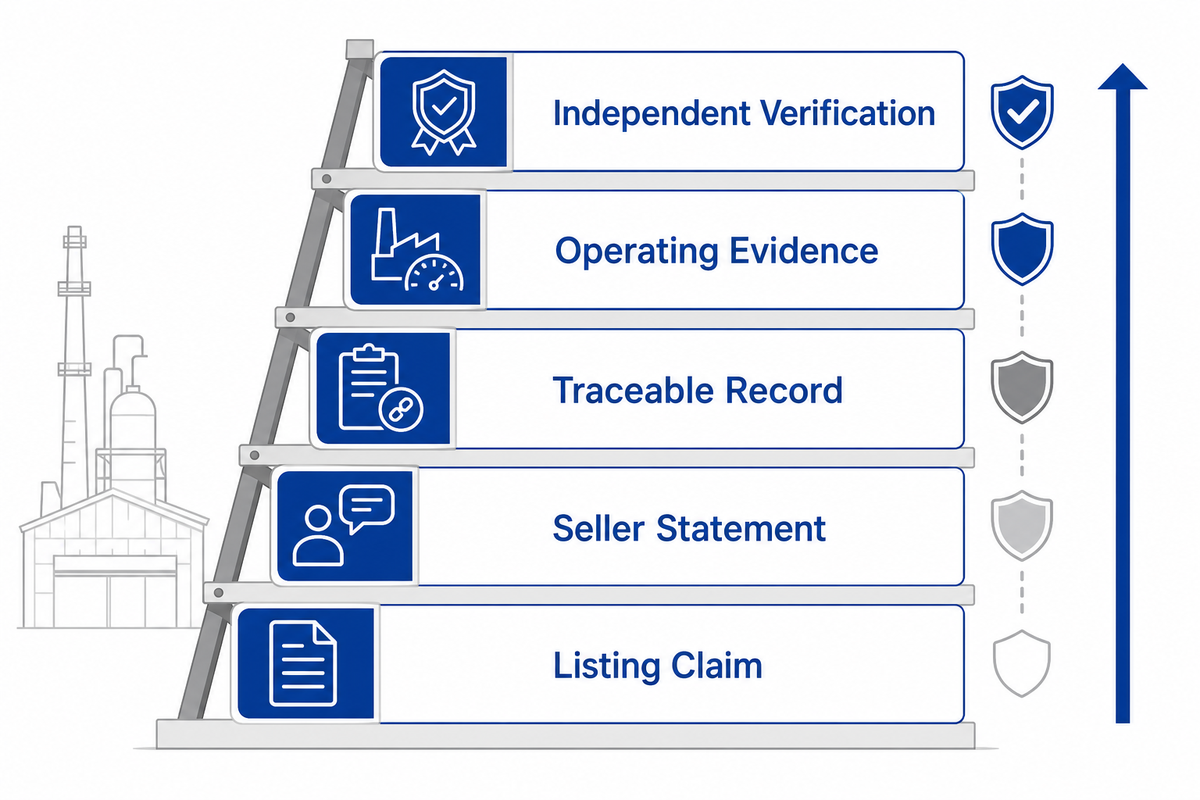
Our Five-Evidence Ladder ranks information by how directly it supports a decision about the identified machine. Each higher level adds traceability, operating context, or independent checking, so polished listings no longer receive evidentiary weight equal to dated records and controlled observations.
- Level 1 — Listing claim. A useful lead, not verification. Save the exact wording, date, URL, and machine identifier.
- Level 2 — Seller statement. Ask who supplied the answer and whether it refers to design, historical best, or current condition.
- Level 3 — Traceable record. Nameplates, layouts, motor lists, PLC backups, maintenance records, inspection reports, and shutdown history should match the same asset.
- Level 4 — Operating evidence. Dated video, trends, production logs, quality data, and observations under a defined grade, speed, load, and utility state.
- Level 5 — Independent verification. A qualified party checks critical identity, condition, measurements, and test boundaries against an agreed scope.
Minimum record for every material claim
Record the claim, machine identity, evidence owner, evidence date, operating state, limitation, and next action. If any field is missing, mark the claim not verified rather than filling the gap with an assumption.
ISO 12100 provides a machinery risk-assessment and risk-reduction methodology. It does not certify a used listing, but its logic is useful here: identify risks and assumptions, evaluate them, and document the reduction action. ISO reports the 2010 edition was confirmed in 2022 while a replacement draft is in development.
Before booking travel, reconcile the evidence pack against a machine identity sheet. At minimum, compare manufacturer, model, serial number, original year, major rebuild dates, current owner, current location, and the scope offered for sale. Then compare layout revision, drive list, PLC architecture, and the latest available operating record. A drawing with no revision or machine identifier may still be helpful, but it belongs lower on the ladder until the seller shows how it maps to the installed asset.
Evidence also has a time boundary. Historical live runs prove past capability, not current readiness after shutdown or storage. Recent storage inspections prove visible condition, not prior production. Retain both; label each correctly. When evidence conflicts, do not average the claims. Record the contradiction and ask for the next discriminating record or test.
Live Run or Static Inspection: What Each Can Prove
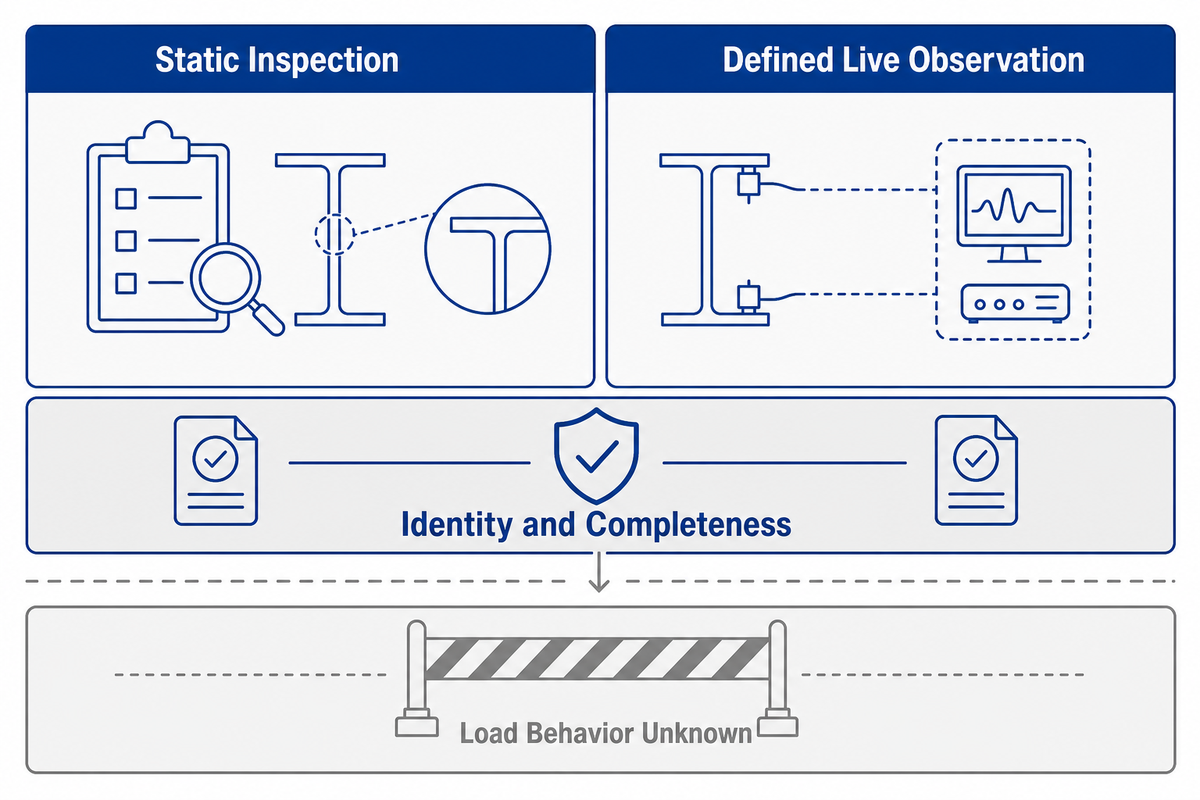
Yes, a machine can be inspected when it is not running, but the report must state what remains unproven. A static inspection can establish identity, obvious completeness, visible corrosion, storage damage, access, drawing mismatches, controls age, and some measured dimensions. It cannot prove load vibration, steam or vacuum stability, drive synchronization, sheet runnability, quality stability, or sustained output.
| Evidence question | Static inspection | Defined live observation |
|---|---|---|
| Identity and completeness | strong if tagged and reconciled | also confirms installed relationships |
| Visible wear or corrosion | observable where accessible | guarding and motion limit access |
| Bearing behavior | history and non-running checks only | temperature, sound, and vibration under stated load |
| Process stability | not demonstrated | observable for the actual run window |
| Sustained output | records only | requires enough duration and production context |
Safety is not an inspection variable to trade away. OSHA 1910.147 covers servicing and maintenance where unexpected energization, startup, or stored-energy release could injure workers. Observation while operating is not permission to bypass guards. Hands-on checks belong under a site-approved isolation procedure led by qualified personnel.
In another precision-manufacturing domain, a controlled study of 82 inspectors found that they correctly rejected 85% of defective parts but incorrectly rejected 35% of acceptable parts. Those are not paper-machine defect rates. More narrowly, the study shows that visual judgment can create false alarms as well as misses, so an anomaly should lead to a defined measurement, record check, or controlled test—not instant certainty. See the peer-reviewed study.
The 12-System Inspection Grid
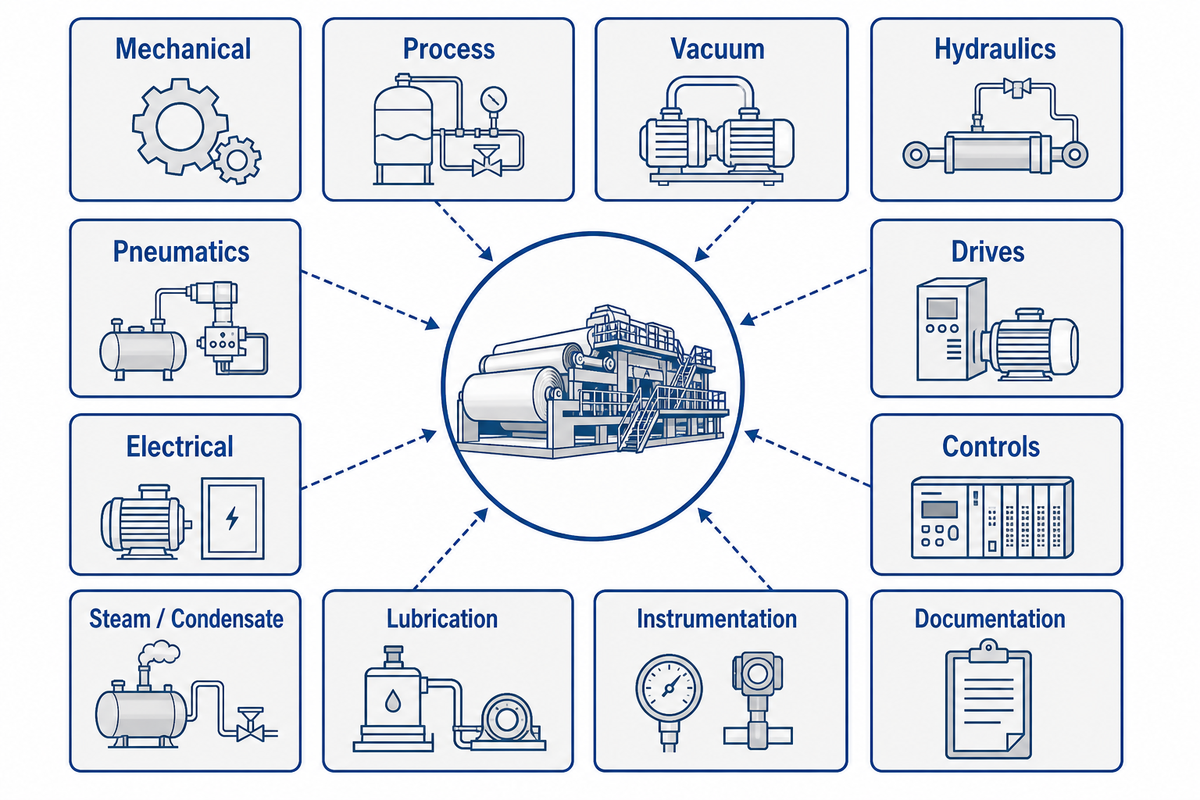
Paper machines are interacting systems. Drive alarms may originate in mechanics, process load, controls, instrumentation, or power quality. Dryer problems may cross steam, condensate, ventilation, lubrication, and alignment. Our 12-System Inspection Grid keeps observations connected and gives every open item an owner and next test.
| System | Inspect or reconcile | Preferred evidence | Typical next test |
|---|---|---|---|
| 1. Mechanical | frames, rolls, journals, bearings, guards | drawings, repair history, measurements | dimensional or NDT scope by qualified inspector |
| 2. Process | flow path, showers, doctors, fabrics | P&IDs, grade logs, operating notes | mass-flow and interface review |
| 3. Steam/condensate | headers, joints, siphons, traps | pressure records and inspection files | code- and site-specific inspection plan |
| 4. Vacuum | pumps, separators, piping, seals | vacuum trends and motor load | leak and capacity test |
| 5. Lubrication | oil system, lines, filtration, cleanliness | oil analysis and change records | sample or flush-scope review |
| 6. Hydraulics | power units, cylinders, hoses, valves | schematics and leak history | pressure-hold and contamination checks |
| 7. Pneumatics | air preparation, cylinders, controls | air demand and maintenance records | leak and function check |
| 8. Electrical | MCCs, cables, panels, protection | single-lines and test records | qualified condition and compatibility review |
| 9. Drives | motors, gearboxes, VFDs, line shafts | load, alarm, and vibration trends | load-context vibration and drive review |
| 10. Controls | PLC, DCS/QCS, HMI, networks | hardware list, licenses, backups, versions | restore test and lifecycle review |
| 11. Instrumentation | sensors, scanners, transmitters | calibration and loop records | loop and calibration check |
| 12. Documentation | as-builts, manuals, software, spares | indexed document register | gap-to-recovery plan |
A 2024 peer-reviewed condition-monitoring review explains that operating machinery produces vibration from both normal behavior and developing problems. Context is therefore essential: sensor location, speed, load, direction, time history, and comparison baseline matter more than an isolated number.
“These major cracks were located outside of the ‘high stress areas’ associated with the heads typically specified for periodic inspection.”
James E. Bennett, National Board paper-machine dryer-can failure investigation
That 1990 paper describes one vintage machine and should not be turned into a universal rejection threshold. Its durable lesson is about scope: assumptions about “usual” locations can leave material areas unexamined. Inspection method and coverage should be selected by qualified specialists for the actual equipment.
The Red-Flag-to-Next-Test Table
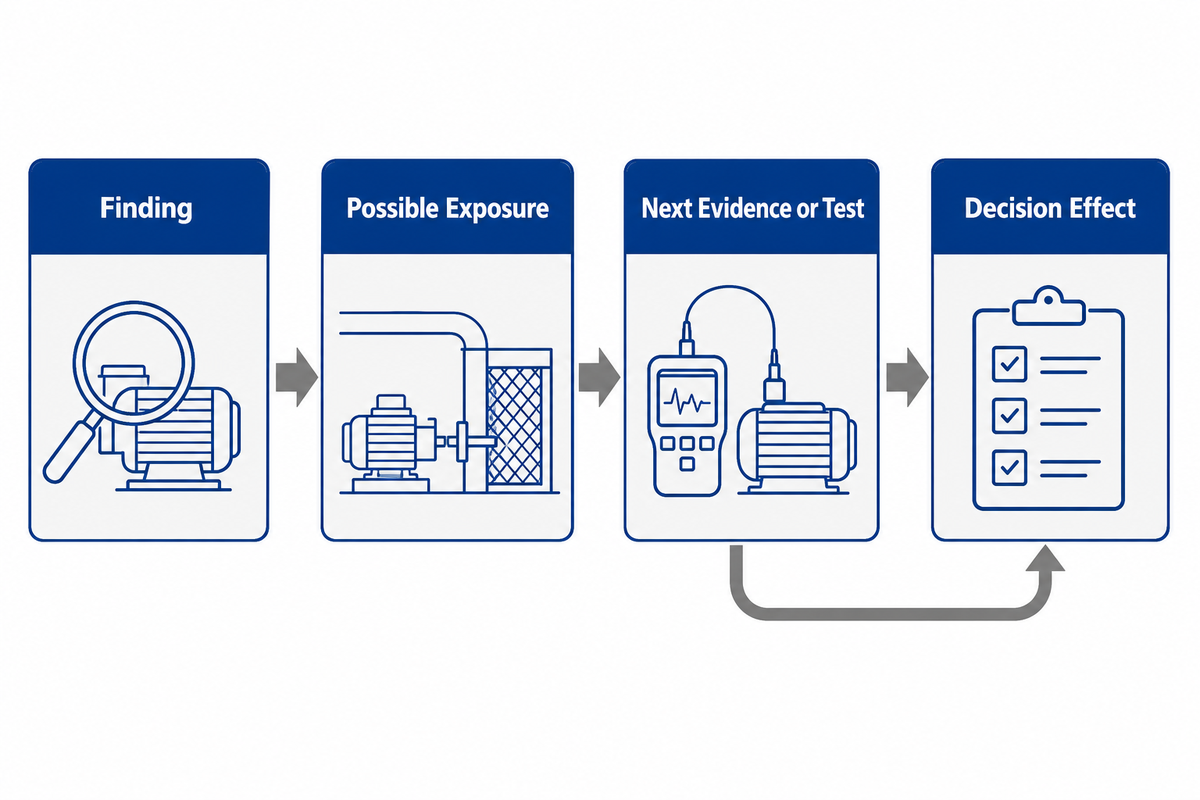
The 12-system inspection scope makes red flags decision inputs, not automatic verdicts. That system-by-system context keeps a visible sign from being mistaken for its cause. Our Red-Flag-to-Next-Test Table then turns each observation into an action by defining the evidence needed to close it. Reject immediately only when the issue is already a non-recoverable fit, safety, ownership, or evidence failure.
| Finding | Possible exposure | Next evidence or test | Decision effect |
|---|---|---|---|
| No live run | load behavior unknown | records, test conditions, allowance | conditional, unless critical proof has no recovery route |
| Missing PLC backup | controls recovery or rewrite | version inventory, backup search, migration scope | costed condition |
| Corrosion under storage | surface or section loss | qualified examination and measurements | hold pending scope |
| High bearing vibration | bearing, alignment, looseness, process load | trend with speed/load and location | investigate before pricing repair |
| Drawings do not match | undocumented modification | field walkdown and redline set | documentation condition |
| Critical part unavailable | long outage or redesign | OEM status and engineered alternative | replace, redesign, or reject |
Used, Repaired, Refurbished, Rebuilt or Modernized?
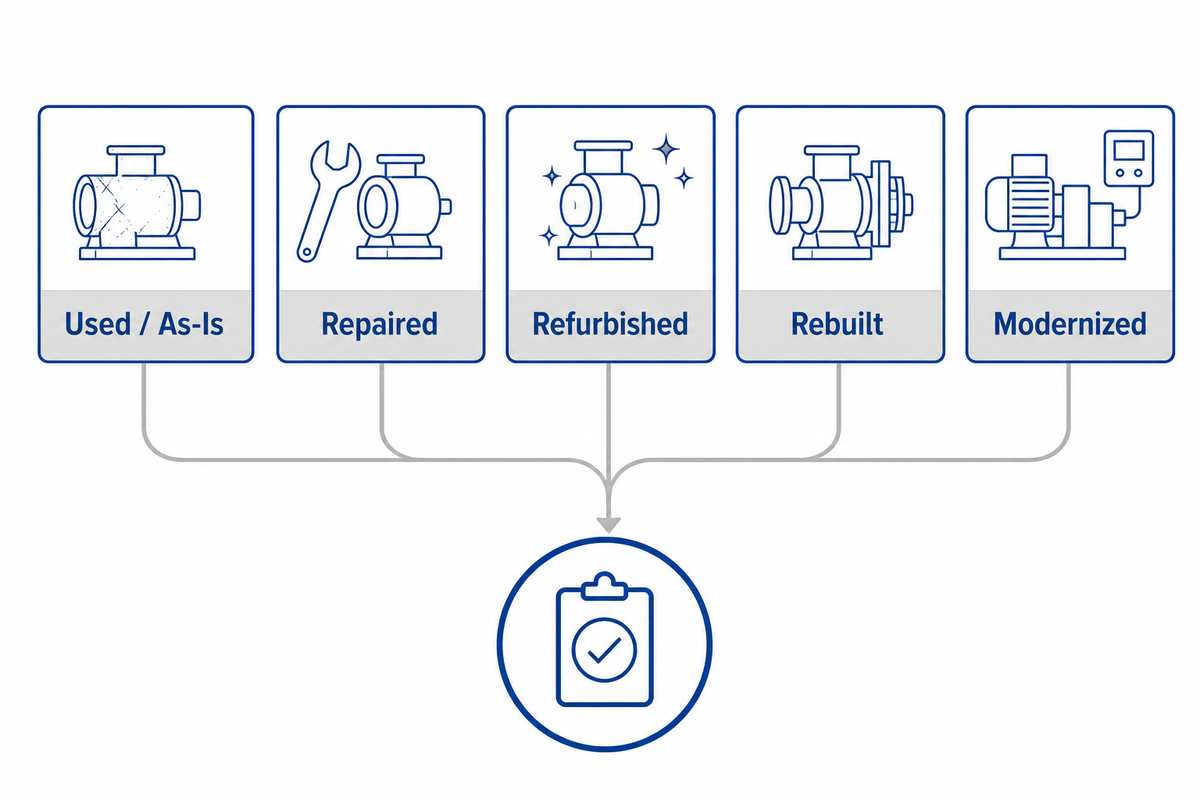
Condition-label evidence follows the same red-flag and next-test rules. “Used,” “repaired,” “refurbished,” “rebuilt,” and “modernized” are not interchangeable, and this research found no binding cross-market work scope for them; treat each label as a claim that needs a component-level work ledger.
| Label | Possible meaning | Evidence to require |
|---|---|---|
| Used / as-is | no defined restoration scope | condition record, exclusions, included scope |
| Repaired | specific faults addressed | repair report, parts, measurements, test |
| Refurbished | selected cleaning, service, and replacement | line-item scope and untouched exclusions |
| Rebuilt | deeper restoration of defined sections | as-left dimensions, parts, drawings, acceptance tests |
| Modernized | new controls, drives, instrumentation, or performance changes | architecture, software, licenses, interfaces, performance basis |
Ask what was inspected, what was replaced, what remained untouched, which drawings were updated, how the work was tested, and which acceptance criteria apply. For the full project sequence, use the paper machine rebuild planning guide rather than trying to infer rebuild depth from a sales label.
The Landed-Project Cost Stack
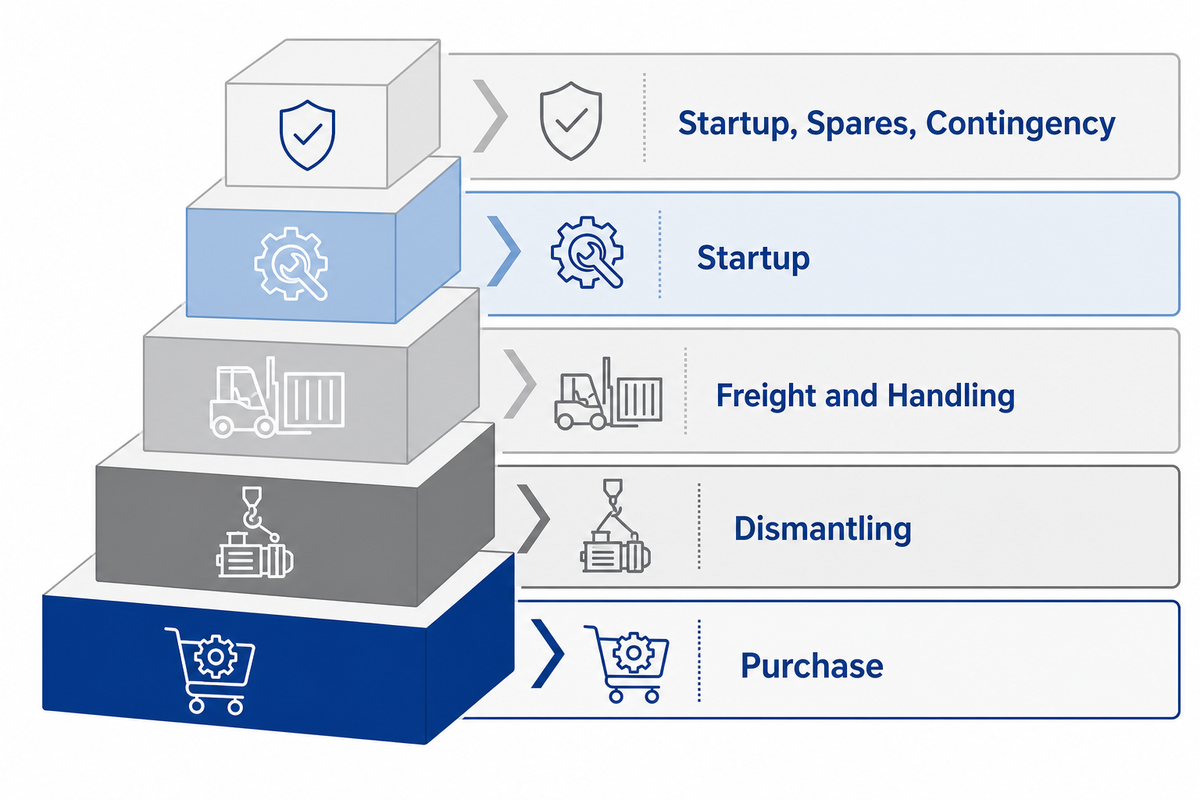
Useful comparisons do not stop at listing price versus new-machine price. Once the rebuild or refurbishment scope is defined, carry its open work into the expected cost of placing the asset into a defined operating state, along with the early lifecycle exposure that available evidence has not removed.
Illustrative indexed example: purchase price = 100 units
This is a worksheet, not a market-price claim. Assign low, base, and high allowances from project quotations, site surveys, and inspection findings.
| Cost bucket | Low | Base | High | Evidence basis |
|---|---|---|---|---|
| Purchase | 100 | 100 | 100 | agreed commercial scope |
| Dismantling and match-marking | buyer input | method, labor, lift plan, site limits | ||
| Preservation and packing | buyer input | pack list, storage duration, export requirements | ||
| Freight, handling, duties, destination levies | buyer input | route-specific quotations | ||
| Foundation and utilities | buyer input | destination survey and loads | ||
| Reassembly and alignment | buyer input | crew scope and tolerances | ||
| Controls and electrical recovery | buyer input | backup, license, hardware lifecycle | ||
| Startup, spares, contingency | buyer input | open-item register and acceptance plan | ||
Calculate three totals. Low case assumes documented, recoverable interfaces; base case uses the most likely defined scope; high case prices unresolved items without assuming they will disappear. Record the owner and confidence for every line. If one party says an item is included, attach the exact deliverable and acceptance boundary.
Energy belongs in the operating comparison, not the purchase invoice. Use the paper machine energy estimator to structure inputs, then validate them against the proposed configuration and target grade. Do not invent a universal percentage for freight, rebuild, or contingency; those shares change with location, completeness, size, condition, and responsibility.
Dismantling, Shipping and Startup Are One Risk Chain
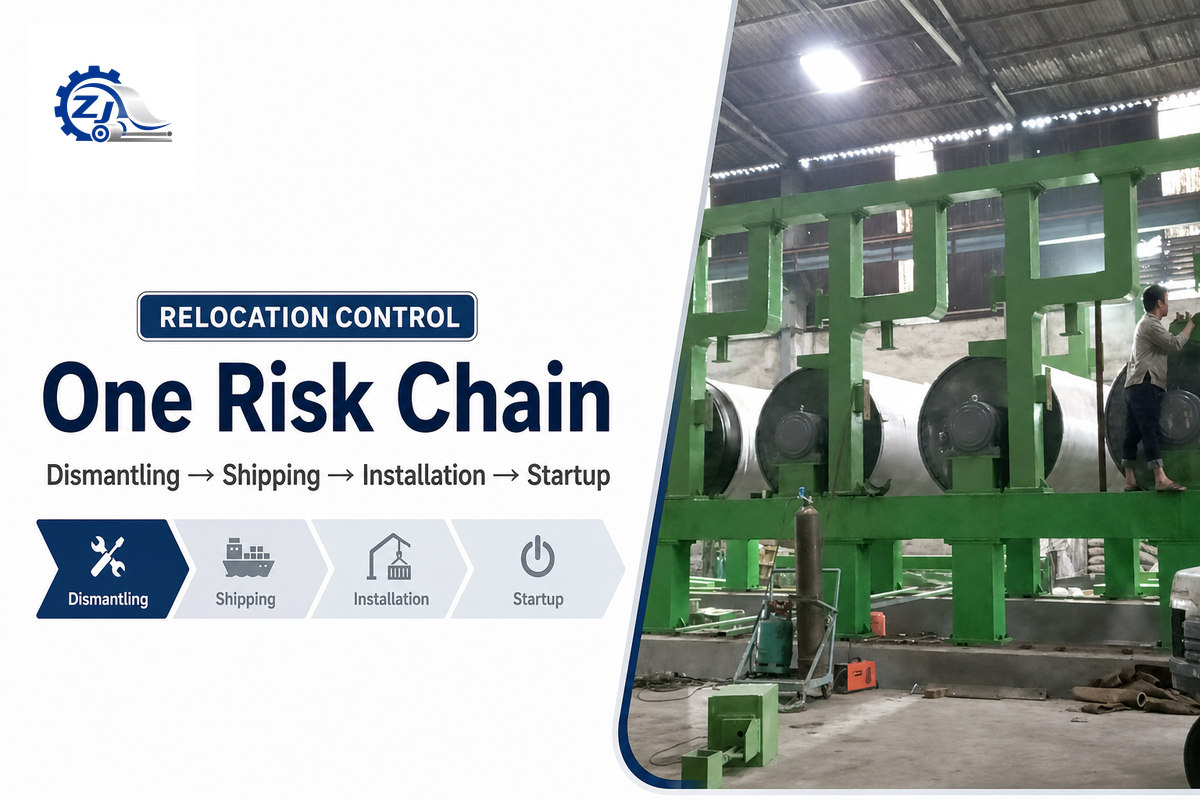
A good inspection can still end in a poor project if the machine loses identity during dismantling. Those cost-stack allowances now become work packages with named owners. Freeze the handoffs before removal begins: tag equipment and cables, photograph interfaces, match-mark parts, reconcile the pack list, preserve machined surfaces, define lift points, and record loose items and software media.
Responsibility chain to freeze before shipment
- Seller/site owner: access, isolation, regulated-material information, utilities, and asset release.
- Dismantling contractor: method statement, match-marking, preservation, lift plan, and damage record.
- Packer/freight forwarder: packing standard, dimensions, weights, route, handling points, and weather protection.
- Importer/buyer: classification, documents, duties and levies, destination permits, and unloading.
- Civil and installation teams: foundation data, anchor plan, access, utilities, alignment, and as-built updates.
- Controls/startup team: backups, licenses, networks, I/O checks, interlocks, dry tests, wet tests, and acceptance records.
Official IPPC guidance on ISPM 15 covers approved treatment, marking, repair, reuse, and import inspection of wood packaging. Whether it applies to a particular crate and route is a shipping-compliance question, not a machine-condition claim.
For EU projects, EU Machinery Regulation 2023/1230 applies from 20 January 2027 and includes machinery, partly completed machinery, and substantial-modification considerations. Confirm project-specific obligations with qualified local specialists.
Use the site readiness checklist before the asset leaves its current location, then map the full paper machine commissioning process. Purchase acceptance, shipping acceptance, mechanical completion, and performance acceptance are different gates.
What Mill Closures and Grade Shifts Mean for Buyers

The risk is treating a regional capacity headline as evidence about one machine. Buyers still have to verify grade fit, current condition, utility demand, controls support, relocation scope, and the destination market for the identified asset. Availability may change; technical suitability does not become automatic.
Closure news can increase the number of available assets, but it does not prove a bargain. In its January 2026 review of 2025, ResourceWise reported—with FisherSolve attribution—that North America lost nearly 6 million tons of capacity while Asia Pacific added nearly 16 million tons; it also reported U.S. containerboard capacity down nearly 10% from 2024. These figures describe regional capacity change, not used-machine prices or transaction quality.
Current PaperAge news coverage likewise shows closures, conversions, and capacity additions occurring together. Buyers should test relevance: original grade, stable speed, efficiency, controls support, utility demand, and conversion scope. An asset released from a closed mill may be well documented or badly depleted; the closure itself proves neither.
No reliable current global dataset was found for used paper machinery transaction volume or universal discounts. Treat broad market narratives as context and evaluate the identified machine on fit and evidence.
The Go / Conditional-Go / Reject Gate
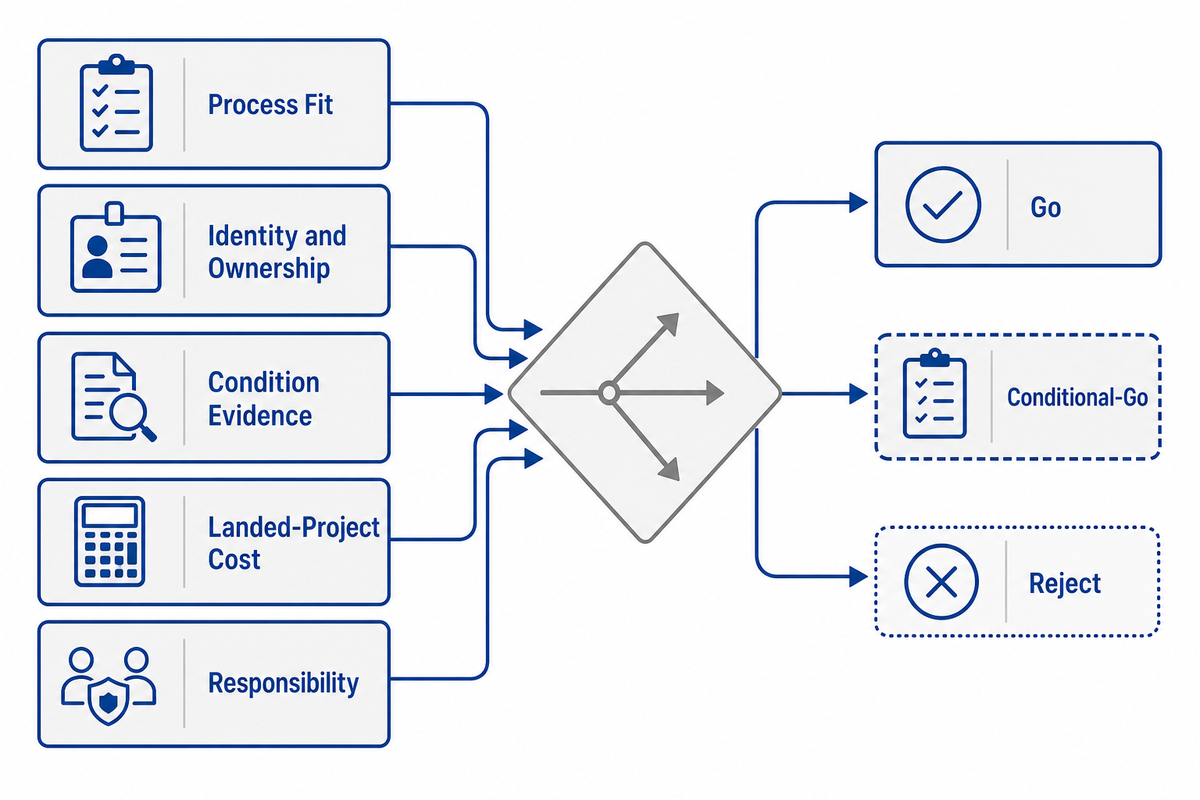
Our Go / Conditional-Go / Reject Gate turns the inspection file into a decision. Review five gates together: process fit, identity and ownership, condition evidence, landed-project cost, and responsibility from dismantling through acceptance. One unresolved gate can hold the decision even when the others pass.
| Decision | Use when | Required record |
|---|---|---|
| Go | fit is demonstrated; identity and ownership are clear; material evidence is sufficient; costs and responsibilities are bounded | approved evidence register and commercial scope |
| Conditional-Go | gaps are recoverable and each has a next test, owner, allowance, deadline, and acceptance condition | condition schedule attached to the agreement |
| Reject | required fit is impossible, safe inspection cannot be arranged, identity/ownership fails, or a critical gap has no credible recovery path | written rejection reason and closed evaluation |
Before the commercial handoff, prepare a compact information pack: target grade and furnish, required trim and capacity, current site and destination, included sections, evidence level reached, critical open items, expected relocation window, and the preferred acceptance boundary. That gives a machinery supplier a defined problem to review instead of a vague request for “a used paper machine.”
A Conditional-Go is not a softer version of approval. It is a controlled hold with written release criteria. For example, “controls obsolete” is too vague; “buyer accepts replacement of the listed PLC rack and HMI if the seller supplies the final I/O list, cabinet drawings, source files, and a successful backup export by the agreed date” is testable. The same structure applies to mechanical findings: identify the component, measurement method, acceptance basis, repair owner, cost treatment, and evidence required to close the condition.
Reject decisions should be equally specific. Record whether the failure is fit, safety, identity, ownership, evidence recoverability, or commercial responsibility. This prevents the same unsuitable asset from re-entering the shortlist under a different price discussion. It also preserves useful learning: a rejected machine may reveal that the buyer’s fit sheet, utility limits, or acceptance language needs to become more precise for the next candidate.
When the evaluation file is ready, review the relevant used paper machinery solutions. For organization and capability context, see about Henan Zejiang Paper Machinery. These links are the commercial next step; they are not substitutes for independent verification of a specific asset.
Technical Review for an Evaluated Machine
Share the target grade, machine scope, evidence level, and open-item register for a focused technical discussion.
Frequently Asked Questions
What records should come with used paper machinery?
Ask for the serial and nameplate record, machine layout and section drawings, motor and drive lists, PLC and I/O documentation, maintenance and shutdown history, recent operating data, and a traceable refurbishment scope. Match drawing revisions and files to the offered asset rather than accepting an unindexed data room. Missing records do not automatically reject a machine, but each gap should become a costed verification task, a test, or a written purchase condition with an owner and due date.
Can a used paper machine be inspected without running it?
Yes, but a static inspection proves less. It can reveal corrosion, missing components, obvious wear, drawing mismatches, accessibility, and storage damage. It cannot confirm vibration under load, steam and vacuum stability, drive synchronization, or sustained output. Separate observations from unverified operating claims.
How do you estimate the true cost of used paper machinery?
Build a range rather than one figure. Add dismantling, match-marking, packing, freight, duties, foundations, utilities, reassembly, alignment, controls work, startup support, initial wear parts, and contingency to the purchase price. Record which party owns each item, then compare the landed-project range with demonstrated fit and unresolved evidence gaps.
What is the difference between used, refurbished and rebuilt equipment?
Used, refurbished, rebuilt, and modernized equipment describe different claimed work scopes, not guaranteed condition. Used may be sold as-is; refurbishment usually covers selected repairs; rebuilding may go deeper. Require a line-item work ledger, replaced-component list, tests, exclusions, and acceptance criteria.
When should a buyer reject a used paper machine?
Reject the machine when required grade or interface fit is impossible, safe inspection cannot be arranged, identity or ownership cannot be verified, critical drawings or control backups have no recovery route, or dismantling responsibility remains undefined. A repairable finding may support conditional approval only when the next test, cost allowance, owner, and acceptance condition are explicit.
References & Sources
- OSHA 29 CFR 1910.147 — Control of Hazardous Energy
- ISO 12100:2010 — Safety of Machinery, Risk Assessment and Risk Reduction
- Sensors (2024) — Vibration-Based Condition Monitoring Review
- National Board — Paper Machine Dryer-Can Failure Investigation
- Human Factors — Visual Inspection Performance Study
- EU-OSHA — Regulation (EU) 2023/1230 on Machinery
- IPPC — Regulation of Wood Packaging Material Guide
- ResourceWise — 2025 Pulp, Paper and Forest Products Review
- PaperAge — Current Industry News Index
- US10677685B2 — Condition Monitoring Vocabulary
- US8849443B2 — Expanded Paper-Machine Drying-System Boundary
Reviewed by the Henan Zejiang Paper Machinery technical team. This guide is an evaluation framework, not a condition certificate for any specific machine.


![Refiner Plates & Screen Baskets [Complete Guide]](https://zjpapermachine.com/wp-content/uploads/2026/07/refiner-plates-screen-baskets-guide-featured-150x150.png)
![Doctor Blade: Types, Materials & How It Works [Guide]](https://zjpapermachine.com/wp-content/uploads/2026/07/doctor-blade-guide-featured-1-150x150.png)
![Pulping Equipment: How Paper Pulping Works [Guide]](https://zjpapermachine.com/wp-content/uploads/2026/07/pulping-equipment-guide-featured-150x150.png)