Get in touch with Zejiang Paper Machinery Company


Updated August 2026
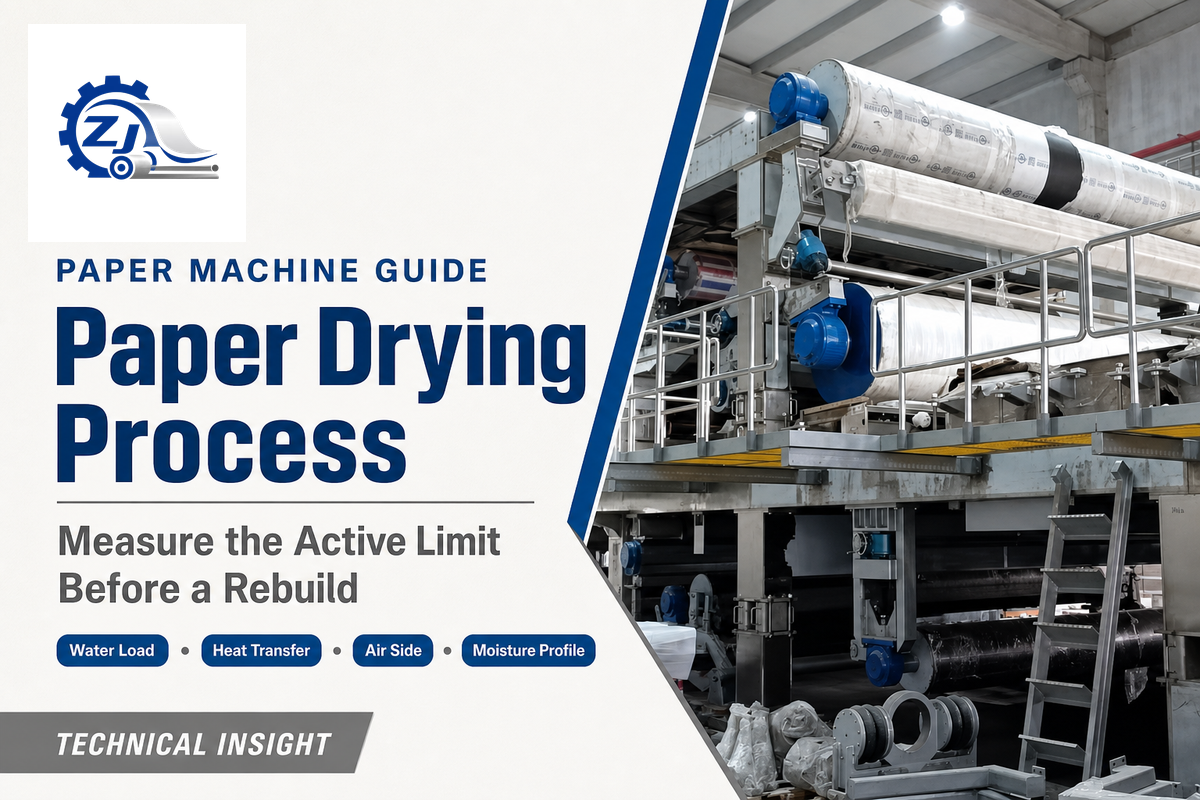
The paper drying process is the controlled transfer of heat into a moving sheet and the removal of the resulting water vapour. In an industrial paper machine, it begins with a pressed, wet paper web and ends with a stable sheet ready for finishing or the reel. Steam-heated cylinders supply heat, dryer fabrics hold the web against hot surfaces, and ventilation removes evaporated moisture. Capacity depends on the whole system, not steam pressure alone.
TL;DR
- Mechanical dewatering sets the dryer section’s incoming load; poor press exit solids cannot always be cured by adding cylinder area.
- Steam and condensate, sheet contact, and humid-air removal create three separate capacity ceilings.
- Make comparisons between mills based upon metered steam per saleable tonne only after grade, incoming solids, basis weight, moisture target and reporting boundary are aligned.
- Specify cylinder material, pressure, geometry, rotor behaviour, destination code, and inspection requirements as one project package.
What the Paper Drying Process Actually Is, and Where It Starts
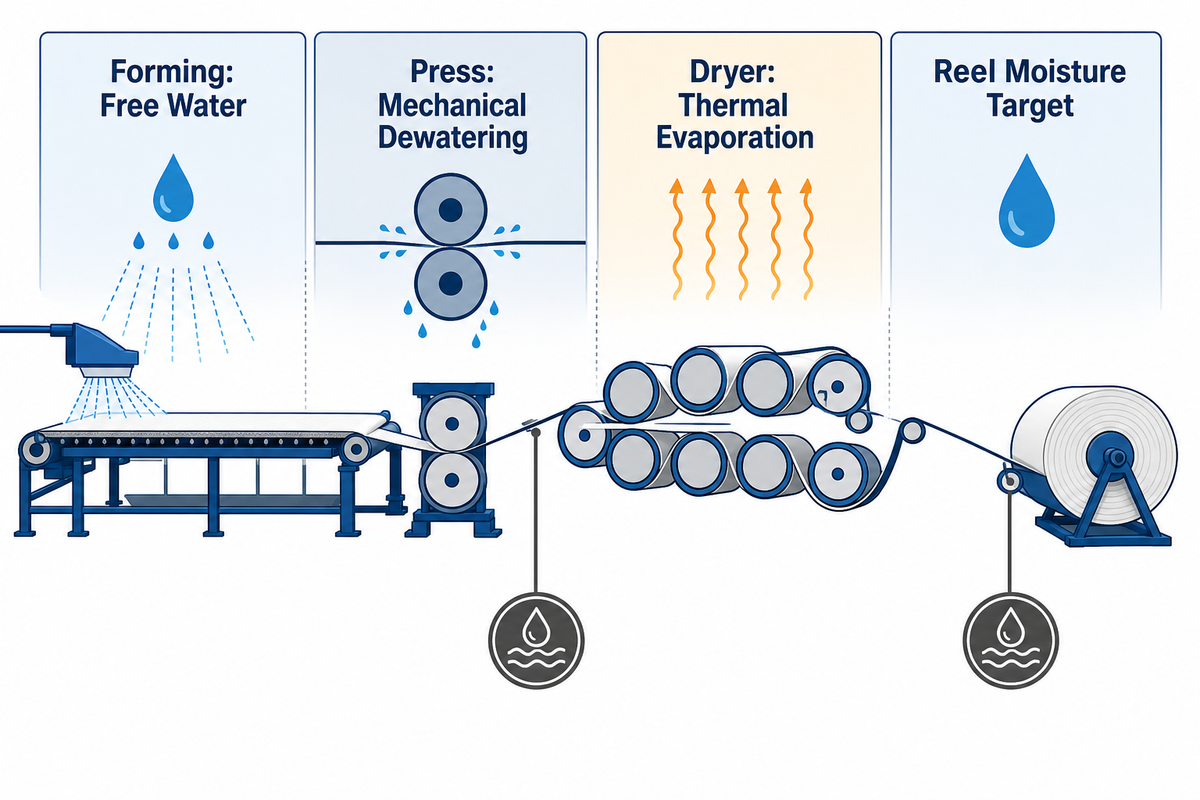
Drying paper on a machine is the controlled transfer of heat into a moving sheet and the removal of the resulting water vapour. Industrial drying starts before the first cylinder: forming and pressing determine how much water reaches the section, while the reel moisture target determines how much must leave. Those two boundaries set the thermal duty.
In papermaking, also written paper making, the forming section removes free water and the press section removes more water mechanically. During the drying course, heat removes water from the paper by evaporating moisture from the sheet. Research describes this stage as a major thermal-energy user in pulp and paper manufacturing, but the reported share changes with paper grade, mill configuration, and the accounting boundary. No universal percentage fits every mill.
Control begins practically with the measurement of press exit solids and the cross-direction profile entering the dryer, recording steam flow and condensate return, and validating reel moisture and saleable tonnes. If the first two readings drift, the apparent dryer problem may originate upstream. If the utility system is being sized or upgraded, evaluate industrial boilers from Taiguo against measured drying demand and the required pressure and steam quality; extra boiler capacity alone will not remove a dryer-side bottleneck.
What Is the Press Section of a Paper Machine?
Mechanical dewatering in the press section sits between forming and drying. Press rolls and felts squeeze water from the sheet while supporting it through high-load nips. Every kilogram left in the sheet becomes a thermal load later. Check the actual solids and profile leaving the press rolls before blaming dryer cylinders for lost speed.
📐 Measurement rule
Don’t compare dryer performance from steam pressure and reel moisture alone. Add press exit solids, incoming profile, saleable tonnes and the selected measurement period.
Inside the Dryer Section: Groups, Fabrics, Draws and Drives
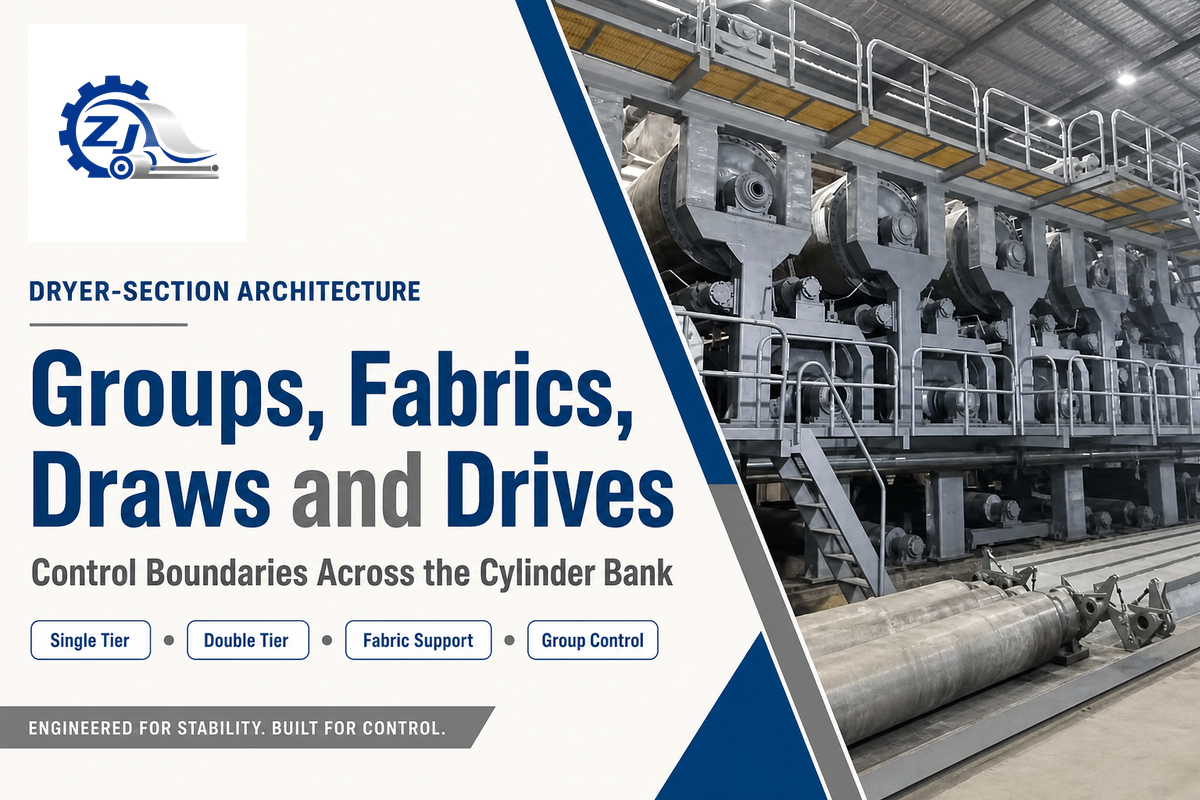
Dryer groups arrange multiple steam-heated cylinders into controllable sections. Each group has its own fabric path, drainage behaviour, drive relationship, and ventilation environment. Equipment used in the dryer section supports the sheet while allowing evaporation, controlled draw, and progressive speed adjustment as the paper web dries and changes dimension.
Double-tier groups alternate the web between upper and lower cylinders. Single-tier groups keep the web better supported through open draws, which can help runnability where the sheet is still weak. Neither layout is automatically superior: grade, basis weight, machine speed, sheet strength, pocket ventilation, and rebuild space decide the arrangement.
Drying groups also create control boundaries. Operators can change steam conditions or draws by group instead of treating the whole section of the paper machine as one undivided heater. Cylinder count matters less than enough effective surface and residence time under verified conditions. Fabric support and controlled draws protect the runnability of the dryer section. For machine-wide context, the paper machines guide explains how the wet end, press, dry end, calender, and reel connect.
What Is the Dry End of the Paper Machine?
“Dry end” names the downstream part of the paper machine where the sheet is dried, conditioned, finished, and wound. Exact boundaries vary by machine: the term usually includes the dryer section and may also include size press or coating equipment, calendering, scanners, and the reel. For troubleshooting, name the precise group or device instead of saying only “dry end,” because steam, air, web handling, and finishing faults require different measurements.
Dryer Cylinder Materials: Cast Iron vs Carbon Steel
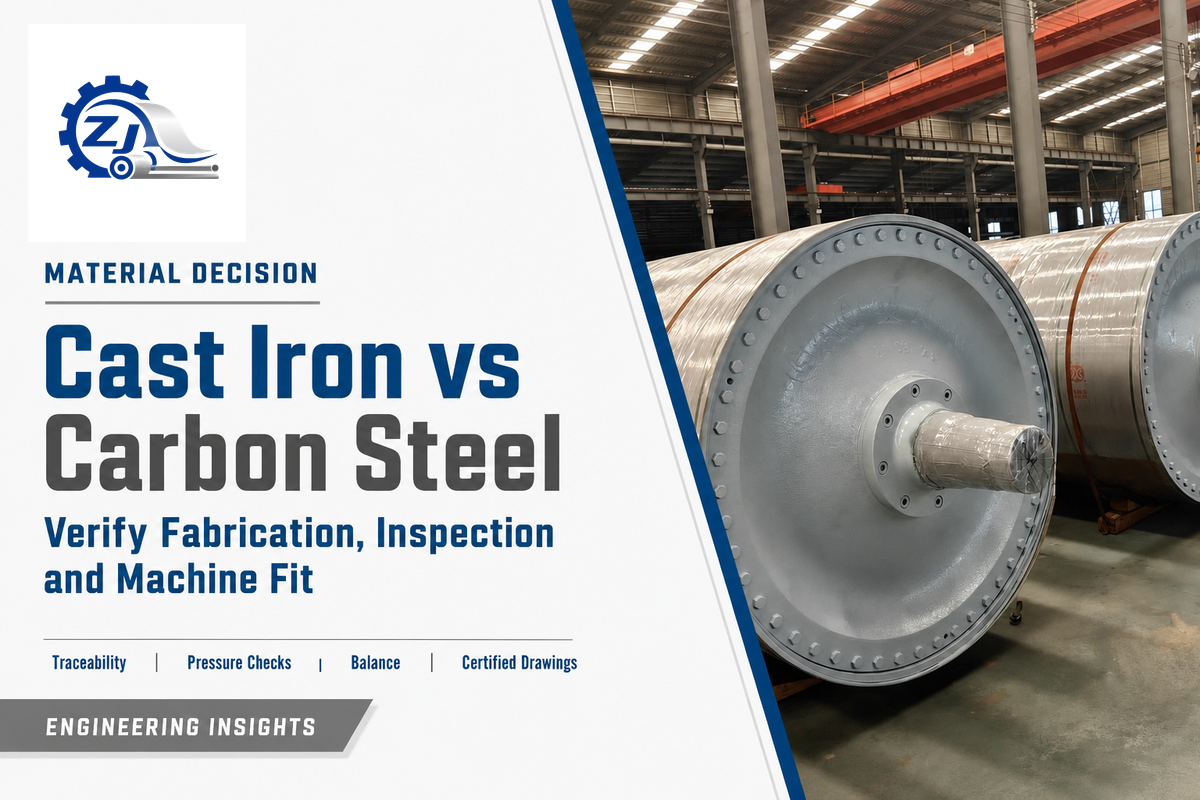
Cylinder material affects fabrication, inspection, repair planning, and the allowable project design, but it does not determine drying performance by itself. Cylinder drying can improve heat transfer only when shell design, steam condition, condensate removal, web contact, and residence time work together. Selecting from a material label alone creates a false-fit risk when process duty or machine geometry is still undefined.
| Decision question | Cast-iron route | Carbon-steel route | Verify before selection |
|---|---|---|---|
| How is the shell produced and inspected? | Casting quality, material traceability, pressure checks, and surface condition require an agreed route. | Material traceability, weld quality, pressure checks, and surface condition require an agreed route. | Material standard, inspection plan, acceptance criteria, and destination rules. |
| What controls drying performance? | Shell condition works with steam, condensate evacuation, and web contact. | Shell condition works with steam, condensate evacuation, and web contact. | Calculated duty, effective area, drainage behaviour, fabric contact, and hood balance. |
| What controls machine fit and reliability? | Project geometry, journals, bearings, drive, balance, and repair practice. | Project geometry, journals, bearings, drive, balance, and repair practice. | Certified drawings, rotor classification, site clearances, and operating range. |
For manufacturer-specific dimensions, pressure ranges, and the full material comparison, use Zejiang’s dryer cylinder product page. Those supplier ranges belong on the product page; this process guide uses them only as a handoff after the active drying limit has been measured.
Pressure Equipment, Balancing and Machine Safety Are Separate Scopes
Under the European Pressure Equipment Directive, equipment with maximum allowable pressure above 0.5 bar enters the scope screen, but that threshold is only the beginning. Record explicitly whether project PS exceeds 0.5 bar; exclusions, equipment type, fluid group, volume, and PS × V still affect classification and the conformity route. For ASME work, state the contractually applicable section and edition; never ask merely for “ASME certified.”
ISO 21940-11 covers balancing procedures and tolerances for rotors with rigid behaviour. Flexible-behaviour rotors require the separately applicable ISO 21940 scope, commonly Part 12. Engineering teams must classify rotor behaviour rather than write one standard into every RFQ. For gray cast iron, current TAPPI inspection guidance and ASTM A278/A278M-01(2024) help define inspection and material boundaries; neither is a substitute for a fitness-for-service decision.
Pressure-vessel compliance also doesn’t close the machine-safety scope. In the United States, 29 CFR 1910.261 addresses paper-mill hazards including emergency stops, guarding, lockout-related provisions, hot piping, and dryer gears. This article is a procurement and diagnostic guide, not an operating or safety procedure.
Yankee, Multi-Cylinder and Other Drying Systems Serve Different Duties
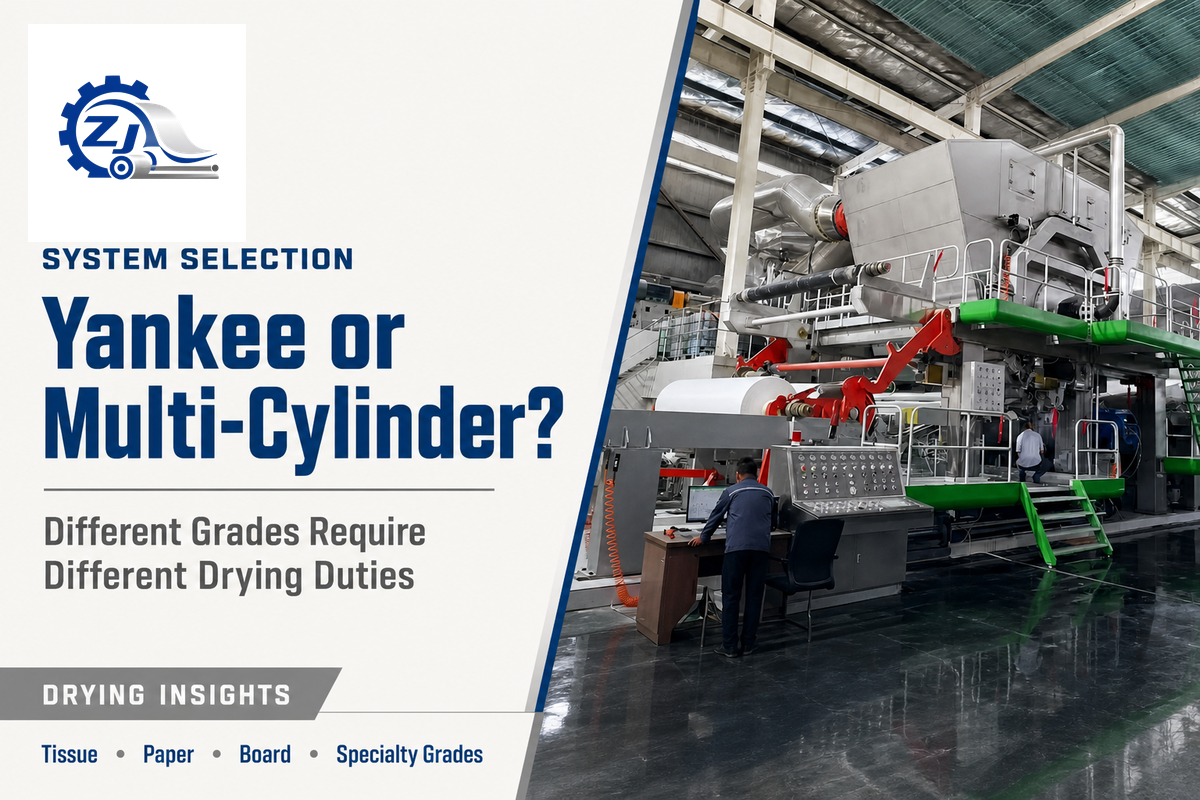
Yankee drying uses a large steam-heated cylinder within a process built around intimate sheet contact, hood air, coating chemistry, doctoring, and the required paper surface. It is not a one-for-one replacement for a conventional bank of cylinders. Through-air, impingement, and infrared systems also serve different grade, bulk, surface, or capacity duties.
For tissue, the Yankee shell, condensate system, hood, coating, and doctor system act as one drying and creping environment. For paper or board machine duties, multi-cylinder arrangements may provide the staged control and two-sided contact the grade requires. Whole-line decisions belong in the tissue paper machine specification, not in a shell-only comparison.
Which Dryer Is Used in the Paper Industry?
Paper mills use multi-cylinder steam drying for many paper and board grades, Yankee drying for tissue and some specialty duties, and air or radiant systems where the sheet property or process constraint justifies them. Selection begins with grade, basis weight, bulk, speed, moisture load, surface requirements, and available utilities. “Maximum drying efficiency” isn’t a machine type; it’s a verified result inside a defined production boundary.
Steam and Condensate: The Invisible Half of Drying Capacity
Steam pressure can look normal while heat transfer remains poor. Steam must condense against the inner shell, condensate must leave through the siphon system, and non-condensable gases must not blanket the heat-transfer surface. If condensate accumulates faster than it leaves, the dryer floods and effective shell temperature can fall.
As cylinder speed changes, condensate behaviour can move from a pool or cascade toward a rotating film. No universal transition speed applies across cylinder diameters, fill levels, internal hardware, and operating conditions. Siphon clearance and differential pressure therefore belong in the machine-specific drainage study, not in a generic internet threshold.
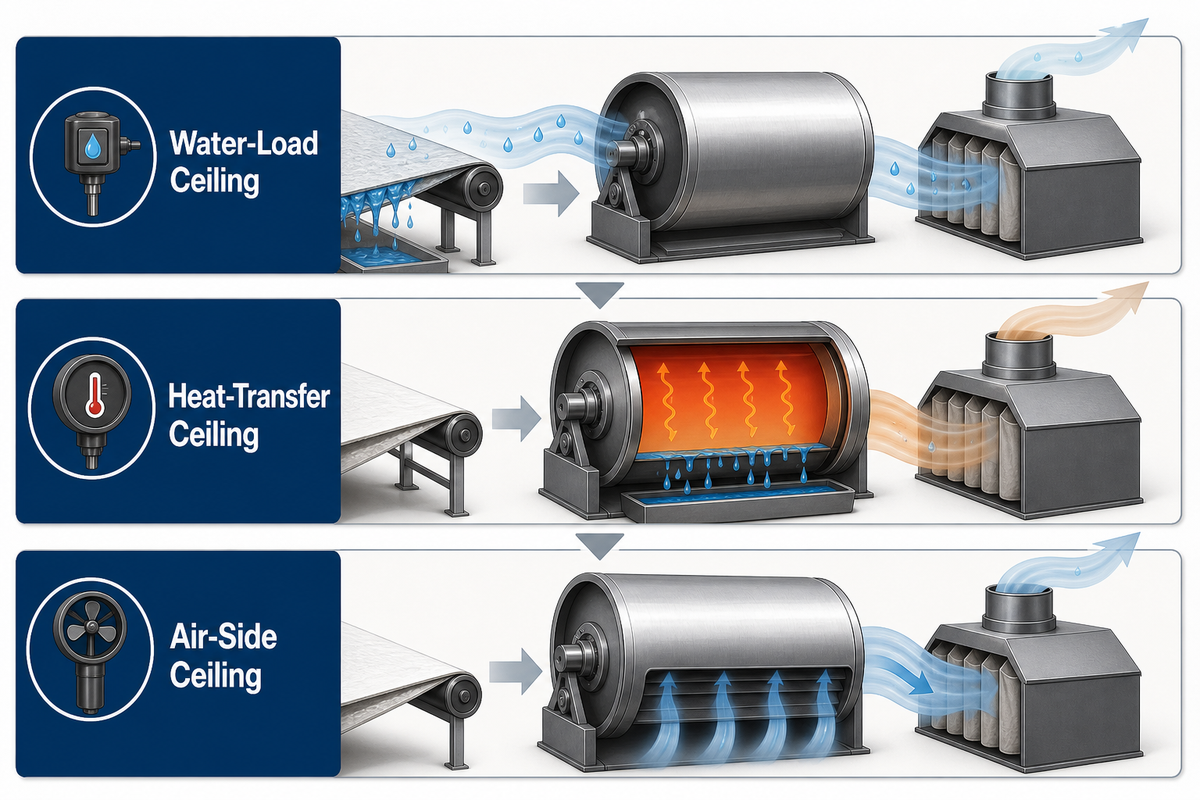
The Three Ceilings of Drying Capacity, 3-Ceiling Map
- Water-load ceiling: press exit solids and the incoming cross-direction profile determine how much moisture enters.
- Heat-transfer ceiling: steam condition, condensate evacuation, siphon geometry, shell condition, and web contact determine how much useful heat crosses the shell.
- Air-side ceiling: pocket ventilation and hood exhaust determine whether evaporated water can leave the sheet environment.
Before adding pressure, area, or drive power, a rebuild study should identify the active ceiling.
Illustrative scenario, not a customer case: a mill sees normal header pressure, falling production, and wetter sheets after one drying group. If differential pressure is unstable and condensate return fluctuates, the first test is drainage and siphon behaviour, not a higher header setpoint. Raising steam pressure on a flooded group may add risk without restoring the missing heat transfer.
Dryer Fabrics: Rate Temperature Before Permeability

Dryer fabric selection starts with the supplier’s rated temperature for the exact material and position, then moves to permeability, contamination, seam, stability, and sheet support. Those variables affect uniform drying, paper quality, and the side of the sheet touching the fabric. Polymer names don’t establish a safe temperature ceiling, and high-quality supply claims don’t replace a position-specific rating.
Permeability influences pocket ventilation and moisture removal, but more open isn’t always better. The fabric must keep contact, guide the web, release contamination, and remain dimensionally stable across the machine. Grades that shed fillers or coating contaminants can need a cleaning and fabric-life decision different from a clean uncoated sheet.
Ask the supplier to identify the resin, weave, permeability test method, seam, recommended position, continuous and short-duration temperature ratings, cleaning method, and acceptance evidence. Zejiang’s dryer fabrics and press felts page provides the product-family context, while the dryer fabric selector helps organize the inputs.
Hoods, Pocket Ventilation and Heat Recovery: The Air Side
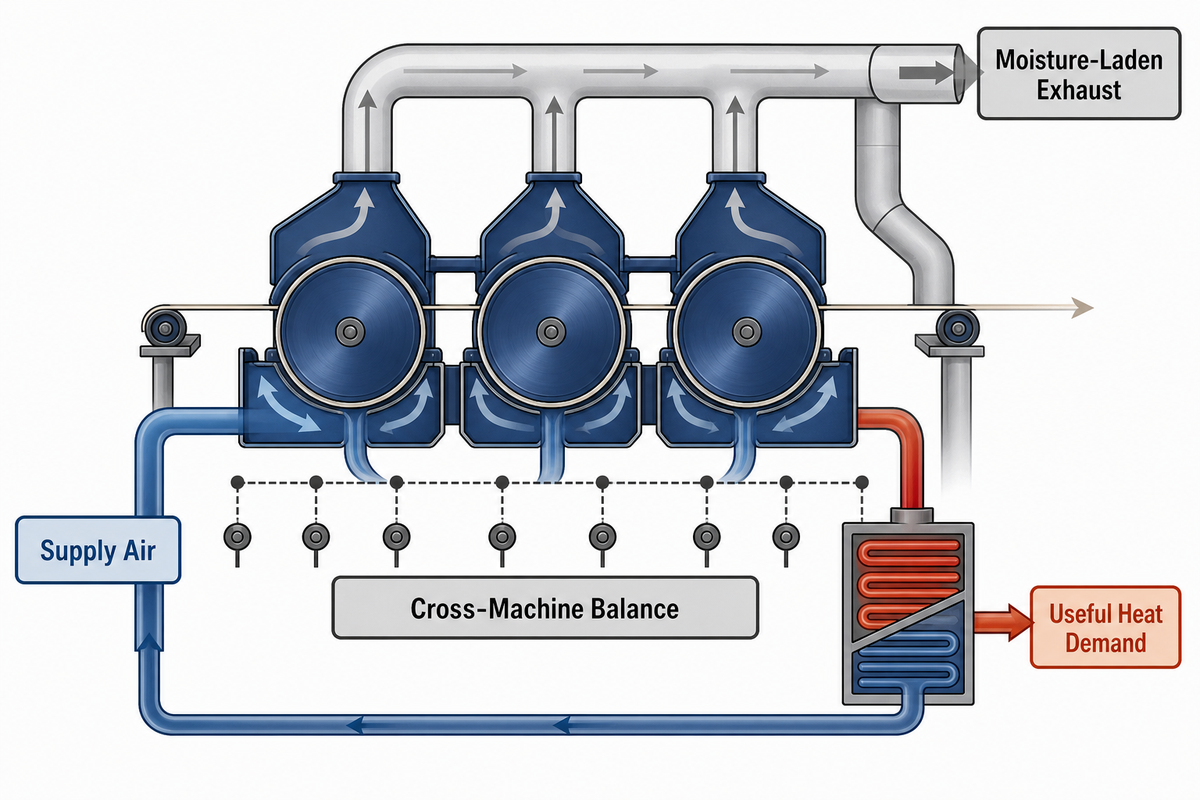
Dryer hoods and pocket ventilation remove warm, moisture-laden air from around the sheet and replace it with conditioned supply air. When pockets saturate, the vapour-pressure driving force, drying rate, and drying performance fall even if the cylinders remain hot. Efficient drying and energy-efficient operation then depend on the air side, not steam pressure alone.
Useful measurements include supply and exhaust airflow, temperature, humidity, static pressure, leakage, pocket conditions, and cross-machine balance. Heat recovery systems can reuse exhaust energy for supply-air heating, process water, building air, or another defined duty. The destination must have a simultaneous, measurable heat demand; otherwise “recovered” heat may have no practical value.
Illustrative scenario, not a customer case: steam pressure and condensate return are steady, but the wet edge worsens as speed rises. Hood survey data find uneven air and exhaust distribution across the machine. Correct pocket and hood balance before specifying more cylinder area.
Moisture Targets and Cross-Direction Profile Control
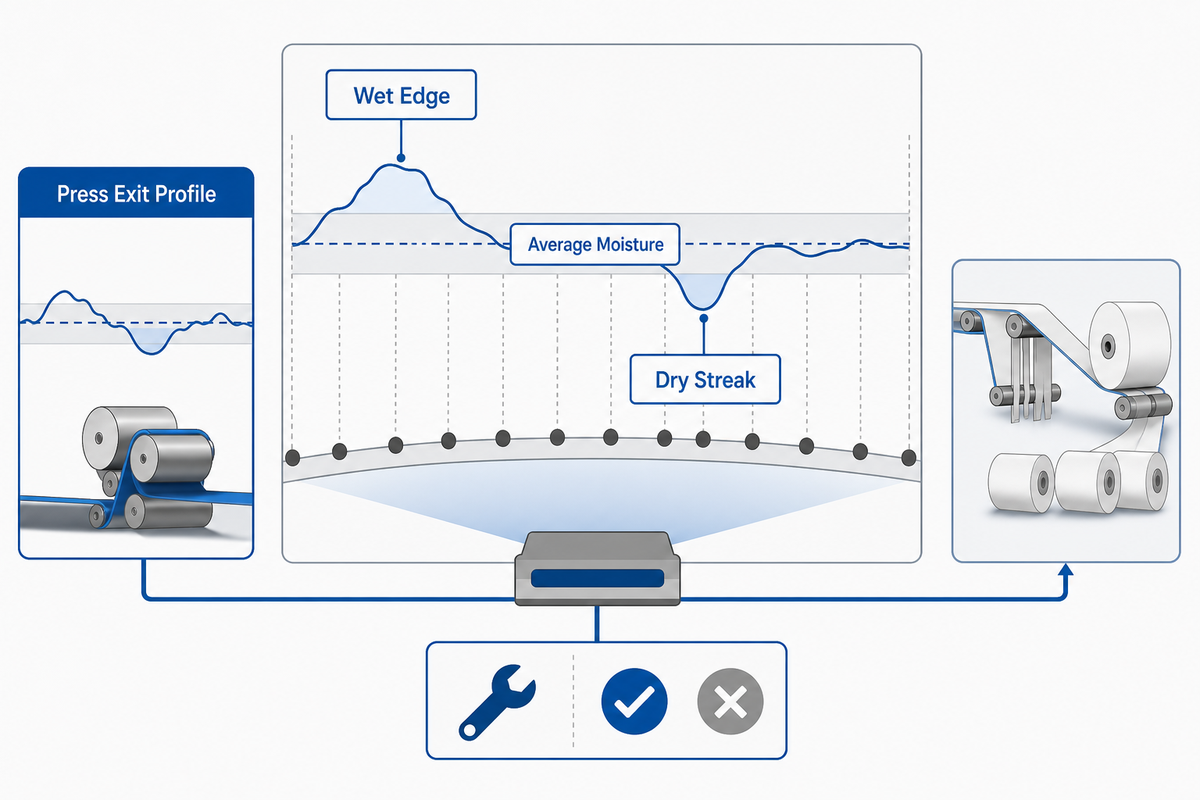
Reel moisture content must be set for the paper grade, converting route, storage climate, and customer specification. An acceptable average can still hide a wet edge, a dry streak, curl, shrinkage, or local paper defects.
Optimal drying means meeting the profile and moisture target without avoidable energy waste. Over-drying raises overall energy use and can change paper properties without creating saleable value; under-drying may raise reel, coating, converting, or storage risk. Useful control charts show the profile, machine-direction trend, sensor validation, grade changes, broke periods, and the exact point at which tonnes are counted.
Illustrative scenario, not a customer case: the reel scanner reports an acceptable average moisture, yet converting sees edge curl. An incoming profile check then finds that the press already delivers a wetter edge. That evidence shifts the investigation toward press loading, felt condition, and cross-direction dewatering before any dryer rebuild.
What Paper Drying Actually Costs per Tonne
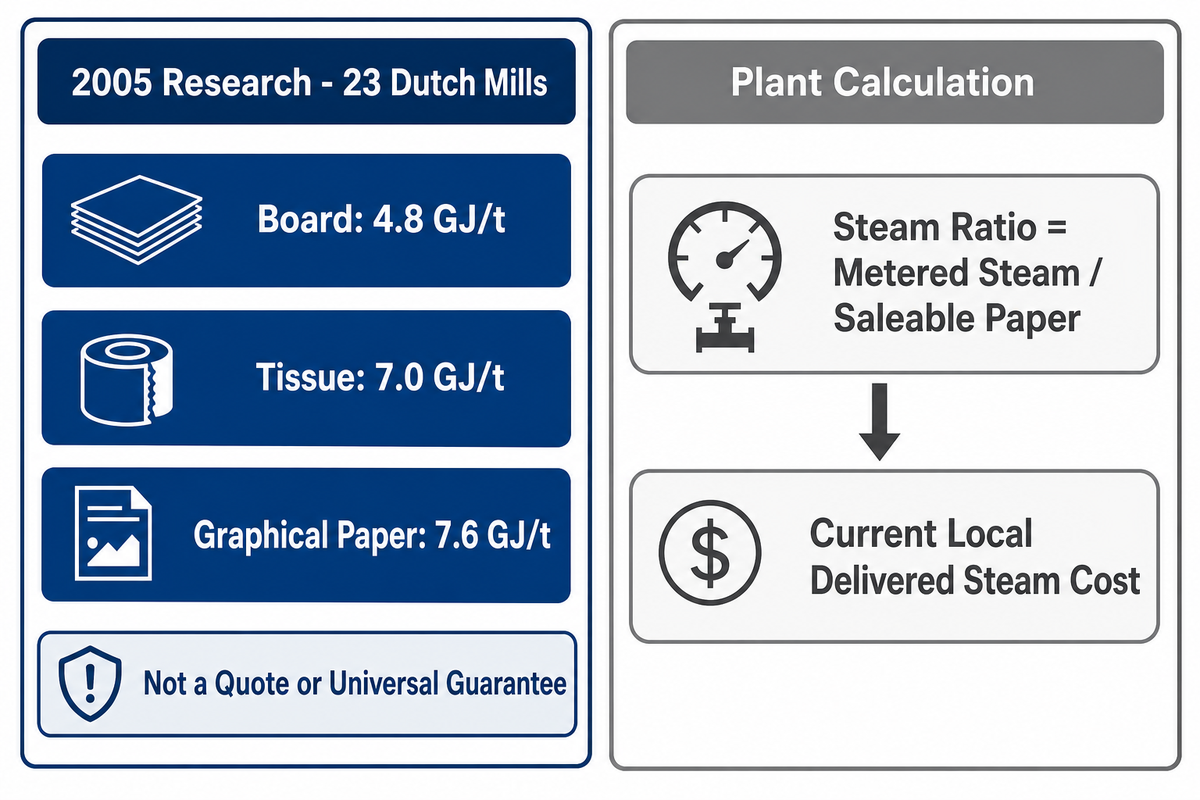
Drying cost per tonne in the paper production process should be calculated from the plant’s metered energy use and saleable production, not copied from a supplier promise. Energy efficiency can be compared only after grade, incoming solids, basis weight, target moisture, steam boundary, condensate return, fuel, electricity mix, and measurement period are aligned. Because utility tariffs and metering boundaries differ, a boundary mismatch creates a false comparison risk.
| Grade group | Average drying energy | How to use it | Limitations / not suitable for |
|---|---|---|---|
| Board | 4.8 GJ/t paper | Order-of-magnitude grade benchmark | Not a monetary quote or guarantee for one board machine |
| Tissue | 7.0 GJ/t paper | Compare only after aligning system boundary | Not transferable across utility mixes and water-removal duties |
| Graphical paper | 7.6 GJ/t paper | Research reference for a matched grade family | Annual averages hide mill and operating variation |
This historical research benchmark uses 2005 data from 23 Dutch mills. Published annual averages include mill variation, water-removal differences, excluded implausible data, and measurement uncertainty. They do not support a current universal target, a monetary quote, or a nine-grade cost table.
Worked Example: Steam per Saleable Tonne
Use steam ratio = metered dryer steam ÷ saleable paper. In a hypothetical period lasting 30 days, a matched meter boundary records 18,000 tons of dryer steam and the mill produces 10,000 tons of saleable paper. Dividing 18,000 by 10,000 gives 1.80 tons of steam per ton of paper. If the next matched period uses 17,000 tons for the same 10,000 tons, the ratio becomes 1.70 tons per ton, a reduction of 0.10 tons per ton. This example demonstrates the calculation; it is not a Zejiang guarantee.
To calculate money per tonne, multiply the ratio by a current, local delivered steam cost, or calculate fuel, boiler efficiency, water, treatment, and auxiliary electricity within a declared boundary. The U.S. Energy Information Administration’s dated industrial natural-gas price series illustrates why an undated global currency figure is unreliable. A paper machine energy estimator can organize plant inputs, but finance should approve the price and boundary.
Is Your Machine Drying-Limited? The 4-Signal Drying-Limited Check
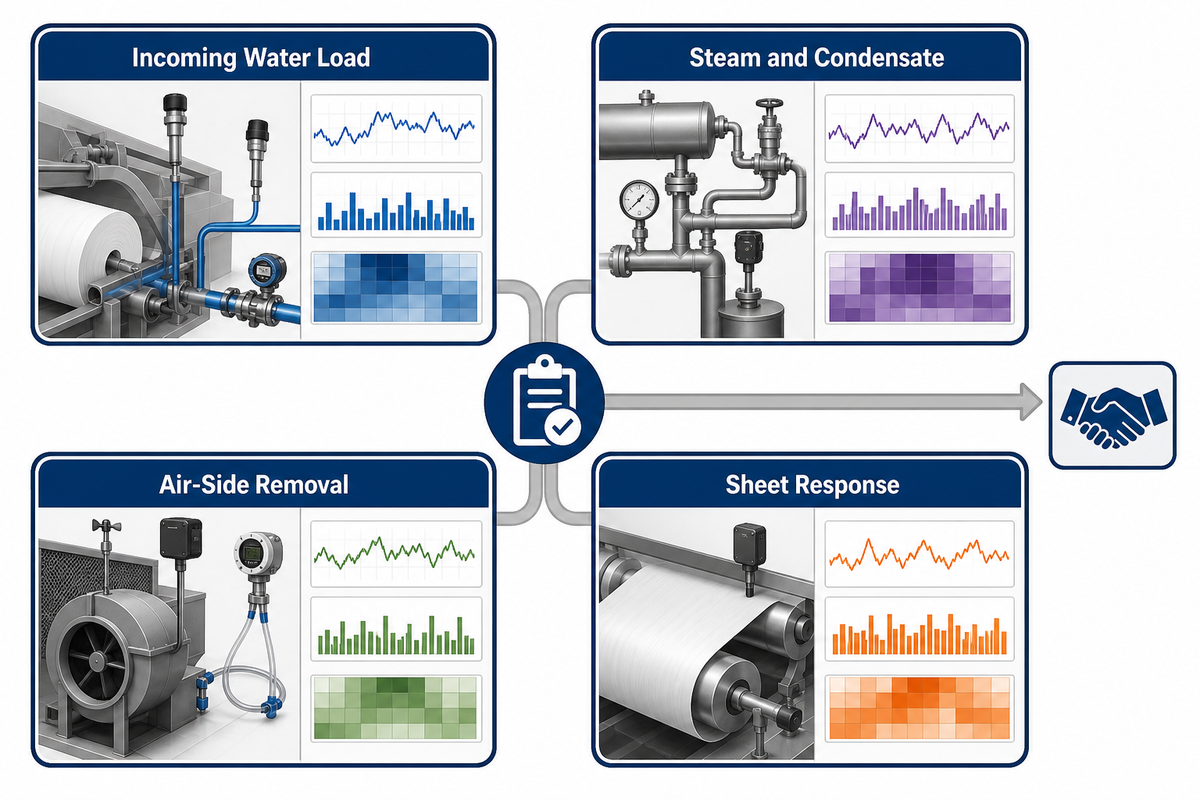
A drying-limited machine reaches its required reel moisture only by sacrificing speed, but that symptom does not prove the cylinders are too small. The dryer section of a paper machine is essential to keep output on target, yet its bottleneck may be incoming water load, condensate drainage, sheet contact, humid-air removal, or profile control. Run a matched campaign over a representative production period before a rebuild study.
This 4-Signal Drying-Limited Check groups plant evidence into four measurement signals, not four universal limits:
- Incoming water load: compare press exit solids and the cross-direction profile at matched grade and basis weight.
- Steam and condensate: compare steam condition, differential pressure, shell temperature, and condensate-return stability.
- Air-side removal: compare pocket humidity or dew point with hood supply and exhaust conditions.
- Sheet response: track speed, draw, reel moisture, and the cross-direction profile through the same matched campaign.
For one matched drying section campaign, keep the units explicit: basis weight (g/m²), line speed (m/min), steam and condensate flow (t/h), shell temperature (°C), hood airflow (m³/s), pocket humidity (g water/kg dry air), and reel moisture (%). This measurement set compares the duty around the drying cylinders without turning any unit into a universal target.
| Condition type | Measure first | Likely decision owner | RFQ evidence if confirmed | Limitations / not suitable for |
|---|---|---|---|---|
| Speed falls while reel moisture is unchanged | Incoming solids, grade, basis weight, steam/t | Production | Matched baseline and target duty | Not proof of insufficient cylinder area by itself |
| One group runs wet | Differential pressure and condensate return | Maintenance | Siphon and drainage condition report | Header pressure alone is insufficient |
| Wet edge or dry streak | Incoming and outgoing cross-direction profiles | Quality | Profile maps at matched grade and speed | Average moisture hides the fault |
| Hot cylinders, weak drying | Web contact, fabric condition, pocket humidity | Process engineering | Contact and ventilation survey | Surface temperature alone cannot locate the cause |
| Steam rises with unchanged production | Meter boundary, leaks, return, moisture target | Energy manager | Mass-and-energy boundary statement | Do not compare unmatched reporting periods |
| Breaks increase in early dryers | Draws, web support, fabric path, incoming profile | Operations | Threading and runnability requirement | Not automatically a heat-capacity problem |
| Hood humidity climbs with speed | Supply/exhaust flow and leakage | Utilities | Air-balance and heat-recovery duty | More steam can worsen the air-side load |
| Cylinder replacement is due | Geometry, condition, code, rotor behaviour | Engineering and procurement | Certified drawing and inspection plan | Price-only comparison is not technically equal |
| Electrification is proposed | Heat sink/source, temperatures, tariffs, carbon basis | Owner and finance | Site-specific energy and capital model | A published tissue case is not a universal business case |
If the evidence points to inadequate effective drying area after upstream, steam, condensate, contact, air, and profile checks are stable, then a rebuild study is justified. Use the paper machine bottleneck finder for the first screen and the paper machine rebuild guide for scope, shutdown, and acceptance planning.
Key takeaway
A dryer rebuild is justified only after a matched test separates the water-load, heat-transfer, and air-side ceilings; machine speed and reel moisture alone do not identify the active limit.
When Not to Buy More Dryer Area
Do not add cylinders merely because steam consumption is high, the reel is wet, or speed has fallen. Hold the purchase when press exit solids are unstable, the incoming profile is uneven, drainage is flooded, sheet contact is poor, hood balance is unknown, the scanner is unverified, or target moisture has changed. Those conditions corrupt the design basis. Correct or quantify them first, then repeat a matched trial. Extra surface cannot cure every dewatering, condensate, ventilation, runnability, or measurement fault.
What Is Changing in Paper Drying Through 2026
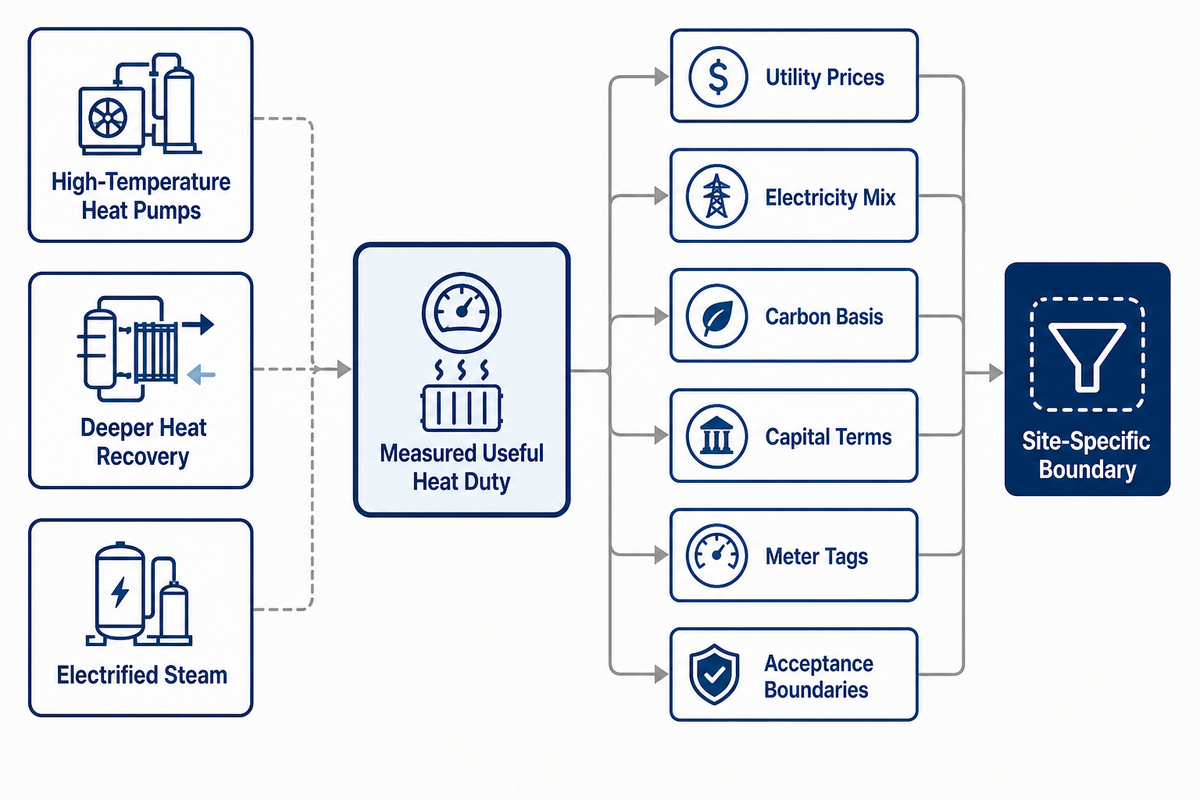
In 2026, the decision driver is where drying heat comes from and how confidently a mill can measure its useful duty. High-temperature heat pumps, deeper heat recovery, and electrified steam options are being studied, while fuel and electricity spreads vary sharply by location. Ask not “How much energy does the technology save?” but “Under our temperature levels, utility prices, electricity mix, carbon basis, and capital terms, what changes?”
A peer-reviewed tissue-mill heat-pump study shows why the boundary matters: its energy, emissions, and cost results depend on the modeled European electricity mix, gas-to-electricity price spread, carbon price, and capital support. Those results are evidence that the route is being evaluated, not a universal energy-savings promise for every paper mill.
Standards hygiene is the other immediate change in the operation of paper machine assets. Replace withdrawn ISO 1940 references, identify rigid or flexible rotor behaviour, name the governing edition, and define the destination conformity route. Procurement should also require meter tags and acceptance boundaries that let the owner verify steam consumption, moisture profile, and saleable output after commissioning.
“We remain committed to providing cost-effective paper machinery solutions, professional technical support, and long-term cooperation for paper manufacturers around the world.”
Henan Zejiang Paper Machinery Co., Ltd.
Frequently Asked Questions
What are the parts of a paper machine?
Paper machines normally include stock approach, forming, pressing, drying, finishing, and winding systems, supported by utilities and controls that move stock from pulp preparation to a saleable reel.
Wet-end systems form the sheet; presses remove water mechanically; the dryer section evaporates remaining moisture; optional sizing, coating, and calendering develop surface properties; scanners measure the sheet; and the reel winds production. Vacuum, steam and condensate, hood air, drives, lubrication, broke handling, controls, and safety systems connect these visible sections.
What is the function of the dryer section in a paper machine?
The dryer section removes moisture thermally while controlling sheet support, profile, shrinkage, surface condition, and runnability at the grade-specific final moisture needed at the reel.
Steam-heated cylinders transfer heat through the shell; fabrics keep contact and guide the sheet; condensate systems preserve heat transfer; and hood ventilation carries vapour away. The dryer section of the paper machine dries the paper to a grade-specific target, and the end of the dryer remains dependent on incoming press solids and profile.
How do you reduce energy consumption in the dry section of a paper machine?
Dry-section energy consumption falls when the mill removes more water mechanically, prevents flooding, avoids over-drying, balances hood air, and recovers useful heat under matched production conditions.
Start with a matched mass-and-energy boundary. Track press exit solids, steam flow, condensate return, hood exhaust, moisture profile, grade, and saleable tonnes. Then fix the active ceiling and repeat the matched trial. Lower steam per tonne is meaningful only when basis weight, incoming and final moisture, production period, meter boundary, and saleable-output rules remain comparable.
What is the purpose of pocket ventilation systems?
Pocket ventilation supplies conditioned air and removes humid air between cylinders so evaporation can continue while limiting wet pockets and cross-machine moisture variation during normal production.
It also helps control the cross-machine moisture profile. Performance depends on distribution, leakage, hood pressure, exhaust capacity, and fabric permeability, so airflow should be measured rather than inferred from fan operation.
What are single-tiered dryer sections, and why are they followed by double-tiered sections?
Single-tier dryers keep the web supported through a one-row path, while double-tier arrangements alternate contact between upper and lower cylinder rows and provide different layout options.
Early in drying, the wet paper web is weak and benefits from continuous support and controlled draws. Later, stronger paper may tolerate a double-tier geometry that provides different contact and layout options. No sequence is mandatory for every machine; grade, speed, sheet strength, shrinkage control, fabric path, ventilation, and rebuild space govern the choice. Where early web stability dominates the design, support needs can outweigh the space or contact pattern that would otherwise favour a double-tier group.
How long does paper take to dry?
Industrial paper dries during a seconds-long machine pass, not the hours associated with handmade sheets on racks, because residence time depends on speed and active dryer length.
The exact residence time depends on machine speed, effective path length, grade, basis weight, incoming solids, and target moisture. Specify those inputs instead of using one universal drying time.
References & Sources
- Paper-machine dryer-section research record University of Illinois
- Multi-mill drying energy benchmark peer-reviewed journal article
- Directive 2014/68/EU on pressure equipment EUR-Lex
- ISO 21940-11 official scope record International Organization for Standardization
- TIP 0402-16 dryer inspection guidance TAPPI
- ASTM A278/A278M-01(2024) ASTM International
- 29 CFR 1910.261, Pulp, paper, and paperboard mills Occupational Safety and Health Administration
- High-temperature heat-pump study for tissue production Energies
About This Paper Drying Analysis
Henan Zejiang Paper Machinery describes itself as a manufacturer and supplier of paper machines, pulp-processing equipment, and spare parts for mills in international markets. This guide separates the company’s stated product information from independent standards and plant-specific process measurements.
Diagnose the Drying Limit Before Selecting Hardware
Bring matched operating data for press exit solids, speed, steam and condensate, pocket conditions, and reel moisture. Use those measurements to identify whether the active limit is water load, heat transfer, air-side removal, or sheet response before defining any equipment scope.
![Refiner Plates & Screen Baskets [Complete Guide]](https://zjpapermachine.com/wp-content/uploads/2026/07/refiner-plates-screen-baskets-guide-featured-150x150.png)
![Doctor Blade: Types, Materials & How It Works [Guide]](https://zjpapermachine.com/wp-content/uploads/2026/07/doctor-blade-guide-featured-1-150x150.png)
![Pulping Equipment: How Paper Pulping Works [Guide]](https://zjpapermachine.com/wp-content/uploads/2026/07/pulping-equipment-guide-featured-150x150.png)