
Get in touch with Zejiang Paper Machinery Company


Updated October 2026
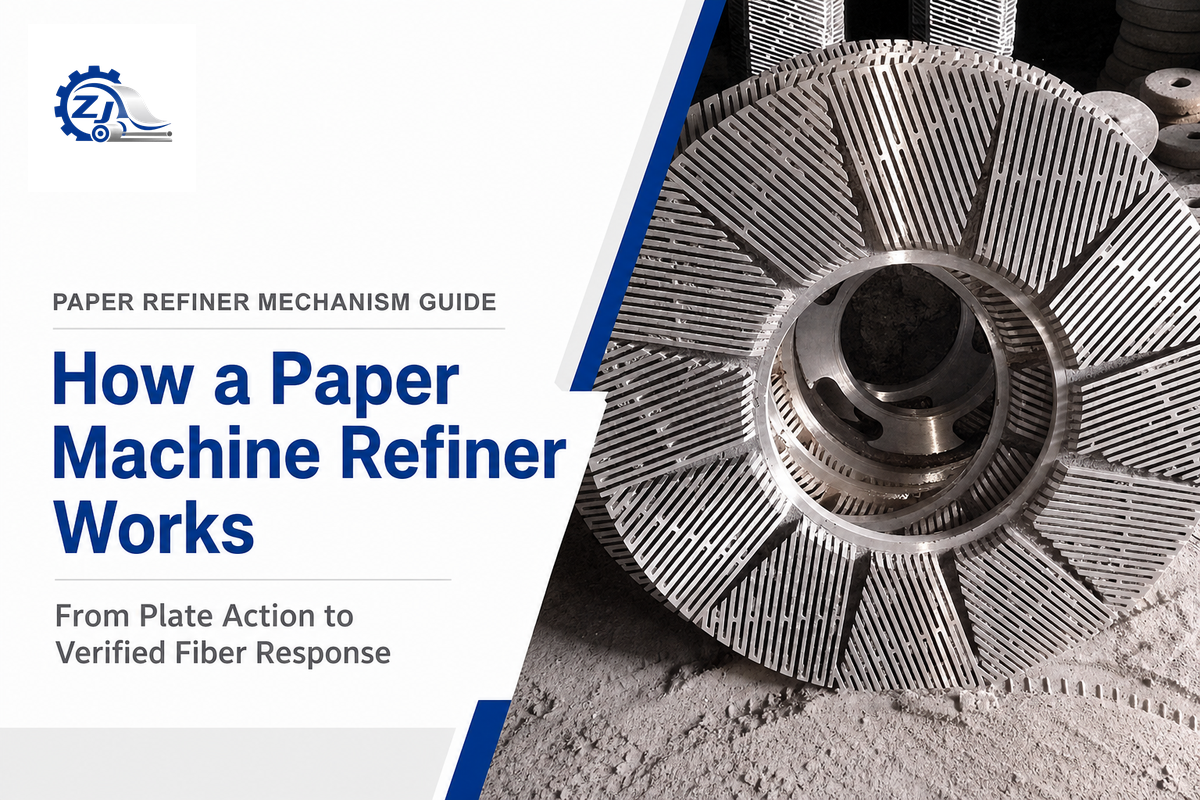
How does a paper machine refiner work? A paper machine refiner is a stock-preparation machine that passes screened pulp through a water clearance between patterned rotor and stator plates. Repeated bar crossings compress, bend and shear fiber flocs to develop a fiber structure. This structure provides controlled fiber development, not simple chopping: flexibility, fibrillation, collapse and bonding potential, checked against drainage and sheet properties.
This guide covers continuous low-consistency disc refiners used before the paper machine. Industry sources also use the spelling disk refiners. In some regions, fiber is spelled as fibre. By contrast, a conical refiner, high-consistency mechanical-pulp refiner, or laboratory beater exposes the paper pulp to a different geometry or regime. Therefore, their gap, energy, and test results can’t be transferred to other equipment without an equipment- and furnish-specific review.
Plant teams can use the two named tools to connect mechanism to action in the following ways: The 6-Stage Inside-the-Gap Action Loop shows what the mechanism does, and The 6-Signal Refiner Diagnostic Matrix shows what to measure before modifying a control setting or blaming a plate.
Key takeaway
A refiner creates a distribution of fiber treatments. Gap, power or freeness alone cannot prove the result. Read the incoming stock, mechanical loading, energy basis, response lag and fiber or sheet evidence together.
Quick Answer: What Does a Paper Machine Refiner Do?
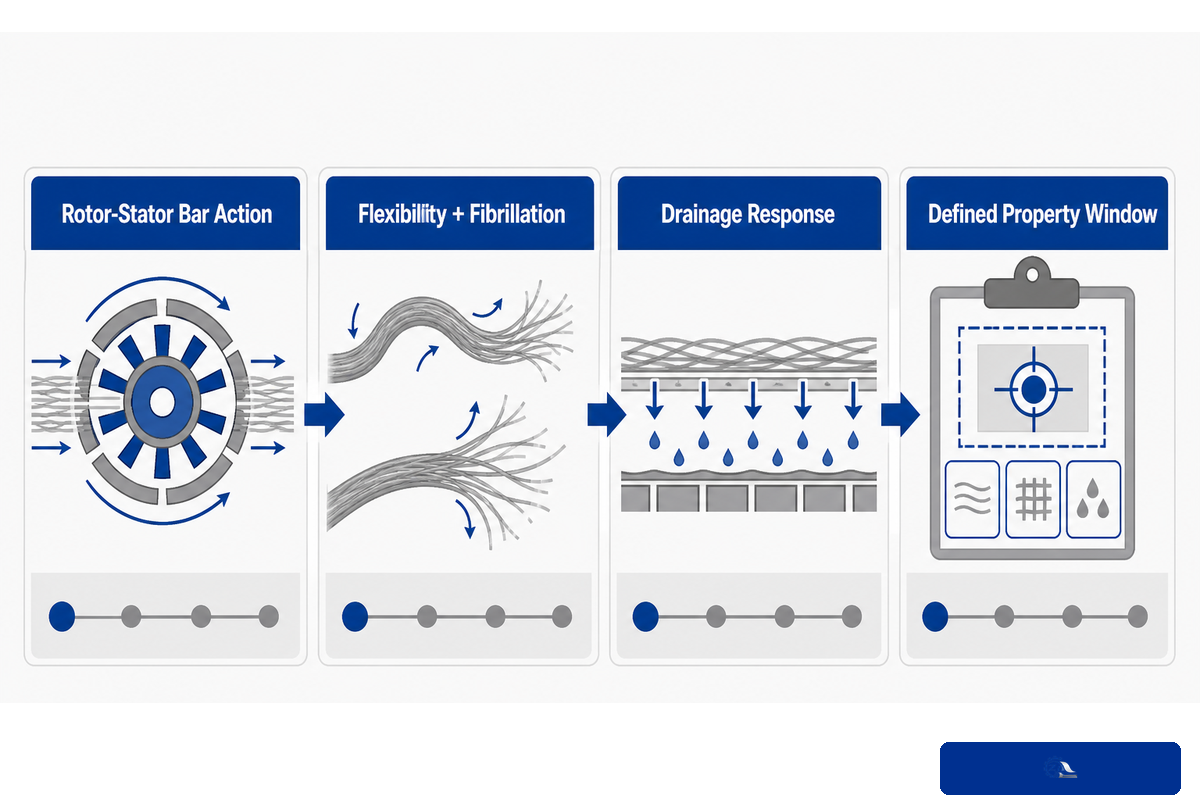
The paper machine refiner helps develop pulp fibers to bond together in a sheet more effectively and in a stronger way. The pulp is processed through several groups of rotor stator bars and has changed characteristics such as flexibility, surface fibrillation, and drainage. The machine can create tearing and fines but isn’t designed to do so.
“The strength of paper is largely determined by the strength of the attachments at these fiber crossing points.” Source: University of British Columbia, Papermaking Stock Preparation: LC Refining
Paper quality can’t be set by refining alone. Formation, furnish blend, retention, pressing, drying and basis weight also affect the sheet. Refining should therefore be controlled against a defined property window, not against the lowest possible freeness or the highest motor load.
For other steps after screening and cleaning like mixing and approach flow refer to the stock preparation process guide. Here, the article focuses on the activities within the refiner and evidence needed to assess it.
The 6-Stage Inside-the-Gap Action Loop
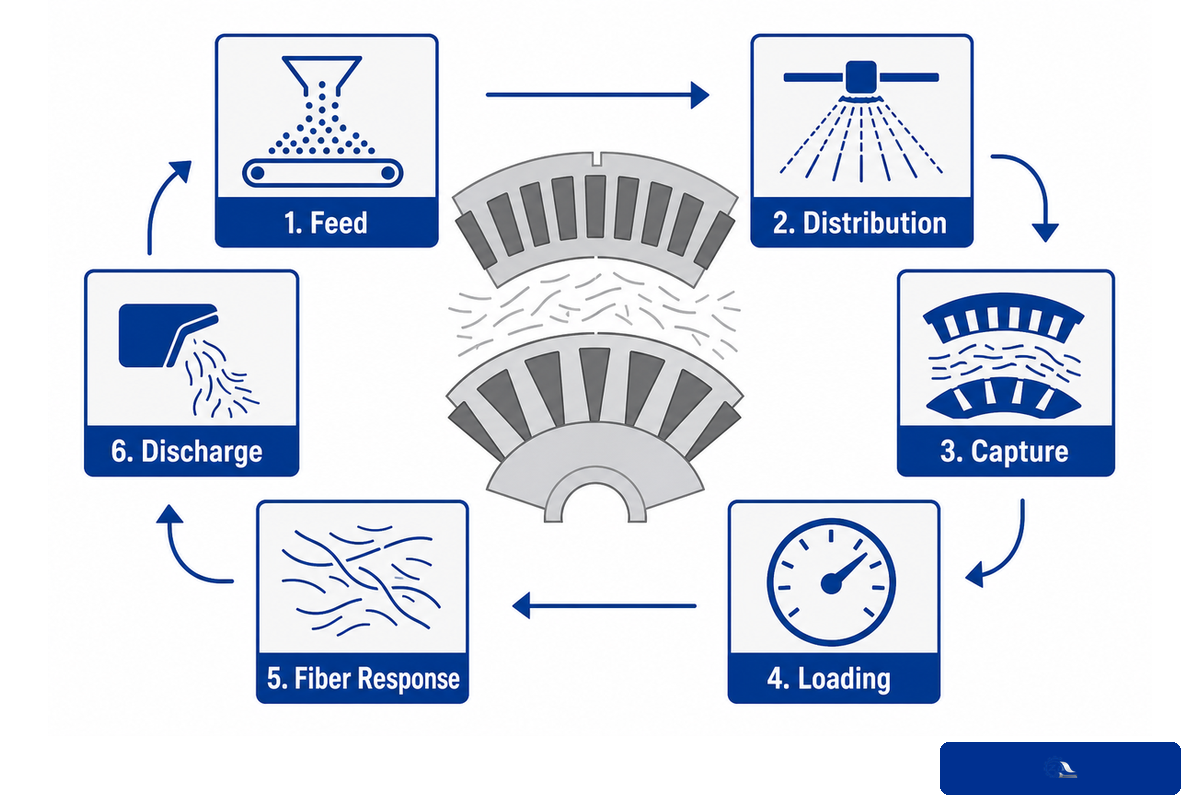
The 6-Stage Inside-the-Gap Action Loop follows feed, distribution, capture, loading, fiber response and discharge. The loop uses several response measures to avoid a common diagnostic trap: treating one control tag as the result. An actuator, such as the plate gap, is considered to be the final result here. The result exists only when downstream fiber or sheet evidence confirms the intended response.
| Stage | What happens | What can change it | Evidence to retain |
|---|---|---|---|
| 1. Feed | Screened stock reaches the refiner at a dry mass flow, consistency and temperature. | Furnish ratio, broke or recycled content, dilution and upstream debris | Dry flow, inlet consistency, temperature and furnish identity |
| 2. Distribution | Hydraulics distribute the suspension into the active plate area. | Flow, pressure, air, wear, recirculation and groove capacity | Inlet and outlet pressure, flow stability and vibration |
| 3. Capture | Fiber flocs approach crossing bar edges; capture is probabilistic, not uniform. | Fiber length, coarseness, flocculation, plate pattern and speed | Furnish morphology and plate geometry |
| 4. Loading | Captured material receives compression, bending and shear during many crossings. | Effective gap, net power, edge length, speed and consistency | Validated no-load basis, net power and gap feedback |
| 5. Fiber response | Walls delaminate, surfaces fibrillate, fibers flex or collapse, and some fibers shorten. | Wood species, pulping route, drying history and treatment severity | Fiber length, fines, morphology and water retention |
| 6. Discharge | Treated stock exits with heat and a changed drainage and bonding response. | Transport lag, chest mixing and sample location | Timed freeness or SR, fiber tests and sheet tests |
Industrial treatment is quite heterogeneous. Some fibers experience only a few effective contacts while others experience very severe loading. So, averages such as average power, average freeness, or one handsheet value can conceal a number of different fiber subpopulations. For this reason, there are a number of response measures at the end of the loop rather than a single control tag.
The six-stage explanation may apply to low-consistency stock-preparation processes, although it may not describe high-consistency mechanical-pulp refining processes. Mechanism boundaries vary depending on the consistency regime, steam and temperature conditions, plate architecture and the objective of fiber production.
What Actually Happens to the Fibers?
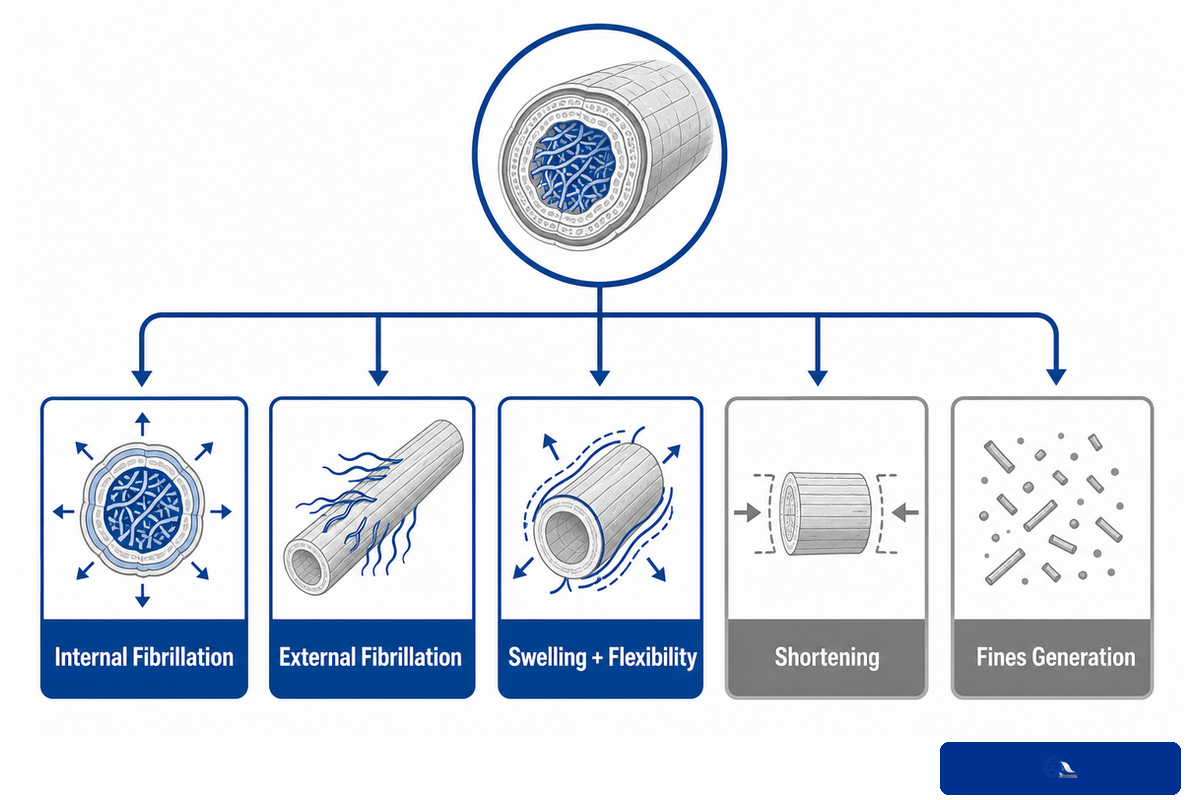
Refining modifies the fiber wall and the fiber population. Internal fibrillation can increase flexibility and conformability; external fibrillation can add bonded surface; in production, compare swelling, collapse, fiber length, fines, drainage and sheet properties before assigning a change to the refiner. On the other hand, shortening and detached fines may change the property of tear and drainage, bulk and water retention.
- Internal fibrillation: The layers within the fiber wall loosen. That change allows the fiber to collapse more easily.
- External fibrillation: Fibrils are attached to the surface and make inter-fiber contact.
- Swelling and flexibility: the fiber, when wet, will conform more closely at crossings increasing bonded area after consolidation.
- Shortening: some fibers are cut. The response can depend on the starting distribution of fibers, and the kind of property of the sheet being protected.
- Fines generation: detached material may block pores and impede drainage; it may also bind too much water.
Cutting isn’t necessarily a bad thing. In one mixed-pulp plate-angle study, the condition with faster cutting also produced stronger external fibrillation and better tested tensile and tear results than the other tested patterns. This certainly doesn’t mean this condition is a recommended plate, but rather explains that the one-direction rule can be wrong.
History matters. Long softwood fibers, short hardwood fibers, mechanical pulp, virgin chemical pulp and once-dried recycled fibers don’t possess the same coarseness, flexibility or bonding potential. The refiner can produce different results from mixed refining versus separate component refining and later blending.
Why Better Bonding Creates Trade-Offs
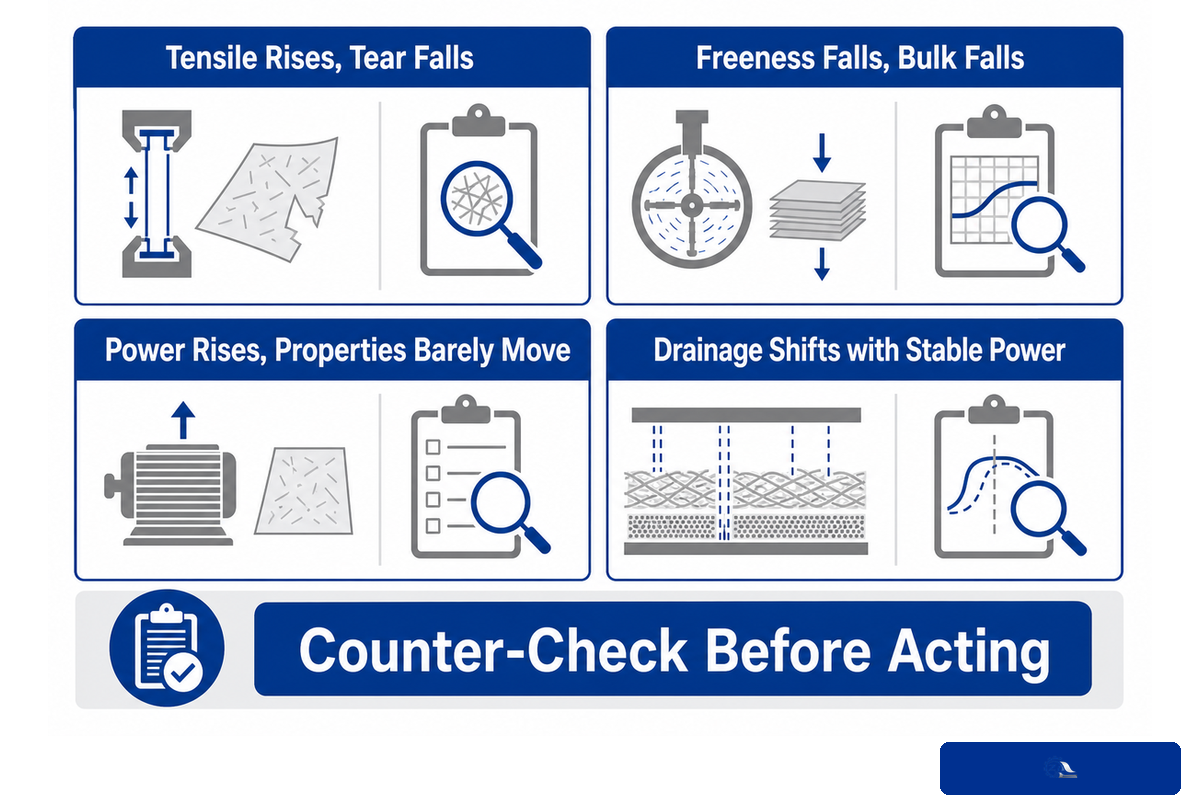
Greater bonding potential can improve tensile or burst response while reducing drainage, bulk, porosity or tear reserve. The direction isn’t fixed for every furnish because of the influence of many factors, including the length and coarseness of fiber, previous drying, fines, plate geometry, and sheetmaking conditions. As a result, a useful trial can protect several properties at once.
| Observed change | Possible refining explanation | Counter-check before acting |
|---|---|---|
| Tensile rises, tear falls | More bonding with loss of long-fiber contribution | Fiber length, fines, furnish blend and sheet basis |
| Freeness falls, bulk falls | More fibrillation, swelling and collapse | Pressing, fines retention and temperature compensation |
| Power rises, properties barely move | No-load basis, bypass, blinding or diminishing response | Net power, dry flow, actual gap movement and plates |
| Drainage shifts with stable power | Consistency, furnish or temperature changed | Time-aligned inlet data and morphology |
The property window will have tensile, tear, drainage, bulk, porosity, and machine runnability. However, it should only include measures tied to the grade decision. Such a long list with no release rule isn’t a control plan. Assign an owner, method, sample time and acceptance boundary to each measure kept in the window.
Which Variables Control Refiner Action?
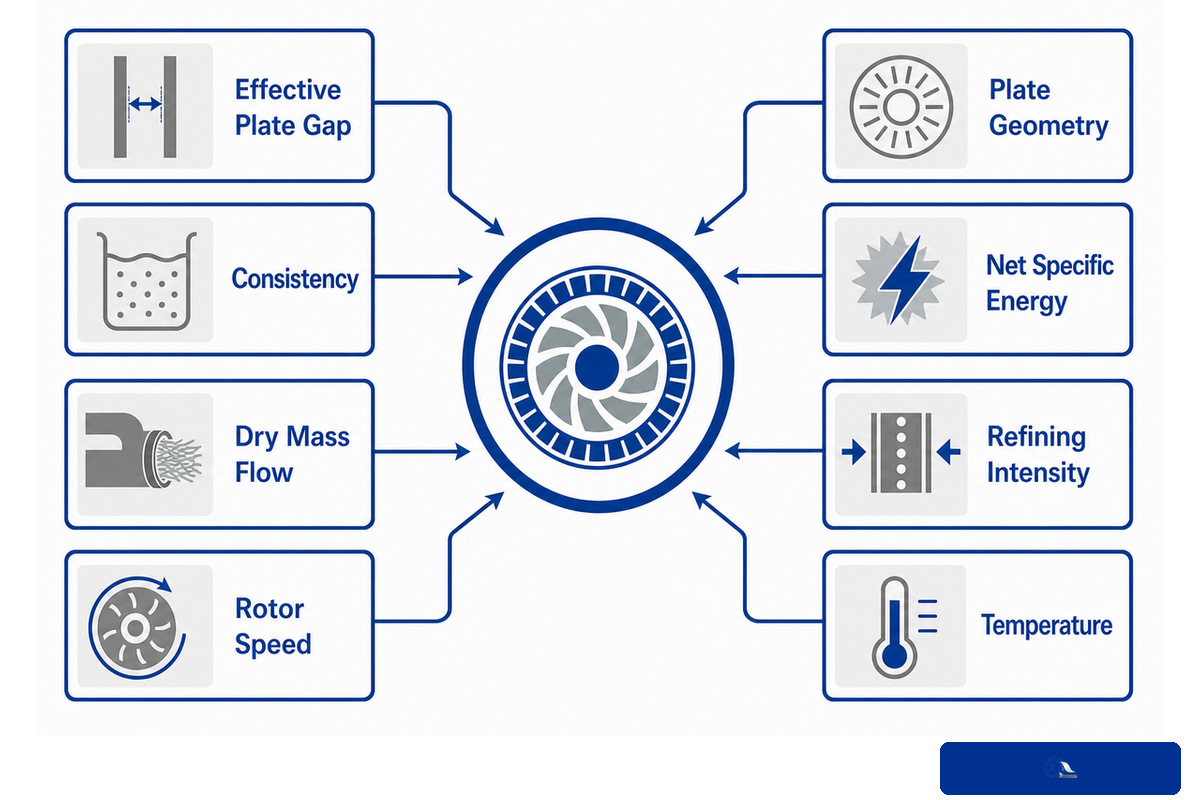
Refiner action depends on multiple variables acting in combination with each other. This includes, among others, effective clearance, stock consistency, dry mass flow, rotor speed, plate geometry, net specific energy, loading intensity, temperature, as well as prior processing and furnish morphology.
| Variable | What it changes | Measurement boundary | Do not infer |
|---|---|---|---|
| Effective plate gap | Interaction rate, hydraulics and contact risk | Thermal growth, wear, runout and feedback basis | Smaller always means better |
| Consistency | Crowding, flocculation, impact count and energy per impact | Sampling location and dry-solids method | Consistency is the master variable |
| Dry mass flow | Energy dose per dry tonne | Flow multiplied by verified dry consistency | Volumetric flow equals production |
| Rotor speed | Bar-crossing frequency, hydraulics and no-load power | Actual speed and equipment design | Speed can be compared across models alone |
| Plate geometry | Capture, edge length, flow capacity and loading distribution | Bar angle, width, groove and active diameter | Bar count predicts fiber response |
| Net specific energy | Energy applied per dry mass | Validated no-load subtraction and dry flow | Gross motor kW is the dose |
| Refining intensity | Severity or distribution of loading events | Metric definition and plate-edge basis | Equal SEL means equal fiber treatment |
| Temperature | Water viscosity, swelling and drainage reading | Sensor location and test compensation | A hot sample equals a more-refined sample |
There needs to be a careful evidence boundary around consistency. One study explains how it changes the number of impacts and energy per impact. A different peer-reviewed study states that in a tested range of 2.0-5.5%, refiner loadability was more closely related to the length and coarseness of the fibers. Both of these studies can be correct, due to the fact that plate and furnish conditions can be different.
If a plant can’t hold all eight inputs stable, record the drift and evaluate the results appropriately. Hiding an uncontrolled variable behind an average value gives a false sense of precision. A qualified trial with one known deviation is more useful than a neat table with an unknown furnish change.
Specific Energy vs Refining Intensity
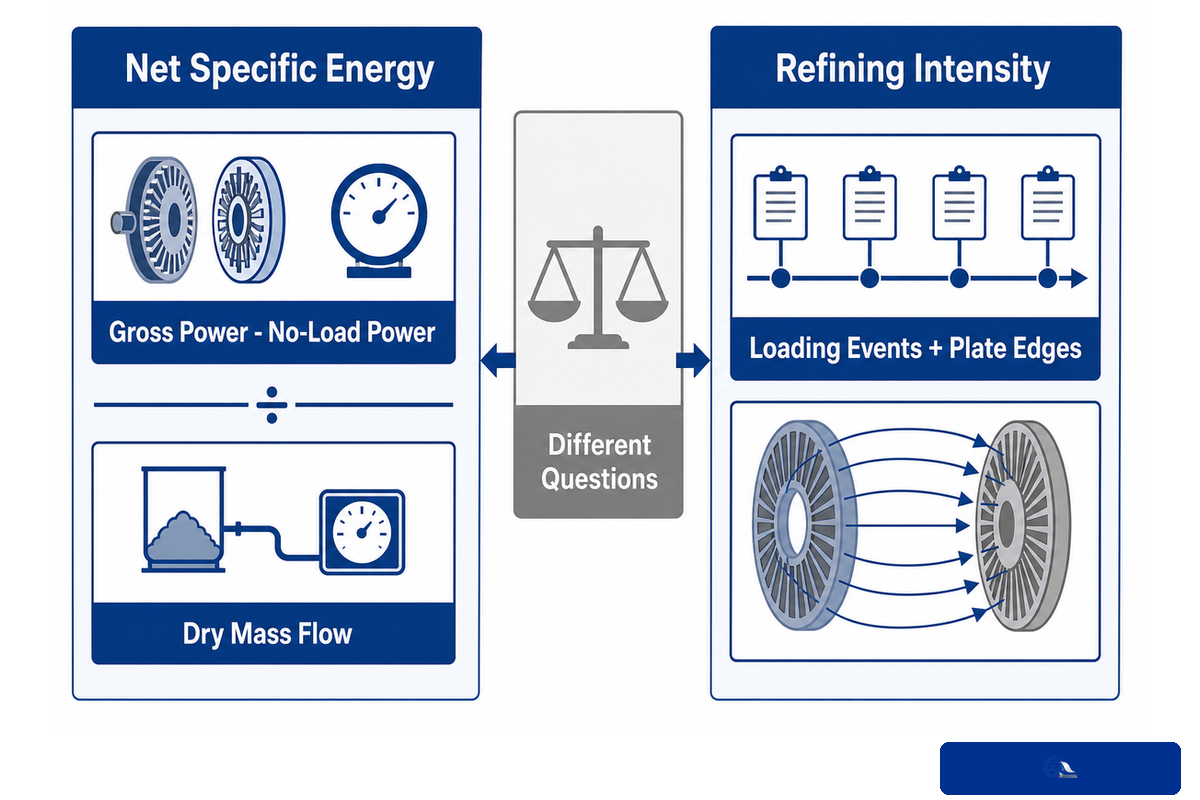
Specific energy and refining intensity respond to different queries. Estimating net specific energy determines how much energy the refiners use to process each dry tonne. Refining intensity answers the question of how the energy was distributed across the loading events or plate edges. The same energy dose can produce different responses in fiber based on the type of geometry, speed, furnish and consistency.
Net specific refining energy can be written as:
Net Specific Energy = (Gross Motor Power – Validated No Load Power) in kW / Dry Mass Flow in t/h
Illustrative calculation only: if gross motor power is 250 kW, the validated no-load basis is 70 kW and dry mass flow is 12 t/h, net power is 180 kW and net specific energy is 15 kWh/t. Those numbers are arithmetic inputs, not a recommended setting.
A trial worksheet might record 3.5% consistency, 45 °C inlet temperature, 280 kPa pressure, a 0.30 mm indicated gap, 12 t/h dry flow, 250 kW gross power, a 5 kW change marker, a 0.05 mm command increment and a 19 min response tag. These values represent a subset of fields being monitored; they do not represent operating targets.
No-load power isn’t a permanent nameplate constant. It includes hydraulic, pumping and mechanical losses that can vary with speed, flow, plates and the condition of the equipment. A gross-load trend can look stable while net-fiber treatment power moves, especially if the no-load basis or dry mass estimate has drifted.
Localized edge loading and associated intensity descriptors offer additional vantage points and perspectives, but they too are models. They’re a function of active edge length, velocity and power. Use the same established calculation basis across a given trial and don’t compare values from different plates as if they represent fiber contacts of the same nature.
The 6-Signal Refiner Diagnostic Matrix
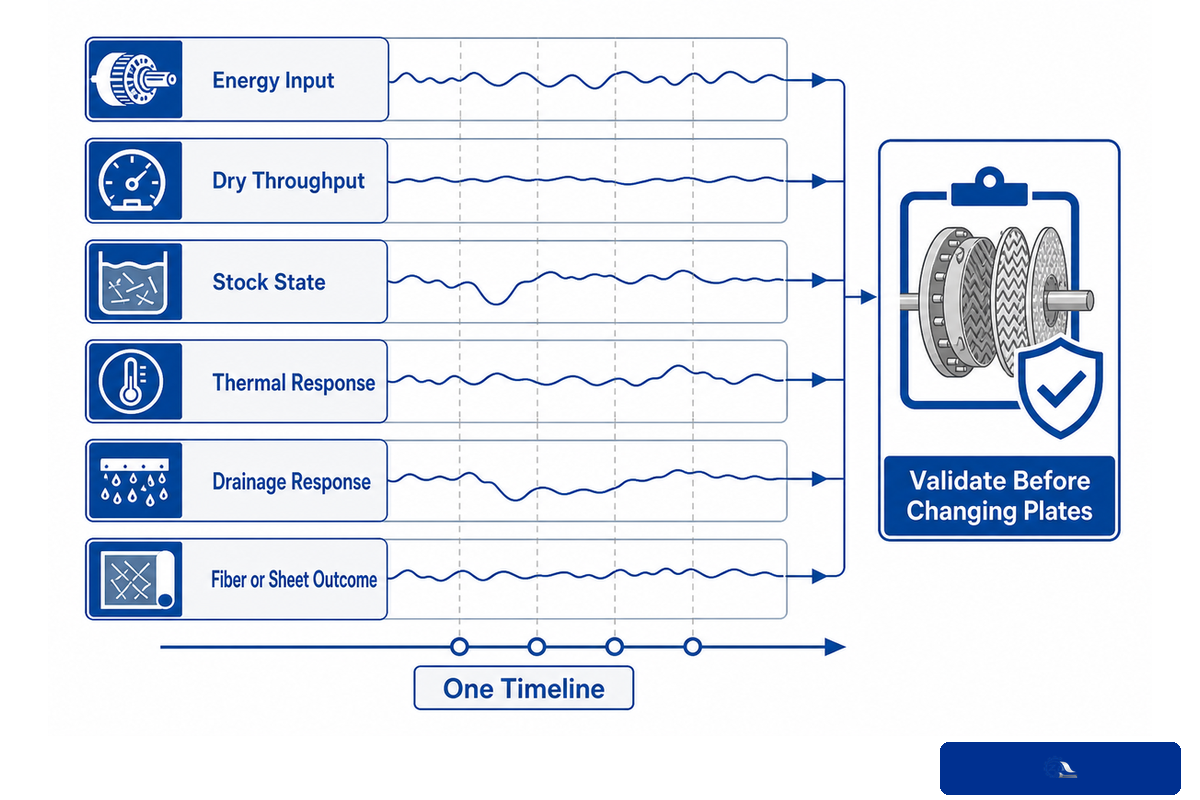
The 6-Signal Refiner Diagnostic Matrix places energy input, dry throughput, stock state, thermal response, drainage response and fiber or sheet outcome on one timeline. This mechanism allows the team to diagnose a true change in fiber development from a misrepresentation of the denominator, transport lag, furnish shift, temperature effect or hardware issue before changing the plates.
| Signal category and pattern | First interpretation | Counter-check | Next bounded action |
|---|---|---|---|
| Gross power rises; dry flow, consistency and speed look stable | More net load or more losses | No-load basis, pressure, temperature, vibration and actual gap movement | Validate power basis before moving gap |
| Power stable; freeness falls | Dose per dry tonne or furnish response changed | Dry flow, inlet consistency, temperature, fiber length and fines | Recalculate SEC on the same time window |
| Power rises; freeness and sheet result barely move | Loss, bypass, blinding or diminishing response | Gap feedback, plate condition, air, flow and sample lag | Confirm mechanics and transport timing |
| Freeness falls; fines rise; tear falls after tensile rises | Treatment moved beyond the grade window | Furnish blend, fiber length, SEC, intensity and plate geometry | Return to the last accepted trial point |
| Power or temperature oscillates | Flow, consistency, air or control-loop instability | Pressure, flow, dilution, deaeration, gap and timestamps | Stabilize inputs before judging fiber response |
| Tensile rises; bulk or porosity falls | Expected bonding trade-off may be present | Pressing, retention, drying and basis weight | Let the grade window decide, not one property |
| Gap command changes; pulp response appears late | Transport, chest mixing or sample delay | Line volume, sample point, lab time and trend alignment | Shift the comparison window before changing again |
| All process signals stable; quality still changes | Incoming furnish or downstream paper-machine cause | Species, recycled content, pulping history, retention, press and dryer data | Expand the investigation beyond the refiner |
Time alignment is not optional. In one CTMP study, the estimated delay from a gap change to measured freeness response was 19 min because of that system’s hydraulic residence time. This number isn’t generally applicable. The idea is to determine a given plant’s transport lag and sampling lag, and only then make multiple gap changes.
In a different context, concerning drainage measurement, see the freeness and SR converter. A unit conversion can align units; it can’t turn either test into a full quality judgment.
Signs of Excessive or Unstable Refining
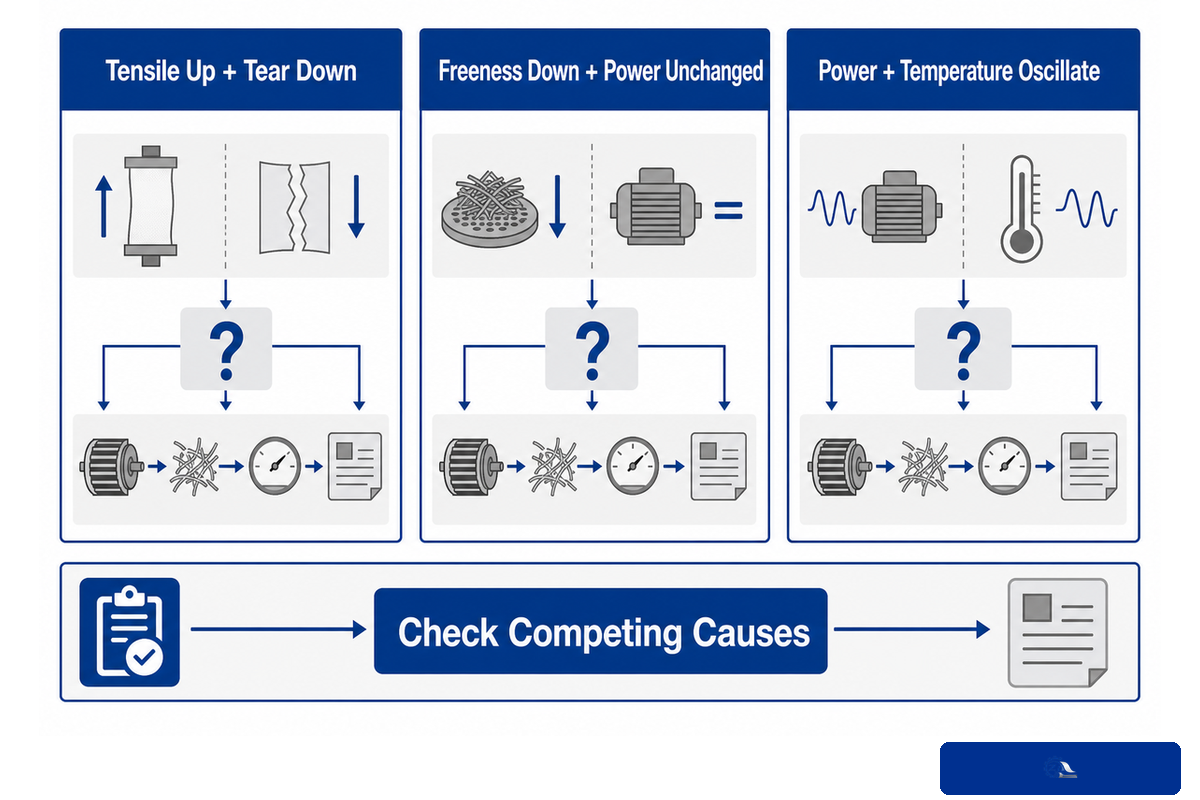
Excessive or unstable refining appears as a pattern across several signals, not as one threshold. Falling drainage, rising fines, shortening of fibers, loss of tear reserve, increased water retention, unstable power and temperature, and property changes warrant an investigation. Each symptom has other causes that must also be checked.
Scenario 1: Tensile improves and tear worsens. Stronger bonding with more shortening is one possible explanation. However, changing the furnish blend can also result in a similar pattern. Freeze the blend, compare fiber-length distribution, and check the same sheet basis before concluding this is due to a gap.
Scenario 2: a reduction in freeness is coupled with gross power being unchanged. The contradiction may be resolved by recalculating net energy per dry tonne. Consistency errors, lower dry flow, hotter samples or different recycled-fiber share may also affect drainage results without a visible motor-load change.
Scenario 3: Study what happens to power and temperature when they’re oscillating together and check dilution control, pressure, air, flow, gap feedback and control loop hunting. A sample taken after chest mixing may hide the oscillation, so line up high frequency process data to the sample’s true production window.
The public forum search found a papermaking discussion where a commenter with alleged paper-machine operating experience said that excess refining can make a sheet brittle while tensile strength continues to improve. This experience explained the question, but peer-reviewed articles describe the answer.
Safe Trial-and-Decision Framework
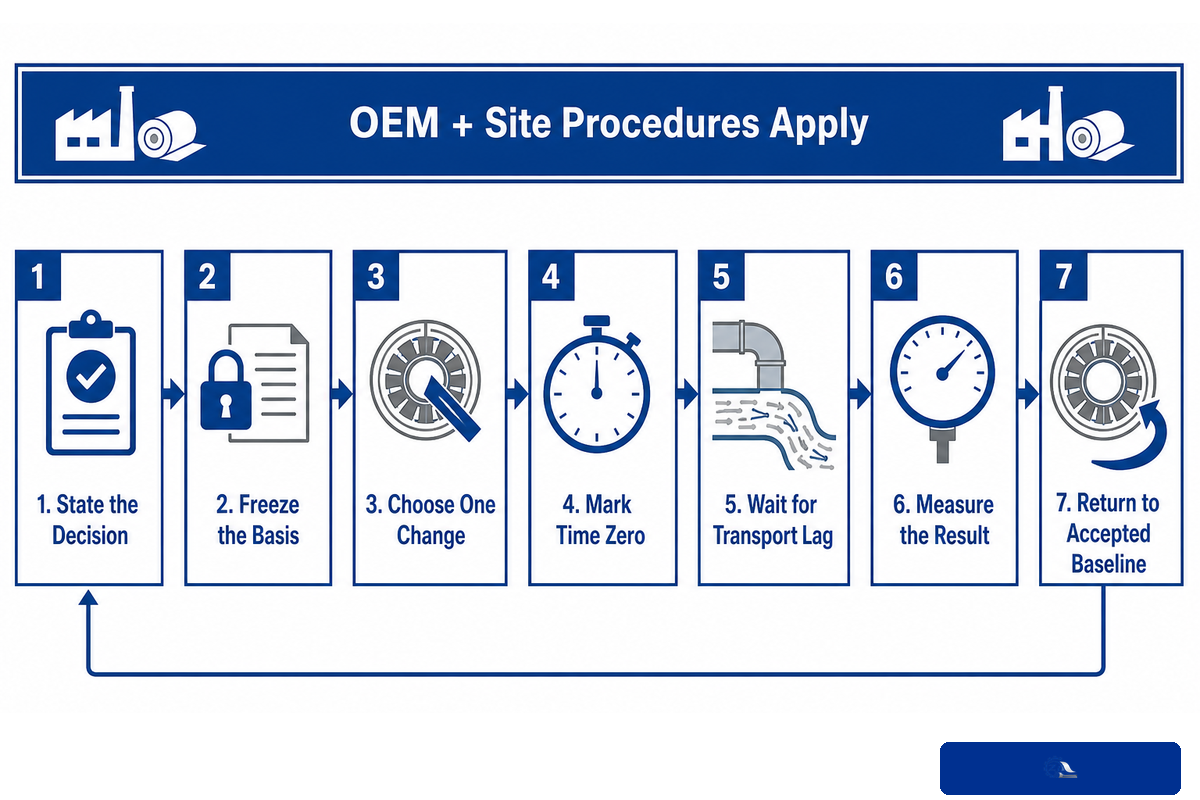
A controlled refiner trial fixes the grade objective, freezes the major inputs, changes one dominant factor, waits through the known response lag and evaluates several output properties. It defines stop conditions before the run. This allows a decision to be made; it isn’t a replacement for the OEM manual or site isolation procedure.
- State the decision. Name the property to be improved and name the properties that aren’t allowed to cross their accepted limits.
- Freeze the basis. Record furnish identity, blend, recycled history, inlet consistency, dry flow, temperature, speed, plate set and no-load-power basis.
- Choose one dominant change. Use a loaded gap, flow, or pressure change that’s approved for the exact machine and plate set.
- Mark time zero. Record the command, actual response, power, pressure, temperature and sample lineage.
- Wait for transport lag. Don’t examine or interpret samples produced prior to the new condition being achieved at the sample point.
- Measure the result. Use drainage and selected fiber and sheet properties, along with the same methods and conditioning, to determine the trial result.
- If the trial is rejected, return to the previously accepted baseline, before the next change.
Use the refiner’s OEM limits, guarding, interlocks, permit-to-work and site lockout/tagout procedure for electrical, hydraulic, pneumatic, pressure and rotational energy. For power spikes, abnormal vibration, seal leaks or plate-contact indications, follow site stop and emergency procedures rather than make an improvised online adjustment.
For the overall process of a refining trial, along with definitions and illustrations for process checkpoints, see the pulp refining process guide. That page contains the overall process; this page provides the logic and diagnostics.
When Evidence Points to Plates or Hardware
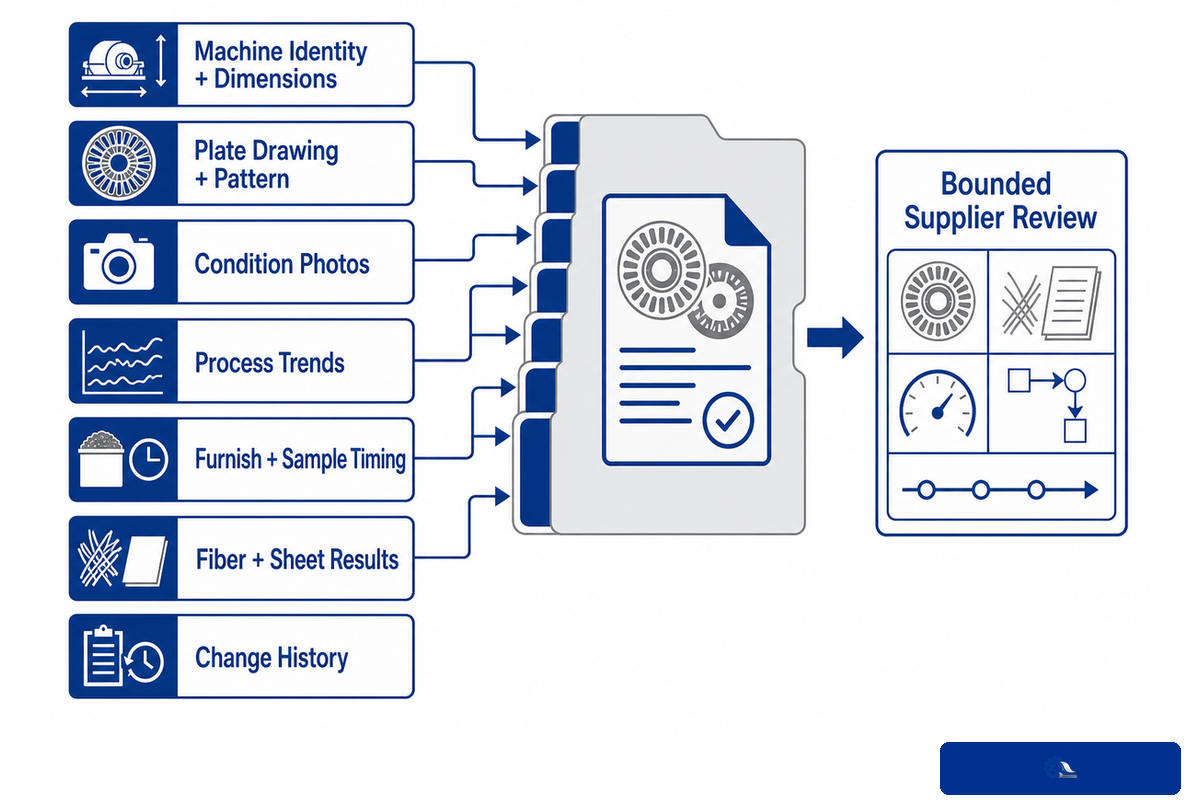
Hardware becomes the main suspect when, with respect to validated power, consistency, and other factors, there’s a gap, feedback, wear, or other evidence with the change. Before a supplier is asked to exchange a plate, prepare a traceable packet showing evidence for the change.
Asset 3: Evidence-to-Hardware Handoff Checklist
- Machine make, model, plate-holder dimensions and rotation direction
- Current plate drawing, bar pattern, active diameter, material and installation date
- Clear photos both sides, wear zones, deposits, cracks, contact marks and fasteners
- Gross power, validated no-load, dry flow, consistency, speed, pressure, temperature and gap trend
- Furnish identity, blend, recycled history, sample times, and known transport lag
- Freeness or SR, fiber length, fines and the selected sheet-property results
- What changed, when it changed, what was restored, and which condition reproduced the problem
Zejiang’s commercial page asks for plate-holder measurements and, where available, the current bar pattern or a worn sample, prior to quotation. Use the Refiner plates and screen baskets compatibility page for fit, material, replacement and RFQ questions. This article doesn’t repeat those commercial decisions.
Discuss a refiner-parts evidence packet
Frequently Asked Questions
Does a paper machine refiner cut fibers?
A refiner can cut fibers, but cutting is only one possible response. Compression, bending and shear can also increase internal and external fibrillation, flexibility, swelling and collapse. The useful balance depends on furnish and grade objectives. Check fiber length, fines, drainage and sheet properties instead of assuming every lower freeness result is desirable. A falling average fiber length should therefore be interpreted beside strength, bulk, porosity and drainage, with samples aligned to the correct transport delay. If the target property improves while tear or runnability moves outside its approved window, the trial has still missed its objective.
Is plate gap the main refiner control?
Plate gap is important, but it isn’t a complete control by itself. Consistency, dry mass flow, rotor speed, plate geometry, temperature, no-load losses and furnish morphology change how a gap command affects fiber treatment. Use the effective machine-specific gap with validated power and response data, never a copied cross-model setting.
What is specific refining energy?
Specific refining energy is the net refiner energy applied per dry mass of pulp, often reported in kWh/t. Calculate it from gross power minus a validated no-load basis, divided by dry mass flow. It describes dose, not treatment severity, and should be read beside intensity, furnish, geometry and property results.
Can freeness alone show over-refining?
No. Freeness or Schopper-Riegler records drainage response under a defined test, not the entire fiber or sheet condition. Temperature, fines and furnish can change the result. Confirm suspected over-refining with fiber length, fines, water retention and relevant sheet properties, aligned to the correct production and sample window.
Related Articles
- Pulp Refining Process: From Trial to Sheet Response
- Types of Pulp Refiners and Their Operating Roles
- Refiner Sizing Reference
- Pulping Equipment Overview
- About Zejiang Paper Machinery
References & Sources
- PubMed: Basic effects of pulp refining on fiber properties: a review
- University of British Columbia: Papermaking Stock Preparation: LC Refining
- BioResources: Impact of pulp consistency under constant SEL and SEC
- Journal of the Korean Wood Science and Technology: Combined refining plates and paper properties
- BioResources: Time-series analysis of refining conditions and pulp properties
- TAPPI: Refining recycled fiber for tissue production
Technical claims were traced to university, peer-reviewed and industry-association sources; machine settings remain subject to the exact OEM manual, furnish and site procedure.




![Refiner Plates & Screen Baskets [Complete Guide]](https://zjpapermachine.com/wp-content/uploads/2026/07/refiner-plates-screen-baskets-guide-featured-150x150.png)
![Doctor Blade: Types, Materials & How It Works [Guide]](https://zjpapermachine.com/wp-content/uploads/2026/07/doctor-blade-guide-featured-1-150x150.png)
![Pulping Equipment: How Paper Pulping Works [Guide]](https://zjpapermachine.com/wp-content/uploads/2026/07/pulping-equipment-guide-featured-150x150.png)