Get in touch with Zejiang Paper Machinery Company

Types of Pulp Refiners: A Practical Classification Guide


If you are comparing types of pulp refiners, start with the process duty rather than the product label. Types of pulp refiners are overlapping labels for feed position, stock consistency, working geometry and rotor/stator arrangement, not one exclusive taxonomy. Disc, conical, double-disc, low- and high-consistency, blowline, and reject types are just a few. These types answer different questions about the machine and its process duty.
The description of pulp refiners isn’t as cumbersome as the long listing may seem. Typically, a useful description states the process duty, stock consistency, working geometry, and rotor/stator arrangement. These descriptions should be sufficient for practical purposes.
Quick answer: Industrial pulp refiners are commonly described as low-, medium- or high-consistency; disc, conical or cylindrical; and single-, double-, twin- or multi-disc. Names of process positions or duties such as blowline, hot-stock, deshive, and reject describe pulp refiners in a given position.
What Counts as a Pulp Refiner?
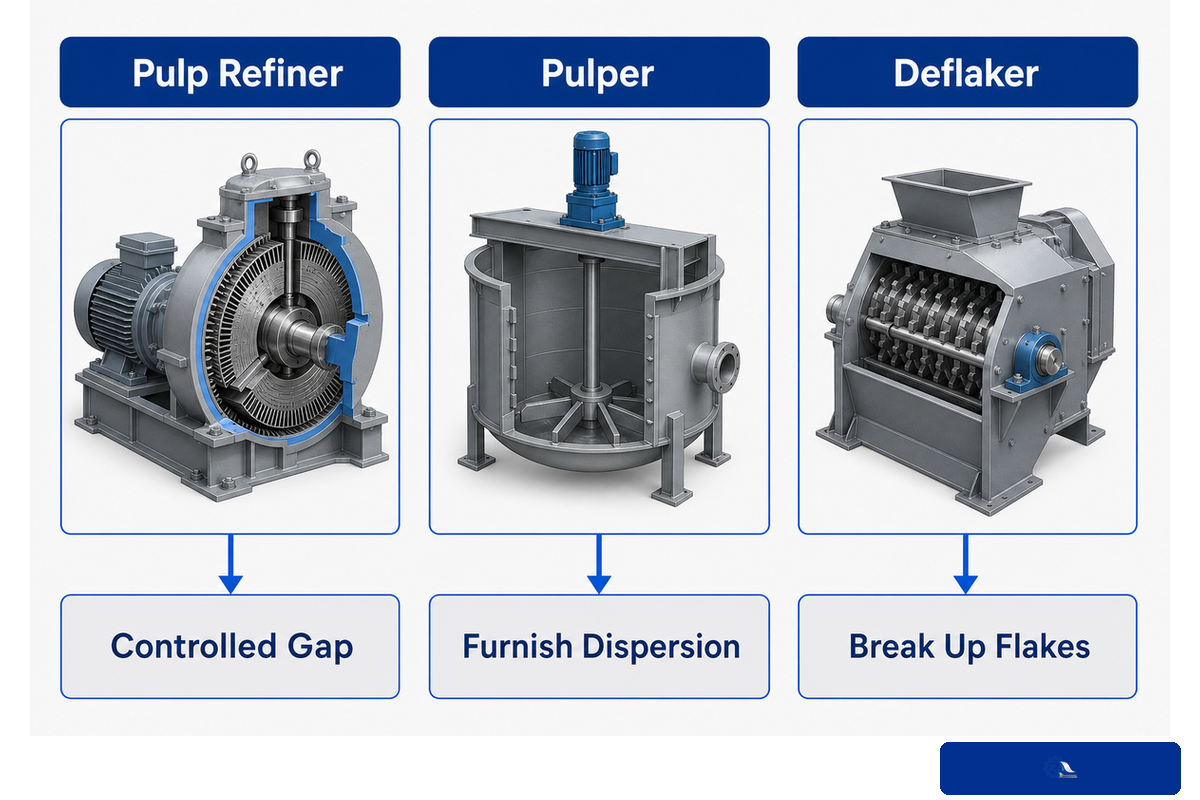
Pulp refiners apply mechanical treatment in a controlled gap, but feed can enter at different stages. One pulp refiner may defibrate chips in mechanical pulping, separate bundles after chemical pulping, or develop bonding in stock preparation. In pulp and paper mills, types of pulp refiners describe overlapping duties rather than one exclusive taxonomy.
For a mill operator, the risk is a false comparison because a pulper, deflaker and refiner solve different production tasks. That mismatch can create a wrong machine decision, a delayed trial and avoidable rework when feed history, pressure state and the paper-grade objective are not recorded. The 3% to 5% laboratory result is evidence for comparison, not a capacity promise.
Distinctions precede the name of the equipment in question. Although both may use a disc working surface, a chip-fed, pressurized mechanical pulping refiner and a low-consistency stock preparation refiner have processes and measurements that aren’t comparable.
Pulpers are not simply another refiner type. A pulper disperses furnish before downstream refining. A refiner, on the other hand, applies controlled mechanical action in a defined working zone. Deflakers break up fibre bundles between those duties. Mills may use all three, so compare their process duty instead of interchanging the names.
The 3-Axis Refiner Classification Map
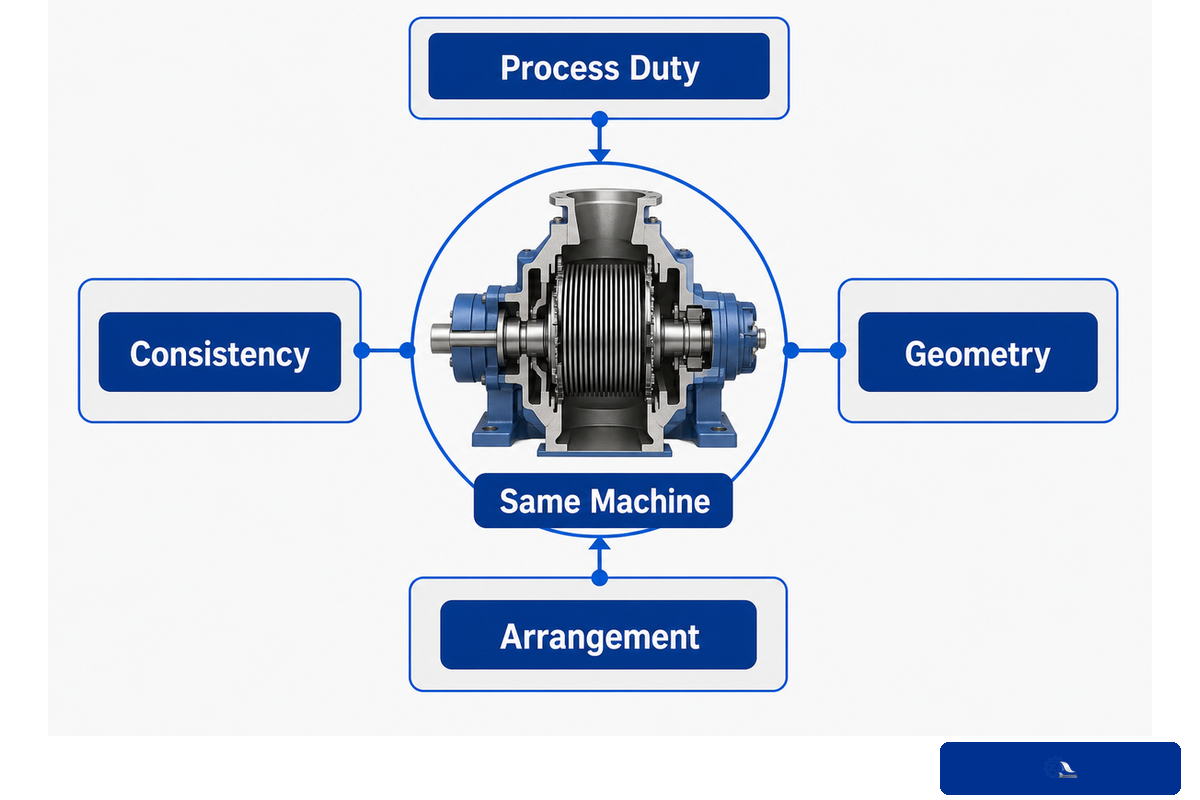
The 3-Axis Refiner Classification Map prevents labels from being compared at the wrong level. After the process gate, describe the same machine three ways: In production, the risk is a category error because consistency, geometry and arrangement answer different questions. Zejiang Paper Machinery can review the drawing against the stated duty. Supplier review should therefore record the process position, the consistency window, the sectional drawing and the stock path before a capacity or quality claim is compared. Because labels overlap, attach the ISO/TS 11371 3% to 5% scope and the sectional drawing before comparing capacity.
| Refiner type or label | Organizing axis | What it describes | What it does not prove |
|---|---|---|---|
| Low consistency | Consistency | Dilute stock condition in the treatment zone | A universal percentage boundary |
| Medium consistency | Consistency | Intermediate application-defined stock condition | One fixed range across all duties |
| High consistency | Consistency | Dense stock condition with stronger fibre-to-fibre interaction | Automatically gentler or more efficient treatment |
| Disc | Geometry | Broadly planar active surfaces | Capacity, intensity or sheet result |
| Conical | Geometry | Matching cone-shaped active surfaces | A universally longer or gentler treatment |
| Cylindrical | Geometry | Treatment around a cylindrical surface | Fit for a duty without process data |
| Hybrid | Geometry | Two geometry forms within one machine or train | One exclusive geometry class |
| Single-disc | Arrangement | A named rotor/stator layout | The number of active faces without a drawing |
| Double- or twin-disc | Arrangement | Two-disc terminology that varies by design family | Which elements move or float |
| Tri- or multi-disc | Arrangement | Several active elements or zones | Whether stock flows in series or parallel |
For instance, a low-consistency, double disc stock preparation refiner may be described. Pressurized high-consistency disc refiners in mechanical pulping may also be described.
The map also needs an exception box. One peer-reviewed full-scale study describes a CD refiner with a flat zone and a conical zone in series. That machine can’t be forced into one exclusive geometry bucket. Pressure state, continuous or batch operation, feed form and number of stages may therefore be necessary qualifiers.
Low-, Medium- and High-Consistency Refiners
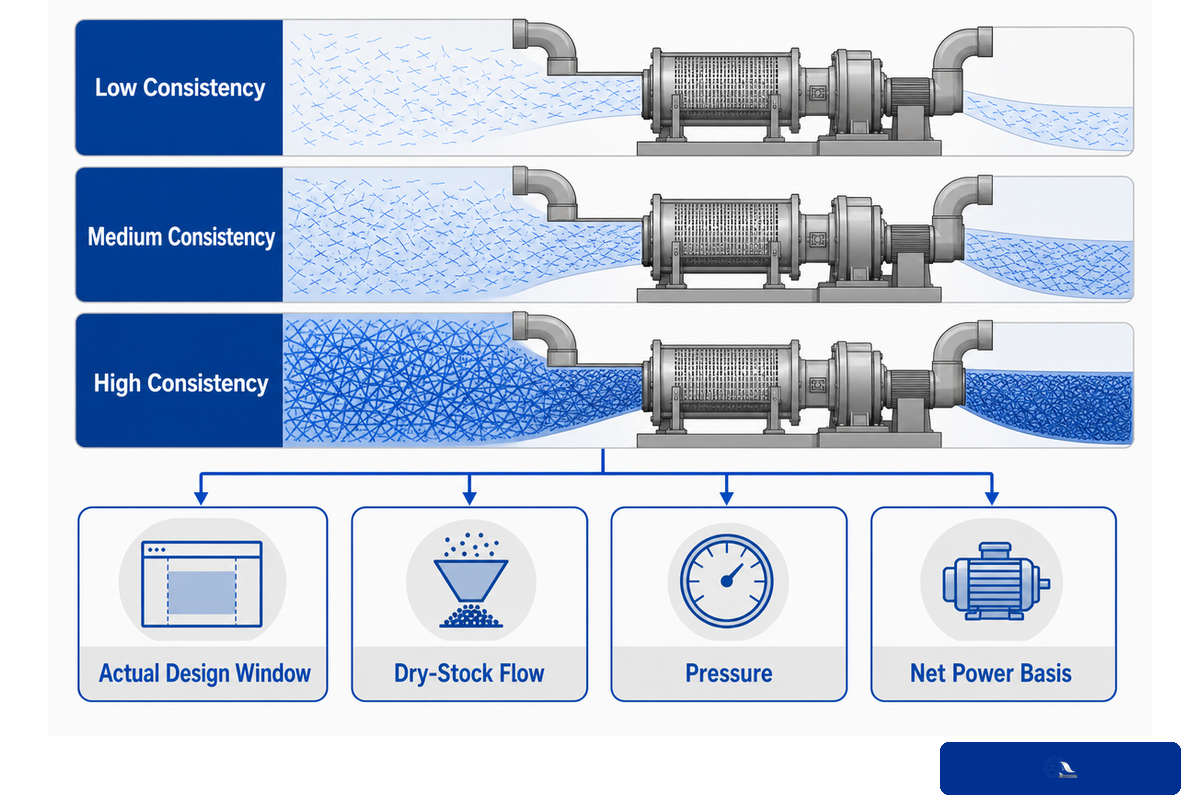
Consistency describes fibre solids concentration in the stock passing through the refining zone. It influences fibre-to-fibre contact, hydraulic behaviour, pumping, dewatering, heat generation and how representative a sample can be. Operators also compare refining energy, refining intensity, freeness, and the action of refining; none of those measures is a substitute for the full operating window. Consistency does not affect the shape of the refining surface. In a production trial, the risk is a false boundary because consistency ranges overlap by application. ISO/TS 11371:2023 defines a 3% to 5% laboratory low-consistency simulation scope; that evidence prevents an operator from treating 5% as a universal machine boundary.
The labels are useful, but their boundaries are application-dependent. ISO/TS 11371:2023 covers laboratory simulation of industrial low-consistency refining at 3% to 5% stock concentration. That is the scope of this method, not a universal rule that every process above 5% becomes high consistency. One peer-reviewed mechanical-pulp study discusses a 4% to 10% low- or medium-consistency operating span, showing why an intermediate category cannot be ignored.
| Consistency label | Useful interpretation | Evidence to verify | Common error |
|---|---|---|---|
| Low consistency | Dilute suspension with strong hydraulic and pumping influence | Actual design window, dry-stock flow, pressure, net power basis | Treating the ISO laboratory range as a universal machine boundary |
| Medium consistency | Intermediate range used in some pulp-line duties | Supplier definition, dewatering and feed system, process position | Forcing every installation into only LC or HC |
| High consistency | Denser fibre mat or plug with more fibre-to-fibre interaction | Feed preparation, steam/pressure state, dilution and discharge design | Assuming higher consistency is automatically gentler or more efficient |
There’s no universally best solution. An analysis of high- and low-consistency refining in mechanical pulp identifies the presence of furnish and fibre mechanism along with the role of process architecture in the difference. Compare involved systems against the same set of design targets and evaluate against the same demonstration period.
Numbers are context, not defaults. The ISO method states 3% to 5% for its laboratory LC scope, while the cited mechanical-pulp study spans 4% to 10% under low/medium terminology. These values belong to different methods, studies and products. They must never be merged into a recommended operating range.
Disc, Conical and Cylindrical Working Geometries
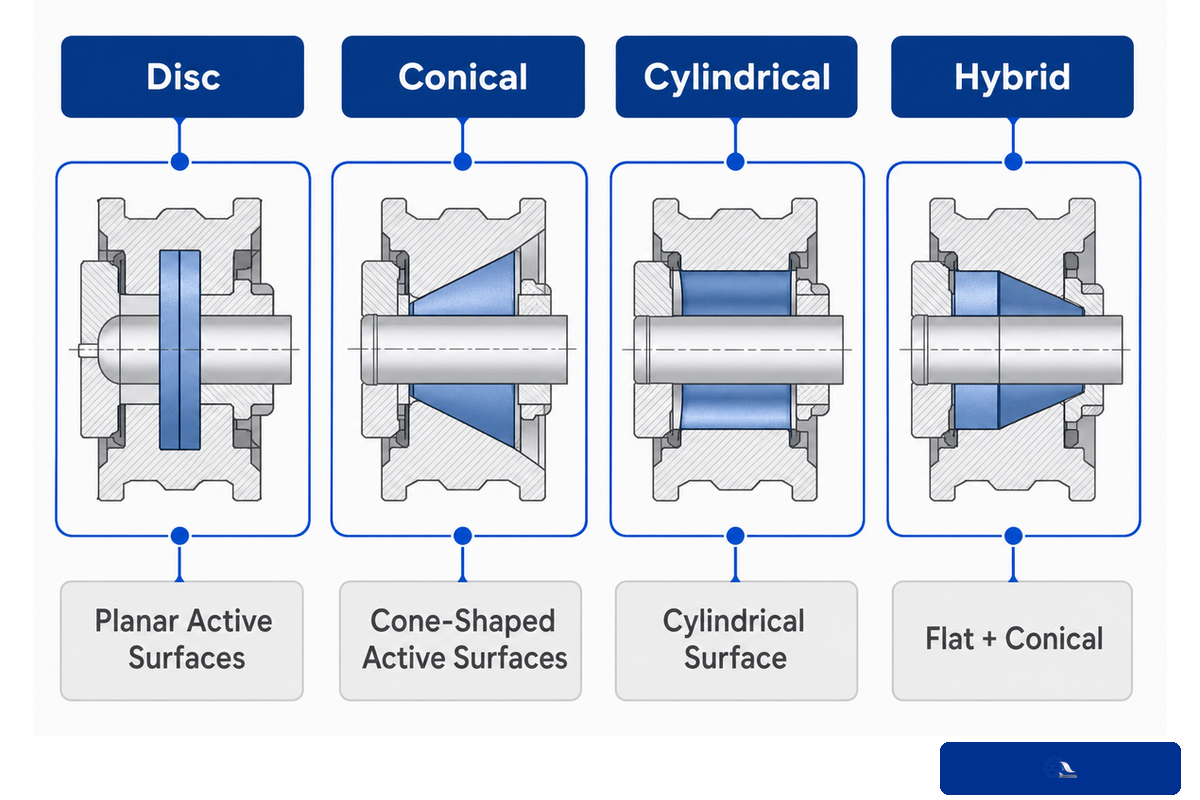
For a mill operator, the risk is a geometry-only decision because plates, speed, gap, flow and furnish still control the production result. The practical failure mode is an apparently lower-energy or higher-throughput comparison that is actually caused by a different plate pattern, gap or furnish, so the trial must hold those fields visible. Zejiang Paper Machinery can compare the plate fit with the recorded process duty. Disc refiners use broadly planar surfaces. Conical refiners use matching cone-shaped surfaces. Cylindrical designs are also feasible. Each design can use different parameters to modify stock treatment in the refining zone.
The positioning, peripheral speeds and dimensions of the machine change with geometry, but they don’t independently predict capacity, energy use or fibre quality. For a given design, the type and positioning of zones, bar patterns and operating points determine the treatment offered. Differences in speeds, flow and gaps of different machine components contribute to variation in performance and may explain differences in observed treatment.
This flexibility is available in equipment combinatory units, such as those using both flat and conical methods in series. In these cases, drawings should replace unit descriptions. The drawings should show the feed point, dilution points, active surfaces, adjustment direction, discharge path and every pressure boundary.
Single-, Double-, Twin- and Multi-Disc Arrangements
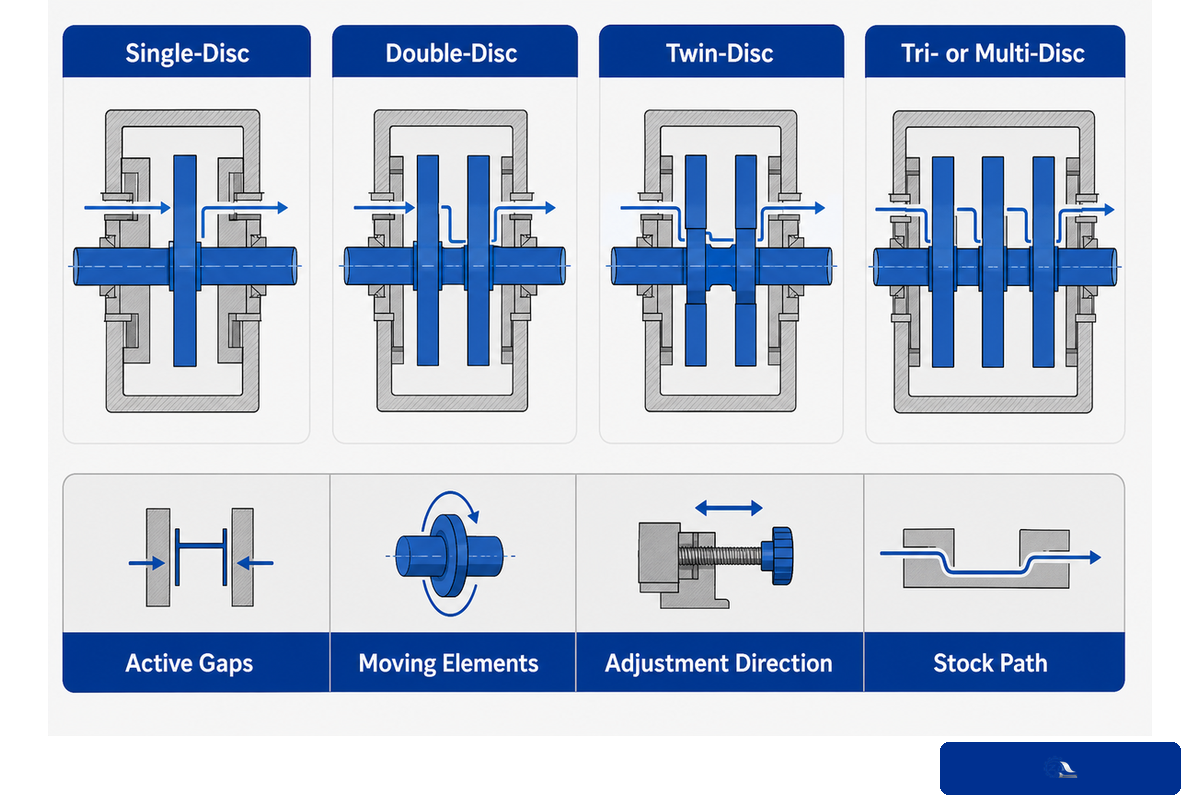
Arrangement terms describe the relationship of moving and non-moving parts, but terms aren’t definitive and thus don’t substitute drawings. “Double-disc” may show two active gaps with a rotating element. “Twin-disc” may represent a product line from the same manufacturer. “Multi-disc” may be used to describe multiple treatment zones. “Tri-disc” and others don’t reduce ambiguity without path information. In an engineering drawing review, the buyer should verify the number of active gaps, the floating element, the adjustment direction and whether flow is serial or parallel; otherwise a familiar name can hide a mismatch.
| Label encountered | Verify on the drawing | Why the name alone is risky |
|---|---|---|
| Single-disc | Which surface rotates and whether one or two faces are active | “Single” can describe a rotor, a gap or a product family |
| Double-disc | Number of gaps, floating element, stock split and discharge path | Internal layouts differ |
| Twin-disc | Actual rotor/stator cross-section and adjustment system | Often a vendor name rather than a neutral standard term |
| Tri- or multi-disc | Number of active zones and whether flow is serial or parallel | More discs do not automatically mean more useful treatment |
The technical refining handbook surfaced in this research distinguishes double-disc and multi-disc arrangements and documents different industrial layouts. Use those terms as prompts for inspection, not as a promise of a fixed internal design.
Refiner Types by Process Duty
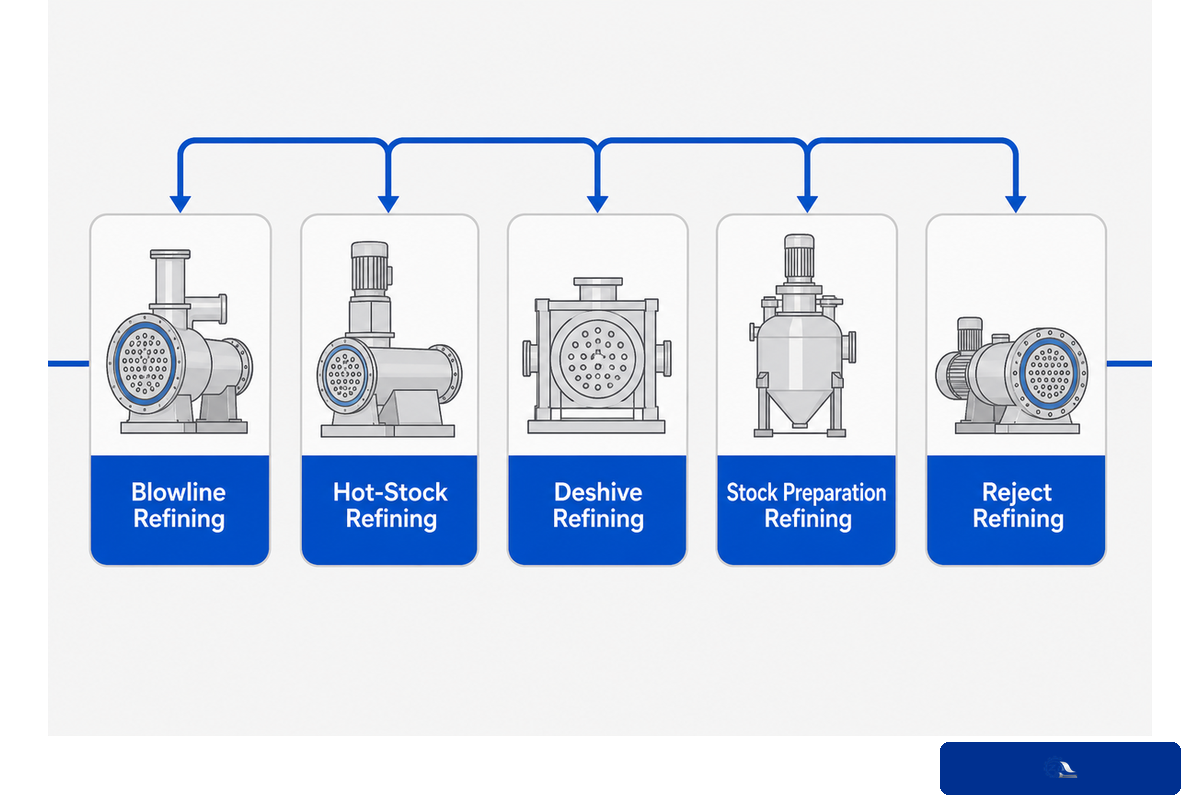
Duty labels say where or why the refiner is used. Of the three axes of hardware, it is the process phase and the selected streams that belong to higher classification levels. In a fiber line pulp mill, the risk is comparing unlike production duties because process phase and selected-stream duty sit at different classification levels. The duty label is a process-position clue, not a capacity guarantee: blowline, hot-stock, deshive, reject and stock preparation still require feed, pressure, temperature and sampling evidence. Blowline trials can be delayed when pressure and temperature are missing, so log the process position and sample time.
- “Blowline refining” describes a treatment stage that’s done on the blowline of a pulp system.
- “Hot-stock refining” describes refining after the blow tank in the chemical-pulp system.
- “Deshive refining” describes a treatment stage in which shives and fibre bundles are removed from a pulp system.
- “Stock preparation refining” describes the treatment of fibres to produce board or paper of a particular grade.
- “Reject refining” describes a treatment stream that’s removed by a screening device.
This is documented on the Valmet chemical-pulp refining page. It states that hot-stock service may use conical or planar-disc and reject service may use conical-disc or double-disc refiner. Therefore, contradictions in the description of a machine may be due to different views of the same physical arrangement. Valmet refiner names are still only a starting point because the drawing shows whether the hardware is conical-disc or double-disc.
Blowline refiners aren’t just stock refiners with different plates. The feed form, pressure and temperature of a refiner can combine with other process variables, including shive load and objective. Understand the process first.
Laboratory Refiners Are Comparators, Not Industrial Categories
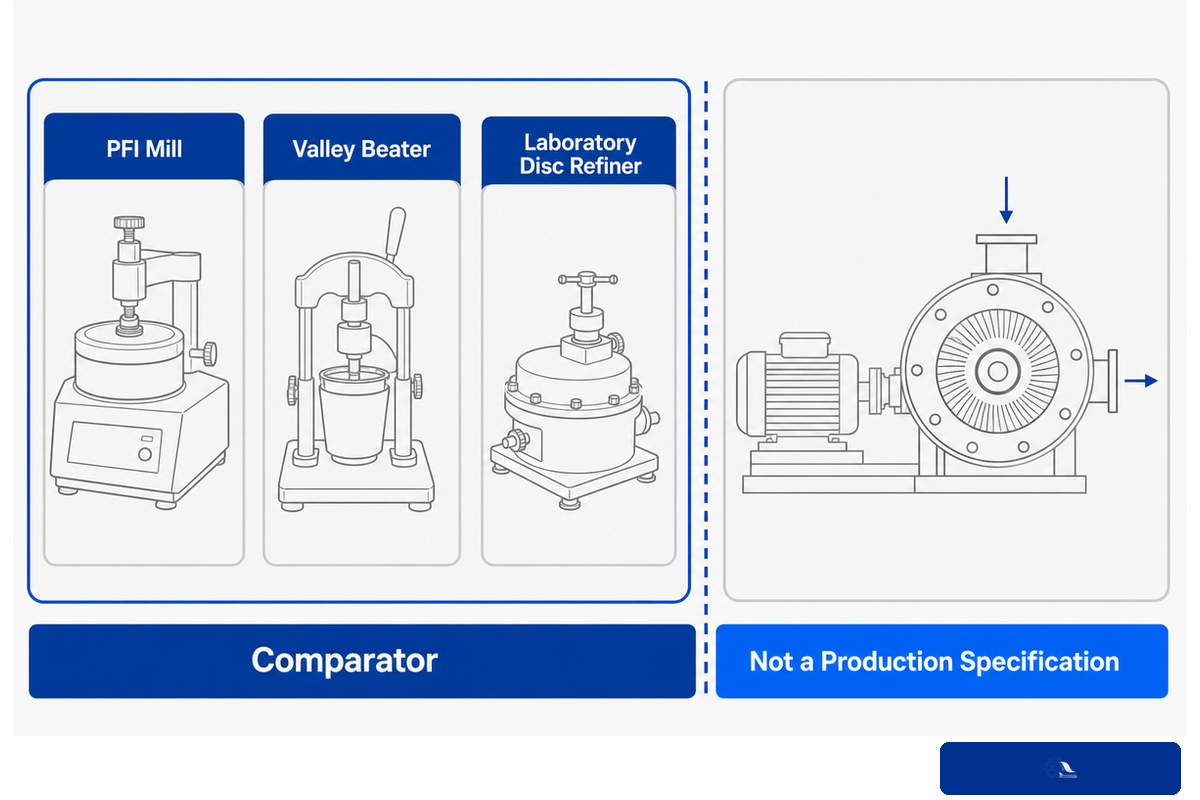
PFI mills, Valley beaters, and lab-scale disc refiners are good test equipment because they alter pulp in a defined way. They allow the user to assess and compare pulp transformations and behavior. However, they don’t directly designate the diameter, power, plate pattern or capacity of a production refiner, and they can’t predict the full behaviour of industrial pulp. That limit matters when machine equipment is selected for a mill rather than a bench test. For a mill operator, the risk is over-scaling laboratory data because production equipment distributes treatment less uniformly. A controlled mill comparison should therefore record drainage, fibre integrity, dry-stock flow and the laboratory timestamp instead of treating one PFI result as a production specification. The handbook’s PFI comparison is evidence, not a production specification; record flow and sampling conditions.
The major obstacle to scaling-up pulp treatment isn’t the size of the equipment. Industrial refiners create unequal bar-crossing exposure across the fibre population. The refining handbook states pulp streams treated by PFI or Valley mills can vary in behavior from streams treated by industrial machines for an identical drainage result and may not identify optimum commercial conditions.
| Device or method | Useful for | Does not prove |
|---|---|---|
| PFI mill | Repeatable laboratory treatment and pulp-response comparison | Production geometry, capacity or full-scale treatment distribution |
| Valley beater | Controlled comparative beating under the stated method | Industrial pressure, residence time, stock path or plate wear |
| Laboratory disc refiner | Closer study of disc-treatment variables | Automatic transfer to a mill without scale and process validation |
What Refiner Type Changes, and What It Does Not
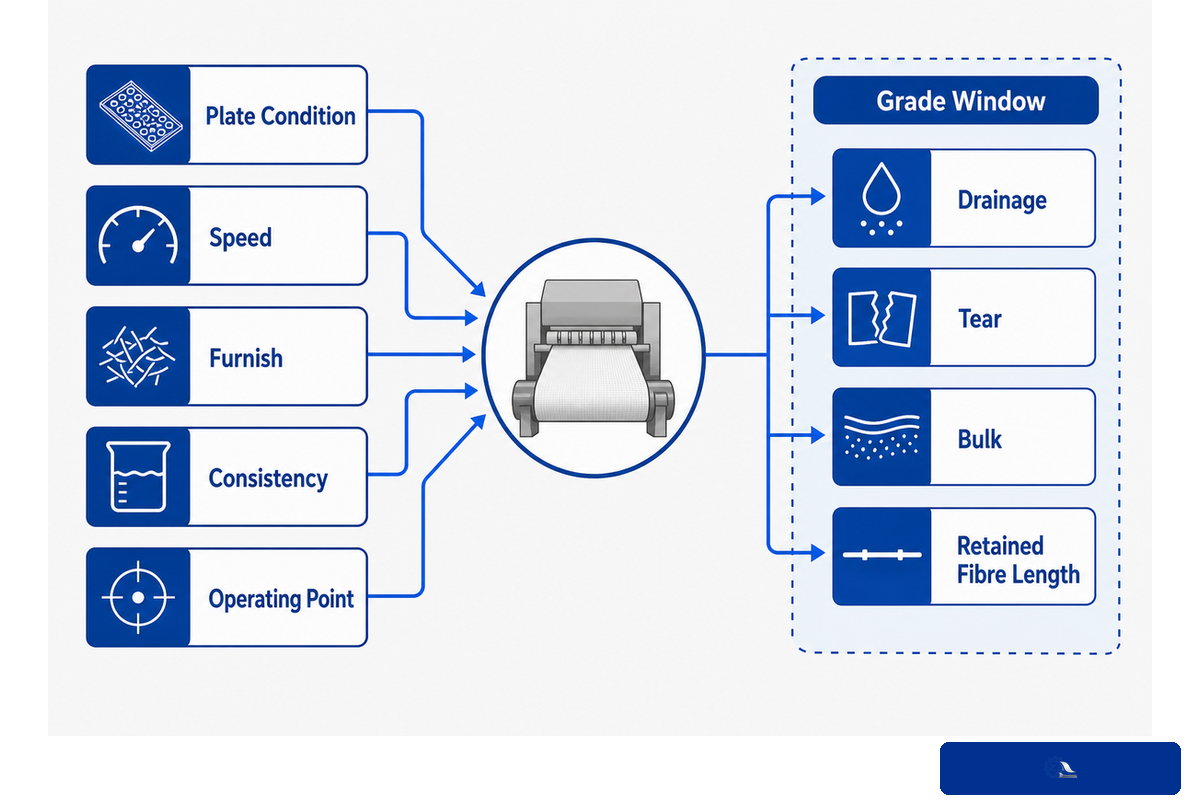
Changing refiner type changes how treatment is delivered; it does not guarantee a grade result. Plate condition, speed, furnish, consistency and operating point still control response. A drainage result can look acceptable while tear, bulk or retained fibre length leaves the grade window, so compare the full property set on a declared net-energy basis.
The production risk is accepting a drainage-only improvement while tear, bulk or fibre length drifts outside the grade window. A controlled mill trial is the evidence: the 3% to 5% laboratory scope cannot guarantee a grade window, so verify tensile, tear and bulk before release.
This explains why it isn’t possible to link a single value to a specific machine. Drainage behaves as intended while the remaining parameters, i.e. tear, bulk, retained fibre length, and fines, may leave the specification limit. The type and intensity of energy applied answer different questions. Specific energy describes the treatment dose, while intensity describes how the treatment is applied. The existing process technology guide is the appropriate reference for such detailed evaluation.
Generally, a multi-property comparison is more valid. Set a range within which the desirable values of drainage, tensile, tear, bulk, and fibre length are attained, and note the conditions of the process and the samples at the time. Such a range is of value only if the entire range is still acceptable.
Specification terminology crosswalk
In a paper mill, judgement is made for refiners based on evidence from the pulping process. Therefore, the paper industry compares refiners using evidence from different pulp furnishes. Wood pulp, straw pulp, and recovered waste paper don’t share identical mechanical properties. Properties of paper depend on grade requirements, so paper strength is one field in a broader trial. Bulk and surface characteristics are evaluated with respect to drainage. Paper strength is a sheet property, not a machine name.
LC refining and HC refining are shorthand for low- and high-consistency operation; some systems also use medium consistency or two-stage refining. A claim of gentle refining, low-intensity refining or high-intensity refining needs a declared specific edge load, net energy consumption, dry-stock throughput and no-load method. Those fields show the energy transfer basis and help compare refining efficiency. The word high-intensity alone does not reveal the effect of refining or whether a later stage is the final refining pass.
At fibre level, the mechanical treatment of pulp can increase fibrillation, expose more specific surface area and improve fiber bonding. It can also increase fiber cutting, fiber length reduction or fine fiber fragments. A plate’s bars and grooves, each groove, and the pattern of bar refiner plates influence that treatment. The useful measurements include fiber surface, fiber morphology, average fiber length, fines and fiber strength. The length of the fibers, condition of the cell wall and each visible fibril help explain the fibrillation of fibers. This is why a guide to refiner plates or a refiner design drawing must be read beside pulp data, not as a stand-alone prediction.
A fresh wood chip or pulp with a high level of lignin and hemicellulose, recycled pulp and short fiber pulps are examples of pulps that don’t have similar fiber characteristics. Different pulps may behave differently when subjected to refining. The effects of refining equipment on fiber characteristics must be analyzed to gain an understanding of the mechanisms of refining. This information shouldn’t be used to develop a relative scale to evaluate the quality of paper produced by a given machine.
The Trial-to-Decision Grid
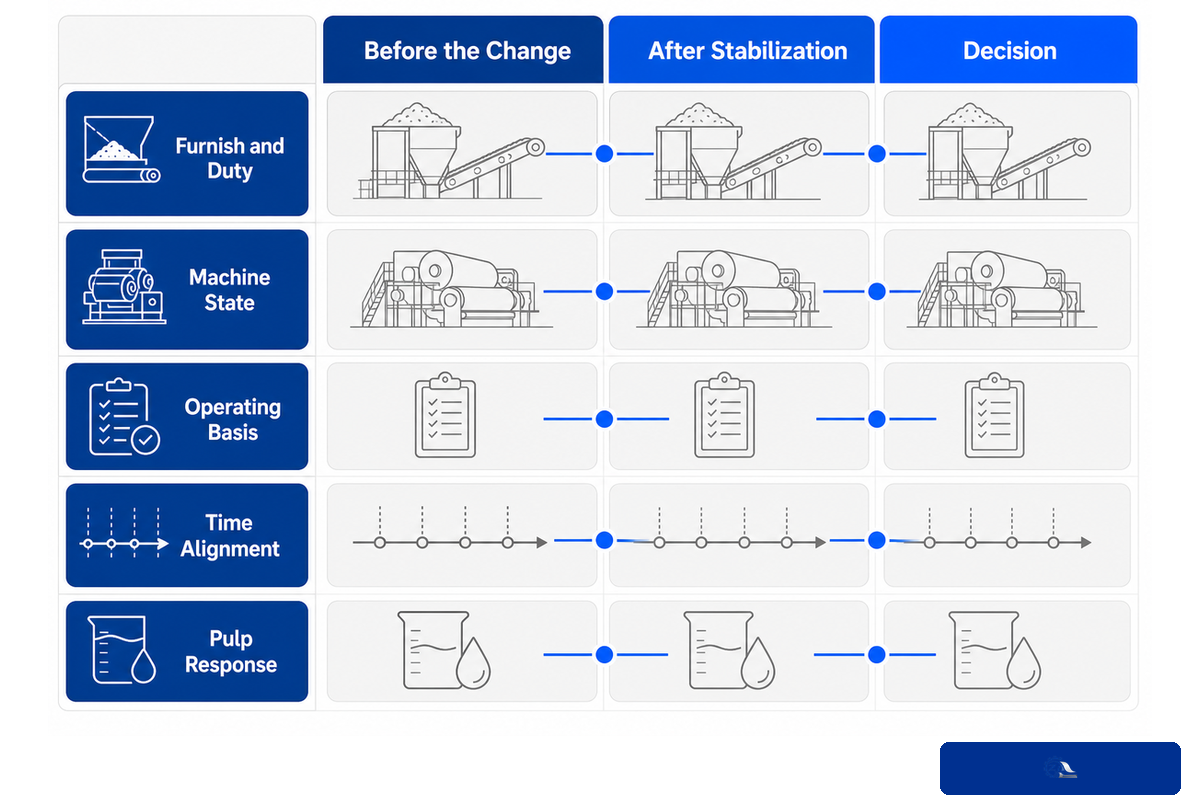
The Trial-to-Decision Grid allows a comparison of refiner types to be considered a controlled decision. The latest sample shouldn’t be credited to the latest setting until the stock has reached the sampling point. For an operator, the risk is crediting the wrong setting because stock transit delays the sample seen at the laboratory. A time-aligned trial records the sample location, residence delay, consistency, dry-stock flow and laboratory timestamp before it attributes a change to one refiner setting.
| Evidence group | Record before the change | Record after stabilization | Decision question |
|---|---|---|---|
| Furnish and duty | Pulp species/history, grade, process position | Same fields plus any blend shift | Was the feed truly comparable? |
| Machine state | Geometry, arrangement, plate pattern/condition, pressure mode | Actual changed hardware and inspected condition | What physically changed? |
| Operating basis | Consistency, dry-stock flow, speed, gap, gross and no-load power | Same units and calculation basis | Was treatment dose and intensity compared consistently? |
| Time alignment | Setpoint time, chest level, residence/mixing estimate, sample point | Sample and lab timestamps | Does this sample belong to this setting? |
| Pulp response | Drainage, tensile, tear, bulk, fibre length/fines | Same tests and conditioning | Did the complete grade window hold? |
Modify the most influential variable, when possible. Maintain the process conditions as constant as possible within the constraints of the mill. If a shift in a furnish or blend occurs, consider the data set as confounded. Earmarks differentiate similar machines and include mode of operation, type of feed, and state of the process.
What to Send Before a Refiner or Plate Review
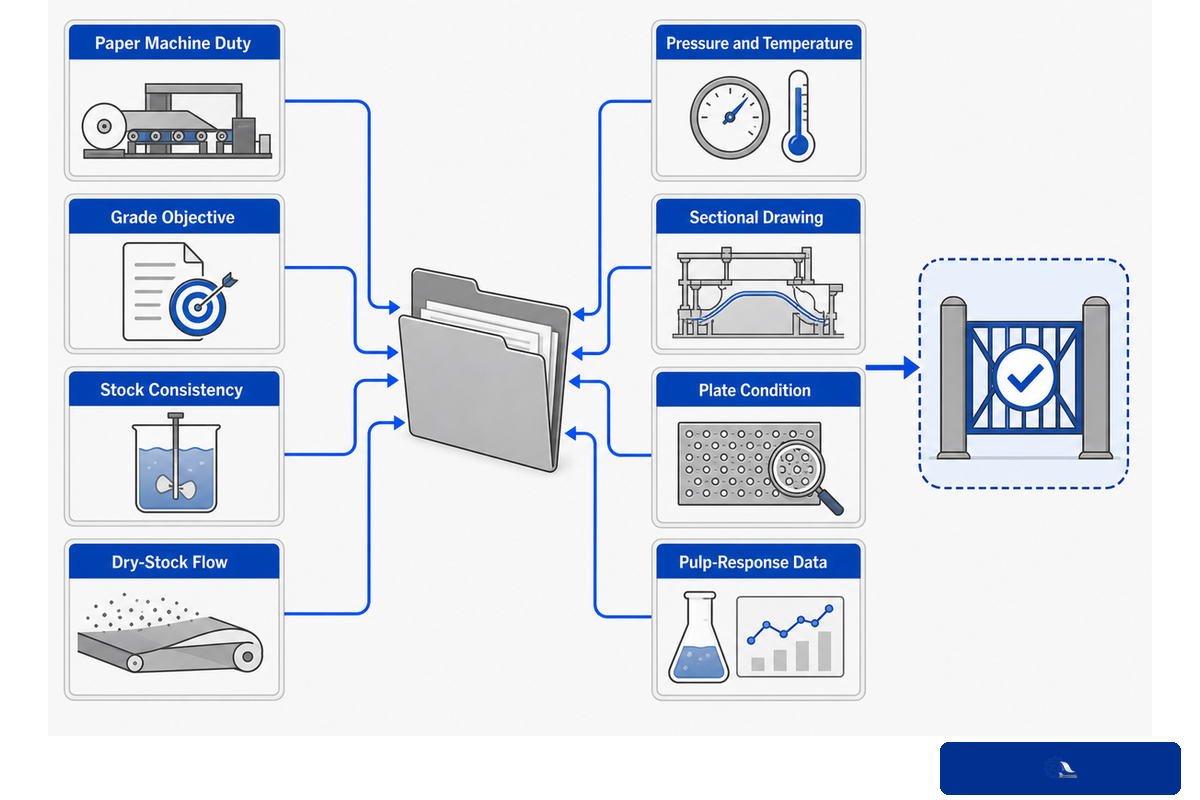
Before a refiner or plate review, send the operating evidence first, then the fit and commercial data. Define the paper machine duty and papermaking grade objective, stock consistency, dry-stock flow, pressure, temperature, current equipment, plate condition, pulp-response data and site constraints. This prevents a type name from hiding the actual configuration.
For a production review, the risk is a wrong hardware recommendation because missing drawings or operating data hide the actual configuration. The RFQ package should include the machine model, sectional drawing, plate diameters, bolt pattern, rotation direction, material requirement and clear photos so a supplier can check fit rather than guess.
Verification of equipment may require assembly and sectional drawings, plate diameters, bolt pattern, rotation direction, bar pattern, material requirement and photographs. The photographs help define the condition and type of equipment.
When the equipment requires a fit assessment, review the information on Zejiang’s refiner plates and screen baskets page and use the information to check the actual hardware.
For a plant-specific review, start with Zejiang Paper Machinery’s manufacturing background, then compare the refiner sizing guide and freeness converter against the refiner plates and screen baskets page before sending a quotation request.
Request a Refiner Configuration Review
Frequently Asked Questions
What are the main types of pulp refiners?
The main industrial labels relate to different dimensions. Working geometries include disc, conical, cylindrical and hybrid designs. Consistency is expressed as low, medium and high. Rotor/stator arrangements include single-, double-, twin- and multi-disc. In some cases process duty should also be specified.
What is the difference between a disc refiner and a conical refiner?
Disc refiners, for instance, employ planar working faces, while a conical refiner employs a pair of conical working faces. Use of a conical mode doesn’t necessarily guarantee lower energy consumption and higher throughput. Several mill systems combine flat and conical zones, so performance assessment should be based on the actual cross-section, plates, speed, consistency and duty.
What is the difference between low-, medium- and high-consistency refining?
Labels such as low, medium and high, when used in process description, denote consistency. For pulp refiners, consistency and stock hydraulics affect the behavior of fibre elements, pumping and sampling. Published scopes and boundaries for one process overlap with those of another. ISO/TS 11371:2023 uses 3% to 5% for its laboratory low-consistency simulation scope, but that range is not a universal LC/MC/HC boundary for every mill system. However, this range may vary for other mill systems.
Are double-disc and twin-disc refiners the same?
Not always. The term “Twin-disc” is used to refer to a group of related products, while “Double-disc” may describe a particular pair of active gaps. Check sectional drawings, moving elements, active zones and the stock path before comparing equipment performance.
How do I choose a pulp refiner type?
Choose a type by matching feed, process duty and paper-grade objective, then confirm consistency, pressure state, stock path and equipment arrangement. Ask for a cross-section instead of relying on a nominal label. Compare candidates under stable conditions with synchronized samples, recorded plate condition, gross and no-load power, and an acceptance window for drainage, tensile, tear, bulk and fibre integrity.
If the process is unstable because of feed or blending variability, the trial is inconclusive even when one sample looks promising.
Is a PFI mill the same as an industrial pulp refiner?
PFI mills are controlled lab devices for comparing alternatives. They simulate some attributes of commercial devices, but they do not represent the full variability, scale or residence-time effects of an industrial refiner. A PFI result can frame a larger-scale trial, not authorize a production change.
Commercial selection still requires process and equipment layout, drawings, balances, comparative devices, plate condition, stock path and a defined acceptance window for the target paper grade. It also requires a clear statement of whether the laboratory result represents a batch comparison, a continuous line, an atmospheric condition or a pressurized duty; without that boundary, a useful lab number can be mistaken for a production capacity or energy guarantee.
References & Sources
- ISO/TS 11371:2023, Fibre suspension refining by laboratory procedure
- BioResources: Observations on the High and Low Consistency Refining of pulp
- BioResources: Data-Driven Soft Sensors in Pulp Refining Processes
- BioResources: Low-Consistency Refining Combined with Screen Fractionation ; BioResources: Time-Series Analysis of Refining Conditions and Estimated Pulp Properties
- IPPTA technical refining handbook
- Valmet: Refining of Chemical Pulp (application terminology only)


![Refiner Plates & Screen Baskets [Complete Guide]](https://zjpapermachine.com/wp-content/uploads/2026/07/refiner-plates-screen-baskets-guide-featured-150x150.png)
![Doctor Blade: Types, Materials & How It Works [Guide]](https://zjpapermachine.com/wp-content/uploads/2026/07/doctor-blade-guide-featured-1-150x150.png)
![Pulping Equipment: How Paper Pulping Works [Guide]](https://zjpapermachine.com/wp-content/uploads/2026/07/pulping-equipment-guide-featured-150x150.png)