
Get in touch with Zejiang Paper Machinery Company


![Doctor Blade: Types, Materials & How It Works [Guide]](https://zjpapermachine.com/wp-content/uploads/2026/07/doctor-blade-guide-featured-1.png)
Quick Specs
| Common edge profiles | Square (blunt), bevel, lamella (stepped/thin-tip) |
| Common materials | Carbon steel, stainless steel, ceramic-tipped composite, engineered polymer |
| Typical positions (paper machine) | Press section, dryer section, calender, Yankee dryer (tissue) |
| Replacement trigger | Common industry guidance: ~15% blade width loss from wear, or earlier if chipping/vibration appears |
A doctor blade is a thin, replaceable strip of steel, ceramic-coated metal, or engineered polymer mounted at a controlled angle against a moving roll or cylinder to scrape, meter, or clean its surface. The term appears in at least three distinct industries – printing, thin-film and battery-electrode coating, and paper and board manufacturing – and Google’s own AI Overview for the term asks users which industry they’re asking about before answering. This guide provides brief coverage of all three, then focuses in on the paper-machine application, where the doctor blade play a role in surface protection, sheet quality, and machine uptime.
A doctor blade is used to remove or meter material from a moving surface in three industries – printing (ink), coating (thin films), and paper-making (fiber, water, and scale) – although its function on paper and board machines is almost entirely as a roll cleaner and web handler, not an ink meter.
What Is a Doctor Blade? (Definition and Etymology)
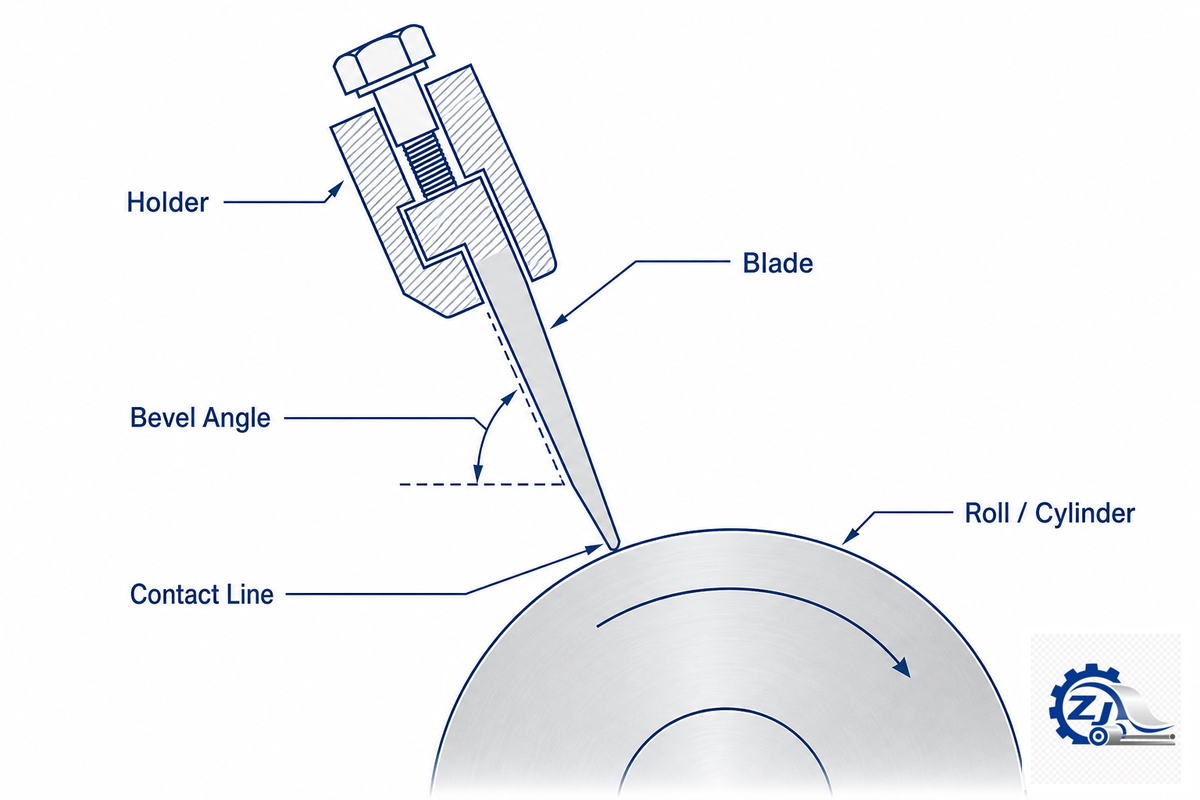
A doctor blade is a thin, replaceable strip of steel, ceramic-coated metal, or engineered polymer mounted at a controlled angle against a moving roll or cylinder to scrape, meter, or clean its surface. The name has nothing to do with medicine, and you’ll sometimes see it shortened to “dr blade” in supplier catalogs and spec sheets.
Its best-known origin story comes from letterpress printing, where a “ductor blade” was used to wipe excess ink from a ductor roll that transferred ink throughout the early printing press; “ductor” eventually evolved into “doctor” over time through shortened pronunciation and mistranscription. In this context, a doctor blade “doctors” – corrects or refines – the amount of material left on a roll surface, whether it’s ink, a battery-electrode coating, or water and fiber on a paper machine roll. For printing, the OSHA Printing Industry eTool Glossary offers a plain explanation: “a thin, flexible, adjustable blade mounted parallel against the anilox roll for the purpose of scraping off excess ink.” A doctor blade for printing machine use and a doctoring blade built for a paper machine share that same basic geometry even though the material they’re removing is completely different.
Outside of printing, the physical device and basic geometry (thin edge at controlled angle and gap) appear any time a uniform, thin layer of material must be either applied or removed. In scholarly works related to lithium-ion and printed electronics, the technique is referred to as the “doctor blade coating method” or simply “blade coating,” treated as a specialized film-forming process rather than a cleaning tool (see one peer-reviewed study on blade-coating conditions for printed electrodes). A 2005 U.S. federal securities filing from paper equipment maker Kadant Inc. mentioned several applications of doctor blades on paper machines, including surface cleaning, creping, and web removal during sheet breaks, as well as coating applications (SEC filing, Kadant Inc., 2005).
How the Doctor Blade Process Works
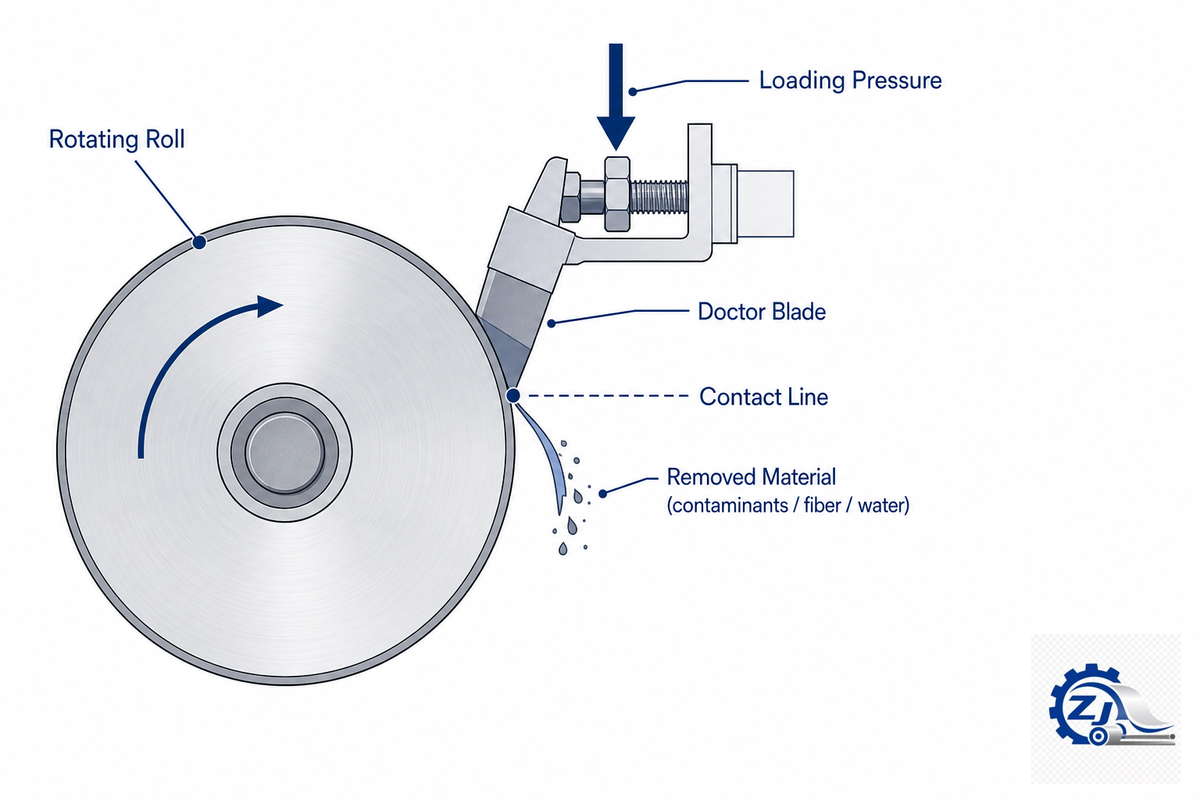
Three variables control every doctor-blade operation: the gap between the blade edge and the surface it contacts, the angle at which it makes contact, and the loading pressure applied to it. In coating applications, those three variables interact with substrate speed and coating viscosity to directly set the resulting layer’s thickness.
A peer-reviewed study on Ag-nanowire electrode coating showed that blade height was the single biggest factor in resulting coating-layer performance, tested over heights between 150 and 350 micrometers at a constant speed of 10 mm/s (MDPI, peer-reviewed).
Typical contact angles in printing fall within a range of 25-42 degrees depending on application and generally sharper angle gives a cleaner cut across the ink film than a flatter one. Similarly on a paper machine, the same three variables control the application; in this case instead of a coating application, a doctor blade mounted at an angle and pressure to sweep fibers, pitch and scale from a rotary dryer cylinder or roll surface. This is similarly explained in an eng-tips.com engineering forum discussion about paper-mill dryer cylinders: “the paper is carried around the surface and scraped off on the opposite side by a doctor blade” (eng-tips.com engineering forum). A blade too shallow at its angle of wipe won’t effectively clean the surface, and a blade tip will flutter, deflect, or wear unevenly under excessive loading – it’s the same underlying physics as ink metering in printing, just working on a different material.
📐 Engineering Note
In most doctor blade systems, the cleaning operation is actually handled by a primary blade and then often a secondary (non-cleaning, but supplying liquid) blade is positioned just behind the cleaning blade (as in a chambered or two-blade system) on the same holder assembly. Recent patent applications addressing two-blade holder mounting and swing-arm geometries include EP2236667A3 and blade-system advancements are discussed in US7921773B2.
Where Doctor Blades Are Used: The 4-Industry Application Map
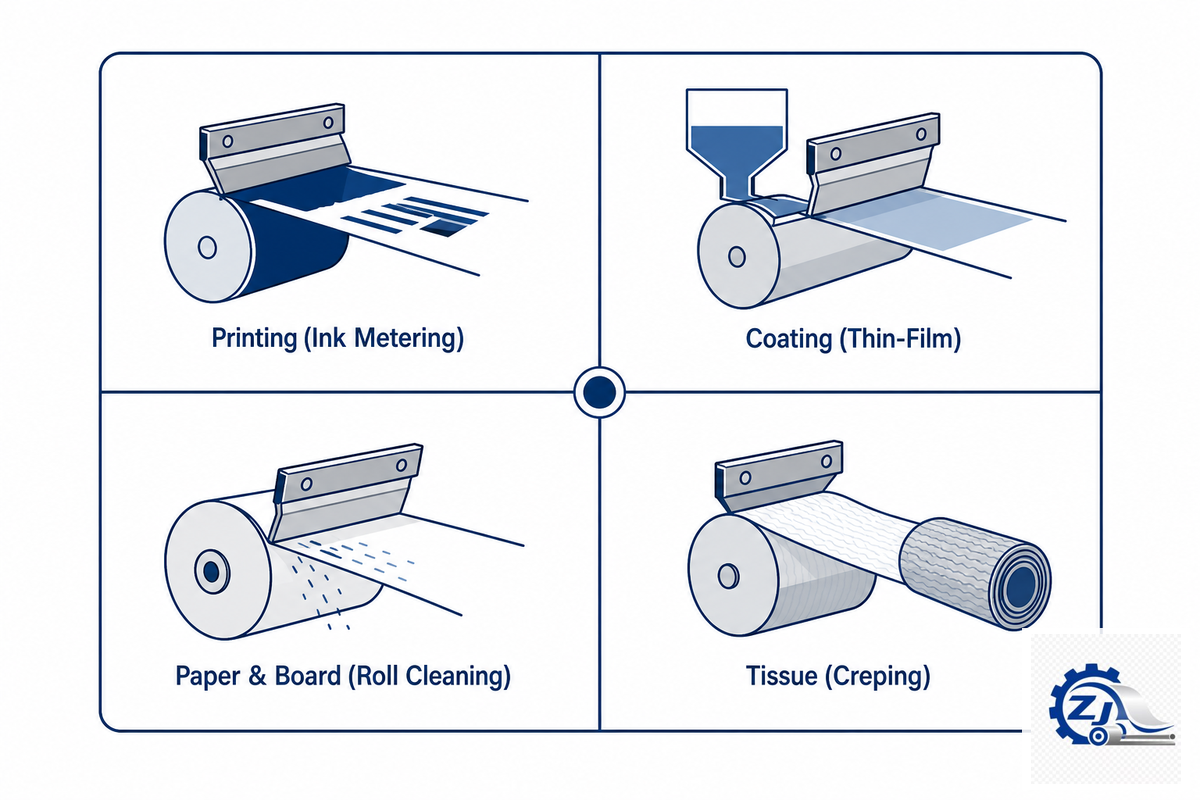
Because the term spans several independent technical fields, it may be helpful to compare them across those fields briefly before drilling into any particular industry. Table below provides a comparison of the three industries with the strongest evidence base for this guide.
| Industry | Primary Function | Typical Material | What Drives Blade Selection |
|---|---|---|---|
| Printing & flexographic/gravure | Meter/remove excess ink from an anilox or gravure cylinder | Steel or polymer, 15–42° contact angle range | Ink viscosity, cylinder speed, edge profile |
| Thin-film & battery-electrode coating | Apply a uniform slurry/solution film to a substrate | Precision steel blade, 150–350 µm blade-height range tested | Blade height/gap, solution viscosity, coating speed |
| Paper & board manufacturing | Clean rolls/cylinders; fold sheet off Yankee dryer (creping) | Carbon/stainless steel, ceramic-tipped, or composite | Machine position (press/dryer/calender/Yankee), temperature, roll cover |
Two industries, printing and the coating industry, share an almost identical technical lexicon even though they possess almost no direct commercial linkage. Printing’s typical contact-angle range runs approximately 25-42 degrees for the ink, whereas blade-height sensitivity is the dominant factor in the coating industry. Both apply to the same basic geometric challenge addressed by a doctor blade for a paper machine, except they’ve been optimized for the different materials being processed – the same gap-and-angle geometry covered in blade-system patent filings such as US7921773B2 applies across all three industries, just tuned to a different material in each case.
Here’s a quick vocabulary note for readers coming from adjacent fields: in flexo and gravure printing, doctor-blade coating setups often run two blades in a chambered system – a primary blade doing the wipe and a second, non-wiping containment blade just holding ink inside the chamber, with blade angle and blade gap tuned independently for each. Simplest of all is the flat blade (the square-edge type), one of the baseline coating material choices for this job, sitting alongside steel doctor and plastic doctor blades as the baseline options before anyone reaches for a specialty edge. Thin-film and battery-electrode work uses the same doctor blading technique under related names – spin coating and slot die coating are two other coating processes used for similar thin, uniform layers, including solar cell and printed-electronics manufacturing – though doctor blading remains the simplest and lowest-cost of the group. None of this vocabulary carries over to paper-machine doctoring, where the same words describe cleaning hardware rather than a deposition method, which is exactly the kind of cross-industry confusion this guide exists to sort out.
Here’s a mechanical footnote for the coating side: the coating solution sits in a reservoir just ahead of the blade, and shear at the blade edge is what actually spreads it into a uniform film – a viscous coating system tolerates a wider blade gap than a thin, low-viscosity one. High viscosities are also why dip coating exists as an alternative deposition route for some materials that don’t spread well under a blade at all. One printing-industry supplier, Allison Systems, publishes practical guidance on when a used blade still has service life left versus when it should come out of rotation – a judgment call that, as covered next, is easy to get wrong in either direction.
Doctor Blade Types by Edge Profile
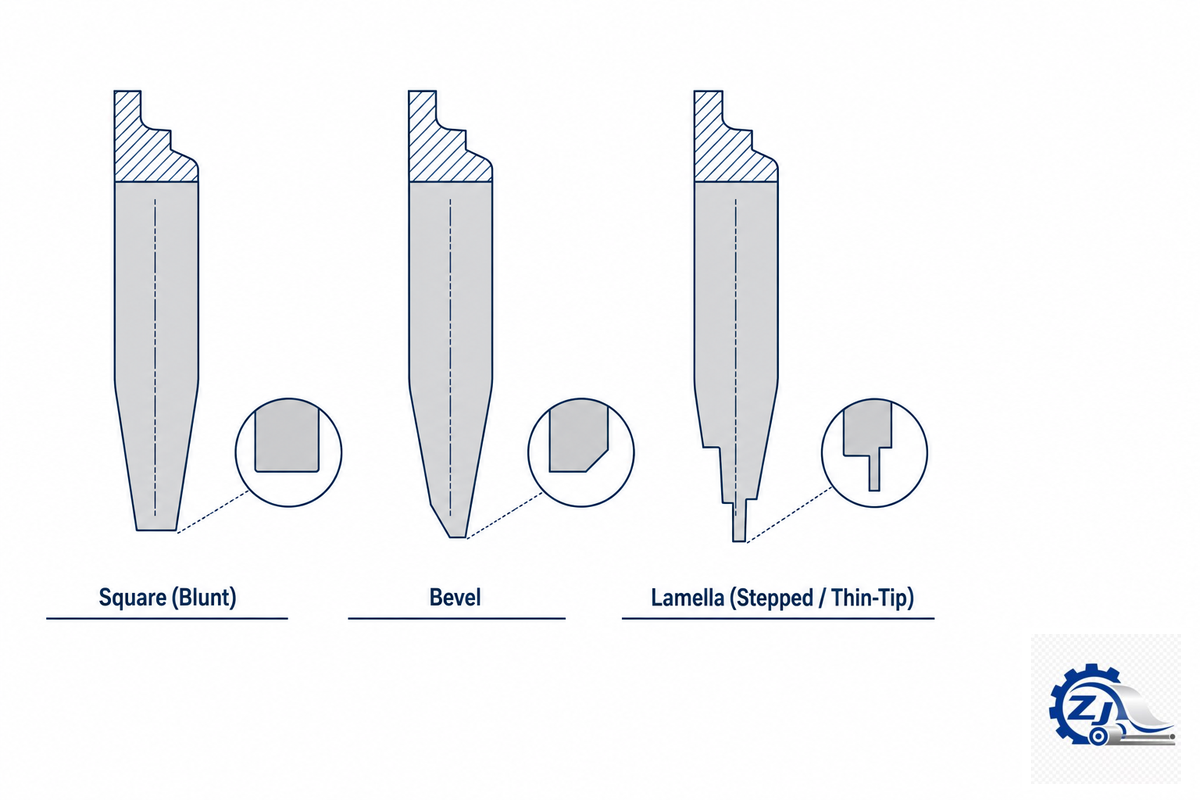
Knowing the types of doctor blade edge profiles matters more than it sounds, since the wrong one is a common reason a blade underperforms even when the material is right. Within all three industries cited here, doctor blades generally share the same three tip configurations: straight (also called blunt or square-cut), bevel (also called angle or ground) and lamella (a stepped, or thinned tip profile that provides a stable wear contact area as the tip wear). The Packaging and Printing glossary compiled by the Packaging School and supported by a Clemson University curriculum explicitly defines bevel as “an angle ground, honed, or filed on the edge of a doctor blade” and also distinguishes and defines separately “angle of wipe” (the angle the blade make with the rotating surface at no loading pressure) and “contact area” (the actual wear surface of the blade) (Packaging School glossary).
| Edge Profile | Geometry | Best Suited For |
|---|---|---|
| Square / straight | Blunt, unangled cut edge | General cleaning and lower-linescreen coating applications |
| Bevel | Ground/honed angled edge (commonly 15–42° depending on application) | Precision wiping, low-viscosity fluids, high-definition applications |
| Lamella | Stepped/thinned tip, maintains near-constant contact area as it wears | Long-run applications where consistent wipe quality over time matters most |
Typically, blade thickness varies based on the application; thin blades, at around 0.004 in. (0.10 mm), can be adequate for low-intensity applications. Heavy-duty operations, such as those requiring a high pressure application, will most often use material that’s between 0.010 and 0.012 in. (0.25-0.30 mm) in thickness, which provides for greater rigidity. Even so, the shape of the blade’s edge isn’t the only variable involved; a published,peer-reviewed coating study suggests that blades with bevel-type edges may perform acceptably well with a lower-viscosity Ag-nanowire coating, but height and the rate of coating application were observed to influence the result more than the specific profile of the blade (MDPI). The conclusion is to not assume the tip of the blade has a greater influence than any other factors; this, among others, becomes a topic of concern for diagnosing a worn blade, which is addressed further in the document.
Doctor Blade Materials Compared
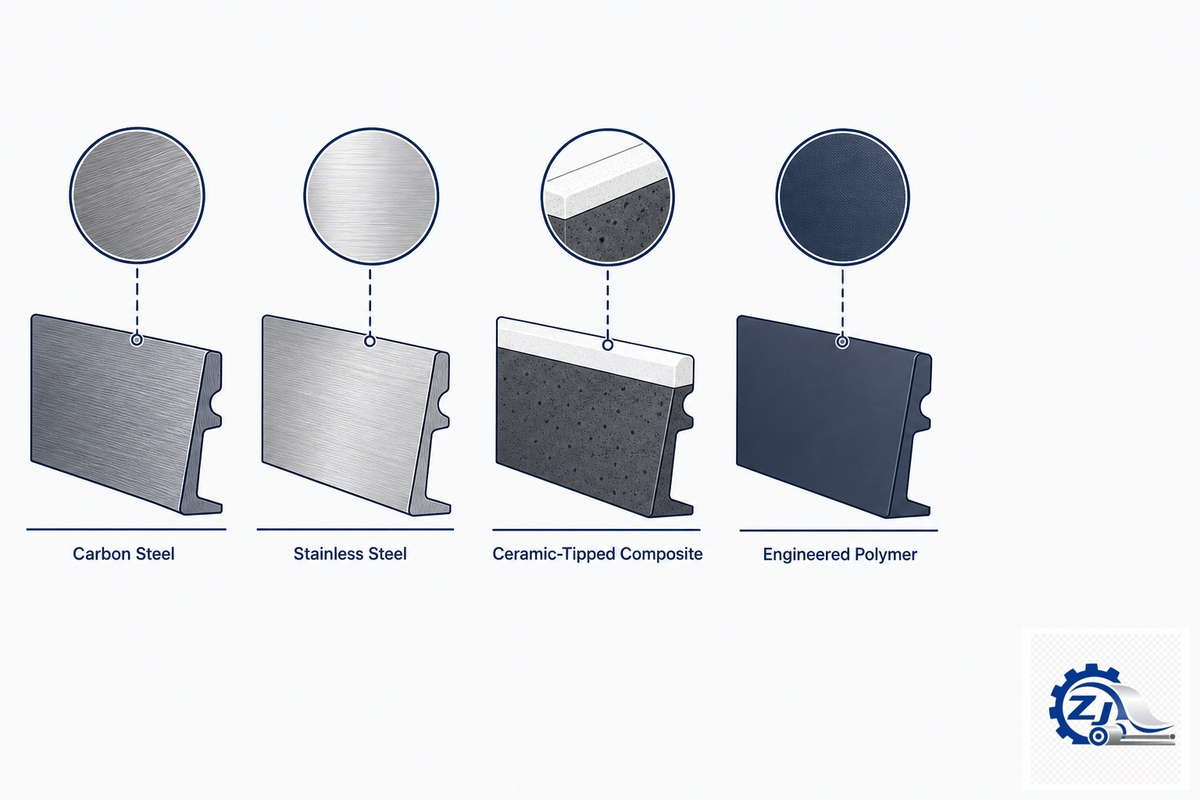
Material choice comes down to a tradeoff between hardness, roll-friendliness, and corrosion resistance, and each family strikes that balance differently. Even a high-quality blade in the wrong material for its position will still underperform, which is why the table below is organized around tradeoffs rather than a single “best” material.
| Material Type | Category | Relative Hardness | Roll Compatibility | Best Fit / Typical Failure Mode |
|---|---|---|---|---|
| Carbon steel | Metal | High, stiff | Can mark soft/coated roll covers if misapplied | Economical general cleaning; chips or forms slivers under excess pressure |
| Stainless steel | Metal | High, stiff | Same as carbon steel | Corrosive or humid environments where carbon steel would rust |
| Chromium-coated steel | Coated metal | High + wear-resistant coating | Moderate | Extended edge life over bare steel; coating can spall if impact-loaded |
| Ceramic-tipped composite | Composite | Very high at the tip | Gentle when correctly seated; sensitive to misalignment | High-abrasion dryer/calender positions; tip delaminates if impact-loaded |
| Carbon-fiber composite | Composite | Medium-high | Gentle | Long-run consistency; favored for oscillating cleaning positions |
| Glass-fiber composite | Composite | Medium | Gentle | Softer roll covers, general-purpose press-section use |
| UHMW-PE polymer | Polymer | Low-medium, flexible | Very gentle | Soft/coated rolls; wears faster under abrasive or hot conditions |
| Phosphor bronze | Metal alloy | Medium | Very gentle, non-sparking | Stickies removal and spark-sensitive environments |
| Engineered polyurethane blend | Polymer | Low-medium, flexible | Very gentle | Delicate coated/soft rolls under low loading pressure |
Blade-system patent filings (US7921773B2) describe steel-versus-ceramic-versus-polymer selection as a function of the specific roll surface and process conditions, not a single “best” material – a genuinely cross-industry finding, since the same tradeoff between hardness, gentleness, and cost shows up in printing-cylinder doctoring, coating-blade design, and paper-roll cleaning alike. This is a materials-science comparison of what each family generally does, not a position-by-position specification – that level of detail depends on the exact machine and roll, covered next for paper machines specifically.
Doctor Blades in Paper and Board Machines
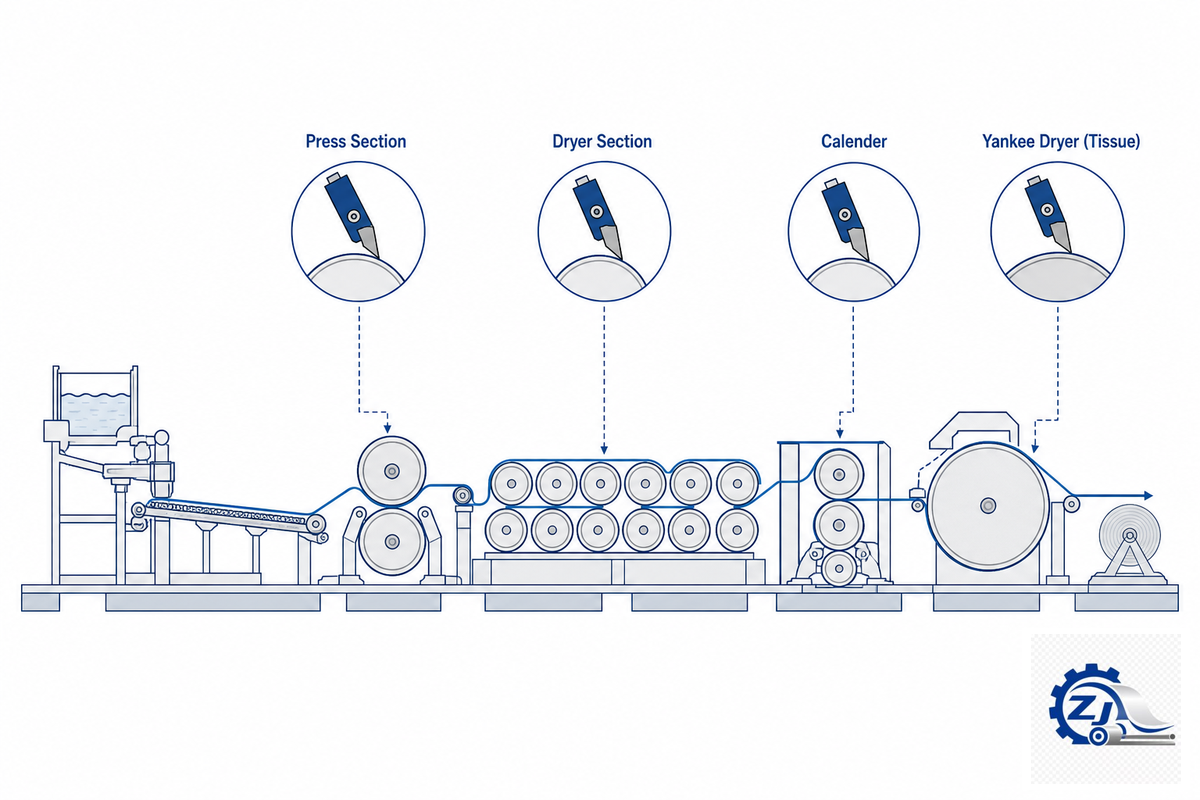
A doctor blade on a paper or board machine typically runs at 4 distinct positions across the same line – press, dryer, calender, and Yankee – and position, not a single “best” material, is what should drive the selection. Federal documentation of pulp, paper, and paperboard mill hazards addresses this directly: 29 CFR 1910.261(k)(2)(iii) states that “all accessible disengaged doctor blades should be covered.” That guidance is a real-world signal: mills that treat doctor blades as ordinary replaceable maintenance items, rather than as mechanical components sitting directly against a rotating roll, are the ones most likely to overlook the guarding this regulation calls for.
Press-section doctor blades typically wipe water and fiber from press or suction rolls, and soft roll surfaces there generally favor composite or polymeric blades over steel to avoid damaging the cover.
Dryer-section conditions are harsher: high cylinder temperature combines with residue buildup (pitch, fiber, scale), so doctor blades there need to hold up under sustained thermal and mechanical load while keeping the cylinder clean enough for consistent heat transfer to the sheet.
Calender rolls affect the finished sheet directly, so doctoring here favors a low-friction, consistent touch over aggressive material removal – a rougher blade tip can visibly mark the sheet, which is a mistake a press-section blade choice would rarely cause.
Yankee dryer (tissue). This position employs a specialized creping blade rather than a standard cleaning blade-so distinct an application that it deserves its own discussion below. Safe-entry procedures for this machine section specifically, are detailed in the TAPPI TIP 0425-10:2024 technical guidance “Safe Entry into a Yankee Dryer”; accordingly, Yankee-dryer doctoring is a specialized enough application to be handled as its own category of the standards as of 2024.
Temperatures, roll materials, and loading pressures differ enough across the press, dryer, calender, and Yankee positions that a doctor blade specification designed for one position likely would underperform or wear irregularly at another. This explains why paper mills default to developing position-specific material and holder specifications for paper machine doctor blades rather than maintaining one generic part number for the entire machine.
Creping Blades: The Tissue-Machine Specialist
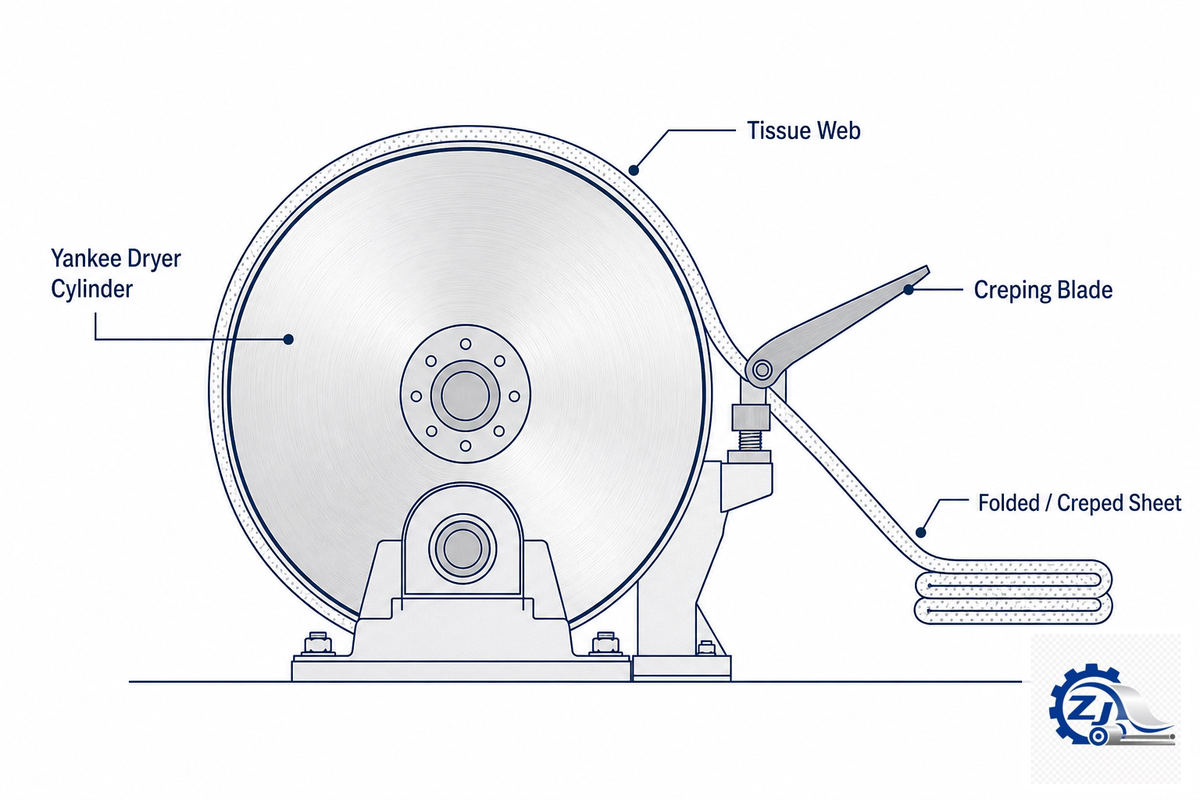
The function of a creping blade is fundamentally different from that of a standard doctor blade: rather than simply cleaning the surface of the Yankee dryer, the creping blade folds the drying tissue web away from the hot cylinder in a controlled manner to produce bulk, stretch, and softness. Because this involves a continuous, high-frequency mechanical interaction (rather than the periodic surface cleaning), creping blades have much shorter wear cycles than standard doctor blades used elsewhere on the machine. For example, one U.S. patent on creped-paper production techniques describes creping blades in a typical creping operation as being “replaced four to eight times a day (every three to six hours)” (US6454901B1); this replacement rate is specific to creping and isn’t reflective of the typical doctor blade change frequency for other paper machine sections. One more creped-paper production patent emphasizes that more durable, longer-lasting creping blades increase overall productivity and decrease power consumption at the dryer (EP1157818A1).
💡 Pro Tip
Given that the purpose of a creping blade is folding rather than mere cleaning, irregular creping patterns over the run of paper may indicate uneven blade wear rather than a forming or chemistry issue. It may be useful to address potential wear problems before exploring solutions further upstream in the paper-making process.
Signs of Wear and When to Replace a Doctor Blade
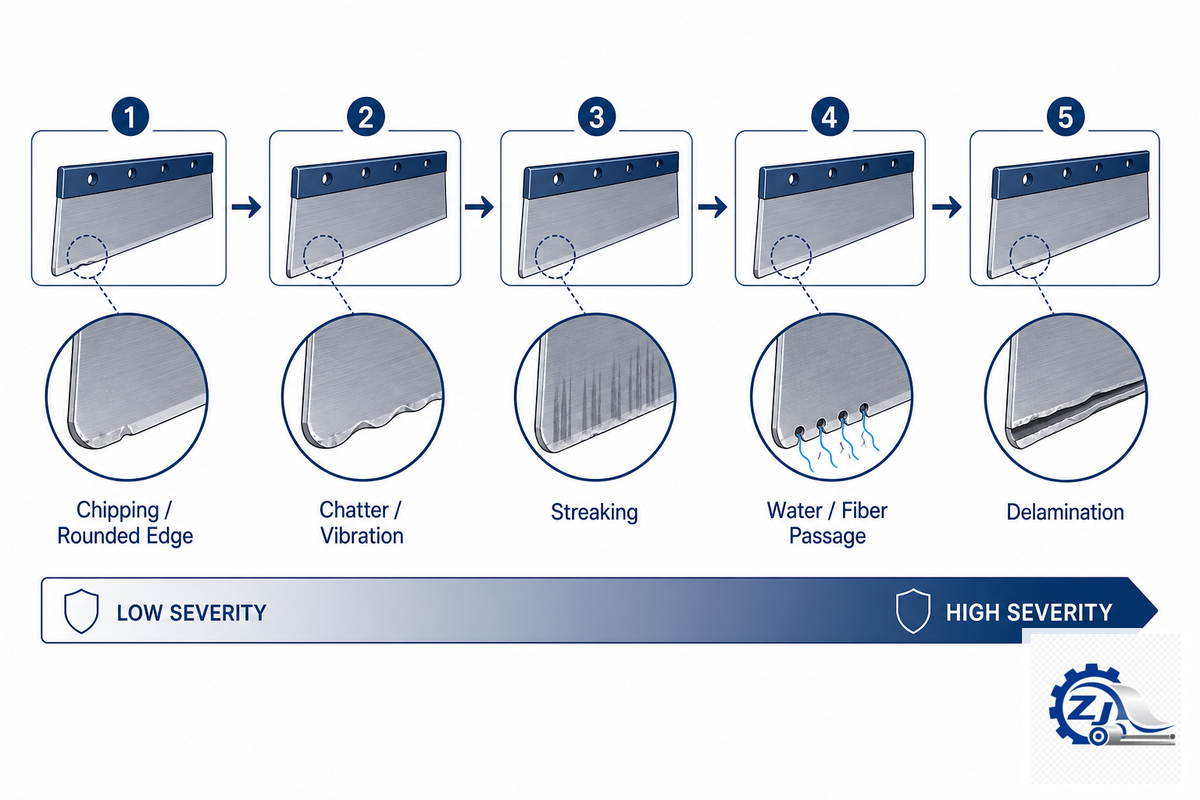
A common industry practice is to replace a doctor blade when it loses approximately 15% of its width due to wear-not when it fails completely or after a set interval. Such wear-loss thresholds are published in paper machine doctor blade replacement guidelines rather than prescribing 100% loss or a specific date. Ranked from earliest to most severe, the table below – the Blade-Wear Signal Scale – lists those same warning signs, so a maintenance team can tell a routine watch-list item from a stop-the-line problem at a glance.
Blade-Wear Signal Scale
| Level | Signal | What’s happening | Response |
|---|---|---|---|
| 1 – Watch | Visible chipping or a rounded (non-sharp) bevel edge | Contact edge is beginning to wear unevenly | Log it, schedule the next inspection sooner |
| 2 – Monitor | Noticeable chatter or vibration against the roll | Uneven contact pressure across the blade face | Check loading pressure and alignment before assuming the blade is at fault |
| 3 – Plan | Streaking or incomplete cleaning of the roll surface | Contact is no longer consistent along the full blade width | Plan a replacement at the next scheduled stop |
| 4 – Act | Water or fiber passing underneath the blade | Wear has broken the seal against the roll | Replace at the next available stop, not the next scheduled one |
| 5 – Emergency | Delamination, holder contacting the roll surface | The blade has failed structurally | Stop and replace immediately – risk of roll damage |
⚠️ Important
When a worn blade is left in place, its wear typically escalates. Vibration gradually evolves into chipping, which increases the friction between the blade and the roll and permits the passage of water and fiber; in extreme cases, the blade delaminates, causing the holder itself to come into contact with the roll surface. Catching a worn blade at one of the earlier stages transforms the blade replacement into a planned maintenance event rather than an emergency unscheduled change over.
The blade isn’t always to blame. Two independent sources – a printing-trade-association technical article and a separate paper-industry practitioner discussion – both make the same non-obvious point: blades are frequently changed and later found to have little or no actual wear, with the real problem being something else entirely. A flexographic-printing trade association piece notes plainly: “there’s minimal wear on the blade and sometimes no wear is found. In these cases, it was assumed blade wear was what created the need to change the blade when something else was the culprit” (Flexographic Technical Association). A separate paper-industry practitioner discussion of crepe-paper streaking makes the identical point from a different angle, pointing to alignment, pressure, or roll condition rather than the blade itself:
“The blade isn’t always to blame. Even when a doctor blade seems fine, streaks or inconsistent creping often appear. The real cause is usually interaction [with other factors].”
That two unrelated sources in two different industries independently landed on the same diagnosis is a useful caution: before reordering a blade, it’s worth checking loading pressure, alignment, and roll condition – not just assuming the blade wore out.
Doctor Blade Holders, Sourcing, and Where to Buy
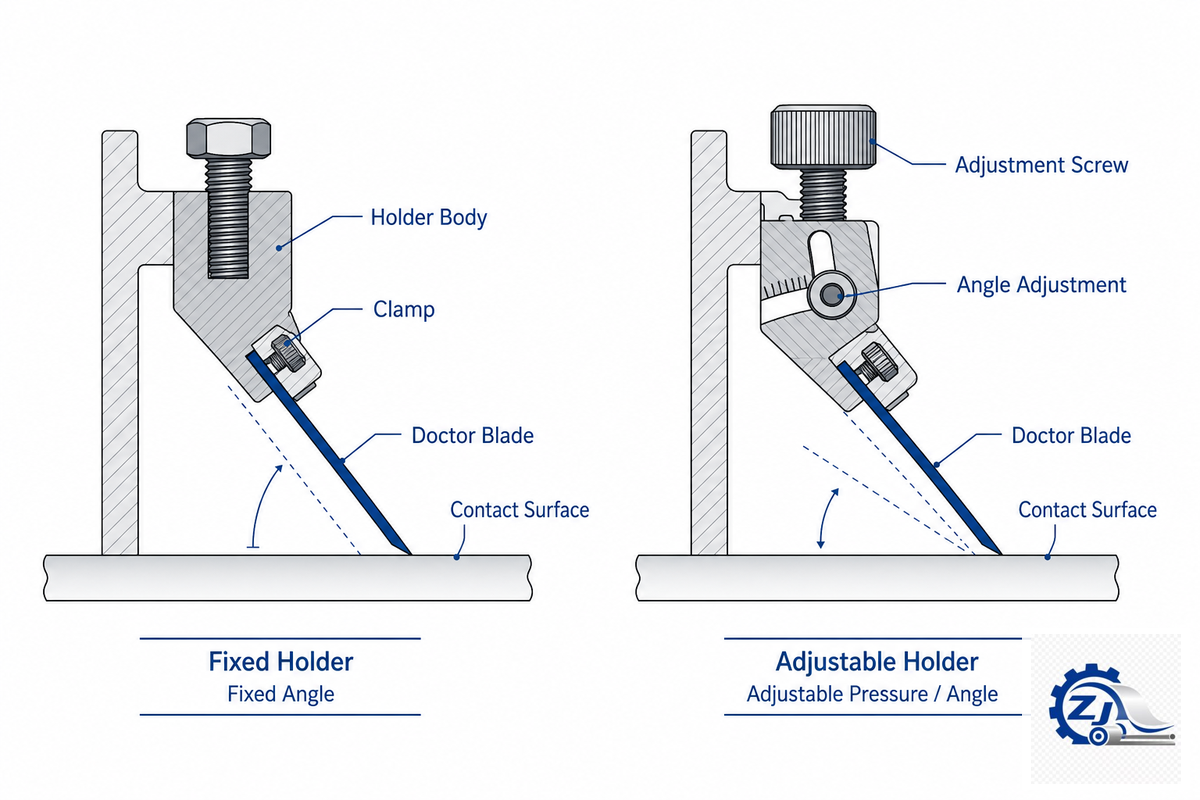
Blade selection is only half the system – a holder mounts the blade at the correct angle, absorbs roll-surface irregularities, and allows blade changes without dismantling the whole doctoring beam. Mismatched holders are a common, easy-to-miss reason a correctly specified blade still underperforms: a mill can order the right material and edge profile and still see uneven wear if the holder itself doesn’t hold the blade at a consistent angle across the roll face. Holder-and-pivot mounting design is itself the subject of ongoing patent activity (EP2236667A3), which is a sign this is a genuinely engineered component, not a generic bracket – a mill running a single dryer cylinder at a fixed diameter can standardize on one fixed holder, while a line running 3 or more roll sizes across its press, dryer, and calender positions typically stocks at least one adjustable holder per position to cover that variation.
Documentation from doctor blade suppliers and industry sourcing guides shows lead time and customization terms varying widely from one supplier to the next, which is exactly the trap a mill comparing only sticker price falls into. A more reliable sourcing approach matches material family and dimensions to your specific machine position first, then compares lead time, customization, and total cost of ownership across suppliers – rather than material technology alone, since the core material science (steel, composite, ceramic-tipped) is broadly standardized industry-wide. For a full position-by-position material and holder specification, request-a-quote flow, and paper-machine-specific ordering guidance, see Zejiang’s paper machine doctor blade page.
Industry Outlook: What’s Changing in Doctor Blade Technology
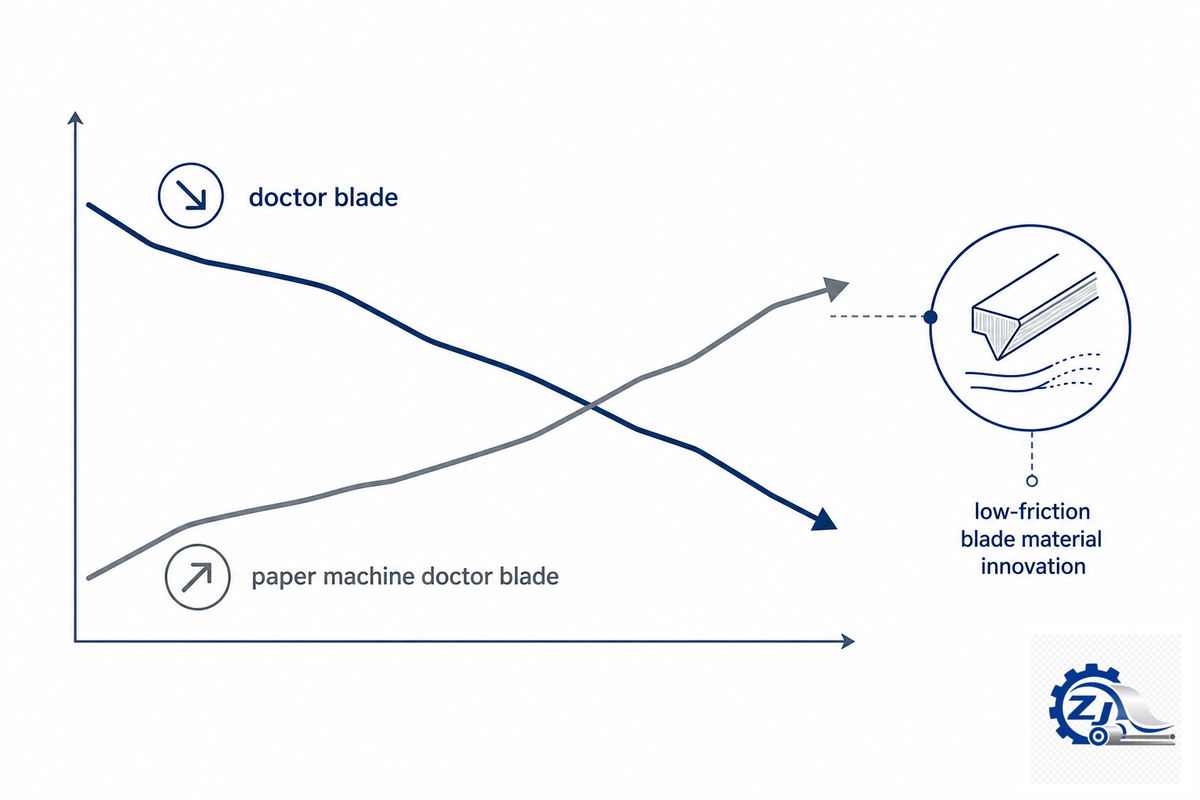
Right now, the clearest indicator isn’t a market-size number – it’s a shift in what people are actually searching for. Search volume for the broad, definitional term “doctor blade” has eased roughly 23% year over year, while the specific, buying-intent term “paper machine doctor blade” is up roughly 133% over the same period (DataForSEO search data, 2026). Read together, that’s a sign that general, top-of-funnel curiosity about the term is giving way to more specific, purchase-ready research – buyers are arriving at the search results already knowing what they need, not just what the part is called. In practice, that shows up as a maintenance engineer at a mid-size mill searching for a specific position and material combination instead of researching “what is a doctor blade” from scratch – the buying decision is happening earlier, before the search even starts.
And in terms of technology, Low-friction doctor blade materials are a legitimate, aged innovation to watch out for: back in April 2024, the equipment manufacturer Valmet launched doctor blades based on glass- and/or carbon fiber-reinforced epoxy resins, and the manufacturer claims that they decrease the loads of the motors and energy consumption at the dryer section. It was announced independently (although not in independent lab tests) by two pulp & paper trade media (Pulp & Paper Canada and Pulp & Paper News), rather than solely by Valmet press releases. The energy usage at the dryer section is a genuine entry into the doctoring cost analysis. For a mill still comparing quotes on sticker price and wear life alone, that means asking a supplier directly what a given blade material does to dryer-section power draw before signing off, not just how long the blade itself lasts.
Several market-research firms publish doctor blade market-size estimates: some put the figure near $200 million, others scope it well above $2 billion. That spread is wide enough that any single figure should be read as order-of-magnitude context, not a precise projection.
FAQ: Doctor Blade Basics
Q: What is a doctor blade called?
View Answer
Depending on the industry, a doctor blade is also called a metering blade or a wiper blade in printing and coating, and a roll-cleaning blade or a doctoring blade in the paper and board industry. Older trade literature sometimes calls it a doctor knife. In every case, it’s the same basic component: a thin, replaceable strip of steel, ceramic-coated metal, or engineered polymer, clamped at an adjustable angle against a moving roll.
Q: Why are they called doctor blades?
View Answer
The origin of the name is traditionally linked to letterpress printing, where a ductor blade wiped surplus ink off the ductor roll that transferred ink from the ink plates to the paper. Over time, “ductor” was misheard or shortened into “doctor,” and the word carried into modern printing, coating, and papermaking equipment.
Despite that drift in the name, the blade’s task has always remained the same: it “doctors,” or corrects, the amount of material left on a roll surface, whether it’s ink, coating slurry, or process water.
Q: What is the doctor blade technique?
View Answer
The doctor blade technique is the process of positioning a straight, slender blade at a constant distance and angle against a roll or moving web that scrapes, meters, or cleans the surface. Battery-electrode and thin-film production calls the same process blade coating, laying down a film of a specified thickness.
That thickness depends on the gap between blade and substrate along with the coating’s viscosity and travel speed. On a paper or board machine, the same mechanical principle removes fiber, pitch, and moisture buildup from rolls and drying cylinders instead of depositing a coating layer.
Q: What are the signs of a worn doctor blade?
View Answer
Common warning signs include chipping or a rounded, no-longer-sharp bevel edge; noticeable chatter or vibration against the roll; streaking or incomplete cleaning of the roll surface; and water or fiber traveling under the blade. Left untreated, these progress toward blade delamination and eventually the holder itself contacting the roll.
Before reordering, though, confirm it’s actually the blade at fault – a falsely identified wear part is a documented, recurring mistake.
Q: How often should a doctor blade be replaced?
View Answer
Replacement interval depends heavily on position and material. For standard paper-machine positions – press, dryer, and calender – a common rule is to replace at around 15% blade width loss rather than running to failure, which in practice can mean anywhere from a few days to several weeks depending on machine speed and duty cycle.
Creping blades on a Yankee dryer are a distinct exception: patent documentation on tissue production describes normal creping operation replacing blades four to eight times per day, roughly every three to six hours, driven by the mechanical folding action rather than gradual wear, and specific to that one position.
Q: What is the difference between a rubber roll and a doctor blade?
View Answer
Rubber or covered rolls transfer material by rolling contact, carrying ink, coating, or fiber along with their rotation, while doctor blades work the opposite way: they control material by scraping or wiping it off a surface – a shearing action rather than a rolling one. In printing, that’s the difference between an ink-transfer roller and the blade that meters ink off it.
Related Articles
- Paper Machine Doctor Blade — Materials, Positions & Custom Specs — full position-by-position specification guide and quote request
- Dryer Cylinders for Paper Machines — the surface most dryer-section doctor blades clean
- Paper Pulper Machines — the upstream stock-preparation equipment feeding the paper machine
- Paper Pulper Machine: Types & How They Work
Why We Write This
“Doctor blade” actually means wildly different things depending on whether you’re a paper-mill maintenance engineer, a flexographic press operator, or a battery electrode researcher. We cover cross-industry common ground first to ensure readers of all backgrounds know immediately whether they’re in the right article, then zero in on paper-machine use cases – where Henan Zejiang Paper Machinery’s own manufacturing and use experience is rooted. Updated July 2026.
Reviewed by the Zejiang Paper Machinery technical team.
References & Sources
- OSHA Printing Industry eTool — Glossary — U.S. Department of Labor, Occupational Safety and Health Administration
- 29 CFR 1910.261 — Pulp, Paper, and Paperboard Mills — U.S. Department of Labor, Occupational Safety and Health Administration
- Kadant Inc. SEC Filing (2005) — U.S. Securities and Exchange Commission
- Effect of the Blade-Coating Conditions on Electrode Properties — PubMed Central, National Institutes of Health
- Blade-Coating Process Study, Ag-Nanowire Electrodes — MDPI, peer-reviewed open-access journal
- Packaging & Printing Terminology Glossary — Packaging School (Clemson University curriculum-affiliated)
- TAPPI TIP 0425-10:2024 — Safe Entry into a Yankee Dryer — Technical Association of the Pulp and Paper Industry
- US7921773B2 — Doctor Blade System — USPTO / Google Patents
- EP2236667A3 — Doctor Blade Assembly Mounting Design — European Patent Office / Google Patents
- US6454901B1 — Method of Making Quality Crepe Paper — USPTO / Google Patents
- EP1157818A1 — Creping Blade, Creped Paper and Method — European Patent Office / Google Patents
- The Best Doctor Blade for Every Flexographic Application — Flexographic Technical Association
- Valmet Introduces Low-Friction Doctor Blades for Dryer Section — Pulp & Paper Canada
- Valmet Introduces Sustainable Low-Friction Doctor Blades — Pulp & Paper News



![Refiner Plates & Screen Baskets [Complete Guide]](https://zjpapermachine.com/wp-content/uploads/2026/07/refiner-plates-screen-baskets-guide-featured-150x150.png)
![Doctor Blade: Types, Materials & How It Works [Guide]](https://zjpapermachine.com/wp-content/uploads/2026/07/doctor-blade-guide-featured-1-150x150.png)
![Pulping Equipment: How Paper Pulping Works [Guide]](https://zjpapermachine.com/wp-content/uploads/2026/07/pulping-equipment-guide-featured-150x150.png)