Get in touch with Zejiang Paper Machinery Company


![Refiner Plates & Screen Baskets [Complete Guide]](https://zjpapermachine.com/wp-content/uploads/2026/07/refiner-plates-screen-baskets-guide-featured.png)
Refiner Plates & Screen Baskets are the two wear components that do the hardest work in any stock-preparation line: refiner plates develop fiber strength through compression and shear, while screen baskets separate accepted fiber from contaminants through slotted or drilled apertures. Confusing how they’re built and how they fail is what sends buyers back to the same supplier three weeks after a mismatched order arrives. This guide explains what each component actually does, how the underlying refining and screening mechanisms work, the material and geometry choices that determine service life, and how to diagnose wear before it costs you a shutdown.
Quick Specs
| Refiner plate function | Compresses and shears fiber between rotating/stationary bar patterns to develop bonding strength |
| Screen basket function | Separates accepted fiber from contaminants through slotted or drilled apertures |
| Common refiner plate materials | White cast iron / stainless steel alloys per ASTM A532/A532M class |
| Typical screen basket slot width range | Roughly 0.06-0.76 mm depending on screening position |
| Typical service life range | 6 weeks to 2 years, depending on furnish abrasiveness and maintenance discipline |
Refiner plates and screen baskets are consumable wear parts in a pulp stock-preparation line: refiner plates mechanically develop fiber strength through compression and shear inside a refiner or defibrator, while screen baskets remove contaminants from the stock through a slotted or perforated cylinder inside a pressure screen. Both wear out on a predictable but furnish-dependent schedule, and both are frequently misdiagnosed or mismatched when buyers shop on brand name alone instead of plate-holder geometry.
In This Guide
- What refiner plates and screen baskets actually are and where they sit in the line
- How refining and screening mechanically work, including the HC/LC refining split
- refiner plate types and how to match a pattern to your process
- Screen basket types and slot geometry by screening position
- The material science behind service life – and why alloy grade alone doesn’t explain it
What Are Refiner Plates and Screen Baskets?
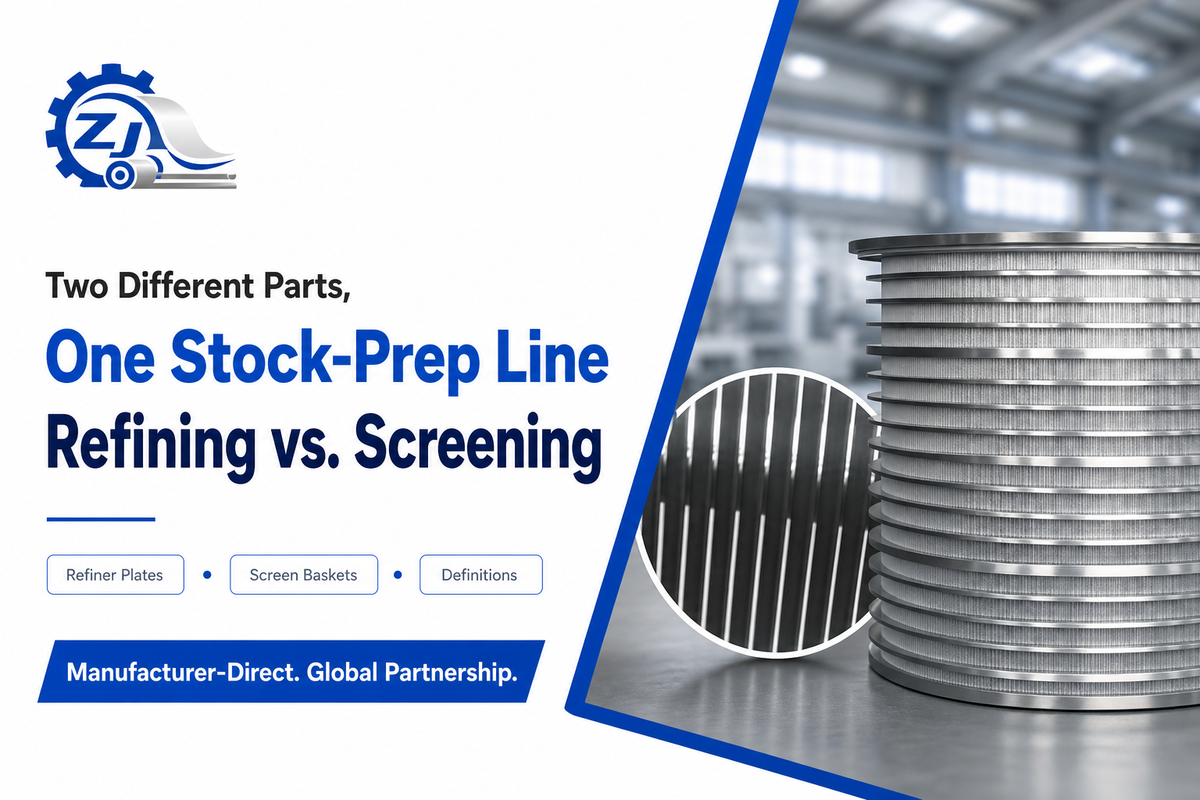
A refiner plate is a wear-alloy disc, cone, or segmented insert that sits inside a refiner or defibrator. Pulp fiber passes through a small, precisely controlled gap between a rotating plate and a stationary one, where the bars and grooves machined or cast into each plate’s surface compress and shear the fiber as it crosses that gap.
That mechanical action fibrillates the fiber surface – roughens it and partially separates its internal fiber wall layers – which is what creates the bonding strength that holds a sheet of paper together, a mechanism examined directly in a peer-reviewed refiner-plate design study.
A screen basket is a different component solving a different problem. It’s a slotted or drilled cylinder mounted inside a pressure screen, positioned downstream or upstream of refining depending on the line design. Stock is fed into the screen under pressure, and a rotor inside the basket generates pulses that keep good fiber moving through the basket’s apertures while shives, plastic, sand, and fiber bundles too large to pass are diverted into a reject stream. Refiner plates develop fiber quality; screen baskets protect fiber quality by removing what shouldn’t be there.
Beyond paper and board mills, MDF refiner plates and Andritz refiner plates using similar bar geometry are also common in fiberboard (MDF/HDF) production, since the same compression-and-shear mechanism develops fiber for panel products as well as paper. The two components are easy to conflate because they’re both wear-alloy consumables sold by the same manufacturers and specified together on a stock-prep line drawing – but their engineering logic, their failure modes, and (as later sections show) even their governing material variables are different enough that treating them as one undifferentiated “wear parts” category is where a lot of buyer confusion starts. Both are also covered by the same family of wear-resistant alloy standards, including ASTM A532/A532M, which is worth knowing before you evaluate either component in detail.
Key takeaway: Refiner plates develop fiber strength through shear; screen baskets protect fiber quality through separation. They’re both wear parts, but they don’t wear out for the same reasons — a distinction this guide keeps separate throughout.
How Refining and Screening Actually Work
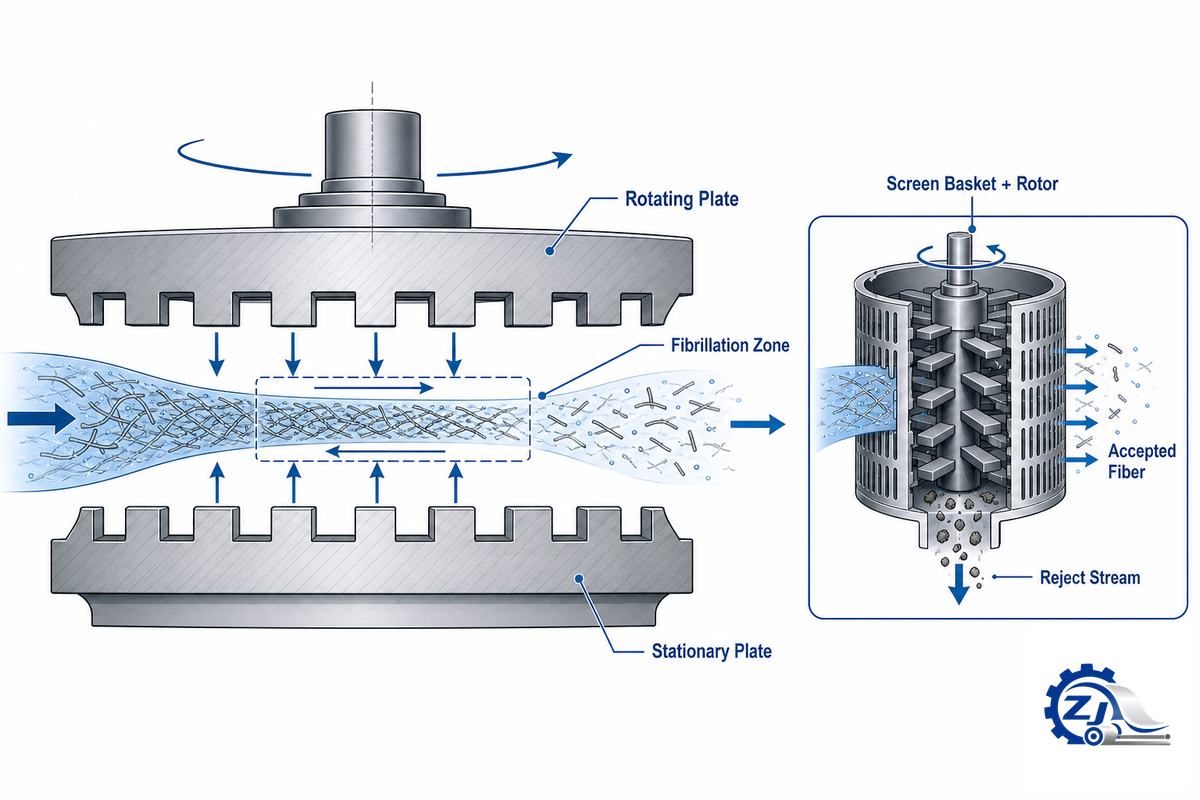
Refining and screening work through two entirely different mechanical actions on the same fiber slurry. Refining squeezes and shears fiber between a rotating plate and a stationary plate to build bonding strength, while screening pushes stock through a rotor-agitated basket that lets good fiber pass and diverts oversized contaminants to a reject line. The two stages are typically sequenced together in a stock-prep line but solve unrelated problems – one builds fiber quality, the other protects it.
Why Is Pulp Refined?
Refining’s the magic pulp’s after the fiber’s broken down into a slurry-because raw, unrefined fiber creates a sheet that’s weak, bulky, and doesn’t bond well. When the slurry run through the bar-and-groove gap of a refiner plate mechanically, it “works” the fiber wall, both internally delaminating (fibrillating) it and generating fine material that gets caught between fibers.
The result: more fiber surface area for hydrogen bonding during drying, which is what drives higher tensile, burst, and tear strength – the practical proxies mills use to judge pulp quality coming off the refining stage. Refining also impacts freeness (the speed at which water drains from stock), which is why mills use freeness to estimate how far along refining has gone instead of tracking fibrillation (which is tougher to measure). Laboratory refining trials typically disintegrate stock at around 1.5% consistency before adjusting to roughly 4-5% for the refining pass itself, a useful reference point if you’re ever comparing a supplier’s lab data to your own mill conditions.
Where Does Refining Fit in the Stock-Prep Line?
Refining happens after pulping, usually followed or run in parallel with screening and cleaning. These are three separate operations, but it’s common for parts catalogs to group consumables together, causing confusion for quoting purposes-a problem that this guide’s main-target site addresses for pulper rotors in particular (see ecosystem).
“Refining intensity has an accepted target range for a given furnish-typically 0.2 to 0.6 Ws/m specific edge load for hardwood pulps according to published refining research-but hitting that range depends on plate geometry as much as on operating power. Buyers who focus only on horsepower and ignore bar pattern are optimizing the wrong variable.”
The HC/LC Refining Consistency Divide
There are two broad consistency regimes where refining takes place; what counts as a good plate outcome differs by regime. High-consistency (HC) refining handles the slurry at approximately 25-40% fiber-standard for mechanical pulping (TMP/BCTMP) that’s all about max fiber per unit energy. Low-consistency (LC) refining uses a 3-6% concentration, more typical for chemical and recycled fiber operations and often more about gentler strength development without cutting the fiber too short. A theoretical look at LC-refining and pressure-screening in TMP suggests the interplay of refining intensity and screening downstream is still an area of active research-the two are more coupled than viewing them individually would imply. Simply put: A plate bar pattern designed for one consistency will behave differently in the other; “same brand, different regime” is a common cause of complaints. Matching specific refining intensity to furnish type is what drives improved fiber development without over-refining – get it right and the mill sees a real productivity gain, get it wrong and the extra energy simply goes to boost pulp temperature instead of strength.
Bottom line: HC and LC refining are different regimes with different plate-performance expectations. A plate that performs well in one may disappoint in the other even if the brand and nominal pattern are identical.
Refiner Plate Types: Disc, Conical, and Segmented Patterns
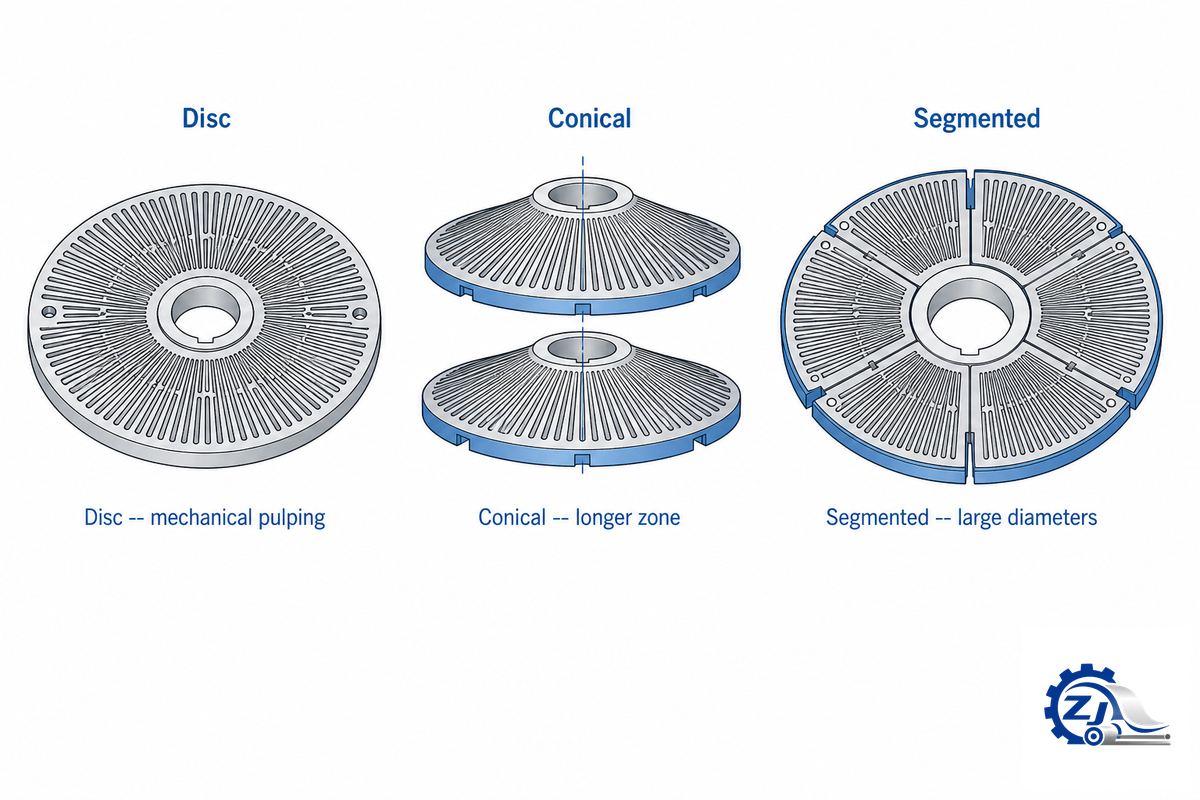
Refiner plates come in three general geometric families, and matching your equipment to the correct family is a necessary prerequisite even to choosing among the various bar-pattern options. Disc refiners use flat, round plates, and are most commonly found in TMP and general mechanical pulping applications; many disc designs run as twin-disc pairs, pairing one rotating plate against one or two stationary plates, and the rotating and stationary halves are matched as a set rather than ordered as generic interchangeable stock. Because mills run various models of refiners from different eras, most reputable manufacturers can customize bar pattern and groove depth to a submitted drawing instead of forcing a mill onto a fixed catalog of customizable options – the same premise behind the lightweight, zero-draft-angle plate design documented in the bar-geometry study cited later in this guide. Conical refiners use a cone-shaped plate pair, and work well when a longer refining zone is desired within a smaller footprint. Segmented plates are available; these are a manufacturing and handling solution (rather than a fundamental difference in how refining is done), and both “refiner segments” and “refiner plates” are used for this configuration in the industry, though “segments” can be used specifically for the pie-shaped supply version – in European technical literature the same wear-part pair is also commonly referred to as refiner plates and fillings.
| Your Process | Typical Plate Family | Why |
|---|---|---|
| TMP / mechanical pulping, HC refining | Disc, single or double-disc | Established geometry for high-consistency fiber development at scale |
| Chip pre-treatment / defibration | Conical | Longer effective refining zone suits coarser initial fiber breakdown |
| Large-diameter discs (>600 mm) | Segmented | Sectional handling makes installation and replacement practical at scale |
| Recycled / OCC fiber, LC refining | Disc, fine-bar pattern | Finer bar spacing suits lower-intensity, gentler refining targets |
Within each family, it’s the bar pattern-coarseness, groove depth, and bar angle-rather than the family itself, which dictates actual performance on a given furnish. Manufacturing literature on segmented disc filling designs notes pumping angle offsets typically in the range of 3 to 20 degrees, with a standard filling usually being divided into 6 to 8 segments, a matter of dimensional importance for fit rather than any basic functional distinction beyond diameter alone. A recent study on TMP properties showed fiber development that differed between refiner plates using different bar patterns within the same family. In general, coarser, wider groove patterns are better suited for virgin softwood kraft refining and high consistency material, while finer patterns are appropriate for recycled pulp and hardwood furnish when energy cost for a given level of freeness is more critical than throughput. As a rough reference point, groove depths on conventional patterns commonly run in the 3-6 mm range, with fine-bar variants going narrower still.
In practice: Pick the plate family based on your refiner type and consistency regime first, then let bar pattern — not brand — determine performance within that family.
Screen Basket Types and Slot Geometry
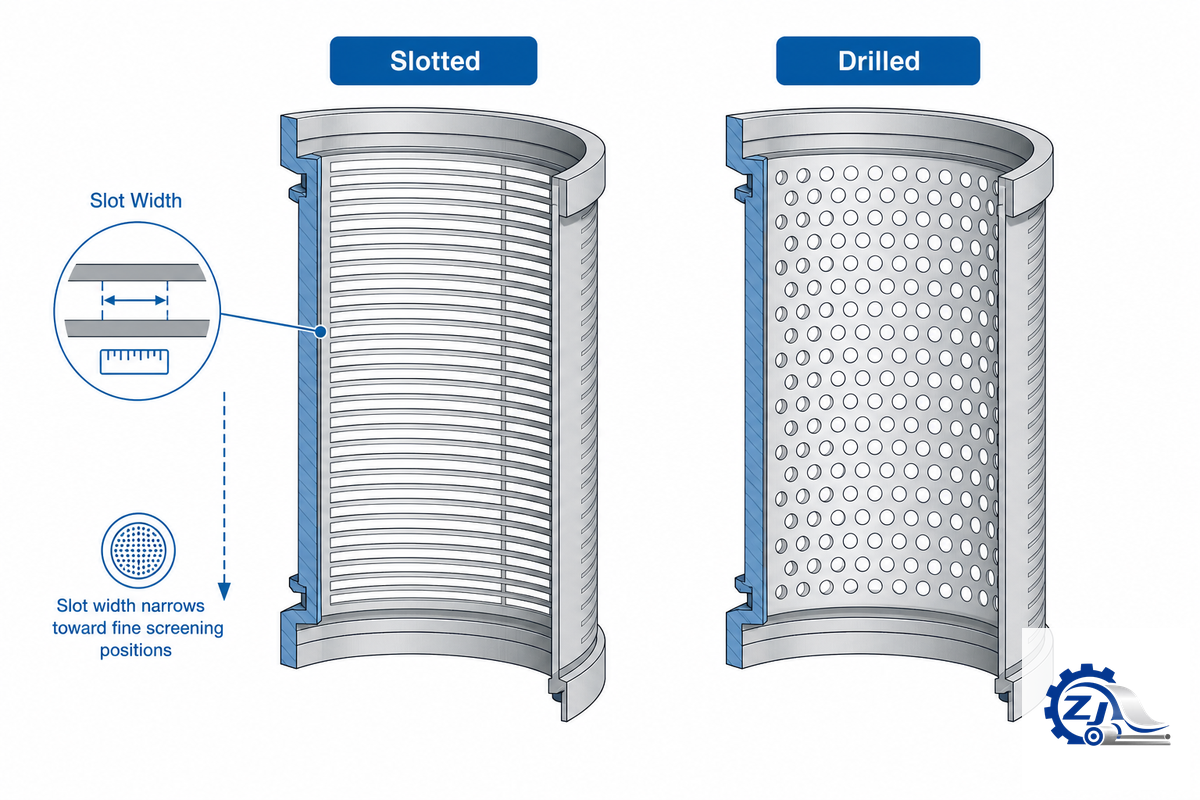
Screen baskets come in both slotted and drilled configurations, and the one that’s right for your application is largely dictated by your place in the screening system and your desired size of removed contaminant, rather than preference. Slotted baskets have long, thin slots and are used in most fiber screening applications, since the slot catches material based on its smallest dimension and allows long pieces of fiber to pass while still blocking rigid contamination. Drilled baskets are used more commonly in upstream screening stages where capacity is of higher importance than precision. It’s worth being precise about what screening actually is: a pressure screen is a coarse mechanical filtration stage that removes shives and rigid debris by size exclusion, not a filter in the fine-clarification sense – an efficient screen basket is judged on throughput and contaminant removal at a given slot width, not on filtration polish. Screening efficiency is the metric that actually matters for downstream papermaking output – a basket with the suitable slot width for your furnish removes contaminants without sacrificing high-quality fiber to the reject stream.
💡 The Terminology Decoder
Four terms often used synonymously by suppliers, and prone to confusing price and part number:
- screen basket-the complete cylindrical wear component, sometimes called a pressure screen basket, which fits inside a pressure screen housing.
- screen plate-either flat or curved, slotted or drilled elements that are substituted for screen baskets in certain screen and thickener designs.
- screen cylinder-often used interchangeably with screen basket by original equipment manufacturers (OEMs), but in some contexts may specifically denote the outer shell containing the removable basket.
- Outflow screen-in this design, the furnish passes through the wall of the basket from the inside to the outside. This configuration directs contaminants to accumulate on the inner surface.
Published screening research puts the typical range at roughly 0.06 to 0.76mm, though exact figures vary by study and by screen manufacturer – treat this as a directional range to confirm with your specific supplier rather than a universal spec. Slot width generally narrows depending on position along the screening line – the narrower end of the range, microperforated and sub-300 micron varieties, will usually be specified in those tight applications where maximum contaminant removal is desired – like fine/rejects and the headbox-screen positions. But slot velocity is as important as the slot width. One could argue that this aspect is just as much a work in progress: a recently published (2025) pulp screening machine patent application, for instance, hints that screen rotor and screen-basket geometry design is a work in progress and not just some set catalog item: optimizing rotor and foil design for a desired slot velocity can dramatically affect capacity and thickening as much as the basket does at any given specification. This just serves to point out that simply looking at the basket slot width is never the full story.
Key takeaway: Slot width is set by your screening position, not by preference — but slot velocity and rotor/foil design affect real-world capacity and thickening just as much as the slot number on a spec sheet.
Material Science: Why Alloy Composition Determines Service Life, But Not by Itself
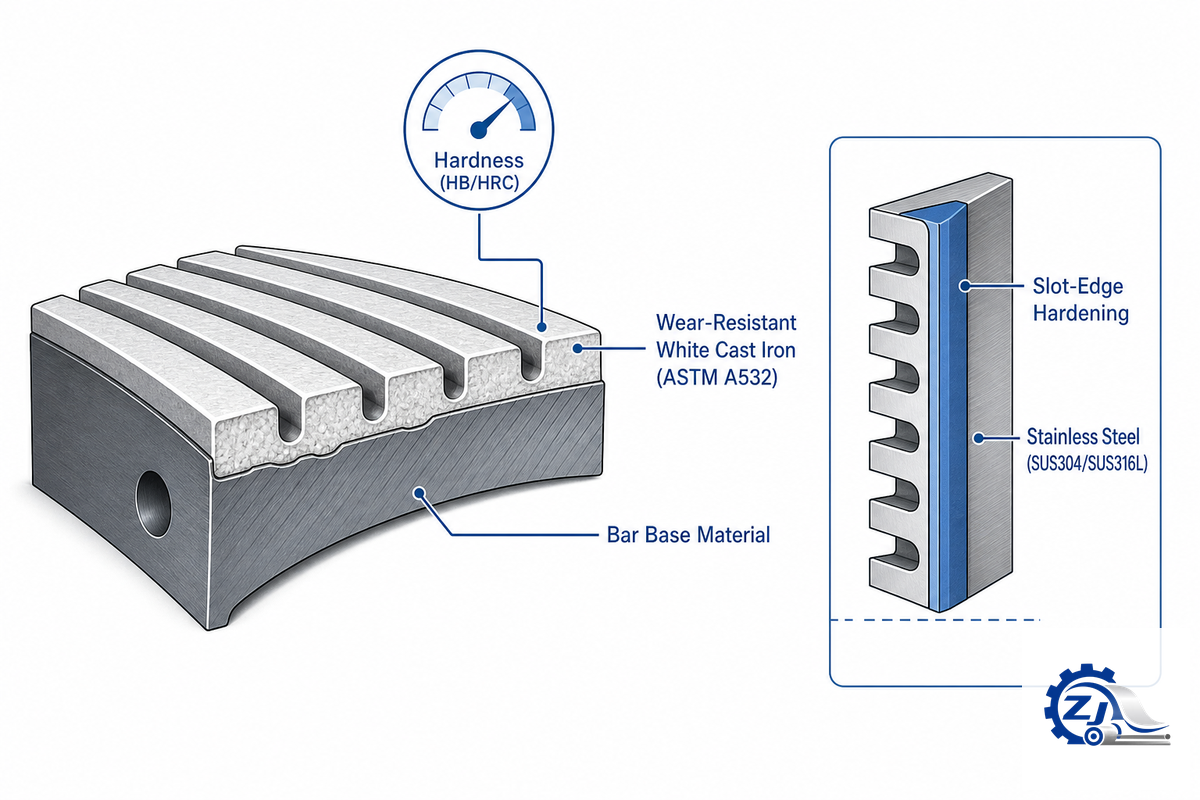
Refiner plates are most commonly constructed of high-grade, wear-resistant white cast irons conforming to ASTM A532/A532M, the standard specification for abrasion-resistant cast irons. (The most recent approved revision was 2023, reaffirming it.) Different grades are designated as Classes and Types depending on composition and hardness. For example, Class III-A (a 25% chromium type) has specific compositional ranges for nickel, chromium, and carbon and will have a specified minimum hardness in as-cast condition. When a supplier provides a percent range of alloy for refiner plates, they should also have a class specification – without that, it’s hard to verify their material claim.
However, even when the material conforms to a specified standard, refiner plates service life doesn’t just depend on the alloy’s class and hardness rating. One study, a 2020 BioResources publication regarding the production of lighter weight refiner plate units, suggests that heat treatment of the bar material play an equally important role to the alloy’s grade. They found that if the bar material isn’t correctly heat-treated before being set into the base, it will soften during the casting of the plate body, lowering its resistance to the repeated impact of the rotor and stator, thereby prematurely wearing it down- regardless of the base alloy’s inherent hardness rating. The study found that their lighter weight, zero-draft-angle, heat-treated (at ~1,100°C before assembly) lightweight refiner plate unit (with 270 bars/segment and a 75 km/s cutting edge length) achieved about 27% more throughput with ~47% less overall weight compared to a standard sand-cast unit (4° draft angle, 165 bars/segment, and a 37 km/s cutting edge length), and required approximately 3 times less refining energy to reach a target freeness.
📐 Engineering Note
25% chrome (Class III-A) white iron as per ASTM A532/A532M dictates ranges of about 2.0-3.3% carbon, up to 2.5% nickel, 23.0-30.0% chromium, up to 3.0% molybdenum and at least 450 HB / 46 HRC as-cast hardness. This hardness should be verified using Rockwell per an appropriate test methodology, e.g. ASTM E18 (a common lab setup applies a 150 kg load for a 30 s dwell time before reading the indentation). If a plate quotation from a vendor is given for a hardness number without a class designation behind it, you should inquire as to which ASTM class that number corresponds; a class number is verifiably specified, while a plain hardness value is not.
For screen baskets, the dominant variables differ from those of the refiner plates. Baskets are normally of stainless construction (often SUS304 or SUS316L, depending on the abrasiveness of the furnish and resulting corrosion potential), and because the wear mechanism is of the abrasive / erosive variety around the slots and interior of the part, and not driven by impact to the degree seen in bar-type plates, the slot-edge hardening and coating is more significant than the alloy chemistry once the appropriate grade of stainless has been selected for corrosiveness. This is one reason that “the same material story” for a material such as a white iron isn’t easily transferable to a screen basket as is apparent when comparing the two component types side by side.
Net effect: A verifiable ASTM class number is the right question to ask — but for refiner plates, heat treatment and bar geometry can matter as much as the alloy itself, and for screen baskets, coating and slot-edge condition matter more than bulk chemistry. In both cases, real-world durability is a function of these secondary factors as much as the base alloy grade printed on the quote. A plate that is properly heat-treated and correctly matched to furnish demand will generally prove more durable in service, reaching a long service life without the higher energy consumption that comes from running an undersized or mismatched pattern.
What Actually Wears Out a Refiner Plate or Screen Basket (and How to Tell)
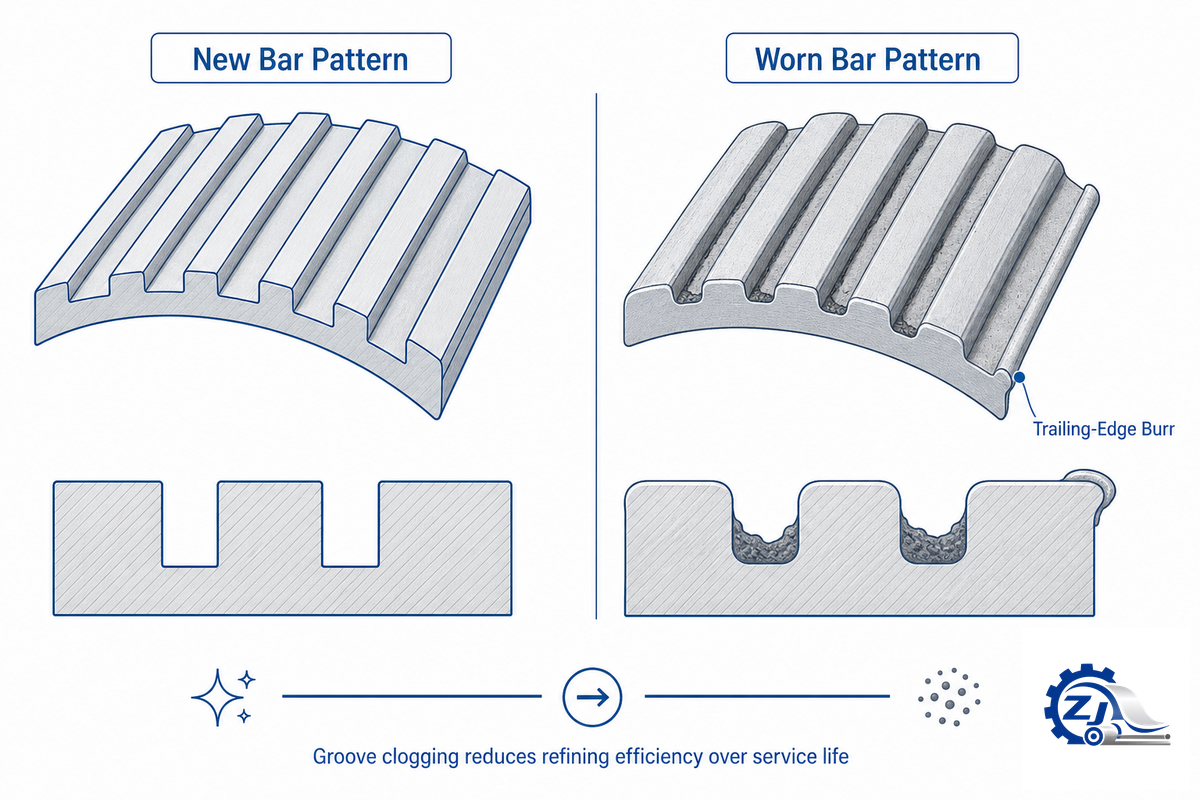
For refiner plates, the indications of wear include not only bar/tooth rounding but also groove clogging and what could be described as metal burrs, or “tails,” growing from the trailing edge of the bars. As this buildup progresses, fiber floc size increases and fiber uniformity declines, eventually causing high-pressure water and mechanical picking to no longer adequately clear the clogged grooves. This is typically when the operator will give up on cleaning the plate and will schedule a replacement.
In the case of the screen basket, the wear manifestations are somewhat different: as the relief features which surround the slots and openings of the part wear and smooth over, the basket can no longer induce the turbulence needed to keep fiber moving through the openings, and an actual fiber mat may begin to form over them instead. A peer-reviewed refiner-plate manufacturing study cited earlier makes a related point relevant to wear: bar hardness lost during manufacturing (not just in-service wear) can shorten plate life before the part ever sees production.
The 9-Signal Wear Diagnostic Matrix
| Type | Signal | Likely Cause | What to Check First |
|---|---|---|---|
| Refiner plate | Rising refining current at constant gap setting | Bar/tooth rounding reducing cutting efficiency | 30-day current trend vs. baseline |
| Refiner plate | Persistent fiber clumping resistant to flushing | Groove clogging / burr (“tail”) formation | Visual groove inspection at next downtime |
| Refiner plate | Increasing specific energy for the same freeness target | Cumulative bar wear reducing bar-edge length | kWh/ton trend vs. plate operating hours |
| Refiner plate | Visible metal burrs (“tails”) at bar trailing edges | Advanced-stage groove clogging | Physical inspection, stopped condition |
| Screen basket | Rising differential pressure (ΔP) across the screen | Aperture plugging from worn, smoothed reliefs — or a furnish-consistency or hydraulic issue upstream | Furnish consistency log before assuming wear |
| Screen basket | Thickening reject stream / high reject-line motor load | Reduced turbulence at worn basket wall, or a rotor/foil condition issue | Rotor/foil condition before basket replacement |
| Screen basket | Freeness drift toward more long fiber in rejects | Smoothed reliefs passing more long fiber than intended | Accept/reject fiber-length distribution |
| Either | Freeness drift at constant refining energy | Refiner plate wear (reduced cutting efficiency) or screen fractionation shift | Isolate by testing each component independently |
| Screen basket | Coating breakthrough / exposed base material visible | Wear-acceleration threshold reached — reported 5-10x faster wear rate past this point | Immediate inspection priority; schedule replacement |
⚠️ Important — Rule Out Other Causes First
Rising ΔP (differential pressure), increasing rejects, and freeness deviation can all be indicators of plate or basket wear, but they aren’t necessarily definitive of such. These three indications can arise just as easily from changes in the furnishes and/or pulp blends being processed, or from variations in rotor or foil condition, or even changes in upstream hydraulics, all without any actual physical wear of the component. Be certain to first confirm furnishes are stable and check upstream hydraulics before ordering a replacement solely based on these signals.
Where the use of coating or hard surface layer to increase basket life is being employed, industry equipment-supplier literature shows coating thicknesses ranging approximately from 150 to 350 microns, depending upon process application requirements, thin enough to maintain slot tolerance but thick enough to prolong until wear has reached the base material, (consider this a directional industry range rather than a specification that you can repeat to a supplier). The same supplier-field pattern shows that, once wear has gone beyond the limits of a protective coating or hard surface layer, the wear rate on the base material beneath rapidly increases, (as high as 5-10 times the previous rate according to the literature cited) reminding you that a planned schedule is often not as critical as scheduled checks (again, keep in mind the 5-10 multiplier is a supplier reported figure, not the result of independent testing) in extending life. Typical service life reported for screen baskets ranges from six weeks to more than two years, again dependent on furnish abrasiveness. Recoating and resurfacing, when applied, has been reportedly documented as doubling or more in basket life in the field (in one case study the change from around 2 months to over 4 months following a coating change and in another from 3-6 months to 8+ months) again, however, the success is both furnish and installation dependent and not a definitive multiplier to expect on any mill.
Practical rule: Diagnose before you replace — the classic warning signs are ambiguous between three or four different root causes, and confirming which one you actually have can save an unnecessary shutdown.
OEM Brand-Match vs. Custom-Engineered Replacement
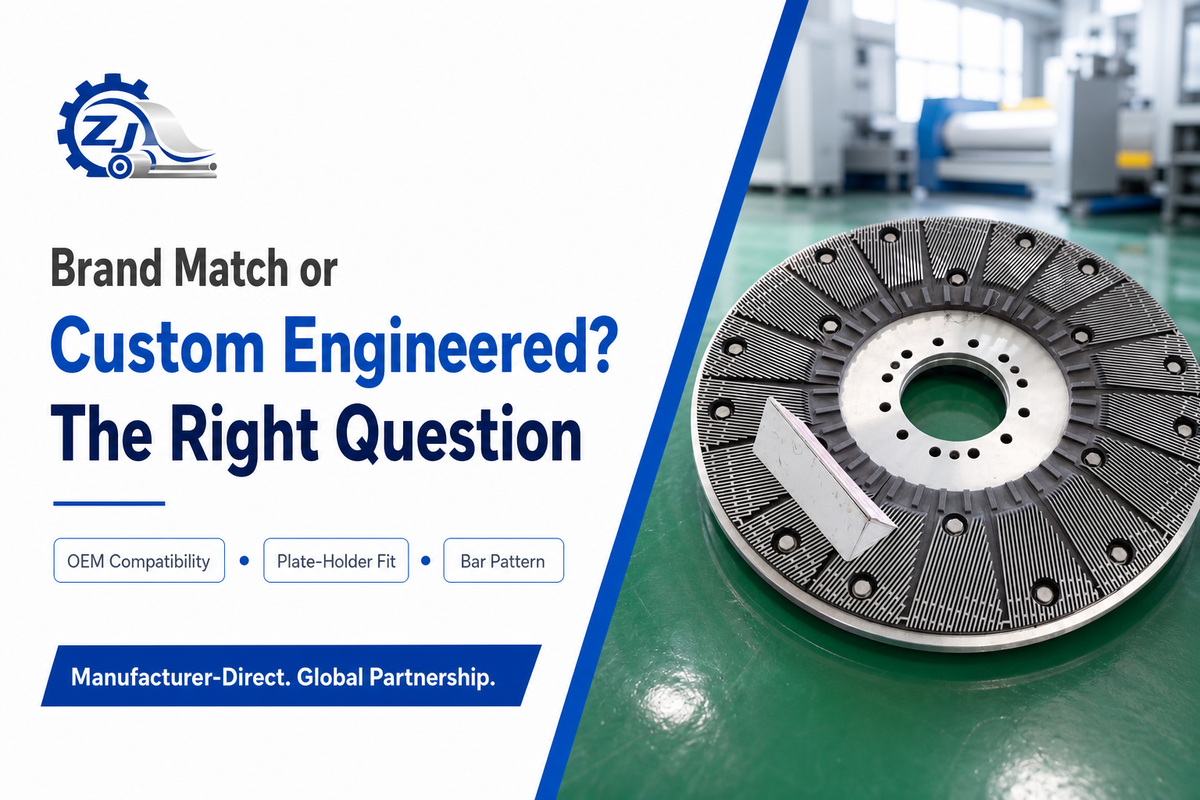
Understanding a refiner’s brand and model does provide a supplier with the housing family — but it doesn’t reveal the bar pattern, bar-edge length, or groove geometry that really drive performance. Peer-reviewed refining research comparing plates with varying bar-edge lengths, holding target refining energy constant, has revealed tensile-index differences of a few percentage points purely due to geometry (with the equipment family held constant), consistent with the bar-geometry throughput data cited earlier, and another indication that “the right brand” and “the right plate” aren’t synonymous claims. Even among established brand families, that distinction has practical importance: Valmet’s acquisition in 2019 of J&L Fiber Services, a well-established US refiner-plate manufacturer, serves as another example of how OEM history itself can be a vehicle for change, both of the OEM itself and of associated bar-pattern specs, leaving “brand history” not to be relied on as a stable substitute for current geometry. Other established OEM families in this space – Andritz, Voith, and Parason among them – each maintain their own plate-holder and basket-housing tolerances, which is exactly why “brand and model” is treated as a starting point rather than a complete specification throughout this guide.
Further compounding the issue is the practical challenge that when a mill need a replacement, original plate-holder or basket-housing drawings often can no longer be retrieved because the equipment has been around for decades, its original supplier has lost track of its data, or the machine has been transferred ownership, such that “tell us the brand and model” often really is all that the buyer has to tell the vendor (brand match or no brand match).
Most refiner plates manufacturers will ask for the same starting information regardless of brand: your equipment make and model, plate-holder or basket-housing dimensions, and a sample or drawing if one is available. For a brand-by-brand OEM compatibility reference and a guided measurement-matching process, see Zejiang’s refiner plate and screen basket compatibility page, which covers the practical ordering workflow this guide doesn’t duplicate.
✔ OEM Brand-Match Advantages
- Fastest quoting occurs for a valid drawing/current part number
- Lower ambiguity for straightforward, unmodified equipment
- good starting point, although custom made at the end
⚠ OEM Brand-Match Limitations
- Brand and model don’t necessarily identify the bar pattern, the grooves, nor the slots
- Field reports cite aftermarket parts with solely brand-match designed units that can experience fitment and vibration issues.
- Assuming that the drawings exist and are accurate – very often not the case on older equipment.
Custom engineered replacement – match the plate-holder or basket-housing dimensions, plus any available worn sample or existing bar pattern. This approach solves the drawing problem directly, and it’s the most justifiable default solution whenever geometry, not brand loyalty, is the actual performance variable. A slightly higher initial cost is paid to get the accurate measurement, but it bypasses the higher cost of buying and fitting a plate or basket that might be the right fit but doesn’t have the right geometry for the job. To understand the process and find the brand by brand compatibility, as well as a handy measurement process for matching, you can refer to the refiner plate and screen basket compatibility table on our website.
Key takeaway: Brand and model get you in the right family; plate-holder measurements and bar-pattern data get you the right performance. Ask for both, but don’t assume brand alone is sufficient. Reaching optimal performance from either component depends on matching hardness loading and bar geometry to the furnish, not on brand reputation alone.
Refiner Plates and Screen Baskets in the Wider Stock-Prep Picture
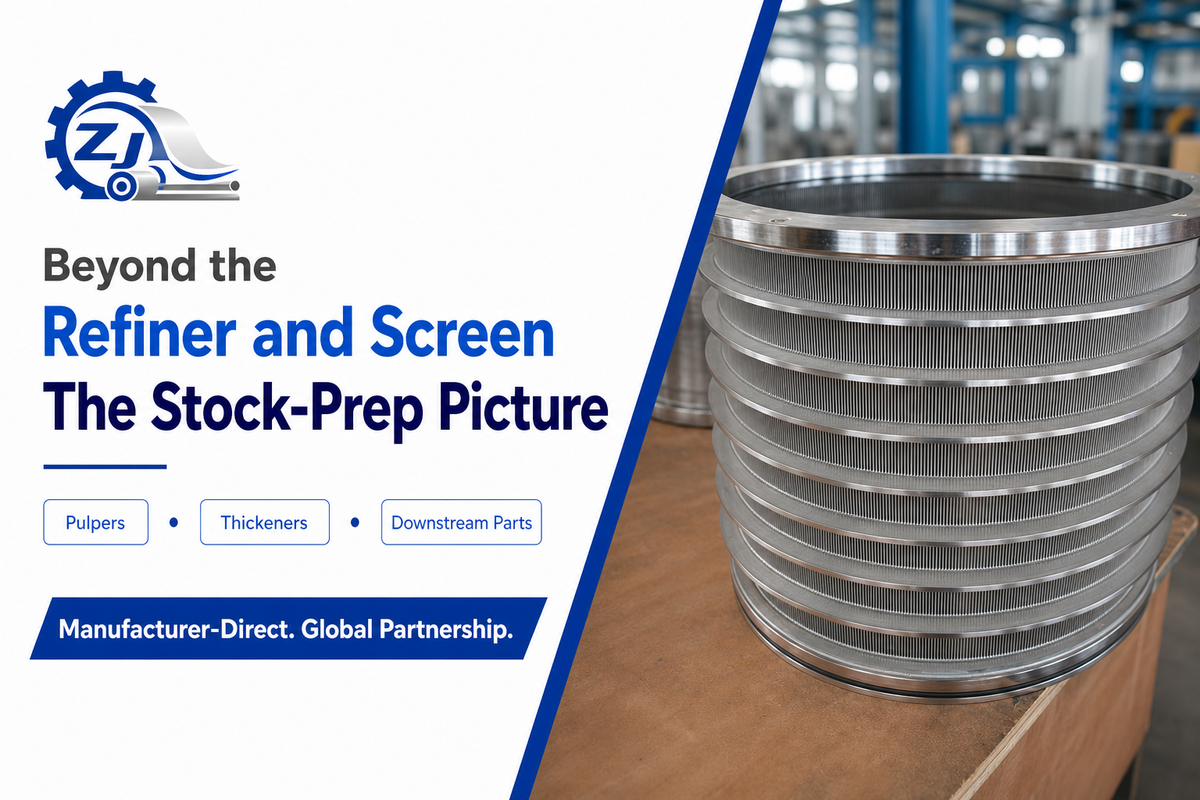
refiner plates and screen baskets are part of a broader stock-prep line where pulpers, cleaners, thickeners, and paper-machine parts (at the head of the sheet-forming section) make their own decisions on wear life. Thinking about these replacements together, instead of on an individual basis, will avoid planning an outage for one component that’s nearly due for replacement, while two or three other wear parts that are near the end of their useful life on the same timeline are ignored. Particularly thickeners (near the screening and refining stages), have been shown to share common wear variables related to fiber quality that impact their performance, just like refiners and screens, especially when you’re evaluating your stock-prep line in its entirety – the coupling between refining intensity and downstream screening performance is an active research area in its own right, as the theoretical look at LC-refining and pressure-screening in TMP cited earlier in this guide illustrates.
Downstream on the paper machine itself, wear parts including doctor blades, headboxes, press rolls, dryer cylinders, and forming fabric and wire all have their own furnish-driven wear profile. The quality of fiber coming from refining and screening has a dramatic effect on the life and performance of those downstream parts. Running a mill on under-refined or poorly screened pulp often means accelerated wear on felt and forming fabric as they face more unwanted fines and contaminants – a reason to treat refiner plate and screen basket quality as a machine-wide consideration, not an isolated one.
Also Sourcing Pulper Rotors?
There are three distinct processes involved in the initial stock preparation process: pulping, refining, and screening. Despite this, part catalogs often bundle their wear parts and consumables into one convenient price, which leads to considerable confusion when purchasing. Rotors in pulping (as distinct from refiner plates and screen baskets) are responsible for breaking down the initial fiber-slurry before it’s refined or screened.
If you also order pulper rotors along with refiner plates and screen baskets, you’ll want to include them as a separate line item on your request for quote, instead of assuming there’s overlap between them. Some suppliers use the trademarked term Hydrapulper interchangeably with generic “pulper” when quoting rotors, which is worth clarifying up front to avoid part-number confusion.
About Henan Zejiang Paper Machinery
This article was written by the Technical Content Team at Henan Zejiang Paper machinery, a manufacturer and supplier of paper machine spare parts, including doctor blades, headboxes, forming fabric, press felts, press rolls, and dryer cylinders, for all major brands of paper-forming machines including paper machinery and pulp and paper mills for both kraft and linerboard grades.
Industry Outlook: What’s Changing in Refining and Screening Technology
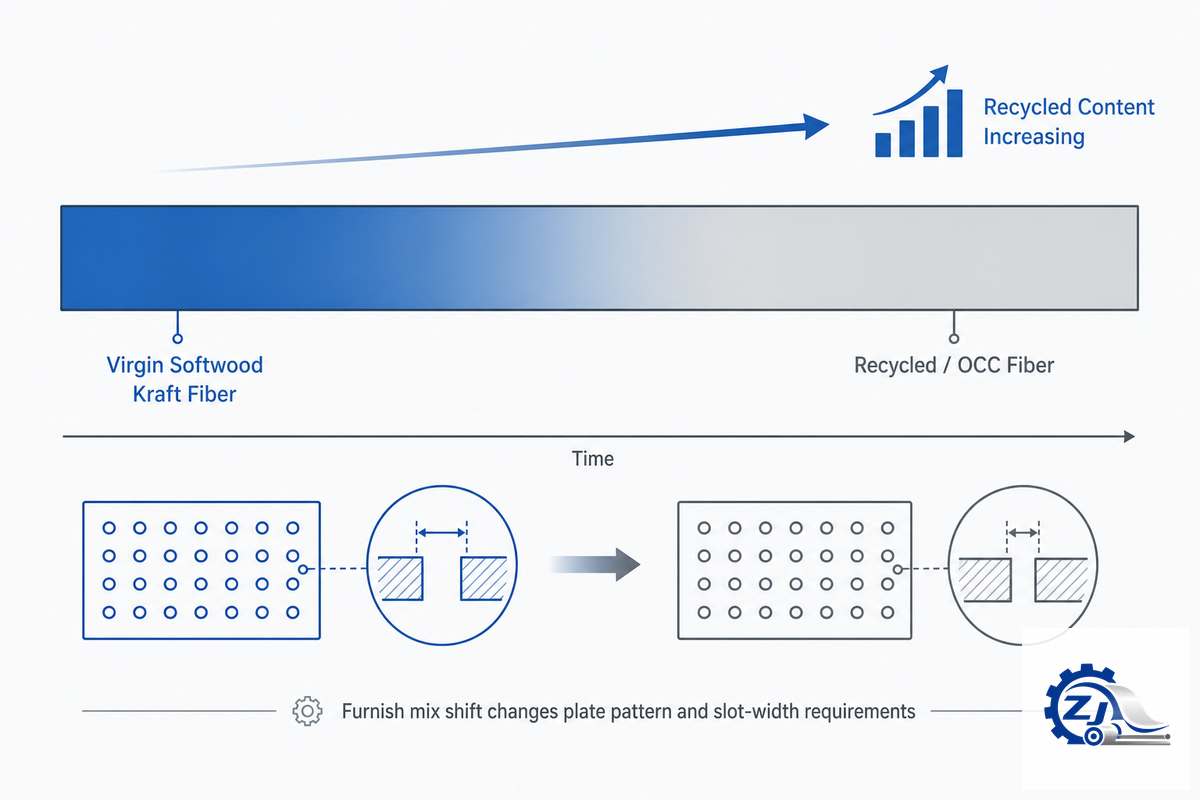
The most important near-term change for buyers isn’t the emergence of a new material, but the increasing proportion of recycled and OCC (old corrugated container) fiber going into the refining and screening lines and the fact that recycled furnish behaves differently from virgin fiber in ways that change equipment selection. Industry published research in April 2025 in TAPPI Journal evaluating OCC refining with a defloccing step which achieved approximately 15% gain in refining efficiency in fully recycled machines; this represents a significant advantage to mills, who are increasingly turning toward recycled content either voluntarily or due to fiber availability pressures in their respective regions. To buyers, this translates to: A refiner plate pattern or slot design proven for use in virgin softwood kraft doesn’t necessarily continue to be optimal as fiber content increases. This isn’t an obvious observation, and we encourage any buyer whose furnish mix changes substantially to reconsider both refiner plate pattern and screen basket slot width not just after a part has experienced wear and tear, but also as a routine part of operating with a new furnish mix.
The question of furnish-behavior is similarly an area of active academic study, rather than established science – consistent with the theoretical look at LC-refining and pressure-screening in TMP discussed earlier, which frames the refining-screening interplay as still being actively characterized rather than settled. A 2023 peer-reviewed study examining refiner plates utilizing alternative bar pattern fillings was able to determine distinct variations in the characteristics of TMP fiber, which were the result of the design of the filling material. This adds evidence that plate geometry research continues to explore how “optimal patterns” should be defined, as opposed to concluding the issue. Similar activity was observed in industry conferences, where pulping and fiber-treatment research was one area of focus for the TAPPICon 2025 event held in Minneapolis, with stock prep equipment suppliers and refiner-plate exhibiting equipment in 2026 – indicating active investment in the plate and basket product areas by vendors.
Market-size forecasts for the broader pulp-refining equipment category (several third-party research firms are estimating double-digit compound annual growth rates through the early 2030s) are directional context at best – they don’t tell a specific mill anything about when to replace a specific plate or basket, and this guide treats them as general background rather than as the basis for any recommendation above.
This is corroborated by investment trends within the sector: a recent $50 million project at Hood Container’s containerboard facility called for new refiners for the digester blow-line as part of a stock-prep modernization – one tangible instance where a supplier treats a mill processing refinement as a continuously needed investment and not a one-time buy. For those planning capital and/or MRO budgets over the coming year or two, factor in a furnished mix review as part of your regular, wear-based purchasing process and inquire if a supplier quoting a plate or basket design has tested it on your specific furnished mix and not just on the equipment make and model of the equipment in use.
Key takeaway: Furnish mix, not a new material breakthrough, is the variable most likely to change your plate or basket specification over the next two years — review it alongside routine wear-based replacement.
Frequently Asked Questions
Q: How often should refiner plates or screen baskets actually be replaced?
View Answer
There is no one interval that is applicable across mills, as replacements are dictated by furnish abrasiveness, operating time, and maintenance rather than calendar date. Field-reported ranges for screen baskets can be as short as six weeks at the aggressive end and two years or more for more gentle, well-maintained conditions, and refiner plates range from low-six weeks to high two-years depending on the bar pattern and furnish.
More reliably, replacements are based on condition: Monitor refining current or differential pressure over time, establish your own mill’s normal wear rate over the first few months after a new part has been installed, and then use this wear rate – not some arbitrary number – to determine your next replacement. Consistent periodic inspections (monthly is a common starting point) will allow you to catch the wear rate as it is beginning to steepen – and the data indicate that once this happens the wear rate can jump five-to-ten times or more after the hard facing has worn through.
Q: Can a worn refiner plate be reconditioned instead of replaced?
View Answer
Screen baskets have a more established recoating history than refiner plates. Baskets often can be recoated multiple times without excessive wear of the underlying material, and a program of recoating baskets is a documented way of extending service life in the field.
The more difficult plate case is harder to define with any precision. If a refiner plate’s bar-edge is past its ability to adequately grind material in combination with its slots and has started burring or “tailing” as a result of clogging then that plate should likely be replaced, but beyond a certain point, there is no real hope of recovering lost performance simply by resurfacing. A more general approach: ask your supplier whether recoating is available for baskets directly, but for refiner plates that are past the point of groove clogging the wear is usually non-reversible.
Q: What’s the difference between high-consistency (HC) and low-consistency (LC) refining?
View Answer
In high-consistency refining operations the stock consists of between 25% and 40% fiber. This process is most often found in the mechanical process of TMP/BCTMP production in order to maximize development per unit of refining energy. Low-consistency refining is found in more chemically oriented processes, recycled furnish or in other operations seeking more gentle strength development with a higher cut fiber.
This distinction is critical for selecting appropriate plates, as a bar pattern designed for the performance you’d expect at one consistency is not likely to provide comparable results at another consistency, due to shifts in the interaction between fiber and bar, energy transfer and the freeness response. The practice of swapping plates of the same brand from a HC to a LC process is a common cause of underperformance complaints.
Q: Do screen baskets and refiner plates wear out at the same rate?
View Answer
No, they wear out at different rates and on different schedules due to fundamentally different failure mechanisms: plates wear down their teeth; baskets erode at the edges of the slot openings. Both are best tracked and replaced on individual, condition-based schedules.
Q: What documentation should a mill request when buying refiner plates or screen baskets?
View Answer
At the very least, require a Mill Test Certificate (MTC) or equivalent material certification that links the delivered part’s alloy composition and hardness to a checkable standard designation such as ASTM A532/A532M, and include dimension inspection records that the plate-holder or basket-housing fit was verified before shipment – not just stated as a catalog number.
If you ordered a custom match, ask for the drawing or measurement record the supplier used to make it so you have that on file for your next replacement order, even if you no longer have the original on file.
Q: Why do some refiner plates cost significantly more than others?
View Answer
Complexity is king. A standard bar pattern manufactured on an existing, well-proven holder is cheapest. A modified bar pattern on an existing holder costs a little more, due to tooling costs associated with changing it. A completely new custom pattern that requires new tooling or even a new mold is most expensive, since the part is made to your specifications instead of from existing stock designs.
Alloy selection and heat-treat processes represent a second, separate driver of cost difference: a plate made from an ASTM-class alloy, appropriately heat-treated, and properly certified, will be more expensive than one using unverifiable material. But this cost reflects a genuine difference in performance and wear-resistance.
Why We Write This
Refiner plates and screen baskets are commonly marketed based on brand name alone. That’s the wrong way to sell these parts. We feel that the geometries and material specifications listed in this guide actually make the difference between an adequate part and a failure-the same factors we use to quote a custom match on our own refiner plate and screen basket page.
We’ll update this guide if future, peer-reviewed research, or new standards, modify what’s currently verifiable.
Reviewed by the Henan Zejiang Paper Machinery technical team.
References & Sources
- ASTM A532/A532M-10(2023) — Standard Specification for Abrasion-Resistant Cast Irons — ASTM International
- Theoretical Analysis of LC-Refining, Pressure Screening Systems in TMP — PMC / National Institutes of Health
- New Technology for Developing a Lightweight Refiner Plate for Hardwood Kraft Pulp Fibers — BioResources, NC State University (Min et al., 2020)
- Effects of Refiner Plates with Different Fillings on TMP Properties — MDPI Applied Sciences, 2023
- Optimizing OCC Refining with Defloccing — TAPPI Journal, April 2025
- Pulp Screening Machine (CN119736810A) — Google Patents, 2025-published application
- Hood Container to Invest $50 Million in Upgrade Projects — PaperAge, 2020
- Valmet Acquires U.S.-based J&L Fiber Services — PaperAge, 2019
Related Articles
- Refiner Plates & Screen Baskets, Compatibility Match & Ordering — brand-by-brand compatibility reference and custom-match ordering process
- Doctor Blades for Paper Machines — adjacent wear-part selection by machine position
- Headboxes — fiber distribution upstream of the forming section
- Refiners — refiner equipment overview
- Pressure Screens — pressure screen equipment overview
- How Pulping Equipment Works — upstream stock-prep guide
![Refiner Plates & Screen Baskets [Complete Guide]](https://zjpapermachine.com/wp-content/uploads/2026/07/refiner-plates-screen-baskets-guide-featured-150x150.png)
![Doctor Blade: Types, Materials & How It Works [Guide]](https://zjpapermachine.com/wp-content/uploads/2026/07/doctor-blade-guide-featured-1-150x150.png)
![Pulping Equipment: How Paper Pulping Works [Guide]](https://zjpapermachine.com/wp-content/uploads/2026/07/pulping-equipment-guide-featured-150x150.png)