Get in touch with Zejiang Paper Machinery Company

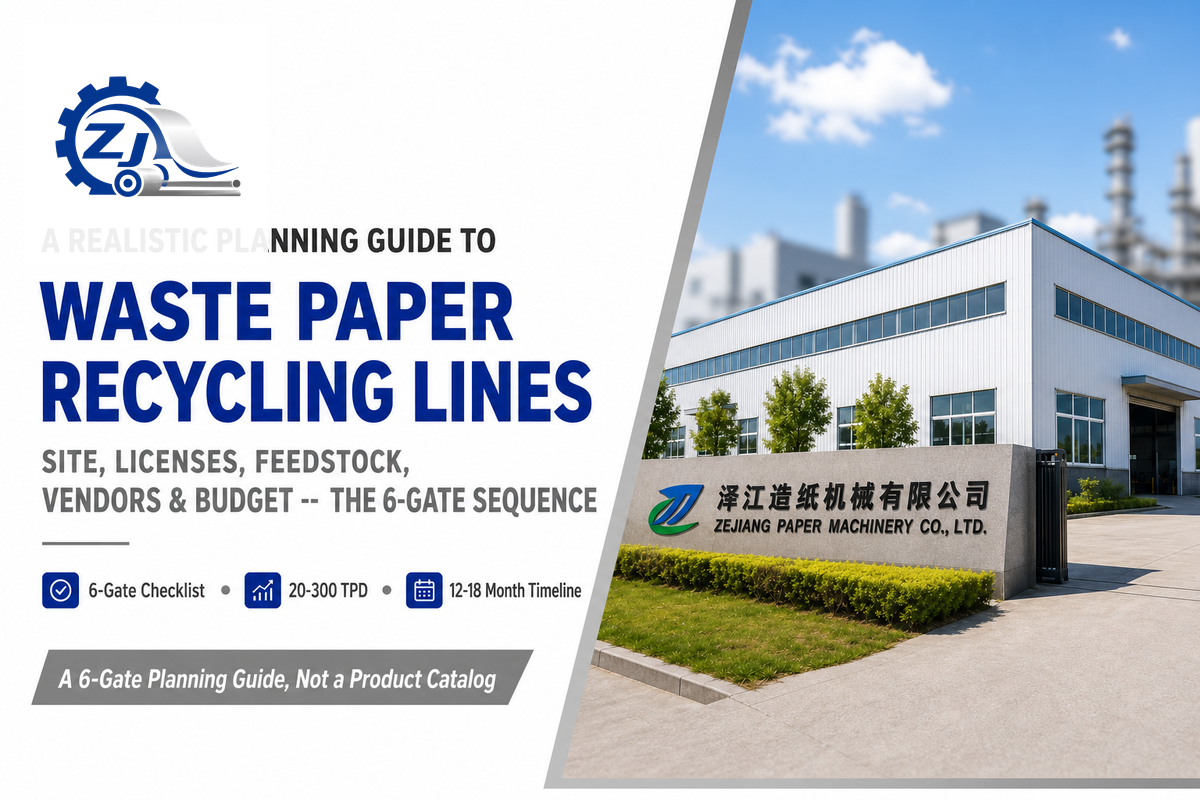
Setting up a waste paper recycling line means sequencing six gates in the right order-site, licenses, feedstock, capacity, vendor, and budget-before signing an equipment purchase order. The quick-reference numbers below give the range; the six-gate breakdown that follows explains what drives them.
Quick Specs
| Typical entry capacity | 20–300 TPD (tonnes per day) |
| Small-scale capex (20–30 TPD) | ₹3–8 Cr / roughly $0.4M–$1.0M |
| Planning-to-startup timeline | 12–18 months (18–24 for 100+ TPD) |
| Core licenses (India) | CTE, CTO, Factory License, GST, MSME Udyam |
| Typical payback | 3–5 years at stable utilization |
Setting up a waste paper recycling line means getting six interconnected moving pieces to fall roughly into place before a purchase order is signed: site selection, utility & license approval, feedstock acquisition, capacity sizing, vendor choice, and financing. Often, new project developers will lead with the equipment requirement (“I need to make X paper recycled per day,” “What equipment will it take?”) because that’s the part a machinery catalog clearly specifies. Where the delays really start to occur, though, are in the unadvertised steps: the Consent to Establish that must come before machinery order, the feedstock contract needed for startup, and the budget that can survive waste paper price fluctuations.
Building a waste paper recycling plant involves aligning the order of operations for site acquisition, permitting, feedstock procurement, and equipment orders to avoid creating logjams between these elements. For example, the installation phase can’t begin before securing Consent to Establish. The approximate cost for a basic 20-30 TPD plant in India is ₹3-8 Cr (around $0.4-1.0 million) and it generally takes 12-18 months to go from feasibility study to the production of finished product, according to relevant industry cost reports.
Key Points
- You must obtain your Consent to Establish (CTE) before ordering your equipment; in most cases, ordering equipment too early in the project is the most expensive planning mistake made by novice project owners.
- Feedstock makes up 50-60% of your operational costs, making a reliable supply of waste paper as essential as your equipment’s technical specification.
- The capital cost increases non-linearly with capacity; a 100-200 TPD line is likely to cost five to ten times the expense of a 20-30 TPD line, rather than simply scaling linearly with output.
- Imported machinery often has an upfront cost premium that ranges between 30-50% over machinery made in India, and understanding what drives that premium is essential when comparing offers.
- Fluctuations in the price of old corrugated cardboard (OCC) feedstock during the 2025-2026 period represent a tangible planning consideration for buyers and impact purchasing strategy in a way that’s independent of equipment specification.
What Setting Up a Waste Paper Recycling Line Actually Involves
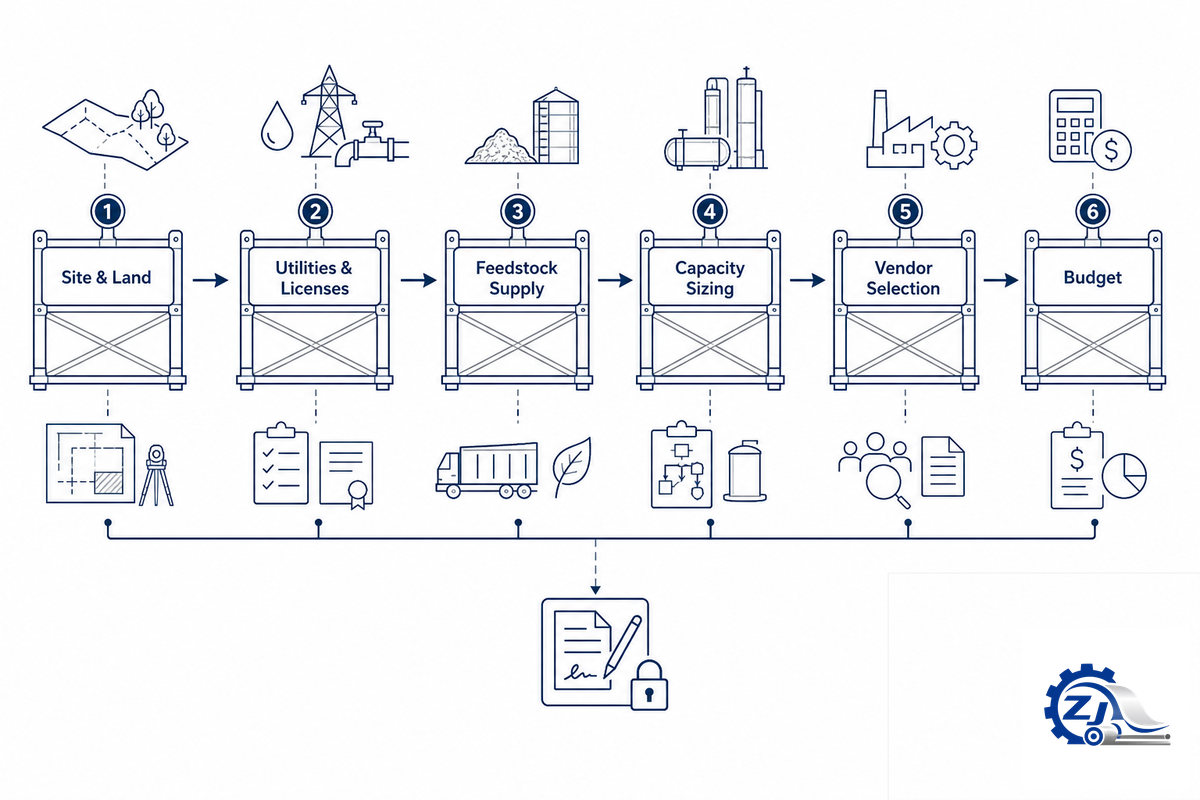
Any recycling line installation requires all six key stages to be successfully completed before the project become a working mill and is no longer simply an order quote: sourcing site & land, obtaining necessary utilities & licenses, arranging for feedstock supply, determining capacity, selecting a supplier, and establishing the budget. Each stage is critical and missing even one can create significant delays-an improperly secured license may delay installation, and an unconfirmed feedstock agreement may delay production startup.
This guide specifically details the planning phase required to turn recycling process, which produces baled paper waste transformed into paper products, into a functioning entity; it doesn’t focus on the process technology itself.
For the equipment itself-which include a pulp preparation line consisting of pulp, screening, and cleaning sections, possibly with deinking and connected to a paper machine interface-our page on waste paper and OCC recycling lines explains the six steps and typical configurations by output size in more detail than required for a planning guide. For buyers who begin their process by inquiring about equipment specifications without having already addressed site selection, licensing, and feedstock agreements, the process typically involve re-estimating equipment costs once those underlying constraints are revealed. By following this approach of addressing the gates in the order described above, rather than leading with the equipment query, these unnecessary re-estimates can be avoided. Buyers who compare paper recycling machine quotes between vendors before those upstream questions are settled often find the imported-machinery premium noted above looks like the deciding variable, when duty cycle and cleaning-cascade depth in the pulping process usually matter more.
This guide covers setting up a waste paper recycling line in India specifically, since licensing, feedstock sourcing, and government schemes vary meaningfully outside that market. If your starting question is closer to how is paper recycled step by step, or you’re comparing this to a paper recycling plant near me at consumer scale, this planning guide isn’t the right starting point – it’s written for an industrial buyer sizing an industrial recycling line, not a household recycling question. Whether you landed here researching paper recycling plant setup steps, comparing paper manufacturers, or trying to confirm what counts as genuinely recyclable paper at industrial scale, the six-gate sequence below applies the same way.
The 6-Gate Pre-Quote Planning Checklist
Before requesting a firm quote, clear these six gates in order – each one changes what the next gate need to answer:
- ✔ Site & land – water and power access confirmed, even if the final layout isn’t locked yet.
- ✔ Utilities & regulatory – CTE application filed or ready to file with your State PCB.
- ✔ Feedstock – local grade and realistic supply volume confirmed, not assumed.
- ✔ Capacity – sized to confirmed feedstock and a demand study, not to the budget ceiling.
- ✔ Vendor – factory-direct vs. trader evaluation completed against a written checklist.
- ✔ Budget – capex range sanity-checked and government scheme eligibility confirmed.
Site & Land Planning Before You Order Equipment
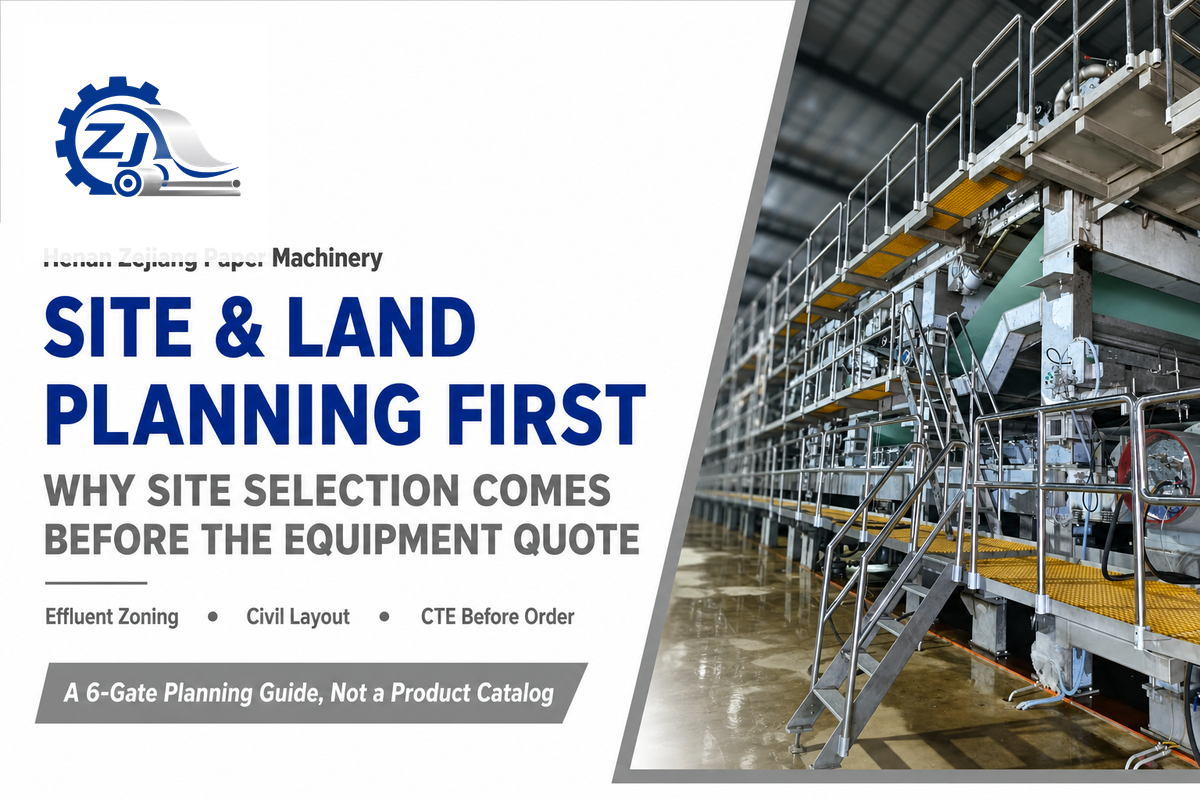
Water and power supply can dictate site suitability more than first-time buyers realize. A recycled-fiber line requires approximately 40-50 m³ of water per ton of paper produced – less than a virgin-pulp mill, but enough to render access to water supply a serious, non-negotiable constraint.[1] Equally, reliable power supply from the grid or the site’s own cogeneration source is critical, as both the stock prep line and the paper machine run 24/7 once commissioned.
Location near sources of waste paper supply is another important determinant of operating costs; for an Indian project this means proximity to Delhi NCR, Mumbai-Pune, Chennai, Hyderabad, Bangalore or Kolkata. At this scale of operations, raw material transport is the dominant component of their economics.[1] The available sources of this feedstock are recycling facilities and waste paper scrap aggregation centers in these areas, and not single long-distance suppliers. Moreover, timeframes for obtaining consent from the State Pollution Control Board vary greatly from state to state. States like Gujarat, Andhra Pradesh, Telangana, Maharashtra, and Tamil Nadu are usually mentioned as faster to process, or more paper-industry-friendly states for establishing recycling capacity.[1]
⚠ On land area
Exact site requirements will vary with the project’s capacity, the size of the required machinery, and the process that it incorporates, if it includes deinking. General figures that one can find online are not necessarily the same from one project to the next, and are not based on detailed site planning or specific equipment layouts. Work with your civil engineer and equipment vendor on developing a site layout before deciding on a location.
Underestimating water and power access is a common, expensive mistake at the site-selection stage – the risk shows up 1-2 years in, once output climbs toward the confirmed feedstock volume and the site’s actual water sanction falls 20-30% short of what the mill needs. Zejiang engineers ask an industrial buyer for the site’s real water and power sanction letters before finalizing a capacity recommendation, not just a stated availability figure, because the two numbers frequently don’t match on regional sites – a gap that is far cheaper to close before commissioning than after. Industrial effluent discharge is also regulated at the federal level in comparable markets – see the U.S. EPA’s Pulp, Paper and Paperboard Effluent Guidelines for the kind of water-discharge framework a site’s ETP sizing needs to satisfy.
Utilities, Effluent Treatment, and Regulatory Clearances for a Paper Recycling Plant
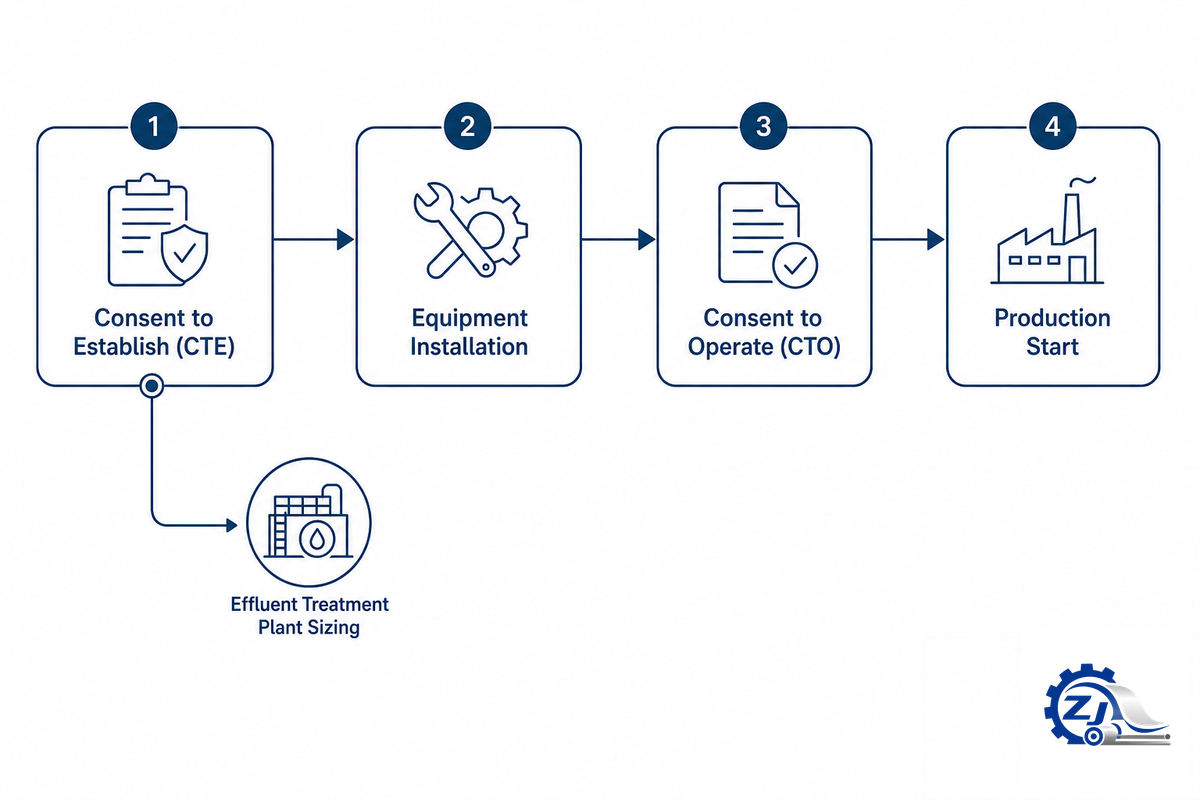
Regulatory compliance is often a source of significant timeline slippage. In India, a paper recycling plant will require a Consent to Establish (CTE)[1][2] from the State Pollution Control Board before placing an order for any machinery. Once installed and run, the plant will need to get its Consent to Operate (CTO).
There’s an important point of clarification on this topic of consent: classification of the project and examination of its effluents isn’t the same for all types of recycling plants. An OCC-only brown line (which uses waste paper, but without deinking) generally requires less extensive effluent treatment and faces less scrutiny than a white-grade line that includes deinking and bleaching processes; handling deinked slurry, including wastewater treatment and disposal of ink and other sludge, is a far more complex regulatory issue.[8] This document addresses only the requirements of a brown-line OCC recycling facility, the type most commonly built by first-time recycling entrepreneurs; the specific categorization for your type of project will depend on your State PCB, and may also differ from the CPCB industrial-sector classification.[9] Adding a deinking line to the same plant later, once demand for white grades justifies it, is a materially different capital and effluent-treatment decision than the brown-only configuration this guide focuses on.
What licenses and approvals are required to start a paper recycling plant in India?
Show Answer
A paper recycling plant in India needs a slew of approvals that mostly happen in parallel after CTE submission: State Pollution Control Board’s Consent to Establish (CTE) before procurement of machinery; Consent to Operate (CTO) after commissioning and trial run; Factories Act’s Factory License; GST Registration; MSME Udyam registration (the key to various subsidy schemes); Import-Export Code (IEC) for imports of waste paper and/or machinery; Hazardous Waste Authorization for processing imported waste paper; and Electrical Safety Certificate & Fire NOC[1]. Imported waste paper needs additional BIS and Plastic Waste Management compliance according to 2022 amendments. Total regulatory approvals take 4-9 months[2] that are staggered through out the equipment purchase process, not following it sequentially; actual regulatory compliance case filings confirm CTE/CTO compliance enforcement, therefore consider it a hard dependency, not paperwork that can be caught up with later.
Waste Paper As an OCC and mixed-waste line (these skip deinking), the sludge and effluent load is lower than a white-grade line used to make tissue or printer paper-we discuss this line design logic at length on our recycling line page. It doesn’t eliminate the need for ETP but does reduce the scale, which is an important item to verify early with the State PCB since the ETP sizing dictates part of the CTE application.
Confirming Feedstock and Paper Grade Before You Finalize a Spec
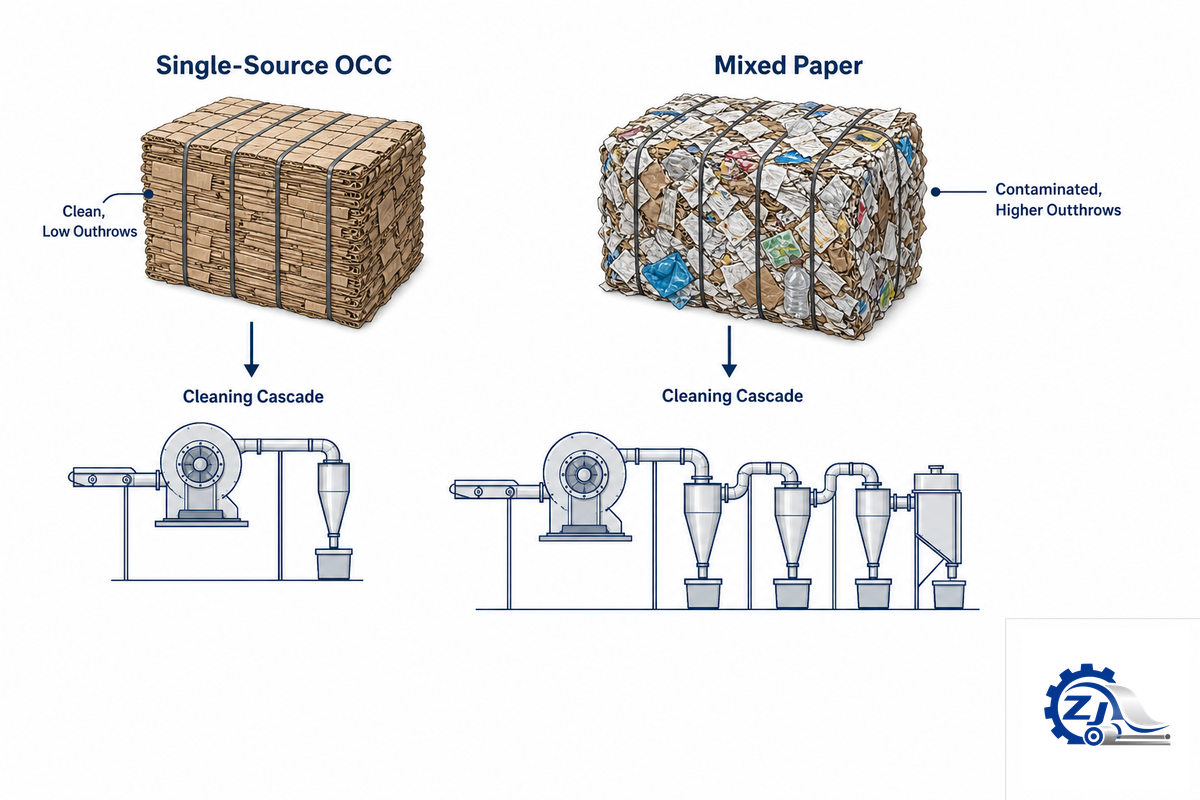
Waste paper accounts for 50-60% of ongoing operating cost on a recycled-fiber line[1], thus it’s an economic as well as technical challenge. recovered paper comes in several categories according to ISRI PS standards[3] (US) or the European EN 643 standard[4] (last revised 2013 and still in effect); old mixed containers (OCC) represent the dominant furnish for testliner and kraft grades, and old newsprint (ONP) and mixed sorted office papers are the feedstocks for other grades. Mixed paper, a separate ISRI-recognized grade with a lower and more volatile price than sorted OCC, is a common source of the contamination spikes described below when a supplier blends it into a load a buyer expected to be single-source.
Your grade of paper and contaminant level are major factors in the cleaning capacity you’ll require: A high level of contaminants in mixed-waste paper demands a larger cascade of equipment than for clean OCC. We cover the details of PS 11/PS 12 grades and outthrows on our feedstock grade and contamination page, but the simpler point for the planning stage is to verify the actual, available grade and volume of waste paper near your proposed plant location before selecting equipment, not after. Select a plant with the capacity to run only clean, single-source OCC and feed it contaminated mixed waste, and it will operate well below its published capacity until a bigger cleaning line can be added-the cost of which is yours to pay, not the equipment manufacturer’s.
Underestimating contamination is one of the more expensive mistakes in this category, because a cleaning cascade rated for a 5% outthrows furnish can lose 15-20% of throughput when the actual local supply runs closer to 10-12% outthrows – a gap that shows up as unplanned downtime, not a line-item on the original quote. Zejiang engineers size the cleaning cascade to the feedstock grade a customer actually confirms, not the grade a catalog assumes, which is why we ask an industrial buyer for a real bale sample or contamination report before finalizing a spec.
Right-Sizing Capacity as a Planning Input
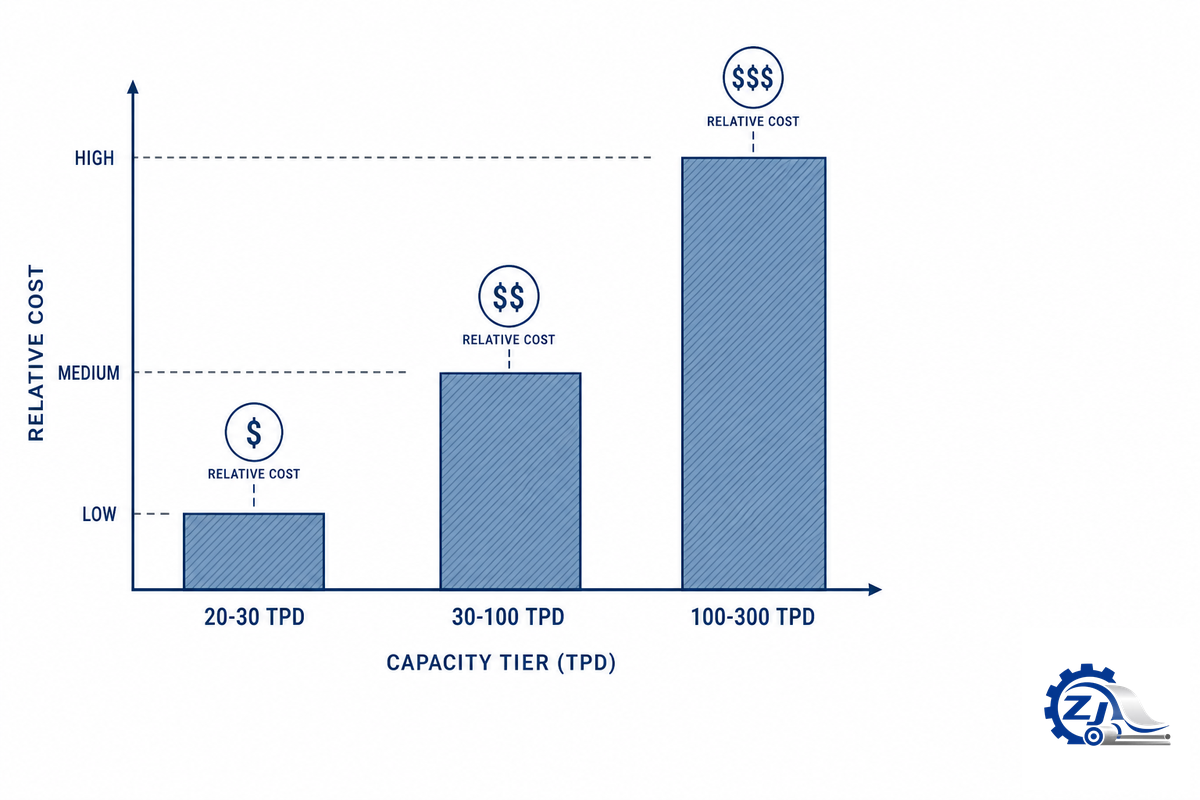
The capacity decision sizing is an input to the planning decision. Most popular entry points into the Indian market fall within 20-30 TPD (entry, quick pay back), 30-50 TPD (often best bang-for-buck on a first time investment), 50-100 TPD (national-level branded grades), and 100-300 TPD[1] (often the 2nd/3rd investment in the sector rather than a first time investment). The standard ranges from Zejiang are also covered from 10 to 300 TPD matched against mill profile – refer to the Equipment Configuration by Output table.
The risk of getting this wrong runs in both directions. A line sized to the budget ceiling rather than confirmed feedstock commonly runs at 40-60% of nameplate output through its first year, because the mill’s own feedstock network hadn’t scaled to match the equipment – a mistake Zejiang engineers see most often on lines above 100 tons per day built ahead of a secured multi-year OCC supply contract. For an industrial buyer, the practical fix isn’t a smaller line on principle; it’s a plan built around a signed feedstock volume and a real demand study, with expansion room left in the civil layout for a second shift once supply is proven. Zejiang sizes each configuration this way as standard practice, not as an upsell.
How the “right” number is derived will depend on your demand study output, guaranteed feedstock available, and your budget, not solely how much capital is ready for investment. Equipment that’s sized beyond your proven feedstock will only shift your constraint to raw material supply. Generally speaking: Size the line based on confirmed feedstock supply and your demand study, not to what the maximum budget cap would technically build – running a line well below name plate capacity for want of feedstock will only cost more per pound/kilogram.
Evaluating Equipment Vendors and Suppliers
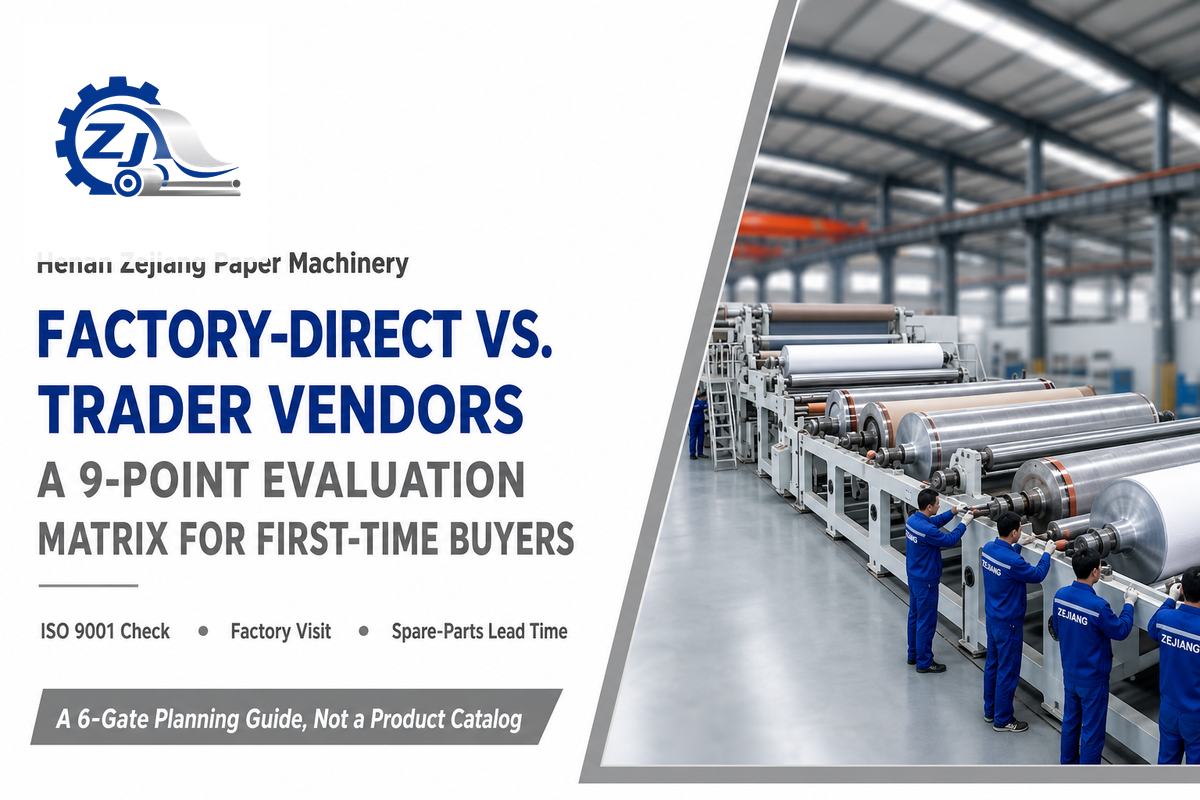
Since the paper machine along with the stock preparation line is usually 55-65% of the total cost[1] , the selection of the supplier is the biggest single high-impact decision of the entire project. A simple, unavoidable and frankly, quite inconvenient truth: The import price on the paper machine plus the associated stock prep equipment often comes with a 30-50% premium over a comparable locally made Indian setup on a face-value cost basis[1] – it’s an unavoidable number to factor into the planning process.
What really counts for total cost of ownership isn’t what you see at the sticker price – it’s what’s behind it; take stock of where the spare parts come from, how far they’ve to be shipped, how far the service engineer’s travel involves, and whether your purchase is via the factory that built the line or via a trading agent premium. A sourcing factory is the one that build with its own pulpers, cleaners, screens, and thickeners, and gets spare parts (screen basket, refiner plate, pump liner) from the same plant that built the original line. That can literally influence the lead time on a mid production failure a lot more significantly than if you bought it via a trading intermediary who had no manufacturing investment in the project.
Factory-Direct vs. Trader Vendor Evaluation Matrix
| Evaluation Category | Factory-Direct | Trader / Reseller |
|---|---|---|
| Spare parts source | Same facility that built the line | Depends on upstream manufacturer’s response time |
| Engineering questions | Direct line to the design team | Relayed through a sales intermediary |
| Reference mills | Can arrange plant visits | May not have direct access to installed base |
| Performance guarantee accountability | Manufacturer stands behind the spec | Guarantee may not survive a dispute pass-through |
| Sticker price | No intermediary markup | Markup layered on manufacturer price |
| Payment terms flexibility | Milestone-tied terms negotiable directly | Terms often fixed by the trader’s own margin needs |
| Training & commissioning support | Typically bundled pre- and post-commissioning | Often quoted as a separate line item |
| ISO 9001/quality certification verification | Verifiable directly with the manufacturing facility | Certificate authenticity harder to confirm through an intermediary |
| Technical support response time | Direct line to the facility that built the line | Routed through the trading company first |
⚠ Red flags in a vendor quote
In fact, buyers shopping recycling line suppliers typically point out the exact same handful of warning signs[1]: a list of references is withheld or can be seen only in photos; no site visits can be scheduled; specs are given over the phone without printed information on refining energy or screen efficiencies; there is no quantifiable fiber yield commitment included in the PO; and terms include greater than 50% upfront payment with no retention based on milestone performance. No single one of these will scare you off but if a supplier is displaying more than two, they are certainly worthy of a phone call.
“The questions we get most at the RFQ stage aren’t about tonnage, they’re about who answers the phone when a screen basket needs replacing eighteen months in. That’s the real difference between buying from a factory and buying through a trading company.”
Our engineering team at Zejiang
Budget Planning: Realistic Plant Costs for a Waste Paper Recycling Line
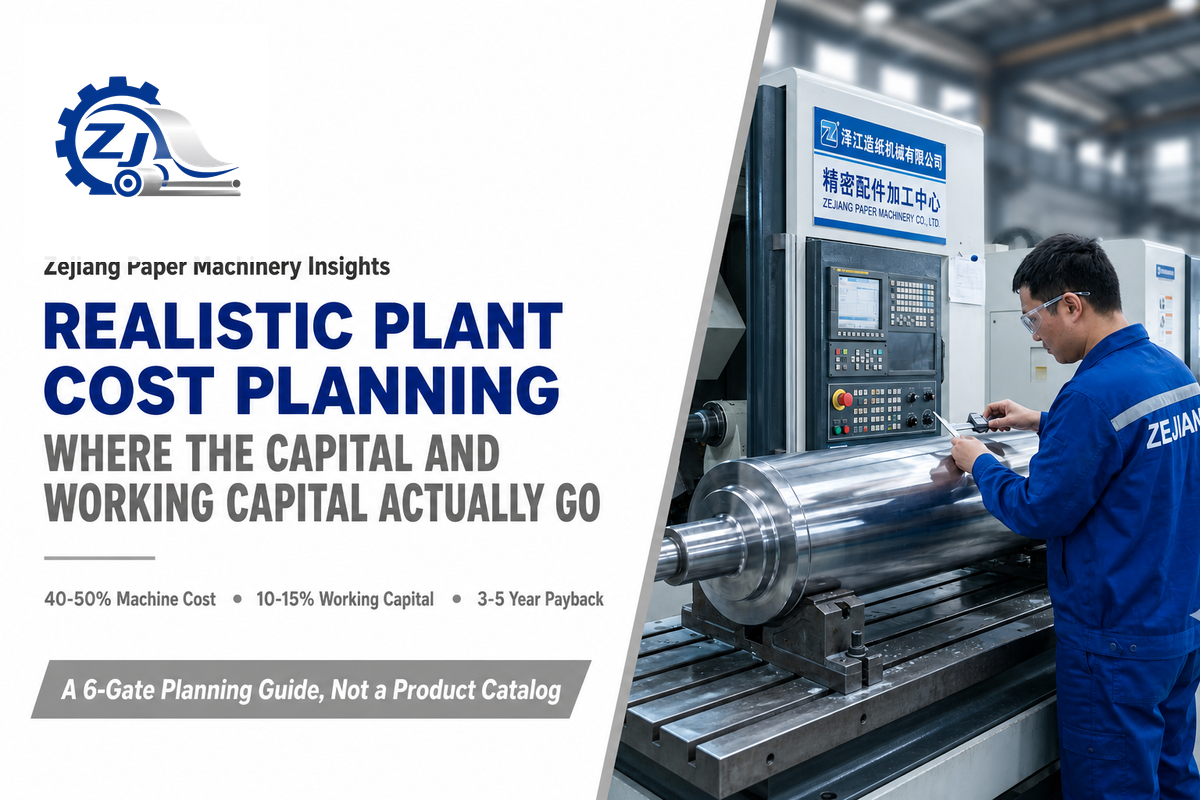
Capex for a waste paper recycling line grows non-linearly with capacity- larger mills cost per tonne are more efficient but require a much larger total check. These ranges are industry estimates, triangulated from published project-cost reporting, not a quote – use as a planning baseline to sanity-check a vendor proposal against, rather than a number to hold a vendor to.[1] Capex benchmarks like these move with steel, energy, and currency costs, so cross check against a recent Detailed Project Report or vendor quote rather than treating any published number as durable past a few months.
| Capacity (TPD) | Capex (USD, indicative) | Typical profile |
|---|---|---|
| 20–30 | $0.4M – $1.0M | Small kraft/testliner, first-time entrant |
| 30–50 | $1.0M – $2.0M | Mid-scale recycled kraft |
| 50–100 | $2.0M – $4.5M | Branded recycled board/kraft/writing |
| 100–200 | $4.5M – $9.5M | Large integrated packaging mill |
| 200+ | $9.5M+ | Continuous integrated recycled mill |
Paper machine cost alone usually accounts for 40-50% of the total budget, stock preparation (pulper, screens, cleaners, refiner) 12-18%, utilities 8-12%, civil work 8-12%, and working capital reserve 10-15%[1] for the first 3-6 months plus initial feedstock inventory. Skip deinking altogether for kraft/testliner grades – that alone removes some where around 5-12% of budget a white-grade line would otherwise need to carry.[1]
How much does it cost to set up a paper recycling plant in India?
Read Answer
Industry cost reporting places total project cost for an Indian paper recycling plant somewhere between roughly $0.4M (₹3 Cr) for a 20-30 TPD entry-level unit and $9.5M+ (₹80 Cr+) for a 200+ TPD integrated plant.[1] A mid-scale 30-50 TPD line, a frequently-cited “sweet-spot” from a first time operator perspective, runs $1.0M-$2.0M (₹8-16 Cr) – indicative ranges, not fixed prices. Actual cost varies by paper grade, machinery sourcing (India-made vs imported), automation level, site location, and land acquisition cost, not included in the above ranges. Several government schemes can support part of this – see the FAQ on incentive schemes below.
A handful of Government of India schemes apply specifically to smaller-scale projects: the Prime Minister’s Employment Generation Programme (PMEGP) offers subsidies up to 35% for projects below ₹50 lakh, the MUDRA loan scheme supports working capital and term loans for micro-enterprises up to ₹10 lakh, and the Credit Guarantee Fund Trust for Micro and Small Enterprises (CGTMSE) provides collateral-free credit guarantees up to ₹2 Cr;[1][5] these sit alongside a separate MSE-SPICE scheme (up to 25% subsidy on plant and machinery, capped at ₹50 lakh) – worth confirming with your MSME advisor which scheme actually fits your project size, since the eligibility criteria and subsidy caps differ.[5] Current terms are published directly on the Ministry of MSME’s MSE-SPICE scheme page.
Treating a single published capex figure as a fixed number is a common mistake, because real project costs on lines above 100 tons per day can swing 15-20% based on site civil work, grid connection distance, and current steel pricing – a risk that catches first-time buyers who lock a budget before a vendor site visit. Zejiang engineers walk an industrial buyer through a line-item breakdown before quoting a final number, specifically because generic per-TPD benchmarks routinely miss local civil and utility costs that can equal 10-15% of the total project.
Project Timeline: From Planning to Startup
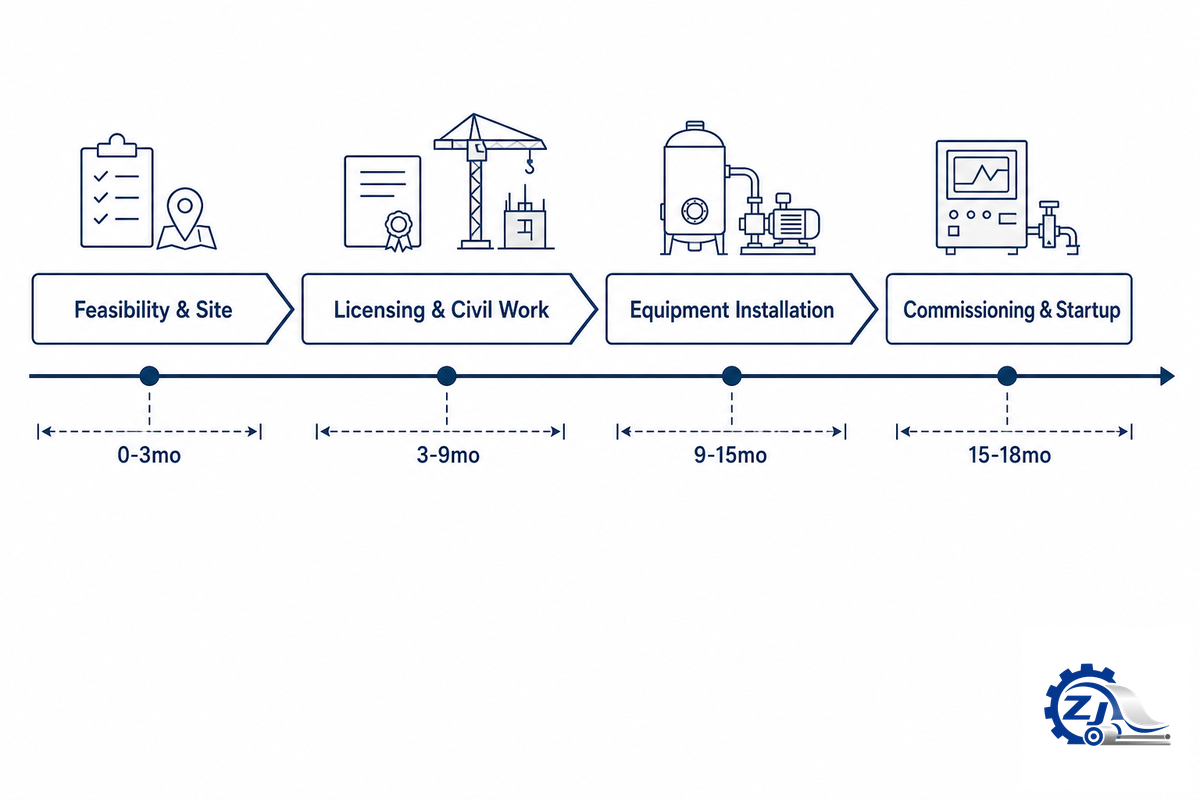
On average, a paper recycling plant in India takes from 12-18 months[1] after project initiation to achieve commercial production on a standard-scale line, increasing to 18-24 months for projects larger than 100+ TPD.
How long does it take to commission a paper recycling plant in India?
Show Answer
Four phased overlapping process: Stage I 2-3 Months for a study of the feasibility, site selection, and CTE application; Stage II 3-4 Months for the purchase of the machine if it is made in India (6-9 months if imported); Stage III 4-6 Months for civil works and the installation and trial; and Stage IV 1-2 Months for Consent to Operate (CTO) approval and production ramp-up.[1] Notice that the phases of application, approval, procurement, and erection & installation of the machine can happen at the same time, which makes it possible to squeeze such a project into a time span of 12-18 months rather than stacking the activities back to back. These durations are indicative rather than fixed — some State Pollution Control Boards have been actively cutting industrial-clearance processing times, so confirm current turnaround with your specific state board rather than assuming the slower end of the range. See more details about erection and commissioning on our installation and commissioning page.
An often overlooked piece of scheduling detail – ensure contracts and commitments from waste paper supply and buyers are in place by months 9-10 of the project,[1] and not after commissioning – a line that can be physically built is no good unless you know where the feedstock comes from and what you’ll do with it afterwards.
Underestimating the regulatory-to-procurement handoff is a real risk and a common delay driver, because a mill that files CTE paperwork 2-3 months late relative to machinery ordering commonly pushes commissioning back 4-6 months – well over 90 days beyond plan – since downstream trial-run scheduling depends on both being ready together. Zejiang engineers flag this dependency for every industrial buyer at the quoting stage, because a line that arrives before the site is CTE-cleared just sits in storage accruing cost.
Common First-Time Setup Mistakes
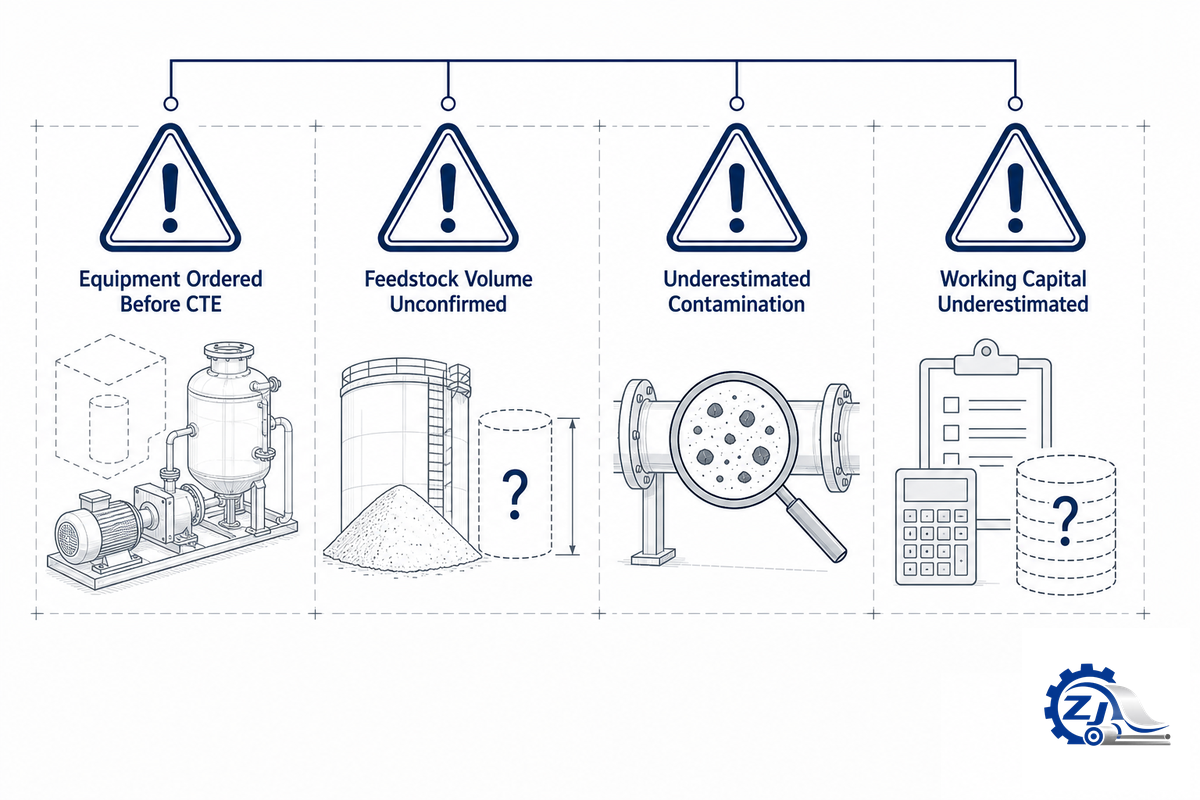
One we’ve already covered on our recycling line page: pricing an industrial line against a small office shredder-baler, because we consider it such a serious and often fatal error. However there are another two that appear with more frequency when an project has already started to take shape.
1. Underestimating working capital relative to input-cost volatility overall, rather than just waste paper alone. The price of OCC fell roughly 41% over the course of 2025 to about $44/ton, before showing early, uneven signs of a partial rebound in parts of the market by March 2026[6]. That’s more than enough of a swing to strain a plant that was working capitaling to the beat of a single-price point, rather than the likely range. The strain is exacerbated if the mill also uses imported waste paper, coal or process chemicals, as input-cost volatility may be out of sync with the price movement for its domestic inputs[1]. We’ve frequently heard from practitioners that the cash flow impact really gets felt in the first 9 to 12 months of operations-long after the cap ex investment decision has been made.
The second one is inconsistent quality output –GSM, brightness and moisture content that falls out of a buyer’s specification limits. [1]That’s more a process control issue than a machinery one and it’s an issue that will cause a regional B2B customer relationship to collapse quicker than almost anything else, as packaging converters and box plants don’t typically have room to accept rejected rolls. A first time buyer should get a vendor to agree in writing on the fiber yield and quality-consistency commitment on the Purchase Order (not over the telephone).
Industry Outlook: What’s Changing for OCC/Recycled-Fiber Buyers
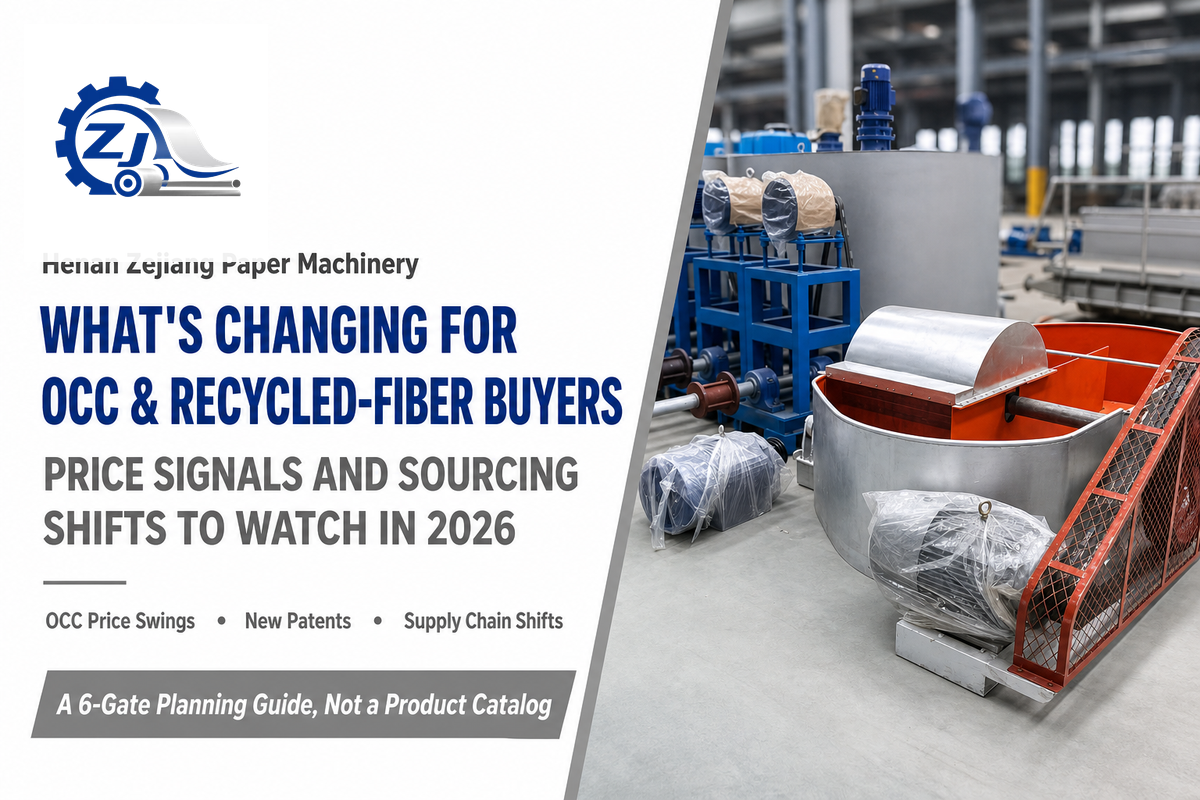
Right now, the clearest planning signal isn’t the growth graph but rather the price graph. OCC prices fell roughly 41% over 2025 to around $44/t, then started showing preliminary (and lumpy) signs of rebound in parts of the market by March 2026[6] (small $1-5/t price jumps) – remember this is a snapshot, so check current pricing for yourself if you’re entering a contract/purchase now. If you’re looking to buy right now, that translates into working capital planning against a price range and not a single, snapshot price. That’s a better activity than trying to call the “right time to buy,” since cost of feed is one input that’s out of your control, and most of your control, as soon as the line is running.
For example, equipment, technology on recycled linerboard and kraft paper produced from OCC has been patented extensively as of recent date; including improving stock yield, reducing the amount of wax contained in the waxed OCC stock and changing from refining to agitation, for instance.[7] This is a helpful fact in itself: there’s still progress being made, and it’s safe to assume that “whatever was the status five years ago” may be less than desirable today.
Grade classifications themselves are stable, with EN 643 (the standard for grades of recovered paper) last being updated in 2013, still current and used with ISRI PS codes.[3][4] It will be some time before any grade system upgrade comes down the line. So there’s no reason to sit tight while we wait for a change. Background on scale of things – India consumes somewhere between 22-25 million tons of paper and paperboard per year, with recycled-fiber the quickest segment growing segment of that demand and the recycled paper global market is estimated to reach somewhere around $55.88 billion by 2034 at a 4.1% CAGR.[1] This is directional, not the driver of decision making this quarter.
Frequently Asked Questions
Q: Is setting up a waste paper recycling line profitable for a new investor?
View Answer
Industry reporting estimates gross margins on standard recycled kraft and testliner grades in the 30-40% range, net profit after depreciation, interest, and tax of 12-20% and EBITDA of 25-35% [1] at over 80% utilization. Payback is typically 3-5 years, assuming steady operations and utilization above approx. 75%. Profitability is most exposed to the waste paper sourcing plan and cost – that’s why feed stock supply plan deserves as much attention in this guide as the equipment specs. ( these are average industry numbers, and not a promise of any specific project, actual margins will be dependent on local feedstock cost, buyer strength, utilization etc.) For a first-time paper recycling business, that sourcing risk is usually the deciding factor on whether payback lands closer to three years or closer to five.
Q: What’s the real difference in setup between a recycled-fiber (OCC) line and a virgin-pulp paper plant?
View Answer
A recycled-fiber line generally saves 30-50% compared with a virgin-pulp plant of similar capacity. It saves primarily because it completely bypasses the need for the chemical pulping infrastructure – no digester, no recovery boiler, no causticizing plant. Capex/tonne for recycled lines averages between ₹15-40 lakh per TPD against ₹40-50 lakh per TPD for an integrated virgin mill.
recycled lines also have reduced effluent treatment burden. Kraft/testliner grade based on OCC and mixed waste skips deinking, which is only required if one is producing white grades like office paper or tissue.
Q: How is planning a new-build line different from adding capacity to an existing paper machine?
View Answer
Greenfield is a full regulatory cycle – fresh CTE application, new site utility sizing and first-time CTO and a site from scratch. Existing paper machine recycling adds a CTO modification instead of a new one, and may reuse existing utilities (water treatment, power supply, ETP) that are sized for their existing job, thus compressing the regulatory cycle considerably compared to a new site. Stock-preparation is largely a size to match of the destination machine (feed pulper, screening, cleaning to the machine requirements and throughput/consistency) – only the paper machine itself is not up for debate, unlike in greenfield.
Q: What government incentive schemes exist for paper recycling plants in India?
View Answer
The following schemes are particularly useful for smaller projects: PMEGP offers subsidies up to 35% for projects less than INR 50 lakh; MUDRA loans are working-capital and term-loan instruments up to INR 10 lakh for micro enterprises; and CGTMSE provides collateral-free credit guarantees for up to INR 2 Cr[1][5]. A separate MSE-SPICE green-MSME scheme supports 25% of the plant and machinery cost, up to INR 50 lakh[5] – don’t confuse it with PMEGP as eligibility criteria and limits differ. State governments also typically have incentives like power-tariff rebates or capital subsidies (Gujarat, AP, MP, Maharashtra etc.). Eligibility rules and limits are fluid – check current terms with CGTMSE, MSME Udyam and your advisor.
Q: What’s the realistic minimum investment for a small-scale line?
Read Answer
A minimum viable plant generally runs from 20-30 TPD, requiring about ₹3-8 Cr ($0.4-1.0M) in total project costs (paper machine alone taking nearly half)[1]. Smaller volumes struggle with unit economics due to non-scalable fixed costs.
Q: What does a typical paper recycling plant site layout look like?
Show Answer
You’ll see segregated areas for waste paper storage, waste handling (bale), screening/cleaning cascades (pulping), paper machine, utilities (boiler, ETP, water treatment) and finished goods storage. Exact plot size depends on capacity and if deinking is involved; calculate based on layout with a civil engineer.
Why We Write This
Zejiang has designed stock-prep and recycling lines for Henan Province based on paper mill’s 10 to 300 TPD operations utilizing OCC and mixed waste over the last decade – the band in which our customers’ mills generally operate. this guide addresses the common questions encountered at the RFQ stage rather than just listing equipment sizes: site selection, licensing, feedstock and vendor selection. (Updated Jul 2026)
Reviewed by the Zejiang technical team
References & Sources
- IMARC Group, Recycled Paper Manufacturing Plant Project Report 2026capex, OpEx, and margin data (industry cost estimates)
- Central Pollution Control Board (CPCB), IndiaCTE/CTO requirements and effluent norms
- EN 643, European List of Standard Grades of Paper and Board for RecyclingCEPI/PITA, revised 2013
- CEPI Paper for Recycling Quality Control GuidelinesConfederation of European Paper Industries
- MSE-SPICE SchemeMinistry of Micro, Small & Medium Enterprises, Government of India
- Recovered paper prices show signs of reboundWaste Today Magazine, citing RISI/Sonoco pricing data, March 2026
- US Patent 6,340,407 B1, Process of making recycled linerboard or Kraft paper from OCCUSPTO / Google Patents
- ISO 9001:2015, Quality Management SystemsInternational Organization for Standardization
- Pulp, Paper, and Paperboard Effluent GuidelinesU.S. Environmental Protection Agency (Secondary Fiber Deink vs. Non-Deink subcategorization)
- Categorization of Industrial SectorsCentral Pollution Control Board (CPCB), India
![Refiner Plates & Screen Baskets [Complete Guide]](https://zjpapermachine.com/wp-content/uploads/2026/07/refiner-plates-screen-baskets-guide-featured-150x150.png)
![Doctor Blade: Types, Materials & How It Works [Guide]](https://zjpapermachine.com/wp-content/uploads/2026/07/doctor-blade-guide-featured-1-150x150.png)
![Pulping Equipment: How Paper Pulping Works [Guide]](https://zjpapermachine.com/wp-content/uploads/2026/07/pulping-equipment-guide-featured-150x150.png)