Get in touch with Zejiang Paper Machinery Company

ZJPM SYSTEM
+
+
+
Scroll To Explore
ISO Certified System
Tissue Paper Machine
Tissue Paper Machine, Crescent Former & Cylinder Mould Production Lines
A tissue paper machine turns wood pulp or recycled fiber into the base paper reels that become toilet paper, napkins, and facial tissue, and the forming technology behind it sets your production ceiling for years, not months. Zejiang Paper Machinery, based in Henan Province, builds two forming platforms, single cylinder mould and crescent former, engineered for mills at different stages of scale, backed by a spare parts supply line most competitors treat as an afterthought.
2 Furnish Types — Virgin Pulp & Recycled Fiber
✓ Spare Parts Supply Included in Every Order
High Precision
2
Forming Platforms — Cylinder Mould & Crescent Former
160–2,400 m/min
Forming Speed Range Across Both Lines
5–100+ TPD
Typical Capacity Band
13–40 gsm
Basis Weight Range
HEAVY MACHINERY // PLATFORM
Why Tissue Mill Buyers Struggle to Choose the Right Machine
Most manufacturers selling into Asia, the Middle East, Africa and South America – Zejiang’s main export markets – carry just one forming stage. That leaves new mill owners in a bind: pay dearly for years of excess capacity, or pay for equipment that has an expiration date of a year and must be scrapped instead of enhanced. A tissue paper machine forming stage (crescent former or cylinder mould) forms the base paper on the stock: it’s separate from the rewinding and converting equipment that takes the base paper and rolls it into napkin, toilet paper or facial tissue rolls. The EU’s Best Available Techniques conclusions on the pulp and paper industry define tissue-mill net production as the “saleable production after the tissue machine, before any rewinding processes (see the peer-reviewed forming-technology review this page draws on)”, meaning that the forming stage and the converting stage are treated as distinct.[1]
That distinction matter at the negotiating table. Suppliers who blur “tissue paper machine” and “toilet paper machine” into one catalog entry are often selling a single generic platform dressed up as a full product line. Zejiang runs paper making machines, pulp processing equipment, and paper machine spare parts as three separate, dedicated business lines, which is why a buyer get a straight answer about which forming platform fits their target output, instead of a one-size-fits-all quote.
The same tissue making machine, run at different basis weights and speeds, produces base paper for toilet tissue, napkin, facial tissue, and kitchen towels or paper towel grades, the forming platform itself doesn’t change between end products; what changes downstream is the converting and packing equipment matched to each grade.
The practical cost of picking the wrong platform show up months after commissioning, not at the negotiating table. A mill that buy crescent-former capacity it can’t yet sell into carries idle capital and higher energy draw per tonne produced than a right-sized line would. Buying the cheapest entry-level machine without a clear upgrade path carries the opposite risk: a mill ends up re-financing a full line replacement within a year or two of hitting its ceiling, instead of adding capacity incrementally. Zejiang’s design, manufacturing, refurbishment, and installation work is built around avoiding both outcomes, sizing the platform to where a mill actually is, with a documented path to where it’s going next.
Sys.Ver: ZJ-2026 // B2B Tissue Former
Doc.Ref: ZJP-003090 // Eng.Dept
Zejiang Tissue Paper Machine Product Line, Cylinder Mould & Crescent Former Selection
Zejiang builds two forming platforms because tissue mills start at very different sizes, and shouldn’t all pay for the same equipment. Choosing between them comes down to one number more than any other: your target daily output relative to the roughly 20-tonne-per-day mark, where a crescent former’s higher capital price starts paying for itself.[2]
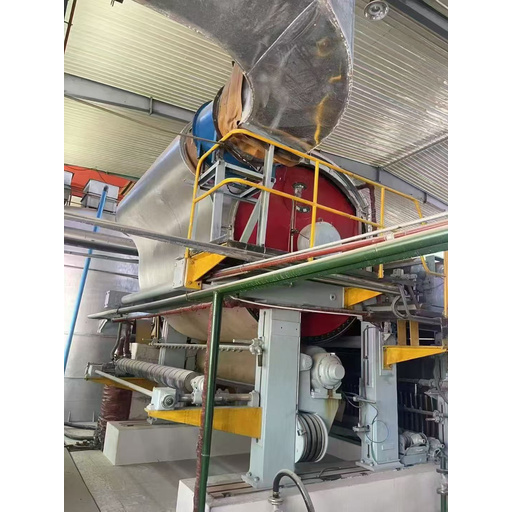
Fig. 01
Single Cylinder Mould Tissue Paper Machine
The cylinder mould platform is Zejiang’s entry point for new tissue producers and mills that want to prove out a market before committing to high-volume capital equipment. A single cylinder forming drum with a matched dryer can is a simpler mechanical system than a crescent former line, fewer wear points, a shorter commissioning curve, and a lower capital outlay for mills starting their first production run.
Typical reference class: ~160 m/min forming speed · ~2,000mm cylinder / ~3,000mm dryer · ~30 gsm basis weight · daily output in the 5–7 tonne range at this scale.[3] Figures reflect industry-standard configurations at this machine class, not a fixed Zejiang spec sheet — confirm exact output for your furnish and target grade with our engineering team.
Crescent Former Tissue Paper Machine
Crescent former is the forming technology that dominates modern high-volume tissue production worldwide, invented by Kimberly-Clark (patent lineage documented on Google Patents) in the 1960s and now the default platform once a mill outgrows entry-level equipment. Stock is trapped between the forming fabric and a felt, without a wire-to-felt transfer step, which is what lets crescent former lines run faster with fewer sheet breaks than older forming concepts. Paired with a Yankee dryer, it’s the platform mills move to once they need both higher throughput and tighter sheet-quality control.[4]
Reference performance ceiling: peer-reviewed technical literature puts top-end crescent former speeds at up to 2,400 m/min, well above the other tissue-forming methods it reviews.[5] Commercial Yankee dryer diameters typically run 12–16 ft (3.6–4.9m); deckle widths to ~4,500mm at this machine class.[6]
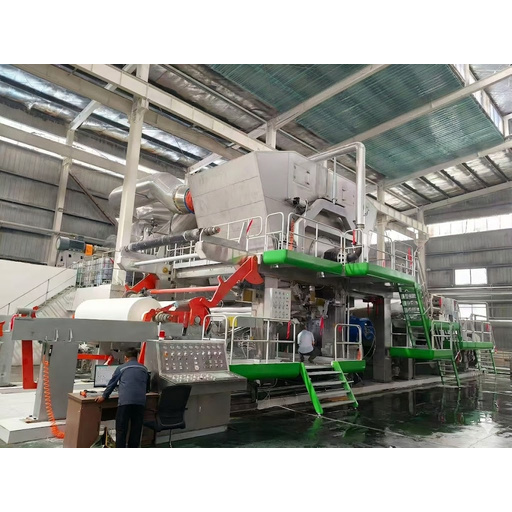
Fig. 02
Selection Matrix, Forming Platform by Target Output
| Factor | Single Cylinder Mould | Crescent Former |
|---|---|---|
| Reference daily output | ~5–7 TPD (entry scale) | 20–100+ TPD |
| Forming speed class | ~160 m/min | up to 2,200–2,400 m/min |
| Best-fit buyer | New producers, capital-constrained entry | Scaling mills, established production |
| Relative capital tier | Lower | Higher |
| Furnish compatibility | Virgin pulp & recycled fiber | Virgin pulp & recycled fiber (finer headbox screening for recycled) |
| Typical basis weight | ~30 gsm | 13–40 gsm |
| Natural next step | Starting platform | Upgrade destination |
Furnish choice interacts with forming platform more than most buyers expect. Recycled fiber now accounts for roughly a third of global tissue furnish, but it degrades after three to five recycling cycles and needs continual virgin-pulp top-up to hold sheet quality. Processing it also demands more from the stock-prep system: virgin pulp runs at 4–6% consistency with light cleaning, while recycled furnish needs 15–16% consistency high-density pulping plus a full deinking train, pulping, cleaning, screening, washing, and flotation, before it ever reaches the forming section. Machines set up for recycled fiber also run finer headbox screens, roughly 0.20–0.35mm slots against 1.6–2.0mm for virgin-pulp lines, to handle the higher contaminant load. Neither forming platform is furnish-exclusive, the difference shows up upstream, in how much stock-prep equipment the line need, not in the former itself.[7]
Furnish choice also sets a rough ceiling on which end-product grade your output can reach. Peer-reviewed comparison work backs up what mills learn the hard way in production: virgin fibers stay more flexible through processing, which generally produces stronger and softer sheet, while recycled fibers stiffen and bond less effectively after repeated pulping cycles, though their lower swellability can sometimes push bulk higher even as strength drops. That’s why the industry’s rough grade tiers track recycled content directly: economy-grade tissue can run up to 100% recycled content on conventional drying technology, premium grade uses a lower recycled percentage on the same conventional platform, and ultra-premium grade, the kind built for softness rather than cost, typically runs as little as 20% recycled content on through-air-dried, multi-ply construction. Running a cylinder mould line on high-recycled-content furnish is a reasonable match for economy-grade output; pushing that same furnish mix toward premium or ultra grade is a materials problem no forming platform alone solves. Recent materials research offers a partial way around that ceiling, nanofibrillated cellulose derived from recycled fiber has been shown to perform comparably to virgin-fiber-derived material as a strength additive, at meaningfully lower cost, which suggests the recycled-fiber quality gap is something mills can partly engineer around rather than simply accept.[7][21]
“We size the forming section before we ever quote a dryer. A cylinder mould line running virgin pulp and a crescent former running high-recycled-content furnish need completely different screen configurations upstream, skip that step and the machine that shows up doesn’t match the paper the mill actually needs to make.”
Drying technology is the other lever that separates entry-level output from premium sheet quality, and it sits on a cost tier of its own, independent of which forming platform feeds it. Conventional dry-crepe drying, a single Yankee cylinder with a hot-air hood, is the cheapest and most common configuration, and it’s what most cylinder mould and standard crescent former lines run.[17] Through-air drying (TAD) trades roughly three times the capital and operating cost of conventional drying for the bulk and softness that premium and ultra-premium tissue grades require.[18] A newer alternative, structured/molded tissue technology such as Voith’s ATMOS platform, has been reported to cut energy use by around 60% compared to TAD while matching or beating its quality on recycled-fiber furnish, real-world installations include a roughly $30 million project at Cascades’ Candiac, Quebec mill and a $220 million project at Wausau Paper’s Harrodsburg, Kentucky facility, both in the 50,000–75,000 tonne-per-year range. Those figures aren’t Zejiang project costs, they’re published benchmarks for what commercial-scale drying-technology upgrades cost industry-wide, useful context for understanding where a cylinder mould or standard crescent former line sits on that investment curve: well below premium-drying territory, which is exactly the point for a mill that need standard-grade toilet tissue and napkin output rather than ultra-premium facial tissue.
Forming-section engineering hasn’t stood still either. Recent patent activity from the two largest global paper-machinery suppliers shows where the technology is heading: Valmet’s 2024-granted shoe-press patent describes an extended nip where the felt wraps the press roll more than 80 degrees before reaching the Yankee cylinder, improving pre-drying dewatering efficiency, while Voith holds a patent on forming sections that selectively bypass dewatering equipment and swap forming-fabric type, structured mesh versus plain felt, depending on whether the target grade needs more absorbency or more tear resistance from the same machine platform.[19] Neither of those specific mechanisms is what Zejiang ships on its standard cylinder mould or crescent former lines, they’re cited here as evidence of where the industry’s engineering attention is going, not as a Zejiang feature claim.
Tissue Paper Machine Performance Comparison, Safety, Efficiency, and Output
Sheet output gets most of the attention in tissue machine sourcing conversations, but two dimensions buyers routinely under-ask about, machine guarding and water/energy performance, carry real operating-cost and liability weight over a machine’s working life. Both are governed by published standards rather than marketing claims, which makes them some of the easiest specifications to verify before you sign a purchase order.
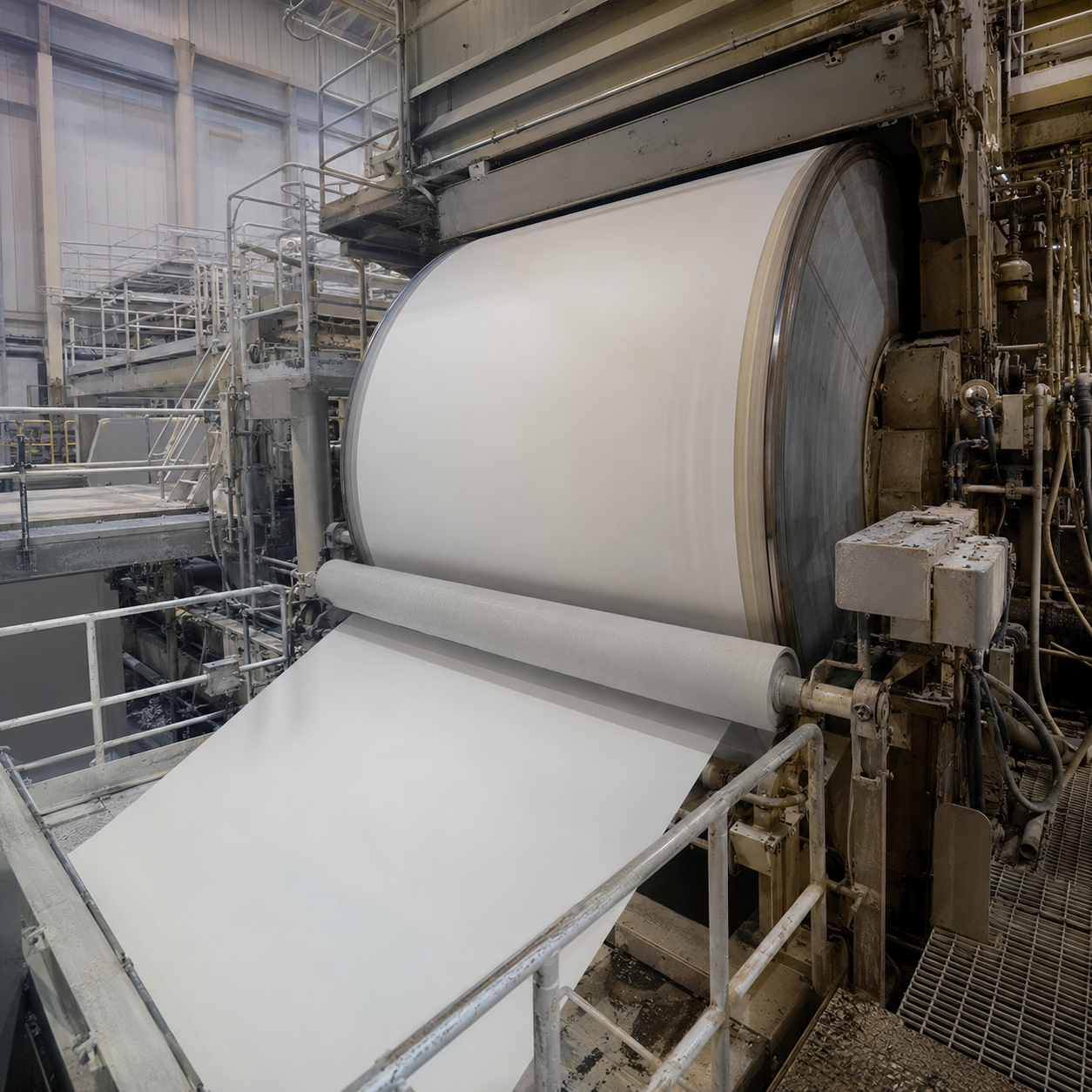
| Dimension | Minimum-Guarding Setup | Standards-Aligned Design (Zejiang reference) |
|---|---|---|
| Calender nip points | Exposed / hand-fed | Barrier device, rope carrier, or air-jet feed per OSHA 1910.261(k)(18) |
| Rotating shaft guarding | Partial coverage | Full guarding on all shaft ends including dryer drum shafts, 1910.261(k)(2)(ii) |
| Emergency stop | Main power switch only | Dedicated stop devices (push button/pull cord) interlocked with braking, tested periodically, 1910.261(k)(1) |
| Reel handling | Manual, no interlock | Reel stops rotating before being lifted from bearings, 1910.261(k)(24)(i) |
| RCF tissue water use | Unmonitored | Benchmarked against 10–25 m³/t net production (EU BAT reference range)[1] |
| Wastewater COD (RCF tissue) | Unmonitored | Benchmarked against 0.9–4.0 kg/t reference range (EU BAT Table 19)[1] |
These aren’t abstract compliance boxes. OSHA’s pulp-and-paper standard (29 CFR 1910.261) requires exposed steam and hot-water piping within 7 feet of the working floor, or within 15 inches of stairways, ramps, or fixed ladders, to be insulated or guarded, a specific, checkable measurement rather than a general “safe design” claim. The same standard covers dryer-section details buyers rarely think to ask about: a permanent guardrail or apron guard is required in front of the first dryer in each section, all exposed sole plates between dryers, calenders, reels, and rewinders must have a nonskid surface, and dryer gears must be guarded unless the oiler’s walkway keeps operators physically out of reach of the gear nips. None of these are exotic requirements, they’re the difference between a machine designed against a published guarding standard and one designed to look complete in a product photo.[8]
On the environmental side, the EU’s Best Available Techniques conclusions single out tissue production for its own emission bands separate from general paper mills, total nitrogen at 0.01–0.15 kg/t for tissue against 0.01–0.1 kg/t generally, and COD at 0.9–4.0 kg/t against 0.9–3.0 kg/t generally, because deinked recycled furnish carries a heavier nutrient and organic load than virgin-pulp paper production. The same reference document is explicit about a common assumption that doesn’t hold for tissue: press-section dewatering optimization, a standard efficiency technique on general paper machines, is specifically flagged as “not applicable to tissue paper,” because a tissue sheet’s low basis weight and single-pass drying requirement make it a different engineering problem from board or printing-grade paper. Where the technique list does apply is heat recovery, exhaust air from the Yankee hood through a trickling tower, and, where axial blowers are used, heat recovery from the hood supply air, both are qualitative BAT-listed techniques rather than machines with a fixed percentage improvement, so treat any specific energy-savings percentage a supplier quotes with appropriate skepticism unless they can point to the underlying test data. A buyer who asks a supplier to walk through nip-point guarding and water-loop design before ordering is asking a more useful question than “is it safe,” and gets a more specific answer.[1]
2–5 yrs
Typical payback range reported across the tissue machinery industry for a new production line, before financing costs
Industry-reported range, not independently audited — actual payback depends heavily on local energy cost, furnish mix, and utilization rate. Raw material typically accounts for 40–60% of total operating cost, the single largest lever on payback speed.[9]
Zejiang Paper Machinery, Export Track Record & Engineering Support
Zejiang has supplied paper production equipment and spare parts to customers across Asia, the Middle East, Africa, and South America – the same regions where most new tissue mills are being commissioned today, and where local spare parts availability determines whether a machine stays running or sits idle waiting on an overseas shipment. The base tissue paper produced on a Zejiang cylinder mould or crescent former line feeds directly into toilet paper, napkin, and facial tissue converting operations run by our customers and their downstream partners in these markets.
The upgrade path this page describes – start on cylinder mould, move to crescent former once volume justifies it – isn’t a sales narrative unique to Zejiang; it’s the documented growth pattern across the tissue industry (forming-technology scaling patterns are covered in the same BioResources review). Turkish producer Essel Cellulose installed its first machine in 2005 at roughly 30,000 tonnes per year, added a second line in 2015, and by 2021 had commissioned what it described as Turkey’s largest tissue paper machine at 95,000 tonnes per year – three production lines totaling 175,000 tonnes annually, shipping to 60 countries.[15] Mexico’s Convertipap followed a similar curve, growing from roughly 10 tonnes per day of napkin production in 2000 to five production lines and 80,000 tonnes per year of tissue by 2021, while absorbing raw-material cost inflation that ran 50-90% across natural gas, recycled fiber, and packaging chemicals in the same period.[16] Neither producer started at commercial-machine scale. Both scaled into it – which is the entire argument for buying a machine sized to your current output rather than the output you hope to reach in five years.[15][16]
Our engineering team work on production efficiency, operating-cost reduction, and paper-quality consistency as an ongoing relationship, not a one-time installation handoff. That includes design, manufacturing, refurbishment, and installation support, and it extends to used and reconditioned machinery for mills that want a lower entry cost than a new production line. Used equipment isn’t automatically the cheaper long-term option, though: worn parts and shorter remaining service life can push total maintenance cost above what a new machine would have cost over the same period, which is exactly the kind of tradeoff our engineering team walks through with each buyer rather than defaulting to a single recommendation.[10]
“The question we get most from first-time mill owners isn’t ‘how fast does it run’ — it’s ‘what happens the first time something breaks.’ That’s a fair question, and it’s the one our spare parts business line exists to answer before it comes up, not after.”
Quality & Compliance Standards
Production consistency of the tissue paper machine involves a small number of steps repeated precisely. That starts with input materials and proceeds to tight tolerance precision in machined moving parts and final testing before any machine leaves the factory. Zejiang’s production relies on this series of checkpoints, rather than vague promises of “quality.” That same design work also builds in machine guarding against the OSHA 1910.261 principles (osha.gov) detailed above.
Our lockout/tagout program runs through the entire design, not just the E-stop button. Our maintenance, inspection, cleaning and adjustment practices all follow that same OSHA guide line requiring padlocked disconnects and remote placement of oil cups and grease fittings away from nip points and heat sources.[8]
It’s worth asking a potential supplier directly about a maintenance schedule, it should exist and be the result of industry experience, not an afterthought. Bearing checks generally run weekly for machines in a paper-making environment. Monthly vacuum-pump servicing and quarterly checks on press rolls and dryer cylinders follow, with a full machine alignment check roughly every six months. Handing that schedule to a new mill owner on day one is worth more than leaving them to trial and error after the first breakdown, and Zejiang’s engineering team works from the same schedule.[22]
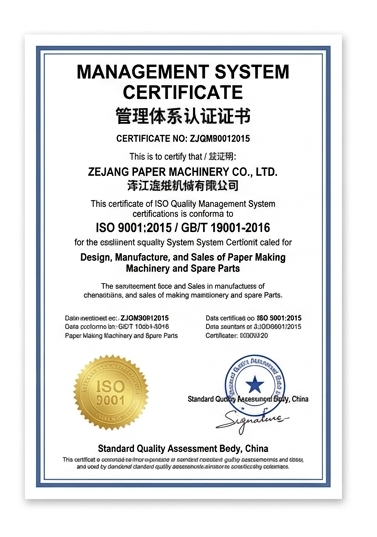
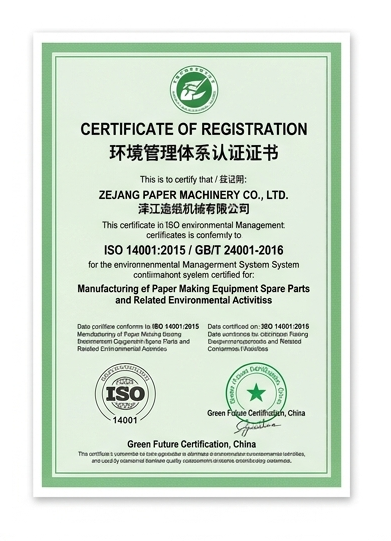
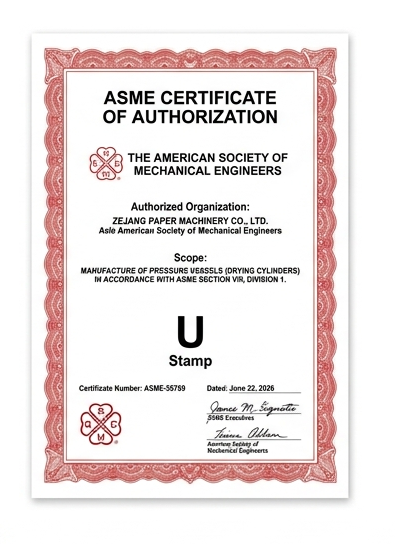
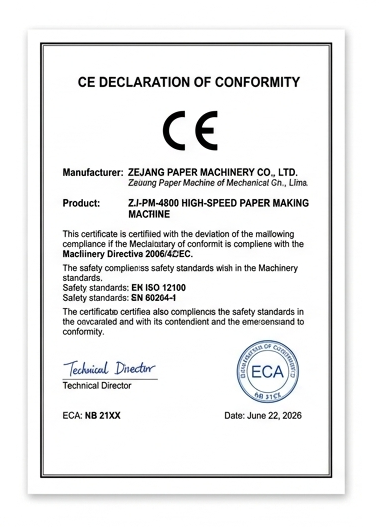
Incoming Inspection
Raw material & component checks before assembly
Precision Machining
Rotating-component tolerance control
Pre-Shipment Testing
Functional test before every machine ships
OSHA-Referenced Guarding
Nip points, shaft ends & emergency stops per 1910.261
Buyer Advisory: What to Ask Before You Sign
Evasive or vague answers about machine specifications are one of the more reliable warning signs when evaluating a manufacturer, according to China-sourcing due-diligence guidance from industry procurement advisors.[11] Before ordering, ask specifically: is production in-house or outsourced, what’s the current monthly capacity utilization, what’s the in-line inspection rate, and what’s the contingency plan if a raw-material shortage hit mid-order.[12] A supplier who answers each of those with a specific number, not a general reassurance, is giving you something you can actually verify.
A factory can look competitive on paper, a clean showroom, an impressive sample line, while hiding weaknesses that only surface at volume: limited production capacity, inconsistent quality control, or financial instability that shows up as missed delivery dates six months into a relationship.[11] The lowest quote in a set of bids is worth a second look rather than an automatic acceptance; it can reflect outsourced production, reduced quality control, or lower-grade materials than the buyer expects, and the gap usually doesn’t show up until the machine is already running your production floor.[12]
×
![Enlarged view]()
Tissue Paper Machine Assessment Tools
Tissue Machine Selection Matrix
Enter your target output to see which forming platform fits — cylinder mould or crescent former.
Machine Guarding Compliance Checklist
Based on OSHA 29 CFR 1910.261 (Pulp, Paper, and Paperboard Mills). Check off what your current or prospective machine has, and ask suppliers directly about anything unchecked.
Realistic Delivery Estimator
Vendor-quoted lead times rarely account for your own internal approval cycle. Enter both to see a realistic delivery window.
Frequently Asked Questions
How much does a tissue paper machine cost?
The price of your tissue machine is determined by such factors as your forming platform (cylinder mould vs. crescent former), level of automation, dryer sizing, and furnish-handling equipment – see Pricing Factors above. Get a custom quotation tailored to your desired output and furnishing requirements from us.
What’s the difference between a crescent former and a cylinder mould tissue machine?
Cylinder mould is the simpler, lower-capital entry platform, generally suited to production in the single-digit tonnes-per-day range. Crescent former is the higher-speed, higher-capacity platform most tissue mills move to once they scale past roughly 20 tonnes per day, where its higher capital cost starts paying for itself in speed and sheet quality.[2]
Can a tissue paper machine run both virgin pulp and recycled fiber?
Yes, neither forming platform is furnish-exclusive. What changes is the stock-prep equipment: recycled fiber needs a fuller deinking and screening train and finer headbox screens than a virgin-pulp-only setup.[7]
Is a used tissue paper machine more affordable than buying new?
Not necessarily. A lower purchase price on used equipment can be offset by higher maintenance costs and a shorter remaining service life, which is why this is worth an honest engineering assessment rather than a default assumption either way.[10]
What safety features should a tissue paper machine have?
At minimum: guarded calender nip points, full guarding on rotating shaft ends including dryer drum shafts, an interlocked emergency stop system, and reel-handling equipment that stops rotation before lifting, all specified under OSHA 1910.261.[8]
How do I evaluate a tissue paper machine supplier before ordering?
Ask for specifics, not reassurances: in-house vs. outsourced production, current monthly capacity utilization, in-line inspection rate, and a raw-material shortage contingency plan. Vague answers to direct questions are a documented warning sign in China-sourcing due diligence.[11]
What happens if a machine part breaks after installation?
This is precisely the problem of parts supply being an afterthought – what causes long delays in tissue mills awaiting replacement parts from manufacturers that fail to plan for after-sales supply. We offer dedicated tissue paper spare parts from stock in China as a business, not just a reactive service, specifically to eliminate this gap in downtime.
Why does my machine keep taking longer to arrive than the quoted lead time?
Often, the delay isn’t on the supplier’s end at all. Research on industrial-equipment lead times found that a buyer’s own purchase-approval cycle can extend a vendor’s quoted delivery window by roughly 30% — a 12-week vendor lead time becoming a 16-week actual delivery is a documented, common pattern, not a sign the supplier missed their commitment.[14] Confirming your own internal approval timeline before you request a quote is one of the more overlooked ways to close that gap.
Is a small “mini” tissue plant a legitimate way to enter the market?
Yes, it’s a recognized category, not a scaled-down compromise. Technical literature from the Indian Pulp and Paper Technical Association documents mini paper plant configurations built specifically around single cylinder mould and mini cast-iron drying cylinders as one of two standard technology routes for small-scale production, alongside a Fourdrinier-based alternative.[20] Cylinder mould tissue paper machines sit squarely in that established small-plant category, not outside it.
Looking for a toilet paper machine, napkin paper machine, or facial tissue machine instead?
If your search was toilet paper machine price, automatic toilet paper machine, napkin paper machine for sale, or facial tissue machine for sale, you’re looking at converting/rewinding equipment, the machine stage that turns finished tissue paper into retail rolls, folded napkins, or boxed facial tissue. That’s a different machine category from the tissue paper machine (forming equipment) described on this page. Zejiang’s current product line covers the forming stagecontact us to discuss your full production line, including converting-equipment sourcing.
![Refiner Plates & Screen Baskets [Complete Guide]](https://zjpapermachine.com/wp-content/uploads/2026/07/refiner-plates-screen-baskets-guide-featured-150x150.png)
![Doctor Blade: Types, Materials & How It Works [Guide]](https://zjpapermachine.com/wp-content/uploads/2026/07/doctor-blade-guide-featured-1-150x150.png)
![Pulping Equipment: How Paper Pulping Works [Guide]](https://zjpapermachine.com/wp-content/uploads/2026/07/pulping-equipment-guide-featured-150x150.png)