Get in touch with Zejiang Paper Machinery Company

Disc Refiner
Disc Refiner for Pulp & Paper Mills, Double & Single Disc Refining Equipment
A disc refiner, also spelled disk refiner, is the low-consistency workhorse of every paper mill stock preparation line, and the single point where fiber quality and your energy bill are decided together. Henan Zejiang Paper Machinery builds single and double disc refiners for pulp and paper mills that publish the numbers most suppliers hide: net specific energy per tonne, refining intensity, plate metallurgy and freeness control.
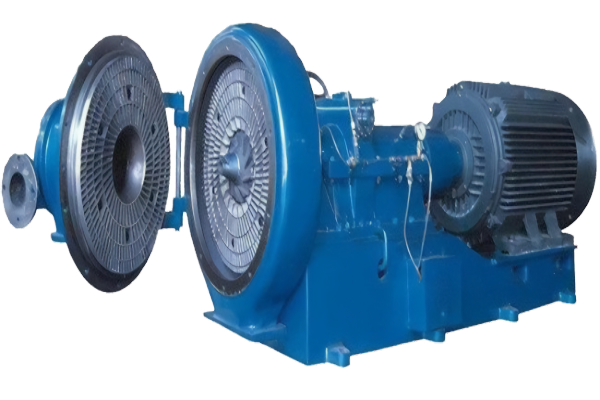
Disc Refiner Specifications
Ø380–1100 mm
Plate diameter (single & double disc)
2–8%
Low-consistency operating band
0.2–3.0 Ws/m
Specific edge load, by furnish
30–120 kWh/t
Typical net refining energy
Single · Double
Disc configuration
OCC · Kraft · Straw
Furnish-matched plates
Unstable Freeness and Rising Energy Costs Start at the Refiner
In a low-consistency stock preparation line, the disc refiner, the most widely used refiner in paper industry stock prep, mechanically treats pulp fibers between a rotating disc and a stationary disc, both fitted with bar-and-groove plates. As dilute stock (2–8% consistency) passes through the working gap, the bars flex, delaminate and fibrillate the fibers so they bond into a stronger, more uniform sheet. That’s the useful work. Everything around it is the problem, and it’s the mistake most buyers make when they shop a disc refiner machine on horsepower alone.
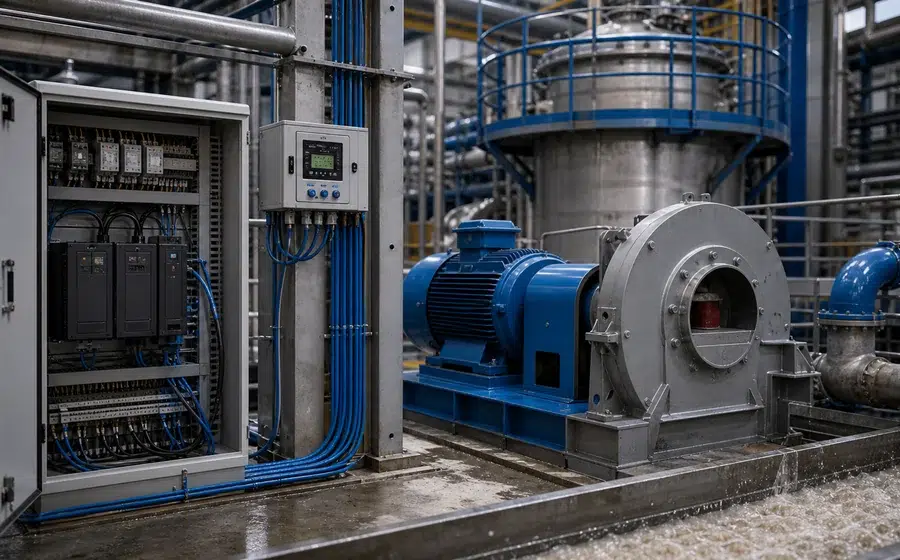
Refining is one of the single largest electrical loads in the whole mill. Independent reviews put it at 17–20% of total paper-machine energy, expending 100–180 kWh per tonne of paper for typical grades, and within stock preparation, itself up to one third of mill electricity, low-consistency refining is the biggest single consumer. Worse, a large share of that power never touches fiber at all. No-load power consumes 20–50% of a disc refiner’s total draw. This is circulating power that only heats the stock while doing zero refining work. Whereas a horsepower number tells you nothing about that waste, net energy per tonne and no-load share tell you everything.
Then the plates wear. As bars round over, energy efficiency drops first, quietly raising your kWh/tonne, and only later does fiber quality slip. Uneven, wavy plate wear compounds it, causing maximum fiber damage, higher power draw and load swings. For mills running heavily recycled furnish (OCC and mixed waste, the staple across South Asia), the safe refining window is narrower still, because the fibers are already structurally degraded. A disc refiner that cannot be dialed to a low, controlled intensity turns every one of these into a recurring cost. Zejiang engineers each unit to hold that low, controlled intensity, with alloy discs, a hardened main shaft and ISO 9001 factory inspection behind it. What follows is the data we use to size and specify one that does.
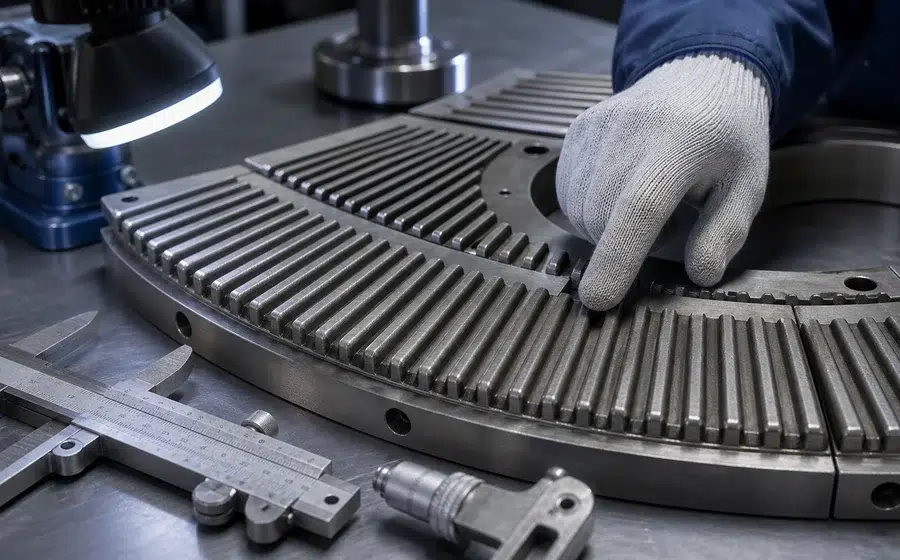
Henan Zejiang Disc Refiner Range, Single & Double Disc Models & Sizing
How to size a disc refiner: plate diameter sets both throughput and rotor speed, which run inversely – a 20-inch (Ø508 mm) plate turns near 900 rpm, a 34-inch (Ø864 mm) near 500–600 rpm, and a 52-inch (Ø1321 mm) near 400 rpm. Match the diameter to your tonnes/day, then match the plate pattern and specific edge load to your furnish. Zejiang builds single and double disc refiners across the Ø380–1100 mm band on this logic.
Zejiang manufactures single disc and double disc refiners (also written disk refiner in North-American specs) as configurable stock-preparation units. Whereas competitors quote a double disc refiner price off a bare model number, refiner performance is actually governed by furnish, target freeness and line throughput, so the table below states the engineering envelope we build within. Unlike a fixed catalog spec, final plate diameter, motor rating and filling pattern are confirmed against your stock and capacity on quotation. This is a pulp refiner machine specified around your line, not a box you specify your line around.
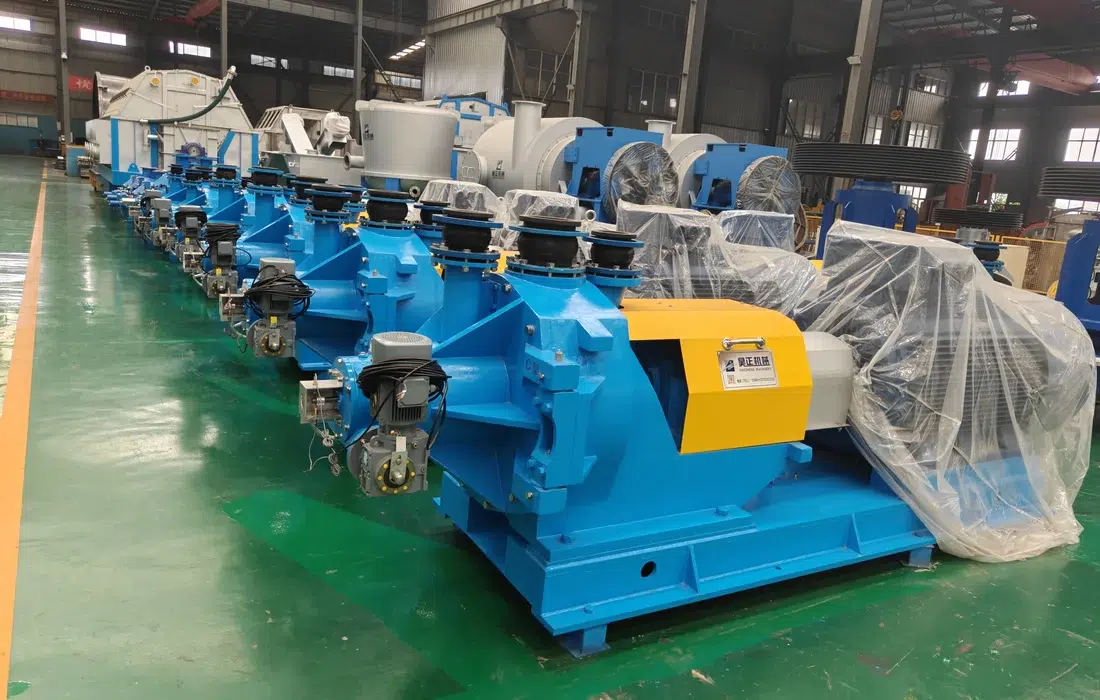
| Configuration tier | Plate Ø (mm / in) | Rotor speed (rpm) | Indicative capacity | Typical motor | Best-fit duty |
|---|---|---|---|---|---|
| Compact single disc | Ø380–500 / 15–20″ | ~900 | Small mill / trials | 37–90 kW | Straw, small tissue lines |
| Mid double disc | Ø600–760 / 24–30″ | ~600–720 | Mainstream board / packaging | 160–500 kW | OCC, recycled, kraft (most orders) |
| Large double disc | Ø860–970 / 34–38″ | ~510–600 | High-throughput lines | 500–900 kW | Fine paper, coating base |
| Heavy double disc | Ø1050–1100 / 42–48″ | ~400–450 | Large integrated mills | 900–1800 kW | Softwood reinforcement, liner |
Operating envelope, the fields most suppliers leave blank
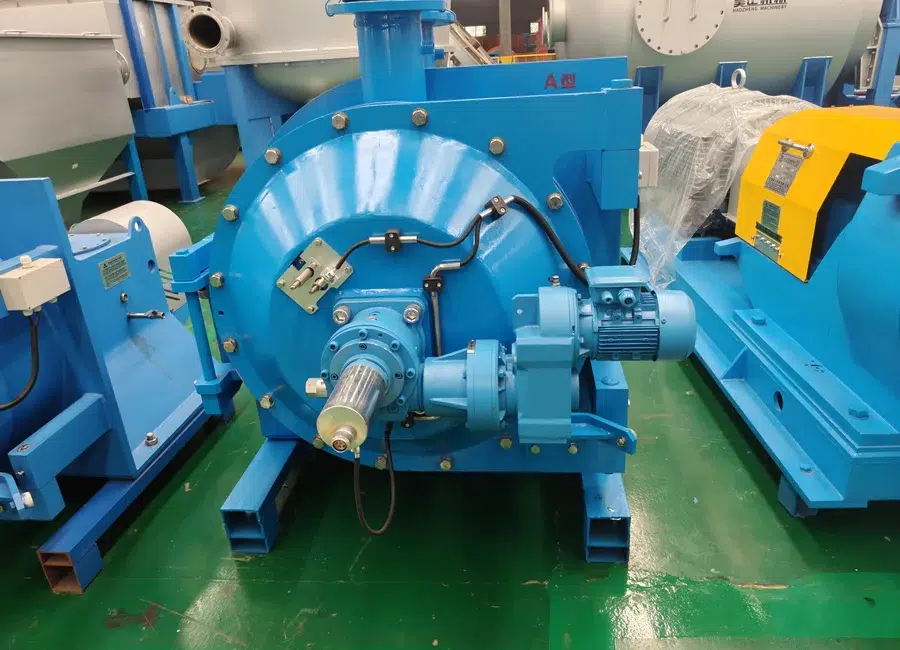
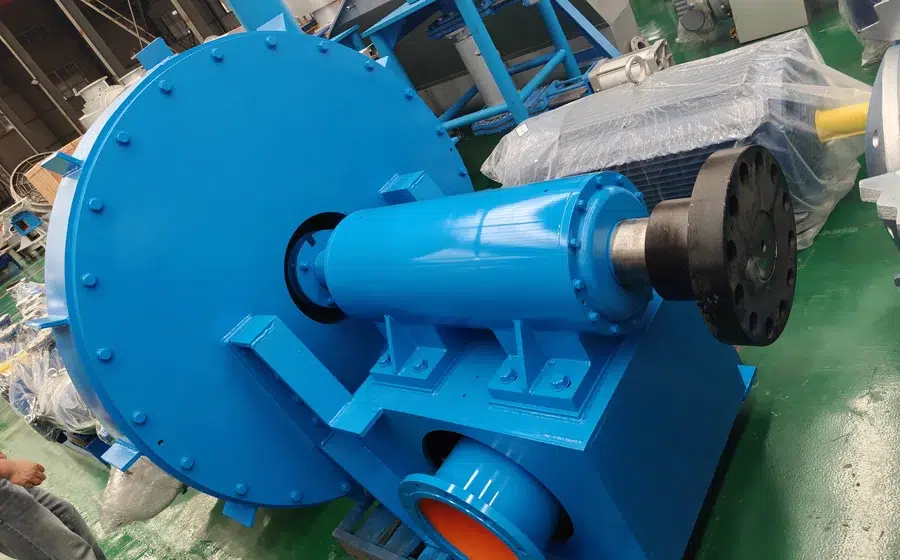
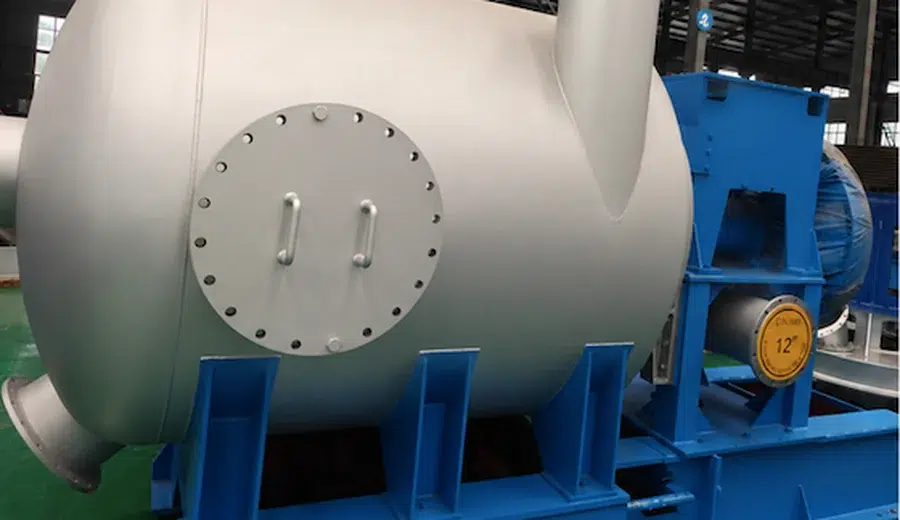
Double disc refiner drive end showing flanged inlet and outlet ports and the hardened main shaft, Henan Zejiang Paper Machinery
Drive end of a Zejiang double disc refiner: flanged inlet/outlet and hardened main shaft — the wetted geometry that, with the plate pattern, sets refining intensity.
Operating consistency
low-consistency band 2–8%; industrial norm 3–4%. Optimum tensile development in controlled softwood-kraft trials lands near 3% consistency, a variable that specific-energy figures alone miss.
Working plate gap
0.076–0.203 mm (0.003–0.008″), held by hydrodynamic self-centering of the floating rotor.
Inlet pressure
0.14–0.28 MPa (20–40 psi) at the disc inlet.
Refining intensity (SEL)
softwood kraft 1.0–3.0 Ws/m, hardwood/eucalyptus 0.1–0.6, recycled fiber 0.2–0.8, TMP/groundwood 0.2–0.5 Ws/m. SEL = net refining power ÷ cutting edge length; CEL = (rotor + stator bars) × bar length × rpm.
Freeness target
freeness is a controlled index, not an exact number, read as Canadian Standard Freeness (mL, ISO 5267-2 / TAPPI T227) or Schopper-Riegler (°SR, ISO 5267-1) on inverse scales, with ±25 mL reproducibility across labs at 531 mL CSF. Tissue runs 20–40 °SR; greaseproof 80–90 °SR.
“We do not quote a refiner off a horsepower number. We ask for the furnish, the target freeness and the tonnes per day first, because the plate pattern and the intensity setting decide the energy bill far more than the motor size does.”Engineering Team, Henan Zejiang Paper Machinery
Disc Refiner vs Conical Refiner vs Single Disc, Which Refiner for Your Grade
Disc vs conical, in one line: the energy difference is driven by no-load power and mechanical efficiency, not by the flow geometry name. In one Indian-mill field assessment a modern double-disc (Conflo-type) unit ran 82% efficient with only 35 kW no-load, while a legacy Jordan (conical) refiner on the same duty was ~50% efficient and wasted 132 kW at no-load – nearly half its installed motor never touched fiber.
Picking the wrong refiner type, or the wrong disc size within a type, is a decision you pay for on every kWh bill for the machine’s whole life. Best-in-class industrial refining efficiency tops out around 75–82%, whereas a legacy Jordan can run near 50% and waste ~132 kW at no-load, installed kilowatts aren’t the same as useful refining. So the useful comparison isn’t “disc or conical” as categories, both survive in modern mills, but efficiency and controllability on your stock. Unlike a bare parameter grid, the numbers below are drawn from published mill data and academic reviews, and they point the same way: lower, well-controlled intensity beats brute power. Zejiang specifies each disc refiner against this data rather than a horsepower rating.
| Selection factor | Double disc refiner | Conical / Jordan refiner | Single disc refiner |
|---|---|---|---|
| Net specific energy (typical duty) | 80–200 kWh/t | 50–150 kWh/t | Comparable to double, lower capacity |
| Field efficiency (net ÷ total) | Up to ~82% | ~50% (legacy Jordan) to ~80% (modern Conflo) | >75% (industrial) |
| No-load power share | 20–50% of draw | Low on shallow-groove Conflo | 20–50% of draw |
| Flow path | Radial, double-sided rotor | Axial, cone | Radial, single-sided |
| Best-fit furnish | OCC, kraft, board, packaging | Fine paper, long-fiber development | Straw, small tissue, trials |
| Intensity control range (SEL) | 0.2–3.0 Ws/m via plate pattern | Set by cone bars | 0.2–3.0 Ws/m |
Energy/efficiency figures: worldpapermill.com (L4) & IPPTA field data (L3); intensity guidance: UBC fibrelab & AFT FineBar manual (L1/L4). Peer-reviewed basis: NC State BioResources, fine-bar plate refining study.
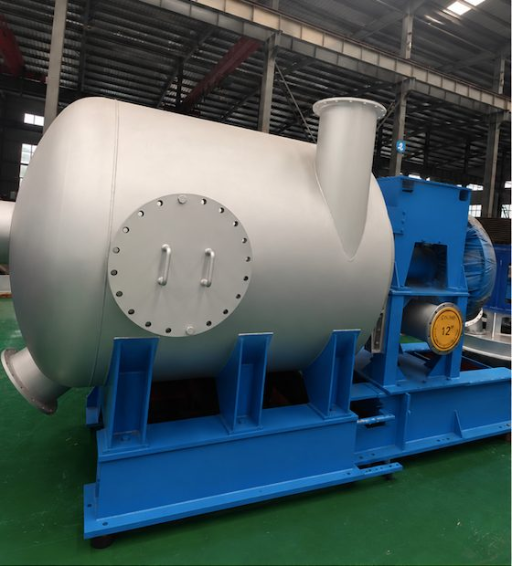
Horizontal conical Jordan-type refiner for low-consistency pulp refining, Henan Zejiang Paper Machinery
A horizontal conical (Jordan-type) refiner — axial-flow geometry, contrasted with the radial-flow disc refiners above; Zejiang builds both and selects on efficiency, not the geometry label.
The lever competitors do not mention: cutting edge length vs bar count
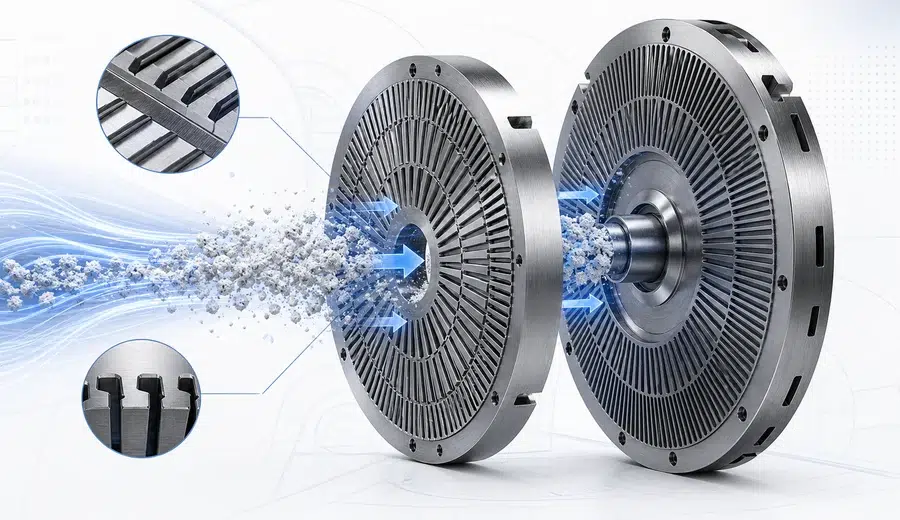
Refining intensity is engineered into the plate, not just the motor. A conventional cast plate carries ~165 bars per segment (cutting edge length ≈ 37 km/s); a fine-bar plate carries ~270 bars (CEL ≈ 75 km/s, roughly double). More edges at the same power means lower intensity per impact, which develops fiber gently instead of cutting it. On a 34-inch double-disc filling, opening the bar angle from 5° to 15° raises CEL from 102 to 165 km/s and drops SEL from 2.9 to 1.8 Ws/m at the same 300 kWh/t. This is why plate specification, not horsepower, sets whether your refiner builds strength or destroys it.
Refining Energy, Specific Edge Load & Refiner-Plate Economics
Where the money actually goes
Of a disc refiner’s total power draw, 20–50% is no-load power that produces no refining – and it scales brutally with geometry, roughly as plate diameter4.3 × rpm3. That is why plate design and speed selection, not motor size, decide your kWh/tonne.
The single biggest lifecycle cost of a refiner is electricity, and most of the savings live in two places: cutting the parasitic no-load draw, and refining at the lowest intensity that still hits your freeness target. Both are engineering choices you specify at purchase, and here the trade-off runs opposite to intuition: a wider inner gap and a finer plate, not more horsepower, is what lowers your kWh/tonne. Whereas a generic paper refiner machine is sold on motor size, a Zejiang unit is quoted on net energy per tonne, backed by ISO 9001 factory inspection.
−13%
refining energy, with tensile up 9% and plate life doubled – after switching to a finer-bar, lower-intensity plate pattern (SEL cut from 0.8–1.0 to 0.5–0.6 Ws/m) at the 300 CSF / 40 °SR target on 38-inch hardwood refiners.
Source: AFT FineBar mill case, APPW-2004 (industry field study). Result reflects plate technology, not a Zejiang-specific measurement.The net energy budget you should size against
| Grade / furnish | Net specific refining energy | Source tier |
|---|---|---|
| Fine paper (hardwood/softwood) | 30–120 kWh/t | UBC fibrelab (L1) |
| Printings & writings (India field data) | 60–100 kWh/t net (90–300 gross) | IPPTA (L3) |
| OCC / recycled linerboard | 30–60 kWh/t | UBC fibrelab (L1) |
| Newsprint (softwood kraft) | 20–60 kWh/t | UBC fibrelab (L1) |
| Coating base papers | 100–150 kWh/t net | IPPTA (L3) |
| Glassine / greaseproof (high refining) | 450–600 kWh/t net | IPPTA (L3) |
Energy Optimization Levers
Refining accounts for 17–20% of total paper-machine energy, so a few percent off your kWh/tonne compounds across every shift. Three levers are proven in the literature: reducing plate groove depth from 6 mm to 3 mm cuts no-load power by about 40%; deflocculating outer-zone plate designs deliver a median ~15% reduction in gross refining energy; and an Andritz-patented method that separates the fiberizing and fibrillating zones, deliberately widening the inner gap rather than tightening it, achieved 15–32% specific-energy savings to the same freeness.
Plate wear is a schedule, not a surprise, budget for it
Refiner plates are a wear item, and plate metallurgy is the primary lever on both filling life and sustained efficiency. As bars wear, energy efficiency drops before fiber quality does, so a worn plate raises your energy bill silently, weeks before an operator sees a quality problem. Wear-resistant plate alloys have shown up to 80% higher abrasive-wear resistance in lab testing with no loss of impact strength versus conventional alloy, and edge-retention (flat-wear) fillings are documented to cut power draw by 6–22 kW/hr across applications. We quote plate life and replacement interval as line items, not as an afterthought.
Build Quality, Plate Metallurgy & Certifications
Harder is not simply better. A refiner plate is a three-way metallurgical trade-off between toughness, corrosion resistance and abrasion resistance – raising carbon for hardness normally forms chromium carbides that embrittle the plate and locally strip its corrosion protection. A refiner plate is matched to your furnish, not just the hardest one on the shelf.
Zejiang refiners are built as welded structural units with cast-iron or fabricated frames, stainless-steel wetted parts, alloy-steel refining discs and a hardened, quenched-and-tempered main shaft. What matters most, though, is the plate itself:
01
Plate metallurgy:
refiner-plate alloys balance chromium (corrosion), nickel and carbide-formers (wear). Patented plate alloys use niobium carbides to add wear resistance without the embrittlement of chromium carbides, with age-hardening raising hardness from ~35 to ~42 HRc. Plate stock ranges from stainless steel to Ni-Hard depending on furnish abrasivity.02
Bar pattern:
specified by bar width, fine 1.0–2.0 mm, medium 2.0–3.5 mm, coarse 3.5–5.0 mm, matched to furnish and target sheet. Fabricated (laser-cut, diffusion-bonded) plates reach patterns as fine as 1.3 × 1.3 mm with rectangular grooves that cast plates can’t.03
Manufacturing method:
cast plates require a 2–5° bar draft angle that limits open groove area; zero-draft fabricated construction improves throughput by ~27%.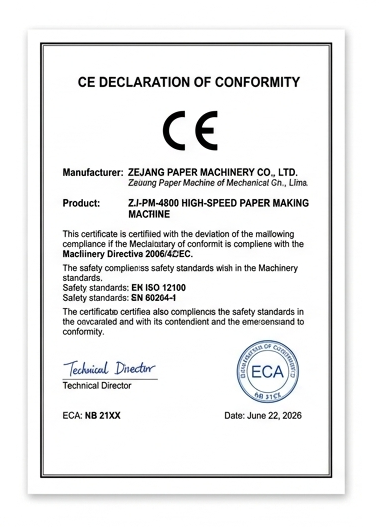
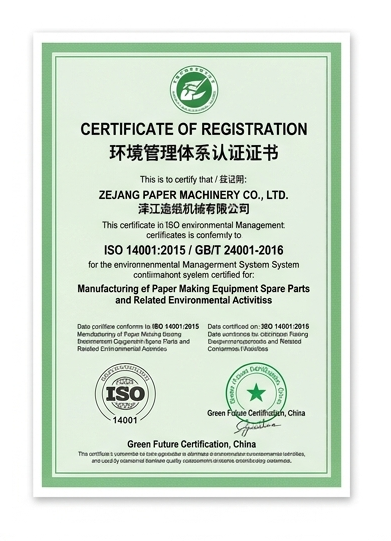
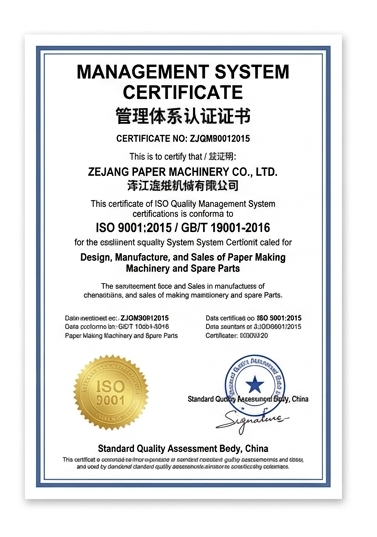
CE
Machinery Directive
ISO 9001
Quality management
AWS / ISO 3834
Welded-structure
ISO 5267
Freeness test basis
Factory QC
Machining & assembly
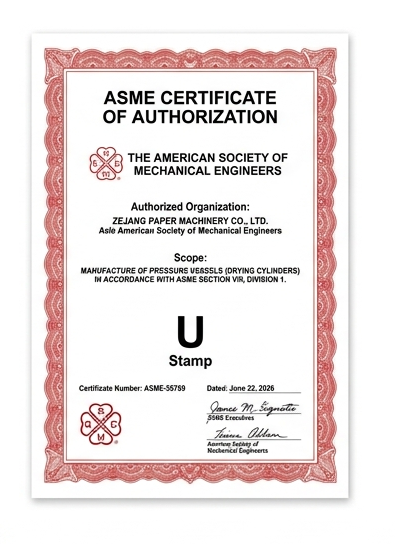
Certifications shown are the standards Zejiang builds and tests to; certificate numbers are provided with quotation. Welding standards cited rebut the unbacked “high-strength welded” claims common on competitor pages. Plate-metallurgy evidence: niobium-carbide refiner-plate alloy patent (CA2285869A1).
Procurement Guide, Cost Factors, Lead Time, Installation & After-Sales
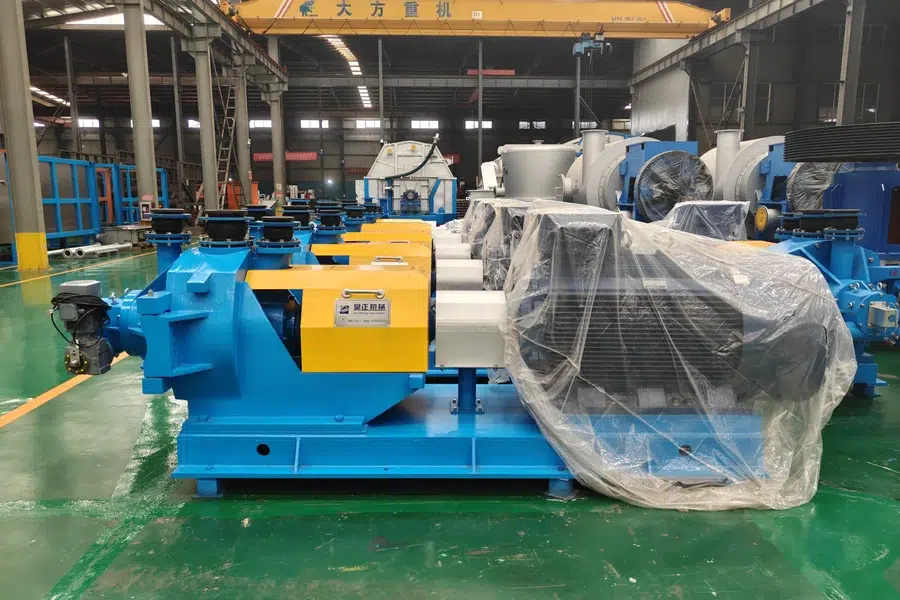
What drives a disc refiner quotation: plate diameter and motor rating (capacity), single vs double disc, plate alloy and pattern (furnish-matched), control system, and delivery scope. There is no honest single sticker price – the cost is set by your tonnes/day, furnish and freeness target. Zejiang returns a detailed quotation against those parameters.
Zejiang is a production-type manufacturer (established 2014, ISO 9001, CE-conformant) supplying paper mills across India, Pakistan, Bangladesh, Central Asia and South America. For buyers in these markets, the refiner purchase decision is rightly a total-cost decision, not a purchase-price one. Here is the catch that trips up first-time buyers: the cheapest quotation is rarely the cheapest machine, because an oversized or high-intensity unit burns the difference back in energy within the first year. Unlike a bare price list, our proposals are built around the factors that actually move lifecycle cost:
Cost / lead-time factor
Capacity tier
Depends on: Plate Ø + motor kW vs tonnes/day
TCO Impact: Oversizing wastes no-load energy every hour
TCO Impact: Oversizing wastes no-load energy every hour
Cost / lead-time factor
Disc configuration
Depends on: Single vs double disc
TCO Impact: Double disc doubles refining area per footprint
TCO Impact: Double disc doubles refining area per footprint
Cost / lead-time factor
Plate alloy & pattern
Depends on: Furnish abrasivity + freeness target
TCO Impact: Sets plate life (hours) and kWh/tonne
TCO Impact: Sets plate life (hours) and kWh/tonne
Cost / lead-time factor
Control system
Depends on: Constant-power vs manual gap
TCO Impact: Holds freeness stable, protects fiber
TCO Impact: Holds freeness stable, protects fiber
Cost / lead-time factor
Delivery & commissioning
Depends on: Incoterms + on-site scope
TCO Impact: Regional spares/service reduce downtime risk
TCO Impact: Regional spares/service reduce downtime risk
What we commit to in writing on every order
- Indicative price band by capacity tier at first contact [Request a quotation] for the exact figure against your stock.
- Lead time, minimum order and Incoterms stated up front [Request lead-time estimate].
- Warranty terms, spare-plate supply and installation/commissioning support for your region.
- Furnish-matched plate-pattern recommendation before you commit to a capacity tier.
- Quality-system & freeness-method basis: ISO 5267 (pulp freeness determination), referenced for acceptance testing on every order.
Technical Application
Application Outcomes, Where Zejiang Refiners Fit
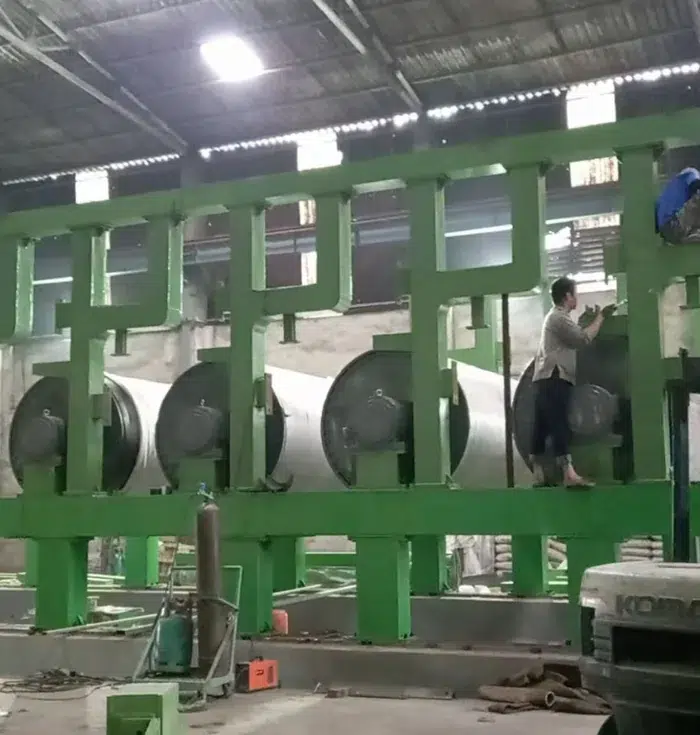
Best fit: recycled and OCC-heavy lines, kraft and testliner, board and packaging, tissue and specialty grades. These furnishes need long bar-edge-length, low-intensity refining to fibrillate without cutting – exactly the plate-and-intensity regime a well-specified double disc refiner delivers.
The wrong plate on the right machine still makes weak paper, so Zejiang supplies the disc refiner as part of a stock-preparation system, not in isolation, matched to your furnish rather than sold as a one-size box. The application logic below comes from published refining data, cross-checked against the furnishes our target mills actually run. Note the pattern: the mistake isn’t always too little power, more often it’s the wrong intensity for the fiber.
Because the optimum tensile development in controlled trials sits near 3% consistency, and shifts with consistency even at constant intensitywe specify the refiner around your actual furnish and dilution, then validate freeness against ISO 5267 methods. Where a mill needs documented results on its own stock, we recommend a trial run rather than quoting a strength number we did not measure.
Data Source: NC State BioResources, consistency & intensity study.
01
Specific Edge Load (SEL) Calculator
SEL is the refining intensity that decides whether a disc refiner develops fiber or cuts it. This calculator applies the standard definition SEL = Pnet / CEL, where CEL = (rotor bars + stator bars) × effective bar length × rpm.
02
Freeness Converter: CSF (mL) ↔ Schopper-Riegler (°SR)
Refining degree is read two ways: Canadian Standard Freeness in mL (ISO 5267-2 / TAPPI T227) and Schopper-Riegler in °SR (ISO 5267-1). They move inversely — more refining lowers CSF while it raises °SR. This tool gives an engineering approximation for quick cross-reading; always confirm against a bench test.
03
Disc Refiner Sizing & Net-Energy Estimator
A first-pass estimate of plate diameter, motor rating and net refining energy from your line throughput and furnish. Diameter and rotor speed run inversely (UBC FineBar chart); net energy bands are furnish-specific. Final specification is confirmed per order.
Disc Refiner FAQ
Both mechanically refine pulp between bars, but the flow path differs, a disc refiner uses radial flow between flat rotating and stationary plates, while a conical (Jordan) refiner uses axial flow through a cone. In practice the decisive difference is efficiency: modern double-disc units have run ~82% efficient with 35 kW no-load in field tests, versus ~50% and 132 kW no-load for a legacy Jordan on the same duty. Whether specified as a disc refiner or disk refiner, select on net energy per tonne and intensity control, not the geometry label.
A double disc refiner has a double-sided rotating disc between two stationary discs, roughly doubling refining area within one footprint, so it handles higher throughput per machine. A single disc refiner is simpler and suits smaller lines, straw furnish and trials. The right choice is set by your tonnes/day and furnish, not by “more discs is better.”
No, this is the most common and most expensive misconception. Tensile strength begins dropping once applied energy passes roughly 50 kWh/t on cast plates, because excess intensity cuts fibers and generates fines instead of fibrillating. Over-refining also slows drainage (higher °SR), which lowers machine speed. Aim for controlled low intensity matched to your furnish, not maximum power.
SEL is refining intensity, net refining power divided by cutting edge length, in Ws/m (J/m). Typical targets: softwood kraft 1.0–3.0 Ws/m, hardwood/eucalyptus 0.1–0.6, recycled fiber 0.2–0.8, TMP/groundwood 0.2–0.5 Ws/m. Running above these bands is where fiber cutting dominates, as documented by NC State BioResources. Your plate pattern sets the achievable SEL range.
Net specific refining energy is furnish-specific: fine papers 30–120 kWh/t, OCC linerboard 30–60, newsprint 20–60, coating base 100–150 kWh/t. Remember that 20–50% of total draw is no-load power doing no refining, which is why plate and speed selection, not motor size, drive your energy bill.
Recycled and OCC fibers are stiffer and already damaged, so they need longer bar-edge-length and lower intensity to fibrillate without cutting. Blends of 30–70% OCC typically use intermediate bar-edge-length (~2.0 km/rev) plates to reach tensile at lower energy than wide-bar plates. A double disc refiner with a furnish-matched fine-bar plate is the usual answer for South-Asian recycled lines.
Plate life depends on furnish abrasivity, alloy and intensity, so it’s quoted per application rather than as a universal number. What matters: as bars wear, energy efficiency drops before quality does, so plates are a scheduled wear item. Wear-resistant alloys have shown up to 80% higher abrasion resistance in testing, and lower-intensity fine-bar patterns have doubled plate life in field cases. We quote plate life and replacement interval as line items.
Low-consistency disc refining runs at 2–8% pulp consistency, with 3–4% the industrial norm and optimum tensile development often near 3%. Consistency changes the refining outcome even at constant intensity, which is why we specify the machine around your actual dilution.
Price is set by capacity tier (plate diameter and motor rating), single vs double disc, plate alloy and pattern, control system and delivery scope, so there’s no honest single figure. We provide an indicative price band by capacity tier at first contact and a detailed quotation against your tonnes/day and furnish.Request a quotation →
![Refiner Plates & Screen Baskets [Complete Guide]](https://zjpapermachine.com/wp-content/uploads/2026/07/refiner-plates-screen-baskets-guide-featured-150x150.png)
![Doctor Blade: Types, Materials & How It Works [Guide]](https://zjpapermachine.com/wp-content/uploads/2026/07/doctor-blade-guide-featured-1-150x150.png)
![Pulping Equipment: How Paper Pulping Works [Guide]](https://zjpapermachine.com/wp-content/uploads/2026/07/pulping-equipment-guide-featured-150x150.png)