Get in touch with Zejiang Paper Machinery Company


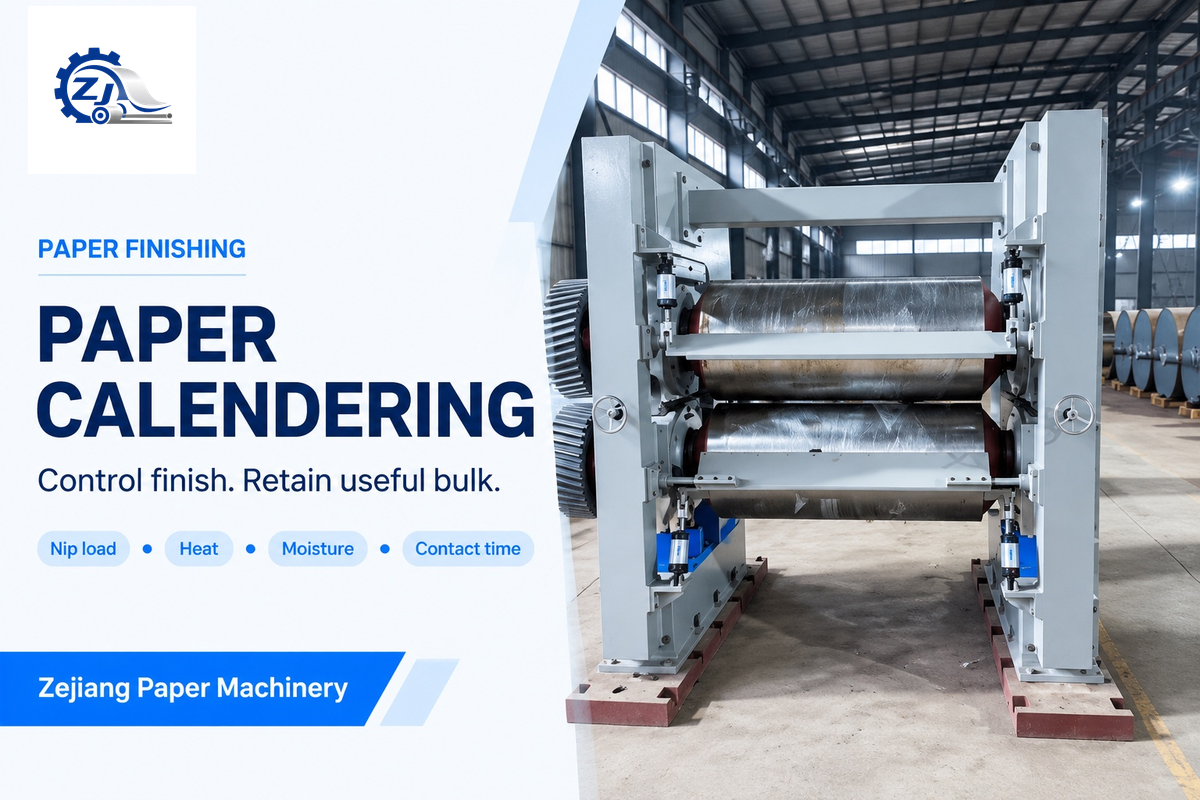
A paper web is pressed through roll nips in the paper calendering process in order to obtain desired thickness and surface finish. The behavior of the fibers is directly related to heat, moisture and loading. A smoother sheet may print better, but excessive compression costs bulk and stiffness. Try to keep line loads, roll temperatures and moisture within the mill’s limits. Compare bulk and stiffness with the grade specification when adjusting contact time.
Updated October 2026
Process at a glance
- Position: dry-end finishing, either online or on a separate finishing line.
- Primary controls: line load, roll temperature, sheet moisture and contact time.
- Quality balance: smoothness and gloss against caliper, bulk, stiffness and print behaviour.
- Selection inputs: paper grade, incoming sheet profile, finished-property limits and roll duty.
A loaded roll nip smooths and compacts a sheet in paper calendering. Roll construction and heat control give the required contact. Mills select the finishing process to obtain the required sheet properties and compare sample tests with the incoming sheet.
Irregular moisture and poor formation may lead to localized over-compression; roll condition and vibration can create repeating marks. Comparing matched samples before and after the nip of the calender helps find where a defect starts. This guide follows that comparison for control of a paper calendering machine, specification of equipment and replacement rolls.
How Does the Paper Calendering Process Work from Dryer Section to Pope Reel?
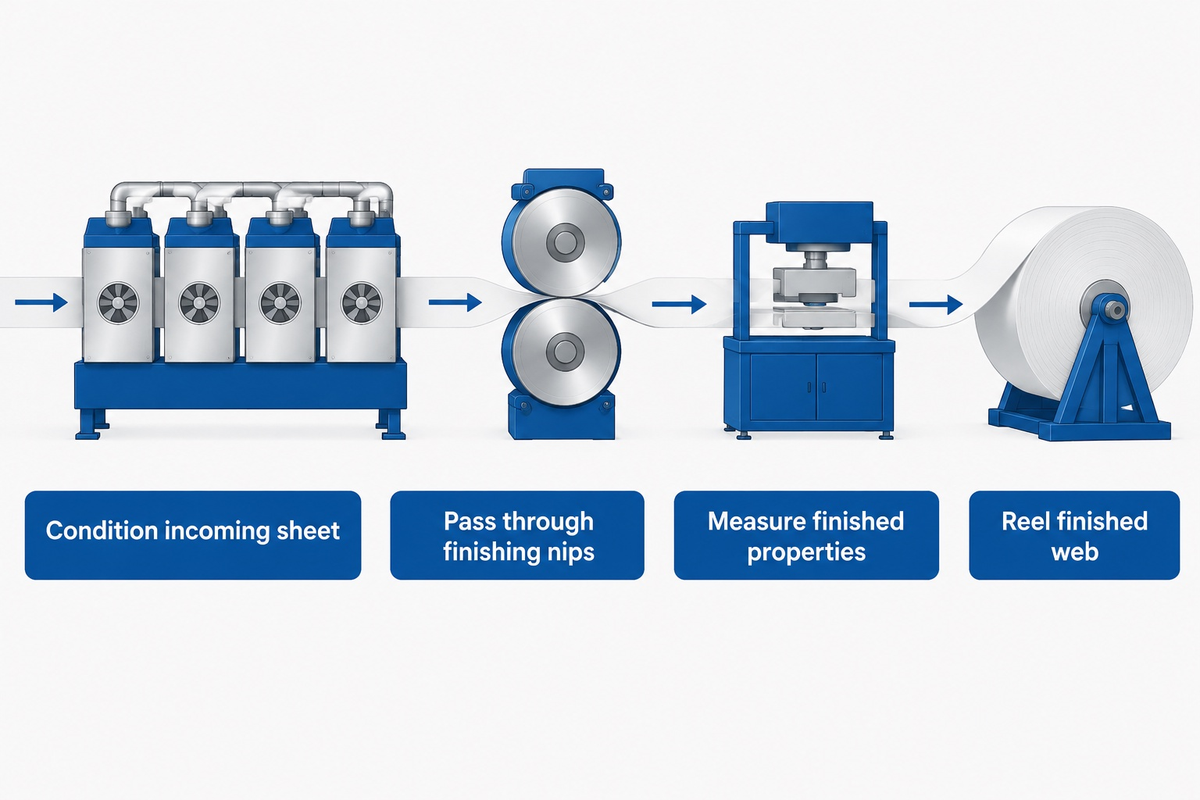
Online calendering finishes the dried sheet before it reaches the reel. Two or more rollers create loaded contact zones that compress the paper and alter the surface of the web. An off-machine arrangement finishes a previously wound reel separately. Its speed and number of passes, therefore, can differ from those of the papermaking machine.
- Condition the incoming sheet. Establish its moisture, temperature and cross-direction profile after drying or coating.
- Pass through the finishing nips. Apply the selected contact geometry, loading and thermal conditions.
- Measure the finished properties. Compare caliper, roughness and the grade’s other acceptance measurements with the incoming sample.
- Reel the finished web. Coordinate draw and winding with the upstream section.
Picture a textured surface pressed against a smooth plate. Raised areas carry more local stress than valleys. Paper also partially recovers its thickness after leaving the contact, so the compressed thickness inside the nip is different from the relaxed thickness of the sheet. Valmet’s calendering notes describe the elastic response, permanent deformation and this recovery behavior.
The section of the paper machine immediately before the calender determines much of the incoming condition. Irregular drying can cause moisture to be unevenly distributed and a calendering nip can act differently on the various bands. Inspect the relationship with dryer cylinders and press rollers before attributing a finished-sheet stripe to the calender roll alone.
A paper rewinder and pope reel downstream add another measurement. A ridge that builds repeatedly at the same position across the parent reel suggests a persistent profile difference. Compare the position across the web to upstream and finished sheet measurements.
What Nip Load, Roll Temperature, and Moisture Controls Change Calendering Results?
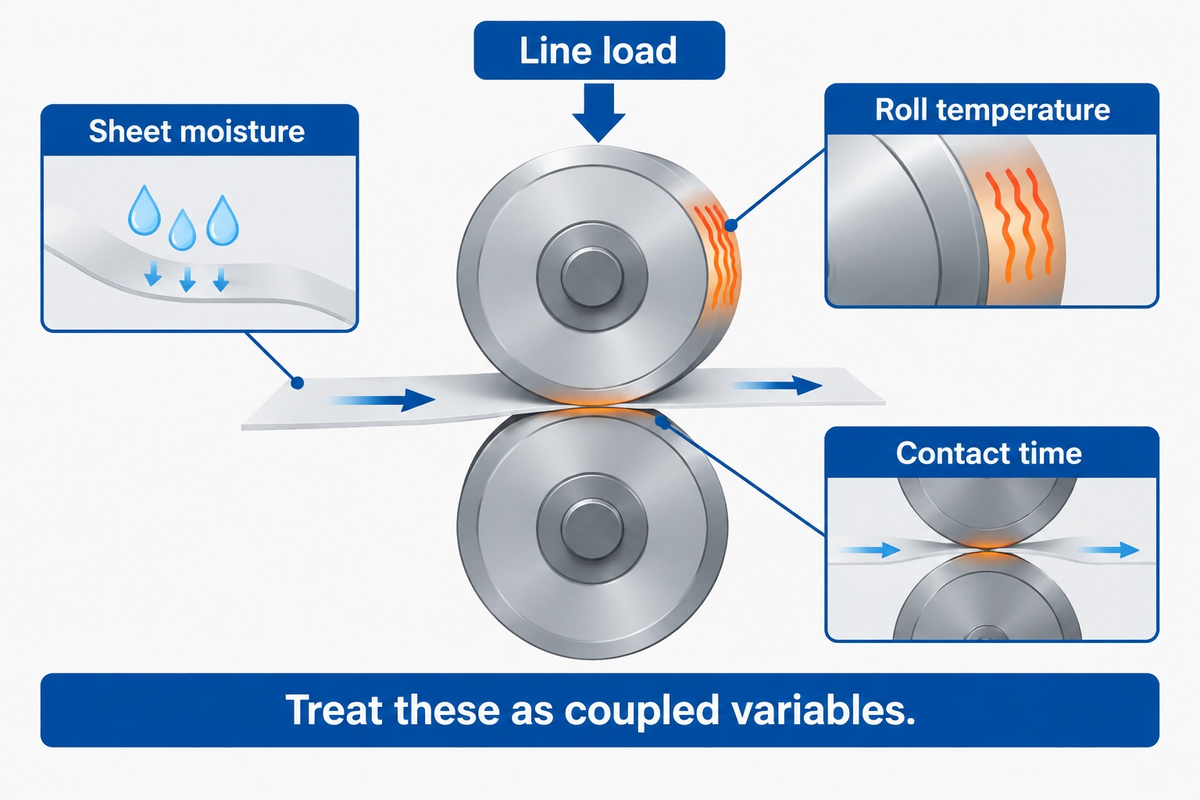
Line load determines force per unit width of the roll, while nip geometry determines how that load is distributed. Temperature and moisture change the sheet response, while the speed of the calender determines how long the load acts. Treat these as coupled variables.
3-Variable Calendering Window Table
The intent of this trial is to separate the changes in load, heat and moisture, while keeping speed and incoming sheet conditions recorded.
Use the mill grade recipe provided to enter baseline values, modified values and finished property results for each trial. Keep the approved limits for each piece of equipment in your trial sheet. The process engineer decides what changes to implement; quality personnel compare conditioned samples using the same method.
| Record or change | Measure alongside it | Decision supported |
|---|---|---|
| Baseline line load, kN/m | Caliper and roughness before and after | Establish current compaction cost |
| Changed line load, kN/m | Stiffness, opacity and print result | Keep added loading only if the grade benefits |
| Baseline roll temperature, °C | Web temperature and running speed | Separate roll heating from incoming-sheet heat |
| Changed roll temperature, °C | Surface quality and bulk | Compare heat-assisted finishing with extra loading |
| Baseline sheet moisture, % | Cross-direction moisture profile | Find wet bands hidden by the average |
| Changed conditioning | Both sheet sides and print mottle | Test whether surface treatment helps uniformly |
| Web speed, m/min | Contact width and number of nips | Interpret changes in dwell time |
| Incoming basis weight, g/m² | Incoming caliper and formation | Avoid comparing different base sheets |
| Conditioned finished sample | Same tests and conditioning as baseline | Accept the change against the product limits |
How do line load, nip width and dwell time relate?
Average nip pressure equals line load divided by contact width. To obtain peak pressure, pressure distribution across that contact must be determined. A wider nip can spread the same line load over a larger area; nevertheless, the force per metre of the roll face is unchanged.
Example: assume a line load of 100 kN/m. With a 2.5 mm contact width, average pressure is 100,000 N/m ÷ 0.0025 m = 40 MPa. At 8 mm, the same calculation gives 12.5 MPa. These assumed widths describe the contact in the direction of the web, not the full roll-face length.
Now assume a web speed of 600 m/min, or 10 m/s. Contact time is approximately width divided by speed: 0.25 ms for the first contact and 0.8 ms for the second. At 300 m/min, those times become 0.5 ms and 1.6 ms. A process engineer comparing these trials must therefore separate pressure changes from the longer contact time.
Rolls can be heated. The temperature reading on a roll isn’t the actual temperature of every single fiber in the sheet. Original research on fibre-polymer softening found that absorbed water changed the softening behaviour of lignin and hemicellulose. A single polymer temperature can’t define a mill recipe.
Why Do Heated Calender Rolls and Steam Showers Preserve Bulk Better Than Cold Pressure Alone?
Heat and surface moisture can make the outer fibres easier to deform, reducing the loading needed for a particular finish. That can preserve bulk compared with achieving the same finish through extra compression. The result depends on the sheet and contact conditions; compare bulk at the same achieved roughness during the trial.
Hard-Nip, Soft-Nip or Multinip: Which Calender Architecture Fits the Grade?
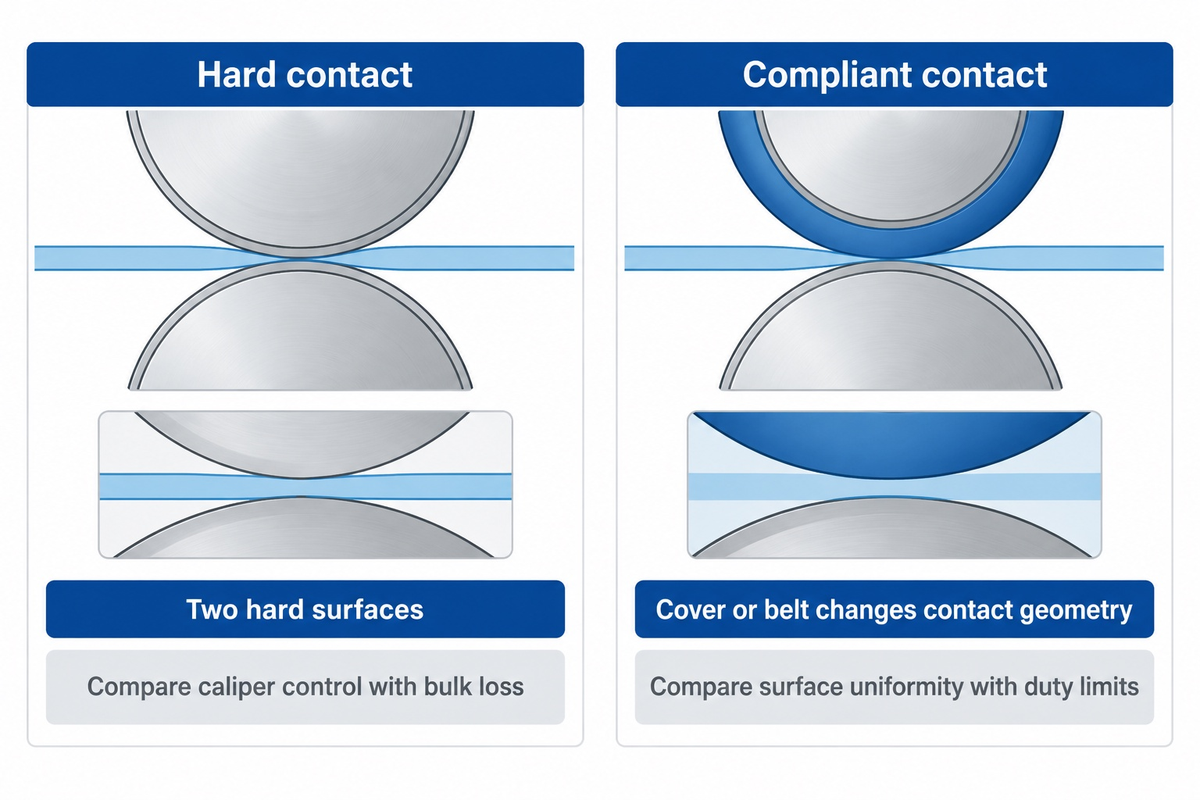
A hard nip machine calender is an option for thickness control. A soft calender pairs a hard roll with a cover to change contact and improve surface uniformity. Multinip and extended-nip systems provide further finishing options when the required gloss, density or bulk balance exceeds a simpler arrangement.
Hard contact
- Two hard surfaces define the nip.
- Local sheet thickness affects local compression.
- Compare caliper control with bulk loss.
Compliant contact
- A cover or belt changes contact geometry.
- Cover properties influence pressure distribution.
- Compare surface uniformity with cover duty limits.
In a conventional supercalender, hard rolls alternate with resilient rolls. Older descriptions include rolls made of compressed cotton or wool paper; modern designs may use polymer covers. The rolls used, stack geometry and loading method matter more than the historical name. Calendered paper, for example, has passed through the nips before its final evaluation. Think about using an off-machine supercalender if the requirements of the grade rule out a finishing speed or nip sequence that can be offered by the online process, and if the separate line can meet the demand. For a bulk-sensitive grade, also think about a soft-nip finish at the same achieved surface roughness. Compliant contact can lead to less bulk loss compared to a hard-nip finish, but the cover’s duty still defines the limits.
Imagine a customer accepts the print surface of your board but not the cartons because of poor stiffness. More calender nips would address the wrong property. You can compare a lower-compaction finish with your current route, keeping the basis weight and conditioning the same. The purchasing decision then rests on the measured stiffness retained at acceptable roughness, plus the cost of any heating, cover maintenance or speed change.
Hard and soft nips, multi-nips, and metal-belt systems covered by Valmet’s calendering equipment range, require comparison against the paper produced and existing line interfaces. Extended contact, however, requires more than replacing a hard roll with a softer surface.
Where do textile and film calenders differ?
Textile calenders can incorporate texture or employ relative surface motion; plastic film calenders, on the other hand, process polymers with varying degrees of deformation and thermal limits with respect to the fibre network in paper making. A Schreiner calender employs a patterned surface for a textile finish. An embossing calender intentionally adds texture. Friction calendering uses relative surface motion. These differ from controlling a paper sheet’s caliper and print surface.
In textile descriptions, fabric is compressed by passing through rollers under controlled conditions. A felt calender may be described using bowls instead of paper machine rolls. The quality of the material entering those contacts, the heat duty and the properties of the final product still require their own specification. Films used in packaging have different deformation and thermal limits with respect to a fibre network.
Calender Roll Materials and Crown Control
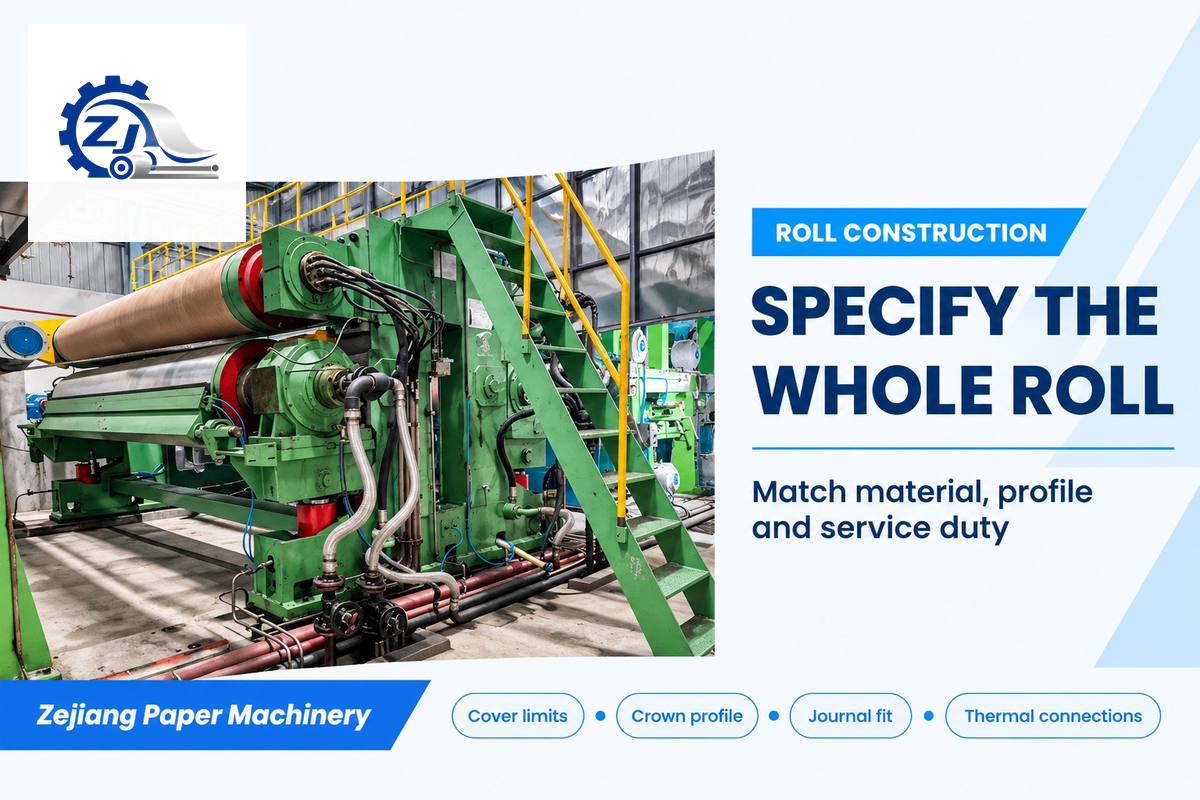
Maintain a balance between the type of roll material and cover construction, loading, heating and grade duty. Hard roll surfaces must maintain the prescribed finish and geometry. Soft covers must suit their pressure and thermal conditions. The grind profile and any controlled-deflection system then distribute loading across the working width instead of concentrating it unevenly.
Some hard rolls are made of chilled iron; heated constructions can use steel rolls or composite constructions. Specify composition and hardness and heat treatment of the material separately. ASTM A532/A532M covers specified abrasion resistant alloy white irons. Its scope excludes simple and low-alloy white irons consisting chiefly of iron carbides and pearlite.
Henan Zejiang Paper Machinery Co., Ltd. manufactures chilled-iron, composite and soft-cover calender rolls. Their selection matrix places chilled cast iron in hard-nip duty, alloy or forged steel constructions with drilled passages in heated duty, and polymer covers in soft contact. When comparing constructions, consider the cover material’s service limits, heat transfer, roll design and journal fit. These are choices of construction, not a pecking order of materials.
Rolls tend to bend under load. Adequate crown or a controlled deflection arrangement can help compensate for roll deflection. However, its design must be appropriate to the loading range. Copying the unloaded diameter without the requisite running profile can result in the edge and centre of the roll having different contact conditions. Consider both the width of the calender and the supported bearing span.
When buying a spare roll, the buyer can get two quotes for rolls of the same face diameter and length. One includes the required crown, journal fit and thermal passages; the other quotes only the cylindrical body. Quote these items separately. Procurement can then compare machining scope, while maintenance checks whether the proposed roll fits the actual stack.
When Should a Mill Choose a Swimming Crown-Compensated Roll Over Fixed Roll Crowning?
Choose adjustable crown compensation when the required loading range produces profiles that a fixed crown can’t keep within the mill specification. A fixed profile is simpler when the duty remains stable. Compare the required cross-direction profile over the actual grade range, along with the hydraulic system and maintenance scope.
For acceptance, compare incoming and outgoing caliper at matched positions across the web and at each agreed trial duty. A band already present upstream needs a different explanation from a band introduced by the nip. Accept the cross-direction profile against the tolerances agreed, after the supplier has adjusted the profile to the required shape. Settings of the actuators and the sequence of adjustment are specific to the machine in which they’re installed.
How Does Calendering Change Smoothness, Gloss, Bulk and Stiffness?
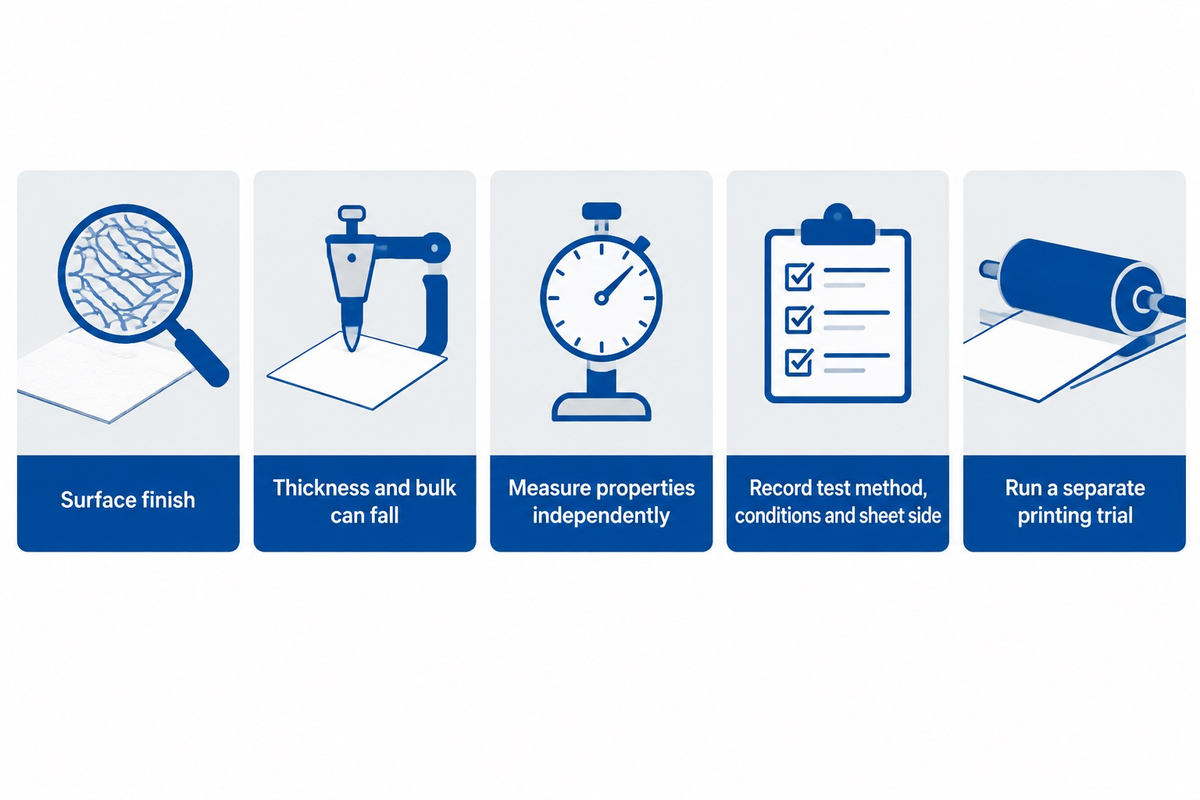
Calendering compresses the sheet, so the thickness of the paper and its bulk can fall. These changes affect stiffness and printing. Measure the properties of the paper independently: gloss of a surface is not a direct measure of bending resistance, opacity or ink-setting performance.
“Paper partially returns to its original shape when exiting a nip.”
Keep roughness results associated with their respective methods. Parker Print-Surf, Bendtsen and Bekk readings aren’t interchangeable numbers. For each test, record the chosen test, test conditions and sheet side. Do the same for gloss, caliper and bending measurements. Don’t combine measurements to calculate a surface quality score.
Example: for an idealized material with unchanged elastic modulus and width, bending rigidity scales with thickness cubed. Reducing thickness from 0.30 mm to 0.27 mm gives (0.27 ÷ 0.30)³ = 0.729. The model therefore predicts a 27.1% reduction in bending rigidity. Real paper can also change modulus and structure; this is not a box-compression strength estimation.
Surface absorption deserves a separate printing trial. In research on moisture-gradient calendering, oil absorption slowed while set-off remained at normal levels. Paper’s drying history also affected wetting. Therefore, slow absorption alone can’t diagnose a delayed ink setting failure.
A printing-paper trial should evaluate the actual ink and the converting conditions required by the customer. If roughness improves but mottle increases, inspect formation, coating distribution and local compression before accepting the smoother sheet. The calendering effect also needs to be assessed as a mechanical process. Evaluate the performance of the calender finish in mottle and roughness.
Calendering Priorities by Paper Grade
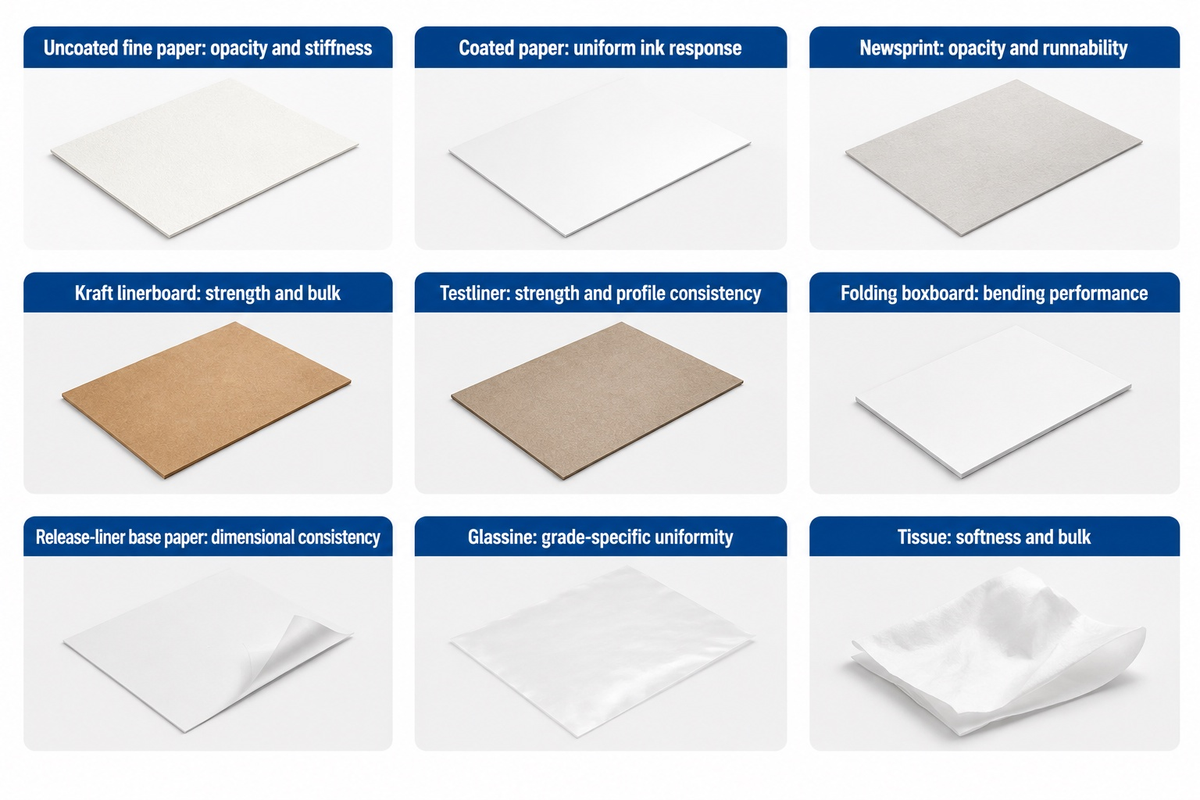
Printing grades prioritize a uniform print surface. Packaging board also needs to retain the required structural properties. Tissue, on the other hand, places more emphasis on bulk and softness. Specialty grades can require dense, tightly controlled surfaces. Select the calendering route according to these grade differences. Use the finished-grade limits for comparison.
| Grade or duty | Finishing objective | Property to retain | Trial decision |
|---|---|---|---|
| Uncoated fine paper | Uniform surface for printing | Opacity and usable stiffness | Compare print results, not gloss alone |
| Coated paper | Coating smoothness and gloss | Uniform ink response | Check both mottle and surface finish |
| Newsprint | Print contact and profile | Opacity and runnability | Track local densification |
| Kraft linerboard | Printable surface and thickness control | Specified strength and bulk | Reject unnecessary compaction |
| Testliner | Finish across variable furnish | Strength and profile consistency | Compare incoming-sheet variation |
| Folding boxboard | Smooth printable faces | Bending performance | Compare compliant or extended contact |
| Release-liner base paper | Surface and coating holdout | Dimensional consistency | Include the downstream coating trial |
| Glassine | Dense, highly finished sheet | Grade-specific uniformity | Evaluate the complete finishing sequence |
| Tissue | Required surface feel and caliper | Softness and bulk | Assess the converting result |
For a kraft paper machine, a packaging-grade trial should include strength measurements. An approach borrowed from coated printing papers can consume bulk and not necessarily benefit the packaging customer. The same is true when a mill changes recycled furnish or basis weight and keeps an old recipe.
Machine-glazed paper receives its characteristic glazed face through its cylinder-drying route. So, a special paper order should specify the surface finish and downstream use rather than request “more calendering” for general improvement.
Troubleshooting Blackening, Barring and Caliper Variations
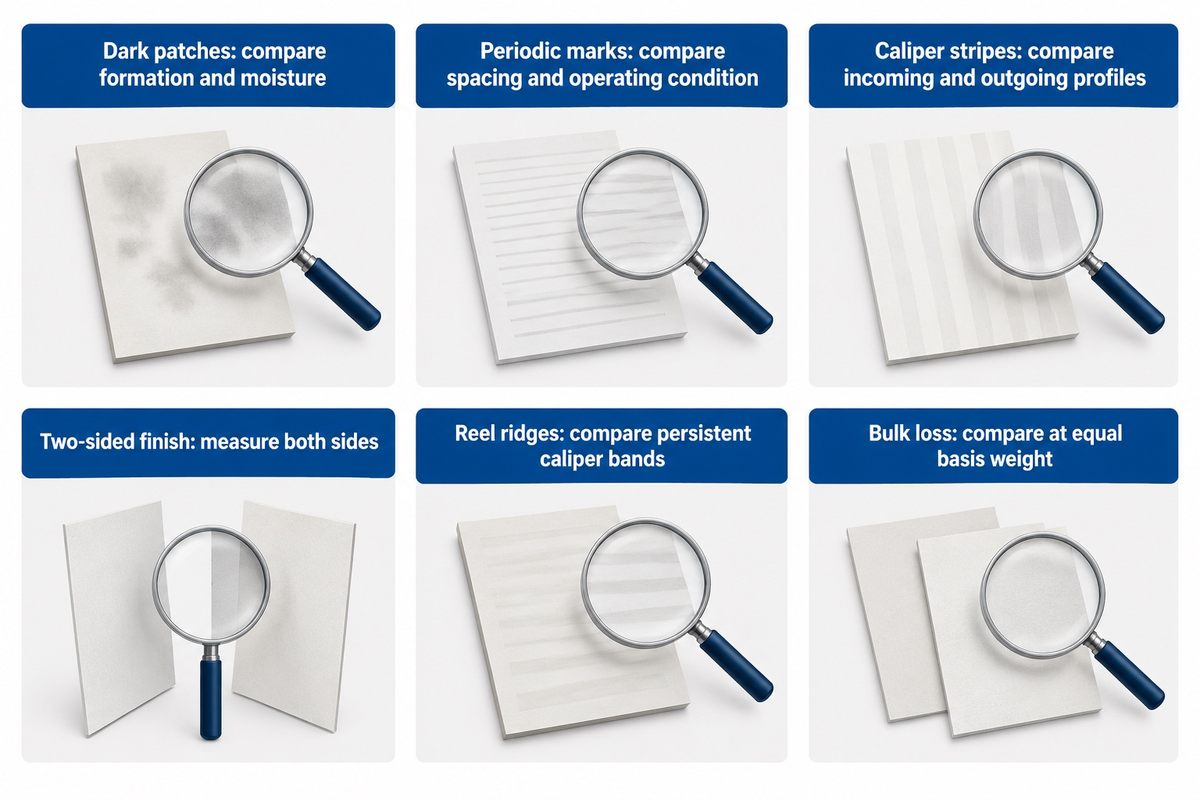
Wet or poorly formed areas can densify unevenly; repeating marks can involve roll surfaces or vibration. Persistent cross-directional profiles can be caused by crown or loading. Upstream drying can also contribute to unevenness. Compare incoming and finished sheets at the same position to determine where the defect first appears and then select the corresponding reason from the table below.
| Observed symptom | First comparison | Follow-up for the mill team |
|---|---|---|
| Dark or translucent patches | Formation and moisture at the same locations | Relate opacity loss to local compaction |
| Periodic bars or gloss marks | Mark spacing versus operating condition | Review vibration and roll-condition measurements |
| Caliper stripes across the sheet | Incoming and outgoing cross-direction profiles | Separate crown/loading effects from upstream bands |
| Different finish on the two sides | Both-side roughness and gloss results | Review which surface contacts each roll |
| Reel ridges | Ridge position against persistent caliper bands | Coordinate finishing and winding diagnosis |
| Unexpected bulk loss | Conditioned samples at equal basis weight | Compare trial intensity and finished performance |
Calender blackening is related to local densification and loss of opacity. Moist flocs can fuse together and become more transparent, as described by Valmet. An average moisture content may conceal the wet bands involved. The process team should look for a profile and matched samples rather than a general universal moisture limit.
Example: A mill observes a reel ridge at one cross-direction position after increasing output. If the same caliper band exists before the finishing section, and a calender roll is replaced, it may remain unchanged. If the entering profile is even, however, and the band is added after finishing, maintenance may check the loading profile and the condition of the running rolls. This comparison limits the work to be done before parts are ordered.
Base roll maintenance on measured surface conditions, remaining dimensions and the equipment supplier’s instructions. A fixed calendar interval can’t represent the condition of abrasive furnish, contaminants, cover damage or varying duty cycles. Keep cold geometry, running behavior and previous grind records together in order to identify a trend.
Dry-End Integration and Calender Roll Procurement

A new roll must fit the existing bearings, drive, and loading system and thermal service. A new finishing section also requires coordinated draw, threading, access and winding interfaces. Define these boundaries and then evaluate equipment costs. An inexpensive roll may increase the overall cost if the equipment interface is undefined.
What Drives Paper Machine Calender Price, Replacement Roll Lead Times, and RFQ Specs?
Compare prices against roll size, material, cover, machining accuracy and thermal construction: a quote for a bare roll body covers different work from a thermally controlled assembly. For the exact scope and revision of the drawing, request the delivery date, and include tests and installations in your scope. Public descriptions don’t provide a reasonable price or time frame.
- Grade, furnish, basis-weight range in g/m², and operating speed in m/min.
- Face length, body diameter, bearing span and journal dimensions in mm.
- Required line-load range in kN/m and the crown or controlled-deflection arrangement.
- Heating medium, normal temperatures in °C, and the existing passage connections.
- Surface finish in the specified roughness units, plus material and cover requirements.
- Drawings for drive connections, frame interfaces, lifting arrangements and accessible service points.
- Inspection records, trial acceptance criteria, delivery scope and spare-part responsibilities.
For United States pulp and paper mills, 29 CFR 1910.261(k)(14) and (k)(18) address calender feeding devices and nip hazards respectively. Incorporate the necessary safeguards and access into the equipment integration review. Threading, cleaning, and maintenance follow the mill’s approved procedures.
How Do Paper Mills Compare Global Calender OEMs with Specialized Roll and Machinery Suppliers?
Compare suppliers against the purchased scope. A complete calender island includes process design, controls and interfaces; a replacement roll order, for example, focuses on integration, fabrication and inspection. Zejiang supplies custom calender-roll families and paper-machinery support. Match each offer to the work required, with the remaining responsibilities assigned to the mill or its integrator.
For finance, compare the purchase price and the annual cost per accepted tonne. Cover or grind work, heating, planned downtime and reject loss should also be evaluated. An increase in production will only add value if drying, finishing and reeling can also accept the added output. Resolve this hidden limit before increasing the finishing capacity.
| Boundary | Evidence to compare | Purchasing consequence |
|---|---|---|
| Drying to finishing | Accepted moisture profile at planned output | A faster calender cannot remove an upstream drying limit |
| Finishing to reel | Accepted grade quality at matching web width and speed | Base capacity on saleable output, including rejects |
| Reel to off-machine finishing | Transfer time, available operating hours and finishing passes | Include handling and the separate line in capacity planning |
| Reel to rewinder | Parent width, diameter and winding configuration | Check downstream dimensions before ordering a wider section |
For a dimensional comparison, Zejiang’s rewinder reference table provides tissue parent widths up to 2,800 mm (with rolls up to 1,500 mm in diameter) and kraft parent widths up to 3,200 mm (with rolls up to 1,800 mm in diameter). These are published reference configurations and not capacities that would be guaranteed for a proposed line. Match the actual reel drawing, grade and winding method to the calender proposal.
Frequently Asked Questions
What is the difference between on-machine calendering and off-machine supercalendering?
On-machine calendering runs within the paper-machine production line. Off-machine supercalendering treats an already wound reel on separate finishing equipment. The separate route gives another opportunity to choose finishing speed and passes, but adds handling and another production stage. Compare total accepted output, reel transfers and available finishing hours across both stages when planning capacity.
What sheet moisture content should enter the paper calendering section?
Incoming sheet moisture, including its cross-direction profile, must meet the established specification for the grade and equipment. Different furnishes and surface-conditioning systems respond differently. Record the incoming moisture alongside temperature, load and speed during trials. A wet band can behave differently from the average sheet even when the average moisture reading meets the target.
How does calender blackening happen and how do mill operators stop it?
Blackening appears when local densification makes the sheet more transparent. Moisture and formation variation can concentrate this effect. Compare incoming and finished samples to identify the affected bands, then let the process team adjust the approved recipe or upstream condition. The diagnosis should distinguish local sheet variation from a uniform change in finishing intensity.
Does calendering make paper stronger?
Calendering doesn’t necessarily make paper stronger: it primarily changes surface finish and thickness, and strength improvement isn’t its general purpose. Compaction can reduce bulk and stiffness, while individual strength tests respond to the grade and treatment. Check the required finished-paper properties rather than treating a smoother surface as evidence of greater strength.
Can the same calender handle several paper grades?
Yes, when its loading, thermal system, covers and controls suit the required grades. Establish a separate accepted recipe for each grade family. A change in furnish, coating or basis weight may require a new comparison, even when the commercial grade name remains unchanged.
What is the difference between calendering and embossing?
Calendering generally levels and compacts the surface of the paper. Embossing uses a patterned roll or matched tooling to create a deliberate surface pattern. The latter can change texture and appearance instead of simply making the sheet smooth. Specify the required finish when selecting the roller and its surface.
Specify the Roll Around Your Grade and Existing Stack
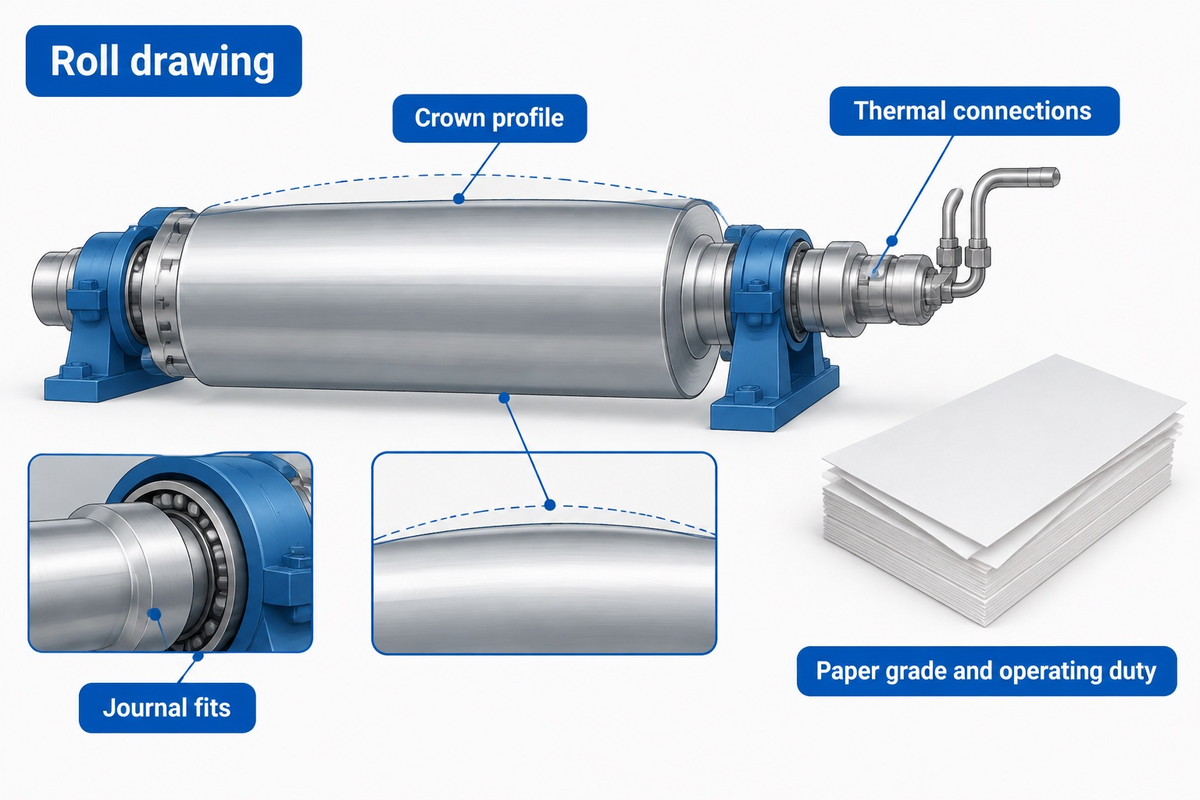
Send Zejiang your roll drawing, paper grade and operating duty to discuss a replacement or dry-end upgrade. Include the crown profile, journal fits and thermal connections so the proposal covers the actual interfaces.
View Zejiang calender roll options or send your drawing for a quotation.
This information uses published process research and combines it with supplier equipment information. Numerical examples are based on stated assumptions; mill acceptance will be determined by test results for the paper and equipment being purchased.
References & Sources
- Thermal Softening, Adhesive Properties and Glass Transitions in Lignin, Hemicellulose and Cellulose research archive hosted by North Carolina State University.
- The Effect of Moisture and Moisture Gradients on the Calendering of Paper research archive hosted by North Carolina State University.
- ASTM A532/A532M-10(2023), Abrasion-Resistant Cast Irons public scope.
- 29 CFR 1910.261, Pulp, Paper, and Paperboard Mills Occupational Safety and Health Administration.